Home Blog Page 2681

‘Lock him up’ — how Twitter responded to Ibrahim Mantu’s ‘election rigging’ confession


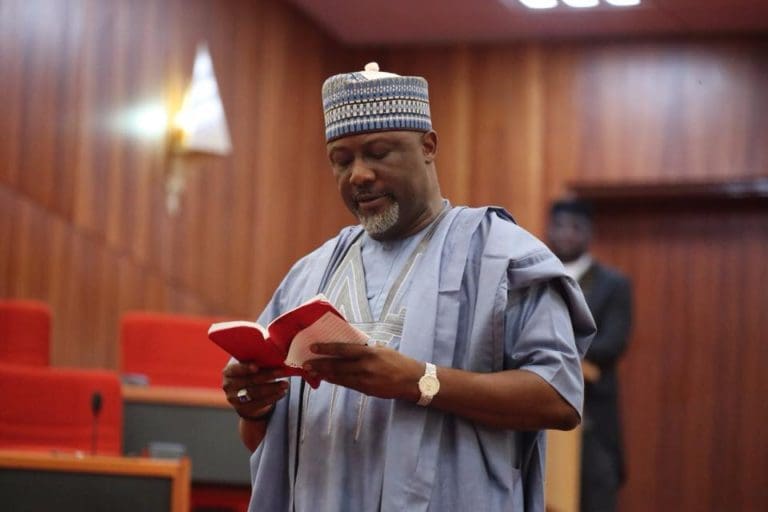
Many Nigerians have called for the prosecution of Ibrahim Mantu, former Deputy Senate President, who confessed on live television to helping to rig elections for the Peoples Democratic Party (PDP).

Mantu was one of the most powerful men in the Senate during the Olusegun Obasanjo administration, and was one of the legislators who supported and vigorously campaigned for his third term agenda.

Speaking during an interview on Channels Television’s Fard Copy, Mantu had said he provided money and other resources to ensure that he and other PDP candidates won elections.

“I’m now confessing the truth,” he said. “I don’t have to go and change the election (results), but you know when you provide money, you give money to INEC boys to help, if they see any chance that they should try and favour you, you provide money to the security.


READ ALSO:


“All our elections in the past. I’ve been in this game for about 20 years, and I tell you, it is not necessarily when I am contesting elections, but when my party sponsors a candidate, I will like that candidate to win election.

“And what we used to do before, we made provision for INEC, we made provision for security, we made provision for even agents of other parties so that they will not raise any objections to whatever we are able to get.

“So whether I rig myself or not, by providing those resources, financial inducements to the officials, I am rigging elections.”

Mantu said he came out to confess because he was tired of being seen as a criminal across the world just because he is a Nigerian, adding that Nigerian needs genuine and honest leaders in order to make significant progress.

However, many who reacted to the development on Twitter did not buy into his ‘born again’ gospel, rather they said he should be picked up by law enforcement agencies and made to face the law for electoral crimes.

FACT CHECK: Did Metuh take N1.4bn from NSA, as claimed by Lai Mohammed?


Lai Mohammed, Minister of Information and Culture, says Olisa Metuh, former National Publicity Secretary of the Peoples Democratic Party (PDP), is being tried for defrauding the nation of the sum of N1.4 billion.

Mohammed said this when he addressed a press conference in Lagos on Friday, in response to PDP’s charge that APC should mention names of those it claimed looted the country’s treasury.

“Well, I am sure they know that the treasury was looted dry under their watch, yet they decided to grandstand,” Mohammed said.

“Let’s just give them a teaser with this list: PDP Chairman, Uche Secondus (on the 19th of February, 2015, he took N200m only from the office of the then National Security Adviser).

“The then PDP Financial Secretary (on the 24th of October, 2014, he took N600m only from the office of the then NSA).

“The then National Publicity Secretary, Olisah Metuh (on trial for collecting N1.4bn from the office of the then NSA).

“Dr. Raymond Dokpesi, Chairman of DAAR Communications, (on trial for taking N2.1bn from the office of the then NSA).

“Former SSA to President Goodluck Jonathan, Dudafa Waripamo-Owei, (on trial over N830m kept in accounts of four different companies).

“Former President Jonathan’s cousin, Robert Azibaola, (on Thursday, a Federal High Court ruled that he has a case to answer for collecting $40m from the office of the then NSA.)”

FACT

While it is true that Olisa Metuh is on trial for allegedly collecting money from Sambo Dasuki, former NSA, it is not true that the amount he was accused of collecting is N1.4 billion.

According to information of the official website of the EFCC, Metuh is alleged to have received N400 million from Dasuki, from funds meant for arms procurement. This is way lower than the amount Mohammed said Metuh was being tried for.

One of the charges against Metuh by the EFCC reads: “That you, Olisa Metuh and Destra Investments Limited on or before the 24th November, 2014 in Abuja within the Jurisdiction of this Honourable court took possession of the sum N400,000,000 (Four Hundred Million Naira) only, paid into the account of DESTRA INVESTMENTS LIMITED with DIAMOND BANK Plc account number: 0040437573 from the account of the National Security Adviser  with the Central Bank of Nigeria without contract award when you reasonably ought to have known that the said sum formed part of the proceeds of an unlawful activity of Col. Mohammed Sambo Dasuki (rtd), the then National Security Adviser (to wit; criminal breach of trust and corruption) and thereby committed an offence contrary to Section 15(2), (d) of the Money Laundering (Prohibition) Act, 2011 as amended in 2012 and punishable under Section 15(3) of the same Act”.

Metuh pleaded not guilty when the charges were read to him.

Though the EFCC would file fresh charges against Metuh, they were not for any financial crime, but rather for destruction of evidence.

The charge reads: “Olisa Metuh on the 5th day of January 2016 in Abuja within the jurisdiction of the High Court of the Federal Capital Territory destroyed a document, to wit: a statement made under caution to investigators/operatives of the Economic and Financial Crimes Commission on the 5th of January 2016, with the intention of preventing the same from being produced or used as evidence in a court of law.”

According to the EFCC, the offence is punishable under Section 166 of the Penal Code Cap 532 laws of the Federation of Nigeria, (Abuja) 2004.

Mohammed stressed that the cases he mentioned were not made up as “many of these cases are in court and the records are available”.

However, there’s presently no court case against Uche Secondus, National Chairman of the PDP for collecting N200 million from Dasuki. So Mohammed’s claim to this effect remains debatable unless he has provided evidence to back it.

Secondus has already issued a statement saying Mohammed should get ready to establish his argument in court.

FLASHBACK: How Naomi Campbell met war criminal Charles Taylor — and received ‘blood diamonds’ from him


There are lots of side attractions and talking points about President Muhammadu Buhari’s just concluded two-day visit to Lagos State, one of which, and perhaps the most controversial, is his meeting with Naomi Campbell, British supermodel and celebrity.

The meeting between the duo has generated heated controversy among Nigerians on the social media, even though the Presidency had explained that Campbell was not in the country on the invitation of the federal government.

“For the sake of clarity, President Buhari didn’t invite Ms. Naomi Campbell to any event during his 2-day visit to Lagos State,” explained Bashir Ahmad, Buhari’s Personal Assistant on New Media. “They only met at the Eko Atlantic City while Mr. President was touring the project, and she requested to take photos with him.”

But Tolu Ogunlesi, Special Assistant to the President on Digital/New Media, in his usual manner, took his explanation to a new low, branding the critics “animals” and saying they’re “raving mad”.

“Naomi Campbell met Nelson Mandela more than once. He hugged her, called her his ‘honorary granddaughter’. She visits Nigeria for a fashion festival and meets President Buhari, and some of you animals are slandering her. YOU’RE RAVING MAD WITH NOBODY TO TELL YOU,” the ostensibly angry Ogunlesi tweeted.

Ogunlesi had referred to former President Goodluck Jonathan as a “bloody sadist” for causing serious traffic gridlock during his visit to Lagos State in 2012.

However, the controversy on the social media over Buhari’s meeting with Campbell stems from the her benefiting from Liberia’s ‘blood diamonds’, used by Charles Taylor, former Liberian President, to finance the six-year civil war in neighbouring Sierra Leone between 1996 and 2012.

In 2010, during the Taylor’s trial at the International Criminal Court (ICC) in The Hague, Campbell agreed to receiving “three stones” from an unknown admirer, during a visit to South Africa.

Those “dirty stones” were actually 24-carat diamonds and Campbell knew it.

Campbell and Taylor sat together during a dinner hosted by Nelson Mandela in September 1997 and evidence in court suggested they had been “mildly flirtatious” with each other while the dinner lasted.

Thereafter, Campbell said that she was given three “small, dirty-looking stones” by some mysterious visitors, adding that “I’m used to seeing diamonds shiny and in a box”.

She said she accepted the “dirty-looking stones” when they were presented to her later in the night but insisted she had no idea who sent them.

However, the witness of Mia Farrow, an American Actress, who also was at the dinner in South Africa, suggested Campbell knew the diamonds were from Taylor.


READ ALSO:


Farrow told the court that the next morning at breakfast, Campbell told her that Taylor had dispatched his men to present her with a “huge diamond” and that she intended to hand it over to Mandela’s charity.

It was not clear whether Campbell handed the diamonds to the charity or not.

The special court was jointly established by the United Nations and the Sierra Leonean Government to “try those who bear the greatest responsibility for serious violations of international humanitarian law and Sierra Leonean law committed in the territory of Sierra Leone” between November 1996 and January 2002.

However, while the other actors were tried in Sierra Leone, Taylor’s trial was moved to the international criminal court (ICC) in The Hague after the UN Security Council expressed concerns that his presence in Freetown could lead to a breakdown of law and order.

The trial began in January 2008 and more than 115 witnesses were called to testify. Closing arguments were made in March 2011.

In May 2012, Taylor was sentenced to 50 years in prison “for aiding and abetting as well as planning some of the most heinous and brutal crimes recorded in human history”.

He is currently serving his sentence in a prison in the United Kingdom after the rejection of his application to be transferred to a Rwandan prison.

Police ‘brutalise, detain’ woman who filmed a policeman ‘beating up a civilian’


Lawal Murtala, an Inspector at the Dopemu, Lagos, Division of the Nigeria Police, allegedly beat up and detained a woman on Thursday for filming him as he beat up a civilian.

Narrating her experience, accompanied by a video, on her social media channels, Pearl Anne, the victim, called for an end to police brutality

The short video showed passengers in a commercial minibus. A woman is heard complaining, in Pidgin, that the policeman “is just oppressing everybody inside this bus, just dey beat everybody“.

It also showed that as the phone was directed to the Inspector’s face, he angrily landed a slap on the woman, smashing the screen of her phone in the process and asking if she was stupid.

“You want to snap me in uniform?” he asked repeatedly. “Oya, snap me let me see.”

According to Anne, the Inspector beat her up “just because I recorded him beating up an innocent man” who was dragged to the police station. She also said she was detained from 2pm to 7pm, the recorded video forcefully deleted, and her phone smashed and seized.

But unknown to them, she added, “I had already forwarded one successfully to my sister via WhatsApp”.

She said she had gone to make a report of the policeman’s assault but was instead detained with the excuse that “a policeman can do whatever he likes and that videoing a policeman is an offence”.

She wrote: Inspector Lawal Murtala of the Dopemu division Lagos, Nigeria, beat me up today just because i recorded him beating up an innocent man and was dragged to the police station. I was detained for hours, and the video forcefully deleted of which unknowing to them, i had already forwarded one successfully to my sister via WhatsApp. Then my phone was smashed and seized.

Imagine going to report an assault by a policeman and i get detained instead saying a policeman can do whatever he likes and that videoing a policeman is an offence. The dpo , a woman was in full support of the policeman, ordered that i get detained saying i wanted to video to post and she will not let that happen. I was detained from 2pm till 7pm. This is INJUSTICE !!! ????????

The police who should protect us are the ones victimising is and this should change. It is not just fair. We all should say no to police brutality.

Edgar Imohimi, Commissioner of Police, could not be reached for comments, as his phone was switched off.

REVIEW: The Tinubu, Jonathan awards that Buhari wanted to emulate with MLK plaque


Pictures and videos flew across the airwaves, on Monday, of President Muhammadu Buhari receiving the “First Black History Month National Black Excellence and Exceptional African Leadership Award”.

An award ceremony, which took place at the Council Chambers in Abuja, was said to have been done by Martin Luther King’s junior family. It was witnessed by Abike Dabire Erewa, Baba Onabanjo, Erika Bennett and Naomi Barbara King, “the family’s matriarch”.

In no time, the news reached the skies of the social media, where many said the award was just a smokescreen to divert attention away from the administration’s shortcomings. Suspicion was fuelled when Newton-Farris, Martin Luther King’s nephew, advised Nigerians in an interview to “give this man [Buhari] the time he needs to do the job that he is doing”.

“He is one of the most legitimate leaders that the continent has produced. And he would if you all just stick to him I assure you he is going to make Nigeria a better place,” he added.

This is perhaps similar to what Louis Farrakhan, American Muslim leader, said about Abacha during his visit to the country in 1996: “that Nigerians should give strongman Gen. Sani Abacha the three years he has sought for a handover to civilians” and implement his timetable for democracy.

What really ignited the keg of gun powder, however, was a tweet by the Martin Luther King Center for Non-Violent Change, established in 1968 by Coretta Scott King. Reacting to an earlier tweet by Godwin Amaize (@MrFixNigeria), the Center had strongly denounced connection to the award.

The Presidency later explained that the award was presented on behalf of the family, not The King Center, and that the tweet must have been triggered by Newton-Farris’ politically-flavoured interview.

Though this is the first time such an award will be met with great distrust and disagreement, it is not the first of its kind conferred on a Nigerian leader by the US black community.

Two recent cases:

JONATHAN’S MLK HUMAN RIGHTS AWARD IN 2016

Following his defeat at the polls in 2015, Goodluck Jonathan, former President, was awarded in the United States in recognition of his leadership in “human rights, social justice and universal fight for freedom”.

The award was presented by the Southern Christian Leadership Conference, founded by Martin Luther King Jr, the late American human rights activist. Just like Buhari, Jonathan was said to be “the first African leader to be so honoured”. Naomi Barbara King was also at the event.

Jonathan had noted that it was “also a pleasure to meet Naomi King, the sister of the late American Civil Rights leader and founder of the SCLC, Dr. Martin Luther King Jr, who was kind enough to attend the event and identify with the goals and aspirations of the Goodluck Jonathan Foundation”.

TINUBU’S BLACK MAYORS’ AWARD IN 2012

Bola Ahmed Tinubu, former Governor of Lagos State and National Leader of the All Progressives Congress, also received a ‘prestigious’ award from the US. In 2012, the National Conference of Black Mayors in America gave him its highest award, the President’s Award.

“We searched for Africans leaders who have made great impact in linking African-Americans with Africans towards positive development and you emerged as one of such,” Vanessa Williams, Executive Director of the Conference, told Tinubu. “You have linked your international experience with national experience to chart a path for development for your people.”

In his response, Tinubu had said: “African-Americans and Nigerians are the same in their crusade to achieve freedom and liberty. We must work together to elevate our people. We share a common aspiration in the struggle to eradicate poverty and give hope to our people.”

He further added that Martin Luther King, a crusader extraordinary, had shown everyone else the way.

The Buhari controversy has already been laid to rest, but were the President still interested  in equaling the feats of Tinubu and Jonathan, he’d have to wait a little longer.

‘It’s not a religious obligation’ — clerics urged to condemn FGM this Easter

0


As million of Nigerians celebrate the death and resurrection of Jesus Christ this Easter period, End Female Genital Mutilation/Cutting campaigners across the country and beyond have urged Christian leaders to speak up against the practice.

Data from the United Nations reveal that over 200 million girls and women currently live with diverse complications as a result of FGM. In Nigeria alone, over 20 million girls and women live with the side effects, some of which include loss of sex drive, infertility, increased rate of maternal and infant mortality, complications during delivery and even inability to control urination because of ruptured organs during cutting.

The activists say there is no religious basis for Female Genital Mutilation, with Pope Francis calling it a “degradation of women that needs to be combated”.

Leading Muslim leaders from across the world are also insisting that there is nothing in the Quran to support Female Genital Mutilation and that contrary to popular belief in many parts of the world, FGM is not a religious obligation.

“Nigerians are a very religious people and clerics have a responsibility to educate their congregation on the effects of Female Genital Mutilation,” Oti Wilberforce of the House of Kings and Priests, Ebonyi, said.

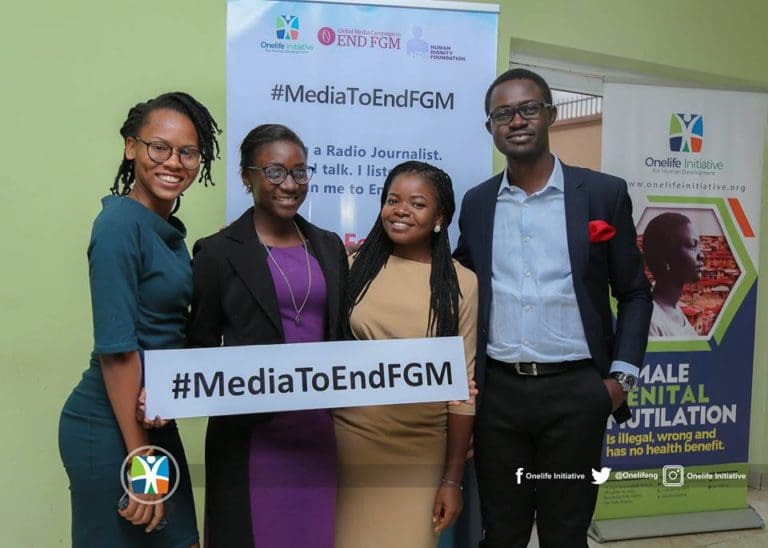
Maggie O’Kane, Executive Director of the Global Media Campaign to EndFGM, believes that working to get voices of religious leaders on the media to call for an end to FGM is the single most effective way to use the media to end FGM.

“They are the voices that people listen to and are very powerful,” O’Kane said. “FGM is not a religious obligation and clerics have the power to let the #FGMNotMyReligion message run faster.”

‘Sola Fagorusi of Onelife Initiative for Human development, a Nigerian non-profit that has worked extensively with broadcast and print journalists on the #MediaToEndFGM campaign, explains that the work with the media has to be consolidated by the clerics to ensure they protect women and girls through the pulpit and various ways through which they engage their congregants.

The #FGMNotMyReligion campaign is expected to reach over 100 million viewers and listeners across Nigeria, Sierra Leone and Kenya with radio talk shows, TV debates and campaigns planned for Twitter, Instagram and Facebook.

‘Bad belle letters’ — Tinubu dishes out sly dig at Obasanjo


Bola Tinubu, a former Governor of Lagos State and chieftain of the All Progressives Congress (APC), may have taken a dig at former President Olusegun Obasanjo over the latter’s recent ‘special press statement‘ in which he asked President Muhammadu Buhari to go home and rest.

Speaking at the annual colloquium to mark his birthday, Tinubu made reference to a certain ‘bad belle letter’ written by one who achieved nothing when he was given the opportunity, though he didn’t actually mention Obasanjo by name.

“Thank you Nigerians for being patient with us. There’s a clear understanding here. There’s a clear difference between us and them (PDP), night and day,” Tinubu said.

“I want the economic minister to please give us a data, first quarter of year 2012 and for their 16 years.

“I remember my grandmother used to send me to a letter writer in the post office of those days and near the magistrate court. So somebody is writing letters these days, a letter of politics, as if they’ve never been there before. Bad belle letters.

“We want to focus. I don’t want to address that one today. I’ve gotten the most beautiful birthday present I needed, and I am happy.”

Tinubu said it is impossible to stop talking about the massive looting and corruption that was the order of the day throughout the 16 years that PDP stayed in power.

“If we are not talking about it, then what is the lesson to all Nigerians? he asked.

“We have to report to millions of Nigerians who voted for us that this is what we found, and we are not going to take it off the ground no matter how twisting the mind of PDP and their supporters may be.

“We’ll keep talking about it. You looted, you wasted our resources, you did not do what you promised. The market gave you the maximum, the production level was at the maximum, and there’s nothing.

“Yoruba say ‘aitete m’ole, ole n m’oloko’ (If you don’t catch the thief early enough, the thief will catch the farm owner).

“Thank you Nigerians for being patient with us. There’s a clear understanding here. There’s a difference between us and them, night and day.”

Shortly after Obasanjo’s special press statement, Ibrahim Babangida, former Military Head of State, also issued a statement, urging Buhari to allow younger Nigerians to move the country forward.

But Tinubu said both Obasanjo and Babangida are retired politicians and should be left to enjoy their retirement.

“I don’t address those shadows,” Tinubu had told journalists at the time..

“We should let our former presidents join retirees’ club and take pensions but they can participate in our politics if they are interested. It is a free world but this freedom is not served a la carte. They should allow us to move our country forward. It is a challenge to every Nigerian.”

Melaye, Salkida, Afegbua… six victims of security agencies’ hurried ‘wanted declarations’


In recent times, security agencies have become fond of haphazardly declaring people wanted without following the procedures of the law.

There appears to be no clear process leading to the declaration of a wanted person. Security agencies just issue arbitrary press statements, sometimes without even having contacted the affected person at all. Here are some instances:

DINO MELAYE

Dino Melaye

The case of Dino Melaye, controversial senator representing Kogi West Senatorial District, is the latest of such recklessness and lawlessness by the Police in declaring a ‘suspect’ wanted.

One would naturally expect that a wanted person is one who has committed an offence but whose whereabouts is not immediately known to the authorities. So, how does one explain that Melaye was attending the Senate plenary at the National Assembly, Abuja, on Wednesday, same day the Kogi State Police Command declared him wanted?

After narrating how six suspects, including two who confessed that Melaye supplied them arms, escaped from police custody, Ali Janga, Commissioner of Police, added that “all the six suspects, Senator Dino Melaye and Mohammed Audu were sent for watch listing and red notice by the INTERPOL for immediate arrest anywhere we see them”.

“The Command hereby appeals to the members of the public to assist the Police with useful information on the whereabouts of the suspects by reporting to the nearest police station,” Janga said.

Seriously? Useful information on Melaye’s whereabouts?

KAZEEM AFEGBUA

Kazeem Afegbua

The Melaye saga came a one month after the Police arbitrarily declared Kazeem Afegbua wanted. The crime of Afegbua, Ibrahim Babangida’s spokesman, was that he issued a press statement in which his principal opposed Buhari’s reelection bid in favour of younger blood.

However, the Police deemed it was capable of “instigating public disturbance throughout the country”.

The Police never contacted Afegbua before going on air to declare him wanted, neither was an arrest warrant obtained against him from a court of competent jurisdiction.

When eventually Afegbua reported at the Police Headquarters the next day, it turned out to be a mere courtesy visit, as he was warmly received, exchanged banters with officers and left. The end.

AHMAD SALKIDA, AISHA WAKIL, AHMED BOLORI

Ahmad Salkida

In 2016, the Nigerian Army declared Ahmad Salkida, a journalist; Aisha Wakil, a lawyer; and Ahmed Bolori, a social worker, wanted for their alleged links to Boko Haram.

“They must therefore come forward and tell us where the group is keeping the Chibok Girls and other abducted persons to enable us rescue them,” the Army had said.

At the time, Salkida was based in the UAE, his exact location unknown to the security agencies. Wakil, also known as ‘Mama Boko Haram’, is a known figure in the anti-terrorism campaign and she was never in hiding. Same also goes for Bolori. However, they were all declared wanted without prior invitation.

They did report themselves to the army authorities and as usual, nothing happened; no charges were pressed against them.

BENEDICT PETERS

Robert Peters

Only two days ago, Justice Othman Musa of the FCT High Court chided the EFCC for declaring Benedict Peters, Vice Chairman of AITEO, wanted for alleged corruption.

The EFFC claimed it had summoned Peters on several occasions before declaring him wanted. However, evidence presented in court showed that Peters was out of the country on health grounds and this was communicated to EFCC by his lawyers.

Another date was agreed between the EFCC and Peters’ lawyers for him to honour the invitation, but a day before the agreed date, the EFCC raided his office premises and made some arrests.

Delivering his judgement, Justice Musa held that “Peters has never been charged with, nor tried for any criminal offence in any Court of law, nor has he ever jumped bail for any offence howsoever in Nigeria and cannot be declared wanted by administrative fiat, without any prior order or leave of Court”.

“The very act of declaring the Applicant (Benedict Peters) a WANTED PERSON on the official website of the 1st Respondent (EFCC) without any prior order or leave of a Court of competent jurisdiction to that effect is unlawful, illegal, wrongful, ultra vires, unconstitutional and constitutes a flagrant violation of his Fundamental rights,” Musa ruled.

CONCLUSION

The ruling by Justice Musa of the FCT High Court sums it up. Declaring a person wanted is not and cannot be done arbitrarily and at the whim and caprices of the security agencies.

Security agencies cannot afford to be seen as making a mockery of due process and the rule of law by always declaring ‘innocent’ people wanted without a valid court injunction. Law enforcement agencies should not be seen as flouting the very laws they are supposed to uphold.

FLASHBACK: In 2012, Buhari’s social media aide called Jonathan ‘bloody sadist’ for causing traffic gridlock during Lagos visit

It is no longer news that Lagos is currently literally on a shutdown as President Muhammadu Buhari embarks on a two-day working visit to the state.

Many say Buhari’s visit has more to do with the birthday of Bola Tinubu, former Governor of Lagos State and chieftain of the All Progressives Congress (APC), than the commissioning of the Ikeja bus terminal constructed by Akinwumi Ambode, Governor of the state.

As a result of Buhari’s visit, many roads leading to the places he intends to visit have been blocked, local flights into and out of Lagos have been cancelled, leaving hundreds of Lagosians stuck in traffic along the few roads that are open to commuters. Many, seeing the seriousness of the traffic jam, opted to trek to their destinations, covering several kilometres on foot under the scorching sun.

A similar scenario played out in June and December 2012, when then President Goodluck Jonathan visited Lagos. As usual, roads were blocked and thousands stranded, and Nigerians took to twitter to vent their frustration.

Among the critics was Tolu Ogunlesi, the current Special Assistant to President Buhari on Social Media, who bashed Jonathan for apparently unleashing suffering and hardship on the ordinary people.

“Grumbling in Lagos as President Jonathan temporarily renames city ‘Car Park’,” Ogunlesi tweeted on June 1, 2012.

But on Jonathan’s second visit in December of 2012, Ogunlesi took his tirade to a more personal level, hurling abuses on Jonathan, specifically branding him a “bloody sadist” and his visit to Lagos “madness”.

“I have tried to ignore the madnesses issuing from Abuja. But GEJ’s (Goodluck Ebele Jonathan) infliction of traffic-hell on Lagos is the stuff of despotism. #Bloodysadist,” Ogunlesi tweeted on December 14, 2012.

Fast forward to 2018, a lot has changed, the table has turned and Ogunlesi is now a presidential aide. His principal is visiting Lagos, and not only have roads been closed on his behalf, the state government took a step further to declare a public holiday for him. Flights have been cancelled, leaving both air and road passengers stranded. On Twitter, the raging question is how and why Ogunlesi, the one-time social media critic, has lost his voice all of a sudden.

ALL THE DATA: The earnings of Nigerian senators ― how much and how fair?

Nigeria is home to numerous controversies. Everything — from police arrests to national budgets — is more often than not either controversial or scandalous. Just three weeks ago, for instance, Yahaya Bello, Governor of Kogi State, was reported to have sacked his cabinet ministers only to reverse the decision after 10 minutes. But despite the never-ending theatre of absurdity, few matters in this country have been subjected to as much controversy as what federal lawmakers make, after making the law.

A 2015 report by Premium Times, based on remuneration approved by the Revenue Mobilisation, Allocation and Fiscal Commission (RMAFC), states that all senators get N2.14 billion annually in salaries and allowances, leaving each with N19.66 million a year. This analysis “did however not include the illegal but hefty quarterly allowances lawmakers pay themselves”, known as office running cost.

A STRING OF DISCREPANCIES

The following year, Sahara Reporters published a report obtained by the Economic Confidential magazine, with similar figures. The report claimed to contain the legitimate remuneration of federal lawmakers, in compliance with the statutory approval of the Revenue Mobilisation, Allocation and Fiscal Commission (RMAFC). While the entire Red Chambers gulped N1.85billion over the year, an average senator was said to have earned N12.76 million, covering both annual basic salary and regular allowances, and excluding non-regular allowances such as furniture, severance gratuity, estacodes and so on.

However, we have seen more astronomical claims. For instance, last year, Itse Sagay, a Professor and Chairman of the Presidential Advisory Committee Against Corruption (PACAC), said from information available to him, “a Nigerian Senator earns about N29 million a month and over N3 billion a year”. He provided a comprehensive breakdown of the lawmaker’s monthly pay, having a basic salary of N2.48 million and several millions-worth of allowances.

Following this disclosure, Bukola Saraki, Senate President, agreed to meet with members of the Socio-Economic and Accountability Project (SERAP) to discuss details of senators’ salaries and allowances. However, after the meeting, Timothy Adewale, SERAP’s Deputy Director, lamented that the promise was not kept. He merely referred his guests to the National Assembly website “which contained vague information on the senators’ emoluments”.

Similar to Sagay’s claim is that of Areoye Oyebola, Initiator and Chairman of the Movement for Nigeria’s Total Transformation, in October 2017 that “A senator, not minding the grinding poverty of Nigerians, earns $1.7 million a year [N612 million using the present exchange rate], which is far higher than the $400,000 yearly income of the United States’ President, whose stupendous country is the richest in the world.” He further said a 90% cut in their salaries would still leave them richer than their counterparts in the US and UK. A particular columnist has in fact asserted: “It is a known fact that Nigerian Lawmakers are the highest paid in world.”

THE SENATE’S RESPONSE

Besides vaguely dismissing the assertions flying from various corners with a wave of the hand, the Senate actually responded in considerable detail as far back as 2015. This response is contained a document titled ‘‘Legislators’ Salaries and Allowances – A Cross-Country Comparison’ and prepared by the National Institute for Legislative and Democratic Studies (NILS), an organ of the National Assembly.

The document compares the salaries and allowances of Nigerian senators to those of lawmakers in eight other countries, and, instructively, figures from Nigeria happen to be the lowest in the file. It states that Nigerian senators get a basic annual salary of $10,132 (N3.1 million) and other allowances totalling $174,829 (N53.5 million) – making $184,961 (N56.6 million). One obvious flaw in this document is that while it adds huge sums constituting the Constituency Development Fund (CDF) to the pay of lawmakers from India, Tanzania, Kenya and Philippines, it stated “not applicable” to Nigerian lawmakers.

Also, in 2017, for the first time, the National Assembly released a breakdown for its annual budget, totalling a perfect N125 billion. According to the breakdown, the senators get N1.86 billion for salaries and wages, with N17 million going to each lawmaker. What is, however, suspicious about this document is that there is no mention of allowances under the sub-headings for the Senate and the House of Representatives. We only have allowances for legislative aides, the National Assembly Service Commission, the Public Accounts Committee (PAC), and the NIL.

Interestingly, there is also no mention of the words “domestic staff”, “wardrobe”, “recess”, “entertainment”, “estacode” and “constituency” – terminologies used by the NILS in its breakdown of the allowances received by Nigerian lawmakers. Ditto for the words “accommodation” (except once for legislative aides), “vehicle loan”, and “severance gratuity”. It almost appears there was a deliberate attempt to bury the many allowances and their implication in stranger, imprecise terms – such as “total goods and non-personal service” to which was allocated N21.1 billion for the Senate alone, or “purchase of utility vehicles” for which the senators got N2.6 billion.

UNVEILING OF AN EPIC RUNNING COST!

The latest addition to the discussion is the bombshell from Shehu Sani, the senator representing Kaduna Central at the National Assembly. In an interview he granted to The News Magazine earlier this month, he revealed that he and his colleagues receive over N750,000 as basic monthly salary. But this is like saying students of Obafemi Awolowo University pay only N90 as accommodation levy – when they also pay an additional N2,500 as maintenance charge!

Likewise, according to him, the senators also receive N13.5 million monthly as running cost, in addition to a consolidated salary, various allowances, and an annual constituency fund of N200 million (which has been poorly accounted for or not accounted for at all). This revelation confirmed earlier speculations that senators get N41.5 million quarterly as running cost, which is nowhere to be found in the published 2017 NASS budget.

SO FAR, WHAT EXACTLY DO THEY EARN?

So, based on what we know so far, how much exactly is the legitimate pay of our senior lawmakers? Well, using figures from the National Assembly itself – i.e. 2015 figures from the National Institute for Legislative and Democratic Studies (NILS) – they make N56.6 million every year when we factor in consolidated salaries and regular allowances. However, once we add the monthly running cost of N13.5 million, what we have is a yearly takehome pay of N218.6 million.

WHAT ‘SENATORS’ EARN IN OTHER COUNTRIES

[infogram id=”nigerian-senators-vs-the-world-1h0n25xoy3lz4pe”]

THE UNITED STATES

According to the website of the United States Senate, the average senator, just as members of the House of Representatives, has earned $174,000 per year since 2009 when it was reviewed upwards. The website contains the list of what the senators earned from 1789 till date. The President of the United States is the highest-paid public official in the federal government, earning a salary in 2011 of $400,000 a year. The next in command, on the other hand, the US Vice President, earns $227,300.

However, these figures do not include monies earned as part of annual allowances. United States senators also receive what is known as the Members’ Representational Allowance, which is where the true nectar is. It covers supporting personnel, office expenses, district travel costs, and mail for members of the house (otherwise called franking). The allowances are provided for by statute and regulated by the Committee on House Administration.

According to the Congressional Research Service (CRS) report, in 2016, the MRAs of members ranged from $1,207,510 to $1,383,709, with an average of $1,268,520. However, most of each member’s annual MRA is used to pay office personnel i.e. salary for up to 18 permanent employees. For example, in 2016, the office personnel allowance for each member was $944,671.

If we add the annual basic salary of the senators to the average representational allowance for 2016, what we have is a total of $1,442,520.

THE UNITED KINGDOM

According to the UK Independent Parliamentary Standards Authority, the basic annual salary of Members of Parliament (MPs) as of April 2017 was £76,011. The country’s laws provide only for post-paid additional allowances, which can be claimed by each parliamentarian, depending on how much, in total, is spent over the period. Members of Parliament, according to a 2009 BBC report, were paid an annual salary of £63,291 and received allowances for the costs of running an office, having homes both near Westminster and in their constituency, and travelling between both. According to figures published in October 2007, the report said the average claimed by each MP was £135,600 a year.

Labour MP, Jim Murphy claimed £86,908.81, the highest allowance for the financial year 2011/2012. And for the same period, Conservative MP, Guto Bebb, claimed £60,644.38. If Jim Murphy’s claim is added to the 2017 basic salary figure, what we have is £162,919.81 – equivalent to $228,675.87.

KENYA

According to a report by Africa Check, in March 2013, the Kenyan Salaries and Remuneration Commission revised the salary of members of parliament upwards. Following this change, the pay of regular MPs grew to KSh710,000 (US$7,014) from KSh532,000 (US$5,256). But that is not all. A national daily calculated that once we factor in allowances, Kenyan MPs take home at least KSh1.1 million monthly (that is, $130,416 annually). Another estimated a monthly salary of KSh1.387 million (equivalent to $164,442.72 annually).

INDIA

PRS Legislative Research, an independent research institute and non-profit organisation, says that, following the hike in 2010, Indian Members of Parliament get ₹50,000 per month as base salary. However, they also receive ₹45,000 constituency allowance, ₹45,000 office expenses allowance and ₹2,000 sitting allowance per session days. Based on the assumption that they sit on 20 days a month, it makes a total of ₹180,000 a month and ₹2,160,000 a year – in order words $33,069.60. If we consider that they are also entitled to pension of ₹20,000 per month, then this figure becomes $36,744 per annum. A recent hike has not led to much difference in the legislators’ take-home pay.

UGANDA

It is reported that Ugandan parliamentarians are the second highest-paid in East Africa, lower to figures from Kenya and higher than those obtainable from Tanzania and Rwanda. A Member of Parliament in the country earns a taxed basic salary of Shs 11.18million. But, in addition, they also take home a large amount of untaxed allowances, elevating their total pay package to at least Shs 20 million (i.e. $64,800 per year), according to The Observer. The allowances cover town running allowance, gratuity, medical allowance, committee sitting allowance, plenary sitting allowance, as well as a mileage allowance.

LIBERIA

For Liberia, a document by the Institute for Research and Democratic Development, released through the Liberian Lawmakers Watch project, says ordinary members of the House of Senate earned $193,416 that year. The document, containing extracts from the 2015/16 national budget, also stated that members of the House of Representatives got even more: $209,516.

IN OTHER WORDS…

Using the new figure of what Nigerian Senators earn, N218.6 million ($714,846), which is still an educated guess, the country’s lawmakers make much more than their counterparts in other parts of the world, including the United Kingdom, Kenya, India, Uganda and Liberia. They, however, do not “legitimately” make more than senators in the United States, based on available evidence.

[infogram id=”nigerian-senators-salary-as-ratio-of-budget-1h984wxvo8qd6p3″]

CONCLUSION

The shortcoming with most previous analyses is that while they sum the basic salaries and allowances of Nigerian lawmakers, they only consider the basic salaries of legislators in foreign countries, especially the United States and the United Kingdom. Nevertheless, even with their allowances, many of them still earn much less than Nigerian lawmakers.

But it is not enough to compare the bare facts of what lawmakers earn in various countries. We must also demand for the level of acceptability, using such variables as GDP per capita and national minimum wages. In a nutshell, the salaries and allowances of lawmakers must be considered in the context national realities, levels of poverty and infrastructure, and the dominant standard of living of a country’s population.

For instance, in the UK where the highest a Member of Parliament received for 2017 was $228,675, the GDP per capita is $39,899 and the minimum wage is $1,719. On the other hand, in Nigeria, where lawmakers rake in $714,846 per year, the GDP per capita is $2,178 and the minimum wage remains $59. The difference is both clear and upsetting.

Still comparing the country with the world, according to the 2012 Global Parliamentary Report by Inter-Parliamentary Union and the United Nations Development Programme (UNDP), the global average percentage of state budget allotted to parliament is 0.49%. At 0.77%, Africa is the region with the greatest percentage of state budget allocated to parliament. But with the released National Assembly budget of 2017, Nigeria effortlessly surpasses these figures with 1.71% of the entire budget going to the federal legislative houses. This is no doubt not sustainable.

What then is the solution? The Nigerian Senate should not be treated in isolation from the Nigerian state. Their salaries and allowances must reflect the realities on the streets, and downsized accordingly. We may not need to toe the same path as Senegal which abolished its Senate in order to divert its allocation for the benefit of flood victims, or Mauritius which voted to do the same in a referendum last year. But we certainly need to make governance leaner.

One way to do this is to adopt a constitutional ceiling for lawmakers’ salaries based on economic realities. For instance, the law can state, “Members of the National Assembly shall earn no more than 70% of the country’s GDP per capita as basic monthly salary, with accumulated allowances of not more than 50% of the calculated salary.” With this, the Revenue Mobilisation, Allocation and Fiscal Commission (RMAFC) will be guided by law, and not just sentiments or political arm-twisting; and there will be an empirical standard to which lawmakers’ pays can be held to.

While we do this, we must not forget that the remuneration for senators is just a drop in the lake of the level of wasteful luxury in the country’s budgetary allocations to public officials. Senator Shehu Sani has suggested it, Peter Obi has confirmed it – when he said senators’ allowances was just a tip of the iceberg compared to the earnings of governors. The problem is therefore elaborate and monstrous. And the solution, to be truly effective, must be radical and without delay. Anything short of that is simply an additional scene to the theatre of absurdity.


Please note: All currency conversions in this article were done using official CBN rates.