Home Blog Page 2685

Gates tells Nigerian leaders: If you don’t invest in the people, your country won’t grow


Bill Gates, founder of the Microsoft Corporation and world’s second richest man, says Nigeria’s economy will not grow unless its leaders invest in the people.

He made this remark on Thursday while delivering a speech at a special session of the National Economic Council held at the old Banquet Hall of the Presidential Villa, Abuja.

The event, presided over by Vice President Yemi Osinbajo, was themed ‘The role of human capital investment in supporting pro-poor and economic growth agenda’.

Gates said the Nigerian people are the country’s greatest resource, and further argued that there would be a limit to economic growth unless the government invests in them.

“Nigeria is now the biggest economy on the continent,” he said. “But growth is not inevitable. Nigeria has unmatched economic potential, but what becomes of that potential depends on the choices you make as Nigeria’s leaders.

“The most important choice you can make is to maximise your greatest resource, the Nigerian people. Nigeria will thrive when every Nigerian is able to thrive.

“If you invest in their health, education, and opportunities — the ‘human capital’ we are talking about today — then they will lay the foundation for sustained prosperity. If you don’t, however, then it is very important to recognize that there will be a sharp limit on how much the country can grow.”

Gates also lauded the Economic Recovery and Growth Plan developed by the administration of President Buhari and introduced in 2017, but observed that “the ‘execution priorities’ don’t fully reflect people’s needs, prioritizing physical capital over human capital”.

“To anchor the economy over the long term, investments in infrastructure and competitiveness must go hand in hand with investments in people. People without roads, ports, and factories can’t flourish. And roads, ports, and factories without skilled workers to build and manage them can’t sustain an economy,” he said.

He likened Nigeria to a low-income country from the point of view of the quality of life, and reeled off facts to support this. He noted that the average life expectancy in low-income countries is 62, while “in Nigeria, it is lower still: just 53 years.”

He also noted that one in three Nigerian children is chronically malnourished, and the country in one of the most dangerous globally to give birth.

He explained what he means by investing in people as “prioritizing health and education, continuing to open up opportunities in the agriculture and micro-enterprise sectors, as the government has proposed in the ERGP, [and] I mean creating the conditions where Nigerians can reach their goals while adding value to the economy—the win-win scenario”.

“The conclusion is inescapable,” he added. “Nigeria’s economy tomorrow depends on improving its schools today. The same is true of health.”

Also speaking at the event, Alhaji Aliko Dangote, who will be hosting the American billionaire today at his daughter’s wedding, said the government needs to focus on investing in youth development.

“The government needs to invest in the youth’s ability to learn and apply new skills in an ever-changing global economy,” Dangote said. “That at its core, is what we mean by human capital; healthy and productive and well-educated young people who are then enabled to succeed, lift up themselves and their families, and contribute to the society through their own ingenuity.”

Ex-civil service director to spend six years in jail for stealing pension funds


The court of appeal has upturned the N750,000 fine given to John Yusuf, a former assistant director of the Federal Civil Service, in 2013, after he pleaded guilty to embezzling police pension funds.

The appellate court ruled that Yusuf will now serve a six-year prison sentence and also pay a fine of N22.9 billion.

Yusuf was arraigned by the EFCC before Justice Abubakar Talba of the FCT High Court in 2013, alongside four others — Atiku Abubakar, a permanent secretary; Ahmed Wada, a director; Veronica Onyegbula, a cashier; and Sani Zira, an ICT officer — on a 20-count charge of converting N33 billion from the police pension funds to personal use.

He pleaded guilty to three counts of betrayal of trust and fraudulently converting N2 billion of the police pension to personal use. However, in a surprise ruling, the trial judge, sentenced Yusuf to two years imprisonment on each of the charges, but gave him an option of N250,000 fine for each count, totaling N750,000.

The EFCC, not satisfied with the ruling, took the case to the court of appeal, seeking to determine whether the judgement by the lower court was appropriate to the crimes to which the accused person pleaded guilty.

Yusuf, on his part, filed an application urging the court of appeal to strike out the appeal on the grounds that it was filed outside the mandatory 90 days.

Delivering its ruling on Wednesday, the panel of three appeal court judges unanimously held that the day the judgement was delivered cannot be included in the computation of the 90 days.

Therefore, since the High Court judgement was delivered on January 28, 2013, the 90 days started running from January 29 and thus, the 90th day would fall on a Sunday.

“Since the 90th day was a Sunday and by virtue of s. 15 (5) of Interpretation Act, a Sunday is a holiday, the next day which the notice of appeal was filed is within time, hence the appeal is competent and is therefore allowed,” the panel held.

The judges also unanimously ruled that the sentence of the High Court was not commensurate with the charges the accused person pleaded guilty to. The sentence was consequently quashed.

The new judgement will see Yusuf serve a two year prison sentence for each of the three counts. In addition, for Count 17, he is to pay a fine of N20 billion; N1.4 billion on Count 18, and N1.5 billion on Count 19.

The sentence of imprisonment is to run concurrently, and the fine is to be cumulative, the court ruled.

World Water Day: The data behind Nigeria’s woeful drinking water situation


Safe drinking water is a luxury in Nigeria and only a negligible percentage of the population has access to this luxury.

Budgeting for clean and safe drinking water provision has been abysmal over the years. As a result, 57 million Nigerians do not have access to safe water and almost 60,000 children under five years old die every year from diarrhoeal diseases caused by poor water and sanitation, according to Water Aid.

With less than five percent of Nigerians having access to improved drinking water source that is accessible on premises, available when needed and free from contamination, Nigeria is likely to miss the Sustainable Development Goals (SDGs) target. Goal 6 of SDG sets an ambitious target of achieving universal and equitable access to safe and affordable drinking water for all by 2030.

A significant percentage of Nigerians spend valuable time to get improved and unimproved drinking water, according to Multiple Indicator Cluster Survey (MICS 2016-2017).


World Water Day is marked every March 22 to draw attention to the importance of water.

In a statement, Unicef, the UN children’s agency, said access to safe drinking water remains a challenge to majority of Nigerians, especially those living in the rural areas.

Unicef pointed out that “the recent Multiple Indicator Cluster Survey (MICS), conducted by the Government of Nigeria in 2016/17, indicates that about 40 per cent of households and about 69 million people, do not have access to clean water sources. In the rural areas, 19 million people walk long distances to collect unsafe water from lakes, streams and rivers.”

According to Unicef, without access to safe water,  children are more likely to die in infancy and throughout childhood from waterborne diseases.

“Diarrhea remains the leading cause of death among children under five years of age in Nigeria. Waterborne diseases also contribute to stunting.A stunted child is shorter than she or he could have been and will never be able to reach her or his full cognitive potential.

“Lack of safe water and sanitation also makes children vulnerable to other threats beyond health. Many children in rural areas spend hours daily collecting water, missing out on the opportunity to go to school.”

Globally, it is estimated that 1.8 billion people use a source of drinking water contaminated with faeces, putting them at risk of contracting cholera, dysentery, typhoid and polio. Unsafe water, poor sanitation and hygiene cause around 842,000 deaths each year, according to UN.

The theme for World Water Day 2018 is ‘Nature for Water’ – exploring nature-based solutions to the water challenges  in the 21st century.

According to the UN, environmental damage, together with climate change, is driving water-related crises  around the world, awhile floods, drought and water pollution are all made worse by degraded vegetation, soil, rivers and lakes.

The UN is advocating nature-based solutions to solve many of water challenges. “We need to do so much more with ‘green’ infrastructure and harmonize it with ‘grey’ infrastructure wherever possible,” it said. “Planting new forests, reconnecting rivers to floodplains, and restoring wetlands will rebalance the water cycle and improve human health and livelihoods.”

Infographics by Victoria Nwaziri

The human side of Boko Haram

0

By Fredrick Nwabufo

The phrase, “human side”, was given a Nigerian tinge and notoriety by Femi Adesina, spokesman of the president.

On December 24, 2017, Adesina announced that a 55-minute documentary entitled the ‘Human Side of Buhari’ would air the next day. This was at a time of chronic petrol drought, and when Nigerians became tenants of fuel stations.

Adesina said the documentary aimed to show the soft interior of the president against the background of his vaunted steel exterior; hence the title the ‘Human Side…’

I hope I have given enough credit to Oga Adesina because I intend to appropriate his phrase here.

On Wednesday, Lai Mohammed, minister of information, said the government did not pay ransom to Boko Haram for the release of the Dapchi schoolgirls. In fact, he said the girls were released unconditionally.

I would have given the minister the benefit of the doubt. But he said exactly the same thing when 85 Chibok schoolgirls were released in October – only for facts of how the government paid the insurgents a ransom of millions of Euros to surface.

Perhaps, Boko Haram has a “human side”. But it shatters the grail of reason that a band of murderous renegades will walk a treadmill of danger to abduct a group of schoolgirls only to return them without any condition. Maybe Boko Haram has had an epiphany.

However, I believe the Dapchi abduction is not a scam or a political orchestration. Though I think Boko Haram is sympathetic to the Buhari administration.

The reasons for this are obvious. The government has released a multitude of Boko Haram suspects; even the wives and children of the insurgents previously incarcerated. I doubt if any Boko Haram member, tried and convicted, has been sentenced to death or even given a life sentence under this administration.

The government has been temperate with them in this regard. This is not entirely a bad or immoral approach because the insurgents are still Nigerians. And there is the other issue, which is purely sentimental.

Also, hundreds of Boko Haram members have been released for purging or deradicalisation by the Buhari government. Most of these insurgents were captured by the military under President Jonathan, but they were left to rot in diseased prisons.

In conclusion, I think the government has been able to secure the trust of the insurgents by its approach; hence the breakthrough. But the Jonathan administration could not achieve this.

Fredrick is a journalist, writer and media entrepreneur. He can be reached on @Twitter: FredrickNwabufo, Facebook: Fredrick Nwabufo.

QUESTION: Why is Gowon just registering for a voter card — since 1999?


Yakubu Gowon, former Military Head of State, is best remembered as the man who oversaw Nigeria’s Civil War of 1967 to 1970.

In recent times, Gowon has been more active as the convener of a Christian group, ‘Nigeria Prays’, which he founded in 1996 to pray against the myriads of challenges confronting the country at the time, chief of which was Sani Abacha, then Head of State.

In fact, Gowon had once implied that Abacha’s death was an answer to one of the prayer rallies organised by his group in Ekiti.

“I remember we went to Ekiti to hold the prayer rally. It was in Ekiti that the Lord really heard our prayers,” Gowon said during a dinner at the Redeemed Christian Church of God, Olive Tree Parish, Lagos, on August 15, 2015.

“The attendance at the meeting was incredible and the people who came really prayed. At that time, some army officers had been sentenced to death according to military rule. Some of the officers were from Ekiti. I recall that some of their colleagues had expressed concern about these officers.

“I remember telling them that if the Lord says nothing would happen to the officers that would be it. God Himself would deliver them. I tried to instill faith in the heart of those who expressed such concern. They probably did not believe me. But by the following day after the series of intercession in Ekiti, Abacha was reported to have died.”

It was therefore surprising to many Nigerians when the Independent National Electoral Commission (INEC) tweeted photographs of Gowon and his wife Victoria taking part in the ongoing continuous voter registration (CVR) exercise on Wednesday, March 21.

If Gowon is just registering as a voter in Nigeria, it does mean that the respected elder statesman does not have a voter card, and therefore has not voted in the country’s general election, at least since 2011, when a new voter register was compiled.

INEC says the ongoing CVR is also for voters who had lost the permanent voter cards (PVCs), as well as those who have moved from the place they originally registered.

However, none of the above scenarios requires fresh data capturing as clearly shown in the pictures of Gowon shared by INEC.

A voter who has lost his PVC or who has moved places needs only to apply to the Resident Electoral Commissioner (REC) of his present residence, attaching the required documents, and the issue would be resolved.

Fresh data capturing is only required for persons who had not registered before, or persons who, for some reason, can no longer find their names in the voter register.

So, to which of these two categories do Gowon and his wife belong?

Meanwhile, below are a few reactions of Nigerians after they realised that the former Head of State, who organises nationwide prayers for the good of the nation, has perhaps not been carrying out an important civic obligation.

FACT CHECK: Did Dapchi girls return from captivity with ‘Ghana Must Go’ bags?

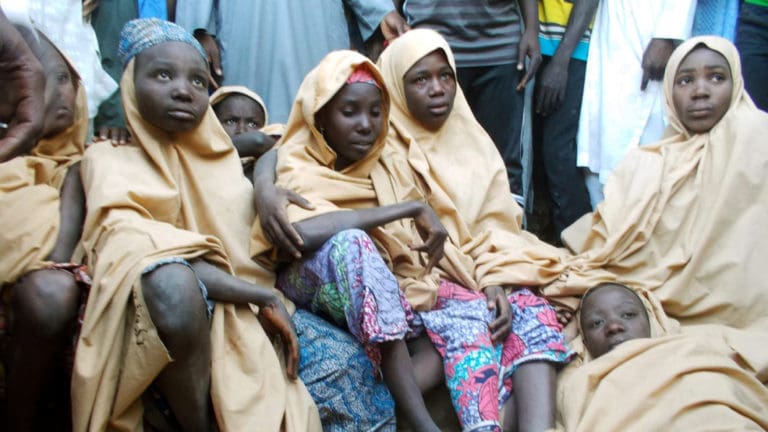
The mood in Nigeria has generally been celebratory since Wednesday, following the release of 105 schoolgirls abducted by Boko Haram from the Government Girls Science and Technical College, Yobe State.

But this has not stopped allegations, counter-allegations and even conspiracy theories from seeping into the ongoing conversations. Most prominent of all, the APC-led Federal Government has been accused of staging the saga, from the abduction to the eventual release of the girls.

The People’s Democratic Party (PDP) levelled this allegation on Wednesday through its official Twitter handle, and called on “the and the International Criminal Court to declare this evil by the Federal Government a war crime against humanity and immediately commence investigation on the matter”.

Mr. Kola Ologbondiyan, the party’s National Publicity Secretary, made the same allegation at a press conference in Abuja.

“Nigerians know that the main aim of this devilish act was to delude the public, set the stage for an orchestrated rescue, create a heroic myth and false sense of achievement around the APC administration and serve as a spur for President Muhammadu Buhari’s declaration to contest the 2019 presidential election, perhaps in the coming weeks,” he said.

More specifically, eyebrows have been raised regarding a picture making the rounds, showing the Dapchi girls in pink hijabs and heavily-loaded “Ghana-must-go” bags. The picture was used by PremiumTimes Hausa in a report published on Wednesday about the ordered closure of boarding schools in Dapchi and Borno.

One of the prominent personalities who have raised questions respecting the photo is lawyer and former minister, Femi Fani-Kayode.

In an article published on Thursday, he wrote: “So many questions need to be answered. For example how do you explain the Ghana Must Go bags that the girls were carrying on their return? Did they go shopping in Sambisa Forest? Or is it that when they abducted them they gave them time to pack all their clothes and allowed them to bring them back when freed?”

Another blog has the picture uploaded and asked two similar questions, “Were they kidnapped or did they go on vacation? How did they come by the Travel Bags and the items therein when they were kidnapped from the School?”

Many other Nigerians have shared the picture on the social media with questions and allegations along the same line.

Picture with caption uploaded by a Facebook user

THE SOURCE OF THE PICTURE?

Although the exact source of this picture is unclear, it has been on the Internet for at least a month before yesterday’s release of the Dapchi schoolgirls, also in connection to the case.

In fact, The Cable used it on February 24 in a story titled ‘FULL LIST: The 105 missing Dapchi girls’.

Daily Post had used it two days earlier in another story: ‘2 Yobe schoolgirls killed in rescue operation, others still missing’. The same platform again used it on February 25 in a published list of the names of the missing schoolgirls.

Also on February 25, 2018, Business Online used the same picture in a report of the Federal Government’s confirmation of the abduction.

FACES OF THE REAL DAPCHI GIRLS

Let us start with this photo news by Daily Nigerian with eight pictures showing some of the released schoolgirls in light brown hijabs.

PM News also uploaded a similar picture on Wednesday with the caption, ‘The released Dapchi girls’.

Picture uploaded by PM News

A story from Punch contains even greater detail. The feature image used has the caption, ‘Freed 106 Dapchi girls assembled at the Nigerian Air Force Base in Maiduguri on Wednesday. Source: @buharisallau Instagram page.’

Buhari Sallau, who describes himself as a news personality, has even more pictures showing the schoolgirls indoors on his Instagram page.

The Guardian Nigeria has also uploaded an image showing the released girls, which was credited to Ola Lanre of Reuters. The caption states: ‘Some of the newly-released Dapchi schoolgirls are pictured in Jumbam village, Yobe State, Nigeria March 21, 2018.’ Similar pictures were published by The Cable and Vanguard.

Picture uploaded by The Guardian

CONCLUSION

It is NOT TRUE, based on available evidence, that the released Dapchi girls were wearing uniform pink hijabs, bearing large travel bags colloquially known as ‘Ghana Must Go’.

On the contrary, many of the schoolgirls wore brown hijabs upon their return and were seen nowhere close to the ‘Ghana Must Go’ bags suggesting they had time to pack their belongings before the abduction or that their abductors gifted them the bags and their contents.

Whether or not the government played an active role in the abduction and release is in doubt, but the circulated picture DOES NOT substantiate the theory that it was “stage-managed”.

Senate confirms five of Buhari’s six CBN nominees — after five months


The Senate has cleared the candidates, bar one, nominated by President Muhammadu Buhari into the Central Bank of Nigeria (CBN).

This was following the recommendations of the Senate Committee on Banking, Insurance and other Financial Institutions, headed by Rafiu Adebayo.

Those whose nominations were confirmed include Aisha Ahmad and Edward Adamu, deputy governors; and Adeola Adenikinju, Aliyu Sanusi and Robert Asogwa, members of the monetary policy committee (MPC).

The nomination of Asheikh Maigudu as a member of the MPC was, however rejected, the lawmakers calling on Buhari to forward another nominee for confirmation.

Prior to his nomination, Maidugu was a Director at the Federal Inland Revenue Services (FIRS). He had also worked as a senior lecturer in Department of Economics, University of Maiduguri between 1994 and 2007.

It is not clear yet why his nomination was rejected.

Speaking after the exercise, Bukola Saraki, Senate President, said the confirmation of the candidates would enable the CBN to continue to play its role of providing stability to the Nigerian economy.

“We promised the country last week that within a week we would carry out this confirmation and we have done this,” Saraki said.

“Let me congratulate the two nominees, particularly Mr. Edward Lamatek Adamu, whose upliftment to a Deputy Governor will be great encouragement to the staff of the CBN who will see one of their own in this position. I am sure it will boost the morale within the institution.

“The two new deputy governors of the CBN are coming at a time when the economy is a major issue. We have just come out of a recession and we need to continue with our economic growth and see the sustainability of the foreign exchange and other related challenges.

“We hope that the two new deputy governors will work with the Governor to move the country and our economy in the right direction.

“We hope, also, that you all will continue to work closely with the National Assembly to update us on the progress that is achieved by the Central Bank.

“I wish the members of the Monetary Policy Committee (MPC) a fruitful and successful tenure. For the MPC member that has been rejected and the issue of the board, when we come back next week we will revisit this issue.”

Earlier, Ahmed Lawan, Senate Majority Leader, had pointed out that the CBN board was not fully constituted because of the rejected nominee. He urged the Executive to expedite action in sending a replacement.

The nominees into the CBN MPC were announced in October, but the upper legislative chamber refused to  confirm the candidates, in protest against the President’s refusal to withdraw Ibrahim Magu as EFCC Chairman, despite having been rejected twice by the lawmakers.

An MPC meeting scheduled for January could not hold since the committee could not form a quorum due to the non-confirmation of the nominees.

What the $9m in Boroh’s house can fund — and how much he must spend daily to exhaust it in 365 days


It is alarming and disheartening the ease with which top government officials turn their private homes to overnight ‘central banks’ where public funds are stashed.

A year after the Economic and Financial Crimes Commission (EFCC) discovered a whopping $9.2 million and £750,000 in the Kaduna residence of Andrew Yakubu, former Group Managing Director of the Nigerian National Petroleum Corporation (NNPC), it has discovered another $9 million (N2.75 billion) stashed at the house of Paul Boroh, sacked Coordinator of the Presidential Amnesty Programme.

The budget of the Presidential Amnesty Programme was N65 billion in 2017 — same amount that has been retained in the proposed 2018 budget. The cash discovered in Boroh’s house represents almost half of one-tenth of the entire budget of the amnesty programme either in 2017 or 2018.

VALUE OF N2.5BN IN PROPOSED 2018 BUDGET

By looking through the proposed 2018 budget yet to be passed by the national assembly, here are some expenditure that the discovered cash can fund.


To put matters in another context, were Boroh to personally supervise the spending of the said $9million, he would have to spend approximately N7.52m daily for 365 days to exhaust it.

AI asks FG to investigate death of five Dapchi schoolgirls

Amnesty International (AI) has asked the Federal Government to investigate the security failures that led to the abduction of 110 Dapchi schoolgirls, and the death of five of them, by Boko Haram.

It also called for the immediate release of all abductees, including the Chibok schoolgirls, still being held by Boko Haram.

It demanded the “unconditional release” of the remaining Chibok schoolgirls, and an end to abductions of civilians by insurgents.

The Federal Government, through Lai Mohammed, Minister of Information and Culture, had said the number of the rescued girls was 105.

A total of 110 girls were originally abducted by the insurgents on February 19, and five of them were said to have died while in custody. Also, one of them was said to have been held back because she refused to renounce her Christian faith.

Osai Ojigho, Nigeria’s Director of AI, described the return of the Dapchi girls as a “huge relief” especially for the girls and their families, but added that “despite this positive development, four girls from Dapchi are still being held by Boko Haram”.

“Boko Haram must immediately release these girls and all other abductees – including some of the Chibok girls – and end the spate of abductions of civilians, which amount to war crimes,” Ojigho said.

“Moreover, the 101 [it was later updated to 105] released girls are currently being held in the government’s custody, further prolonging their ordeal.


READ ALSO:


“The authorities must immediately release them, and ensure that they are able to return to their families or be provided with an alternative safe option if they so-choose.

“The authorities must also ensure the girls have access to comprehensive support, including confidential counselling and medical care.”

Ojigho called for an investigation into “the security failures that lead to the abduction” and consequently, to the the death of five of the girls in captivity.

Similarly, AI asked the Federal Government to make public the results of the two investigations into the abduction of the Chibok schoolgirls in April 2014, in order to ensure adequate protection of all schools in northeast Nigeria.

Defence minister: Didn’t I tell you we’d rescue Dapchi girls within two months?


Mansur Dan-Ali, Minister of Defence, says the release of the abducted Dapchi schoolgirls was the result of President Muhammadu Buhari’s support to security agencies.

Speaking with journalists after Wednesday’s Federal Executive Council(FEC) meeting at the State House in Abuja, Dan-Ali recalled how he had assured the public that the girls would be rescued within a maximum of two months.

“Basically, I want to speak on the impression that people had that we cannot get the girls released. If you can remember the last interview I had with Channels Television, I said in two weeks, two months or less we are going to get the girls released and this has happened,” Dan-Ali boasted.

“So this is as result of the efforts of Mr. President and the Commander-in-Chief of the Armed Forces for the support he has been giving us and the output is showing now.”

Speaking earlier, Lai Mohammed, Minister of Information and Culture, said the girls would be quarantined and psychologically counselled before they are allowed to return to their schools.

He said the girls were already at the General Hospital in Dapchi where they would undergo medical tests.

“As I speak to you now they are in General Hospital in Dapchi and I’m sure the counsellors are there with them,” he said.

“Just as we did when we had the first set and second set of release of the Chibok girls, they will be quarantined and psychologically counselled before they go back to their schools.”

Mohammed added that insurgency and armed violence was not a peculiar to Nigeria alone as many other countries, including much more developed ones, are facing similar challenges.

“You see, we must look at this thing in context,” he said.

“If you look at other countries like the US, [in] Florida, you saw how gunmen entered the school and killed about 17 pupils. Insurgency all over the world is a global issue and the government must always be on its toes.

“One of the things we have done today is that we have tried to secure the schools and there are even efforts on parts of government to merge some schools, schools that are far-flung.”

The Florida school shooting Mohammed referred to was actually carried out by a lone 19-year-old gunman, Nikolas Cruz, not “gunmen” as Mohammed claimed. Also, the incident was not a case of insurgency as he claimed. Gun violence has been a nagging issue in the US over the years.

Mohammed insisted that “no money changed hands” in the negotiations that led to the release of the girls.

“It was agreed that there would be no force; there would be no confrontation; that was why it was possible for them to drop the girls,” he said.

“It was part of the agreement that we will release the girls; there will be no violence or confrontation. And don’t forget that the lives of these children are much more important to us than any cheap victory.

“The girls were released unconditionally, no money changed hands. They only had one condition, that they will return them to where they picked them.”

The Federal Government has consistently denied claims that it paid huge amounts of money to secure the release of 82 of the abducted Chibok schoolgirls in 2017, and the subsequent release of 13 other Boko Haram hostages early this year.