Home Blog Page 2689

Falana to Buhari: Resign now, you have neglected your duty as Petroleum Minister

Femi Falana, lawyer and human rights activist, has advised President Muhammadu Buhari to resign as Minister of Petroleum Resources.

His advice came in the wake of a leaked memo purportedly written by Ibe Kachikwu, Minister of State for Petroleum Resources, to Buhari alleging insubordination and disrespect by Maikanti Baru, Group Managing Director of the NNPC.

Falana said Buhari should appoint another Nigerian of proven integrity and competence to superintend the affairs of the ministry, in view of the enormous responsibilities of the office of the Minister of Petroleum Resources and Chairman of the NNPC Board.

He said Buhari must reorganise the NNPC to ensure transparency and credibility, adding that Kachikwu’s letter showed that Buhari has neglected his duty as Petroleum Minister.

“Curiously, the presidency has demanded for the minutes of the meetings of the NNPC board. This demand has confirmed that the meetings of the board which are statutory required to be chaired by the Minister of Petroleum Resources have not been held as and when due,” Falana said.

“More importantly, the demand has corroborated that aspect of Dr. Kachukwu’s petition alleging that the powers of the Board have been usurped by Dr. Baru.

“Therefore, the petition should provide an opportunity for the President to reorganise the NNPC with a view to ensuring that it is publicly owned in a manner that the Board is constituted by accredited representatives of the oil producing communities and credible civil society groups including the trade unions in the oil and gas industry.

“Having regard to the enormous responsibilities of the office of the Minister of Petroleum Resources and Chairman of the NNPC Board, President Buhari is advised to relinquish the ministerial position in view of his busy schedule and appoint another Nigerian of proven integrity and competence to superintend the affairs of the ministry.

“If this advice is accepted in good faith and acted upon without any delay it would remove undue pressure on the health of the President and allow him to attend to urgent matters of the state.”

Falana also called for the suspension of Baru over the allegations.

“Apart from sanctioning the officers responsible for creating the wide gulf between Dr. Kachukwu and the President, the allegation of the unilateral award of contracts worth $25 billion by Dr. Baru ought to be investigated in line with the anti-corruption policy of the Buhari administration,” he said.

“In order to conduct a thorough investigation into the grave allegations of the reckless contravention of the provisions of the Public Procurement Act, Mr. Baru should be placed on indefinite suspension while the Presidency should refer the case to the Economic and Financial Crimes Commission.

“And once it is confirmed that the said $25 billion contracts were awarded without the approval of the NNPC board, they should be revoked while the recent appointment of the heads of the parastatals in the oil and gas industry should be reviewed in line with the constitution and the Federal Character Commission Act.”

Hunger, sickness, death … ex-NITEL workers ask Buhari to pay their pension

Former workers of defunct national telecom carrier, Nigerian Telecommunications Limited (NITEL) and Mobile Telecommunications Limited (M-Tel), under the auspices of Association of Former Telecoms Employees of Nigeria have cried to President Muhammadu Buhari to order the payment of their pensions.

This follows the recent approval by Buhari of a N45 billion severance package to be paid to workers of the liquidated Nigeria Airways.

According to a press release issued on Sunday by Gabriel Oluti, President of the association, the workers were only paid a five-year buy out pension when the company was privatized under the administration of former President Olusegun Obasanjo as against 25 years pension entitlement.

This follow the recent approval by Buhari that N45 billion severance package should be paid to workers of the now liquidated Nigeria Airways.

While noting that NITEL was also liquidated like the Nigerian Airways after its privatization failed, the association said its members are now languishing in abject poverty and many have died due to lack of proper healthcare.

They argued that about N93 billion pension fund belonging to their members is lying fallow after the Federal Government liquidated the company.

“When they paid us, it was just five years buy- out instead of 25 years and it was paid in piece meal between 2007 and 2010 and we went to the Court to challenge this injustice,” Oluti said

“It is interesting to know that the management of NITEL then, and the Bureau of Public Enterprise (BPE), under the leadership of Nasir El-Rufai illegally and criminally liquidated our pension scheme, our properties were sold and the money sent to the government coffers and other entitlement withheld till date.

“Our pension scheme was liquidated without our knowledge. We made PTAD to know that we are not part of the monthly pension payment recently directed by the Federal Government because we are entitled to pension for life.

“Two hundred and fifty staff buses bought by staff were sold, the mortgage was also not remitted with the Federal Mortgage Bank, the canteen and other properties sold should be paid for.”

Oluti said he and his members are asking the President to implement the court order by directing the Federal Ministry of Finance to release the counterpart fund for the liquidator so that he can add his own counterpart fund and pay them.

Monkeypox disease confirmed in Akwa Ibom

One case of the monkeypox disease has been confirmed in Akwa Ibom State, while two other suspected cases are being investigated.

Charles Udoh, the state’s Commissioner for Information and Culture, made this known on Sunday.

The monkeypox disease was first detected in Bayelsa State and health authorities say everything is being done to contain the outbreak.

More to come…

We are in trouble, says Abaribe the Senator who signed Kanu’s bail bond

Enyinnaya Abaribe, Senator representing Abia South Senatorial District at the National Assembly, says he and the others who signed Nnamdi Kanu’s bail bond are now in trouble since nobody knows where he is currently.

Abaribe, who is also the leader of the South East caucus in the National Assembly, said this at the Made-in-Aba Products Show, which was part of activities to mark the 2017 Convention of the Abia State National Association of North America (ASNA), in New York, USA on Saturday.

He was one of the three sureties that stood in for Kanu after the IPOB leader was granted bail on health grounds in his ongoing treason trial at the Federal High Court, Abuja.

Kanu’s next court date is on October 17, but it is unclear whether he will appear in court on that day.

Abaribe also noted that the progress so far made in the purchase and export of made-in-Aba products, have been eroded as a result of the Biafran agitation led by Kanu.

“I am a Nigerian Senator and not that of Biafra,” Abaribe said.

“We had advised Kanu, reminding him that his rights end where those of others begin.

“We are now in trouble, because we do not know where he is and how to contact him.

“Those that support Kanu’ s agitation should think twice.”

Abaribe, who described himself as a made-in-Aba Senator, stressed that the the Igbo will thrive more under a better Nigeria than outside of it.

“We think we need Biafra, but this Biafra should be that of the mind that represents our ingenuity and our innate quality for hard work and enterprise, especially as oil proceeds keep dwindling,” he said.

“Igbo are largest and highest investors in the country, contributing to the development of wherever they reside and operate.

“In Lagos alone, we have built and developed about ten different markets from which over N3 billion are generated on daily basis.

“We should trust that our leaders, both elected and not elected can get the best for us.”

Okezie Ikpeazu, the Governor of Abia State, was represented at the occasion by Ude Oko Chukwu, his Deputy.

We have not seen our king since three weeks, Nnamdi Kanu’s community cries out

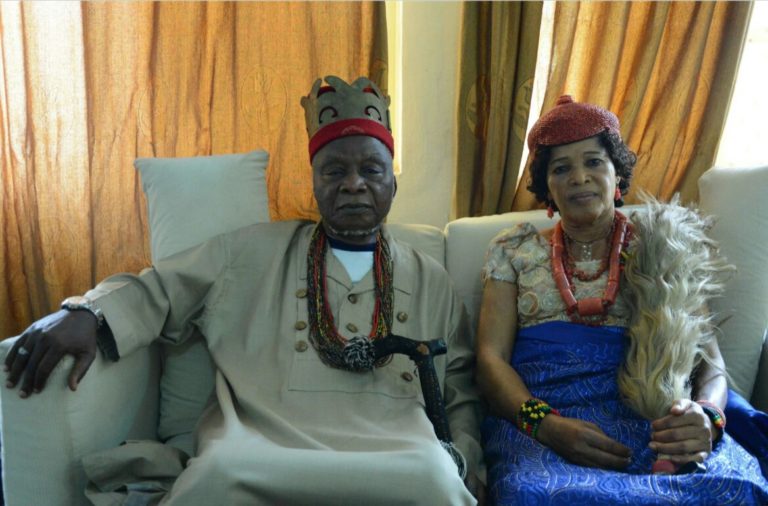
Eze Israel Kanu and his wife

Members of Afaraukwu community in Umuahia, the Abia State Capital, where Nnamdi Kanu hails from, are worried over the whereabouts of Israel Kanu, the traditional ruler of the community and father of Nnamdi, Leader of the IPOB.

Nobody seem to know where Kanu, together with his mother and father, is currently located since after the invasion of their home by soldiers on September 10.

Newsmen who visited the community reports that the palace of Kanu’s father was still cordoned off while three vehicles riddled with bullets were seen in the compound.

Chimechefulam Odoemelam, a member of the Afaraukwu council of chiefs, said the council is worried as they have no idea where their King and Queen are.

He said that though the soldiers have been withdrawn from the community, and things appear to have calmed down, many people are still living in apprehension.

“The truth is that we have not seen or heard from our Eze since we all came back,” Odoemelam said.

“Everybody is confused about his whereabouts because we do not know where to look for him.

“We have reported the case to the body of traditional rulers in Ibeku, Umuahia kingdom where we belong and our Chairman, Eze Henry Ezekwem, has promised to give us a date to meet him on the matter.

“We are hoping that the Abia State Council of Traditional Rulers which he (Eze Kanu) is a member will also lend their voice in asking for his whereabouts.”

Odoemelam said the community did not officially report the matter to the police because they were advised to stop further action until the umbrella body of traditional institutions in the kingdom decides on the next step to take.

He however said the Abia State and Federal Governments should question the soldiers that invaded the palace to know if they have information on their King’s location.

The Nigerian army have denied invading Kanu’s home in Afaraukwu and arresting him.

John Enenche, Director of Defence Information, said he monitored the operation live and nothing like that ever happened.

Kanu, who is currently undergoing treason charges at the Federal High Court, Abuja, has been in hiding since after the events of September 10.

His next court date is on October 17.

Scores injured in stampede during Nigeria-Zambia match

Many football fans were seriously injured during a stampede that occurred at the entrance gate of Godswill Akpabio International Stadium in Uyo, the Akwa Ibom State capital, on Saturday.

The stadium was where the all-important World Cup qualifier between Nigeria and Zambia was played.

Reports say the stampede happened when security operatives tried to prevent some people from entering into the stadium.

Soldiers allegedly used sticks and batons to disperse the crowd and many sustained serious injuries as a result.

Five persons were said to have died in the incident but the claim could not be confirmed.

However, ambulances were seen conveying injured persons to the hospital.

A correspondent with The Punch said he was also assaulted by the club-wielding soldiers and lost N 10,000 in the stampede.

Some persons who spoke with journalists say stampedes happen at the stadium every time an important football match is hosted there.

“I thank God that I’m alive. This is not the first time this kind of incident had occurred,” said Aniema Ekong.

“In fact, in every major tournament, there is always a tale of woes to tell about security agents injuring or killing people.”

Another fan who gave his name simply as Chukwudi, said his girlfriend was seriously injured by the security personnel at the gate, adding that “I don’t know why there is always trouble in this stadium”.

When contacted, Elkana Bala, the Akwa Ibom State Police Public Relations Officer, confirmed that there was a stampede and people sustained injuries but he stressed that no life was lost in the incident.

“It is confirmed that nobody died. But some persons were injured while struggling to gain access into the stadium,” Bala told newsmen via text message.

“The injured persons were taken to hospital for medical attention.”

Nigeria defeated Zambia 1-0 to become the first African country to qualify for the 2018 World Cup which is scheduled to hold in Russia.

Six years after, only two Nigerian security institutions obey FOI Act

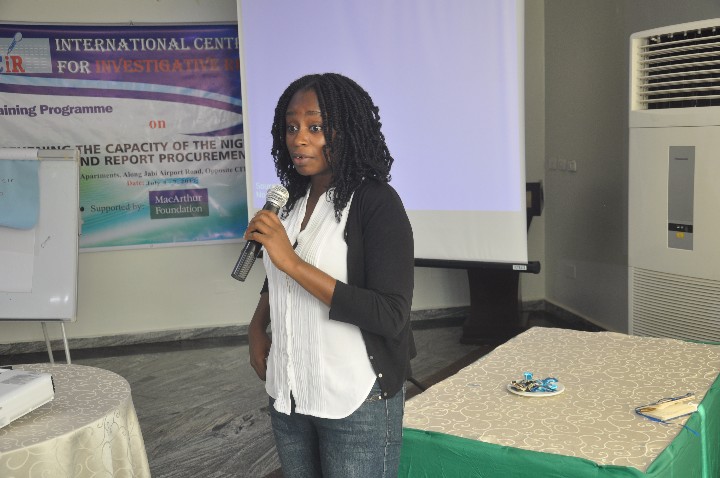
Seember Nyager

Despite the passage of Freedom of Information (FOI) Act by the National Assembly six years ago, Nigerian security institutions are still hoarding information relating to procurement process, the Public and Private Development Center (PPDC) has said.

According to the 2017 FOI compliance ranking for security sector organisations conducted by PPDC, only the Police Service Commission and Nigeria Security and Civil Defence Corps (NSCDC) complied with the FOI Act, 2011 benchmarks.

The two security organisations came first and second respectively in the ranking of 12 security organisations which included the Nigerian Immigration Service, Office of the National Security Adviser (ONSA), Defence Headquarters, Military Pension Board, Defence Intelligence Agency and National Defence College,

Others were Federal Ministry of Defence, Federal Ministry of Interior, Nigerian Prison Service and Federal Fire Service.

Speaking at the third edition of the ranking, Seember Nyager, Executive Director of PPDC, explained that the ranking was based on an assessment of levels of access to procurement related information from the 12 security sector institutions.

She said the ranking, since 2014 has been used extensively for advocacy and has contributed immensely to the responsiveness of public institutions to FOI requests.

“Specifically, information on procurement plans, procurement processes and capital expenditure was sought,” she said.

“The FOI rankings build on two previous editions of annual rankings. This is the aim of the rankings; that procurement related information would be liberated and made as coherent as possible; and in a way that enables increased efficiency in public service delivery.”

The institutions were ranked based on benchmarks for disclosure within the Nigerian FOI Act, 2011; which are proactive disclosure, responsiveness to requests for information and level of disclosure to requests for information.

Based on proactive disclosure which is further divided into full proactive disclosure, partial proactive disclosure and no proactive disclosure, none of the institutions were proactive in disclosure of procurement information.

Nyager explained that proactive disclosure is obtained where information on the procurement plans and capital expenditure of a public institution is found on their website. Based on this, an institution scores 22 points for full proactive disclosure, 17 points for partial disclosure and no point for no disclosure.

She said: “Where a part of this information is found, partial disclosure applied. Where there is no disclosure of procurement related information on the website of the public institution, there is no proactive disclosure.”

While noting that where there is no full proactive disclosure, she said, “request for information is made”, and responsiveness to request for information is ranked based on response within seven days which scores 20 points, response within 14 days which attracts 15points, response within 15 days which scores 10 points and no response which attracts no point.

On the level of disclosure to requests for information, an institution score 22 points for full disclosure, 17 points for partial disclosure and no point for no disclosure.

In the public institutions category, 163 of the 166 institutions assessed were not complying with the FOI Act, 2011 requirement for disclosure of procurement plans, processes and public expenditure.

Bureau of Public Service Reforms (BPSR) which came first last year retained the position, while Infrastructure Concession Regulatory Commission (ICRC) and Independent Corrupt Practices and Other Related Offences Commission (ICPC) came second and third respectively.

Biafra agitation is a case of sour grapes and bad sportsmanship, says Jigawa governor

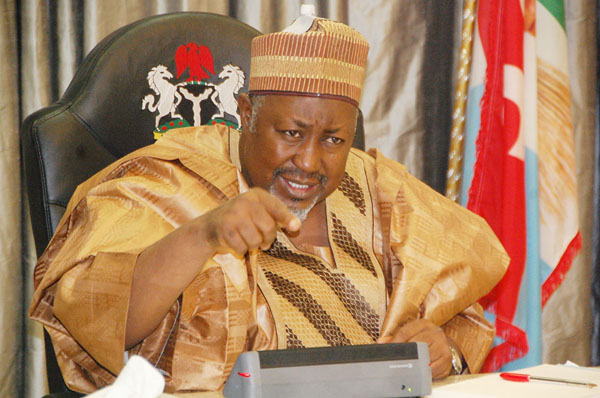
Abubakar Badaru, Governor of Jigawa says those agitating for the division of Nigeria should get their acts together and participate in the political dispensation, instead of heating up the polity.

In an interview with Daily Trust, he said some of the agitators were active politicians who lost elections.

“Some of them were active players in the politics of yore, some contested elections and lost,” Badaru said.

“I have seen some that were advocates of tenure elongation at some point in time.

“My take is that it’s all a case of sour grapes and bad sportsmanship. Instead of heating up the polity, let them get their acts together and participate in the political dispensation, then they can articulate their positions within the ambit of the law and the constitution.”

The governor wondered why the agitation gained momentum in the administration of Muhammadu Buhari.

He also questioned the justification for the agitations, noting that anything done outside the ambit of or in contravention of the law is illegitimate.

He asked: “Where were the agitators before the advent of this administration? Was the previous government so repressive and brutal that they couldn’t voice out their aspirations?

Badaru urged Nigerians to focus on what they have in common rather than their differences.

“We should sanitize the political space and do away with politics of ethnicity and religion, and focus on issues, not sentiment.

“We must evolve a system that ensures quality leadership is appreciated and respected so that meritocracy takes root, and we can begin to celebrate leaders with national outlook and exemplary vision and capacity.

“Today, no matter how good you are, political and ethnic considerations will be used to denigrate you and pull you down. You can imagine a situation where a leader’s illness is being celebrated in the name of politics. This is sad.”

UNCOVERED: UK properties belonging to APC chieftain, former head of state

Luxury mansion in the UK used to illustrate the story

Five ‘powerful’ Nigerian politicians, including a current chieftain of the All Progressives Congress, APC, and a former Head of State, bought choice properties worth millions of pounds in the UK using proxy companies, investigation has revealed.

The findings by PUNCH follows an earlier investigations by ClampK, a group of anti-corruption campaigners, which revealed 10 multimillion-pound properties owned by Nigerian politicians in the United Kingdom.

A video clip of the findings have been trending on the social media as it was reported by international media organisations, including the BBC, Al Jazeera and AFP.

According to The Punch, the properties were linked to two top lawmakers, one of whom is also a chieftain of the All Progressives Congress; a former military Head of State; a late military Head of State; and a retired senior military officer, who is also a serving government official.

Journalists were able to get the costs of seven out of the 10 properties while the costs of others were not available.

The seven properties are valued at £15,785,000 or approximately N6,345,570,000 (using the Central Bank of Nigeria’s official rate of N402).

Further breakdown shows that the properties are worth: £5, 650, 000; £4,250,000; £2, 900,000; £850,000; £830,000; £820,000 and £485,000, respectively.

The luxury properties were acquired by proxy in order to hide the identities of the true owners.

According to authentic documents seen by journalists, one of the properties linked to an APC chieftain cost £4,250,000 (apart from other rents that had been paid on the grant of the lease).

One of the properties, belonging to one of the “powerful” Nigerians was purchased at the cost of £5, 650, 000 and was paid for on October 4, 2011. Another choice property was acquired by a firm on behalf of a former military Head of State, while yet another property was registered with a company’s name as the owner.

A luxury property at Kensington West Blythe Road, was also linked to one of the powerful Nigerians, and another located in Peterborough was linked to a top lawmaker in the Peoples Democratic Party (PDP).

The documents were made available to Punch by HM (Her Majesty’s) Land Registry in London.

Many international anti-corruption campaigners believe that the UK subtly encourages the misuse of public funds.

According to Rachel Davies of Transparency International, there were 40,000 land titles in London owned by companies based in many jurisdictions.

This means that when the properties were bought, the owners didn’t need to have a land registry to reveal who they really were “and so the land registry, the police, and the local residents do not know who they are”.

A source in the diplomatic community in the UK, who pleaded anonymity, also corroborated Davies’ position.

He, however added that though, the UK law enforcement agencies had been “secretive” about their activities; there were reasons to believe that they were “in the process of building a more expansive prosecution against a former Minister of Petroleum Resources, Diezani (Alison-Madueke),” who is believed to be under investigation.

But the general belief of anti-graft campaigners is that the UK government had failed to show enough commitment and political will to investigate and expose politically-exposed Nigerians using the foreign country as a haven to hide stolen funds.

“The UK government doesn’t have the resources or the political will to pursue a broad range of investigations into the high-end property holdings of politically-exposed Nigerians or suspected kleptocrats from around the world,” said Matthew Page, a consultant and former Nigeria specialist at the US State Department.

“Government officials may be looking into a handful of the most high-profile examples, but they are doing little to tighten the laws and close the loopholes that help the world’s treasury looters buy posh homes in London.

“Many of us are concerned that the UK government is losing interest in stopping kleptocrats using the country’s property market, corporate structures, and financial system to launder and spend stolen money.

“I suspect UK officials see these kinds of financial activities as a necessary evil, that is, a much-needed alternative source of revenue that will help offset the negative economic and fiscal effects of Brexit.”

AWOLOWO STATUE: Ambode did a bad job, says Odia Ofeimum

Odia Ofeimum, Personal Secretary to Obafemi Awolowo, the late Premier of the Western Region of Nigeria, says the Awolowo Statue which was unveiled by Akinwumi Ambode, the Governor of Lagos State, in September, was a bad job.

Ofeimum said the representation in the 20-feet statue was not that of the Awolowo that he knew and worked with closely for many years.

According to Ofeimum, everything about the statue was wrong, from the fact that Awo was taller than the one depicted in the sculptor, to the fact that he wore more of buba than agbada and never wore laced shoes.

“Somebody else would have to do another (Awo statue) one day and I don’t think it is fair to Ambode to be remembered as the man who did a bad Awo statue,” Ofeimum said during an interview with the Punch.

“Awolowo is taller than the person sitting down there, and you can feel it very quickly when you see the fellow.

“That was the first thing that hit me when I saw it and I thought if this man was standing, what would he look like?

“Even if the artist did not know Awolowo at all, he could still present a perfect picture.I don’t think it is good the way it is, and it is too bold an effort not to be done well.

“Whoever did it had a great feeling, but that artwork is not a representative of a great feeling. Therefore, it does need to be redone.

“If they don’t do that, it’s like teaching students wrong history because when you look at it, what you see is not the history.”

Hamza Ata, the sculptor who created the statue had explained that the sitting position in which Awo was depicted was to create an impression of someone who was thinking, but Ofeimum disagrees.

“A man who is doing serious thinking won’t appear like that,” he said.

“No. Your limbs would be free, not folded or crossed; he wouldn’t wear a cap while thinking and he would have looked relaxed.

“That is not a thinking posture. He’s like a man asked to say ‘cheese’ (laughs).

“In any case, you don’t present a public figure in that manner; you present him as a public figure that he was. A true Awo statue must be a standing one , and with the V-sign.”

Ofeimum noted that the statue, if not corrected, will become a thing of mockery rather than honour for the great Awolowo.

“I mean, it is not nice. Very many school children would go to that statue and say, ‘they say the shoe is too big, let us go and look at it’, as a joke,” he said.

“I cannot remember ever seeing Awolowo with a laced shoe. I can’t remember, ever. No.

“I look back and I try to figure it out, but no, I couldn’t remember any such moment.

“And it’s not just about the kind of shoes, it’s also in relation to the rest of the body. That shoe is a bit overdone; too big.

“When Awolowo was campaigning, he hardly wore Agbada. He wore a Buba and Soro and a very simple pair of shoes, usually shoes that matched the dress.

“But, there was a way Awolowo looked when he wore Agbada  this one didn’t quite look like that.”

Ofeimum said that such a project ought to have been contracted to an artist that knows his onions and not merely to patronise some acquaintance.

“I think by now, Lagos State should have a proper public art policy, which requires more than just the award of a contract, it should also involve a process of crosschecking and ensuring that what is provided is good enough for public consumption.

“I’ve seen many public artworks and it would seem some people just think if you have a friend and you want to help him to make money, you give him a job, but you create eyesores all over the place and it is not fair.

“I heard somebody bragging that nothing would be done about it. Fine. Another person would still do a proper sculpture that would make the other one look like something for the garbage.”