Home Blog Page 2688

Kachikwu’s memo mainly to incite the public, says Baru

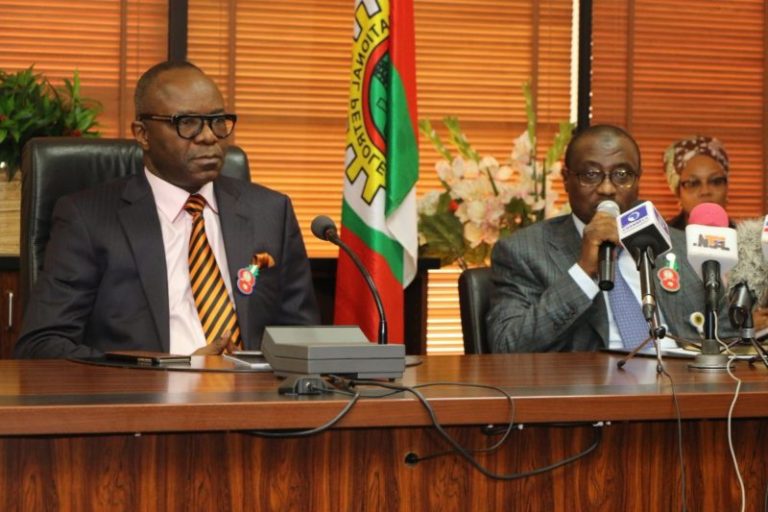
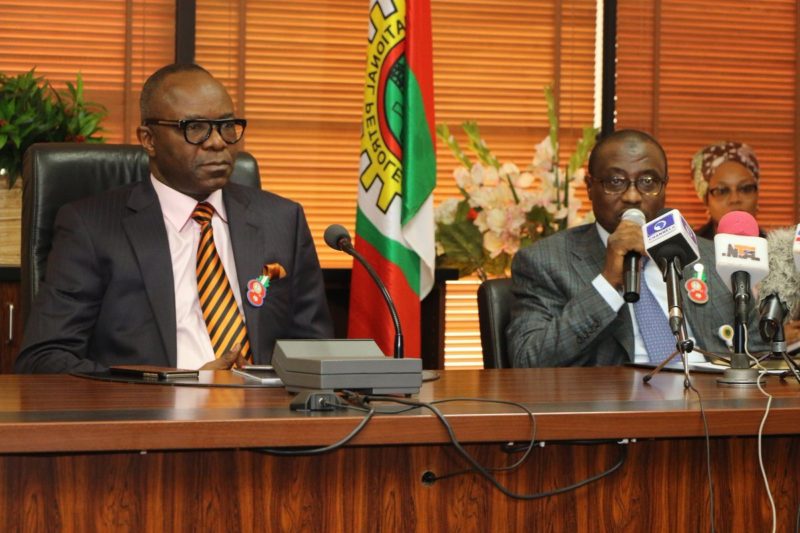
Maikanti Baru, Group Managing Director of the Nigerian National Petroleum Corporation (NNPC) says the allegations contained in Ibe Kachikwu’s memo to President Buhari was intended to incite the public.

Baru said this while playing host to members of the Petroleum and Natural Gas Senior Staff Association of Nigeria (PENGASSAN) and the Nigerian Union of Petroleum and Natural Gas Workers (NUPENG), who paid him a solidarity visit at the NNPC headquarters in Abuja.

According to a statement issued by Ndu Ughamadu, NNPC Group General Manager Group Public Affairs Division, Baru described Kachikwu’s allegations as “unfortunate” and “unfounded”.

“I know for those of you who are following what we are doing here, you know that there’s no money lost and no process has been breached,” Baru was quoted as saying.

“Our contracting process is perfect and we will continue to follow the process. The NNPC Board has no role, I repeat, has no role as far as the contracting process is concerned.

”The case of DSDP (direct sale, direct purchase) is of those that will take crude and give us products in return. So there is no value to them. But humongous figures have been put forward mainly to incite the public, it is most unfortunate.”

Ughamadu further stated that the unions pledged total support for Baru whose leadership they described as exemplary.

“The unions’ support for the GMD is based on his ability to walk his talk since assuming office last year,” Francis Johnson, the national President of PENGASSAN, was quoted as saying.

“The National body of PENGASSAN and all the NNPC in-house unions are here today to show our support for you.

“You have brought stability to the NNPC and we are happy today that staff morale is high. You were Chairman of NNPC Anti-Corruption Committee for over five years and that was what informed your appointment as GMD of NNPC.

“Today, all the bullets you are taking are on behalf of members of staff. We will continue to pray for you, God will continue to guide and shield you.”

Buhari seeks Senate approval to borrow $3 billion

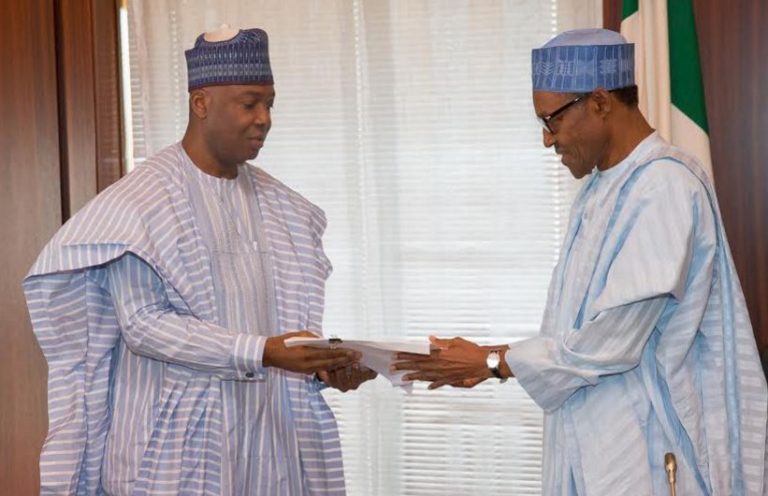
President Muhammadu Buhari wants the Senate to approve the borrowing of $3 billion which he said would be used to refinance the country’s maturing debts.

This was contained in a letter read by Bukola Saraki, Senate President, during Tuesday’s plenary.

Buhari also requested the legislators to approve the issuance of a $2.5 billion Eurobond or Diaspora bond in the International Capital Market, to be used to fund the 2017 budget deficit and finance ongoing critical projects, such as the Mambilla hydro-power project.

“The Senate may wish to know that in order to implement the external borrowings approved by National Assembly in the 2017 appropriation act, the FGN issued $300 million diaspora fund in the International Capital Market, ICM in June 2017,” the letter read in part.

“The balance of the 2017 external borrowing in the sum of $3.2 billion is planned to be partially sourced in the ICM of $2.5 billion through Eurobonds or a combination of Eurobonds and Diaspora bonds, while $700 billion is proposed to be raised from multilateral sources.

“It should be noted that intention is to issue the Eurobonds first with the objective of raising all the funds through Eurobonds and Diaspora bonds will only be issued when the full amount cannot be raised through Eurobonds.

“The Senate may wish to know that the proceeds of the proposed issuance of Eurobonds and Diaspora bonds in the ICM will be used to finance the deficit of the 2017 appropriation act and provide funding for capital projects in the budget.

“The projects include the Mambilla hydro-power project, construction of the second runway of the Nnamdi Azikwe International Airport, counterpart funding of rail projects and construction of Bonny road with a bridge across Opobo channel.”

Buhari’s letter also informed the legislators that “the FGN seeks to source $3 billion through issuance of Eurobonds to the ICM and or loan syndication by banks” in order to enable it “reduce debt service levels, and …  substitute maturing domestic debts with less expensive long term external debts”.

“It is important to note that the proposed sourcing of $3billion from external sources to refinance maturing domestic debts will not lead to an increase in public debt profile because debt already exist,” the letter read.

“Rather, the substitution of domestic debts with relatively cheaper and long term external debts will lead to a significant decrease in debt service cost.

“This will also achieve more stability in the debt stock while also creating more borrowing space in the domestic market for the private sector.

“The Senate will recall that in the 2017 appropriation act, debt service had 1.66 trillion representing 32.73% of the FGN’s total expenditure which makes it important to urgent steps to reduce debt service cost,” the letter read.

Last week, Kemi Adeosun, the Minister of Finance appeared before the Senate Joint Committee on Appropriation and Finance, where, among other things, she said that some capital projects captured in the 2017 budget could not be funded due to inability to access foreign loans.

Kachikwu, Baru and the NNPC debacle

0

By Reuben Abati

The current NNPC debacle is probably the most embarrassing, even if mercifully, eye-opening crisis in the history of that nationally strategic institution since its creation in 1977.

I seek in the following commentary to offer a number of observations that would probably throw some light on the muck and confusion running riot out there on the matter.

In my view, it was an error to have paired the Group Managing Director of the Nigeria National Petroleum Corporation (NNPC), Dr Maikanti Baru, with Dr. Ibe Kachikwu.

I say this for two reasons. When Dr. Ibe Kachikwu was appointed the GMD in charge of the NNPC and as Minister of State in 2015, it looked like a dream appointment and an extra-ordinary career point for him but not necessarily for the sector.

Dr Kachikwu did not hesitate to assert himself and in his attempt to reform the NNPC, one of the victims was a certain Dr Maikanti Baru, most senior Executive Director at the NNPC, who was redeployed under the new dispensation as a Technical Adviser in the Ministry of Petroleum.

This was like sending Baru to desert territory of the oil and gas sector. How the same Baru eventually got rehabilitated as GMD of the NNPC, to work with the same man who had tried to marginalize him within the system was a poor demonstration of an understanding of human psychology.

It was common knowledge that there was no love lost between the two men, and yet someone thought it was a good idea to force them to work together as a team. Leadership failed at that point, because the arrangement was not going to work.

The Ministry of Petroleum and NNPC that emerged at that point was built on a fulcrum of conflict of personality and interest.

The key players in the oil and gas sector can only work together as a team if they must reduce the opaqueness and conflicts in that sector, but the pairing of Kachikwu and Baru practically showed a lack of understanding.

The crisis that has now erupted between both men was foreseeable, and I dare say, avoidable. Where is the wisdom in forcing two persons who have shown open dislike for each other to work together?

But let us consider the other level of the conflict: and that is the conflict of interest. One major issue in the oil and gas industry, over the years has been the uneasy relationship between the Ministry of Petroleum and the International Oil Companies (IOCs).

The Ministry of Petroleum through its parastatals, the NNPC, and more particularly, NAPIMS, regulates the IOCs. Nonetheless, the relationship between the regulator and the IOCs has always been like that between the cat and the mouse. Civil servants not just in the NNPC but elsewhere within the government have a penchant to want to work with their own.

Political appointees are treated with suspicion, as wayfarers, as the civil servants seek to protect their own territory.

The battle for territory in the Nigerian government is one of the most vicious fights in the corridors of power.

So it has been that in the oil and gas industry in Nigeria, every attempt to appoint an IOC-associated person as head of the NNPC or other parastatals under the Ministry of Petroleum has always resulted in the equivalent of street fights.

Under President Olusegun Obasanjo, Edmund Daukoru and Funso Kupolokun could not forge a seamless relationship even if Daukoru spent only five months or so in that position.

Diezani Allison-Madueke was also from the IOCs (in her case Shell) and obviously she had issues with NNPC and Ministry officials. She had an advantage though: no GMD of NNPC would dare stand up to her, or by-pass her.

The belief within the Ministry of Petroleum system is that Ministerial appointees from the IOCs have interests that are different from their own traditions.

President Buhari made the matter worse by making Kachikwu, an IOC man, from Exxon Mobil, GMD and Minister of State of Petroleum. On the surface of it, the impression was created that he could generate policies as he deemed fit, enjoy direct access to the Minister of Petroleum and gain the authorization to implement the same policies as he liked.

From day one, Kachikwu was thus a marked man within the Ministry of Petroleum system. It will be naïve to assume that it is only Maikanti Baru that is fighting him. It will be safer to assume that it is the establishment that is trying to cut him down to size.

If you doubt that, then check the history of the system: most of the former Ministers of Petroleum that managed to do well are not even from the system but complete outsiders.

Caught in the middle of this conflict, Kachikwu does not want to take the matter lying low. He is fighting back. I’ll comment on whether that is a smart or clever move anon.

I think the other problem signposted so far in this matter, is the role of the Minister of State and the substantive Minister and how power and responsibility are delegated along the reporting lines.

The related issue is access to the delegating authority. What we know is that the Minister of State in the Nigerian system has always faced difficulties. He or she occupies the same space in the power spectrum similar to that of a Deputy Governor, even if he or she does not have any Constitutional right of succession, in the event of the death or impeachment of the substantive officer.

So serious is this matter that when certain Ministers of State were treated shabbily in the past they had to protest, and force the issue.

The Nigerian Constitution, in line with the Federal Character Principle, says there must be a Minister from every state of the Federation. Since it would make no sense to have 36 Federal Ministries, some Ministers end up as Deputy Ministers, but in reality, they are expected to report to a substantive Minister representing another state! The result has been nothing but conflict.

Under President Umaru Yar’Adua, the then Secretary to the Federal Government had to issue a memo dividing functions and responsibilities between Ministers and Ministers of State. Under President Goodluck Jonathan, there were three Ministers in the Ministry of Foreign Affairs representing different states of the Federation: their functions had to be spelled out to avoid conflict.

This was also done in the Ministry of Health between Onyebuchi Chukwu and Muhammed Ali Pate, but one of the unwritten reasons why Pate eventually left the government was that he didn’t like the assigned role of a subordinate.

At a time, not even Rilwan Lukman and Odein Ajumogobia could work together. In Kachikwu’s case, he faced a humiliating situation whereby the GMD of a parastatal under his Ministry seemed to have better access to the substantive Minister and President.

For months, the Minister of State could not access his principal, but the GMD of NNPC could, and that must have made him feel really bad. The truth is that the oil and gas sector is Nigeria’s honey pot and every GMD of NNPC has always enjoyed both official and unofficial access to the President. As I said earlier, only Diezani Allison-Madueke could keep her NNPC GMDs in effective check. If they stepped out of line, they lost their job.

Nonetheless, the President of the Federal Republic of Nigeria does not have to be the Minister of Petroleum of Nigeria. At face value, the President seeing that the oil and gas sector is the honey pot of Nigeria may want to supervise it directly.

Oil generates close to 80% of Nigeria’s foreign exchange. Even a President who does not hold on to that portfolio will be tempted to keep a close eye on that. In President Buhari’s case, he had been a Minister of Petroleum in the past and chairman of the Petroleum Trust Fund.

All of this when new players in the industry were in kindergarten class, and so it can be assumed that he knows much about the industry. But the President being the Minister of Petroleum creates exactly the kind of crisis that we are witnessing. The President is the final authority.

Whoever is appointed Minister of Petroleum Resources exercises in any case, delegated authority. Both the Petroleum Act and the NNPC Act further vest authority in the Minister of Petroleum Resources exercising delegated authority.

When the President combines the positions of President, Minister of Petroleum and Chairman of the Executive Council, and memos by all Ministers are to be processed through the Council, the President turns himself in the case of the Petroleum Ministry into a mini-god over Nigeria’s honeypot.

If the President acting as Minister presents a Memo to Council, it is most unlikely that anyone among his own appointees will oppose that memo. The memo ordinarily receives automatic approval, no matter how it may be.

NNPC GMDs from Obasanjo’s time have tried to exploit this, when given that advantage, and it is why the NNPC’s response to Ibe Kachikwu now in the public domain is so troubling.

Baru quotes the law. He insists that he has followed due process in all that he has done. He merely exploits the loopholes within the system that work perfectly in his favour under the present arrangement.

In his opportunistic statement released yesterday, he quotes NNPC’s alleged fidelity to the Procurement Act, and why and how the NNPC Group Executive Council does not have to report to a Minister of State, but the Minister or the Federal Executive Council.

Mr Baru should be told that due process is not the only issue raised in Dr Kachikwu’s memo.

He raised issues about the appointment and deployment of NNPC Executives and the appointment of COOs. Is that part of the mandate of the BPP? So, why should we have a Board that cannot perform oversight functions?

The truth is that in many government departments, the chief executives often undermine the Board, especially if they are as powerful as an NNPC GMD who wields enormous influence and goodwill, as he wishes. On his part, Dr Kachikwu himself ruins his own case when he begins to talk about his being pro-North and his father having served in the North. What is that all about?

It is completely immaterial. When a serving Minister begins to justify his own Nigerianness on the grounds of being pro-north, then we get closer to the root of the problem with Nigeria. Is Kachikwu also trying to play smart, to protect himself strategically?

Kachikwu and Baru have created significant mess in the petroleum industry due to their own conflicts. With due respect, that is the truth and the situation. It is a conflict that must be resolved in the national interest and the buck for doing that stops at the President’s table.

This particular conflict, and other intra-governmental conflicts before now, almost becoming recurring decimals: EFCC vs NIA, DSS vs. EFCC, Babachir Lawal and NIA probe, the Senate and the Inspector General of Police, have altogether dramatized to the international community cracks within this administration, and a growing governance crisis.

President Buhari has a responsibility to rescue his administration from the same odium that has often compromised Nigeria’s most strategic revenue sector. So far, he has not done so, and his failure will be remembered appropriately, if not now, then at the right time. It is tragic.

The National Assembly also probably has a role to play, beyond claiming it would look into the allegations that have been raised. The Senate has since separated the Petroleum Industry Governance Bill into three sections.

It has passed the Administrative Section. But it would appear that the key issues in that industry would be both the Fiscal Regime and the local community frameworks. Administrative reform is not enough, and may even cause more serious problems such as we are witnessing.

However, more probing questions have to be asked for the benefit of the divided public: how many NNPC contracts have been tabled before the FEC in the last two years, and what is their status? There is more to this matter than we know.

Footballer, model, rebel leader … Candidates that may emerge Liberia’s new president

0

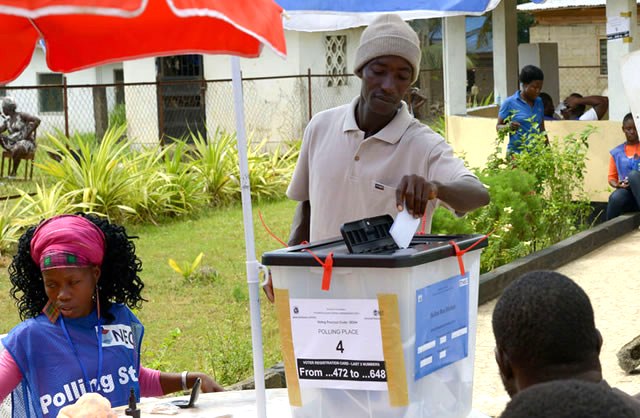
The Presidential election in Liberia is already under way, a poll that will see the country’s first transfer of power from one democratically elected leader to another in over 70 years.

President Ellen Johnson Sirleaf, Africa’s first female president, will step down when her second term expires in 2018. She has served a total of 12 years in office – the maximum that is allowed under the Liberian constitution.

In 2003, a brutal 14-year long civil war ended in Liberia, leaving an estimated 250,000 million people dead.

Under Sirleaf, the Liberian economy expanded at an average rate of 7.5 percent a year between 2006 and 2013 until the country was hit by the worst-ever Ebola epidemic that killed thousands of people.

As it stands currently, 20 candidates are jostling for the post of Presidentc, including an ex professional footballer, a former model, a rebel leader-turned preacher, a poultry farmer, a former Central Bank Governor and the current Vice President.

Here are some of them:

JOSEPH BOAKAI, 72

He is the current Vice President of Liberia and Leader of the ruling Unity Party, which is widely credited with consolidating peace in the country after the civil war. Previously he was Minister of Agriculture from 1983 to 1985.

Sirleaf is fully behind Boakai’s presidential bid and analysts believe her support counts for so much.

CHARLES WALKER BRUMSKINE, 66

Brumskine is the Political Leader of the opposition Liberty Party which came third in the 2005 Presidential election.

A former ally of Charles Taylor (currently serving a 50-year jail term in the UK), and former Senate President, Brumskine is considered the most popular opposition politician in Liberia.

GEORGE WEAH, 51

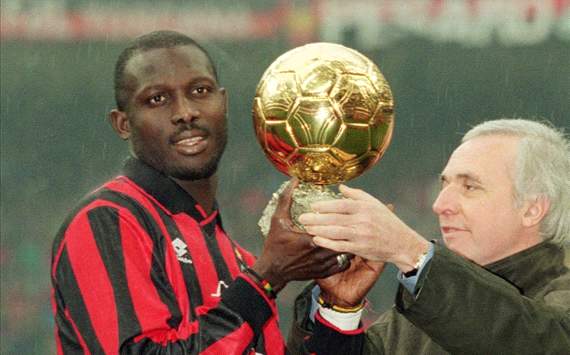
Weah is regarded as one of the all time African best football players. In 1995, while playing for AC Milan in Italy, he was named FIFA World Player of the Year and won the Ballon d’Or, becoming the first African player to win these awards.

He was also named the African Footballer of the Year in 1989, 1994 and 1995, and in 1996, he was named African Player of the Century.

As a politician, Weah ran unsuccessfully for president in 2005, coming second behind Ellen Johnson Sirleaf in the second round of voting. In 2011, he was the running mate to Winston Tubman as candidate of the Congress for Democratic Change. However in 2014, Weah was elected into the Liberian Senate.

MACDELLA COOPER, 40

Is a philanthropist and founder of the MacDella Cooper Foundation, an organization dedicated to improving the lives of children and women in Liberia.

Before delving into philanthropy, Cooper was professional fashion model and planner. She worked extensively in New York City, Paris, London and Milan, modelling for clients such as Ralph Lauren and Jones Apparel.

She was a regular feature in fashion magazines such as Glamour and Marie Claire.

The school run by her foundation, the MacDella Cooper Academy, currently houses 80 Students, aged 4 to 13 years.

YORMIE JOHNSON

Johnson, a former rebel leader, played a prominent role in the first Liberian civil war. It was Johnson’s men that captured, tortured and executed former President Samuel Doe, who had himself overthrown and murdered the previous president William R. Tolbert.

The gory incident was recorded and broadcast around the world. The video showed Johnson sipping a beer and being fanned by an assistant as his men cut off Doe’s ear.

Johnson was forced to flee to Nigeria to avoid capture by forces loyal to Charles Taylor, and so he was not involved in the second Liberian civil war.

While in Nigeria Johnson became a Christian and preacher. He reconciled with the Doe family through the intervention of Nigeria’s T. B. Joshua.

JOSEPH MILLS JONES

Jones is a Liberian politician and Former Executive Governor Central Bank of Liberia.

As CBL Governor between 2006 and 2016, Jones played a key role in managing the Liberian economy, and was an important member of the team that managed the debt relief process for heavily indebted poor countries with the International Monetary Fund (IMF).

BENONI UREY, 60

In 2014 ‘The Economist’, a UK-based business magazine reported that Urey was Liberia’s richest man.

Urey, a former Commissioner of Maritime Affairs, was said to have made his fortune through poultry farming, however there are indications that he may have profited from the series of civil wars that ravaged Liberia.

In 2000 Urey was sanctioned by the United Nations for his alleged role in arms procurement and also for his alleged “ongoing ties with Charles Taylor”.

His name was added to the US Treasury Department’s Specially Designated Nationals list, prohibiting him from conducting business with US companies, citizens and residents, and blocking all US based assets.

But currently, Urey owns a number of businesses including Lonestar Cell (Liberia’s largest mobile network provider), Wuki Farms, Love Media, U-Housing etc

OTHERS

The other contestants include: Alexander B. Cummings (former Executive Vice President and Chief Administrative Officer of Coca-Cola); MacDonald Wento; Jeremiah Whapoe; and Richard Miller;

A candidate must get at least 50 percent of the votes cast, plus one, in order to be declared outright winner. However, if no clear favourite emerges, a second round of voting is likely.

Liberians will also elect 73 members of the House of Representatives or the upper house, where the representative with the highest number of votes is elected. No senators (lower house) will be elected this year.

And as the attention of the world turns to Liberia, albeit for a few days, the words of President Sirleaf to citizens of the country re-echoes:

“Go to the polls peacefully, respecting every Liberian’s right to vote with dignity and pride. Embrace your neighbour, regardless of their political choice. The future of the country is in your hands. Vote for the person and persons you believe will make Liberia a better place. The world will be watching. Let’s make them proud.”

Kaduna State shopping for primary school teachers after almost 22,000 failed screening

The Kaduna State government says it will recruit 25,000 fresh primary school teachers following the woeful performance of almost 22,000 teachers during a screening exercise.

Nasir El-Rufai, the Kaduna State Governor made this known when a World Bank delegation paid him a courtesy visit at the Government House in Kaduna on Monday.

El-Rufai said that 21,780 out of 33,000 teachers failed the primary four pupils’ exams which they were mandated to take as a test of competence.

“We tested our 33,000 primary school teachers, we gave them primary four examination and required they must get at least 75 per cent but I am sad to announce that 66 percent of them failed to get the requirements,” El-Rufai said.

“The hiring of teachers in the past was politicized and we intend to change that by bringing in young and qualified primary school teachers to restore the dignity of education in the state.

“We have a challenge with the teacher-pupil ratio in the urban schools; there is concentration of teachers that are not needed.

“In some local government areas, it’s a teacher pupil ratio of 1-9 while in some places it’s 1-100.”

El-Rufai noted that directors of schools in the state have decided to enrol their children and wards in public schools starting from the 2017/2018 academic session in order to demonstrate their commitment to improving the education sector in the State.

Kunle Adekola, leader of the World Bank delegation, commended the El-Rufai-led Kaduna State government for investing in education, especially with the priority given to the girl child.

As part of its support for the state, Adekola pledged that the World Bank will invest N30 million into Rigasa Primary School, which has one of the largest population of pupils in Kaduna State – about 22,000.

The News Agency of Nigeria (NAN) reports that the Education Intervention Fund, an initiative of the World Bank, together with other development partners, renders support to about 13 Northern states as well as a state from each of the other geopolitical zones of Nigeria.

Agbakoba sues FG over exclusion of South East from NNPC Board


Olisa Agbakoba, a former President of Nigerian Bar Association (NBA) has sued the Federal Government over alleged “lopsided appointments” at the Nigerian National Petroleum Corporation (NNPC).

According to a statement signed on Monday by Niyi Odunmorayo, his media assistant, Agbakoba made the allegation in a suit filed at the Federal High Court, Abuja.

In the suit, he challenged the non-inclusion of persons from the South East of the country in appointments in the NNPC Board.

Agbakoba alleged that the appointment made by the Federal Government contravened the provisions of Section 14 of the Constitution, as well as the Federal Character Commission Act.

He stated that it was also in contravention of the “provisions of Sections 42 of the Constitution of Nigeria that prohibits discrimination of any of Nigeria’s ethnic groups such as, in this case, the South East”.

He requested the court to declare the“lopsided appointments” of board members of the NNPC unconstitutional, null and void.

No date has yet been fixed to hear the suit.

The board members of the NNPC as announced by Buhari in July 2016 include: Ibe Kachikwu (Minister of State for Petroleum Resources and Chairman of the board); Maikanti Baru (NNPC GMD); Abba Kyari (Chief of Staff to the President); Mahmoud Isa-Dutse (Perm. Sec. Ministry of Finance); Pius Akinyelure; Tajudeen Umar; Thomas M.A John; Mohammed Lawal and  Yusuf Lawal.

KACHIKWU’S ALLEGATIONS: NNPC responds to one, keeps mum on the other

In a memo to President Muhammadu Buhari,  Ibe Kachikwu, the Minister of State for Petroleum Resources raised two strong allegations against  Maikanti Baru, Group Managing Director of the Nigerian National Petroleum Corporation (NNPC).

The first allegation was that Baru made key appointments in NNPC without the input of NNPC board which Kachikwu chairs while the second was that Baru unilaterally awarded contracts running into billions of dollars without the consultation of the minister and the board.

On Monday, the NNPC responded only to the allegation on the award of contracts, saying the approval of neither the minister nor the board was required before those contracts were awarded.

In the leaked memo that has generated controversy, Kachikwu complained bitterly that high profile appointments were made in NNPC in an apparent insubordination and humiliation from Baru because he was not consulted even though he is the chairman of the NNPC board.

Part of the memo reads “Mr. President, yesterday like many other Nigerians. I resumed work confronted by many publications of massive changed within NNPC. Like the previous reorganizations and reposting done since Dr. Baru resumed as GMD. I was never given the opportunity before the announcements to discuss these appointments. This is so despite being Minister of State of Petroleum and Chairman NNPC Board.

“The Board of NNPC which you appointed and which has met every month since its inauguration and, which by the statues of NNPC is meant to review these planned appointments and postings, was never briefed. Members of the Board learned of these appointments from the pages of social media and the press release of NNPC.

“At the minimum and like all other Parastatals being supervised by me at the Ministry have continued to do, and in compliance with the proper governance standards expected of a serious public institution, these executive actions by NNPC were supposed to benefit from mine and the Board’s input prior to presentation to you. This was never done.

“Indeed, in anticipation of vacancies that would arise from retiring senior executives of NNPC, I wrote the GMD A letter requesting that we both have prior review of the proposed appointments. This was to enable me to present same to the Board or give an anticipatory approval and then review with the Board later (Appendix 1). I wrote to the GMD given previous happenstance of this nature, in addition, thereafter, I called the GMD to a private meeting where I discussed these issues. Needless to say that, not only did he not give my letter the courtesy of a reply, he proceeded to announce the appointments without consultation or Board concurrence.

“Mr. President please not that there is a Board Services Committee whose function is to review potential appointments and terminations of Senior Staff prior to implementation. This committee was also not consulted.

“The above is just one of the many occurrences of disrespectful experiences I have encountered with the GMD as your Minister of State.”

While the NNPC responded to the allegation on the award of contracts, it kept silent on the equally weighty allegation of Baru making important appointments without the knowledge of the NNPC board of which Kachikwu is the chairman.

Osinbajo: Running for presidency not on the cards now

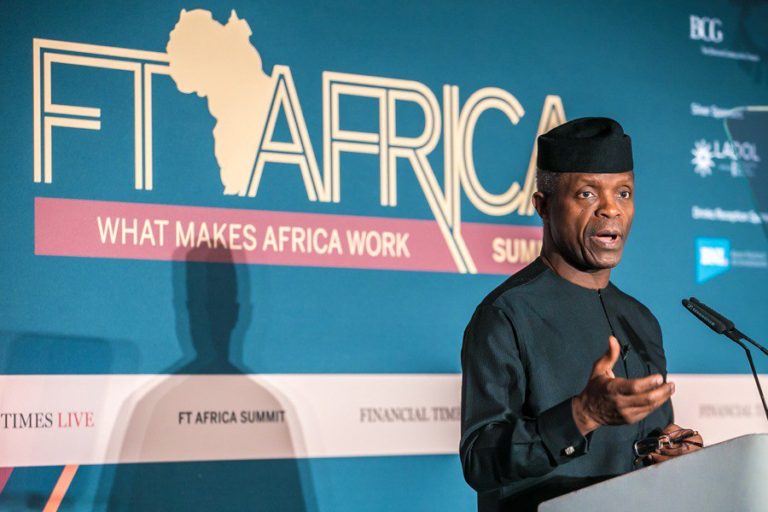
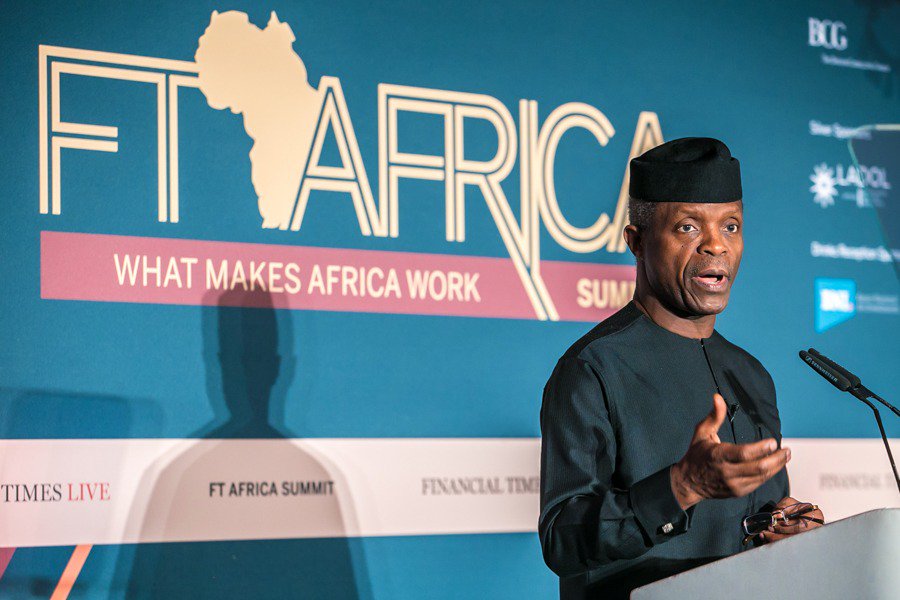
Vice President Yemi Osinbajo, says running for presidency in the 2019 general elections is not on his cards now.

Osinbajo told Reuters on Monday at the Financial Times Africa conference in London where he is one of the speakers, that he had not given any thought to contesting the presidential election in 2019 adding that he has no timeline for when he may make such a decision.

This comes amid speculations as to whether President Muhammadu Buhari, who has battled with an undisclosed ailment, would seek re-election or bow out after one term, and whether Osinbajo could decide to run in the 2019 elections should Buhari decide not to re-contest.

But when asked about that possibility, the Vice President said “none of that is on the cards”.

Osinbajo also spoke about the activities of militants in the oil producing Niger Delta region, saying that they no longer pose a significant threat to oil production.

He however said that Nigeria is aware of the dangers of over-reliance on oil as sole source of foreign revenue and is working to diversify its economy.

“We don’t have all the time in the world with oil. We have to use oil while it makes sense to do so,” he said


Read also:

Approval of Minister of State not required for award of contracts, says NNPC

The Nigerian National Petroleum Corporation (NNPC) says the approval of the Minister of State for Petroleum resources is not required before contracts could be awarded.

Ndu Ughamadu, General Manager Public Affairs of the NNPC, made this known in a statement issued on Monday.

This is following the brouhaha caused by a memo written to President Muhammadu Buhari by Ibe Kachikwu, the Minister of State for Petroleum Resources, which was leaked to the media.

In the memo, Kachikwu alleged that Maikanti Baru, the Group Managing Director of the NNPC, unilaterally awards contracts running into billions of dollars without the approval of the board of which he (Kachikwu) is the Chairman.

He also said appointments into strategic positions in The NNPC were made without any input from the board, among other acts of “insubordination” by Baru.

However, according to the statement by the NNPC, the only approval required before certain contracts could be awarded is that of the Minister of Petroleum or the Federal Executive Council.

“It is important to note from the outset that the law and the rules do not require a review or discussion with the Minister of State or the NNPC board on contractual matters but the President’s approval in his executive capacity as Minister of Petroleum, or the Federal Executive Council (FEC) as the case may be,” the statement read.

“There are therefore situations where all that is required is the approval of the NNPC Tenders Board while, in other cases, based on the threshold, the award must be submitted for presidential approval. Likewise, in some instances it is FEC approval that is required.

“It should be noted that for both the Crude Term Contract and the Direct Sale and Direct Purchase (DSDP) agreements, there are no specific values attached to each transaction to warrant the values of $10billion and $5billion respectively placed on them in the claim of Dr. Kachikwu.

“It is therefore inappropriate to attach arbitrary values to the shortlists with the aim of classifying the transactions as contracts above NNPC Tenders Board limit.

“They are merely the shortlisting of prospective off-takers of crude oil and suppliers of petroleum products under agreed terms.

“These transactions were not required to be presented as contracts to the Board of NNPC and, of course, the monetary value of any crude oil eventually lifted by any of the companies goes straight into the federation account and not to the company.”

The statement also noted that “contrary to the assertion of Dr. Kachikwu that he was never involved in the 2017/2018 contracting process for the Crude Oil Term Contracts, Dr. Kachikwu was in fact expressly consulted by the GMD and his recommendations were taken into account in following through the laid down procedure.”

“Thus, for him to turn around and claim that “…these major contracts were never reviewed or discussed with me…” is most unfortunate to say the least.”

Kachikwu and Buhari met behind closed doors on Friday and their discussion is believed to be based on the NNPC controversy, even though Kachikwu refused to speak to the press after the meeting.

Soldiers raid Nnamdi Kanu’s home again

The Nigerian Army conducted another raid on the home of Nnamdi Kanu, leader of the Indigenous People of Biafra (IPOB) in Afaraukwu, Umuahia, the Abia State Capital, on Sunday.

Emmanuel Kanu, younger brother to Nnamdi Kanu made this known to the media on Monday, saying that the soldiers said they were searching for ‘technical items.’

According to him, the soldiers carted away some items from the house including television sets, generator and clothes.

The younger Kanu appealed to the Federal Government and the international community to direct the army to stop harassing his family.

He also asked the army to let the world know where they have taken his brother to.

Confirming the development, a military personnel who refused to give his name said it was a joint operation between the army and other security agencies.

The unnamed army official who is also the desk officer of the Operation Python Dance in Abia State said the raid was informed by a recent intelligence report which suggested that arms were hidden in the compound.

He however refuted the claims by Kanu’s brother that television sets and generators were removed from the house by soldiers.

“The things removed may be technical items…Somebody was arrested with weapon in the compound,” he said.

Soldiers first invaded Kanu’s residence on September 10, following the declaration of the IPOB as terrorist group by the defence headquarters. Kanu’s whereabouts has remained unknown ever since.

However, John Eneche, Director of Defence Information, denied that soldiers ever raided Kanu’s home.

“I saw everything, nobody raided Kanu’s house. I stand to justify it not from the information I got. I was watching it live. I was monitoring it live,” Enenche said.