Home Blog Page 2727

Policemen rob Jonathan’s house, cart away multi-million-naira items


Police officers have burgled and looted an Abuja home of Goodluck Jonathan, former President of the country.

According to PREMIUM TIMES, the three police officers involved in the criminal act were assigned to guard the house. They have been arrested for stealing items valued at several millions of naira from the house, located at No. 89, Fourth Avenue, in the Gwarimpa district of Abuja.

Items allegedly stolen by the policemen include sets of furniture, dozens of plasma television sets, refrigerators, air-conditioner units and box-loads of clothes such as designer suits imprinted with the former president’s name, male and female Ijaw traditional attires, lace materials and bowler hats.

The three mobile police officers conducted a systematic looting over a period of three months, beginning from around March 2016, until they totally stripped the house of all movable items, which they sold piecemeal to dealers at the Panteka second-hand materials market in Tipper Garage, Gwarimpa.

Ikechukwu Eze, Jonathan’s spokesperson, has confirmed the theft and the arrest of the officers.

Jonathan had lived in the house for about a year when he was Vice President. His mother was said to have assumed residence there after Jonathan moved to the Aso Rock Villa upon becoming Acting President in 2010.

The paper said its investigation could not ascertain when and why Jonathan’s mother vacated the residence, leaving it under the guard of the police officers.


READ ALSO:

Port Harcourt court sentences three to death over ‘Aluu Four’ murder


The Rivers State High Court has found three persons guilty of the killing of three students in Aluu community the state, in 2012.

Letam Nyordee, the presiding Judge, who gave the judgementin Port Harcourt, capital of the state capital, on Monday, sentenced the trio to death.

He also discharged and acquitted four other persons that were joined in the suit, saying the prosecution did not do enough to prove beyond reasonable doubt that the 4th, 5th, 6th and 7th respondents killed the deceased students.

The 1st to 3rd defendants were however declared guilty as charged.

The deceased students — Ugonna Obuzor, Toku Lloyd, Chiadika Biringa, and Tekena Elkanah — were all students of the University of Port Harcourt. They were lynched by a mob after they were falsely accused of theft on October 5, 2012.

The incident was filmed by bystanders and uploaded to the Internet. It is believed that the police used the recorded video clip to apprehend the principal actors in the incident and charged them to court for pre-meditated murder.

After begging for funds all over the world, UN sends $10.5m to Nigeria’s northeast


The United Nations, through a new fund set up to tackle the crisis-hit northeast, has allocated over $10.5m to help thousands of women, children and men in need of life-saving humanitarian assistance.

This was part of the money raised from the worldwide appeal for Nigeria this year for $1.05bn to help millions of people displaced by Boko Haram.

It is the fourth largest single-country appeal globally, says a statement on Monday by the UN Office for the Coordination of Humanitarian Affairs (UNOCHA) in Abuja.

The Nigeria Humanitarian Fund was launched during the Oslo Humanitarian Conference on Nigeria and the Lake Chad Region in February 2017 and has so far received $25 million in contributions and pledges from different countries.

“This crisis has caused an untold loss of life and liberty across the north-east of Nigeria and civilians continue to bear the brunt of the conflict,” Edward Kallon, Resident and Humanitarian Coordinator in Nigeria, said in the statement.

“These funds will go towards addressing some of the key priority areas in the humanitarian response that have not yet been financially supported, including the provision of safe drinking water, emergency shelter and health services to those in need.”

According to the statement, specifically, the $10.5 million will fund about 15 different projects, which were selected by the various sectors of the humanitarian response and approved by the NHF Advisory Board.

It said the projects target and address the needs of the most vulnerable people in locations where access is sporadic and where flooding, disease outbreaks and new displacements continue to take place such as Monguno, Mafa, Pulka and Rann (in Borno State), and Michika (in Adamawa State).

The statement added that the funds will also support efforts to enhance the protection of civilians in vulnerable communities and those trapped in conflict areas.

The humanitarian crisis in northeast and the Lake Chad region is one of the most severe in the world today, with 8.5 million people in need of humanitarian assistance in the three worst-affected states of Borno, Adamawa and Yobe alone.


READ ALSO:

Kachikwu: We may stop oil production — the current costs ‘do not make sense’


Ibe Kachikwu, Minister of State for Petroleum Resources, says Nigeria will rather stop production of crude oil than keep doing it at very high cost.

Kachikwu made the comments on Monday at the Nigeria Annual International Conference and Exhibition, organised by the Society of Petroleum Engineers in Lagos.

He said many countries around the world have managed to reduce their production cost over the years but Nigeria’s has remained “stubbornly” high.

“When you look at the cost of production in Nigeria, it remains blatantly high. Our cost per barrel today is about $27 per barrel for JV (joint venture) fields,” he said.

“In Saudi Arabia, it is about $9. So we are way apart in terms of cost that anything that happens will hit us very hard.

“Even though we have been singing over the last two years that we need to drive cost down, the current figure that I still have, showing me the numbers of last year, have not shown me a major dramatic reduction in the cost of production.

“There is no way this country will produce oil at this sort of swelling prices that we see; there will be no margins left for this country.

“For me, you rather leave the oil in the ground than produce at a cost that doesn’t make sense. So, cost is going to be a very high driver. So that is certainly one area we are focusing on; we are working collaboratively with oil companies.

“But let’s make no mistake about it: If we cannot negotiate it down, we will compel it or we will stop the production; it does not make any sense.”

Kachikwu said that only oil companies who are able to drive down costs will be given favourable consideration in the oil sector, going forward.

According to Bloomberg, the price of a barrel of crude oil hovers around $52.5 as of Monday.

Nigerian military’s half-truth and propagandist war against Boko Haram

0

Conscience is an open wound: only truth can heal it —  Uthman Dan Fodio (1754-1816).

This is the 13th month since I stopped believing the official statements of the Nigerian military. In that time frame, I have edited and published reports written from the military’s press releases without believing the contents. As a full-time journalist, this is an extremely difficult admission to make. Impartiality in news reporting demands that the journalist separates his belief from the job, or — to be more brutal with the truth — that belief is suppressed for reporting. Knowing the gulf between belief and reporting is what separates the journalist from the person.

No one needs to be told that propaganda is a generously-deployed item in any military’s weaponry of war, but never would I have imagined that the Nigerian military’s case was of such extreme proportions. As we all now know, propaganda precedes arms, ammo and artillery in the war of the Nigerian military, particularly the army, against Boko Haram.

THE TRUTH CAN’T BE HIDDEN FOREVER

On Tuesday, an oil exploration team comprising staff of the Nigerian National Petroleum Corporation (NNPC) and the University of Maiduguri was ambushed in Magumeri Local Government Area of Borno State, despite having the escort of soldiers and civilian Joint Task Force (JTF) members. Majority of the contingent were killed while some were kidnapped; a few of them managed to escape. The following day, the army claimed it had rescued “all the NNPC staff”.

“So far, they have rescued all the NNPC staff and recovered the corpses of the officer, eight soldiers and a civilian have who have been evacuated to 7 division medical services and hospital,” Sani Usman, army spokesman, said.

It soon emerged that the army had lied. ‎Ibe Kachikwu, Minister of State for Petroleum Resources, was the first to subtly expose the army. “We only heard, but can’t confirm if anyone has been rescued,” Kachikwu said one full day after the army’s supposed rescue. A senior military official surreptitiously told the media that the military was trying to conceal the casualty toll, adding that for several hours after the attack, there was in fact no reinforcement team to support the victims.

As the bodies of the victims began arriving the UNIMAID teaching hospital, a cover-up had simply become impossible. There are still conflicting media reports on the death toll; while the minimum valuation is 48, figures of “more than 50” and 69 have also been mentioned. What is no longer in conflict is that scores were massacred by Boko Haram, nine of them lecturers of UNIMAID’s Geology and Survey department.

Ordinarily, the army would have gone scot-free with the misinformation. There were two reasons why the lie was exposed this time: some of the victims were NNPC staff and the corporation couldn’t possibly lie to the media that its missing staff had been found; nine other victims had put a minimum of 10 years into their UNIMAID careers; there was no way key officers of the university would hide their grief. They were influential people — important members of the academia; such deaths are impossible to cover.

A HISTORY OF BAREFACED COVER-UPS

Hundreds of ‘not-so-influential’ soldiers and civilians have had their deaths smothered. For example, during an undercover investigation to the northeast in June 2016, I discovered that the army had been grossly reducing the figures of slain soldiers. In the six months of that year alone, I CONFIRMED that more than 900 soldiers had been killed by Boko Haram. According to all press releases by the army in that same space of time, the figure was not even up to 100. That’s at least nine times an undervaluation of the casualty toll on the army’s side.

On November 18, 2015, a 330-man army deployed to Gudumbali, Borno State, was the victim of an unexpected attack that left 183 soldiers either dead or unaccounted for. The army covered it up, only issuing a statement after Premium Times reported the attack. Even then, it merely dismissed the attack as “a minor setback”, and it’s rejoinder to a follow-up report by the ICIR failed to acknowledge the death of a single soldier. What the army did not know was that the ICIR report was prompted by hard evidence, as the investigative newspaper was in possession of a video of the attack.

In January 2017, shortly before the accidental bombing in Rann that resulted in the death of at least 126 civilians, 42 Internally Displaced Persons (IDPs) were accidentally gunned down by soldiers after they were mistaken for insurgents. The IDPs got clearance to enter the bush in search of firewood but they died at the hands of soldiers from Marte who were on patrol. The story was largely suppressed by the army, but — no longer able to hold his peace after the Rann bombing — the second mistake in two weeks — a military source spilled it out.

THE DOWNSIDE OF PROPAGANDA

In all the three cases mentioned, the army did not take kindly to the journalists and media houses behind the revelations. After my Forgotten Soldiers series of 2016, the army accused me of committing subversion — a treasonable offence punishable with death in a military regime. I expect a similar reaction to this op-ed but I remain an ally of the army, despite my disenchantment with its media strategy. I am first an admirer of the valour of Nigerian soldiers, and — despite my aforementioned examples of unimpressive information management by the army — I still firmly believe that the army is winning this war against Boko Haram. I have previously documented the army’s great work in restoring the suitability of many parts of Borno for habitation. I have also reported how soldiers are dealing with Boko Haram, and paid tributes to the officers coordinating the operations.

When superficially examined, the army’s information strategy looks understandable: minimise the damage, free the public from apprehension, obliterate any trace of defeat at the doorstep of the armed forces, starve the enemy of ego. Unfortunately, the current strategy is fast proving counter-productive, already upturning the results it was meant to deliver.

Public trust in the army is a crucial component of the war against insurgency. The people must be able to trust in the integrity of the armed forces; they must be able to rely on the army for the true picture of the war. Frequent release of false statements has rendered the army vulnerable to public distrust and left the people nursing far more apprehension than they ordinarily should. As journalist Frederick Nwabufo already asked, why should we still trust the claims of the military in this war?

The strategy is also undermining the military’s good work in this war, and this is my ultimate worry. With the false success claims about the latest attack, the public is right to believe that the military is living in perpetual denial. The ‘Boko Haram is back’ narrative is gaining traction not just because of renewed attacks but due to the fuel supplied by the military’s pompous PR. Denials like this are the reason the people find it hard to believe that Boko Haram was ever driven out of Sambisa, or that the war is being won at all. The military must rethink its information management strategy, else it will end up winning the war yet losing the people for whom it went to war in the first place.


VIDEO: How CNN’s Fareed Zakaria ridiculed Nigeria


Fareed Zakaria, a CNN TV presenter, made mockery of President Mohammadu Buhari’s ill-health on his programme, The Global Public Square (GPS) on Sunday.

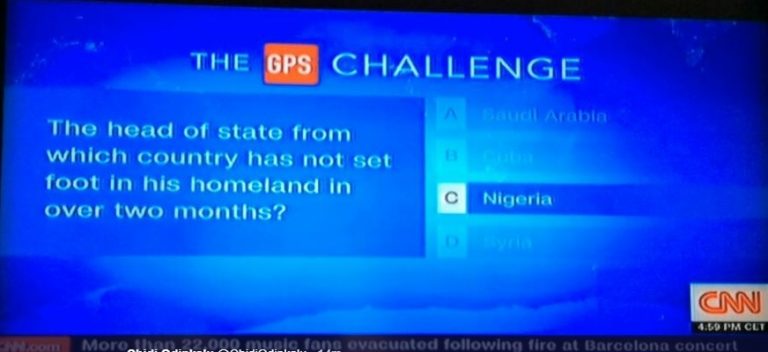
He posed a cheeky quiz saying: “The head of state from which country has not set foot in his homeland in over two months?”

And in the options he mentioned Saudi Arabia, Cuba, Nigeria and Syria, with the answer given eventually as Nigeria.

Watch the video below:

EXTRA: Nigeria mocked on CNN over Buhari’s ill-health


Nigeria was the butt of a cheeky piece of trivia on the latest edition of The Global Public Square (GPS), a foreign affairs show anchored on CNN by Fareed Zakaria.

In an apparent mockery of President Muhammadu Buhari’s ill-health and Nigeria’s health sector, the following trivia was displayed at 4:59pm on Sunday: “The head of state from which country has not set foot in his homeland in over two months?”

The options were given as Saudi Arabia, Cuba, Nigeria and Syria, with Nigeria eventually confirmed the answer.

A screenshot of the trivia was tweeted by Chidi Odinkalu, Chairman of the National Human Rights Commission (NHRC).

Buhari has been receiving medical attention in the United Kingdom since May 7.

Yemi Osinbajo, his deputy, visited him on July 11, and returned the following day to say the President would return to the country “sooner than you expect”.

In the last week, two separate batches of governors visited him the UK as well, many of them expressing divergent opinions of how soon the President is likely to be back in the country.

Police have no single evidence against Evans, says lawyer


Olukoya Ogungbeje, lawyer of Chukwudi Onwuamadike, the self-confessed billionaire kidnapper popularly known as Evans, says the police do not have any single evidence against his client.

“Do you know that till date, the police don’t have any witness? Do you know that till date they don’t have any single evidence?” he said in an interview with Premium Times.

“Do you know that till date there is no case file on that case? It is the case we filed in court that put them on their toes; they are now running helter-skelter.”

Ogungbeje denied that the police obtained court order to keep Evans without charging him to court as the law requires, saying that the police have been engaging in media trial of his client without doing their work.

“The time they should have used in investigation, they were busy grandstanding, lying to the public that they had court order,” he continued.

“They don’t have any court order. Tell the Police Public Relations Officer to publish the court order that they have. No court has the power to expand the two days period for which you can detain a suspect.

“This is the first time a suspected criminal will be telling the police, ‘charge me to court’. It has never happened before. And if the police have all the proofs and have concluded their investigating activity, they should charge him to court — not [leave him] in the court of public opinion.”

Ogungbeje filed a fundamental rights enforcement action for the release of his client but Evans later denied that he asked the lawyer to file the suit on his behalf.

However, the lawyer said he has the full support of the Evan’s family to proceed with the case. He also alleged that the police forced Evans to make the statement.

“For the record, the statement he made is a police-induced statement; it’s a police-forced statement,” he said. “It was the police that was talking. They brainwashed him and forced him to make such statements. When we get to court, you will see it will fall like a pack of cards.”

Ogungbeje said he believes that as a legal practitioner, he has the right to represent Evans no matter how grave the crime is, as Evans is presumed innocent until proven guilty by a court of law.

Reps want to cripple civil society for generations to come, SERAP tells UN


Socio-Economic Rights and Accountability Project (SERAP) has asked the UN Special Rapporteurs to urgently “put meaningful pressure on the leadership of the National Assembly in Nigeria particularly, Yakubu Dogara, Speaker of the House of Representatives, to immediately withdraw the repressive bill to establish a commission that would monitor, supervise, de-register, and pre-approve all activities by civil society, labour, community-based organisations, and the media in the country”.

SERAP warned that if passed and signed into law by Acting President Yemi Osinbajo, the bill, sponsored by Umar Buba Jibril, Deputy Leader (PDP: Kogi State), would severely curtail the rights of all Nigerians to freedom of expression and freedom of peaceful assembly and association in the country.

Its appeal was contained in a letter dated July 28, 2017, sent to Annalisa Ciampi, Special Rapporteur on the rights to freedom of peaceful assembly and of association, Michel Forst, Special Rapporteur on the situation of human rights defenders and David Kaye, Special Rapporteur on the promotion and protection of the right to freedom of opinion and expression¸

In the letter, SERAP also urged the Special Rapporteurs to “prevail on the Acting President to decline to sign the bill into law; and on the House of Representatives and the Senate to exercise their legislative powers for good governance, and ensure a safe and enabling environment for civil society organizations both in practice and rhetoric, in line with the 1999 Constitution of Nigeria (as amended) and the government’s international human rights obligations and commitments”.

“The sole objective of the House of Representatives is to weaken and delegitimize the work of independent and credible civil society. If adopted, the bill which is copied from repressive countries like Somalia, Ethiopia and Uganda, would have a chilling effect not only on expressions of peaceful dissent by the citizens but also on the legitimate work of NGOs and individual human rights defenders and activists scrutinizing corruption in the National Assembly and exposing human rights violations by the government,” it said in the letter

Signed by Adetokunbo Mumuni, Executive Director of SERAP, the letter reads in part: “SERAP is seriously concerned that the bill is by far the most dangerous piece of legislation in the country in terms of its reach and devastating consequences not only for the work of civil society but also the effective enjoyment of constitutionally and internationally recognized human rights of the citizens. The bill will devastate the country’s civil society for generations to come and turn it into a government puppet.

“The bill is a further path of closing civic space in the country, something witnessed only under military regimes, and has no place in a democratic Nigeria. The bill is entirely unnecessary, as the work of civil society is already sufficiently regulated under existing legislation, including the Companies and Allied Matters Act, Economic and Financial Crimes Commission (EFCC) Act, the Independent Corrupt Practices and Other Related Offences Commission (ICPC) Act and other similar legislation.

“SERAP is also concerned that the proposed bill is coming at a time the members of the Senate and House of Representatives are proposing amnesty and immunity for themselves against prosecution for corruption and other economic crimes; and the government is proposing a social media policy to restrict and undermine citizens’ access to the social media ahead of the general elections in 2019.

“By including civil society in general, the bill will also undermine both section 22 of the 1999 Nigerian constitution and article 13 of the UN Convention against Corruption, both of which have given the media a critical role to ensure that the government, at all levels, is accountable to the citizenry.

“The bill would subject Nigerians and civil society to extensive government control and interference that it would negate the very essence of the constitutionally and internationally recognized rights to freedom of expression, association and peaceful assembly.The bill also raises serious concerns about the commitment of Nigerian lawmakers and the government to good governance and basic freedoms in a democratic society.

“SERAP fears that the overbearing bill would inhibit and obstruct the ability of Nigerians to work collectively through local and international organizations on any human rights, transparency and accountability research or advocacy that may be deemed contrary to “the national interest” of Nigeria, or not “consistent with the programmes of government.

“The provisions of the bill are also not subject to any judicial oversight. SERAP believes that independent groups and activists should have space to carry out their human rights and anticorruption work without fear of reprisals, such as losing their registration or being sent prison.

“Apart from the Nigerian Constitution, article 22 of the International Covenant on Civil and Political Rights and article 10 of the African Charter on Human and Peoples’ Rights to which Nigeria is a state party guarantee the rights to freedom of expression, association and peaceful assembly. The African Commission on Human and Peoples’ Rights has made clear that the charter does not allow governments to “enact provisions which would limit the exercise of this freedom.” The African Commission has consistently criticised restriction on the work of civil society.

“SERAP is concerned that by proposing this bill, Nigeria’s parliament is trying to immune itself from public criticism and scrutiny. If this bill is passed into law, good governance, the rule of law and respect for human rights of Nigerians would become a farce in the country. By gagging civil society from criticising the National Assembly and the government, the bill will undercut the rule of law, shrink civic space, and expose vulnerable Nigerians to greater level of injustice and repression.

“Civil society groups play a key role in holding government and parliaments accountable but without a strong civil society in Nigeria, the problem of high-level official corruption and other cases of violations of human rights would go unaddressed, and perpetrators would continue to enjoy impunity.”

SERAP therefore urged the Special Rapporteurs to: publicly condemn the bill as inconsistent and incompatible with Nigeria’s international obligations to respect, protect, promote and fulfil the citizens’ rights to freedom of expression, association and peaceful assembly.

We didn’t deliberately claim we had rescued slain oil exploration team, says army


The Nigeria Army has apologised for its earlier statement that it had rescued all the members of the oil exploration team ambushed by Boko Haram in Maiduguri on Tuesday.

Sani Usman, Spokesman of the Army, gave the apology through a statement issued on Sunday.

He said that 21 additional bodies and various calibres of weapons were recovered in another rescue operation.

“So far the search and rescue team has recovered additional bodies of five soldiers, 11 members of the Civilian Joint Task Force (CJTF) and five members of the exploration team,” Usman wrote.

“Contrary to reports in some media, six out of the 12 members of the exploration team that went out are still missing, while one of the NNPC staff returned to base alive.

“The incident of 25th July 2017, where Boko Haram insurgents ambushed our troops including members of the CJTF) escorting some staff of the NNPC as well as that of University of Maiduguri (UNIMAID) on oil exploration in Yesu District of Magumeri Local Government Area of the state, is unfortunate and highly regrettable.

“Most regrettable also is my earlier release on the said incident about the rescue of all NNPC Staff. The error in the statement was not deliberate.”

It will be recalled that the Nigerian Army had earlier claimed to have rescued all the abducted university’s personnel.

“Search and rescue is still ongoing to secure the safe return of the remaining civilians,” he said. “The Nigerian Army condoles with the families of all that lost their loved ones in this unfortunate incident.”

Usman said the weapons recovered from the insurgents include three gun trucks belonging to the Army, “four Rocket Propelled Grenade (RPG), four RPG chargers, six AK-47 rifles, one Anti-Aircraft Gun, one General Purpose Machine Gun, one Anti-Aircraft Gun Barrel, one RPG tube, four dane guns, eight tyres and two rims.”

Others include “one pumping machine gun, two tyre jacks, one super battery, five reflective jackets, three Toyota Hilux, four jerry cans filled with petrol, one Motorola radio, one Geographical Positioning System (GPS), 21 empty jerry cans, two shovels and three food coolers.

“Troops also recovered 122 rounds of PKM ammunition, 213 rounds of 7.62mm NATO ammunition, 1255 Anti-Aircraft Guns ammunition, four boxes of API 12.7mm ammunition, one AK-47 Rifle Magazine, a digger, two bows and 13 Arrows, two LLG bombs, assorted drugs and working tools”.

He urged the general public to volunteer “valuable information that could help in the search and rescue operation”.