CONTROVERSIAL Nigerian singer, Habeeb Okikiola, popularly known as Portable, has been remanded at the Oke Kura Correctional Centre in Ilorin, the Kwara State, for failing to meet bail conditions set by an Upper Area Court.
The singer was arraigned on Monday, April 14, before the Area Court sitting in Ilorin over allegations of defamation character levelled against him by a Fuji musician Akorede Saheed, also known as Saheed Osupa.
The court granted him bail of N1 million among other conditions, shortly after the charges were read, but the singer was unable to meet the bail requirements as of the time of filing this report, according to media reports.
The singer was also asked to provide two sureties in like sum. The sureties must be either the Chairman or Secretary of the Performing Musicians Association of Nigeria (PMAN) and the other must be a resident property owner in a Government Reserved Area (GRA) in Ilorin, with a valid Certificate of Occupancy as proof.
The ICIR reported that Kwara State police on Sunday, arrested singer ‘Portable’, over allegations of criminal defamation, threat to life, and incitement against Osupa.
The controversial musician was also accused of character assassination by the police.
Police Public Relations Officer (PPRO) of the Kwara Command, Superintendent (SP) Adetoun Ejire-Adeyemi, in a statement released on Sunday, April 14, said the command acted by the law after receiving credible evidence to support the petition.
According to the police, the petition borders on serious allegations, which include criminal defamation, threat to life, incitement, character assassination, conduct likely to cause a breach of peace, and the use of abusive and insulting words.
The police said Portable was arrested in Abeokuta, Ogun State, on Saturday, April 13, 2025, around 7:25 pm, by Kwara State Police officers who had obtained an arrest warrant from a Magistrate Court in Ilorin.
The ICIR reported that Portable surrendered to the Lagos State Police Command in February 2025 after he was declared wanted by the Ogun State Police Command.
His then arrest followed an incident on February 5, 2025, in which he was accused of leading a violent attack on government officials from the Ogun State Ministry of Physical Planning and Urban Development during an enforcement exercise in Ota.
A professor, Abayomi Sunday Fasina who is the vice-chancellor of the Federal University Oye-Ekiti (FUOYE), has been directed to proceed on a six-month leave by the university’s Governing Council.
Fasina is currently under investigation over allegations of sexual harassment within the institution.
In the interim, Deputy Vice-Chancellor a professor, Olubunmi S. Shittu has been appointed to serve in an acting capacity.
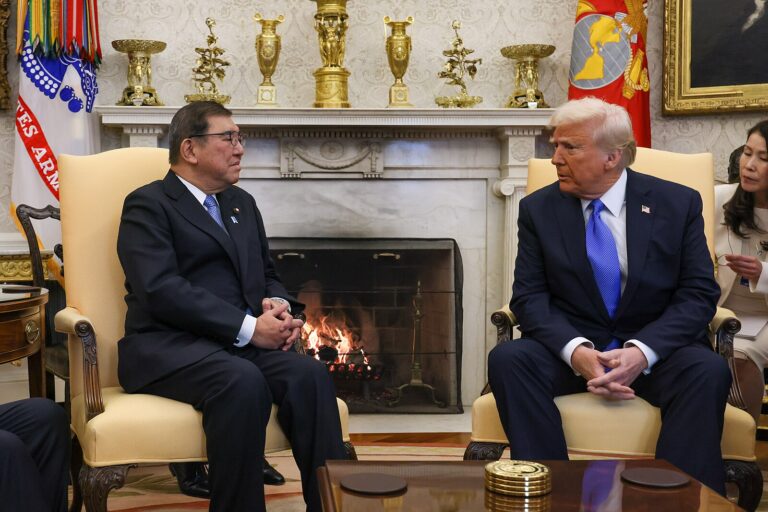
JAPANESE Prime Minister Shigeru Ishiba has said the nation has no intention of making significant concessions or hastily finalising an agreement in the upcoming tariff negotiations with President Donald Trump’s administration.
Ishiba disclosed this on Monday, April 14, during parliament, in response to President Trump’s 24 per cent tariff on Japanese exports to the United States.
However, like many of Trump’s broad “reciprocal” tariffs, the measure has been temporarily suspended for 90 days, during which a universal 10 per cent rate applies, along with a 25 per cent duty specifically on cars.
The ICIR reported that President Trump said last week that his government was working on “tailored deals” with trading partners, noting that he would prioritise allies like Japan and South Korea.
As a result, the Trump administration has scheduled talks with South Korea and Japan, while Italian Prime Minister Giorgia Meloni is expected to visit on Thursday this week.
The two countries are set to begin trade talks in Washington on Thursday, with discussions expected to focus on tariffs, non-tariff barriers, and exchange rates.
“I’m not of the view that we should make big concessions for the sake of wrapping up negotiations quickly,” Ishiba told parliament, while ruling out the possibility of imposing Japanese tariffs on United States imports in retaliation.
“In negotiating with the United States, we need to understand what’s behind Trump’s argument, both in terms of the logic and the emotional elements behind his views,” Ishiba said, noting that United States tariffs have the potential to disrupt the global economic order.
Japan, a long-time United States ally, and its biggest export destination and automobile shipments accounts for roughly 28 per cent of its exports.
Along with its significant trade surplus with the United States, Trump has also accused Japan of deliberately keeping the yen weak, leading to expectations that Tokyo may face pressure to strengthen its currency.
This is despite a recent broad dollar sell-off that has driven the yen higher.
The dollar fell 0.62 per cent to 142.62 yen on Monday.
Sources have previously indicated that the Bank of Japan’s gradual approach to raising borrowing costs from ultra-low levels could also face criticism during the talks.
Economy Minister Ryosei Akazawa, who will head Japan’s delegation, stated that any discussions regarding currency exchange rates will be conducted between Japanese Finance Minister Katsunobu Kato and United States Treasury Secretary Scott Bessent.
“Both countries share the view that excessive market volatility would have adverse effects on the economy,” Kato said.
Japan has traditionally aimed to curb excessive appreciation of its currency, since a strong yen negatively impacts its export-driven economy. However, in recent years, a weak yen has posed a greater challenge by increasing import costs and dampening consumer spending.
Lawmakers from both ruling and opposition parties have intensified calls for the government to reduce taxes or provide cash handouts to help ease the economic strain caused by rising living costs and Trump’s tariffs.
Ishiba stated that the government is not currently considering a supplementary budget but is prepared to take timely action to mitigate any economic impact.
GOVERNOR Dauda Lawal of Zamfara State has claimed that his administration met only N4 million in the state’s treasury upon assumption of office in 2023.
Lawal, who spoke during an interview on Arise TV on Monday, April 14, said his government also inherited a heavy debt burden from the previous administration, with widespread insecurity, a dysfunctional education sector, and poor healthcare infrastructure.
According to him, Zamfara was facing a backlog of four and a half months in unpaid salaries, while the state judiciary was owed N1.6 billion.
He also noted that the state was indebted to examination bodies, with N1.6 billion owed to WAEC and N1.4 billion to NECO.
He noted that the financial situation forced his administration to enter into agreements with WAEC and NECO to enable students sit for exams and retrieve previously withheld certificates.
Lawal also revealed that pensions had not been paid since 2011, amounting to N16.5 billion in arrears, which his administration has now cleared.
“When I took over, there was nothing in our treasury, but many debts. I only inherited N4 million.
“The records are there, with all sorts of liabilities, ranging from a backlog of salaries of four and a half months, judiciary owing 1.6 billion, WAEC-1.6 billion, NECO-1.4 billion, and so many other challenges which I had to face head-on.
“The first thing I did was to clear the backlog of salaries. I had to make sure I went in some kind of agreement with WAEC as well as NECO so that our children could sit for WAEC and NECO.”
He added that the salaries of civil servants, previously as low as N7,000, were increased to the then-minimum wage of N30,000, and currently raised to N70,000.
On the education front, Lawal said over 400 schools have been renovated and furnished across the state’s 14 local government areas.
“When I took over, the salary of a civil servant in Zamfara State was just 7,000 at the state, and local government. I had to quickly do what I had to do to jerk it up to then the minimum wage of 30,000 naira.
“Since 2011, pensioners were not paid to the tune of N16.5 billion. I was able to settle everybody as of last month. The pension of every civil servant from 2011 was cleared, and we’re now paying the 70,000 minimum wage,” he said.
The ICIR, could not independently verify these claims by press time.
THE presidential candidate of the Labour Party (LP) in the 2023 election, Peter Obi, has described the killings and violence in Plateau State as saddening and unacceptable.
Obi, who visited Plateau on Sunday, April 13, said his visit aimed to condole with victims of the violence in the state and show solidarity with Governor Caleb Mutfwang.
In a post on his official social media handle, on Monday, April 14, the former governor of Anambra State, said the recent killings in the Bokkos area of the state are senseless.
“I travelled to Bokkos and spent time with the victims, the displaced children, and others. What has happened in these communities is very sad and utterly unacceptable.
“Nigerians should not be killed or forced to flee their homes when we are not at war. Every life is precious, and no Nigerian, regardless of where they live, should have to live in fear or uncertainty,” he tweeted.
“My deepest condolences go to the families and communities who have suffered tragic losses.
According to Obi no words can truly capture the pain and devastation that such violence brings.
He said that the ‘Obedient Movement’ had earlier built a borehole to provide clean water for the Internally Displaced People (IDP) camp and the Bokkos community.
He announcedthe sum of 7.5 million naira to help in providing facilities for the displaced children and providing continuous education, among other needs of those affected.
He added that leadership and compassion are essential to tackle the persistent violence in the state.
“I stand in solidarity with Plateau State and remain committed to supporting all efforts toward peace, justice, and healing,” he stated.
The ICIR reported on Monday that forty persons were killed in another attack on the Zike community, Kimakpa, in the Kwali district of Bassa Local Government Area of Plateau State.
According to Channels TV, in the early morning of Monday, April 14, gunmen attacked the community and started shooting at residents.
Media reports said vigilantes responded to the attack and repelled the assailants, but not before 36 people were killed, with 4 more dying later.
The Plateau police command has yet to confirm the incident.
The North Central State in Nigeria is experiencing recurring violent attacks, with a recent incident that led to the killing of 52 people in the Bokkos Local Government Area. The ongoing violence has resulted in significant loss of life, destruction of property, and erosion of trust in governance, demanding urgent national attention.
The ICIR reported that President Bola Tinubu has vowed that those behind the gruesome attacks on several communities in Plateau state will be apprehended and made to face the full weight of the law.
Reacting to the spate of killings in the Bokkos Local Government Area, the president, in a statement on Saturday, April 5, described the violence as “unacceptable” and directed security agencies to hunt down the perpetrators.
The renewed violence, which began on March 28, 2025, escalated with a series of coordinated attacks on villages across Bokkos LGA.
The ICIR also reported that the attacks witnessed more death toll, which rose from 40 additional bodies to 52 on Wednesday and Thursday, left communities in mourning and further exposed the vulnerability of rural populations to violent attacks.
FORTY persons have been killed in another attack on the Zike community, Kimakpa, in the Kwali district of the Bassa Local Government Area of Plateau State.
According to Channels TV, in the early morning of Monday, April 14, gunmen attacked the community and started shooting at residents.
Media reports said vigilantes responded to the attack and repelled the assailants, but not before 36 people were killed, with 4 more dying later.
The Plateau state police command has yet to confirm the incident.
Plateau State in Nigeria is experiencing recurring violent attacks, with a recent incident following the killing of 52 people in the Bokkos Local Government Area. The ongoing violence has resulted in significant loss of life, destruction of property, and erosion of trust in governance, demanding urgent national attention.
The ICIR reported that President Bola Tinubu has vowed that those behind the gruesome attacks on several communities in Plateau state will be apprehended and made to face the full weight of the law.
Reacting to the spate of killings in the Bokkos Local Government Area, the president, in a statement on Saturday, April 5, described the violence as “unacceptable” and directed security agencies to hunt down the perpetrators.
The statement, which was released by Special Adviser on Information and Strategy to the president, Bayo Onanuga, extended his condolences to the families of victims in Ruwi, Hurti, Tadai, Manguna, and Dafo communities, where dozens were killed and homes destroyed.
The renewed violence, which began on March 28, 2025, escalated with a series of coordinated attacks on villages across Bokkos LGA.
The ICIR reported that the death toll, which rose from 40 additional bodies to 52 on Wednesday and Thursday, left communities in mourning and further exposed the vulnerability of rural populations to violent attacks.
According to the Bokkos Cultural Development Council (BCDC) Vanguard, 31 victims were buried in a mass grave, including five children burned beyond recognition in the village.
Other victims were killed in the villages of Ruwi, Manguna, and Daffo.
Reacting to this, Tinubu commiserated with Governor Caleb Mutfwang and the people of Plateau State, assuring them of his support in ending the spate of ‘wanton bloodletting on the Plateau.’
He further directed the National Emergency Management Agency (NEMA) to work closely with state authorities to bring immediate relief to survivors and help rebuild affected communities.
Recall that on Wednesday, April 2 alone, over 10 people were reportedly killed when gunmen stormed several communities, burning homes, injuring dozens, and leaving many still unaccounted for.
This was according to the initial comment by the Bokkos Cultural Development Council (BCDC) Vanguard.
The affected communities include Mongor, Daffo, Manguna, Hurti, and Tadai.
These attacks came just six days after gunmen killed 10 others during a wake in the Ruwi community, bringing the weekly death toll to 20.
However, local leaders and rescue teams have said the actual number has now hit 52.
Speaking to journalists after the Wednesday attack, thechairman of the Bokkos Cultural Development Council (BCDC), Farmasum Fuddang, said more than 50 villages in Bokkos have been attacked in the past six months.
Meanwhile, Tinubu has ordered security agencies to fish out the masterminds of the cycle of killings in Plateau State.
Tinubu reaffirmed his government’s strong resolve to stop violent crimes and all forms of criminality everywhere in Nigeria.
THE police in Kwara State have again arrested singer Habeeb Okikiola Badmus, popularly known as ‘Portable’, over allegations of criminal defamation, threat to life, and incitement against popular Fuji musician Okunola Saheed, popularly known as Osupa.
The controversial musician was also accused of character assassination by the police.
Portable was arrested based on a petition filed by Osupa with the Kwara State Police Command, where he accused Portable of using abusive and defamatory words capable of instigating violence and damaging his reputation.
Police Public Relations Officer (PPRO) of the Kwara Command, Superintendent (SP) Adetoun Ejire-Adeyemi, in a statement released on Sunday, April 14, said the command acted by the law after receiving credible evidence to support the petition.
According to the police, the petition borders on serious allegations, which include criminal defamation, threat to life, incitement, character assassination, conduct likely to cause a breach of peace, and the use of abusive and insulting words.
The police said Portable was arrested in Abeokuta, Ogun State, on Saturday, April 13, 2025, around 7:25 pm, by Kwara State Police officers who had obtained an arrest warrant from a Magistrate Court in Ilorin.
He was taken to Ilorin for investigation, and his statement was recorded in the presence of his lawyers and representatives from the other party. Portable is still in custody and will be taken to court soon
The statement added that the command remains determined to maintain the rule of law and ensure that justiceis served fairly and transparently.
The ICIR reported that Portable surrendered to the Lagos State Police Command in February 2025 after he was declared wanted by the Ogun State Police Command.
The ICIR reports that Portable’s arrest followed an incident on February 5, 2025, in which he was accused of leading a violent attack on government officials from the Ogun State Ministry of Physical Planning and Urban Development during an enforcement exercise in Ota.
The officials were reportedly inspecting buildings when they were assaulted by the singer and a group of men armed with dangerous weapons.
Nine of his associates were arrested and charged in court, but Portable, who had escaped arrest on the day of the incident, was said to have evaded multiple police invitations.
This prompted the Ogun State Police Command to declare him wanted on Monday, February 17. The police noted that it had secured a court order declaring him wanted.
The command further urged the public to provide any useful information that could lead to his immediate arrest.
Reacting to the declaration, the singer took to social media and declared himself a mentally unstable person undergoing treatment at the Federal Neuropsychiatric Hospital, Aro, Abeokuta.
NIGERIANS are still battling with epileptic power supply in their households, despite the government claim that it has reported notable progress in the stability of the power grid.
The Nigerian government credited the grid stability to the addition of 700 megawatts (MW) in transmission capacity.
This was disclosed by the Minister of Power, Adebayo Adelabu, over the weekend during a meeting with the European (EU) Ambassador to Nigeria, Gautier Mignot, at his office in Abuja.
Here’s an improved version of the sentence for clarity, grammar, and flow:
Over the weekend, several parts of Nigeria, including the Federal Capital Territory (FCT), experienced widespread blackouts and power outages. Residents of areas such as Kubwa, Nyanya, and Airport Road confirmed to The ICIR that they had little to no electricity supply.
Let me know if you’d like a more concise or more casual version!
According to a statement issued on Sunday, April 13, by the Minister’s media aide, Bolaji Tunji, Adelabu explained that the increased capacity was made possible through the Presidential Power Initiative, which secured $2.3 billion in funding to overhaul and upgrade the transmission infrastructure.
He noted that in the past, the power grid became unstable and vulnerable to collapse whenever supply neared 5,000MW. He further stated that almost 90 per cent of the newly added capacity has already been installed and is now in use, significantly improving the grid’s performance.
“We have installed almost 90 per cent of this, and they are working. And that has improved transmission capacity by over 700 megawatts, which is the result of what we are seeing now in terms of relative stability in the transmission grid.
“We have almost completed the pilot phase of that project, which involved the importation, installation, commissioning, and energisation of 10 power transformers across the country and another set of 10 mobile substations,” the statement read in part.
The minister explained that previously, the grid became unstable and frequently collapsed whenever the supply reached 5,000 megawatts.
However, he said that the country is now averaging between 5,000 and 8,000 megawatts, attributing the improvement to the government’s ongoing efforts and initiatives.
Adelabu also stated that the current administration has achieved two significant milestones in Nigeria’s power sector history.
He noted that, for the first time, the country recorded an average daily power consumption of over 20,000 kilowatt hours.
Additionally, the Nigerian Electricity Supply Industry (NESI) transmitted and distributed a record 5,801.63 megawatts of energy, surpassing the previous peak set in 2021.
He further highlighted that the nation reached a generation capacity of 6,003 megawatts, the highest ever recorded. He emphasised that these achievements reflect the positive impact of the government’s efforts in the sector.
Meanwhile, the minister appealed to EU member states to maintain their support for Nigeria by providing technical, financial, and other forms of assistance, particularly in the power sector, which he described as the backbone of the nation’s economy.
He stressed the importance of the sector in ensuring the economy functions at its best.
Adelabu also reaffirmed Nigeria’s commitment to working closely with the EU and its development partners to achieve shared goals through both bilateral and multilateral agreements.
THE rush for solid minerals by illegal artisanal and small-scale miners in Benue State has left communities at risk of a lead poisoning outbreak, turning once fertile farmlands into degraded wastelands. This investigation exposes how the ugly trend has continued in two local government areas despite the ban on illegal mining activities.
It had been an exhausting day for 35-year-old widow, Terdoo Tyozenda, and her 11-year-old daughter, as they returned from a mining site in Anyiin, on the evening of January 19.
Both carried on their heads plastic bowls containing lead ore, but daughter absentmindedly fiddled her lead-coated finger in her mouth.
Lowering the bucket from her head, Tyozenda said, “mining has become our new farm. Without this (lead ore), we would die of hunger, and I won’t have money to buy basic things like soap.”
Terdoo Tyozenda (R) and her daughter (L) Photo credit: Sinafi Omanga/The ICIR
She estimated that the quantity in the bowl weighed around 3 kilograms. “We sell a kilo at N500 (to local traders), so I think I will make N1,500,” she said, adding that the killing of her husband during a 2023 attack on their village by armed herdsmen left her struggling to make ends meet.
Anyiin, a town in Logo LGA of Benue state is now home to thousands of displaced farmers living in Internally Displaced Persons (IDP) camps, many of whom have turned to illegal mining activities for survival. Tyozenda and her daughter were heading to the camp when The ICIR sought to speak with her.
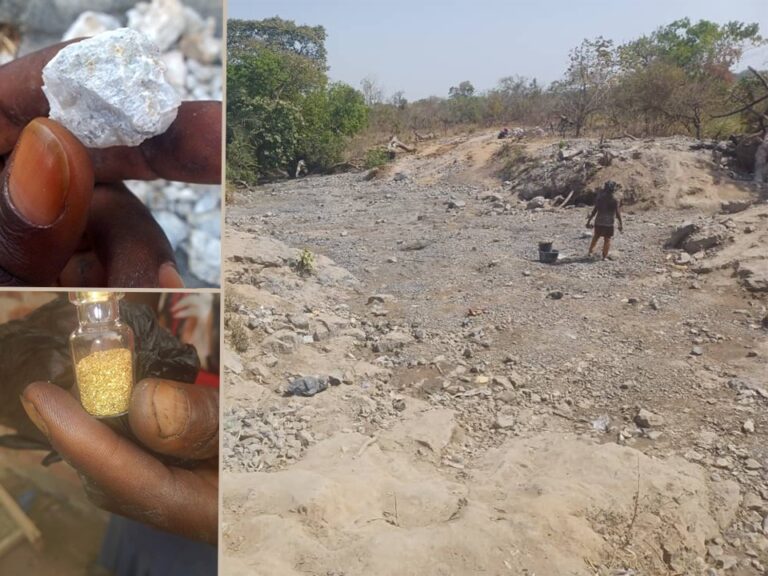
At the mining sites located about 15 kilometres off Akwana Road in Anyiin, women and children were found in their hundreds scavenging for lead ore and fluorite, with their bare hands. Some men operated heavy machinery, without Personal Protective Equipment (PPE). The scene resembled a rowdy market as sacks of lead ore and fluorite were on display for potential buyers.
Sacks containing lead ore on display for potential buyers and the location of Akwana Road on Google Earth Credit: Sinafi Omanga/The ICIR
Along the Akwana Road and Tyogbenda village in Anyiin were acidic mine ponds and pits which residents said overflow into nearby farmlands during the rainy seasons.
Similarly, Kwande LGA has several farmlands and water sources like River Mbagwa, which are contaminated by mining activities of gold.
Lead poisoning looms
In Benue State, the rush for solid mineral resources by artisanal miners who are often illegal and small-scale miners has left communities at the risk of a lead poisoning outbreak and turned once fertile farmlands into degraded wasteland. It has also caused revenue losses for the government.
Despite suspension on mining activities by the state government, the trend has continued in Logo and Kwande LGAs due to poor guidelines and enforcement.
An acidic mine pond in, Anyiin. Credit: Sinafi Omanga / The ICIR
Contamination leaves food consumers at risk- Soil science expert
Ibiwumi Nwachukwu, a professor of Soil Science at Michael Okpara University of Agriculture, Umudike, said Nigeria should be concerned that Benue, a state in the north-central region which provides a substantial portion of the country’s agricultural output, is now at risk of not only being stripped of its fertility but also endangering the health of food consumers.
When mining of heavy metals like lead is unregulated, the people are exposed to poisoning and the land suffers degradation, said the professor, whose current research is on heavy metals in soil-plant systems, soil contamination and remediation.
Shedding light on the danger of abandoned acid mine ponds overflowing into farmlands, Nwachukwu said, “If it overflows, of course, it will spill into the surrounding farmlands. The water will seep into the soil, and the plants will absorb it. It’s not localised; that is what we call diffuse contamination.”
“The danger is that, even though I’m far from that place and not directly exposed to the contaminants in the soil, I’m still at risk. All the food produced in those areas get transported across the country, and anyone can buy it in the market,” she stated.
‘They will die slowly, without knowing’
The U.S. Centre for Disease Control and Prevention (CDC), in a report titled, “Lead Poisoning Investigation in Northern Nigeria” says when lead dust is in the air, children and adults breathe in the particles. They also get exposed by drinking water or eating contaminated food.
“Lead exposure can damage many body systems, including the brain, kidneys, bones, and the nervous system,” the report said, adding that children exposed to lead contamination “often die.”
On the threat of a lead poisoning outbreak at the mine sites and the IDP camps, Nwachuku said the women and children scavenging the minerals “without specialised gloves were exposed to slow death, without knowing.” She explained that children get poisoned by just touching the soil that has high lead in it.
Some illegal miners gathering lead ore with bare hands Credit: Sinafi Omanga/ The ICIR
“The poison goes into the body, into the bloodstream because the human skin has pores. They may feel it’s not affecting them immediately, but over time, the effects accumulate. After years of exposure, they’ll start to see the consequences. Some symptoms show up early, while others may take years to manifest,” she stated.
Curiously, Nigeria has faced some lead poisoning outbreaks. Between April and May 2015, 28 children in the remote villages of Kawo and Magiro, in Niger State died days after exhibiting symptoms like convulsions, insomnia, and hallucinations. Doctors Without Borders (MSF) later confirmed that the children died due to dangerously high levels of lead in their bodies.
Similarly, in 2010 there was another outbreak of lead poisoning in Zamfara, a state in Northern Nigeria notorious for illegal gold mining, which killed at least 400 people, mainly children.
Farmlands turned degraded wasteland
After walking 4 kilometres along a narrow path, Tyoughnande Tertindi, a 23-year-old farmer, stopped at an uncultivated piece of land near River Mbagwa, to share his growing frustration with illegal miners. For several years, the farmland in the Kwande LGA of Benue State had produced a bountiful harvest of cassava and sweet potatoes. However, the situation changed in 2023.
What was once fertile soil, has now been overtaken by open mine pits, and prone to flooding during the rainy season. The destruction of Tertindi’s farmland was caused by his fellow villagers seeking fortunes from imining of alluvial gold, which was discovered on the banks of River Mbagwa.
River Mbagwa in Kwande LGA has been contaminated as a result of mining activities. Credit: Sinafi Omanga/ The ICIR
The artisanal miners often leave behind open pits after extracting minerals, or even when their labour proves in vain. This results in farmers like Tertindi suffering the devastation of farmlands when the pits overflow during the rainy season. He estimated that his cassava and sweet potato farms worth over a million naira had been destroyed by illegal mining activities.
“I reported the case to our community’s mining chairman, but nothing has been done,” he said.
Open mine pit leaves Tyoughnande Tertindi’s farmland prone to flooding Credit: Sinafi Omanga/The ICIR
Aba Kimbi, a resident in Kwande, who is familiar with the history of gold mining in the state, said the scramble began in 2017 after an artisanal miner identified as Don Kwas made the discovery near one of the rivers tributaries in the neighbouring Agenago village. Kwas had returned home from Zamfara, a state notorious for illegal gold mining.
“After Kwas hit the jackpot, many villagers abandoned farming in search of gold (without government permit). They believe that a few grams of gold can fetch them money that several years of farming cannot,” Kimbi said during an interview in Adikpo, the local government headquarters.
Mining without geophysical data, guidelines, the genesis
After the 2017 discovery of gold in Kwande, some villagers began destroying their farmlands to strike gold and other minerals, said a geologist and the chief executive officer of Gemini Mining and Exploration Ltd, Andrew Kputu.
Kputu said he was shocked to observe the trend while serving as a Special Adviser to the former governor of Benue state, Samuel Ortom, on Solid Minerals. “Ordinarily, mining is always bound to affect agriculture if carried out without proper geophysical data. The sad thing is these people are mining haphazardly.
Andrew Kputu. Photo by TheICIR/Sinafi Omanga.
“They do so without first checking to know whether the places they are digging have any commercial quantity of the deposit. So, they end up excavating and leaving these pits open, then move to the next place and continue the damage,” he noted during an interview at his Makurdi residence.
Briefing newsmen in October 2023, Comfort Akwanya Adau, the Chairperson of Benue State’s Task Force on Illegal Mining, said “huge mineral deposits” across the 23 local government areas of the state had been taken over by illegal miners.
“Presently, there are no guidelines for mining, as even under-age children from IDP camps are involved in digging a huge pit in the name of mining, which poses danger to their health,” she said.
There are 500,182 IDPs in Benue State as a result of the farmer-herder conflict, which has intensified in recent years. Out of the figures, Logo alone accounts for 13,633 individuals, while Kwande has 15,909 individuals, according to the January 2025 report by the International Organisation for Migration Displacement Tracking Matrix (DTM).
An IDP camp in Anyiin. Photo Sinafi Omanga/The ICIR.
Benue food crisis deepens
As illegal miners continue to destroy farmlands in Benue, a food security analysis conducted by the African Journal of Food, Agriculture, Nutrition, and Development showed that 50.3 per cent of the rural farming households in the state are food insecure. The study further revealed that rural households were often affected by environmental factors such as “limited water supply, and contaminated surface water.”
Similarly, the Global Alliance for Improved Nutrition (GAIN) has said there is at least 62.2 per cent prevalence of moderate or severe food insecurity in Benue State. The Policy and Advocacy Associate of the Swiss-based foundation, Toromade Olutayo, disclosed this during a training held at Makurdi in June 2024.
Furthermore, in November 2024, the Managing Director of the Benue Investment and Property Company (BIPC), Raymond Asemakaha, stated that, “Food prices remain higher in Benue than neighbouring states despite being tagged the Food Basket of the country.”
Asemakaha stated this at a meeting with Benue Farmers and Traders Protection and Development (BFTPD) aimed to address food insecurity and improve the economic conditions of farmers in the state.
Revenue losses
Nigeria loses $9bn annually to illegal mining, according to the House of Representatives Committee on Solid Minerals. The chairperson of the committee, Jonathan Gaza Gbefwi said, “The unregulated exploitation of our natural resources jeopardises the sustainability of the mineral sector, leading to environmental degradation and revenue loss that could otherwise benefit our communities and nation as a whole.”
Despite having 34 out of the 44 solid minerals found in Nigeria, Benue State gets only N30 million as derivative from the federal government due to the activities of illegal miners, according to the Benue State Mineral Resources and Environmental Management Committee (MIREMCO).
At a media briefing in February 2024, Fidelis Mnyim, the Chairperson of MIREMCO, said, “The presence of illegal miners in the state, the problem of improper reporting of mining activities have denied the state the royalties and 13 per cent derivatives that it should receive.”
Rivalry over mining areas
Section 44(3) of the 1999 Nigerian Constitution vests control of mineral resources in the federal government, but the land where mining takes place fall under the jurisdiction of state governments.
The Minerals and Mining Act (2007), the primary law governing Nigeria’s mining sector says, “No person shall search for or exploit mineral resources in Nigeria or divert or impound water for the purpose of mining except as provided in this Act.”
A document obtained from the website of the Nigeria Mining Cadastre Office (NMCO) revealed that it has approved valid mineral titles for 124 companies that spanned a total of 3,725 Sq. Km in Benue state. NMCO is the federal government agency mandated by Section 5 (1) of the Nigerian Minerals and Mining Act, 2007 to administer and manage minerals titles in Nigeria.
According to an analysis by The ICIR, 1,459 Sq. Km of the allotted titles are located on borderlines between Benue and its neighbouring states of Cross River, Nasarawa, Kogi, Enugu and Taraba.
However, Kimbi, the Kwande resident, earlier interviewed, said some local communities have formed resistance movements against companies that come to mine in their communities, despite obtaining licences from NMCO.
Kimbi, who works with Adila Nigeria Limited, a registered mining company, recalled how they were barred from entering a community to carry out exploration of gold, despite obtaining a licence from the government.
“The government got it wrong from the beginning when it failed to issue a clear guideline and sensitise the local people on how mining activities should be carried out. These villagers display a dangerous ignorance of the law,” he said.
Reacting to Kimbi’s claim, Kputu, the geologist, faulted some miners for obtaining exploration licences or mining leases without consultation with landowners or entering into a community development agreement (CDA) with the host communities.
“We have situations where investors try to shortchange the communities, sometimes they extend their operations into areas that are not within their scope. This has caused strife between host communities and investors,” he said.
Despite ban, illegal mining activities persist
At an emergency security meeting on August 18, 2022, the former governor of Benue state, Samuel Ortom ordered the immediate suspension of illegal mining of gold across various communities in the Kwande LGA saying, “If allowed to fester, illegal mining posed security and environmental problems to the state.”
Despite the suspension, illegal mining was still prevalent in 2023 when Ortom’s tenure ended, ushering in the current administration of Governor Hyacinth Alia.
In March 2024, the state government again, suspended all mining activities in the state, expressing concerns over the contamination of water sources for residents in the affected areas, especially in Kwande, which The ICIR confirmed during the January visit.
“The state government will not tolerate any illegality. It is our administration’s prerogative to protect the lives and property of the people,” Alia said.
Hyacinth Alia, Governor of Benue State
Nine months after the embargo was placed on mining activities in Benue State, Governor Alia created a new Bureau for Solid Minerals to address illegal mining activities in the state, appointing Stephen Utah, who hitherto was his Principal Special Assistant on Solid Minerals, to head the bureau.
However, findings by The ICIR during a visit to Logo and Kwande revealed that illegal mining activities persist in the state. Reacting to the findings, the communications officer of the Bureau for Solid Minerals, Paul Iorlaha, in a telephone interview said the bureau was aware of the destruction of farmlands by illegal miners.
“These illegal miners are not people from abroad. Some of them are destroying their farmlands by themselves to get the minerals. As indigenes, sometimes they sneak out at midnight to carry out these illegal mining activities. It’s been difficult to checkmate them.”
While Iorlaha did not state the number of illegal miners that the state government had arrested or prosecuted, the Minister of Solid Minerals, Dele Alake, told journalists in March 2025, that the federal government had arrested 320 illegal miners across the country, adding that 150 were facing prosecution, and 9 including 4 foreigners, had been convicted.
Dele Alake, Minister of Solid Minerals
“Political, social, cultural sensitivities were major impediments to the eradication of illegal and unregulated mining activities in the country,” the Minister said.
Government paying lip services – Conservation group
The Chairman of the Benue Hike, Tourism, and Conservation Foundation, Tersoo Akula, said mining illegally meant that an environmental impact assessment was not carried out.
“The people discovered gold and started mining on their own, using crude tools and methods. They expose the environment to a lot of danger because they don’t know how, where and when to dig. They might not even understand the environmental implications of what they do,” he said.
To draw the attention of the state government and the general public to the danger posed by illegal mining in the local communities, the Benue Hike, Tourism, and Conservation Foundation in 2024 published a documentary, titled, “Gold Fields of Kwande – The Real Story.”
The seven minutes and seventeen seconds documentary show that apart from gold, other minerals discovered in the state include gemstones like agate, mica, quartz, pirate, topaz, ilmenite, and azurite.
“These minerals are in high demand for key industries like electronics, pharmacy, aerospace, and defence,” he noted.
In a telephone interview, Akula said despite writing several letters to the state government and paying advocacy visits to Governor Hyacinth Alia requesting urgent regulations, the foundation observed that “nothing had changed.”
Tersoo Akula, Chairman of the Benue Hike, Tourism, and Conservation Foundation
“It is worrisome that the Benue state government is aware that these things are happening but has not put in place a framework for regulating these activities. I do not see any concrete action and I think the government is paying lip service to those problems.”
However, the communication officer of the State Bureau for Solid Minerals, Iorlaha said Governor Alia’s decision to suspend mining in the state was one of the measures to address illegal mining activities.
He said the suspension was part of the state government plan to compensate farmers whose farmlands were destroyed by illegal mining activities and sensitise them on the need to comply with the law governing the mining sector.
“Definitely, farmlands must be destroyed for mining activities to take place. But the state government under the bureau is making sure that those concerns become a thing of the past,” Iorlaha said.
Towards a sustainable future…
Jonathan Ekafan, a professor of Plant Pathology at the University of Agriculture, Makurdi said he has observed an increasing number of cases of diseases linked to mining of heavy metals in the society.
“Exposure to these heavy minerals can damage vital organs like the kidney, the liver, the brain and the heart. That tells you how important it is to really think about controlling mining so that such effects are reduced,” he said.
Calling for stricter regulation and surveillance, Ekafan urged the government to make sure that only licensed miners are allowed to carry out mining activities “with clear guidelines that protect people and the environment.”
In addition to suspending mining activities, Nwachukwu, the professor of soil science at Michael Okpara University of Agriculture, Umudike, said the government must ensure the revegetation and remediation of the areas that have been destroyed by illegal mining activities.
“There is no quick solution, but the government must stop the unregulated mining activities,” said Nwachukwu, a member of Soil Science Society of Nigeria, Soil Science Society of America, and the British Society of Soil Science.
For Tyozenda and her daughter, addressing illegal mining activities in Anyiin must start from tackling the incessant attacks and displacement of farmers by armed herdsmen.
“If they (government) stop illegal mining, what else can we do?” she asked, trudging to the IDP camp, that has been their home since 2023.
THE Presidency has downplayed concerns surrounding a recent U.S. federal court ruling ordering American law enforcement agencies to release investigative records linked to President Bola Ahmed Tinubu, insisting that the documents reveal nothing new.
The decision, handed down by Judge Beryl Howell of the U.S. District Court for the District of Columbia, mandates the Federal Bureau of Investigation (FBI) and the Drug Enforcement Administration (DEA) to make public records related to a reported narcotics investigation from the 1990s.
Responding to the judgment, President Tinubu’s Special Adviser on Information and Strategy, Bayo Onanuga, stated on Sunday, April 13, that the administration has “nothing new to say” on the matter.
“There is nothing new to be revealed,” Onanuga said.
The report by Agent Moss of the FBI and the DEA report have been in the public space for more than 30 years. The reports did not indict the Nigerian leader. The lawyers are examining the ruling,” he said.
He added that media inquiries about the presidency’s reaction were not unexpected but emphasised that the administration remained unshaken.
Journalists have sought the Presidency’s reaction to the ruling last Tuesday by a Washington DC judge ordering the US FBI and DEA to release reports connected with President Bola Ahmed Tinubu. Our response is as follows: there is nothing new to be revealed,” he reiterated.
The ICIRreported that the US District Court for the District of Columbia ordered top law enforcement agencies to release confidential information related to President Tinubu during a “purported federal investigation in the 1990s.”
Beryl Howell, the judge, made the order on Tuesday, April 8.
Responding to a motion by Aaron Greenspan, an American who is seeking a reconsideration of an earlier ruling, Howell said protecting the information from public disclosure is “neither logical nor plausible.”
Greenspan had accused US agencies of violating the Freedom of Information Act (FOIA) by refusing to release records related to federal investigations into President Tinubu and one Abiodun Agbele.
In her ruling, Howell said the agencies’ attempt to shield the information from public disclosure is neither logical nor plausible.
She specifically faulted the Federal Bureau of Investigation (FBI) and the Drug Enforcement Administration (DEA) for relying on so-called ‘Glomar’ responses—refusals to confirm or deny the existence of records.
The judge ruled that both agencies failed to demonstrate that their reliance on Glomar responses was justified under FOIA exemptions. “Since it has already been acknowledged that Tinubu was the subject of investigation by the FBI and DEA, continuing to withhold that information is not defensible,” Howell said.
Greenspan argued that the public’s right to access the records outweighs any privacy concerns. He also cited previous official acknowledgments of investigations involving both Tinubu and Agbele, as well as confirmation by the CIA that it holds responsive records related to Tinubu.