ON Palm Sunday, Pope Francis thrilled worshippers with a spontaneous tour of St. Peter’s Square, despite doctors advising him to avoid crowds while recovering from pneumonia.
For the second consecutive Sunday following his longest hospital stay as pope, the 88-year-old Pontiff left his Vatican residence, distributing sweets to children and shaking hands while touring the Vatican landmark.
Seated in his wheelchair, the Argentine pope appeared to be in good health, notably without the nasal cannula, used to aid his breathing during recovery, still attached.
Since his discharge from the hospital, the Pope has made several outings despite his doctors advising him to rest, with his unannounced visits not listed on any official Vatican schedule.
AFP reports that on Thursday, the Pope made an unplanned visit to St. Peter’s Basilica to check on renovation progress and to pay his respects at the tomb of Pius X. Then, on Saturday, he visited his favorite Church, Santa Maria Maggiore in Rome, for prayer.
During his Sunday Angelus prayer, shared by the Vatican, the Pope expressed gratitude for the prayers of the faithful and reiterated his usual plea for peace in the world.
After his scheduled meeting with King Charles III was canceled due to his health, Pope Francis privately received the British monarch and Queen Camilla on Wednesday.
However, the Vatican has yet to confirm the Pope’s level of involvement in next week’s Easter celebrations, the most sacred period of the Christian calendar.
The Pope was admitted on February 14, 2025, for bronchitis, abd while there, he developed additional infections that required him to remain under the care of doctors, and soon after developed pneumonia in both lungs, according to the Vatican.
He was discharged on March 23 with a prescription of two months of rest and was advised against taking any meetings with large groups.
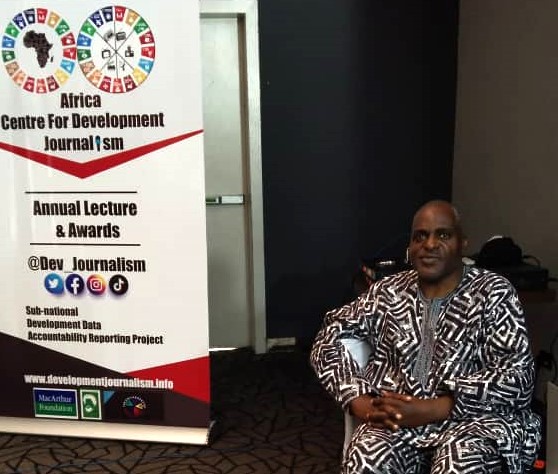
The Rotimi Sankore scholarship award for indigent students is seeking applications from brilliant indigent undergraduate students from the Lagos State University (LASU).
The scholarship is open to students studying Communication and Media Studies, particularly those interested in pursuing a career in developmental and data journalism.
This initiative was established in memory of the late Sankore, who lived from June 6, 1968, to April 12, 2024.
The ICIRreports that he was a renowned journalist, data analyst, and radio host, widely recognised for his expertise in using data to analyse and highlight national trends and issues.
Funded by media entrepreneur and philanthropist Kadaria Ahmed, the scholarship will cover both tuition and accommodation expenses.
To be qualified for the award, applicants must have spent one full academic session at the University with evidence of good academic performance and justification for deserving financial support towards the completion of the academic programme.
Interested students are required to submit a written application, including a brief 200-word statement explaining why they should be selected for the award.
Applicants are instructed to send all applications and supporting documents to rotimisankoreawards@yahoo.com by May 1, 2025.
Only shortlisted candidates will be contacted for a physical interview.
THE Federal Capital Territory (FCT) police command has apprehended a car theft syndicate in the Durumi axis, an official statement has said.
The arrest followed a distress call on Friday, April 11, 2025, received by the Durumi Division regarding the theft of a gold-colored 2005 Toyota Corolla marked: KUJ 208 DA from the owner’s residence.
This was contained in a statement by the spokesperson of the FCT police command, Josephine Adeh, made available to The ICIR on Sunday, April 13.
The vehicle was traced to a workshop in Durumi, where it was being refurbished. The color was being changed to avoid detection and enable a quick resale.
The statement added that a subsequent search of the premises also led to the recovery of another suspected stolen vehicle-a red Toyota Corolla (registration number GWA 844 CK), which had been previously reported stolen from a home in Jikwoyi.
“Three suspects: Steven Musa, David Dalyol (a painter), and Ibrahim Mohammed (a mechanic), were arrested at the scene. During interrogation, they confessed to being members of a car theft syndicate operating across Wuse, Central Area, Jikwoyi, and Bwari axis of the FCT.
They admitted to stealing several vehicles, refurbishing them, and reselling them as newer models.
“The suspects are currently in custody and will be charged to court upon the conclusion of investigations,” the statement read in part.
The statement further noted that the Commissioner of Police, FCT Command, Ajao Adewale, advised vehicle owners to install tracking devices and other anti-theft measures to assist in swift recovery actions.
It further urged the public to stay alert and report any suspicious activity through the emergency numbers: 08032003913, 08033111911, or 07057321547, while reassuring residents that the police remain dedicated to protecting the lives and property of all residents.
TROOPS under Operation Safe Haven (OPSH) have foiled a plot by the Islamic State West Africa Province (ISWAP) to establish operational bases in Plateau and Bauchi States.
In a statement issued on Sunday, April 13, the OPSH Spokesperson, Samson Zhakom, said two suspected ISWAP members were apprehended during a sting operation on April 11, in the Yelwa area of Shendam Local Government Area (LGA), Plateau State.
The suspects, 25-year-old Abdulkadir Dalhatu and Ubaidu Hassan, were reportedly operating under the guise of tailors while secretly working to expand ISWAP’s footprint in the North-Central region. Preliminary investigations indicate they were sent by an ISWAP commander to set up new cells in the two states.
In a separate operation, troops from Sector 4 OPSH also raided the hideout of a wanted criminal in Mazat village, Barkin Ladi LGA.
Although the suspect escaped, soldiers recovered an AK-47 rifle, a magazine, and other items buried within the building.
Elsewhere, troops from Sector 2, acting on credible intelligence, laid an ambush for bandits along the Pinau-Bangalala Road in Wase LGA. One bandit was killed, while others escaped with gunshot wounds.
Meanwhile, tragedy struck the Zogu community in Miango District, Bassa LGA, as terrorists launched an early morning attack on Saturday, killing a man and his two sons.
According to the Irigwe Development Association (IDA), the victims were identified as 56-year-old Weyi Gebeh and his sons, Zhu (25) and Henry (16).
Reacting to the killings, IDA’s spokesperson, Jugo, said: “The way criminal elements invade our motherland and kill with impunity seems to suggest a more sinister motive than mere reprisal for alleged wrongs.
“IDA therefore calls on the Plateau State government and security agencies to take urgent action and end the slaughter of innocent people in Irigwe land.”
In recent months, the Islamic State West Africa Province (ISWAP), a splinter faction of Boko Haram, has intensified its insurgency across northeastern Nigeria, particularly in Borno State.
On January 26, 2025, ISWAP fighters launched a deadly assault on a Nigerian army base in Malam-Fatori, resulting in the deaths of at least 20 soldiers, including a commanding officer.Just days earlier, on January 14, ISWAP militants killed 40 farmers in Kukawa Local Government Area, despite the victims reportedly paying levies to the group for protection.
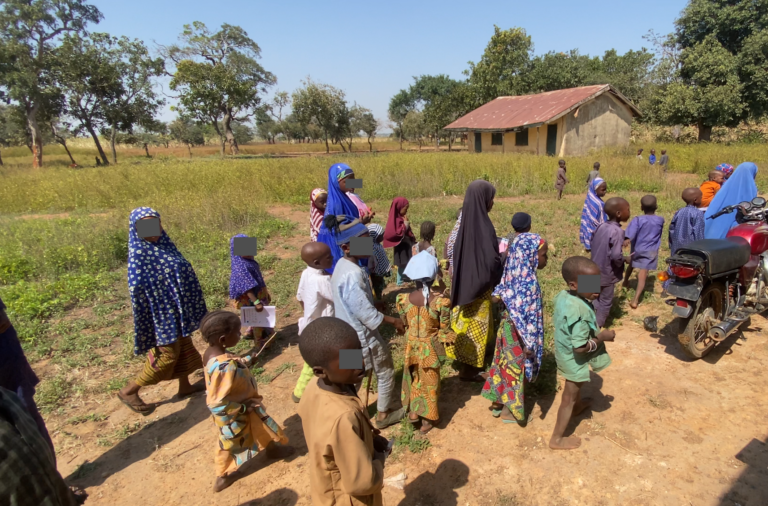
THE hyperactive life of nomadism is disruptive to basic education, making nomadic children unable to fit into conventional schools. TheCable visited nomadic settlements in Nigeria’s northern city of Kaduna and other small communities to document how inadequate access to education marginalises already disconnected nomads and potentially fuels crime.
In addition to the northern region, many nomadic communities down south lack functional schools. School-age children idle around their huts all day.
Where nomadic schools exist in the Iseyin town of Oyo state, just 62 miles north of Ibadan, the state capital, they lack critical infrastructure and sanitation, making them unfit to be called a place of learning for the young ones.
This is the case with Nomadic Primary School (NPS) Ajiwogbo, a nomadic primary school that tells of resilience draped in neglect.
There, a single dilapidated building struggles to hold its purpose. Its corrugated roof dulls under the sun, offering meagre shelter from the elements. Flies buzz relentlessly as bees would in an almost deafening hum of discomfort. The pupils swat them off their faces, barely distracted from the lessons happening inside.
The Fulbe Education Awareness and Development Association. Photo: Samuel Adebanjo/TheCable
Cow dung litters the surrounding pathways, a stark reminder of the livestock mingling freely with students on the premises. The air is thick with the acrid smell of waste and earth.
Barefoot children, many with patched clothes and moisturized skin, sit in these crude conditions with wide, curious eyes. They hold onto stubby pencils and frayed notebooks, determined to extract a future from the fragments of opportunity around them.
The absence of infrastructure — a proper floor, classroom furniture, windows, or sanitation facilities — speaks volumes of their reality, where education, though meagre, is a hard-won pursuit.
“We don’t have sufficient classrooms. We use two, despite needing at least six,” A.F Olalekan, the school’s assistant headmistress, explained to TheCable during a visit. “We had to mix the students.”
NPS Ajiwogbo recorded low enrollment despite the high population of nomads in the community. Olalekan narrated how door-to-door visits upped the school’s student population from 30 to over 100.
“We need more nomadic children to return to school to be useful within the community. The government must undertake awareness campaigns targeting nomadic parents,” the head teacher said.
Some 39 kilometres from Ajiwogbo is Ilero, a settlement where Muhammed Usman, a father of eight, lives without a school to enrol his children.
“We have engaged in a series of meetings with the government but got no help. During the electioneering season, they promised to build us schools. To date, they did not fulfil their promises,” he lamented.
Yakubu Bello, a traditional chief who looks out for the interest of the Fulbe in Oyo, noted that most nomads in remote communities lack access to adequate facilities to enable their education.
“The ones close to town join conventional schools. For those in the bush, however, it is either a nomadic school or no school at all. A lot of nomadic children are supposed to be schooling but are not,” he said.
Umar Ardo, director of extension education at the National Commission of Nomadic Education (NCNE), said at least N12 billion in consistent annual capital funding is needed over the space of five years to address its infrastructure deficits, with a 15 to 20 per cent yearly increase to hedge against inflation and the rising demands of nomadic education.
Budget analysis revealed NCNE was allocated a cumulative N2.29 billion for construction projects within the five-year window of 2020 to 2024. A stand-out was in 2024 when N1.33 billion was set aside for this purpose, a large chunk of which serviced ongoing projects not directly related to classrooms or schools. Within the 2020-2024 window, N1.14 billion was budgeted and allocated for repairs and rehabilitation.
Nomadic schools face severe teacher attrition
Umar Ardo said tutor attrition is extremely high in nomadic schools. He said many state-hired teachers trained with NCNE resources lobby relentlessly to transfer and relocate away from rural areas partly due to the nonpayment of hardship allowance by the state basic school boards.
He said this has forced NCNE to rely heavily on signing bonds with the local governments to ensure that the commission’s limited teachers remain in their assigned nomadic schools for at least a stipulated number of years before reassignment.
“Teachers have the right to in-service training that requires moving. In insecure areas, you can’t guarantee safety. No law mandates them to remain there for life. And you can only beg, not recruit,” he explained.
Classes in session at NPS in Ajiwogbo, Iseyin LGA of Oyo state.
In Kaduna, Musa Ibrahim Aboki, the state universal basic education board’s assistant director for access and equity, said the agency is looking to work with local government education departments to perfect the recruitment of 10,000 teachers, some of whom are expected to be nomadic.
Ibrahim Bayero, the Kaduna media director of the Miyetti Allah Cattle Breeders Association of Nigeria, said such recruitments are usually not enough to serve even the conventional public schools, talk more of nomadic.
“Nomadic schools are neglected. Very few are co-opted by the state to be sent teachers. SUBEB is not giving nomadic schools the attention they deserve,” Bayero raged in a phone interview.
On the national scale, Umar Ardo had similar concerns, “Most of those deployed to nomadic schools from states and local governments are low-quality teachers who are not wanted in conventional schools. They are sent as either punishment or replacement.
“There is an incessant transfer of trained teachers from nomadic to conventional schools. We spend a lot of time training them on nomadic pedagogy. But they look for posting and return to conventional schools.”
The bandits of tomorrow
Northwest Nigeria has had a history of violent farmer-herder conflicts driven by the tussle for land and water resources, slowly yielding a network of criminality that would come to be known as “banditry”. But analysts say what served to catalyse banditry in Nigeria over a decade ago may no longer solely be what drives it.
Poverty and limited economic opportunities increasingly forced marginalised people into joining bandit groups as a means of survival. Inadequate government presence and law enforcement in remote rural communities created a vacuum that the bandits exploited.
The proliferation of small arms escalated the intensity and frequency of bandit attacks, with a changing climate and stretching deserts worsening resource scarcity. Cattle rustling and abduction for ransom became lucrative, resulting in a cycle of almost never-ending blood spills, reprisal attacks, and migration.
Multiple reports indicate that this bandit culture has spread beyond the northwest, affecting Taraba and Adamawa states, where it overlaps with insurgency in the north-east as well as Oyo, Ondo, Ogun, and Ekiti in the south-west.
Banditry is a composite crime that includes abduction, massacre, rape, cattle rustling, firearms possession, and even illegal mining.
NBS data, as of 2022, shows the north-west had the highest poverty rate in Nigeria, with some 45.49 million people (75.8 per cent of the population) living in multidimensional poverty. In the region, states like Zamfara, Katsina, Kaduna, and Sokoto have had security hotspots where entire local governments are reportedly overrun, and residents, including children, unwittingly mingle with bandits.
The CDD gives an admittedly tenuous estimate of at least 100 bandit groups operating in the north-west alone, constituting between 10,000 and 30,000 armed militants.
According to an IPI report, their activities have devastated communities with an aggregated 1,087,875 rural dwellers displaced as of 2022. Schools are often forced to shut down from the tension, leaving impressionable young children and students without meaningful social preoccupation.
In 2024, Nigeria’s Senate President Godswill Akpabio warned that the country’s unschooled children of today risk becoming the bandits of tomorrow.
Left on the margins of society and heavily dependent on adults, these young folks become vulnerable to recruitment into criminal activities that sadly offer an alternative sense of identity, protection, income, and power.
The Fulbe Education Awareness and Development Association, a non-profit, has been traversing disconnected nomadic communities in the north to revive dysfunctional schools and encourage child re-enrollment to avert this crisis.
“Many of our people get into banditry because they never had the opportunity to attend school,” said Hassan Lamido, the non-profit’s national secretary, who acknowledged the role of literacy in providing a pathway to inclusion, socioeconomic stability, and upward mobility for the nomads.
He affirmed, “Some young nomadic children are joining bandits because they lack access to education.”
Lamido cited a part of the Giwa LGA in Kaduna where he said children are “prone to commit to bandit groups” and even their uneducated “parents are not stopping them”.
“In Birnin Gwari and Chikun LGA of Kaduna also, it is happening. In Zamfara, Sokoto, and Birnin Kebbi, especially around places with lots of vegetation, children join bandit groups because they are not meaningfully engaged,” Lamido said.
“Some of their elders are bandits, so they grow into it and think banditry is noble work.”
Husseini Abdullahi, a Fulbe disaster analyst and now the LGA vice-chair in Kachia Kaduna, said tracking and resettling displaced nomadic communities, relocating affected schools, and re-employing teachers is a capital-intensive project Nigeria must undertake only after the scourge of banditry has been significantly neutralised. The latter, he said, must start by cutting off the illegal influx of small arms.
Nigeria’s creation of a livestock ministry, Abdullahi added, could ensure that nomad resettlement is prioritised. At the same time, a census can then be conducted to systemically capture nomadic populations in social interventions and secure the future generation of nomads from looming crises.
Legislative delays hold back urgent reforms
The legislation that guides the National Commission for Nomadic Education was introduced in 1989 under the late military leader Ibrahim Babangida’s regime and codified into Nigeria’s civilian laws by 2004. However, it has remained unchanged for 35 years despite the evolving needs of nomadic populations.
Efforts to re-enact this legislation have repeatedly stalled.
Legislative member bills proposing critical amendments to address the commission’s apparent funding deficits and teacher attrition troubles have failed to progress beyond the second reading in multiple national assemblies — ending at this stage during the sixth and seventh assemblies, reaching the public hearing stage during the eighth, and once again stalling at the second reading in the ninth.
Each failure has forced the process to restart from the draft with subsequent assemblies, illustrating the challenges of pushing through member-sponsored legislation.
In the tenth assembly, the re-enactment is taking a new path as an executive bill being drafted at the education ministry and undergoing reviews involving its legal department and the ministry of justice. This is intended to guarantee political, technical, and legal backing that could enable faster processing.
Submission to the legislature is anticipated by the end of the first quarter of 2025, following approval by the federal executive council.
By convention, Nigeria’s public school teachers are hired, owned, managed, and deployed by local governments who work closely with state basic education boards. Many of these conventional teachers will then be retrained to adapt their methods to the nomadic curriculum.
The proposed NCNE amendments aim to empower the commission to hire mobile and non-mobile teachers independently without relying on state universal basic education boards, ensuring seamless cross-border operations for mobile teachers who serve actively migrating nomadic communities.
The bill also seeks to establish a Nomadic Education Fund designed to stabilise funding through diverse revenue sources, including non-profit donations and foreign aid, managed by a dedicated board of trustees.
Additionally, the NCNE advocates state-level nomadic education departments with independent budgets to bolster financing and ensure comprehensive coverage, recognising that basic education is on the concurrent list with responsibilities for not just federal but also state governments.
It seeks a statutory percentage from the Universal Basic Education Commission’s two per cent cut of the consolidated revenue fund, a pool into which taxes, duties, fees, and other federal revenues are deposited for onward disbursement.
Whatever the bill’s fate, the prolonged legislative delays condemn nomadic children to an uncertain future, robbing them of the education they need to escape cycles of poverty and crime.
Nomadic schools remain unsafe
In 2015, Norway and Argentina led a process among UN member states to develop a political agreement that would become the Safe Schools Declaration (SSD). A total of 120 countries, including Nigeria, endorsed the guidelines of this pact. In 2019, Nigeria ratified the SSD, effectively committing to protecting students, teachers, and schools during conflict to guarantee the continuation of education.
The SSD holds that schools must remain safe havens during armed conflict or insecurity.
In the context of banditry and attacks by non-state actors, this implies implementing measures to prevent the targeting of schools or the abduction of children. For nomadic schools, it includes securing learning spaces to ensure they are not abandoned due to fear of violence.
SSD guidelines mandate the creation of contingency plans for securing education during crises. For nomadic communities, this could take the form of deploying mobile security units, early warning systems, or community-led initiatives to protect schools, teachers, and learners.
The SSD recommends support for children affected by attacks. For nomadic children traumatised by banditry or abduction, policy experts argue that mental health programmes and reintegration services would ensure they can continue education in a supportive environment.
SSD encourages governments to work with international organisations, non-profits, and communities in addressing education-related challenges. For Nigeria, this means leveraging partnerships to adopt and adapt innovative education models such as mobile schools.
In 2022, a finance plan for the Safe School Initiative (SSI) was launched, outlining investment totalling N144.8 billion over a four-year term to protect 62,271 at-risk schools and their learners, teachers, and non-teaching staff from attacks.
Nigeria was to spend N32.58 billion in 2023, N36.98 billion in 2024, N37.15 billion in 2025, and N38.03 billion in 2026. But budget funding has not materialised as planned, with the government setting aside a comparatively paltry N15 billion in 2023 and N5.01 billion in 2024 for the SSI. Budget analysis for both years also showed no structured and holistic funding for projects related to the SSI.
So, while the SSI laid a strong groundwork for safer learning environments, its uneven and inconsistent implementation has left many public schools, more so those serving nomadic populations, vulnerable to ongoing threats. As a result, the low-hanging response by states to persisting attacks and student abductions was to close those schools.
Badar Musa worked with Nigeria’s education ministry and the Education in Emergencies Working Group, a coalition of government stakeholders, the UN, multinational non-profits, and other stakeholders. He participated in projects that informed Nigeria’s policies around safe schools before joining Save The Children International’s office in Nigeria as an advocacy campaign and policy manager.
Badar Musa, an advocacy campaign and policy manager at Save the Children International in Nigeria. Photo: Samuel Adebanjo/TheCable
Musa said Nigeria tapped the newfound SSI funding in February 2023 to create a national safe schools coordination centre domiciled at the headquarters of the National Safety and Civil Defense Corps (NSCDC), where all Nigerian security agencies and MDAs are represented.
“By 2024, the centre had prevented 86 attacks on education nationwide. If it gets intelligence about impending attacks, the HQ alerts relevant security agencies around the threatened location,” he said.
“The centre is still registering all schools in Nigeria on their database with precise coordinates and contact persons. About 11,000 schools have been registered.”
In 2024, UNICEF analysed the implementation of Nigeria’s minimum standards for safe schools, which guides the domestication of the SSD, across a sample of states in the north-west and north-east. The agency reported a “minimal implementation rate” with an average score of 42 per cent as of 2023. Its findings concluded that “a significant gap between policy formulation and its execution” persists.
“Education has deteriorated. Nomadic education is at a higher disadvantage because it is non-formal, which is underfunded. If we can’t protect non-formal schools, how much more the ones located in coordinated environments?” said Musa over a video conference.
Nigeria is desperate to cut its alarming out-of-school children rate, integrate informal schooling into formal systems, and work out an accelerated basic education scheme for over-age underserved people in a scramble to score more positive development indices.
Yet, an observation of grassroots realities indicates that nomadic children remain no more than an afterthought.
The economy has looked far from bright; the weather has been suffocating; and cost of living has been stubbornly oppressive. With rising massacres in the Middle Belt, and Borno State in the northeast apparently losing ground to the nihilism of Boko Haram terror, violence remains unremitting. In the Niger Delta, a judicially manufactured crisis of political godfathering threatens serious repercussions for the national purse and endangers rent and royalties from the wells of oil-rich Rivers State. All this unfolds under the watch of a president who appears to have grown into a habit of sending episodic missives to Nigerians from his preferred base in Paris and occasionally paying a visit to Abuja from there.
Each of these developments is eminently newsworthy. Together, they should grip attentions about the goings-on in the sixth most populous country in the world. Instead, the biggest news out of Nigeria this year is the failure of Nigeria’s men of power to manage libidinal sexploits in the workplace, and the accompanying tendency to default to abuse of power to inter any resulting embarrassments.
Natasha Akpoti-Uduaghan is the Senator for Kogi Central and, by herself, 25 per cent of the female contingent in the Nigeria’s Senate. Her detailed allegations of sexual harassment against Senate President, Godswill Akpabio, would probably have long ago run their course if the chamber and its leadership had approached the matter with due regard to any rule book. Instead, they chose to orchestrate the longest-running political soap opera in Africa’s most populous country.
As with these things, most people no longer remember the complaint because the cover-up procured by abuse of power has been more impressive. It has guaranteed that this story has “dominated conversations and highlighted longstanding women’s rights issues in the socially conservative country, where no woman has ever been elected governor, vice-president or president.”
For many, any suggestion that it is abnormal for a man not to get excited in the presence of a woman in the workplace is perplexing to the point of vexing. In a case in 2016, a lawyer representing a powerful international organisation in a case of sexual harassment before the National Industrial Court of Nigeria (NICN), told the judge that “it is expected among adults that a man would naturally chase a woman, make romantic overtures.” Few have paused to ask what exactly “sexual harassment” means, why it matters and why it is such a lingering issue in both work spaces and public institutions.
In 2011, the Lagos State Criminal Law made sexual harassment a felony. The law describes the crime to include “unwelcome sexual advances, request for sexual favours, and other visual, verbal or physical conduct of a sexual nature which when submitted to or rejected” could affect or unreasonably interfere with the employment or educational opportunities of a person; become a factor in their academic or employment decision, or create an intimidating, hostile or offensive learning or working environment. Other states like Ekiti and Kaduna States have followed the example of Lagos in making sexual harassment a crime.
Sexual harassment can also create civil liability. Stella Odey was a widow with four children when the development organisation, CUSO, hired her in January 2015 as project manager. At work, she found herself under a male boss who repeatedly told her that “her voice arrests him, slapping her buttocks and embracing her against her will and consent.” He was reluctant to hear her protestation that she desired to remarry.
In July 2015, 14 days after Odey gave her boss a card inviting him to her wedding, he summarily sacked her. In upholding her claim of unlawful termination, the National Industrial Court pointed out that “the main point in allegations of sexual harassment is that unwelcome sexual conduct has invaded the workplace.”
Four years earlier, the same court awarded quite substantial damages against Microsoft in Nigeria in favour of a female staff whose employment the country manager, a man, terminated after she refused his sexual advances.
While parliamentary sexploits in the Senate have brought much-needed attention to the subject generally, it remains the case that Nigeria’s educational and academic institutions are the places most persistently associated with sexual harassment. Nearly 45 years ago, in 1981, a mere two years after Akpoti-Uduaghan was born, the report of the Presidential Commission on Salary and Conditions of University Staff chaired by Samuel Cookey, a Professor, acknowledged an incipient problem of sexual harassment in the universities. Since then, the issue has grown in both scope and significance.
In 2024, a pioneering Baseline Survey conducted under the auspices of the Committee of Gender Directors in Nigerian Universities in partnership with the non-governmental organisation, Alliances for Africa, found that at least 63 per cent of female students in universities in the country had experienced sexual harassment. The perpetrators included lecturers, staff, and students. The report acknowledged an absence of progress on this issue, citing “stigmatisation, absence of adequate institutional support, power imbalances between victims and perpetrators, lack of clear policies and procedures for reporting incidents.”
An ongoing scandal at the Federal University, Oye Ekiti (FUOYE), involving allegations of sexual harassment against the Vice-Chancellor, Abayomi Fasina, a professor, illustrates how bad the situation is. At the end of last year, it emerged that a female senior director at the university, Folasade Adebayo, had accused the Vice-Chancellor of work place reprisals after she allegedly rejected his persistent sexual advances.
The Ekiti State Gender-Based Violence (Prohibition) Law creates a felony crime of sexual harassment which occurs when there is “unwanted conduct of a sexual nature or other conduct based on sex or gender which is persistent or serious and demeans, humiliates, or creates a hostile or intimidating environment.” To prove her allegations, Adebayo produced a sound clip of a telephone conversation with the Vice-Chancellor in 2023 in which he could be heard pleading that he would make her happy as long as she made him happy, and confessing: “Let me tell you, I’m dying inside for you.”
After what was supposed to be an internal investigation, the Governing Council issued a statement claiming that it had cleared the Vice-Chancellor of the allegations. Instead it ordered various disciplinary measures against Adebayo and the leadership of the Staff Union of the University (which made her allegations public), “for bringing the name of the university into disrepute.”
Without challenging the provenance of the sound clip or the veracity of its contents, the Governing Council instead “condemned the recording of the Vice-Chancellor without his knowledge and consent.” Yet, it resolved to advise the Vice-Chancellor “in writing to be more careful and circumspect in dealing with subordinates.” Not done with this piece of tortured administrative theatre, the Governing Council then announced that it would constitute a “peace and reconciliation committee to look into all the issues in the university.”
The performance of the Senate in the institutional calisthenics of inspired cover-up easily pales into insignificance beside the mastery displayed by the Governing Council of FUOYE. Under cover of high statutory authority, the Governing Council procured the burial of serious allegations that could be criminal in Ekiti while implicitly validating their veracity. Why would the Vice-Chancellor need gratuitous advice of the kind the Council will be offering if the recording lacked credibility? Unsurprisingly, the university staff union promptly denounced the decision.
The bigger problem is that the Council by this decision destroys any hope of remedies for students, staff or anyone with credible claims of sexual harassment in the university. Instead, they guarantee exactly the opposite of what the university seeks to avoid: resort to public advocacy by victims. Anticipating that, the Governing Council of FUOYE says it will expedite the production of policies on cyber-bullying and use of social media. The intention is not to help victims or to bring perpetrators to account. Rather, it seeks to perpetuate a culture of cover-up. Anyone looking for where the men in Senate learnt their art when they were boys should look no further than a Nigerian University.
The US District Court for the District of Columbia has ordered top law enforcement agencies to release confidential information related to President Bola Ahmed Tinubu during a “purported federal investigation in the 1990s.”
Beryl Howell, the judge, made the order on Tuesday, April 8.
Responding to a motion by Aaron Greenspan, an American who is seeking a reconsideration of an earlier ruling, Howell said protecting the information from public disclosure is “neither logical nor plausible.”
Greenspan had accused US agencies of violating the Freedom of Information Act (FOIA) by refusing to release records related to federal investigations into President Tinubu and one Abiodun Agbele.
In her ruling, Howell said the agencies’ attempt to shield the information from public disclosure is neither logical nor plausible.
She specifically faulted the Federal Bureau of Investigation (FBI) and the Drug Enforcement Administration (DEA) for relying on so-called ‘Glomar’ responses—refusals to confirm or deny the existence of records.
The judge ruled that both agencies failed to demonstrate that their reliance on Glomar responses was justified under FOIA exemptions. “Since it has already been acknowledged that Tinubu was the subject of investigation by the FBI and DEA, continuing to withhold that information is not defensible,” Howell said.
Greenspan argued that the public’s right to access the records outweighs any privacy concerns. He also cited previous official acknowledgments of investigations involving both Tinubu and Agbele, as well as confirmation by the CIA that it holds responsive records related to Tinubu.
Background of the case
On October 20, 2023, Greenspan filed an emergency motion seeking a hearing to compel the US agencies to immediately produce records responsive to his FOIA requests.
He cited the Nigerian Supreme Court’s plan to begin hearing arguments in three days in a litigation contesting Tinubu’s 2023 election as the President of Nigeria.
Three days later, on October 23, 2023, Greenspan’s emergency motion was denied for failing to “satisfy any of the requirements for emergency injunctive relief.”
Also on that same day, President Tinubu moved to intervene in the case, citing his privacy interests in his “confidential tax records” and “documents from federal law enforcement agencies that fall within the Privacy Act or exceptions to FOIA and should not be disclosed.”
In 1993, Tinubu was said to have forfeited $460,000 to the American government after authorities linked the funds to proceeds of narcotics trafficking.
The issue of Tinubu’s forfeiture of the funds featured prominently at the Presidential Election Petition Court when his opponents, Atiku Abubakar and Peter Obi, challenged the president’s eligibility to contest Nigeria’s presidency. But the election court, in a unanimous decision, dismissed the suits, affirming Tinubu’s election.
However, on Tuesday, Judge Howell ruled partly in favour of Greenspan in the US case.
As part of his case for reconsideration under the Freedom of Information Act (FOIA), Aaron Greenspan submitted a verified complaint and affidavit filed by the US Department of Justice (DOJ) on July 26, 1993, in the Northern District of Illinois.
The legal documents sought the civil forfeiture of funds held by President Bola Tinubu in First Heritage Bank, which authorities alleged were linked to a drug trafficking investigation.
The affidavit, written by IRS Special Agent Kevin Moss, outlined the drug trafficking activities of Abiodun Agbele, which served as the basis for seeking the forfeiture of Tinubu’s funds.
Moss’s investigation revealed that Agbele was arrested while selling white heroin to an undercover agent, unknowingly, as the buyer was posing as a customer.
Upon arriving in the United States, Agbele reportedly identified a man named Akande, who had also been linked to Tinubu, as his uncle. Agbele claimed that Akande had helped him secure an apartment in Hammond, Indiana, a detail provided by DEA agents.
Further investigations by the DEA revealed that Agbele had sold heroin to other individuals on multiple occasions. Using an undercover operation, DEA agents, with the help of a confidential informant, arranged for Agbele to sell one ounce of white heroin to a law enforcement officer working undercover.
Following the sale, Agbele was arrested and agreed to cooperate with the investigation.
The affidavit further detailed how the DEA uncovered a lease application completed by Agbele during their investigation. It also confirmed that both the FBI and DEA had conducted investigations into Tinubu as part of the broader probe into Agbele’s drug trafficking activities.
The documents affirmed that there was probable cause to believe that funds held in accounts controlled by Tinubu were involved in financial transactions violating US law and represented proceeds of drug trafficking.
PLATEAU State Governor, Caleb Mutfwang, has ordered a census of residents in communities occupied by terrorists to ensure proper documentation of those living in the area.
According to Punch, the governor gave the directive on Saturday, April 12, during a visit to the Tyop community in Mangu Local Government Area.
The move is part of efforts to tackle rising insecurity in the state, where terrorists have taken over 64 communities.
The governor condemned the displacement of indigenous people from their ancestral homes, describing it as a strategy to keep them in poverty.
Mutfwang emphasised the need for citizens to be law-abiding, stating that the state cannot afford to be lawless.
The governor said, “I want a census of people living in this place (Tyop community ). Who permitted them to build their houses when they built their houses? We can not afford to be lawless. Let me clarify: any district head who allows people to settle within the district without proper documentation of who they are, that district head knows that he will dance to the music that will follow accordingly.
“We will not allow this nonsense to continue. We have to be law-abiding. We cannot be lawless. This kind of arrangement, where the indigenous population is chased out of their ancestral homes, is an arrangement to keep our people in poverty, and we cannot accept it.”
The governor appealed for a peaceful engagement with the current occupants of the affected communities and called on security agencies to take full control of the situation.
He added, “We want everybody to live in peace. We welcome people who want land to build houses, but there is a procedure that must be followed.
“You can’t just come from nowhere and start building houses in the middle of nowhere. It is not done anywhere. Worse still, people were chased out of their homes; you take it over and occupy it. This is not right. This is not correct. So, we need to engage these people, and I want us to do it as peacefully as possible because we can’t continue to allow this kind of story to continue to repeat itself.”
Mutfwang also visited other communities recently attacked by bandits in Bokkos Local Government Area, including Hurti, Daho, and other severely affected areas, where he interacted with Internally Displaced Persons (IDPs).
The governor said he was deeply moved by the distressing conditions of the displaced, particularly women and children, and urged them not to give up their ancestral lands to strangers and land grabbers.
He stressed the importance of unity, resilience, and vigilance in the face of growing insecurity.
Addressing the youths in the affected communities, Mutfwang encouraged them to stay focused and dedicate their strength to defending their people and heritage, reminding them that they are the future leaders of their communities.
He also addressed displaced persons at Hurti in the Manguna District, where he reaffirmed his administration’s commitment to rebuilding destroyed communities and ensuring the safe return of all displaced residents to their homes.
“We are here to witness firsthand the devastation caused by these acts of banditry. This village recorded one of the highest number of casualties in this coordinated act of terrorism and genocide. I’ve come not just to sympathise but to assure you that this government stands firmly with you.
“We must rise above our differences, unite as a people, and resist the agenda of division. God did not make a mistake by planting you in this land. The government will do its part, and I urge the youth to play their role. President Tinubu has extended his condolences and stands with you in the quest for peace and justice,” Mutfwang said.
The ICIR reported that attacks, which began on March 28, 2025, escalated with a series of coordinated invasions of villages across the Bokkos Local Government Area of the North-Central state.
On Wednesday, April 2, the attack escalated in several communities of the LGA, displacing many and leaving a trail of destruction in Ruwi, Hurti, Tadai, Manguna, and Dafo communities.
The death toll from the recent attacks reportedly rose to 52, according to local authorities on April 4.
This followed the recovery of 40 more bodies on Wednesday and Thursday night while the search and rescue team kept combing the bushes for missing persons.
Plateau State is home to about 40 ethnic groups and has been a hotbed of conflict. The clashes, mostly between Muslim Fulani herders and Christian farmers, are often painted as ethno-religious. However, analysts have said climate change and scarcity of pastoral land are pitting the farmers and herders against each other, irrespective of faith.
THE Joint Admissions and Matriculation Board (JAMB) has released the results of the 2025 Mock Unified Tertiary Matriculation Examination held on Thursday, April 10.
In a statement issued on Sunday, April 13, by its spokesperson, Fabian Benjamin, the board advised candidates to check their results by texting “MOCKRESULT” to 55019 or 66019 using the phone number they used during registration.
JAMB explained that the mock UTME is not compulsory but serves to test new features introduced annually and to help candidates familiarise themselves with the computer-based test environment ahead of the main exam.
The statement reads, “A total of 200,115 candidates initially expressed interest in participating; however, two candidates later withdrew, resulting in 200,113 registered candidates.
“Of those registered, 73,844 candidates were absent on the day of the examination, and 88 candidates failed the biometric verification screening.
“Consequently, 126,181 candidates successfully sat for the examination, and results for 115,735 of these candidates are now available for viewing. Additionally, 10,446 results are still being processed and will be released soon.”
JAMB also acknowledged delays faced by some candidates during the mock exam and expressed regret over the inconvenience.
It noted that the disruptions were due to new features introduced to improve the upcoming main UTME.
The board urged candidates to continue supporting its efforts, adding that the mock exam remains a key part of its strategy to enhance the UTME process and better prepare candidates.
“The mock examination serves as a trial version of the UTME, allowing the Board to test new innovations while helping candidates familiarise themselves with the CBT environment.
“Over the years, this initiative has successfully achieved its objectives, addressing noted lapses and equipping candidates with valuable experience for the main examination,” the statement added.
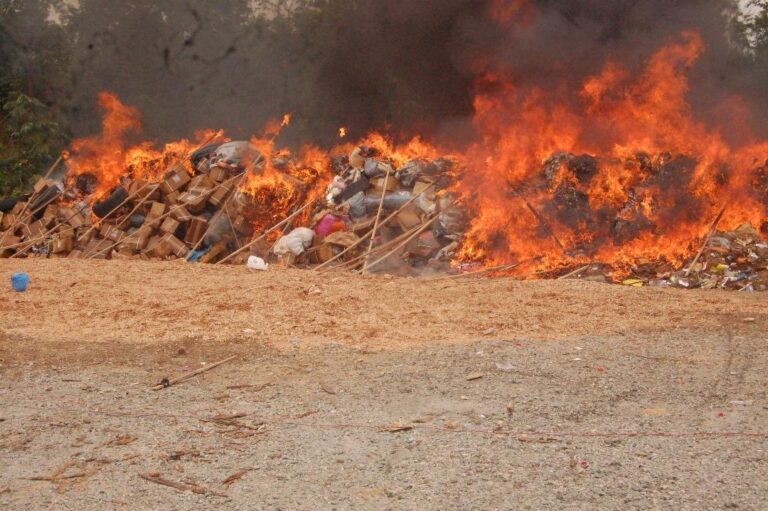
THE National Drug Law Enforcement Agency (NDLEA), has destroyed 1.6 million kilograms of various illicit drugs seized in Lagos, Ogun, and Oyo States
The drug regulatory agency said this remains the largest single batch of drug seizures ever burned in the agency’s history.
This was contained in a statement released on Saturday, April 12, by spokesperson Femi Babafemi.
The public destruction took place on Saturday, April 12, 2025, at a secluded site in Ipara along the Lagos-Ibadan expressway in Ogun State. The event was witnessed by representatives from government bodies, traditional institutions, religious leaders, security agencies, international partners, NGOs, and community heads, among others.
Among the destroyed substances were 123 kilograms of cocaine, 46.8 kilograms of heroin, 1.4 million kilograms of cannabis, 148,000 kilograms of codeine syrup, 3,244.26 kilograms of tramadol, 1,544 kilograms of skuchies, and 111 kilograms of methamphetamine, among others.
Speaking at the event, the NDLEA chairman, Buba Marwa, stated that the destruction exercise reflects the agency’s unwavering dedication to combating drug trafficking in Nigeria.
“The sheer volume of seizures, which totals approximately 1.6 million kilograms, serves as a reminder of the grave danger these substances pose to public health until they are completely and irreversibly destroyed.
“The NDLEA operates under a clear mandate to reduce these narcotics to rubble. At all times, we discharge this duty with the utmost seriousness and diligence”, he stated.
He warned individuals engaged in drug trafficking, stressing that the era of impunity is over and there will be no hiding place for offenders in Nigeria.
“To those still involved in the illicit drug trade, we will continue to remind them that the times have changed at the NDLEA; we are fully determined to achieve our goal of bringing all lawbreakers to justice,” he warned.
Represented by the Agency’s Director of Assets and Financial Investigation (DAFI), Ibrahim Abdul, Marwa explained the reason behind the public destruction of the seized drugs was to ensure transparency and accountability.
Speaking at the event, Ogun State Governor Dapo Abiodun, represented by his Special Adviser on Security, Olusola Subair, praised the NDLEA for its dedication, professionalism, and ongoing efforts in preventing illicit drugs from reaching communities. He acknowledged the agency’s vital role in saving lives, strengthening society, and enforcing the law, affirming the state’s continued support in the fight against drug-related crimes.
Abiodun highlighted drug abuse as a major social, economic, and public health issue, while stressing the need for prevention through education, counseling, and youth empowerment, as well as improved rehabilitation and support for those struggling with addiction.