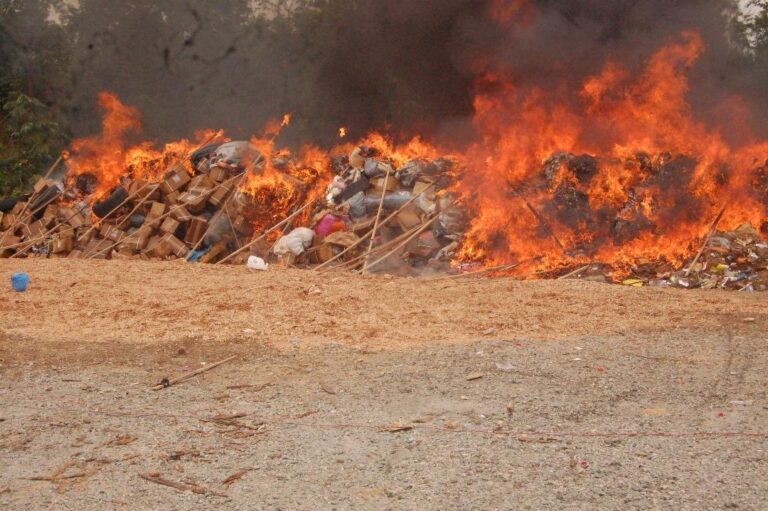
THE National Drug Law Enforcement Agency (NDLEA), has destroyed 1.6 million kilograms of various illicit drugs seized in Lagos, Ogun, and Oyo States
The drug regulatory agency said this remains the largest single batch of drug seizures ever burned in the agency’s history.
This was contained in a statement released on Saturday, April 12, by spokesperson Femi Babafemi.
The public destruction took place on Saturday, April 12, 2025, at a secluded site in Ipara along the Lagos-Ibadan expressway in Ogun State. The event was witnessed by representatives from government bodies, traditional institutions, religious leaders, security agencies, international partners, NGOs, and community heads, among others.
Among the destroyed substances were 123 kilograms of cocaine, 46.8 kilograms of heroin, 1.4 million kilograms of cannabis, 148,000 kilograms of codeine syrup, 3,244.26 kilograms of tramadol, 1,544 kilograms of skuchies, and 111 kilograms of methamphetamine, among others.
Speaking at the event, the NDLEA chairman, Buba Marwa, stated that the destruction exercise reflects the agency’s unwavering dedication to combating drug trafficking in Nigeria.
“The sheer volume of seizures, which totals approximately 1.6 million kilograms, serves as a reminder of the grave danger these substances pose to public health until they are completely and irreversibly destroyed.
“The NDLEA operates under a clear mandate to reduce these narcotics to rubble. At all times, we discharge this duty with the utmost seriousness and diligence”, he stated.
He warned individuals engaged in drug trafficking, stressing that the era of impunity is over and there will be no hiding place for offenders in Nigeria.
“To those still involved in the illicit drug trade, we will continue to remind them that the times have changed at the NDLEA; we are fully determined to achieve our goal of bringing all lawbreakers to justice,” he warned.
Represented by the Agency’s Director of Assets and Financial Investigation (DAFI), Ibrahim Abdul, Marwa explained the reason behind the public destruction of the seized drugs was to ensure transparency and accountability.
Speaking at the event, Ogun State Governor Dapo Abiodun, represented by his Special Adviser on Security, Olusola Subair, praised the NDLEA for its dedication, professionalism, and ongoing efforts in preventing illicit drugs from reaching communities. He acknowledged the agency’s vital role in saving lives, strengthening society, and enforcing the law, affirming the state’s continued support in the fight against drug-related crimes.
Abiodun highlighted drug abuse as a major social, economic, and public health issue, while stressing the need for prevention through education, counseling, and youth empowerment, as well as improved rehabilitation and support for those struggling with addiction.
A FORMER captain and head coach of the Super Eagles, Christian Chukwu, has passed away at 74.
The ICIR gathered that the revered football icon died in the early hours of Saturday at his residence in Enugu State.
As of the time of filing this report, the exact cause of death remained unclear.
His close friend and former teammate, Olusegun Odegbami, confirmed the news in a post on Saturday.
“I just received the news that between 9:00 and 10:00 this morning, ‘Chairman’ Christian Chukwu, MFR, my bosom friend and teammate, one of the greatest football players in Nigeria’s history, has passed on,” Odegbami wrote. “Babuje, Emmanuel Okala, MON, gave me the sad news a few minutes ago. May ‘Onyim’ find peace with our Creator in Heaven and console his family.”
Christian Chukwu, born on January 4, 1951, was a towering figure in Nigerian football whose impact spanned decades. He captained the national team, then called the Green Eagles, from 1974 to 1980, guiding the squad to its historic first Africa Cup of Nations (AFCON) title in 1980. Under his leadership, the team had earlier reached the finals in 1976 and 1978, finishing as runners-up on both occasions.
Chukwu, who hailed from Enugu, was also a key figure at Enugu Rangers FC, where he led the club to one of its most iconic achievements—the Africa Cup Winners’ Cup triumph in 1977.
After retiring from active play, Chukwu transitioned into coaching and continued shaping the development of Nigerian football. He was on the technical bench of the Golden Eaglets team that clinched Nigeria’s first-ever FIFA title at the U-16 World Championship in China in 1985. He also served as assistant coach of the celebrated 1994 Super Eagles team, which earned Nigeria its first appearance at the FIFA World Cup.
Chukwu’s coaching career extended beyond Nigeria. In 1998, he was appointed head coach of Kenya’s national team. He returned to manage the Super Eagles between 2003 and 2005, leading them to a third-place finish at the 2004 AFCON in Tunisia before his exit during the qualifiers for the 2006 World Cup.
In recognition of his contributions to football, he was appointed General Manager and Chief Executive Officer of Enugu Rangers by then-Governor Ifeanyi Ugwuanyi.
In 2019, Chukwu faced a major health challenge after being diagnosed with prostate cancer, which affected his mobility.
A ‘GoFundMe’ campaign was launched to support his treatment, and philanthropist Femi Otedola later covered the full cost by donating $50,000. The donation was presented by Philip Akinola, Chief Operating Officer of Zenon Petroleum, in the presence of key figures, including former NFF President Amaju Pinnick, journalist Onochie Anibeze, and Governor Ugwuanyi.
Chukwu was honoured with the national title of Member of the Federal Republic (MFR) for his service to Nigerian sports, affirming his place in the country’s history as both a football icon and national hero.
THE Supreme Court of Nigeria has unanimously affirmed that the Freedom of Information Act (FOIA) 2011 applies to all tiers of government, including state institutions.
This decision marks a decisive reversal of the 2018 majority ruling by the Court of Appeal, Benin Division, which controversially held that the FOIA applied only to federal Ministries, Departments, and Agencies (MDAs).
The apex court upheld the appeal, affirming the trial court’s decision that the National Assembly has the legislative competence to enact laws on public records and archives.
The Court emphasised that the FOIA, designed to promote transparency, citizen engagement, and accountability in public governance, is binding throughout the federation.
A referenced case in point, which led to the decision was Austin Osaku v. EDOSACA SC/614/2014, which began on January 6, 2014, when a coalition of civil society organisations filed a Freedom of Information request to the Edo State Agency for the Control of AIDS (EDOSACA).
The applicants sought detailed records related to the HIV/AIDS Program Development Project (HPDP II), including financial expenditures, grants, donor partnerships, contract awards, and criteria for grant allocations between 2011 and 2014.
Speaking after the judgment, President Aigbokhan, Esq., lead counsel for the appellants, hailed the ruling as a model decision that addresses not only inconsistencies in law but also a legislative vacuum at the state level.
“This is not just a legal victory—it is a victory for democracy. This decision is a major leap for the global campaign for probity, accountability, and transparency, with far-reaching impact on public citizens at the sub-national level. Our laws must work for all. Once again, the Supreme Court has demonstrated its crucial role as a veritable arbiter of democratic ideals.”
He further dedicated the victory to the activists and NGOs in Edo State who stood together to pursue the matter to its logical conclusion.
This judgment dismantles the long-held excuse by some states for refusing to comply with FOIA provisions due to the absence of corresponding state laws. With the Supreme Court’s pronouncement, state governments can no longer deny access to public records on the grounds of legislative non-alignment.
Since Nigeria’s return to democracy in May 1999, citizens, media, and civil society organisations have been engaging with the various tiers of government to achieve transparency and accountability.
In 2011, replicating a law that was already in force in many parts of the world, former President Goodluck Jonathan signed the FOI Bill into law to give the Nigerian people access to information on government activities in the custody of any public institution or where the public fund was (or is being) utilised.
The law also mandates public institutions to disclose essential information on their websites.
The law gives a person, group, association, or organisation the right to access information from all government institutions and private firms utilising public funds.
It provides a platform to hold leaders accountable. Still, public institutions, especially at the state level, have continued to disregard the law, especially when they have something to hide from Nigerians.
Section 1, subsection (1) of the FOI Act, states that “Notwithstanding anything contained in any other Act, law or regulation, the right of any person to access or request information, whether or not contained in any written form, which is in the custody or possession of any public official, agency or institution howsoever described, is established.”
Also, Section 2, Subsection 4 of the same Act mandates public institutions to ensure that information requested by an individual or organisation is widely disseminated and made readily available to the public through various means, including print, electronic, and online sources, and at the offices of such public institutions.
Should there be any reason an FOI request will not be granted, the Act stipulates that the affected institution must give written notice to the applicant on why the information will not be granted, referencing the section of the Act under which the denial is made.
Furthermore, Section 4 of the Act states: “Where information is applied for under this Act, the public institution to which the application is made shall, subject to sections 6, 7, and 8 of this Act, within 7 days after the application is received- (a) make the information available to the applicant (b) Where the public institution considers that the application should be denied, the institution shall give written notice to the applicant that access to all or part of the information will not be granted, stating reasons for the denial, and the section of this Act under which the denial is made.”
Similarly, section 5 provides for a public institution to transfer an FOI request to another public institution if the organisation has a greater interest in the information within at least 7 days after the application is received.
“(2) Where an application is transferred under subsection (l), the application shall be deemed to have been made to the public institution to which it was transferred on the day the public institution received it.
“(3) For the purpose of subsection (l), a public institution has a greater interest in information if – (a) the information was originally produced in or for the institution; or (b) in the case of information not originally produced in or for the public institution, the institution was the first public institution to receive the information.”
THE hyperactive life of nomadism is disruptive to basic education, making nomadic children unable to fit into conventional schools. In response Nigeria created a flexible nomadic education system. This scheme has continued to struggle due to insecurity, teacher attrition, and a severe shortfall in critical infrastructure. This report by TheCable looks at the nomadic settlements in Nigeria’s northern city of Kaduna and other small communities to document how inadequate access to education marginalises already disconnected nomads and potentially fuels crime.
Jaafar Mohammed is 10. He walks 10 kilometres from Lambel, a rural community in Kaduna state, to school every day after tilling the soil with his farmer father.
“School has helped me communicate better with people,” a drained Jaafar mouthed lifelessly. “I believe education will help my future, better my lifestyle, and improve my approach to cattle rearing.”
Young Jaafar is unhappy that his education has stagnated in primary five. But he is forced to choose between a dysfunctional school or no school at all.
Schools in Kaduna state, especially the nomadic ones in remote communities, face significant security threats due to banditry, kidnapping, and violent attacks. In fringe communities, banditry has forced families to abandon their homes and schools by extension. Many nomadic schools operate under minimal infrastructure, such as tree shades and isolated buildings, leaving pupils vulnerable, educators deterred from performing their duties, and parents discouraged from enrolling their wards.
School-age girls walking the bush path to NPS Farin Dutse in Giwa LGA at midday.
In 2024, over 359 basic schools hit by banditry in Kaduna were marked for relocation. Uba Sani, the Kaduna state governor, said the state’s educational system faces a crisis of declining enrollment, dropping from 2.1 million in 2022 to 1.7 million in 2023.
Schools in Kajuru, Giwa, Igabi, and Chikun LGAs are affected, including nomadic ones.
Galadimawa, an administrative district in Giwa LGA located about 73km from the Zaria metropolis, hosts 25 nomadic schools, seven of which were deserted after bandits began raiding the communities in 2019.
Nomadic Primary School Farin Dutse is one such school.
Its building stands weathered and isolated, its walls a mixture of crumbling mud bricks and peeling plaster that hint at years of neglect. Its tin roof, streaked with rust, sits askew, allowing glimpses of the open sky through its seams. For a school that used to be teeming with children looking to learn, the structure’s windows are now hollow frames, their shutters hanging precariously or missing altogether.
Overgrown grass has reclaimed the surrounding area, creeping up as if to erase the memory of what was once a modest school. The empty doorways and silent corridors evoke a haunting quietness, a stark reminder of disrupted dreams and the lives put on hold in a community grappling with insecurity and loss.
During school hours, the winding muddy road leading to this community is packed with young children trudging along, bare feet battered and bathed with red dust, some with a raft of strung-up firewood balanced on their petite heads. Their faces, streaked with sweat and smudges of dirt, betray the exhaustion of days spent on domestic chores. The silence of the road is broken only by the rustling of dry leaves and the incoherent, distant chatter of roaming children.
Unable to trek to neighbouring communities to seek alternative schools, some children in this community have discontinued their education. They mostly join their parents in farming, cattle herding, and small trades like firewood sales.
As it has been for NPS Farin Dutse, so it is for six other schools, including NPS Hayin Sirdi, NPS Tudun Jatau, NPS Kudodo, NPS Gidan Bature, NPS Aginsawa, and NPS Unguwan Mashekari.
Defying the odds to acquire education
The road to Galadimawa is heavily manned by uniformed police and army officials who compel droves of commuters to disembark from their automobiles and walk past a checkpoint on asphalt. But the teachers working at NPS Farin Dutse said they received stern threats from unyielding bandits to keep out of the community, with extension agents on regulatory oversight yielding to the fear of abduction.
Hassan Sulaiman, the headteacher at NPS Farin Dutse, said the local government authorities had transferred some teachers to NPS Gidan Ardo, forcing some pupils to walk 4 kilometres of unsafe bush paths from Farin Dutse to school daily, at times accompanied by their weary parents.
Hassan Sulaiman, the headteacher at NPS Farin Dutse in Giwa LGA, Kaduna. Photo: Samuel Adebanjo/TheCable
These efforts did little to nothing to stop these communities from the tight grip of bandits, pulling out of school many children who would rather not risk unsafe distances.
“The security threats started in 2018 and have persisted to this day,” Sulaiman said.
NPS Gidan Ardo is a block of two classrooms that operates on a multi-grade teaching method. There are about 50 to 70 semi-mobile nomadic children enrolled in it. Two teachers were relocated from some of the schools whose host communities were rendered inaccessible by incessant bandit activity, bringing the number of tutors there to three, excluding the headmaster.
Gidan Ardo is an unfenced structure sited two kilometres into the thick of surrounding farms and vegetation, its windows creaking from damage. Functioning for just three hours daily to imbue nomadic children with basic numeracy skills, the school has no electricity.
The school itself is not entirely safe.
As of November 2024, locals said the spouse of the immediate past village chief in Galadimawa was abducted about 2 kilometres away from Gidan Ardo and had been in captivity for two months.
Compounding these threats is that Galadimawa is a telecommunication dead zone, making it a haven for bandits who mostly raid at dusk. Cell phone reception vanishes about two kilometres in, with military intervention during such attacks taking a while to materialise.
In a small, cramped classroom, where the air is thick with the dust of northern harmattan, children in Gidan Ardo sit shoulder to shoulder, their bare feet poking out from under their worn clothes. Their skin, dry and pale from the harsh winds, bears the marks of a life far removed from comfort.
With slippers, no uniforms, barely enough writing materials, and only chalkboards to support their lessons, they chew on pencils. Their faces beam with innocent exuberance as they chatter in a mix of Hausa and Fulfulde, unbothered that the classroom offered no protection from the danger lurking outside, the very threats they have learned to ignore.
A nomad leading his herd of cattle across Kaduna.Samuel Adebanjo/TheCable
A school for hundreds has no teacher
At the heart of Kachia in southern Kaduna, what is considered a model for standard nomadic schools has remained stifled in a state of dysfunction for over one year. A debilitating shortage of tutors subjects the school’s pupils to the daily routine of roaming the premises and returning home after three hours without taking classes.
NPS Wuro Nyako sits on two hectares of land at the very centre of Kaduna’s famous Ladduga Grazing Reserve, an expansive swathe of virgin land spanning 33,114 hectares intended as a refuge for migrant nomads seeking safety away from the underbelly of deadly communal conflicts.
NPS Wuro Nyako operates between 9:am and 12:pm. Its pre-teen students only report to school after doing a morning round of domestic work with their herd or on the farm.
Thriving heavily on non-profit donations, the school self-generates its electricity with 24 solar panels of 250 watts each and a backup generator of 100kva. It hosts a shea butter processing plant. The nomads and their children have access to a functional grinder, thresher, sheller, dehusker, decorticator, oil expellers, and planters.
NPS Wuro Nyako has a tailoring factory equipped with 33+ electric-powered sewing, whipping, and knitting machines with a digital board for instructional purposes. There is a honey processing unit, a veterinary clinic with brick-built drinkers, and a massive water tank for cattle herding. Its ICT centre is equipped with projectors, scanners, UPS machines, and at least 24 desktop computers mounted on wooden cubicles. The school has a library packed with books on nomadic life.
These resources could engage nomadic youth and generate major commercial activity, but they gather dust due to the lack of teachers to run them and train the nomadic students.
NPS Wuro Nyako could be aptly described as an institution that has everything, yet lacks everything; holding so much potential, yet, crippled by the weight of its deficiencies.
The night before TheCable visited Ladugga on November 14, 16 mercenaries hired from neighbouring states by locals to ward off bandit activity were massacred in a bloody ambush that never made the news. There was palpable trepidation in the air, with armed security mounting roadblocks and checkpoints.
NPS Wuro Nyako in Ladduga, Kachia LGA of Kaduna. Photo: Samuel Adebanjo/TheCable
NPS Wuro Nyako bore the likeness of an outpost in the heart of danger and neglect.
Pupils were playing football in the open on bare feet whitened with the dust of extremely dry harmattan. The school was supposed to be in session, but it wasn’t. The school had not one teacher, save for a volunteer NCE graduate, Usman Muhammed, who was initially away for a community meeting.
Over one year of unproductive schooling had nomadic parents in Ladduga pulling out their wards, a reality that has left the school’s enrollment numbers fluctuating at intervals.
A primary school needs at least six multi-subject teachers to manage each class. Data obtained by TheCable showed Nigeria had 19,728 “qualified” nomadic teachers and 7,413 nomadic primary schools. This amounts to a national total of 44,478 in required teachers and a deficit of 24,750.
Sustained by community effort
Wuro Nyako has benefited from World Bank-affiliated basic education interventions, a signpost showed.
Salisu Yunusa, a man in his 60s who would later become a community leader and an unpaid informal administrator at the school, told TheCable he donated the land NPS Wuro Nyako sits on. But donations, Yunusa noted, are no sustainable funding source in the long term.
“NPS Wuronyako was founded in 1997,” Salisu said in Fulfulde, showing this reporter around the school. “Initially, the community sponsored it. We provided resources to facilitate teaching at the school out of pocket. We were the ones hiring and paying volunteer teachers. Then, the government intervened.”
Salisu Yunusa is an informal school administrator at NPS Wuro Nyako in Ladduga, Kachia LGA OF Kaduna. Photo: Samuel Adebanjo/TheCable
Between 2017 and 2018, the Nasir el-Rufai government in Kaduna fired over 22,000 teachers deemed unqualified after 83 per cent of the tutors in public schools were said to have scored below 25 per cent in an arithmetic and literacy test. Sources affiliated with NPS Wuro Nyako said the teachers who were later sent as replacements were young and less resilient NCE graduates, often unwilling to work in suboptimal conditions that have become the norm for nomads or reluctant to teach in unsafe remote communities.
“Insecurity in the area and the disengagement of teachers made things hard,” said headteacher Halimat Buhari, who was away for a nomadic school cluster meeting when TheCable visited.
“There is a stigma that nomads are terrorists. People stay away from anything that has to do with them. We tried persuasion, but it didn’t help. Most of Ladduga’s 39 nomadic schools have no teachers.”
Halimat lives 30 kilometres away from NPS Wuro Nyako, commuting on commercial bikes past Crossing, a community where young bandits raid homes, kill, and abduct entire families for ransom at intervals.
“I can’t go every day. Coming from Crossing to Wuro Nyako every day is dangerous,” she explained. “I’m considering moving into the school and returning only on weekends, but the quarters need furnishing.”
Halimat said a model school the size of NPS Wuro Nyako, which has a total of 594 students as of this reporting, needs 50 niche tutors to work optimally or 12 class-based teachers grounded in all subjects of the nomadic curriculum to be “manageable” at the targeted student-teacher ratio of 50:1.
Usman Mohammed started schooling at NPS Wuro Nyako in 2001, finished in 2007, moved to Kogi state for secondary education, obtained an NCE, and returned to Wuro Nyako to volunteer as a teacher as part of the community-wide effort to keep the struggling nomadic school functioning.
“The system was productive in my time,” he recounted. “Hardly was there a primary 5 student who couldn’t speak English and Hausa. I returned, only to find there were no more teachers.”
Far away from Kachia, in Soba, Makarfi, Ikara, Kudan, and Kubau, semi-nomadic Fulani herders establish schools and hire teachers, most skilled only enough to impart Arabic education.
Millions of nomadic children are out of school
In Nigeria, nomads are everywhere. They are perched on the fringes of villages and towns, herding their cattle, farming, and fishing in the thick of remote vegetation. But nomadic communities remain marginalised despite their omnipresence, their existence treated as an afterthought.
Their transient way of life renders them invisible to the machinery of social interventions and policy. This invisibility is observable in the education sector, where nomadic children grapple with dysfunctional schools and a lack of teachers.
Their activities sustain local economies, but their lack of substantial social acknowledgment locks them out of systemic support. This exclusion perpetuates cycles of poverty, denying nomadic children the basic right to sustainable education and hindering their future socioeconomic reintegration.
The abandoned NPS Farin Dutse in Giwa LGA. Photo: Samuel Adebanjo/TheCable
Established in 1989 by a military decree, the National Commission for Nomadic Education (NCNE) is tasked with catering to the educational needs of Nigeria’s socially excluded or educationally disadvantaged migrants.
The NCNE estimates Nigeria’s nomadic population to be at about 50 million. Only 10 to 12 per cent of this figure is literate. The UNESCO Institute of Statistics data shows that Nigeria has a major out-of-school crisis. About 28 million children between ages 6 and 11 are not in school, with over 19.5 million in rural communities. Further data from the NCNE shows that 5.5 million school-age nomadic children are out of school, with education policy discourse in Nigeria rarely highlighting this.
UNESCO recommends a student-teacher ratio of 40:1 for primary and 25:1 for secondary schools in developing countries to avoid “learning poverty” and ease pressure on infrastructure, with a cap of 10 per cent for rates exceeding this threshold.
Many nomadic schools in Nigeria exceed this, as seen with NPS Wuro Nyako, which has a student-teacher ratio of 600:1. More holistically, NCNE data shows that enrollment in nomadic schools sits at about 1.8 million, with just around 19,728 qualified teachers employed as of 2023. This yields about 91:1 in student-teacher ratio, a rate above the UNESCO threshold by 125 per cent. An additional 6,932, mostly school drop-outs, had to be engaged to tutor in nomadic schools with no teachers at all.
The NCNE database shows that Nigeria had a total of 7,413 nomadic schools spread across the country as of 2023. How many of them are fully functional remains unclear. The commission said it needs at least 30,000 to mop up Nigeria’s out-of-school nomadic children.
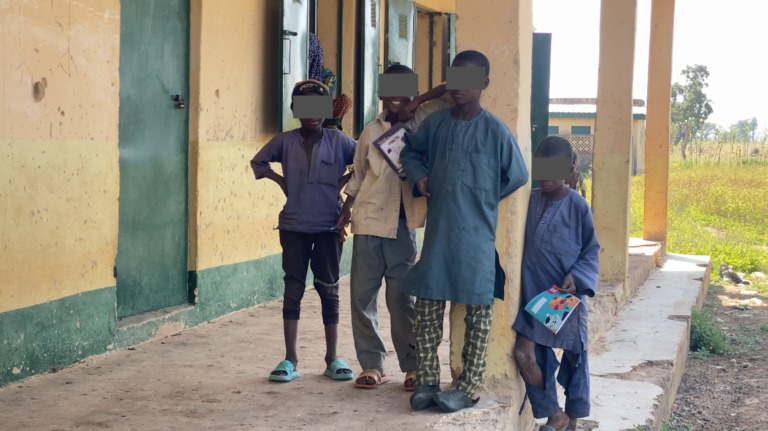
Pupils at Nomadic Primary School Gidan Ardo in Galadimawa, Giwa LGA of Kaduna.
As nomads migrate south, their children need school
About 30 million of Nigeria’s 50 million nomads are pastoralists, most of whom are in the north. They herd animals and are mainly from the Fulani ethnic group, often called “Fulbe”. They include settled, semi-nomadic, and nomadic (wodaabe) communities.
Migration in livestock farming is mostly to search for pasture, water, disease-free communities, and a secure environment. Up north, desertification, increasing aridity, insecurity, cattle rustling, population density, and the conversion of grazing routes/reserves for farming force Fulbe people to migrate south.
“Rainfall pattern is shifting from eight to six, to four months yearly. Some areas have just three months of rainfall. There is no green grass anymore. All the states in the north are affected,” said Umar Ardo, director of extension education at NCNE.
Over a long period, the herders and their cattle migrate on foot from states like Kebbi, Sokoto, Zamfara, Katsina, Kano, Jigawa, Yobe, Borno, Bauchi, Gombe, Adamawa, and Taraba.
They move to the middle belt states like Plateau, Kaduna, Niger, and Kwara, to converge in Lokoja. From there, many migrate further down south to Edo. Some cross and move south-east to Enugu. Others cross from Benue to Calabar in the south-south.
The movement is from the north to the middle belt and down south, where there is rainfall and vegetation.
The Wodaabe are more mobile, crossing state and national borders to Ghana, Togo, and the Benin Republic.
“Some pastoralists move because they are not secured,” Umar added. “They are killed. They are also categorised as bandits. Many lost their livelihood. Animals are taken. Some are kidnapped and raped.”
Umar said the north-south movement will continue towards the foreseeable future, regardless of local laws or policies, resulting in an increasing population of migrant children who will need basic education.
“When they move, we link them with our zonal offices, state directors, and local governments. The teachers are posted and the schools re-established,” Umar noted.
Most nomadic schools are location-based, and it may not always be practical to cater to active migrants via mobile schools. In Nigeria, only local governments and state basic education boards hire public school teachers, most of whom are only trained to teach in conventional schools. Due to stretched resources, staffing troubles, and language barriers, many migrant nomad children remain unschooled.
This report is republished from TheCable. Read the second part HERE
THE United States Embassy has announced updated visa interview requirements for Nigerian applicants, effective from April 22.
In a statement issued on Friday, April 11, the US Mission stated that all applicants attending interviews in Abuja and Lagos must bring a DS-160 visa application form that includes a confirmation barcode starting with “AA” followed by two zeros.
This barcode must exactly match the one used to book the interview appointment online.
This barcode must exactly match the one used to book the interview appointment online.
The embassy warned that applicants who fail to present a matching barcode will be denied entry to the consular section and disqualified from the interview.
“If the confirmation/barcode number on your DS-160 form does not match the one you used to book your appointment, you will not be allowed to enter the Consular Section or attend your visa interview,” the statement read.
Applicants are also advised to verify the alignment at least two weeks before their appointment.
The statement further clarified that previously used DS-160 forms are not reusable. In cases of a mismatch, applicants are advised to log into their AVITS account and submit a correction request at least ten days before their scheduled interview.
The US mission noted, “At least two weeks before your interview, please double-check that the barcode number on your DS-160 form matches the one you used to schedule your appointment.
“You cannot reuse a DS-160 from a previous application. If your DS-160 barcode is incorrect, you must log into your AVITS account at least 10 days before your appointment to create a support ticket requesting correction of your barcode number.”
Additionally, the US mission reminded applicants to ensure that their visa appointment is scheduled at the location indicated in their DS-160 form.
“If you are turned away from your appointment because your barcode numbers do not match, once you correct the problem, you will need to book a new appointment to proceed with your visa application. You may book a new appointment by logging into your AVITS account. If your visa fee has expired, you may have to pay a new fee before booking,” it added.
These changes are part of ongoing efforts to streamline visa processing and reduce administrative errors.
Since January 1, all visa applicants have been required to visit the US Consulate General in Lagos twice as part of the application process.
THE Nigerian Upstream Petroleum Regulatory Commission (NUPRC) says the country’s oil reserves stood at 37.28 billion barrels as of January 1 this year.
The apex regulator in the upstream oil and gas sector declared this in a statement on Friday, April 11, issued by its chief executive, Gbenga Komolafe.
He disclosed that the total gas reserves were officially at 210.54 trillion cubic feet.
Komolafe, in the statement noted that he acted in line with the commission’s mandate as stipulated in the Petroleum Industry Act 2021.
He further said, as against the foregoing, he was pleased to present an overview of the Nation’s oil, condensate, associated gas, and non-associated gas reserves as of January 1, 2025.
“2P Crude Oil and Condensate reserves stand at 31.44 bllion barrels and 5.84 billion barrels respectively, amounting to a total of 37.28 billion barrels.
“2P Associated Gas and Non-Associated Gas reserves stand at 101.03 Trillion Cubic Feet and 109.51 TCF, respectively, resulting in total Gas reserves of 210.54 TCF,” Komolafe stated.
He noted that the reserves life index stands at 64 years for oil and 93 years for gas.
This, he said, signals Nigeria’s potential to remain a dominant player in the global energy space for generations.
The NUPRC boss maintained the figures represent not just a statistical update but a bold reaffirmation of the Commission’s Regulatory Action Plan for 2024.
He said the aim was directed at ramping up exploration, enhancing upstream investment, and unlocking value from Nigeria’s vast energy resources.
He believes that boosting the efficiency and effectiveness of the upstream oil and gas sector, growing the nation’s reserves, and driving a sustainable rise in production for shared prosperity remain key priorities, as outlined in the 2024 Regulatory Action Plan and near-term strategy.
“Given the above, and furtherance of Chapter 1, Part III, Section 7 (g), (i). (i). (k), (m). (a). (r), and other powers enabling me in this respect, I hereby declare the Total Oil and Condensate reserves of 37.28 Billion Barrels and Total Gas reserves of 210.54 Trillion Cubic Feet as the official National Petroleum Reserves Position as of 1st January 2025,” he noted in the statement.
The growth in the reserves is expected to help the country achieve its 2.06 million barrels per day oil production output set by the government.
The NUPRC had last year launched an aggressive plan to increase Nigeria’s oil production by 1 million barrels per day.
In pursuit of this aim, The ICIR reported that the NUPRC opened up the country for investment with successful bid rounds, which were to allow an increase in oil production.
Its 2024 bid round saw 25 winners emerge after a competitive bidding process.
Major winners included Petroli Energy Marketing & Supply Limited (PPL 269), Sahara Deepwater Resource Limited (PPLs 270 and 271), Panout Oil and Gas Limited (PPL 300/301-CS), and TotalEnergies E&P Nigeria (PPL 2000/2001).
The round, with a focus on fallow assets, was aimed at boosting Nigeria’s energy production.
THERE is the possibility and likelihood of an annual budget reset as the Federal Government has constituted a subcommittee to evaluate the potential economic impact of the recent tariff measures announced by the United States government.
The decision followed a meeting of the Economic Management Team (EMT), chaired by Minister of Finance and Coordinating Minister of the economy, Wale Edun, according to a statement issued on Friday, April 11, by Mohammed Manga, Director of Information and Public Relations at the ministry, Mohammed Manga.
The ICIRreported that US President Trump slammed a 14 per cent tariff on Nigerian exports, arguing that Nigeria had already imposed a 27 per cent tariff on US exports to the country.
He, however, exempted oil and minerals-related exports from the new tariff.
A few days later, Edun said Nigeria is well-positioned to withstand global trade disruptions, including the United States import tariffs.
He said plans were underway for possible budget adjustments and prioritisation where possible.
To assess the impact of the tariffs, Manga said the EMT convened earlier in the week with key ministries and agencies to review the fiscal and macroeconomic implications of emerging global trade dynamics.
He said the EMT noted that while Nigeria’s major export — crude oil — has not been directly targeted by the new tariffs, the policy shift has coincided with a dip in international oil prices, raising concern over potential revenue and budgetary pressures.
“To support evidence-based policymaking, the EMT has established a subcommittee tasked with conducting a detailed review of the direct and indirect economic impacts of both the emerging tariff measures and the global commodity price shifts,” Manga said.
“The subcommittee includes representatives from the Ministry of Finance, the Ministry of Budget and Economic Planning (including the budget office of the Federation), and the Central Bank of Nigeria (CBN).”
Manga also said the subcommittee has already held its inaugural meeting and is expected to present its findings to the full EMT without delay.
The ICIRreported that Edun expressed concerns that amid the huge impact of the tariff on the oil slump, the government has to adjust, possibly, where necessary, its 2025 budget plans as a result of the global shift in Trump’s policies.
“We are monitoring developments globally, and we are adjusting accordingly. We’ll be speaking to the National Economic Council on this. It’s not our exclusive decision to make, however, we’ll make adjustments where necessary,” he said.
“Budget adjustment and prioritisation, where possible, as well as innovative non-debt financing strategies, would be embraced,” Edun was quoted in an earlier report by TheICIR.
THE Nigerian Meteorological Agency (NiMet) has warned about severe heat stress affecting Gombe and 17 other northern states.
According to its weather outlook released on Friday, April 11, by the Meteorological Manager for Gombe State, Gayus Musa.
The affected states include Borno, Adamawa, Taraba, Yobe, Bauchi, Jigawa, Kano, Katsina, Kaduna, Zamfara, Sokoto, Kebbi, Niger, Kogi, Nasarawa, Benue, and the Federal Capital Territory (FCT)
The agency stated that starting Saturday, April 12, temperatures in the affected states could soar up to 40 degrees Celsius(°C), leading to thermal discomfort.
“After three days of rainfall, discomfort levels are set to rise from April 12 due to high temperatures and clear skies.
Maximum temperatures in the north are reaching up to 40°C; with clear skies and moisture in the air, heat and discomfort will be more intense,” part of the statement read.
Musa encouraged residents of Gombe to take precautionary steps, noting that extreme heat could pose serious health risks.
He further cautioned that the combination of soaring temperatures and high humidity might lead to thermal discomfort.
He, therefore, advised people to limit their exposure to the sun, stay in cooler places, stay well-hydrated, and avoid intense physical activities during peak heat hours.
“Also, let’s always check up on vulnerable persons like our children and the elderly in our communities,” The statement further read.
He called on stakeholders to raise greater awareness about the dangers of heat stress and promote preventive actions crucial for maintaining good health.
In 2024, The ICIR reported how heat stress is affecting poultry farming in Sokoto state.
The report noted that heat stress is one of the most significant challenges of poultry farming. It occurs mostly during periods of high temperatures, causing birds difficulty in balancing heat production and loss.
States like Kebbi, Kano and Sokoto are among the hottest in the country, and in 2023, Sokoto state was predicted to be one of the states to exceed 40 degrees, according to the Nigerian Meteorological Agency (NiMET).
For farmers in Sokoto, high temperatures pose a major business challenge, as older birds are usually more prone to developing respiratory and other diseases during the heat, usually after a lot of investments have been made by the farmers.
FORMER Peoples Democratic Party (PDP) presidential candidate in the 2023 general election, Atiku Abubakar, has again stirred up coalition speculation talks in some quarters during a visit to former President Muhammadu Buhari at his residence in Kaduna on Friday, April 11.
Atiku met the former Nigerian leader in the company of former Governor of Kaduna State, Nasir El-Rufai, as the build-up to the 2027 election gears up.
Also in the delegation were an ex-governor of Sokoto State, Aminu Tambuwal, former Benue State Governor, Gabriel Suswam, former Governor of Imo State, Achike Udenwa, and former Adamawa State Governor, Jubirila Bindow.
Atiku disclosed the visit to Buhari in a post via X on Friday.
He wrote: “As the Waziri Adamawa, I was obligated to be in Adamawa during the Sallah celebrations. I held forth for the Lamido Fombina in some of the activities of the Sallah celebrations.
“Today, I had the opportunity to pay a post-Sallah visit to His Excellency Muhammadu Buhari, former President of the Federal Republic of Nigeria, 2015- 2023. It was a wonderful time with him. As usual, he cracked me up (to the extent that my ribs were hurting with his peculiar humour).”
The former Vice President, however, did not disclose the details of the visit.
As political activities heat up for the 2027 elections, there are rumours that Atiku, El-Rufai, and Peter Obi of the Labour Party are planning to form a coalition to remove President Bola Tinubu from power in 2027.
Atiku hinted about the formation of the coalition during a press conference by a group known as Concerned Leaders and Political Stakeholders in Nigeria.
The ICIR reported that the former Vice President and El-Rufai had raised alarm over what they described as a growing threat to Nigeria’s democracy.
Speaking at a national conference on strengthening democracy in Abuja on Monday, January 27, 2025, the leaders warned that if urgent action was not taken, the country could lose its hard-fought democracy.
Abubakar highlighted the erosion of democratic values, arguing that Nigeria was at crossroads.
He criticised the growing influence of the judiciary in determining electoral outcomes, arguing that the courts, not the people, decided candidates and winners.
He further accused the Federal Government of undermining opposition parties through financial inducements, adding that some political party leaders were given N50 million each.
On his part, El-Rufai said he shared similar concerns with Atiku, describing the current situation in the country as a “national emergency.”
He warned that the opposition risks extinction unless it unites.
The former Kaduna State governor claimed that there was a deliberate effort to destroy parties like the PDP and the Labour Party (LP).
He urged opposition leaders to prioritise internal democracy and adopt stricter standards for party delegates and candidates.
THE Federal Capital Territory Administration (FCT) has announced some land reforms, including a new law which seeks to revoke undeveloped plots after two years of issuance of Rights of Occupancy.
Addressing a news conference in Abuja on Friday, April 11, the Director of Land Administration in the FCTA, Chijioke Nwankwoeze, said the reforms will become operational from April 21, 2025.
He said the reforms cover specific areas like conditions of grant of Statutory Right of Occupancy, contents of the Statutory Right of Occupancy Bill, contents of Letter of Acceptance/Refusal of offer of grant of Right of Occupancy, titling of Mass Housing and sectional interests, as well as regularisation of Area Council Land documents.
The director noted that before now, the deadline for payment of bills, rents, and fees was not specified in the Statutory Right of Occupancy bill, and there was no penalty for failure to make payment promptly.
He explained that the development has caused a delay in revenue receivable due to non-collection of Right of Occupancy and non-payment of bills, slower pace of infrastructural development, sustained land speculation, and racketeering.
He further said that as a result, the FCT administration has incurred huge expenses through repeated advertisements and publications notifying the public on the need for collection of R-of-O and timely payment of bills and charges.
“Consequently, as against the unspecified period within which to collect the Right of Occupancy and make full payment of the Statutory Right of Occupancy bills and charges, land allottees now have 21 days from the date of offer, to make full payment of all bills, fees, rents and charges prescribed on offers of Statutory Rights of Occupancy and submit a duly completed Letter of acceptance alongside evidence of payments, or lose the offer.
“Also, as against the lengthy period within which to develop allocated lands, the period within which to erect and complete developments on any land granted in the FCT is now two years from the date of the commencement of the R-of-O.
“Therefore, any R-of-O bills and any other payments made outside the stipulated 21 days shall be considered invalid, while any land granted should be developed within two years”, he stated.
On lands previously allocated by Area Councils, Nwankwoeze said the law stipulates that all lands in the FCT are urban land.
He said it, therefore, becomes necessary that all land documents issued by the Area Councils are considered for regularization to statutory titles in line with relevant statutes.
“It should be noted that in 2006, the Zonal Land, Planning and Survey offices of the six Area Councils were directed to submit all Area Council allocation lists, layouts, files, and registers to Abuja Geographic Information System (AGIS)/Lands Department, and the Area Councils did this.
“However, to date, out of the 261,914 Area Council land documents submitted for regularization, only 8,287 have been vetted, out of which only 2,358 were cleared, validated and regularized to statutory titles. The 8,287 were vetted from 2006 to 2023 (17 years), and this represents just 3.2% of the total land documents submitted for vetting and regularization as of today; the FCT Administration is still left with 253,627 submissions in its database.
“Area Council land documents successfully vetted and confirmed would have statutory titles on such lands issued, and the allottees will have sixty days to make full payments of all bills, fees, rents, and charges prescribed, failure of which the offers shall become invalid,” he said.
The ICIRreported that Minister of FCT, Nyesom Wike, has approved the revocation of 4,794 land titles in the nation’s capital due to alleged non-payment of ground rent for over 40 years.
The minister’s Senior Special Assistant on Public Communications and Social Media, Lere Olayinka, and the Federal Capital Territory Administration (FCTA) Director of Lands, Chijioke Nwankwoeze, disclosed this at a press briefing on Monday, March 17.
Olayinka noted that the revocation followed multiple publications and announcements on broadcast media by the FCT Administration since 2023, adding that payment of ground rents was backed by extant laws.