Home Blog Page 327

Lawmakers to look into money lost to tax incentives, waivers

LAWMAKERS in Nigeria, specifically the House of Representatives, have decided to investigate claims that Nigeria has lost trillions of naira because of tax incentives, waivers, and exemptions given to companies.

The government agency responsible for handing out these tax breaks and incentives is the Federal Ministry of Finance, through the Nigeria Investment Promotion Commission (NIPC).

The motion was adopted at the plenary on Thursday, March 27.

It followed the adoption of a motion of urgent public importance moved by a member representing Oriade/Obokun Federal Constituency, Osun State, Oluwole Oke.

While moving the motion, Oke explained that the Federal Government has the sole right to tax income, profits, capital gains, exports, and imports. They use tax rules to try and keep the economy stable..

He pointed out that one way the government tries to boost the economy in certain areas is by giving tax waivers, breaks, exemptions, and incentives.

However, the the lawmaker also said that while these tax breaks are meant to be helpful, they have created a massive hole in the country’s finances.

He claimed that this is mainly because companies that benefit from these schemes are abusing the system.

Oke, however, pointed out  that successive administrations had issued fiscal policy measures and tax modification orders in line with national economic strategies, with some interventions yielding positive results.

Despite the good intentions, the lawmaker, however, lamented that tax incentives and waivers had created a “major black hole in the country’s finances.”

He asserted that this is mainly due to abuses by companies benefiting from the scheme.

Oke stressed that data suggest Nigeria loses an estimated N8 trillion every year due to tax waivers. Out of this, N6 trillion is lost because companies are taking advantage, and N2 trillion is down to badly managed waivers.

He highlighted specific tax areas that are often misused, such as capital allowances, investment allowances, pioneer status incentives, free trade zone exemptions, and VAT exemptions.

“These loopholes have significantly impacted Nigeria’s tax-to-GDP ratio, which currently stands at 10.6%—one of the lowest in Africa,” Oke maintained.

He believes that urgent steps need to be taken to curb the abuse of tax waivers so the country does not get plugged into severe fiscal crises.

“If this situation persists, Nigeria may not only be on the verge of a fiscal collapse but could suffer a fate similar to Venezuela, where a country with vast resources finds itself in deep economic turmoil, recession, and depression.”

To further look into the matter, the Green Chamber then mandated its Committees on Industry, Finance, and Commerce to investigate the issue and submit a report within four weeks for legislative action.

Nigeria’s losses to tax incentives and others have been a worry to many stakeholders and concerned groups.

In particular, the Civil Society Legislative Advocacy Centre (CISLAC) has repeatedly expressed worries that Nigeria faces a severe fiscal crisis marked by a consistent decline in government revenue over the past years.

The ICIR reported in April 2024 that CISLAC’s executive director, Auwal Ibrahim Musa, lamented that Nigeria’s fiscal woes were being compounded significantly by revenue losses attributed to tax expenditures, encompassing incentives, exemptions, credits, and waivers.

According to him, this substantial revenue leakage underscores the urgency of addressing tax expenditure and debt management issues with utmost priority.

He argued that there is a need for a comprehensive review of existing tax incentives to ensure their effectiveness, efficiency, and alignment with national development priorities.
NNPCL plans to sell shares to public

0

NEARLY  four years into the implementation of the Petroleum Industry Act (PIA), the Nigerian National Petroleum Company Limited (NNPCL) has said they are planning to offer shares to people to buy on the Nigerian stock market.

The move is a welcome development as people can now invest in the national oil company and share in profits.

Selling shares could also mean the government gets more money from taxes, dividends (which are like little payouts to shareholders), and royalties. Plus, it means Nigerians will really own a part of their national oil company.

The NNPCL announced this in a statement on Thursday, March 27 signed its chief corporate communications officer, Olufemi Soneye.

He said the NNPCL is at the final stage of getting listed in the capital market, in keeping with the provisions of the Petroleum Industry Act (PIA) 2021.

According to Soneye, the company’s finance boss, Olugbenga Oluwaniyi, mentioned this at a meeting with their partners in Abuja on the same Thursday.

Oluwaniyi said the NNPCL is currently talking to potential partners in what they’re calling an “IPO Beauty Parade”. This is basically where they chat with different companies to see how they can help with the share sale, which is called an Initial Public Offer (IPO).

The idea of the “IPO Beauty Parade” is to find out which companies can help them with things like talking to investors, getting ready for the IPO, and being their investment bank partners.

The areas of partnership required include investor relations, IPO readiness advisers, and investment bank partners, the company stated.

“The company with the best offer in terms of project partnership would be selected for each of the three categories,” the statement added.

The ICIR reports that the PIA provides for the NNPCL to list its shares in the capital market in line with the provisions of the Companies and Allied Matters Act (CAMA) 1990.

An IPO is a public offering in which shares of a company are sold to institutional investors.

There has been concern over the delay in listing the state-owned oil firm despite having transitioned into a Limited Liability Company on July 19, 2022, with the signing of the PIA. The ICIR earlier reported.

The NNPCL’s failure to enlist in Nigeria’s capital market came following the initial plan to list in the middle of 2023.

2027: Tinubu, Atiku, Obi’s presidential bid threatened as Reps pass bill limiting candidates age to 60

THE House of Representatives has passed for the second reading a bill seeking to bar individuals above 60 years from contesting for the offices of President and Governor in Nigeria.

The Green Chamber passed the bill, sponsored by one of its members, Ikeagwuonu Ugochinyere, on Thursday, March 27.

The bill proposes amendments to the 1999 Constitution to revise eligibility requirements for key political positions.

It spells out that presidential and gubernatorial candidates must not be older than 60 years at the time of contesting for the office.

It also requires that candidates must hold at least a Bachelor’s degree in their chosen field of study.

Specifically, it proposes an amendment to Section 131 of the 1999 Constitution to introduce an age limit for a presidential and Section 177 for governorship candidates.

If allowed to see the light of the day and passed into law, it will stop President Bola Tinubu from seeking re-election in 2027.

It will also kill the ambition of Atiku Abubakar and Peter Obi, among others, from seeking the highest political office in the country.

The ICIR reports that there have been calls for lawmakers to legislate on limiting the age of candidates aspiring to contest for political offices in the country.

In November 2024, two Labour Party (LP) chieftains, national youth leader Kennedy Ahanotu and the party’s lawmaker representing Okpe/Sapele/Uvwie Federal Constituency, Benedict Etanabene, made a similar call.

Their call was that any politician who is 70 years and above should be stopped from contesting elections just as the Federal Government placed an age restriction on civil servants, who are the most productive arm of the nation.

According to them, this is to free a lot of positions for the younger generations to take up important national responsibilities.

The ICIR had reported that the former governor of Ebonyi State and currently the Minister of Works, Dave Umahi, had suggested an age limit for the lawmakers.

He made the call while refuting an allegation that former governors had turned the Senate into a retirement home since the return of Nigeria to civil rule in 1999.

Northern Youth Council opposes proposed conversion of Lagos 37 LCDAs to LGAs

1

NORTHERN Youth Council of Nigeria (NYCN) has kicked against the bill seeking to convert 37 Local Council Development Areas (LCDAs) in Lagos State to Local Government Areas (LGAs)

In a statement on Thursday, March 27, the NYCN National President, Isah Abubakar, stated the bill was unfair and a threat to national unity.

The House of Representatives, on Wednesday, March 26, had passed the bill for a second reading.

The ICIR reports that if the bill scales through, Lagos State LGAs will increase from 20 to 57 and will raise Nigerian LGAs from 774 to 811.

The NYCN warned that the proposed change would unfairly favour Lagos State, undermining fairness and equality in governance.

Instead, the group advocated for a thorough review of local governance structures in the country to ensure fair representation and consideration of diverse needs.

It advised Nigerian governors, especially those from the Northern region, to oppose the bill.

The NYCN reaffirmed its dedication to advancing unity, fairness, and equal opportunities in governance, cautioning lawmakers to carefully weigh the potential consequences of the bill.

The bill is among dozens of bills currently before the House of Representatives as the National Assembly seeks to amend the Constitution of the Federal Republic of Nigeria (1999 as amended) and enact new laws for the country.

The ICIR reported on Thursday that a bill seeking to create the Office of the Prime Minister as the head of government and the Office of the President as head of state passed a second reading at the House of Representatives. 

 The bill proposed to alter the provisions of the constitution to provide a framework for the mode of election to the two offices.

The bill is among the 32 constitutional amendment bills that scaled second reading in the House of Representatives on Thursday.

Also among the bills is a bill for an Act to amend the constitution to provide for specific seats for women in the National Assembly and state houses of assembly.

Another bill proposes to amend the constitution to shorten the time for resolving pre-election disputes, establish pre-election tribunals, and regulate the suspension of National Assembly members.

A bill for an Act to amend the constitution to review the requirements that qualify persons to be elected as president and vice-president of the Federal Republic of Nigeria, governors and deputy governors also passed a second reading at Thursday’s session.

Three other bills that seek to alter Nigeria’s Constitution to review the Federal Capital Territory’s status in presidential elections and create two new states, Wan and Gobir, also passed a second reading.

This brings the total number of Constitution Amendment Bills to 113.

The ICIR also reported that the House reversed its decision on a bill that sought to strip the vice president, governors, and deputy governors of immunity from prosecution.

Bill to create Office of Prime Minister passes second reading at House of Reps

0

A BILL seeking to create the Office of the Prime Minister as the head of government and the Office of the President as head of state has passed a second reading at the House of Representatives.  

The bill proposed to alter the provisions of the Constitution of the Federal Republic of Nigeria, 1999 as amended, to provide a framework for the mode of election to the two offices.

The bill is among the 32 constitutional amendment bills that scaled second reading in the House of Representatives on Thursday, March 27.

Also among the bills is a bill for an Act to alter the provisions of the Constitution of the Federal Republic of Nigeria, 1999 as amended, to provide for specific seats for women in the National Assembly and state houses of assembly.

Another bill proposes to amend Nigeria’s 1999 Constitution to shorten the time for resolving pre-election disputes, establish pre-election tribunals, and regulate the suspension of National Assembly members.

A bill for an Act to alter the Constitution of the Federal Republic of Nigeria, 1999, to review the requirements that qualify persons to be elected as president and vice-president of the Federal Republic of Nigeria, governors and deputy governors also passed a second reading at Thursday’s session.

Three other bills that seek to alter Nigeria’s Constitution and review the Federal Capital Territory’s status in presidential elections and create two new states, Wan and Gobir, also passed second reading.

This brings the total number of Constitution Amendment Bills to 113.

The ICIR reported that the House reversed its decision on a bill that sought to strip the vice president, governors, and deputy governors of immunity from prosecution.

This change followed a motion moved by the Majority Leader, Julius Ihonvbere, during Thursday’s plenary.

The bill had passed its second reading on Wednesday but was revisited and rescinded the next day. 

The House also rescinded its decision to pass for a second reading the bill to amend the Constitution to review the death penalty for certain categories of offences. 

The Deputy Speaker, Benjamin Kalu, who presided over the plenary, said the House’s decision to pass the bills for second reading became necessary given the need to subject them to further debate

Kalu said the bills would be returned to the House for debate by members, given the sensitive nature of the issues involved. 

EU seeks framework for its €1.3bn trade, investment committment in Nigeria

THE European Union (EU) wants to set up a clear plan for its proposed €1.3 billion trade and investment in Nigeria’s economy. The EU says this will increase its commitments to infrastructure and sustainable development in Nigeria.

Because of this, the EU has suggested establishing a structured discussion framework with the Nigerian government about trade and investment. This would improve cooperation in important areas like infrastructure, green finance, and sustainable development.

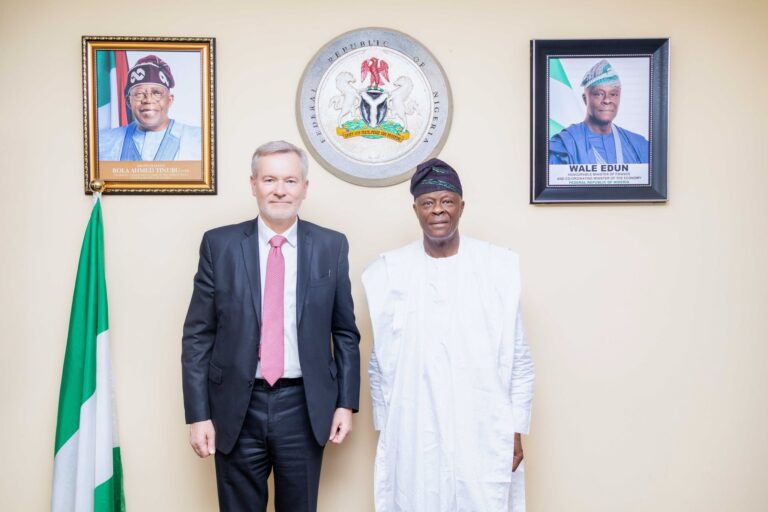
Nigeria’s Minister of Finance and the coordinating Minister of the Economy, Wale Edun, has confirmed that he has discussed this with the EU Ambassador to Nigeria, Gautier Mignot, in Abuja. The talks specifically focused on creating a structured investment plan for the Nigerian economy.

This was contained in a social media post by the Federal Ministry of Finance on Thursday, March 27.

The post quoted the EU Ambassador to Nigeria as highlighting the EU’s position as Nigeria’s biggest trading partner and a major source of foreign direct investment (FDI).  

The meeting emphasised the EU’s current €1.3 billion investment in Nigeria, along with recent involvement from the European Bank for Reconstruction and Development (EBRD). It also highlighted the EU’s Global Gateway Investment Strategy, which aims to boost infrastructure and sustainable development across Africa.

The post reads in part, “The meeting spotlighted the EU’s €1.3 billion investment portfolio in Nigeria, recent engagement by the European Bank for Reconstruction and Development (EBRD), and the Global Gateway Investment Strategy aimed at deepening Africa-Europe economic ties.”

Minister Edun welcomed the EU’s proposal while reaffirming Nigeria’s commitment to macroeconomic stability, investor-friendly policies, and fiscal consolidation.

He highlighted key reforms designed to make it easier to do business in Nigeria, including the National Single Window trade system, adjustments to tax policies, and efforts to attract private investment into crucial sectors.

Edun also pointed to Nigeria’s projected gross domestic product (GDP) growth of 4.6 per cent by 2025, driven by sustained reforms in the oil and non-oil sectors, as well as strategic investments in agriculture, technology, and manufacturing.

The ICIR has recently reported the EU’s call on the Nigerian government to allocate more resources to social protection programmes aiming to mitigate poverty and improve the welfare of vulnerable populations.

The head of cooperation of the EU delegation to Nigeria and the Economic Community of West African States (ECOWAS), Massimo De Luca, said this at the third edition of the Social Protection Cross-learning Summit (SPECS) held in Abuja on June 28, 2024.

De Luca said that social protection provided safety nets that ensured access to essential services for the country’s development, adding that investing in social protection would contribute meaningfully to society.

Nigeria condemns shooting of Immigration officer allegedly on Chinese firm’s order

0

THE Minister of Interior, Olubunmi Tunji-Ojo, has vowed to take tough actions against the shooting of an officer of the Nigeria Immigration Service (NIS), allegedly on the order of a Chinese company operating in Nigeria.

The minister, while condemning the incident at a stakeholders’ sensitisation workshop on the implementation of the Nigeria Visa Policy 2025 in Abuja on Thursday, March 27, described the action as an outright “attack on Nigeria.” 

He vowed to escalate the incident, which happened in Niger State, at the highest diplomatic level, adding that such action would not be tolerated.

He said, “I will not go to any country, open a company, and say the Immigration Service cannot come out. I will not do that.

“I don’t want to mention the company here, but they shot one of our Immigration officers. They told their security attaché to shoot our officer, and he did— a foreign company?

“That happened a couple of weeks ago in Niger (State), and we are going to take it up with the Chinese embassy because it’s a Chinese company. I won’t go to China as a Nigerian, enter a company, and tell my security to shoot a government official in uniform. It’s never done anywhere in the world. That alone is an attack on Nigeria.”

The officer, he explained, was simply carrying out his duty when he was shot.

“That is a diplomatic issue, and we will handle it. It will not happen again. So we are going to be very firm. We will not disturb your business or overburden your operations.

“But don’t make us inferior in our land. We are going to be very tough on this. I’m not just speaking with passion; I’m speaking with anger.”

Tunji-Ojo further warned that the government would not hesitate to revoke business licences and shut down companies operating with disregard for Nigerian laws.

“No company is above the law. We will not tolerate it. No agent, no company is above the law.

“We are doing our best to make things easier and to collaborate with businesses. But please, we beg you, do not insult us. We will not disrespect you. As long as the president remains in office, nobody will disrespect you in Nigeria. All we ask for is mutual respect,” he stated.

Reps rescind decision on bill seeking to strip VP, governors of immunity

0

THE House of Representatives has reversed its decision on a bill that sought to strip the vice president, governors, and deputy governors of immunity from prosecution.

The change followed a motion moved by the Majority Leader, Julius Ihonvbere, during the plenary session on Thursday, March 27.

The bill had passed its second reading on Wednesday but was revisited the next day.

The lawmakers also changed their decision to pass a bill to amend the Constitution to review the death penalty for certain categories of offences. 

The Deputy Speaker, Benjamin Kalu, who presided over the plenary, said the House’s decision to pass the bills for second reading became necessary given the need to subject them to further debate

Kalu said the bills would be returned to the House for debate by members, given the sensitive nature of the issues involved. 

The ICIR reported that the House moved to strip the vice president, governors, and their deputies of immunity from prosecution, a privilege currently enshrined in the 1999 Constitution.

A bill seeking to amend Section 308 of the constitution scaled second reading on Wednesday, March 26.

Under existing laws, the president, vice president, governors, and their deputies cannot be prosecuted while in office. 

This wasn’t the first time the National Assembly would be moving to strip the vice president, governor, and their deputies of immunity. 

In 2020, the Nigerian Senate approved a bill that would strip the officials of immunity if found guilty of misappropriation of government funds. 

 The bill was consequently referred to the Committee on Constitution Review for further legislative consideration.

The proposal, before it was rescinded, was part of a broader set of 42 constitutional amendment bills that were passed on Wednesday.

France pledges €2bn in military aid as world leaders convene in Paris for Ukraine talks

FRANCE has announced a commitment of 2 billion euros in military aid to Ukraine as about 30 leaders arrive with President Volodymyr Zelensky in Paris on Thursday, March 27, to discuss bolstering Kyiv’s position and exploring their potential roles in a future peace agreement with Russia.

The ICIR reports that the third summit of what France and Britain refer to as the “Coalition of the Willing” brings together key leaders, including British Prime Minister Keir Starmer, NATO Secretary General Mark Rutte, Polish Prime Minister Donald Tusk, Italian Prime Minister Giorgia Meloni, and Turkish Vice President Cevdet Yılmaz.

French President Emmanuel Macron revealed the latest development to reporters on Wednesday evening during a press conference with Zelensky, noting that the commitment included missiles, warplanes and air defence equipment.

“First and foremost (we will discuss) the immediate support for Ukraine. It must go on because it is necessary to continue the resistance,” he said.

“The objective is to allow Ukraine to keep the situation on the ground and resist the Russian aggression while building the credible elements to this lasting peace,” Macron said.

French officials said that the meeting aimed to define Europe’s role in negotiations to end the conflict, emphasising that while the United States was not participating, the summit’s outcome would be shared with the United States Government.

The officials said that the discussions would centre on strengthening Ukraine’s military to deter future attacks and monitoring the limited ceasefires on sea targets and energy infrastructure, as addressed during the United States-led talks in Saudi Arabia this week.

“The Prime Minister will underline that all must come together to support Ukraine to remain in the fight and back US efforts to make real progress despite continued Russian obfuscation,” British Prime Minister Keir Starmer’s office said in a statement.

The statement added that planning had explored the full spectrum of European military capabilities, including aircraft, tanks, troops, intelligence, and logistics, as discussions have focused on what European nations can contribute to support any future force.

Responding, Zelensky expressed hope for greater clarity on which countries would ultimately commit to such a force. While acknowledging that the process was still in its early stages, he noted that other partners might announce aid packages on Thursday.

Highlighting differing views among Ukraine’s partners, Italian Foreign Minister Antonio Tajani reaffirmed his country’s opposition to the proposed force.

“Not sending troops on a mission unless they are part of the United Nations, (this) is the only condition for us to deploy military personnel” in Ukraine, Tajani said after a cabinet meeting Wednesday evening.

However, Russian Foreign Ministry spokeswoman Maria Zakharova on Thursday accused France and Britain of plotting a “military intervention in Ukraine” under the pretext of a peacekeeping mission, warning that such actions could result in a direct military confrontation between Russia and NATO.

The ICIR reports that this commitment comes after Zelensky agreed earlier this month to move forward with ceasefire talks to facilitate the resumption of US aid and intelligence sharing.

Meanwhile, Russia has imposed additional conditions on implementing a ceasefire deal in the Black Sea and energy targets, while many European nations remain skeptical about the likelihood of a peace agreement soon.


Japan, Canada threaten revenge as Trump imposes 25% tariffs on imported vehicles

JAPAN’S Prime Minister Shigeru Ishiba has condemned Washington’s decision to impose steep tariffs on auto imports and parts, calling it “extremely regrettable.”

As Asian markets opened on Thursday, March 27, carmaker stocks saw sharp declines, prompting Ishiba to say that Tokyo was “considering all possible countermeasures.”

“Japan is a country that is making the largest amount of investment to the United States, so we wonder if it makes sense for (Washington) to apply uniform tariffs to all countries. That is a point we’ve been making and will continue to do so,” Ishiba told parliament.

“We need to consider what’s best for Japan’s national interest. We’re putting all options on the table in considering the most effective response,” Ishiba said, without elaborating on the possible steps Tokyo could take.

The ICIR reports that U.S. President Donald Trump announced steep tariffs on auto imports and parts on Wednesday, March 26, ahead of additional trade levies expected next week.

“What we’re going to be doing is a 25 per cent tariff on all cars that are not made in the United States,” Trump said, as he signed the order in the Oval Office.

Trump noted that the duties would take effect at 12:01 a.m. (0401 GMT) on April 3, targeting foreign-made cars and light trucks, with key automobile parts also facing tariffs later in the month.

Meanwhile, Trump’s senior counselor for trade and manufacturing, Peter Navarro, in a briefing after the announcement, blasted “foreign trade cheaters” who, he said, turned America’s manufacturing sector into a “lower wage assembly operation for foreign parts.”

Navarro particularly criticised Germany and Japan for keeping the production of higher-value parts within their own countries.

Reacting, Canadian Prime Minister Mark Carney condemned Trump’s tariffs as a “direct attack” on his country’s workers, stating that the cabinet would meet on Thursday to discuss possible retaliation.

Similarly, South Korea’s auto industry minister Ahn Duk-geun announced on Thursday that the government was planning an emergency response by April.

“Global uncertainties are growing, but South Korean auto companies will not be fighting alone,” Ahn said. The government will consider financial assistance, investment support, and help with market diversification, Duk-geun said.

Brazil’s President Luiz Inácio Lula da Silva warned that Trump’s additional tariffs could harm the U.S. economy.

“Protectionism benefits no country in the world,” Lula said at a press conference in Tokyo on Thursday, vowing to file a complaint with the World Trade Organization over the trade levy on Brazilian steel.

The ICIR reports that the latest tariff hike adds to existing duties Trump has introduced since assuming office in January.

Trump imposed 25 per cent duty on steel and aluminum on imports from key US trading partners, Canada, Mexico, and China, in the first week of March.