Home Blog Page 330

INEC notifies Natasha of recall petition, begins verification process

0

THE Independent National Electoral Commission (INEC) said it had notified the senator representing Kogi Central, Natasha Akpoti-Uduaghan, of a recall petition initiated by registered voters in her district. 

The notification, dated March 26, was issued by the INEC’s Secretary, Rose Oriaran Anthony.

In the letter addressed to the senator and copied to the presiding officer of the Senate, INEC confirmed receiving a petition from her constituents seeking her recall from the National Assembly. 

“Pursuant to Section 69 of the Constitution of the Federal Republic of Nigeria 1999 (as amended), I write to notify you of the receipt of a petition from representatives of registered voters in your constituency seeking your recall from the Senate.

“This notification is in line with the provision of Clause 2(a) of the Commission’s Regulations and Guidelines for Recall, 2024. This letter is also copied to the presiding officer of the Senate and simultaneously published on the Commission’s website,” the letter read.

This was as the commission, in another letter, confirmed that it had received a letter providing the contact details of the petitioners’ representatives. 

The statement, released by the National Commissioner and Chairman of INEC’s Information and Voter Education Committee, Sam Olumekun, on Wednesday, March 26, stated that the next stage involved verifying the signatures submitted by the petitioners to ascertain that the recall request was endorsed by more than half (over 50 per cent) of the registered voters in Kogi Central Senatorial District. 

Recall that the commission, while acknowledging the receipt of the petition, which it said was accompanied by six bags of documents purportedly containing the signatures of over half of the district’s 474,554 registered voters, stated that there was an omission of contact address and phone numbers of the petitioners’ representatives.

The INEC deemed the only address provided by the petitioners, “Okene, Kogi State”, too vague for official correspondence.  

The commission has, however, noted that the verification process would take place in the coming days, with the outcome determining subsequent actions.  

“As provided in Clause 2(a) of the Commission’s Regulations and Guidelines for Recall 2024, a letter has been written to notify the senator sought to be recalled about the receipt of the petition and delivered to her official address. The same letter has been copied to the presiding officer of the Senate and published on the Commission’s website.

“The next step is to scrutinise the list of signatories submitted by the petitioners to ascertain that the petition is signed by more than one-half (over 50 per cent of the registered voters in the constituency. This will be done in the coming days. The outcome, which will be made public, shall determine the next step to be taken by the commission,” the statement added.

The INEC reassured Nigerians that the recall process would be conducted transparently and in accordance with legal provisions.

FG begins payment of N77,000 to corps members, but many yet to receive new allowance

0

THE Federal Government has commenced the payment of N77,000 to National Youth Service Corps (NYSC) members, nearly a year after the approval of the new minimum wage.

However, while some corps members have confirmed receiving the new allowance for the month of March, many said they had yet to get it, hoping they would receive the payment alert before the end of today.

Some of the corps members who spoke with The ICIR, in Abuja, Gombe, Sokoto and Adamawa claimed that they had yet to get their monthly stipend but said some of their colleagues in other states received the new allowance.

Corps members serving in Katsina, Kano, and Cross Rivers confirmed to The ICIR, that they had received the new allowance.

The payment of N77,000 followed earlier reports that the NYSC would begin disbursing the new allowance in March, in line with the Federal Government’s decision to adjust corps members’ stipend to reflect the new minimum wage proposal.

The Director-General of the NYSC, Olakunle Nafiu, a brigadier-general, assured corps members last week that the new monthly allowance of N77,000 would take effect from this month.

Speaking during an interactive session with corps members at the Wuse and Garki NYSC Zonal Offices in Abuja, Nafiu reaffirmed the commitment of the NYSC and the Federal Government to the welfare of corps members.

According to a statement by the NYSC’s Acting Director of Information and Public Relations, Caroline Embu, the approval of the N77,000 allowance was outlined in a letter from the National Salaries, Incomes and Wages Commission, dated September 25, 2024. 

This development also came in the wake of a controversy involving a corps member, Ushie Rita Uguamaye, who publicly criticised President Bola Tinubu, calling him a “terrible president” due to the worsening economic conditions in the country. 

Uguamaye, popularly known as Raye, went viral after expressing her frustrations over the rising cost of living, stating that the previous N33,000 paid corps members was insufficient to meet basic needs.

She had lamented how prices of essential goods skyrocketed, narrating how the cost of a crate of eggs rose from N800 to N6,500. Following her comments, Uguamaye claimed she received threats from NYSC officials instructing her to delete her post.

The ICIR reports that since assuming office in May 2023, President Tinubu has embarked on a series of economic reforms aimed at stabilising the nation’s economy. 

These measures, which include the removal of subsidy from petrol, exchange rate unification, and increased reliance on food importation to lower consumer prices, have been highly criticised as inflation, food prices and cost of living remained high.

Despite signing the new minimum wage of N70,000 into law in June 2024, which is expected to reflect in the allowance of serving corps members from the day he signed the new wage, the Tinubu government failed to begin its implementation for the NYSC until today.

Corps members nationwide had continued to survive on the N33,000 monthly allowance from the Federal Government, except for those fortunate enough to receive additional stipends from the states where they serve or their places of primary assignment.

Lawmakers want states to control oil, mineral resources as bill passes second reading 

0

A proposed law that would shift control of natural resources like oil fields, minerals, and natural gas from the federal government to state governments in Nigeria has passed its second reading in the House of Representatives.

This bill  seeks to amend the 1999 Constitution  to change how Nigeria manages its resources, giving states more independence in deciding how to explore, manage, and earn money from the natural assets within their borders.

The bill, titled “A Bill for an Act to Alter the Provisions of the Constitution of the Federal Republic of Nigeria, 1999 to Decentralise the Governance of Natural Resources in the Federal Republic of Nigeria to transfer Mines and Minerals, Including Oil Fields, Oil Mining, Geological Surveys and Natural Gas from the Exclusive Legislative List to the Concurrent Legislative List and for Related Matters (HB. 200, 1310, 1446 & 1546)” was sponsored by Abbas Tajudeen, the House speaker and three others.

The ICIR reports that currently, certain natural resources, such as mines, minerals, oil fields, oil mining, geological surveys, and natural gas, are solely managed by the federal government.

They are on what’s called the “Exclusive Legislative List,” meaning only the federal government makes laws and decisions about them. Part 1 of the Second Schedule (Exclusive Legislative List) of the 1999 Constitution, Item 39 currently states: “Mines and minerals, including oil fields, oil mining, geological surveys, and natural gas.” This provision gives the federal government exclusive control over these resources, meaning that states have no direct authority to regulate, tax, or manage them.

Therefore, this new bill wants to remove Item 39 from the Exclusive List and put it on the “Concurrent Legislative List.” If it’s on this list, both the federal and state governments would have the power to make laws and regulate how resources are extracted and managed.

If the bill becomes law, it could mean states can issue licences for mining and oil exploration, control how resources are taken out of the ground, and collect money from these activities without needing to go through the federal government.

It’s worth noting that a similar bill was suggested in 2016 but didn’t progress beyond the second reading. Some people argue that giving states more control could create inequalities, with richer oil-producing states benefiting much more than others.

Having passed this stage, the bill will now go to the Committee Stage, specifically the committee responsible for constitutional amendments. If approved there, it will return to the House for a third reading before being sent to the Senate for their agreement.

For the bill to become law, it also needs to be approved by two-thirds of the 36 State Houses of Assembly, as required for changes to the constitution under Section 9 of the 1999 Constitution.

The ICIR reports that if the bill eventually becomes law, it’s expected to increase the amount of money states can generate. Many states could grow their income without being restricted by the federal government.

A similar approach was taken when the President approved the Electricity Act 2023. This law gives states more power to improve electricity supply within their own borders and rely less on the national grid

The ICIR reported that the  Electricity Act consolidates all legislation dealing with the electricity supply industry to provide an ideal institutional framework to guide the post-privatisation phase and encourage private sector investments in the sector.

New police commissioner assumes office in FCT

0

A NEW police commissioner for the Federal Capital Territory (FCT), Ajao Saka Adewale, has assumed office.

Adewale assumed duty on Wednesday, March 26, pledging to enhance security through intelligence-driven and proactive policing.

He took over from Tunji Disu, who has been promoted to Assistant Inspector General (AIG) and redeployed to head the Special Protection Unit at the Force Headquarters.

During the handover ceremony in Abuja, Adewale lauded his predecessor and promised to build upon his accomplishments to ensure seamless and effective policing in the nation’s capital.

The new police chief vowed to provide top-notch leadership to his team and ensure they are well-equipped to serve.

He also reassured the FCT residents that they should expect a more responsive and efficient policing approach aimed at keeping the city safe and building trust.

In his farewell speech, Disu encouraged the command’s personnel to give the new CP maximum support and cooperation.

He also expressed gratitude for the support he received and requested that the team extend the same level of cooperation to the new commissioner.

The ICIR reported that Disu assumed duty as the 32nd commissioner of police for the FCT on Monday, October 7.

He replaced Benneth Igweh, who was promoted to assistant inspector-general (AIG) of police and posted to Zone 7 headquarters.

The ICIR reports that residents of the FCT have been struggling with a rising spate of insecurity in the city’s area councils, especially Bwari and Kuje.

A 2022 report by this organisation showed the magnitude of insecurity in the city.

The ICIR reported cases in Mpape, Sauka, Chikakore, among other communities in the FCT.

In January, the minister of FCT, Nyesome Wike, berated the FCT area council chairpersons while addressing stakeholders at an emergency security meeting in his office.

He expressed concern over the lack of proactive measures taken to address the rising insecurity issues within their jurisdictions.

Bill seeking vice-president, governors’ immunity removal passes second reading

0

THE House of Representatives has moved to strip the vice president, governors, and their deputies of immunity from prosecution, a privilege currently enshrined in the 1999 Constitution.

A bill seeking to amend Section 308 of the constitution scaled second reading on Wednesday, March 26.

If eventually passed by both chambers and signed by President Bola Tinubu, it would allow law enforcement agencies to investigate and prosecute these officials for corruption and financial mismanagement while they are still in office.

Under existing laws, the president, vice president, governors, and their deputies cannot be prosecuted while in office. 

This wasn’t the first time the National Assembly would be moving to strip the vice president, governor, and their deputies of immunity. 

In 2020, the Nigerian Senate approved a bill that would strip the officials of immunity if found guilty of misappropriation of government funds.  

The bill was consequently referred to the Committee on Constitution Review for further legislative consideration.

The recent proposal is part of a broader set of 42 constitutional amendment bills that were passed today.

Other amendments considered by lawmakers include a bill to separate the offices of the Attorney-General of the Federation and the Minister of Justice, a Bill for an Act to alter the provisions of the Constitution of the Federal Republic of Nigeria, as well as proposals to create new states such as Ijebu, Ife-Ijesa, Tiga, Orlu, and Etiti.

With this latest development, a total of 81 constitutional amendment bills have now passed second reading in the House.

The House passed 39 constitutional amendment bills after they scaled second reading on Tuesday, March 25.

’30 days rant challenge’ goes viral as Nigerians struggle with high costs

NIGERIAN are taking to the internet to protest the unbearable cost of living in the country, with the ’30-Day Rant Challenge’.

The nationwide online outcry began after a video went viral on March 16, featuring Ushie Rita Uguamaye, popularly known as Raye, a member of the National Youth Service Corps (NYSC). In the video, Uguamaye urged fellow young Nigerians to start a “30-Day Rant Challenge” to express their frustration with the country’s tough economic situation.

The ICIR reported that Uguamaye, who is serving in Lagos State, shared her feelings in a widely shared video on her Instagram page. She spoke about how Nigeria’s rising cost of living made her monthly NYSC allowance of N33,000 insufficient to cover basic necessities.

A day after her viral video, in which she called President Bola Tinubu a ‘terrible’ leader,  Uguamaye expressed concerns for her safety, claiming she had received threats.

On March 17, she encouraged Nigerians to start an online protest against any questionable government actions.

“If we decide to start calling the Nigerian government out, don’t you think a lot of changes would be made? If we decide that we want to run a 30-day challenge where we complain about the economy, do you guys not know that people would start looking into it and they will start making changes?” she said.

The following day, Nigerian youths began expressing their frustration online, using the hashtag “Day One of the 30-Day Rant Challenge.”

On X, Blaqboi Victor posted a video on Monday ranting with the caption “Day 1, calling out the Nigerian Government”

@Ourfavonlinedoc posted, “I have never seen a government more determined to impoverish and destroy the people’s entire lives like this. You should share this so the entire world sees what the average Nigerian is going through. This is unbelievable. #30daysrantchallenge”

@Kangaroo PHD (hc) on Tiktok didn’t hold back his frustration as he compared the state of the country under President Goodluck Jonathan’s administration with its current state. He detailed the sharp differences between the two governments.

@Mko, a comedian on TikTok, also voiced his concerns over the hardship in Nigeria.

Tiktoker Itisbobby amplified Uguamaye’s cry when he recorded a situation update in one of the nation’s markets.

Other TikTokers like Celynukam, Purple Speedy, and Ivana also highlighted the rising cost of living since Tinubu assumed power sharing their grievances about the country’s economic hardships and governance.

The ICIR reports that the 30-Day Rant Challenge comes seven months after the nationwide protests against bad governance from August 1-10, 2024.

Those earlier protests, also led by Nigerian youths, sparked outrage and gained significant support from citizens across the country..

Starting in Lagos and the Federal Capital Territory (FCT), Abuja, the protests quickly spread to other states. At the heart of the demonstrations were complaints about poor governance and economic hardship, which many attributed to Tinubu’s reforms.

Since taking office in May 2023, Tinubu has implemented a series of economic reforms aimed at stabilising the nation’s economy.

These measures, which include removing subsidies on petrol, unifying exchange rates, and increasing reliance on food imports to lower consumer prices, have been heavily criticised as inflation, food prices, and the cost of living have soared.

My encounter with senator Nwebonyi reveals women’s struggles in politics – Ezekwesili

0

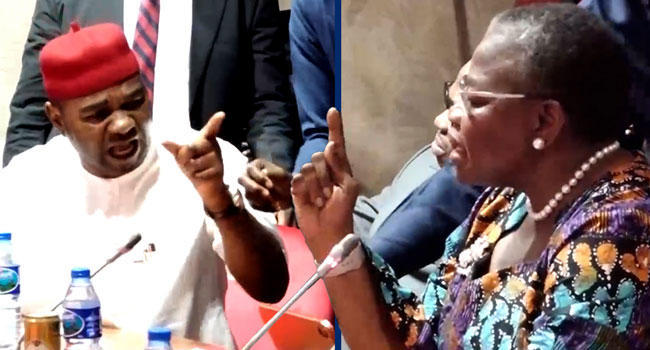
FORMER Minister of Education, Oby Ezekwesili, has expressed satisfaction with her encounter with Onyekachi Nwebonyi, a senator, during Senate Committee on Ethics, Privileges, and Public Petitions panel in Abuja on Tuesday, March 25.

She said the incident shed light on the challenges women face in a patriarchal society.

Ezekwesili revealed this when she appeared on Channels Television’s Sunrise Daily programme on Wednesday, March 26, while recounting her perspective on the altercation between her and Nwebonyi during the panel’s session on the sexual harassment allegations involving suspended Senator Natasha Akpoti-Uduaghan of Kogi Central and Senate President Godswill Akpabio.

The former minister, Akpoti-Uduaghan’s counsel, Abiola Akiyode-Afolabi, and Zubairu Yakubu, who identified himself as a concerned Nigerian citizen from Kogi Central Senatorial District, appeared before the Senate panel in Abuja on Tuesday after being summoned by the Senate.

The ICIR reported that Akpoti-Uduaghan presented the petition on the Senate floor on March 5, just minutes before her controversial suspension from the upper legislative chamber.

The petition was subsequently referred to the Ethics Committee, chaired by Edo South Senator Neda Imasuen, for review.

Yakubu, who signed the petition, declined to proceed with his testimony unless his principal witness, Akpoti-Uduaghan, was permitted to be present at the National Assembly.

The petitioner accused the committee chairman, Neda Imasuen, of bias, referring to previous public statements where Imasuen reportedly described the petition as “dead on arrival”.

“If the chairman has already declared the petition dead before even hearing it, how can we expect fairness? One of the committee members even went on national television to claim that he was a principal witness for the Senate President. How then can we trust this process?” Zubairu queried.

Following heated verbal exchanges between committee members and Yakubu, the panel dismissed the petition because the matter was already before a court.

“If they knew the matter was in court, why did they invite me in the first place? This only confirms their bias and lack of respect for due process,” he stated.

Moments before the panel adjourned, a heated verbal exchange erupted between Ezekwesili and Nwebonyi.

The confrontation began after Ezekwesili accused the committee of bias, leading Nwebonyi to challenge her over her choice of words.

The lawmaker and Ezekwesili used unprintable words to attack each other.

Recounting the incident during the TV programme on Wednesday, Ezekwesili stated that the committee refused to allow her to speak.

She accused the Senate of diverting attention from the core issue of sexual harassment, which Akpoti-Uduaghan alleged against Akpabio, emphasising that the suspended Kogi lawmaker must receive justice.

The former minister said that society has a long-standing attitude toward dissenting voices, not just those of women, but also individuals who challenge the status quo or, like her, who persistently demand public accountability from leaders of institutions serving the public.

“It is a historic more or less function. And so, that attitude pervades the way our lawmakers are behaving. I was actually very pleased with what happened yesterday because now it is in the public domain what women endure in many instances, and the rest of society may know little about it but has not focused on it,” she said.

While advocating for public accountability and emphasising that no group or individuals, regardless of their power, should silence voices demanding transparency, Ezekwesili accused Imasuen of bias.

She argued that, in the interest of justice and fairness, he should recuse himself from presiding over the matter.

The suspended lawmaker’s lawyer, Akiyode-Afolabi, who was also a guest on the same TV programme, condemned the panel’s conduct, calling it unwarranted.

Akiyode-Afolabi, who was present at the Senate sitting with the former minister on Tuesday, criticised the committee for being unwelcoming, alleging that the senators had prearranged a plan and sought to draw her team into it.

She said, “The attitude of the panel was not what you would expect from any responsible chamber in the world. They were not friendly. They already had a plan, and what they wanted us to do was just to walk into that plan. They had a plan not to allow us to speak at all.

“They were quite disrespectful and spoke to us as if they were speaking to some slaves that they brought from somewhere.

“One of the things that this is showing at that very high level of people who are making decisions in this country, to have people there who are so patriarchal, who don’t mind the kind of language when speaking to people in public, who don’t give respect to citizens, was not something you would respect.”


I’m yet to decide on 2027 presidential bid, says Atiku

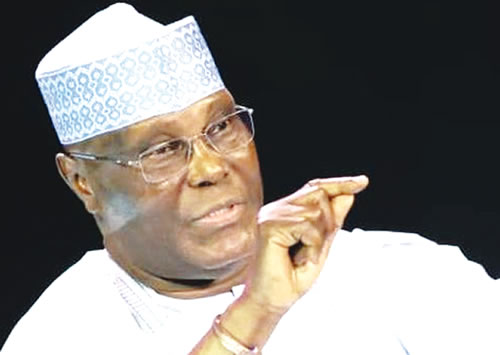
FORMER Vice President Atiku Abubakar said that he had yet to decide if he would contest the presidency in 2027.

He disclosed this in a yet-to-be-aired interview with Arise TV, scheduled for broadcast later today, Wednesday, March 26.

In the snippet of the interview aired Wednesday morning, Abubakar said,I don’t know because there has to be, first of all, a viable platform, more than any other time in the political history of this country, particularly since the return of democracy.”

Abubakar, the presidential candidate of the People’s Democratic Party (PDP) in the 2023 general election, added that Nigeria urgently needed experienced and credible leadership.

He noted that the country’s current situation is more dire than ever.

He also referenced the 2014 merger, where multiple presidential aspirants came together, and one emerged as the winner with their collective support.

Additionally, Abubakar concurred with former President Olusegun Obasanjo’s assessment that Nigeria’s democracy is deteriorating, describing the situation asvery dire“.

He expressed doubts about the credibility of the current legislative leadership, particularly regarding the National Assembly’s swift approval of the state of emergency in Rivers State.

He alleged that the Senate leadership was corrupt, stating that its actions didn’t surprise him.

The former vice president defended his decision not to choose Federal Capital Territory (FCT) Minister Nyesom Wike as his running mate in the 2023 election.

According to him, he has no regrets about picking former Delta state governor Ifeanyi Okowa instead.

The ICIR, in a special report after the 2023 election, reported that after six unsuccessful attempts, Abubakar became the only politician in Nigeria who had sought the presidency the most times and had yet to win it.

The report titledHope dims for Atiku’s presidency bid after six failed attemptsrevealed that the former vice president had had two more shots at the country’s most exalted office than former President Muhammadu Buhari, who ran four times before winning it.

Abubakar, 78, has contested for the top office for 33 years and has had his hopes dashed.

He vied for the presidency on the PDP platform in the election conducted on February 25, 2023.

He came second with 6,984,520 votes, trailing the All Progressives Congress (APC) candidate, Bola Tinubu, who polled 8,794,726. 

He was one of the 18 presidential candidates in the election.

He vowed to challenge Tinubu’s victory declared by the Independent National Electoral Commission (INEC) in court but lost at the Supreme Court.

While Abubakar has failed all six times he has contested for the seat since 1992, Tinubu only contested once and won.

The ICIR reports that Atiku came into politics about the same time as Tinubu.

Kenya’s decision to make maths optional in high school is a bad idea – what should happen instead

0

By Moses NGWARE, African Population and Health Research Center

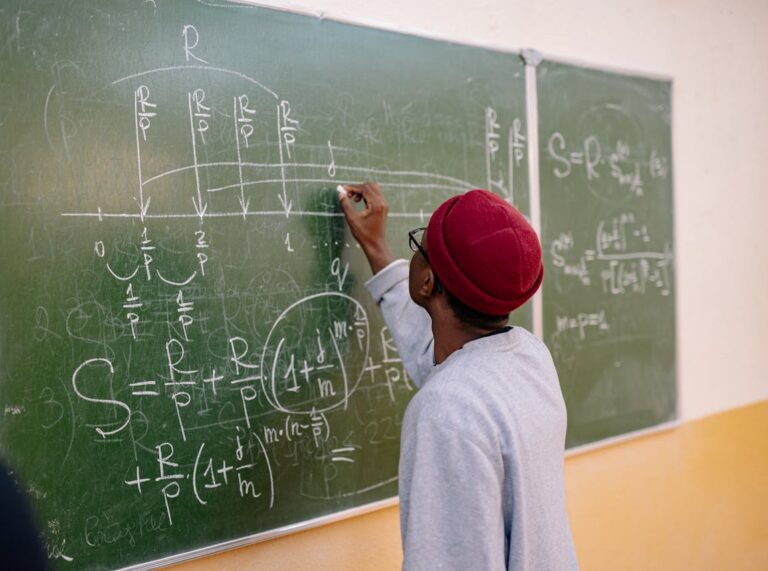
KENYA’S education ministry announced in March 2025 that mathematics would be an optional subject in senior secondary school, which begins in grade 10. Most students in this grade are aged 15 years. The education minister said the mathematics taught from grade 4 to grade 9 was sufficient for foundational “numeracy literacy”.

The change, in January 2026, is part of a shift to a new education system styled as the competence based curriculum. The decision is not to scrap maths altogether but rather to make it optional. However, given the poor performance in this subject, it is expected there will be few takers.

Maths is a compulsory subject in the first 12 years of basic education in many African countries. This is the case in Mauritius, Nigeria and South Africa, which opted for a choice between maths and mathematical literacy for grades 10-12.

The older education system, known as 8-4-4, featured eight years of primary school and four each at high school and university. Under this, core maths, dubbed Alternative A, is compulsory for all schoolgoing children until the second year of high school (form 2). Most students in this grade are aged 16 years. In the final two years of high school, one has the option of switching to Alternative B, a simplified version of Alternative A introduced in 2009. Alternative B is similar to South Africa’s mathematical literacy subject.

The decision has triggered heated debates in the country, in favour and against.

As a researcher who has taught high school maths and researched maths teaching for over 20 years, I have the view that making maths optional is not a good idea. This is because both individuals and society need maths, regardless of the career path they might choose.

It’s been argued that the change applies to the last two senior years of high school, which was the case in the old system too. For the new curriculum, however, this should not have been a problem as it is competence-based. This implies that what matters is the specific skills and knowledge mastered by a student, and not the examination scores.

The Kenyan education department should establish the root causes of the low performance in maths, and fix them. Research shows that chief among these are resource allocation; weak teacher preparation and support for foundational numeracy instruction; a learning disability known as dyscalculia; and the behavioural performance of maths teachers.

Kenya’s maths problem

In the 2022 Kenya Certificate of Secondary Education exams, graded between A (highest) and E (lowest), over half of the 881,416 candidates’ maths scores fell in the lowest two grades, D and E. This improved only marginally in 2023. To put the performance in context, the pass rate in high school certificate maths examinations in Mauritius improved from 81.4 per cent to 91.8 per cent between 2019 and 2022.

There are a number of reasons for this dismal performance in Kenya:

Resource allocation: The better-resourced national schools can only admit a small number of students, leaving out over 70 per cent who join low-resourced day schools. Resources for learning maths range from teachers to interactive teaching and learning materials inside the classroom. With the support of partners such as the Global Partnership for Education, the government aims to achieve a 1:1 textbook-per-student ratio goal. However, the flow of capitation grants to secondary schools has been wanting, jeopardising access to resources at the school level.

Teacher preparation: Teachers aren’t well prepared to support learners in foundational numeracy (maths in early grades). Foundational numeracy skills are critical in creating strong building blocks for future learning and success in later grades.

Teacher behaviour: Classroom observation studies reveal that maths teachers favour boys. Furthermore, above average learners sit in the front closer to the chalkboard, and learners are denied positive reinforcement that would motivate them to learn maths. There are also negative attitudes about maths as a difficult subject, reinforcing the stereotype that it is only suitable for boys and “bright” children.

Dyscalculia: Worldwide, 3 per cent -7 per cent of the general population are affected by a disability known as dyscalculia. In Kenya, 6.4 per cent among primary and secondary school children have the disability. It is a condition that affects a person’s ability to understand numerical concepts. By implication, the number of the 962,512 Kenya Certificate of Secondary Education candidates of 2024 with this disability works out to between 28,000 and 68,000 candidates. But Kenya’s education system doesn’t support teachers in diagnosing learners with dyscalculia, or managing their disability.

Policy options

There are alternatives to making maths an optional subject in senior secondary school.

The system needs to focus on the root causes of low performance, and then on how to fix them.

I suggest the following solutions.

  • Avoid unnecessarily using achievement in maths to determine access to academic and training programmes. This way, one’s career will not solely be determined by performance in maths.
  • Keep a simpler maths alternative, or maths literacy, for senior secondary instead of making maths optional.
  • Teachers should continue to develop their competence in maths, focusing on content knowledge as well as knowledge of how to teach numeracy.
  • The general public should communicate effectively to eliminate negative stereotypes and unhelpful attitudes in society. The aim is to shift mindsets so that maths is perceived as part of life – making it necessary to support all children to succeed in maths.
  • Help learners to overcome dyscalculia, using multisensory teaching approaches – a way of teaching that engages more than one sense at a time: sight, hearing, movement and touch.The Conversation

Moses Ngware, Senior Research Scientist, African Population and Health Research Center

This article is republished from The Conversation under a Creative Commons license. Read the original article.

South Korea wildfires kill 18, cause ‘unprecedented damage’

SOUTH Korean Prime Minister and Acting President Han Duck-soo has announced that a wildfire outbreak in the Asian nation claimed 18 lives, destroyed over 200 structures, and forced 27,000 people to flee their homes.

On Wednesday, March 26, Duck-soo revealed that the wildfires, among the worst in the country’s history, ravaged southern regions and caused “unprecedented damage.”

He urged response agencies to “assume the worst-case scenario and act accordingly.”

Reports indicate that a helicopter crashed while battling wildfires in the southeastern town of Uiseong, killing the pilot and prompting the Korea Forest Service to suspend helicopter operations nationwide.

Officials told AFP that authorities in Andong and other southeastern cities and towns ordered evacuations on Tuesday as firefighters struggled to contain multiple wildfires fueled by dry winds.

The fires have burned more than 17,400 hectares (43,000 acres) of land and destroyed hundreds of structures, including a 1,300-year-old Buddhist temple.

The ICIR reports that the South Korea’s Ministry of the Interior and Safety said more than 5,500 people were forced to leave their homes in Andong, the neighboring counties of Uiseong and Sancheong, and the city of Ulsan, where the fires were most severe.

Earlier on Tuesday, South Korean officials reported that firefighters had extinguished most of the flames from the largest wildfires in these areas.

However, dry and windy conditions caused setbacks, allowing the fires to reignite and spread further.

The fires began on March 21, when dozens of wildfires erupted across South Korea as dry winds swept through the country, killing four people and injuring nine others.

The conflagrations prompted mass evacuations and led to the deployment of thousands of personnel and over 100 helicopters to contain the blazes.

The fires follow a similar incident in Los Angeles, United States, earlier in January this year.