THE Central Bank of Nigeria (CBN) has debunked rumours suggesting that Polaris Bank is undergoing liquidation, while affirming that the bank is safe and secure for its customers, investors and depositors.
The apex bank disclosed this in a post on X, assuring the public that the country’s banking system remained stable and secure.
The clarification followed a viral post, claiming that Polaris Bank was facing liquidation for failing to meet the bank’s recapitalisation requirements, and could soon lose its operating licence, with the Nigeria Deposit Insurance Corporation set to take over the process.
It further alleged that the founder of the Eleganza Group, Razaq Okoya, had made a bid to acquire and revive the bank, pending approval from regulators and shareholders.
Sharing a screenshot of a viral claim, however, the apex bank flagged it as “fake content.”
It clarified that the claims did not reflect the current state of the Nigerian banking sector.
“This content is fake. Let the public be guided. The Nigerian banking system is safe and secure,” the bank said.
On April 1, the CBN confirmed that 33 banks successfully met the revised minimum capital requirements under its recapitalisation programme, marking a significant milestone in strengthening the financial system.
A total of N4.65 trillion was raised during the 24-month exercise, pushing capital adequacy ratios across the sector above global Basel benchmarks and enhancing banks’ resilience, according to the apex bank.
However, it noted that “a limited number of institutions remain subject to ongoing regulatory and judicial processes, which are being addressed through established supervisory and legal frameworks.”
As part of efforts to reinforce oversight and stability in the sector, in January 2024, the CBN dissolved the boards and management of Polaris Bank, alongside Union Bank and Keystone Bank.
In 2022, the bank was also at the centre of controversy following claims that a higher bid was submitted during its sale process than the one eventually accepted.
At the time, reports indicated that the House of Representatives directed the apex bank to suspend the sale.
Again, a Federal High Court in Lagos reportedly reversed the sack of the board and management of Union Bank of Nigeria on March 25.
Responding, while maintaining that the bank’s regulatory status remained unchanged, the CBN stated that it would review the judgment.
An earlier report by The ICIR disclosed that although the March 31st deadline for their recapitalisation was not met, the CBN advised depositors with Union, Keystone, and Polaris banks not to panic about their funds.
The apex bank said the banks were still undergoing judicial and regulatory procedures, while assuring depositors about the safety of their funds.
THE Vice Chancellor of the university of Jos, Tanko Ishaya, a professor, has confirmed the death of two students of the institution during the recent unrest in Jos North Local government area of Plateau State.
Ishaya made this known during a news conference in Jos on April 9.
THE ICIRreported that the violence began on March 29 when gunmen attacked the Angwan Rukuba community, an area where many students and staff of the university reside.
The attack led to several deaths and injuries and forced the state government to impose a 48-hour curfew. Although the curfew was later lifted on April 1, reports indicate that the violence spread to other nearby communities.
According to the vice chancellor, aside from the two fatalities, several others linked to the institution were harmed, including students and a staff member who are currently undergoing medical care.
He said the deceased were identified as Abel Gershon, a third-year student studying Building, and Adeyemo Temitope, a final-year student studying Quantity Surveying.
“Abel Gershon was shot in the stomach on March 29 and admitted to the intensive care unit of the Jos University Teaching Hospital (JUTH). Unfortunately, he died on Sunday, April 5,” Ishaya said,
Temitope left the campus alone on April 1 and encountered violence along Bauchi Road. He was shot and macheted to death by hoodlums.
“We have a total of five members of the university community affected by this incident: four students and one staff member,” the vice chancellor stated.
He extended his sympathies to the bereaved families and noted that those hospitalised were showing signs of recovery. Despite the situation, he assured that the institution remained secure, and that its campuses had not been directly targeted since the conflict in the state began.
He further explained that academic activities would proceed as planned, with students expected to return on April 13.
While appealing to parents and guardians to allow their children to resume their studies and continue their examinations, he assured that additional safety measures had been put in place within the school and nearby areas.
The ICIR reports that many students at the university were quickly evacuated by their state governments, while others left the school environment on their own.
A SERIES of remarks and policy signals attributed to the United States in recent months have drawn attention to Nigeria’s international image, with critics warning of potential diplomatic and economic implications as the federal government intensifies efforts to attract foreign investment.
Since late 2025, statements linked to the administration of the US President Donald Trump have increasingly portrayed Nigeria in a negative light, ranging from security concerns to questions about governance and public health systems.
While some of these characterisations remain contested, they have nonetheless circulated widely in diplomatic and media spaces.
Below is a timeline of the US key comments on Nigeria within the period.
Trump listed Nigeria as CPC
In October 2025, Trump designated Nigeria as a “Country of Particular Concern” (CPC), a label used by the US for countries accused of alleged violations of religious freedom.
The US president first triggered controversy when he claimed that Christians in Nigeria were under severe threat. Posting on Truth Social, Trump said Christianity was facing an “existential threat” in Nigeria, alleging that thousands of Christians were being killed by “radical Islamists.”
The move placed Nigeria in the same conversation as countries like China and North Korea under US watchlists.
‘Now a disgraced country’
In a follow-up statement in November 2025, Trump escalated his rhetoric, threatening punitive measures against Nigeria.
He further dubbed the country as “now a disgraced country,” adding that US attack on Nigeria would be “fast, vicious, and sweet.”
“If the Nigerian government continues to allow the killing of Christians, the U.S.A. will immediately stop all aid and assistance to Nigeria and may very well go into that now disgraced country, ‘guns-a-blazing,’ to completely wipe out the Islamic terrorists who are committing these horrible atrocities.
“I am hereby instructing our Department of War to prepare for possible action. If we attack, it will be fast, vicious, and sweet, just like the terrorist thugs attack our CHERISHED Christians! WARNING: THE NIGERIAN GOVERNMENT BETTER MOVE FAST!” he threatened.
The phrase has since gained traction among Nigerians opposition leaders, with some noting that such language from a US president could shape diplomatic and investors perceptions.
Trump links Nigeria to ‘fake news’
Months later, reacting to a report by CNN on a US-Iran ceasefire, Trump on April 8, 2026, claimed the report relied on a “false statement” originating from a Nigerian source.
“The false statement was linked to a Fake News site (from Nigeria),” he said, describing it as a “new, trouble-making site.”
Trump, however, did not name the platform or provide evidence to back the claim.
Nigeria described as insecure, parading weak health system
Hours after accusing Nigeria of peddling fake news, the Trump’s administration described Africa’s most populous country as an “insecure nation with a very poor health system.”
In a detailed travel advisory, the US, through the Department of States, urged its citizens to reconsider visiting Nigeria due to rising concerns over crime, terrorism, civil unrest, kidnapping, and unreliable healthcare services.
It also directed all its non-emergency employees and its employees’ families at its Abuja Embassy to quit over insecurity.
The US labelled all regions in Nigeria as unsafe except the South-West. It listed 23 of Nigeria’s 36 states as unsafe for its citizens.
The advisory placed Nigeria at Level 3, meaning travellers are advised to reconsider their plans because of serious dangers that exist across the country.
“Reconsider travel to Nigeria due to crime, terrorism, unrest, kidnapping, andinconsistent availability of health care services.Some areas have increased risk.” part of the advisory read.
The US pointed to widespread violent crime as a major concern and listed armed robbery, assault, carjacking, and kidnapping for ransom as common across states in the North-West, North-West, North-Central, South-South, and South-East.
It argued that the incidents occurred in both urban and rural areas, and affected both foreigners and locals, sometimes along major roads or in residential neighborhoods.
The advsory also highlighted the persistent threat of terrorism that happens with little warning, particularly in parts of the country where extremist groups remain active. These groups are said to be capable of carrying out attacks in public spaces. The risk is heightened by the presence of armed gangs and criminal networks, especially in regions where government control is limited.
The US stance on Nigeria’s health systems is more concerning as it said they could not match those of the US and other advanced nations.
“Americans should not expect the same level of health care to be available in Nigeria as they do in the United States. Nigerian medical facilities are generally not equipped to US or European standards. Many medicines are not available. This includes common medications for diabetes or asthma,” the advisory stated.
The US urged its citizens coming to Nigeria to bring enough over the counter and prescription medicines to last their entire stay.
Nigeria’s push for foreign investors
The remarks came at a time when the administration of President Bola Tinubu is actively seeking foreign investors to boost the economy.
The federal government has embarked on multiple investment drives, policy reforms, and international engagements aimed at improving the business environment and attracting capital inflows.
However, analysts and critics warned that persistent negative narratives from influential global figures like Trump could affect investor confidence, particularly in areas tied to security, governance, and stability.
Is Trump administration saying the obvious?
The ICIR reports that as contestable as the claims are, some of them speak eloquently to the true state of affairs in the country.
Insecurity is rife across Nigeria, as terrorists, bandits and other criminals snuff out the lives of citizens at will daily. As news of one terrorist attack on a community breaks, another will likely follow in matter of hours in different parts of the nation.
Currently, hundreds of citizens are in kidnappers’ custody as billions have been paid to rescue others.
Dozens of rank and file and senior officers of Nigerian security forces have been killed by the criminals in their attempts to contain the menace.
Besides, millions of citizens have been displaced by the crisis and other conflicts across the country..
Similarly, Nigeria’s health sector is currently under several strain. Nigeria, with a population nearing 250 million, continues to face deep structural challenges in healthcare delivery.
Out-of-pocket spending accounts for about 74.68 per cent of total health financing, placing a heavy burden on households and limiting access to essential services. Neonatal mortality remains high at 41 deaths per 1,000 live births as of 2023, while the maternal mortality rate of 576 deaths per 100,000 live births ranks among the worst globally.
The system is also critically understaffed, with about 55,000 licensed doctors serving the population as of March 2024.
The ICIR reports that inequitable distribution of services, weak infrastructure, persistent brain drain and widening socioeconomic inequalities, particularly in rural and underserved communities, have continued to deepen health disparities.
Many facilities lack basic equipment, medicines and essential amenities, while poor remuneration and working conditions drive the continued emigration of skilled health professionals, further weakening service delivery.
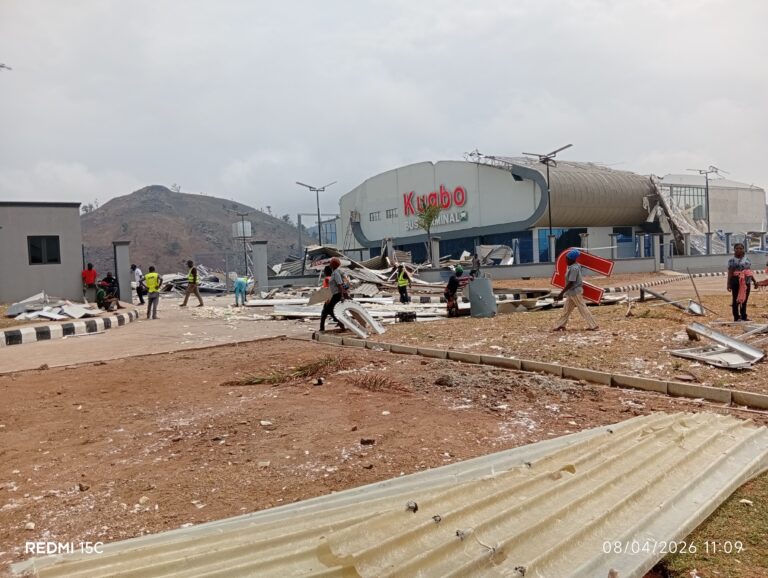
In this report The ICIR dives into the windstorm damage on the newly built Kugbo Bus Terminal in Nyanya, Abuja, which occurred in the late afternoon of Tuesday, April 7, 2026.
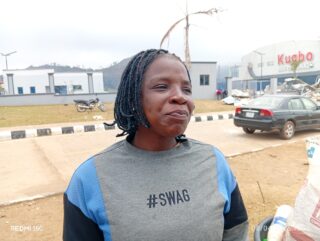
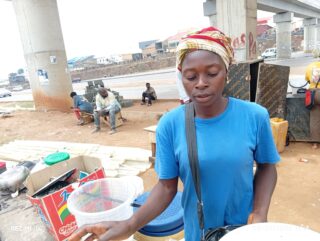
Blessing, a Point of Sale (POS) agent near the terminal, said a resident who tried to escape the strong wind got his arm slashed. She also noted that their business was disrupted when aluminium sheets and roofing materials were blown onto their wares during the windstorm.
Blessing, the POS agent. credit: ICIR
“It was around 3:30 pm when we heard the breeze, as we started packing our chairs and canopy, that was when we saw the zinc and roofs flew to our stalls. No one died, but the man who stopped near us due to the breeze got his arm slashed and lots of blood gushed out from it.
“Even the vulcaniser’s machine fell inside the gutter because the zinc from the roof flew to his direction and damaged a car that was parked beside him.”
Thomas, the vulcaniser in front of the terminal. credit: ICIR
The vulcaniser, Thomas, corroborated her account as he narrated the ordeal to The ICIR.
“i was working when the breeze started. I started packing my machines because I thought it would be just rain, then suddenly we heard a noise, and by the time we knew what was going on, we saw the roof of the terminal flying around. Before I could finish packing, the zinc fell my machine into the gutter. A car that was parked beside me got damaged, and a man who was riding a bicycle got his arm slashed too.”
When asked if the damages affected their sales and business inflow, he said, “Market and sales aren’t constant, but my sales have reduced since yesterday.” he noted.
The ICIR reports that a statement released by Lere Olayinka, spokesperson for the Minister of the Federal Capital Territory, Nyesome Wike, stated that no casualties or property losses were recorded.
“From preliminary reports, no one was injured, and no vehicle was damaged,” the statement claimed.
However, eyewitnesses spoken to by The ICIR contradict the statement. Several traders at the terminal said that a vehicle was damaged, their businesses disrupted and someone’s arm was slashed when the windstorm tore the facility apart.
Backstory
On Tuesday, April 7, a windstorm, accompanied by rainfall, damaged a multi-billion bus terminal, a project by the Federal Capital Territory Development Agency under the Ministry of the Federal Capital Territory, Nyesom Wike, which was commissioned in June 2025.
Before this incident, residents and commuters had complained about delays in the take off of the terminal. The transportation difficulties and the increment in fuel price added to this.
This incident has left residents worried as they had believed that once operational, their movements will be seamless but are now left with uncertainty as they don’t know when the project will be utilised now that it’s damaged.
Prior to this rainstorm, a video by Premium Times circulated earlier this year showing leaks in the roof of the recently completed terminal. This raised concerns about the structure and quality of the building.
The ICIR also observed that the multi-billion-naira terminal, which was expected to be filled with buses and other facilities to aid transportation, was largely empty. There was no furniture, not even a plastic chair, despite the building having been commissioned since last year
Security operatives obstruct journalists and residents
Officials of the Federal Capital Development Authority, FCDA, harassed journalists for documenting and taking images of the scene.
Altercation between the FCDA officials and journalists. credit: ICIR
The situation escalated when officials attempted to confiscate equipment, including drones and cameras, from TVC and News Central correspondents.
A policewoman threatened to send Juliet, a food seller with a stall in front of the terminal, away for responding to The ICIR reporter’s question.
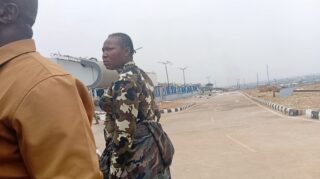
The policewoman. credit: ICIR
The officer’s name couldn’t be identified but her image was captured.
The incident raised further questions among residents as no houses in the area were affected except the bus terminal.
Juliet, who was stopped from answering The ICIR. credit: ICIR
One of Juliet’s customers stated: “My house that’s incomplete, nothing happened to it, but this one that the government constructed got ruined. How?”
His development raises concerns about the execution and quality of construction and whether the facility met required standards as other uncompleted buildings nearby were untouched.
Residents said it was a terrible incident, aside from the fact that they couldn’t move freely when the incident happened due to debris blocking the roads, they expressed concern about their safety.
Citizens call for Wike’s arrest
Meanwhile, citizens have asked for the arrest of the minister after the collapse of the Kugbo bus terminal in their reactions to the FCT Minister’s earlier directive on the arrest of collapsed building owner in Jikwoyi.
The ICIR reports that earlier on April 7, 2026, Wike ordered the arrest of the owner of a building that collapsed on Good Friday, April 3, in Jikwoyi area of the FCT and directed that the land be revoked.
According to the statement issued by his office, the building was under construction without approval, despite stop-work notices from the Development Control Department, which were ignored by the developer.
Wike emphasised the need for strict compliance with building regulations, stating that any structure without approval would be demolished, while defaulters would be arrested and prosecuted.
“I have always said this, go to the Development Control to get approval, let them know what you are building, the quality of materials, and they will supervise it from one stage to another… Anywhere you see a building going on without approval, report to the government and we shall prosecute those who refuse to get approvals”, he said.
However, the development raises questions about consistency in enforcement and accountability, especially in light of the damage to the government-constructed Kugbo Bus Terminal.
The incident has also raised concerns about the safety of the other two bus terminals awaiting commissioning by the Minister.
The questions are about whether similar standards of construction and oversight are being applied, especially as the three terminals together cost ₦51 billion and one of them got damaged after just a single windstorm.
Civil engineer weighs in
The ICIR reached out to a civil engineer, Oladapo Idowu, to comment on the damage at the Kugbo Bus Terminal.
“A standard, properly installed metal roof of a commercial building like the Kugbo Bus Terminal should be able to withstand winds of at least 90 to 140 mph, roughly 145 to 225 kilometres per hour, before sustaining major damage as observed. Ordinary rain or a breeze would not be able to rip off large sections of the roof,” she said.
On whether the damage could be due to poor construction materials, design flaws, or installation issues rather than just the weather, he explained, “Structurally, metal roofing systems, particularly the trusses, are designed to resist uplift, which is the suction force created when high-speed air passes over a roof. If a roof fails at lower speeds, it usually points to poor installation or poor material quality.
“This could include insufficient or low-quality fasteners, such as screws, welds, or clips; improper anchoring of the roof to the main structural frame; or poorly secured edges or ridges where the wind can get hold of the metal and rip it off,” he stressed.
On the measures authorities should take to ensure that other government-owned terminals are safe before commissioning, he said, “Authorities must implement strict safety and quality control measures for other government-owned terminals. Independent structural audits should be conducted by certified engineers to verify the structural integrity of newly constructed terminals, particularly the roof structures. Material testing and verification are also critical to ensure that steelwork and roofing meet approved quality standards and are not substandard.”
He concluded that environmental stress tests should be performed to ensure structural stability against weather conditions, especially in light of the Kugbo terminal being damaged by a windstorm shortly after rainfall.
Domestic manufacturing is largely concentrated in lower-end medicines that require relatively simple production processes. The more complex and higher-value pharmaceutical products continue to be imported.
This pattern has persisted for decades. It reflects two things. First is the limited impact of policies aimed at reducing import dependence. The other is the entrenched interests across pharmaceutical companies. An incentive structure that favours imports over local production.
I recently completed my doctorate studies focusing on the political economy of pharmaceutical manufacturing in Nigeria, with comparisons to Uganda, Bangladesh and India. My research looked at how the industry had evolved and analysed how the distribution of organisational power and manufacturing capabilities has made it difficult for reforms to work.
I found that policy interventions have largely failed because weak institutions cannot influence manufacturers to expand their production capabilties.
The biggest obstacles stem from how power and benefits are distributed across political, bureaucratic and pharmaceutical actors.
Any policy that does not fully take this into account will likely be resisted.
Factors militating against Nigerian manufacturers
Nigerian manufacturers face:
a lack of protection and incentives to produce certain medicines
high levels of imports of finished medicines
pressure to import as well as manufacture
low manufacturing capabilities.
Weak incentive structure:
The first policy to specifically support domestic manufacturers of medicines was introduced in 2005, when the Nigerian government restricted the importation of 17 lower-end medicines. The prohibited medicines included paracetamol, aspirin and metronidazole (antibiotic) tablets.
The protectionist policy has not been expanded since then. So manufacturers have no incentive to invest in technological upgrading to make more complex medicines.
Importation of finished medicines:
At least 100 manufacturers also import medicines – including some that are produced locally. In some cases, manufacturers both produce and import the same medicine, marketing them under different brand names.
Two medicines illustrate this. The antibiotic ciprofloxacin (tablet form) is currently imported by at least 93 registered pharmaceutical companies, even though 21 domestic producers make it too.
A similar pattern is evident for artemether-lumefantrine, a widely used antimalarial medicine. Fewer than 30 pharmaceutical companies produce it locally. More than 200 import it – including some established manufacturers.
Manufacturers as producers and importers:
Many companies combine local manufacturing with importing finished medicines as a way of managing risk.
This creates commercially attractive, lower-risk revenue streams for manufacturers. They are likely to resist policy or reforms that would limit imports in favour of expanded local production.
Low manufacturing capacities:
Nigerian pharmaceutical companies have low manufacturing capacities. And the learning process involved in complex manufacturing is time consuming, costly and risky.
It is also difficult to compel a company to do something where governance is weak.
In the absence of adequate and sustained policy support, many manufacturers rely on political networks to protect their interests or challenge policies that threaten them.
An example is the modification of a regional tariff in 2016 because it threatened locally manufactured medicines. The regional trade policy had imposed zero duty on essential finished medicines and up to 20% on the raw materials used in medicine manufacturing. This was to increase the availability and affordability of essential medicines across the region. Nigerian manufacturers exerted pressure on government to reject it.
In the absence of credible policy support for upgrading into technologically sophisticated medicines, manufacturers continue to rely on imports. Similarly, they continue to influence policy decisions that could disrupt existing revenue streams.
Why the problem persists
When some pharmaceutical companies manufacture medicines locally while others import the same products, it weakens collective action. It’s harder to mobilise around shared policy demands.
The Pharmaceutical Manufacturers Group of Manufacturers Association of Nigeria, an influential trade association, illustrates this challenge. One of its objectives is to lobby for increased market protection for locally produced medicines. But member firms have differing commercial interests in locally manufactured and imported medicines. This often works against policy objectives.
It impedes how member firms form alliances to support or oppose policies. It also affects influence over them.
Nigeria’s reliance on imported medicines has less to do with the commonly cited capability constraints. It is the outcome of a policy vacuum that has made it more attractive to import products.
This dynamic is also evident in some other African countries, such as Ghana, Kenya, and Uganda. Manufacturers similarly import more complex medicines and produce simple medicines locally. There is limited support for domestic manufacturing of more complex medicines.
Moving forward
High levels of imports limit the rewards for expanding manufacturing capabilities and any credible path to competitiveness. The significant revenues generated from imports also weaken incentives to invest in learning how to produce more complex medicines.
Recognising this matters for policymakers and international development organisations.
The challenge is not simply increasing financial support or political commitment. It is designing policies that reconfigure current benefits. They need to make it worthwhile to invest in more complex pharmaceutical manufacturing.
A REGIONAL network of human rights and media lawyers, the West Africa Network of Activists and Media Defense Lawyers (WANAMDEL), has condemned the alleged assault on one of its members, Paul Kamara, by police officers in Freetown, Sierra Leone.
In a statement on April 7, WANAMDEL said the incident occurred on April 4 at the Adonkia Police Station, where Kamara, also a journalist, had gone to follow up on investigations into the death of his colleague, Augustine Sensie Bangura.
According to the group, Kamara was at the station’s Criminal Investigations Department and later joined sympathisers consoling the bereaved family when he witnessed a confrontation between a police officer and a civilian.
The statement said Kamara attempted to de-escalate the situation but was instead assaulted by the officers.
“He was physically assaulted, restrained, and pepper sprayed by another officer, despite identifying himself as a lawyer and journalist,” WANAMDEL said, describing the officers’ actions as a violation of professional standards and the rule of law.
The group also criticised the response Kamara received when he tried to file a complaint at the station.
It said officers at the Complaints Desk treated him with indifference and ridicule, only allowing him to lodge a formal complaint after intervention from concerned individuals who contacted the Local Unit Commander.
WANAMDEL called for an immediate, independent, and transparent investigation into the incident, as well as sanctions against all officers involved.
It also urged the Sierra Leone Police to take concrete steps to prevent similar occurrences and to uphold the rights and dignity of citizens.
The incident came amid growing concerns over press freedom violations across West Africa and the broader continent. Reports document increasing cases of harassment, arbitrary arrests, and assaults on journalists by security forces.
Recent reports by the Media Foundation for West Africa show that press freedom in the region remains precarious, with multiple cases of repression recorded in countries including Sierra Leone and Ghana. Similarly, the International Press Institute documented at least 149 threats to press freedom across 30 sub-Saharan African countries within a three-month period in 2025.
Data compiled by media monitoring groups also indicate that West Africa recorded over 100 press freedom violations in 2024 alone.
Global watchdog Reporters Without Borders has repeatedly warned of declining press freedom rankings in parts of Africa, linking the trend to political instability, weak institutions, and the growing role of security agencies in suppressing dissents.
In several cases, journalists covering elections, protests, and governance issues have been assaulted or arbitrarily detained.
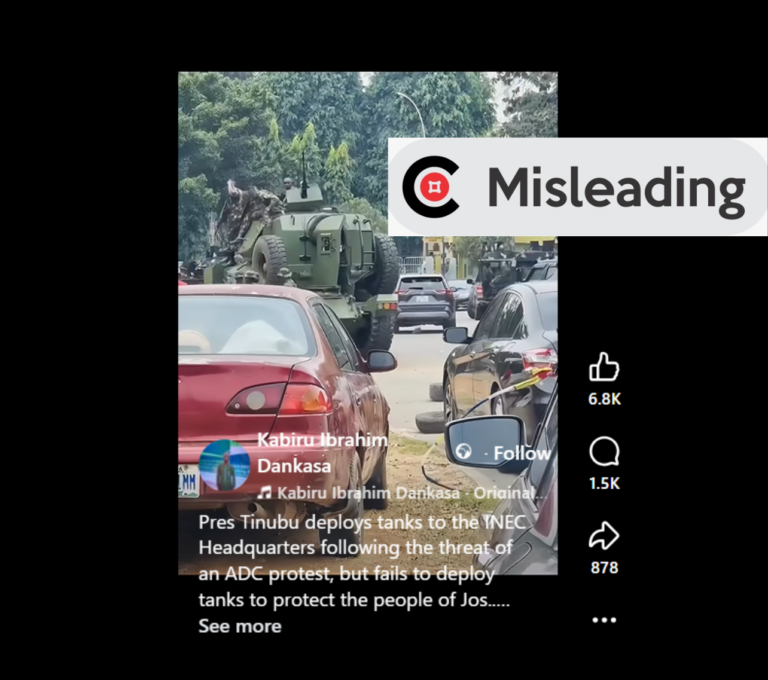
A video circulating on social media claims to show a two-turret armoured vehicle and other military trucks moving toward the headquarters of the Independent National Electoral Commission (INEC) in Abuja.
The 10-second clip shows soldiers on an armoured vehicle driving past a signpost labelled “INEC Headquarters.”
A Facebook account, Kabiru Ibrahim Dankasa posted the video with a caption:
“Pres Tinubu deploys tanks to the INEC Headquarters following the threat of an ADC protest, but fails to deploy tanks to protect the people of Jos.”
The post has generated over 6,800 likes and more than 800 likes.
An X user, @SadiqMaunde, shared the video with the caption: “See what Tinubu deployed to INEC office!”
As of the time of review, the post had generated over 2,000 likes, 560 reposts, and more than 300 quote posts.
CLAIM
The video shows military deployment of armoured vehicles to INEC headquarters in Abuja.
screenshot of the viral post
THE FINDINGS
Findings by The FactCheckHub show that the claim is MISLEADING.
The video surfaced amid heightened political tension following INEC’s announcement that it would not recognise factions of the African Democratic Congress (ADC) led by David Mark and Rafiu Bala, citing a court of appeal order to maintain the status quo pending resolution of the leadership dispute.
The development triggered speculation about a possible protest by supporters of the Mark-led faction at INEC headquarters in Abuja. On Thursday, security operatives, including soldiers and armoured personnel carriers, were indeed deployed around the commission’s headquarters at Zambezi Crescent, Maitama.
Images of the security deployment were widely shared and reported by multiple media outlets.
However, checks by The FactCheckHub show that the circulating video is not authentic.
Analysis of the footage indicates that it was generated using artificial intelligence. The video appears to be based on an earlier image showing security deployment at the INEC headquarters but has been digitally altered.
Some tyres were seen moving on their own in the video while the signboard carrying Maitama Crescent looks suspended in the air without any hanger, a clear sign that the video is synthetic.
We geolocated the INEC HQ’s address, and the result is inconsistent with what is in the video. For instance, the entrance shown in the video is blue-coloured, which does not match the actual INEC headquarters in Abuja.
Additionally, the signpost in the video reads “Maitama Crescent,” whereas the official address of the INEC headquarters is Zambezi Crescent, Maitama.
INEC Headquarters, source: Google Map
Further checks show no credible media reports confirming the movement of such a two-turret armoured vehicle toward the INEC office as depicted in the video.
VERDICT
The claim that the video shows armoured vehicles moving toward INEC headquarters in Abuja is MISLEADING. The video is AI-generated and does not depict a real event.
THE United States, through its Department of State, has warned its citizens against travelling to Nigeria over security concerns.
It also directed all its non-emergency employees and its employees’ families at its Abuja Embassy to quit over insecurity.
In a detailed travel advisory on Nigeria on April 8, 2026, the US urged its citizens to reconsider visiting the country due to rising concerns over crime, terrorism, civil unrest, kidnapping, and unreliable healthcare services.
It labelled all regions in the country as unsafe except the South-West.
The advisory placed Nigeria at Level 3, meaning travellers are advised to reconsider their plans because of serious dangers that exist across the country.
“Reconsider travel to Nigeria due to crime, terrorism, unrest, kidnapping, andinconsistent availability of health care services.Some areas have increased risk.” part of the advisory read.
The US pointed to widespread violent crime as a major concern. Armed robbery, assault, carjacking, and kidnapping for ransom are described as common across states in the North-West, North-West, North-Central, South-South, and South-East, with incidents occurring in both urban and rural areas, and affecting both foreigners and locals, sometimes along major roads or in residential neighborhoods.
The advsory also highlighted the persistent threat of terrorism that happens with little warning, particularly in parts of the country where extremist groups remain active. These groups are said to be capable of carrying out attacks in public spaces. The risk is heightened by the presence of armed gangs and criminal networks, especially in regions where government control is limited.
“Do not travel to Borno, Jigawa, Kogi, Kwara, Niger, Plateau, Taraba, Yobe, and northern Adamawa states due to terrorism, crime, and kidnapping. The security situation in these states is unstable and uncertain. This is because of widespread terrorist activity, violence between communities, and kidnapping,” the US warned.
In the southern part of the country, states such as Abia, Anambra, Bayelsa, Delta, Enugu, Imo, and Rivers were identified as high-risk due to crime, armed gangs, and civil unrest, although Port Harcourt was exempted within Rivers State.
Healthcare is another major issue raised by the US, with officials warning that medical services in Nigeria fall far below the standards Americans are used to.
According to the advisory, Nigerian hospitals often lack proper equipment and essential medicines, including treatments for common conditions such as diabetes or asthma. “Emergency services are limited, ambulance systems are unreliable, and blood supplies may not be safe or available. Patients are usually required to pay cash before receiving treatment, and most hospitals do not accept US health insurance.”
The ICIR reports that Nigeria faces a severe security crisis, with widespread attacks, kidnappings, and citizens displacement. Recent incidents include deadly violence in Plateau and Niger states, rural banditry and kidnappings in the Northern and Middle Belt regions, and attacks on students in Ekiti State.
DEATH toll from Wednesday’s Israeli attacks across Lebanon has risen to 254, with at least 1,165 people injured, according to Lebanon’s civil defence authorities, as strikes hit multiple densely populated areas across the country.
The casualties were recorded across several regions, with Beirut reporting 92 deaths and 742 injuries. In the southern suburbs of the capital, at least 61 people were killed and 200 injured, while Baalbek recorded 18 deaths and 28 injuries.
Hermel reported nine killed and six injured. In Nabatieh, 28 were killed and 59 injured, while Aley District had 17 killed and six injured.
Similarly, in Sidon, 12 died and 56 injured, and in Tyre, 17 were killed and 68 injured, according to the report.
Rescue operations continued in several affected areas as emergency teams worked through rubble and destroyed buildings, particularly in southern Lebanon and Beirut’s outskirts, where residential neighbourhoods were heavily impacted.
The Iranian Islamic Revolutionary Guard Corps (IRGC) condemned what it described as Israel’s “brutal massacre in Beirut,” warning of a “regretful response” if the attacks continue.
Iranian officials also indicated that further escalation could follow if hostilities are not halted.
The escalation came amid confusion over the scope of a reported two-week ceasefire agreement between the United States and Iran.
The United State President Donald Trump was reportedly quoted as saying Lebanon was “not included” in the deal, describing the ongoing war in Lebanon as a “separate skirmish” tied to Hezbollah.
“Because of Hezbollah, they were not included in the deal,” Trump told the public broadcaster PBS.
Iranian state-linked media, however, suggested that the exclusion of Lebanon from the truce could threaten regional stability.
Reports also claimed that Iranian authorities had considered suspending oil tanker movement through the Strait of Hormuz, though this has not been officially confirmed.
According to Al Jazeera Arabic, a senior official claimed that Tehran would “punish Israel” over the strikes in Lebanon, adding that Israel would only be deterred through force if attacks continued.
Israeli Prime Minister Benjamin Netanyahu has, however, maintained that operations in Lebanon would continue.
This has further raised concerns that the conflict could expand beyond existing regional ceasefire efforts.
The ICIRreported that the US and Iran agreed to a temporary ceasefire, pausing weeks of hostilities, but the truce is tied to a set of strict and contested conditions that could determine whether lasting peace is achieved.
The agreement, announced by Trump on Tuesday, April 6, provides for a two-week halt in military operations.
It followed more than a month of coordinated strikes involving the US and Israeli forces on Iranian targets, and rising tensions that threatened the Middle East.
According to Trump, Washington will suspend further attacks if Tehran ensures the immediate reopening of the Strait of Hormuz.
“Based on conversations with Prime Minister Shehbaz Sharif and Field Marshal Asim Munir, of Pakistan, and wherein they requested that I hold off the destructive force being sent tonight to Iran, and subject to the Islamic Republic of Iran agreeing to the complete, immediate, and safe opening of the Strait of Hormuz, I agree to suspend the bombing and attack of Iran for a period of two weeks,” Trump said in a statement.
PETROL prices are expected to fall globally following Iran decision to reopen the Strait of Hormuz for two weeks as part of temporary ceasefire agreement with the United States.
The ICIR reports that Nigeria’s crude – Bonny Light – fell below $95 a barrel on Wednesday from over $130 hours before the announcement.
Petrol, currently selling at an average of N1,370 per litre in several parts of the country, is expected to experience a marginal drop should the ceasefire stand.
The conflict has adversely affected Nigeria’s petroleum pricing, but analysts expect a marginal drop in price from Dangote Refinery, which currently supplies a larger percentage of local consumption.
It would be noted that the price of oil had increased by more than half since the conflict between the US and Iran began over five weeks ago.
The iCIR reported that the US President Donald Trump suspended his planned bombing of Iran’s energy infrastructures on Tuesday, April 7, following the Islamic Republic’s promise to reopen the Strait of Hormuz, a waterway through which a fifth of global oil and gas passes.
Oilprice.com news showed declining crude prices, with West Texas Intermediate losing almost 20 per cent and Brent as much as 16 per cent as investors heaved a huge sigh of relief after more than five weeks of war that has weakened supplies.
Petroleumprice.ng also confirmed that following the ceasefire deal, market reaction was swift and dramatic, with US crude futures down around 15 per cent to $96.31 a barrel, while Brent futures also slid 13 per cent to $94.71 per barrel.
The euphoria also sent global equities rocketing on hopes that the crisis that has shocked the global economy for more than a month would come to an end.
In Asia, Japan’s Nikkei jumped about five per cent while South Korea’s KOSPI vaulted six per cent, triggering a brief halt in trading. That left the MSCI’s broadest index of Asia-Pacific shares outside Japan up four per cent.
Seoul jumped 6.9 per cent and Tokyo 5.4 per cent, while Taipei added more than four per cent and Mumbai 3.8 per cent.
Hong Kong advanced nearly three per cent, while Sydney, Shanghai, Bangkok, Manila, Jakarta, Singapore, and Wellington were also sharply higher.
Trump had threatened on Tuesday that if Hormuz was not reopened, “a whole civilisation will die tonight, never to be brought back again”. That came after he vowed to bomb bridges, power plants, and other civilian infrastructure in Iran.
Iran warned it would deprive the US and its allies of oil and gas “for years” if he did so.
However, as the world counted down to the cutoff, the US president took to social media to say: “Subject to the Islamic Republic of Iran agreeing to the COMPLETE, IMMEDIATE, and SAFE OPENING of the Strait of Hormuz, I agree to suspend the bombing and attack of Iran for a period of two weeks.”
He added that it “will be a double-sided CEASEFIRE!” and that “we have already met and exceeded all Military objectives, and are very far along with a definitive Agreement concerning Longterm PEACE with Iran, and PEACE in the Middle East”.
He later said on Truth Social that the United States would help with the traffic buildup in the Strait of Hormuz, adding, “There will be lots of positive action! Big money will be made. Iran can start the reconstruction process.”
Prime Minister Shehbaz Sharif of Pakistan, who has played a key mediator role, said the ceasefire would start immediately.
He said the United States “along with their allies” had agreed to a ceasefire everywhere, including Lebanon, implying that Israel had agreed to halt its invasion of its northern neighbour.
However, Tel Aviv said it supported the suspension of the bombing of Iran, but maintained the ceasefire did not include Lebanon.