Home Blog Page 503

Indian police fire teargas at demonstrators protesting against doctor’s rape, murder

0

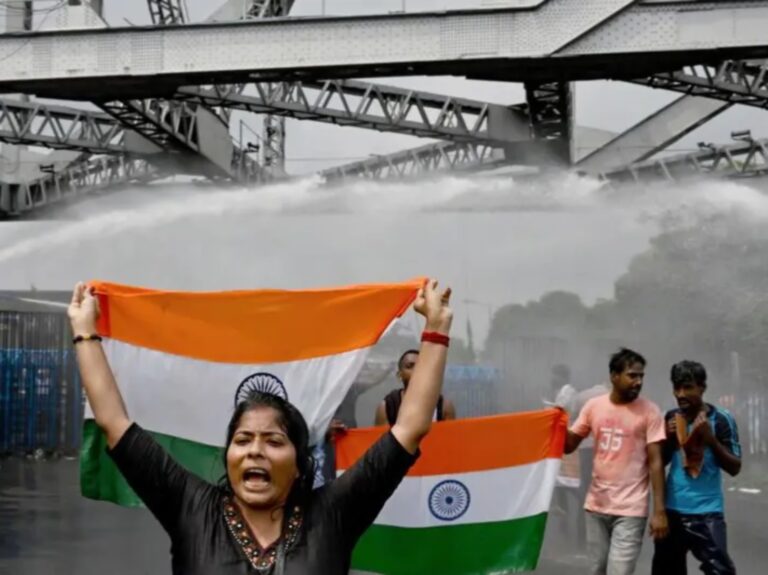
INDIA police have fired teargas and water cannons at thousands of protesters seeking justice for a female trainee doctor who was raped and murdered at a state-run hospital earlier this month.

On Tuesday, August 27, the protesters marched to the government building in Kolkata, demanding the resignation of West Bengal’s chief minister, Mamata Banerjee.

Chanting different slogans, the protesters clashed with police, who used batons to disperse the crowd.

Speaking to newsmen, one of the protesters, a university student, Namita Ghosh explained that they had intended to “protest peacefully” before the attack by the police.

Also, a senior police official anonymously told newsmen that about 100 protesters were arrested for “creating violence”.

The protest in India which has been lingering for a while now is followed a 31-year-old female trainee doctor raped and murdered while on duty at Kolkata’s state-run RG Kar Medical College and Hospital on August 9.

The outrage sheds light on the pervasiveness of sexual violence in the country and the women demanding the “independence to live in freedom and without fear”.

Similar to the situation in India, the Nigerian Association of Resident Doctors (NARD) on Monday commenced a seven-day nationwide strike, demanding the release of a female doctor who has been held for eight months by kidnappers.


READ ALSO:


The doctor, Ganiyat Popoola, was kidnapped on the night of December 27, 2023, at the senior staff quarters of the National Eye Centre, Kaduna alongside her husband and nephew.

However, her husband was released in March this year, leaving her and the nephew in the kidnapper’s den.

The NARD president, Dele Abdullahi,  stated that “there will be no concessions, and there will be no emergency care,” while the strike lasted.

Youth Ministry set to introduce NYSC equivalent for NCE graduates

0

THE Ministry of Youth Development has announced plans to develop a new training programme for graduates of the Nigeria Certificate in Education (NCE), similar to the National Youth Service Corps (NYSC).

The Minister of State for Youth Development, Olawande Wisdom, stated this at the opening ceremony of the BEMORE OYO 2024 Summer Bootcamp in Ibadan, Oyo State, on Monday, August 26, according to the News Agency of Nigeria (NAN).

The minister revealed that the ministry intended to collaborate with the Ministry of Education to introduce various training reforms, including a programme equivalent to the NYSC for NCE graduates. 

He noted that while the NYSC caters to university graduates, there is no similar scheme for those who have completed the NCE or related qualifications.

“The major priority of the ministry is citizenship and training, and we are bringing them back. We have NYSC for those who finished from universities, but what of those who finished from NCE and others?” he asked.

“We want to set up training so that you don’t need to go to other states to have it, you can have it in your state and the camp,” Wisdom stated.

The minister also highlighted the ministry’s dedication to addressing social challenges and acknowledged the role of organisations like the Boys’ Brigade and Girls’ Guide in discouraging youths from negative influences.

The minister emphasised that the ministry’s objective was to enhance citizenship and training, and further impact these values through the proposed programme.

Established in 1973, the NYSC is a programme created by the Nigerian government to foster national unity, promote patriotism, and equip young people with self-employment skills, among other objectives.

Every Nigerian graduate under 30 must participate in a one-year service, during which they are deployed to various states to work in different sectors.

Since its establishment by the former military head of state, Yakubu Gowon, shortly after the country’s civil war, the NYSC has undergone various reforms and has significantly lived up to its mission of unifying Nigeria, despite palpable challenges, including corruption, militating against it.


NFF appoints new coach for Super Eagles

THE Nigeria Football Federation (NFF) has announced that it had reached an agreement with German tactician, Bruno Labbadia, to become the head coach of Nigeria’s senior men’s national team, the Super Eagles.

Labbadia becomes the Super Eagles’ 37th coach – since 1949 – and the 23rd foreign coach hired by Nigeria for the team.

The NFF in a statement, Tuesday morning, quoted its general secretary, Mohammed Sanusi as saying, “The NFF executive committee has approved the recommendation of its technical and development sub-committee to appoint Mr. Bruno Labbadia as the head coach of the Super Eagles. The appointment is with immediate effect.”

He takes over from Finidi George who resigned in June after the team’s poor run of games in the 2026 World Cup qualifiers against South Africa and Benin.

Labbadi’s immediate challenge is to take charge of the three-time African champions for two 2025 Africa Cup of Nations qualifying matches against Benin Republic (Saturday 7th September in Uyo) and Rwanda (Tuesday, 10th September in Kigali), with four other matches to conclude the qualifying race following in October and November, said the NFF.

Born in Darmstadt, Germany on 8th February 1966, Labbadia won two caps for Die Mannschaft in his playing career that took him through clubs such as home-town team Darmstadt 98, Hamburger SV, FC Kaiserslautern, Bayern Munich, FC Cologne, Werder Bremen, Armenia Bielefeld and Karlsruher SC.

He triumphed in the German Bundesliga with Bayern Munich as a player in 1994. He coached famous names Hertha Berlin and VfB Stuttgart this decade, and previously, VfL Wolfsburg, Hamburger SV, Bayer Leverkusen, among others, and holds a UEFA Pro License.

He is the sixth German, after Karl-Heinz Marotzke (who had two stints between 1970 and 1974), Gottlieb Göller (1981), Manfred Höner (1988-1989), Berti Vogts (2007-2008) and Gernot Rohr (2016-2021) to lead the Super Eagles. Höner led the Eagles to the runner-up position at the 1988 Africa Cup of Nations, while Rohr qualified and led Nigeria to the 2018 FIFA World Cup finals in Russia.
List of Super Eagles coaches in history
John Finch (England) – 1949
Daniel Anyiam (Nigeria) – 1954-1956; 1964-1965
Les Courtier (England) – 1956-1960
Moshe Beit Halevi (Israel) – 1960-1961
George Vardar (Hungary) – 1961-1963
Joey Blackwell (England) – 1963 – 1964
József Ember (Hungary) – 1965-1968
Sabino Barinaga (Spain) – 1968-1969
Peter ‘Eto’ Amaechina (Nigeria) – 1969-1970
Karl-Heinz Marotzke (Germany) – 1970-1971; 1974
Jorge Penna (Brazil) – 1972-1973
Jelisavčić ‘Father Tiko’ Tihomir (Yugoslavia) – 1974-1978
Otto Glória (Brazil) – 1979-1982
Gottlieb Göller (Germany) – 1981
Adegboye Onigbinde (Nigeria) – 1983-1984; 2002
Chris Udemezue (Nigeria) – 1984-1986
Patrick Ekeji (Nigeria) – 1985
Paul Hamilton (Nigeria) – 1987; 1989
Manfred Höner (Germany) – 1988-1989
Clemens Westerhof (Netherlands) – 1989-1994
Amodu Shaibu (Nigeria) – 1994-1995; 1996-1997; 2001-2002; 2008-2010
Johannes Bonfrere (Netherlands) – 1995-1996; 1999-2001
Philippe Troussier (France) – 1997
Monday Sinclair (Nigeria) – 1997-1998
Bora Milutinović (Yugoslavia) – 1998
Thijs Libregts (Netherlands) – 1999
Christian Chukwu (Nigeria) – 2002-2005
Augustine Eguavoen (Nigeria) – 2005-2007; 2010; 2022
Berti Vogts (Germany) – 2007-2008
Lars Lagerbäck (Sweden) – 2010
Samson Siasia (Nigeria) – 2010-2011; 2016
Stephen Keshi (Nigeria) – 2011-2014; 2015
Sunday Oliseh (Nigeria) – 2015-2016
Gernot Rohr (Germany) – 2016-2021
José Peseiro (Portugal) – 2022-2024
Finidi George (Nigeria) – 2024
Bruno Labbadia (Germany) – 2024

CBN resumes lending to banks at 31.75% rate increase

THE Central Bank of Nigeria, (CBN), has lifted the ban on its lending to banks, adjusting the rate upward to 31.75 per cent interest rate.

Banks borrow short-term funds from the CBN through a channel known as the Standing Lending Facility (SLF).

Similarly, CBN raised the Standing Deposit Facility (SDF) rate to 25.75 per cent.

The SDF is the means banks use to deposit money with the apex bank.

The Nigerian bankers’ bank disclosed this in two separate circulars released on Monday, August 26.

The circulars were signed by the CBN director of the financial markets department, Omolara Duke.

Financial experts believe that the SDF is part of CBN’s efforts to manage liquidity in the financial system.

According to CBN, the rate increase of the SLF was based on the decision of the Monetary Policy Committee (MPC) to adjust the upper corridor of the standing facilities to 5.00 per cent from 1.00 per cent around the monetary policy rate (MPR) at its 296th meeting.

It said commercial and merchant banks would earn a 19 per cent interest rate on deposits above N3 billion in its Standing Deposit Facility (SDF).

“The Monetary Policy Committee (MPC) adjusted the upper corridor of the standing facilities to 5.00 per cent from 1.00 per cent around the MPR, at its 296th meeting.

“The suspension of the Standing Lending Facility (SLF) is hereby lifted and Authorised Dealers should send their request for SLF through the Scripless Securities Settlement System (S4) within the operating hours of 5.00 pm to 6.30 pm,” CBN said.

It explained that authorised dealers were permitted to access the SLF at 31.75 per cent;  intraday lending facility (ILF) to avoid system gridlock at no cost if repaid the same day.

It retained the 5.00 per cent penalty, as stated in the S4 business rules, for participants who do not settle their ILF, which the system would convert to SLF at 36.75 per cent.

The apex bank reintroduced the collateral execution, that is the rediscounting of instruments pledged by participants at the penal rate by CBN, as stipulated in the approved repo (repurchase agreement) guidelines.

The repo means the same as the interest rate at which the CBN loans money to commercial banks.

On SDF, the apex bank said, “Under sections 12 and 30 of the CBN Act 2007, the Monetary Policy Committee (MPC), at its 296th meeting adjusted the Asymmetric Corridor to +500/-100bps from +100/-300bps around the Monetary Policy Rate (MPR).”

CBN explained that the adjustment of the SDF would be operationalised in a way that commercial and merchant banks enjoy 25.75 per cent for deposits up to N3.00 billion and 19 per cent for excess deposits above the initial N3.00 billion.

For payment service banks,  25.75 per cent would be for deposits up to N1.50 billion and 19.00 per cent for excess deposits above the initial N1.50 billion.

The rates increase in the SLF and SDF besides the incentives take immediate effect, the apex bank added.

The ICIR reported that the apex bank at its last monetary policy committee (MPC) in July raised the MPR rate by 50 basis points to 26.75  per cent.

Tinubu appoints new directors-general for SSS, NIA

PRESIDENT Bola Tinubu, on Monday August 26, appointed Adeola Oluwatosin Ajayi as the new Director-General of the State Security Service (SSS).

The President also appointed Mohammed Mohammed as the new Director General (DG) of the National Intelligence Agency (NIA). 

Both Ajayi and Mohammed’s appointments followed the resignation of the former NIA and the SSS Directors-General, Ahmed Abubakar and Yusuf Bichi, respectively.


The Special Adviser to the President on Media & Publicity, Ajuri Ngelale, disclosed this in a statement, noting that Ajayi would replace  Bichi who was appointed by former president Muhammadu Buhari in 2018.

Tinubu appreciated the two outgoing DGs of the intelligence agencies for their services to the nation.

According to the presidency, the new SSS DG rose through the ranks to attain the post of Assistant Director-General of the Service before his latest appointment.

It noted Ajayi had, at various times, served as state director in Bauchi, Enugu, Bayelsa, Rivers, and Kogi. 

Meanwhile, the new NIA boss Mohammed was said to have had an illustrious career in the foreign service since joining the NIA in 1995. 

According to the presidency, Mohammed served in various capacities, culminating in his promotion to the rank of director and his subsequent appointment as the head of the Nigerian mission to Libya.

Mohammed, who graduated from Bayero University, Kano in 1990, reportedly served in North Korea, Pakistan, Sudan, and at the State House, Abuja.

“President Tinubu challenged the new security chiefs to work assiduously to reposition the two agencies for better results and charged them to bring their experience to bear in tackling the security challenges bedevilling the country through enhanced collaboration with sister agencies and in surgical alignment with the Office of the National Security Adviser (ONSA),” the statement added.

Recall that The ICIR reported that Abubakar submitted his resignation letter to Tinubu, on Saturday, August 24

After emerging from the meeting at Aso Presidential Villa where he tendered his resignation letter, Abubakar thanked Tinubu for allowing him to serve under two presidents.

Group slams Tinubu over continued detention of #EndBadGovernance protesters, harassment of labour leaders

0

THE Solidarity Network for Workers’ Rights (SNWR) has frowned at President Bola Tinubu-led administration’s ‘unconstitutional’ detention of #EndBadGovernance protesters and the harassment of Nigerian labour leaders. 

The group, in a statement issued by its publicity secretary, Daniel Akande, on Sunday, August 25, accused the government of engaging in repressive tactics to silence dissents and undermine democratic rights.

The organisation also expressed outrage over the recent ruling by a Federal High Court in Abuja, which permitted the police to remand 124 #EndBadGovernance protesters for 60 days. 

The protesters, according to the statement, have been denied legal representation and are being held in conditions the group described as inhumane.

The ICIR reports that many Nigerians trooped to the streets in the first and second weeks of August to protest poor governance and economic hardships caused by Tinubu’s reforms.

The protests were marred with violence, largely caused by the security operatives in places like Lagos and Abuja, where protesters were subjected to tear gas and harassment.

On August 12, the Kano State Police Command said it had moved about 76 suspects arrested for flying Russian flags during the protest to the Force Headquarters,  Abuja.

This was as the police said it arrested 873 suspects during the nationwide demonstration.

The ICIR also reported on Monday, August 19, that the Nigeria Police Force (NPF) summoned Nigeria Labour Congress (NLC) Joe Ajaero over allegations of terrorism financing, treasonable felony, and related offences.

Reacting to this in a statement, the Solidarity Network for Workers’ Rights, called on all the labour unions and students to jointly demand the immediate and unconditional release of all the abducted and arrested protesters and also stop the attacks on the NLC.

“The members of our organisation read with dismay that the recent decision by a Federal High Court in Abuja to permit the police to remand 124 #EndBadGovernance protesters for 60 days is a grave violation of constitutional rights and an affront to justice.

“Of course, this unlawful incident explains critically Fela’s political analysis in one of his songs named ‘Government Magic’ The Tinubu APC-led government will not cease to amaze us. We categorically denounce the high-handedness of the Tinubu government as well as the actions of the National Security Adviser, Nuhu Ribadu, whose illegal operations continue to erode the rights and freedoms of Nigerian citizens,” the statement read in part. 

The group also condemned Emeka Nwite, a justice, for granting the order on the protesters’ remand, adding that the action not only undermined the judicial system but also set a dangerous precedent for the continued abuse of power by the Tinubu administration.

It further expressed deep concern over the continuous “deteriorating health conditions” of the arrested individuals, who, it said have been subjected to torture and inhumane conditions by Nuhu Ribadu, at the IRT facility in Abuja.

“We also, unequivocally condemn the harassment of the Nigeria Labour Congress (NLC) President, Joe Ajaero, who is being unjustly targeted by the Tinubu government. This government has escalated its attacks on the NLC, raiding its secretariat under dubious pretences and now attempting to implicate its leadership in serious criminal activities, including terrorism financing. 

“This reflected an attempt to silence and intimidate labour leaders is a clear indication of the government’s fear of growing public discontent. The Tinubu-APC-led regime cannot blame Nigerian youths for protesting against its IMF and World Bank-driven capitalist policies, which have perpetuated hunger and mass poverty amidst plenty, all while dubiously labelling everyone as terrorists and citing terrorism financing as part of the offences,” the statement added.

The SNWR also called for an urgent meeting within the labour movement to discuss an alternative to the government’s economic policies, which it argued had led to widespread poverty and suffering. 

The group insisted that only a collective struggle by the working masses could bring about meaningful change in Nigeria.

Nigeria’s GDP growth to 3.19% in second quarter

NIGERIA’s gross domestic product (GDP) grew by 3.19 per cent and influenced by the services sector on a year-on-year basis in real terms in the second quarter (Q2) of 2024, the National Bureau of Statistics (NBS) report has shown.

The report was released on Monday, August 26.

It indicates that the growth rate was higher than the 2.51 per cent recorded in the second quarter of 2023.

It is also higher than the 2.98 per cent the NBS reported in the first quarter of 2024.

According to the statistics office, the performance of the GDP in the quarter under review was driven mainly by the services sector.

It said the service sector recorded a growth of 3.79 per cent and contributed 58.76 per cent to the aggregate GDP.

The agriculture sector grew by 1.41 per cent, relative to the 1.50 per cent growth recorded in the second quarter of 2023.

Also, the NBS said growth of the industry sector was 3.53 per cent, improving from a negative of -1.94 per cent recorded in the corresponding quarter.

The industry and services sectors contributed more to the aggregate GDP in terms of share of the GDP  than last year’s second quarter report.

In the quarter under review, aggregate GDP at basic price stood at N60.93 trillion in nominal terms, from N52.10 trillion, indicating a year-on-year nominal growth of 16.94 per cent.

“For better clarity, the Nigerian economy has been classified broadly into the oil and non-oil sectors,” NBS stated.

Oil sector and non-oil sectors contribution

In the review quarter, the oil sector contributed 5.70 per cent to the total real GDP, increasing from the 5.34 per cent period in 2023.

The non-oil sector contributed 94.30 per cent to the nation’s GDP in the second quarter of 2024, slightly lower than the 94.66 per cent in 2023

Nigeria recorded an average daily oil production of 1.41 million barrels per day (mbpd) in the second quarter of 2024, representing 0.19 mbpd higher than the 1.22 mbpd recorded in the same quarter of 2023.

The figure is 0.16 mbpd lower than the 1.57 mbpd produced in the first quarter of 2024, the NBS also reported.

FBN Holdings cancels AGM indefinitely amid legal battle

FBN Holdings Plc has cancelled its annual general meeting (AGM), rescheduled to be held on August Tuesday, September 3, 2024, indefinitely, amid a recent legal battle with shareholder.

The parent company of First Bank of Nigeria Limited announced this in a statement on Monday, August 26, signed by its secretary, Adewale Arogundade.

It said, “Notice is hereby given that the 12th Annual General Meeting (AGM) of the members of FBN Holdings Plc, fixed to hold virtually and 22nd of August and re-scheduled to Tuesday, September 3, 2024, at 10 a.m. to consider and if thought fit, approve the accounts, declare  dividend, authorise the company to undertake capital raising of up to N350 billion, and other ancillary matters is hereby cancelled.”

The bank added that further information would be provided in due course, as appropriate.

The parent company of the oldest Nigerian bank did not give the reason for the cancellation, however, the bank has been in legal battles with some shareholders, threatening its holding structure for the second straight year.

A Federal High Court in Lagos state had halted FBN Holdings‘ 12th AGM scheduled for August 22, at the request of shareholder Tohir Folorunsho Ismaila.

The meeting was prevented from holding either virtually or otherwise, pending the determination of a motion for interlocutory injunction.

Justice Akintayo Aluko gave the order on August 13, 2024, after hearing a motion ex-parte filed and moved by Taiwo Osipitan with Olayemi Badewole and Adetola Ogunlewe for Ismaila, the petitioner.

FBN Holdings is the sole respondent in the suit marked FHC/L/CP/1428/2024, according to reports.

The legal battle is the latest of a growing list of shareholders standing in the way of FBN Holdings’ crucial annual meeting.

Rescheduled to September 3 according to an earlier notice by the bank to the investing public, the AGM was to be held to get shareholders’ approval for an N350 billion capital raise following the Central Bank of Nigeria (CBN) mandatory banks recapitalisation.

FBN Holdings had earlier in April announced plans to raise capital through the issuance of shares via a public offering, private placement or rights issue in the Nigerian capital markets to meet CBN’s minimum capital requirements of N500 billion for banks with international operating licences.

The bank had a similar fate last year when shareholders kicked against its decision to hold a virtual session.

Some of the shareholders questioned why the bank planned to avoid a physical meeting bearing in mind the crucial agenda expected to be reached at the AGM.

This led to some minority shareholders’ rallied support for FBN Holdings to hold its AGM.

The chairman of the Trusted Shareholders’ Association, Mukhtar Mukhtar, led the protest at the bank’s headquarters in Lagos in support of the bank, The ICIR reported.

At this year’s AGM, shareholders are supposed to approve a fixed amount of N50 million each as directors’ fees for the financial year ending December 21, 2024, and N63.7 million as the fee for the board chairman, Femi Otedola, whose approval was granted during last year AGM.

Submissions now open for 2024 Sports Media Awards

THE International Sports Press Association (AIPS) has launched its 2024 Sports Media Awards and is now accepting entries.

The categories are writing (best column and best colour piece), photography (action picture and portfolio), audio, video (short feature, athlete profile and documentary) and young reporter under 30.

The first, second and third-place winners in the eight senior categories will receive US$8,000, US$3,000 and US$2,000. The winner in the young reporter category will receive a scholarship to attend a top international event.

Sports journalists can enter this contest.

Works must have been published or broadcast between November 5, 2023 and November 4, 2024. All languages are accepted.

The deadline for the submission of application is November 4, 2024. Interested sports applicants can apply here.

Nigeria recognises only 8 varsities in Togo, Benin Republic – Minister

0

THE Nigerian government has said it recognised certificates of only eight universities in Togo and the Benin Republic.  

The Minister of Education, Tahir Mamman, on Sunday, August 26, while speaking on Channels Television’s “Sunday Politics” said the federal government only recognised three universities in Togo and five in Benin Republic.

His declaration followed the growing concerns about the proliferation of unaccredited institutions awarding degrees to Nigerians in the neighbouring African countries.

The minister had on Friday, August 23, disclosed that over 22,500 Nigerians obtained fake degree certificates from Togo and Benin Republic. He vowed that the certificates would be rendered useless.

The minister revealed that between 2019 and 2023, 21,600 Nigerians obtained fake certificates from unaccredited universities in the Benin Republic, while another 1,105 got theirs from unaccredited universities in Togo. 

He disclosed that his ministry sourced this information from records of the National Youth Service Corps (NYSC) and other agencies.

Meanwhile, while speaking with Channels TV, Mamman stressed that there was no going back on the decision of the federal government to cancel about 22,700 certificates awarded to Nigerians by some of the ‘fake’ universities in the two countries.

According to him, the decision to invalidate the certificates was not harsh as Nigerians who obtained degree certificates from such ‘illegal’ tertiary institutions dented the country’s image.

He said, “Most of those parading the fake certificates didn’t even leave the shores of Nigeria but got their certificates through racketeering in collaboration with government officials at home and abroad.

“The fake universities capitalised on the gullibility of Nigerians patronising such fake schools.

“The federal government, through the offices of the Head of Civil Service and the Secretary of the Federation, would fish out those in the government’s employment with such fake certificates. I also urge the private sector to follow suit.”

Mamman listed the universities recognised by Nigeria in Togo as: Universite De Lome; Universite De Kara; and Catholic University of West Africa.

He also named five accredited universities in the Benin Republic as: Universite D’abomey-Calavi; Universite De Parakou; Universite Nationale Des Sciences, Technologis Ingenierie Et Mathematiques; Universite Nationale D’ Agriculture; and Universite Africaine De Devlopment Cooperatif.


READ ALSO:


The ICIR reported that in January 2024, the federal government suspended the accreditation and evaluation of degree certificates from the two countries.

The suspension followed a report by an online newspaper, Daily Nigerian, which exposed how a Cotonou-based university issued a degree certificate to an undercover journalist within six weeks.   

The newspaper revealed how beneficiaries of these substandard certificates compete for jobs and other opportunities with hard-working graduates who undergo academic rigours for at least four years to obtain their degrees.