Home Blog Page 572

Tinubu sacks PSC chairman, Solomon Arase, days after ICIR’s petition against him

0

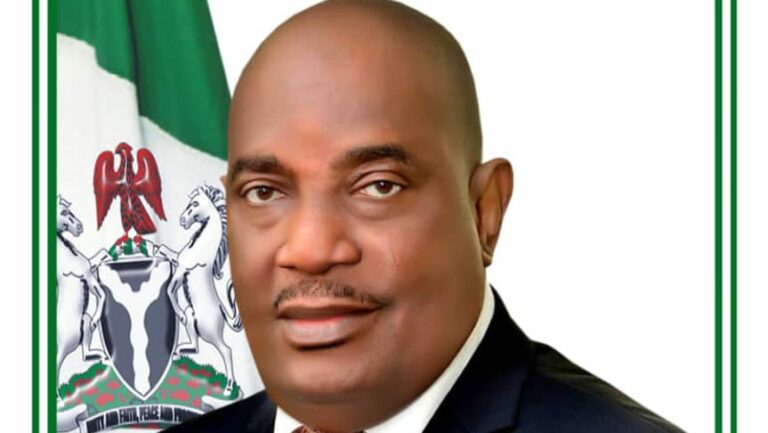
PRESIDENT Bola Tinubu has sacked the chairman of the Police Service Commission (PSC) Solomon Arase, three days after receiving a petition by the International Centre for Investigative Reporting (ICIR) against him.

The ICIR requested that the President suspend and probe Arase due to his corrupt practices while he served as Inspector-General of Police (IGP) and for abusing his office as the PSC chairman.

Additionally, this organisation informed the President of how Arase had been using the police to harrass The ICIR’s staff members after publishing an investigative report that exposed his sleaze while serving as the IGP.

Although Arase is meant to serve for four years under the Commission’s Act, Tinubu appointed Hashimu Argungu as the new PSC chairman on Monday, June 10, less than two years into his tenure.

This was contained in a statement by the Special Adviser to the President on Media and Publicity, Ajuri Ngelale on Monday.

“President Bola Tinubu has approved the appointment of DIG (Deputy Inspector-General of Police) Hashimu Argungu (Rtd) as the Chairman of the Police Service Commission (PSC).

“The President has also approved the appointment of Chief Onyemuche Nnamani as Secretary and DIG Taiwo Lakanu (Rtd) as member of the commission,” the statement read.

Ngelale disclosed that the appointments were subject to confirmation by the Senate, as contained in the PSC’s Act.

The ICIR’s investigation on Arase’s infractions in office revealed that he and another former IGP, Ibrahim Idris, were accused of receiving house allocations worth over N200 million as incentives for awarding an estate development contract to Copran International Limited, for land originally meant to be used as police barracks.

Following the publication, the Nigeria Police Force National Cybercrimes Centre (NPF-NCCC) invited The ICIR’s Executive Director Dayo Aiyetan and the reporter who conducted the investigation, Nurudeen Akewushola, for questioning, during which they were detained for over nine hours.

The petition written by The ICIR to the President noted that the police invitation was at Arase’s behest, and the contractor indicted in the investigation, Andy Chime, both of whom had submitted petitions to the police over the report.

“Thus, the Police appeared more interested in protecting the interest of the person who allegedly fraudulently sold their property than investigating the allegations against him (Arase) and recovering their property.

“Curiously, during the interrogation of Aiyetan and Akewushola by the NPF-NCCC, the investigating officers and the director of the NPF-NCCC, Uche Ifeanyi Henry, were not interested in Andy Chime’s accusations but the source of The ICIR’s report and the evidence it had against Mr Arase,” The ICIR noted in its petition.

The petition also noted that the NPF-NCCC Director tried to force the journalist to release evidence gathered during his investigation, which would be required for their defence in a case already filed by Arase.

This organisation also noted that Arase’s petition to the police had been written on the PSC letterhead, and described it as an abuse of office.

“We consider this as a brazen and flagrant abuse of office by the chairman of the Police Service Commission, who by virtue of his position oversees promotions and appointments in the Nigeria Police Force (NPF).

“Using his official capacity to write a petition concerning a private matter was in all intent and purpose aimed at using the Police to intimidate and threaten The ICIR and its journalists,” the petition further read.

Earlier, Arase also used the PSC platform to announce that he had filed a lawsuit against some of The ICIR’s staff members, including the executive director, Aiyetan, the reporter, Akewushola, and the organisation’s editor, Bamas Victoria.

The ICIR in its petition, therefore, urged Tinubu to launch an independent investigation into the corruption allegations, which will exclude the Police in the interest of justice and fairness.

The petition also requested that The IGP be instructed to desist from allowing the police to intimidate or molest The ICIR staff members and journalists.

Other requests in the petition include an order restricting Arase from abusing the office of the PSC chairman and using it to influence the intimidation of The ICIR staff members and his suspension from office to allow for an independent investigation of the corruption allegations reported by this organisation.


Rhodes Trust opens applications for scholarships

THE Rhodes Scholarship, administered by the Rhodes Trust, is accepting applications for its global scholarships.

The scholarships are intended for outstanding students who are motivated to engage with the global challenges facing humankind and committed to the service of others and to the promotion of international understanding and peace.

Students from anywhere worldwide can apply for a scholarship to study at the University of Oxford in England.


Read Also:

Morland African Writing Scholarship seeks entries

Transparency International School offers scholarships

DW Akademie offers up to 10 full scholarships for journalists


Candidates must have a bachelor’s degree and be fluent in English.

The deadline for the submission of applications is August 1, 2024. Interested applicants can apply here.

Court dismisses suit seeking to declare 25 Rivers Assembly seats vacant

0

A RIVERS State High Court in Port Harcourt has dismissed the suit seeking to sack the state’s 25 lawmakers who defected from the Peoples Democratic Party (PDP) to the All Progressives Congress (APC).  

In his ruling, the presiding judge, Okogbule Gbasam, held that the lawmakers were still members of the PDP, noting that the claimants failed to provide proof that the defendants defected to the APC.

Gbasam explained that defection could only be established through the party membership register, a membership card, and fulfilling all party requirements, not through newspaper, radio, or online publications.

This development came a few weeks after Charles Wali, a jude of the state High Court, declared the seats of the 25 lawmakers vacant pending the determination of a suit before it. 

Wali also ordered Martin Amaewhule to stop parading as the Speaker of the Rivers State House of Assembly and barred the 25 lawmakers, who are believed to be loyal to the state’s immediate past governor and current Minister of the Federal Capital Territory (FCT), Nyesom Wike, from posing as lawmakers in the state.

The presiding judge gave the order in suit No PHC/1512/CS/2024, brought by the Speaker, Rivers State House Of Assembly Victor Oko Jumbo and two others.

Backstory 

The ICIR reports that the state governor, Siminalayi Fubara, and his predecessor, Nyesom Wike,  have been at loggerheads over who controls the state’s PDP structure and other issues since he came into office on May 29, 2023. 

The development has generated widespread controversies and crises in the state, with the APC calling for Fubara’s impeachment.

The call for his impeachment came barely 24 hours after the governor said the House of Assembly, led by the Speaker, Martin Amaewhule, did not exist.

On several occasions this year, the lawmakers have overridden the governor on state policies and laws as the crisis ballooned.

While noting that some of his commissioners were working against him, Fubara decried how the state House of Assembly had been working at variance with his government.

He had also threatened that the House members could cease to exist as state lawmakers if he so wished.

He acknowledged the roles some political figures, particularly his predecessor, Wike, played in his ascent to the governorship but stated that such efforts wouldn’t cause him to idolise a man.

Following the hostility between the two leaders, 25 members of the River State House of Assembly members decamped from the PDP to APC in 2023, shortly after assuming office.

The feud had degenerated into nearly physical combat between their loyalists, and the possible chaos was so palpable in the state that President Tinubu had to intervene twice before tempers were calmed.

The ICIR also reported that no fewer than three commissioners have resigned from the Fubara’s government in the past few weeks as Nigerians await the end of the dramas in the state governance.

Climate Journalism Award seeks entries

The European Journalism Centre, in partnership with the Google News Initiative, is accepting entries for the Climate Journalism Award. The award aims to promote and recognise exceptional climate journalism that adopts an innovative or original storytelling approach, encouraging journalists to prioritise reporting on climate-related issues.

Stories can be submitted in five categories: data-driven visualisation, storytelling and solutions, fighting climate misinformation, investigative reporting, and emerging talent.

Climate journalists around the world can submit stories and compete for cash prizes.

Submitted stories must have been published in a European-based publication between June 1, 2023 and May 31, 2024.

Winners in each category will receive EUR 2,400 (US$2,580).

The deadline for the submission of application is July 5, 2024. Interested applicants can apply here.

Labour may resume strike Tuesday

0

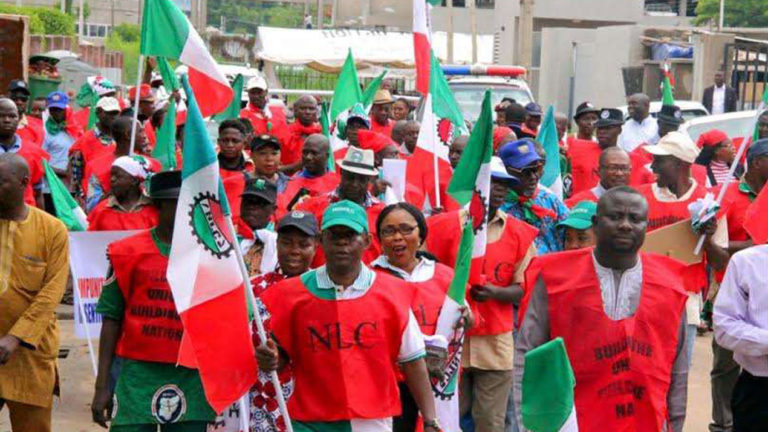
NIGERIAN workers may resume nationwide strike on Tuesday, June 11, if the federal government fails to meet their demand on minimum wage, the Nigeria Labour Congress (NLC), Assistant General Secretary, Chris Onyeka said on Monday.

While featuring on Channels TV “Sunrise Daily on Monday, Onyeka noted that the one-week grace period granted to the Federal Government on Tuesday, June 4, 2024, would expire at midnight on Tuesday, June 11, 2024, adding that should the federal government and National Assembly fail to act on the demands of workers by Tuesday, the organised labour will be forced to embark on indefinite strike.

The NLC official disclosed this on Monday, June 10, while speaking on the Channels Television’s The Morning Brief show.

According to him, the NLC and the Trade Union Congress (TUC) would convene to decide on the resumption of the nationwide industrial action that was relaxed last week.

The ICIR reported how the workers embarked on a strike on Monday, June 3 to compel the government to agree on an acceptable minimum wage.

They relaxed the strike the following day after reaching an agreement with the government.

The government agreed to improve the minimum wage offer beyond the initial N60,000, with President Tinubu ordering the Finance Minister, Wale Edun to prepare a template for the new minimum wage.

Consequently, the federal government proposed N62,000 as the new minimum wage, a N2000 increase from the earlier N60,000 offered.

However, the labour has since demanded a much higher wage, pegging its earlier demand of N615,000 to N250,000.

Speaking on Channel’s morning show, Onyeka said: “The Federal Government and the National Assembly have the call now. It is not our call. Our demand is there for them (the government) to look at and send an Executive Bill to the National Assembly, and for the National Assembly to look at what we have demanded, the various facts of the law, and then come up with a National Minimum Act that meets our demands.

“If that does not meet our demand, we have given the Federal Government a one-week notice to look at the issues and that one week expires tomorrow (Tuesday). If after tomorrow, we have not seen any tangible response from the government, the organs of the organised Labour will meet to decide on what next.”

When asked what the decision of Labour would be should the government insist on ₦62,000, he said, “It was clear what we said. We said we are relaxing a nationwide indefinite strike. It’s like putting a pause on it. So, if you put a pause on something and that organs that govern us as trade unions decide that we should remove that pause, it means that we go back to what was in existence before.”

He insisted that the labour won’t accept the latest government’s offer of N62,000 and the N100,000 proposal, labelling it as “starvation wage”

“We have never considered accepting ₦62,000 or any other wage that we know is below what we know is able to take Nigerian workers home. We will not negotiate a starvation wage,” he added.

State assembly speakers impeached since 1999

ON Wednesday, May 22, members of the Cross River State House of Assembly impeached their speaker, Elvert Anyambem, over several infractions, including gross financial misconduct and noncompliance with the Cross River State Legislature Funds Management Laws of 2021.

The ICIR reported that, in a plenary session, two-thirds of the assembly members had passed a vote of no confidence on the speaker claiming that he misappropriated N48 million intended for payment of electricity bills for the assembly complex and quarters.

Anyambem was also accused of embezzling over N19 million from local government deductions and N404 million generated by the state’s Inland Revenue Service (IRS) for oversight functions by the House. However, the embattled speaker denounced the impeachment.

Findings by The ICIR from various media reports showed that Cross River is among the long list of 23 states where speakers of assemblies have been impeached since the return to democracy in 1999.

Impeachment  galore 

Ogun : Following a mild drama in the Ogun state assembly, 18 out of 26 members  impeached the speaker, Olakunle Oluomo, over gross misconduct and financial misappropriation of funds among others. The ICIR had reported that the impeached speaker was arraigned on 11 counts of conspiracy, forgery, stealing and money laundering preferred against them by the Economic and Financial Crimes Commission (EFCC) in September 2022.

Zamfara: In February, Bilyaminu Moriki, the speaker of the Zamfara State assembly was impeached following a vote of no confidence by 18 out of 24 members . The impeachment was hinged on the security challenges affecting the state without any effort by the House to stop the menace. 

Rivers : In the heat of the crises between the governor of River State, Siminalayi Fubara, and his predecessor, Nyesom Wike, eight members of the state assembly impeached the speaker, Martins Amaewhule, and his deputy, Dumle Maol. The speaker was replaced by Edison Ehie, formerly sacked as leader of the house. The ICIR reported how a court in Port Harcourt, the state capital, affirmed the impeachment in December 2023.

Plateau: In October 2021, 16 out of 24 members of the Plateau State House of Assembly passed a vote of no confidence on its speaker, Abok Ayuba, after a prolonged rivalry between the lawmaker and the former governor, Simon Lalong. The lawmakers immediately elected Sanda Yakubu, as his replacement,

Niger : The ICIR reported that the speaker of the Niger State House of Assembly, Adamu Usman, was impeached by 18 out of 27 members in May 2015. Isa Kawu replaced him. Aliyu was accused of withholding statutory allocation to the assembly for months, payment of half salaries, and non-implementation of resolutions passed by the House, among other issues.

Edo: Two impeachments have been reported in Edo state. The first, was in 2016, when Victor Edoro was ousted by 16 of the 24 members of the assembly for alleged high-handedness, dictatorial tendencies and financial recklessness. He was replaced by Elizabeth Ativie, who became the assembly’s first female speaker.

Also, in October 2020, the assembly impeached its speaker Frank Okiye and elected Marcus Onobun as his replacement. 

Delta : Monday Igbuya was impeached as the Delta State speaker in May 2017 following a vote of no confidence passed by the 22 lawmakers. Sheriff Oborevwori replaced him.

Ekiti : Like Edo, two speakers have also been stripped of their sests in Ekiti stste. In 2022, 17 out of 25 members of the assembly signed the impeachment of Gboyega Aribisogan, as the speaker of the house. 

Also, in October 2018, Kola Oluwawole and his deputy, Sina Animaun, were ousted through an impeachment that was carried out t by 14 members of the House.

Imo: Nineteen out of 27 members of the Imo state assembly impeached the speaker, Paul Emeziem in 2021. He was replaced by Kennedy Ibeh. 

Katsina: In 2017, the Katsina State House of Assembly impeached its speaker, Aliyu Sabiu Muduru. Twenty three out of 34 members endorsed a vote of no confidence before his impeachment was announced.

Gombe : The Gombe State House of Assembly, in November 2020, impeached its speaker, Abubakar Ibrahim, while Abubakar Luggerewo emerged as the new speaker. The former speaker was removed following a voice vote by 16 of the 24 members of the house.

Benue : In 2018, the Benue State House of Assembly elected Titus Uba as its new speaker. This followed the vote of no confidence passed on the immediate past leadership that was accused of high-handedness and other sundry offences.

Ebonyi: In July 2014, Chukwuma Nwazunku, was impeached as the speaker of the Ebonyi state assembly by over two-thirds majority of the members on grounds of incompetence, gross misconduct, embezzlement and misappropriation of public funds as well as conduct likely to cause breach of the Nigerian constitution.

Anambra: The Speaker of the Anambra State House of Assembly, Rita Maduagwu was impeached in November 2018.  He was removed by 22 out of 30 members of the state assembly.

Borno: In February 2012, the Borno State House of Assembly impeached its speaker, Goni Ali Modu, for allegedly being submissive to the state government. The speaker was sacked by a vote of no confidence and was replaced by, Abdulkareem Lawan Adam. 

Ondo : The Ondo state assembly impeached speaker Bamidele Oloyelogun, in November 2018, alongside his deputy, Oladeji Iroju, by 18 out of 26 members of the House,  on grounds of gross misconduct.

Jigawa: In January 2017, the Jigawa State House of Assembly impeached its Speaker, Idris Garba, over allegations bordering on high-handedness and abuse of power. The impeachment notice was signed by 25 of the 30 assembly members. 

Two years later, in May 2019, the lawmakers removed Isa Idris and re-elected Idris Garba back as the speaker.

Taraba : In 2013, the Taraba State House of Assembly members reportedly impeached the speaker, Istifanus Gbana, by 17 out of 24 members. Gbana was replaced by Haruna Tsokwa who later died in questionable circumstances. Another speaker, Josiah Sabo Kente, was ‘forced’ to resign in 2014.

Kano: In December 2011, the Kano State House of Assembly impeached its speaker, Yusuf Falgore, and elected Gambo Sallau to replace him. Also, Abdullahi Atta was impeached in July 2018. About 27 lawmakers signed the impeachment notice accusing the speaker of incompetence, corruption, and failure to carry other members of the Assembly along.


READ ALSO:


Kebbi: In 2015, the Speaker of the Kebbi State House of Assembly, Hassan Shalla, was impeached by 12 out of 24 members for alleged breach of trust and embezzlement of allowances of his colleagues. Also, in 2021, the assembly impeached its speaker, Isma’il Kamb, and his deputy, Muhammadu Aliyu, after 20 out of the 24 members endorsed it.

Bayelsa : The ICIR reported how the speaker of the Bayelsa House of Assembly, Emmanuel Tonye Isenah, was in September 2019 following a series of gunshots in the Assembly complex.

Abia: In May 2023, the speaker of Abia House of Assembly, Chinedum Orji, was impeached  after 18 of the 24 members signed for his removal.

Governors bound by Constitution to pay national minimum wage – Falana

0

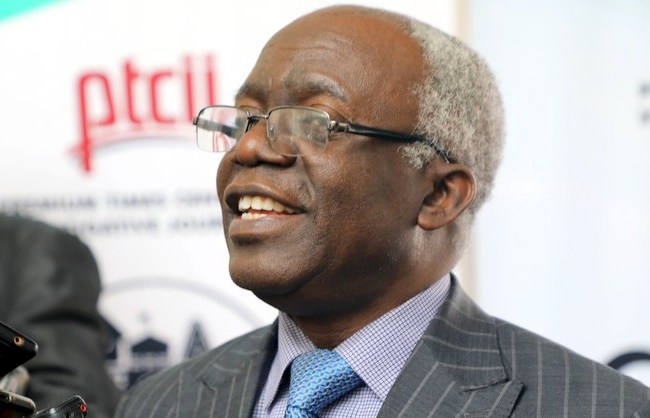
THE Nigerian Constitution compels all governors to accept the national minimum wage, Femi Falana, a senior advocate, has posited as debate rages over the national minimum wage expected to be announced by President Bola Tinubu soon.

While the governors reject the N60,000 earlier offered by the federal government, the organised labour, led by the Nigeria Labour Congress (NLC) and the Trade Union Congress (TUC), have pushed for N250,000.

Once enacted, the National Minimum Wage Act 2024 will be binding on all employers, except those explicitly excluded by the law, Falana said in his titled, ‘Legal Matters Arising from Proposed National Minimum Wage Act’.

Citing past legal precedents, Falana referenced the case of Oyo State Government v Alhaji Apampa & Ors (2008), where the National Industrial Court affirmed that paying less than the national minimum wage violates the law. Similarly, in Attorney General, Osun State v Nigeria Labour Congress (Osun State Council), the court upheld that employers could pay more than the minimum wage but not less.

He further emphasised that state governments and private employers are bound by the provisions of the National Minimum Wage Act. “A state government or private employer may pay more but is not permitted to pay less than the stipulated minimum wage,” citing examples of the Lagos and Edo state governments’ payment of a minimum wage of N70,000, which is above the national minimum of N30,000 set by the 2019 Act.

Addressing concerns about the affordability of a new national minimum wage, he argued that all state governments could meet this obligation if they manage resources efficiently.

He urged governors to reduce waste and tackle official corruption, adding that about 30 states spent N986.64 billion on recurrent expenditures, including refreshments, sitting allowances, travel, and utilities, in the first quarter of 2024 alone.

Falana argued that a national minimum wage does not violate the principles of federalism. “It is not against any tenet of federalism to prescribe a uniform national minimum wage for workers in Nigeria,” the lawyer stated.

He further explained that state legislatures lacked the power to set a minimum wage for public service workers within their respective states, pointing out that it is clearly stated in Item 34 of the Exclusive Legislative List, which covers “labour, including trade unions, industrial relations; conditions, safety and welfare of labour; industrial disputes; prescribing a national minimum wage for the Federation or any part thereof; and industrial arbitration.”

The lawyer highlighted that labour and trade unions are part of the exclusive legislative list, which grants the National Assembly the authority to enact relevant laws such as the Labour Act, Trade Union Act, Factories Act, and Employees Compensation Act.

Also, despite Nigeria’s capitalist orientation, he noted that Section 16(2)(d) of the Constitution mandates the government to ensure “suitable and adequate shelter, food, reasonable national minimum living wage, old age care and pensions, and welfare for the disabled,” among other provisions for all citizens.

Although these constitutional mandates are not directly enforceable, they have compelled the National Assembly to enact laws like the Pension Reforms Act 2014, the National Housing Act, and the Federal Mortgage Bank Act, he stated.

According to him, the Minimum Wage Act aims to bridge the wage gap between lowly paid workers and top public officers.

“The purpose of the law of fixing a national minimum wage is to ensure that no employer of labour is allowed to pay starvation wages to workers,” he added.

The ICIR reports that the NLC and TUC declared a nationwide strike on Monday, June 3, over the government’s failure to announce an acceptable minimum wage, shutting down schools, airports, power and trail stations, among others.

The workers suspended the strike on Tuesday, June 4, after reaching an agreement with the federal government that the N60,000 offered by the government would be reviewed upward.

Anti-graft commission probes alleged N23m empowerment scheme fraud in Kano

0

KANO State Public Complaints Anti-Corruption Commission (PCACC) has launched investigations into allegations of fraud in the recent disbursement of over N23.2 million empowerment funds to street hawkers.

The fund was provided by the state Governor Abba Kabir Yusuf and disbursed to 465 hawkers within the state who were to get N50,000 each.

However, there were allegations that some officials forced beneficiaries into parting with a part of the money meant for strengthening their businesses.

According to the News Agency of Nigeria (NAN) the commission’s chairman, Muhuyi Rimin-Gado, said anyone indicted in the fraudulent act would be brought to book.

“The commission is investigating the matter and anyone found involved would be brought to justice. The commission is determined to prevent corruption from undermining the integrity of the empowerment initiative of the government and ensure that justice is served,” Rimin-Gado was quoted as saying.

Some of the beneficiaries of the empowerment funds were captured in videos circulated on social media, saying they were forced to return as much as N45,000 to the officials.

Others said they were denied access to the venue where the money was being shared.

The governor had said the funds should be disbursed with priority given to the vulnerable groups in the state, including youth and women.

The ICIR reports that the anti-corruption agency’s chairman had come under investigations by the Economic and Financial Crimes Commission (EFCC) and Code of Conduct Bureau (CCB) in 2023 over allegations of corruption, according to a report.

His indictment had come shortly after the chairman commenced fresh investigations into a video that showed the state former governor, Abdullahi Ganduje, receiving bribes in dollars from a contractor.

Some of the beneficiaries of the empowerment funds were captured in videos circulated on social media, saying they were forced to return as much as N45,000 to the officials.

Others said they were denied access to the venue where the money was being shared.

The governor had approved the disbursement of the funds to empower youth in the state.

He said the funds should be disbursed with priority given to the vulnerable groups in the state, including youth and women

Army raids IPOB camp in Abia, kills six

THE Nigerian Army officers participating in Operation UDO KA raided an Indigenous People of Biafra (IPOB) camp in Igboro Forest in Abia State on Saturday, June 8.

The Nigerian Army said in a statement on X on Sunday, June 9, that the purpose of the raid was to apprehend those responsible for the deaths of five soldiers at Obikabia Crossroads in Aba, a major commercial city in the state, in the previous week.

Part of the statement reads:”In order to apprehend the perpetrators of the attack on our troops at Aba last week as well as to recover arms and ammunition from the Indigenous People of Biafra and its affiliate Eastern Security Network terrorist group, troops of Operation UDO KA conducted another successful clearance/raid operations to the IPOB/ESN camp in Igboro Forest in Arochukwu LGA of Abia State yesterday.”

The Army said that six IPOB members were killed as the soldiers engaged in a shootout to subdue the gang during the operation.

“During the intelligence-led operation, troops encountered improvised explosive devices along the axis of advance, and one soldier sustained a minor injury from the fragment.

“The terrorists’ feeble firefight was adequately subdued with superior firepower, which led to the neutralisation of six members of the criminal terrorist group while others escaped into adjoining bushes with varying degrees of gunshot wounds as blood stains were seen along their escape routes,” the statement added.

The statement noted that the soldiers also found three locally made rocket-propelled grenade launchers, two locally made tripod-equipped artillery guns, and bombs.

Additionally, they recovered dane guns, Biafran flags, among others.

The Army urged Abia residents to keep feeding law enforcement agencies reliable and timely information in order to help eradicate criminal activity in the state and the South-East.

The ICIR reported that the state Governor Alex Otti raised the bounty on the soldiers’ killers from N25 million to N30 million.


Eko Disco,Trojan Estate’s violation of NERC metering regulation spurs protests

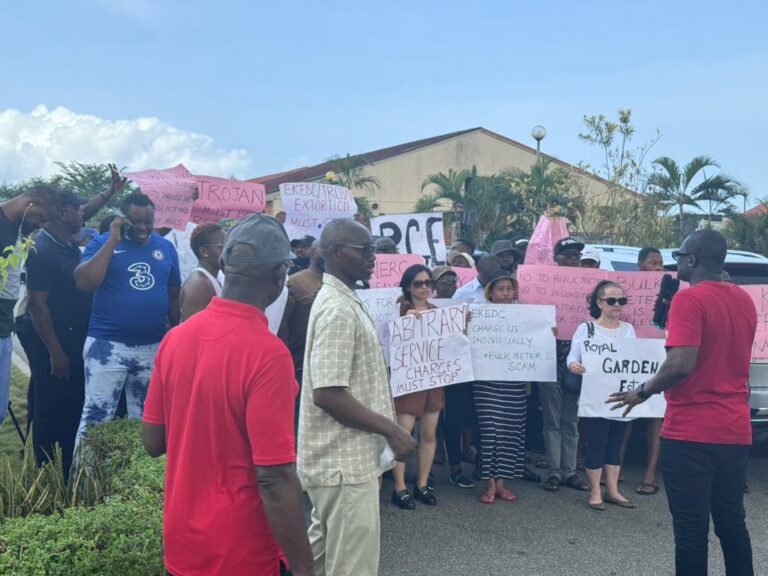
RESIDENTS of Royal Garden Estate at Lekki-Epe Expressway, Lagos State, came out en masse on Thursday, May 30, to protest the arbitrary charges, lack of transparency, accountability, and the use of bulk metering within the estate by the Eko Electricity Distribution Company (EKEDC) in collusion with the Trojan Estate Limited.

Trojan Estate Limited is the developer in charge of Royal Garden Estate, which Rilwan Olakunle Tinubu currently manages.

They were alleged to have violated the Nigerian Electricity Regulatory Commission (NERC) 2015 order which nullified the use of bulk metering in households under Sam Amadi, its former boss.

The NERC had in 2015 agreed with the Senate’s position on the need to eliminate the practice of bulk-billing residential customers and replace the practice with individual metering and billing.

Amadi also confirmed to The ICIR that NERC issued an order to correct possible exploitation of consumers through bulk metering.

“We issued an order at that time to correct possible exploitation in bulk metering. It is an order we have to avoid possible overcharging of electricity consumers. In the order, we demand that the Disco meter them differently,”Amadi told The ICIR.

To further bolster this fact, NERC had previously abolished bulk billing in its ruling on the VGC Case No: NERC/H/03/07 in 2008.

Despite the ruling being in the favour of the customers, the EKEDC has continued to use bulk metering.

This time, residents of Royal Garden Estate said the bulk metering was being done in collusion with the estate developers -Trojan Estate – and had led to arbitrary service charges and constant blackouts, which has drastically increased security challenges in the estate.

In a protest led by the estate executives, the estate’s former executive member, Henry Onaga, said it had been a running battle with the Trojan Estate and everything started as a result of the developers refusing to sign the Service Level Agreement (SLA) which has been on since 2018.

Receipt showing evidence of payment to Eko DisCo
Receipt showing evidence of payment to Eko Disco

The Royal Garden Estate, Anthony Ogbebor, who spoke via telephone, said the SLA helped to bring transparency in the process of managing the estate.

“Before 2012, this document did not exist, when we went to court, the developers generated an SLA and gave it to the new buyers and the old ones. We took them to court and the court clearly stated that if this document was available before the estate came into existence and before everyone came, it is valid. But since it is otherwise, you must carry the residence along.

“So, this means that both the residents and the estate must develop an SLA to be valid. Around 2018 and 2019, the document was updated. It was just to get it to the Trojan management to sign but they refused to sign the SLA,” he said.

In his submission, Onaga said, “It has been a running battle to get the Trojan Estates Limited, the developers of Royal Gardens of this estate to act within the law. However, the essence of the protest is to ensure the disconnection of “illegal bulk metering of power supply to the estate.”

According to Onaga, the estate developers have been in cohort with the EKEDC to surcharge residents for power supply.

“The EKEDC, in collaboration with the developers of this estate, has refused to hear from us and has been imposing bulk metering on us. They’ve put us on Band A from 66 per kilowatt energy to 225 per kilowatt energy. It has become impossible for us to pay for power and the estate has been thrown into darkness. This has increased insecurity within the estate,” he added

Ogbebor further said charges were much, arbitrary and unbearable for the residents.

His words, “Before, once we bought the card, light would be on, and it could only be off when the card is exhausted. But now, we don’t enjoy that again with the use of the bulk metre system. In the bulk metre system, whether we use electricity or not, our bill is reading and we must pay.

“If they bring the month of April bill and add it to the existing bill, we’ll be seeing something close to N250 to N300 million  as our bill for just two months.”

A copy of the electricity bill obtained revealed that N174 million was levied on the estate as the energy charge for April while N187 million was calculated as the bill for the current month, which the estate must pay.

Meanwhile, residents have demanded that the estate developers end the insecurity within the  estate, which they said was aided by the non-availability of electricity supply to power street lights.

They also sought the dismantling of the bulk metre system which they said had worsened power supply in the estate.

Besides, they want the service levels agreement (SLA) signed by the developers.

Eko DisCo’s response

The EKEDC’s General Manager of Corporate Communications, Babatunde Lasaki, said he was not privy to any NERC regulations impeding the distribution company from stopping the use of bulk metering.

Lasaki, who took nearly four hours to decide on granting an interview after abruptly ending the first call, confirmed that not only Royal Garden Estate uses bulk metering but the EKEDC ensured that more estates use it.

“I don’t know about the NERC regulations that say that bulk metering is illegal. There are many estates on bulk metering. So, as regards Royal Garden Estate, what happened was that they’ve been on bulk metering and they pay on bulk payment. So, what happened recently is they’re owning as a result of an increase in the type of band they are in because they are on a dedicated feeder.

‘So they’re owning and they were disconnected because they did not remit their payment for the previous one. That was the situation. I don’t know about the allegation that we’re colluding with one company or the other. What happened was that they pay as their estate and we provide services to them.”

While the residents of Royal Garden Estate said Trojan Estate refused to sign the SLA since 2018, Lasaki said EKEDC had an SLA already signed with the estate management, which they’ve been following.

“I don’t know where they’re getting their readings from. They’ve not complained about us. We don’t deal with individual customers, we deal with estate management. If they have any problems, they should engage with their estate management.

“What we know is that we’ve been servicing them based on the SLA we have with them and they’ve been paying. They were disconnected because of the new rate which they were unable to pay. So, any other issue has to be sorted out between their estate management and the residents.”