A FEDERAL High Court sitting in Lagos State has again adjourned a case against a celebrity bartender and socialite, Pascal Okechukwu, also known as Cubana Chief Priest, for alleged abuse of the naira.
Okechukwu was arraigned by the Economic and Financial Crimes Commission (EFCC) on April 17, on a three-count charge of allegedly spraying and tampering with the naira notes during a social event at Eko Hotel in Lagos.
He was also alleged to have sprayed the naira on February 13, 2024, at the hotel.
He was accused of tampering with funds in the denomination of N500 notes issued by the CBN by spraying the same for two hours.
After pleading not guilty, the judge, Kehinde Ogundare, the presiding judge, granted him ₦10 million bail with two sureties in like sum who must be gainfully employed with the federal or state government and not less than grade level 16.
The sureties are to have landed property, and the court must verify the lands’ documents.
His arraignment followed his initial detainment on Tuesday, April 16, by the anti-graft commission for the same offence.
The case against him was filed on April 4 by Rotimi Oyedepo, a senior advocate, and seven other lawyers representing the EFCC chairman.
On May 2, Chikaosolu Ojukwu, a senior advocate, and the defence counsel, informed the court during a hearing, that the parties were exploring out-of-court settlement and had applied that the matter be settled pursuant to the provisions of section 14(2) of the EFCC Act.
Chikaosolu also said that if the EFCC confirmed the position as true, then there would be a need to apply for a withdrawal of the defence’s preliminary objection to allow for reconciliation.
The EFCC prosecutor, Bilikisu Buhari, confirmed the position as stated by the defence counsel and told the court that the commission was still considering the application.
Following this confirmation, the defence counsel then applied for a withdrawal of the preliminary objection, and with no objections from the prosecution, the court granted the same.
However, on Wednesday, June 5, Punch newspaper quoted the News Agency of Nigeria (NAN) as saying the defence wrote a letter seeking an adjournment of the case.
The case has now been fixed for June 25 for further hearing.
THE Nigerian Minister of Finance and Coordinating Minister of the Economy, Wale Edun, has disclosed that the fuel subsidy was projected to hit N5.4 trillion this year, an official acknowledgement that the federal government has reintroduced the controversial subsidy.
Edun’s disclosure was contained in a report, ‘Accelerated Stabilisation and Advancement Plan (ASAP),’ he reportedly presented to the Nigerian President Bola Tinubu on Tuesday, June 4, according to a ThisDay report.
The draft copy of the ASAP presented to the president was accompanied by an Executive Order to bolster the plan.
It revealed that the federal government is still supporting downstream consumption. “At current rates, expenditure on fuel subsidy is projected to reach N5.4 trillion by the end of 2024. This compares unfavourably with N3.6 trillion in 2023 and N2.0 trillion in 2022.”
The ASAP is designed to address key challenges affecting Tinubu’s reform initiatives and stimulate development in various sectors of the economy.
Edun on Channels Television on Sunday, June 2 hinted that a stabilisation package was underway.
On Tuesday, Tinubu ordered the finance minister to present a template for the new proposed minimum wage within the next 48 hours.
The plan gave an insight into how the Tinubu-led administration seeks to address some of the challenges caused by its reform agenda, among others.
It is said to be structured to advance Tinubu’s economy-related eight priority areas and broken down into different sub-committee plans.
The sub-committee plan includes agriculture and food security; energy, oil and gas, and power; health and social welfare; and business support.
The executive summary of the plan shows that ASAP is designed to curb the “difficult economic conditions threatening to unravel bold reforms undertaken by Mr. President.”
It noted that the oil sector is currently beset by problems of extensive pipeline vandalisation; high cost of production with a 40 per cent cost premium above other jurisdictions; production level at 1.4 million barrels per day (mbpd), below the budgeted level of 1.78mbpd, thereby straining country’s fiscal position, and added that the government still supporting downstream consumption.
In a October 2023, The ICIRreported development from the Nigerian National Petroleum Company Limited (NNPCL) to have confirmed that the subsidy was back despite the federal government’s declaration that “fuel subsidy is gone.”
The report showed that despite the wide gulf between the landing cost and the selling price of fuel, the NNPCL failed to provide answers to who bridges the gap in the cost, which confirmed that the government was still paying subsidies.
In another report on February 17 this year, an energy expert told The ICIR that Nigeria would likely witness another season of cross-border smuggling of premium motor spirit (PMS), known as fuel, as the corruption-ridden fuel subsidy regime was already back.
It further contained that the International Monetary Fund (IMF) after its executive board’s financing assessment meeting with Nigeria confirmed that the Nigerian government brought back petroleum subsidies through the back door.
NIGERIA’s foreign external reserves have dipped further by a $1.8 billion margin in barely 10 weeks – from $ 34.44 billion on March 18, 2024, to $32.69 billion on May 29.
The decline follows numerous interventions by the Central Bank of Nigeria (CBN) for the Bureau de Change Operators (BDCs) among others.
The decline represents 5.081 per cent within two months.
The apex bank has been notable for issuing dollars to BDCs below the official rate, which has huge economic implications for Nigeria’s foreign exchange market and the foreign reserve.
The decline showed a continued drop from the $ 36.1 billion recorded in May 2023, as the reserves have been declining steadily over the past few months, with a total decrease of $ 3.4 billion since February 2024.
Apart from interventions in the foreign exchange market, debt repayment, a significant decline in oil exports, a decrease in foreign investment, and a rise in imports were pointed out by experts to have been responsible for the decline.
Debt repayment recorded by the apex bank as of January 2024 was $560 million. It reduced to $ 283.29 million in February and then $276.16 million in March 2024.
Experts claimed that the apex bank must have been servicing foreign debts from the external reserves.
“Debt servicing and lending dollars to the BDCs at a lower rate than the official market rate are some of the issues that affects the reserve since we are not largely a productive economy,” an economist, Kingsly Obiakor told The ICIR.
The naira ended in May weaker despite a surge in dollar supply amounting to $4.60 billion in the official foreign exchange market.
The FX market closed for the month on Friday, May 31, with the naira losing 5.60 per cent as the dollar was quoted at N1,485.99, weaker than N1,402.67 quoted at the beginning of the month, according to data from the FMDQ Securities Exchange Limited.
The foreign exchange market closed for May 2024, with the dollar selling for N1,470, weaker than the N1,380 quoted at the beginning of the month.
At the same time, the currency’s performance this week reflects a significant struggle to maintain its value amidst fluctuating forex turnover and investor sentiment.
THE Central Bank of Nigeria (CBN) has refuted a report claiming it has set to revoke the licences of three other Unity Bank Plc, Polaris Bank Limited, and Keystone Bank Limited.
The CBN revealed this on its X account on Tuesday, June 4, CBN.
An online media platform(Not The ICIR) had on June 3 published a story with the headlines, ‘EXCLUSIVE: CBN To Revoke Licences of UnityBank, Keystone, Polaris,’ according to a screenshot shared by CBN.
The displayed screenshot was boldly written across with a red mark ‘fake content’ on the apex bank’s social media handle.
The online reports had claimed the apex bank would terminate the licences of the three banks, following the revocation of Heritage Bank’s licence by CBN on June 3.
“The content is fake and not from the CBN,” CBN stated on its X handle.
On Monday, June 3, CBN announced that it had revoked the banking licence of Heritage Bank Plc with immediate effect and had appointed the Nigeria Deposit Insurance Corporation (NDIC) as the sole liquidator, The ICIRreported.
The announcement was contained in a statement signed by Hakama Sidi Ali, acting director of corporate communications.
It said that the action became necessary due to the bank’s breach of Section 12 (1) of the Banks and Other Financial Act (BOFIA) 2020.
It said despite its warning the Heritage Bank’s board and management failed to improve the bank’s financial performance, a situation which constituted a threat to financial stability.
The apex bank said had to revoke Heritage Bank’s licence to strengthen public confidence in the banking system and ensure that the soundness of the country’s financial system is not impaired.
“The Central Bank of Nigeria (CBN), in accordance with its mandate to promote a sound financial system in Nigeria and in exercise of its powers under Section 12 of the Banks and Other Financial Act (BOFIA) 2020, hereby revokes the licence of Heritage Bank Plc with immediate effect.
“The Nigeria Deposit Insurance Corporation (NDIC) is hereby appointed as the liquidator of the bank in accordance with Section 12 (2) of BOFIA, 2020,” the statement read in part.
WITH the current economic hardship facing the country, the federal government might need to consider nothing less than N100,000 as a benchmark for minimum wage, an analysis by The ICIR has shown.
The above benchmark wage would cover the cost of feeding, transportation, electricity bills and other necessary expenses incurred within a month for an average worker.
However, if indices such as the inflation rate, exchange rate, and other bills or taxes continue to increase, the wages may not suffice.
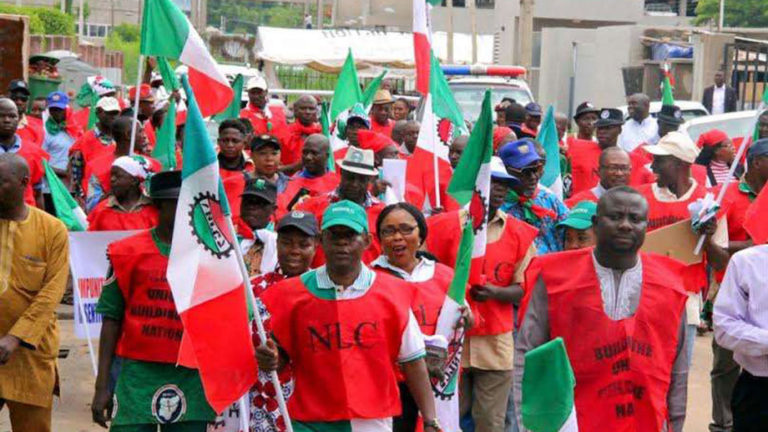
On June 3, the organised labour unions commenced a nationwide strike that suspended activities, including courts, schools and the power grid, within the country to protest for an increase in Nigeria’s N30,000 minimum wage.
The unions, the Nigeria Labour Congress (NLC) and the Trade Union Congress (TUC) are proposing N615,000 which is almost a 2,000 per cent increase. However, The ICIR reported that the federal government pleaded with the organised labour in Nigeria to reconsider its decision to embark on a nationwide strike, noting that the government had offered to review the minimum wage to N60,000.
“The government is pleading with labour to reconsider its position. The federal government has already made an offer of N60,000, and whatever the government does is in the interest of Nigerians. We won’t like to do something that will throw the country into another problem,”, the government said.
This was, however, rejected, despite a subsequent meeting with the leaders of the National Assembly and the federal government while other critics have argued that the proposed wage by the union was outrageous.
For this report, The ICIR used available economic data to make projections for Nigeria’s minimum wage benchmark. The benchmark was hinged on the current economic realities and cost of living, most of which increased by almost 100 per cent since President Tinubu assumed office in May 2023.
A case study of John Paul
To understand the projection, an abstract person, John Paul, was used to mirror an average Nigerian routine expense in a month, backed up by available data.
According to the International Labour Organisation (ILO), the minimum wage is the minimum amount of remuneration an employer is required to pay for the work performed during a given period. Unlike a living wage, which is a more standard and satisfactory payment, the minimum wage serves as a baseline that ensures the worker can meet their essential need.
The ICIR checks show that if John Paul was to meet his monthly essential needs, he would need to earn over N100,000 as minimum wage.
Here are the essential needs:
Feeding: The National Bureau of Statistics (NBS) report on the Cost of a Healthy Diet (CoHD) shows that as of April 2024, Nigerians spend N1,035 to eat a healthy diet. This is 5.4 per cent higher than the amount recorded in the previous month, March 2024, with N982. To better understand this, if John Paul were to eat at least two healthy diets daily for a month, he would be spending N64,170 monthly.
Transportation: The NBS data also showed that the average fare paid by commuters for bus journeys within the city per drop was N967.76 in April 2024. This means that if John Paul were to go to the office communing by bus, he would need approximately N2,000 — and for 20 working days in a month, this amounts to N38,720 in transportation.
Electricity: A survey by Statista, a global data and business intelligence organisation, said that most Nigerians, representing 44 per cent, pay about N5,000 monthly for electricity bills as of 2023.
Already, the total of these above essential needs amounts to N107,890 spent by John Paul, an average Nigerian, monthly.
Other expenses: According to NBS, other major contributors to the increasing inflation rate within the country include housing bills, water bills and clothing. If the federal government were to factor in the average cost of these bills, there are indicators that the minimum wage might be pegged between the range of N130,000 to N180,000.
Essential needs
Amount
Days
Amount (monthly)
Food
N1,035
Twice for 30 days
N64,170
Bus Transport
N967.76
Twice for 20 days
N38,720
Electricity
N5,000
Once a month
N5,000
Total
–
–
N107,890
Table showing the average amount spent by a Nigerian monthly. Source: NBS, Statista
World Bank benchmark
According to the World Bank, an employee’s income is calculated based on the country’s Gross National Income (GNI). For Nigeria, which is categorised as a lower middle-income economy, the GNI per capita ranges from $1,040 to $4,095. This is an average of $2,571 paid annually.
As of June 3, a dollar was exchanged for N1,475. If this is multiplied by $2,571, an employee should be getting N3.79 million annually (N3,792,225).
This implies that the monthly remuneration should be approximately N316,019, which is half (51 per cent) of what the organised labour union is demanding.
Income classification
Annual midpoint ($)
Avergae annunal income (at N1475/$1)
Average monthly income (at N1475/$1)
Low-Income countries
1,045
1,541,375
128,448
Lower middle-income countries
2,571
3,792,225
316,019
Upper-middle-income countries
8,396
12,384,100
1,032,008
High-income countries
12,695
18,725,125
1,560,427
Table showing World Bank income classification by their resident’s average income
Meanwhile, The ICIR reported a social critic and founder of Stanbic IBTC Bank Plc, Atedo Peterside said Nigerian government officials’ flamboyant lifestyle was a major obstacle in the minimum wage negotiations.
According to him, “The Nigerian minimum wage negotiations were destined to be unnecessarily difficult because the federal government poisoned the well for responsible negotiations by approving an irresponsible N90 billion for legislators and others, creating the false impression that they were awash in cash.”
However, in a recent development, the organised labour unions have agreed to suspend the strike for a week to allow negotiations between the unions and the federal government.
PRESIDENT Bola Tinubu has ordered the Minister of Finance, Wale Edun, to present a template for the new proposed minimum wage within the next 48 hours.
This was disclosed by the Minister of Information and National Orientation, Mohammed Idris, after a meeting between the President and government representatives involved in the minimum wage negotiations with organised labour.
“The President has directed the Minister of Finance to do the numbers and get back to him between today and tomorrow so that we can have some figures ready for negotiations with labour.
“Mr President is determined to go with what the committee has set. He is also looking at the welfare of Nigerians,” he said.
He added that the President directed the committee to work together so as to give Nigerians an “affordable, sustainable, and realistic” minimum wage.
“All of us will work together assiduously within the next one week to ensure that we have a new wage for Nigeria that is acceptable, sustainable, and also realistic,” he added.
The organised labour had declared a nationwide strike which started on Monday, June 3, after the federal government failed to meet its demand for a new minimum wage.
Although the Nigerian Labour Congress (NLC) earlier said the nationwide strike would continue despite the resolution reached with the federal government Monday night, The ICIRreported that the organised labour, comprising the NLC and Trade Union Congress (TUC) on Tuesday, June 4 ‘relaxed’ the strike for one week following a joint extraordinary national executive council meeting of the unions.
The Secretary to the Government of the Federation, George Akume, had summoned labour leaders to an emergency meeting following the strike action that crippled economic activities in the country on Monday, June 3.
The meeting produced a resolution co-signed by the president of the NLC, Joe Ajaero, his counterpart at the Trade Union Congress (TUC), Festus Osifo, the Minister of Information, Mohammed Idris, and the Minister of Labour, Nkiruka Onyejeocha.
At the end of the meeting, it was announced that the Federal Government had offered to pay higher than N60,000 minimum wage initially proposed.
THE Nigeria Police Force (NPF) has summoned a journalist with the Premium Times, Emmanuel Agbo, over a story he is working on.
According to a report published by the platform on Tuesday, June 4, Agbo received an invitation letter dated May 31, 2024, from the office of the Deputy Inspector-General of Police, Intelligence Response Team (NPF-IRT), Abuja via WhatsApp on Monday, June 3.
The police were said to have sent the letter after Agbo had been invited through a telephone call.
The journalist was first contacted by phone on May 30 by a police officer, Ezemba Ezekiel, who requested that he come to the Intelligence Response Team (NPF-IRT) office in Guzape, Abuja.
“I am Ezemba Ezekiel from the Intelligence Response Team. I am calling you on behalf of Homadils. You are expected to come over to our office at Abattoir in Guzape to clarify a petition,” the police was quoted as saying in the report.
Meanwhile, the firm Homadils Realty Limited, mentioned by the police officer during the phone conversation, is a land developer and a key party in a land dispute that Agbo’s story focuses on.
Consequently, Agbo requested that the invitation be made via an official letter. While the police complied, they failed to include the petition’s details in the letter.
“The police invitation came after Mr Agbo earlier reached out to the chief executive officer of Homadils, Bilkisu Aliu, over the phone and further exchanged messages on Whatsapp where she shared with the PREMIUM TIMES journalists her reactions to allegations levelled against her by a family laying claim to the land in dispute.”
The police in the letter, requested the journalist to appear on Wednesday, June 5, at 2 p.m.
Reacting to the invitation, PREMIUM TIMES said it had assured the police of its readiness to support their investigation.
The newspaper said it had also requested the details of the petition the police received from Homaldis to allow the journalist to make adequate preparations for the questioning.
The Managing Editor of PREMIUM TIMES, Idris Akinbajo, wrote in the letter delivered to the Deputy Commissioner of Police, IRT, on Monday, June 3, that although the letter was dated May 31, it received the invitation on June 3.
“We ask that you provide more details of the petition to enable our reporter, Mr Agbo, to make adequate preparations and bring along relevant materials when he appears in your office.
“We trust that you will treat this promptly so we and Mr Emmanuel Agbo can prepare adequately and assist you in the course of your work.
“Please feel free to reach out to me if you have any questions or clarifications,” the report quoted Akinbajo to have written.
The newspaper also highlighted that the police invitation extended to Agbo stemmed from a dispute between Homadils Realty Limited and a family regarding a valuable parcel of land in Guzape, a prominent area in Abuja.
According to PREMIUM TIMES, allegations of document falsification arising from the dispute are currently under investigation by the Federal Capital Development Authority.
Invitation comes a week after ICIR journalists were detained by police
Meanwhile, the invitation is coming exactly a week after The ICIR journalists were detained by the Nigerian Police Force National Cybercrime Centre (NPF-NCC).
The Executive Director of The ICIR, Dayo Aiyetan, and its reporter, Nurudeen Yahaya Akewushola, were held for nine hours after they honoured the police’s invitation on Tuesday, May 28.
In its invitation, the Police claimed it was probing a case of cyberstalking and defamation of character based on a petition received by the office of the Deputy Inspector General of Police, Force Criminal Investigative Department, but provided no details.
The invitation by the police was unconnected with an investigation published by The ICIR, which linked some former police bosses to a shady land deal.
Following the initial invitation of The ICIR reporter and its managers by the NPF-NCCC, human rights lawyer Femi Falana said arresting journalists based on cyberstalking and criminal intimidation charges was unlawful, as the section of the Act (Section 24) often relied on by the police had been amended.
THE Independent National Electoral Commission (INEC) has extended the Continuous Voter Registration (CVR) deadline in Ondo and Edo States by four days.
This was disclosed in a statement by INEC’s National Commissioner and Chairman, Information and Voter Education Committee, Sam Olumekun, on Tuesday, June 4.
Originally scheduled to end on Wednesday, June 5, the exercise will now go on till Sunday, June 9, to allow more eligible voters to register ahead of the elections.
The INEC commissioner said the decision was reached during a meeting held by the commission on Tuesday, following appeals from stakeholders in both states.
“Furthermore, the number of centres has been increased beyond the 397 wards and the two State offices in Benin City and Akure to include all the 36 Local Government offices of the commission in the two states.
“More machines will also be deployed to areas identified to have peculiar needs such as difficult terrain or communal issues,” the statement stated.
The exercise will be held between 9.00 a.m. and 5.00 p.m. daily until the new deadline.
More female voters registered
According to the statement by INEC, more women have registered ahead of the forthcoming elections than men in the states.
The commission disclosed that there were 120,458 new voters in the states. Nearly 54 per cent of these are women, while about 46 per cent are male.
Although women are underrepresented in governance, they have accounted for the larger population of registered voters in recent elections.
During the 2023 general elections that ushered in the current President President Bola Tinubu-led government, Nigerian women also accounted for more than 50 per cent of registered voters across the country.
Meanwhile, INEC said nearly 69 per cent of the registered voters in both Edo and Ondo states are youths, and less than one per cent of the new voters are persons with disabilities (PWDs).
THE organised labour, comprising the Nigeria Labour Congress (NLC) and Trade Union Congress (TUC) has ‘relaxed’ the nationwide strike for one week.
The TUC President, Festus Osifo, confirmed this in Abuja on Tuesday, June 4, following a joint extraordinary national executive council meeting of the unions, noting that a communique would soon be issued.
“A joint NEC meeting of TUC/NLC has approved to relax the industrial action for one week with immediate effect,” Osifo told Channels Television.
This latest development was at the heel of the resolution reached between the federal government representatives and the labour after a six-hour meeting on Monday evening, June 3, in Abuja.
The agreement was reached during a meeting convened by the Secretary to the Government of the Federation (SGF), George Akume.
The resolution was co-signed by the President of the NLC, Joe Ajaero, his counterpart at the Trade Union Congress (TUC), Festus Osifo, the Minister of Information, Mohammed Idris, and the Minister of Labour, Nkiruka Onyejeocha.
While no specific amount was agreed upon as the new minimum wage, the parties resolved that the federal government commit to a figure higher than the current N60,000 offered.
The parties also agreed on the tripartite committee meeting every day for the next week to arrive at an agreeable national minimum wage.
“After exhaustive deliberation and engagement by both parties, the following resolutions were reached: the President, Commander-in-Chief of the Armed Forces, Federal Republic of Nigeria is committed to a national minimum wage that is higher than N60,000;
“Arising from the above, the tripartite committee is to meet every day for the next one week with a view to arriving at an agreeable national minimum wage;
“Labour in deference to the high esteem of the President, Commander-in-Chief of the Armed Forces, Federal Republic of Nigeria’s commitment in (ii) above undertakes to convene a meeting of its organs immediately to consider this commitment.
The ICIRreported the just-suspended strike grounded many businesses, with workers shutting down agencies and departments of government across the country.
Schools, airports, train and power stations were among the institutions affected by the strike.
The workers embarked on the strike after the government failed to agree on the new minimum wage and the reversal of the electricity tariff hike demanded by the workers.
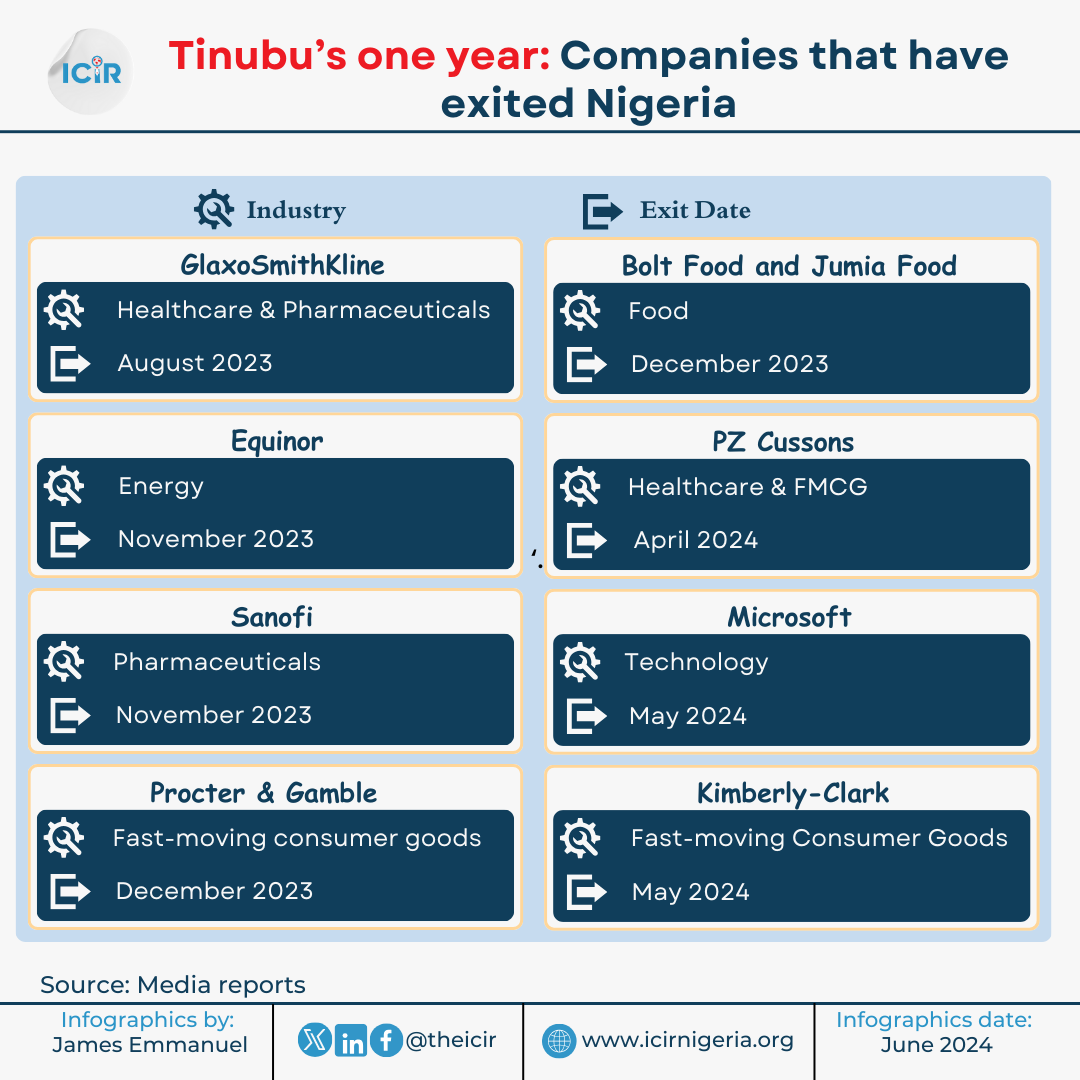
SINCE President Bola Tinubu assumed office on May 29, 2023, Nigeria has witnessed a steady exit of foreign companies, leaving behind a trail of uncertainty and economic instability.
In the past year, at least seven multinational corporations have pulled out of the country, with most of the organisations citing unfavourable business environments caused by the unavailability of foreign exchange. Most of these companies are pharmaceutical, household and food companies, The ICIR reports, as part of the series to track the first year of Tinubu’s administration tagged, “Tinubu’s one year in office“. See the series here.
As the dust settles, the departures of these companies have led to far-reaching implications for Nigeria’s economy, workers, and future investments.
In this report, The ICIR highlights the companies that have left the country and the reasons behind this mass exit.
companies that have exited Nigeria
GlaxoSmithKline
GlaxoSmithKline announced its exit from Nigeria in August 2023 after 51 years of operation in the country. GlaxoSmithKline Consumer Nigeria Plc was incorporated in Nigeria on June 23, 1971, and commenced business on July 1, 1972, under the name Beecham Limited.
The firm is a healthcare company that researches, develops, and manufactures pharmaceutical medicines, vaccines, and consumer healthcare products such as Panadol, Andrews liver salt, Macleans, Ampiclox, and Sensodyne, amongst others.
The ICIRreported that the company attributed its departure from Nigeria to the government’s foreign exchange unification policies, which have led to persistent currency issues and dollar scarcity, severely impacting its manufacturing operations and production capabilities.
The report also noted that as a result of the exit, Nigeria would now have to import and pay more for the prescriptible and off-the-counter drugs made by the company
Equinor
On November 29, 2023, Equinor announced its departure from Nigeria after over 30 years of operations, revealing that it had sold its business interests, including its stake in the Agbami oil field, to Chappal Energies, a Nigerian-owned company.
The Norwegian oil firm will divest its subsidiary, Equinor Nigeria Energy Company (ENEC), which holds a majority stake in oil mining lease (OML) 128, including a significant interest in the Agbami field, operated by Chevron.
While the company didn’t disclose its reasons for leaving, it stated that the transaction’s completion is contingent on meeting certain conditions, including regulatory and contractual approvals from both parties.
Sanofi
Sanofi-Aventis Nigeria Limited, a French pharmaceutical company, announced on November 7, 2023, that it would adopt a third-party distribution model for its products in Nigeria, effective February 2024.
The company, a significant supplier of vaccines, cited Nigeria’s economic challenges, particularly the foreign exchange crisis, as the reason for this decision. However, Sanofi aims to increase efficiency and sustainably reach patients and the medical community through this new model, which involves partnering with a single strong distributor with extensive geographic coverage.
On February 2, 2024, CFAO Healthcare, a subsidiary of the French conglomerate CFAO Group, announced its expansion with Sanofi, strengthening its strategic partnership.
Procter & Gamble
On December 5, 2023, Procter & Gamble (P&G) announced its decision to cease operations in Nigeria after three decades, transitioning to an import-only model.
According to The ICIR, this decision was driven by Nigeria’s challenging business environment, largely due to dollar-denominated operations and unfavourable macroeconomic conditions.
The P&G’s chief financial officer, Andre Schulten, mentioned that operating in certain markets like Nigeria and Argentina had become increasingly challenging due to these macroeconomic factors.
A few days after the announcement, Segun Ajayi-Kadir, the director-general of the Manufacturers Association of Nigeria (MAN), expressed concerns about P&G’s departure, warning that other manufacturers might also consider exiting the country.
Bolt Food and Jumia Food
In December 2023, Bolt Food decided to exit Nigeria after operating for two years in the country. The company cited the need to streamline resources and enhance overall efficiency as the reason for its departure.
Bolt Food was launched in October 2021 by the ride-hailing company to compete with rivals like Jumia Food and Gokada, making food access easier in Lagos.
Similarly, Jumia Food also exited the Nigerian market in December 2023. Initially launched as Hellofood in 2012, it rebranded in 2019 under the Jumia Group.
Jumia Food was one of the pioneers of online food delivery in Nigeria and had the widest geographic coverage before its departure.
Jumia also discontinued its services in other countries, including Kenya, Morocco, Ivory Coast, Tunisia, Uganda, and Algeria. Jumia’s CEO, Francis Dufay, stated that the company would now focus on its core physical goods business and payment platform.
Microsoft
On May 8, 2024, Microsoft announced its decision to close its African Development Centre (ADC) in Ikoyi, Lagos.
Although the company did not provide a specific reason for this closure, it emphasized its continued commitment to operations in Nigeria and its focus on investing in strategic growth areas.
Microsoft launched the innovation centre in 2019 to develop technology solutions from Africa to tackle both regional and global challenges.
Impressed by the initiative’s success, the company established $100 million African Development Centres in Nigeria and Kenya in 2022. Despite the closure of the Nigerian centre, the Kenyan centre will remain operational.
On June 14, 2023, the Central Bank of Nigeria instructed Deposit Money Banks to eliminate the rate cap on the naira at the Investors and Exporters’ (I&E) Window of the foreign exchange market, enabling the national currency to float freely against the dollar and other global currencies.
The floating naira and the resulting dollar fluctuations prompted these companies to exit the market. This has significantly impacted the prices of goods and services, particularly pharmaceutical products. For instance, as of November 2023, the average cost of anti-malaria medication is NGN 2000 , depending on the brand and its effectiveness.
According to World Health Organisation (WHO) data, Nigeria remains the world’s malaria capital, with 97 per cent of its population at risk of the disease.
Divestment of Oil companies
Total Energies, Shell & other International Oil Companies-IOCs are divesting their assets, away from Nigeria with billions of investments going to other African countries with better business environment.
For instance, Total Energies is increasing its stakes in Angola and the Congo.
PZ Cussons
PZ Cussons Plc, in April 2024, said it has commenced a strategic review of its business in Africa, with a consideration of exiting the continent, partly driven by economic challenges in Nigeria such as naira devaluation and inflation, which has significantly impacted the company’s sales and operations, resulting in a 48 percent sales plunge.
Jonathan Myers, CEO of PZ Cussons, emphasised the importance of looking towards the future while respecting the company’s past, indicating that the review’s outcomes could include changes in ownership.
Myers added, “The macro-economic challenges and complexities associated with operating in Nigeria are significant and there is much more to do to unlock the full potential of the business.”
“As such, we have undertaken a strategic review of our brands and geographies and have embarked on plans to transform our portfolio, refocusing on where the business can be most competitive.”
PZ further stated: “In addition to the challenges of the significant exposure to Nigeria, the group is too complex for its size, with financial and human resources spread too thinly to generate consistent returns.”
“This means its competitive advantages have been constrained in comparison to those of both larger multinational companies and some focused, smaller ones,” he further said in a statement that confirmed their exit.
Kimberly-Clark
Also, the American multinational and makers of “Huggies”-Kimberly-Clark has also announced it has made the difficult decision to exit its business in Nigeria after almost 15 years, due to recently refocused company strategic priorities globally as well as economic developments in the country.
Kimberly-Clark will close its manufacturing facility and commercial office in Lagos and will no longer manufacture, market, or sell its Huggies and Kotex products in the country.