FIVE years after former President Muhammadu Buhari signed the law increasing the country’s minimum wage to N30,000, Zamfara government has said that it will begin to reflect this figure in its workers’ remuneration from June 2024.
The state governor Dauda Lawal disclosed this during a meeting with the state’s labour union leaders on Wednesday, May 22, 2024.
According to a statement by the governor’s spokesperson Sulaiman Idris, plans are being made to further improve the working conditions of civil servants in the state.
“Since assuming office as the governor of Zamfara State, my administration has implemented numerous civil service reforms to ensure workers’ welfare. We have achieved the payment of withheld three months’ salaries of workers, payment of leave grant, and other bonuses,” the statement noted.
The statement also noted that retirement benefits will also be paid in a timely fashion.
“No employee should be concerned about retirement, as we will ensure timely payment of retirement benefits without any delays. We are committed to our rescue mission,” the statement.
The decision to commence this payment comes amidst agitations by national labour unions that the N30,000 minimum wage be increased due to harsh economic realities, which are worsening living conditions in Nigeria.
President of the Nigeria Labour Congress (NLC) Joe Ajaero, stated earlier in May that the duration for the N30,000 minimum wage had expired and there is a need for upward review.
Organised Labour in Nigeria has stated that the living wage for an average Nigerian given the current economic situation is N615,000.
Negotiations have been ongoing between labour unions in Nigeria and the federal government.
While the federal government initially offered the sum of N48,000 as the new minimum wage, labour leaders described the figure as ridiculous and an insult to workers.
The government recently increased the offer to N57,000. Labour leaders have refused the offer, but reduced their demands to N497,000.
KANO State House of Assembly has dethroned five emirs, after concluding the amendment of the Emirate Council Law of 2019 that created five emirates.
The decision was taken during plenary on Thursday, May 23, 2024.
According to the bill which passed second and third reading on Thursday, all offices established under the former law have been set aside. It also revived the single emirate system in the state, vesting constitutional powers to appoint a new emir in the State Governor Abba Yusuf alone.
District heads appointed or promoted under the law are also required to return to their previous positions by the new law.
Under the immediate past administration led by Abdullahi Ganduje, the previously existing single emirate system was abolished by the law that is now being amended.
Ganduje established the Bichi, Karaye, Gaya, Rano emirates in addition to the Kano emirate.
Initially, the Kano State High Court nullified the creation of the new emirates. However, the lawmakers in 2019 passed a fresh law that brought about multiple emirs.
The state government then dethroned the existing Kano emir Lamido Sanusi giving insubordination and political interference as reason. He was replaced by Aminu Ado-Bayero, who was transferred from the Bichi emirate to Kano.
Before Sanusi was deposed, the ex-governor’s move to create new emirates was already being seen as an attempt to reduce the emir’s authority.
Sanusi served as the Governor of the Central Bank of Nigeria (CBN) from 2009 to 2014. He was suspended by former president Goodluck Jonathan in 2014.
Speaking on the amendment, Majority Leader of the House Lawan Dala told journalists that the creation of additional emirates through the amended law defeated the aim of the council, which was to serve as a custodian of culture.
The Kano State Assembly also adopted a motion to create a new second class emirate council in Kano on Thursday.
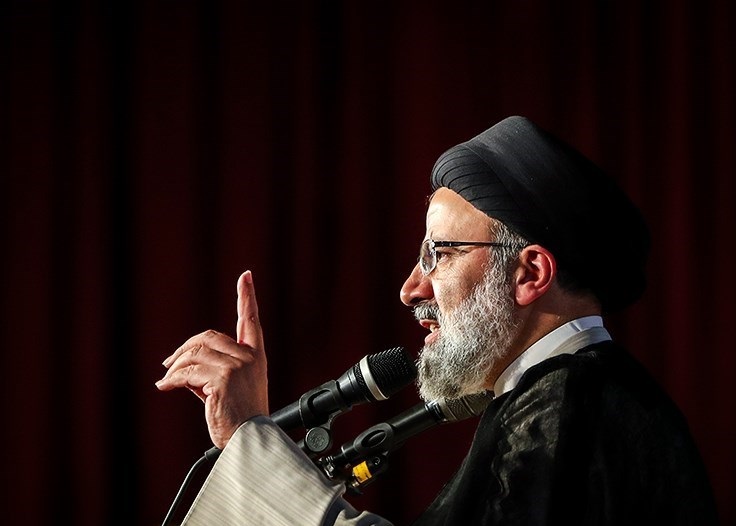
A helicopter carrying Iranian president Ebrahim Raisi, the country’s foreign minister and other officials crashed in the mountainous north-west reaches of Iran on Sunday May 19, sparking a rescue operation in thick fog and driving rain. On Monday, search and rescue teams reached the crash site and “found no signs of the helicopter’s occupants being alive”. The death of Raisi and his foreign minister will shake up Iranian politics. Who was Raisi? What happens now? And what could his death mean for stability in the country and beyond? We spoke with Scott Lucas, a Middle East scholar at University College Dublin, who has been writing about tensions in the Middle East for many years.
Who was Ebrahim Raisi?
Raisi was a dedicated servant of Iran’s former supreme leader (the country’s highest authority), Ayatollah Ruhollah Khomeini. Rising through the judicial system in the 1980s, Raisi came to prominence as a member of the “death committee” imposing capital punishment on thousands of detainees in 1988 at the end of the Iran’s war with Iraq.
The exact number of those who were sentenced to death is not known. But human rights groups have estimated conservatively that about 5,000 men and women were executed in what has been described as a crime against humanity. Raisi denied his role in the death sentences, but also said they were justified because of a religious ruling by Khomeini.
He has also served as deputy chief of justice, attorney general and then a chief of justice. He crafted an image as a leader that was tough on corruption while also working to purge opponents of the regime. In 2016, he was also appointed by the supreme leader to oversee the Astan Quds Razavi religious foundation, which controls tens of billions of US dollars.
In June 2021, Raisi was installed as president in Iran’s elections, handing the elected leadership back to the hardliners. The result came as no great surprise. Raisi was seen as the candidate of the current supreme leader, Ayatollah Ali Khamenei, and the clerical establishment moved to promote his election and impede challengers.
How big of a blow is losing Raisi for the regime?
Raisi was considered loyal to Khamenei and often took on the role of a scapegoat to help the supreme leader avoid criticism. It is because of this loyalty that, despite being seen as unexceptional and even weak by many in Iran’s political system, Raisi had been mentioned as a possible successor to the supreme leader.
But, in itself, the loss of Raisi has little effect on the Iranian system. He was largely a placeholder representing the wishes of the supreme leader, the Revolutionary Guard Corps and hardliners.
The bigger challenge is replacing Raisi with a minimum of in-fighting in the Iranian regime, maintaining the ostracism of reformists and centrists, and suppressing any protests.
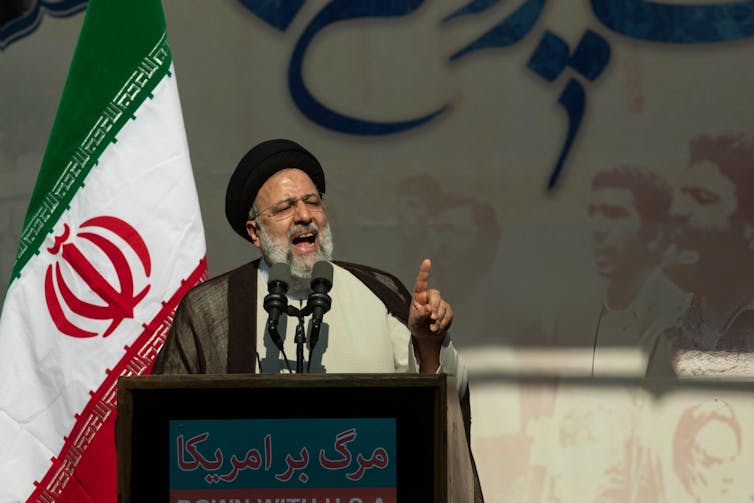
President Raisi was a hardline cleric close to Iran’s supreme leader, Ayatollah Ali Khamenei. photosince/Shutterstock
Following the crash, Khamenei reassured Iranians there would be “no disruption to the work of the country”. How true is this claim?
The supreme leader’s statement is best understood as a call to Iranians to avoid “disruption”, given the series of nationwide protests that erupted after the contested result of Iran’s 2009 presidential election.
The incumbent president at the time, Mahmoud Ahmadinejad, was declared the outright winner against many people’s expectations. Widespread unrest followed and thousands of people were arbitrarily arrested, and dozens were killed on the streets or died in detention.
Khamenei’s rhetoric is also an “all is well” proclamation defying the serious economic problems and regional tensions that Iran faces. Iran’s economy has been in a parlous state for years, through a combination of mismanagement and sanctions. The currency is at a historic low, having lost 93% of value since 2018. Inflation remains above 40% officially and far higher unofficially. And unemployment is high, especially among the younger generation.
The regime continues to suppress protests through detentions and intimidation. But demands for reforms are still widespread. They have been galvanised by the regime’s crackdown over compulsory hijab. Iran’s authorities have tried to quash centrists as well as reformists, but face a backlash from public criticism, including that of former president, Hassan Rouhani.
Who will replace Raisi?
If a president dies in office, Iran’s constitution says that the first vice president takes over for a period of 50 days, with the approval of the supreme leader. A new presidential election is then held at the end of the interim period. Khamenei has confirmed that the first vice president, Mohammad Mokhber, will serve as the country’s acting president until elections are held.
The process will be an accelerated version of the standard procedure, with a 12-member guardian council vetting all candidates and disqualifying those deemed not acceptable. That should ensure a contest between a hardliner and a conservative, blocking any high-profile centrist or reformist.
Different factions within government will be manoeuvring for the supreme leader’s favour. Raisi’s occupancy has signalled the ascendancy of hardliners throughout the regime, pushing aside conservatives. However, there is no clear hardline favourite at this point.
Meanwhile, parliament speaker and former presidential candidate, Mohammad Qalibaf, may be the most likely conservative. He has been at the forefront of Iranian politics for 25 years. But he has also failed in two presidential campaigns, and is unacceptable to many hardliners.
What could Raisi’s death mean for stability in the Middle East and beyond?
The regime will want to avoid any further turmoil in the regime while it rearranges the desk chairs of power. This includes the replacement of foreign minister, Hossein Amir-Abdollahian, who had played an important role in trying to present Tehran’s case to the world and finding ways to ease the impact of western sanctions.
The open question is whether Israel, embroiled in its war in Gaza and serious domestic tension around Prime Minister Benjamin Netanyahu, will return to attacks on Iranian interests, such as its targeted assassinations of Tehran’s commanders in Syria and Hezbollah officials in Lebanon.
ACROSS various markets in Cross River, women grapple with not only the burden of multiple levies imposed by both government officials and non-state agents but also the threat of disease arising from poor sanitary conditions in markets. Despite paying various taxes, market women in the People’s Paradise cannot access clean water. This pervasive issue of multiple taxation has led to a cycle of exploitation and poverty, with traders forced to pay exorbitant sums simply to conduct their business.
In the bustling Marian Market in Calabar, the capital of Cross River state, many traders face numerous challenges as they navigate a risky environment. A story of struggle and perseverance unravels as market women such as Blessing Iqwo, a tomato and pepper seller, deal with these challenges.
Her painful experience exemplifies dangers in the market that put women at risk. The pregnant Iqwo did not anticipate that using a public toilet would result in an infection that led to the loss of her second pregnancy in its second trimester in 2021.
Mrs. Blessing Iqwo
“I was pressed and needed to use the toilet,” she recounted. “Two days later, I started feeling itches around my private part. I couldn’t use antibiotics, because of the pregnancy and was using only hot water.” Unfortunately, she eventually suffered miscarriage, and the hospital attributed it to a toilet-borne infection. Her ordeal highlights the dire consequences of inadequate infrastructure, despite multiple – and even parallel levies enforced by thugs, which only stopped recently – with repercussions extending beyond her tragedy to affect countless others.
According to data from National Union of Shops and Distributive Employees (NUSDE), there are approximately 5,500 traders at the Marian Market in Calabar Municipal Council; 7,000 traders at the Watt Market in Calabar South Council, and 6,000 traders at the Ikom Main Market, in Ikom Council while the Okonoyom Market in Akpabuyo Council has an estimated 300 traders. It was not possible to get the figures for the 8th Mile Market.
In Calabar, market women contend with being harassed and intimidated by agents of government, which fails to provide a good working environment for them to do business, including access to water and toilet facilities.
Over the years, the level of extortion under the guise of market tolls and taxation has pushed many out of business.“I usually take my goods on credit and pay after selling them. And when I don’t sell as much as expected, the ‘matching ground’ collectors keep coming. Sometimes, we don’t even meet our target after paying for tickets.
“Before now, we used to pay up to N700 daily, and on Saturdays, we pay up to N1,600 to different groups but since January, we started paying N200 daily while on Saturdays, we pay N400,” the trader continued, pointing out that illegal levies by non-state actors only stopped at the beginning of this year.
According to The Guardian checks, an average trader contributes N5,100 weekly while the monthly payments amount to N20,400. With the estimated 19,400 traders in the four markets, both the government and the thugs rake in the sum of N395,760,000 monthly and N4,749,120,000 in a year.
Traders in several markets visited by The Guardian are being forced by council agents to pay morning and evening levies. These agents, who move in groups, demand between N850 to N1,000 daily from each roadside trader. They are always aggressive to the women.
Nne, selling Okra by the roadside at Watt Market
Although the state governor Bassey Otu is believed to have reduced the excessive levies collected by council agents and tried to end the illegal collections by non-state agents, findings show that most markets have only reduced their revenue collections to N500.
The councils claimed they collect N50 daily while taxing N200 weekly. Contrary to that claim, our investigation – based on interviews and receipts sighted by reporter – revealed that the traders still pay at least N200 daily and N500 on Saturdays. The Nigerian informal sector has been a major contributor to the nation’s economy, and accounts for a significant portion of employment and the Gross Domestic Product (GDP), with most of its major drivers being street traders, subsistence farmers, and service providers such as hairdressers, taxi drivers, and carpenters. The International Monetary Fund (IMF) estimates that the nation’s informal sector accounted for 65 per cent of the country’s GDP in 2017.
In 2015, the government of Cross River State implemented a policy aimed at providing tax rebates to the poor and vulnerable. To further consolidate this policy, the Cross River Internal Revenue Service (CRIRS) issued a public statement regarding tax exemption Law No.13. The law excludes from paying tax, all persons whose monthly income is below N50,000, including petty traders, wheelbarrow pushers, taxi drivers, and other similar categories of workers.
To demonstrate its commitment to this policy, the state government established an agency to enforce the tax legislation.A few years later, despite these efforts backed up by the existence of an enforcement agency, multiple and unfair taxation is still on the rise.
In Ikom and Akpabuyo, the situation is similar to what traders are experiencing in other markets, though slightly different in the pattern of collection.
Frustrated by the multiple levies, Mama Ayu, a palm fruit seller in Ikom Main Market, told TheGuardian, “if you don’t pay, they snatch your goods, in the process, destroy some. They take it to their office before you get it back; they ask you to pay N5,000 for bail. “The other day, I came with just N2,000 worth of palm fruits to sell, as usual, they came to collect money for the ticket, I begged the woman to allow me for that day and pay the next day, but the ticketing officer refused. He carried my palm fruits and my daughter’s umbrella, I couldn’t raise N5,000 to collect goods of N2,000, that was how I lost that money.”
At Okonoyom Market in Akpabuyo, 17-year-old Etido Peter hawks vegetables called Editan in Efik language in a transparent container. She moved in with her grandmother and two siblings when they lost their parents in a ghastly motor accident two years ago. Her grandmother prepares the leaves every market day for her to hawk.
“Before now, thugs used to harass traders in this market but now, the market is calm since the new government of Prince Otu. The only thing we have here is people that collect N100 for tickets daily, but the ticket collectors still intimidate and harass you when you refuse to pay,” the teenager said.
Despite the burden of multiple taxes these market women bear, they complain of having to contend with poor hygiene and wonder where the taxes they pay go.
Some parts of Marian Marian
Itoro Ekanem, also a trader at Marian Market, was relieved when a part of the heap of debris, a public health nuisance, at the centre of the market, was cleared.
Ekanem had experienced rashes all over her body the year before due to her exposure to the heap of wastes at the market, she said, according to her doctor.”It was that bad,” she said.
The heap discourages sales, but sellers are still forced to pay levies, making their lives difficult, she said, adding, “The clearing of wastes was what a new government normally does but go there and check, it has started gathering again.”
Ekanem is not alone. Anietie Idongesit, who sells clothes at the Marian Market, almost closed down owing to the stench coming from the heap of waste.
She said, “for the past years, right from the time of LiyelImoke, we have been suffering here. Debris will just cover everywhere. Sometimes, when you come to the shop in the morning, you will see debris poured in front of your shop. It was that bad, not just that, the odor stinks that sometimes, customers don’t want to stay long to look at what you are selling. Vehicles and wheelbarrows would be struggling for space, just because the waste had covered the road.”
Mama Ayu’s petty business is less than $3. She holds on to it just to keep food on the table for her family. Her profit can’t buy a dress worth N5,000 from what she gets “and to worsen the matter, we can’t use the toilet facility for free.” “How much do you make daily that you will have to pay N150 each time you use the toilet?” She queried. “We don’t have a water facility here in the market yet we are paying so much to sell in the market. Every day, I pay up to N550, and on Mondays; I pay up to N650 for levies, when you ask them to come later for the money, they snatch your measurement container and customer bags.”
To ease herself without risking toilet infection, Mama Ayu must go back to her house, spending N200.
ticket agent demanding N200 from a trader in Okonoyom market
A United Nations (UN) report shows that 30 per cent of illnesses in the developing world are linked to inadequate water and sanitation. This is the plight of traders like Ekanem, Blessing and Mama Ayu, despite paying so much to sell in markets. It is not different elsewhere.
At Watt Market of Calabar South Council traders similarly have to endure multiple payments despite not having access to adequate water, hygiene, and sanitation facilities.
“Some days, I make N1,000 gain, some days N1,500 or N2,000,” said a Watt Market vegetable seller, Grace Ambai.“But every day, we pay up to N800 or N1,000 to different people for sanitation, security, local government, community, and space.”
Others in the market like Nne, an elderly woman, who sells okra lamented that the multiple levies eat away at profits, leaving her unable to save.
“Those boys, sometimes, behave as if they don’t have a mother or grandmother,” she said, decrying the disrespect and harassment she has faced over the years.
Manyo Ojong, who sells onions at Ikom Main Market, said she pays N50 for ticket and N500 for space daily “but will still pay N150 to use the toilet facility anytime I’m pressed.”
Ojong’s neighbour, Anita Agbo, who sells fairly used clothes, said she fears her business might close anytime soon due to the multiple payments.
Goal Six of Sustainable Development Goals (SDGs) 2030 specifically targets ensuring access to Water and Sanitation for all, including marketplaces.
Water Sanitation Hygiene (WASH), advocate, Abenmire Adi, said, “it is important that these taxes are channeled into places including the provision of potable water and sanitation for market women. Just like we speak for improving Water, Sanitation, and Hygiene in schools, offices, and public places we must have these facilities in the marketplaces.”
The Revenue Officer of Calabar Municipal Council, Ignatius Asuquo, insisted that N50 is the official daily rate and N200 for Saturdays. He said that the council does not have anything to do with the illegal levies or multiple taxations forced on market traders.
“The local government is in charge of sanitation in the markets and the environment around the market. What we collect from women is N50 a day; N25 is for cleaning the market and N25 for toll. Then for Saturday, only N200; it’s not up to N500.
Marian Market dump site at the centre of the market
“We collect N200 from them on Saturdays because the job of sweeping the market is so tedious, and the N25 payment they receive will not cover the maintenance of the wheelbarrows, shovels and other equipment they use for cleaning. If they are claiming that they pay N200 weekly and N500 on Saturdays, they have not informed me. If they do report it to me, I will send my staff to verify and take necessary action,” he stated.
He blamed the former revenue agent, who oversaw the collection for the past three years until January.“He was behind all these illegal taxation on women in markets. What he was collecting was outside our normal toll and sanitation.”
We have given that job to another person,” Asuquo said.
“The rubbish in the market is the duty of the waste management, it’s not the
council because there is a percentage taken from the state through council allocation for waste management, so, it is not our duty to clear the waste but if the state government stop removing the allocation on waste management, we will evacuate all those things without any delay.” The Union Chairman of
ticket agent demanding N200 from a trader in Okonoyom market
Marian Market, Asuquo Etim, was a victim of intimidation and harassment by thugs, who had been assigned by some political actors in disguise as revenue agents or market managers. He said he and his colleagues were beaten by illegal collection agents who the government has not been able to stop.
The focal person, Cross River Chapter of the Association of Nigerian Women Business Network, Ndoma-Egba, said on several occasions, the association has advocated for an end to multiple taxation on market women.
Proposed Legislation
A Cross River State House of Assembly member, Stanley Nsemo, who spoke with The Guardian, said the state legislature recently passed a resolution following a petition from the National Union of Shop and Distributive Employees (NUSDE) from the IkaIka Market (Marian market) on illegal levies, harassment, and intimidation on market traders by revenue agents.
“We were able to push to some level of sanity in the market; the tax system in the market has reduced from about N1,000 or so to about N300, N200 every day. The sanitation in the market has improved, thanks to the Commissioner for Works. Some days ago, we were in Abuja in a meeting and we have resolved to deal with anyone who tried to impose unnecessary hardship on the people. For the first time in five years, sanity has returned to the market, from this we will go to other markets in the local government to flush out those that are making life unbearable for the common man,” Nsemo stated.
According to a tax expert, Williams Itorok, there has been a significant issue of multiple taxations in Cross River for long, adding this is not due to any intentional action by the government, but rather because of the political situation in the region.
Itorok alleged that the government has used these illegal taxes to pay off individuals he described as political jobbers.
Itorok, a member of Tax Justice and Governance, Cross River State, said according to taxation laws, market levies are not supposed to be paid daily, “except when you are parking your car.”
“If you have a designated space for trading, then the traders should pay monthly or yearly, that is what is provided for in the tax law,” Itorok said.
This report republished from The Guardian was made possible with support from the International Budget Partnership (IBP) and the International Centre for Investigative reporting (ICIR) under the Tax Justice, Equity and Transparency Project. Read other stories HERE.
THE Federal Ministry of Petroleum Resources (FMPR) has met with officials of a Chinese company, Wen Advisor, to firm up an agreement to to build compressed natural gas-powered(CNG) stations in Nigeria.
The pact will also see the firm deploy CNG-enabled vehicles across the country.
This partnership is expected to increase the availability of CNG-powered vehicles in the country, as President Tinubu had mandated all federal government institutions to procure CNG-powered vehicles to provide alternatives to rising fuel costs.
When receiving the delegation from the Chinese firm on behalf of the federal government in Abuja, the permanent secretary at the Federal Ministry of Petroleum Resources, Nicholas Ella, said Nigeria offered huge business potential for investments in CNG-powered vehicles.
He said the investment opportunities in using natural gas were enormous, adding that these had received a boost following the directive of the President on CNG-powered vehicles, according to a statement issued by his Personal Assistant, John Ameh, on Wednesday, May 22.
“Ella explained that the President’s policy on gas infrastructure development tallied with global best practices in the use of cleaner energy for environmental sustainability,” the statement read in part.
Also speaking at the meeting, the director of the Upstream Department in the ministry, Kamoru Busari, told the Chinese team that the federal government was ready to provide an enabling environment for its investment to thrive.
Earlier, the Managing Director, Wen Advisor, Haikuo Weng, said he was in Nigeria with his team to explore possible investment areas in the CNG-powered vehicles project.
Weng explained that to develop a CNG gap pump station, it was necessary to ascertain whether local buses in Nigeria currently use liquefied natural gas or compressed natural gas.
The statement stated that in an earlier letter of collaboration for what Weng called ‘Green Transportation Solutions,’ he pledged to introduce CNG buses with competitive pricing.
To assist Nigeria in its energy transition efforts in the transportation sector, Weng said he was in the country to “assess the potential for establishing natural gas refuelling stations.”
President Tinubu’s recent directive on using CNG-powered vehicles was in tandem with Nigeria’s effort to transition to cleaner energy as CNG-enabled vehicles have been considered to produce lower emissions, thereby safeguarding the environment.
The policy also seeks to present a more affordable alternative for Nigerian energy consumers.
Also, Nigeria has over 209 trillion cubic feet of gas reserves, and the federal government has repeatedly stated that the country would use gas as its transition fuel, being more of a gas-based nation than crude oil.
THE Central Bank of Nigeria (CBN) has directed all existing Bureau de Change operators (BDCs) to reapply for new operational licences.
The CBN issued a June 3 deadline for the licence renewal to enable the BDCs to continue operations in the foreign exchange market.
The apex bank disclosed this on Wednesday, May 22, in a document titled ‘Regulatory and Supervisory Guidelines for Bureau De Change Operations in Nigeria’.
“All existing BDCs shall re-apply for a new licence according to any of the tiers or licence category of their choice as provided in the guidelines,” the document stated.
It said the BDCs must meet the minimum capital requirements for the licence category they apply for within six months, starting from June.
According to the release, the minimum capital requirement for tier-one BDC operators is N2 billion while for tier-two BDC operators is N500 million.
There is also a non-refundable application fee of N1 million and a non-refundable licence fee of N5 million naira for tier-one BDC operators.
Tier two operators are expected to pay a non-refundable application and licence fee of N250,000 and N2 million respectively.
“These operation-refundable guidelines for Bureau de Change in Nigeria issued in November 2015 and all related circulars and directives; the guidelines take effect from June 3, 2024,” the statements said.
According to the circular, the guidelines were part of reforms to reposition the BDC sub-sector to play its envisioned role in the foreign exchange market in Nigeria.
Also, applicants for new BDC licences must meet the conditions for the grant of licence by the tier or category of BDC chosen as stipulated in the Guidelines.
BDC operators are also expected to submit the proposed BDC’s name, the promoter’s name, e-mail address and phone number.
The ICIRreported that the CBN has been granting dollar access to the BDCs at a rate lower than the market rate to boost naira appreciation against the dollar.
However, the naira is not strengthening against the dollar as expected by the apex bank, which has had massive impacts on goods imported into the country with the Nigerian Customs constantly changing its import duty rate to the detriment of the nation’s businesses.
THE embattled Speaker of the Cross River State House of Assembly, Elvert Ayambem, has denounced his impeachment by aggrieved members of the Assembly.
He described the action as null and void.
Ayambem in a statement by his chief press secretary, Matthew Okache,, on Wednesday, May 22, alleged that Effiong Akarika, who moved the motion for his impeachment, disrupted the session by “inviting hoodlums to enter the chamber.
The ICIRreported how Ayambem was removed from office by two-thirds of the Assembly members.
This occurred during plenary on Wednesday, May 22, when the aggrieved members passed a vote of no-confidence on the Speaker, alleging several infractions, including gross financial misconduct and non-compliance with the Cross River State Legislature Funds Management Laws of 2021.
In the removal notice seen by The ICIR, Anyambem was accused of misappropriating N48 million originally intended for payment of electricity bills for the House of Assembly Complex and Quarters.
He was also accused of embezzling over N19 million from local government deductions and N404 million generated by the state Inland Revenue Service (IRS) for oversight functions by the House.
However, reacting to the accusations, the embattled Speaker said he remained the Assembly’s Speaker.
The statement read in part, “The Cross River State House of Assembly has been alerted to false news reports that the Speaker, Elvert Ayambem, has been impeached.
“To be clear, the Speaker of the Cross River State House of Assembly is, without a doubt, Elvert Ayambem. He is in the current position. What happened earlier today (Wednesday) during the plenary, when Effiong Akarika, a member representing Calabar South 1, disrupted the session by inviting hoodlums to enter the chamber, is a ridiculous charade with no constitutional basis.
“The House of Assembly is not aware of any impeachment notice being served to anyone before the frivolous act as witnessed at the chambers. The alleged impeachment and replacement are speculative, and the general public is urged to disregard fake news and dismiss any notion of a crisis. The status quo is that Elvert Ayambem is the Speaker of the House of Assembly.
PRESIDENT Bola Tinubu has approved the appointment of Shehu Mohammed as the new Corps Marshall and chief executive officer (CEO) of the Federal Road Safety Commission (FRSC).
The approval was contained in a letter by the Secretary to the Government of the Federation (SGF), George Akume dated May 20, 2024.
His appointment took effect on Monday, May 20, and will last for an initial period of four years.
“President Bola Ahmed Tinubu has approved the appointment of assistant-corps marshal Mohammed Shehu as the Corps Marshal/chief executive officer of the Federal Road Safety Commission.
“The appointment is for an initial period of four years with effect from May 20, 2024, to the relevant provisions of the Act establishing the commission. President Tinubu tasks the appointee to bring his wealth of experience to bear in his new assignment,” the statement by the SGF stated.
Mohammed takes over from Dauda Biu, who served in the capacity between 2022 and 2024.
Biu was first appointed as acting corps marshall in July 2022, after his predecessor retired from office. He was then confirmed as substantive corps marshall in December 2022.
Mohammed’s appointment comes at a time when transporters have opposed the FRSC’s decision to prosecute drivers involved in reckless driving which might lead to road accidents.
The FRSC had suggested that jail terms be imposed on drivers responsible for accidents, while state governments be allowed to sanction those found culpable with hefty fines.
Spokesperson for the National Union of Road Transport Workers (NURTW) Segun Falade said the policy lacked clarity and sustainability.
“Is it sustainable? What measures are we taking to sensitise the drivers and commuters to the basic traffic rules and regulations?” he asked.
THE federal government has banned smoking, money rituals, promotion of crimes, among other vices in Nollywood movies.
This was announced by the executive director of the National Film and Video Censors Board (NFVCB), Shaibu Husseni on Wednesday, May 22, during a National Stakeholders’ engagement in Enugu State.
He highlighted the health risks associated with smoking and the detrimental effects that such depictions in films may have on the next generation, emphasising on the need for stakeholders, parents and guardians to take decisive action in order to solve the industry’s present problems.
“As you all know, the film industry occupies a central position in the entertainment and creative sector and it is imperative that we continue to place the highest premium on the progress of the film industry.
“The NFVCB supports smoke-free movies and supports smoke-free Nollywood, and we therefore seek your collaboration to develop creative content that discourages smoking and promotes positive health messages.
“In spite the obvious fact that our culture and heritage are part of our existence, we tend to pay less than optimal attention to the movies that are produced,” he said.
He further noted that the regulation to ban these practices had been approved by the Minister of Arts, Culture and the Creative Economy, Hannatu Musawa under Section 65 of the NFVCB Act 2004.
“Today, I am delighted to announce to you that the Minister of Arts, Culture and the Creative Economy, Hannatu Musawa, pursuant to section 65 of the NFVCB Act 2004 has approved the regulation.
“The minister has approved the prohibition of money ritual, ritual killing, tobacco, tobacco products, nicotine product promotion and glamorisation display in movies, musical videos and skits,” he added.
The executive director also stated that the board intended to implement comprehensive enlightenment programmes in secondary schools, post-secondary institutions, local communities, faith organisations and other institutions.
The event which brought together movie producers, directors, actors, and leaders of various guilds and associations from across the Nigerian film industry was organised by NFVCB, in collaboration with Corporate Accountability and Public Participation Africa (CAPPA).
The NFVCB has the mandate of registering, regulating film and video outlets in the nation, among others.
SPEAKER of the Cross River State House of Assembly Elvert Anyambem has been removed from office by two-thirds of the Assembly members.
This occurred during plenary on Wednesday, May 22, when the aggrieved members passed a vote of no-confidence on the Speaker, alleging several infractions, including gross financial misconduct and noncompliance with the Cross River State Legislature Funds Management Laws of 2021.
In the removal notice seen by The ICIR, Anyambem was accused of misappropriating N48 million originally intended for payment of electricity bills for the House of Assembly Complex and Quarters.
He was also accused of embezzling over N19 million from local government deductions and N404 million generated by the State’s Inland Revenue Service (IRS) for oversight functions by the House.
The legislators further alleged that Anyambem was incompetent, conducted plenary proceedings wrongly and failed to convene leadership meetings.
“Leadership meeting held only once in 11 months since the inception of the House,” the legislators noted.
Less than a year ago, the Cross River House of Assembly passed a vote of confidence on Anyambem after he was expelled by the University of Calabar, where he had been studying Economics.
According to a report, Deputy Speaker of the House Sylvester Agabi moved the motion for a vote of confidence on behalf of other legislators.
He said that certain successes recorded by the House within a month of its inauguration were a result of Anyambem’s leadership, and described him as the people’s Speaker.
Despite the encomium showered on him last year, Anyambem has now been removed from his position in a decision backed by a majority of the House of Assembly members.