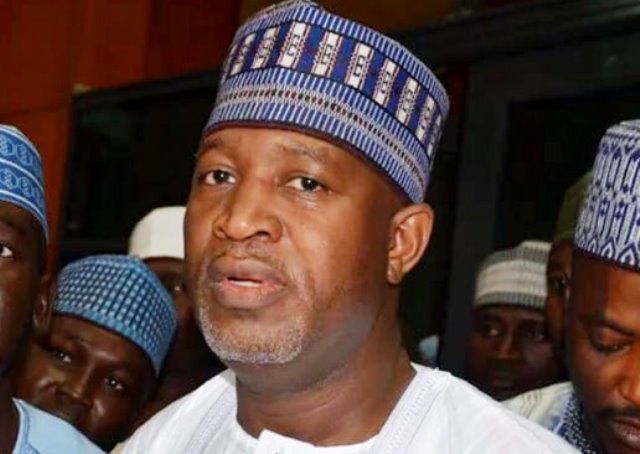
A FEDERAL High Court (FHC) in Abuja has granted the former Minister of Aviation, Hadi Sirika, his daughter Fatima, and two others ₦100 million bail over alleged N2.7 billion fraud for which they are standing trial.
The other two defendants in the case by the Economic and Financial Crimes Commission (EFCC) are Jalal Hamma and Al-Duraq Investment Ltd.
Sirika pleaded ‘not guilty’ when the six-count charge was read to him.
His counsel, Kanu Agabi, urged the court to grant him bail on self-recognition as a former minister.
Lawyer to the EFCC, Rotimi Jacobs, did not oppose the bail application but asked the court to impose hard bail conditions on the accused.
After the arguments, the trial judge, Sylvanus Oriji, granted the accused bail of N100 million each and two sureties in like sum.
According to the court, in addition to the money, they must make sureties available who must have landed properties in Abuja and be responsible citizens.
In addition, the sureties must hold legally registered landed holdings within the FCT.
The court also prohibited the accused from leaving the country without authorisation.
Oriji ordered that the defendants be remanded in prison if they failed to meet their bail conditions.
The trial is scheduled to start on June 10, 11, and 20.
On Wednesday, May 8, The ICIR reported that the EFCC charged Sirika, his daughter and two other suspects in court.
Sirika is standing trial a few weeks after the anti-graft agency quizzed him over alleged money laundering.
It was learnt that the former minister met with EFCC investigators to answer questions on alleged fraudulent contracts he awarded to Engirios Nigeria Limited, owned by his younger brother, Abubakar Sirika.
The ICIR reported on June 15, 2023, that EFCC summoned him over the N3 billion Nigeria Air project.
The former minister on an Arise Television programme on Sunday, June 11 2023, argued that of the N5 billion budgeted for the project take-off, only N3 billion was released, contrary to the speculation that the Aviation Ministry had spent N85 billion on the failed Nigeria Air project.
The bulk of the expended funds, according to Sirika, was channelled into consultancies, salaries, and administrative costs associated with setting up the national carrier.
The ICIR reported that both the Senate and the House of Representatives aviation committees had criticised the unveiling of the Nigeria Air aircraft, with the latter labelling it a fraud.
A MULTI-BILLION naira investment, Okomu Oil Palm Plc has raised concerns over the threat to its investment in Edo State by militants who disrupt its operations and attack its workers.
The company said it would shut down if the attacks persisted.
It said this following the latest attack and killing of three of its workers inside the plantation on Monday, May 6.
“Okomu Oil Palm Company PLC is a successful company established, initially in 1976 in Edo State by the Federal Government of Nigeria before becoming a PLC in 1990,” the company says on its website.
The company’s managing director, Graham Hefer, raised these concerns in an interview with the News Agency of Nigeria (NAN) on Wednesday, May 8, in Okomu.
Okumu is situated in the Ovia South West Local Government Area of Edo State.
“The female worker, who was held hostage but managed to escape unhurt, said the six armed gunmen came in through the Okomu Riverside and also escaped through the same route in their motorboat.
“This is one of the two incidences within a space of one week. Last week, armed gunmen ambushed the company’s patrol vehicle, which they riddled with bullets,” Hefer said.
While lamenting the worsening security situation in the area, he noted that if the situation was left unchecked, the company’s multi-billion naira investment could halt its operations.
Hefer said the government should take control of the area currently being terrorised by militants.
“We have repeatedly said the government should put a military base in the plantation. It’s absurd that we pay over N12 billion in taxes to the government annually and still are left to fend and seek security for equipment and personnel by ourselves,” he said.
He noted that management had been funding its security despite paying more in taxes without commensurate support from the government.
He lamented that the police had yet to bring reinforcements to the area to restore confidence in the workers since Monday’s incident.
Heifer, therefore, urged the state government to urgently address the security situation within the locality and the state in general to restore investors’ confidence.
Speaking with NAN, the state Commissioner of Police, Funsho Adegboye, argued that more men had been deployed by the state command to the area to forestall a repeat of the attack, saying it was shocking that the gunmen could carry out such an attack.
According to him, the attackers were from a neighbouring state.
He further said there had been efforts to arrest the culprits and bring them to book.
“Preliminary findings showed that the gunmen came from the creek in a neighbouring state, which I would not like to mention. The attack is shocking.
“However, more men have been deployed to the area to forestall a repeat, and the police, in conjunction with Okomu, are working to ensure that the culprits are arrested.
“We will not allow such an occurrence to happen in the state again,” the CP added.
Insecurity and uncertainty in Nigeria’s economic environment are among the reasons many companies are shutting down.
In 2022, The ICIR reported how giant industries silently disappeared from the country due to the foreign exchange crunch and market inflation.
During this period, investors who had planned to set up local manufacturing plants also retreated.
In 2023, a major pharmaceutical firm, GlaxoSmithKline(GSK), producer of prescribable medicine such as Augmentin and Amoxil, disclosed its strategic plan to stop the commercialisation of its prescription medicine and vaccines in Nigeria and transition to a third-party distribution model for its pharmaceutical products, citing foreign exchange concerns.
The company was one of the firms that left the nation that year.
More recently, BusinessDay reported that the rise in uncertainty in Nigeria’s macroeconomic environment had further dampened business activities, with some more firms closing shop in 2024.
According to the report, fluctuating macroeconomic indicators affect business plans, potentially leading to lower profitability, increased job losses, and multinational exits.
THE Economic and Financial Crimes Commission (EFCC) has charged former Minister of Aviation, Hadi Sirika, his daughter Fatimah, and two other suspects in court.
The ex-minister is scheduled to appear in court for trial for the first time on Thursday, May 8, before Sylvanus Oriji, a justice of the Federal High Court, Abuja.
Sirika and his three co-defendants – his daughter, Fatima; Jalal Hamma; and Al-Duraq Investment Ltd – are set to appear in court to face a six-count amended charges.
According to the News Agency of Nigeria (NAN), on Wednesday, May 8, his charges include fraudulent contracts awarded by the ministry under his watch.
The suspects were also charged with abusing their positions to launder over N2.7 billion in the Aviation Ministry.
This development is coming a few weeks after the anti-graft agency quizzed the former minister over alleged money laundering.
Sirika reportedly accepted an invitation from the EFCC On Tuesday, April 23, and showed up at the commission’s Abuja office, where he was interrogated.
It was learnt that the former minister met with EFCC investigators to answer questions on alleged fraudulent contracts he awarded to Engirios Nigeria Limited, owned by his younger brother, Abubakar Sirika.
In December 2023, President Bola Tinubu dismissed several senior aviation officials due to widespread fraud in the ministry.
Those affected included managing director of the Federal Airports Authority of Nigeria (FAAN); Kabir Yusuf Mohammed, managing director of the Nigerian Airspace Management Agency (NAMA) Tayib Adetunji Odunowo, director-general of the Nigerian Safety Investigation Bureau (NSIB) Akinola Olateru, director-general of the Nigerian Meteorological Agency (NIMET) Mansur Bako Matazu and rector of the Nigerian College of Aviation Technology (NCAT) Alkali Mahmud Modibbo.
According to the statement, Nuhu, the director-general of the Nigeria Civil Aviation Authority (NCAA), was suspended from office so that the EFCC could conduct a thorough investigation into his activities and those of other senior agency officials.
The ICIR reported on June 15, 2023, that EFCC summoned ex-minister Sirika over the N3 billion Nigeria Air project.
The former minister on an Arise Television programme on Sunday, June 11 2023, argued that of the N5 billion budgeted for the project take-off, only N3 billion was released, contrary to the speculation that the Aviation ministry had spent N85 billion on the failed Nigeria Air project.
The bulk of the expended funds, according to Sirika, was channelled into consultancies, salaries, and administrative costs associated with setting up the national carrier.
The ICIR reported that both the Senate and the House of Representatives aviation committees had criticised the unveiling of the Nigeria Air aircraft, with the latter labelling it a “fraud.”
FIRST NEWS Editor Segun Olatunji has resigned from the media outlet following the organisation’s apology to Femi Gbajabiamila, the Chief of Staff to President Bola Tinubu, over a story that led him to incarceration for days.
In a statement on Wednesday, May 8, Olatunji disclosed that his resignation was a result of the company’s stance on a report he wrote linking Gbajabiamila to corrupt practices and for the safety of his family.
He also insisted that the report was true.
“In view of the latest development regarding the Gbajabiamila story and the stance of the company’s management, I hereby tender my resignation as the General Editor of First News. It has become imperative for me to resign my appointment for the safety of my person and my family.
“However, I want to state that in no distant time, the truth will come out, and then it’ll be my word against theirs. I hope the management of First Media Network Limited, publishers of First News newspaper, will be magnanimous enough to fully settle the one-year outstanding salaries I am being owed in no time.”
Olatunji was abducted from his residence in Lagos by armed men in military uniform on Friday, March 15, and his whereabouts were kept secret for nearly two weeks.
While his location remained unknown, the leadership of the Nigerian media community searched frantically for him, reaching out to sources within the presidency, the Nigerian Army, and the State Security Service (SSS), who all denied knowing his whereabouts.
By Wednesday, March 27, the media community found that he was being detained by the military, and the International Press Institute (IPI), in a statement, urged Tinubu to direct his immediate release or charge him to court if he was being accused of any offence.
Olatunji was released the following morning as officials of the Defence Intelligence Academy (DIA) handed him over to some journalists by the roadside in Abuja.
Narrating his ordeal during the abduction that saw him flown to Abuja from Lagos, Olatunji expressed fear for his life and that of his family.
Weeks after his release, reports had circulated online that Olatunji confessed to being paid N170,000 to publish a false story against Gbajabiamila and had apologised to the Chief of Staff.
However, Olatunji denied issuing an apology or making such confessions. He said the claims were lies cooked up by the DIA and dared the military to disclose when and where he tendered the apology.
First News apologises, appoints new editor
On May 8, over a month after Olatunji’s release, the management of First News, where he worked as editor at the time of his abduction, published an apology to the Chief of Staff to the President.
The management said the story would be retracted as the organisation discovered that it contained “falsehoods and fabricated stories handed to us as facts by a misleading source.
“As a responsible media organisation, we wish to state very categorically that we have no malicious intent towards the person of the Chief of Staff to the President or his office. Hence, our decision to tender an unreserved apology and the need to publish a retraction of the said story,” the statement by First News read.
Olatunji tendered his resignation shortly after the statement was released, and the organisation immediately appointed Ebere Ndukwu as acting editor.
NOLLYWOOD film producer Femi Adebayo has been granted N25 million in damages in a lawsuit between his company and a YouTube channel, Aforefo TV, owned by Murphy Ben International.
The actor shared his victory via his official X page on Tuesday, May 7, stating that it was not “just his win but for all Nollywood.”
However, he did not provide the court case details to validate his claims.
The ICIR could not immediately see the details in media outfits that published reports on the claims.
The ICIR, therefore, contacted the law firm that handled the case and obtained the case details.
The litigation was between Lateef Olufemi Adebayo and Murphy Ben International Ltd (Aforefo TV), with case number FHC/IB/CS/17/2020, at the Federal High Court, Ibadan, Oyo State.
Some media platforms wrongly reported it was a Lagos High Court.
“Judgement was in our favour. Damages of 20 million naira was awarded for us and N5 million as the cost of litigation, making a total of N25 million. The judgement date was 23rd April 2024,” a lawyer at the law firm, who declined to give his name, said.
Adebayo stated that due to the success of his 2019 theatrical release of “Survival of Jelili”, the YouTube channel layered the trailers to trick viewers into thinking they were watching the actual movie, increasing the channel’s views and generating unaccounted income streams over time.
“During the cinema run of “Survival of Jelili” in 2019, my movie was gathering good numbers at that time. They decided to use my movie poster and title to promote a movie on their platform, thereby deceiving fans and diverting revenue accrued to me,” he said.
He added that it took him three years to obtain justice, with the professionalism and assistance of his legal team, for which he was also granted a N25 million compensation.
“They presented undeniable evidence, put up a strong argument, and took the case to trial. Their promptness, efficiency, and attention to detail played a huge part in the direction of the case. We won and were awarded a total of twenty-five million naira, he stated.
Adebayo emphasised the recent expansion of the Nigerian film industry and the difficulties faced by actors and producers in achieving the full financial benefits of their work due to malicious pirates who reap benefits they did not sow, noting that these pirates could be stopped gradually by perseverance and the application of intellectual property laws.
LAGOS is Nigeria’s commercial capital, and obtaining the state’s building approval documents can be rigorous.
On Monday, May 6, the Lagos State Commissioner for Physical Planning and Urban Development (PPUD), Oluyinka Olumide, told journalists that 80 per cent of buildings in the Ibeju-Lekki Local Government Area (LGA) of the state did not have government approval.
Olumide said the buildings involved had been marked for demolition, pointing out that the Ibeju-Lekki corridor was zoned as agricultural land.
According to him, the first step in the procedure is to get the planning information on what the area is zoned out for.
He said that developers or builders could then secure a fence permit, a layout permit and other building regulation requirements.
While he revealed the percentage of buildings without approvals, the commissioner did not disclose the number of buildings affected or the total number of buildings in the Ibeju-Lekki corridor.
His disclosure that 80 per cent of buildings in Ibeju-Lekki had no approvalraised concerns about the government’s effective monitoring of various estates and constructions despite the state’s many ministries and agencies saddled with the responsibility.
It also raises concerns about government officials’ negligence in monitoring and enforcing building regulations in the state.
According to the state Ministry for Physical Planning and Urban Development, a property developer or owner must have documents to obtain a Lagos State Building Permit for every stage of the approval process.
The ICIR presents the documents that intending homeowners must have to get building approval in the state.
Proof of ownership – certified true copy of title, CofO, Governor’s consent, deed of stamp duties on land or purchase receipt, and deed of conveyance.
Survey plan/beacon sheet.
Five sets of working drawings—architectural, structural, mechanical, and electrical—with supporting documents like COREN (Council for the Regulation of Engineering in Nigeria), a letter of supervision or soil tests, and a calculation sheet, as applicable.
Photocopy of payment receipts for statutory fees: processing fees, stage certification, penal fees, and IDC (infrastructure development charges) as applicable.
Clearances from relevant MDAs: Land Use and Allocation Committee (LUAC), New Towns Development Authority (NTDA), Lagos State Urban Renewal Agency (LASURA), Ministry of the Environment (MOE)—Drainage/ Lagos State Environmental Protection Agency (LASEPA), Ministry of Transport—Traffic Impact Assessment (TIA)/Metro line), Fire Service and Police report as applicable.
Planning technical reports, that is. Land Use Planning and Analysis Report (LUPAR) and Physical Planning Technical Report PPTR (where applicable)
Evidence of tax payment (for an individual)
Certificate of incorporation for corporate organisation.
The ICIR reported earlier that the Ibeju-Lekki Local Government Area (LGA) where the government plans to demolish 80 per cent of buildings allegedly not have approval, said it lostall its building records to ENDSARS protests in 2020.
The LGA disclosed this to The ICIR through its public affairs officer, Maryam Hamsat.
The ICIR reporter asked the official to respond to questions regarding the Lagos State government’s planned demolition of buildings in the LGA.
She said all the documents at the council were destroyed during the End-SARS protests.
Ibeju-Lekki LGA is home to the Lekki Free Trade Zone, the Dangote refinery, and a beacon for real estate investors seeking promising opportunities.
WHEN Bola Ahmed Tinubu was sworn into office as the President of Nigeria on May 29, 2023, he promised to end the insecurity that had almost brought the country to its knees.
Before he assumed leadership of the country, Nigeria had witnessed seemingly unrestricted killings by non-state actors, so Nigerians anxiously waited to see how his government would tackle the massive security challenges that bedevilled the country over the past few years. This report which is part of The ICIRseries tagged “Tinubu’s one year in office”, takes an in-depth look at the security situation.
Tinubu promised to tackle insecurity
In June 2022, when Tinubu emerged as the All Progressives Congress (APC) presidential candidate for the 2023 general elections, he promised a secure, prosperous, and united Nigeria in his victory speech.
Tinubu said he was ready to provide security and rebuild the economy. He said if elected president, he would eliminate criminals, including terrorists.
Also, during his campaign tour, Tinubu promised to tackle the security situation across the country, stating that the economy cannot thrive in an insecure environment.
President Bola Tinubu
“I used the same approach to tackle the bad security situation that faced me when I became governor of Lagos. I created programmes and institutions to solve the real and dangerous challenges Lagos faced.
“I shall increase security personnel and better equip them. Advanced air and ground surveillance technology will identify, track and attack the criminals until they are utterly defeated,” the former governor of Lagos state said.
Still on security, in his inaugural speech on May 29, he pledged to prioritise security and effectively tackle the menace of insecurity.
“Security shall be the top priority of our administration because neither prosperity nor justice can prevail amidst insecurity and violence.
“To effectively tackle this menace, we shall reform our security Doctrine and its Architecture.
“We shall invest more in our security personnel, and this means more than an increase in number. We shall provide better training, equipment, pay and firepower,” Tinubu stated.
Data speaks
Despite the promises made by Tinubu on security, data from various sources showed that the security situation has little or no change under under his administration, as over 600 people were killed under him within 45 days.
Data from SBM Intelligence, an analysis platform, revealed that about 629 Nigerians were killed within 45 days across the country under President Tinubu between May 29 and July 13, 2023.
According to data, the killings happened primarily from activities of non-state actors like bandits, Boko Haram insurgents, ethnic militias, armed robbers and other non-state actors.
Other data from the Council on Foreign Relations’ Nigeria Security Tracker (NST) and media reports checked by The ICIR showed that non-state actors killed 587 people within the same period.
A report by a civil society organisation, Global Rights Nigeria, revealed that at least 555 people had been killed and 267 others abducted six weeks after President Tinubu took office.
Also, in a report published on June 14, Amnesty International (AI) said more than 120 people were killed a few days after Tinubu assumed power.
At least 2,336 people were killedin various violent attacks within the first three months of 2024, according to data sourced and analysed by The ICIR.
This is an approximate average of 26 persons killed daily between January 2024 and the end of March 2024.
Resign if you cannot tackle insecurity
In January, following a surge in kidnapping cases, a former Vice President of Nigeria, Atiku Abubakar, advised Tinubu to resign if he could not handle the insecurity challenges currently bedevilling Nigeria.
Atiku, who contested the last presidential election against Tinubu on the platform of the Peoples Democratic Party (PDP), said this in a post on his X handle on Tuesday, January 30.
He accused the President of being a fiddler when the nation was insecure.
On Monday, January 29, civil society organisations (CSOs) in Nigeria appealedto Tinubu to declare an emergency due to the nation’s insecurity.
March
The ICIRreported that four officers and 13 soldiers were murdered in Okuama on March 14.
The officers were said to have been killed by some youths while the troops were on a peace mission to the Okuoma community in Bomadi Local Government Area (LGA).
Image of 17 soldiers killed in Okuama, Delta state: Courtesy Defence Headquarters
Also in March, over 100 students were kidnapped in Kuriga town in Kaduna state. The incident generated public outrage among Nigerians.
Tinubu cancels 72nd birthday due to insecurity
Tinubucancelled his 72nd birthday celebration, scheduled for Friday, March 29, due to the rising hardship and insecurity in the country.
Expert opinion
Meanwhile, earlier in the administration’s life, some stakeholders in the security industry offered suggestions on how the Tinubu administration could effectively address insecurity.
A security analyst with SBM Intelligence, Emeka Okoro, in a chat with The ICIR, listed some measures Tinubu should implement to address insecurity.
Increased funding for security agencies
Collaboration with neighbouring countries.
Address the root causes of insecurity
Community policing
Strengthen intelligence gathering
Address corruption within security agencies
Improve border security
In May 2023, to put the President on its toes, The ICIR published reports highlighting the key insecurity issues that confronted former President Muhammadu Buhari’s administration and another one listing things Tinubu must do to address insecurity.
AS the Nigerian banking sector gears up for recapitalisation, the Central Bank of Nigeria (CBN) has released the list of licensed Deposit Money Banks (DMB) operating in the country.
The list was made public on the CBN’s official website on Tuesday, May 8, to provide insights into the country’s banking landscape.
According to the CBN, banks with international authorisation include Access Bank Limited, Fidelity Bank Plc, First City Monument Bank Limited, First Bank Nigeria Limited, Guaranty Trust Bank Limited, United Bank of Africa Plc, and Zenith Bank Plc.
Commercial banks with national authorisation include Citibank Nigeria Limited, Ecobank Nigeria Limited, Heritage Bank Plc, Globus Bank Limited, Keystone Bank Limited, Polaris Bank Limited, Stanbic IBTC Bank Limited, Standard Chartered Bank Limited, Sterling Bank Limited, Titan Trust Bank Limited, Union Bank of Nigeria Plc, Unity Bank Plc, Wema Bank Plc, Premium Trust Bank Limited and Optimus Bank Limited.
Commercial banks with regional licenses are Providus Bank Limited, Parallex Bank Limited, Suntrust Bank Nigeria Limited, and Signature Bank Limited.
Players in the non-interest banking sector with national authorisation include Jaiz Bank Plc, Taj Bank Limited, Lotus Bank Limited, and Alternative Bank Limited.
In the merchant banking category, the apex banks listed Coronation Merchant Bank Limited, FBN Merchant Bank Limited, FSDH Merchant Bank Limited, Greenwich Merchant Bank Limited, Nova Merchant Bank Limited, and Rand Merchant Bank Limited.
The financial holding companies listed were Access Holdings Plc, FBN Holdings Plc, FCMB Group Plc, FSDH Holding Company Limited, Guaranty Trust Holding Company Plc, Stanbic IBTC Holdings Plc, and Sterling Financial Holdings Limited.
The ICIR reports that the list may not be unconnected with CBN’s regulatory role in ensuring that depositors know the licensed banks to operate with, especially now that recapitalisation process for deposit money banks has begun.
On Thursday, March 28, 2024, the apex bank unveiled new minimum capital requirements for banks and pegged the minimum capital base for commercial banks with international authorisation at N500 billion.
The Bank also said the new minimum capital base for commercial banks with national authorisation would be N200 billion, while the new requirement for those with regional authorisation would be N50 billion.
The last time the CBN increased banks’ capital bases was in 2005, when the current Anambra State Governor, Charles Soludo, was the CBN governor. At the time, the capital base was raised from ₦ 2 billion to ₦ 25 billion.
AMID growing debt burdens and uncertainties over its continuous operation, Oando Plc concentrated $2.6 on a company its top directors owned.
Checks by The ICIR show that over the past five years, Oando has been incurring losses in its operational performance and carrying net liabilities.
A company is in a net liabilities position when its total liabilities exceed its assets.
The company’s struggle to stay afloat and its growing debt obligations have again caught the attention of its independent auditor, BDO Professional Services Chartered Accountants.
In Oando’s 2022 audited financial statements, released on Tuesday, April 23, the independent auditor said the $2.6 million drawdown raised audit matters.
The ICIR analysis shows that in 2023, Oando Servco Nigeria Limited, an indirect subsidiary of Oando Plc, entered into a $20 million loan agreement with OODP BVI, a subsidiary of Whitmore Asset Management Limited owned by Jubril Adewale Tinubu and Omamofe Boyo, the chief executive and deputy chief executive of Oando Plc.
The loan was granted at a six per cent per annum interest rate to provide OODP BVI corporate activities funds. The repayment period was 20 years from the utilisation of the last advance of the loan, and there was a 10-year moratorium on the principal repayment.
Following the loan agreement and disbursement deal, Oando Servco instructed Oando Plc to pay $250,000 to OODP BVI on August 8, 2023, and $250,000 on October 24, 2023.
It further requested that Oando Trading DMCC and Oando Plc pay $1 million and $1.1 million to Ansbury Investments Inc. on July 3 and October 24, 2023.
However, as of the date of the auditor’s report, the $2.6 million loan due had yet to be paid.
Financial loss widens
Analysis of the 2022 performance and financial position of Oando Group and the company followed the trends of losses reported in the last five years.
The ICIR reported in September 2023 that the independent auditor expressed worries over Oando’s ability to continue as a going concern.
Since 2022, the multinational oil company has faced delisting, which is yet to be perfected, arising from the huge losses suffered in 2020.
In the review year, the company recorded a comprehensive loss of N41.7 billion from N28.1 billion in 2021.
Its current liabilities exceeded current assets by N273.9 billion relative to a net current liabilities of N231.4 billion in 2021.
The company also reported net liabilities of N243.9 billion compared to net liabilities of N202.2 billion in 2021.
The group recorded a comprehensive loss of N56.8 billion from a total comprehensive profit of N30.6 billion in 2021.
Its current liabilities exceeded its current assets by N818.7 billion relative to a net current liabilities of N668.4 billion in 2021.
The Group also reported net liabilities of N197.2 billion compared to net liabilities of N129 billion in 2021.
According to the independent auditor, the reversal of this trend depends on the successful outcomes of its planned actions to refinance its debts to manage the funding gap of N3 trillion and the attainment of revenue in the Group’s forecast for the year ending 31 December 2024.
It said that if the planned actions were successful, they would only address 32 per cent of the Group’s projected funding gap, leaving the management to address the 68 per cent funding gap shortfall.
The independent auditor pointed out that no written agreements were currently in place for such funding plans, and there could be no assurance that they would be available in the immediate future.
“These conditions, together with other matters, indicate the existence of a material uncertainty that may cast significant doubt on the Group’s and the Company’s ability to continue as a going concern and, therefore, may be unable to realise its assets and settle its liabilities in the ordinary course of business.
“The financial statements are yet to include any adjustments to the amounts and classification of assets and liabilities that may be necessary, should the Group not continue as a going concern as there has neither been any intention by the Directors to liquidate or cease the operations of the Group nor is there any legislation to cause the same. Our opinion is not modified in respect of these matters,” BDO Professional Services submitted.
Facing N1.2trn pending litigation
Several legal suits are outstanding against the Group, amounting to N1.2 trillion in 2022 and N3.07 trillion in 2021, which the Oando legal team claimed might not have any material effect on the Company.
Commenting on the results, Oando’s Group Chief Executive, Wale Tinubu, blamed the Company’s losses and poor performance on pipeline vandalism and operational negligence.
“The heightened militancy and pipeline vandalism acts within the Niger Delta region dealt a substantial blow to our upstream operations, resulting in a marked reduction in our crude production volumes due to the protracted shut-ins for repair following each incidence. This was further compounded by a major gas plant fire incident which also necessitated a lengthy downtime.
“Furthermore, a rise in our net interest expense due to increased interest rates on several of our major facilities in line with global rates increases, also contributed to our Loss after Tax position,” Tinubu said.
He, however, hinted that the Company has put in place definitive measures to bolster production, cash inflows, and return to profitability, hinting that part of the effort is to collaborate with partners to institute a security framework to curb pipeline vandalism permanently.
He said, “We have also implemented a strategic restructuring of our key facilities to ensure they align with our cash flow dynamics.”
Special Adviser to the President on Media and Publicity Ajuri Ngelale released a statement announcing his departure.
The trip brought many heads of organisations in Nigeria and the Netherlands together for the Nigerian-Dutch Business and Investment Forum.
Ngelale also disclosed in the statement that the President would travel to Riyadh, Saudi Arabia, between April 28 and 29, to attend a World Economic Forum (WEF), after which he was expected to return to the country.
However, Tinubu did not return to Nigeria after the Riyadh trip, and there was no official statement on his whereabouts.
It was reported that unnamed sources within the presidency said he was in London to “take time off after such hectic meetings and engagements.”
The silence over his whereabouts left many Nigerians speculating that he might not be healthy.
But the Minister of State for Health and Social Welfare, Tunji Alausa, said the President’s absence was not for medical reasons.
The presidency confirmed he was in Europe on Tuesday, May 7, via Onanuga’s post on X.
“President Bola Ahmed Tinubu, along with his aides, will return to Nigeria tomorrow from Europe,” he posted.
The ICIR traced at least 17 trips the president has embarked on since he assumed office on May 29, 2023.