Home Blog Page 604

NERC unbundles TCN into two independent operators

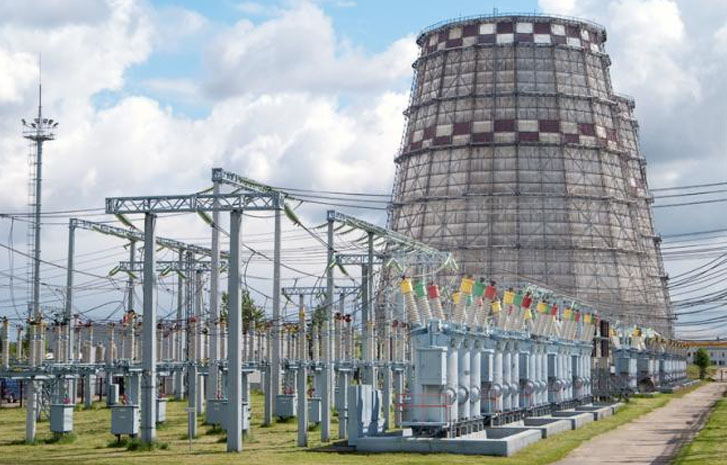
THE Nigerian Electricity Regulatory Commission (NERC), has officially unbundled the Transmission Company of Nigeria (TCN) into two entities –  the Nigerian Independent System Operator Nigeria Limited (NISO) and the Transmission Service Provider (TSP).

NERC communicated this in a circular dated April 30th 2024 jointly signed by the Chairman of NERC Sanusi Garba, and the Vice Chairman, Musiliu Oseni, which was made available to the newsmen on Friday, May 3, 2024.

According to the statement, TCN transfers all market and system operation responsibilities to the newly formed entity. Earlier, the commission had granted TCN transmission service provider (TSP) and system operations (SO) licenses by the Electric Power Sector Reform Act.


READ ALSO :


NERC stated that the Order will come into effect on May 1, 2024, and will remain valid until modified or annulled by a subsequent Order issued by the Commission.

The Transmission Company of Nigeria Plc (TCN) as a successor company was issued two separate licences to operate as the transmission service provider and system operator for the national grid system by the Commission.

“The repealed Electric Power Sector Reform Act 2005 (EPSRA or the Repealed Act) envisaged that TCN would transfer the function of system operation for the national grid to an Independent System Operator (ISO).

“The Electricity Act (the EA or Act) 2023 came into effect on 9 June 2023 and this piece of legislation went beyond the Repealed Act by providing clearer guidelines for the incorporation, governance structure, and licensing of the ISO, as well as the transfer of the assets and liabilities of the system operations portion of TCN to the ISO.” The statement read in part.

As a result, the commission mandated in the circular that the Bureau of Public Enterprises (BPE) incorporate a private company limited by shares under the Companies and Allied Matters Act (CAMA) on May 31 2024 without fail.

The statement noted that the corporation is expected to carry out the market and system operation functions stipulated in the Electricity Act and the terms and conditions of the system operation licence issued to TCN.

“The name of the company shall, subject to availability at Corporate Affairs Commission, be the Nigerian Independent System Operator of Nigeria Limited (NISO),” NERC stated.

The electricity regulator  added that the company will hold and manage all assets and liabilities pertaining to market and system operation on behalf of market participants and consumer groups or such stakeholders as the Commission may specify, citing the Electricity Act’s object clause in the NISO’s memorandum of association (MOU).

According to the commission, the new ISO would also be in charge of negotiating and signing contracts with licensees of successor generation and independent power producers for the acquisition of ancillary services.

Additionally, it will typically execute its licencing requirements and the Electricity Act’s market and system operations duties in the best interests of system users and market players.

In 2022, The ICIR reported that  the frequent grid collapse was attributed to the delay in unbundling of the Transmission Company of Nigeria (TCN) by the Federal Government.

Health Minister Pate reveals plans to combat Malaria

0

THE Coordinating Minister of Health and Social Welfare, Muhammad Pate, said the ministry, alongside global health leaders, has identified key action plans geared towards combating malaria in Nigeria.

Pate, on Friday night, May 3, noted that the Ministry arrived at the key decisions at the high-level global dialogue on accelerating malaria elimination with major health stakeholders in Abuja on Friday, May 3.

The dialogue, which involved panel discussions on various topics bordering on accelerating malaria treatment and elimination, captured the steps the country has taken over the years to combat the spread of malaria.


Read Also:

The panelists include Global Coordinator, PMI Lisa O’Hare; Global Fund Mark Edington; Bruno Moonen, BMGF,  Scott Gordon of Gavi, Samrita Sidhu, FCDO & Shubham Chaudhuri, World Bank Africa.

Caused by parasites transmitted to people through the bites of infected female Anopheles mosquitoes, malaria is a preventable and curable major public health issue affecting millions of Nigerians.

The disease, mostly found in tropical countries, can be life-threatening, with nearly half of the world and 97 per cent of Nigeria’s population at risk of the disease.

Nigeria (26.6 per cent), the Democratic Republic of the Congo (12.3 per cent), Uganda (5.1 per cent), Mozambique (4.1 per cent) and Angola (3.4 per cent) collectively represented half of the total malaria cases worldwide.

Also, Nigeria (31.3 per cent), the Democratic Republic of the Congo (12.6 per cent), Tanzania (4.1 per cent), and Niger (3.9 per cent) together accounted for slightly more than half of all malaria-related deaths worldwide.

Speaking on the burden of Malaria, Pate challenged world leaders and Nigerians to work together to eliminate malaria in the country.

“Yes, we have made progress in the elimination of Malaria, but we are not satisfied. Data data-driven approach is needed to accelerate progress, better financing, and better partnerships to eliminate malaria. Today I urged everyone of us to challenge and ourselves and work towards eliminating malaria in Nigeria,” the minister said.

He also questioned how Nigeria can be more effective, equitable, coordinated, and aligned to optimise impact with the right combination of tools in the right places, while monitoring progress. 

He suggested changing the malaria narrative, adding that the country can only shift this narrative and accelerate malaria elimination through a whole-of-society approach. We must all work together across different sectors.”

The identified key shifts and strategic actions to combat malaria in Nigeria, as quoted in a statement released by the minister, include:

  • Establishing an independent Advisory group on Malaria Elimination in Nigeria (#AMEN);
  • Developing a pragmatic, costed plan for malaria elimination making explicit the required trade offs;
  • Intensified malaria case management, including NHIA reforms, domesticated Affordable Medicines for malaria effort, expanding primary health and frontline workforce;
  • Mobilizing domestic and global funding for malaria;
  • Relentless focus on operational excellence to deploy and optimize existing tools for high coverage, including LLINs, SMC, IPT, IVM and phased introduction of safe, efficacious vaccines;
  • Enhancing community and leadership involvement in malaria elimination;
  • Strengthening data integrity and accountability;
  • Intensifying preparedness and response to climate change’s impacts on malaria;
  • Exploring bold innovations in service delivery and financing mechanisms.

Challenges with Malaria Interventions

However, The ICIR reported that some of the malaria interventions, such as the National Malaria Elimination Programme (NMEP), have been marred with corruption, misappropriation of funds, lack of state ownership, and poor budget allocation in the past.

The 2019 Malaria Programme Review (MPR), stated that the country was unable to accomplish the objectives outlined in the National Malaria Strategic Plan and attributed the failure to the government’s inadequate allocation of funds for combating the disease.

In 2022, the Global Fund, in its audit, accused the National Agency for Control of AIDS (NACA) and the Lagos State Government of misappropriating $19.6 million worth of COVID-19 procurement grants through shady contract awards.

That was also not the first time the Global Fund would accuse Nigeria of misusing its grants. In 2016, the Fund accused NACA and NMEP of misappropriating the grants they got. The Global Fund consequently suspended them as its grant recipients, and as of 2021, NACA was yet to clear itself of the 2016 indictment before the Nigerian government.

Chidi Odinkalu raises question over violation of agreement on appointment of new Appeal court judges

THE former chairman of the National Human Rights Commission (NHRC), Chidi Odinkalu, a professor, has raised questions about the violation of the agreement regarding the appointment of new Appeal Court judges.

He criticised the President of the Court of Appeal (PCA), Monica Dongban-Mensem, and the Federal Judicial Service Commission (FJSC) for violating the agreement in appointing the judges.

Odinkalu revealed this in a series of posts on X, formerly Twitter, on Thursday, May 2.


Read Also:

According to him, on November 19, 2020, the FJSC met in an emergency session in Abuja, the Federal Capital Territory (FCT), to consider nominations to the Bench of the Court of Appeal on the request of the PCA, Dongban-Mensem.

He added that it was agreed at the meeting that as a criterion for consideration of judges for the Appeal Court, the PCA proposed and the FJSC agreed that judges who had not spent five years on the Bench or who had less than five years before retirement would not be eligible for consideration. 

According to the minutes of the meeting posted by Odinkalu and seen by The ICIR, the PCA informed members that 257 candidates were recommended for consideration for appointment as justices of the Court of Appeal and in line with the FJSC Revised Guidelines for Appointment or Removal from office of Judicial Officers (2015), 80 candidates had been shortlisted for members consideration, to fill vacancies at the Court of Appeal.

At the meeting, PCA submitted that the nominations were based on an objective evaluation of the nominees’ judgments and the recommendations each received.

The PCA also explained that she considered the age factor. 

She posited that judges who had not spent up to five years on the bench were not considered, while those who would not spend up to five years, if appointed before retirement, were also not considered.

She equally informed members that special attention was paid to specialised courts like the Customary Court, Sharia Court, and the National Industrial Court because appeals from these courts are brought to the Court of Appeal. She cited Section 237(2)(b) of the Constitution (1999) as amended.

However, according to Odinkalu, Eneche Eleojo has been nominated as a judge of the Court of Appeal despite clear rules to the contrary.

“Justices Mohammed Liman of Federal High Court and Lawal Akapo of Lagos High Court, both of whom have also been nominated for Court of Appeal, would also fall foul because they do not have more than five years to retirement (sic).

“Justice Toochukwu Victoria Nwoye of the High Court of Anambra State, also nominated for elevation to the Court of Appeal, was only appointed in December 2019 and is similarly less than five years on the bench.

“The question needs to be asked: why is the FJSC violating its own rules, and whose interests is it serving? he asked.

In a memo dated April 2, 2024, sighted by The ICIR and signed by the Chief Justice of Nigeria (CJN) Olukayode Ariwoola, who also serves as the chairman of the FJSC, 22 judges from state and federal High courts were nominated to the National Judicial Council (NJC) for consideration as Court of Appeal judges.

The list of the 22 recommended justices are:

  1. Polycarp Tema Kwahar – Benue

2. Ruqayat Ayoola – Kogi

3. Eneche Eleojo – Kogi

4. Asmara Akanbi Yusuf – Kwara

5. Abdullahi Muhammad Liman – Nasarawa

6. Abdu Dogo – FCT

7. Fadahu Umaru – Borno

8. Ishaq Mohammed Sani – Kaduna

9. Zainab Bage Abubakar – Kebbi

10. Abdulaziz M. Ankara – Zamfara

 11. Nnamdi Okwy Dimga – Abia

12. Toochukwu Nwoye – Anambra

13. Henry Aja-Onu Njoku – Ebonyi

14. Donatus Uwaezuoke Okorowo – Enugu

15. Ngozika N Okaisabor – Imo

16. Ntong Festus Ntong – Akwa-Ibom

17. Nehizena Idemudia Afolabi – Edo

18. Eberechi Suzette Wike – Rivers

19. Lateef Babajide Lawal-Akapo – Lagos

20. Abiodun Azeem Akinyemi – Ogun

21. Oyewumi Oyejoju Oyebiola – Oyo

22. Bayo Ademola Taiwo – Oyo

Police arrest FIJ journalist over ‘cybercrime’ allegation

0

WHILE many Nigerian journalists joined the rest of the world in advocating press freedom on World Press Freedom Day, commemorated on Friday, May 3, Daniel Ojukwu, a journalist with the Foundation for Investigative Journalism (FIJ), languished in police detention over allegations of cybercrime.

Ojukwu was abducted by the Intelligence Response Team (IRT) of the Inspector-General of Police on Wednesday, May 1, but his abduction became known on Friday, coinciding with World Press Freedom Day.

According to a report by FIJ, he is currently being held at the State Criminal Investigation Department (SCID), Panti, in Lagos, and has been denied access to legal representation.


Read Also:

World Press Freedom Day: How the media can get its groove back

The FIJ stated that upon discovering his unknown destination and finding his phone switched off, it initially filed a missing person report at police stations in the area where Ojukwu was believed to have been headed on Thursday, May 2.

On Friday, May 3, the media platform subsequently hired a private detective to track the last active location of his phones, which was traced to an address in Isheri Olofin, a location FIJ now believes was where the police originally picked him up.

The reporter’s family later learned about his detention at Panti, where they were informed that the authorities were accusing him of violating the 2015 Cybercrime Act. 

According to a family member who visited the station, the authorities refused to provide contact details for the Investigating Police Officer (IPO) due to jurisdictional issues, as the case extended beyond Lagos.

“The arresting officers are part of the IG Monitoring Team. They said when they are done arresting the other people on their watchlist in Lagos, they would transfer him and others to Abuja,” FIJ quoted the family member to have said.

Since the incident,  Ojukwu has been denied access to legal representation.

Although the police have remained silent on Ojukwu’s arrest, FIJ said the arrest might not be unconnected to a story about Adejoke Orelope-Adefulire, the former senior special assistant on sustainable development goals (SSAP-SDGs) to the President.

The story detailed a payment of N147.1 million to an account linked to Enseno Global Ventures, an Abuja-based restaurant, supposedly to construct a classroom. 

Setback on World Press Day

The attack, which has generated widespread condemnation from journalists and concerned Nigerians, was deemed a significant setback in the ongoing battle against impunity and harassment of media professionals in Nigeria.

Earlier on Friday, The ICIR reported how the latest data on the 2024 World Press Freedom Index by Reporters Without Borders (RSF) placed Nigeria as one of West Africa’s most dangerous and difficult countries for journalists.

This followed Nigeria’s placement at 112th out of 180 countries in terms of journalists being regularly monitored, attacked, and arbitrarily arrested.

According to RSF, “The level of governmental interference in the news media in Nigeria is significant. It can involve pressure, harassment of journalists and media outlets, and even censorship. This interference is even stronger during electoral campaigns. Addressing political issues in a balanced way can also be difficult, depending on the media outlet’s owner. To a large extent, government officials have a say in the appointment and dismissal of media officials, whether in the public or private sector.”

Nigerian laws fail to protect journalists

While Section 22 of the 1999 Constitution of the Federal Republic of Nigeria (as amended) mandates the media to ensure the government’s accountability to the people through reporting, other laws passed by the Nigerian government have failed to make that possible.

The laws fail to protect journalists carrying out this responsibility and are often deployed as tools to suppress the free press.

For instance, the Cybercrimes Act, established to prohibit cybercrime in Nigeria, has been weaponised against online journalists in some instances despite their constitutional mandate to fulfil watchdog responsibilities.

The Economic Community of West African States (ECOWAS) Court of Justice also declared the section inconsistent with Article 9 of the African Charter on Human and People’s Rights.

Although President Bola Tinubu has amended the Act, there are still concerns that it can stifle freedom of expression.

One year in office: Tinubu’s foreign trips

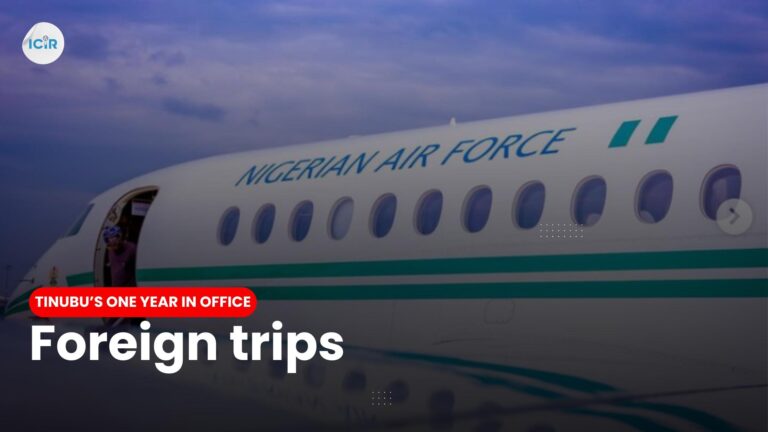
NIGERIAN President Bola Tinubu has made at least 17 trips out of the country for official and unofficial purposes since he was sworn in as president between May 29, 2023, and April 2024, the ICIR reports as part of the series tagged, “Tinubu’s one year in office”.

The president started his official travels in June, a few weeks after he assumed office. The purpose of his trips, as said by him and or his team, was to strengthen Nigeria’s position on the global stage, foster economic growth, and address some of the country’s other challenges.

In this report, The ICIR examines the president’s foreign trips during his first year as president, highlighting the purpose of each trip and its impact on addressing the country’s major concerns.

2023 trips:

New Global Financial Pact summit in France

A few weeks after his assumption into office, President Tinubu embarked on his first international trip to France in June for the New Global Financial Pact Summit.

The 2-day summit afforded the President the opportunity of projecting, on a global stage, his advocacy for widening the fiscal space, economic justice for Africa as the world accelerates the pace of energy transition, and the urgency of addressing the pressing issues of poverty and climate change.

Private visit to London

After the summit in France, Tinubu was billed to return to Nigeria, however in a statement by his special adviser on special duties, communication and strategy, Dele Alake, the president headed to London for a “short private visit” before returning to Nigeria for the Eid-el-Kabir festivities.

63rd ECOWAS summit in Guinea-Bissau

On July 8, President Tinubu made his first official visit within the African continent since assuming office, traveling to Guinea-Bissau for the 63rd Ordinary Session of the ECOWAS Authority of Heads of State and Government.

At the summit, he was elected as the new Chairman of ECOWAS, succeeding President Umaro Sissoco Embaló of Guinea-Bissau.

The regional leaders gathered to address pressing issues affecting the sub-region, including the status of political transition in Mali, Burkina Faso, and Guinea, as well as the ECOWAS Single Currency Programme and obstacles to free movement of goods along the Abidjan-Lagos corridor. While in Bissau, Tinubu also took the opportunity to visit and commend the Nigerian troops serving under the ECOWAS Stabilisation Force, reaffirming his commitment to supporting peace and democracy in the region.

Mid-year coordination meeting in Kenya

PTinubu took a trip to Kenya on July 15, as the Chairperson of the ECOWAS to participate in the Fifth Mid-Year Coordination Meeting (5thMYCM) of the African Union (AU), the Regional Economic Communities (RECs), the Regional Mechanisms (RMs), and the African Union Member States.

The meeting was focused on regional integration within ECOWAS, emphasising actions related to trade, free movement of persons, investment promotion, infrastructure development, peace, security, and stability.

Benin Republic’s 63rd independence anniversary

On August 1,  Tinubu made a short trip to the Benin Republic for the country’s 63rd independence anniversary ceremony.

G-20 leaders’ summit in India 

The President received a special invitation by the Indian Prime Minister, Narendra Modi to attend the G-20 Leaders’ Summit after which he proceeded to New Delhi, India on September 4.

The G-20 summit provides a platform for world leaders to address critical global issues and foster international cooperation. His participation was aimed strengthening Nigeria’s ties with other countries in Asia as well as bolstering economic ties, attract foreign investment and promote Nigeria as a business-friendly country.

Meeting with UAE authorities in Abu Dhabi 

After the G-20 summit in India, President Tinubu travelled to Abu Dhabi, United Arab Emirates (UAE) where he met with the President, Mohamed bin Zayed Al Nahyan to resolve the issue of a visa ban on Nigeria and also discuss other bilateral relations.

The meeting yielded a positive outcome including the immediate cessation of the visa ban placed on Nigerian travellers, resumption of flight schedules for both Etihad Airlines and Emirates Airlines, in and out of Nigeria, among others. Not long after the report on the win permeated the media space, counter reports emerge that the ban was not lifted or was reversed. The back and forth still lingers as of March of 2024 the issue is still being reported with a presidential aid saying the ban has not been lifted.

78th United Nations General Assembly in USA

Again, in September, the president travelled to New York, United States of America to attend the 78th United Nations General Assembly. Tinubu emphasized on the importance of seeing African development as a priority, calling on world leaders and global institutions to invest in Africa, expressed concern about the military coups in Africa, demanding for solutions to perennial problems and called on the international community to strengthen its commitment to arresting the flow of arms and violent individuals into West African regions.

Saudi-Africa summit in Ridyah, South Arabia

Tinubu on November 9, left Abuja for Saudi Arabia to attend the first Saudi- Africa Summit scheduled for the following day, November 10. The summit was aimed at having discussions revolved around supporting joint action, enhancing political coordination, addressing regional security threats, and facilitating economic transformation through research and the local development of new energy solutions, all while bolstering cross-sectoral investment cooperation.

Guinea-Bissau’s 50th Independence Day anniversary

The President travelled again to Bissau, Guinea-Bissau for the country’s 50th independence anniversary and armed forces day on November 15.

G20 Compact with Africa (CwA) conference in Germany

On November 18, President Tinubu jetted out of Nigeria to Berlin, Germany to attend the G20 Compact with Africa (CwA) conference. Tinubu joined other Heads of State of CwA member countries, to deliberate on enhancement of economic and business cooperation with a view to outlining concrete measures to boost investments in areas, including energy, trade, infrastructure, new technologies, among others.

COP28 Climate Summit in Dubai

The President left Abuja for Dubai, on November 28, for COP28 Climate Summit or the 28th United Nations Climate Change Conference of the Parties of the UNFCCC. This climate summit generated lots of controversies by Nigerians on social media after it was revealed  that over 1,400 Nigerian delegates accompanied  him to the summit.

However, the senior special assistant to the president on media & publicity, Temitope Ajayi, explained that not all Nigerians at the event were sponsored by the federal government.

2024 trips:

Private visit to France

On January 24, the president resumed his world tour. He made his first trip of the year on a private visit to Paris, France.

Visit to Qatar

The president went on a two-day visit to Qatar on February 29, at the invitation of the Emir of the State of Qatar, Tamim bin Hamad Al Thani and returned to Nigeria on March 4. The purpose was to further strengthen cooperation between Qatar and Nigeria in the area of security, cultural exchange, economic development, among others.

Inauguration of Senegal’s President-elect

President Tinubu went to Dakar, Senegal on April 2 for the inauguration of Senegal’s President-elect, Bassirou Faye, the youngest democratically elected African president.

Official visit to The Netherlands

President Tinubu embarked on an official visit to the Netherlands on Tuesday, April 23.
The visit aimed to strengthen bilateral ties and explore opportunities for collaboration.

Saudi Arabia Economic Summit

Following his Netherlands visit, Tinubu travelled to Riyadh, the capital of Saudi Arabia where he participated in the 2024 Special World Economic Forum (WEF) on global collaboration, growth, and energy for development.

Would you say Presdents Tinubu’s trips have yielded impact and affected the country positively?  Let us know in the comments. 

70% of environmental journalists report attacks, threats- UNESCO

A RECENT report by the United Nations Educational, Scientific and Cultural Organization (UNESCO) revealed that 70 per cent of environmental journalists worldwide experienced attacks and threats in the course of their work. 

This was as the report warned of increasing violence against and intimidation of journalists dedicated to covering environmental issues, including climate change, pollution, and conservation efforts.    

The survey conducted in March, involving more than 900 environmental journalists from 129 countries, showed that at least 749 journalists or news media reporting on environmental issues were attacked in the last 15 years.


Read Also:

Press freedom: despite constitutional mandate, Nigerian laws fail to protect journalists

Punish DIA officers who detained, tortured FirstNews Editor, journalists urge Tinubu

Nigeria ranks 112th out of 180 countries on press freedom


Among them, two out of five subsequently encountered physical violence.

It noted that more than 300 attacks occurred between 2019 and 2023 – a 42 per cent increase from the preceding five-year period (2014-2018).

The UNESCO analysis also revealed instances in which journalists were targeted with murder, physical violence, detention and arrest, online harassment or legal attacks in the period 2009-2023. 

It said the problem is global, with attacks taking place in 89 countries in all regions of the world.

“Without reliable scientific information about the ongoing environmental crisis, we can never hope to overcome it. And yet, the journalists we rely on to investigate this subject and ensure information is accessible face unacceptably high risks all over the world, and climate-related disinformation is running rampant on social media. On World Press Freedom Day, we must reaffirm our commitment to defending freedom of expression and protecting journalists worldwide.”

Escalating physical attacks

No fewer than 44 environmental journalists have been killed for their work in the past 15 years, with convictions in only five cases, the report found. Other forms of physical attack were also prevalent, with 53 incidents.

It also found attacks had more than doubled in recent years, rising from 85 in 2014-2018 to 183 between 2019 and 2023.

The data shows that women journalists report being more exposed than men to online harassment, echoing the trend identified in UNESCO’s previous report.

In addition to physical assaults, a third of surveyed journalists reported censorship, and nearly half (45 per cent) admitted to self-censorship when reporting on environmental issues due to fear of attacks.

“Almost half (45 per cent) said they self-censored when covering the environment due to fear of being attacked, having their sources exposed, or due to an awareness that their stories conflicted with the interests of concerned stakeholders.”

Nigeria ranks 112 of 180 on the press freedom 

While these attacks continue on the global stage, Nigerian journalists are not left behind as they have continued to experience attacks from state and non-state actors.

The latest data on the 2024 World Press Freedom Index by Reporters Without Borders (RSF) placed Nigeria as one of West Africa’s most dangerous and difficult countries for journalists.

By this, Nigeria ranks 112th out of 180 countries where journalists are regularly monitored, attacked and arbitrarily arrested. 

However, the 2024 figure is lower than the 123rd position the country had in 2023.

According to RSF, “The level of governmental interference in the news media in Nigeria is significant. It can involve pressure, harassment of journalists and media outlets, and even censorship. This interference is even stronger during electoral campaigns. Addressing political issues in a balanced way can also be difficult, depending on the media outlet’s owner. To a large extent, government officials have a say in the appointment and dismissal of media officials, whether in the public or private sector.”

Again, Customs raises import duties

DESPITE calls for a fixed rate, the  Nigeria Customs Service (NCS) has again adjusted the foreign exchange (FX) rate for import duties to N1,441.58/$.

This represents a 4.94 per cent increase compared to the N1,373.64/$ adopted on May 1.

The rate adopted by Customs was observed on Friday, May 3, on the federal government’s single window trade portal.


Read Also:


The Customs typically adopt FX rates recommended by the Central Bank of Nigeria (CBN) for import duties based on trading activities in the official FX market.

Some economic analysts say the volatile exchange rate’s influence on the Customs duty has been ‘fatal’ for businesses in a largely import-dependent economy like Nigeria.

The new FX rate for import duties is above the official market rate of the naira as of May 2 when the naira closed at N1,402.67/$ on the official market.

In the parallel market, the naira closed at N1,380 to the greenback that same day.

According to the CBN on February 23, the Customs and other related parties must adopt the closing rate in the official window for import duty.

The apex bank said the FX rate at the point of importation should be used for import duty assessment until the termination date and clearance are finalised.

Commenting on the frequent changes in the customs FX rate for import duties on May 1, Muda Yusuf, chief executive officer (CEO) of the Centre for the Promotion of Private Enterprise (CPPE), said such movement was detrimental to the economy.

He said the frequent changes negatively impacted the economy’s real sector activities — such as planning, production, and other activities.

In his reaction, the  Director-General of the Manufacturers Association of Nigeria (MAN) Segun Ajayi-Kadir told The ICIR that the association was rooting for N800/$ as basis for the import duty calculations. This, he said, would make businesses make proper projections and have a moderate cost of production, which would bring down the cost of the end product.

“We have been engaging the government on this because if we keep having price uncertainties with the import-duty rates, it will be passed to the consumers at higher prices, leading to low sales. The disposable income of Nigerians is low and prices are up.”

Commenting further, he said, “It will lead to moderate cost of production and raw materials inputs, and it will bring down cost of end products and increase volume of sales. More production and sales means more revenue for the government and overall moderate inflation.”

FIRS directs banks to deduct stamp duty charges on mortgages

THE Federal Inland Revenue Service (FIRS) has reportedly asked the Nigerian banks to deduct a 0.375 per cent stamp duty charge on all mortgaged-backed loans and bonds.

Access Bank disclosed this in a notice sent to its customers on Thursday, May 2, stating that the directive took effect immediately.

The notification also contained that the directive did not affect old loans with already agreed terms and conditions. 


Read Also:


The ICIR could not reach Access Bank for confirmation when filing the report as the phone line of its investor’s relations contact person, Babatunde Adesugba, did not connect.

However, the statement read, “We would like to inform you that the Federal Inland Revenue Service (FIRS) has directed all Nigerian banks to implement stamp duty on certain transactions that require duty payments such as contracts and legal mortgages.

“To this end, a stamp duty charge of 0.375 per cent will be applied to loans backed by legal mortgage, shares, debentures, or bonds. The charge will be applied on the value of the legal mortgage, shares, debentures or bonds and remitted to the Federal Inland Revenue Services,” Access Bank stated.

According to the bank, in compliance with this directive, it has taken measures to streamline the process to make transactions more convenient for its customers.

“However, all previously approved loans will remain unchanged and should be repaid in full as per the agreed terms and conditions,” it added.

The ICIR reports that a mortgage-backed loan is a loan that banks extend to individuals or entities to buy a home and repay the loan amount over time with interest, while stamp duty is a levy charged on physical and electronic instruments or documents.

In January this year, the FIRS directed banks to deduct N50 as an electronic money transfer levy (ETML) from foreign currency (FCY) transactions.

Palliatives worsening Nigeria’s inflation, CBN tells Nigerian government

THE Central Bank of Nigeria (CBN) said it had identified palliatives as a new contributing factor to rising food prices in Nigeria, which fuels inflation.

The CBN governor, Olayemi Cardoso, revealed this in a document on the outcome of the Monetary Policy Committee (MPC) meeting held between March 25 and 26.

Cardoso said new dimensions of inflationary pressure were emerging, including ‘seller inflation’ arising from the oligopolistic structure of commodity markets, such as the gaining significance of local commodities’ prices. 

“In addition, huge purchases by the government for distribution as palliatives to vulnerable citizenry is adding another dimension to the food price inflation, with seasonal factors of food price increases during religious fasting and festive periods, adding price cyclicality. 


Read Also:


“Some of these new sources of inflation are better addressed by the fiscal authorities to complement the efforts of monetary policy in achieving all-round price stability,” he said.

Cardoso noted that the apex bank’s staff reports showed that the principal drivers of inflation acceleration are hikes in food and energy prices, which are associated with structural factors. 

“Having identified these non-monetary components of the current inflationary pressure, the major concern of the MPC at the March 2024 meeting was to ensure that the negative real interest rate is reduced to attract capital flows, improve liquidity in the foreign exchange market, and stabilise the exchange rate. 

“In the short term, attracting capital flows via foreign portfolio investments and moderating the exchange rate pressure is a proper course of action, bearing in mind the impact of exchange rate pass-through on inflation in an import-dependent economy like Nigeria. 

The ICIR reports that headline inflation surged to 33.2 per cent and food inflation to 40.01 per cent in March, rising further after the apex bank’s MPC meeting in February.

Some experts believe that inflation will likely rise in April when the National Bureau of Statistics releases the figure, which is expected to be released by mid-month.

Analysts at CardinalStone Finance Limited, a Lagos-based investment house, project that further inflationary upswing should be expected In April following the recent drastic hike in electricity tariffs.

“The inflation outlook is biased to the upside, a consequence of the recent implementation of a new electricity tariff. For context, the Nigerian Electricity Regulatory Commission (NERC) have hiked price for Band A customer from N68 to N225 per kilowatt hour.

“Nevertheless, we see some downside risk from the recent currency sustainability. “Overall, we project inflation to print 34.6 per cent in April 2024.”

Also, analysts at Alpha Morgan Capital believe that inflation will further increase but at a continuously slower rate. 

“We tie this prediction primarily to the recent monetary interventions by the Central Bank of Nigeria in mopping up excess liquidity, curbing volatile exchange rate movement through various aggressive currency interventions, government fiscal policies, such as agricultural interventions, among others.”

In his statement on the MPC meeting’s document, Cardoso pointed out that the low Purchasing Managers Index (PMI) indicated diminished access to credit by critical sectors, calling for increased funds for these sectors.

“Consequently, there is a need to unlock the flow of credit, especially to agriculture, small and medium enterprises (SMEs) and manufacturing, as these sectors are key drivers of domestic output growth,” he added.


Court stops implementation of new electricity tariff

0

A Federal High Court in Kano has issued an order restraining the Nigerian Electricity Regulatory Commission (NERC) and the Kano Electricity Distribution Company (KEDCO) from implementing the new electricity tariff for Band A consumers.

The suit marked FHC/KN/CS/144/2024 was filed by Super Sack Company Limited and BBY Sacks Limited.

Others are Mama Sannu Industries Limited, Dala Foods Nigeria Limited, Tofa Textile Limited, and Manufacturers Association Of Nigeria Limited.


Read Also:


Ruling on an ex-parte motion by Abubakar Mahmoud, counsel to the plaintiffs, the presiding judge, Abdullahi Liman, stopped NERC and KEDCO from going ahead with the tariff hike pending the hearing and determination of the motion on notice filed before it.

The order also restrained the defendant from intimidating and threatening to disconnect the applicants’ electricity supply for non-acceptance of the new increased tariff.

In April, NERC approved an increase in electricity tariff for customers under the Band A classification.

With the new tariff, customers under the category, who are expected to receive 20 hours of electricity supply daily, would begin to pay N225 per kilowatt, starting from April 3 — up from N66.

Nigerians, including the House of Representatives and other stakeholders, have since criticised the sudden hike, asking NERC to suspend the implementation of the new tariff.

The ICIR reported that the Northern Elders Forum condemned the tariff, urging Nigerians to reject it.

“By implementing such exorbitant electricity tariffs, the government is effectively perpetuating a form of economic oppression that will only serve to widen the gap between the rich and the poor in Nigeria. It is imperative that this act of exploitation be firmly rejected and not be allowed to stand unchallenged,” the forum said.