Home Blog Page 658

Lagos, FCT generate 94% of Nigeria’s capital importation in 2023

0

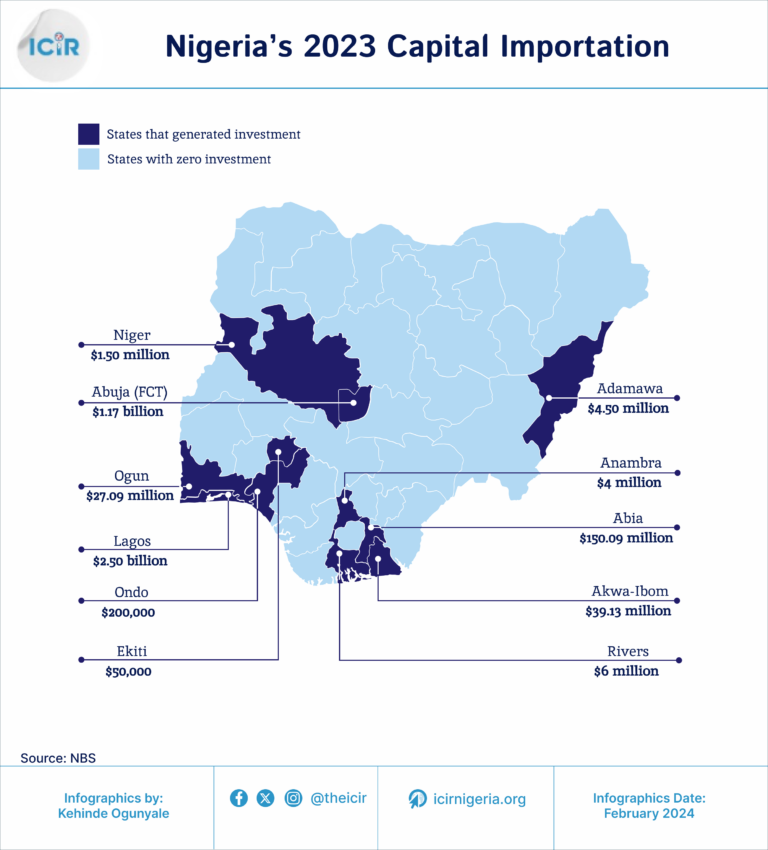
DATA from the National Bureau of Statistics (NBS) show that Nigeria generated $3.91 billion as capital importation in 2023, but only 11 of the country’s 36 states were destinations for imports.

The states are  Abia, Adamawa, Akwa Ibom, Anambra, Ekiti, Lagos, Niger, Ondo, Ogun, Rivers and the Federal Capital Territory, Abuja.

This means that no capital importation came through the remaining 26 states throughout the year. To put it in context these states did not get any foreign investment – money from abroad for the whole of 2023. 


Read Also:


Further analysis by The ICIR shows that 94 per cent of the total capital importation for 2023 was generated by Lagos and the FCT, Abuja. The two states had $2.50 billion and $1.17 billion respectively. 

This means that the other nine states pulled a total value of  $232.55 million in 2023. 

Capital importation is the influx of external resources into the local capital resources for investment, trade and business production. The NBS divides it into three main investment types: foreign direct investment (FDI), portfolio investment and other investments, each comprising various sub-categories. Others here refer to currency deposits, loans, trade credits etc.

From the NBS data, Nigeria generated a capital importation of $1.13 billion and  $1.03 billion in the first and second quarter of 2023 respectively. For the third and fourth quarters of the year under review, the country pulled $654.7 million and $1.09 billion in that order.

Nigeria’s 2023 Capital Importation

The total capital importation for 2023 is about 26.70 per cent lower than what was generated in 2022 which was $5.33 billion.  

The report showed that the lowest capital inflow was generated in Ekiti State which was $50,000 while Lagos State had the highest inflow with $2.50 billion.

Within the year, states like Abia, Anambra, Adamawa, Niger, Ondo and Rivers only generated capital inflow once which totalled $166.29 million.

When analysed by geopolitical zone, no states in the North-West region generated capital inflow. Osun and Oyo States were the only South-West geopolitical states with no capital importation in 2023. The South West region pulled a total of $2.53 billion in investment.

S/n
States with no capital importation in 2023
1 BAUCHI
2 BAYELSA
3 BENUE
4 BORNO
5 CROSS RIVER
6 DELTA
7 EBONYI
8 EDO
9 ENUGU
10 GOMBE
11 IMO
12 JIGAWA
13 KADUNA
14 KANO
15 KATSINA
16 KEBBI
17 KOGI
18 KWARA
19 NASARAWA
20 OSUN
21 OYO
22 PLATEAU
23 SOKOTO
24 TARABA
25 YOBE
26 ZAMFARA

States with no capital inflow in 2023

For other regions, the North Central generated, $1.17 billion in investments, a $4.5 million inflow in the North East, a $154.09 inflow in the South-East, and an inflow of  $45.13 million in the South-South region

The ICIR reported how only five states contributed to Nigeria’s $1.03bn capital importation in the second quarter of 2023.

Recently, the Minister of Industry, Trade and Investment, Doris Anite, said that the Federal Government secured $30 billion in foreign investment since it assumed office in May 2023.

According to her, “Some have already started building and the investments will come in over five to eight years. Some of the monies will come in the form of equipment, and direct investments into manufacturing and the facilities. So that fund is here already.”

‘CBN’s rate hike poses risk for banks, real sector’

0

THE CBN outcome of the Monetary Policy Committee (MPC) meeting would hurt the real sector of the economy, which is already contending with numerous macroeconomic challenges.

It would also pose a significant risk to the financial intermediation role of banks in the Nigerian economy, an economist, Muda Yusuf, said in a statement he shared with The ICIR on Tuesday, February 27. 

“The increase would constrain the capacity of banks to support economic growth and investment, especially in the real sector of the economy because the increases are quite significant,” Yusuf, who is also the chief executive officer of the Centre for the Promotion of Private Enterprise (CPPE), said. 


Read Also:

After its two-day meeting on Tuesday, the MPC raised the monetary policy rate (MPR) by 400 basis points from 18.75 per cent to 22.75 per cent and the cash reserve ratio (CRR) from 32.5 per cent to 45 per cent.

He said the decision was consistent with the typical policy response of the central banks globally, but it failed to reckon with domestic peculiarities. 

“The key drivers of Nigeria inflation are largely supply-side variables and the CBN ways and means of financing. Over the last two years, there has been persistent monetary policy tightening, yet there has not been any significant impact on the inflationary pressures. If anything, the general price level had been continuously on the increase.

“We recognise that the primary mandate of the CBN is price stability, but numerous headwinds have posed significant risks to this critical objective. Some of these include the surge in commodity prices and impact on energy cost, disruptive effects of insecurity on agricultural output, and global supply chain disruptions,” Yusuf said.


Read Also:


He pointed out that the surge in ways and means of finance also makes the CBN a culprit in the inflation predicament over the past few years, saying, “The hike in MPR or CRR would not change these variables.” 

The economist stated that the 32.5 per cent CRR had already constrained bank lending before CBN’s review and discretionary debits.

He noted that the credit situation in the economy was already very tight, with lending rates ranging between 25 to 30 per cent, explaining that the Nigerian banks have yet to live up to their financial intermediation role because of these constraining factors. 

“The Nigerian economy is not a credit-driven economy, unlike what is obtained in many advanced economies, which have much higher levels of financial inclusion, robust consumer credit framework, and strong correlation between interest rate and aggregate demand.  

“The level of financial inclusion in the Nigerian economy is still quite low, access to credit by households and MSMEs is still very challenging, and the informal sector accounts for close to 50 per cent of the economy, Yusuf said. 

Private sector bank credit as a percentage of gross domestic product (GDP) was 14 per cent in 2022 in Nigeria, 59 per cent in South Africa, 30.9 per cent in Egypt, 30 per cent in Botswana, 51.6 per cent in the United States and 130 per cent in the United Kingdom.

The CPPE boss said, “These underscore the variabilities across economies; thus, policy responses have to be different,” he pointed out that the transmission effects of monetary policy on Nigeria’s economy were still fragile. 

The hike in MPR to 22.5 per cent means the cost of credit to the private sector exposed to bank credits will increase, impacting their operating costs, product prices and profit margins amidst very challenging operating conditions.  

It might also adversely impact the equities market, submitting that the CBN must accelerate the increased capitalisation of the development finance institutions to create a concessionary financing window for the real sector and small businesses.

Yusuf highlighted critical drivers of inflation, including foreign exchange scarcity, energy cost, supply chain disruptions, insecurity, and climate change, among other factors.

The ICIR has reported that analysts at Commercio Partners Research expect the MPC’s rate hike to cause increased strain on the economy, especially businesses.

BBC seeks entries for Komla Dumor Award

THE British Broadcasting Corporation (BBC) is calling on journalists fluent in English, living and working in Africa to apply for the BBC World News Komla Dumor Award.

This opportunity is open to African journalists who combine strong journalism skills, on air flair and an exceptional talent in telling African stories.

The winner of the award will receive a once-in-a-lifetime training and development opportunity with the BBC in London, starting in early September 2024  and running for three months.  


READ ALSO:


Also, the winner will get to work with teams from across BBC News and produce an African story for the BBC which will be shared across the continent and the world.  They will be supported by a high-level BBC mentor and attend courses run by the BBC’s world-class training department, the BBC Academy. 

The BBC will pay for the winner’s flights to and from the UK, visa, accommodation in London during their placement as well as receive a £7000 allowance during the three months in London.

Deadline for application is March 15, interested journalists can apply here.

Atlantic Fellows for Health Equity programme seeks applicants

THE Atlantic Fellows for Health Equity is accepting applications for its 2025 fellowship programme.

The fellowship, which is accessible to journalists in their early to mid-career stages, will create and support a network of global, multidisciplinary leaders with the technical knowledge, skills and networks needed to advance health equity in their organisations and communities.

About 15 to 20 fellows will be chosen, and they will attend in-person and online sessions, as well as get coaching, peer mentorship and team-based training.

The programme will pay all educational and travel expenses associated with the fellowship. Applicants must be skilled in English.

The deadline to apply for the fellowship is April 11 and an informational webinar will be held on March 21.

Interested applicants can apply here

Over N10trn intervention funds by CBN damaging Nigeria’s economy – Cardoso

0

THE Governor of the Central Bank of Nigeria (CBN), Olayemi Cardoso, has said the over N10 trillion intervention funds granted by the apex bank caused severe damage to the country’s economy.

Cardoso said during a press briefing after the two-day Monetary Policy Committee’s (MPC) meeting on Tuesday, February 27.

The committee, after its 2-day meeting, raised the monetary policy rate (MPR) by 400 basis points to 22.75 per cent from 18.75 per cent to combat the soaring inflation in the country. 

The committee also adjusted the asymmetric corridor around the MPR to +100 to -700 from +100 to -300 basis points and raised the cash reserve ratio (CRR) to 45 per cent from 32.5 per cent.

Responding to a question on intervention, the CBN governor said, “The interventions that took place in the recent past were estimated in excess of 10 trillion naira. I am not talking about ways and means; I am talking about the interventions. 

“What was the budget of the Federal Government of Nigeria? What was the budget of the largest state in Nigeria? Do the math, and it will tell you the extent of damage.”

Had the N10 trillion been effectively utilised, it would have done much good to the economy, Cardoso lamented.


Read Also


He said the apex bank under his administration had moved away from granting interventions as the reason should not be far-fetched.

He noted that Nigerians were concerned about the surging inflation and relative influence on price stability and that the CBN would do everything to fight the ‘monsters ‘distorting the Nigerian economy.

Stressing that the interventions were dysfunctional, he said, “One, it takes away a lot of your time for something you do not have the expertise to do. And two, if not carefully handled, (it) creates a lot of distortions in the economy, even the inflow of money supply.” 

Cardoso maintained that the CBN would no longer be involved directly in interventions but would partner with entities that could handle them.

He assured that the CBN was doing all within its powers to monitor and recover the intervention monies damaging the economy.

“What has gone out, we have to ensure that we monitor them to ensure they come back in, and we are doing so.

“We are already doing that, and with the various degrees of success at some point in time and the interest of transparency, those figures will be made public,” he said.

He also assured that the time of failed intervention was over and would block any intervention with the potential to fail and would not get to the people it was intended for in the first place.

Cardoso defended his earlier remark that the naira was undervalued, blaming it mainly on what he called the “technical side” and assuring that the distortion in the system was removed.

Hinting that the apex bank was investigating some of the distortions, Cardoso said, “I may not be able to speak much on it, unfortunately, but as and when we come up with these distortions, take them off and throw them away. Where there are distortions as a result of bad behaviour, we will ensure that those who do it will face the music and act as a deterrent to ensure others in future do not go that route.”

The ICIR reported how the CBN intervention in the Anchor Borrowers Scheme to boost agriculture and stop rice importation faced challenges in several states and why the whole intervention needed a total overhauling.

CBN raises interest rate to 22.75%, says banks to recapitalise soon

THE Central Bank of Nigeria (CBN) Monetary Policy Committee (MPC) meeting on Tuesday increased the Monetary policy rate (MPR) by 400 basis points to 22.75 per cent.

The MPC also directed commercial banks to ensure safety buffers in their monetary management preparatory to imminent recapitalisation.

The recapitalisation, the MPC members said, would ensure safer management of banks’ stress triggered by inflationary pressures.

Notably, the MPR, also known as lending rate, was raised to 22.75 from the previous 18.75 per cent.

The committee also adjusted the asymmetric corridor from +100 to -700 from the previous +100 to -300 basis points.

READ ALSO:

The cash reserve ratio was raised from 32.50 per cent to 45.00 per cent, while the liquidity ratio was retained at 30 per cent.

The committee chaired by the CBN Governor, Olayemi Cardoso, who briefed the media said the decisions were influenced by the current inflationary and current exchange rate ratios,  projected inflation, and rising inflation expectations.

Cardoso said the committee members were concerned about the persistent rise in the level of inflation and said the rates would continue to reverse the trend and the inflationary pressures on the economy.

He stressed that the committee acknowledged and further noted that stable growth and output were possible in an environment of slow and stable inflation.

He further said the overall decisions were geared towards taking persistent inflationary pressures.

FX reforms

Speaking on foreign exchange market distortions, the governor noted that despite the present difficulties, the unification policies of the CBN were already yielding the desired results.

He explained that the MPC members were convinced that the ongoing reforms in the foreign exchange market would further strengthen the market.

Banks’ stability and recapitalisation

The committee also reviewed the key indicators of the financial banking system and noted that the system remained stable.

To further ensure the stability of the banking system, the MPC called on the banks to increase system buffers and recapitalise the banks to tame potential risks.

Members enjoined the banks to strengthen surveillance regarding the earlier guidance on the foreign exchange revaluation gains.

The committee also identified non-monetary factors driving inflation such as the persistent infrastructural deficits and noted the roles of fiscal policy in addressing the shortfalls while reiterating the monetary policy support.

It further applauded the civil service reforms which are focused on running down the cost of governance, while also ensuring a lean and efficient civil service structure.

Experts observations

An emerging market and fixed income expert, Ajibola Osho, reacting to the development said the CBN was being cost-cautious, adding that the “cost of funds” from commercial banks would go up for the real sector.

“The real sector would take the heat further because lending rate will go up further and businesses would take the heat because the commercial banks would take their mark-up funds from the CBN rate. The whole market sentiments are bearish,” she said.

Also, a Commercio Partners Research on the MPC decision sent to The ICIR via email noted that “The decision to hike borrowing costs is exceeding market expectations of a hike between 175 basis points to 225 basis points. Also, the Nigerian fixed-income market has seen some pricing-in, as some of the debt instruments have seen increasing yields.

“Sticking to maintain a hawkish stance amidst the present socio-economic problems confronting the Nigerian economy is a tough but bold move by the CBN. This move reiterates the CBN’s commitment to maintain price stability in the country.

“It would have been expected that based on recent data such as inflation, unemployment, and GDP, showing signs of weaknesses in the economy, the CBN would have taken a more subtle approach in its fight against inflation.”

Further insights

At the last MPC meeting in July 2023, the committee voted and raised the benchmark rate by 25 basis points to 18.75 per cent, adjusted the asymmetric corridor around the MPR to +100-300, and retained the CRR at 32.5 per cent.

Nigeria’s economy has since then witnessed increasing inflationary pressure, worsening the country’s economy and prompting many analysts to call on the new CBN governor, Olayemi Cardoso, to make rational decisions to rescue and bolster the economy.

Nigeria faces a sharp depreciation of its currency – the naira, rising cost of goods and services, energy, transportation, and other socio-economic headwinds.

Cardoso took over the helm of affairs at the CBN in September 2023, following the suspension and subsequent resignation of the embattled CBN governor, Godwin Emefiele, who is facing litigation over the misappropriation of funds and other charges.

The MPC has not been held since he assumed office to take any rational decisions on inflation despite the increasing month-on-month inflation rate to 29.9 per cent as of January.

The ICIR had reported that the apex bank indefinitely postponed the by-monthly meeting in September, November 2023, and January 2024.

At every MPC meeting, the committee considers the social, political, and economic events on the global and domestic levels to arrive at its decision, which it uses as one of the monetary tools to control inflation.

The ICIR reports that the MPR started to rise from May 2022 as inflation and the rates tended to move in the same direction.

When inflation rises, analysts expect that the committee will vote to raise the benchmark rate and adjust the other parameters where necessary.

Checks by The ICIR show inflation and MPR have trended in the same direction since 2022.

In May 2022, the headline inflation rose to 17.71 per cent, and the MPC voted and raised the MPR to 13.00 per cent in that same month from 11.50 per cent.

At its meeting in July 2022, the MPC raised the benchmark rates to 14.00 per cent following a rise in inflation to 19.64 per cent that month. In September 2022, inflation rose to 20.77 per cent, and the committee also voted to raise the MPR to 15.50 per cent.

In November 2022, the committee raised the MPR to 16.50 per cent after inflation rose to 21.47 per cent, and in January 2023, the rate was 17.50 per cent as inflation throttled to 21.82 per cent.

Inflation increased to 22.04 per cent in March 2023, and the committee raised the MPR to 18.00 per cent at its March 2023 meeting. In May of that same year, the committee increased the rate to 18.50 per cent when inflation jumped to 22.41 per cent.

At its last MPC meeting in July 2023, the committee also raised the MPR to 18.75 to control the headline inflation, which climbed to 24.08 per cent. Since then, headline inflation has continued to grow, surging to 29.9 per cent as of January, according to the National Bureau of Statistics (NBS) latest report.

MPC, responsibilities, and decisions

The committee is the CBN’s highest policy-making body communicating policy direction to address major economic issues, such as inflation and benchmark interest rates.

It is also saddled with the responsibility to review economic and financial conditions in the economy, determine appropriate policy stance in the short to medium term, check the CBN monetary policy framework, and adopt changes when necessary.

After all the considerations, the committee members vote to adjust the MPR, CRR, asymmetric corridor around the MPR, and liquidity ratio.

The ICIR reported that in just seven months of President Bola Tinubu’s administration, inflation has risen by 749 bps to 29.9 per cent and food inflation by 1,059 bps to 35.41 per cent.

Tinubu removed fuel subsidy and unified the exchange rate, which had heated Nigeria’s fragile and volatile economy, pushing more Nigerians into acute poverty and creating hardships.

Analysts had told The ICIR that the committee would vote to raise rates as the factors influencing inflation were cost-push. As such, the CBN contractionary monetary policy would not avail, but the situation requires fiscal policy interventions.

The Nigeria Labour Congress (NLC) has today, Tuesday, February 27, started a two-day nationwide strike to compel the Federal government to address the hunger and hardships in the country.

 

Police nab 2nd Abuja kidnap leader days after Wike’s N20m bounty

0

THE Federal Capital Territory (FCT) Police Command has arrested a ‘notorious’ kidnapper, Samaila Wakili Fafa, a.k.a Habu Ibrahim, days after the FCT Minister, Nyesom Wike, placed a N20 million bounty on his head and one other.

The command, in a statement signed by its spokesperson Josephine Adeh, on Tuesday, February 27, said acting on credible intelligence, on February 24, at about 7:05 p.m., the command’s operatives stormed Sardauna Forest, Toto, Nasarawa State, and arrested Wakili, who had been on the command’s wanted list for a long time.

“The suspect is one of the two kidnappers the Honorable Minister FCT placed a bounty on, as the other one, namely Saidu Abdulkadir a.k.a Dahiru Adamu, had earlier been arrested by the command.


Read Also:

“He confessed that his syndicate masterminded and executed several kidnappings in FCT and its environs, including the abduction of Barr. Chris Agidy, the legal aid to Senator. Ned Nwoko and Mr Sunday Yahaya Zakwai, the district head of Ketti Village, who were later killed by them,” part of the statement reads. 

According to the police spokesperson, Wakili further led police operatives to where the body of Agidy was buried, and the police recovered and deposited the body in Gwagwalada General Hospital.

The police said while the investigation was ongoing, the FCT Commissioner of Police, Benneth Igweh, reiterated his commitment to combating crime and criminality and to ensure the safety of the FCT residents. 

The Command urged residents to report suspicious activities through the following emergency lines: 08032003913, 08061581938, 07057337653, and 08028940883; PCB: 09022222352.

The ICIR reported that the command arrested a kidnapper, Saidu Abdulkadir, also known as Dahiru Adamu, barely 48 hours after the Wike offered a N20 million bounty.

The FCT police commissioner, Benneth Igwe, said his officers made the arrest after a raid on kidnappers’ camps bordering Nasarawa and Abuja via Kuje Area Council at about midnight on Thursday, February 15.

The ICIR reported that on Wednesday, February 14, Wike promised the command a N20 million reward to apprehend two notorious kidnappers, including Abdulkadir and Wakil.

Several reports by The ICIR ( including the one here and here) have captured the plight of the FCT residents abandoning their homes due to rising kidnapping and bandits attacks.

Speaking on the bounty during a chat with The ICIR on Tuesday, February 27, a security expert, Oladele Fajana, said he did not support the idea of bounty or rewards before police and other security agencies could do their job.

“The idea of announcing bounty, I don’t like it. I don’t know who gets the bounty. It’s not a good thing for security agencies.

“I have never supported it and won’t support it; it has never worked.
Even with the EFCC, it has never worked. It is a fallacy. The police have been paid for their work, so they should do it without expecting any extra reward,” Fajana stated.


Audit report indicts Nigeria’s SEC for N60.65bn fraud

0

THE Nigerian Securities and Exchange Commission (SEC) has been indicted by the Office of the Auditor-General (OAuGF) for committing fraudulent activities amounting to N60.65 billion.

The OAuGF exposed the SEC’s activities in the ‘Auditor-General for the Federation’s Annual Report for the year ended December 2020, ‘ released recently.

It revealed the non-compliance/internal control weaknesses in the federal government’s ministries, departments, and agencies (MDAs).


Read Also:


According to the audit report, the SEC, the apex regulator in the Nigerian capital market, committed 27 infractions during its operations in 2017, 2018, and 2019. See the table below for details of the issues involved.

OAuGF indictment against SEC
S/N INFRACTION AMT INVOLVED
1 Irregular payment of allowances to staff 11,087,344,294.94
2 Ineligible allowances paid to some directors of the commission 625,915,105.70
3 Non-deduction and remittance of PAYE 545,027,411.21
4 Irregular payments of staff PAYE liabilities from public funds 33,424,144.56
5 Irregular payment of medical allowances to staff registered under national health insurance scheme 241,865,640.08
6 Improper payments of medical bills 173,033,395.53
7 Irregular payment of monetised car grant to management staff 3,382,313,745.12
8 Unjustified payments of furniture allowance to staff of the commission 848,986,361.50
9 Diversion of public funds to pension fund administration (PFAs) 871,441,029.08
10 Illegal payment of commission gross income earned on pension fund investments 93,380,888.38
11 Ineligible payments by the commission 269,079,000.00
12 Irregular payment of productivity incentive bonus 34,899,051.15
13 Irregular payment of gratuity/severance to retired staff 1,013,565,617.08
14 Extra-budgetary expenditure 27,191,792,063.85
15 Irregular payment of severance allowance to non-staff 255,426,494.80
16 Irregular transfer of funds to the investment and securities tribunal 1,151,197,320.96
17 Irregularities in the engagement of and payment to audit firms 134,647,500.00
18 Payment for foreign travels without approval 361,787,800.38
19 Unaccounted expenditure by the commission’s subsidiaries 774,259,000.00
20 Irregular payment of allowances 7,394,287,819.88
21 Under remittance of operating surplus 3,400,256,386.14
22 Engagement of external solicitors without the approval of the attorney-general of the federations 329,745,402.82
23 Payments of tenement rates not accounted for 199,527,500.00
24 Unsubstantiated transfer of public funds 50,000,000.00
25 Payments to media houses without evidence of publication 37,096,870.23
26 Irregular payment of sabbatical leave 96,262,704.87
27 Non-adherence to due process in the disposal of vehicles 56,220,000.00
Total amount of indictment 60,652,782,548.26


It disclosed that the SEC perpetrated irregular payment of allowances to staff, failed to deduct and remit staff pay-as-you-go (PAYE) taxes, diverted public funds to pension fund administration (PFAs), reported extra-budgetary expenditure, made payment for foreign travels without approval and unjustified payments of furniture allowance to staff.

The SEC was also involved in ineligible allowances it paid to some of its directors, made improper payments of medical bills, engaged external solicitors without the approval of the Attorney-General of the Federations, and did not account for expenditure by its subsidiaries, among other issues.

The ICIR reports that in the three years under review, the Commission had Abdul Zubair as the SEC Director-General, who served between 2017 and 2018 and Mary Uduk, who served in the same capacity between 2017 and 2020.

The current DG, Lamido Yuguda, was appointed by former President Muhammadu Buhari in May 2020, assumed office on Monday, July 6, 2020, and took over from Uduk.

The audit report specifically accused the SEC of wasting, diverting, and losing public funds and government revenues, exposing the Commission’s inability to fund its budget.

Despite the weighty indictment, the report stated clearly that the SEC management could not provide responses to some of the issues or clear itself from the spotted infractions.

For instance, the SEC could not provide OAuGF’s inquiry over the N11.09 billion the Commission paid its staff between 2017 and 2019 for dressing, leave, medical, education, rent, mineral and other allowances.

The OAuGF stated emphatically that the SEC DG should account for, provide justifications, submit evidence, and remit the various amounts involved in the infractions to the National Assembly Public Accounts Committees.

It also stated that for non-adherence to due processes in its operations in the review years, the Commission should be sanctioned by the Financial Regulations 2009 for gross misconduct of public funds, among other infractions.

It specifically recommended paragraphs 3106, 3115, 3129, and 3111 as sanctions against the SEC and its management.

Paragraph 3106 states, “A public officer who makes an irregular payment from public funds, shall be given 21 days’ notice to explain. Where no satisfactory explanation is given, the amount involved shall be recovered from the officer and such officer shall be removed from the schedule.”

Paragraph 3111 states, “A public officer who receives a query involving an overpayment of public funds in respect of salaries and allowances to staff, shall be given 21 days within which to replay to the query and refund the amount overpaid. He shall also be disciplined by Public Service Rules and if need be, the matter should be referred to the police for prosecution.”

Paragraph 3115 also states, “An Accounting Officer who is queried for his failure to manage or spend public funds effectively or who spends money without due regard to economy contrary to FR 415 and fails to reply to the query, shall be removed from the schedule and be disciplined by the Public Service Rules.”

The ICIR had, in a report, raised the concern that the non-compliance of the SEC in publishing its annual reports yearly for public consumption raises concerns about the Commission’s integrity in their financial management.

Nigerian sitcom, ‘The Johnsons’, ends after 13 years

0

AFTER 13 years of captivating audiences across Africa, the Nigerian sitcom ‘The Johnsons’ has finally ended.

Announcing the conclusion of the TV series, Nollywood actor Charles Inojie took to his Instagram to share some behind-the-scenes photographs and videos from the film set, taking fans on an emotional journey through memory lane and expressing his heartfelt gratitude to viewers over the 13-year journey.

“Thank You, Africa. After 13 years of absolute magic,13 years of awesomeness, 13 years of being Africa’s most-watched show on television, 13 years of being every family’s favourite, The Johnsons is finally taking a bow,” he wrote.

He also lauded the team members and viewers for their support.

“I thank my co-travellers, the wonderful team of cast and crew, without whom these past 13 years could not have been spectacularly outstanding as The Johnsons made it. I am immensely grateful to our fans across the African continent for the love and support we got unconditionally.

“Indeed, while it is the beginning of greater exploits from every individual member of the team, like every good thing that must have a terminal point, it is the end of the road for The Johnsons. Thank You”, he added.

The television series premiered in 2012, with Rogers Ofime as executive producer and Thomas Odia and Olusola Roberts, as directors. It was popular for its realistic depiction of family relationships and daily living in Nigeria.

The humour-filled TV series has ten seasons and 1,830 episodes, starring notable actors including Charles Inojie, Chinedu Ikedieze, Olumide Oworu, Samuel Ajibola, Susan Pwajok, and the late Ada Ameh, who died in 2022, among others.

Ex-IGP threatens to sue ICIR over investigation on shady Police housing project

A former Inspector General of Police and Chairman of the Police Service Commission, Solomon Arase, has threatened to sue the publisher of the International Centre for Investigative Reporting over a report on the controversial sale of residential Police Barracks.

The ICIR had reported how the Nigeria Police under the ex-IGP and his successor, Ibrahim Idris, approved the development of a designated Police Barrack at Mbora district as an estate in circumvention of approved guidelines for the sale of federal government-owned facilities in FCT. 

The report detailed how former staff of the estate developer who was part of the deal testified in the court how they lured both former IGPs with N200 million and house allocation to secure the contract. 

However, in a press statement issued by the spokesperson of the Police Service Commission, Ikechukwu Ani and published by the Guardian on February 22, Arase failed to address this gross violation of law but rather threatened to take legal action on The ICIR for what he described as “cyberstalking”. 

___________________________________________________________________

Read also:

[EXCLUSIVE] Two former IGPs, senior Police officers accused of bribery in shady land sale of designated Police Barracks

_______________________________________________________________________

The ICIR observed that the Guardian has updated the publication to reflect a part of the investigation, but the earlier version of their report has been archived here. 

“While the initial inclination was to ignore the spurious publication with a view to denying the misguided authors and the elements they might be representing the undue attention they were, perhaps, seeking to attract, the depth of the misinformation, maligning content and hatchet man job they clearly seek to project and the overriding consideration of the need to continually protect Dr. Arase’s hard earned public service reputation and integrity, make it expedient that the records be set straight,” the updated statement reads.

“The publication essentially seeks to project a false narrative indicating that in his then capacity as the Inspector-General of Police between 2015-2016, that he drew pecuniary benefits as reward for ‘selling’ police barracks at Mbora District, Abuja.”

According to the Oxford Dictionary, cyberstalking is the repeated use of electronic communications to harass or frighten someone, for example, by sending threatening emails or messages. The ICIR only contacted Arase via phone for reaction which he declined.

In the statement, Arase failed to mention whether the deal followed the Public Procurement Act, enacted in 2007, which prescribes principles by which public institutions such as Nigeria Police Force should conduct their affairs.

Part of the statement reads, “In furtherance to his dispute with Messrs Corpran International Limited, it is clear that Barrister Francis Mgboh is attempting to drag credible personalities with a view to discrediting all principal actors in the project by undertaking smearing campaigns against such responsible personalities and corporate entities involved in the perfection of the well-intentioned project. It is clear that ICIR has wittingly or unwittingly, become a tool in the advancement of this smear campaign.

“IGP Arase (rtd), therefore, finds the unholy alliance between ICIR and Barrister Francis Mgboh in engaging the ICIR platform and the cyberspace to malign his personality and taint his hard-earned public service reputation in the manner conveyed in the publication under reference as irresponsible, intolerable, ill-intentioned and in bad faith.

“At no point in the project perfection process did Dr. Arase seek nor obtain any form of reward as being maliciously and falsely projected by ICIR or their paymasters.”

He also failed to mention the procurement method and the media in which the contract was advertised for interested bidders to compete as provided by the PPA that a contract of such magnitude should be advertised in two national dailies.

Arase also did not address the allegations that he and other senior police officers got a house in the estate nor the the criteria used in selecting the developer and allegations of forgery pointed out by the ex-staff of Copran International Limited. 

The ICIR reported that the Federal Capital Territory Administration (FCTA) allocated 2.13 hectares of land at Cadastral Zone C 06, Mbora District, Abuja to the Nigeria Police in 2014 for the construction of barracks to address the inadequate housing for police officers.

But findings showed that top officials of the Police approved the development of the lands to Copran International Limited, an Abuja-based company against its purpose of allocation and approved guidelines which restricted such land from being sold.

The ICIR sent a Freedom of Information to the Ministry of Police Affairs to track the procurement processes and they admitted that they did not have any information on the project. A copy sent to the Nigeria Police Force was also not responded to as the lawyer assigned couldn’t provide details of the contract. 

The report also revealed how the Nigeria Police Mortgage Bank granted a loan of N573 million to the developer without collateral as against the law. 

Arase said he has briefed his lawyer to initiate requisite civil actions against ICIR and petitioned the relevant law enforcement agency for “cyberstalking and sundry crimes.”