FORMER governor of Ondo state Governor Rotimi Akeredolu, died on Wednesday, December 27, after a prolonged illness at the age of 67.
The state government confirmed his passing and disclosed he battled leukaemia and prostate cancer, which resulted in his death.
He was the third Nigerian governor who died in office since the country returned to democracy in May 1999.
Others are Patrick Yakubu Yakowa, who died in 2012 in a military jet crash, and Mamman Ali of Yobe state, who yielded to death in 2009 after a long battle with leukaemia.
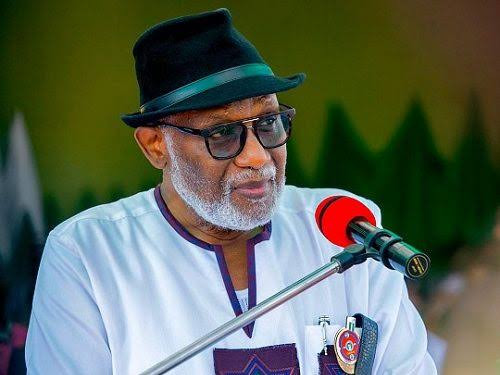
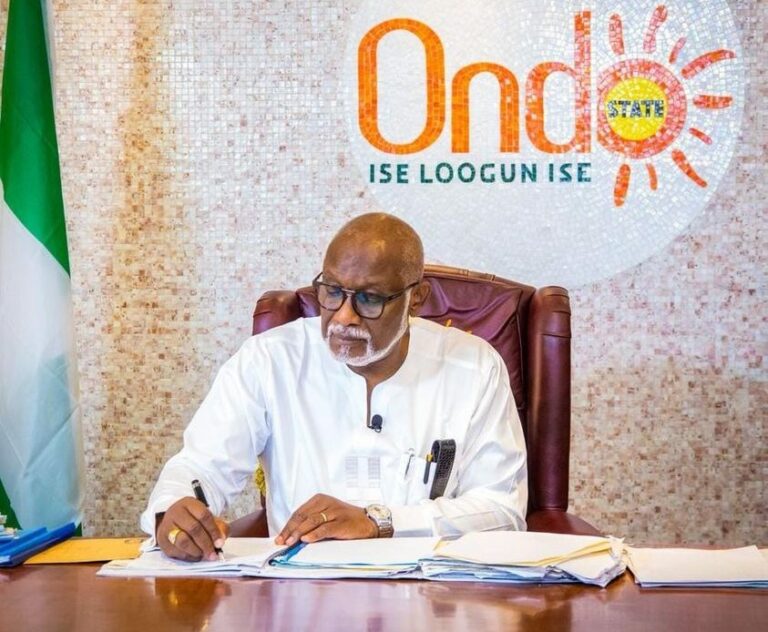
Former governor of Ondo state Rotimi Akeredolu
Confirming Akeredolu’s passing in a statement on Wednesday, December 27, the Ondo state government said the former chairman of the Nigeria Bar Association died of protracted prostate cancer.
The ICIR reports that the late governor had been incapacitated for several months, disrupting governance and causing confusion in the state.
The late governor was born on July 21 1956, in Owo, Ondo state, to the late Ola Akeredolu and Grace Akeredolu.
Patrick Yakubu Yakowa (Kaduna state)
Patrick Yakowa served as governor of Kaduna state from 2010 to 2012.
He was appointed deputy governor in July 2005 and returned as deputy governor in the April 2007 elections.
He was sworn in as governor on May 20, 2010, replacing former governor Namadi Sambo, who was picked as vice president to former President Goodluck Jonathan.
Yakowa ran for election as Kaduna Governor in the April 26 2011 polls and won.
On December 15, 2012, a Nigerian naval helicopter crashed in the Niger Delta, killing Yakowa and a former national security adviser, Owoye Azazi.
Former Kaduna state governor, Patrick Yakowa.
Others who died in the tragedy include Mohammed Kamal, Dauda Tsoho and two pilots.
Mamman Bello Ali (Yobe state)
Mamman Bello Ali contested and won the governorship election in Yobe in 2007 under the defunct All Nigeria Peoples Party (ANPP).
He was in office until he died in 2009.
Before becoming governor, he served as a senator representing Yobe South Senatorial District between 1999 and 2007.
Former governor of Yobe state, Mamman Ali
He died of leukaemia while receiving treatment at a hospital in Florida, United States, on January 27, 2009
THE new governor of Ondo state, Lucky Aiyedatiwa, has appointed five aides hours after taking the oath of office on Wednesday, December 27.
He announced the appointments through his deputy chief of staff, Omojuwa Olusegun.
The governor named the publisher of Trace Magazine, Ebenezer Adeniyan, as his chief press secretary and Sunday Abire as special assistant on new media.
Others are Smart Omodunbi as special assistant on political matters, Monturayo Oyedele as special assistant on photography, and Temitayo Iperepolu as special assistant on domestic and Government House matters.
The appointments take effect immediately.
Meanwhile, three aides to the late Governor Rotimi Akeredolu tendered their resignation letters following the death of their principal on Wednesday, December 27.
The aides include the late governor’s chief press secretary (CPS), Richard Olatunde, special adviser on union matters and special duties, Dare Aragbaye, and the senior special assistant to the governor on special duties and strategy, Adedoyin Odebowale.
Their letters were addressed to the Office of the Secretary to the State Government. They cited Akeredolu’s demise as the reason for their resignation.
“My decision to resign from office is hinged on the unfortunate and untimely death of our leader, principal, and father figure, Governor Oluwarotimi Akeredolu, SAN, CON,” Olatunde noted.
Aragbaye also cited his loyalty to the deceased as the reason for his resignation.
“My decision to resign is based on the unfortunate death of my principal, a fearless and honest leader, Governor Arakunrin Oluwarotimi Odunayo Akeredulu, SAN, CON, whom I am loyal to even in death,” his resignation letter read.
Odebowale also cited his loyalty to the late leader as why he quit.
Akeredolu succumbed to death in the early hours of Wednesday, December 27, after battling a prolonged illness.
Lucky Aiyedatiwa, his deputy, who had been serving in an acting capacity at the time of his death, was sworn in as governor some hours later.
The nature of Akeredolu’s illness had been undisclosed for a long time, but the state government revealed that he died of prostate cancer while confirming his death.
His ailment had stretched for several months and resulted in a feud between the late governor and his deputy following the late governor’s insistence on retaining power despite being unable to function optimally.
As the feud deepened, the Ondo State Assembly moved to impeach Aiyedatiwa despite the Federal High Court in Abuja restraining the legislators from impeaching him.
President Bola Tinubu waded into the dispute in November, urging all parties to “bury the hatchet and maintain the status quo,” which was later explained in a statement by the presidency to mean that Aiyedatiwa remains in his place as deputy.
Aiyedatiwa had accepted Tinubu’s directives, and shortly after, the state Assembly halted impeachment plans.
While embarking on his most recent medical leave on Tuesday, December 12, Akeredolu transmitted power to Aiyedatiwa.
As we stepped out of the pages of 2023, our reporters, in retrospect, highlighted stories that resonated with them. Here are their top picks of standout stories that made 2023 memorable.
1. How North Korean runs illegal hospital patronised by the high and mighty in Abuja
Check out the shocking revelation of a North Korean running an illegal private hospital in Abuja. Our investigation exposes the four-year operation of Lilu Specialist Hospital, which attracts patronage from high-profile individuals, including public officials. The hospital lacks proper registration and operates without a signboard. Despite having a tax identification number, it doesn’t pay the required taxes, and there are several concerns about the nationality of the hospital’s proprietor, who claims to be Chinese, but… Read the full report here.
2. ‘No space’, Abuja hospitals reject patients over dearth of bed space, NARD actions
Explore the challenges faced by Abuja’s public hospitals in 2023, grappling with a severe shortage of bed space amid an ongoing doctors’ strike. The ICIR sheds light on the negative impact on patient care and the growing imbalance in the doctor-patient ratio. Read the full report here.
3. Brides by Barter: Inside story of Niger state communities where young girls are forced into marriages
Uncover the barbaric practice of forced marriages affecting young girls in Niger State. Our investigation features interviews with brave girls resisting forced unions, shedding light on cultural and economic factors contributing to child marriages. Read the full report here.
4. Hardship: Nigerians Turn to Loan Sharks Amidst Challenges
This story aggregates, in detail, the challenges faced by Nigerians dealing with loan apps, revealing cases of harassment, cyberbullying, and unethical practices. Despite regulatory efforts, some loan apps operate without licenses, exploiting the economic crisis. The report identifies specific loan apps engaging in such practices, including Henloan, Quick Credit, Flypay, Camelloan, Cashdoor, and others. The report also exposes the lack of oversight for these loan apps, as many operate without the required licenses from the Central Bank of Nigeria (CBN). Read the full report here.
5. The ICIR’s Bold Predictions: Ministers in Tinubu’s Cabinet and Off-Cycle Governorship Elections
The ICIR’s predictions on appointed ministers in Tinubu’s cabinet and elected governors in the off-cycle elections in Kogi, Imo, and Bayelsa states were also noteworthy, as some of the predictions were correct. Explore ministerial predictions here and governorship predictions here.
Click on the links to unravel the full stories and stay informed on the issues that mattered in 2023!
ACTING governor of Ondo state, Lucky Aiyedatiwa, has been sworn in as governor following the death of his principal, Rotimi Akeredolu, who died in the early hours of Wednesday, December 27.
The ceremony was presided over by the state chief judge, Olusegun Odusola, who administered the oath of office on Wednesday in the presence of other judges and top government functionaries.
In his inaugural speech, Aiyedatiwa described Akeredolu’s passing as devastating.
He said the late governor’s initiatives reduced criminality and banditry in the state and the South-West.
Aiyedatiwa promised to complete and build on the late governor’s infrastructural and other ongoing projects in the state.
“This event has placed a burden on all of us to pull together and stay together as one because we have the onerous responsibility to continue to sustain the legacies of Oluwarotimi Odunayo Akeredolu SAN CON, which was good governance…
“Our leader and governor during his time embarked upon several landmark projects, many if which have been completed and several ones ongoing. We now have the responsibility to complete them,” he said.
Earlier on Wednesday, the Ondo state government, confirming the former governor’s death, said in a statement that he died of prostate cancer.
Akeredolu and Aiyedatiwa had been involved in a months-long feud over the governor’s insistence on retaining power despite being unable to function optimally due to ill health.
On Friday, November 24, The ICIRreported that Akeredolu had been out of Ondo state for 171 days, nearly six months since he was flown out of Nigeria to receive care for an undisclosed medical condition.
Although he returned to Nigeria in September, the governor remained in Ibadan, the Oyo state capital, where he governed the state.
He only transmitted power to his deputy on Tuesday, December 12, when he was about to embark on a fresh medical vacation to Germany.
Amid the feud between him and his deputy, the Ondo State Assembly moved to impeach the Deputy Governor despite the Federal High Court in Abuja restraining the legislators from impeaching him.
President Bola Tinubu waded into the dispute in November, urging all parties to bury the hatchet and maintain the status quo.
“This means that Governor Akeredolu remains the chief executive of the state. Aiyedatiwa remains deputy governor, and members of the state executive council continue their respective duties, even as the leadership of the state’s House of Assembly and the APC chapter in Ondo state is preserved,” a statement by the presidency released after the meeting disclosed.
Conceding to the President’s directives, Aiyedatiwa accepted to remain in his position as deputy, describing the crisis as part of politics, and the state assembly withdrew impeachment plans against him.
PRESIDENT Bola Tinubu has joined other Nigerians in mourning the death of Ondo state Governor Rotimi Akeredolu.
In a statement he released via his X handle on Wednesday, December 27, the President lauded the late Akeredolu for his efforts in advancing justice and fairness through various means.
The ICIR reported that the ailing governor diedin the early hours of Wednesday after battling with prolonged sickness.
According to the state government, Akeredolu died of complications arising from protracted prostate cancer while receiving medical treatment in Germany.
He was aged 67.
Reacting to his death, Tinubu said the late governor was a strong voice and an advocate of strengthening the nation’s security architecture, particularly in the South-West.
“Rotimi was a man of ideas and action. While he was with us, he taught us the power of action and service. In Ondo State, where he had the honour to serve as the governor over the past six years, he served his people with absolute loyalty, dedication, and forthrightness. His footprints dot the entire landscape of the state through the hundreds of kilometres of roads he built, the many schools he built, and healthcare facilities that he provided.
He also extended his condolences to the people of Ondo state, noting that he had telephoned the deceased’s wife and Acting Governor Lucky Aiyedatiwa to commiserate with them.
“I hope that his successor, Aiyedatiwa, will hold steadfast to the vision of governance left by this towering political leader,” the President added.
Similarly, several state governors have commiserated with Ondo state and the deceased’s family.
The Ogun state Governor Dapo Abiodun, in his condolence message, described Akeredolu’s death as tragic, noting that the late governor was a visionary leader with an unwavering dedication to his people and social justice.
“Akeredolu made an indelible mark on Nigerian politics. From his tenure as the chairman of the Nigeria Bar Association to his role as the chairman of the South West Governors Forum, he continuously championed the cause of justice and the upliftment of his people.
“Known for his tireless efforts to improve the lives of Ondo citizens, Akeredolu spearheaded major initiatives that brought about positive change. Under his leadership, the state witnessed significant advancements in healthcare, infrastructure, and education. His commitment to sustainable development earned him the respect and admiration of colleagues and citizens alike,” he said.
Also, the Kwara state Governor, AbdulRahman AbdulRazaq, described Akeredolu as an exceptional statesman who would be remembered “for his courage, patriotism, and immeasurable contributions to the constitutional and sociopolitical development of Nigeria.”
The Oyo State Governor, Seyi Makinde, also mourned Akeredolu’s passing.
Condoling the Ondo state and the deceased’s family, he wrote in a statement: “In Aketi, South-West has lost a dogged fighter and courageous leader who worked hard for the peace, prosperity and progress of the region. I have also lost a worthy co-fighter for the South-West cause because we were both at the vanguard of the struggle, which birthed the South-West Security Network Agency codenamed Amotekun.
”Aketi’s fervent and unrelenting stance on issues that border on South-West’s regional integration and progress is a lesson for leaders. He will be sorely missed.”
Other leaders who have expressed grief over the passing of the late governor include the Speaker of the House of Representatives, Abbas Tajudeen, former Senate President Bukola Saraki, and the Minister of Aviation and Aerospace Development, Festus Keyamo.
FOR most of 2023, the Nigerian courts were busy with various cases ranging from election litigations to corruption and other issues.
As the year winds down, The ICIR’s Bankole Abe highlights key issues in the nation’s judiciary in the outgoing year.
Post-election cases in 2023
All eyes on the Judiciary
The post-2023 general elections litigations made Nigerians beam searchlights on the judiciary as the aggrieved parties sought redress in courts.
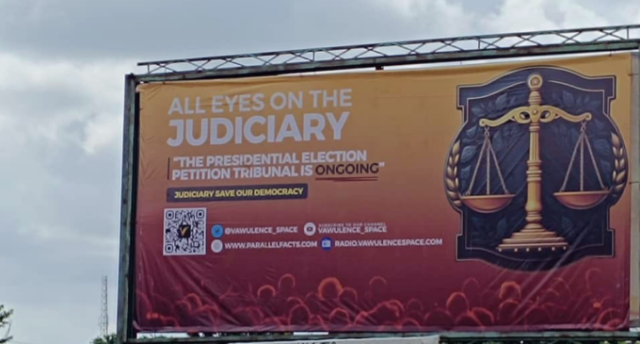
Some Nigerians developed a campaign tagged “All Eyes on the Judiciary” following the presidential election case at the Presidential Election Petitions Tribunal (PEPT).
The slogan resonated with many citizens who keenly expected the court’s pronouncement on who would lead the nation for another four years after the exit of former President Muhammadu Buhari.
The hashtag #AllEyesOnTheJudicairy and its different variations gained traction when the PEPT was about to conclude its hearing.
While the campaign was going online, people were erecting billboards across Nigeria.
A variation of the All Eyes on the Judiciary billboard.
There were reports that the All Progressives Congress (APC) -led government clamped down on the campaigners. The Federal Government also dissolved the Advertising Standard Panel (ASP) for approving the trending ‘All Eyes on The Judiciary’ billboards.
The billboards breached the ASP’s ethical guidelines”, Olalekan Fadolapo, head of the Advertising Regulatory Council of Nigeria (ARCON), said in a statement disbanding ASP.
The ARCON also orderedthe destruction of all billboards carrying the slogan nationwide.
On its part, Intercontinental Marketing & Communication Consortium Limited, the agency that ran the campaign on behalf of its clients, said it followed all due processes and got approval before mounting the campaign on billboards.
Tribunal rulings
After the 2023 general election, the courts were filled with petitions against candidates declared winners by the Independent National Electoral Commission (INEC).
The INEC announced winners in different states, and soon after the announcements, the battle shifted to the Election Petitions Tribunal across the country.
The governorship election petitions tribunals have given judgments in several cases brought before them by the parties.
Here is a lookat the tribunals’ rulings across the states.
After the tribunal ruling, some candidates and their parties who lost at the tribunal proceeded to the Appeal court.
Here are a few decisions from the Appeal court
Adamawa state
On Monday, December 18, the Court of Appeal in Abuja affirmed the victory of Fintiri as the duly elected governor of Adamawa state.
The court dismissed a petition by the APC and its governorship candidate, Aisha Dahiru, also known as Binani.
In its judgment, the court held that the Adamawa governorship election petition tribunal rightly proclaimed Fintiri the poll winner.
Kano state
In a judgement that generated many reactions, the Appeal Court in Abuja sacked Abba Yusuf as Kano state governor, affirming the state’s governorship election petitions tribunal ruling, which earlier sacked him.
APC is contesting Yusuf’s victory as the election winner.
In a judgment delivered on Friday, November 17, a three-member panel of the appellate court held that Yusuf’s party – the New Nigeria Peoples Party (NNPP) – breached the Constitution by sponsoring him when he was not a party member.
Nasarawa state
The Appeal Court in Abuja dismissedthe Nasarawa state governorship election petition tribunal’s ruling on the election. It affirmed Abdullahi Sule of the APC as duly elected.
In its decision on Thursday, November 23, the appellate court stated that the tribunal erred in naming the PDP candidate, David Ombugadu, as the legitimate winner in the poll.
Ogun state
The Court of Appeal, Lagos, upheld the elections of Dapo Abiodun as the duly elected governor of Ogun state.
In the majority judgment delivered by Joseph Ikyegh, the appellate court rejected the appeal filed by Ladi Adebutu, the PDP candidate.
However, the minority judgment delivered by Ane Inyang was delivered in the PDP’s favour as it ordered INEC to conduct a fresh election in the state within 90 days.
Rivers state
On Tuesday, November 28, the appellate court dismissed the suit filed by the governorship candidate of the APC, Tonye Cole, challenging the victory of Siminalayi Fubara of the PDP.
The Appeal Court, in a unanimous decision, dismissed Cole’s petition.
Supreme Court judgment on presidential election
In Nigeria, most presidential elections always end at the Supreme Court, and the 2023 presidential poll was no different.
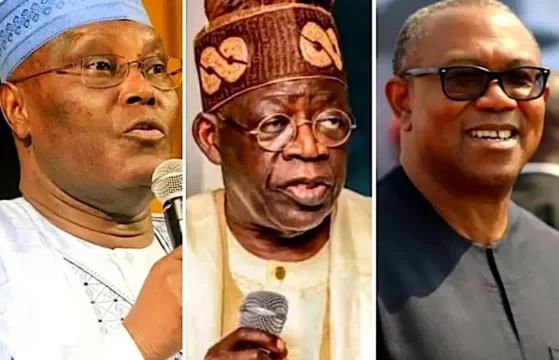
Atiku Abubakar, Bola Tinubu, Peter Obi. Image courtesy: Vanguard
Following the path of the Court of Appeal, on October 26, the Supreme Court dismissed the suits filed by Atiku Abubakar of the PDP and Peter Obi of the Labour Party (LP). It affirmed the Appeal Court’s judgment, which affirmed the victory of President Bola Tinubu of the APC.
Confusion over CTC of Appeal Court judgement on Kano election
There was confusion over the released Certified True Copy (CTC) of the Appeal Court judgment on the Kano state governorship election as a portion of the report contradicted what the court delivered and affirmed Abba Yusuf’s victory as the duly elected governor.
The court’s ruling had sacked Yusuf as governor.
On page 67 of the CTC, sighted by The ICIR on Tuesday, November 21, and signed by the Registrar, Jameel Ibrahim Umar, the court upheld Yusuf’s victory.
On November 17, The ICIRreported that the Court of Appeal in Abuja sacked Yusuf as Kano state governor, affirming the state’s governorship election petitions tribunal ruling.
On page 67 of the CTC sighted, the panel headed by Moore Abraham Adumein, in its conclusion, said, “I will conclude by stating that the live issues in this appeal are hereby resolved in favour of the 1st respondent and against the appellant.”
In this case, Governor Yusuf is the appellant, while the APC is the first respondent. The second and third respondents are the NNPP and INEC.
The first ruling, which settled the matter in favour of the APC, indicated that the tribunal’s decision was upheld, contrary to the CTC later released by the court, which stated that the tribunal’s decision to remove Yusuf had been overturned.
It was a clerical error
Speaking on the controversy, the chief registrar of the Court of Appeal, Umar Bangari, claimed that the alleged disparity was a clerical error that had no bearing on the court’s ruling.
Bangari stated that the Court of Appeals Handbook, Order 23, Rule Four gives the court the authority to fix any clerical error that it or any of the parties to the case discovers.
Bangari promised to correct the ‘error’ as soon as the parties to the case file official applications to that effect.
Fire guts Supreme Court
A section of the Supreme Court complex in Abuja caught fire on Monday, September 25.
Unconfirmed reports said the fire consumed the offices of three justices.
The spokesperson of the Supreme Court, Festus Akande, confirmed the incident but said it was not as severe as widely believed.
He noted that most of the ‘rumours’ on social media were incorrect.
Black Weekend
It was a black weekend for the nation’s judiciary in July 2023 as one Supreme Court judge, Chima Nweze and another at the Federal High Court, Peter Mallong, died.
Nweze died on the evening of Sunday, July 30, at the age of 64, while Mallong passed on after a brief illness. He was 60 years old.
Justices Chima Nweze of the Supreme Court of Nigeria and Peter Mallong of the Federal High Court. Picture courtesy of Nations Newspaper
CJN too powerful – Musa Dattijo
On Friday, October 27, a retiring member of the bench at the Supreme Court, Musa Dattijo, bemoaned the excessive power bestowed upon the Chief Justice of Nigeria (CJN) and contended that it was on purpose that the South-East region’s vacant seat at the Supreme Court bench remained unfilled.
According to Dattijo, the CJN controls the Nigerian Judicial Council (NJC), which is in charge of appointing and disciplining judges. In addition, he said the CJN served as chair of the Legal Practitioners Privileges Committee, the National Judicial Institute, and the Federal Judicial Service Commission.
“My considered opinion: the oversight functions of these bodies should not rest on an individual alone. A person with absolute powers, it is said, corrupts easily and absolutely,” he stated.
He said such enormous powers could be abused, and the practice needed to change.
NJC recommends the appointment of 11 Supreme Court Justices, others
The CJN had, at the valedictory service held in honour of Dattijo in October, complained that the apex court was left with just ten justices on the bench.
According to the CJN, the number was the lowest the court had had in recent years.
But in December, the NJC recommended the appointment of 11 justices to the Supreme Court.
The council also recommended one justice of the Court of Appeal, six heads of courts and 26 other judicial officers to Tinubu for approval.
According to the statement by the apex court’s Director of Information, Soji Oye, the recommended candidates would be sworn in after the Senate approved their nomination.
The appointment of the candidates will give the Supreme Court a full complement of 21 justices, as enshrined in the Constitution.
Below are the 11 justices recommended by the NJC for the Supreme Court bench:
Haruna Tsammani (North-East)
Moore Adumein (South-South)
Jummai Sankey (North-Central)
Chidiebere Uwa (South-East)
Chioma Nwosu-Iheme (South-East)
Obande Ogbuinya (South-East)
Stephen Adah (North-Central)
Habeeb Abiru (South-West)
Jamilu Tukur (North-West)
Abubakar Umar (North-West)
Mohammed Idris (North-Central).
The NJC recommended Mohammed Ahmed Ramat as the Court of Appeal Justice.
It also recommended candidates for various heads of courts across states, such as Taraba, Kebbi, Ogun, Zamfara, Nasarawa, Bayelsa, Kano and Oyo.
Supreme Court Ruling on Nnamdi Kanu
The Supreme Court, on Friday, December 15, refused to order the release of the leader of the proscribed Indigenous People of Biafra (IPOB), Nnamdi Kanu, from confinement.
The Court of Appeal in October 2022 ordered Kanu’s release and dismissed the terrorism charges against him.
IPOB leader Nnamdi Kanu
However, in its ruling through Emmanuel Agim, the Supreme Court nullified the Court of Appeal’s decision.
The Supreme Court ruled in the government’s favour and said Kanu must stand trial before the Federal High Court.
THE Ondo state Governor, Rotimi Akeredolu, is dead.
He was aged 67 years.
The late governor passed on in the early hours of Wednesday, December 27.
His death came barely a year after he buried his mother, Lady Evangelist Grace Akeredolu.
Details about his passing were still sketchy when filing this report, as the state government has yet to confirm it officially.
The ICIR reports that Akeredolu battled leukaemia and had been incapacitated for several months, disrupting governance in the state.
The late governor was born on 21st July 1956 in Owo, Ondo state, to the Late J. O Ola Akeredolu and Lady Evangelist Grace Akeredolu of Igbotu Ese Odo local government area of the state.
Akeredolu, fondly called Aketi, began his primary education at Government School Owo.
Subsequently, in 1968, he enrolled at Aquinas College Akure.
He proceeded to Loyola College, Ibadan, Oyo state, in 1969 to complete his secondary education.
He further pursued his studies at Comprehensive High School Ayetoro for his higher secondary school certificate.
In 1974, the late governor enrolled at the University of Ife, now Obafemi Awolowo University (OAU) where he earned his LLB degree in 1977 and subsequently attended the Nigerian Law School, completing his B.L. in 1978.
He was a member and patron to many associations and organisations.
His demise occurred two weeks after the governor announced his plan to embark on a fresh medical vacation in Germany on Wednesday, December 13.
Akeredolu, in a statement by his chief press secretary, Richard Olatunde, said he would return to Europe to follow up on his medical treatment.
He also disclosed that he had written a letter to the state House of Assembly and that the deputy governor, Lucky Aiyedatiwa, would assume office as the acting governor.
The leave notice came barely four months after the late governor returned to the country and continued to govern the state from his private residence in Ibadan, Oyo state.
Akeredolu and Aiyedatiwa were involved in a months-long feud over the former’s insistence on retaining power despite being unable to function optimally due to ill health.
On Friday, November 24, The ICIRreported that Akeredolu had been out of Ondo state for 171 days, nearly six months since he was flown out of Nigeria to receive care for an undisclosed ailment.
Although he returned to Nigeria in September, the governor remained in Ibadan, the Oyo state capital, where he led his state.
Meanwhile, since he arrived in Ibadan, he had made botched moves to impeach his deputy, which generated public reactions, including the intervention of President Bola Tinubu.
The ICIR reported that during the meeting with Tinubu, Aiyedatiwa accepted to remain in his position as deputy governor, describing the crisis between him and his principal as part of politics.
The latest meeting with Tinubu in December culminated in Aiyedatiwa becoming acting governor in
THE Plateau state Governor Caleb Mutfwang has disclosed that the military received about 36 distress calls on the night of Saturday, December 23, during the attack on some communities in the state.
The ICIR reportedthat assailants killed over 70 people in a fresh attack on several communities in the Barkin-Ladi and Bokkos local government areas (LGAs) of the state between Saturday, December 23 and Sunday, December 24.
According to reports, the assailants attacked residences, looted farm produce, and set houses ablaze.
The Bokkos LGA transition implementation committee chairman, Monday Kasa, told Channels Television that the attacks began on Saturday, December 23 and continued on Christmas Eve, when locals were preparing for Christmas.
Speaking on Channels TV Sunrise Daily programme on Tuesday, December 26, the governor of Plateau state, Caleb Mutfwang, said the military received about 36 distress calls from different points on Saturday night.
The governor said looking at how distress calls got to security agencies was essential.
“I was made to understand by the GOC yesterday that on Saturday alone, they had distress calls from 36 points almost simultaneously.
“That will tell you that that is a logistic issue right there. You don’t normally prepare that you can have 36 distress calls at the same time,” Mutfwang stated.
He also lauded the determination of the Plateau people to ensure that lives and properties were protected.
Similarly, he appreciated the current local government chairmen in the affected areas, who he claimed had been mobilising the communities and security agencies on the ground.
The governor said several people were in hospitals, including some of the wounded soldiers.
“We are taking responsibility to pay their medical bills and ensure they get the best medical attention.
“We are mobilising all the medical assets we have on the ground to be able to engage these communities in addressing the issues of this mental torture, particularly the children and the women,” he stated.
Mutfwang urged President Bola Tinubu to continue to support security agencies on the ground with resources and assets.
“We want to appeal to Mr. President to summon the political will to get the security agencies to go on the offensive rather than to continue to be on the defensive,” Mutfwang stated.
While speaking on the number of people killed during the attack, on another programme on Arise TV on Tuesday morning, Mutfwang said it was difficult to get the actual number of casualties because the attacks were on until probably 10:00 p.m. on Sunday.
“We are just trying to take statistics down, and quite a number of people are missing, so it will be better if we wait and give you accurate figures probably later in the day.
“But what I can tell you for sure is that the 50 I gave was yesterday when I was addressing a function of the Nigerian army. But as of this morning, I can confidently tell you that not less than 100 people have been killed in Bokos local government alone,” he stated.
He promised to give more accurate figures after taking total stock of the situation.
AS 2023 draws to a close, The ICIR looks at some of the key events in the Federal Capital Territory (FCT) within the year.
The FCT was involved in the 2023 general elections held in February and March, which ushered in the current Federal Government led by President Bola Tinubu.
The Labour Party (LP) presidential candidate, Peter Obi, emerged as the poll winner in the FCT. But that was not enough for him to win the presidency. He secured 281,717 votes, followed by Tinubu, the All Progressives Congress (APC) candidate, who garnered 90,902 votes.
Other major contenders in the election were Atiku Abubakar of the People’s Democratic Party (PDP) and Rabiu Kwankwaso of the New Nigeria Peoples Party (NNPP), who polled 74,194 and 4,517 votes, respectively.
Following his victory in the FCT, there was a nationwide debate on the legitimacy of Tinubu’s emergence as president, based on law provisions that say a candidate must secure 25 per cent of votes cast in the 36 states of the country and the FCT before he or she could be declared the winner.
However, the Presidential Election Petition Court (PEPC) and Supreme Court put the debate to rest by declaring that the FCT had no special status and Tinubu did not need to secure 25 per cent of votes in the FCT to emerge as president of Nigeria.
Wike named FCT Minister
After Tinubu assumed office as President, he appointed former Rivers state governor Nyesom Wike as Minister of the FCT.
Although Wike is a PDP chieftain, he joined Tinubu’s cabinet on August 21. On his first day in office, he threatened to demolish illegal structures and revoke ownership of land not developed in the FCT.
About a month into his administration, Wike sacked heads of 21 FCT agencies, parastatals and companies.
He declared that land owners in Abuja must recertify their Certificates of Occupancy (C of O) to include the national identification number (NIN) for individuals and the bank verification number (BVN) for corporate bodies.
The recertification would cost at least N50,000 for individuals and about N100,000 for corporate bodies.
He also pegged the cost of obtaining a certificate of occupancy at N3.5 million.
FCT gets second female senator
Despite the declining female representation in the Nigerian government, the FCT produced a female senator, Ireti Kingibe, from the 2023 polls, the second female FCT senator since 1999.
Kingibe defeated Philip Aduda, who had represented the FCT at the Senate for 12 years.
Speaking on the low female representation in government, Kingibe vowed to bring in more women during her tenure. She said she would achieve this by involving more women in politics and encouraging them to occupy sensitive positions at the party level.
“If there are more women in the party, then it goes without saying that getting those councillors and chairmen will be much easier than when it is only men. So that is where I am going to start,” she said.
Although the elections were largely peaceful in the FCT, there were pockets of violence in parts of the Territory. One such incident resulted in the assaulton The ICIR’s Executive Director Dayo Ayetan while covering the exercise in Gwagwalada.
Aiyetan was beaten up by hoodlums who tore his clothes and stole his phone, car key, purse and a pouch containing his debit cards, Nigeria and US driver’s licenses and other items were stolen.
Insecurity, one-chance robberies persist in FCT
Insecurity and criminal activities by gangs masquerading as commercial drivers, known as one-chance, have been one of the challenges confronting residents of the FCT over the years.
These challenges persisted in 2023, and on September 27, a viral video showed a resident of the city, Greatness Olufemi, by the roadside, where she was dumped after being pushed out of a vehicle by one-chance operators.
Olufemi died of wounds sustained during the attack, and this sparked outrage amongst Nigerians.
There were also several cases of kidnapping recorded in the FCT during the period.
On December 10, gunmen invaded the Dei-Dei area of the FCT and abducted at least 23 people.
The Federal Capital Territory Administration (FCTA) also named three Area Councils, Kuje, Abaji and Bwari, as places with the highest records of kidnapping in the FCT.
Residents, small businesses struggle amid cash crunch, subsidy removal
Between January and March 2023, operators of small businesses and other residents of the nation’s capital struggled with hardship occasioned by the naira scarcity that confronted the country during the period.
The scarcity resulted from the naira redesign policy by former governor of the Central Bank of Nigeria (CBN) Godwin Emefiele.
Emefiele had announced that the N200, N500, and N1,000 denominations of the old naira notes would cease to be legal tender by January 31, 2023, but as the deadline inched closer, both old and new notes were difficult to access.
The scarcity lingered until late March, after the elections. Nigerians, including FCT residents, paid exorbitant charges to access money at Point of Sales (POS) merchants because the notes were unavailable in banks. Several others besieged banks and slept at automated teller machines (ATMs) mounted at the banks to get the notes.
Small business owners, who mostly rely on cash to run their petty businesses, also experienced declining income due to the scarcity.
FCT residents witnessed a few months of respite as the naira found its way back into circulation but were plunged into another round of suffering upon the new administration’s inauguration in June.
In his inaugural speech as President, Tinubu declared that fuel subsidy had become a thing of the past, throwing Nigerians in the FCT and across the country into panic.
There was an immediate hike in the price of petrol, and many fuel stations closed their gates to buyers.
Long queues surfaced in fuel stations across Abuja, and by the end of June, transport costs had increased by about 100 per cent in the FCT.
As the year ends, Nigerians, including FCT residents, are again witnessing a shortage of cash in circulation, though no reason has been given for the crunch by the CBN.
In this second part of the report, DARE AKOGUN shows that the Ecological Project Office under the Office of the Secretary to the Government of the federation refuses to account for the N1.1 billion it claims to have spent on ecological problems in Kwara State, while several communities continue to battle flooding and erosion.
Kwara Government Committed to Preventing Flood – Permanent Secretary
Speaking with our reporter on behalf of the Permanent Secretary Ministry of Environment Kwara State, the Head of Ecology and Conservation Unit, Directorate of Environment, Ilyas Abdulganiyu, said that the Ecological Project Office is responsible for carrying out ecological projects in any state of the federation.
Mr. Ilyas Abdulganiyu
He, however, stated that the only ongoing ecological project in the state is the dredging and construction of the embankment of the Asa River in the state capital within a clear scope spanning some areas of the river.
He says, “I am not aware of money released to the state, but there are areas prone to ecology problems in the state. In Ilorin, it’s the Asa River that extends from Asa Dam Road down to Harmony Bridge.
“The one they are doing now is from Unity bridge to Harmony bridge, which is the second phase, the first phase was from Unity to Amilegbe, which they have completed with concrete embankment,” he said.
He revealed that the only involvement of the ministry is in the area of supervision of the project and nothing more.
“The ministry was informed when the flag was to be done and we were there, so everything about the project is handled by the ecology project office,” he said.
Apart from this project, details of other projects being executed in the state was shrouded in secrecy as no available information about the project was available.
Abdulganiyu, however, revealed that the state government on its part, is carrying out the desilting of drainages and clearing of debris in small rivers and waterways in the Ilorin metropolis as part of its efforts at complementing the work being carried out by the federal government.
“These new areas are Ojatuntun to Ita Amodu and Stadium to Unity Bridge.
“Two separate jobs are being embarked upon at different sections of the large River to arrive at the same solution of preventing flooding and protecting lives and properties,” he said.
When our reporter visited the sites of the project, it was observed that dredging and embankment were carried out at the unity and post office area of the river, while only dredging was noticed at the Amilegbe axis of the river.
According to the signboard at the site, the contract was awarded to EUROBEL International LTD FCT, Abuja; the consultant was Angle Light Resource Limited, also in the FCT, while the client is the Ecological Project Office.
Project signposts at Unity Area of Ilorin PHOTO: DARE AKOGUN
Ecological Office declines multiple FOIA requests about project sites in Kwara state
With ecological problems ravaging many communities in the state, concerns have been raised over how the Ecological Funds Office has spent the N1.1 billion meant to address exactly this problem.
Investigations into the matter revealed a lack of transparency and accountability in the Ecology Project Office. Multiple requests for information regarding the specific projects undertaken with the allocated funds have been met with silence, leaving citizens and stakeholders in the dark about the progress or completion of the ecology initiatives.
A FOIA request was first sent on May 30 to the Ecological Project office requesting for the details of projects executed in the state, including contract description, approved threshold, procurement methods, date of opening bids, and other details. The request was ignored.
A second request was sent on June 26 to the Ecology Project Office but no response till date.
The requests were pursuant to Section 2 (3) and 4 of the Freedom of Information Act 2011, specifically requested for a detailed response on the following;
“The Ecology Project Office total budget for the ecological projects in Kwara state between 2021 and 2022. The total released sum for the Ecological project in Kwara state between 2021 and 2022. The Contract descriptions of ecological projects in Kwara between 2021 and 2022. Dates the projects were advertised in the media, the approved threshold, procurement method, date of bid opening, name of the contractor, date of contract award, contract value, approved budgetary provisions, the amount paid to the contractor so far, and level of project completion.
However, in February 2023 the then Permanent Secretary, of the Ecological Project Office, Shehu Ibrahim, threatened to sanction contractors who fail to meet their contractual agreements and timelines for the completion of their Projects.
Ibrahim said this during an on-the-spot inspection tour of projects in Kwara and Lagos states. Sites visited were Asa River/Isale Koko Erosion and Flood Control Project, Ilorin, Kwara State, where he said that the projects are time-bound because of the seasonal flooding experienced in the country annually.
Speaking at the site of the 4 km Asa River/Isale Koko project and disclosed that the over 20 years of the history of flooding in the area has come to an end with the ecological intervention of the Federal Government through the Ecology Project Office.
According to him, “We are happy that the problems have reduced in the last two to three years when the Federal Government put up measures of erosion and flood control through the project,” adding that the project is positioned to handle the threats posed by the river and its offshoots, causing untold hardship to residents every year.
The major works to be executed under the contract involve dredging and desilting, as well as channelisation and construction of retaining walls and drainage channels.
“After the evacuation, desilting, and dredging of the river, people were still dumping refuse in the river. This is something we need to do with the State Government in order to stop the act of dumping refuse in the river and to achieve our goal,” he said.
Malam Ibrahim appealed to residents to maintain the projects so that they can stand the test of time and also admonished them to avoid indecent dumping of debris on the canals which escalates flooding. In addition, he said that the dumped debris will block the waterways, and narrow the river path which prevents the free flow of water from the rivers during the rainy season.
Growing trends of misuse and misappropriation of funds from EPO
In 1981, the Nigerian Government created the Ecological Project Office (EPO) to address environmental concerns such as erosion, flooding, and landslides amongst other natural or man-made disasters that put human lives and properties at risk across the country.
The EPO receives two percent of Nigeria’s total fiscal budget yearly and does not disclose its annual budget publicly. This is in clear violation of the provision of the Fiscal Responsibility Act, FRA, of 2007, which mandates government agencies to make their budget public.
However, over the past years, there has been a growing trend of misuse and misappropriation of funds from EFO.
An ICIRreport shows that projects approved and funded by the Ecological Fund Office from the year 2005 to 2015 were either abandoned, poorly executed, or not done at all.
Within this period, 25 projects approved and funded by EPO in the North Central states of Niger, Nassarawa, Benue, Plateau, Kwara, Kogi and the Federal Capital Territory (FCT), Abuja, cost a total sum of ₦3.7 billion.
It was observed that some of these projects were approved for purposes not relevant to the aims and objectives of the fund.
For example, money was approved by the Federal government on March 4, 2003, through the Ecological Fund account of the Secretary to the Government of the Federation (SGF) for the construction of an abattoir in Bida, Niger State with Lower Niger River Basin Development Authority (LNRBA) as the executing agency.
Also, an audit report by NEITI revealed among others, how the Federal Government led by Goodluck Jonathan, and then Muhammadu Buhari, diverted N93.7 billion meant for the Derivation and Ecology Fund.
Since September 2013, the Nigerian Government has been receiving support from the World Bank to reduce vulnerability to soil erosion, while also carrying out remedial measures in erosion-affected states under the eight-year, $500-million Nigeria Erosion and Watershed Management Project (NEW MAP).
However, these efforts have not reached residents of the community who still long for the government’s intervention.
FEC approves N16bn for erosion control for 12 states and FCT in 2021
The Federal Executive Council on Wednesday approved N16 billion for erosion control in 12 states and the Federal Capital Territory, Abuja.
The special adviser to the president on Media and Publicity, Femi Adesina, made this known when he briefed State House correspondents on the outcome of the Council meeting, chaired by President Muhammadu Buhari.
The presidential aide listed the benefitting states to include Abia, Imo, Ogun, Osun, Cross River, Adamawa, Gombe, Taraba, Jigawa, Katsina, Kwara, Niger and the Federal Capital Territory, Abuja.
“The Ecological Fund projects for the third and fourth quarters of last year were approved. They are soil and pollution control intervention projects.
“These are the projects that were approved – erosion flood control, bridge reconstruction and road improvement at Umonyi-Nkpa communities of Bende Local Government Area of Abia and gully erosion control works at Umukoro lower Okata community in Ihite Ogoma Local Government Area of Imo.
“Imaluomi erosion control project phase II, Ogun State; afforestation combating land degradation road improvement measures in Osun State and erosion control at Calabar Free Trade Zone in Cross River.
“Erosion and road improvement work at Yelwa Private School and Police Station Road, Yola, Adamawa; ecological problems at Federal College of Education (Technical) Gombe; flood and erosion menace affecting the community and environs in Lau Local Government Area phase II in Taraba.
“Others are erosion and flood control at Birnin Kudu-Kafingana, Tsamiya Local Government in Jigawa; flood erosion control works from Kano Road to main water channel in Daura, Katsina State, phase II; Asa River erosion and flood control project at Ilorin in Kwara.
“Erosion flood control and environmental degradation at Agai and Lapai communities in Niger State and finally, soil erosion, river channelisation, and slope protection within Maitama District, phase III FCT, Abuja,” he said.
House Probe in 2022
Irked by the lack of accountability which has dogged the management of these funds at almost all tiers of government, the House of Representatives in June 2022, mandated its Committee on Environment to investigate remittances to the Ecological Fund and withdrawals from the account between 2010 and 2022, alleging mismanagement by the beneficiaries.
Specifically, the House mandated the committee to, among other things, “investigate the total consolidated mandatory accruals into the Ecological Fund from 2010 to March 2022,” adding that the committee should equally “evaluate the disbursement of the Ecological Fund in line with the provision of the 1999 Constitution from 2010 to March 2022.”
The committee is also to “investigate the utilisation of the Ecological Fund by benefiting government’s departments and agencies (MDAs) from 2010 to March 2022 and establish infractions (if any).”
To establish these facts, the House asked the committee to conduct public hearings with all the major stakeholders on the effective and efficient utilisation of the Ecological Fund and report back within six weeks for further legislative action.
The House resolution to probe was a sequel to a motion moved by a member of the House, Femi Bamisile, titled ‘Need to Investigate the Total Consolidation Accrual and Utilisation of Ecological Fund.’
Bamisile had while moving the motion, noted the existence of the Ecological Fund as an intervention fund set up by the Federal Government to address multifarious ecological challenges across the country.
He also noted that the Federal Government, the 36 states of the federation, the 774 local government areas, and the Federal Capital Territory, FCT, receive funds through the Federal Allocation Committee as shares from the Ecological Fund.
The lawmaker stressed that apart from the annual statutory appropriations, four agencies of the Federal Government draw funds from the one percent share of the Federal Government allocated to the Ecology and Derivation Fund, according to their respective enabling laws.
Bamisile stressed that the National Emergency Management Agency, by virtue of Section 13(2) (b) of its Act, draws 20 percent; the National Agency for the Great Green Wall, by virtue of Section 12 (2) (b) of its Act, draws 15 percent; the North East Development Commission, by virtue of Section 14(12) (b) of its Act, draws 10 percent; and the National Agricultural Land Development Authority, by virtue of Section 18 (2) (a) of its Act, draws 10 percent.
“The House is worried that efforts at making beneficiaries of the Ecological Fund accountable for their accrued shared funds in the last few years have been ignored.
“Sections 88 and 89 Constitution of the Federal Republic of Nigeria, 1999 (as amended) empowers the National Assembly to conduct investigation and power as to matters of evidence,” Bamisile said.
Communities Seeks Government Assistance on Relocation
Communities in Edu and Patigi Local Government Areas (LGAs) of the State, the hardest hit have appealed to the state government to relocate them due to the incessant flooding that has ravaged their homes and farmlands.
The communities are Kpata-Gbaradogi, Kpasha, and Chewuru, which are largely agrarian, have been hit hard by the yearly flooding caused by the overflowing of the River Niger and River Kaduna. The floods have destroyed homes, farmlands, and properties, leaving the people with nothing.
Although, the state government had always advised residents leaving in flood prone areas to relocate before the commencement of the rainy season, such advice has always turned deaf ears by the residents partly due to the uncertainty about where to relocate to, and those who are unwilling to relocate from their ancestral homes.
The district head of Likpata and Chewuru Alhaji Manzuma Ndamusa, spoke on behalf of the communities’ saying villages around the river Niger always suffer heavy losses due to the destruction of their farmlands from flooding.
District head of Likpata and Chewuru Alhaji Manzuma Ndamusa Picture: DARE AKOGUN
According to him Kpasha, a community about one hour by boat from Lafiagi township in Edu local government area is the most affected as half of the village is underwater and the people can’t leave, this is due to the fact that the land provided for the community to relocate to by the government more than is bare without a single structure.
“The Flood every year always destroys food stuff, farmlands, and live stocks are lost. Most times when the water comes, residents stay on trees for days or makeshift tree houses until help comes.
“We are appealing to the Kwara State Government to come to our aid and relocate us to a safer place. We cannot continue to live in fear every year, not knowing when the next flood will come and destroy our homes and farmlands,” he said.
Experts React
Environmental organisations and concerned citizens have expressed their disappointment at the office’s failure to provide a detailed breakdown of the funds’ utilisation.
According to them the refusal to respond to the FOIA request letter only deepens suspicions of mismanagement and possible embezzlement, as the absence of transparency raises questions about the integrity of the ecological projects in Kwara State.
They warn that failure to utilize the funds as intended could have devastating consequences on the people and the environment in the long run.
The Executive Director of Waterwide Nigeria, Wilson Atumeyi, said while ecological funds played a critical role in ecological issues, there were still issues of mismanagement and misuse.
“Ecological funds are significant for the country, but we have mismanagement issues around them. Within the same period of 2021 and 2022, we have had serious ecological problems like flooding, and you wonder where N64 billion went because the impact of such huge money was not felt.”
He argued that the lack of accountability not only undermines public trust but also hampers the state’s ability to effectively address environmental challenges. The mismanagement of such a substantial amount of public funds intended for ecological projects further exacerbates the existing environmental issues in Kwara State, which include deforestation, soil erosion, and water pollution.
“It is high time citizens began to ask relevant government agencies how they spend their share of the Ecological Fund”, he said.
The Global Director of Brain Builders Youth Development Initiative with climate volunteers across all LGAs in Kwara Olasupo Abideen expressed concern about the situation.
He said the scale of the problem demands immediate and sustained action from the appropriate authorities.
According to him “These natural disasters disrupt lives, destroy properties, and threaten the livelihoods of countless people. Despite the allocation of substantial ecological funds, the situation on the ground shows that more needs to be done to effectively mitigate and address these issues.
“A few weeks ago, we visited some selected communities in Kwara state to spotlight the challenges they are facing. The stories we encountered were heart-wrenching, highlighting the urgency of the situation.
“While the ecological funds present an opportunity for addressing these environmental challenges, it is imperative that the funds are utilized effectively and transparently.
“The appropriate authorities must be held accountable for the allocation and disbursement of these funds to ensure that they reach the communities in need and are utilized for sustainable and impactful projects,” he said.
He however called on the Kwara state government and relevant federal agencies to take immediate action to address the plight of these communities.
“The situation requires a comprehensive and sustainable approach that includes investments in flood control infrastructure, erosion management, and climate-resilient measures.
I urge the authorities to be transparent in their allocation and utilisation of ecological funds. It is essential to involve civil society organisations and community representatives,” he said.
Calls for a thorough investigation into the utilisation of the ecology fund have intensified, with demands for those responsible for the mismanagement, if any, to be held accountable. Transparency and accountability in the handling of public funds are crucial for sustainable development and the preservation of the environment.
This investigation republsihed from Sobi FM is supported by the John D. and Catherine T. MacArthur Foundation and the International Centre for Investigative Reporting.