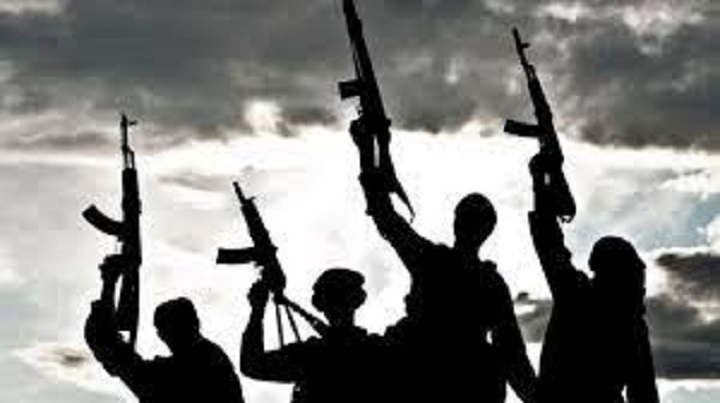
The Plateau state Police Command has confirmed the death of about 96 people in the attack by gunmen on several villages in the state on December 24.
The command said 221 houses were set ablaze across the affected villages.
Many people were also injured in the attacks, which were carried out in Bokkos and Barkin Ladi local government areas of the state. About eight vehicles burnt in the process.
The state commissioner of Police, Okoro Alawari, disclosed this on Tuesday, December 26, in a statement signed by the command’s spokesman, Alfred Alabo.
On Monday, December 25, The ICIR reported how the assailants attacked several communities in the state, killed scores of residents, looted farm produce, and set homes ablaze.
Reacting to the incident, the state commissioner of Police expressed grief over the attacks and directed the deputy commissioner of Police in charge of operations to relocate to Bokkos LGA and also deployed a team of operational forces to the affected areas to prevent further attacks and assess the level of damages in the affected areas.
The statement read, “On December 24, 2023, at 2200hrs, the following 12 villages in Bokkos LGA were attacked: Ndun, Ngyong, Murfet, Makundary, Tamiso, Chiang, Tahore, Gawarba, Dares, Meyenga, Darwat and Butura Kampani.
“Similarly, on December 24, 2023, at about 2245hrs, three villages in Barkin-Ladi LGA namely NTV, Hurum and Darawat were also attacked.”
According to the statement, in Bokkos LGA, the total number of villages attacked is 12, with 221 houses set ablaze, 27 motorcycles and eight motor vehicles burnt down, and over 79 persons were killed.
The Police disclosed that 17 deaths were recorded in Barkin-Ladi LGA, noting that investigation and monitoring of the incidents were ongoing.
However, there are indications that casualties in the attacks are higher than the figures provided by the Police. Several reports suggested that over 100 people were killed, and approximately 23 villages were affected.
Plateau state is one of the states facing ethno-religious conflicts in Nigeria.
Data collated by The ICIRshowed that between January and October 2023, 7,046 people were killed in violent attacks across Nigeria.
The ICIR gathered the data from the Armed Conflict Location & Event Data Project (ACLED), a data bureau collecting real-time data on the locations, dates, actors, fatalities, and types of all reported violence and protest events worldwide.
THE Federal Government earmarked N3.33 trillion as capital expenditure for the presidency and 44 institutions, comprising its ministries and other agencies, in the proposed 2024 budget.
This amount represents 43.13 per cent of the total N7.72 trillion President Bola Tinubu-led government proposed for capital expenditure in 2024.
Capital expenditure is the fund used to build, maintain, acquire or upgrade capital assets like buildings, machinery or facilities.
2024 proposed budget for federal ministries
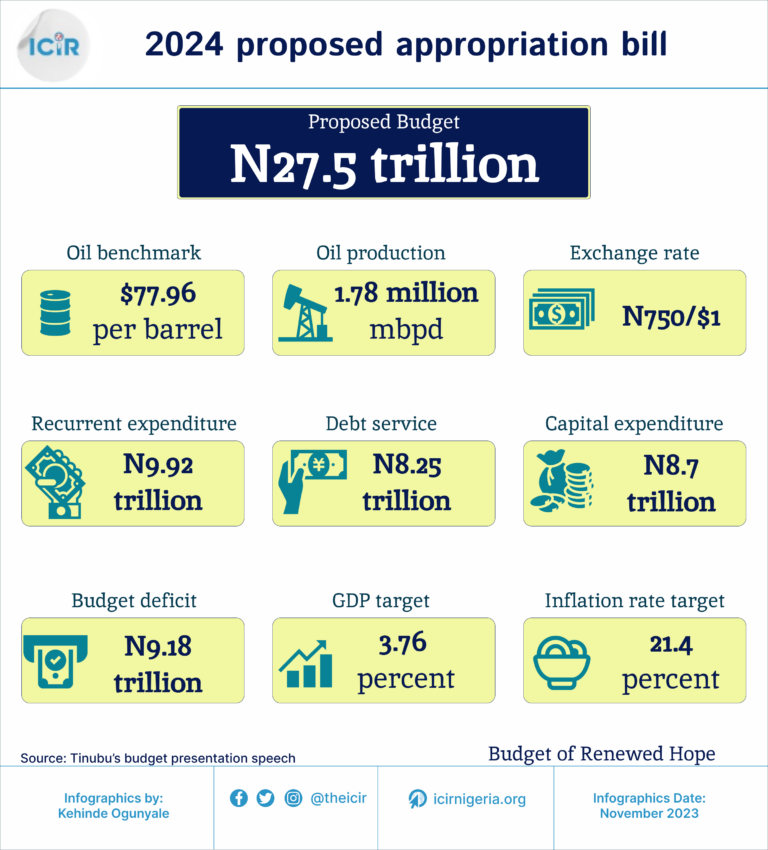
On November 29, Tinubu presented the 2024 appropriation bill of N27.5 trillion to the joint session of the National Assembly. The proposed budget had a revenue inflow of N18.32 trillion and a deficit of N9.18 trillion.
During the presentation, Tinubu said, “We expect the economy to grow by a minimum of 3.76 per cent, above the forecast world average. Inflation is expected to moderate to 21.4 per cent in 2024.
“In preparing the 2024 budget, our primary objective has been to sustain our robust foundation for sustainable economic development. A critical focus of this budget and the medium-term expenditure framework is Nigeria’s commitment to a greener future.”
2024 proposed budget for federal ministries
The ICIR reported that while economic indication showed that the proposed budget might not drive economic development, borrowing to fund it could threaten the economy.
In Section ‘M’ of the budget document, the Federal Ministry of Works has the highest allocation, with N523.02 billion earmarked for capital projects. The Ministry of Finance follows it with N454.98 billion, the Ministry of Health and Social Welfare gets N377.39 billion, and the Ministry of Defence takes N308.24 billion.
The proposed budget for the above four ministries amounts to N1.66 trillion. This is almost half (49.95 per cent) of the total N3.33 trillion allocated to the 44 ministries, agencies, and the president’s office.
2024 proposed budget for federal ministries
Reviewing the budget, The ICIR’s check showed that some institutions’ allocations might be insufficient for critical interventions promised by the President.
These include poverty reduction, job creation, women’s inclusion and development. Further checks revealed that 11 ministries implementing capital projects in these sectors were allocated less than 100 billion each as capital expenditure.
2024 proposed budget for federal ministries
Some of these ministries are the Ministry of Power, the Ministry of Transportation, the Ministry of Women Affairs and the Ministry of Humanitarian Affairs and Poverty Alleviation.
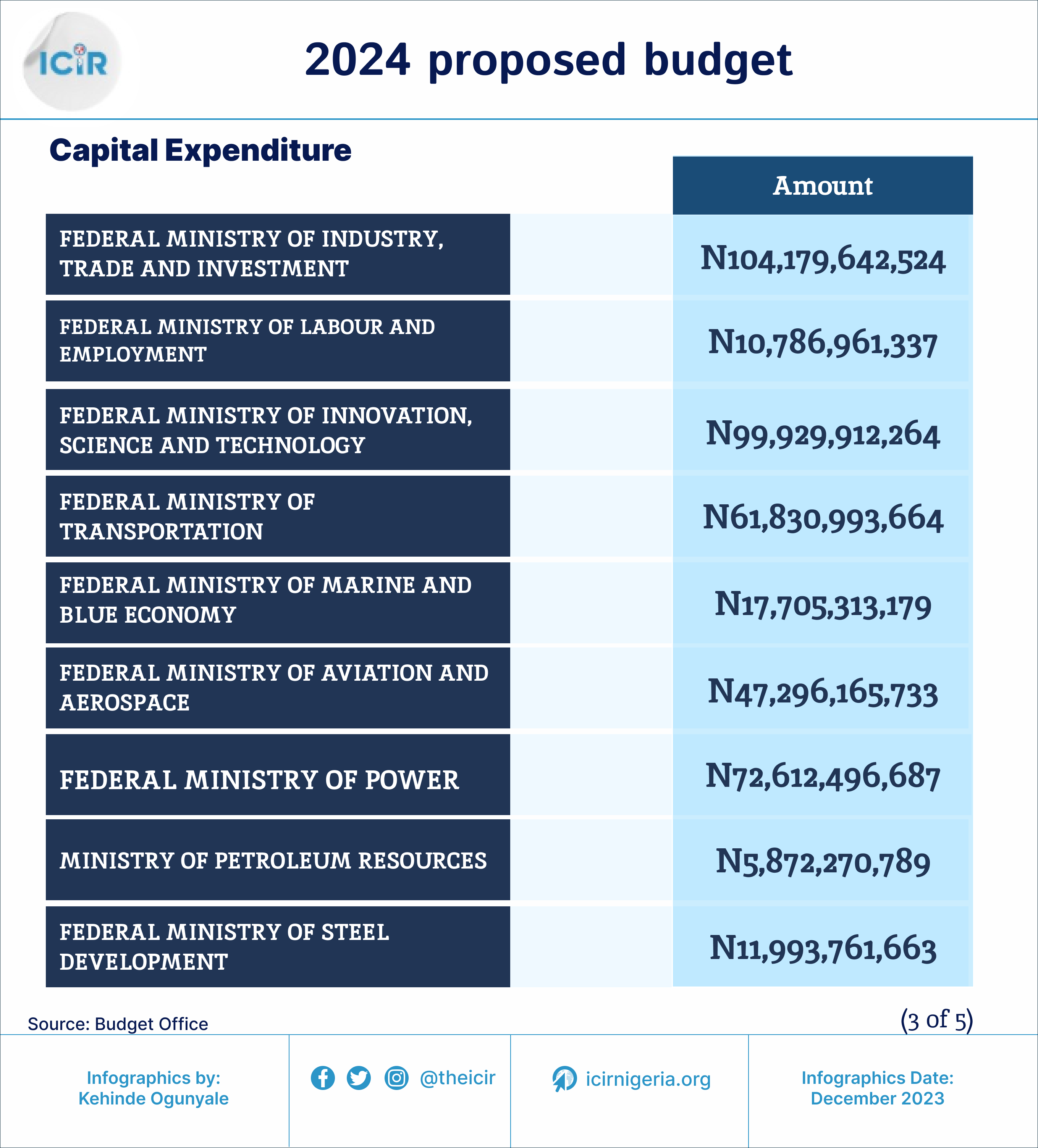
Names of MDA
Proposed capital expenditure
MINISTRY OF HUMANITARIAN AFFAIRS AND POVERTY ALLEVIATION
59,452,251,714
FEDERAL MINISTRY OF LABOUR AND EMPLOYMENT
10,786,961,337
FEDERAL MINISTRY OF INNOVATION, SCIENCE AND TECHNOLOGY
99,929,912,264
FEDERAL MINISTRY OF TRANSPORTATION
61,830,993,664
FEDERAL MINISTRY OF POWER
72,612,496,687
MINISTRY OF PETROLEUM RESOURCES
5,872,270,789
FEDERAL MINISTRY OF HOUSING AND URBAN DEVELOPMENT
96,996,742,133
FEDERAL MINISTRY OF NIGER DELTA DEVELOPMENT
18,066,640,858
FEDERAL MINISTRY OF YOUTH
3,222,760,037
FEDERAL MINISTRY OF WOMEN AFFAIRS
7,602,142,164
FEDERAL MINISTRY OF COMMUNICATIONS, INNOVATION AND DIGITAL ECONOMY
7,594,389,714
The Programme Coordinator at the Centre for Inclusive Social Development (CISD), Folahan Johnson, told The ICIR that the implication was that there would continue to be no improvement in the nation’s unemployment figures as, according to him, it was obvious that the resources allocated to improve it was ‘grossly’ inadequate.
He said poor resource allocation to the critical ministries implied the country expected poor service delivery in 2024.
2024 proposed budget for federal ministries
“The challenges of poverty and unrest in the Niger Delta will also have implications on security. While I applaud the government for allocating resources to improve our security, which is a necessary basis for economic activities to go on smoothly, especially in volatile parts of the country due to insurgencies, one must do a comparative analysis of the cost of solving the challenges of poverty and how it breeds radicalisation and then leads to insecurity and necessitates high spending on defence, as against spending heavily on defence currently which is highly prone to corruption,” Johnson said.
THE Federal Ministry of Women Affairs, under its Minister Uju Kennedy-Ohanenye, has earmarked 40 per cent of its 2024 proposed budget for empowerment schemes.
The Ministry proposed a little over N10 million for the 2024 fiscal year, and the sum covers overhead, personnel and capital projects.
A breakdown of the allocation shows that N1.63 billion would be spent on personnel costs, N796.72 million on overhead costs and N7.60 billion on capital expenditure.
Filtering through words like empowerment, campaign, promotion, support, incentives and improvement used under line items, The ICIR gathered that over N4 billion was earmarked for such programs by the Ministry, which is about 40.58 per cent of the entire sum.
While the Ministry headquarters earmarked N3.81 billion for various empowerment programs, the National Centre for Women Development proposed another N254 million for women empowerment as contained in the proposed budget.
Findings by The ICIR showed that there are about 40 empowerment programs to be executed by the Ministry using the N4.07 billion.
While some of these programs were new projects initiated by the Ministry, others were already ongoing projects.
The empowerment schemes are part of the capital projects to be implemented in the 2024 fiscal year.
They take up 53.5 per cent of the capital projects proposed by the Ministry in the coming year.
Some of the projects include support for vulnerable and indigent women (N103.8 million), national response on orphans and vulnerable children (N102.1 million) and training and empowerment of women and youths in Ankpa federal constituency, Kogi state (N250 million).
PERSONNEL
OVERHEAD
CAPITAL
TOTAL ALLOCATION
FEDERAL MINISTRY OF WOMEN AFFAIRS – HQTRS
1,304,818,000
565,858,011
6,729,669,028
8,600,345,039
NATIONAL CENTRE FOR WOMEN DEVELOPMENT
323,728,897
230,857,283
872,473,134
1,427,059,314
TOTAL
1,628,546,897
796,715,294
7,602,142,162
10,027,404,353
Avenues for misappropriation
While empowerment schemes are often included in Nigeria’s budget as a means of alleviating poverty, they have been identified in the past as a means through which corrupt politicians embezzle public funds.
In 2022, Civil Society Organisation (CSO) BudgiT questioned huge allocations for empowerment schemes, which gulped nearly 60 per cent of the N100 billion allocated for constituency projects for the year.
The organisation disclosed that such projects have been used as avenues for misappropriation of funds by lawmakers in the past due to the difficulties associated with tracking such schemes based on their customarily vague nature.
“We would like to reiterate the importance of having detailed documentation of project locations as this provides the citizens with the correct information to hold the government accountable.
“Whenever details of public projects are unavailable to the public, monitoring the implementation of such projects becomes difficult for the citizens, civil society, and auditing bodies. This creates a loophole for under-delivery and embezzlement of public funds,” Uadamen Ilevbaoje, who works as the head of BudgiT’s project tracking arm, Tracka, disclosed.
In 2019, the Independent Corrupt Practices and Other Related Offences Commission (ICPC) described such projects as a convenient means of embezzling funds by politicians.
“These Capacity Building and Empowerment projects have become a convenient conduit for embezzling public funds by the sponsoring legislators and the executing agency as they are difficult to track and verify due to their ‘soft’ nature,” the report signed by ICPC Chairman Bolaji Owasanoye, disclosed.
The ICIR reached out to the Head, Press and Public Relations of the Federal Ministry of Women Affairs Grace Njoku, requesting measures put in place to ensure accountability for the projects upon approval on Friday, December 22.
A message was also sent to the Minister’s Special Assistant, Media Joseph Osondu Ohaeri on Friday, requesting the same information. However, both messages have yet to be replied to at the time of filing this report.
GUNMEN have reportedly killed over 70 people in a fresh attack on several communities in the Barkin-Ladi and Bokkos local government areas (LGAs) of Plateau state.
According to reports, the assailants attacked residences, looted farm produce, and set houses ablaze.
The Bokkos LGA transition implementation committee chairman, Monday Kasa, told Channels Television that the attacks began on Saturday, December 23 and continued on Christmas Eve, when locals were already preparing for Christmas.
Kasa added that more dead bodies were discovered by the security team, neighbourhood vigilantes, and hunters who were still searching the communities for missing people who were ambushed during the attacks. “This is why the number of casualties is rising”, he added.
According to a statement issued by Gyang Bere, director of press and public affairs in the state governor’s office, the governor, Caleb Mutfwang, became aware of the attacks and condemned the incident.
The governor directed security institutions in the state to ensure those responsible for the attacks were apprehended and brought to justice.
In addition, the governor urged residents of affected communities to keep vigilance and report any suspicious activity to security officers for prompt action.
While rescue efforts continue in the affected communities, neither the Police nor the combined security task force Operation Safe Haven has commented on the attacks.
In another development, eight people died after a terrorist group attacked the Jibia local government area of Katsina state.
During the attack, which took place on Sunday night, four persons were reportedly wounded, and two others were declared missing.
A resident of the LGA informed Channels Television that the victims were attacked by the terrorists who thronged the area in large numbers while they were returning from Yan Gayya community to Kukar Babangida village.
He said all of the deceased, aged between 22 and 47 were from Yan Gayya village and had been buried.
Jibia is situated near Niger’s border with Nigeria.
The LGA borders Batsari, Kaita, Katsina, Batagarawa, and Zurmi local government areas of Zamfara State.
Data collated by The ICIRshowed that between January and October 2023, 7,046 people were killed in violent attacks across Nigeria.
The ICIR gathered the data from the Armed Conflict Location & Event Data Project(ACLED), a data bureau collecting real-time data on the locations, dates, actors, fatalities, and types of all reported violence and protest events worldwide.
Mohammed Tsadu was a rice farmer in Kpata-Gbaradogi, an agrarian and fishing community.
He lost his farm last year to the flooding that ravaged the country, and since then, he has had to fend for himself and his young family by doing menial jobs in the community or nearby Patigi.
He said youths like him who are rice farmers have not been able to farm this year because they are scared of running into losses through the yearly flood, which always ravages the community.
“Because of the losses I suffered last year and no help from anyone, I am now riding okada and delivering N 2,000 daily to the owner while I take the rest,” Tsadu lamented.
“When there are low sales, I help market women offload their goods brought across the River Niger in a canoe to the market in Patigi,” he said.
Mohammed Tsadu Picture: DARE AKOGUN
This is the sad story of many inhabitants of communities like Patigi and Kpata-Gbaradogi in Patigi Local Government Area, LGA, and others like Pututa, Esun, Kpasha, Tswako, Likpata, Eko, Chewuru, Ebangi, Dzanagu all in Edu LGA, which all suffer from the devastating effects of climate change.
Like last year, the Nigeria Meteorological Agency (NiMET) issued a grim forecast for 2023
“2023 will witness an early onset of rainfall accompanied by flooding”, the agency said in its forecast published in January this year.
According to details of the Federation Account Allocation Committee (FAAC) (January 2023 Disbursement) published by the National Bureau of Statistics (NBS), 36 states of the federation and 774 local government councils received a total of N8.4 billion as ecological funds in January 2023. While states got N4.6 billion, local governments received N3.8 billion.
The funds were received by states and local governments despite their inability to justify over N64.417 billion given to them between 2021 and 2022. In all, the NBS data shows that states have received N69 billion as ecological funds between 2021 and January 2023, of this figure, a total of N1,156,671,187 has accrued to Kwara State. The state had received N1.048 billion as ecological funds between 2021 and 2022 before the fresh 108 million disbursed in January 2023.
Concerns have however been raised over the utilisation of the ecological funds in Kwara State, and investigations reveal that the projects are shrouded in secrecy.
The Ecology Project Office domiciled under the presidency, has come under scrutiny for its inability to account for a staggering sum of N1.1 billion allocated for ecology projects in Kwara State despite repeated attempts by Sobi FM to shed light on the matter. The only ecological project being undertaken in the state, according to environment ministry officials, is the dredging and embarkment work at the Asa River.
The Nigerian Meteorological Agency (NiMET) recently expressed concerns that its forecasts on flooding were ignored by most state governments, including the most vulnerable ones across the country. Consequently, citizens and businesses were made to face devastating floods. Many of the affected communities are still yet to recover from the impacts of the event.
Reports from the federal authorities showed that the 2022 floods resulted in 662 deaths across 33 states as the deluge of rain washed away years of investments in agriculture, hundreds of hectares of farmlands, and properties estimated at billions of naira.
In the same year, the National Emergency Management Agency (NEMA) estimated that over two million Nigerians were displaced and that the national economy lost a whopping N4.2 trillion to the floods. Over 569,000 hectares of farmland were destroyed.
Our reporter visited four local governments with perennial flooding issues to assess the situation.
Ilorin East
For the people of Abata Jagun Community, Ifesowopo, Okelele in Ilorin East LGA, environmental degradation has always been a major source of concern, as they have faced serious erosion problems for more than twenty years.
Chairman of Abata Jagun Community, Solihu Ariyo, decried the degree of devastation the erosion has caused to the environment, saying that the development has hindered social and economic growth.
He revealed that the situation has forced many residents out of their various houses, while children have not been going to schools as the erosion has cut off the community from accessing other parts of the Ilorin metropolis.
Erosion occasioned by perennial flooding PHOTO: DARE AKOGUN
According to him “This erosion problem in our community has become a source of worry and serious concern to us as residents, as many people have been rendered homeless, with landlords turning to tenants.
“Those of us that are still residing in the community at the mercy of God, we could not sleep with our eyes closed, especially any time it rains,” he lamented.
Another community leader, Alhaji Yahaya Cisse, maintained that several efforts by the community to lobby the previous administrations in the state to come to their aid proved abortive.
Cisse, however, called on both national and subnational governments to assist in channelling and dredging the river in the community.
Ilorin South
Akorede community in Ilorin South Local Government Area, Kwara State, is currently facing a significant environmental challenge as the community grapples with a massive gully erosion that poses a severe threat to local households.
The gully erosion, which has been gradually worsening over the years, has caused significant damage to the landscape surrounding Akorede Community.
When our reporter visited the area, he observed that the effects of the gully had manifested in some residential buildings with cracks in the walls.
Several houses are now precariously close to the expanding ravine, putting the lives and properties of residents at risk.
The Erosion has also almost chopped off the only access road serving the community, thus posing a danger to the residents and commuters plying the road.
Mr. Adeolu Adebayo pointing to the effect of gully erosion in the community
Local community leader, Adeolu Adebayo, expressed his disappointment, stating, “The erosion continues to expand, and our homes are at risk of collapsing. We need urgent action before it’s too late.”
He explained that the thought of rain is a nightmare for members of the community, saying “When it rains, houses, roads and other valuables will be overwhelmed with water.
“Some residents will have to vacate their houses because of the damage the flood could cause to their lives and property”.
The owner of one of the affected houses Ayodeji Abubakar, said there is no peace of mind in the community during the rainy season.
” There is some set of houses that the erosion had done so much harm to. The gully has crept totally to the residential apartments, forcing them to enter their apartments through the backyards”.
“When we moved into my house about three years ago, the gully was not as much as it is now,” he added.
Abubakar recalled that the spaces that the gully had eaten up now used to be pathways for both cars and pedestrians, adding that the erosion had totally washed away the pathways.
He revealed that he spent a huge amount of money to make concrete walls and drainage to save his building while the erosion had not ceased creeping in.
Abubakar said that erosion control and management is one of the ways the government can protect the lives and property of the residents of the community, pleading with the government to construct drainages and fix their roads to avert looming disasters in the community.
Also speaking, another landlord whose residential building had been affected by the erosion, Mr. Fashola David, said he used concrete to build a water channel in front of his house to divert a drain that would have gotten into his house.
The Abata-Suban area of Ita-Kudimoh in Ilorin West is another community where erosion has displaced many residents, while several buildings and properties were also affected.
Edu LGA
Before the COVID-19 crisis, sub-Sahara Africa, according to different reports, already had the highest number of students excluded from education, “with more than one-fifth of children aged 6-11 years out of school.”
Chewuru, a community on the fringes of River Niger in Edu Local government area of Kwara state, North Central Nigeria tells a story of a desolate community that has been experiencing yearly flooding for more than 30 years and no form of assistance from the government.
At the entrance of the community is a block of two rooms that serve as the community primary school, built through communal effort.
While taking our reporter around the community of about 35 houses and 400 inhabitants, mostly women and children, the community head Umaru Shaaba, who spoke through an interpreter, said the people of the town always relocate to Edogi, a nearby town during the yearly flooding as the whole town is always submerged.
He said they cannot farm during the rainy season, due to fear of running into losses and only make do with dry season farming which affects yields due to lack of irrigation equipment, the effects According to him as also affects education as the school is always flooded and teachers have stopped coming into the community.
Alhaji Umaru Shaaba by his fish farm PICTURE: DARE AKOGUN
For children of the community, any rainy day, most especially during the thick of the rainy season automatically becomes a no-school day as the school is flooded, which has resulted in the death of a 5-year-old girl in the past.
“We are suffering in this community; we can’t farm, because if we do flood water will destroy it. Our children don’t go to school during the rainy season, the three teachers posted to the school live in Lafiagi and can’t access the community.” Shaaba lamented.
According to the UNICEF climate risk index report released in August 2021, climate change is the greatest threat facing the world’s children and young people, with one billion children at “extremely high risk”.
In Nigeria, children are not alone in their suffering. Out of 163 countries, Nigeria ranks second on the list of nations where children are most vulnerable to climate change.
The issue of water scarcity has also become prevalent in Nigeria’s northern region and children are mostly at risk as they have to walk long distances in search of water, which has become a scarce resource due to climate change.
Asabe Usman, aged 10, and 13-year-old Fati Shaaba are some of the victims affected by water scarcity in Chewuru village.
Asabe fetching water from a hole dug by the community to retain river water Picture: DARE AKOGUN
Standing beside a hole to fetch water, Asabe hung her head in despair when asked about the water situation in her community.
She spoke about constant battles with cholera and diarrhoea adding that sometimes, she doesn’t go to school after walking long distances to fetch water for the household.
Fati, could not converse in English, but with the help of an interpreter, spoke in her local dialect about what the children of her community go through.
“I wish the government could provide another water [dig a borehole] for us so we can stop drinking this water,” she said.
Hajia Ladidi, her mother, said they use water from a dirty stream, that runs through the hole dug in the grounds to find water.
She also said the community is aware that the water is not healthy but they keep using it because there is no alternative.
“We drink water from the river which made our children and the women fall sick which has led to the death of some people before we can take them to hospital in the next village.
“We always hear on the radio what the government is doing for other communities suffering from flooding and water scarcity to alleviate their suffering, we only hear we don’t see.
“The only time we see government in the village is during the election campaign with many promises and after that nothing is heard again from them, We have resigned to fate,” she explained with a teary eye.
Patigi LGA
The Impact of yearly flooding in Patigi has forced rice farmers to abandon the once-thriving business of rice farming for menial jobs to survive.
This phenomenon has been observed in several communities in the state where farmers who were once self-sufficient have now been forced to adapt to the changing climate.
For many years rice farming was a profitable business in these areas, providing a source of income for the farmers and contributing to the local economy.
However, with the increase in flooding caused by heavy rains, many farmers have lost their crops and have been left with no means of income. As a result, they have turned to riding Okada motorcycles, popularly known as Okada, to make ends meet.
The village head, 63-years old Mohammed Jiya Ndatsowa Tsadu of Gbaradogi (Second in command) stated that the community started experiencing perennial flooding in 2012, saying that the flood of that year has changed the way of life of people of the community.
Mohammed Jiya, Ndatsowa Tsadu of Gbaradogi PICTURE: DARE AKOGUN
“Since 2012, we started witnessing flooding every year, our rice farms are gone we are always afraid to farm, fish in the rivers are not much like before, and whenever it rains the whole community will be apprehensive.
“We lost 10 people to flooding last year, our children can’t go to school nor do we have a functional health center to cater to our health needs.
“Any time it rains and the whole community is submerged some villagers hang around with friends and family’s upland while most of us live on the water until the water recedes,” he lamented.
He also lamented that the government has made numerous unfulfilled promises to the community.
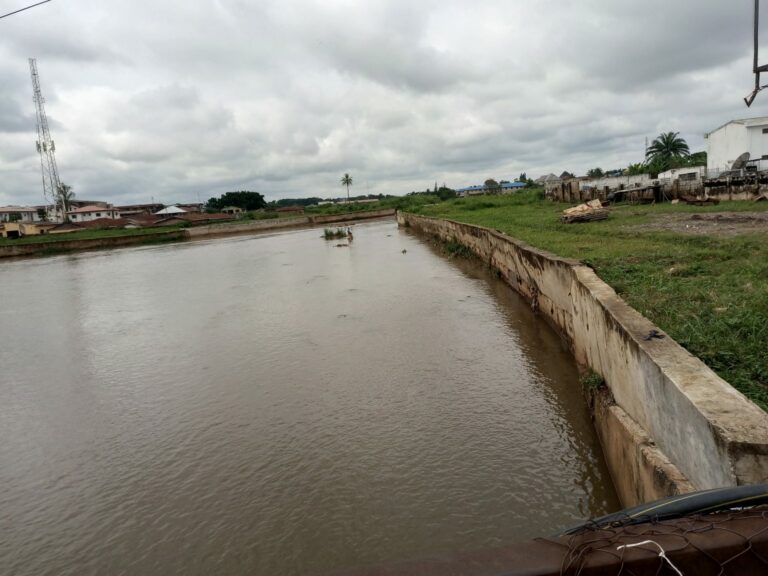
embankment constructed in 2001 by the Kwara State government in Gbaradogi. PHOTO: DARE AKOGUN
“Whenever flood comes and government comes with relief materials, the way it shared, many victims will be excluded and when they get its largely inadequate 50 persons will be given a bag of rice to share, how can 50 people share a bag of rice,” he queried.
*This investigation republished from Sobi FM is supported by the John D. and Catherine T. MacArthur Foundation and the International Centre for Investigative Reporting.
AT least 39 Nigerian journalists were harassed across the country by state and non-state actors in 2023.
About half of the incidents occurred during the 2023 general elections held between February and March.
ICIR executive director, 18 others attacked while covering elections
The ICIR’s Executive Director, Dayo Ayetan, was assaulted by thugs while covering the exercise in Gwagwalada on February 25. He was beaten up by his assailants, who tore his clothes and stole his phone, car key, purse and a pouch containing his debit cards, driver’s licenses and other items.
The founder of WikkiTimes, Haruna Salisu, was detained during the February poll in Bauchi.
In Nasarawa, officials of the Nigeria Security and Civil Defence Corps (NSCDC) attacked a journalist with Breeze FM in Lafia, Edwin Philip, while reporting the governorship and state House of Assembly elections in Nasarawa on March 18.
On the same day, a journalist with Premier Radio Ashiru Umar was attacked by armed thugs while covering the poll in the Gwale local government area of Kano state.
A journalist with People’s Gazette, Adebola Ajayi, was harassed by hoodlums, some of whom wore vests branded with the All Progressives Congress (APC) during the Presidential and National Assembly elections in Lagos. Her phone was seized, and some information on the phone was deleted.
In March, a cameraman and other crew members with Arise TV were assaulted around the Elguishi palace in Lagos. The cameraman sustained facial injuries, and his equipment was seized.
Youths in the Oyo state capital, Ibadan, attacked a vehicle conveying at least two reporters with the News Agency of Nigeria (NAN) during the general elections.
In Bayelsa, supporters of the People’s Democratic Party (PDP) attacked three journalists covering elections, including Akam James, a Daily Post correspondent, Upfront News magazine Publisher, Princewill Sede, and Jeany Metta, the Managing Editor.
Thugs in Delta state injured judiciary correspondent with The Cable, Bolanle Olabimtan. Her phone was seized, and her assailants deleted images.
In Rivers state, the Police detained a reporter with Punch newspaper and threatened to shoot him during the elections. He was driven around Port Harcourt city, and images taken with his phone were deleted before he was released.
Five observers from the Centre for Journalism Innovation and Development (CJID) were assaulted in Sokoto, Akwa Ibom, Kogi, Lagos and Osun states while covering the elections. The observers are Taiwo Fatola, Abiodun Jamiu, Adesola Ikulajolu and Richard Ekeke.
WikiTimes Editor detained for exposing terrorism financing, illegal mining
In September, WikkiTimes Editor Yakubu Mohammed came under surveillance by officials of the Nigeria Police Force, who placed him on their watch list after he published a report that exposed terrorism funding and illegal mining in Niger state.
His investigation exposed how Chinese-allied miners operating under the licenses of Eso Terra Investment Limited and Majelo Global Resources Limited were stealing Nigeria’s natural resources while allegedly bribing armed bandits of the Dogo Gide group.
Officials of the Bauchi and Niger States Police Command tracked Yakubu’s phone lines along with those of his wife, friend and colleagues, whom they threatened and described as sub-targets.
Police detain journalists in Kwara on orders of state gov’t
Two journalists in Kwara, Abdulrazaq Babatunde, publisher of Just Events Online and Lukman Oluwatoyin Bolakale, publisher of Satcom Media, were detained by the Police for ten days in September 2023 based on the orders of state government officials.
Their detention followed a petition written against them by Monsurah Gafar, immediate past Principal Private Secretary (PPS) to the state Governor AbdulRahman AbdulRazaq, who alleged that a story they published based on a press release by another government official, Rotimi Adebowale, was defamatory.
Court remands Agba Jalingo over allegations of false publication
In March, the Publisher of Cross River Watch, Agba Jalingo, was remanded in prison by a Federal High Court in the FCT over a report published against Elizabeth Frank Ayade, sister-in-law to the state governor at the time, Ben Ayade.
Ayade also demanded N500 million as compensation.
Jalingo was apprehended in August 2022 by security operatives who laid siege to his Lagos residence for hours and moved him to Abuja after the arrest.
The journalist has been detained several times previously, including in 2021, when officials of the Cross River State Police command arrested him over a planned June 12 protest. He was granted bail days later with stringent conditions, including a N500,000 bail bond and a surety who must own a landed property within the FCT.
Police arrest Imo journalist
In July, police officials in Imo arrested a broadcast journalist in the state, Chinonso Uba, known to be critical of the government under the administration of Hope Uzodimma.
When he was apprehended, it was unclear if the arrest was connected to his work, as the security operatives gave no reason.
Premium Times reporter detained for filming at Supreme Court
On Friday, May 26, Police officers detained a Premium Times reporter, Ameh Ejekwonyilo, at the Supreme Court Police station for over four hours.
Ejekwonyilo was arrested for recording a tussle between a policewoman and a woman in court witnessing proceedings. Though Police authorities had stated that it was not a crime to record a public scene, the reporter was apprehended by the security operatives and his phone was seized.
Six journalists attacked while covering clashes in Bayelsa
At least six journalists were attacked by armed men in the Opu-Nembe area of Bayelsa state while covering clashes between the community youths and their leaders.
The journalists attacked are Joseph Kunde, Miebi Binafiai, Awe Baratuapere, Ayebakuro Rhodes Egein, Iniyekenime Bruce and Folaranmi Femi, who work with different media organisations.
Some of the journalists were assaulted and robbed of their equipment, and Binafiai lost a tooth in the process. Others sustained different degrees of injuries while fleeing the scene.
Man in military uniform, others attack ICIR journalist
In March, a man in military uniform and a woman, who identified themselves as soldiers of the Nigerian Army, led a mob action against a journalist with The ICIR, Sinafi Omanga.
The journalist had noticed a case of jungle justice against two men accused of stealing a mobile phone, which the military officials were a part of, and had picked up his device to record the incident when they pounced on him. He was robbed of at least N9,000 and other valuables in the process.
Freelance photojournalist Ben Uwalaka, who reports for Daily Trust Newspaper, was attacked by a Police officer in Lagos while covering a protest by aviation workers in April.
The official injured Uwalaka on the hand and broke his camera’s screen, preventing its lens from re-attaching.
The assault came after Uwalaka refused to delete pictures taken during the protest as ordered by the officer, prompting him to seize the journalist’s camera, punch him in the hand several times and detain him at the nearby police station for nearly an hour.
Mob attack journalist covering Borno Market Fire
A reporter with the Nigerian Television Authority (NTA), Pauline Kuje Vana, was attacked by a mob in February while covering a fire outbreak at the Maiduguri Monday Market in Borno state.
Vana and her crew were attacked by the mob while trying to file a live report on the incident.
FRSC officials attack ICIR journalist
Federal Road Safety Corps (FRSC) officers attacked Mustapha Usman, a reporter with The ICIR, on Monday, September 18, and confiscated his identity card at Zone 7, Wuse, in Abuja.
Usman was beaten up by the officers while trying to record a video of them forcefully grabbing the steering wheel from a female driver and deflating her car tyres afterwards.
ICIR news editor detained for hours
Similarly, The ICIR news editor, Marcus Fatunmole, was detained for six hours by security operatives in the FCT in December while investigating a mass transportation scheme in city.
Although Fatunmole presented a valid identity card identifying him as The ICIR journalist, he was detained between 9.00 a.m. and 2.00 p.m. at the Eagle Square security outpost before eventually being taken to the Central Police Station, Federal Secretariat in Abuja.
PDP agents attack CrossRiverWatch editor
The editor of the CrossRiverWatch, Jonathan Ugbal, was attacked by PDP members while covering a protest by youths in a community around the party’s campaign office in Cross River state.
His devices were damaged, and he was robbed of some cash and his identity card.
Katsina journalist assaulted by Police
A female journalist with Cliqq TV in Katsina Rukayya Jibia was assaulted by policemen attached to the state Police command in May for speaking up against the parade of four young women arrested over alleged prostitution by the Police when the ladies had not been convicted or tried.
Journalist receives death threats in Niger
Niger state correspondent of Aljazeera newspapers, Samson Alfa, raised an alarm over threats to his life following his discovery of a facility suspected to have been used for rigging the Presidential and National Assembly elections.
He said he had been receiving death threats via calls from politicians warning him to stay away from the story.
In May, Nigeria dropped to 129th place from 120 on the global press freedom ranking index out of 180 countries ranked, with the civic space shrinking even more as journalists continue to face abuses while performing their duties.
ABOUT 12,000 pensioners in Edo state will benefit from the state government’s free health insurance scheme.
Other beneficiaries of the scheme include members of the state security network.
The director-general of the state Health Insurance Scheme (EDOHIS), Rock Amegor, disclosed this over the weekend.
According to Amegor, N1 billion has been saved for the free health insurance scheme.
He said over 12,000 pensioners across the 18 local government areas, 4,000 operatives of the Edo State Security Network and others would enjoy the free health insurance package.
He said the programme would start in the first quarter of 2024 and that the state was the second state in Nigeria to offer retirees access to healthcare.
He clarified that the programme would cover physiotherapy, dental, eye, surgical, and medical care for beneficiaries and would consequently reduce out-of-pocket spending on health.
“It is a robust medical care that can take care of about 70 per cent to 80 per cent of all medical challenges that we should expect at one point in our lives.
“Today, we have about 302 facilities in the scheme, which will cover the pensioners and vigilante members across the state,” he said.
NOLLYWOOD actor and movie director Azeez Ololade Ijaduade has allegedly been shot by an official of the Nigeria Police Force (NPF) in the Iperu area of Ogun state.
This was contained in a social media post by a fellow actor Abiodun Adebanjo via his Instagram handle iamabiodunadebanjo in the early hours of Sunday, December 24.
“Please we need help in Iperu. My director, Azeez Ijaduade, @kingzeez1, was shot by a Nigeria Police personnel. He is presently at Babcock University Teaching Hospital.
“Please, we need all the help we can get. This is no joke. Anybody with the contacts of the Police IG (Inspector-General) or Commissioner should reach out,” the post read.
The ICIR reached out to the Ogun state Police public relations officer (PPRO), Omolola Odutola, for confirmation.
She did not pick up the call put across to her phone, and she has yet to respond to a text message sent to her for a reaction to the allegation when filing this report.
Barely a month ago, officers of the Ogun state Police command were accused of torturing a suspect remanded in custody, Seyi Samson, to death.
The deceased was arrested on Monday, November 20.
By Friday, November 24, Police officers in the Eleweran Police station allegedly told the deceased’s family members that he had developed an ailment and died while in custody.
The command, however, denied the allegations in a statement released afterwards.
“Ogun state Police command is well versed in the legal framework that safeguards the rights of individuals in custody, free from all forms of cruel, inhuman, or degrading treatment.
“For the records, the deceased was already charged for cult-related activities, and he was taken to court on Thursday, November 23, 2023, where he was to be arraigned before a special court on a cultism case in Isabo Abeokuta, but the honourable court did not sit. He was brought back to Eleweran in Abeokuta the same Thursday,” the Police said.
THE Socio-Economic Rights and Accountability Project (SERAP) has sued the Nigerian National Petroleum Company Limited (NNPCL) for its alleged failure to account for Nigeria’s daily oil production, exportation, and the total revenue generated from oil since the removal of petrol subsidy in May 2023.
In the suit number FHC/ABJ/CS/1719/2023, filed on Friday, December 22, at the Federal High Court in Abuja, the SERAP sought an order of mandamus to compel the NNPCL to disclose details of barrels of oil Nigeria produces and exports daily and the total revenues it generated since the removal of subsidy on petrol.
A statement by the organisation on Sunday, December 24, stated that it also requested “an order of mandamus to direct and compel the NNPCL to disclose details of payment of 11 trillion naira made as subsidy payments from 1999 to May 2023, including a detailed breakdown of the payments made.”
This development followed a recent claim by the former governor of the Central Bank of Nigeria (CBN), Sanusi Lamido Sanusi.
Sanusi had alleged on December 7 that the NNPCL failed to remit enough foreign exchange into the treasury despite removing fuel subsidy.
He also challenged the NNPCL to account for the dollar inflows from its operations amid the rising volatile exchange rate.
His allegations prompted SERAP to demand NNPCL to provide information on Nigeria’s daily production and exportation of oil via a Freedom of Information (FOI).
Additionally, it demanded the total revenue generated from oil since the removal of the petrol subsidy in May 2023.
Reacting via a statement on Sunday, SERAP argued that there was a legitimate public interest in disclosing the information sought, noting that the NNPCL had a legal responsibility to disclose the details of Nigeria’s daily oil production, exportation and the revenues generated and remitted.
SERAP also argued that “Nigerians have the right to know the amounts of barrels of oil the country produces and exports daily, the revenues generated and remitted to the public treasury. Compelling the NNPC to disclose these details would promote transparency and accountability in the oil sector.”
According to the organisation, the NNPCL’s failure to disclose the requested information violates the Nigerian Constitution, the Freedom of Information Act, and the country’s obligations under the African Charter on Human and Peoples’ Rights.
SERAP emphasised that transparency in revealing Nigeria’s oil revenues would prevent misuse, boost public trust, and benefit all Nigerians.
“Nigeria’s daily oil production, exportation and the revenues generated have been mostly shrouded in secrecy.
“Disclosing the amounts of barrels of oil the country produces and exports daily, the revenues generated and remitted to the public treasury would also ensure that the NNPC operates within the law,” the suit filed by SERAP read in part.
It added that tackling oil sector corruption would reduce poverty, enhance access to public goods and services for Nigerians, and support the government to meet its human rights and anti-corruption commitments.
IN recent years, the Nigerian music Industry has experienced significant growth and evolution. The emergence of new technology and the rise of digital streaming platforms have made Nigerian artistes reach a global audience.
This has expanded the reach of Nigerian music and also brought about international collaborations and partnerships.
With the global acceptance of Afrobeats, Nigerian artistes have gained international acclaim and collaborations with international artistes, which has helped to further elevate the genre’s profile.
In 2023 alone, these artistes, particularly Burna Boy, Rema, Davido among others have performed at global stages, selling out stadiums and bagging various awards while also maintaining a strong position on streaming platforms.
In this report, The ICIR compiled a list of some notable moments in the Nigerian music industry 2023.
Rema’s wins
Rema whose government name is Divine Ikubor, made a name for himself and a significant mark in the entertainment industry in 2023. He became the African artistes with the most streamed African album and song on Spotify where he surpassed 1 billion streams on the platform. He also became the first African act to chart on the Billboard Hot 100 for a year, with his song ‘Calm Down’ making it to the Billboard Hot 100 at number 3.
Rema also clinched various awards, including Best Male Artiste at the 16th Headies Awards, Best Afrobeats category award winner, 2023 MTV VMA and MTV Europe Music Awards (EMA) respectively, among others.
He also sold out and performed at some notable global stages, including his iconic performance at the 67th Ballon D’Or in France.
Davido’s new album and world performances
David Adeleke, widely known as Davido has been a sensation in the Nigerian music industry for over a decade. After the death of his son in 2022, he went on a long break away from the music industry.
He returned in March this year with the release of his fourth studio album ‘Timeless’ which has been a global hit, topping charts and winning various awards including Trace Awards, MTV EMA, among others.
The album also earned him his first Grammy nominations for the categories including, Best Global Music Album, Beat African Music Performance and Best Global Music performance.
In October, Davido and his wife, Chioma welcomed a set of twins in the United States of America (USA).
Asake’s global rise to prominence
Since Asake’s signing to YBNL Records under the ownership of Olamide, he has become a sensation dominating the Nigerian entertainment industry.
In 2022, after the release of his ‘Mr Money with the Vibe’ album, he rose to global prominence, selling out shows at home and abroad.
In 2023, he released an album ’Work of Art’ which topped the charts and earned him numerous awards, including his first Grammy nomination for the category of Best African Music alongside Ayra Starr.
He is also the most streamed artiste in Nigeria on Spotify for 2023 and also among the most streamed artiste in sub-Saharan Africa following Burna Boy who led the list.