PRESIDENT Bola Tinubu has approved the sacking and replacement of chief executive officers (CEOs) of agencies under the Federal Ministry of Aviation and Aerospace Development.
According to a statement by the Special Adviser to the President on Media and publicity, Ajuri Ngelale, on Wednesday, December 13, the sack is consistent with the President’s resolve to establish international standards for consumer protection and the advancement of the welfare of Nigerian travellers and other industry players in Nigerian civil aviation.
According to Ngelale, the managing director (MD) of the Federal Airports Authority of Nigeria (FAAN), Kabir Yusuf Mohammed, has been removed from office and replaced with Olubunmi Oluwaseun Kuku.
Also, the director-general of the Nigerian Safety Investigation Bureau (NSIB), Akinola Olateru, has been replaced with Alex Badeh Jr.
Tinubu appointed Umar Ahmed Farouk as the acting managing director of the Nigerian Airspace Management Agency (NAMA), succeeding Tayib Adetunji Odunowo, who was fired.
The sack also affects Mansur Bako Matazu, the Nigerian Meteorological Agency (NiMET) director-general, whom Charles Anosike has replaced as the substantive director-general.
Similarly, the rector of the Nigerian College of Aviation Technology (NCAT), Alkali Mahmud Modibbo, was removed and replaced by Joseph Shaka Imalighwe as the acting rector until a substantive rector is appointed.
Meanwhile, the director-general of the Nigeria Civil Aviation Authority (NCAA), Musa Nuhu, was suspended from office to enable the Economic and Financial Crimes Commission (EFCC) to conduct an unfettered investigation into his activities and other senior officials of the agency.
Chris Najomo will assume office as the acting director-general of the NCAA immediately, according to the President.
Besides, Tinubu authorised the minister of Aviation and Aerospace Development to begin a thorough recruitment process for a substantive vice-chancellor and other key officials of the African Aviation and Aerospace University (AAAU).
The statement said the President expected the newly-appointed leaders to prioritise the well-being, security and convenience of Nigerians in line with his administration’s agenda.
DESPITE withdrawal limits on cash policy enforced by most commercial banks, the Central Bank of Nigeria (CBN) has said N3.4 trillion in cash was in circulation in the country.
The CBN’s acting director of Corporate Communications, Hakama Sidi-Ali, said this in a statement she issued in Abuja on Wednesday, December 13.
Sidi-Ali said: “There is indeed an increase in currency in circulation. From N1 trillion in February 2023, we have seen a rise to over N3.4 trillion as of December 11, 2023. This demonstrates that enough cash is available, but unfortunately, it’s not circulating due to apprehension among some individuals.”
“We empathise with the recent and past experiences of Nigerians. The CBN assures everyone that we have adequate cash to meet daily transaction needs, even during the upcoming festive season.”
She attributed the current cash crunch to some persons’ hoarding the naira due to challenges experienced during the naira redesign policy earlier in 2023.
She added that the CBN was monitoring the situation and had released sufficient cash to its branches nationwide for onward distribution to deposit money banks (DMBs).
Checks by The ICIR showed some point of sale (PoS) operators have resorted to sourcing cash from filling station pump attendants and market people as cash scarcity bites.
“Most of the commercial banks don’t give us the requested amount. They don’t give more than N50,000 even when we need up to N1,000,000 for our transactions. I have negotiated with some fuel pump attendants to buy cash for my business,” said Emeka Ekwenugo, a PoS operator in Kubwa, the Federal Capital Territory (FCT).
Another PoS operator, Bassey Bissong, in Dutse, Bwari Area Council of the FCT, told The ICIR that he had resorted to charging higher for his transactions since commercial banks were rationing cash to consumers.
“I previously charged N200 for N10,000. Now I charge N400 for N10 000. For N20,000, I charge N700. We don’t get money easily. Sometimes, the automated teller machine (ATM) doesn’t pay you what you request. It’s a difficult time for us,” he said.
On November 27, The ICIRreported that the CBN was mopping up currency through its recent open market operations to control inflation. This could be linked to the current cash scarcity across the country.
THE Senate Committee on Banking, Insurance and other Financial Institutions have demanded the dissolution of the Asset Management Corporation of Nigeria (AMCON) over its failure to recover the agency’s liabilities totalling N5 trillion.
The federal lawmakers made the demand when AMCON’s managing director, Ahmed Kuru, appeared before the committee on Wednesday, December 13, to defend the agency’s budget for the 2024 fiscal year.
At the budget defence in Abuja, Kuru told the lawmakers that AMCON recovered about N648 billion out of the agency’s total liabilities of N5 trillion as of September 20, 2023.
Some of the panel members thereafter expressed concern over the commission’s financial statements since the beginning of the year.
The lawmakers called for the dissolution of the asset-recovery organisation because its management was not proactive in recovering liabilities.
Some of the committee members who called for the commission’s dissolution are Sani Musa (APC Niger East), Jimoh Ibrahim (APC, Ondo South), Adamu Aliero (PDP, Kebbi Central) and Ifeanyi Ubah (APC, Anambra South).
In his remarks, the Senate Committee on Finance chairman, Sani Musa, expressed dissatisfaction with the commission’s performance.
“Most of the loans were owed by individual companies which were never sanctioned. At the end of the day, the same company would go back to buy back their assets that AMCON had hitherto taken over. Are we going to continue like this?
“It is not only about defending the budget; it is about seeing the effect of the appropriation. We need to know whether it is working. Or are we just creating a job for those we can’t protect?
He queried why AMCON should not be scrapped since it appeared to have lost its statutory mandate.
Chairman of the Senate Committee on Banking, Insurance and Other Financial Institutions, Tokunbo Abiru, further said AMCON must have a timeline to recover all the outstanding liabilities.
“The only challenge that we have today is that we need to have a definite time that all the obligations hanging on the throat of AMCON must be redeemed,” he said.
AMCON was set up by an Act of the National Assembly in July 2010 in the wake of the global financial meltdown of 2008-2010 and the systemic stress that swept through Nigeria’s financial system, with an initial intended lifespan of 10 years to buy the bad loans of the banks and avert bank failures.
THE Federal Executive Council (FEC) has exempted universities, polytechnics, colleges of education and other tertiary institutions from the Integrated Personnel Payroll Information System (IPPIS) payment platform.
The FEC also granted permission to the institutions to embark on recruitment without recourse to the Head of Service of the Federation.
Minister of Education Tahir Maman disclosed these on Wednesday, December 13, after the FEC meeting presided over by President Bola Tinubu at the Council Chambers of the Presidential Villa, Abuja.
Maman noted that the council had relieved the management of tertiary institutions of the burden of obtaining approval and waiver from the Office of the Head of Service for recruitment.
He said the decision was taken after appropriate consideration by the President and the council regarding the universities’ management efficiency.
“”he President cannot understand why vice-chancellors should leave their duty post and run to Abuja to get staff enlisted on IPPIS when they get recruited.
“The basic concern is that laws govern universities. And those laws give them autonomy in certain respects and most respects, and the IPPIS has sort of eroded that autonomy granted universities in accordance with their act,” the minister added.
The ICIRreports that enrolment on the IPPIS is one of the reasons the Academic Staff Union of Universities (ASUU) had often been at daggers drawn and in perennial conflict with the Federal Government, leading to several strikes under the past administrations of former President Goodluck Jonathan and Muhammadu Buhari.
The ASUU went on strike for 669 days during the Buhari administration, the highest number of days the lecturers had downed tools under any president since the nation returned to democracy in 1999.
The lecturers were demanding the implementation of an agreement the Federal government signed with them in 2009, which included the funding for infrastructure and research in the universities, use of the University Transparency and Accountability Solution (UTAS) in place of IPPIS, payment of outstanding arrears of Earned Academic Allowances (EAA).
Although the number of times the polytechnic lecturers embarked on strike during Buhari’s administration was lower than that of ASUU, The ICIR can confirm that ASUP went on strike in 2017, 2018/19, 2021, and 2022.
Meanwhile, in his reaction to the development, the Minister of Information and National Orientation, Muhammed Idris, said: “Today, the universities and other tertiary institutions have gotten a very big relief from the integrated personnel payroll and information system. You will recall that the university authorities and the others have been clamouring for the exemption of the universities and other tertiary institutions from this system.
“Today, the council has graciously approved that. What that means is that going forward, the universities like the Honorable Minister of Education has said, and other tertiary institutions, the polytechnics and colleges of education will be taken off the IPPIS.”
THE Economic and Financial Crimes Commission (EFCC) has declared the former Minister of Power and Steel, Olu Agunloye, wanted over an alleged $6 billion fraud.
The anti-graft agency announced this on Wednesday, December 13, on its official website in a statement signed by its spokesman, Dele Oyewale.
In the statement, EFCC appealed to Nigerians with useful information about the former minister’s whereabouts to report to the nearest Police station or the anti-graft agency’s zonal office.
“Anybody with useful information as to his whereabouts should please contact the commission in its Benin, Kaduna, Ibadan, Sokoto, Maiduguri, Mardi, Ilorin, Enugu, Kano, Lagos, Gombe, Uyo, Port Harcourt, and Abuja offices or contact 08093322644 or email info@efcc.gov.ng or the nearest Police station and any other security agencies,” it declared.
EFCC’s statement declaring Agunloye wanted on Wednesday, December 2023.
Agunloye, who served under the administration of President Olusegun Obasanjo between 1999 and 2003, had earlier been quizzed by the EFCC.
In September this year, Obasanjo accused the former minister of mismanaging the Mambilla power project during his tenure and alleged that Agunloye fraudulently awarded the project contract without the approval of the Federal Executive Council.
Initially awarded in 2003 to Sunrise Power and Transmission Limited, the proposed 3,050-megawatt plant in Mambilla, Taraba State, is expected to be the largest power-generating installation in Nigeria and one of Africa’s largest hydroelectric power stations.
However, the project has been the subject of decades of legal dispute between the company and the Nigerian government.
In 2008, the late President Umaru Yar’Adua, who succeeded Obasanjo, terminated the project.
In November 2022, The ICIR, in one of its reports, stated that the EFCC launched an investigation into the project.
In his defence, Agunloye described Obasanjo’s accusation as baseless, false, and malicious, arguing that the former president was incorrect when he referred to the award to Sunrise simply as a $6 billion contract (about N800 billion in 2003).
Agunloye said the project was a build, operate and transfer (BOT) contract in which the Federal Government did not need to pay any amount to the contractor, Messrs Sunrise Power and Transmission Company Limited (Sunrise).
“As a matter of fact, Sunrise has not been paid a single naira or dollar by the FGN (Federal Government of Nigeria) from 2000 till date (14/9/23),” Agunloye was quoted to have argued.
PRESIDENT Bola Tinubu has sworn in the chairmen of the Independent Corrupt Practices and Other Related Offences Commission (ICPC) and Federal Civil Service Commission (FCSC), Musa Aliyu and Tunji Olaopa, respectively.
Special Adviser to the President on Media and Publicity Ajuri Ngelale said this in a statement on Wednesday, December 13.
The ICIR reports that Aliyu served as Attorney-General and Commissioner for Justice in Jigawa state from 2019 to 2023. He holds Bachelors, Masters, and Doctorate degrees in Law.
Tinubu appointed him as ICPC chairman on October 16, 2023, but the appointment was subject to confirmation by the Senate.
“The new chairman of the ICPC is nominated for confirmation by the Nigerian Senate, following the President’s approval of the outgoing chairman’s request to proceed on pre-end of tenure leave beginning on November 4, 2023, ahead of the expiration of his tenure on February 3, 2024,” a statement by Ngelale on Aliyu’s appointment had read.
The FCSC chairman, Olaopa, is a professor and former federal permanent secretary who served as permanent secretary across five ministries.
The swearing-in was carried out in the Council Chambers of the State House in Abuja shortly before Wednesday’s Federal Executive Council (FEC) meeting.
Eleven other members of the FCSC, representing various states across Nigeria, were also sworn in during the event.
They include Dauda Jalo representing Adamawa, Gombe, and Taraba, Obong Eyoma, Akwa-Ibom and Cross River; Chamberlain Nwele, Anambra, Ebonyi and Enugu; Sarah Sosan representing Lagos and Ogun and Festus Oyebade for Osun and Oyo.
Others are Adamu Hussein representing Niger and the Federal Capital Territory (FCT), Aminu Nabegu, Jigawa and Kano; Rufus Godwins, for Rivers, Delta and Bayelsa; Odekunle Aduke, Kogi and Kwara; Shehu Aliyu, Kebbi, Sokoto, and Zamfara and Hindatu Abdullahi representing Kaduna and Katsina.
THE Rivers state Governor, Siminalayi Fubara, has presented the 2024 budget to only five members of the state House of Assembly.
He reportedly presented the budget at the state’s Government House.
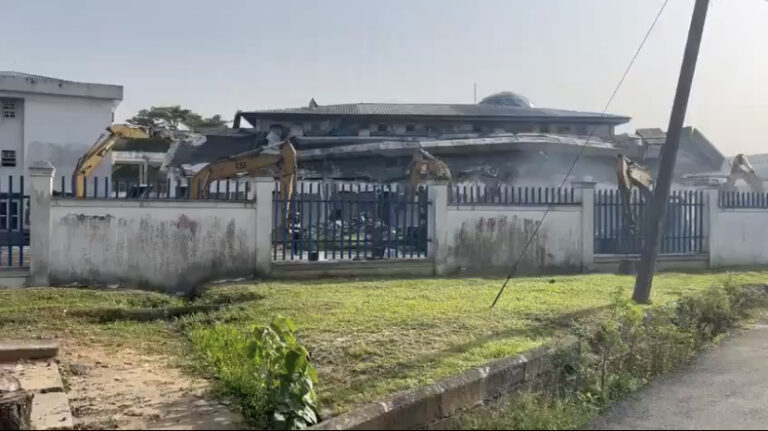
The presentation took place hours after his government demolished the state House of Assembly building on Wednesday, December 13, amid the ongoing political crisis in the state.
The development came two days after 27 out of the 32 state House of Assembly members defectedfrom the Peoples Democratic Party (PDP) to the All Progressives Congress (APC).
It is also coming a few weeks after unknown persons burnt the Assembly Complex.
Accompanied by the secretary to the state government, Tammy Danagogo, and other members of his cabinet, Fubara presented a N800 billion appropriation bill for the 2024 fiscal year to the five-member Assembly.
At its fifth meeting on Monday, the state executive council adopted the projected 2024 fiscal year budget worth over N800 billion, dubbed the budget of renewed hope, consolidation, and continuity.
During the Wednesday sitting, Edison Ehie, the Assembly speaker, declared vacant the seats of 27 legislators who defected to the APC during the sessions on Wednesday.
The ICIR reports that fire engulfed the complex on Sunday, October 29, around 10 p.m. and was quenched by the Fire Service and security agents, who prevented it from consuming the entire complex.
Some members of the Assembly believed to be loyal to the state’s immediate past governor and current Minister of the Federal Capital Territory (FCT) initiated impeachment against the governor a day after the inferno.
The then majority leader Edison, known to be the Fubara’s ally, was removed in the botched attempt to impeach the governor, while Fubara was also accused of masterminding the inferno as part of efforts to frustrate his impeachment.
Ehie was elected speaker in October by a faction of the House after the attempt to impeach Fubara failed.
On Tuesday, December 12, the state high Court in Port Harcourt confirmed Ehie as the authentic speaker of the state’s House of Assembly.
The presiding judge, M.W Danagogo, ordered Martin Amaewhule and Dumle Maol, who claim to be the House leaders, to refrain from parading themselves or meddling with Ehie’s duties as speaker of the state House of Assembly.
The court also warned against forceful entry into the Assembly Complex using thugs or Police.
BANDITS suspected to be loyalists of a notorious kingpin Gwaska Dankeremi have attacked the Military base in Zurmi community, in Zormi local government area of Zamfara state, killing three soldiers.
The ICIR gathered that the resurgence of the banditry attacks in the area could be linked with the recent military operations that led to the recovery of many cattle from the dreaded bandits in a nearby forest.
Consequently, the bandits launched a series of attacks on the Zormi community for five consecutive times, leaving four civilians dead and injuring others.
The ICIR gathered that the worst of the attacks occurred in the afternoon of Tuesday, December 12.
The attack lasted from 4pm to 6:30pm during which four patrol vehicles of security operatives, including a military armoured personnel carrier (APC), were destroyed.
A government official who pleaded anonymity said three soldiers were killed during the encounter.
One of the military vehicles attacked by bandits in Zurlum
“We appreciate the bravery and agility of the gallant soldiers who faced the terrorists with AK47s while they (bandits) were shooting them with rockets.
“It was a terrible experience indeed; we were thrown into confusion and frightened due to the heavy sounds of guns both from the bandits and security operatives, as nobody could even dare go out to pray”, the official lamented.
A military APC attacked in Zurmi by bandits
According to the official, a military aircraft was seen hovering in the air, giving soldiers cover. After a while, it disappeared.
The source suggested that more modern weapons be provided for the Army to enable its officers to conduct their operations effectively.
“Most of them don’t even have bulletproof vests or helmets for their safety. They are giving their lives for us, so there is a need to provide them with the need to do their job if at all this country is serious,” added the source.
Side view of a military APC attacked in Zurmi by bandits
Zayyanu Na-Rabe, a resident of Zurmi town who escaped a bullet on Monday, said most of the outskirts area of the town were deserted in addition to over 40 nearby villages, including Kadamutsa, Gidan Shaho, Sangamawa, and Dada, where residents had fled and were taking refuge in Zurmi town before the renewed attacks.
Narrating his ordeal, Mallam Abubakar, a classroom teacher, said the bandits arrived in large numbers brandishing sophisticated weapons. They entered through the Gada Biyu area, Bakin Gidan Zaki and Gangaren Korama, leading to the General Hospital Zurmi, as they shot sporadically.
He added that during the earlier attack on Saturday, the bandits arrived at Nasarawar Zurmi area through Gidan Shaho village and killed two aged men, while two others were killed during the Monday and Tuesday attacks, respectively.
The ICIR reports that Zamfara is one of the North-West states facing protracted insecurity.
The state’s immediate past governor, Bello Matalle, lost re-election in March after battling unsuccessfully throughout his four years in office to secure his state.
In August, The ICIRreported how President Tinubu appointed him a Minister of State for Defence despite failure to protect his people.
Zamfara has faced attacks from terrorists, lost hundreds of residents to insecurity, and had thousands of others displaced.
In October 2022, this organisation reported how 30 schools remained shut after one year because of insecurity.
THE Rivers state government has begun the demolition of the State House of Assembly building on Moscow Road, Port Harcourt City local government area, amid the ongoing political turmoil in the state.
According to reports, the demolition, which is still ongoing, commenced at about 7:30 a.m., with several bulldozers and other heavy-duty equipment sighted at the location.
The latest development comes two days after 27 out of the 32 members of the state House of Assembly defectedfrom the Peoples Democratic Party (PDP) to the All Progressives Congress (APC).
It is also coming a few weeks after unknown persons burnt the Assembly Complex.
The ICIR reports that fire engulfed the complex on Sunday, October 29, around 10 p.m and was subsequently quenched by the Fire Service and security agents who prevented it from consuming the entire complex.
Some members of the Assembly believed to be loyal of the state’s immediate past governor and current Minister of the Federal Capital Territory (FCT) initiated impeachment action against the governor a day after the inferno.
The Majority Leader Ehie Edison, known to be the Fubara’s ally, was removed in the botched attempt to impeach the governor, while Fubara was also accused of masterminding the inferno as part of efforts to frustrate his impeachment.
The former Assembly leader Ehie was subsequently elected Speaker in October by a faction of the House after the attempt to impeach Fubara failed.
On Tuesday, December 12, the state high Court in Port Harcourt confirmed Ehie as the authentic speaker of the state’s House of Assembly.
The presiding judge, M.W Danagogo, ordered Martin Amaewhule and Dumle Maol, who claim to be the House leaders, to refrain from parading themselves or meddling with Ehie’s duties as speaker of the state House of Assembly.
The court also warned against forceful entry into the Assembly Complex using thugs or Police.
Despite being circulated nationwide for public consumption, companies producing Cway Water, Golden Penny Spaghetti, Peak Milk Powder, and other widely-consumed products failed to renew their operational licences from the National Agency for Food, Drug Administration and Control (NAFDAC), exclusive documents obtained by The ICIR have shown.
Findings by The ICIR showed that the approvals previously granted to the companies manufacturing these products have expired. This means the NAFDAC might have failed to re-assess the products and the environment under which they are produced.
The NAFDAC regulates and controls the manufacturing, importation, exportation, advertisement, distribution, sale and use of food, drugs, cosmetics, medical devices, chemicals and packaged water in Nigeria.
According to the NAFDAC Act 2004, no food product or packaged water shall be manufactured, imported, exported, advertised, sold, distributed or used in Nigeria unless registered and approved by the agency.
The act provides that any manufacturer of consumables must apply for certification from the agency. The certificate of registration shall be valid for five years and should be renewed immediately after expiration.
According to the act, any company or individual found violating the regulation may be banned from engaging in the importation, exportation, manufacture, distribution, sale, or use of the food product. Additionally, they may be subject to a fine of N50,000.
The ICIR checked some selected widely consumed products in Nigeria on the agency’s website and sent a Freedom of Information Act (FOIA) request to the organisation for further verification.
From NAFDAC’s response, five of the 11 selected product samples sent to NAFDAC for verification have not renewed their licences.
Experts told The ICIR that this negligence by NAFDAC and the firms posed a threat to public health.
Cway and Eva Water
Findings revealed that Cway Ultra Park drinking water, a popular bottled water brand in Nigeria, lacks a valid NAFDAC licence. The manufacturer, Cway Nigeria Drinking Water Science and Technology Limited, based in Lagos state, registered the product in 2017 under number 01-3892, but the registration expired in 2022. Despite this, the company has continued selling the product nationwide.
File Photo: Cway water: Source: Jumia
Similarly, Eva Table Water, owned by Nigeria Bottling Company in Lagos, operates illegally without due certification. The certificate with the registration number 01-0492 issued to the company for its production and sale in February 2013 has expired since 2018.
UPDATE: In reaction to this publication, a spokesperson for the Nigeria bottling company (NBC), Samuel Iboroma told The ICIR that their licence is up to date. He also sent a licence obtained from the NAFDAC that is due to expire in 2025.
A statement sent to The ICIR noted that, “The Nigerian Bottling Company’s EVA Premium Table Water registration licence, with registration number 01-0492, is hereby attached and remains valid until February 2025.
We would like to state that NBC adheres to high ethical standards of doing business and assures the public that NBC is fully committed to ensuring the safety and well-being of our valued consumers. We have been operating in Nigeria for over 70 years and consistently uphold the highest safety and quality standards in the production process of all our products.”
The ICIR has contacted NAFDAC to respond to this.
Eva water: Source: Cocacola
Peak Milk Powder
Another product being sold across the country with expired certification is Peak Milk Powder, a popular brand of instant milk powder in Nigeria, produced by FrieslandCampina, a Dutch multinational dairy company. Findings by The ICIR show that the certification for the product expired in 2020.
UPDATE: In reaction to this publication, an official of the FrieslandCampina WAMCO, Ngozi Manukaji told The ICIR, that contrary to what the food and drug regulator, NAFDAC said, their registration is up to date and will expire in June 2025.
Manukaji provided a licence certificate obtained from NAFDAC in 2020 to back up the claim.
“It is pertinent to note that Peak Milk Powder with NAFDAC registration number 01-0274 has a valid Certificate of Registration due to expire in June 2025,” the company said in a statement addressed to The ICIR and signed by its Executive Director Corporate Affairs, Ore Famurewa.
The company said it also adheres to all international and local regulatory laws/guidelines for milk production.
“All FrieslandCampina WAMCO’s factories adhere to the international Food Safety System Certification (FSSC) 22000 v5.1 Standards; a globally recognised certification that validates the Company’s dedication to producing wholesome dairy products to nourish its consumers.
“Furthermore, all our products are NAFDAC and MANCAP certified; a mandatory product certification scheme put in place by the Standards Organisation of Nigeria (SON) to ensure that all locally manufactured products in the country conform to the relevant Nigerian Industrial Standards (NIS) before sale in the market or exported.”
The ICIR has reached out to NAFDAC on this development.
Golden Penny Spaghetti
Golden Penny Spaghetti is produced by Flour Mills of Nigeria Plc, a food and agro-allied company in Nigeria. Flour Mills of Nigeria Plc was established in 1960, making it a longstanding player in the Nigerian food industry. The document revealed that the approval for the product expired in 2018, even though the product could be found in almost every Nigerian market.
Golden Penny Spaghetti
Gino magic season tomato mix
The tomato mix is widely used for cooking various dishes in Nigerian homes. Produced by Conserveria Africana Limited in Lagos state, the company has failed to update its approval since June 2022.
PRODUCT
NAFDAC NO
Manufacturer
APPROVED DATE
EXPIRY DATE
Cway Ultra Pak Water with Zinc
&
CWAY Ultra Drinking Water
D1-7020
&
01-3892
Cway Nigeria Limited
&
CWAY Portharcourt
6/9/2018
&
12/20/2017
9/5/2020
&
12/20/2022
Peak Milk Powder
01-0274
Friesland Campina Wamco Nigeria Limited
1/29/2015
1/28/2020
Golden Penny Spaghetti
&
Golden Penny Spaghettini
01-0291
&
A1-0291
Golden Pasta and co. Ltd
8/1/2013
8/1/2018
Gino Tomato Mix
08-6288
Conserveria Africana Ltd
6/2/2017
6/1/2022
Eva premium Table Water
01-0492
Nigeria Bottling Company
2/5/2013
2/4/2018
Table showing the list of products with expired licences. Source: NAFDAC
In an interview with The ICIR, Malomo Olusola, a chief dietitian at Ajeromi Hospital in Lagos, explained that the essence of the renewal of licences was to ensure that manufacturers did not alter the standard. He noted that the proliferation of unlicenced products could cause severe danger to the public.
“It’s crucial to acknowledge that the products are not safe. Why do we have a protocol for bringing back certificates and samples? It’s for quality control. The NAFDAC is the agency that regulates a product in terms of quality control. It is part of the guidelines for receiving a NAFDAC number or approval that companies must periodically bring samples for evaluation.
“When a company doesn’t come for an assessment and their licence expires, who guarantees the quality of such products? This is particularly critical for food products, as it directly impacts the well-being of individuals. Quality control ensures that the company will be on its toes to ensure the consistency of quality that was earlier approved. If approved samples are not brought for re-assessment, it becomes uncertain whether the same quality used yesterday is maintained today.”
Malomo explained that there were manufacturers who might attempt to take shortcuts, and in doing so, the assurance of quality could be compromised, leading to a decline in the quality and overall qualitative value of the content.
“Now, I’m not particularly concerned about expired products. Those can be discarded. What’s alarming is when the licence is not renewed, and production continues. The expiry date will not reflect the actual time the licence expires. For instance, if your licence is supposed to expire in 2023, but you continue production in 2026 without renewal, the stated expiry date on the product will not show that the company is not licenced.
Malomo argued that NAFDAC’s failure to enforce compliance means the public would continue to consume potentially unsafe products, which might cause significant harm to the well-being of the public.
The dietician added that if an issue is identified later, NAFDAC might need to order the product to be withdrawn from the market. However, a substantial quantity of these products could already be in circulation by that point.
“Imagine a scenario like contaminated water entering the market and being distributed to a large gathering, such as a wedding with 1,500 guests from all over Nigeria. Look at how harmful that could be.”
He said that even though some renowned companies might claim they have internal quality control measures, there’s a need for peer review by a regulatory body like NAFDAC to ensure checks and balances.
NAFDAC’s Misleading database
NAFDAC maintains a publicly accessible online database containing all approved food and drug manufacturing companies in Nigeria and regularly updates the portal with information about the approval status of various products in Nigeria in line with its mandate.
The database tagged Registered Products Automated Database (NARPAD) collates and keeps data on all registered products in an automated database accessible electronically to designated users.
A Freedom of Information request filed by The ICIR revealed discrepancies between the information displayed on NAFDAC’s online portal and the agency’s official response.
The ICIR ran a search on some selected products and filed a freedom of information request to NAFDAC to confirm the accuracy of the information displayed on the agency’s portal. The information provided in the FOI response largely contradicts the data on the portal.
For instance, according to the database, the approval for Dangote bread flour expired in June 2022, but the FOI response says the approval is valid till August 2025. The database also states that the approval for the Nescafe Classic Pure Instant Coffee expired in August 2022, while the FOI response reveals that it is valid till 2028.
This discrepancy led to confusion when the Foundation for Investigative Journalism reported no proof of NAFDAC registering Nagiko Tomato Mix, manufactured by Erisco Foods Limited. The organisation reached this conclusion after searching the agency’s database and failing to locate the product.
This occurred after a Facebook user, Chioma Egodi, posted a negative review about the product, alleging high sugar content. The review led to a legal tussle between the reviewer and the company, who argued that the review was defamatory.
The NAFDAC later clarified that the product received its registration in 2021 but had not been updated on its database due to a backlog issue. The agency said it was actively updating the portal.
It also presented the registration certificate issued to Erisco Foods for Nagiko Tomato Mix, saying that the certificate issued to the company on February 25, 2021, remained valid until February 24, 2026. However, The ICIR‘s investigation reveals that NAFDAC has not consistently uploaded various certified products, and some of those that have been uploaded contain inaccuracies in their details.
When contacted by The ICIR, the NAFDAC spokesperson Christy Obiazikwor said the agency was beefing up its post-market surveillance to ensure that manufacturers without updated certifications and distributors of expired products are sanctioned.
“We have extended and expanded our post-marketing surveillance. There are people that go to market on the field to look for any of such products. We go to shops. We have expanded our post-market surveillance. That is why we keep telling people if they get any information about any product that has expired, they should not buy it. We tell them to report such products so that we can make an announcement about them and create awareness,” she said.
She said the agency frowned at selling products with expired licences and was taking active measures to apprehend and prosecute the manufacturers caught.
However, when asked why popular products like Peak Milk Power, Eva and Cway water are sold nationwide without valid licences, she asked The ICIR to send evidence.
The ICIR sent her the Freedom of Information response, but she has yet to revert as of the time of filing this report. The ICIR also asked about discrepancies in the database and she is yet to respond to the enquiry.
NOTES:
This report was updated to reflect the comments of Peak Milk Powder and Eva Water organisations.
Paragraph 8: 14 was changed to 11.
The table was updated to reflect some products have different versions.
This report was updated to reflect that NBC provided a licence copy to back their claim.