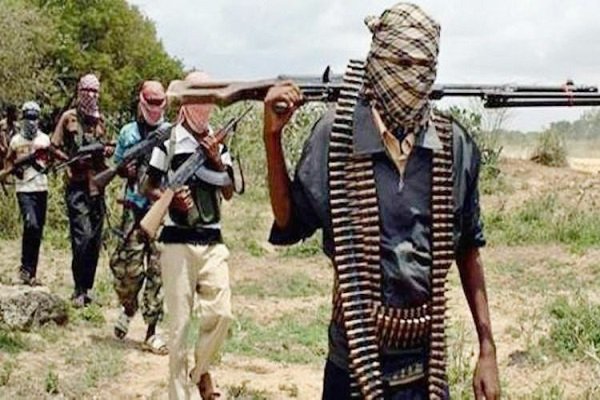
ONE of the notorious bandits terrorising northern parts of Nigeria, Ali Alheri, also known as Kachalla Kawaje, has been killed by the Nigerian Air Force (NAF).
The bandits warlord, who masterminded the kidnapping of female students of Federal University Gusau (FUGUS), Zamfara state, and some construction workers earlier this year, was killed alongside his kingpins by the troops of the NAF air strike on December 11.
A source in the Joint task force Operation Hadarin Daji (OPHD) told Smarts News, a local media platform, on Monday, December 11, that Kachalla Kawaje was killed in Niger state during the air strike.
The ICIRreported how over 25 students, mostly female, were abducted from the Federal University, Gusau, on September 22.
A few days later, the abductors returned and whisked away two more students of the institution in October.
Sources within the school told The ICIR that the terrorists had earlier threatened to kidnap more than 100 people from the institution.
“They vowed that they would abduct 100, kill 30, and the government would pay ransoms for 70. Now they have started their mission and went with 24. They are still coming back to abduct the remaining 76 if care is not taken,” a school student, Mubarak (surname withheld), told The ICIR.
Although the Nigerian Army has since then been rescuing some of the affected students from the bandits, the attacks in other parts of the state have continued, resulting in severe casualties.
Also, according to the source who spoke with Smart News, the NAF air strike had on December 6 hit the camps of Ali Kachalla and Dogo Gide during which several notorious bandits Kingpins were killed.
Some of the kingpins killed by NAF were Dogo Gide’s younger brother and IED producer trained by Ansaru Machika, a top commander in Gide’s group, Haro, and a kidnap and assault specialist, Dan Muhammadu.
The terrorists, alongside several others, were reportedly killed while on an attack mission in Niger state.
The neutralised bandits were known to be hibernating in Kamuku National Park in Birnin Gwari Local Government Area of Kaduna state; Kuyambana Game Reserve in Maru Local government area of Zamfara state and Kainji lake National Park in Mashegu, Magama and Borgu Local Government areas of Niger state.
Over the years, both Niger and Zamafara states have battled incessant attacks from bandits and other terrorist groups.
The terrorists often target communities, raiding villages and abducting people for ransom.
These activities have led to loss of several lives and property, displacing numerous families and causing widespread fear and instability in the state.
Zamfara had the second-highest number of deaths caused by non-state actors in the first quarter of 2022, with 327 cases.
On October 5, 2023, The ICIRreported how no fewer than 1,552 individuals were killed in violent attacks in Niger state between January 2022 and June 2023.
Within the same period, about 1,044 others were kidnapped.
This implies that an average of three people were killed daily from violent attacks in 2022, given that the year had 365 days divided by 1,176, averaging 3.2.
VICTOR Osimhen, Asisat Oshoala were crowned the 2023 African Footballer of the Year in both male and female categories, on Monday, December 11, as Nigeria dominates the 2023 Confederation of African Football (CAF) Awards held in Marrakech, Morocco.
In the male category, Osimhen defeated Morocco’s Achraf Hakimi and Egyptian forward Mohamed Salah to emerge as the winner, ending Nigeria’s 24-year-old wait for Africa’s top individual football prize.
Coincidentally, Osimhen was less than a year old when former Nigerian striker Nwankwo Kanu won the award in 1999.
In the female category, Oshoala added another feather to her cap, winning the African Women’s Player of the Year for a record-extending sixth time.
Also, Super Falcons’ goal keeper Chinaza Nnadozie won the inaugural best African goalkeeper of the year.
In the National Team category, Nigeria’s Super Falcon won the best team of the year.
However, Nigeria midfielder Deborah Abiodun lost out on the African Young Player to Moroccan rivals Nesrye El Chad in the youth category…
Oshimen has registered his name among past winners likes of Rashidi Yekini, Victor Ikpeba, Emmanuel Amunike, and Kanu to win the award.
Elated by the Nigeria’s feat at the CAF Awards, the President. Nigeria Football Federation, Ibrahim Musa Gusau congratulated the winners, advising them not to rest on their oars.
“I am very excited tonight. This has been hugely rewarding for our football and for our country as a whole. I congratulate Osimhen, Oshoala and Nnadozie, and I congratulate the Super Falcons as a team for bringing us this honour.
“My charge would be that they all keep doing what they know how to do best, keep improving and keep winning. The sky will be the beginning for them.”
THE presidency plans to spend about N11.1 billion on computer software acquisition next year, as shown in the Federal Government’s 2024 budget proposal.
The ICIR reports that the budget proposal for this item is a sharp rise from the N926.1 million approved by the National Assembly for the same item for the presidency in the 2023 budget.
However, the quantity of the item to be procured was not stated in either year.
2024
2023
N11.1 billion
N926.1 million
Justapoxing the budgets for both years shows that in 2024, the presidency seeks a budget 11 times more than it got for computer software in 2023.
That is, the 2024 proposed budget of N11.1 billion for computer software for the presidency is 1,107 per cent more than what the National Assembly approved in 2023.
The Budget Office of the Federation released the proposed 2024 budget details days after President Bola Tinubu presented the appropriation bill to the joint session of the National Assembly,
Some MDAs under the presidency include the State House, Bureau of Public Procurement, ICPC, Office of the Secretary to the Government of the Federation, and Office of the Accountant-General.
The ICIR reports that the Federal Executive Council (FEC), on Monday, November 27, approved N27.5 trillion as the Federal Government’s aggregate expenditure for 2024.
The Minister of Budget and Economic Planning, Atiku Bagudu, who spoke to journalists after the meeting presided over by Tinubu, said the targeted revenue for 2024 was N18 trillion.
On Wednesday, November 29, Tinubu presenteda proposed budget of N27.5 trillion to the National Assembly.
The budget presentation requested budgetary approval of a total spending plan that included 1.78 million barrels of crude oil per day, a borrowing plan of N7.8 trillion, and an exchange rate of N700 to the U.S. dollar.
The N27 trillion budget proposal was themed, ‘Budget of Renewed Hope’.
At the presentation, Tinubu listed the budget’s objectives to include:
Reducing poverty,
Improving human capital development,
Macroeconomic stability,
Job-rich economic growth, and
Increased access to social security.
The ICIR reported on Wednesday, December 6, that Tinubu’s Chief of Staff (CoS), Femi Gbajabiamila, refuted the claim that he would spend N10 billion from the proposed budget on his official residence.
The response followed reports by some media platforms on the amount budgeted to refurbish the CoS’ residence and purchase software computers in his office, amounting to N21 billion.
Although Gbajabiamila failed to justify or explain the quality of computer software that would consume over N10 billion, he said the N10 billion allocated for rehabilitating fixed assets was for repairing the presidential lodge and the vice presidential quarters.
A review of the proposed budget by The ICIR showed that the CoS office would spend N21 billion, with the renovation of fixed assets and computer software acquisition amounting to over N10 billion each.
The breakdown of the N10 billion earmarked for the renovation of the fixed assets showed that N5 billion was budgeted to repair the Dodan Barracks presidential lodge and the vice presidential quarters.
The purchase of fixed assets, such as computers, printers, vehicles, refreshments, and office stationery, among other expenditures, takes up the remaining amount.
The CoS further stressed that Tinubu’s administration encouraged constructive scrutiny of government expenditure.
Meanwhile, the N10 billion allocated in the proposed 2024 national budget was aside from the previously allocated N15 billion for a ‘befitting residence’ for the Vice President by the Federal Capital Territory (FCT) Minister, Nyesom Wike.
The ICIR reports that capital projects across Nigeria would suffer more as the Federal Government projected 45 per cent of its N18.3 trillion expected revenue in 2024 to service debts.
The 2024 budget proposes non-debt recurrent expenditure of N9.92 trillion naira, while debt service is projected to be N8.25 trillion naira and capital expenditure is N8.7 trillion.
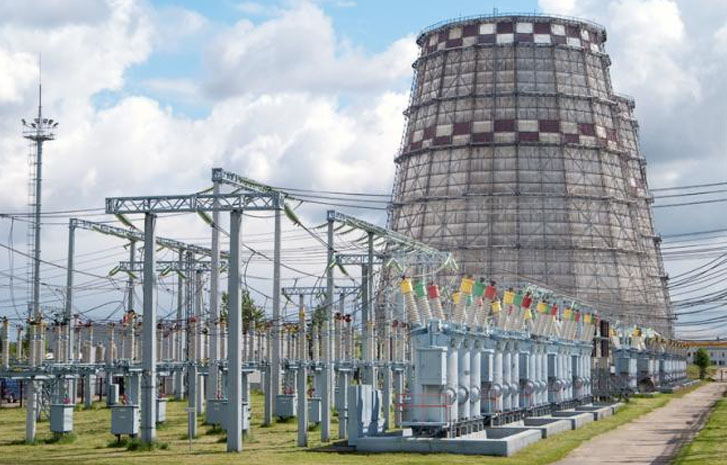
THE Transmission Company of Nigeria (TCN) said suspected vandals attacked its Gwagwalada-Kukwaba-Apo 132KV Transmission Line 1 in Abuja on Sunday, December 10.
The organisation stated this in a statement on Monday, December 11.
The statement signed by TCN General Manager, Public Affairs, Ndidi Mbah, noted that the transmission line was “vandalised between Tower 23 and Tower 25.”
According to the statement, the line was reportedly vandalised when the bulk power supply was cut off, necessitating an early morning investigation by the TCN’s linesmen.
Mbah said a vandalised section of the line route between Tower 23 and Tower 25 was discovered during investigations.
He explained that the Kukwaba Transmission Substation was without electricity due to the vandals taking conductors with them.
However, he said while plans were being made to fix the damaged line, the TCN had temporarily restored bulk power supply to the Kukwaba substation through the Apo substation.
“TCN has restored bulk power supply to Kukwaba Substation at 07:08 p.m. as a temporary solution through Apo substation. Arrangements are, however, ongoing to effect repairs on the affected line,” Mbah said.
In September, the TCN said vandals destroyed 109 transmission towers across Nigeria in nine months.
This was revealed in the company’s most recent vandalism report, which claimed that excavation had put transmission towers in danger and that 330kV and 132kV double circuit power transmission wires had been destroyed.
The TCN report said most vandalism happened in the Benin, Lagos, Kano, Enugu, and Abuja regions.
According to the company, Abeokuta’s power supply was disrupted for a few days due to the necessity of supplying large amounts of electricity over a different line. This, it said, allowed Ibadan Distribution Company to send electricity to its clients whose supply was impacted by the incident.
The report said vandals severed the legs of the four towers in the Benin region by attacking towers 30 to 33 along the Ihovbor-Osogbo-Benin-Osogbo double circuit transmission line.
An X account, @AkpraiseMedia, posted a photo showing a young man standing handcuffed amid two policemen with a claim that it shows the student undergoing Industrial Training (internship) at the telecommunication firm MTN Nigeria Ltd, who purportedly cleared the debt of customers in November 2023.
Earlier in November, many Nigerian users of the network who borrowed airtime woke up to see their debts being cleared by the company. The debts were later reverted a few days after.
The claim posted on Saturday, December 9, 2023, reads: “The IT student who allegedly cleared all MTN users debt has reportedly been arrested.”
The post has generated over 1500 reposts and more than 8,500 likes as of Sunday, December 10, 2023.
CLAIM
The photo shows MTN’s student intern, who cleared customers’ debts.
THE FINDINGS
Findings by TheFactCheckHub show that the claim is FALSE.
The FactCheckHub subjected the image to Google Reverse Image search and the results show that the image has been online since 2014.
Findings show that an earlier version of the picture was posted by the Nigeria Police Force (NPF) on November 5, 2014, reportedly showing one Jeffery Ozuka Okafor, a fugitive that fled to Nigeria from the United Kingdom over murder allegations.
Okafor was arrested by Nigeria Police Force on September 23, 2014 in Asaba, Delta State, after fleeing the United Kingdom over the alleged murder of one Carl Beatson Asiedu on 1st August, 2009 in London.
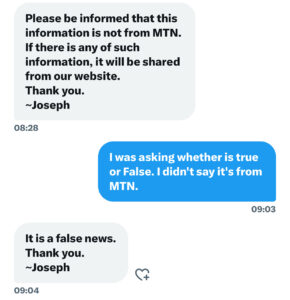
Screenshot of official response from the MTN support via X.
Meanwhile, MTN Nigeria had earlier clarified in a post on X that an unexpected glitch in its system caused the cancellation of debts owed by its network subscribers; meaning that it was not a deliberate action by the company.
The FactCheckHub further contacted the MTN Support on X to further verify the claim. An agent of the telecom company who identified himself as Joseph confirmed that the information is not true.
THE VERDICT
The claim that the image in circulation shows a student intern who purportedly cleared the debts of MTN subscribers is FALSE; findings show that the image shows a murder suspect arrested by the Nigerian police in 2014.
This fact-check is republished from FactCheckHub. Original article can be read here.
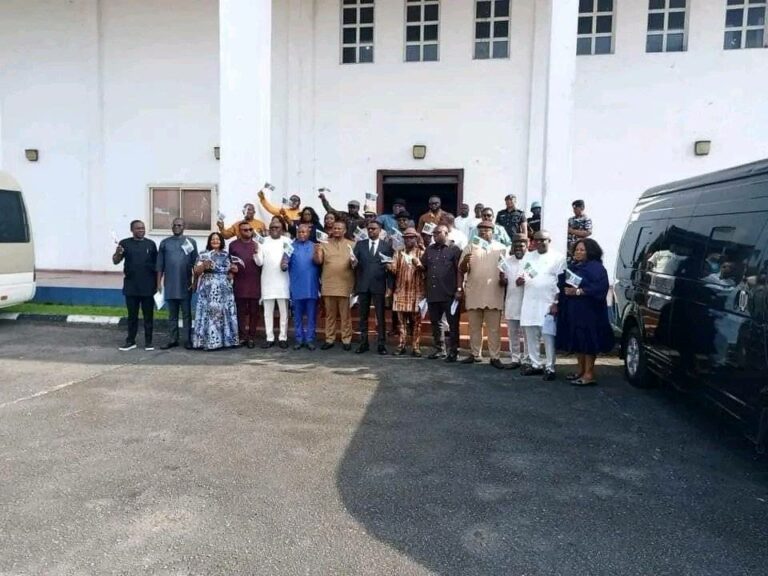
TWENTY-SEVEN lawmakers in the Rivers State House of Assembly have defected from the Peoples Democratic Party (PDP) to the All Progressives Congress (APC).
The defectors, under Martin Amaewhule’s leadership, comprise members loyal to the state’s former governor and current minister of the Federal Capital Territory, Nyesom Wike.
Moments after the defection on Monday, December 11, the lawmakers were seen waving the APC flag in viral videos on social media.
The 27 lawmakers are among the 32 members of the state House of Assembly.
The ICIR reports that the defection came on the heels of the political tension rocking the state party politics.
There have been fears in the state following news of a rift between Governor Siminalayi Fubara and his predecessor, Wike.
Wike handed over to Fubara on May 29, 2023, after concluding his two terms of four years apiece. Fubara is widely believed to be Wike’s political godson.
Anxiety among people in the state was heightened in October when the state House of Assembly moved to impeach the governor, a day after fire gutted the Assembly.
Fubara claimed that he was shot at by military officials while on his way to assess the damage done to the Assembly as a result of the fire on Monday, October 30.
After the fire incident, impeachment actions were initiated against the governor by some members of the House of Assembly believed to be loyal to Wike.
The Majority Leader Ehie Edison, known to be the governor’s ally, was removed.in the botched attempt to impeach the governor.
Fubara was accused of masterminding the inferno as part of efforts to frustrate his impeachment.
When this report was filed, Wike and Fubara remained in the PDP. It is unclear whether the lawmakers’ defection is a ploy to succeed with Fubara’s impeachment or to mainstream the state’s politics into the APC, which controls power at the federal level.
President Bola Tinubu appointed Wike, a PDP member, in August into his cabinet. He has since been seen as a bigwig in the PDP.
The ICIR further reports that with the lawmakers’ defection, more developments are expected in the Rivers state politics in the next few days.
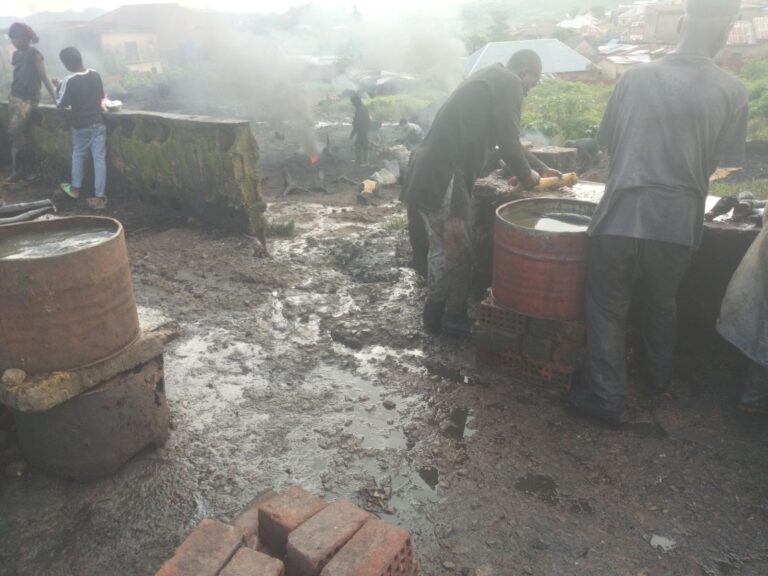
VOM, NIGERIA—At first glance, there seems to be nothing wrong with the slaughter slab located near a stream in Vwang, Jos South local government area of Plateau state. A closer look would however reveal that the abattoir, where the meat consumed daily by residents is processed, is a breeding ground for diseases.
Over the years, residents of Vwang have continued to make use of the facility despite the health risks. The contract awarded for the construction of a modern abattoir in 2020 failed to materialise.
For visitors and regular faces, the ominous plume of dark smoke, accompanied by the pungent scent of burning animal hide, announces that an abattoir is nearby – it is a beehive of activities, regardless of the state of the infrastructure.
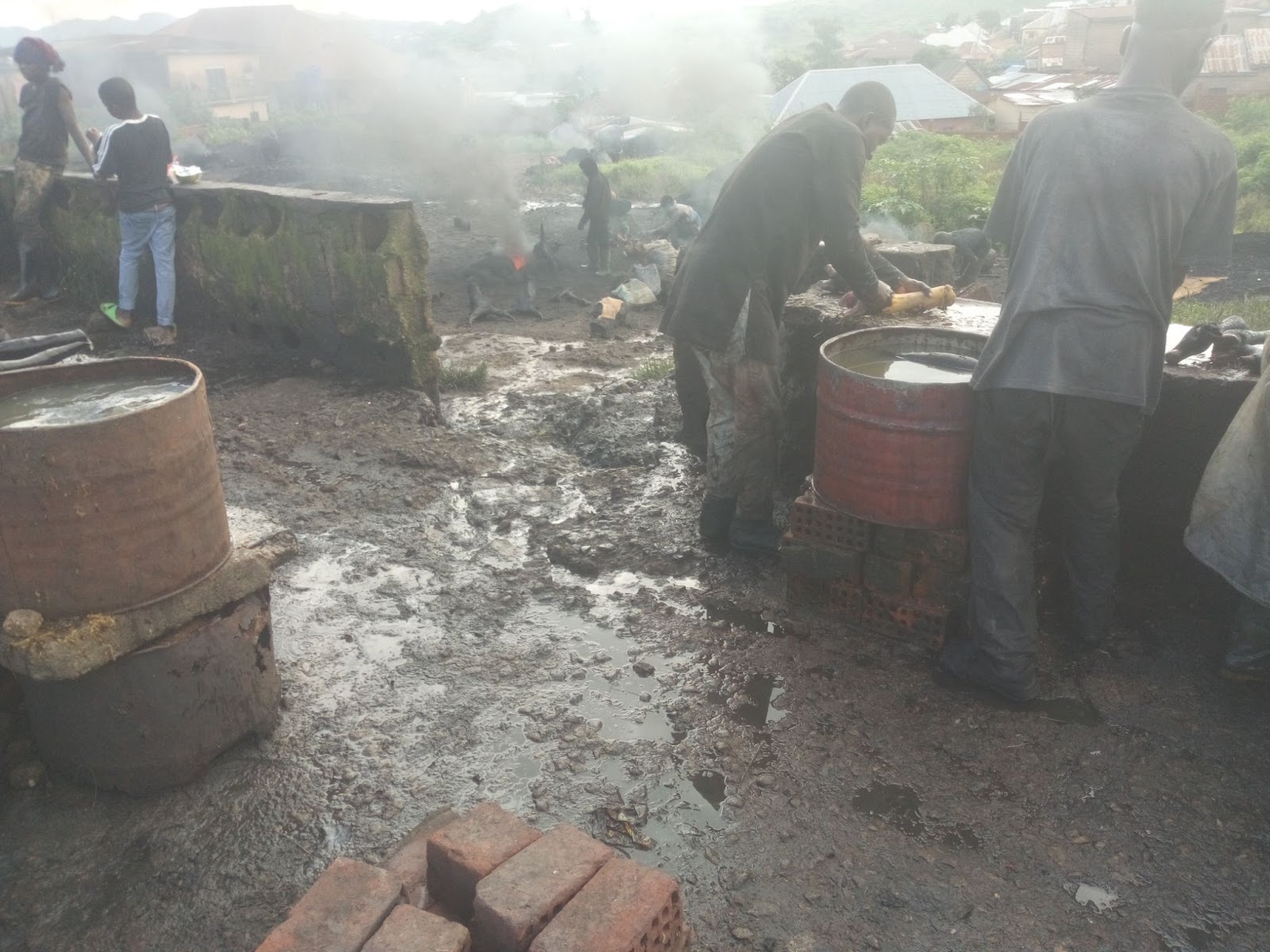
Each morning, cows and goats are dragged to the slaughter slab — killed and prepared for meat but without passing through the hygienic procedures. The slaughterhouse at Vwang village is a makeshift structure that has no facilities that modern abattoirs should boast of.
Butchers at work
From Monday to Saturday, Baba Mai Tio, an elderly butcher and others like him, get busy processing the animals in a rather filthy environment. At the makeshift slaughter slab, there is no veterinary doctor to assess the quality of the animals before they are slaughtered.
“We don’t have the facilities or equipment to adhere to a standardised procedure; we simply process the animals as they are brought in,” says Baba Mai Tio as he wipes his hands on his dirty and blood-stained shirt.
“We are aware that due to lack of standard facilities and equipment what we do is sometimes dangerous, but we have to do what we can do,” he adds. “Hopefully, if this abattoir is completed and sensitisation is carried out, I am sure that several butchers will utilise the facility.” But his hope of seeing a standard abattoir is fast fading as the project has not received attention since 2021.
According to a veterinarian at the National Veterinary Research Institute, Vom, pre-slaughter care takes about six to 12 hours to ensure the quality of meat.
This is, however, missing in Vwang village. As animals are dismembered, butchers take the remains to the stream to wash the meat, exposing the product to possible contamination and infection. They also release animal waste into the water, which causes contamination.
Sometimes, residents collect the waste for use on their farms. “During festive periods like Christmas, we have a higher number of animals to slaughter, but on regular days like today, the number is lower,” says Sunday Dung, another butcher, as he disposes of some of the animal waste into the nearby bushes.
The Food and Agriculture Organisation’s (FAO) manual for the slaughter of small ruminant animals in developing nations states that “the siting of slaughter premises near waterlogged areas must be avoided.
“Evidently, such sites can raise sanitation problems as in the breeding of mosquitoes and stagnation of wastes. Location near watercourses or inland bodies of water such as rivers, lakes and lagoons is also unadvisable,” the FAO recommends.
From the makeshift abattoirs to the chef’s pot
Despite not meeting up with the standard practices, meat from the filthy abattoir ends up in a plate of food at restaurants.
Pam Ruth, who runs a local restaurant at Tya Andavco market in Vwang villages sources meet from the slaughter slab. At her restaurant, as many as 30 customers feed there daily.
“I typically wake up early to meet with the butchers right after they’ve returned from slaughtering to obtain the best cuts,” Ruth says in Hausa while placing a piece of beef onto a plate for a customer.
Ruth says she didn’t know animals have to be assessed before they are slaughtered and processed for meat. “For me, I just buy meat and cook and serve my customers,” she says with a carefree expression on her face.
According to a medical doctor Habiba Momoh, the head of the animal health department at the Federal College of Animal Health and Production Technology, Vom, (FCAHPT), “the practices in these (illegal or makeshift) slaughterhouses give rise to serious health risks for consumers and butchers alike, as diseased, deceased, and pregnant animals can be processed without proper oversight.”
An advisory by the National Centre for Disease Control and Prevention also warns that “slaughtering sick animals can expose the anthrax spores which humans can inhale which will cause severe manifestations of the disease.”
Although the names of the communities were not mentioned, Gyang Bere, the state’s director of press and public affairs, said samples were sent to the National Veterinary Research Institute, Vom—the parent institution of FCAHPT— for investigation. The outcome of the investigation has not been made public.
Several butchers at Vwang who spoke to this reporter said that the community has never had an abattoir that follows the processes outlined by Dr Momoh.
Tya Andavco Slaughterhouse: Forgotten millions, taken over by tall grasses
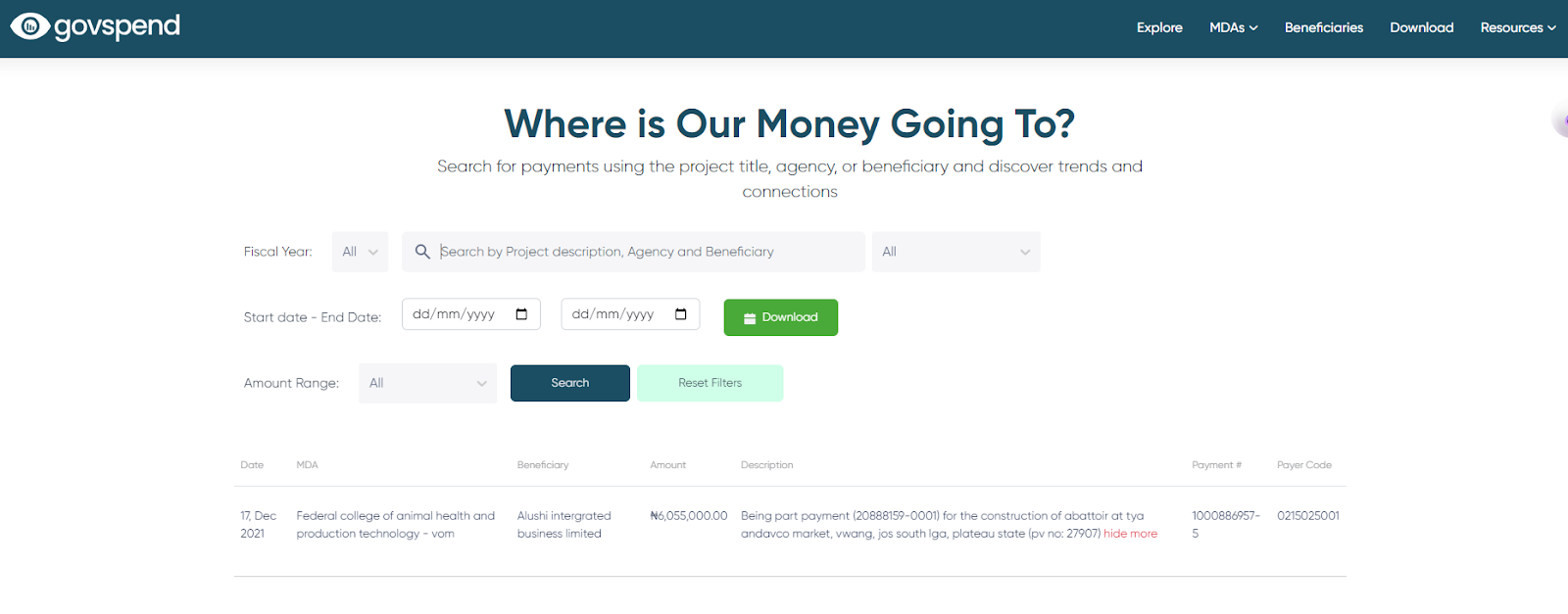
In 2020, ₦20 million was allocated for the construction of an abattoir at Tya Andavco Market— the largest market in Vwang, under the supervision of the Federal College of Animal Health and Production Technology, Vom.
According to GovSpend, a civic tech platform that tracks and analyses federal government spending in Nigeria, ₦6 million was released as an initial payment to the contractor, Alushi Integrated Business Limited, in December 2021.
Proof of payment via Govspend portal.
However, about two years later, the project has been abandoned. When this reporter inquired about the abattoir during a visit in October 2023, a resident who did not want to be named did not know about it.
“Hmm! I don’t know of any abattoir in this community. If you are looking for meat, you can ask the men sitting over there,” she gestured towards a nearby slab. “That’s where they sometimes slaughter animals.”
About six other residents that we asked were also unaware. Even the local fixer was in the dark about the supposed abattoir. As they continued their search, a distant sight caught their attention: a building nestled amidst tall grasses with a green roof.
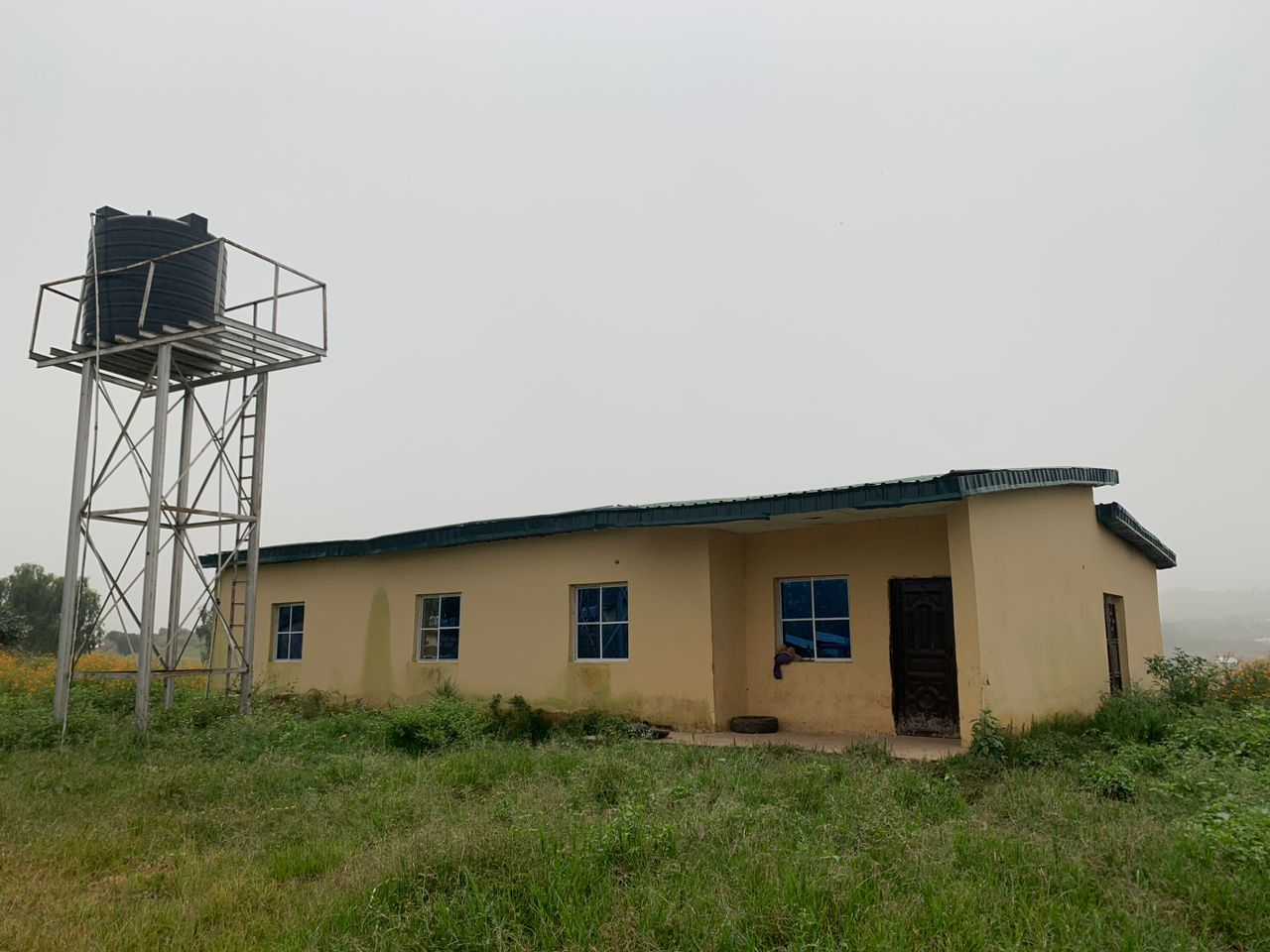
The abandoned abattoir at Vwang
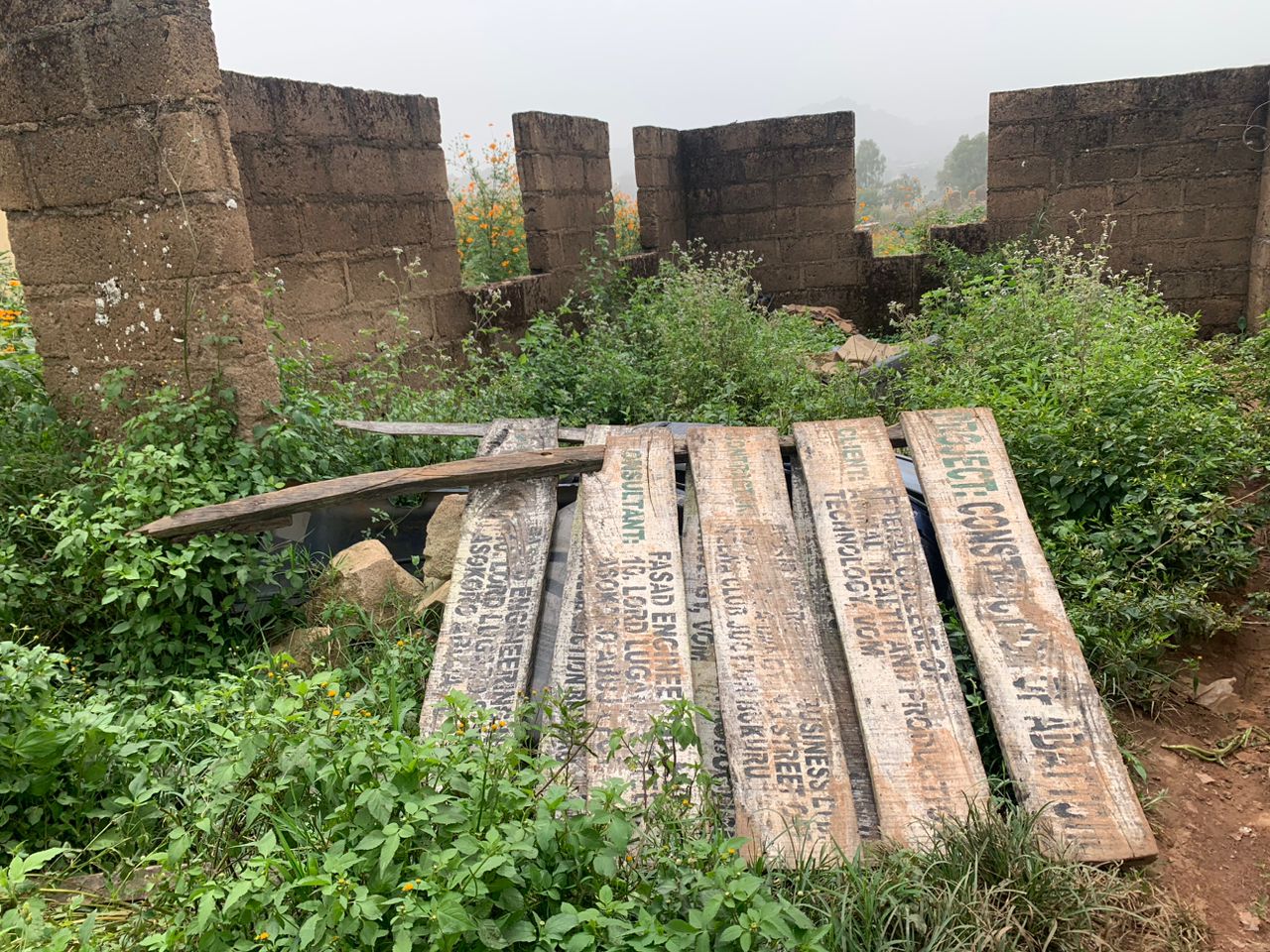
“This must be the abattoir,” the reporter surmised, offering a glimmer of hope in their quest. Amid the grasses lies the decaying signage that provides a summary of the project. “We finally found it,” the fixer exclaimed, expressing relief after about a 30-minute search.
In January 2021, when Tracka, BudgIT’s social accountability initiative, tracked the project, the building was at lintel level: “This project has been ABANDONED by the contractor,” the report stated.
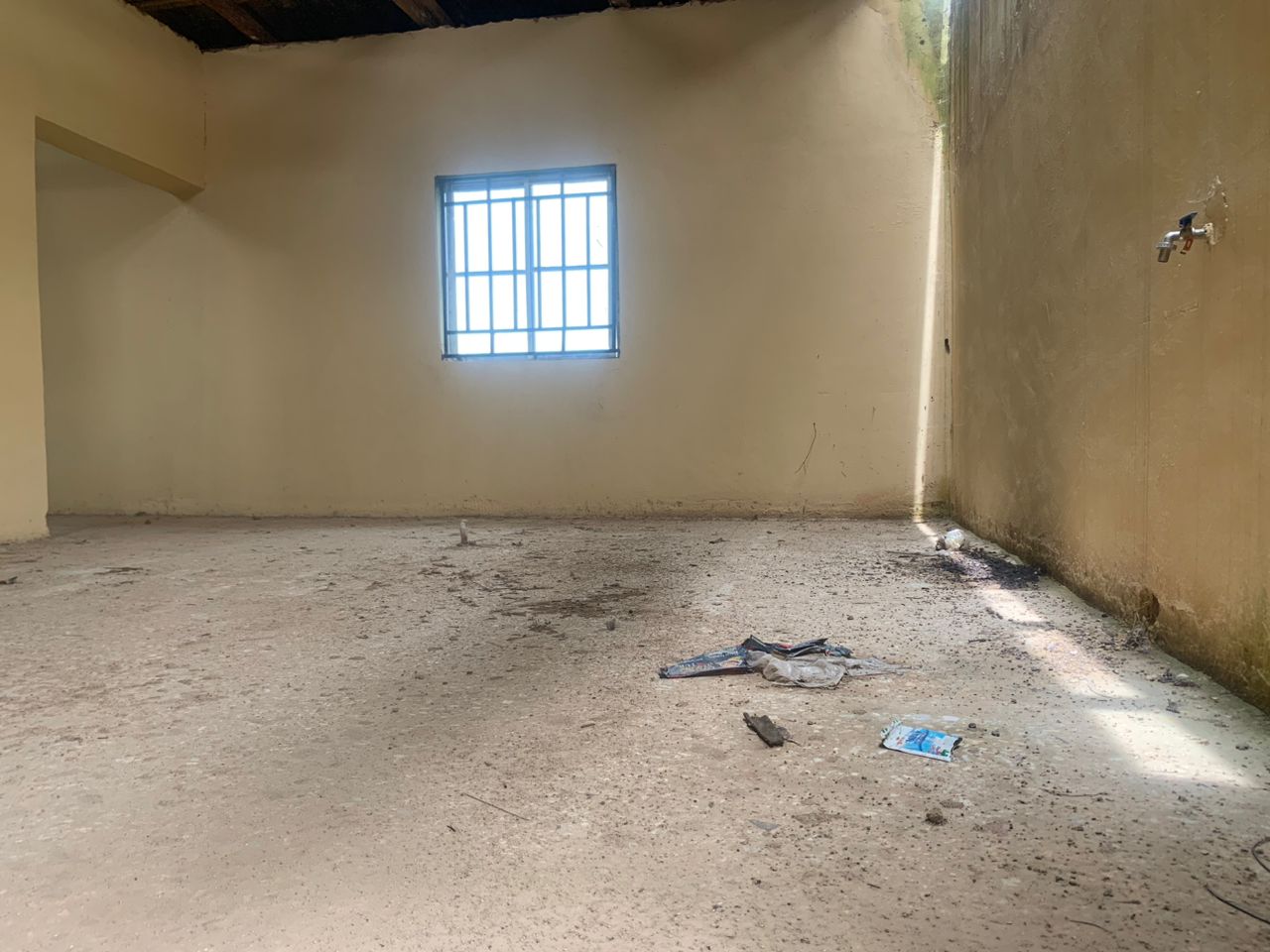
Two years later, the building appears nearly finished from the outside, featuring a pristine cream coat on the walls, a vibrant green roof crowned with a solar panel, and a water tank standing resolutely by its side. However, a step beyond the entrance reveals a contrasting narrative.
Amid the dust and cobwebs that shroud the building’s interior, Chung Davou* who was employed by Alushi Integrated Business Limited as the security guard, said, “The project got to this current level two years ago (2021) but since then no work has continued inside the building.”
Inside the abandoned multi-million naira abattoir
Aside from the ₦6 million initial payment made to the contractor, no follow-up disbursement has been recorded by GovSpend.
“It was an exciting initiative when we learned about it. However, we have not been carried along with the project, so we do not know exactly what is going on,” says one butcher,” who opted to remain anonymous. “When the contractor is done, I am sure he will hand it over to the college, and then to the community.”
Location falls short of FAO’s standard
Unlike the makeshift slaughter slabs in Vwang, the abandoned abattoir is situated quite a distance from the riverside. But it is cited right amid the bus park and Tya Adavco market, a deviation from global best practices.
“Slaughterhouses are best sited on the outskirts of a town or village, at a distance from built-up areas,” according to the FAO manual.
“This is to prevent possible inconvenience to dwelling-places either by way of pollution from slaughter wastes or by way of nuisance from noise, stench or the presence of scavenging animals such as vultures, stray dogs, etc.”
However, Philip Chung, a resident, argues that the location makes commuting easier. “Since it is in the middle of the market, it’s easier to get the meat to the consumers. If it is located far from here, it will be difficult to distribute it,” Chung retorts.
A decaying signpost showing the details of the construction project
Alushi & FCAHPT declined to comment
Federal College of Animal Health and Production Technology, which is the supervisory agency for the project, is not forthcoming about why the contract is stalled.
When asked, Momoh, an administrative staff of FCAHPT declined to comment in the absence of the provost. “I am not sure about the project,” Dr Momoh said.
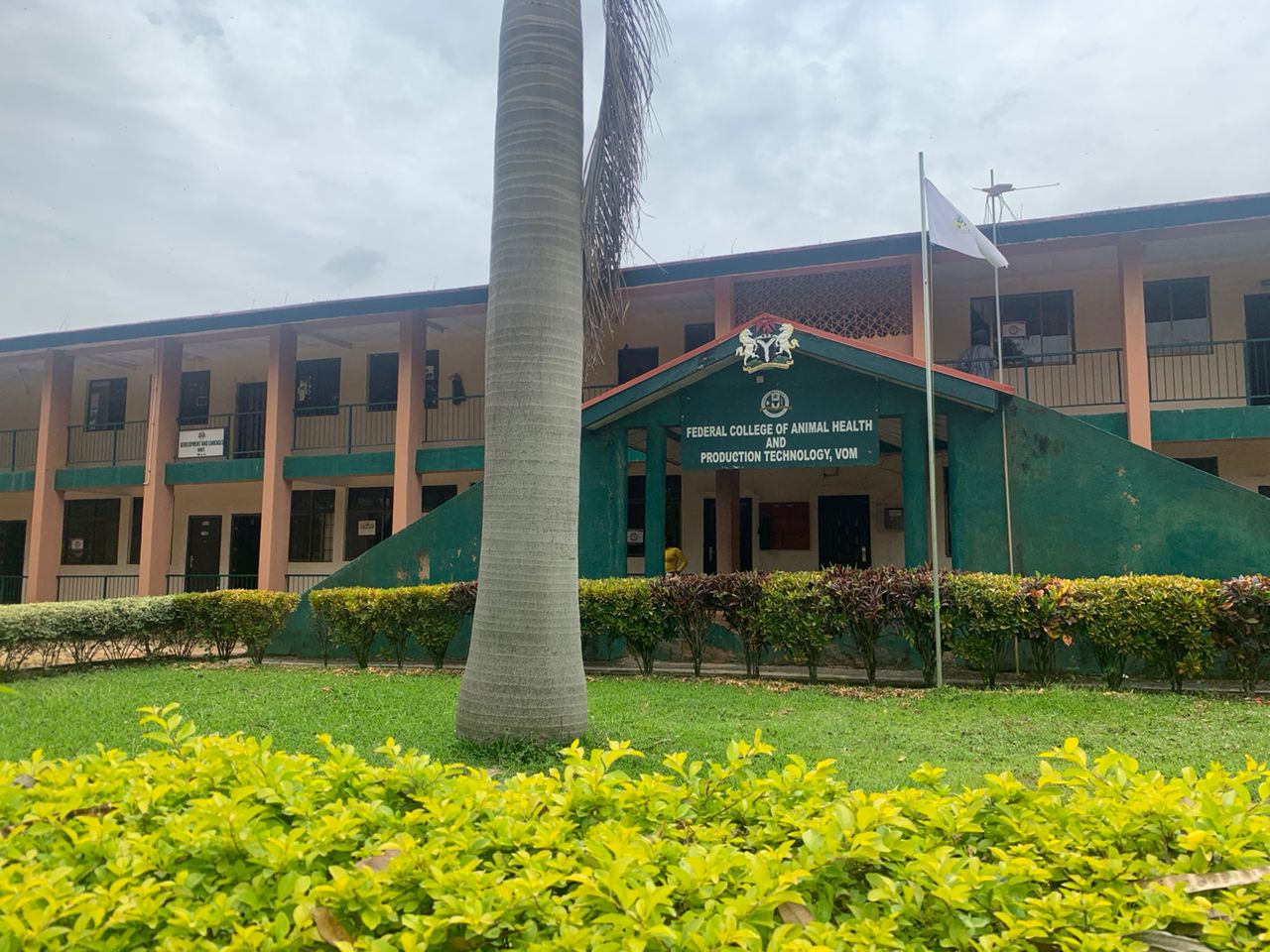
The admin block of the Federal College of Animal Health and Production Tech, Vom
However, the security guard at the abandoned project recalled that a few months after completing the painting and roofing of the abattoir, the contractors returned to collect some of the remaining construction materials. “I don’t know exactly what the issue is. I’ve not been paid my salary for several months,” he said.
When we contacted Nathaniel Manga, the director of Alushi Integrated Business Limited, via a phone call said that he was unavailable to respond to questions regarding the project. “Can we meet tomorrow?—that is Wednesday—I am in Abuja at the moment, I will reach out to you once I am in Jos,” he said.
However, Manga did not honour the appointment and he also did not respond to follow-up messages and calls.
Residents call for action
Baba Mai Tio believes that the completion of the project would facilitate butchers’ work and promote good practices.
“We will be glad to leave the old and unbefitting slab that we have been using for years to the new one if it is completed,” he said. “We can be sure that our animals are prepared in a very clean and hygienic place.”
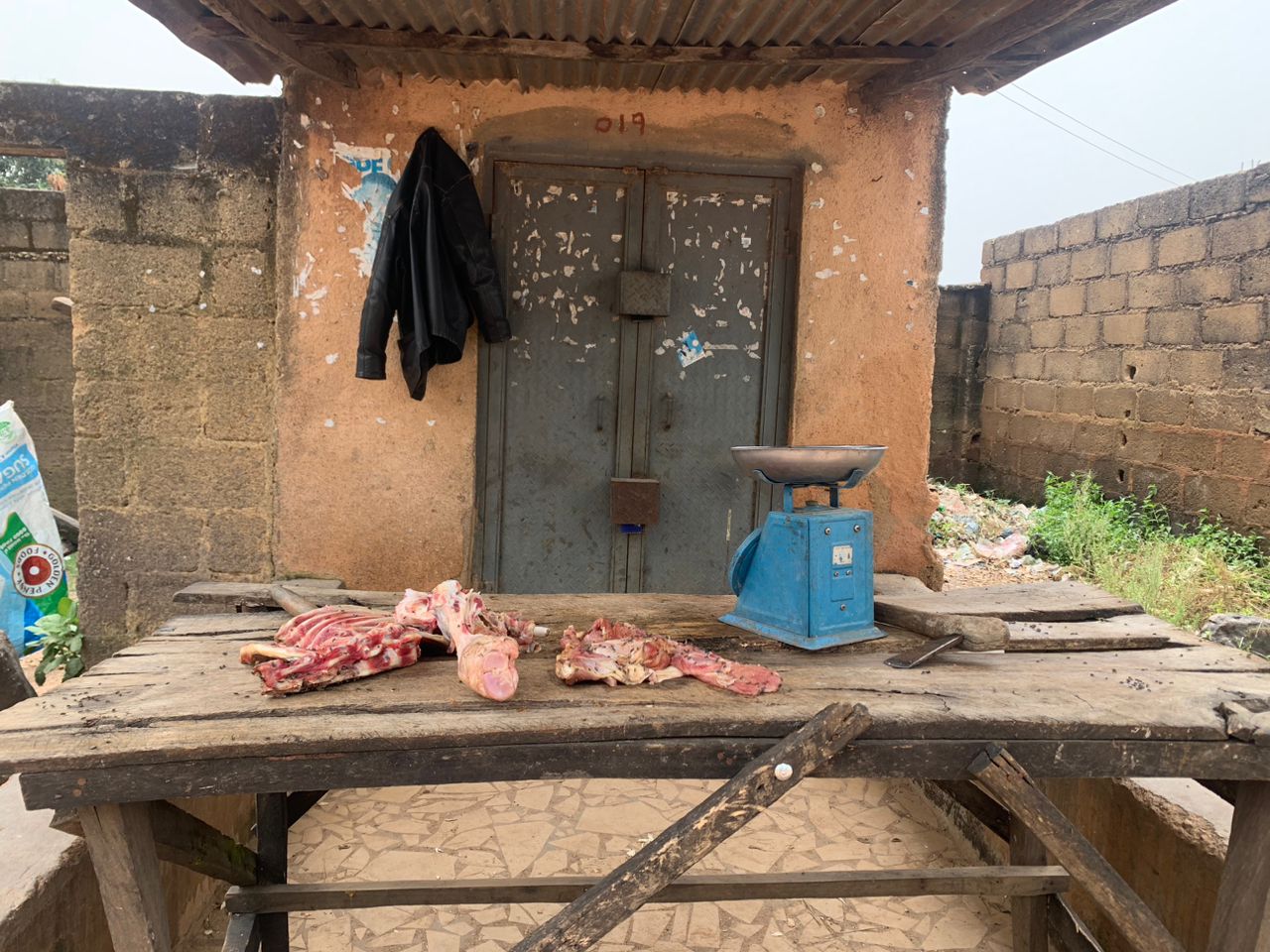
Baba Mai Tio’s meat stand
On his part, Dung says a new era in the practice of animal butchering would be heralded if the government could release funds to finish the abattoir. “If this building is working, we would also be proud of the work that we do and can do things the right way,” he said.
For Ruth, a new abattoir will guarantee public health, especially for residents of Vwang village and beyond. “Our health is important, but many times we take things for granted by not looking at where our animals are killed and how the meat is processed,” she said.
“But if they have pity on us and finish this work, we will be happy that the health of our people is guaranteed.”
This story is republished from Joey Off Air under the GovSpend Media Fellowship, supported by BudgIT, ICIR and MacArthur Foundation.
THE Socio-Economic Rights and Accountability Project (SERAP) has tasked the Nigerian National Petroleum Company Limited’s (NNPCL) group chief executive officer, Mele Kyari, to provide information on the quantity of oil that Nigeria produces and exports on a daily basis.
It also requested that the NNPCL produce the total amount of revenue it has generated from oil since the removal of petrol subsidy in May, 2023.
This was contained in a freedom of information (FOI) request issued by SERAP on Saturday, December 9.
The request was signed by its deputy director, Kolawole Oluwadare.
A former governor of the Central Bank of Nigeria (CBN), Sanusi Lamido Sanusi had alleged last week, that the NNPCL was failing to remit enough foreign exchange into the treasury despite the removal of fuel subsidy.
He questioned where the money was going.
In its request, the SERAP gave the NNPCL seven days to respond, failure of which it vowed to take necessary legal action to compel the national oil firm to do so in the public interest.
“According to our information, the NNPCL has failed to disclose the amounts of barrels of oil the country produces and exports.
“The NNPCL has also reportedly failed to publish details of revenues generated from the production and exportation of oil and the amounts of revenues remitted to the public treasury as required by Nigerian laws.
“According to the former Governor of the Central Bank of Nigeria (CBN), Sanusi Lamido Sanusi, ‘t is only the NNPCL that can give the figures about how much oil we produce daily, how much we sell, and where the money is going. We are no longer paying subsidies. Now, where are the dollars? Where is the money,?’ Part of the FoI read.
The request also highlighted that it was the responsibility of the NNPCL to uphold accountability and transparency regarding the quantity of oil that the nation produces and exports on a daily basis, while making sure that the proceeds from the activities are properly transferred to the public coffers.
The SERAP requested that the NNPCL provide information regarding the payment of N11 trillion in subsidies and address claims that the company has not sent oil earnings to the public treasury since the removal of the petrol subsidy.
The letter further stated that “SERAP is extremely worried about the years of allegations of corruption and mismanagement in the oil sector”, while adding that the impunity of perpetrators had undermined public trust and confidence in the NNPCL.
THE total Companies Income Tax (CIT) collected by the Federal Inland Revenue Service (FIRS) in the third quarter (Q3) of 2023 was far higher than the total CIT collection from local firms, which is an indication of Nigeria’s harsh operating environment worsened by the recent reforms of the President Bola Tinubu-led Federal Government.
The ‘Company Income Tax’ report for Q3 2023, provided by the FIRS, validated and released by the National Bureau of Statistics (NBS) on Friday, December 8, indicated that the FIRS collected lower CIT from local firms than foreign firms.
The report shows that foreign firms’ CIT payments rose by 235.63 per cent to N1.097 trillion in Q3 2023 from N327.02 billion in Q2 2022, while local firms’ CIT payments increased by 34.87 per cent to N651.63 billion from N483.17 billion, representing a N770.56 billion increase for foreign firms CIT payment and an N168.46 billion for local firms CIT payment.
A cursory look at CIT reports for the first and second quarters of this year showed that the total amount of CIT payment by local firms stood at N300.78 billion in Q1, higher than the N168.23 billion total CIT paid by foreign firms. Also, in Q2, the total local firms’ CIT payment of N1.03 trillion was higher than the N505.91 billion CIT paid by foreign firms.
However, in the review quarter (Q3), the total sum of N651.63 billion in CIT payments by local firms was lower than N1.097 trillion in CIT payments by foreign firms.
Experts believe this is a consequence of the fuel subsidy and exchange rate reforms of the new administration of President Bola Tinubu.
According to PricewaterhouseCoopers (PwC) International Limited, a tax consultant firm, resident companies are liable to CIT on their worldwide income. At the same time, non-residents are subject to CIT on their Nigeria-source income.
It pointed out that companies with gross turnover greater than N100 million are entitled to pay a 30 per cent CIT rate, and companies with gross turnover greater than N25 million and less than N100 million pay a 20 per cent rate. In contrast, companies with a gross turnover of N25 million pay zero per cent.
The lower amount of CIT paid by local firms relative to the foreign firms deliberately shows us the realities of the Nigerian economy, the Head of Financial Institutions rating at Agusto&Co, Ayokunle Olubunmi, told The ICIR.
He said, “All those reforms that the new administration introduced were meant to make the country go forward. Still, we are going through the teething stage, and the impact significantly affects the economy and companies’ performances.
“As we all know, the profitability of a company is what determines the amount of taxes paid. You can see that the environment is not as harsh and challenging for companies operating outside the country as what we have in Nigeria.”
Meanwhile, in the review quarter, CIT aggregate rose to N1.75 trillion from N810.19 billion in the corresponding quarter of 2022.
THE leadership of the Senate has announced the donation of its December salary amounting to 109 million naira to victims of accidental army airstrike at Tudun Biri village in Igabi local government area of Kaduna state.
The Deputy Senate President, Barau Jibrin, disclosed this during a condolence visit to the state Governor Uba Sani at the state Government House on Sunday, December 9, 2023.
Barau, who represented the Senate President, Godswill Akpabio, said the National Assembly would collaborate with the presidency to unravel the circumstances surrounding the accidental bombing of the victims in order to avert a recurrence.
“We are all worried. We are all disturbed but the only thing we can say now is that the Almighty Allah grant those who lost their lives rest, and those who sustained different degrees of injuries quick recovery.
“We are here to show our solidarity and to show the fact that we stand by the government of Kaduna state and indeed the entire people of this state, particularly, the people of Tudun Biri in this trying period that the state is experiencing.”
On his part, the governor, while thanking the senators for their show of empathy for the victims, called on the National Assembly to support the Federal Government in probing the attack.
He also appealed to the federal legislators to review the agitation for the creation of state Police to strengthen security at all levels.
The ICIRreported that no fewer than 85 unarmed civilians were killed recently in an attack by the military on Tundun Biri village, Kaduna state. The villagers had been celebrating the Maulud Nabiyy (the birth of Prophet Muhammad) in the late hours of Sunday, December 3, when they were bombed.
The Nigerian Army took responsibility for the bombing, and according to the National Emergency Management Agency (NEMA), 85 corpses were recovered from the scene of the attack.