Home Blog Page 757

Nigeria’s indebtedness in contract awards exceeds its foreign reserves – Agbakoba

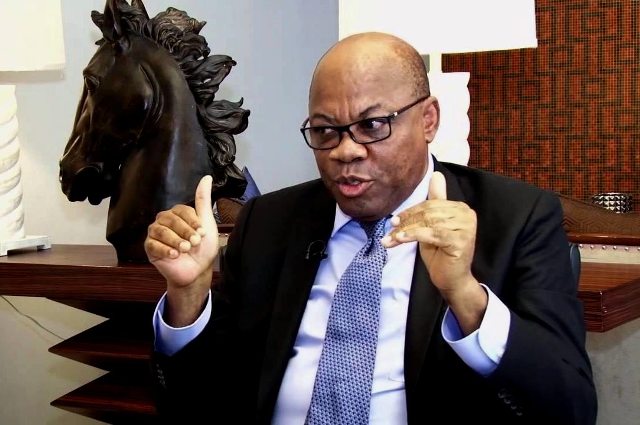
A SENIOR Advocate, Olisa Agbakoba, has hinted that Nigeria’s potential liabilities on contract awards exceeded the country’s total foreign reserves.

He said this on Monday, October 30, when he appeared as a guest on the Arise TV programme, ‘The Morning Show,’ to review the retiring Justice Musa Dattijo’s valedictory speech, which continues to generate interest among lawyers and the general public.

Responding to a question on the Process & Industrial Development (P&ID) case favouring the Nigerian government, Agbakoba said the country was deeply indebted to contract awards cases.

“As I speak, our liabilities on potential awards exceed our foreign reserves.

“There are a thousand other cases. This [the P&ID case] is not the only one. This is the popular one. There are so many cases around the world against Nigeria,” the renowned SAN said.

According to data from the Central Bank of Nigeria (CBN), Nigeria’s gross foreign reserves stands at $33.34 billion as of Friday, October 27.

Using the Nigerian Autonomous Foreign Exchange Market (NAFEM) rate, which closed at N993.83/$1 on Monday, October 30, Agbakoba’s estimation of Nigeria’s contract award liabilities could be well over N33.13 trillion.

The ICIR reported that the immediate past President Muhammadu Buhari said it would have cost Nigeria $15 billion had the country lost the P&ID case.

Continuing, Agbakoba noted that he was incidentally the chairman of the National Arbitration Policy Committee set up by a former minister of Justice and Attorney General, Abubakar Malami, on the P&ID case.

He said, “So, I call on the Attorney-General to set up a panel so that we can study these cases and we know what exactly our potential liabilities are.”

According to him, the P&ID award showed a need for more culture of interest on the path of Nigerian leaders.

He queried, “How could two men come into the country, just showed us a powerpoint and get away with a huge contract with the Federal Government and the Federal Ministry of Justice officials, absolutely bungling it.”

Commending Robin Knowles for his “great” wisdom to have detected that what transpired in the P&ID award was not the proper thing to have been done, he lamented that the P&ID case was “humongous embarrassing” for Nigeria.

“I am very happy that it went in our favour, and we have been free from that liability. But there are a thousand other cases.

“This is only the third time in English history that an award is upset. You don’t upturn an award in the English system because the sanctity of an arbitration award is valuable. That is why the English arbitration jurisdiction is one of the most effective in the world.”

Knowles had ruled in favour of the Nigerian government on Monday, October 23, while presiding over the P&ID case in a London Court.

Meanwhile, Agbakoba, while commenting on some of the submissions in Dattijo’s valedictory speech, described the judiciary as the most undemocratic arm of government.

The retiring Justice of the Supreme Court, who reportedly withdrew from the seven-man panel that dismissed all the appeals that sought to remove President Bola Tinubu from office, has accused the office of the Chief Justice of Nigeria (CJN) of abuse of power.

Dattijo, who had spent 47 years in active judicial service, bowed out of the apex court on Friday, October 27, having clocked the 70-year mandatory retirement age.

He used the opportunity of the valedictory session organised in his honour by the Supreme Court to address what he observed as rot in the judiciary that has continued to affect the justice delivery system in the country.

He maintained that the judiciary, as presently structured, gives so much power to the CJN, who he said usually takes decisions without consulting other justices.

‘I’m grateful for this opportunity’, Rema says after Ballon d’Or performance

0

DIVINE Ikubor, professionally known as Rema, has expressed delight over his performance at the 67th Ballon d’Or held at Theatre du Chatelet in Paris, France, on Monday, October 30.

Rema, via his official Instagram said “Afrobeat in Ballon d’Or, I’m truly grateful for the opportunity. Glory to the Most High for the grace 🤲🏽❤️”

The global artiste, who is taking Afrobeat to new heights while also breaking new ground for himself and the Nigerian music industry, performed his hit song, ‘Calm Down,’ becoming the first Nigerian artiste to sing at the Ballon d’Or.

He recently released his highly anticipated EP titled, ‘Ravage’ which features five new tracks: ‘Trouble Maker’, ‘DND,’, ‘Smooth Criminal’, ‘Don’t Leave’ and ‘Red Potion’.

Rema made history in 2023 and won numerous awards including the MTV Video Music Awards (VMAs) where his song ‘Calm Down’ featuring Selena Gomez won the award for the ‘Best Afrobeats’ among other prestigious awards.

Ballon d’Or which is regarded as one of football’s most prestigious and valuable individual award is an annual award presented by French news magazine.

With Lionel Messi winning the 2023 Ballon d’Or for the eighth time, Napoli and Super Eagles forward Victor Osimhen finished eighth, making him the first and highest-ranking Nigerian on the list.

Lionel Messi bags 8th Ballon d’Or  Award at age 36

0

LIONEL Messi, 36, on Monday night, emerged as the 2023 Ballon d’Or winner for a record-extending eighth time.

At the ceremony held in Paris, it was a 3-man horse race among Messi, Manchester City striker Erling Haaland, and PSG and France forward Kylian Mbappe.

But, after the count of votes, Messi was announced the winner ahead of Erling Haaland who scored 52 goals last season to help City win the treble and Mbappe- the second man to score a World Cup final hat-trick who finished third.

The Argentina captain led his country to win the World Cup held last year in Qatar where he won the trophy for the first time for his country and bagged the Golden Ball award for the best player of the tournament.

The Inter-Miami captain stunned the world footballing scene in 2009 to win his first Ballon d’Or and dominated the scene, winning the title for four consecutive times; 2009, 2010, 2011 and 2012.

Messi, who won the title from France’s Karim Benzema, added his current title to his wins in  2015, 2019 and 2021.

He is currently the player who has won the title eight times. Close to him is 38-year-old Portuguese  Cristiano Ronaldo, who has won it five times.

In the female category, Barcelona midfielder Bonmati won the Women’s Ballon d’Or for the first time as she helped Spain to maiden World Cup glory in August and won a league and Champions League double at club level.

The best goalkeeper award was given to Argentina and Aston Villa goalkeeper Emiliano Martinez, who won the Yashin Trophy for the best goalkeeper in the world.

Despite emerging second in the best player of the year of the men’s category, Haaland’s outstanding performance last season earned him the Gerd Muller Trophy for his record-breaking goal haul last season.

Meanwhile, his team, Man City, were named the men’s club of the year for a second year running after winning the Treble.

4,000mw of power 10 years after privatisation shameful, says Minister

NIGERIA’S Minister of Power, Adebayo Adelabu said ‘it is shameful’ that the national grid only utilised about 4,000 megawatts of on-grid power 10 years after privatising the sector.

The Minister disclosed this on Monday, October 30, at a three-day Nigerian Electricity Supply Industry (NESI) Market Participants and Stakeholders Roundtable (NMPSR) in Abuja.

Adelabu also decried huge interventions running into trillions paid by the government to sustain the sector despite privatisation since 2013.

“It is shameful, the national grid is doing a little above 4,000 megawatts after 10 years of privatisation. We’ve been hearing of this 4,000 megawatts of power for long.This is not something I’m proud to say in the public.The big question is, after 10 years of taking over the assets, have these core investors transformed the sector? Are they also adhering to terms and conditions of their licence,? he asked.

He told the stakeholders to be sincere in providing answers to privatisation evaluation by answering whether the privatisation had yielded the desired results.

“We need to approach this with all sincerity. It is either yes or no to make headway in our discussion here and move forward.

Adelabu suggested that a developing nation like Nigeria would have gone for the commercialisation of the sector instead of wholesale privatisation.

He stressed that the privatisation had failed to yield the desired results, despite huge interventions from the Federal Government, amid poor liquidity in the sector.

He informed, however, that all hope was not lost as the government was exploring options within renewable energy sources to improve the sector.

The National Cordinator, All Electricity Consumers Protection, Ademola Ilori, at the event told The ICIR that the power sector risked going further worse, if the legal commitments signed by various parties -the generation, distribution and transmission companies and the government were not adhered to.

“We had expected a boom in the generation, transmission and distribution after privatisation and handing over core assets to investors. Unfortunately, we’re still groping around 3,500 and 4,000 megawatts,. Then, there’s a problem.

The privatisation of the Nigerian Electricity Supply Industry, (NESI), took place in 2013 with huge expectations to herald a turning point in the nation’s energy sector.

The process transitioned it from the era of the Power Holding Company of Nigeria (PHCN) to a system of private investor ownership and participation.

However, the progress in NESI, post-privatization has not fully met the expectations set in the National Electricity Power Policy, 2001 (NEPP), the Electric Power Sector Reform Act, 2005 (EPSRA) now Electricity Act 2023, with trillions of interventions and subsidy being paid by the government to sustain the sector.

Polaris Bank loses N26bn loans granted to 6 ex-directors without collaterals

1

By Odinaka Anudu

  • …one ex-director with N31bn loan placed on watchlist

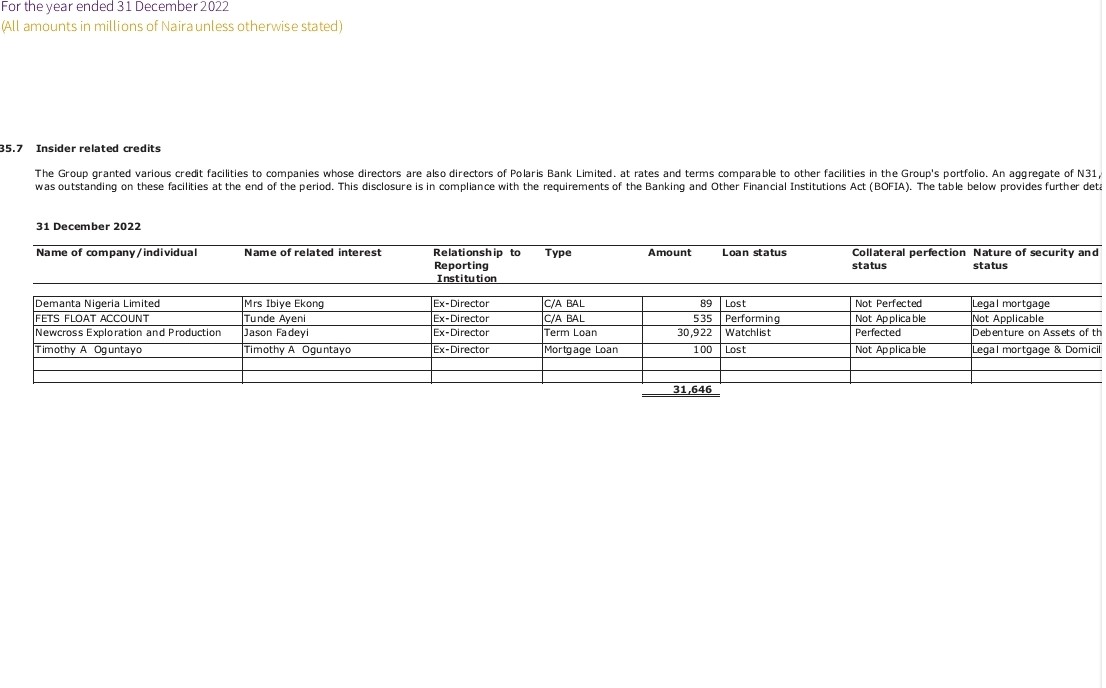
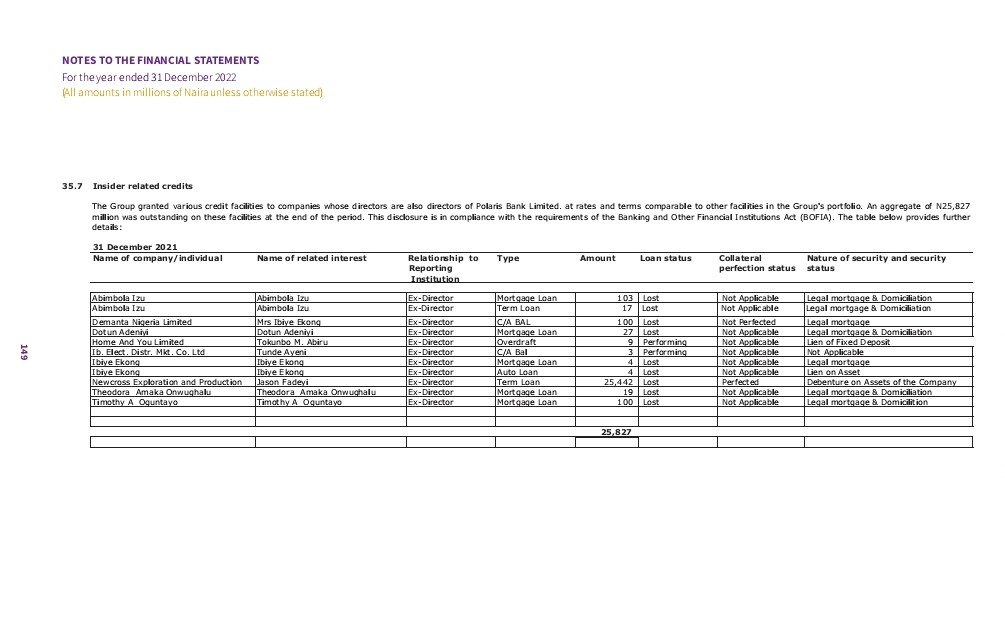
POLARIS Bank has lost N26.005 billion worth of loans granted to 6 ex-directors, mostly without collaterals.

Economy Post found from the bank’s 2022 annual report that 5 out of the six ex-directors did not perfect their collaterals before receiving the loans from the bank. Only one ex-director, Jason Fadeyi of Newcross Exploration and Production, who collected N25.442 billion term loan from the bank, perfected his collaterals.Jason Fadeyi

However, the term loan given to him was recorded as “lost,” meaning that it was not recovered by the bank. From the Corporate Affairs Commission (CAC) records, Newcross Exploration and Production was registered on July 9, 2013, with Festus Fadeyi and Bolaji Ogundare as persons with significant control of the company.

Fadeyi borrowed another N30.922 billion term loan from the bank – which has been placed on the watchlist.

Placing a loan on a watch list means that “a list (a subset) from a universe of securities, loans or other financial instruments is identified for more intense monitoring,” according to the Open Risk Manual.

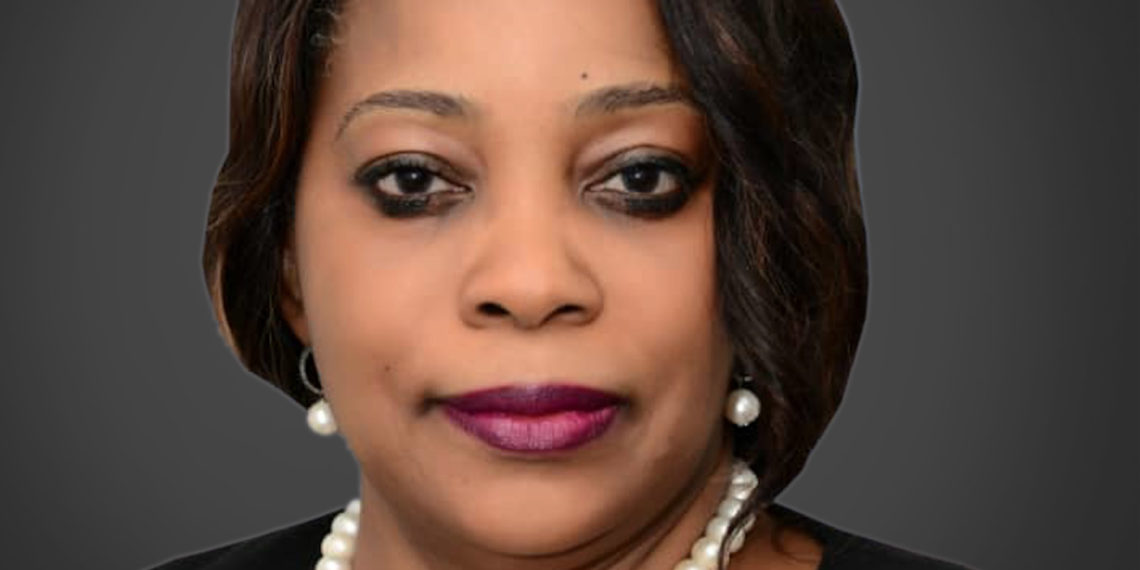
Based on Polaris Bank’s records, Ibiyi Ekong of Demanta Nigeria Limited is another ex-director who took loans from the bank without repaying them. Ekong, a former executive director of the bank who resigned in 2016, owes the bank N89 million. The bank recorded it as loss, with her collaterals not perfected. Collateral perfection allows a legal claim to seize assets of a payor defaults, according to Investopedia, an online investment dictionary. She now works at the Foundation for Partnership Initiatives in the Niger Delta.

Ibiye Ekong

Ekong also owes the bank N4 million borrowed as a mortgage loan and another N4 million taken as an auto loan, which was not repaid. Bank records showed their collateral perfection statuses were described as “not applicable.”

Next is Timothy A. Oguntayo, who took N100 million mortgage loan but did not pay it back, prompting the bank to report it as loss. The bank said that his collateral perfection status was “not applicable.” When someone’s collateral perfection status reads “not applicable,” it means the person is not mandated to present collateral for a loan, experts said.Timothy Oguntayo

Oguntayo is a former managing director of Skye Bank (now Polaris Bank), who was earlier charged by the Economic and Financial Crimes Commission (EFCC) but later exonerated. Oguntayo also owes Polaris Bank a mortgage loan of N100 million, which was also recorded as “lost.” It means he did not pay back both loans.

Abimbola Izu

Abimbola Izu, another ex-director, got N103 million mortgage loan from Polaris Bank but did not repay it, according to bank records. Her collateral perfection status was also recorded as “not applicable.”

Bank records also showed that Izu took a term loan of N17 million with another “not applicable” collateral status. Izu is a lawyer and principal advisor at Portalls Advisory Services.

Theodora Amaka Onwughalu is another ex-director who borrowed N19 million mortgage loan from Polaris Bank but did not pay it back. Her loan was recorded as “lost,” with collateral perfection status classified as “not applicable.”

Onwughalu is the chief executive officer of Blueshield Financial Services Limited and was the former group managing director of Mainstreet Bank Limited.  

Similarly, Dotun Adeniyi, an ex-director of Polaris Bank, borrowed N27 million mortgage loan from the financial institution but did not repay it. The loan was recorded as “lost.” The collateral perfection status was also described as “not applicable.” Adeniyi resigned from the former Skye Bank ( now Polaris Bank) board in 2016 during a shakeup, which saw all the board members resign their positions at the bank. According to bank records, the ex-directors took these loans while they were members of the board of the bank.
Tokunbo Abiru, now a Lagos senator, was appointed the managing director of the then Skye Bank in 2016 but resigned in 2020 to fulfil his political ambition. Adekunle Sonola is the current managing director of the bank.

As of December 31, 2022, total outstanding loans owed by these ex-directors of Polaris Bank, some of which would not be repaid, amounted to N 57.473 billion.

Management contributed to collapse of Skye Bank

In 2018, the Central Bank of Nigeria (CBN) revoked Skye Bank’s license and set up a bridge bank known as Polaris Bank. Skye Bank’s problems began when it used short-term funds to buy another bank, Mainstream Bank, in 2014, according to Reuters.

The Nigeria Deposit Insurance Corporation (NDIC) had accused the former management of the bank of being major contributors to the bank’s collapse, Reuters reported.

The CBN took over the bank in 2018 and injected N1.3 trillion to recapitalise and rehabilitate it.

As of 2018, the defunct Skye Bank Plc operated 300 branches across the country, employing over 500 staff members.

The bank was accused of poor corporate governance and inept management, which are evident in the loans taken without collateral and repayment.

Strategic Capital Investment Limited emerged as the preferred bidder for Polaris Bank in 2022, paying N50 billion. It was given 25 years to repay the N1.3 trillion injected by the apex bank into the bank.

Experts call for strong corporate governance

Financial experts have urged other financial institutions to learn lessons from the defunct Skye Bank and strengthen their corporate governance structures.

“Some banks still have issues with corporate governance. It is obvious, from what you have said, that there was a total collapse of corporate governance at the defunct Skye Bank,” said an Abuja-based financial analyst, Uko Amadi.

“I guess the CBN was a bit late and did not act fast. However, banks should begin to examine themselves to ensure that things are done transparently. They are custodians of people’s money but should not act as if the deposits are theirs,” he noted.

An ex-bank worker, Chinyere Ogundamisi, said there was a need for regulators to pay a closer attention to activities of financial institutions.

“I am not for over-regulation because I think there is already over-regulation of the banking system. But I am saying that if you are regulating, get experienced people who know where loopholes should be to do the monitoring. Some persons at the CBN never worked in banks, and cannot detect some sharp practices. So, get people who worked in banks and allow them to do the monitoring.”

Bank keeps mute

Polaris Bank’s Head of Corporate Communications, Bolarinwa Rasheed, did not respond to questions regarding why the loans were lost even though the people were still alive. He promised to get back to us but did not do so as at the time of going to press.

This report was republished from the Economy Post, read the original here

ICIR partners tertiary institutions on countering misinformation

THE International Center for Investigative Reporting (ICIR) has partnered tertiary institutions in Nigeria to build capacity for students on countering misinformation.

The project “Countering Misinformation and Promoting Media Literacy” kicked off on Wednesday, October 25, 2023, at the Federal University Lokoja, Kogi State, Hassan Usman Polytechnic, Katsina State, and Adekunle Ajasin University, Akungba-Akoko, Ondo state.

It aims at reducing the dissemination and impact of misinformation in Nigeria by promoting media literacy and responsible information sharing among citizens.

The project is supported by the German Embassy in Abuja.

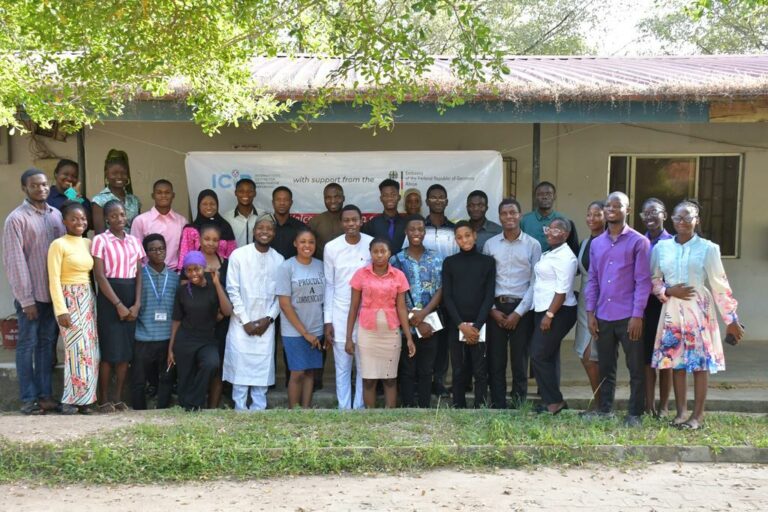
At the two-day training held at the institutions’ premises, students were taken through a step-by-step guide on how to combat fake news, identify phishing websites and verify images and videos.

They were also trained on pitch writing, using OSINT tools and how to archive online claims, among others.

Kogi state

In his welcome address, the Dean of Social Sciences, S.D. Musa, a professor, commended The ICIR for the initiative.

He advised the students to make the most of the opportunity to help them become versatile and make valuable contributions to society.

The Editor, FactCheckHub, Opeyemi Kehinde, who led the facilitators, spoke extensively on misinformation, disinformation and malformation, citing copious examples.

He also stressed the need for the students to cross-check sources cited in every report.

Kehinde emphasized the importance of identifying fake news circulated on various platforms and how to fact check, using fact-checking tools.

Facilitators include Temilade Onilede, a fact-checker and researcher of DUBAWA, Kimberly Kures, an author and content creator, and Opeyemi Kehinde, the Editor of the FactCheckHub.

Students at the event expressed gratitude to the organisers as they revealed it was an eye-opening seminar.

Some of the students noted that the seminar taught them not to be purveyors of false news and how to always check sources of information obtained on social media platforms.

Ondo state

In Ondo state, The ICIR team was led by the Head of Programmes, Alfred Akerele, at the Adekunle Ajasin University in Akungba-Akoko.

In attendance were the university’s Vice Chancellor, Olugbenga Ige, the Acting Head of the Mass Communication Department, faculty members, and students.

In his address, Ige, a professor, emphasized the university’s commitment to enhancing the educational experience of its students. He lauded The ICIR for selecting the university as one of the 12 tertiary schools benefitting from the training.

Ige reiterated the university’s full support for whatever would help its students acquire good knowledge.

In his address, Akerele said the training’s objective was to arm the students with all the skills they needed to identify and fight misinformation.

“The Factcheckhub was set up due to the need to proffer solutions to misinformation and disinformation. One of our major goals is to counter misinformation and promote media literacy in Nigeria,” he stated.

Facilitators include Dubawa editor Kemi Busari, fact-checker Nurudeen Akewushola, and digital media expert, Esther Ilesanmi.

Katsina state

In Katsina state, the Director of the College of Environmental Studies and Acting Rector, Sani Yar’adua, spoke glowingly of the training.

He commended The ICIR for selecting the school for the project. Yar’Adua expressed the institution’s readiness to partner with The ICIR to promote teaching, research and other programmes that advance knowledge.

In her opening remark, The ICIR’s Assistant Programme Manager Ayisat Abiona said the training objective was to equip students of tertiary institutions with knowledge and skills on how to verify information and fact-check claims.

Facilitators for the programme in the state include The ICIR Editor Bamas Victoria, OSINT Investigator with Dubawa, Silas Jonathan, and journalist and The ICIR‘s Social Media Manager Shehu Olayinka.

The ICIR is an independent, non–profit media organisation promoting good governance in Nigeria through robust investigative, data-driven reporting. It aim to build a culture of watchdog reporting for the media in Nigeria.

In the last five years, the Centre has worked to develop the capacity for journalists to undertake investigative, data-driven reporting, thus strengthening accountability and engendering effective service delivery for the welfare of the citizens, particularly at the sub-regional level.

Police Special Intervention Squad set to take off in 10 states

THE Nigeria Police Force (NPF) is set to launch Special Intervention Squad (SIS) in 10 pilot states.

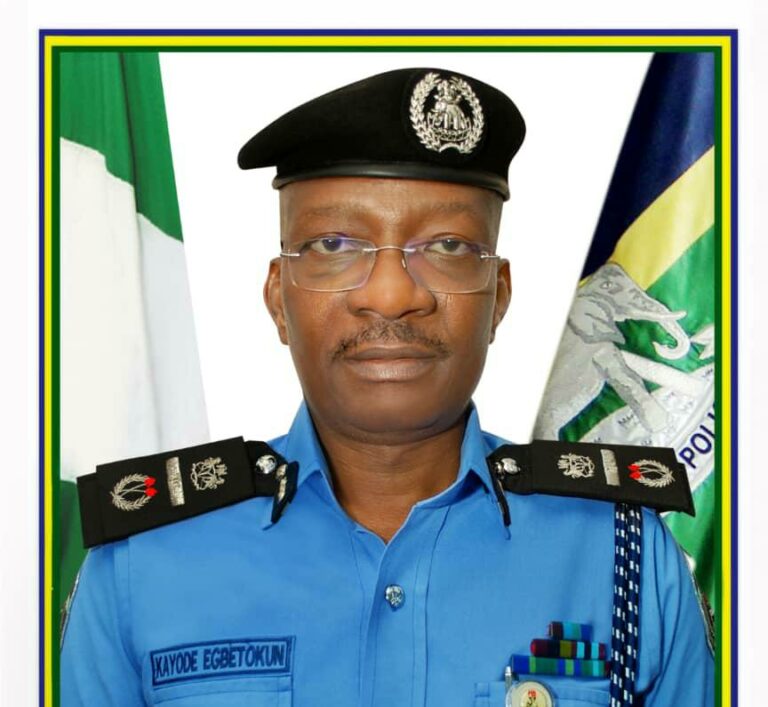
The Inspector General of Police (IGP), Kayode Egbetokun, disclosed this on Monday, October 30, at the retreat for senior officers of the Force in Owerri, Imo State.

To combat the threat of violent crimes in the nation, the IGP said one of his top priorities was to create the squad,’ which would be a reserve group of officers with specialised training to respond promptly during crises.

The squad will take effect in ten pilot states, after which it will be launched n the remaining 26 states and the Federal Capital Territory.

He said the pilot states that were selected based on the most recent violent crime assessment across the country.

“The establishment of a Special Intervention Squad (SIS), a standby team of specially trained officers to rapidly intervene in significant incidents, which was immediately announced on my assumption of office, is considered an immediate priority in this effort.

“The Squad will be deployed in each command to deal with the state’s salient security challenges,” Egbetokun stated.

He announced plans to establish a Special Intervention Squad (SIS) to deal with security threats in August when he led the Police management team on a courtesy call to Kano State Governor Abba Yusuf.

He solicited the support of the Kano State government to succeed, with Kano being one of the pilot states.

He said he would equip the squad with well-trained and well-remunerated personnel to meet the nation’s security challenges.

Supreme Court legalising illegality, criminality – Atiku Abubakar

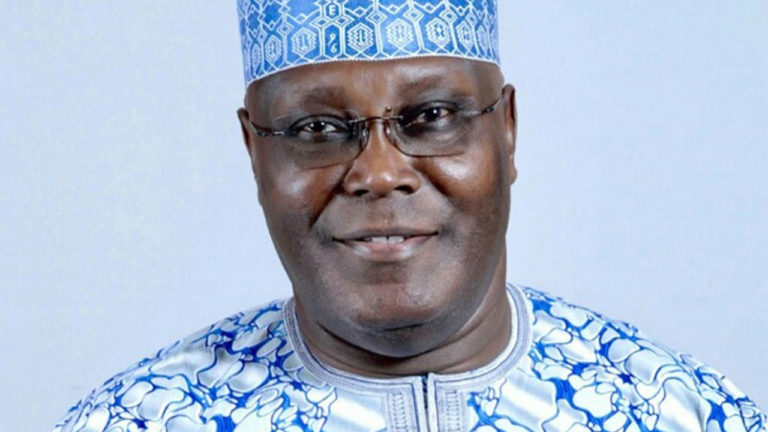
THE presidential candidate of the Peoples’ Democratic Party (PDP) in the February 2023 election, Atiku Abubakar, has accused the Supreme Court of legalising illegality, forgery and identity theft.

Abubakar said this in at a press conference on Monday, October 30, in Abuja.

He spoke for the first time after the Supreme Court dismissed his petition against the victory of President Bola Tinubu on Thursday, October 26.

Abubakar said that with the judgement, the Supreme Court told Nigerians to win an election by any means, including “forgery, identity theft and violence.”

“If the Supreme Court, the highest court of the land, implies that crime is good and should be rewarded, then Nigeria is lost,” the former vice-president said, adding “It is not about me; it is about our country, Nigeria and the future.

“It is about the kind of society we want to leave for the next generation and what kind of example we want to set for our children. It is about the reputation of Nigeria and Nigerians in the eyes of the world. We showed evidence that Tinubu was not qualified to contest the presidential election because he forged the qualifying academic certificate.”

Abubakar argued that the consequences of the Supreme Court decision on his case against Tinubu would not end at the expiration of the current government but would last for several years. 

He added that he had always fought for democracy and would always do so till he dies.

“In one incident, nine policemen guarding my home in Kaduna were murdered in an attempt to assassinate me. I was also forced into exile for nine months. 

“In addition, my interest in a logistics company that I co-owned was confiscated and given to friends of the military government. As Vice President in the civilian government that succeeded the military, I, again at great personal cost, chose to oppose the extension of the tenure of the government beyond the two four-year terms enshrined in our constitution,” he said.

Abubakar explained that evidence tendered in court against Tinubu was procured with the assistance of the American Court to help it do justice in the case. 

He claimed INEC undermined the technology approved for use by its Act during the elections and collation process and proceeded to declare Tinubu as the winner.

He said when people lost trust and confidence in elections, democracy ibe on a life support. 

The PDP candidate said Nigerians knew the person sitting in office as their President, how he got there, and the dangers his stay in office portended for them and the country. 

On whether he would be retiring, Abubakar said, “For as long as I breathe, I will continue to struggle, with other Nigerians, to deepen our democracy and the rule of law and for the kind of political and economic restructuring the country needs to reach its true potential.” 

The ICIR reported how the apex court dismissed the appeals by Atiku and his Labour Party counterpart, Peter Obi.

On Wednesday, March 1, The ICIR declared Tinubu winner of the presidential election conducted on February 25. 

Tinubu polled 8,794,726 votes to defeat a dozen other candidates, including three major ones, namely the PDP’s Abubakar, LP’s Obi and New Nigeria Peoples Party (NNP)’s Rabiu Kwankwaso. 

According to the election results announced by INEC chairman Mahmood Yakubu, Abubakar came second with 6,984,520 votes, Obi followed closely with 6,101,533 votes, and Kwankwaso got 1,496,687.

‘I was shot at,’ Fubara alleges, as Rivers Assembly moves to impeach governor

THE Rivers State Governor Siminalayi Fubara has said he was shot at by police and military officers on his way to the state House of Assembly in the early hours of Monday, October 30.

Fubara’s claim made amid the suspension of the Majority Leader of the State House of Assembly, Edison Ehie, over allegations that he supervised the burning of the Assembly Complex Sunday night.

Fire engulfed the complex on Sunday, October 29, around 10 p.m.

It was subsequently quenched by the Fire Service and security agents who prevented it from consuming the entire complex.

The crises follow reports of an impending impeachment of the governor by the House.

While it remains uncertain whether the fire is related to the political dispute, there have been rumours of feud between Fubara and his predecessor, Nyesom Wike, who currently serves as the Minister of the Federal Capital Territory (FCT).

The feud allegedly resulted in the removal of the Majority Leader believed to be one of the Fubara’s loyalists, although the House led by its Speaker, Martin Amaewhule, said Ehie was removed for being the alleged sponsor of the fire outbreak,

The House also served an impeachment notice on the governor.

A protest immediately broke out outside the omplex with the governor and his supporters resisting the planned impeachment.

Some viral videos on social media showed how the governor’s entourage was allegedly tear gassed and sprayed with water by the Police outside the complex.  

The House members subsequently fled the Assembly complex for safety as tear gas was fired outside building.

In another video sighted by The ICIR, the embattled governor stated that he was shot at on his way to the House of Assembly.

He also asked those plotting his removal to publicly state his offence, adding that he enjoyed the people’s support.

“When you have the youths, you have the power. But the difference with our own power, we do not abuse it.  We woke up this morning to a very troubling news, and we have gone to the Assembly to see for ourselves what’s happening. On my way there, I was shot at directly by the military operation. But it doesn’t matter.

“Whatever that wants to happen today, make it happened…Come out and tell the people of Rivers State what Fubura has done.”

Fubura of the People’s Democratic Party (PDP), was the state governorship candidate favoured by Wike during the last governorship election.

Supreme Court: APC petitions NBA over Abure, Kenneth Okonkwo’s comments

0

THE All Progressives Congress (APC) has petitioned the Nigeria Bar Association (NBA) over comments made by two lawyers regarding the recent Supreme Court judgement on the 2023 presidential election.

The party described the comments made by the National Chairman of the Labour Party, Julius Abure, and a spokesman of the party campaign council, Kenneth Okonkwo, both lawyers, as ‘deprecating remarks’ against the justices of the Supreme Court.

In the petition signed by the party’s national secretary, Ajibola Bashiru, the APC said that it believed Abure and Okonkwo’s obligations as legal practitioners had been violated by their criticism of the judges and the judiciary.

According to the PUNCH, Bashiru said he could not stand by and watch the judiciary’s image in Nigeria tarnished by those who should know better.

Responding to the petition in a statement on Sunday, October 29, the National Publicity Secretary of the Labour Party, Obiora Ifoh, said the petition against the LP members confirmed Abure’s earlier warning that President Bola Tinubu and the APC planned to go after his party’s chieftains and presidential candidate, Peter Obi.

“In that same statement, we drew attention to planned persecution, intimidation, suppression and harassment of our party leaders, and that members would likely be enforced using security agencies and other institutions of the state.

“The Labour Party views this action by the APC, less than three days after the Supreme Court judgment, as a confirmation of our suspicion and information of a campaign of persecution, harassment, intimidation and incarceration against the Labour Party and its overwhelming supporters, nationally and globally,” the LP said.

The LP said every court judgment, especially on political matters, was subject to criticism and administrative review.

“Therefore, for the APC to isolate our leaders for vilification, by exaggerated and misguided inferences, our fears of persecution have begun to materialise,” the party stated.

The LP added that it would stand firm and resolute to “anti- democratic actions, that are beginning to surface quite very early, under this government.”

The ICIR reported on Thursday, October 26, that the Supreme Court dismissed the appeal filed by the Presidential candidate of the Peoples Democratic Party (PDP), Atiku Abubakar, and Peter Obi of the LP against the victory of President Bola Tinubu in the February 25 election.

In a unanimous ruling, the court described both petitions as incompetent and lacking merit.

Abubakar and Obi had sought the nullification of Tinubu’s victory over alleged irregularities and the presentation of forged academic certificates by the President.

While addressing the first issue in Obi’s appeal, the panel led by Inyang Okoro said Obi raised many of the same arguments as Abubakar’s prior appeal, which the court had rejected.

In a unanimous decision, the court dismissed Atiku and Obi’s petitions and upheld Tinubu’s victor. the Labour party chairman and some of its spokespersons.