Home Blog Page 77

APC, ADC chairmanship candidates’ polling units record low voter turnout in AMAC

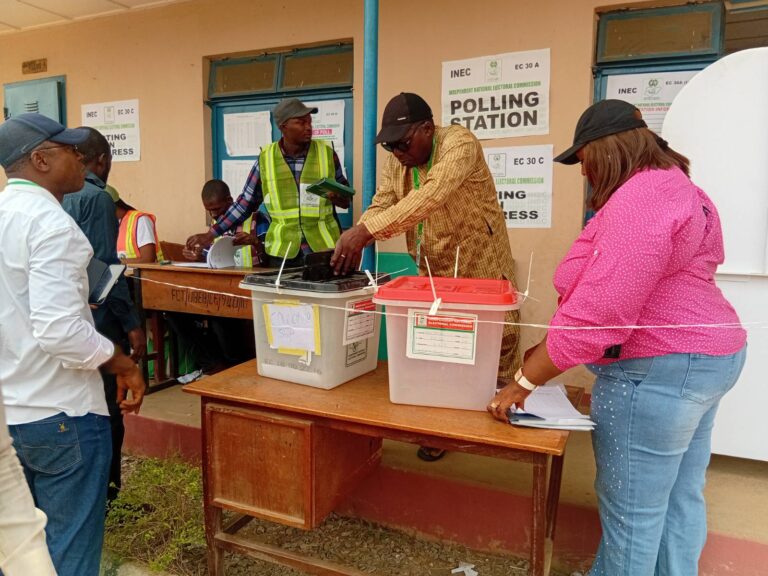
VOTING in the Abuja Municipal Area Council (AMAC) is progressing under a peaceful atmosphere, though voter turnout remains generally low across several polling units visited in the early hours of the election day.

At the polling unit 076, AMAC, Wuse Zone 4, Blk 53 Suez Close, where the candidate of African Democratic Congress (ADC) Moses Paul, cast his vote, there was a significant low voter turnout.

The presiding officer, Nonye Obianyor, said voters did not turn out, adding that the registered voters at the polling unit was 454 but fewer than 30 have voted as of this time.

However, turnout was described as relatively higher at the polling unit 004, Garki Village, where the All Progressives Congress (APC) candidate, Christopher Maikalangu, cast his vote earlier in the morning.

At Polling Unit 004, Garki II, Garki Village, which has 2,287 registered voters, only 168 voters had been accredited as of 10:38 a.m., indicating a slow turnout.

Similarly, at Polling Unit 035 in Nsukka, Garki Ward, just 20 out of 96 registered voters had been accredited as of 10:18 a.m.

Officials of the Independent National Electoral Commission (INEC) at the Nsukka Polling Unit reported a technical issue with the Bimodal Voter Accreditation System (BVAS), noting that while the device was not capturing thumbprints, it was successfully verifying voters through facial recognition.

They said no other challenges were recorded.

Low voter’s turnout was also discovered in several polling units in City Centre Ward. The polling units include PU 030, PU 032, PU 028 and PU 027.

At Polling Unit 007, City Centre, National Library, the presiding officer, Mustapha Muhammad, said he was supervising two polling points, but noted that the voter’s turnout was low.

Polling Booth A has 1,105 registered voters, while Booth B has 1,114.

Muhammad noted that turnout had not been impressive as of the time of filing this report but confirmed that the process was orderly, with no major incidents recorded.

In all the polling units observed, palpable calm was observed with security operatives monitoring the process.

NSCDC assures residents of safety

The ICIR reports that security officials assured residents of adequate protection throughout the exercise.

The Commandant of the Nigeria Security and Civil Defence Corps, Olushola Odumosu, who spoke with journalists dismissed concerns that heavy security presence or convoys could discourage voters.

“The electoral officials are not complaining of any issues. The voters have also expressed their happiness. Our job is to ensure that there is peace and orderliness. There are no miscreants or political thugs. That’s why we are out to send the right signal to the wrong people to steer clear, because this election is going to be free and fair,” he said.

Responding to questions about whether security convoys might intimidate voters, the commandant added: “You will only be scared if you are a criminal. It is election day – what are you afraid of? The job of security personnel is to protect lives and property. If you are a person of good conscience, you have nothing to worry about. Security men are out to protect the sanctity of the people.”

The ICIR reported that INEC fixed February 21, 2026, for the polls, with over 600 candidates contesting chairmanship, vice chairmanship and councillorship positions.

The election involves 1,680,315 registered voters across 2,822 polling units. To facilitate the process, INEC deployed 3,345 Bimodal Voter Accreditation System (BVAS) devices.

The exercise is taking place across the FCT’s six area councils and 62 political wards, with 68 elective positions up for grabs.

This organisation reports that the exercise, where the APC, ADC, Peoples Democratic Party (PDP) and other political parties are battling to win seats, has also been going on smoothly in Kuje, Gwagwalada and other area councils in the nation’s capital.


Delays mar area council poll in AMAC

0

THE Federal Capital Territory (FCT) Area Council election is underway across the city’s six area councils, namey Abaji, Bwari, Gwagwalada, Kuje, Kwali, and the Abuja Municipal Area Council (AMAC)

The election, conducted by the Independent National Electoral Commission (INEC), was scheduled to start at 8:30 a.m. across polling units.

In the Abuja Municipal Area Council (AMAC), there were reported delays at Area 1, Section 1 Primary School, as INEC staff allegedly arrived late.

Observers noted that because of the lateness, no voters were on ground when accreditation and voting were supposed to begin.

Polling units affected included Olusola Michael (PU 030), PU 032, PU 028 at Area 1 Primary School, and PU 027 in Area 1.

Accreditation and voting were underway at Polling Unit 005 in Area 2, Park and Garden, with security personnel fully on the ground monitoring the process.

At Polling Unit 010 in Area 2, AMAC, INEC staff were seen setting up polling booths late. They explained that they missed their way multiple times while trying to reach the location.

Meanwhile, at Polling Unit 011 in Area 2, Section 2, Amusement Park, the presiding officers said voting started on time at 8:30 a.m. without any issues, and BVAS devices were working perfectly. This unit has 863 registered voters.

Delays were also reported at Polling Unit 067 in Area 2, Park and Garden, due to logistics challenges. Presiding officer Afuye Olamilekan Clement explained that although his team arrived before 8:30 a.m., it had to wait for a canopy to be brought from the RAC Centre before the exercise could commence.

Over 1.6 million registered voters across 2,822 polling units are expected to participate in the election, with 3,345 BVAS devices deployed. Sixty-two political wards are participating, with 68 elective positions contested by 637 candidates from 17 political parties. The process is being closely observed by 88 local and international observers.

Accreditation, voting begins as residents elect chairman, councillors for FCT area councils

ACCREDITATION and voting are underway in the Abuja Municipal Area Council (AMAC) as officials of the Independent National Electoral Commission (INEC) conduct the 2026 FCT Area Council elections.

Voting commenced in AMAC, Ward City Centre, on Saturday morning as residents turned out to elect new council leaders.

The ICIR reporter on the field reports that accreditation and voting began at Polling Unit 001, Area 2, Section 2, Amusement Park, where 863 voters are registered as of 9:30 a.m.

At Polling Unit 005, Area 2, Section 2, Park and Garden, which has 920 registered voters, only a handful of voters were present.

Similarly, at polling unit 066, City Centre, some electorates have been accredited and cleared to cast their respective vote.

The ICIR reported that INEC fixed February 21, 2026, for the polls, with over 600 candidates contesting chairmanship, vice chairmanship and councillorship positions.

The election involves 1,680,315 registered voters across 2,822 polling units. To facilitate the process, INEC deployed 3,345 Bimodal Voter Accreditation System (BVAS) devices.

The exercise is taking place across the FCT’s six area councils and 62 political wards, with 68 elective positions up for grabs.

This organisation reports that the exercise, where the All Progressives Congress (APC), African Democratic Congress (ADC), Peoples Democratic Party (PDP) and other political parties are battling to win seats, has also been going on smoothly in Kuje, Gwagwalada and other area councils in the nation’s capital.

Election runs smoothly as Gwagwalada Area Council records high voter turnout

0

VOTING is progressing smoothly across several polling units in Gwagwalada Area Council of the Federal Capital Territory (FCT), with residents turning out early to participate in the ongoing area council chairmanship and councillorship elections.

At Kutunku Primary School, one of the major voting centres in the area council, a large number of voters were observed forming orderly queues as accreditation and voting commenced under the supervision of officials of the Independent National Electoral Commission (INEC).

Electoral officials arrived early at the polling unit, while security personnel maintained a calm atmosphere, allowing voters to exercise their civic rights without disruption.

Similarly, Phase 1/Gado Nasko Primary School polling unit recorded impressive voter participation, with steady turnout throughout the morning hours. Many voters expressed satisfaction with INEC preparation for the exercise, noting that accreditation using the Bimodal Voter Accreditation System (BVAS) went smoothly.

Residents described the process as peaceful, with party agents and observers present while voters patiently waited for their turn.

However, The ICIR observed that some polling units within the council experienced relatively low voter presence compared to others, as only a few voters were seen at the location during early voting hours.

The poll is being conducted simultaneously in 2,822 polling units where voters are to elect chairmen and councillors in the six area councils of the FCT, with about 1.6 million registered voters expected to participate in the exercise.

INEC had earlier confirmed that all sensitive materials, including ballot papers and BVAS machines, were deployed under tight security ahead of the polls to ensure transparency and credibility.

Security presence also remained visible across the council following the restriction of movement imposed by the FCT Police Command from 6 a.m. to 6 p.m. to guarantee peaceful conduct of the elections.

As voting continues, observers say the turnout recorded in parts of Gwagwalada, particularly at Kutunku and Gado Nasko polling centres, signals growing voter interest compared to previous council elections historically marked by lower participation.


FCT poll: voting begins across polling units in Kuje

0

VOTING has commenced across polling units in Kuje Area Council as residents of the Federal Capital Territory (FCT) elect new chairmen and lawmakers for the city’s six area council today, Saturday, February 21.

Prospective voters were seen forming orderly queues awaiting accreditation and voting as officials of the Independent National Electoral Commission (INEC) attended to the crowds.

Baba Adamu who was the second person to cast his vote at the Central Primary School polling unit, described the atmosphere as peaceful, and expressed delight with voters turnout. 

“In Kuje Central Ward, we are peaceful people. We believe it will go well,” Adamu said.

The INEC scheduled the election to begin across the city at 8:30 a.m., with only registered voters with valid Permanent Voter Cards (PVCs) eligible to vote.

Earlier, at the Kuje Collation Centre, election officials were observed receiving last-minute briefings before boarding vehicles conveying them to their polling units, while electoral materials were sorted and dispatched in batches.

The commission had earlier confirmed readiness for the poll, deploying the Bimodal Voter Accreditation System (BVAS) to all polling units to enhance transparency and real-time result management.

The FCT Police Command had also imposed restriction on movement across the city from 6 a.m. to 6 p.m. to ensure a peaceful exercise, while security personnel were deployed to polling locations, collation centres, and different part of the nation’s capital.

The restriction forms part of broader security arrangements for the election taking place simultaneously across the six area councils namely Abaji, Abuja Municipal Area Council (AMAC), Bwari, Gwagwalada, Kuje and Kwali.

However, vehicles were moving, and businesses were open from the early hours before security officials started restricting movement at 9:11 a.m.

Residents across the FCT are voting to elect chairmen and councillors who will oversee grassroots administration in the Territory.

INEC disclosed that more than 1.58 million PVCs were collected ahead of the election.

The election covers 2,822 polling units across 62 wards, where voters are choosing leaders for six area councils and 62 councillorship seats.

Insecurity: 323 killed in Nigeria within 20 days – Amnesty International

NIGERIA lost 323 of its population to insecurity within the first 20 days of February, according to Amnesty International.
The organisation said in a statement on Saturday, February 21, that the killings occurred in Benue, Katsina, Kwara, Kebbi, Niger and Zamfara states.
“The rising death toll clearly shows that President Bola Tinubu and his government have no effective plan for ending years of atrocities by armed groups and gunmen that have killed thousands of people.
“Incessant killings and the shocking failure of the authorities to end them and bring suspected perpetrators to justice have been and continue to be a threat to the right to life in Nigeria,” the organisation said.
The ICIR reports that Nigeria’s insecurity worsened with the emergence of Boko Haram in the early years of this century. With thousands killed and millions displaced, the group unleashed widespread mayhem, targeting infrastructure such as schools, hospitals, and other essential amenities.
Several other deadly groups have since joined the terrorist group, including the Islamic State West Africa Province (ISWAP), Lakurawa, Indigenous People of Biafra (IPOB), and other killers and kidnappers widely known as bandits.
The activities of these groups span every region in Nigeria, particularly in the North-East, North-West, North-Central, and South-East.
Thousands of Nigerians, especially schoolchildren, have been abducted and killed over the years. Many victims of abduction spend months in kidnappers’ dens, and are slaughtered after their families have paid ransoms.
In addition to these groups, Nigeria has experienced farmer-herder clashes, including inter and intra-communal conflicts, which have exacted a high human toll.
Since 2020, Amnesty International said it had been documenting a horrifying pattern in which attackers invade villages on motorcycles and are heavily armed.
“They shoot sporadically at people, abduct women and girls, set houses on fire, steal livestock, destroy farm produce and abduct villagers for ransom. In recent cases, villagers received ‘warning letters’ from armed groups — ahead of attacks. Such attacks take hours. One of recent attacks on some villages in Niger state started from 3:00am to 10:00am.
“Most villagers told Amnesty International that the government left them at the mercy of their attackers.  The government has an obligation to protect its population. The rising death toll in the north of Nigeria shows just how badly the authorities are failing in this responsibility,” the organisation stated.

FCT election: preparation underway as INEC ad-hoc staff set up polling units

ELECTORAL activities are underway in the Federal Capital Territory (FCT) where residents of the nation’s capital elect new chairmen and councillors of the city’s six area councils today, Saturday, February 21.

In Abuja Municipal Area Council (AMAC), officials of the Independent National Electoral Commission (INEC) commenced preparations ahead of the 8:30 a.m. scheduled for the commencement of accreditation and voting.

The ICIR reported that INEC fixed February 21 for the poll, in which over 600 candidates are vying for chairmanship, vice chairmanship and councillorship positions.

The poll will involve 1,680,315 registered voters spread across 2,822 polling units, according to INEC.

For accreditation and voting, INEC deployed 3,345 Bimodal Voter Accreditation System (BVAS) devices for the exercise.

The election will be conducted across the FCT’s six area councils, covering 62 political wards, with a total of 68 elective positions being contested.

As of 7:30am, INEC adhoc staff distributed election materials at GSS Garki area, City ward, AMAC, to various collation centres for onward deployment to polling units.

The ICIR observed that the exercise so far has been peaceful. However, some INEC officials are still stranded and unable to move to their polling unit.

At LEA primary school Area 1, Section 1, polling unit 1, the INEC Ad-hoc were seen setting up voting cubicles, configuring the Bimodal Voter Accreditation System (BVAS) devices, and displaying voter registers while party agents, security operatives were on ground.

Court declares police ‘wanted’ notice on Sowore unlawful, awards N30m damages

0

THE Federal High Court in Lagos has ruled that the Nigeria Police Force’s declaration of human rights activist Omoyele Sowore as wanted was unlawful, describing the action as unconstitutional and an abuse of authority.

Delivering judgment on Friday, February 20, the presiding judge, Musa Kakaki held that the Lagos State Commissioner of Police who declared the activist wanted lacked the legal backing to issue such a declaration.

The court said only a competent court of law could authorise a ‘wanted’ notice after issuing a valid warrant, giving proper notice, and establishing that the individual is evading lawful process.

It consequently awarded ₦30 million in damages against the police commissioner and the police leadership.

The ICIR reported how the Lagos Police Command declared Sowore wanted for allegedly causing a disturbance of public peace and attempting to block the Third Mainland Bridge during a protest against the demolition of houses in Oworonshoki area of the state.

Commissioner of Police in the state, Olohundare Jimoh, made the declaration on Monday, November 3, 2025, at the protest ground.

Jimoh, who led anti-riot police officers to the location, said the massive deployment was to safeguard critical national infrastructure, and prevent any attempt to disrupt traffic or economic activities.

However, Sowore challenged the police decision to declare him wanted on November 3, 2025. The move also followed an earlier public warning by the police commissioner on October 27, 2025, directing him to stay away from Lagos State.

Sowore told the court he was declared wanted without any prior invitation, warrant, or charge, describing the action as a violation of his constitutional rights and a blow to his reputation.

He further asked the court to nullify the declaration, stop the police from harassing or arresting him, and award ₦500 million in damages.

Judge slams Lagos CP

In its ruling, the court reportedly described the “stay away from Lagos” warning as arbitrary and beyond the powers of the police, noting that security agencies could not restrict a citizen’s movement without lawful justification.

The subsequent declaration branding him wanted was also declared illegal, ultra vires, and inconsistent with constitutional provisions safeguarding fundamental rights.

Kakaki reaffirmed that citizens could not be penalised for expressing dissent views, organising protests, or demanding accountability from public officials.

He ruled that no citizen could be declared wanted without prior approval from a court.

The judge explained that a valid warrant must first be issued, proper notice given, and evidence shown that the individual is evading lawful process before a court can authorise such a declaration.

According to the court, circumventing judicial safeguards in the name of law enforcement amounts to oppression.

Sowore’s lawyer reacts

Reacting to the verdict, Sowore’s counsel, Tope Temokun, described the judgment as a landmark affirmation of constitutional governance.

He said the decision reflected the supremacy of the rule of law and served as a warning against the misuse of state power.

While acknowledging the ₦30 million damages awarded, Temokun noted that the broader significance of the case lay in the court’s clear message that no authority is above the constitution.

Tinubu’s powers to override NNPC on revenue remittance questioned

0

PRESIDENT Bola Tinubu’s power to override the Nigerian National Petroleum Company Limited (NNPCL) on revenue remittance with an executive order is being questioned in several quarters.

Some oil and gas governance experts differ in their stance, with some also noting that the Petroleum Industry Act (PIA) should be amended since it is already an act of the parliament passed and signed by the executive.

On Wednesday, February 18, Tinubu signed an executive order directing remittance of oil and gas revenues to the Federation Account Allocation Committee (FAAC).

By this order, all taxes, royalties and profits under Production Sharing Contracts (PSC) are to be fully remitted to the federation account.

The order, the Presidency said, would safeguard and enhance oil and gas revenues for the federation, curb wasteful spending and eliminate duplicate structures in the oil and gas sector.

According to the order, which has been officially gazetted, the NNPC will no longer collect and manage the 30 per cent frontier exploration fund.

Similarly, all operators/contractors of oil and gas assets held under a Production Sharing contract shall, from the date the order was issued, pay royalty oil, tax oil, profit oil, profit gas, and any other interest due to the government of the federation directly to the federation account.

The Presidency said Tinubu had also suspended payments of the has flare penalty into the midstream and downstream gas infrastructure fund.

However, in a statement, Wumi Iledare, an oil governance expert and a professor Emeritus of Petroleum Economics, told The ICIR that there were some merits and demerits in the order.

He noted that the order represented a significant fiscal intervention within Nigeria’s petroleum governance framework and signaled a renewed effort to strengthen revenue transparency, reduce discretionary retention, and improve statutory remittances to the three tiers of government.

He emphasised that apart from the intent to safeguard revenues, certain aspects of the order intersected directly with provisions of the Petroleum Industry Act (PIA) 2021.

Citing an instance, Iledare argued that the Frontier Exploration Fund, the Midstream and Downstream Gas Infrastructure Fund, and existing Production Sharing Contract (PSC) fiscal structures were statutory constructs established by the National Assembly.

While executive authority under Section 5 of the Constitution empowers the president to implement and enforce laws, Iledare pointed out that substantive alterations to statutory fiscal frameworks might require legislative amendment to ensure constitutional alignment and institutional certainty.

On the question of direct remittance of royalty oil, tax oil, and profit oil to the Federation Account, he said the order had the potential to enhance transparency and reduce intermediation.

He stated, however, that the implementation must be carefully sequenced to preserve contractual stability and avoid unintended legal or investor confidence challenges.

Iledare also observes that the structural dual role of NNPC Limited — as both commercial operator and concessionaire under certain arrangements — has long presented institutional tensions within the post-PIA framework.

“Any reform aimed at reinforcing NNPC’s commercial identity must be anchored in legal clarity and predictable governance mechanisms,” he stressed.

Making a similar submission, the Lead Director of the Centre for Social Justice, Eze Onyekpere, said the instrument of an executive order did not confer legislative powers on the president.

He clarified further executive order is issued as a supplement to the proper execution of existing legislation.

“A bill passed by the National Assembly and assented to by the President can only be amended by a subsequent act of the parliament. The president cannot use an executive order to vary, suspend or rewrite a validly enacted act,” he added.


Solar migration: Presidency has declared national grid unfit for purpose – GENCOs

0

POWER Generation Companies (GENCOs) has said the Presidential Villa’s decision to disconnect fully from the national grid by March 2026 represented a vote of no confidence in on-grid power.

They argued that the decision, facilitated by a ₦17 billion independent solar mini-grid project, made the national grid unfit for purpose.

Besides also noted that it would further send wrong signals to investors in on-grid power, as rising debts in the sector remained alarming.

Director-General of the Energy Commission of Nigeria, Mustapha Abdullahi, had defended the project, stating that it was unsustainable for the Presidential Villa to continue paying an annual electricity bill of approximately N47 billion.

The Executive Secretary of the Association of Power Generating Companies (APGC), Joy Ogaji, who spoke on the development with The ICIR in an exclusive interview noted that the migration had been viewed in some quarters as a cost-saving measure to curb excessive billing, adding, however, that “the implication for on-grid power is severe, as it represents a sovereign vote of no confidence in the national grid.”

According to Ogaji, being the regulator, policymaker, and largest equity holder in the transmission network (TCN), bypassing its own infrastructure constitutes a total failure of the Service-Based Tariff (SBT) model.

“It signals to the market and to local and international investors that the national grid is no longer a viable platform for critical infrastructure,” she said.

The migration, Ogaji argued, not only removed a premium “Band A” consumer from the revenue pool but risked catalysing a “grid defection” domino effect among other premium industrial and government consumers. This, she said, would compound liquidity problems in the sector and weaken investors’ confidence in the sector.

She stressed that GenCos’ legacy debts surpassed ₦6 trillion (as of Q4 2025), with the recent ₦501 billion bond issuance covering less than 10 per cent of outstanding obligations, which she said would compound debt woes, adding that “This migration to solar is ill-timed as it raises an existential threat not to the GenCos but to the sector.”

She further disclosed that the Nigerian electricity market relied on a cross-subsidy model, which the exit of the Villa to solar could lead to revenue erosion.

“The loss of the Presidential Villa’s monthly billing reduces the market remittance flowing from DisCos to NBET, and ultimately to GenCos.

“If the Presidency exits grid-power, other Ministries, Departments, and Agencies (MDAs), which collectively owe billions in unpaid bills, will likely seek similar budget allocations for off-grid solutions to avoid payment, further shrinking the addressable market for GenCos.

“The loss of the Presidential Villa’s monthly billing reduces the market remittance flowing from DisCos to NBET, and ultimately to GenCos,” she added.

The Presidency’s exit is not merely an installation of solar panels; “It is a policy statement. It declares that the Nigerian national grid is unfit for purpose.”

She suggested that Nigeria needed a mix of power generation sources with a huge baseload, which provides a stable and constant supply of electricity.

The ICIR reports that Nigeria’s power sector is currently going through liquidity problems largely occasioned by an unbalanced tariff methodology and subsidies, which have impacted on investors’ trust in the market, with the GENCOs currently being owed over N6 trillion as of January 2026, with the government only able to pay N501 billion of the debt.