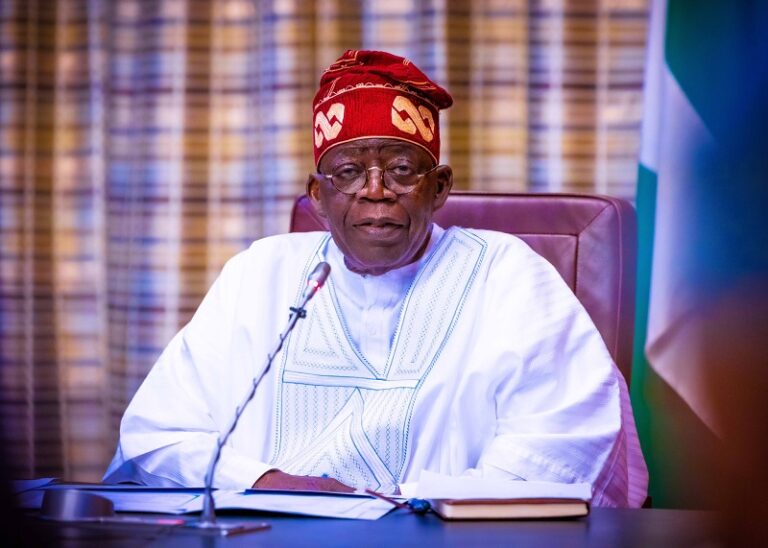
NIGERIAN President Bola Ahmed Tinubu has reacted to a helicopter crash which occurred on Monday, August 14, leaving some officials of the Nigerian Army dead
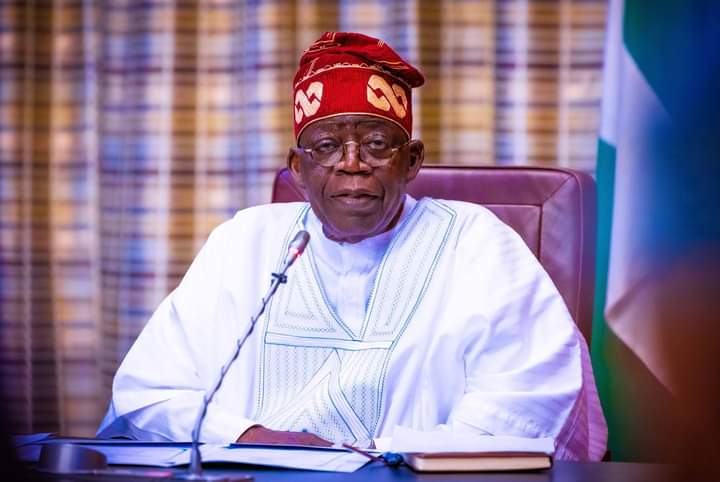
In a statement on Tuesday, August 15, Tinubu said the incident caused him “immense sadness.”
“These officers and men were answering the call of duty while on an evacuation mission. In their dedicated service to our beloved country, they paid the ultimate price.
“While we mourn their untimely departure, we will forever remember them, not just as servicemen, but as national heroes who gave their all for the peace and security of our country. They will always be remembered as courageous men who did not consider the perils and dangers of their national duty as paramount to their sacred mandate of ensuring that their fellow countrymen and women can live in peace,” the statement read.
Acknowledging the loyalty of the deceased officers, Tinubu condoled the families of the deceased and the Armed Forces.
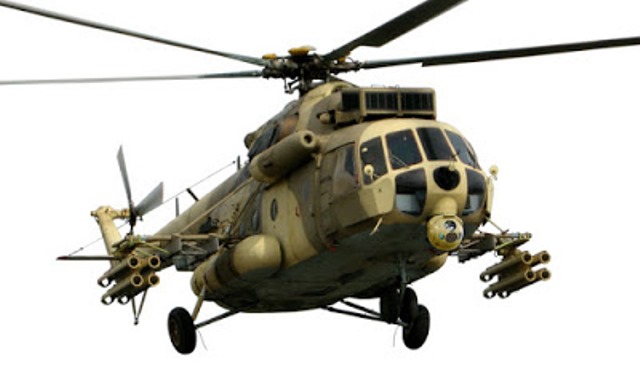
On August 14, a Nigerian Air Force (NAF) MI-171 helicopter crashed around Chukuba village in the Shiroro Local Government Area (LGA) of Niger State.
The helicopter was conveying officials of the Nigerian Army, travelling from Niger to Kaduna on a casualty evacuation mission, at the time of the crash.
This is the second military air crash recorded in 2023.
On July 14, exactly a month before the Niger incident, an aircraft belonging to NAF crashed in Makurdi, Benue, during a routine training exercise.
No tragedies were recorded in the Benue crash, as the two pilots on board ejected the aircraft quickly enough, according to a statement by NAF.
Two officers also died in an air crash involving a military trainer aircraft in Kaduna state in 2022.
In 2021, the Chief of Army Staff (COAS) Ibrahim Attahiru died in a plane crash on his way to Kaduna less than four months after his appointment. There were 10 other soldiers aboard the aircraft who also lost their lives in the crash.
The plane crash, which killed Attahiru, was the fourth such incident to claim the lives of military personnel in 2021.
NOTE: The name “Attahiru Jega” was corrected to Ibrahim Attahiru.
OPERATIVES of the Lagos State Traffic Management Authority (LASTMA) says it has agreed to strengthen partnership on traffic management in Lagos with the Nigerian Army.
This development was at the core of the incidents that happened between Army officers and a LASTMA official who was on traffic enforcement duty.
A statement by the Director of Public Affairs and Enlightenment Department of LASTMA, Adebayo Taofiq, on Tuesday, August 15, said the operatives would continue to rely on continuous support from the Nigerian Army and other security agencies across the State.
The video, which was circulated on August 8 on social media, showed the face-off between the two security forces, with a LASTMA official seen using a wooden object against a soldier who had initially hit the official with his hand.
Subsequently, on Monday, August 14, another video emerged, capturing a distressing scene where about seven individuals in Army uniform were seen assaulting the LASTMA official. The masked soldiers, suspected to be on a revenge mission, mobbed the official before leaving the scene.
Reacting to this during a working visit by Officials of the 9 Brigade Command of the Nigerian Army, the General Manager of LASTMA Bolaji Oreagba, maintained that the organisation “won’t abuse the relationship nor take the cordiality and warm friendliness which has existed between the Army and Lastma for granted.”
Although, he described the incident as unfortunate, Oreagba said there is no love lost between the two agencies, adding that Lastma personnel would continue to rely on continuous support from the Nigerian Army and other security agencies across the State.
He emphasized that the recurrence of such incidents would be prevented through the continued utilisation of established communication channels, stating that additional new hotlines will be explored by the two agencies always to resolve issues.
In his speech, the Commander of the 9 Brigade of the Nigerian Army, Adegoke Moses Adetuyi, stressed the importance of unity among security agencies to prevent the success of negative elements.
He also called for improved collaboration among government bodies, including Lastma, to achieve this goal.
Meanwhile, the Nigerian Army had on Monday, August 14, described the clash between soldiers and officials LASTMA, as disturbing.
The force spokesperson, Onyema Nwachukwu said, “I must say it is very disturbing that soldiers/LASTMA conflict is now one too many.
“The authorities of the Nigerian Army are genuinely concerned and are embarking on vigorous sensitisation campaign to educate our personnel on the need to ensure compliance with traffic rules and promote synergy and interagency cooperation in Lagos State and around the country.”
However, in their statements, the two agencies did not clearly indicate whether the officers involved would face disciplinary measures or not.
THE LATEST data from the National Bureau of Statistics (NBS) on the Consumer Price Index has shown that Nigeria’s headline inflation rate rose to 24.08 per cent in July 2023.
The CPI measures the average change over time in the prices of goods and services people consume for day-to-day living.
The ICIR findings showed that this is the highest rate reported in 15 years since 2009 and the seventh consecutive increase in 2023. Also, additional findings showed that the last time Nigeria recorded an inflation rate above 24 per cent was in September 2005.
According to NBS, the rate is 1.29 per cent higher when compared to June 2023 headline inflation rate which was 22.79 per cent.
The NBS said, “On a year-on-year basis, the headline inflation rate was 4.44 per cent points higher compared to the rate recorded in July 2022, which was 19.64 per cent. This shows that the headline inflation rate (year-on-year basis) increased in July 2023 when compared to the same month in the preceding year (i.e., July 2022).”
NBS also disclosed that the urban inflation rate stood at 25.83 per cent, while rural inflation was 22.49 per cent.
Oil, Bread increases food inflation
The bureau also published that the food inflation rate in July 2023 was 26.98 per cent.
It said, “On a year-on-year basis, which was 4.97 per cent points higher compared to the rate recorded in July 2022 (22.02 per cent). On a month-on-month basis, the Food inflation rate in July 2023 was 3.45 cent, this was 1.06 per cent higher compared to the rate recorded in June 2023 (2.40 per cent).”
The rise in food inflation, according to the data, was caused by increases in prices of Oil and fat, Bread and cereals, Fish, Potatoes, Yam and other tubers, Fruits, Meat, Vegetable, Milk, Cheese, and Eggs.
The ICIR had reported how unsettling policies of the federal government contribute to the increase in the inflation rate.
THE Federal Government, on Tuesday, August 15, filed fresh charges against Suspended Central Bank of Nigeria (CBN) Governor Godwin Emefiele in Abuja.
This was disclosed to journalists after the day’s proceedings by the Director of Public Prosecutions (DPP) at the Federal Ministry of Justice, Mohammed Bakodo Abubakar.
Abubakar said the fresh charges – with 20 counts – were filed at the Federal Capital Territory (FCT) High Court.
One of the counts accuses Emefiele of “conferring unlawful advantages”.
Earlier, the Federal government applied to withdraw the “illegal possession of firearms” case it filed against Godwin Emefiele at the Federal High Court sitting in Lagos.
Abubakar, who made the application orally, informed the judge, Nicholas Oweibo that the application followed the result of further investigations.
Emefiele’s lawyer, Joseph Daudu a senior advocate of Nigeria (SAN), opposed the application, arguing that because the government disobeyed the court’s order granting Emefiele bail, its application could not be taken.
The judge, Oweibo adjourned till Thursday, August 17, 2023, to rule on the application.
The ICIRreported on July 25 that the Federal High Court in Lagos had granted bail to Emefiele in his alleged gun possession trial.
Oweibo released Emefiele on a N20 million bail bond, with one surety in the like sum.
The accused person was arraigned on two counts of illegal possession of firearms and ammunition.
The judge rejected the Federal government’s argument that Emefiele posed a flight risk, saying the government had not presented any evidence to support its assertion.
Previous judgment
A High Court in Abuja on July 14 nullified the arrest, detention and interrogation of Emefiele by the DSS.
The court, presided by Bello Kawu, ordered Emefiele’s release and described his arrest and detention as illegal.
Emefiele had filed a motion against his arrest and detention with the Incorporated Trustees of Forum for Accountability and Good Leadership, the Attorney General of the Federation (AGF), the Economic and Financial Crimes Commission (EFCC), the Inspector-General of Police, State Security Service (SSS), and the Central Bank of Nigeria as respondents.
Kawu, delivering judgment, held that the arrest, detention and interrogation of the former CBN governor violated the subsisting decision and orders of a judge, M. A. Hassan in Suit No. FCT/HC/GAR/CV/41/2022.
The court also granted an injunction restraining the security agencies, particularly the DSS, from interfering with his liberty and freedom of movement or taking other steps against him.
The judgment came barely 24 hours after another High Court in Abuja had ordered the release of Emefiele.
THE Central Bank of Nigeria (CBN) says it is taking decisive action to stabilise the naira against the dollar and to sanction foreign exchange speculators and black market operators supposedly influencing the loss in naira value.
The acting governor, Folasodun Sonubi, told journalists at the state house on Monday, August 14, after meeting with the President, Bola Tinubu, to brief him on what the bank is doing to halt the depreciation of the naira further.
The apex bank had floated the exchange rate, sharply dropping the naira against other foreign currencies.
The effects are an increasing cost of living, higher operating costs for businesses and a shrink in general economic activity.
A recent report by The ICIR disclosed that illegal operators in the foreign exchange market allegedly influence and manipulate the market, riding on poor insufficient dollars to the Nigerian economy.
Experts have faulted the exchange rate unification policy as unthought-out, having loopholes for speculators and black market operators to hijack the system.
Sonubi, however, said the banks were actively working to improve liquidity and stability, including addressing issues in the parallel market.
According to him, the apex bank is developing initiatives that can potentially lead to significant losses for speculators and black marketers.
“Mr President is very concerned about some of the goings on in the foreign exchange market. One of the things we discussed is what could be done to stabilise and what could be done to improve the liquidity in the market and also the goings on in the various other markets, including the parallel market.
“He is concerned about its impact on the average person since; unfortunately, a lot of activities that we do, which are purely local, are still referenced to exchange rates in the parallel market,” Sonubi said.
Although the acting governor did not reveal the steps the bank is taking to hurt the continuous depreciation of the naira, he asserted that the official market (I&E window) has been relatively stable, and the spreads of the difference have not fluctuated as much.
“We do not believe that the changes going on in the parallel market are driven by pure economic demand and supply but are touched by speculative demand from people.
“Some of the plans and strategies, which I’m not at liberty to share with you, means sooner rather than later, the speculators should be careful because we believe the things we’re doing, when they come to fruition, may result in significant losses to them,” he stressed.
Sonubi also said what the CBN was doing would significantly impact the market in a few days.
“The intention is to ensure the environment operates at a level that’s more efficient, but also that is also very reasonable and does not have a negative impact to the best that we can on the lives of the average person,” he added.
A new debutant of the Nigeria Professional Football League, (NPFL) club side, Sporting Lagos’ stadium is 80 percent near completion, The ICIR learnt.
Sporting Lagos gained promotion from the second-tier league, Nigeria National League (NNL) to the top-flights league (NPFL) after they garnered the maximum points from the (NNL) Super 8 playoff held in Asaba.
In an interview (Read it here) with the The ICIR, the club’s Chairman, GodwinEnakhena expressed the club’s readiness ahead of the 2023/2024 Nigeria’s top-flight league season, disclosing the club has begun construction of their own stadium inside Landmark in Victoria Island.
“We are building our stadium inside Landmark in Victoria Island,” he said.
He added, “It is 85 per cent complete, so it means we will not have to beg anybody for a stadium.”
The chairman absolved Sporting Lagos promotion to the top-flight league as sheer luck, separating the operations of the club from previous clubs who have gained promotion into the top-flight league in Lagos.
He added that the club was established for youth reposition coupled with a corporate business model, saying the club prioritised the value it offers to football fans.
“The previous clubs in Lagos were not set for business. Mountain of Fire Ministries (MFM) FC was not set up for business. Julius Berger was just CSR; things like that do not last, but this is a business model from the get-go.
“Football is big business, and it is about competition. You must give something to the fans. Nigerians want to watch football. You have to give them a reason to come to the stadium, a value for money and their time,” he said.
During the stint of the MFM FC in the top-flight league from 2016 to 2021, they played all their home matches at the Agege Township stadium.
But, since 2021, stadia like Teslim Balogun Stadium in Surulere, Agege Township Stadium and TTC Stadium in Ifako Ijaye have been sealed for rehabilitation.
Due to the rehabilitation of the major stadia in Lagos, some clubs in the second and third-tier leagues have been left to manage the major available ones which are Onikan stadium and Legacy pitch which is inside the National Stadium in Surulere in Lagos.
The Lagos State Sports Commission, Sola Aiyepeku, told The ICIR that five stadia are under construction and eight new ones will be completed in the first quarter of 2024.
“We have 13 facilities. We are rehabilitating all the ones that have been dilapidated, and we are building eight brand-new ones. Five are ready on their way, and we believe that at the end of the first quarter of next year, the other few will have started.
“So, by the time we finish the entire project, we will have 21 facilities. They are multifaceted, and they spread across Lagos from Ifako Ijaiye to Epe to Ikorodu.
“The whole idea is to ensure that facilities are available to Lagosian and talents can have a way and platform to express themselves,” he said.
A NIGERIAN Air Force MI-171 aircraft on a casualty evacuation mission crashed near Chukuba Village in Niger state.
The aircraft, which crashed on Monday, August 14, at about 1 p.m., was on its way to Kaduna from Niger state.
However, as of the time of this report, the number of individuals on board and their condition remained unknown.
The NAF spokesman, Edward Gabkwet, confirming the incident said efforts are currently ongoing to rescue the crew and passengers onboard.
“The aircraft had departed Zungeru Primary School enroute Kaduna but was later discovered to have crashed near Chukuba Village in Shiroro Local Government Area of Niger State.
“Efforts are currently ongoing to rescue the crew and passengers on board the helicopter, while preliminary investigations have commenced to determine the probable cause of the crash,” the statement added.
Meanwhile, this was not the first time the Nigerian Air Force would crash in recent times as The ICIR on July 14, 2023, reported that a Nigerian Air Force (NAF) FT-7NI trainer aircraft crashed in Makurdi, Benue State capital, while on a routine training exercise.
According to Gabkwet, two pilots onboard the aircraft survived and were being observed in a military facility.
He said: “Luckily, the two pilots on board survived the crash after successfully ejecting from the aircraft. Additionally, there was no loss of lives or damage to any property around the area of impact.
Similarly, on May 30, The ICIRreported that Nigeria, under former President Muhammadu Buhari experienced a series of military air crashes.
Data garnered from media reports in the last seven years shows that the incidents resulted in the loss of 14 aircraft and claimed the lives of 35 people, including civilians and military personnel.
The report also noted that the crashes also imposed significant financial costs on the military and diminished the number of operational aircraft in its fleet.
THE Economic and Financial Crimes Commission (EFCC) Lagos Zonal Command has facilitated the extradition of two siblings to the United States of America on Sunday, August 13, to face prosecution for sexual exploitation of children.
The siblings are Samuel Ogoshi, 22, and Samson Ogoshi, 20.
They are alleged to have extorted numerous young men and teenage boys in the Western District of Michigan and across the U.S.
The EFCC said it has, sometime in May 2023, initiated the extradition proceedings at the Federal High Court, Abuja Judicial Division, against the Ogoshis alongside one Ezekiel Ejemeh Robert over-exploitation of minors and production of pornography, following a request by the U.S. Federal Bureau of Investigation (FBI).
The Ogoshis and Ezekiel were indicted in a United States Federal Court on December 1, 2022, on charges of exploitation of minors, resulting in death, conspiracy to sexually exploit minors by causing the minors to produce child pornographic images that the defendants now use to blackmail them.
They are further charged with conspiracy to distribute child pornography, which borders on sending images to minors, their families and friends, as well as conspiracy to commit stalking through the Internet.
The offences carry a minimum of five years and maximum 20 years imprisonment.
According to a statement signed by EFCC Spokesperson Wilson Uwujaren on Monday, August 14, Samuel was charged with causing the death of 17-year-old Jordan DeMay of Marquette, Michigan, who died of a self-inflicted gunshot wound in March 2022.
EFCC added that investigations showed that the suspects conspired to conduct sex-based extortion of minors and adults in the United States of America.
“The trio allegedly hacked some social media accounts, posing to be young attractive women to entice unsuspecting victims to send their sexually explicit photographs.
“These pictures were then used to blackmail the victims, thereby forcing them into making huge financial payments,’ the EFCC stated.
The anti-fraud agency further said while the Ogoshi’s were arrested sometime in February 2023 around the Ojo axis of Lagos, Ezekiel was picked up in Nasarawa by operatives of the EFCC.
However, the third defendant, Robert, extradition is still pending.
IN a bid to foster insightful analysis and discussions on life and politics across the African continent, Ufahamu Africa is calling for applications for their nine-month non-resident fellowship.
The fellowship aims to bring together a diverse group of researchers, journalists, practitioners, and podcasters passionate about contributing to disseminating cutting-edge narratives.
Selected fellows will be granted the unique opportunity to actively engage in content creation and dissemination through podcast episodes, guest hosting, and partnership building with other content producers. The fellowship period will run from October 2023 to May 2024, providing ample time for participants to delve deep into their chosen subjects.
Fellows will be responsible for producing four podcast episodes during the fellowship term. These episodes will cover a range of topics related to African life and politics, reflecting the rich diversity and complexity of the continent. Fellows will also be integrated into the editorial team, actively shaping the content of the upcoming season 8, proposing dissemination strategies, forming mashup partnerships, and contributing to other podcast production decisions.
A stipend of USD 3,500 will be allocated to fellows to support their participation. This stipend is intended to offset internet data costs and acknowledge the time and effort fellows invest in the fellowship.
Beyond the fellowship experience, participants will gain access to a network of connections and opportunities. These connections will enable them to participate in annual research grant competitions, virtual and in-person gatherings, training workshops, and other enriching activities.
Ufahamu Africa’s non-resident fellowship represents a unique chance for content creators, researchers, and podcasters to contribute meaningfully to discussions about Africa’s intricate socio-political landscape. The application process is now open, and interested individuals are encouraged to seize this opportunity to contribute their perspectives and insights to the continent’s narrative.
The deadline for the submission of the application is August 30, 2023. Interested individuals can apply here
KILLINGS by non-state actors have continued unabated in many places in Nigeria several weeks into President Bola Tinubu’s administration.
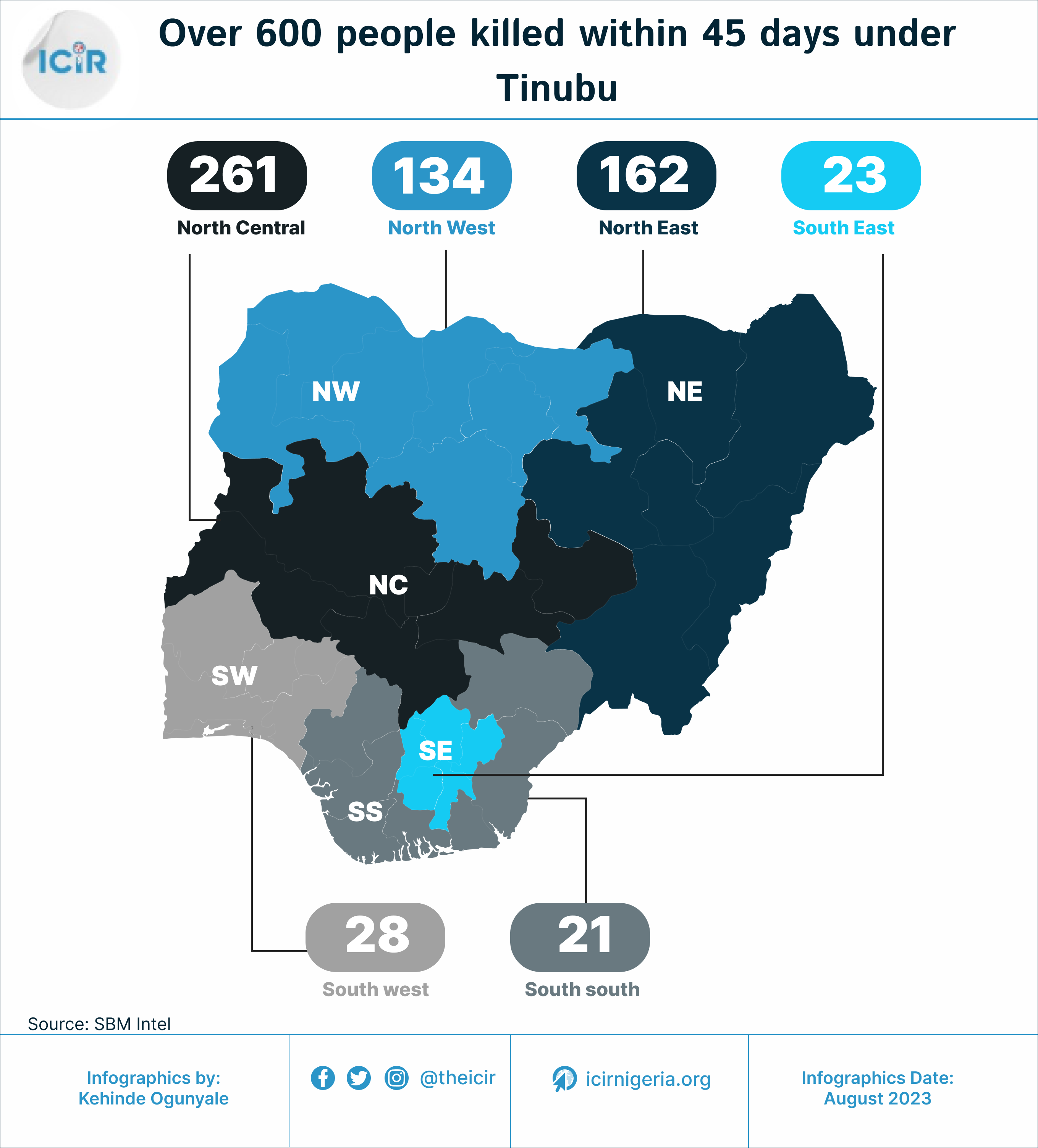
In 45 days between May 29 and July 13, 2023, over 600 people had been killed by non-state actors across the country.
According to data, the killings happened primarily from activities of bandits, Boko Haram insurgents, ethnic militias, armed robbers and other non-state actors.
Data from SBM Intelligence, an analysis platform, revealed that about 629 Nigerians were killed in the last 45 days under President Tinubu.
Other data from the Council on Foreign Relations’ Nigeria Security Tracker (NST) and media reports checked by The ICIR showed that non-state actors killed 587 people within the same period.
President Bola Tinubu during his inauguration.
In May, The ICIR published reports highlighting the key insecurity issues confronting the Muhammadu Buhari administration and another listingthings Tinubu must do to address insecurity.
highlights of promises made by Tinubu on security
In his victory speech after securing the All Progressives Congress (APC) presidential ticket in June 2022, Tinubu promised a secure, prosperous, united Nigeria if he won the 2023 general elections.
Tinubu said he was ready to unite the nation, provide security, revamp the economy and create wealth.
He also promised to eliminate criminals, including terrorists.
“They have been worrying us, but we will eliminate them. We are Nigerians. We are sure that no animal in the darkness of the night, no intruders, no destroyers, can bring Nigeria backwards. Forward we are moving,” he said.
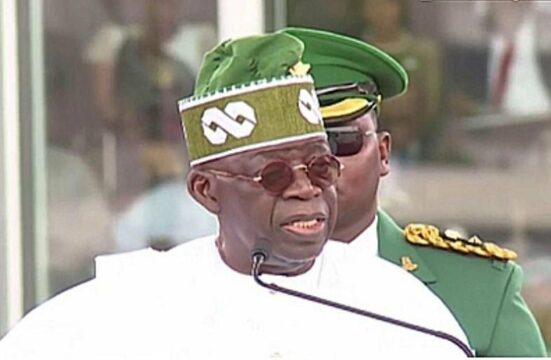
Tinubu, while delivering his inaugural speech as President amid cheers from his supporters on Monday, May 29, at Eagle Square in Abuja, outlined the key initiatives to be anticipated from his administration and pledgedto prioritise security and effectively tackle the menace of insecurity.
“Security shall be the top priority of our administration because neither prosperity nor justice can prevail amidst insecurity and violence.
“To effectively tackle this menace, we shall reform our security doctrine and its architecture.
“We shall invest more in our security personnel, and this means more than an increase in number. We shall provide better training, equipment, pay and firepower,” Tinubu stated.
What data say
Despite the promise made by the President to hit the ground running, data from various sources showed that the insecurity issues is yet to improve under Tinubu’s administration.
Disaggregating the data
A further look at the data from the SBM Intelligence revealed that in May, 38 people were killed by non-state actors between May 29 and May 31, 541 in June, and 50 as of July 13.
Killings by non-state actors per region
North Central: 261
North East: 162
North West: 134
South East: 23
South West: 28
South-South: 21
A breakdown of the data per state shows that Plateau has the highest number of casualties with 111, followed by Borno, 96; Niger, 76; Benue, 69; Zamfara, 67; Taraba, 60; and Sokoto, 51.
Others are Lagos, 13; Kaduna, 11; Rivers and Anambra, 9, Ogun, 8; Ebonyi, 7; and Imo and Delta, 6.
Other states had less than five casualties, while states like Osun, Kano and Jigawa recorded zero losses within this period.
In total, 629 casualties were documented from actions of non-state actors from May 29 to July 13.
NST/Media reports
Data from NST/Media reports showed that 39 persons were killed from May 29 to May 31, 444 in June, and 104 as of July 13, totalling 587 deaths recorded.
Plateau had the highest number of casualties with 145 deaths, Benue 68; Zamfara, 57; Sokoto, 55; Imo, 53; Niger and Borno, 51; and Taraba, 50.
Governor of Plateau State Caleb Mutfwang
Additional data
A recent report by a civil society organisation, Global Rights Nigeria, revealed that at least 555 people had been killed and 267 others abducted six weeks after President Tinubu took office.
The Country Manager of Global Rights Nigeria, Edosa Oviawe, while presenting a paper on realities of mass atrocities at a two-day ‘Conflict Sensitive Reporting Training for Journalists’ programme in Abuja, said the findings were based on reports from the media, civil society groups and security agencies.
Also, in a report published on June 14, Amnesty International (AI) said more than 120 people were killed a few days after Tinubu assumed power.
“It is horrific. Gunmen attacks have claimed at least 123 lives mere weeks after President Bola Tinubu assumed office on May 29. Rural communities, always bracing for the next bout of violence, faced deadly attacks by rampaging killers. Protecting lives should be the utmost priority of the new government. The Nigerian authorities must urgently take steps to stop the bloodletting.
“The brazen failure of the authorities to protect the people of Nigeria is gradually becoming the norm in the country. The government said it will enact security measures in response to these attacks, but these promises have not translated into meaningful action that protects the lives of vulnerable communities,” Amnesty International’s Acting Nigeria Director, Isa Sanusi, said concerning the report.
Some major incidents under Tinubu as President
May
Four persons were reportedly killedon Monday, May 29, with two of them beheaded by gunmen who invaded the Rundele community in Emohua Local Council of Rivers State.
Bandits on May 30 killed25 people in three separate attacks in the Kanoma district of Maru Local Government Area of Zamfara State.
Gunmen suspected to be cultists invaded two communities in the Ahoada East and Ahoada West local government areas of Rivers State on Wednesday, May 31, killing six persons.
June
The Makurdi branch of Shitile Development Association (SDA), Benue State, in a letter of intervention written to the state government and signed by its President, Door Samuel, and secretary general, Zuai Ephraim, said at least 40 people were killed in separate attacks carried out simultaneously on June 4 in several communities of the Katsina-Ala local government area of the state.
Samuel stated that after the dust settled on the June 4 shooting by gunmen at Imande Mbakange village market in Mbacher council ward, a total of 28 people had been killed.
The group added that on the same day, in Michihe council ward, six other people were slaughtered, while another six on the same night were killed at Achamegh village, Mbagene Kpav, bringing the total number of those killed to 40 in just one night.
Bandits killed no fewer than 50 people in Gwadabawa and Tangaza local government areas of Sokoto state in June for refusing to pay illegal levies imposed on them.
In another incident, attacks by bandits on the villages of Janbako and Sakida in Maradun local government area, Zamfara State, resulted in the death of 31 persons and injuries to many others.
At least 13 persons were also killed in Barkin Ladi local government area of Plateau State on June 10 in a retaliatory attack between herders and farming communities.
The incident happened after five herders were killed in Rawu village earlier.
According to reports, bandits in Niger State’s Rafi local government area slaughtered 25 farmers and kidnapped several women and girls from different areas.
According to reports, the incident happened in five communities.
July
On Sunday, July 2, Taraba State Governor Agbu Kefas imposed a 24-hour curfew on Karim town and its surroundings in Karim Lamido local government area.
The curfew followed a communal clash between the Wurkuns and the Karimjos in the LGA, where at least 50 people died.
A total of 24 people were killedon Saturday, July 8, when armed men entered the Zaki Akpuuna 1 and Diom towns in the Mbaterem district of the Ukum local government area of Benue State.
The way forward…
Commenting on the data on incessant killings in the country, a security analyst with SBM Intelligence, Emeka Okoro, said the killings in Nigeria have continued despite a new administration due to various complex factors.
Okoro said the killing in Nigeria is multifaceted and influenced by factors such as:
1. Ethnic and religious tensions.
2. Insurgencies and terrorism.
3. Inadequate security infrastructure.
5. Socio-economic factors.
6. Political tensions, frictions from political competition, and power struggles can sometimes spill over into violence. Pre- and post-election periods have historically been accompanied by an upsurge in politically motivated violence in Nigeria.
“Addressing these complex issues requires a multifaceted approach, including improved security infrastructure, effective governance, social cohesion, economic development, and peace-building efforts.
“However, comprehensive and sustainable solutions will require political will and concerted efforts both within Nigeria and from the international community,” the security analyst stated.