Home Blog Page 835

Fans hail Wizkid’s performance at Tottenham Hotspur stadium

FANS and followers of afrobeats star, Ayodeji Ibrahim Balogun widely known as Wizkid have taken to social media to shower praises following his performance at the Tottenham Hotspur Stadium, London.

Wizkid made history on Saturday, July 29, as the first African artiste to hold a concert at the 60,000-capacity stadium.

With his hit song ‘Reckless’ from his album ‘Made in Lagos,’ he made a grand entrance that sparked excitement among the audience as he took the stage at the More Love Less Ego concert. He followed it up with a series of performances, including a rendition of ‘Ayo’ from his album ‘Superstar.’

Additionally, the event featured music performances by the highlife band The Cavemen and Nigerian afrobeat artist Wande Coal.

Fan’s reactions 

Reacting to this, a media personality, Rinu Oduala in a tweet expressed excitement urging Nigerians to celebrate Wizkid.

“When you see your fellow Nigerian doing iconic things, stop hating!Celebrate greatness! 🦅#WizkidxTottehamStadium”, she tweeted.

Other individuals, expressed excitement for the artiste, celebrating him on Twitter.

“Best concert I have ever attended. We had so much fun..  Beatiful staging, presence, band (cavemen) OMG the audience🔥filled to the brim. It was spectacular . Thank you Wizkid for a classy night & great performance” – @janetbrownie1

“Big Wiz has always been the blueprint for all afrobeats artist from day one 🐐🦅 #WizkidxTottehamStadium” – @Darknighthood1

“I can’t even post most videos because i was screaming in all of them 😭😭. Best concert i have ever been to for real 🔥❤️” – @cruisewithmee

“See as Wizkid show clean workings.. No explanations…just evidences 🦅❤️“ – @TheMahleek

Growth of Afrobeats

In recent years, the Nigerian music industry has gained global recognition with Afrobeat leading the way. This has opened doors to international collaborations, award nominations and wins, chart-topping hits and performances on major stages worldwide.

In 2020, the UK’s Official Charts Company introduced Britain’s inaugural Afrobeats singles charts, showcasing Nigerian artists including Burna Boy, Wizkid, Davido, Rema, Mr Eazi, Tekno, among others.

Like Wizkid’s achievement, The ICIR reported Burna Boy’s milestone as the first African artist to sell out the 80,000-capacity London stadium in the United Kingdom (UK) for a concert.

EIU predicts govt-controlled forex management, as naira loses value

ON the heels of exchange rate volatility concerns, the Economic Intelligence Unit (EIU) has predicted Federal Government’s intervention in the exchange rate movement over apprehension the naira could plunge uncontrollably.

The EIU believes that the Central Bank of Nigeria (CBN), which manages the country’s exchang rate movement, lacks the experience to handle a floating forex regime.

The President Bola Tinubu administration has made foreign exchange unification a key component of its policies, which has seen the naira struggling to maintain a handsome level against foreign currencies, especially the dollar, the euro, and the pound sterling.

Economic watchers also argue Nigeria’s weak export earnings and  external reserves would not be able to serve as enough buffer to hedge Nigeria’s forex problems.

The EIU, in its latest report, stated, “The CBN lacks experience in conducting monetary policy under a float, and the need to control rapidly increasing inflation will become more acute over time.

“Our forecast is finely balanced, but we expect a return to heavier exchange-rate management from the second half of 2023 as the naira slides beyond N800:US$1 from N770:US$1 in early July.”

The research firm observed a shortage of foreign currencies in Nigeria, especially in fulfilling foreign exchange demands through Form A and M.

This, combined with speculators taking advantage of the situation, might push the CBN to step in more and “intervene” in the market, especially since about 98 per cent of their foreign reserves are in cash, it stated.

The EIU, however, regarded Nigeria’s foreign reserves as still relatively liquid, saying the country can pay for imports for, at least, another six to eight months. Some analysts believe this gives the government enough time to increase revenue, stop financial leaks, and pay off some debts.

The report also projected that because of the unstable exchange rate and how it affects people’s lives, the naira would lose its value more slowly than expected in the medium-to-long term.

It estimated the average rate to be “N815 to US$1 in 2024” and to further decline to “N1,018 to US$1 by the end of 2027.”

The naira depreciated on Friday, July 28 by 0.93 per cent at the Investors’ and Exporters’ (I&E) window, Nigeria’s official foreign exchange (FX) market, following a shortage of dollars.

After trading on Friday, the dollar was quoted at N775.76 as against the  N768.60 figure quoted the previous day at the I&E window, data from the FMDQ indicated.

The market recorded a decline in turnover, which dropped by 38.89 per cent to $54.18 million on Friday, from $88.66 million on Thursday.

NAPTIP warns against traffickers disguising as sports scouts

0

THE National Agency for Prohibition of Trafficking in Persons (NAPTIP) has warned against traffickers who pretend to be sports scouts while carrying out criminal activities.

Director-General of the Agency Fatima Waziri-Azi issued the warning in Abuja on Saturday, July 29.

She warned youths, who were interested in sporting activities, especially football, to be wary of people with criminal intentions seeking to exploit their ambitions.

Waziri-Azi disclosed this during a football match held in commemoration of the 2023 World Day against Human Trafficking and the 20th anniversary of NAPTIP.

“NAPTIP has the powers to regulate and to issue clearance to travel agencies, tour operators and sporting recruitment agencies. Potential sportsmen and women are at liberty to demand for NAPTIP clearance from the recruitment agencies before engaging with them,” she said.

Meanwhile, the Agency also sensitised People with Disabilities (PWDs) in Edo state on the need to be more aware of traffickers preying on their vulnerabilities.

NAPTIP Commander, Benin Zonal Office Nduka Nwawenene said PWDs were also now becoming major targets for traffickers and others involved in organ harvesting.

“There have been silent recruitment and exploitation of persons with disabilities, so with this enlightenment, it is an avenue to bring them into NAPTIP effort to end human trafficking. The nexus between people with disability, human trafficking and violence against persons necessitated the disability inclusion policy by NAPTIP directed general Fatima Waziri-Azi,” Nwawenene said.

According to the 2022 United States Department Trafficking In Persons Report, Nigeria is a source, transit and destination country for human trafficking. NAPTIP statistics between 2019- 2022 show that 61 per cent of human trafficking in Nigeria happens internally, while 39 per cent occurs across borders.

In 2022, the Nigerian Immigration Service (NIS) said human traffickers exploit the Economic Community West African States (ECOWAS) travel certificate to avoid security checks while carrying out illicit activities.

Eight arrested over alleged diversion of N4bn in Kano

0

THE Kano State Public Complaints and Anti-Corruption Commission said it has arrested eight suspects over the alleged diversion of N4 billion from the Kano Agricultural Supply Company (KASCO).

The Chairman of the Commission, Muhuyi Magaji Rimini Rimini Gado, disclosed this on Saturday, July 29, during a tour of the company’s warehouse facility.

According to him, the Commission has commenced investigations to unravel the circumstances that led to the diversion of the funds. 

He alleged that the funds were transferred from the Kano Agricultural Supply Company (KASCO) to a firm known as Association of Compassionate Friends, registered with the Corporate Affairs Commission. 

“The Association was meant to promote and take care of the living standard of the children of the less-privileged people in the society, but unfortunately it has been converted into a machine for stealing public funds,” he said.

The anti-graft boss alleged that the funds were drawn from the state government as a grant to KASCO. 

He confirmed that eight suspects have been arrested in connection with the alleged crime, adding that they are providing useful statements about the incident. 

According to him, the authorities have already recovered N15 million and blocked approximately N8 million of the misappropriated funds.

Gado expressed concerns about certain transactions between companies and banks, suggesting that some bank managers may be called to address the issues

He stressed that the Commission would pursue the case in the appropriate court.

He also urged the people of the state, especially civil servants, to come forward with credible information that could aid in the recovery of looted government properties.

Gado assured that anyone who volunteers information will be protected.

Trend: Governors who became ministers since 1999

FIFTY-EIGHT days into office, President Bola Tinubu submitted the names of ministerial nominees to the senate for screening. 

The list, containing 28 names, was submitted as part of the constitutional requirements by the president to forward ministerial nominees to the Senate not later than 60 days after taking the Oath of Office. 

The ICIR reported that while 25 per cent of the names are women, 11 out of 36 states are yet to have a ministerial nominee. 


READ ALSO:
Tinubu nominates Wike, El-Rufai, Umahi, others as ministers

How Ministers’ directive on reconnecting debtor discos weakens regulatory compliance

Lagos, Kano, nine other states yet to get ministerial nominees

Women make up 25% of Tinubu’s ministerial list


However, in what is gradually becoming a trend among previous presidents, Tinubu submitted the names of four past governors who severed two terms each as ministerial nominees. 

These governors are the former governor of Rivers State, Nyesom Wike; the former governor of Ebonyi state, David Umahi; the former governor of Kaduna state, Nasri El-Rufai; and the former governor of Jigawa state, Abubakar Badaru.

If these governors successfully pass the Senate’s screening, they would be assigned portfolios by the president as ministers, which, in turn, adds to their status as former governors.

Trends by previous presidents

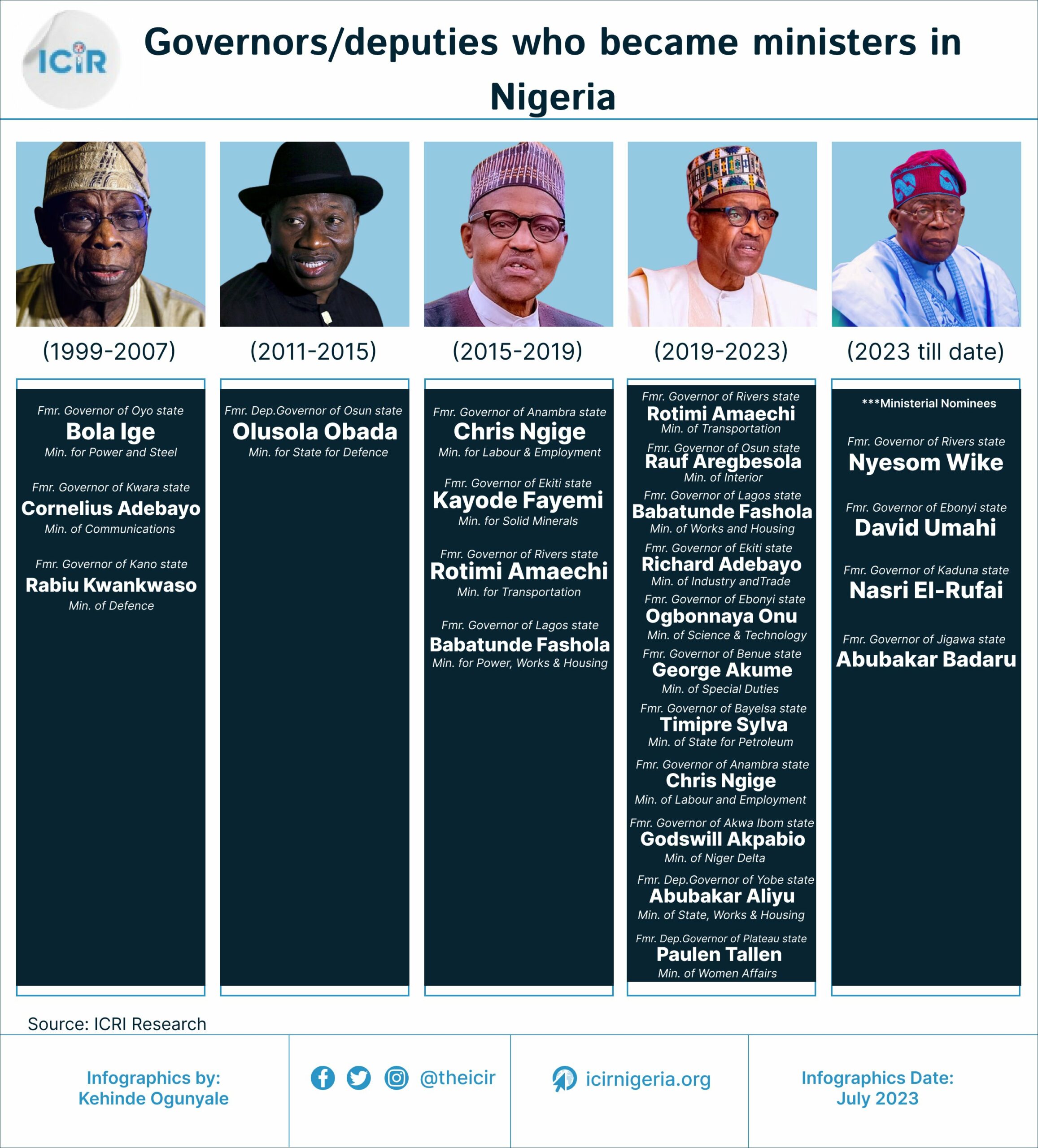
Between 1999 and 2023, Nigeria has had four democratic presidents who appointed or intends to appoint former governors into their cabinet as ministers.

Governors/deputies who became ministers in Nigeria

When former president, Muhammadu Buhari, was elected as president in 2015,  he appointed four former state governors as ministers. They are Chris Ngige (former governor of Anambra) as Minister of Labour and employment, Kayode Fayemi (former governor of Ekiti) as Minister of Solid Minerals, Rotimi Amaechi (former governor of Rivers) as Minister of Transportation and Babatunde Fashola (former governor of Lagos) as Minister of Power, Works and Housing.

In 2019, when Buhari was re-elected as president, he reshuffled the ministers to 44 names and  nine past governors and two deputy governors were appointed. 

  1. Rotimi Amaechi (former governor of Rivers State) as Minister of Transportation,
  2. Rauf Aregbesola (former governor of Osun State) as Minister of Interior,
  3. Babatunde Fashola (former governor of Lagos State) as Minister of Works and Housing,
  4. Richard Adeniyi Adebayo (former governor Ekiti State) as Minister of Industry, Trade and Investment,
  5. Ogbonnaya Onu (former governor Ebonyi State) as Minister of Science and Technology,
  6. George Akume (former governor Benue State) as Minister of Special Duties,
  7. Timipre Sylva (former governor Bayelsa State) as Minister of State for Petroleum,
  8. Chris Ngige (former governor Anambra State) as Minister Labour and Employment,
  9.  Godswill Akpabio (former governor Akwa Ibom State) as Minister of Niger Delta.
  10. Abubakar D. Aliyu (deputy governor of Yobe State) was appointed as Minister of State, Works and Housing,
  11. and Paulen Tallen (deputy governor of Plateau State) as Minister of Women Affairs.

Meanwhile, under former president Goodluck Jonathan, in 2011, Olusola Obada was appointed as minister of state for defence. Before her appointment, she had served as the deputy governor of Osun state.

Similarly, under the two-term tenure of former president Olusegun Obasanjo from 1999 to 2007, Bola Ige (former governor of Oyo state) was appointed as minister for power and steel, Cornelius Adebayo (former governor of Kwara state) was appointed as the minister of communications, and Rabiu Kwankwaso (former governor of Kano) was appointed as minister of defence.

However, the founder of Policy Shapers, Ebenezar Wikina, told The ICIR that the cabinet positions should not be used as an opportunity for political settlement but must be about competence. 

He said, “It should be a space for seasoned Nigerians who are experts in their respective fields to advise and direct the administration’s goals towards implementation. One of the best cabinets we’ve had as a country is the group of Ministers who worked with President Obasanjo. You can see how all of them have continued to excel internationally for decades after serving as Ministers at AfDB, WTO, World Bank, etc.”

Bandits kill cleric, others, abduct 40 in Kaduna

SIX farmers, including the vice chairman of the Jama’atul Izalatul Bid’ah Wa Iqamatus-Sunnah Yakubu Muhammad Bugai, have been killed by bandits during attacks in the Birnin-Gwari Local Government Area (LGA) of Kaduna State.

The terrorists also abducted over 40 villagers while several farmlands were destroyed and seized during the attacks.

Although the police and the Kaduna State Government have yet to officially comment on the incident, the Chairman of Birnin-Gwari Emirate Progressives Union (BEPU), Ishaq Usman Kasai, disclosed in a statement on Saturday, July 29, that the attacks occurred between Wednesday, July 26 and Thursday, July 27.

According to the statement, the Islamic cleric was shot dead on Wednesday, July 26, at his farm located around the Rema area and his corpse was later taken to Jibril Mai-Gwari General Hospital.

He said the cleric sustained gunshot wounds on his abdomen and arm.

The chairman giving the account of other attacks in Birnin Gwari disclosed that the bandits abducted scores of locals around the Kuyambana forest, which served as a hideout for the hoodlums.

Kasai said: “In another sad development, around Sabon-Layi, Kurgi, Yelwa, Tashan-Keji, Shiwaka, Unguwan Danfulani and many more rural communities in the western part of Birnin-Gwari sharing boundaries with Kamuku and Kuyambana forests, which are serving as hideouts of the bandits, large number of locals were kidnapped at their farms.

“In fact, the situation is so rampant and complex for one to choose among the incidents to report. The bandits also took over peoples’ farms in those areas. In the Sabon-layi community alone, more than 10 farms, especially those with grown up maize, have been cleared deliberately by the bandits’ cattle.

“In fact, the bandits told the farmers to stop wasting their time going to farm in the area because even if they failed to obey, they would not allow them to harvest and they may end up being killed or abducted.”

He added: “On Friday 21-7-2023, the bandits invaded Ung Bawa in Randagi Ward and kidnapped 28 persons, including women and children and also killed one and shot four who are currently receiving medical attention at various health facilities. However, 13 out of the captives have managed to escape from the den.

“On Tuesday 25/7/2023, the bandits attacked Rafin Zango, around Eka Farm, and kidnapped two persons who were on their way back from Birnin-Gwari town heading to Gagumi community.

“Also, on Wednesday, 26/7/2023, they invaded Unguwan Roka of Kakangi Ward, killed 1 person and kidnapped 9. On Thursday night (27/7/2023), the bandits came back to a nearby Community, Unguwan Danfulani, killed 1 person and kidnapped seven from one family.

“Earlier on the same Thursday, 27/7/2023, the bandits blocked traders and grain suppliers who were on their way from the western part to the Birnin-Gwari weekly market. The bandits operated for about an hour and kidnapped six persons”

70% of farmlands are yet to be accessible 

Speaking further on the negative impact of insecurity in his area, Kasai, the local government is at risk of food insecurity as their targeted farming outputs may not be met.

According to him, about 70 per cent of farmlands have been hijacked by the bandits and aren’t yet accessible to farmers.

“The BEPU are deeply concerned that farmers continue to be attacked whenever they go to their farms. This poses a danger to this year’s targeted farming outputs, as about 70 per cent of farmlands are yet to be accessible.

“The kidnapping and killings of locals at farms have become rampant in the entire Birnin-Gwari general area. Even today (Saturday), the bandits abducted two farmers at the Maraban Agyaro area of the Gagumi axis.

“BEPU is deeply concerned that the killings and abductions of farmers in the Birnin-Gwari general area have continued to escalate daily, unchallenged and unreported,” he said.

Appeal to the government, security agencies 

While appreciating the determination of the president, Bola Tinubu administration and the effort of the security agencies toward addressing insecurity in the area, the Union appealed to the Federal Government to deploy military formations in some of the insecurity-prone communities.

He also appealed to the government to restore mobile police units in Damari, one of the affected communities.

“The Union, however, appeal to the Federal Government to facilitate the establishment of military detachments in Katakaki, Gagumi, Tashar-Keji, and Bugai axis of the western part of Birnin-Gwari, which the bandits warlords are now using as their operational base and continuously terrorising the Birnin-Gwari general area.

“Equally important, there is a need for restoration of the Mobile Police Unit in Damari community of the eastern part of the local government, which bandits are using as a route in attacking many communities in the area.”

Kasai also bemoaned the poor healthcare delivery in the region.

“The victims of armed banditry continue to die due to poor medical attention as a result of inadequate staffing and equipment in the Jibril Mai-Gwari General Hospital. (There is) only one medical doctor in the entire hospital.

“This is by far not proportionate to the population. On this note, BEPU appeals to the Kaduna State Government to post more health personnel or recruit indigenous medical doctors who would manage the hospital as victims of armed banditry continue to die due to insufficient primary medical attention,” he said.

Striking doctors reject 25% salary increase offered by FG

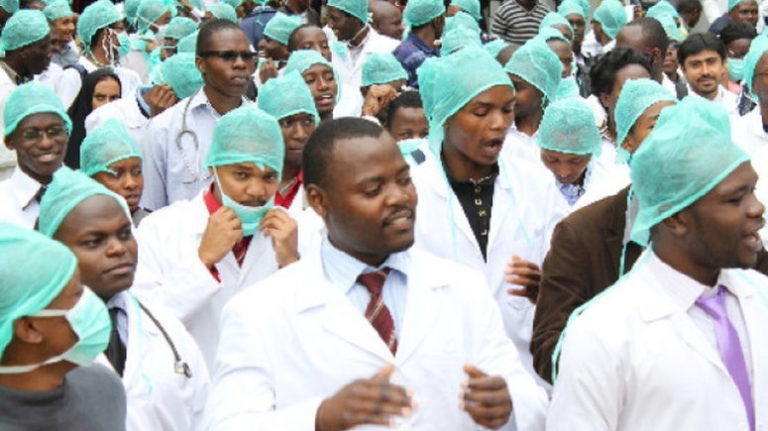
THE Nigerian Association of Resident Doctors (NARD) has rejected the 25 per cent increase made to the Consolidated Medical Salary Structure by the Federal Government.

This was disclosed in a communique issued on Saturday, July 29 after the association’s National Executive Council (NEC) meeting in Lagos.

The communique was signed by the president of the association, Orji Emeka Innocent, secretary-general, Chikezie Kelechi, and publicity and social secretary, Umar Musa.

They insisted that their earlier demands was for full restoration of the Consolidated Medical Salary Structure (CMSS) to its right value as at the time of the approval of the structure in 2009.

“NEC vehemently rejects the paltry 25 per cent increment in the basic salary of doctors, as well as the accouterment allowance”, the communique said.

The doctors embarked on an indefinite industrial action on Wednesday, July 26, after the expiration of a two-week ultimatum earlier issued to the government.

Orji said the strike continues indefinitely until reasonable progress is made by the government to address the association’s demands as contained in the ultimatum earlier issued to the Federal Government.

The doctors’ demands include immediate payment of the 2023 Medical Residency Training Fund (MRTF), tangible steps on the “upward review” of the Consolidated Medical Salary Structure (CONMESS), and payment of all salary arrears owed its members, since 2015.

The doctors also want immediate massive recruitment of clinical staff in the hospitals and abolishment of the bureaucratic limitations to the immediate replacement of doctors and nurses who leave the system.

They also want the immediate review of hazard allowance by all the state governments as well as private tertiary health institutions where any form of residency training is done.

In response to the demands, The ICIR reported that the Federal Government approved the payment of N25,000 peculiar allowance for the medical and dental doctors in hospitals, medical centres and clinics in the federal public service.

The ICIR reports that this is not the first time the resident’s doctors would be embarking on strike, as they had downed tools for 159 days since 2013, making the group the only association of workers in the nation’s health sector that has embarked on industrial action beyond 100 days within the period.

NARD’s current strike is the first major workers face-off with the Federal Government since President Bola Tinubu took over power on May 29.

CBN to penalise banks flouting 65% loan-to-deposit ratio policy

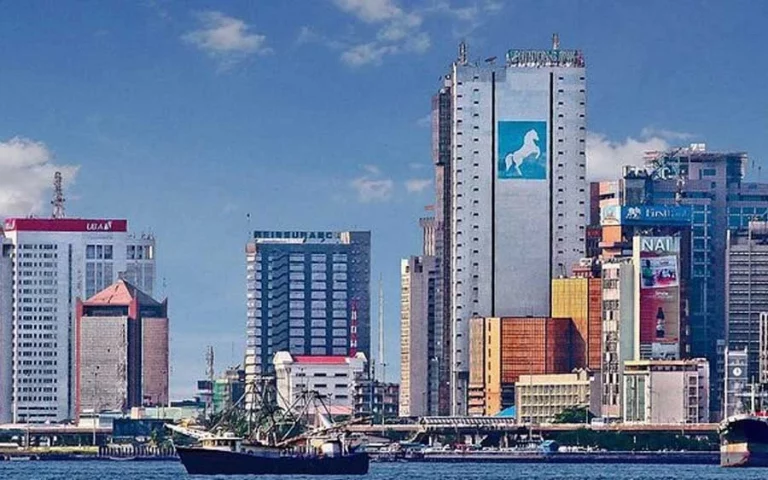
THE Central Bank of Nigeria (CBN) will from July 31 begin to enforce the 65 per cent loan-to-deposit ratio (LDR) policy on banks flouting its directive.

The policy was set to improve lending to customers in order to stimulate the real sector of the economy.

It implies that for every N100 received as deposits, the banks are to lend N65 to customers.

According to a ThisDay report, the apex bank had in a circular to banks stated that it would resume the enforcement of the LDR policy effective July 31, 2023.

The move followed CBN’s directive to banks to maintain a minimum LDR of 65 per cent, after the apex bank had in October 2019, raised the LDR from 60 per cent.

Checks by The ICIR showed that in the last three years, most banks had failed to meet the CBN 65 per cent minimum loan requirement to customers.

The apex bank, urging commercial banks to comply, stated in the circular that the resumption of enforcement was in line with the objective of the policy and the need to moderate industry excess liquidity.

Banks with LDR below the minimum requirement as of the date – and monthly thereafter –  would be liable to a Cash Reserve Requirement (CRR) surcharge of up to 50 per cent of the lending shortfall, the CBN warned.

Banks currently maintain 32.5 per cent CRR with CBN, which represents a specified minimum fraction of the total deposits of customers.

The LDR is used to assess a bank’s liquidity by comparing total loans to deposits for the same period, which impacts both liquidity and solvency in the short, medium and long term.

Liquidity and profitability are two required methods of credit creation that lubricate banks’ ability to generate loans, a finance lecturer, Abu Noruwa, said.

“First, the banks must maintain certain reserves from their total demand deposits to pay for the cash demands of their depositors.

“Second, the profitability of banks makes the credit cycle sustainable as it ensures banks are in a healthy position. At the same time, it indicates that banks are generating higher revenues from their interest earnings than what they are paying their customers on their demand deposits,” Noruwa, a lecturer at the Department of Finance, University of Lagos, explained.

Banks flouting CBN’s LDR policy

Checks by The ICIR on three-year financial statements of some banks showed that most of the banks had defiled the 65 per cent LDR policy.

The banks are FBN Holdings (FBNH), United Bank for Africa (UBA), Guaranty Trust Holding Company (GTCO), Zenith Bank, Access Holdings, FCMB Group, and Fidelity Bank.

It showed that FBNH total loans – loans and advances to customers plus loans and advances to banks – in 2020 stood at N3.61 trillion, while its total deposits – deposits from customers plus deposits from banks – stood at N6.55 trillion, representing about 55 per cent LDR.

In 2021, FBNH’s loans stood at N4.45 trillion and deposits at N8.65 trillion, as LDR fell to about 51 per cent. Also, in 2022, LDR fell to about 49 per cent as the bank reported N5.56 trillion loans and N11.26 trillion deposits.

In the three-year period under review, UBA reported N2.63 trillion, N2.83 trillion and N3.44 trillion total loans, and N6.09 trillion, N7.02 trillion and N8.99 trillion deposits in 2020, 2021 and 2022 respectively.

Following from the figures, the bank’s LDR, which was about 43 per cent in 2022, fell to 40 per cent and 38 per cent in 2021 and 2022 respectively.

GTCO reported N1.66 trillion, N1.8 trillion and N1.89 trillion total loans in 2020, 2021 and 2022, while its total deposits stood at N3.61 trillion, N4.13 trillion and N4.61 trillion in that order.

The bank’s LDR also dropped from about 46 per cent in 2020 to 44 per cent in 2021, and 41 per cent in 2022.

Zenith Bank’s total loans was N2.78 trillion in 2020, N3.36 trillion in 2021, and N4.01 trillion in 2022, while total deposits was N5.34 trillion, N6.47 trillion and N8.98 trillion respectively. The bank’s LDR also dropped from about 52 per cent in 2020 to 51.85 per cent in 2021 and 45 per cent in 2022.

Access Holdings’ total loans in 2020 was N3.61 trillion, and N4.45 trillion and N5.56 trillion in 2021 and 2022, while its total deposits were N6.55 trillion, N8.65 trillion and N11.26 trillion respectively.

The bank’s LDR also fell from about 55 per cent in 2020 to 51 per cent in 2021, and 49 per cent in 2022.

FCMB reported N822.77 billion total loans in 2020, N1.06 trillion in 2021, and N1.19 trillion in 2022. Its total deposits were N1.38 trillion, N1.72 trillion and N2.07 trillion respectively. The bank’s LDR, which was about 60 per cent in 2022, rose to 62 per cent in 2021, and later dropped to 58 per cent in 2022.

While these banks failed to meet the CBN 65 per cent mandatory LDR in the three-year period under review, Fidelity Bank, however, surpassed the minimum requirement.

The ICIR analysis of the bank’s financial statements showed that Fidelity Bank’s total loans stood at N1.33 trillion in 2020, N1.66 trillion in 2021, and N2.12 trillion in 2022. Total deposits stood at N1.699 trillion, N2.02 trillion and N2.58 trillion in those respective years.

Following from the figures, the bank’s LDR rose from about 78 per cent in 2020 to 81.9 per cent in 2021 and 82 per cent in 2022.

Impacts on banks, businesses and the economy

The need to measure the impact of LDR on banks’ liquidity to ensure the achievement of the CBN mandate cannot be overstretched as it helps to promote a sound financial system without compromising the health of the domestic banks.

According to the CBN, the justification for the LDR policy was to encourage banks to enhance credit delivery to the real sector of the economy.

Noruwa explained that as money plays multiple roles, raising credit (LDR) allows an economy to achieve growth and development through more consumption, increasing demand, greater investment and increase in employment and economic activities.

“It also enables efficient monetary policy to stabilise the economy along with a mandatory reserve system, to mitigate inflation, and to make credit available to poorer sections of the society leading to inclusive growth, and for a wider access to consumer goods and investment opportunities,” he highlighted.

“However, it will affect banks’ operations because a very high LDR will limit credit creation by banks. Also, because deposits form the basis for credit creation, a bank with a low base of deposits will generate less credit.

“As to investment, people who do not have potential security as collateral cannot be availed credit,” the lecturer pointed out.

While the CBN placed an incentive of 150 per cent to encourage banks to meet the LDR requirement, it warned that failure to achieve the target attracts a levy of additional CRR of 50 per cent of the lending shortfall.

It, however, advised banks to maintain strong risk management practices regarding their lending operations.

An ideal situation

Dataphyte, a media research and data analytics organisation, revealed that many of the commercial banks in the country are lending below the minimum ratio.

Explaining the LDR concept, it said high ratio means a bank might have little cash to meet unforeseen demands, while a low ratio may mean low earnings.

A LDR of 80 per cent to 90 per cent is ideal for a bank to ensure profitability and meet customers’ demands, Dataphyte noted.

According to the research firm, at the end of 2019, 2020 and 2021, LDR achievements were 62.87 per cent, 59.37 per cent, and 62.17 per cent respectively.

Although the ideal ratio is between 80 per cent and 90 per cent, it varies from country to country.

In South Africa, the minimum ratio is 91 per cent, 70 per cent in Brazil, 75 per cent in India, and 76 per cent in Kenya, Dataphyte stated.

A high LDR shows bank’s ability to attract customers, increases profitability and attracts more investors.


From curls to costs: How economic challenges shape women’s hairdos

WOMEN’s hair care has been an integral part of grooming practices for centuries, reflecting societal norms, fashion trends and personal preferences.

However, economic fluctuations and financial constraints can significantly impact how women approach and invest in their hair care routines.

The choices and behaviours of women regarding hair care products, salon services and overall grooming practices have been greatly affected by the current economic situation in the country.

Speaking to The ICIR, the manager of Beauty by Inavina Salon, Abuja, Victory Omono said the business has been severely affected by the economy, leading to skyrocketing prices which have now doubled compared to their previous levels.

“The economy has affected us tremendously, prices have skyrocketed. The prices of hair products and extensions have changed compared to before”, she said.

She added that hairstylists now “negotiate prices with customers to keep them as they do not troop in like before”. “Most of them only make cornrows and wear wigs to cover it and look good,” Omono added.

Speaking with The ICIR, proprietor of Hairs by Pandora, Happiness Newman, explained how the economy has affected her business.

“The economy has not been friendly at all, it has really affected my business. The hike in the prices of things is not funny. Some clients even find it difficult to get transportation and so business has not been the way it used to be. There are times I will have a braiding appointment and the next thing, they call to cancel, blaming it on lack of transport fare,” she said.

Additionally, she disclosed that she has adjusted her rates, ensuring to keep them affordable, as many of her customers have resorted to cutting their hair amid the challenging economic conditions.

“My rates have changed but not too much, it is still very affordable. Most of my customers have cut their hair. They complain and say instead of carrying the hair without braiding it, they will rather be on low-cut.”

“Also, prices of hair products have greatly increased  and this is alarming. People can barely afford two attachments  at the moment, hence the trending ‘Hilda Baci’s style’”.

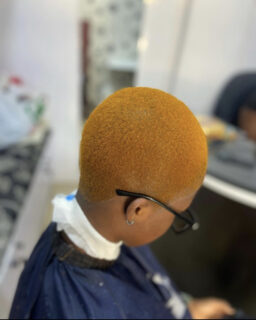
A lady on low cut. Source: Instagram

A lady who recently decided to cut her hair due to the high cost of maintaining it, told The ICIR that she couldn’t handle the expenses anymore.

“I had to cut my hair because of the cost of making it and most times it doesn’t last more than three weeks. For me to make a standard hair, I will be spending nothing less than 10k which might last for just three weeks.

“The cost of washing and setting was N500 but now N1000 in my area, Kubwa and that is as a result of the cost of fuel since most of these beauty salons use their generators almost all the time. Braiding moved from N2500 to N4000 depending on the style, there are some that are more.

“A major concern is the price of attachments. As at February I got it for N1400 but it is now N2200 for the small pack and the quantity has reduced with an increased price so you will be forced to get two to three packs depending on the style”, she stated.

The lady explained she would rather get a haircut and use the money for food, considering the high cost of living.


READ ALSO:


“Instead of using such money on a hair that won’t last me I prefer to use it to get foodstuffs since the cost of living has also increased. It is cost effective because I will only need to spend 1000 every month to cut my hair in my area as a lady”, she added.

Meanwhile, another lady, Ese noted that despite being affected by the current state of the economy, which has also led to high expenses for hairdressing, she will not cut her hair.

“I know that the economy is bad now and hairstylists are increasing their prices but no matter how bad it gets, I will not cut my hair. Rather, I will look for other styles and also wear my wigs”, she said.

NDLEA raises alarm as drug abuse among women surges

THE National Drug Law Enforcement Agency (NDLEA) has expressed concern as drug abuse among women continues to surge.

According to the Agency, latest records on drug use show that one in four drug abusers in the country is a woman.

The Ogun State Commander of the NDLEA, Ibiba Odili, stated this during the Launch of the War Against Drug Abuse in collaboration with Lions Club International, in Abeokuta.

The NDLEA official revealed that 14.3 million Nigerian drug abusers are within the age range of 15 and 64 years, adding that more women are now involved.

She said, “2018 survey tells us that the most common drug abused in Nigeria is cannabis, which regrettably is cultivated mostly in the South-West region of Nigeria.

“One out of every four drug users is a woman. In 2018 data shows that more women are going into drug use. And if more women are going into drug use, it is a source of worry for us, because, it means that the traditional role of women in families and communities as caregivers, role models, and life moulders will be threatened, because what quality of children are these women going to raise?”

Odili further disclosed that Nigeria transformed from a mere transit country for drug trafficking to a major consumer and even producer of illicit substances.

“We started by being a transit country, consuming maybe cannabis, alcohol, and all of that, then, we graduated to heroin, cocaine, but today, regrettably, Nigeria is not just transit, we are huge consumers, and we are not just cultivator of cannabis, we are now producing drugs, such as methamphetamine, which is highly addictive, very potent.”

The Governor of Lions Clubs International, District 404 B3, Olayiwola Fadairo said the Club has the mandate to cleanse the society of drugs.

“We want to partner with NDLEA anywhere and anyhow that we can help. If we cannot eradicate it, we can reduce it,” he concluded.

The ICIR had earlier reported that 891 women were arrested for drug trafficking and related offences in 2022. The number, although negligible when compared to the 11,710 males arrested within the same period, raised some concerns.

In an earlier conversation with The ICIR, Fatai Adeshina Badru, a senior lecturer in the Social Work department at the University of Lagos (UNILAG), highlighted the impact of the general urge to survive on women’s engagement in drug trafficking. He explained that while everyone desires success, the means chosen to achieve it can vary, with some resorting to crime.

Badru pointed out that women, like men, aspire to attain positions of power, live luxuriously, and enjoy material comforts, which could trigger the temptation to enter illegal activities. Additionally, peer influence and social media play a role in shaping these decisions.

He also emphasised the influence of low minimum wage rates, attributing the high rate of women involved in drug trafficking to economic hardships and limited opportunities.

Aisha Bubah, the Lead Psychologist at The Sunshine Series, joined the conversation and stated that Nigeria’s numerous challenges contribute to the increasing number of women in drug trafficking.

According to her, the insecurity and conflicts in the North-East and other parts of the country have led to a significant number of internally displaced women, making them the primary breadwinners in their families and pushing them towards illegal activities to survive.

Bubah further highlighted the prevalence of sexual and gender-based violence against women and girls in Nigerian communities, leading to stigma and discrimination. These adversities can drive women towards drug trafficking as a means of coping with their social and economic disadvantages.

She warned that such involvement can perpetuate gender biases and stereotypes, hindering progress in achieving gender equality and equal access to opportunities for women.

According to her, the increasing trend of women’s involvement in drug trafficking in Nigeria poses serious challenges for society, warranting urgent attention and comprehensive solutions to address the underlying issues.