Home Blog Page 861

Why SEC, CBN, other public interest entities must disclose reports yearly

LIKE other public interest entities, the Central Bank of Nigeria (CBN) and the Securities and Exchange Commission (SEC) are expected to disclose annual reports to underline trust, transparency, and accountability.

But a check at the SEC website showed that it has not published its annual reports since 2015, and the CBN website since 2018, raising concerns of integrity in their financial management.

The annual reports are the core of transparency and accountability surrounding the activities of public interest entities, a financial analyst, David Adonri, said.

“The CBN and SEC are regulators in their industry. They require that companies they regulate disclose their financial activities from time to time, and impose sanctions when such disclosures are not followed. So, if they demand such a level of transparency, but they themselves are no longer transparent, then it is a call for concern,” Adonri said.

A development economist, Kelvin Emmanuel, had also expressed concern during an appearance on Channels Television in June 2023 that the CBN had since 2019 stopped disclosing its audited financial statements to the Senate in line with Section 51 of the CBN Act 2007, and had consequently stopped gazetting the published financial statements in line with Section 53 of the CBN Act.

What the law says

The law is not silent as regards the publication of annual reports by public interest entities, a legal expert, Rose Adima, told The ICIR.

“It is not news that for accountability sake, public interest entities are duty-bound to publish financial reports. Such publications, however, depend on the entity and the law that governs the activities of such entities,” Adima explained.

FRC, its Act, and role

The Financial Reporting Council (FRC) of Nigeria is a federal government agency responsible for, among other things, developing and publishing accounting and financial reporting standards to be observed in preparing financial statements of public entities in Nigeria, and for related matters.

Under Section 77 of the Financial Reporting Council of Nigeria Act, 2011 (Act No. 6), public interest entities “means Governments, Government Organisations, quoted and unquoted companies, and all other Organisations which are required by law to file returns with regulatory authorities, and this excludes private companies that routinely file returns only with the Corporate Affairs Commission (CAC) and the Federal Inland Revenue Service (FIRS).”

Adima, the principal partner at Rose Adinma & Associates, posited, “In line with the above, therefore, it could be said that government organisations may include the CAC, CBN, FIRS, and SEC.

“All public interest entities are mandated by virtue of the law establishing them to publish their financial statements.”

What CBN Act says

Section 50 (1) of the Central Bank of Nigeria Act (2007) provides thus:

“The Bank shall, within two months after the close of each financial year, transmit to the National Assembly and the President a copy of its annual accounts certified by the Auditor.

(2) A Report required to be submitted to the National Assembly and the President shall be published by the Bank in such manner as the Governor may Direct.

(3) The Board shall ensure that accounts submitted pursuant to this Section shall as soon as possible be published in the Gazette.

(4) The Bank shall as soon as practicable after the last day of each month make up and publish a return of its assets and liabilities as at the close of business on that day, or if that day is a holiday, as at the close of business on the last day preceding business day.

(5) A copy of the return referred to in sub–section (4) of this Section shall be forwarded to the President and shall be published in the Gazette.”

Section 48 of the Central Bank of Nigeria Act (2007), says the Bank’s financial year shall begin on January 1 and end on December 31.

What ISA Act says

The SEC, being an establishment of the Federal Government, is also expected to file an annual report, Adima maintained.

This is in line with Section 27 of the Investment and Securities Act (2007), which provides that “The Commission, shall not later than three months after the end of each year, submit to the Minister and the National Assembly a report on the activities and administration of the Commission during the immediately preceding year, and shall include in such reports audited accounts of the Commission and the report of the Auditor on the accounts.”

According to her, from the two provisions above, therefore, it was crystal clear that the publication of reports is part of the obligations bestowed upon government agencies, and that there are punishments for defaulters.

Section 57 of the Financial Reporting Council of Nigeria Act, 2011 (Act No. 6) states that “where any public interest entity is required to prepare any financial statement or report under any enactment, it shall ensure that the financial statements or reports are in compliance with the accounting and financial reporting standards developed by the Council under this Act,” she noted.

Effect of non-compliance

Adima also cited Section 65 (1) of the Financial Reporting Council of Nigeria Act, 2011 (Act No. 6), which provides thus:

“Where the Council reaches a final decision under section 57 to the effect that a public interest entity has failed to comply with any of its decisions under this Act, and with such other financial reporting, accounting, auditing, and financial reporting standards as may be specified under the relevant enactments, the Council shall serve a notice on the entity for an immediate restatement of its financial statements.

(2) Where a notice is served on a public interest entity under sub-section (1) of this Section, it shall, within 60 days of the service of the notice, restate its financial statements and resubmit same to the Council and to the relevant government department or authority.

(3) Any public interest entity which fails to comply with the notice referred to in sub-section (2) of this section commits an offence and shall on conviction be liable to a fine not exceeding N10,000,000.00 and be required to restate the said financial statements within 30 days thereafter, and the Council shall require such entity to disclose same in the following year’s financial statements.”

The lawyer explained that by the provision, “it is compulsory for all government organisations that fall under the public interest entities to publish their reports on financial statements and make them available to the public whose tax payments are used to fund their activities as domesticated in the Freedom of Information Act (2011).”

CBN declines comment

The apex bank did not respond to The ICIR questions on why it has not been making its annual reports public since 2018, as its director of corporate communications, Isa Abdulmumin, did not respond to messages sent via WhatsApp.

How SEC and FRC responded

The SEC head of corporate communication, Efe Ebelo, had in March 2020 told this reporter that a board was to meet to approve the commission’s annual reports.

Asked now why SEC has still not made the reports public, Ebelo said, “The board has approved all the reports from 2015 to 2021,” but declined to explain why the reports remained have not been made public.

When also reached for inquiry, the deputy director of policy, planning, research, and statistics at the FRC, Felix Azubuike, responded, “We confirm to you that the Council is in receipt of the Annual Reports and Financial Statements of Securities and Exchange Commission and Central Bank of Nigeria up to the year ending 2021.

“The Council has, in line with her statutory powers carried out regulatory reviews of the FS [financial statements].”

But Azubuike did not respond to a follow-up question about whether FRC was not supposed to have received 2022 annual reports from CBN and SEC and what sanctions were meted out to the regulators, even though he promised to revert.

A look at CBN’s financial status as of December 2017

A draft copy of the CBN Annual Report for the year ended December 31, 2017, signed by its suspended governor Godwin Emefiele, and former deputy governor, economic policy directorate, Okwu Nnanna, revealed that the apex bank posted a negative net interest (expense)/ income of N659.254 billion in 2017 after N1.344 trillion interest expenses were deducted from N685.608 billion interest income.

Net operating income dropped to N418.427 billion in 2017 from N660.350 billion in 2016 after the deduction of loan impairment charges from the total operating income of N788.736.

The bank also posted negative total operating expense of N327.643 billion in 2017 and N548.884 billion in 2016, respectively.

A further look at the report showed that net income before tax dropped to N109.170 billion from N125.360 billion, and after-tax deduction, the net income for the year dropped to N107.397 billion in 2017 from N124.470 billion in 2016.

Its total assets stood at N29.588 trillion, from N21.914 trillion, total liabilities at N28.769 trillion from N21.219 trillion, and total equity at N819.222 billion from N695.104 billion in the review year.

SEC financial status as of the 2014 year-end

For the year ended December 31, 2014, SEC posted a total comprehensive loss of N73.541 million after other comprehensive income/loss of N269.024 million was deducted from the surplus of N195.483 million.

Total income rose to N9.280 billion in 2014 from N8.965 billion in 2013, and total assets to N34.196 billion from N34.402 billion, while total liabilities stood at N2.033 billion from N2.166 billion.

Global perspective and standard

The publishing of annual reports does not relate to the CBN or SEC or any government ministry or agency alone; it is a standard globally known and recognised practice, a development economist, Kazeem Bello, said.

It is a practice that all public sector entities must ensure they take accountability serious, and financial report rendering is mandatory, he said.

Publishing of annual report is a standard globally known and recognized, says Bello
Bello: Publishing of annual reports is a standard globally known and recognised

According to Bello, the fact that the laws require this as a minimum standard shows why it must be honoured.

He wondered why Nigeria lacked simple adherence to the laid-down rule.

“We lack the taste for accountability and financial reporting responsibilities in Nigeria. In most countries where things are well structured, the volume of work carried out by professional auditors, lawyers and accountants are in the ratio of average 65 per cent for governments and the public sector, and 35 per cent or lower for the private sector,” said Bello, who is the chief executive officer/principal partner, Afrique Capital and Equity Funds Limited.

He pointed out that public service or sector anywhere, regardless of the type of government, either transparent democracy, autocracy, or even dictatorship to some extent, is primarily established on holding and managing that sector in trust for the people and the country.

He said, “The key point is that when you hold any position or asset in trust, the issue relating to accountability, prudent management, rendering of service reports and financials are completely non-negotiable.

“The constitution may not specifically mention accountability and financial reporting, but the fact that it has implied or referenced the issue of trust holding is adequately sufficient to compel and, I restate, force all public entities, governments, and institutions to render the records in accountability and comprehensive financial reporting. Unfortunately, in Nigeria, the problem actually centres on the disobedience and flagrant abuse of the rule of law.”

He emphasised the need to change the narratives as part of the larger effort to improve the quality of services rendered by our public sector groups, generate economic activities and income, improve citizen trusts in governance, and reduce the incidence of public officers corruption.
Properties destroyed as flood submerge houses in FCT community

0

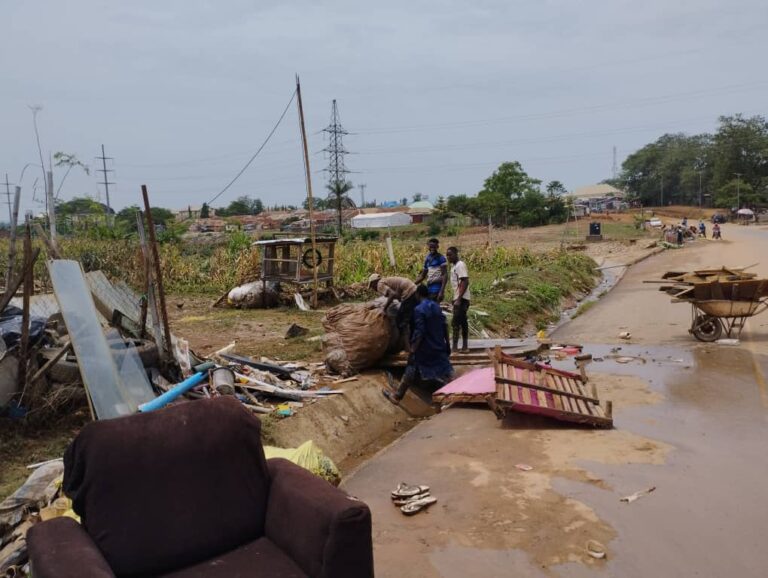
HOUSES and farmlands have been submerged following a flash flood in Yangoji, a community in the Kwali Local Government Area of the Federal Capital Territory (FCT).

The flash flood occurred Tuesday morning after heavy rainfall that lasted hours.

It was gathered that the second lane of the Abuja-Lokoja highway was also affected by the flood.

The residents struggled to save some of their belongings as the flood submerged several buildings and crumbled many others.

A resident, Saidu Ibrahim, said the flood was sudden and forceful, adding that it began shortly after the rainfall started.

“Before I realised what was happening, the entire compound had already been taken by flood until I managed to move my family to a neighbour’s place quickly,” he told Daily Trust.

The incident in Yangoji is coming a few days after flood overtook Trademore Estate along the airport road in Abuja.

Trademore was flooded last Friday, June 23, after a heavy downpour.

The flood submerged over 116 houses and caused the death of a certain Philip Azubuike, a lecturer in the Physics Department at the University of Technology in Yola, Adamawa State.

Tuesday’s flooding is not the first flood incident in Kwali Local Government Area. Last year, flood affected the area and washed away parts of the bridge that links Tungan-Sarki–Dafa-Yangoji.

The incident cut off about 16 communities that rely on the bridge for their day-to-day activities.

Several factors are responsible for flooding in Nigeria, including heavy rainfall, poor drainage systems, blocked waterways, and deforestation.

Climate change has also contributed to the frequency and intensity of flooding in the country.

FCTA investigates collapse of Abuja building

0

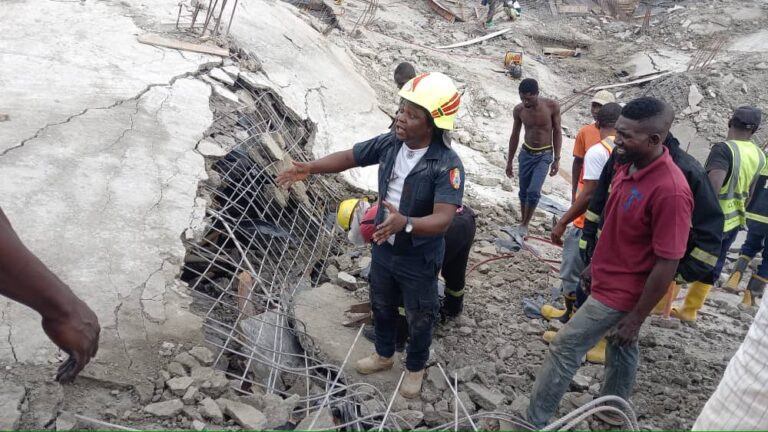
THE Federal Capital Territory Administration (FCTA) has ordered an investigation to unravel the remote and immediate causes of the collapse of a building in Abuja on Monday, July 3.

According to a statement by the Director of Press Anthony Ogunleye on Tuesday, July 4, FCTA Permanent Secretary Olusade Adesola ordered the investigation during a visit to the site of the collapsed building.

Adesola said a technical committee would be set up, headed by Executive Secretary Federal Capital Development Authority (FCDA) Shehu Ahmad, to determine reasons behind the collapse and establish culpability.

He revealed that the developers had been ordered to stop working on the site, but they ignored the directive.

“The collapse of this building affirms the fact that when you ignore professional advice, it has a repercussion, and this is what is evident. We were just informed that instructions and notices were served to stop work. Even the consultant on site advised that no further work should be done on this site, but it was ignored.

“These are preliminary information being provided to us. Going forward, we have to really go to the root of it to know what happened. Until further investigation is concluded, the site is permanently closed. A caveat will be placed on the plot so that some efforts are not made, either by way of sale or any other transactions,” the Permanent Secretary said.

He added that those found culpable for the collapse of the building would be adequately sanctioned.

The ICIR reported that nine persons were rescued when the building which is still under construction collapsed on Monday, July 3.


READ ALSO:


With building collapse becoming a recurring incident in the FCT, President of the Nigerian Institute of Building Yohana Izam blamed under-regulation of the sector for the development.

“The absence of baseline regulations such as the National Building Code is indeed a monumental scandal. The world over, the building industry is regulated by a set of consistent minimum standards for the siting, design, construction, and post-construction phases of a building.

“There must always be in existence virile physical planning laws to control development while building regulations, as in the UK or Codes as in the US, deal with key issues of standards,” Izam said.

Fake UTME result: We’ve concluded investigations — JAMB registrar

0

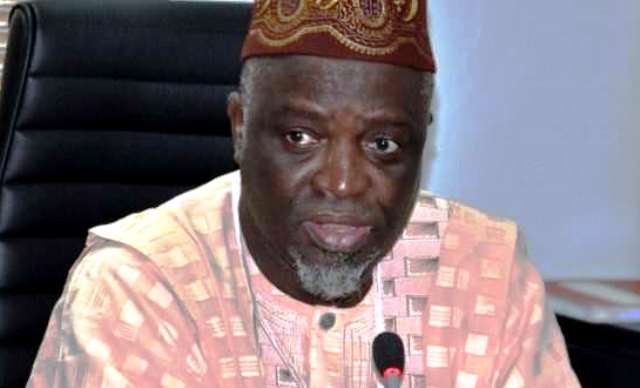
REGISTRAR of the Joint Admissions Matriculations Board (JAMB) Is-haq Oloyede on Tuesday, July 4, disclosed that investigations into the alleged falsification of results by Mmesoma Ejikeme had been concluded.

According to a report, Is-haq said the Board also identified other candidates who falsified their Unified Tertiary Matriculation Examination (UTME) results as well.

“Presently, there is an industry faking results, and unfortunately, they cannot penetrate JAMB system, reasons being that (our) system is foolproofed, and we will prove it any time. It is unfortunate that parents and some of the candidates that are being fooled are not aware that they are only being fooled.

“There is internal evidence to show that the change in Ejikeme’s scores was done with her collaboration. There are certain features pertaining to her that only her knows unless she makes it available to somebody else. They couldn’t have increased her scores on her behalf,” Oloyede said.

The registrar further disclosed that he had discussed with former minister of education Oby Ezekwesili over the issue and described the result as a careless case of forgery.

Ezekwesili had reacted to a video released by Ejikeme on Monday, July 3 and called for an independent forensic investigation into the result.

Ejikeme had been celebrated for emerging as the overall best candidate for the 2023 UTME. However, JAMB disputed the result and described it as inflated.

The examination body said Ejikeme originally scored 249 and manipulated the result to secure scholarships fraudulently.

Nigerian automobile manufacturer Innoson Motors awarded Ejikeme a N3 million scholarship but threatened to withdraw it if she was found guilty.

Despite the allegations, Ejikeme insisted in a video Monday that she printed the result being described as manipulated directly from the JAMB portal.

“This is my aggregate, 362. This is exactly how I printed it out and downloaded from that site. So they now saying that I forged my result, is what I don’t know, and I’m traumatised that they accused me of forging my own result. I am not capable of this,” she said, holding up a copy of the printed result sheet,” she said.

Meanwhile, a statement by JAMB Public Relations Officer (PRO) Fabian Benjamin disclosed that Ejikeme has been barred from taking the examination for three years.

Threads: Meta set to new launch app to rival Twitter

META is set to launch a new app to rival Twitter.

The new social media platform, to be known as ‘Threads’, will go live on Thursday July 6.

Threads is accessible for pre-order on the Apple App Store, which will be linked to Instagram.

The app shares some similarities to Twitter but Meta describes Threads as a “text based conversation app”.


“Threads is where communities come together to discuss everything from the topics you care about today to what’ll be trending tomorrow,” the description of the new platform on the App Store read.

The development is the latest in the rivalry between Meta boss Mark Zuckerberg and Twitter owner Elon Musk.

Meanwhile, Twitter has said that the popular user dashboard, TweetDeck, will go behind a paywall in 30 days time.

The move is the latest push by Musk as he tries to get users to sign up to Twitter’s subscription service, Twitter Blue.

The previous Saturday, the business mogul restricted the number of tweets users could see, specifying extreme “data scraping”.

Furthermore, it seems Meta’s Threads app will be a service free – and no restrictions on how many posts a user can view. Formally a Meta app, Threads will also hoover up data on your phone, including location data, purchases and browsing history.

Meanwhile, there have also been similar apps that have remarkable resemblance to Twitter in recent times – such as Donald Trump’s Truth Social and Mastodon. Bluesky, another similar app claimed to have seen “record” traffic after Musk’s move to restrict usage at the weekend.

However, Zuckerberg’s Threads could be the biggest threat faced by Twitter to date.

INEC closes defence against Obi’s petition with one witness

THE Independent National Electoral Commission (INEC) has closed its defence against the petition filed by Labour Party (LP) candidate, Peter Obi, at the Presidential Election Petition Court.

INEC counsel, Abubakar Mahmoud, a Senior Advocate of Nigeria (SAN), said the Commission has closed it’s case after adopting the written statement of the sole witness, Lawrence Bayode, during the proceedings on Tuesday, July 4.

Bayode is INEC’s Director of Information Technology (IT).

Mahmoud tendered the cloud trail log report and certification as evidence. The court admitted the documents as exhibits and considered them to be read and demonstrated before the court.

Under cross-examination by Wole Olanipekun (SAN), counsel to Tinubu and Shettima, the witness agreed that the foundation of any election conducted by INEC is the results recorded in Forms EC8As. He also agreed that blurred results downloaded from INEC’s I-ReV would not affect the results recorded in Form EC8As.

The witness further confirmed that the e-Naira, launched in October 2021, has not been activated due to technological issues. He agreed that the e-Naira app had to be temporarily removed from the Google Play store to fix glitches shortly after its launch.

The witness stated that elections were practically concluded at the polling unit when the presiding officers input election results into Form EC8As, announce the results openly to all parties and their agents, sign the forms, and use the Biomodal Voters Accreditation System (BVAS) machine to capture the forms.

Responding to questions from the counsel to the All Progressives Congress (APC), Lateef Fagbemi (SAN), the witness clarified that INEC used the physical results in Forms EC8As to compute the results of the presidential election. He emphasised that any glitches experienced during the election did not impact the collation of results, and if necessary, the required information could be retrieved from the physical results.

During cross-examination by counsel to Obi, Patrick Ikwueto (SAN), Bayode agreed that the e-transmission application underwent testing on February 4, 2023, before being deployed for use in the presidential election. Ikwueto presented the test report as evidence, which the court admitted as an exhibit.

The witness concurred with Ikwueto that the report of the e-transmission application outlined remediation measures to address the identified vulnerabilities.

However, objections to the document’s admissibility were raised by Tinubu, Shettima, and the APC, with promises to provide reasons for the objection at a later stage.

The Tribunal presided over by Haruna Tsammani, subsequently adjourned proceedings to Wednesday, July 5, for Tinubu and Shettima to open their defence against the petition filed by Obi.

Obi is challenging the outcome of the February 25 presidential election.

INEC had declared Tinubu as the winner of the February 25 presidential election.

According to INEC, Tinubu secured 8,794,726 votes to come first, Atiku Abubakar of the Peoples Democratic Party (PDP) finished second with 6,984,520, while Obi polled 6,101,533 to come third.

Displeased with the results, Obi and his party filed a petition at the court to challenge Tinubu’s victory.

In their petition, Obi and the LP argued that when Tinubu’s running mate, Kashim Shettima, became the vice presidential candidate, he was still nominated as the APC candidate for the Borno Central Senatorial election.

They also challenged Tinubu’s eligibility, alleging that he was previously indicted and fined $460,000.00 by a United States District Court for an offence involving dishonesty and drug trafficking.

Obi claimed that the election was invalid due to corrupt practices and non-compliance with the provisions of the Electoral Act 2022.

He argued that INEC breached its regulations and guidelines by not prescribing and deploying technological devices for voter accreditation, verification, continuation, and authentication as required.

The petitioner sought a declaration from the court that Tinubu was not qualified to contest the election and that all votes recorded for him were wasted.

He also requested the court to determine that he received a majority of lawful votes and satisfied constitutional requirements to be declared the winner.

In the alternative, he called for the cancellation of the election and the conduct of a fresh election in which Tinubu, Shettima, and the APC would not participate.

Bamidele, Mwadkwon emerge Senate leaders

PRINCIPAL officers of the 10th Senate emerged on Tuesday, June 4 as Opeyemi Bamidele and Simon Mwadkwon were named Senate leaders.

Bamidele, of the All Progressives Congress (APC) representing Ekiti Central, emerged Senate Majority Leader after a close-door meeting presided by Senate President Godswill Akpabío, while Mwadkwon, Peoples Democratic Party (PDP), Plateau North, was named Minority Leader.

In the same vein, Ali Ndume (APC, Borno South), was announced as Chief Whip of the Senate.

Akpabio said the principal officers emerged through consensus.

The Senate President also announced Dave Umahi (APC, Ebonyi South) as the Deputy Majority Leader and Lola Ashiru (APC, Kwara South) as the Deputy Whip.

Bamidele, born on July 29, 1963, is a lawyer and was a member of the 7th, 8th and 9th Senates.

Akpabio also announced the Minority Leader of the Senate.

“The Minority Caucus of the Senate is made up of about seven political parties and have come up with their leadership so I will proceed to announce [the names],” Akpabio said.

“Senator Simon Mwadkwon, Minority Leader; Oyewumi Olalere, Deputy Minority Leader; Darlington Nwokocha, Minority Whip; and Rufai Anga, Deputy Minority Whip,” Akpabio said.

The 10th National Assembly was inaugurated on, June 13, and The ICIR reported how Akpabio, representing North-West emerged as the Senate President.

He got 63 votes out of the 109 total ballots cast to defeat the former Zamfara state governor Abdulaziz Yari, who had 46 total votes.

APC has 59 seats in the 10th Senate; PDP 36, and Labour Party, 8.

The New Nigeria Peoples Party (NNPP) and the Social Democratic Party have two members each, while the All Progressives Grand Alliance (APGA) and the Young Peoples Progressive Party (YPPP) have one member each.

Fake UTME result: JAMB bars student for three years

0

THE Joint Admissions and Matriculations Board (JAMB) has barred a student accused of faking her Unified Tertiary Matriculations Examination (UTME) score Mmesoma Ejikeme, from taking the examination for three years.

In a statement on Tuesday, July 4, JAMB spokesperson Fabian Benjamin restated the organisation’s position that Ejikeme’s result was forged.

“Consequently, the Board would like to reassure Nigerians that its system was neither tampered with nor compromised as the candidate simply falsified a copy of a result slip of a candidate named ‘Asimiyu Mariam Omobolanle,’ who sat the UTME in 2021 and scored 138.

“It is also instructive to note that the candidate, in her statement, has inadvertently revealed the rightful owner of the result she is parading when she pointed out that the QR code on the result slip showed the actual owner of the said result before she peddled a lie in an attempt to obfuscate the truth,” Benjamin said.

He also noted that JAMB had stopped issuing Notification of Result slips since 2021 as a result of previous cases of forgery in the past.

“Consequently, the Board has been issuing actual UTME RESULT Slips (not notification of results ) since 2022 complete with the photograph of each candidate,” he said.

In a separate interview, Benjamin challenged other students who claim to have had similar experiences to present evidence, adding that JAMB would pay the sum of N1 million if found wanting.

“I want to assure you, and I am saying it here on air, if you have any candidate who claimed that he had checked his result and he had something higher than what he saw later, bring the candidate; and if we cannot prove otherwise, on behalf of the Board, we are going to give you one million naira to cover your cost of coming and everything,” he said.

Ejikeme, had been celebrated for emerging as the overall best candidate for the 2023 UTME.

JAMB disputed Ejikeme’s result a few days later, describing it as falsified.

In an earlier statement released on Sunday, July 2, the examination body announced that Ejikeme originally scored 249 and manipulated the result to secure scholarships fraudulently.

Nigerian automobile manufacturer Innoson Motors awarded Ejikeme a N3 million scholarship but threatened to withdraw it if she was found guilty.

Diphtheria outbreak confirmed in FCT, one death recorded

0

THE Federal Capital Territory (FCT) Primary Healthcare Board said it has confirmed the outbreak of diphtheria disease in the city following the death of a patient.

The Director Public Health, Dr Saddiq Abdulrahman disclosed this on Monday, July 4, at a media briefing in Abuja.

Diphtheria, according to the Nigeria Centre for Disease Control (NCDC), is a serious bacterial infection caused by the bacterium called Corynebacterium species that affects the nose, throat and, sometimes, skin of an individual.

The disease has already been reported in some states such as Kano, Lagos, Osun and Yobe.

The NCDC attributed the outbreak and the high fatality rate to delays in diagnosis and the absence of diphtheria antitoxin during the early stage of the outbreak.

Meanwhile, the outbreak which had already killed a four years old child in Abuja, prompted swift action as an emergency operation centre has been activated to tackle the outbreak, according to Abdulrahman.

Abdulrahman said the FCT health authorities recorded eight suspected cases and after tests, only one of the cases came positive. He added that community awareness is currently ongoing to mitigate the spread.

“We had one four year-old child that died out of the eight suspected cases that we took the sample to the NCDC general lab which has the capacity to diagnose. 

“Out of that eight only one came positive and one also died. However, the community awareness is already ongoing alongside our partners to strengthen the contact traces of all these cases and mapping the community, specifically the communities at Dei Dei.”

He further called on FCT residents to report any strange symptoms, particularly respiratory challenges to relevant authorities.

Similarly, the Executive Secretary, FCT Primary Health Care Board, Dr. Yahaya Vatsa, said there are over 400 facilities in the FCT where residents can get vaccinated, stressing that vaccine reduces the risk of contracting the disease. 

“The vaccines are available in virtually over 400 facilities in FCT and these facilities are not very far from the communities and individuals. So usually we urge people to actually go to these facilities and get vaccinated.”

Vatsa advised residents to ensure that their children were fully vaccinated, in line with the National Childhood Immunisation Schedule.

“To reduce the risk of contracting the disease, FCT residents are hereby advised to ensure that their children are fully vaccinated with three doses of the pentavalent vaccine. This is recommended in the National Childhood Immunisation Schedule,” he said.

He, however, emphasised the importance for individuals experiencing any of the signs and symptoms to seclude themselves and inform either the FCT Disease Surveillance Notification Officer or the Emergency Operation Center by utilising the toll-free lines provided at the FCT Call Center.

The ICIR had on May 11, reported how advocacy through community leaders and improvement in epidemic preparedness are mitigating the spread of the disease in some Kano communities.

The report detailed how the disease has spread across five local government areas in Kano state, namely, Ndala, Gwale, Ungogo, Nasarawa and Tarauni, resulting in the loss of at least 61 lives while hundreds of residents were admitted to hospitals. 

Data from NCDC showed that 783 patients were on admission, of which 360 were females and 423 were males, as of March 2, 2023.

While the factors for this may also be attributed to low vaccination across the country, Kano State is, however, an exception, according to sources and authorities who spoke to The ICIR, they recorded significant progress in vaccination since the outbreak this year.

Some residents of these communities who spoke to The ICIR said that advocacy and house-to-house immunisation efforts by the Kano State Government helps in mitigating the spread of diphtheria in the state.

The NCDC, has also explained that people most at risk of contracting diphtheria are children and adults who have not received any or a single dose of the pentavalent vaccine (a diphtheria toxoid-containing vaccine) and people who live in a crowded environment.

Also, people who live in areas with poor sanitation, healthcare workers and others who are exposed to suspected/confirmed cases of diphtheria can easily contact the disease.

The Centre stressed that the disease spreads easily between people through; direct contact with infected people, droplets from coughing or sneezing and contact with contaminated clothing and objects.

Vehicle owners have government’s proof of ownership, renewal unnecessary – PwC Tax Leader

FISCAL Policy Partner and Africa Tax Leader at Pricewaterhousecoopers International (PwC), Taiwo Oyedele, has described renewal of vehicle ownership, as now being demanded by the Federal government, as “unnecessary.”

To Oyedele, the vehicle renewal demand is a regressive tax model since vehicle owners already possess government-issued proof of ownership.

The Federal government has directed that with effect from July 1, 2023, vehicle owners must renew proof of vehicle ownership annually with the sum of N1,000.

But the PwC tax expert said, “Apart from the payment which seems to be solely for revenue generation, and more for non-state actors than for the government, it is illogical for people to have to prove annually that they own a vehicle for which they already have a certificate of proof of ownership issued by the government.”

Oyedele, quoting the National Bureau of Statistics (NBS) on Sunday, July 2 in a statement he issued through his official Twitter handle @taiwooyedele, stated, “There are about 12 million vehicles in Nigeria. If we assume that everyone complies and pays to the government, the tax will generate gross receipts of N12 billion annually, before taking into account the likely high cost of collection and possible leakages, in addition to the unquantifiable time, cost, and burden of compliance by vehicle owners.”

Oyedele saw the introduction of the renewal policy as setting a bad precedent for more regressive taxes in Nigeria.

The new fee is an additional charge, besides payment for vehicle particulars and registration.

The PwC top shot regarded it as “insensitive” for the government to introduce additional taxes while Nigerians are still grappling with the devastating impact of fuel subsidy removal.

Oyedele described the introduction of the vehicle renewal tax as “retrogressive, ill-conceived, and poorly designed.”

He noted that the tax also added complications to the myriad of multiple taxes, which he said made doing business in Nigeria difficult, and had dampened tax morale.

He said, “While this tax will not necessarily stop the earth from rotating, it is wrong both in terms of signalling from a multiple taxation perspective and in terms of timing, given the recent fuel subsidy removal.

“To be sensitive and demonstrate empathy, the government should not impose any new or higher taxes on transportation, energy, or food, which are the most impacted by the subsidy removal. The same reasons why the recent attempt to collect VAT on diesel needs to be reconsidered.

“The tax should be set aside in the interest of good order and to prevent setting a bad precedent. Who says we cannot be asked to also renew our birth certificates, C of O, etc. on an annual basis if this succeeds?”