THE National Agency for Food and Drug Administration and Control (NAFDAC) has commenced enforcement of ban on the production and sale of alcoholic beverages packaged in sachets and small PET or glass bottles below 200 milliliters.
A statement by the organisation on Thursday, January 29, stated that the enforcement was supported by the Federal Ministry of Health and Social Welfare.
NAFDAC said the action targeted only two product categories, spirit drinks sold in sachets and in bottles smaller than 200ml and did not involve shutting down alcohol-producing companies or banning alcohol consumption.
It also noted that products packaged in larger volumes remained permitted for production and sale.
“The widespread availability, low cost, and ease of concealment of alcohol in sachets and small containers have contributed to underage access, misuse, and addiction, with associated social consequences including road accidents, school dropouts, and other social vices,” the agency stated.
Policy revived after suspension
The current enforcement followed weeks of uncertainty after the Federal Government had ordered a temporary halt to the ban pending consultations with stakeholders.
The Senate on November 6, 2025, directed the regulatory body to strictly enforce the ban on the packaging of high-strength alcoholic beverages in sachet formats beginning December 2025.
The lawmakers further stressed that no additional extension should be granted beyond the moratorium.
However, the Federal Government directive in December seemed to have stalled the implementation despite NAFDAC announcing on November 11, 2025, that it would proceed with a total ban by December.
On December 16, the Nigeria government ordered an immediate pause on all enforcement measures connected to the proposed ban, pending the completion of stakeholder consultations and the issuance of a final policy directive.
The directive was conveyed through the Office of the Secretary to the Government of the Federation (OSGF) after concerns were raised by the House of Representatives Committee on Food and Drugs Administration and Control.
It further said any enforcement without approval from the Office of the Secretary to the Government of the Federation would be invalid until a formal decision is issued.
Meanwhile, on January 21, NAFDAC announced that it had received a matching order from the Senate to proceed with the enforcement of the ban.
According to the agency, the renewed action aligns with its public health mandate, particularly the protection of children, adolescents and young adults.
“We already started the enforcement to ban alcohol production in sachets and bottles below 200ml, after we received the order from the Senate.
“NAFDAC is not against alcohol, but we are against its proliferation in high concentrations in sachets and small bottles to prevent children from having easy access to it,” Adeyeye added.
Root of the ban
The policy traces its origin to December 2018, when NAFDAC, the Federal Ministry of Health and the Federal Competition and Consumer Protection Commission signed a Memorandum of Understanding with industry groups to phase out sachet and small-volume alcohol packaging.
Under that agreement, manufacturers were given five years until January 31, 2024, to exhaust existing stock and reconfigure production lines, according to NAFDAC.
The deadline was later extended to December 2025, following appeals from industry players who cited the scale of investment involved and the risk to jobs.
Announcing the latest enforcement plan, NAFDAC maintained that the “current enforcement aligns with that agreement and with Nigeria’s commitment to the World Health Assembly Global Strategy to Reduce the Harmful Use of Alcohol.”
Industry protests
The ICIR reports that the renewed enforcement has triggered protests, particularly in Lagos State, where workers in the food, beverage and tobacco sector staged demonstrations at NAFDAC’s office in Isolo.
Members of the Food, Beverages and Tobacco Senior Staff Association and the National Union of Food, Beverages and Tobacco Employees, on January 27, protested in Lagos, arguing that the ban threatened livelihoods across the value chain.
Union leaders estimated that up to one million jobs could be affected, warning that some workers had already been laid off and might not receive salaries.
They disputed claims that sachet alcohol fueled underage drinking, insisting there was no publicly available data linking the packaging format directly to its consumption by youth.
Addressing the press, the National President of the Food, Beverages and Tobacco Senior Staff Association, Oyibo Jimoh, argued that sachet alcohol is easier to regulate because manufacturers are known and licensed, unlike illicit or counterfeit products that could fill the market vacuum if regulated products disappear.
Manufacturers fault regulator
The Manufacturers Association of Nigeria (MAN) has also criticised the enforcement, describing it as harmful to indigenous producers and inconsistent with earlier government directives.
MAN in a statement on Tuesday, January 27, contended that NAFDAC’s actions contradicted instructions previously issued by the Office of the Secretary to the Government of the Federation and resolutions of the House of Representatives, which had urged restraint pending further stakeholder engagement.
The association further argued that small-size alcohol packaging was introduced to serve adult consumers with limited purchasing power and that removing this option would restrict consumer choice. MAN also warned that the ban could encourage the circulation of unregulated and unsafe alcoholic products.
NOMINATIONS are now open for the UNESCO/Guillermo Cano World Press Freedom Prize.
Member States as well as international and regional professional and non-governmental organisations working in the field of journalism and freedom of expression may nominate up to three candidates for the Prize.
Created in 1997, the annual UNESCO/Guillermo Cano World Press Freedom Prize will honour a person, organisation or institution that has made an outstanding contribution to the defence and/or promotion of press freedom anywhere in the world, and especially when this has been achieved in the face of danger.
Organiser says, “The Prize was established on the initiative of UNESCO’s Executive Board and is formally conferred by UNESCO, on the occasion of World Press Freedom Day, on 3 May.
“It is named in honour of Guillermo Cano Isaza, a Colombian journalist who was assassinated in front of the offices of his newspaper El Espectador in Bogotá, Colombia on 17 December 1986”.
Interested applicants can apply here. Entries close on February 15, 2026.
THE Nigerian government allocates over N16 billion for energy-related projects and maintenance at the State House, including N7 billion for a solar mini-grid and nearly N2 billion for diesel fuel in its 2026 proposed budget.
Documents show that alongside the planned solar project, the government will continue to fund diesel generators and electricity payments to the Abuja Electricity Distribution Company (AEDC).
The President Bola Tinubu administration set aside N1.99 billion on plant/generator fuel cost in the budget proposal.
It further budgeted N8.35 billion for line items, including the AEDC, Sid/liquid waste disposal, Julius Berger liabilities, and other maintenance liabilities ‘owed as from 2022 till date.’
The allocations are from the N58.18 trillion appropriation bill for the 2026 financial year.
The spending pattern at the State House follows a similar trend from last year, when the 2025 budget included N10 billion for solarisation of the Villa.
At that time, the allocation was part of a the N57 billion operational budget for the State House, which also included conventional energy costs of over N300 million.
Historically, the Presidential Villa has received substantial allocations for energy projects. The 2025 mini-grid project, according to the Presidency, was an attempt to reduce reliance on the national grid and operational spending on diesel and electricity.
It also noted that it was part of efforts to reduce the cost of governance and promote cleaner, more sustainable energy use.
Meanwhile, the 2026 budget shows a continuation of this dual funding to solar and grid electricity.
Nigeria in darkness
Against this backdrop, The ICIR reports that Nigeria has continued to grapple with the worsening power outages, as the national grid already fell two times in 2026.
Just as in 2025, where it experienced repeated collapses, plunging homes, hospitals, small businesses, and entire communities into darkness, the national grid experienced its first collapse this year on January 23.
A check on the website of the Nigerian Independent System Operator (NISO) also showed that all the Discos had no allocated supply on January 27, as of 11. am, consequently marking its second collapse.
Electricity generation dropped sharply from over 4,500 megawatts to as low as 0 megawatts as of 11 am on Tuesday.
Checks showed that all 23 power generation plants connected to the grid lost output during the incident, resulting in zero power allocation to power distribution companies.
Grid collapses have largely been attributed to a combination of technical faults, including inadequate maintenance of transmission lines, and fluctuations in generation capacity.
Across the country, residents have increasingly turned to small solar panels to power their bulbs due to the unreliable public power, and the soaring fuel prices.
Nigeria Police officers on Wednesday, January 28, reportedly opened fire and teargassed residents protesting ongoing evictions and demolitions in parts of Lagos State.
The protesters, many of whom said they had lost homes and businesses to recent demolition exercises in locations including Makoko and Oworonshoki had marched to the State House of Assembly Complex to demand legislative intervention and a halt to further evictions.
Tensions escalated shortly after the crowd converged on the complex, with police shooting and teargassing journalists and protesters.
It was not immediately clear whether there were arrests, but viral videos published by Punch and other media organisations showed injured persons running for cover as clouds of tear gas fired by police officers enveloped the area.
Some protesters were seen coughing and seeking refuge in safe places.
Premium Times also reported that the police, in their bid to disperse the crowd, opened fire on the protesters and journalists covering the demonstration.
In the aftermath of the incident, several people sustained varying degrees of injuries.
Several videos recorded before the incident showed that the protest was peaceful, with aggrieved residents calling on Lagos authorities to resolve the crisis and heed their demands.
The Lagos State Police Command had yet to issue an official statement at the time of filing this report, and efforts to reach the command’s spokesperson proved abortive as of press time.
The ICIR reports that the protest followed demolition exercises carried out in Makoko in recent weeks, which residents said were conducted without due process or resettlement plans.
While the government said the exercise was part of a wider plan to redevelop waterfront areas and increase revenue from coastal assets, affected residents have accused authorities of ignoring court orders and calls for dialogue.
Makoko has long been a flashpoint for forced evictions and government-led demolitions, a pattern that stretches back to over a decade, with its first encounter in April 2005, followed by July 2012, when armed police dismantled parts of the stilt community after a 72-hour notice.
Reacting to the demolition, Human Rights and Environmental Justiceorganisation said armed security personnel, demolition teams and “armed thugs” have repeatedly invaded Makoko since January 5, 2026, pulling down homes, setting some structures ablaze, and firing tear gas at residents, including women, children and elderly persons. It said at least three people, including two infants, have died in connection with the demolitions.
Trends
Meanwhile, Wednesday’s incident adds to a growing list of protests since 2024 that have been met with police use of tear gas and force across the country.
In Lagos, past protests over housing, cost-of-living, and governance issues have frequently drawn heavy police presence, and attacks on peaceful protesters.
Although there is no official central record tracking every instance of tear gas use nationwide, reports by media organisations and rights groups show a recurring pattern of police crowd control involving the use of tear gas, arrests and, in some cases, live ammunition.
At the fourth anniversary memorial of the 2020 #EndSARS protests, police dispersed peaceful participants at the Lekki Tollgate with tear gas.
The ICIR reports that during nationwide protests against rising living costs and governance failures tagged #EndBadGovernance# in 2024, police deployed tear gas across several cities, including Abuja, Kano, Lagos and other state capitals.
Amnesty International reported that at least 24 protesters were killed during the crackdown, with many others injured or suffocated by tear gas, and more than 1,200 detained.
Also, in the Federal Capital Territory, police fired tear gas to disperse protesters demanding improved good governance and accountability from authorities. The police officers also teargassed and fired bullets at journalists covering the protest.
In October 2025, the Nigerian police fired tear gas near the Transcorp Hilton in Abuja as protesters gathered to demand the release of Nnamdi Kanu.
Similarly in December 2025, police teargassedmembers of the Coalition of Indigenous FCT Contractors who were protesting an alleged unpaid debt of N5.2 billion owed them by the Federal Capital Territory Administration (FCTA).
DEPUTY Chief Minister, Maharashtra State in India, Ajit Anantrao Pawar, and four others died in a plane crash on Wednesday, January 28.
The disaster occurred after a charter aircraft conveying them crash-landed near Baramati Airport in Pune district in the early hours.
Officials said the Learjet 45 aircraft, registered VT‑SSK, had visibility crisis while attempting to land, consequently crashing and exploding in flames. All five people on board, including Pawar, his two aides, and two pilots were killed as ball fires rolled in waves and smokes billowed at the scene of the tragedy.
A statement from the Directorate General of Civil Aviation said, “no person on board has survived the crash.”
Reports indicated that up to 242 people were onboard, and the aircraft crashed in a residential area. According to the flight tracking website FlightRadar, the ill-fated aircraft was a Boeing 787-8 Dreamliner with registration VT-ANB.
Prime Minister Narendra Modi mourned Pawar’s death in an official post on X, saying: “Shri Ajit Pawar Ji was a leader of the people, having a strong grassroots level connect. He was widely respected as a hardworking personality at the forefront of serving the people of Maharashtra. His understanding of administrative matters and passion for empowering the poor and downtrodden were also noteworthy. His untimely demise is very shocking and saddening. Condolences to his family and countless admirers. Om Shanti.”
Maharashtra Chief Minister Devendra Fadnavis announced a three‑day state mourning period, with flags at half‑mast and official events paused as a mark of respect.
Deputy Chief Minister Eknath Shinde described the accident as “a very painful incident… very sad and unfortunate for Maharashtra” and confirmed that authorities had launched a full investigation into the crash.
PUBLIC primary schools in Nigeria’s Federal Capital Territory (FCT) have faced prolonged disruptions since 2023, as repeated strike actions by teachers kept classrooms closed for a cumulative period of at least 165 days.
The disruptions, which occurred across four major industrial actions between September 2023 and July 2025, were led by the Nigeria Union of Teachers (NUT), FCT chapter, and primarily affected public primary schools.
Until the most recent action, the strikes were largely triggered by unresolved welfare issues, including the non-payment of about 60 per cent of 25-month minimum wage arrears. Others are the non-implementation of approved 25 per cent and 35 per cent salary increases, as well as the non-payment of a 40 per cent peculiar allowance.
The union also demanded the payment of ₦35,000 wage award arrears and the full implementation of a template on outstanding teachers’ entitlements reached in negotiations with the government in 2022.
Union leaders repeatedly expressed frustration that agreements were reached during negotiations but were not fully implemented, leaving primary school teachers perennially hopeful.
The cumulative disruption has affected academic calendars, delayed syllabi, and forced some parents to withdraw their wards and enroll them in private schools, where they pay exorbitant tuition fees. The strikes also worsen out-of-school children crisis in Nigeria, with nearly 20 million children unable to enjoy formal education.
In the most recent development, the dispute has expanded beyond primary schools, with secondary schools joining the industrial action after the NUT aligned with the Joint Union Action Congress (JUAC) in its dispute with the Federal Capital Territory Administration (FCTA).
The JUAC directed the shutdown of both primary and secondary schools, according to a communiqué signed by the FCT NUT Chairman, Abdullahi Shafas; Secretary, Margaret Jethro; and Publicity Secretary, Ibukun Adekeye.
Timeline of teachers strikes under Wike’s watch
The first strike under Wike’s began on September 11, 2023, when primary school teachers embarked on an indefinite industrial action over the non-payment of 25 months’ minimum wage arrears, 40 per cent peculiar allowance, and other entitlements.
The union suspended the strike on October 2, 2023, after assurances that the issues would be resolved within six weeks.
Speaking on the suspension, the NUT chairman, Stephen Knabayi, said the decision followed an agreement reached between the union and chairmen of the six Area Councils, after Wike’s intervention.
However, the teachers resumed the strike on January 15, 2024. They described it as a continuation of the earlier action because the government allegedly failed to keep its words. The strike lasted until January 29, 2024, when they returned to classrooms following renewed negotiations.
About a year later, on September 18, 2024, the union again downed tools over unresolved welfare issues, including unpaid arrears and allowances. The action was described as a continuation of the earlier strikes.
That action was suspended on October 8, 2024, allowing schools to reopen after roughly three weeks of closure.
The most prolonged disruption began on March 24, 2025, when teachers embarked on a fresh strike over the non-implementation of the new national minimum wage, alongside outstanding arrears and other benefits. The strike lasted for more than three months and was suspended on July 9, 2025, following the release of funds to partially settle the teachers’ demands.
Across the four strikes, public primary schools in the FCT were closed for approximately 162 to 165 days.
Consequently, public primary schools in the nation’s capital have lost nearly an academic year to strikes under the minister.
However, with the ongoing JUAC-led strike, which the NUT has joined, public schools in the FCT have now been shut at least five times under Wike.
Workers’ struggle
The ICIR reports that while primary school teachers in the FCT are employed and paid by the six Area Councils, the FCT Administration has been repeatedly criticised for failing to prevent recurring strikes that have disrupted education in the nation’s capital.
Throughout the disputes, Wike has maintained that primary education falls under the jurisdiction of the Area Councils. In April 2024, the minister blamed the council chairmen for failing to pay teachers despite receiving statutory allocations.
He subsequently approved the release of funds, sourced from 10 per cent of six months’ Internally Generated Revenue (IGR) of the Area Councils, to offset wage arrears. The move led to the suspension of the strike.
However, with the ongoing JUAC action now affecting both primary and secondary schools, there have been more concerns over further disruptions to public education in the nation’s capital.
The strikes have also coincided with similar actions by other Area Council workers, including primary healthcare staff and other FCTA workers.
Critics also highlighted Wike’s recent 17-day visit to Rivers State, where he abandoned his constitutional duties in Abuja to tour his state’s 23 local government areas preparatory the 2027 general elections.
The former Rivers State governor described his tour as a “thank-you” visit, while also drumming support for President Bola Tinubu’s re-election.
He used the period to take aim at the state Governor Fubara has been at loggerheads with him.
Fubara, Wike’s successor and godson, who is currently facing renewed impeachment case with the Rivers State Assembly, has abandoned Wike in his Peoples’ Democratic Party (PDP) and defected to the ruling All Progressives Congress (APC), where is serving. Recall that President Bola Tinubu had appointed Wike, one of the PDP main leaders as minister shortly after he assumed office in May 2023. The minister has remained a member of the PDP, despite a legion of crises that have befallen it, with its members defecting to other political groups.
The Rivers State House of Assembly initiated the impeachment process against Fubara shortly after Wike accused the governor of reneging on the peace deal brokered by Tinubu.
During his tour, The ICIR reports that the FCTA workers issued a seven-day ultimatum over what they described as unresolved and long-standing labour and welfare issues.
The notice, issued by JUAC FCT, took effect on January 7, 2026. In a statement signed by its president, Rifkatu Iortyer, and secretary, Abdullahi Umar Saleh, the union warned that it would resort to strike action if the demands were not addressed.
The workers listed several grievances, including the failure to release approved overhead costs for six months in 2025, and the non-payment of five months’ wage award arrears.
They also cited alleged staff intimidation and harassment, restrictions on phone use among workers of the FCT Geographic Information System, and the non-payment of enforcement officers, street sweepers, and cleaners under the Abuja Environmental Protection Board and Satellite Town Development Department.
Allegation on the failure of Wike-led administration to pay Abuja sweepers came on the heel of multiple media reports, including those of The ICIR, which exposed the growing filth and stench in Nigeria’s capital under the minister’s supervision.
A CARPENTER and father in the Makoko area of Lagos State, Papa Eve Amossou, has alleged that his three-week-old daughter died during the ongoing demolition of the waterfront community by the state government.
Amossou said the tragedy occurred amid the chaos that trailed the enforcement of the demolition order by security operatives. According to him, police fired tear gas to disperse residents, and in the confusion, his wife, who was carrying their newborn, slipped into the lagoon.
he said symphatisers rescued both mother and child and rushed them to a nearby hospital, where medical personnel confirmed the baby had died.
“They started firing tear gas and people were running. My wife was holding our baby when she slipped and fell into the water. We took the child to the hospital, but they said she was already dead,” Amossou said.
He added that his workshop, which provided the family’s livelihood, was also destroyed during the exercise, leaving him without work.
The ICIR reported that the Lagos State government began demolishing parts of Makoko, a densely populated waterfront community along the Third Mainland Bridge, three weeks ago. Authorities said the exercise was part of a broader plan to redevelop waterfront areas and increase revenue from coastal assets.
Makoko has long been a flashpoint for forced evictions, with its first large-scale demolition in April 2005 and another in July 2012, when armed police dismantled parts of the stilt community after issuing a 72-hour notice.
The Lagos State government has defended the current demolition, emphasising safety concerns, particularly for structures built near high-tension power lines. Governor Babajide Sanwo-Olu said the exercise was necessary to prevent potential accidents. “Of what interest would it be for the government to demolish anyone’s structure if not for the overall safety of citizens?” he said.
The demolitions have disrupted lives beyond the alleged death of the carpenter’s child, with nursing mothers and infants rendered homeless and basic services, including immunisation services, negatively affected.
Political figures have criticised the demolition for its impact on livelihoods and residents’ rights, calling for more inclusive approaches to urban planning.
Residents continue to live under uncertainty as the demolition continues, with many struggling to rebuild their homes and livelihoods.
Protests are currently ongoing in parts of the state over the exercise.
THE battle for land in Niger State is no longer just between man and nature. It is now between farmers, herders, and miners, with women caught in the middle. From Paikoro to Gurara and Agaie, farmlands are being destroyed and livelihoods are being erased. This report highlights how the women who fed their communities now struggle to hold on to the land and to hope for themselves.
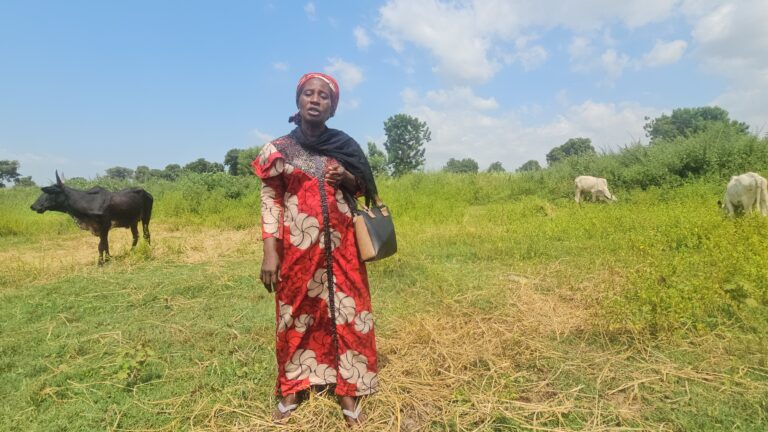
Every morning, Agnes Aynadanyi, a farmer in Daku village in Gurara Local Government Area (LGA) of Niger state, walks past deep holes carved into the earth where her millet once grew. She does not need anyone to tell her who dug them – gold miners who have invaded their lands.
Agnes, who started farming three years ago, had always enjoyed bountiful harvests despite challenges of accessing fertilisers and other farm inputs but she barely got 10 bags of guinea corn from her last planting season.
Agnes woman famer in Gurara Local Government Area
“When they came, they took no permission from anybody, they just started digging the corner there,” she said, standing near one of the pits and pointing to the edge of the farm.
“Before we knew anything, they started shifting, digging holes everywhere. When we asked them, they said they were looking for gold.
“There was a year, I harvested up to 50 bags of guinea corn, but last year, I did not get up to 10 bags because these days, if you plant, nothing grows here. The land is dead; Look at what I planted recently, corn. You can see that they did not grow very well. The land is gone because of these miners”, she lamented.
Comfort Joseph had to abandon her farm located at Dikko ward in Gurara LGA of Niger state and move to a farm along Lambatta Road which is still in the same local government but a long distance from the farm in Dikko ward in order to be able to farm properly and avoid the menace of the miners who had destroyed her farm.
“These miners have really driven many farmers around here out of their farms, me, particularly. It has drawn farmers back. They made me vacate the farm I have been tilling for years. I have to get another farm in another village, which is some kilometres away. The way they have affected the land, in 10 to 15 years, no one can farm there, and the crops will yield results. The farm I abandoned is where I farm maize, guinea corn and soyabeans, and it is very good for those crops”, she said.
The identity of the miners is currently unknown, some of the affected farmers said some of them come from far northern states like Zamfara, Kano and Kebbi while there are foreigners who come from Niger and Benin Republic who also join in the mining. In Niger State, the government policy passed a policy in 2024 banning mining across the state but this has not been heeded to as there are several mining activities happening across the state – mining is very rampant in Shiroro, Munya, Rafi, Paikoro, Gurara, Rijau.
There is usually enforcement team from the state Ministry of Mineral Resources who often go to these mining sites to enforce the no mining policy, but the enforcement train are limited by funding which makes the enforcement drive less frequent, giving room for the miners to operate without restriction.
Farming between fear and loss
Across Paikoro, Gurara, and Agaie, not only are the miners the only concern for women farmers, who are also losing their crops to herders who graze cattle through their fields.
“I planted cassava, I spent a lot of money on my cassava”, said Alice Amako in Agaie LGA, her voice rising with anger.
“The cows entered and ate everything. Nothing remained. The money I spent on it before it was wasted. I will say I spent up to N200,000. When I went to complain, the police said they would look into it, but till today, nothing.”
Sarah Mathew, another farmer in Agaie who plants rice and groundnut, lamented that the Fulani herders unleashed their cows to her farm when her crops had gotten to the stage of harvesting and she lost a lot of money, including the money she used in hiring labourers to help her.
Women farmers in Agaie
“One of my challenges is getting labourers to the farm, I cook for them and pay them. Then, when you plant, the Fulanis will not allow you to harvest what you have planted, even yesterday, they cut my crops for their cows to eat, whereas I have spent so much, they won’t even allow us farmers to harvest what we plant.”
In Paikoro, Hannah Bala says she no longer sleeps soundly during the harvest season.
“Sometimes, I go to the farm in the morning and see that my maize and groundnuts have been eaten up (by cattle) overnight. Last season, my groundnut and maize were all eaten; I couldn’t salvage anything. If you confront them, they threaten you. They carry sticks and cutlasses.”
The cost of silence
The women farmers say they have learned to avoid confrontation.
“It is better to run for your life,” said Comfort about the herders. “If you fight, they can harm you. They have killed people before.”
But running comes at a cost. Many have abandoned their ancestral farmlands and now rent new plots in faraway villages.
“I pay ₦100,000 every year for land,” said Ladi Makun, who farms rice and pumpkins in Paikoro LGA. “We women don’t get free land. If you don’t rent early, you won’t get anywhere to plant.”
But efforts made to dislodge the miners from their lands often prove abortive as they return days after they are driven away or arrested by security personnel. Others return at night when the farmers have gone home.
Women farmers-in Paikoro
“We sometimes use police and soldiers to pick them up, but after some days, they reemerge and continue from where they stopped before they were picked. We quarrel sometimes, but they have not fought anybody here in my land. They always come back despite everything we do”, said Agnes.
The combination of destroyed farms, expensive rent, and high input costs has left many women with little or no profit.
“Before I even start farming, I’m already in debt,” Ladi said quietly.
Mining the soil, killing the land
The miners’ presence is changing more than the landscape. The air smells of burnt earth, and rainwater collects in the pits, turning them into breeding grounds for mosquitoes, and if a farmer or someone not used to the terrain gets unlucky to falls into the pit, the person gets injured and may end up breaking a leg.
“We used to get 20 bags of corn,” Agnes said. “Now, even with fertiliser, we get little. The land is tired. The holes are too many. You can fall in and die.”
Mining on fertile farmland has severe and often irreversible impacts, leading to land degradation, water pollution, and the loss of agricultural livelihoods. Environmental experts warn that unregulated mining contaminates soil and water with heavy metals, making farmland infertile for years.
Leah Kolo woman farmer in Katcha Local Government
The most direct impact is the complete loss and degradation of the soil, which is the primary asset of fertile land. Open-pit mining, which is the most common method, involves removing topsoil and vegetation to access minerals. This permanently destroys the land’s agricultural capacity. Mining waste, known as tailings, and windblown dust can heavily contaminate the surrounding soil.
This contamination often includes heavy metals like lead, arsenic, and cadmium. These metals are toxic to plants, inhibit growth, and can be absorbed by crops, posing a serious health risk to humans and livestock.
Mining is extremely water-intensive and a major source of water pollution, which devastates farming operations far beyond the mine’s immediate footprint. One of the most serious environmental effects is acid mine drainage (AMD). When sulphide minerals in excavated rock are exposed to air and water, they create sulfuric acid.
This acid leaches toxic heavy metals from the rock, creating a highly polluted runoff that can poison rivers, streams, and groundwater. This water becomes unusable for irrigation or livestock, as it can kill crops and animals. Mining operations also consume vast quantities of water, often diverting it from local rivers or groundwater sources. This directly competes with agriculture, which relies on the same water for irrigation, especially in water-stressed regions.
But for the women farmers, the danger is more immediate: hunger and displacement.
Herders, fear, and the fading hope
The fear of herders is the beginning of wisdom for farmers, especially women farmers, as the former move about with deadly weapons ready to attack anyone who opposes their cattle from eating the crops.
In Agaie, Halima Mohammed lost her entire rice farm when migrating herders let their cattle loose on her fields.
“Those Fulani who were migrating allowed their cows to eat up my rice. The rice was already close to harvest, and they allowed their cows to finish my rice. I could not farm last year because I could not get money to pay for labour. I cried that day it happened.”
Woman famer in Katcha
Other women say herders roam freely even in daylight, often daring farmers to protest.
“They behave as if the land belongs to them,” said Sarah Mathew, a rice and groundnut farmer. “If you argue, they will attack you. We are women; we can’t fight them.”
Sado said: “Sometimes, you will be on the farm and maybe Fulani will be roaming about with his cows around your farm waiting for you to leave. Immediately you leave, they will enter and allow their cows to eat up your crops. Some are even more daring, they enter when the farmer is there, daring them to do or say anything. They killed a woman on her farm last year because she tried to stop them from entering. They have entered my farm, even recently. My cassava was eaten up, though not all.”
The farmers say they have reported several incidents to security agents, but without results. “Even if the police catch them, they release them,” said Amina Mohammed, a widow from Paikoro. “It is like the herders have more power than us.”
Where the law gets tired
The Niger State Governor, Mohammed Umaru Bago, in 2024 announced a statewide ban on mining after a mining incident where a pit collapsed in Shiroro, burying many miners underground. This stance was reiterated by the Governor in October this year and covers both legal and illegal mining.
During a visit to the Niger state Commissioner of Police, Adamu Elleman, the former Commissioner of Mineral Resources, Alhaji Garba Sabo Yahaya, stated the need for a stronger and more aggressive response to tackle the issue of illegal mining pointing that the ministry does not have the required manpower for enforcement of the state government’s suspension on illegal mining. He appealed for the Police and other security agencies to assist the ministry in the enforcement.
Woman market leader in Agaie
The Director of Mining in the Niger state Ministry of Mineral Resources, Alhaji Umar Yusuf, who spoke to the reporter confirmed that there are a lot of people engaging in illegal mining across the state, adding that there are others who are mining legally after being issued mining titles from the Federal Ministry of Mines. He said that the mineral resources ministry has received a lot of complaints about illegal mining across the state.
He noted that the normal process in starting mining is to meet with the landowner and the community leaders where certain community development agreements will be reached upon but several of the miners, both legal and illegal ones, do not do so.
He stated the need for community residents to report such incidents to the ministry so that they will be aware of it and know what to do about it.
“What you do now, madam, anybody that complains to you, direct them to come to the Ministry of Mineral Resources. And once they come, we will lead them to the Federal Ministry of Mineral Resources to confirm what they will do with those people.”
Yusuf also lamented that there is no adequate logistics to go on surveillance tours across the local government areas where illegal mining is rampant, pointing out that these surveillance tours are supposed to be done bi-weekly.
“One of our problems is that there are no sufficient funds to go on regular surveillance tours. Because if we go and dispatch them today, they will return after we have gone. It is supposed to be a continual exercise, like every two weeks. We are supposed to go there with the men of the Nigeria Security and Civil Defence Corps as back up but presently, the government doesn’t give us the logistics to carry out that operation.
“For the past four good months now, there has been no logistics for us to go on surveillance especially the logistics for the civil defence like fuelling our vehicles and others, all these are not there now. That is the problem.
The director confirmed that the artisanal miners are very despotic people who can harm anyone who forces them out without security backup, noting that “they are hooligans. They are very despotic people. But in our case, if the government sponsors us, so we are able to go there with our surveillance group, with civil defence and the other hunters to talk to them and make them leave.”
The Agro-Rangers and local vigilantes, on their part try to intervene, but their efforts are also limited by poor logistics and lack of manpower. The Managing Director of the Niger state Mechanization Development Agency, Muhammad Alibaba said that the agro-rangers are not enough in the state but the government is making arrangements to recruit more hands as extension workers and agro-rangers. Local government authorities promise action, yet the attacks and mining continue.
The Niger state Police Public Relation Officer (PPRO), SP Wasiu Abiodun said that the police has always responded to distress calls including those of illegal and artisanal mining activities in the state adding that a lot of arrests have been made with exhibits recovered while some of the suspects have been charged to court for prosecution accordingly.
“The Police Command as a responsive law enforcement agency have been responding to a series of distress calls, including illegal or artisanal mining activities in the State, such as the recent incidents in a school at Mutun-Daya, Shiroro LGA, Western Bye-Pass behind El-Amin area, Mechanic area around Angwan-Daji, COE Tungan-goro area and Korokpan, Chanchaga.
“The Command has made many arrests in this regard and recovered a lot of exhibits such as shovels, diggers, head pans, and other dangerous weapons including knives, cutlasses and illicit substances. These suspects were charged to court for prosecution accordingly.”
Abiodun, however pointed that the challenge at hand is the need for stiffer punishment for these offenders because it has been observed that they mostly pay a meager amount of fine and return to these activities after they are released, “We hope that there can be a legal framework for stiffer punishment to serve as deterrence.”
Farming on borrowed time
The result of the miners’ invasion of farmlands and herders leading their cattle to eat up farm produce is that more women are leaving farming altogether. Some now work as petty traders; others rely on family support.
Grace Disa, the Niger state Coordinator of the Smallholder women Farmers of Nigeria (SWOFON) said that women farmers in Niger East and some parts of Niger South are leaving farming due to the threats from farmers but added that she cannot give the exact numbers.
But for many, giving up the land feels like losing a part of themselves.
“I was born into farming,” said Agnes, gazing at her ruined field. “My mother farmed here. Now, even the soil doesn’t know us anymore. We will not stop farming, but we need peace to plant, and land that still remembers us.”
Still, they keep hope alive. “We will not stop,” said Comfort. “We only want the government to protect us, give us peace and land, and we will feed the nation.”
The cries of Niger’s women farmers are not just about lost crops; they are warnings of a deeper crisis. Each mine dug, each herd let loose on farmland, is another wound to Nigeria’s food security. Until the government acts, the women who feed the nation will remain its hungriest.
This report was made possible with support from the International Centre for Investigative Reporting (ICIR) under the Strengthening Public Accountability for Results and Knowledge (SPARK 2.2) project.
THE Anja Niedringhaus Courage in Photojournalism Award is seeking applications that celebrate the courageous work of women photojournalists.
The award was created to honour the life and work of Pulitzer Prize-winning AP photographer and International Women’s Media Foundation Courage in Journalism Award winner Anja Niedringhaus (1965-2014), with a generous $1 million gift from the Howard G. Buffett Foundation.
With this award, the IWMF celebrates the courageous work of women photojournalists like Anja who inspire us to take action and better understand the world. This courageous work manifests in many different forms which may include but not limited to conflict or frontline reporting.
Recipients of the Courage in Photojournalism award will receive a cash prize of $20,000 and have their work showcased during the award ceremony. The IWMF will accept applications and third-party nominations in English until March 31, 2026.
Applications are not accepted based on the length of work or engagement in conflict areas. No matter your level of experience, you have a story to tell; if you are dedicated to your work in journalism and passionate about your content, apply!
The application deadline is March 31, 2026. Interested applicants can apply here.
THE Nigerian Institute for Oceanography and Marine Research (NIOMR) budgeted N700 million for the construction of inner roads in Igbo Etu/Apuabi communities in Iyin, Ekiti State, in the 2026 Federal Government’s appropriation bill.
It proposes to spend another N420 million on the renovation of six primary healthcare centres (PHCs) in Owan Federal Constituency of Edo State within the financial year.
The institute also plans to spend N980 million on the provision of 14-seater buses for religious and community development organisations in Ikeja, Lagos State from its proposed N58.68 billion (N58,679,565,787) for the year.
Finding showed that the N980 million earmarked by the institute for PHCs repair represents 1.67 per cent of its total budget.
The ICIR reports that the proposed spending is outside the mandate of the institute, which includes “Rational exploitation of marine resources and conservation for sustainable development and healthy environment.”
Other statutory responsibilities of the organisation obtained from its website include “Genetic improvement of marine and brackich water living resources in Nigeria; brackich and marine waters; establishment of physical and chemical characteristics of Nigerian territorial waters and the determination of the effects of pollution of Nigerian coastal waters, and its prevention.
The institute budgeted another N1.05 billion for the fabrication, fencing and equipping of ultra-modern town halls in selected schools of South-South states
The N1.05 billion budget represents 1.79 per cent of the total N58.67 billion for the institute in the proposed budget.
It also seeks to spend N490 million on the supply of grains to the less privileged people of Njikoka/Anaocha and Njikoka Federal Constituency to reduce hunger in selected communities.
The proposals are coming at a time when the government is to fund a large chunk of its budget from borrowing through domestic and dollar-denominated bonds.
The government is also struggling to fund the capital component of its budget, with only 30 per cent achievement recorded in 2025, while 70 per cent was carried over to 2026.
Apart from the stipulated fund for borrowing, a large chunk of the budget is to be funded by the new tax laws.
Economic watchers lent their voice and urged the National Assembly to subject the 2026 budget to rigorous scrutiny, with lots of questionable allocations already identified in the N58.47 trillion 2026 appropriation bill.
The scrutiny, they said, should not be neglected, given the government’s proposal to borrow N17.89 trillion to fund the 2026 budget.
With Nigeria entering a new fiscal phase in which oil revenues play a lesser role, analysts said legislative diligence during budget defence sessions must not be optional but central to fiscal credibility.
Chief Economist at SPM Professionals, Paul Alaje, said the 2026 budget is most likely to be funded largely by tax revenue and borrowings.
He warned that while the government had expressed optimism around tax reforms, Nigeria’s fiscal history suggests borrowing will still play a dominant role.
“Perhaps the government expects taxes to deliver the 2026 budget, but if that does not happen, borrowing will finance the gap. The framework already shows borrowing above 30 per cent of financing needs, and that could rise,” Alaje said.