Home Blog Page 899

Sokoto gov reverses Tambuwal’s last minute appointments, revokes land allocations

SOKOTO State governor Ahmad Aliyu has overturned the last-minute appointments and some other major decisions taken by his predecessor, Aminu Tambuwal, before leaving office.

The governor also suspended all traditional rulers recently appointed by the immediate-past governor of the state.

Press Secretary to the new governor, Abubakar Bawa, disclosed these while addressing journalists on Tuesday, May 30, at the Government House, Sokoto.

According to him, Aliyu nullified the naming of tertiary institutions and the constitution of governing councils and directed the affected institutions to revert to their former names and locations.

“All the affected institutions are instructed to return to their previous names and locations accordingly,” he said.

Bawa further disclosed that all appointments pertaining to the institutions’ governing councils and recent relocations announced by the previous administration have been invalidated.

Bawa added: “All local government Sole Administrators/Caretaker Committees recently appointed by the immediate-past administration are hereby dissolved and the Sole Administrators are to hand over to the Directors of Administration of their local governments with immediate effect.

“All governing boards of parastatals other than statutory boards are hereby dissolved with immediate effect.

“All land allocations and other related matters made by the out-gone administration in recent weeks are hereby revoked with immediate effect.

“All recent wasteful and unnecessary auction of government assets are hereby suspended and will be revisited in due course.”

The ICIR had on March 20, reported that Aliyu, the candidate of the All Progressives Congress (APC) was declared winner of the March 18 governorship election in Sokoto State by the Independent National Electoral Commission (INEC).

Aliyu won with a total of 453,661 votes, defeating Saidu Umar of the Peoples Democratic Party (PDP), who received 404,632 votes, in a close race.

Tribunal admits US court judgment, BVAS report in Obi, Atiku’s petitions against Tinubu

THE Presidential Election Petition Court (PEPC) accepted five exhibits as evidence on the opening day of the hearing of the petition filed by the Labour Party (LP) and its presidential candidate, Peter Obi, to challenge the election of President Bola Tinubu.

Led by Jubril Okutekpa, a Senior Advocate of Nigeria (SAN), the LP presented the exhibits, marked as Exhibits PA (1 to 5), which included a copy of a United States court judgment alleging Tinubu’s conviction with a fine of $460,000 for drug trafficking.

These exhibits, along with the deposition of the first witness, Lawrence Uchechukwu Nwakaeti, were admitted by the tribunal led by Haruna Tsammani, on Tuesday, May 30.

Tinubu and the All Progressives Congress (APC) voiced objections against admitting the judgment into evidence.

During cross-examination by Wole Olanipekun, (SAN), representing Tinubu, Nwakaeti acknowledged that the judgment was not registered in Nigeria.

Olanipekun questioned the witness about the absence of any mention of a fine in the US court judgment, to which Nwakaeti agreed.

“Will you be surprised that not a single line or word relating to fine was in the US court judgment?” Olanipekun asked.

However, Nwakaeti asserted that he had read the judgment in its entirety during his visit to the United States and would be surprised if the $460,000 forfeiture was not mentioned.

Under cross-examination by Lateef Fagbemi (SAN), counsel for the APC, Nwakaeti stated that the American court judgment lacked a certificate from any American police officer.

He also denied awareness of a formal clearance report from the American Embassy concerning the alleged indictment and forfeiture on February 4, 2003.

When asked by Fagbemi to provide a copy of the charges against Tinubu, Nwakaeti admitted not having one but maintained that the indictment and forfeiture arose from civil proceedings.

In a separate petition filed by the People’s Democratic Party’s (PDP) presidential candidate, Atiku Abubakar, the tribunal admitted the printout of results from the Bimodal Voter Accreditation System (BVAS) of all 36 states as evidence.

Tsammani accepted the evidence in line with the First Schedule of the Electoral Act 2022.

The court marked the evidence as PG (1-36) and PH (1-36), representing the printouts of BVAS results and Permanent Voter Cards (PVCs) from the 36 states and the Federal Capital Territory.

During the opening of Atiku’s petition, his counsel, Eyitayo Jegede (SAN), informed the court that the documents were filed at the beginning of the petitions and duly served to all parties, adhering to the legal requirements.

However, counsel for the second and third respondents – Tinubu and APC – objected to the admissibility of the evidence, arguing that the documents were not submitted in accordance with the law.

INEC had declared Tinubu as the winner of the February 25 presidential election.

According to INEC, Tinubu secured 8,794,726 votes, Abubakar had 6,984,520, while Obi polled 6,101,533.

The PDP and LP candidates rejected the result and approached the tribunal with separate petitions to challenge Tinubu’s victory.

They alleged that Tinubu was not qualified to contest the election and that he failed to secure the majority of lawful votes cast at the poll.

They are also contesting that Tinubu’s running mate, Kashim Shettima, had a double nomination contrary to the Electoral Act.

Despite the objection, the court admitted the evidence as per its pre-hearing orders, which stipulated that parties would not contest the certified true copies provided by the Independent National Electoral Commission (INEC).

The court adjourned the proceedings to May 31, where further examination of the evidence and arguments from the parties involved are expected to take place.

Economic challenges Tinubu should tackle in first 100 days

AS President Bola Tinubu gets down to work in earnest, stakeholders are concerned about how his administration could within the next 100 days start addressing, and visibly too, the seemingly overwhelming economic challenges confronting Nigeria.

Tinubu was sworn in as the President of the Federal Republic of Nigeria on Monday, May 29.

In his inaugural speech, he promised to detail critical aspects of his programme in the next few days.

Higher growth in the gross domestic product (GDP), stimulating the economy without triggering inflation, promoting domestic manufacturing, lessening import dependency, creating job and agriculture hubs, phasing out the petrol subsidy regime, and improving electricity transmission and distribution are some of the issues the new President raised.

Speaking with The ICIR, some experts and stakeholders across different economic sectors identified areas they believe the Tinubu administration should concentrate on in its first 100 days.

Financial sector

A lecturer at the Department of Finance, University of Lagos, Abu Noruwa, noted that the president has said he would bring the interest rate down.

“It’s a welcome development because it will allow many individuals and small and medium scale enterprises to access funds from deposit money banks to stimulate the economy. It will also create more jobs.

“Second, this will create more funds/money for the banks,” Noruwa explained.

According to the executive vice chairman of Highcap Securities Limited, David Adonri, major issues confronting the financial sector include multiple exchange rates, foreign exchange scarcity and trapped foreign investor’s funds, naira scarcity, excessive public borrowing and debt burden, excessive tax on investment, and inactivity of the equities primary market.

“These challenges continue to inflict pains on the productive economy and erode investors’ confidence.

“Many of the issues were partially addressed in President Tinubu’s inaugural speech; it’s hoped that he will follow words with action,” Adonri said.

An economics lecturer at the University of Lagos, Babatope Ogunniyi, saw unfavourable exchange rates and subsidies as two significant issues that could negatively affect the economy.

The distortion of the exchange market, he urged, should be narrowed to a single window.

The distortion of the exchange market, he urged, should be narrowed to a single window.

He also called on the President to remove petroleum subsidy “because of the corruption embedded in it.”

He urged the government to roll out interstate transportation to cushion the impact of subsidy removal.

Aviation

A policy that will arrest the ever-rising exchange rate within the first 100 days of the administration will impact the aviation sector and the entire economy, an aviation consultant and ex-financial secretary of the National Union of Air Transport Employees (NUATE), Fatai Afolabi, said.

Who will chart an obvious policy path for the Tinubu administration and clear up fast the confused state in which Hadi Sirika, the outgone minister, left the industry.

According to Afolabi, the President must appoint an expert and industry man as minister of aviation “who will chart an obvious policy path for the Tinubu administration and clear up fast the confused state in which Hadi Sirika, the outgone minister, left the industry.”

He said, “They must take a quick inventory of the infrastructures on which fortunes have been spent. The state of those infrastructures must be ascertained and adequate maintenance plans put in place.”

The former NUATE executive explained that a minister who is an industry man would know the issues on the ground and how to resolve them efficiently.

The issue of funds repatriation by foreign airlines must be tackled within the first 100 days as this will lead to a drastic control of the rising cost of airfares witnessed since this year, Afolabi noted.

“A policy that will arrest the ever-rising exchange rate within the first 100 days of the administration will impact not only the aviation sector but the entire economy,” he added.

He likewise suggested that Tinubu should look into the restiveness of the aviation unions, which he said must be resolved via genuine dialogue.

Cotton, textile, and garment

The president of the National Cotton Association of Nigeria and Co-ordinator Cotton, Textile and Garment (CTG) Development Forum, Anibe Achimugu, urged Tinubu to treat the textile sector with the importance he had mentioned in his manifesto.

Achievements of Tinubu’s first 100 days should include establishing a CTG development unit/office driven by private sector-industry players but under the office of the President.

Achimugu said achievements of Tinubu’s first 100 days should include establishing a CTG development unit/office driven by private sector-industry players but under the office of the President.

This sector, he said, is vital for the growth and prosperity of Nigeria due to its vast value chain that would primarily create jobs and wealth for millions of Nigerians as it would spur an industrial revolution.

“This unit/office will allow for the holistic revamping of the sector to be achieved synergistically, addressing critical areas of concern and challenges such as smuggling, low and inconsistent cotton cultivation, inadequate power and other infrastructure.

“Other areas it would tackle include insufficient enforcement of Executive Order 003, inadequate support for research and development, lack of long-term, well-structured, and rightly priced financing, and lack of an industry-led and developed roadmap.

“The above concerns and challenges are critical to the revamping of the sector as they are key success factors, and they speak for themselves,” he maintained.

He added that the other areas of sustainable cultivation of cotton, market access, tackling of smuggling, and some others are paramount to the revamping of the CTG sector of Nigeria,” Achimugu added.

Agriculture

In the face of scarcity of resources, as well as a plethora of problems confronting Nigeria’s agriculture, some critical bottlenecks were noted by Ikechi Agbugba, a former United Nations consultant to the Food Crop Production Transfer Station, Ubiaja, and National Horticulture Research Institute (NIHORT) Ibadan.

There is no regulation of the agricultural sector, no access to land for agricultural purposes, no effective agrarian insurance policy, not enough agricultural machinery to be used by farmers, no financial partners/investors in the agricultural sector, and a lack of quality seeds and livestock, Agbugba highlighted.

He also suggested the need for the President to appoint an agriculturist as minister.

Agbugba, who is also a senior lecturer at the Department of Agriculture and Applied Economics, Rivers State University, Port Harcourt, wanted the new administration to open up rural roads to enhance farmers’ access to the markets and more agricultural lands as the National Agricultural Land Development Authority (NALDA) was doing during the General Ibrahim Babangida regime.

He explained that access to mechanisation through provisions of simple hand-held machines for transplanting, harvesting, threshing and winnowing reduces drudgery and post-harvest losses.

Agbugba wanted the President to direct all state governors to revitalise their agricultural development programmes.

He called on the President to “stop the importation of food products (food crops, livestock and fishery products) that we can produce”, and follow that up by encouraging smallholder farmers in scaling up or by increasing their capacity.

“Government should encourage the creation of agricultural hubs across the country, encourage value addition to agricultural produce, and encourage processing and faster and seamless access to inputs to aid improved productivity. Fertilisers, in particular, should be depoliticised and freely operated in the market.

“Perhaps, a reduced exchange rate regime might improve access to mechanisation due to higher equipment cost,” Agbugba added.

Fuel queues resurface in Nigeria amid Tinubu’s ‘no more subsidy’ declaration

FUEL queues have resurfaced in major cities across the country, following the declaration by President Bola Ahmed Tinubu that there will be no more subsidy on petrol.

Already, fuel marketers are riding on the uncertainty created by the announcement and had arbitrarily hiked the pump price of petrol.

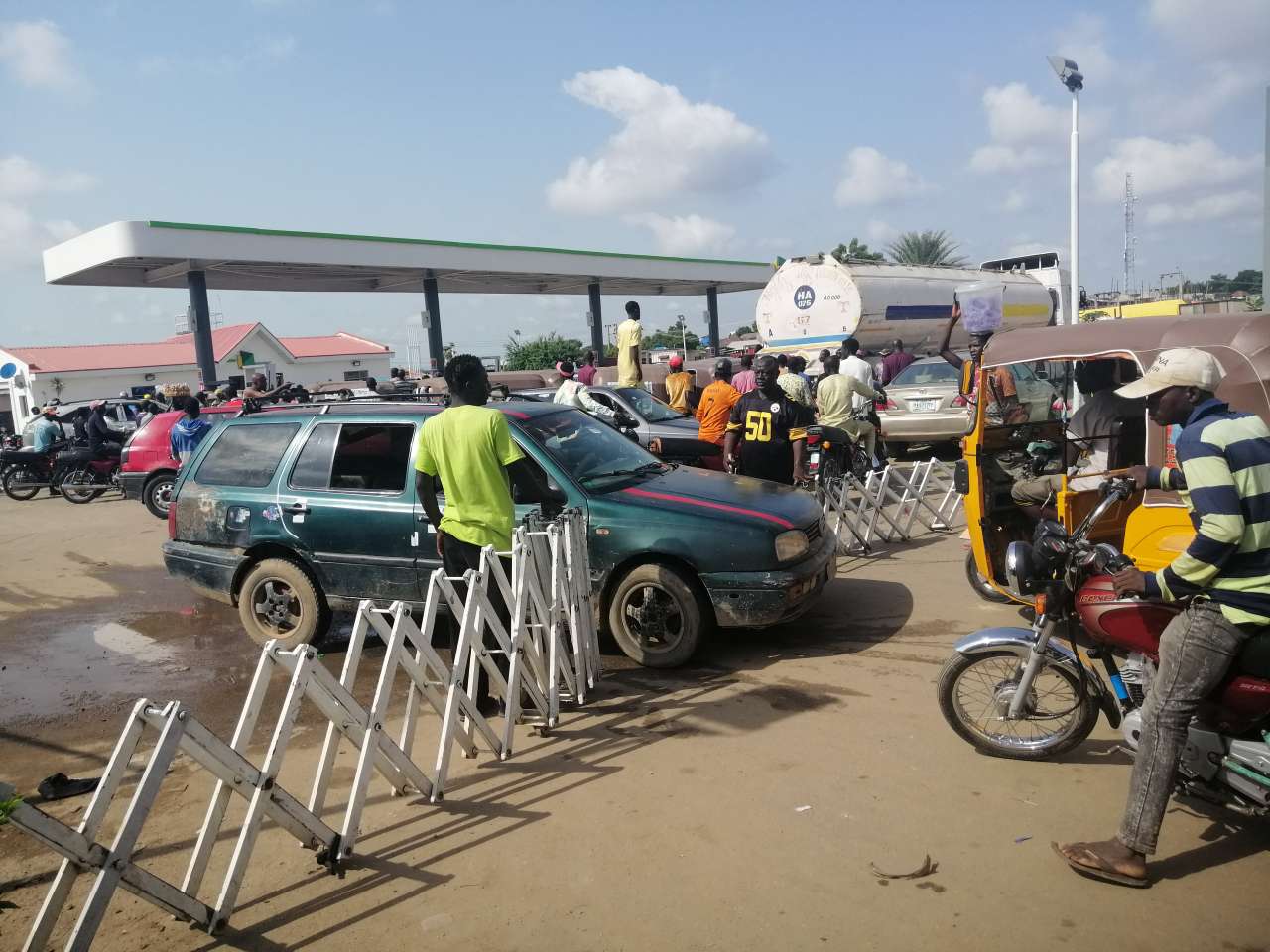
Some marketers have shut down their retail outlets, hoarding the product, which has created long queues of vehicles at filling stations.

The ICIR reports that commercial buses were scarce on the roads in major cities today as a consequence of fuel scarcity. Where available, the bus operators jacked up fares as high as 100-300 per cent. Many commuters who could not afford the fares were seen trekking long distances.

In Lagos, many filling stations were seen shut. The NNPC and Mobil filling stations on Bariga Road in the Lagos metropolis, for example, were not dispensing Tuesday. The NNPC station sold fuel in the morning of Monday, May 29, at N185 per litre, but by the afternoon after Tinubu’s speech had spread, the station had suddenly locked its gates.

On the Ikorodu Road stretch between the Fadeyi and Palm Grove axis, the Total filling station was seen dispensing fuel. The other NNPC and Conoil filling stations in the area closed their gates.

An independent filling station on Sipeolu Street, Palm Grove Road, was also not selling.

Motorists at an NNPCLtd retail outlet in Dei-Dei, a suburb of the Federal Capital Territory, struggling to buy petrol

In Port-Harcourt, Rivers state, several motorists were stranded on Tuesday, May 30, as most fuel stations in the city failed to operate.

A tricycle driver, Samson Tonye, who operates along the Okuru-Abuluoma axis, shared his experience with The ICIR.

“Someone told me that he bought fuel for N500 yesterday in a fuel station. I drove from here to Amadi; no fuel station is open,” he said.

It is a similar situation in Ogun state, as residents confirmed that a surge was recorded in transport costs on Tuesday.

“I usually pay N150 to N200 for transportation to work, but today, I spent N300. They said there is no fuel,” a resident Funke Abiodun told The ICIR.

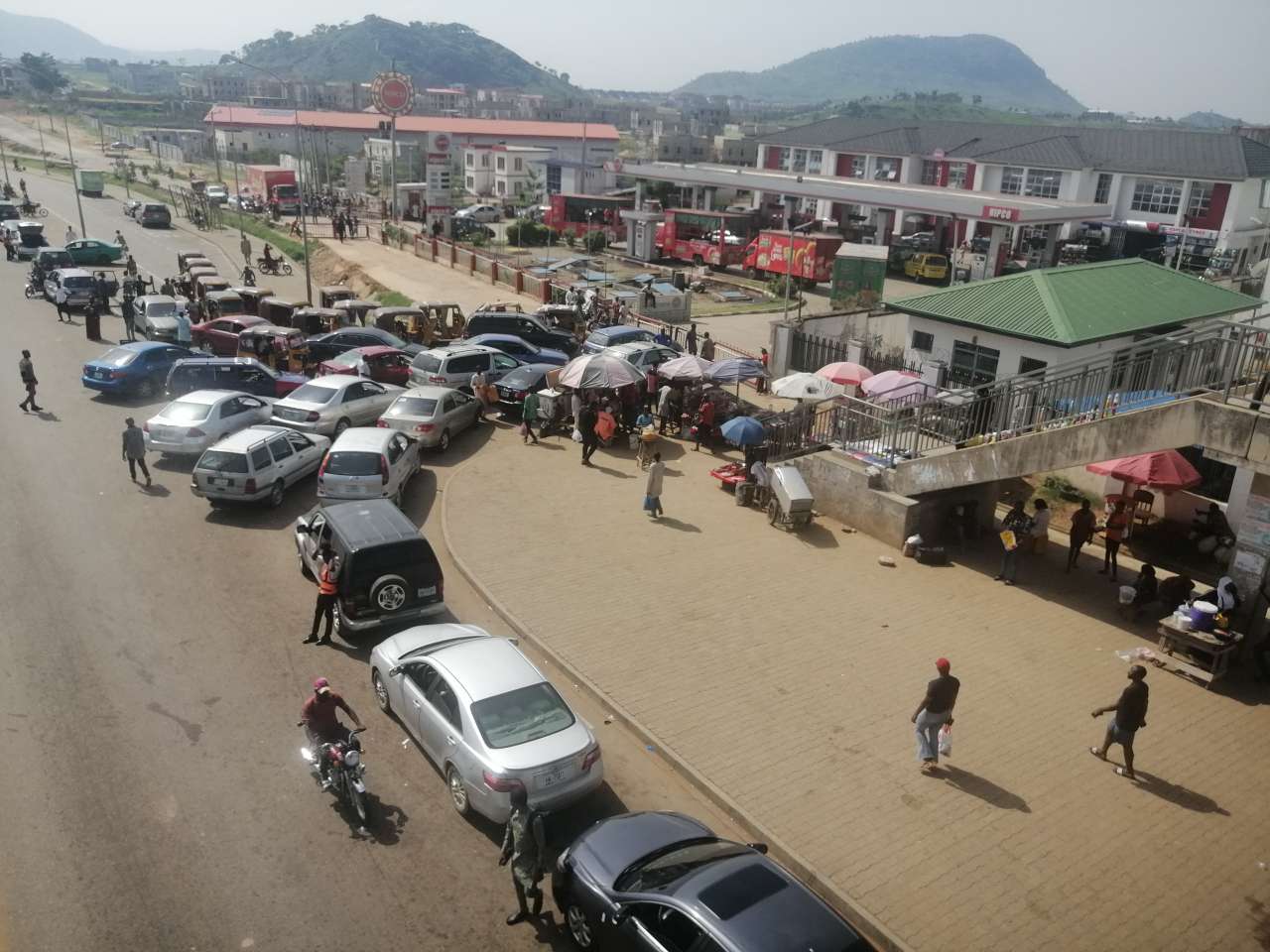
While some fuel stations were also closed in the Federal Capital Territory (FCT), a number of fuel stations remained open. However, queues stretched for hundreds of metres away from the pumps.

Consumers in long queues at NIPCO filling station in Kubwa.
Consumers in long queues at NIPCO filling station in Kubwa, May 2023

A motorist who spoke to The ICIR at the NNPCLtd. fuel station in Guzape said the queues resulted from panic buying, as residents were anticipating a shortage of petrol following Tinubu’s declaration.

“There is fuel, but people are panic-buying. They said they would remove the subsidy, but they haven’t removed it. Yet people have started buying in a rush instead of waiting for the increase,” he said.

The development is making motorists turn to the black market, where vendors sell as high as N350 per litre in the FCT, against the average N194 for which fuel is usually sold.

A Total Energy retail outlet shutdown as a result of the pronouncement

Tonye told The ICIR that he eventually purchased a litre of fuel for N600 in Port Harcourt.

“I just bought fuel now at the black market at N600 for a litre. People were even rushing it, and I could only get two litres,” he said.

While delivering his inauguration speech after his swearing-in as Nigeria’s president on Monday, Tinubu said the country could no longer subsidise fuel prices due to lean resources.

“Subsidy can no longer justify its ever-increasing costs in the wake of drying resources. We shall instead re-channel the funds into better investment in public infrastructure, education, health care and jobs that will materially improve the lives of millions,” Tinubu stated.

Fuel subsidy has consumed a substantial part of Nigeria’s revenue and has been identified as a cause of declining financial resources by the past administration.

According to data from the Nigerian National Petroleum Company Limited (NNPCLtd), N4.39 trillion ($9.7 billion) was spent on petrol subsidy in 2022.

Efforts had been made to remove or reduce fuel subsidy, but such efforts had been met with resistance by Nigerians.

International bodies like the International Monetary Fund (IMF) and the World Bank had urged the Nigerian government many times to remove the subsidy on petrol, arguing it was holding down infrastructural development.

Many Nigerian financial experts and stakeholders in the oil and gas sector had also pointed out what they called the numerous corrupt practices in subsidy payments, insisting the government should stop the payments and channel the gains into developmental projects.

What experts are saying

While some analysts’ voices have been lauding the Tinubu administration for what they described as its courage in finally removing the subsidy, they are blaming it for the poor communication of its decision to the masses.

“The marketers are being ahead of the narrative as marketers. The marketers are tactically following the market since no one has told them what the price will be after they finish their present stock. It also shows a case of poor quality communication and lack of clarity of policy,” an oil and gas governance expert Henry Ademola Adigun told The ICIR.

“That is the reason why we said that announcement should not have been made at the time it was made. The announcement should have been done with tact after meeting with stakeholders. The manner of the announcement brought uncertainty into the polity and the market is reacting to it,” Adigun added.

The president of the Petroleum Retail Outlets Owners Association of Nigeria (PETROAN), Prince Gilly-Harris, told The ICIR that effective stakeholder engagements needed to happen before the summarily removal of petrol subsidy.

“The President himself campaigned on this subsidy removal. However, there is need for high-level consultation before this kind of announcement is made.

“On our own as a group, we have been having high-level consultation on how to manage the opportunity cost of the subsidy removal when it is eventually thrown at us,” Gilly-Harry said.

Tinubu directs DSS to vacate EFCC office, gunshots rock building

PRESIDENT Bola Tinubu has directed the Department of State Services (DSS) to immediately vacate the Lagos office of the Economic and Financial Crimes Commission (EFCC).

The directive was disclosed in a statement released by Tinubu’s media aide, Tunde Rahman, on Tuesday, May 30.

The President said any issues between the two government agencies should be resolved amicably.

“President Bola Tinubu has directed the Department of State Security Service to immediately vacate the office of the Economic and Financial Crimes Commission in Ikoyi, Lagos.

“The President gave the directive when reports that DSS officials stormed the EFCC office located on Awolowo Road, Ikoyi, Lagos on Tuesday, preventing officials of the anti-graft agency from accessing their workplace, was brought to his attention.

“The President said if there were issues between the two important agencies of government, they would be resolved amicably,” the statement said.

The ICIR reported that DSS operatives reportedly prevented staff of the EFCC from gaining access to their offices on Tuesday, May 30.

It was gathered that the EFCC and the DSS shared office spaces in the building at No. 15A Awolowo Road, Ikoyi.

According to reports, EFCC employees carried out their duties calmly on Monday, May 29, believing that the DSS agents were there to keep the peace during the inauguration.

However, they were surprised on Tuesday morning when the DSS officials prevented them from gaining access to the premises.

The DSS responded to the situation on its official Twitter page on Tuesday, claiming there is no rivalry between the Service and the anti-graft organisation.

In a statement signed by the spokesperson of the DSS, Peter Afunanya, the security agency said it did not stop EFCC staff from having access to their offices.

Rather, the DSS said the building in question belonged to it.

“It is not correct that the DSS barricaded EFCC from entering its office. No. It is not true. The Service is only occupying its own facility where it is carrying out its official and statutory responsibility.

“By the way, there is no controversy over No 15A Awolowo Road as being insinuated by the media. Did the EFCC tell you it is contesting the ownership of the building?

“I will be surprised if it is contesting the ownership. Awolowo Road was NSO headquarters. SSS/DSS started from there. It is a common knowledge. It is a historical fact. Check it out,” the statement said.

The DSS restated that there is no rivalry between it and the EFCC over and about anything.

“Please do not create any imaginary one. They are great partners working for the good of the nation. Dismiss any falsehood of a fight,” the DSS added.

In its reaction, the EFCC described the siege on its Lagos office by the DSS as shocking.

The EFCC claimed that the action of the DSS has wider implications for the nation’s fight against economic and financial crimes.

The EFCC’s reaction was contained in a statement signed by the Commission’s spokesperson, Wilson Uwujaren, on Tuesday.

“This development is strange to the Commission given that we have cohabited with the DSS in that facility for 20 years without incident.”

The anti-fraud commission said it had cohabited with the DSS in the same facility for 20 years without any fracas.

The EFCC said the siege is inconsistent with the synergy expected of agencies working for the same government and nation and noted that there are ongoing discussions on the matter.

Meanwhile, Channels TV reported that shots were fired within the premises during the altercation.

According to Channels TV, the shots appeared to have been fired in the air as a warning to journalists who had approached the locked gate of the premises to get close-up video shots.

In a video posted by Channels TV on its Twitter page, sounds of sporadic gunshot could be heard coming from within the premises of the building as a group of journalists stood outside the locked gate.

Declare your assets, AFRICMIL tells Tinubu

THE African Centre for Media and Information Literacy (AFRICMIL) has called on President Bola Tinubu to declare his assets in accordance with Paragraph 11, Part I of the Fifth Schedule of the Nigerian Constitution.

The civil society organisation also charged Tinubu to make his declaration public as a way of committing to the genuine fresh beginning he promised Nigerians.

AFRICMIL in a statement released on Tuesday, May 30, by its coordinator Chido Onumah said by making his assets public, Tinubu would set a higher moral standard compared to his predecessors, who were not on record to have taken any significant action regarding the constitutional obligation.


READ ALSO:

US, others congratulate Tinubu, pledge support

Tinubu vows to create one million jobs, grow GDP by 6% annually

Tinubu promises unified forex regime, agricultural hubs in states

Full text of President Bola Tinubu’s inaugural address


“Besides the moral capital that accompanies such a rare gesture, Mr. Tinubu would be seen to have reinforced belief in the “Renewed Hope” agenda on which his governance plan is anchored, and which was the mantra at every turn in his campaign trail.

“The anti-corruption agenda of the Tinubu administration remains vague even though in his inaugural speech President Tinubu said his administration would “take proactive steps such as championing a credit culture to discourage corruption while strengthening the effectiveness and efficiency of the various anti-corruption agencies.”

AFRICMIL added that it is looking forward to a more detailed and unambiguous anti-corruption programme and is ready to work with the Tinubu administration to “tame the vicious monster of corruption” currently ravaging the country.

The organisation, in the same vein, stressed the importance of whistleblowing as a tool to enhance transparency and accountability and also reduce corruption.

It expressed disappointment in the previous government’s failure to enact a whistleblowing and whistleblower protection law, despite introducing the whistleblowing policy in December 2016 and approving a draft whistleblower protection bill in December 2022.

“We are disappointed at the failure of the immediate past government to enact a whistleblowing and whistleblower protection law, even though it introduced the whistleblowing policy as one of its anti-corruption strategies in December 2016 and approved a draft whistleblower protection bill in December 2022.”

Onumah further urged Tinubu’s administration to address the disabling lapse and take steps to sign the whistleblowing and whistleblower protection bill into law without further delay. 

According to him, the whistleblowing law would boost the confidence of citizens to report fraud, block leakages and increase the revenue which the new administration badly needs to sustain effective governance at the moment.

AFRICMIL also charged the former President, Muhammadu Buhari, to declare his assets and make it public “to redeem his severely diminished integrity”.

Onumah noted that this is not the first time AFRICMIL would be requesting elected officers to publicise their assets records as a mark of upholding transparency and accountability in governance through personal example.

“In 2011, AFRICMIL dragged the Code of Conduct Bureau to court seeking an order compelling the CCB, within the ambit of the Freedom of Information (FoI) Act, to make available to the public the asset declaration form of President Goodluck Jonathan.

“In 2017, AFRICMIL again sued the CCB for refusal to make available the asset details of principal officers of the National Assembly since 2011. Following the unfavorable judgment of Justice Adamu Abdu-Kafarati of the Federal High Court, AFRICMIL took the matter to the Appeal Court. The case has yet to be heard.

“AFRICMIL will not relent in its advocacy for good governance through activities that are targeted at holding public officers accountable,” the statement added.

The ICIR, on May 29, reported that Tinubu and Kashim Shettima were inaugurated as the President and Vice President of Nigeria, respectively.

The inauguration came few weeks after Tinubu was declared the winner of the presidential election that took place on February 25.

Tinubu was elected on the platform of the All Progressives Congress (APC).

Subsidy removal: TUC calls for caution, consultation with stakeholders

0

THE Trade Union Congress (TUC) has raised concerns over the removal of fuel subsidy by the administration of President Bola Tinubu, calling for caution in the implementation of the decision.

In his inaugural speech on May 29, Tinubu declared an end to fuel subsidy, citing the country’s inability to sustain it due to dwindling resources.

He stressed the need to redirect the funds previously allocated for subsidy towards public infrastructure, education, healthcare, and job creation to significantly improve the lives of Nigerians.


READ ALSO:
Scam website circulates as FG plans to distribute fuel subsidy removal palliative

FG to amend PIA to make room for fuel subsidy removal, says Sylva

Subsidy removal: Govs warn fuel stations against hoarding petrol

FLASH BACK: Lai Mohammed’s 360 degree change from critic to advocate of fuel subsidy removal


“Subsidy can no longer justify its ever-increasing costs in the wake of drying resources. We shall instead re-channel the funds into better investment in public infrastructure, education, health care and jobs that will materially improve the lives of millions,” he said.

However, this announcement has resulted in widespread economic repercussions, with petrol prices rising at filling stations across the nation.

TUC President, Festus Osifo, and Secretary General, Nuhu Toro, in a statement on Tuesday, May 30, urged the President to consult extensively with relevant stakeholders.

The labour union noted that the decision to remove the subsidy would have far-reaching effects on millions of Nigerians.

Expressing surprise and concern, the TUC stated, “If by this, he means increases in pump price and the exploitation of the people by unregulated and exploitative deregulated prices, then it’s a joke taken too far.”

The TUC stated the need for clarity and consistency in the President’s statements and alignment with the provisions outlined in the 2023 Appropriation Act.

The Congress stressed the importance of treating the issue with utmost caution and conducting robust dialogues and consultations with working class representatives, including professionals, market vendors, students, and the impoverished masses.

The union demanded ample time for these discussions and engagements, to ensure that all concerns and questions were addressed before proceeding.

The TUC also stressed that Nigerian workers and the masses should not bear the brunt of the inefficiencies of successive governments.

“But we expect the Tinubu government to be wise on such a sensitive issue and be more explicit in its pronouncement to avoid contradictory interpretations when comparing his written statement, what he said and the provision in the 2023 Appropriation Act.

“We dare say that this is a very delicate issue that touches on the lives, if not very survival, of particularly the working people. Hence, it ought to have been treated with utmost caution, and should have been preceded by robust dialogue and consultation with the representatives of the working people, including professionals, market people, students and the poor masses.

“Accordingly, we hereby demand that President Tinubu should tarry awhile to give room for robust dialogue and consultation and stakeholders engagement. Just as he opined in his speech until all issues and questions; and there are a host of them, are amicably considered and resolved. Nigerian Workers and indeed masses must not be made to suffer the inefficiency of successive governments.”

The TUC expressed its willingness to engage in dialogue with the Tinubu administration but insisted that the government should not dictate or manipulate the outcome.

They highlighted the deteriorating state of the N30,000 minimum wage, which has been eroded by problematic monetary and fiscal policies. The TUC called on the administration to prioritise resolving the issue due to its severe implications for workers and their livelihoods.

“We are also worried that in his speech, President Tinubu failed to delve into or reveal his plans on how to tackle and address the issue of poor and unchecked deterioration in industrial relations, particularly in the education, health and judiciary sectors, often resulting in prolonged strike and Industrial actions and their attendant adverse effects on society and the economy. A case in point is the current nationwide strike by JOHESU.

“If there is anything for the new administration to hurriedly address from day one in office, it is the abysmal N30,000 minimum wage that has since been eroded by the problematic monetary and fiscal policies of the government.

“The Labour Movement is open and ready to dialogue with the Tinubu administration on the fuel subsidy issue. We urge it in the interest of the country and its people not to dictate on such a matter or manipulate the outcome of such consultations.”

The Congress applauded the government’s pledged commitment to combating terrorism and criminality and suggested adopting a more inclusive approach in reviewing the security architecture to empower Nigerians to defend themselves against bandits and terrorists.

It commended Tinubu’s promises of job creation, food security, and eradicating extreme poverty. They urged him to involve organized labour, employers, professional organizations, and the informal sector to ensure that these programs deliver tangible improvements and can be verified with reliable statistics.

“Congress welcomes the promise to make electricity accessible and affordable to businesses and homes and, suggests that the Tinubu government begins by stopping the periodic arbitrary increases in the price of electricity imposed by the distribution companies while regulatory and consumer agencies look away,” it added.

The association pledged unwavering support for Nigerian workers who continue to persevere despite harsh government policies, poor governance, and mismanagement of resources, which have contributed to the challenging living conditions experienced by many.

Subsidy removal: Govs warn fuel stations against hoarding petrol

SOME governors have warned filling stations against hoarding petrol, following queues that resurfaced across the country after President Bola Tinubu announced a decision to remove fuel subsidy.

Kwara State governor AbdulRahman AbdulRazaq in a statement on Tuesday, May 30, threatened to revoke the Certificates of Occupancy of fuel stations found hoarding petrol.

“The Governor urges the marketers to desist from anything that qualifies as economic sabotage of the people. Hoarding fuel bought at subsidised prices and creating panic in the state is opportunistic and will not be condoned. His Excellency, the Deputy Governor, Mr Kayode Alabi, will be leading a task force to ensure that no fuel marketer causes undue hardship to the citizens in Kwara State.

“Fuel stations are to note that the task force will dip into their pits. Any filling stations found to be hoarding fuel will have their Certificate of Occupancy revoked, among other penalties,” the statement read.

He warned marketers to immediately supply fuel to the public at standard rates and avoid creating challenging conditions for residents.

Similarly, in a statement on Tuesday, Osun State governor Ademola Adeleke said the deliberate creation of artificial scarcity by dealers would not be tolerated, as fuel stations found hoarding petrol will be sealed off and operators prosecuted.

“To this end, the Special Monitoring Team on fuel scarcity set up by His Excellency, Governor Ademola Nurudeen Jackson Adeleke, headed by the Chief of Staff, Hon Kazeem Akinleye is still effective and shall not condone any form of economic sabotage,” the statement read.

In Ekiti, the state governor Biodun Oyebanji urged marketers to await directives on the implementation of the subsidy removal. He also threatened to sanction operators who are creating artificial scarcity.

Oyebanji also invited executives of the National Union of Petroleum and Natural Gas Workers (NUPENG) to a meeting in his office by 4:00 pm on Tuesday.

While delivering his inauguration speech after his swearing-in as Nigeria’s President on Monday, May 29, Tinubu said the country could no longer subsidise fuel prices due to lean resources.

“Subsidy can no longer justify its ever-increasing costs in the wake of drying resources. We shall instead re-channel the funds into better investment in public infrastructure, education, health care and jobs that will materially improve the lives of millions,” Tinubu stated.

Although this is not the first attempt to remove or reduce subsidy in Nigeria, Tinubu’s declaration on his first day as President sent residents into panic-buying, as many fuel operators across the country stopped operations.

In the Federal Capital Territory (FCT), stations that remained open had fuel queues stretching for hundreds of metres away from the pumps, resulting in traffic congestion and frustrating motorists.

UNICEF sets new four-year targets for Nigeria

0

THE United Nations Children Fund (UNICEF) has set a new four-year target for Nigeria.

The target includes supporting Nigerian health care systems for children and women, promoting access to water, sanitation and hygiene (WASH), and increasing school enrolment. 

Addressing journalists at a two-day media dialogue held in Kano between May 29 and May 30 on the ‘New Country Programme 2023-2027 and the States of Implementation of the Child Rights Law (2003) in States’, Communication Specialist for UNICEF Nigeria, Geoffrey Njoku, said the agency’s new programme aimed at working further to guarantee the rights of every child in Nigeria to survive, thrive, learn, and be protected and develop their full potentials.

Njoku noted that the programme targeted child’s freedom from poverty and ensuring they lived in a safe and sustainable climate and environment.

The ICIR reports that UNICEF’s objectives for health within the four years include health system strengthening, improved health leadership and governance, and affordability/universal health coverage. 

According to Njoku, the new programme intends to increase vaccination coverage and reduce inequalities, boost vaccine logistics management, eliminate maternal and neonatal tetanus, and sustain Nigeria’s polio-free status.

By 2027, UNICEF wants over one million more children immunised and training of 15,000 additional community health workers. It seeks to ensure that 1,700 primary health care facilities (out of 3,476) in 14 states meet PHC minimum standards, and 25 health facilities have functional level two newborn units and state-level and national capacities built to prepare and respond to public health emergencies.

He added that the programme also hoped to achieve the following, “By 2027, 50 million children (80 per cent of children aged six to 59 months) receive vitamin A twice a year, 16.5 million children (50 per cent of children aged six to 23 months) are fed with a minimum diverse died in 19 states.

“12.5 million women (50 per cent of pregnant women) receive more than 90 iron-folic acid tablets or multiple micronutrient supplements in 19 states, and five million infants (50 per cent under six months exclusively breastfeed in 19 states.”

Summary of UNICEF’s programmes in Nigeria from 2023 to 2027
Source: UNICEF

UNICEF also hopes that by 2027, ten million more children access formal or non-formal education, 4.8 million children access learning materials and 21 states scale up foundational literacy and numeracy.

The target includes making 22 states use integrated data systems for education planning and 12 states with improved adequacy, efficiency and equity in education finance.

On water, sanitation and hygiene (WASH), the agency plans to make five million more people access to basic sanitation services, support another two million people with access to basic water supply services, and five hundred schools and 250 PHCs to have access to basic services.

Meanwhile, UNICEF revealed that it helped Nigeria to vaccinate 30 million in the past five years and supported vaccinating 58 million children against polio.

Presenting the report of its programmes from 2018 to 2022, Njoku said the UNICEF assisted 1.5 million girls to enrol in school, using a new evidence-based approach, and 1.3 million children living in conflict-affected areas to access formal and informal education.

The agency’s programme currently makes 20 million people live in communities certified free of open defecation, and 2.4 million people can now access life-saving water, sanitation and hygiene services, said Njoku.

Besides, thirty-four states had the Children’s Act, and he said 600,000 children aged six to 59 months with severe acute malnutrition were admitted for treatment. 

UNICEF works in all of Nigeria’s geo-political zones, focusing on 20 states. Its programmes include health, nutrition, education, child protection, WASH and social policy.

In April, The ICIR reported UNICEF and the United States Agency for International Development (USAID) presenting a new model for child literacy in Nigeria.

Another report by this organisation showed key data on early childhood education in Nigeria

In March, The ICIR reported UNICEF saying 78 million Nigerian children were at the highest risk of water-related threats.

Court upholds FG’s ‘no work, no pay’ policy against ASUU

0

THE National Industrial Court (NIC), on Tuesday, May 30, upheld the ‘no work, no pay’ policy implemented by the Federal Government against the Academic Staff Union of Universities (ASUU).

The court took the decision in a suit filed by Federal Government against the university lecturers.

The Federal Government implemented the ‘no work, no pay’ policy during the period ASUU embarked on strike.


READ ALSO:

Strike likely if govt fails to meet our demands – ASUU

Strike: Gbajabiamila did not deceive ASUU – Reps

ASUU: Why FG should reconsider no work, no pay policy – Labour expert

Half salaries: Gbajabiamila intervenes in ASUU, FG fresh row


In its ruling on the suit numbered NICN/ABJ/270/2022, the court said the no work, no pay rule enforced by the Federal Government against members of the union who went on strike last year was entirely legal.

The judgment was delivered by the President of the Court, Benedict Kanyip.

Kanyip held that it is within the right of the Federal Government to withhold salaries of workers who embark on industrial action.

The court, however, held that Federal Government violated the autonomy of universities by imposing the Integrated Payroll and Personnel Information System (IPPIS) platform on members of ASUU who reserve the right to determine how their salaries should be paid.

The Federal Government took ASUU before the National Industrial Court when they demanded payment of salaries from February 14 to October 7, 2022, when they were on strike.

Among other prayers, the Federal Government asked the court to declare that the eight-month ASUU strike was unlawful because it broke the law.

The government also requested that the court rule that ASUU was not entitled to any compensation under Section 43 of the Trade Dispute Act (TDA), 2004, due to the strike.