ABOUT 64 million Nigerians are at risk of emergency food and nutritional assistance due to the attendant effects of rising inflation, climate change, among others, according to the World Bank.
Also, there are currently 24.8 million Nigerians who suffer from acute hunger, according to the United Nations World Food Programme, indicating worsening food insecurity and a widespread system of privation.
This was revealed in the bank’s latest food security update, titled, ‘Food security update: World Bank Response to Rising Food Insecurity’.
The ICIR has earlier reported an analysis of Nigeria’s Consumer Price Index which revealed that the country’s inflation rate rose 59 times under President Muhammadu Buhari’s eight-year administration.
The inflation surge showed how many Nigerians whose income have not appreciated grew hungrier under President Buhari’s administration, with the current inflation rate removing 22.22 per cent from their earnings which weakened their purchasing power.
Meanwhile, the World Bank report also revealed that about 107.5 million people living in West Africa and Central Africa region are in a stressed zone and could fall into a food crisis if additional shocks in the current farming season occur.
This new figure is almost double that of the 27 million people predicted by Oxfam, ALIMA, and Save the Children, who warned that food crises in West Africa could affect people in Burkina Faso, Niger, Chad, Mali and Nigeria.
The report also stated that the number of people experiencing crisis and acute food insecurity was the highest on record since the Global Report on Food Crises started in 2017.
The bank added that persistent trade barriers, high transport costs, repercussions of the war in Ukraine, and currency depreciation in coastal countries caused food price inflation that limits the household’s ability to access sufficient nutritious food.
On the average, prices of major staple grains across West Africa are 25 per cent to 40 per cent higher than in the last five years.
Moreover, accelerating climate change is decreasing the productive capacity of the region’s food systems, the report added.
Also, the Food Crisis Prevention Network identified civil insecurity, high inflation, and climate change as key factors aggravating the current food and nutrition security crisis.
THE DIRECTOR-GENERAL of the National Agency for Food and Drug Administration and Control (NAFDAC) Mojisola Adeyeye has said over 70 per cent of food exported from Nigeria are rejected abroad due the poor state of export trade facilitation for regulated products leaving the country.
Adeyeye stated this at the official commissioning of the New NAFDAC Office complex at the Murtala Mohammed International Airport in Lagos, according to a statement released on Sunday, May 21, by the agency’s media consultant, Sayo Akintola.
The NAFDAC DG assured that the incessant rejection of food exports from Nigeria in some European countries and the United States of America will be addressed.
She said there was a need to strengthen collaboration between NAFDAC and related agencies in other countries at the ports.
“NAFDAC collaborates with Nigeria Agricultural Quarantine Services to ensure that due diligence is done because over 70 per cent of the products that leave our ports get rejected.
“Considering the money spent on getting those products out of the country, it is a double loss for both the exporter and the country,” she said.
Adeyeye further noted that a trip to NAFDAC export warehouses within the international airport will explain the major reason for the continuous rejection of Nigerian exports abroad.
She, however, noted that the agency is responding to the challenge by collaborating with agencies at the ports to ensure that goods attain the standard and regulatory requirements of the importing countries and destinations.
“The mandate to safeguard the health of the populace through ensuring that food, medicines, cosmetics, medical devices, chemicals, and packaged water are safe, efficacious, and of the right quality in an economy that is overwhelmingly dependent on the importation of the bulk of its finished products and raw materials could never have been actualised without the effective presence of NAFDAC at the ports and land borders,’’ she said.
Adeyeye commended the collaboration between the agency and the Nigeria Customs Service, as well as the police and other security agencies.
‘’Without Customs, we will not be able to do a lot of what we have been able to do. The collaboration between Customs and NAFDAC is huge.
“NAFDAC is a complex organisation. We are scientific. We are police and we work with the Department of State Services. We work with Interpol and the Federal Bureau of Investigation because of the few unscrupulous stakeholders.
‘’Without the police, we cannot do much in terms of investigation and enforcement. We have over 80 policemen with us in NAFDAC. They help us a lot when we are doing raids or investigations as the case may be’’
The ICIRreported that a study revealed that some hazardous pesticides banned in Europe were being used in Nigeria despite attempts by the National Agency for Food and Drug Administration and Control (NAFDAC) to clamp down on the importation of harmful chemicals into the country.
The report stated that Nigeria imports 147,446 tonnes of pesticides annually, more than the total imports of Southern Africa, 87,403 tonnes, and North Africa, 109,561 tonnes.
However, the report further noted that despite the increasing imports, the informal nature of agricultural production in the country has made it difficult to record how pesticides are used.
“Surveys have shown that 80 per cent of the pesticides used most frequently by small-scale farmers are highly hazardous pesticides. Among the most commonly used are atrazine, chlorpyrifos and mancozeb – all of which are prohibited in the European Union,” the report said, adding that 58 per cent of the existing pesticides in the country are already banned in Europe.
The banned pesticides are prevalently used for agricultural commodities produced like cassava, yam, maize, fruits, cocoa, beans, among others.
Reacting to the report’s findings in a statement released on May 7, the Director General of NAFDAC Mojisola Adeyeye said the agency is set to ban another 12 pesticides and agrochemical active ingredients in the country.
The NAFDAC boss called for the cooperation of stakeholders and the general public to rid the country of hazardous pesticides.
AN Abuja Federal High Court has ordered the Federal Government to provide details on how a $460 million Chinese loan was used to fund the failed Abuja Closed-Circuit Television (CCTV) project.
A statement by the Socio-Economic Rights and Accountability Project (SERAP) on Sunday, May 21, said the court presided by Emeka Nwite made the order in a judgment on Monday, May 15.
Details of the judgment were obtained in a Freedom of Information (FOI) suit filed by SERAP.
Joined as defendants in the suit are the Finance Minister Zainab Ahmed and the Minister of Police Affairs Mohammed Maigari Dingyadi
Nwite ordered that the government must publish the total amount of money paid to Chinese and local companies and contractors, precise details of the identities of the companies and contractors, and the status of the implementation of the project.
According to the statement, the suit followed comments made by Minister of Finance Zainab Ahmed, concerning the CCTV project in 2019. The minister said: “We are servicing the loan, but on the project, we will have to ask the FCT Authority because the project was deployed in the FCTA. I have no information on the status of the CCTV.”
The CCTV contract was reportedly awarded to a Chinese firm in 2010 by the Goodluck Jonathan administration after then Minister of Finance Olusegun Aganga led a delegation to sign a Memorandum of Understanding (MoU) in Beijing, China.
The project was, reportedly, to be funded from a $600 million financing portfolio secured as a soft credit loan.
However, the project has failed to materialise and serious concerns have been raised over the matter by Civil Society Organisations (CSO) and Nigerians.
Delivering judgment on the case, Nwite agreed that “there is a reasonable cause of action against the government”.
“Accounting for the spending of the $460 million Chinese loan is in the public’s interest. It will be inimical for the court to refuse SERAP’s application for judicial review of the government’s action.”
He also held that “the Minister of Finance is in charge of the finances of the country and cannot by any stretch of imagination be oblivious of the amount of money paid to the contractors for the Abuja CCTV contract”.
The judge ordered the government to provide the “details clarifying whether the sum of N1.5 billion paid for the failed contract meant to construct the headquarters of the Code of Conduct Bureau was part of another loan obtained from China”.
Nwite granted an order of mandamus compelling the Federal Government through the Minister of Finance, “to provide and make available to SERAP information on the total amount of money paid to contractors, with specific details of names of companies local contractors involved, from the $460 million loan obtained in 2010 from China by the Federal Government of Nigeria to fund the failed Abuja CCTV contract”.
The judgment further read: “An order of mandamus is hereby made directing and compelling the government (through the Minister of Finance) to provide the details of the local companies and Chinese contractors that have received funds from the $460 million loan for the finance of the Abuja CCTV contract as well as details of the status of implementation of the project.
“An order of mandamus is hereby made directing and compelling the government (through the Minister of Finance) to provide the details clarifying whether the sum of N1.5 billion mobilisation fee reportedly paid to the contractors for the construction of the Headquarters of the Code of Conduct Bureau in Abuja was part of another loan from China.”
OPERATIVES of the National Drug Law Enforcement Agency (NDLEA) have confiscated a substantial shipment of methamphetamine at the export shed of the Murtala Muhammed International Airport (MMIA) Ikeja Lagos.
The illicit substance was concealed within powdered custard containers, forming part of a combined cargo destined for London, United Kingdom (UK).
According to the agency’s spokesperson, Femi Babafemi, in a statement released on Sunday, May 21, the illicit drug consignment weighing 30.10 kilograms with a street value of N567 million was detected and seized by operatives at the airport on Tuesday, May 16.
The follow-up operations led to the arrest of a freight agent, Nwobodo Chidiebere, a female suspect, Chioma Lucy Akuta and ultimately the mastermind behind the shipment, Charles Chinedu Ezeh, who was arrested at Sotel Suites, Amuwo Odofin, Lagos on Thursday, May 18.
”Ezeh claims he’s a businessman and deals in articles in Onitsha, Anambra State but investigations reveal he lived with his wife and children in London until 10th December 2022 when he fled to Nigeria after his involvement in a drug related offense in the UK.
“Though he claimed to have been living in hotels since his return to Nigeria last December, operatives were however able to locate his mansion at No. 1 Hawawu Abikan Street, Lekki, on Friday 19th May, where a search was conducted and his travel and property documents among others were recovered.”
The agency’s operatives in Adamawa on Monday, May 15, also arrested a 32-year-old notorious drug dealer, Prince Ikechukwu Uzoma, in Mubi area of the state with 1kg of skunk. Ikechukwu had twice been arrested in the past, and convicted for the same offence.
He was in 2017 sentenced to six months imprisonment and in 2019 he was again sent to two years in jail.
In the same vein, a trans-border trafficker, Faisal Mohammed, 27, was on Wednesday, May 17, arrested in Mubi following the interception of a truck from Onitsha, Anambra State, where a total of 2,376 sachets of tramadol comprising 23,760 pills were found concealed in three blue rubber jerrycans which were hidden underneath the body part of the trailer.
The suspect admitted the opioid was to be taken to Cameroon.
In Oyo State, two suspects: Osas Susan, 35, and Thomas Biodun, 23, were arrested at Igbon, Gambari in Ogbomoso North LGA with 2.13kg cannabis while Idris Muhammed, 55, was nabbed with 4,500 pills of tramadol when a commercial bus conveying him and other passengers was stopped and searched along Lagos-Ibadan expressway.
Similarly, Bulus Mikah, 63, was arrested at Kafanchan, Kaduna state with over 5kg opioids including tramadol, diazepam, rohypnol and exol-5, just as a total of 965kg cannabis was seized from Shehu Muhammadu Dandare, 25, at Maraban Jos, in Igabi local government area of the state.
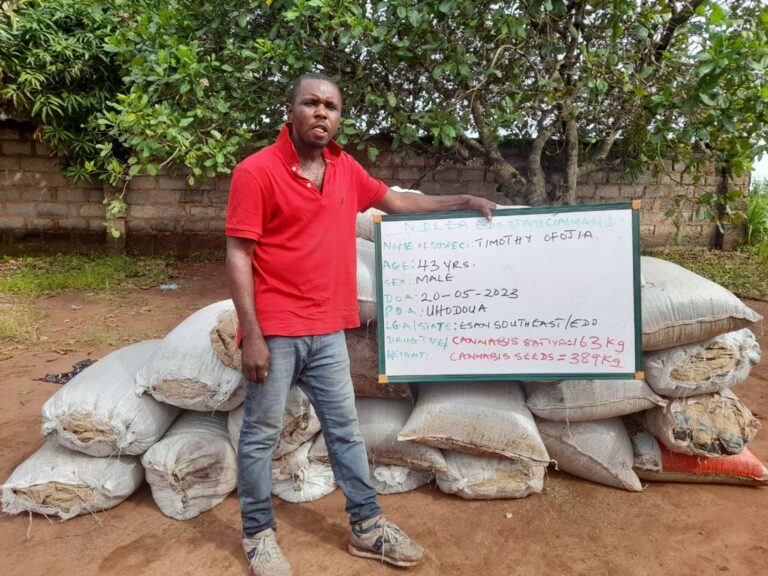
While 552kg cannabis was recovered from a warehouse in a bush when operatives stormed and destroyed 1.5 hectares of cannabis farm in Uhodoua forest, Esan South East LGA, Edo state, 10 suspects were arrested with a total of 5.587kg cannabis sativa, 144.4grams of methamphetamine and 48, 260 capsules of tramadol in different parts of Onitsha, Anambra state on Friday, May 19.
In Kwara, two suspects: Mohammed Isa, 47 and Mohammed Haman, 36, were arrested on Friday, May 19, along Ilorin/Lagos road in a commercial bus on their way to Maiduguri, Borno state with 6kg cannabis, 50grams of methamphetamine and 20 pieces of military camouflage caps and uniforms.
The same day, operatives in Jigawa state nabbed one Ibrahim Abdullahi, 53, with 120kg cannabis at Sara town in Gwaram LGA.
Not less than 628 bottles of new psychoactive substance, skuchies when operatives raided a drug joint at Idanre where four suspects were arrested. They include: Olamide Olusola, 26; Abiodun Tijjani, 21; Fatope Temidayo, 29; Agba Obi, 30 and Olafisoye Festus, 26.
In the same vein, a suspect, Kayode Hakeem, 22, was arrested at Hawan Dawaki, Kano with 293 blocks of cannabis weighing 211.6kg.
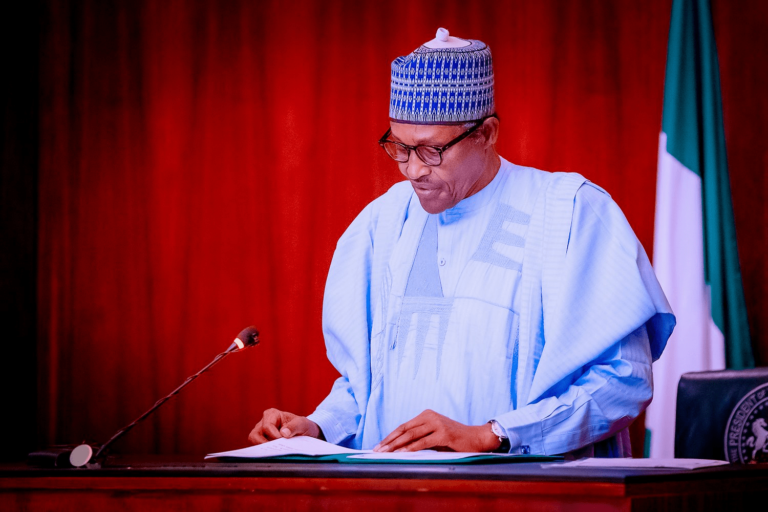
WHEN Muhammadu Buhari was sworn into office as President of Nigeria on May 29 2015, he reiterated his campaign promises that his administration would concentrate on the economy, fight corruption, and tackle security.
In May 2023, as Buhari’s tenure winds down, the Presidency claimed his administration had made outstanding progress between 2015 and 2023 in addressing security-related challenges.
The Special Adviser to the President on Media and Publicity, Femi Adesina, stated in a 90-page document released in Abuja that Buhari’s efforts had had a favourable impact on the paramilitary.
Buhari himself had saidat a military event in Abuja on May 10 that since taking office, his administration had successfully provided the security forces with the necessary equipment, and contained the operations of terrorists, bandits, kidnappers, and other criminal elements.
However, data by the Council on Foreign Relations’ Nigeria Security Tracker (NST) checked by The ICIR showed that non-state actors killed 31,821 people between May 2015 and April 2023. The NST website tracks violent incidents related to political, economic, and social grievances directed at the state or other affiliated groups.
President Muhammadu Buhari//Source: PremiumTimes
Likely reasons for insecurity during the Buhari administration
A report published in January 2023 by the Global Initiative Against Transnational Organized Crime (GI-TOC) recommended that to solve the issues of insecurity and terrorism in Nigeria, the problem of cattle rustling must be given priority.
The report identified cattle rustling as a significant contributor to rising insecurity in the country’s northern region.
In March, Amnesty International (AI) also blamed the development on the failure of leadership and global organisations.
The AI confirmed that Nigeria’s human rights abuse and insecurity levels rose in 2022.
The international human rights organisation stated this in its 2022 annual report on Monday, March 27.
The Al ‘2022/23: State of the World’s Human Rights Report’ highlighted the drastic effects of conflicts in many sub-Saharan African countries, including Nigeria, while blaming the development on the failure of leadership and global organisations.
Some major killings under Buhari’s tenure
2015
Borno state: In Buhari’s first year in office, at least 55 people were killed in two Boko Haram raids near Maiduguri, the state capital.
Taraba state: In the same year, 21 people were also killed in Takum.
2016
Benue state: On February 29, 2016, Agatu Massacre happened, leading to the displacement of thousands.
2017
Ondo state: In 2017, an attackby cultists led to the death of at least 10 persons in Akure.
In the same state, five persons were killed by armed robbers during a bank robbery in Ogbagi Akoko.
2018
Yobe state: In July 2018, the Nigerian Army suffered heavy casualties as Boko Haramkilled 62 personnel in an attack on a military base in Geidam local government area,.
Kogi State: In 2018, unknown gunmen killed 12 people in Kpanche, Bassa local government.
2019
Ebonyi state: At least 15 persons met their death during a communal clash in Izi in April 2019.
Kaduna state: Herdsmen on a rampage killed 21 people in Anguwan Aku, Kajuru, in April 2019.
Katsina state: In the home state of President Buhari, at least 36 people were killed by bandits in Kankara in April.
2020
Katsina state: In April, bandits killed 47 people in Safana, Dutsinma and Danmusa local government areas of the state.
The police reported that 47 people were killed during the attacks, while the locals said 70 remains were found.
Borno state: Boko attacked a convoy returning families to their homes in Baga and killed 30 persons during the incident.
On July 29, Near Baga, Boko Haram militants attacked a vehicle carrying the governor of Borno state, Babagana Zulum.
According to media sources, the governor was unharmed, but there were casualties among his group.
2021
Ebonyi state: 14 people were killed in 2021 when gunmen attacked Effium, Ohaukwu local government area.
Niger state: Rampaging bandits killed 27 people in Kurebe Ward in February 2021.
2022
The ICIR, in a report in 2022, looked at the cost of insecurity in the southeast region and how billions of naira went up in flames amid intensifying attacks.
The report looked at how billions of naira had been lost due to attacks that were becoming more frequent.
Two hundred and eight-seven people dieddue to insecurity in Nigeria’s southeast region in five months, as shown in NST data covering January to May 24, 2022.
Gunmen
Anambra state: On February 26, 2022, up to 20 people were killed at a burial ceremony in Ebenebe, Akwa North, LGA.
Niger state: Thesecurity situation in Niger State, in the Northcentral region, worsened in 2022. The governor of the state, Abubakar Bello, disclosed that terrorists wreaked havoc and killed over 300 people in two weeks.
Ogun state: In 2022, records showed that Ogun state had the highest number of deaths from violence in five months in the Southwest region of Nigeria.
The Southwest states are Lagos, Ogun, Osun, Ekiti, Ondo, and Oyo.
A total of 165 deaths were recorded from 122 incidents of violence that occurred in the region between January and May 2022.
Data obtained from NST covered January to May 31 2022.
The deaths are mainly from cult-related activities, armed robbers, kidnappers, farmers/herders crises and security operatives.
According to the data, there were 122 incidents within the period, resulting in 165 deaths.
Ogun state had the highest number of fatalities, with a total of 44 deaths within the period, with many of them linked to cult-related violence.
Kaduna state: In April 2023, the state government disclosed that bandits killed 1,266 persons in 15 months in the state.
Also, 746 persons were kidnapped in the state between January and March 2023.
Nasir-El-Rufai
The Kaduna State Commissioner for Internal Security and Home Affairs, Samuel Aruwan, released the figures on April 19 at the Sir Kashim Ibrahim Government House, Kaduna.
Plateau state: In May 2023, in the Bwoi District of Mangu Local Government Area, gunmen killed around 30 people.
In a statement, the state’s police spokesperson, Alfred Alabo, acknowledged the occurrence.
The state’s commissioner of police Bartholomew Onyeka described the incident as sad and ordered the urgent deployment of armed people to the area.
Other attacks that occurred during Buhari’s eight years tenure
Attacks on worship centres
Over 289 people were killed in worship centres within 18 months during Buhari’s tenure.
The rate of attacks on worship centres leading to death was brought to the fore with the attack on Saint Francis Catholic Church, Owo, Ondo state, on June 5, 2022.
No fewer than 40 worshipers died in the attack.
The data obtained from the NST covered January 2021 to June 20, 2022.
Attacks on military personnel
Gunmen reportedly attacked military personnel and facilities across the country during this period.
For instance, an Army patrol van in Aba, the commercial city of Abia State, was attacked by unknown gunmen.
It was gathered that the attackers laid ambush for the unsuspecting soldiers.
Military personnel
The attackers burnt the Army patrol van, but the number of casualties could not be ascertained.
Attack on Police personnel
The Nigeria Police lost 138 officers in eight months during Buhari’s eight in years tenure.
Data from the NST website showed that 138 policemen were killed within eight months nationwide.
The data covered January 1 to August 10, 2022.
The deaths resulted from the activities of unknown gunmen, ESN, armed robbers, kidnappers, and security operatives.
The data showed that the killing of these policemen cut across states.
In July 2022, attempts were made to impeach Buhari over Insecurity worries.
Senators of the opposition Peoples Democratic Party (PDP) staged a walkoutafter a move to commence impeachment proceedings against President Muhammadu Buhari was blocked by Senate President Ahmad Lawan.
Senate President Ahmed Lawan
The Minority Leader of the Senate, Phillip Aduda, had raised a point of order asking the Senate President, Ahmad Lawan, to discuss the country’s security situation and initiate discussions on Buhari’s impeachment.
Security analyst gives verdict.
Speaking on insecurity in Buhari’s eight years tenure, a security analyst with the SBM Intelligence, Emeka Okoro, said the President missed the opportunity to fix Nigeria’s security challenge.
Okoro said that despite the increased budget on insecurity, the situation only got worse.
“Pre-2015, President Buhari’s campaign rode on the heels of fixing the pervasive insecurity challenge left by his predecessor; but not only has he missed it entirely, the situation has also worsened.
“And despite rising budgetary commitments to the security sector since his first term in office, the reality on the ground paints the picture of a battle that has been lost,” Okoro said.
He added that underfunding had never been the problem of the security sector. Instead, he maintained, the issue had been where the funds had been going, especially with ever-present instances of robbery, kidnapping and banditry.
“Nigeria has continually poured trillions of naira into a sector that produced no significant results amid an impending recession,” he said.
Okoro gave unemployment, corruption, a weak judicial system, porous borders, high influx of illegal arms and narcotics as significant propellers of insecurity in the last eight years.
He added security of lives and property as a crucial role of the State, “and this is the main reason people had to give up some of their natural rights to the state for the state to protect them.”
VETERAN Nollywood actress Patience Ozokwor, former Big Brother Naija (BBN) housemate Tobi Bakre and Osas Ighodaro were among the big winners at the grand finale of the African Magic Viewers Choice Awards (AMVCA) on Saturday night.
The 9th Edition of the AMVCA held at Eko Conventional Center on Saturday, May 20, with media personality, Ik Osakioduwa, and Miss Universe 2021, Zozibini Tunzi, as the hosts.
Actors and actresses from across Africa, including other top celebrities and influencers, gathered for a dazzling night to celebrate the vibrant African entertainment industry at the highly anticipated awards ceremony.
The awards celebrate Africa’s dynamic entertainment industry with its wide array of captivating movies, gripping series, thought-provoking documentaries, and attention-grabbing social media content, featuring talented individuals from West, East and Southern Africa.
Ozokwor, widely known as Mama G, was recognised for her roles in various movies in the Nigerian movie industry, Nollywood, and honoured with the Industry Merit Award.
The actress expressed appreciation to God and her fans for the award.
“Thank you Jesus, I can’t thank you enough. I appreciate you. You can’t even stop loving me. I will die for your love, nothing matters to me anymore, the hate or those who don’t appreciate me. MNET, thank you for giving me this,” she said.
Similarly, reality TV star and actor, Bakre bagged the award of the Best Actor in a Drama, Movie or TV Series making him the ‘Actor of the Year’ at The AMVCA.
Bakre won the award for his role in the series ‘Brotherhood’.
He showed his excitement and expressed gratitude to his fans and supporters in a tweet.
“Thank you. Family! Tobination! All of the BBN families. All my friends and supporters out there. We did it!!!! Zu! Esther! Priceless to give special mention and many many more! We did it! Thank you!!!! Rico! This one is for you my Amigoooooo👊🏾”, he tweeted.
Ighodaro was another big winner on the night, emerging the Best Actress In A Drama, Movie Or TV Series with her performance in the movie ‘Man of God’. The award made her Actor of the Year.
Enioluwa Adeoluwa and Beauty Tukura won best dressed awards in the male and female categories, respectively.
The Executive Head, Content and West Africa Channels at MultiChoice Nigeria, Busola Tejumola, had stated that this year’s edition of the AMVCAs is focused on raising the bar when it comes to recognising and rewarding talents in the various aspects of the African film and television industry.
This year’s AMVCA was a three-day event with an enchanting ambiance of opulence and splendor, with renowned Nigerian actors, actresses and other A-list celebrities making appearances in adorning exquisite outfits.
The award show commenced on Thursday, May 18 with a cultural night showcasing African culture, to honour the diverse and vibrant African heritage. Thereafter, a fashion and runway show was staged on Friday and finally the award night in Saturday.
The award night honoured the exceptional achievements of African actors, actresses, directors and other movie producers whilst celebrating Africa Magic’s 20 years of showcasing African culture to the world.
Full list of winners at AMVCA 9
Best Costume Designer Movie/TV Series – The Real Housewives of Lagos Reunion Episode – Adeola Art-Alade
Best Makeup Artist Movie Or TV Series – Shanty Town – Maryam Ndukwe & Hakeem Effects Onilogbo
Best Soundtrack In Movie Or TV Series – Anikulapo – Kent Edunjobi (first time and first win)
Best Cinematographer- Brotherhood – Loukman Ali
Best Art Director (Movie Or TV Series) – King Of Thieves (Agesinkole) – Wale Adeleke
Best Indigenous Language Movie Or TV Series: Swahili- Click Click Bang – Philip Karanja Njenga
Best Indigenous Language Movie Or TV Series: Hausa – Aisha – Abubakar Bashir Maishadda
Best Indigenous Language Movie Or TV Series: Yoruba – Anikulapo – Kunle Afolayan
Best Indigenous Language Movie Or TV Series: Igbo – Uhuruchi – Victor Iyke
Best Short Film Or Online Video- Adeoye Adetunji – Pa Aromire (First nomination and win)
Best Online Social Content Creator powered by Zagg – Back From the Future – Elozonam & Kiekie
Best Television Series powered by Verve – Crime & Justice Lagos – Yinka Edward
Best Documentary powered by 2sure – Baby Blues – Nora Awolowo
Best Writer In Movie Or TV Series- Anikulapo – Sola Dada
Best Lighting Designer In Movie Or TV Series – Brotherhood – Mathew Yusuf
Best Picture Editor In Movie Or TV Series – Crime & Justice – Holmes Awa & Daniel Tom
Best Sound Editor In Movie Or TV Series – Anikulapo – Anu Afolayan
Best Movie East Africa- Click Click Bang – Philip Karanja Njenga
Best Movie West Africa- Brotherhood – Jade Osiberu
Best Movie Southern Africa- Jewel – Elvis Chucks
Best Supporting Actress In A Drama, Movie Or TV Series- Four Four Forty Four – Efe Irele
Best Supporting Actor (Movie/TV Series) – Gacal – Abdisattar Ahmed
Best Actress In A Comedy/TV Series – Promasidor – Selina – Bimbo Ademoye
Best Actor In A Comedy Drama, Movie Or TV Series – Inside Life – Samuel Perry ‘Broda Shaggi’
Best Actress In A Drama, Movie Or TV Series – Man of God – Osas Ighodaro
Best Actor In A Drama, Movie Or TV Series – Brotherhood – Tobi Bakre
THE Director-General of Nigerian Maritime Administration and Safety Agency (NIMASA) Bashir Jamoh has expressed concern over lack of shipyard infrastructure in the country.
Jamoh observed that as a result of the infrastructure deficit, many Nigerian Ship Owners travel to Ghana and Equatorial Guinea to repair their vessels.
He spoke at the opening of the 4th Edition of the Nigerian Oil & Gas Opportunity Fair (NOGOF), with the theme, ‘Oil & Gas Industry – Catalyst and Fuel for the Industrialization of Nigeria’, in Yenagoa, Bayelsa State.
The event is annually organised by the Nigerian Content Development Monitoring Board (NCDMB).
Jamoh projected a major leap in oil and gas export following determined efforts by the NCDMB towards the completion of the Brass Shipyard Project in Bayelsa State.
He applauded the NCDMB for initiating the project, which he said will enable vessel owners dry dock their vessels and carry out repairs in Nigeria.
Jamoh who was represented by NIMASA’s Director Cabotage Services, Rita Uruakpa, said apart from saving the country huge foreign exchange the project will also create more jobs and enhance export potentials of the country.
He assured the Board of the Agency’s support to ensure sustainable growth in the oil and gas sector, noting that the maritime industry is key to boosting export of crude oil and import of other industry related goods and services.
The construction of the shipyard in Brass Island, Bayelsa State, is expected to cater for the maintenance and repair services of cargo vessels, oil tankers, and LNG carriers.
The project is to be executed by the China Harbour Engineering Company, which had carried out similar projects across the globe. The feasibility study for the project is being funded by the NCDMB as part of its mandate to domicile key oil and gas industry infrastructure and increase retention of industry spend.
The scope of the feasibility study includes geo-technical and bathymetric surveys, conducting a market study, ascertaining an optimal construction scale, developing technical proposal and construction plan and estimation of the required investment to bring the project into reality.
Jamoh noted that high traffic of vessels in and out of Nigeria provides a huge opportunity to retain substantial value in-country through the provision of dry-dock services.
He said the shipyard project would further develop and harness the nation’s position in the oil and gas value chain and linkage to other sectors of the economy.
Earlier, the Executive Secretary of NCDMB, Simbi Wabote, said the NLNG’s Train 7 Project is expected to increase the company’s Liquefied Natural Gas capacity from 22MTPA (million tonnes per annum) to 30MTPA and induce the acquisition of additional LNG carriers to the existing ones, all of which would need maintainance and servicing.
He added that the project would also benefit from the upcoming implementation of the Africa Continental Free Trade Agreement (AfCFTA) as Nigeria could serve as hub for ship-building and repairs.
Wabote expressed confidence that the outcomes of the feasibility study and subsequent construction and operation of the shipyard will create employment opportunities and contribute to poverty reduction in line with the aspirations of the Federal Government.
The NCDMB boss assured that the Brass shipyard project and other ongoing efforts to catalyze manufacturing would help the Board achieve the target of 70 per cent Nigerian Content by 2027.
He confirmed that the project was being driven by the NCDMB in conjunction with NLNG as a Capacity Development Initiative (CDI) on the back of the Train 7 Project.
Nigeria has a long coastline of 853 kilometers and navigable inland waterways of 3,000 kilometers, which offer immense potential for maritime sector development. ThecBrass coastline is very close to the Atlantic Ocean.
There are over 20,000 ships operating in the oil and gas sector on Nigerian waters and the annual spend on the maintenance of the vessels is over $600 million in the upstream sector.
According to statistics, operators in the oil sector spent $3.047 billion on marine vessels between 2014 and 2018 and 73 per cent of the total spend went to crew boats, security vessels, diving support vessels and fast supply intervention vessels. Other vessels in that category include mooring launch and shallow draft vessels.
The ICIR observed that most of the vessels that operate in the oil industry are taken to Ghana, Equatorial Guinea, Cameroun and other countries for dry docking because Nigeria’s local dry docks were built many years ago and no longer provide the required services.
Wabote further listed the objectives of NCDMB’s Marine Vessel Strategy to include promotion of indigenous ownership, increase participation and capacity of local shipyards to build, service and maintain marine vessels of various sizes, and manufacturing of vessel components and consumables in-country.
Other objectives of the Marine Strategy are to give first consideration to Nigerian built or owned vessels for contract awards and job offers, discourage capital flight, generate employment and increase retention of industry spends and stimulate value creation.
The Brass shipyard project’s schedule indicates that the site work would be executed within six months while feasibility study would be completed in four months.
THE Managing Director, Jos Electricity Distribution Company (Jos DisCo) Abdu Bello Mohammed has said the company has enough meters that will serve its customers in its franchise areas – Gombe, Bauchi, Benue and Plateau states.
Mohammed, however, noted that customers are not willing to take advantage of the billing technology to end estimated bills.
This was disclosed in statement signed by the Head, Corporate Communications, Adakole Elijah, on Saturday, May 20.
Speaking at the mobile re-launching of the Meter Asset Providers (MAP), at various locations in Plateau State, the Jos DisCo boss urged customers to take advantage of the scheme to be metered.
The Managing Director of Jos DisCo Abdu Bello Mohammed
Represented at the event by Senior Managers in the Marketing Department, Felix Shalzim Adamu and the Nasiru Faskari, Mohammed said there are enough meters at the disposal of the vendors.
According to him: “All customers of the company would be metered. Meter remains the only credible implement that will be used in measuring energy.
“We have engaged the services of credible vendors who have made available enough meters awaiting customers’ patronage.”
He disclosed that a single-phase meter costs N63,06.00 while a three-phase meter costs N117, 010. 00. He explained that the cost of the meter would be repaid to customers via energy within a given period as specified by the regulator.
“Upon payment of the prescribed fees and presentation of evidence of payment to the Company, the customer would be metered within ten working days”, he said.
The Federal Government’s mass metering programme which targets metering of four million power users in phase 1 has been dragging as concerns grow over capacity of local meter manufacturers.
The policy initiative commenced in 2020 to put an end to the estimated electricity billing regime.
Under the initiative, the government planned to distribute over six million electricity meters free to Nigerians.
But data for the electricity sector, which was prepared by the National Bureau of Statistics (NBS), showed that despite the policy, the number of estimated customers has been on an upward trend.
THE President Muhammadu Buhari administration failed to lift many Nigerians out of poverty due to poor concentration on the human development index (HDI), analysts have said.
Some development experts question President Buhari’s model of addressing poverty alleviation, saying the President should have concentrated on improving the HDI, instead of giving out financial handouts, which the Buhari administration adopted.
A survey by the National Bureau of Statistics (NBS) last year showed that Nigeria had 133 million people living in different categories of poverty, a situation some analysts believe could have been averted with increased focus on wealth creation opportunities and human capital development.
A Federal Government report on multi-dimensional poverty that it released in November 2022 stated that 65 per cent of the poor in Nigeria (86 million people) were living in the North, with 35 per cent (almost 47 million) living in the South.
A development expert and associate consultant for the British Department for International Development (DFID), Celestine Okeke, told The ICIR that inflationary pressures had been rising because of what he called government’s knee-jerk approach to policies and less attention to human capital development.
Okeke said, “Most of our intervention programmes failed because they are knee-jerk. Look at our Anchor Borrowers programme and see how it was politicised, and now, we have the CBN lamenting people are not paying back.”
Another development economist, Kelvin Emmanuel, told The ICIR that improving the HDI would stimulate economic activities.
Emmanuel said, “Buhari started, for instance, with closing the borders and widening the size of the budget while relying on the central bank to provide the deficit financing of the budget.
“The idea that you could create a bigger budget and then rely on the central bank to provide deficit financing through ways and means is detrimental to the economy.”
He stressed that the more the ways and means, the more the CBN faces a currency depreciation problem, and the more it keeps adjusting the rates to meet up with the parralel market and official rates against the dollar because of exchange rate issues.
He argued that the reality on the ground is that inflation is double digit.
“It has gone from 16.95 per cent in 2016 to the current 22.22 per cent. When you add bank lending rate to management fees to document action fees, you could see that the commercial bank lending rate is at 31 per cent. How can industries borrow at 31 per cent per annum and still be in business?” he wondered.
LABOUR Party (LP) presidential candidate, Peter Obi, has accused the Independent National Electoral Commission (INEC) of failing to comply with a court order which granted the party permission to audit the Bimodal Voter Accreditation System (BVAS) machines used in the 2023 presidential election.
The Court of Appeal had in March granted an order permitting Obi and the Peoples Democratic Party (PDP) presidential candidate, Abubakar Atiku, to inspect the BVAS machines and other sensitive electoral materials used for the election.
Obi and Atiku had requested access to the electoral materials preparatory to filing their petitions to challenge the outcome of the February 25 presidential election in court.
Apart from granting them access to the materials, the court had, in its ruling delivered on March 3, also restrained INEC from tampering with the BVAS machines pending the inspection to be conducted by the candidates.
But INEC subsequently filed an ex parte application on March 4 urging the Court of Appeal to vary the ex parte order made in favour of the PDP and the LP candidates.
INEC’s request was granted after it assured the court that the data for the presidential election won’t be tempered with despite the reconfiguration.
However, Obi alleged through a member of is legal team, Awa Kalu, a Senior Advocate of Nigeria (SAN), during resumed hearing at the Presidential Election Petition Court (PEPC) on May 20, that the order of the Appeal Court has not been fully complied with.
“My lords, we still have a few hiccups at INEC because of the order that was made by this court on March 8, directing them to allow us to carry out a forensic examination of the BVAS. They have not allowed us.
“We are also waiting for some documents we requested from them,” he said.
Obi demands 7 weeks to present 50 witnesses to prove his petition
Obi, through his lawyers, also told the court that he had prepared 50 witnesses who would testify and present evidence to support his claim that the 2023 presidential election was rigged against him.
He requested a period of seven weeks to present his case before the court, citing “a few hiccups” encountered at INEC.
Kalu informed the court that both parties had agreed to allocate 30 minutes for star witnesses to present their evidence-in-chief, with an additional 20 minutes for cross-examination and five minutes for re-examination.
However, INEC’s lawyer, Abubakar Mahmood, SAN, stated that the electoral body had not reached any agreement with Obi or the LP regarding the allocated time for witnesses.
Mahmood also denied any knowledge of the hiccups mentioned by the petitioners, expressing his willingness to assist if any difficulties arose.
The lawyer said INEC, as the first respondent, would require three days to present its two witnesses.
In his response, Bola Ahmed Tinubu, the All Progressives Congress (APC) presidential candidate, through his lawyer, Roland Otaru, SAN, told the court that he would call 21 witnesses, excluding expert witnesses, over a period of nine days to defend his victory in the election.
Similarly, the APC’s counsel, Niyi Akintola, SAN, said the party would present seven witnesses, excluding those to be subpoenaed, within a nine-day timeframe.
All respondents requested a 48-hour notice before any expert witnesses would testify in the case.
Obi’s petition
Obi and the LP argued in their petition that at the time Tinubu’s running mate, Kashim Shettima, became the vice presidential candidate, he was still nominated as the APC candidate for the Borno Central Senatorial election.
They also challenged Tinubu’s eligibility, alleging that he was previously indicted and fined $460,000.00 by a United States District Court for an offense involving dishonesty and drug trafficking.
Obi, who came third according to results announced by INEC, claimed that the election was invalid due to corrupt practices and non-compliance with the provisions of the Electoral Act, 2022.
He argued that INEC breached its own regulations and guidelines by not prescribing and deploying technological devices for voter accreditation, verification, continuation, and authentication as required.
The petitioner sought a declaration from the court that Tinubu was not qualified to contest the election and that all votes recorded for him were wasted.
He also requested the court to determine that he received a majority of lawful votes and satisfied constitutional requirements to be declared the winner.
In the alternative, he called for the cancellation of the election and the conduct of a fresh election in which Tinubu, Shettima, and the APC would not participate.