THE first cargo from the $18.5 billion Dangote Refinery and Petrochemical Company, Ibeju-Lekki, Nigeria, which was commissioned on Monday, May 22 will be available in the market by the beginning of August 2023.
The 650,000 barrels per day (bpd) refinery, expected to save Nigeria from spending scarce foreign currency earnings on importing petroleum products and subsidy payments, was commissioned by outgoing president, Muhammadu Buhari.
The president and chief executive officer of the Dangote Group, Aliko Dangote, told dignitaries at the occasion that the refinery was borne out of the desire for Nigeria’s economy to become a key player in the global competitive oil market.
Dangote enthused that the refinery would support and contribute to the Federal government’s plan to transform and position Nigeria’s economy in the global market.
He said, “Our first product will be in the market before the end of July and beginning of August this year. Our investment of over $18.5 billion in this industry has been prompted by our desire to support and contribute our quota to the Federal government to sustain airports, the transform our economy and properly positioned.”
He said the petroleum products would be exported to neighbouring west African countries, and to meet the continent’s petroleum demand, adding that it would advance Nigeria’s commitment to creating a common market in the continent.
He said, “We expect that, at least, 40 per cent of the capacity will be available for export and this will result in significant foreign exchange earning into the country.”
Dangote stressed his commitment to ensuring that the refinery is committed to adopting international best practice in line with global standard, and promoting an eco-friendly environment.
“We are committed to operating our plan in line with international best practice, recognising the importance of the environment. We have adopted the stringent environmental, health and safety policies to ensure that the refinery operates a safe and sustainable manner,” he said.
The entrepreneur applauded the Lagos State government for providing an investment-friendly environment that made it possible for the group to invest in the state.
In a report by The ICIR, an energy expert, Najim Animasaun, stated that Nigeria’s hope of ending subsidy payments on petroleum import would be brightened after the inauguration of the refinery.
Animasaun was optimistic that the subsidy regime would end if the Dangote refinery performed optimally with almost 51 million litres daily production.
“Possibly, with this development subsidy will go,” Animasaun told The ICIR.
The ICIR further reported that the integrated refinery project would be a big relief to the Federal government, which is spending almost N6 trillion on fuel imports this year.
The Lagos Chamber of Commerce and Industry (LCCI) had also expressed optimism that the refinery would create and broaden investment opportunities in Nigeria’s oil and gas sector.
The Director-General of the LCCI, Chinyere Alumona, is expecting the refinery to provide product sufficiency for Nigeria.
Almona asserted that the LCCI viewed the refinery’s impact on the Nigerian economy as significant, and underlined its huge prospects for the Nigerian economy, saying it would enable the country save and as well generate foreign exchange.
She said, “The refinery will create jobs and positively affect the value of the naira, broaden prosperity for the downstream sector, and provide growth opportunities for businesses. It will also stimulate economic growth by impacting the country’s balance of payments.”
The ICIR had reported in 2022 the governor of the Central Bank of Nigeria (CBN), Godwin Emefiele, saying the Federal government would put a stop to petroleum subsidy once local consumption demand was met after the Dangote refinery had come on stream.
Emefiele said meeting local refining demands would prune logistics costs and other related charges associated with fuel import.
He said, “When you see people talk about removal of subsidy, I support it. When people talk about holding on to it till we get the right time, I support it also. You heard the Finance Minister say we decided to defer the policy on subsidy removal till sometime next year when we’re sure Dangote refinery has fully taken off.
“What does that mean? It means it is easier for people to find the petroleum product and pay in naira, rather than the importation troubles we are going through. You’ll find that the price would be a little bit high and Dangote himself would procure the crude, out of 445,000 barrels per day.”
THE United Nations (UN) World Meteorological Organisation (WMO) says the climate-related disasters that occurred in the last 50 years killed over 2 million people and resulted in economic damages worth $4.3 trillion.
The WMO, a specialised agency of the UN whose mandate covers weather, climate and water resources, disclosed this in a report released on Monday, May 22.
According to the report, climate-related hazards caused close to 11,778 disasters between 1970 and 2021.
The WMO said the developing countries were hit hardest. It noted that more than 90 per cent of deaths reported worldwide due to these disasters occurred in developing countries.
The new figures by the global organisation showed that developing countries experienced nine in 10 deaths and 60 per cent of economic losses from climate shocks and extreme weather.
The WMO said undeveloped countries and small Island developing states suffered a “disproportionately” high cost compared to the size of their economies.
According to the WMO, in Africa droughts accounted for 95 per cent of the reported 733,585 climate disaster deaths.
Speaking on the report, WMO Secretary-General Petteri Taalas said: “The most vulnerable communities unfortunately bear the brunt of weather, climate and water-related hazards.”
He said Cyclone Mocha, which wreaked havoc in Myanmar and Bangladesh last week, exemplified this reality.
Cyclone Mocha is a violent and destructive storm brewing in the Bay of Bengal and making headlines across India.
Taaalas said during disasters similar to Mocha in the past, “both Myanmar and Bangladesh suffered death tolls of tens and even hundreds of thousands of people”.
He said Myanmar’s military government had put the death toll from the latest cyclone at 145, but there are fears the number is higher.
He says the severe storm “caused widespread devastation, impacting the poorest of the poor”.
The WMO had earlier reported that floods and heatwaves, driven by climate change, have increased fivefold over the past 50 years.
In a report released in 2021, the organisation showed an accelerating trend, with the number of disasters increasing nearly five-fold from the 1970s to the most recent decade.
The organisation noted signs that extreme weather events are becoming more frequent due to global warming.
The WMO attributed the growing frequency to climate change and improved disaster reporting.
Last week, the WMO predicted that the next five years might be the hottest period ever due to greenhouse gas emissions.
“There is a 98-per cent likelihood that at least one of the next five years, and the five-year period as a whole, will be the warmest on record,” the WMO said.
“Global temperatures are soon set to exceed the more ambitious target set out in the Paris Climate Accords, with a two-thirds chance that one of the next five years will do so.”
THE Supreme Court will on May 26 deliver judgment in a suit filed by the Peoples Democratic Party (PDP) for the disqualification of President-elect Bola Tinubu and Vice President-elect Kashim Shettima.
The PDP, in the suit filed on July 28, 2022, asked for the disqualification of Tinubu and Shettima from contesting the 2023 presidential election on the grounds that Shettima’s nomination as Tinubu’s running mate amounted to double nomination, in breach of the provisions of Sections 29(1), 33, 35 and 84{1)}(2)} of the Electoral Act, 2022 as amended.
The party argued that Shettima’s nomination to contest the position of vice president and Borno Central senatorial seat breached the law.
The suit had earlier been dismissed by an Abuja Federal High Court and the Court of Appeal.
The PDP is asking the Supreme Court to reverse the Court of Appeal judgment, which held that the party failed to establish its locus standi, noting that Shettima’s disqualification for double nomination could halt the swearing-in of Tinubu as President since they ran a combined ticket.
Lawyer to PDP Joe Agim told the court that the All Progressives Congress (APC) had earlier admitted Shettima’s double nomination at the Court of Appeal.
“There’s a punishment for double nomination,” Agim said.
The All Progressives Congress (APC) in its argument noted that the PDP lacked the locus standi to file the suit, which was challenging the political party’s decision and its nomination of candidates for the polls.
The APC also argued that the issue on contention concerned the internal affairs of the political party.
The party also noted that the after 180 days, it was too late for the PDP to file a case on the subject with the Supreme Court.
However, in its rejoinder, the PDP cited Uche Nwosu’s precedent and contended that the number of days was irrelevant since, as the Supreme Court had previously stated, “time does not run” when considering cases of double nomination.
The PDP requested that the Supreme Court exercise its authority and assume jurisdiction over the case to overturn the lower courts’ earlier rulings and reassess the parties’ arguments.
The PDP claimed that Shettima’s nominations for vice president and senator are against the terms of the Electoral Act.
The party asserted that Shettima’s Senate nomination had not been withdrawn from the Independent National Electoral Commission (INEC) at the time he was nominated as Tinubu’s running mate, arguing that running for two posts at once was unlawful.
The Supreme Court fixed Friday, May 26, to deliver judgment on the matter after listening to the contending parties.
The apex court had in the past dismissed suits seeking Tinubu’s disqualification.
On March 30, the Supreme Court dismissed an appeal filed by a former Minister of State for Education, Chukwuemeka Nwajiuba, seeking the disqualification of the presidential candidates of the APC, Tinubu and the PDP, Atiku Abubakar, from the just concluded presidential election.
The court dismissed the appeal when the former minister withdrew it after learning that it had been submitted outside the legal deadline and was, therefore, statute barred.
The Federal High Court and the Court of Appeal in Abuja had dismissed the matter on the grounds that the case lacked merit.
Nwajiuba and a non-governmental organisation, Rights for Everyone International, had petitioned the Supreme Court to annul the procedures that resulted in Tinubu and Abubakar emerging as the candidates for their respective political parties.
Similarly, five residents of the Federal Capital Territory (FCT) are currently asking the Federal High Court sitting in Abuja to stop Tinubu’s inauguration as Nigeria’s President on May 29.
The five applicants who declared themselves as FCT registered voters – Jeffery Ucheh, Osang Paul Anyaegbunam Okoye, Chibuike Nwachukwu and David Adzer – said Tinubu should not be sworn in as President for failing to secure up to 25 per cent votes in the FCT during the presidential election.
They said Tinubu’s failure to secure 25 per cent in the nation’s capital is a valid reason to stop his inauguration.
They are also asking for an extension of the tenure of President Muhammadu Buhari pending the determination of the petitions before the Presidential Election Petition Court.
Barring any unforeseen circumstances, Tinubu and Shettima will be sworn in as President and Vice President on May 29 for a tenure of four years.
THE All Progressives Congress (APC) and the President-elect, Bola Tinubu, have rejected plans by the Presidential Election Petition Court to merge three petitions challenging the result of the February 25 presidential election.
The petitions are those filed the Peoples Democratic Party (PDP) and it’s presidential candidate Atiku Abubakar, the Labour Party (LP) and it’s candidate Peter Obi, and the Allied Peoples Movement (APM).
Citing paragraph 50 of the 1st Schedule of the Electoral Act, the tribunal led by Haruna Tsammani, had announced on Saturday, May 20, that all the petitions against Tinubu’s election will be merged for easy adjudication.
The tribunal subsequently directed all the counsels to consult with their clients and report the outcome on Monday, May 22.
During the resumed sitting on Monday, counsel for the APC, Charles Edosomwam, a Senior Advocate of Nigeria (SAN), argued that consolidating the petitions would go against the interest of justice.
Edosomwan noted that the grounds and issues raised by the parties were different, adding that consolidating them would result in major issues being lost.
He also noted that it would be practically impossible for the respondent to effectively defend the case, adding that justice should not be sacrificed for convenience.
“Major issues before this court will be lost like a pin in a haystack. if the consolidation is considered,” he said.
“Moreover, it will be pragmatically impossible for the respondent to effectively defend the case. It is our position that the issue of justice cannot be sacrificed at the altar of convenience.”
Similarly, Tinubu’s legal team, led by Akin Olujinmi, SAN, argued that consolidating all the petitions would hinder their ability to defend the issues raised against the President-elect.
Olujinmi further argued that the provision of the Electoral Act referred to by the court was not absolute, and the exercise of power should be subject to limitations.
He pointed out that there were varying issues and evidential matters in each petition, making it difficult to consent to consolidation.
“The issue of justice should be a restraint on the power of this court to exercise its discretion in granting the order for consolidation,” he said.
“My lords, when the exercise of power is subject to the limitation of some conditions, then it cannot be said that the exercise is mandatory.”
“There are issues raised in one petition that are not there in others. The issues vary. The same goes for evidential issues that are based on pleadings that have been exchanged by parties in this case.”
“We want to make it clear at this stage that it will be absolutely difficult for us to consent to consolidation of the petitions.”
In contrast, the Independent National Electoral Commission (INEC) stated that it would defer to the court’s discretion regarding the consolidation issue.
INEC had declared Tinubu as the winner of the February 25 presidential election.
According to INEC, Tinubu secured 8,794,726 votes, the Peoples Democratic Party (PDP) candidate, Atiku Abubakar had 6,984,520, while the Labour Party (PDP) presidential candidate, Peter Obi, polled 6,101,533.
The PDP and LP candidate rejected the result and approached the tribunal with separate petitions to challenge Tinubu’s victory.
They alleged that Tinubu was not qualified to contest the election and that he failed to secure the majority of lawful votes cast at the poll.
They are also contesting that Tinubu’s running mate, Kashim Shettima, had a double nomination contrary to the Electoral Act.
In addition to Atiku and Obi’s petitions, the Allied Peoples Movement (APM) is also asking the court to nullify Tinubu’s election.
The party argued that the withdrawal of Ibrahim Masari as the initially nominated Vice-Presidential candidate of the APC invalidated Tinubu’s candidacy under Section 131(c) and 142 of the 1999 Constitution, as amended.
The party contended that there was a three-week gap between Masari’s expressed intention to withdraw, the actual withdrawal of his nomination, and Tinubu’s replacement of him with Shettima.
The APM further claimed that Tinubu’s nomination had expired when he nominated Shettima as Masari’s replacement.
Although initially five petitions were filed challenging Tinubu’s victory, The ICIR reported that two of the petitioners, the Action Alliance (AA) and the Action Peoples Party (APP), withdrew their cases during the ongoing pre-hearing sitting of the tribunal.
THE Presidential Election Petition Court (PEPC) on Monday, May 22, rejected the application for live broadcast of proceedings on petitions seeking to nullify the outcome of the 2023 presidential election.
The five-member panel led by Haruna Tsammani dismissed the request as lacking merit.
The application was brought before the tribunal by Atiku Abubakar of the Peoples Democratic Party (PDP) and Peter Obi of the Labour Party (LP).
They are both challenging the outcome of the February 25 presidential election. The Independent National Electoral Commission (INEC) declared Bola Tinubu of the All Progressives Congress (APC) as winner of the election.
In its ruling on the application for live broadcast of proceedings, the tribunal said no regulatory framework or policy direction authorised it to grant such a request.
It held that allowing cameras in the courtroom is a significant judicial policy that the law must support.
“The court can only be guided and act in accordance with the practice directions and procedures approved by the President of the Court of Appeal.
“We cannot permit a situation that may lead to dramatisation of our proceedings,” Tsammani held.
Additionally, the court observed that the request was not included in any of the petitions it was considering, noting that it was only supported by a sentimental argument that the gesture would help the electorates.
The panel held that the petitioners had not demonstrated how broadcasting the proceedings would help their cause.
Former Vice President and PDP candidate, Atiku Abubakar, was the first to request live coverage of the tribunal’s proceedings. Subsequently, Obi of the LP also made the same request.
Their lead lawyers, Livy Uzoukwu, a Senior Advocate of Nigeria (SAN), for Obi, and Chris Uche (SAN), for Atiku, argued that the petitions filed to contest the declaration of Tinubu as the winner of the presidential poll were of enormous national importance and public interest.
“Televising court proceedings is not alien to this Honourable Court and will enhance public confidence”, Obi’s lawyer Uzoukwu argued.
Atiku and the PDP, in the application filed on May 8 requesting live coverage of the tribunal’s proceedings, asked the tribunal for “an order directing the court’s registry and the parties on modalities for admission of media practitioners and their equipment into the courtroom”.
They described the election petition as a matter of public interest, with millions of Nigerian citizens and voters as stakeholders with a constitutional right to receive information.
“An integral part of the constitutional duty of the court to hold proceedings in public is a discretion to allow public access to proceedings either physically or by electronic means,” the application filed by Atiku and the PDP said.
However, in separate processes filed before the court, both the President-elect Tinubu and the APC urged the court to dismiss the applications for live broadcast.
Tinubu described the request as an “abuse of the processes of court”.
Tinubu, through his lawyer, Wole Olanipekun, SAN, asked the tribunal to dismiss the application, arguing that the relief sought by the applicants was not such that the court could grant.
Arguing against the application in a written address, Olanipekun warned that the court should not be made “an arena for public entertainment”.
Olanipekun noted that Atiku and the PDP failed to acknowledge the practice directions issued by the respective courts to facilitate such proceedings.
Following the declaration of Tinubu as the winner of the 2023 presidential election, Atikuand Obi filed separate petitions challenging the result declared by the Independent National Electoral Commission (INEC).
They alleged that irregularities in thousands of polling units marred the poll.
JOURNALISMFUND.EU is inviting applications for its investigative grants for environmental journalism as part of its Earth Investigations Program.
The program supports and stimulates comparative investigations into local environmental issues and policies between two or more regions or cities.
The grants also offer support for preliminary work in the development of new investigative projects.
The grants can cover working time and expenses such as logistics, travel, insurance, access to legal support, translations, access to technology and data sets, etc.
A total of EUR800,000 will be distributed among all supported investigations.
Journalists and news outlets can apply for grants to investigate environmental affairs related to Europe.
The deadline for the submission of applications is July 27, 2023. Interested applicants can apply here.
A survey published in 2021 shows that the majority of Nigerians perceive corruption as a major problem, but one-quarter of the respondents are unwilling to report any form of corruption.
The survey conducted and published by the African Centre for Media & Information Literacy (AFRICMIL) titled, “Survey on 5 years of whistleblowing policy in Nigeria” also showed that 3 out of 4 respondents have stopped reporting cases of looted funds due to fear of victimisation, believing that authorities do not provide proper channels to make the report or take action against the suspects.
Weak internal mechanisms
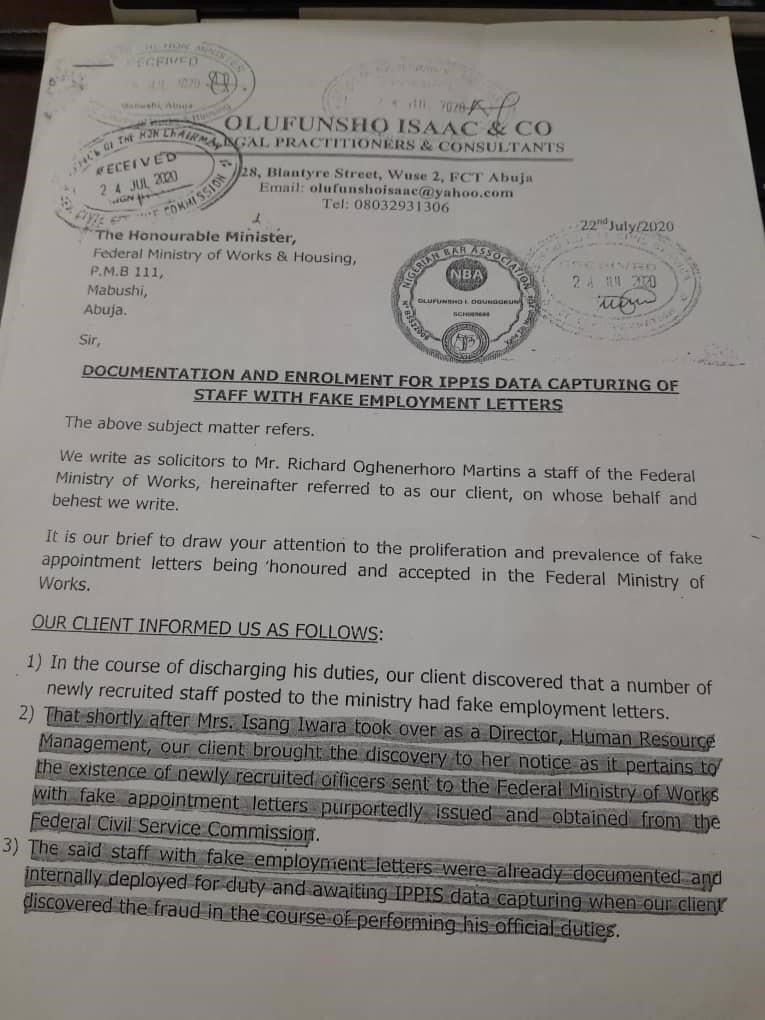
The belief that no action would be taken made a civil servant at the Federal Ministry of Works and Housing (FMWH), Richard Oghenerhoro Martins, look for external recourse. The whistleblowing policy launched in 2016 states that an internal stakeholder can “escalate the matter further” when the issue is not adequately addressed internally.
Martins has repeatedly complained about employment racketeering within the ministry to his superiors but was ignored.
He reported to the then Director of Human Resource Management, Isang Iwara, and other superior officers, like the Deputy Director Appointment Promotion & Discipline – Shehu Aliyu, Assistant Director Bosede Omoniyi, and others, as documents in a petition forwarded by his lawyers to the ministry show.
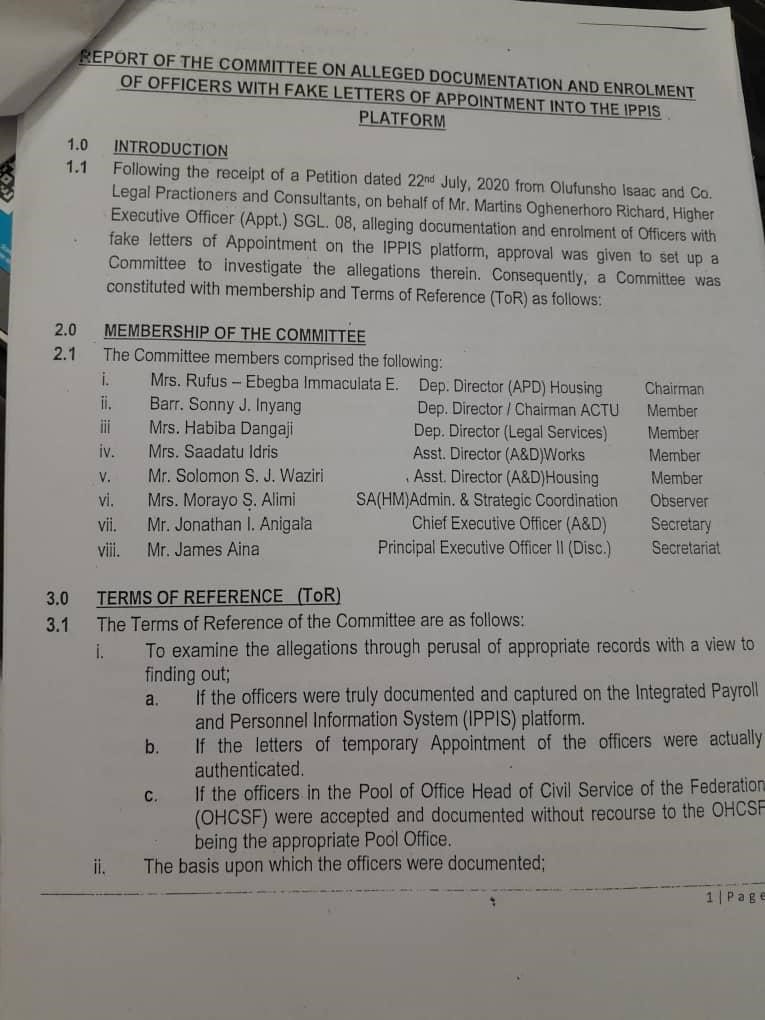
Martins briefed his lawyers to send a petition to the Minister of Works and Housing, Babatunde Fashola, in July 2020, which spurred the setting up of a committee led by a senior official of the ministry, Rufus-Ebegba Immaculata.
The report from the panel investigating the claims from Martins.
Martins said several colleagues intimidated and warned him to stop investigating the prevalence of fake employment in public service, but he was committed to seeing the end to the employment fraud.
The committee, which sat in August and September of 2020, found Martins’ claims to have merit. They found cases of employment manipulation, violation of due process and fake employment documentation.
The committee recommended immediate discontinuation of salary payments to the officers with fake letters and their names were forwarded to the Independent Corrupt Practices and Other Related Offences Commission (ICPC) for further investigation.
The ICPC is one of the investigating agencies of the whistleblower policy.
In a twist of fate, the panel also recommended disciplinary action against Martins, citing a breach of oath of secrecy as contained by the Public Service Rules (PSR).
The petition written to the Minister of Works and Housing from Martins’ lawyers.
The report reads that disciplinary action should be taken against the petitioner, “Mr Richard Oghenerhoro, over his misconduct, breach of oath of secrecy, unauthorised disclosure of official information and abstraction or copying of official documents without approval as enshrined in Public Service Rules 030301 (f), 030415, 030416 and 030417 respectively.”
The director of press and public relations, FMWH, Blessing Lere-Adams, tells The ICIR that there is an internal mechanism to deal with reports on corruption without having to involve the office of the minister.
“Whoever has done that [use external mechanism] does not know the public service rule (PSR).”
“The PSR specifically states if you have a complaint, there is a structure you have to follow, so anybody who goes above that should be questioned,” the spokesperson says.
When asked what happens when the internal structure is followed and no action is taken, Lere-Adams directed and facilitated a meeting with the deputy director Anti-Corruption and Transparency Unit (ACTU), saying he is in the best position to respond.
The head of ACTU, Sonny Inyang, however, says he cannot speak to the press as he does not have the clearance to do so, noting that the public he deals with is the ICPC on issues of whistleblowing and corruption. Lere-Adams, therefore, advised that a letter should be sent to the ministry’s permanent secretary. The ICIR sent the letter which was duly acknowledged, but there is no response as at press time.
The Coalition for Whistleblower Protection and Press Freedom (CWPPF), describes the action against Martins as “one among numerous cases of violations and stigmatisation of whistleblowers”.
“You would think that a government that lays so much emphasis on fighting corruption would be appreciative of citizens who are willing to expose irregularities and corruption in the public interest,” the group says.
The shades of violations against whistleblowers
Godwin Onyeacholem has been at the forefront of advocating for the protection of whistleblowers in Nigeria. “It takes a lot of courage to blow the whistle. You need to know what whistleblowers go through,” he says. “It’s traumatising.”
Godwin Onyeacholem. Image: CORA
Onyeacholem is the project coordinator for Corruption Anonymous (CORA), an initiative of AFRICMIL working to build public support and confidence in the whistleblowing policy introduced by the Nigerian government in 2016.
CORA, set up in 2017, advocates effective protection for whistleblowers. This makes Onyeacholem the ‘go-to guy’ whistleblowers call when they face challenges.
“Whistleblowing constricts their lives because of what they are going through,” he tells The ICIR of his interaction with whistleblowers.
“Friends avoid you. You are alone.”
Accountant Joseph Akeju has lived the experience. Before his retirement, he was a lecturer and bursar at Yaba College of Technology, where he was dismissed twice for blowing the whistle.
“You know it’s natural,” he says, recalling how family and friends blamed and abandoned him.
He is 70 now, when he spoke to The ICIR.
“Some people were laughing at me; some people were calling me ‘Mr Clean’. They were mocking me. They said instead of me to join them and make my own money”.
“Only a few people stood with me,” he adds in a restrained voice.
Compromised by journalists
Akeju, judging from his experience, says he won’t advise anyone to blow the whistle. He also says journalists need to do better with regard to the confidentiality of sources.
“During my time, some of the journalists exposed me to ridicule. They will collect information from me and go and expose me to my boss and tell them I gave them the information,” he explains.
Some of the journalists, he said, collected money from his boss. This, he explained, greatly affected him as the school was able to plan to checkmate his moves.
A mass communication lecturer at the University of Nigeria Nsukka, Gerver Verlumun Celestine, describes the conduct of journalists who breach the confidentiality of sources as “unethical”.
He says such conduct has a far-reaching effect on the source, the journalists, journalism and society.
“If anyone is harassed because he spoke to a journalist in confidence, such a person is likely not to reveal information to journalists again even when such information is needed; the person will be constrained”.
“This will affect the development of the society, investigative journalism will be affected, and things that should have been done to help the society will be retarded”, says the doctor.
The national secretary for the Nigerian Union of Journalists (NUJ) Shua’ibu Leman Usman, confirms to The ICIR that breach of confidentiality of sources “regrettably” happens.
“These things do happen, and they are issues of ethics; sometimes journalists don’t play according to the rules; we have instances where journalists disclosed their sources because they have been enticed with money”, he says.
He adds that they need the corporation of media owners to curb such occurrences. “Media owners have to stand by journalists and insist that they should not disclose their sources,” Usman says.
Compromised by security officials
Since the policy was not in effect in 2008 when Akeju reported irregularities in college funds that were not accounted for, there was no institutional process for whistleblowing. He had to rely heavily on the media to amplify his petition, but that was not the case for an architect Joseph Ameh, who blew the whistle three years after it was launched.
Ameh was head of the physical planning division at Federal College of Education, (Technical) Asaba, when in 2019, he wrote a petition to the ICPC over corrupt practices such as contract inflation and diversion in the institution.
The ICPC contacted the school for more information and eventually began prosecution.
Ameh had expected some level of protection from the investigating agency. “In my petition to ICPC, I wrote my name clearly on it. ICPC was supposed to handle it with diligence, which they did not. They exposed me,” he says.
He had expected them to handle it with discreteness and protect his identity when reaching out to the school, but they didn’t, he says to The ICIR. He received many queries after ICPC sent a memo to the school requesting documents. That was the start of his travail, which led to the loss of his job and the collapse of his family.
The whistleblowing policy states that “It’s preferable individual puts his/her name and contact to any disclosure” but adds that the person’s identity shall be kept confidential to be disclosed only in the circumstances required by law.
That’s not the only way the ICPC affected Ameh.
Ameh says, “When you blow the whistle, you have prepared food for the ICPC officials to eat”. By this, he means the ICPC personnel benefit directly by investigating suspects.
He insists the ICPC officers are corrupt as they use the opportunity for self-aggrandisement. The officers make money from the suspects in exchange for information.
The officers sometimes give advance notice to suspects and employ delay tactics so that they can cover their tracks.
For instance, Ameh says the ICPC prosecutor on the case, whom he calls “Barrister Iwoba” visits the college, and when he confronted her she told him she goes to interview one of the suspects – the registrar.
This, he says, is suspicious because the registrar had already given his statement.
“Somebody that has given his statement to the ICPC in the presence of his lawyers, duly signed and documented by the ICPC; you are telling me you are going to discuss with the person again?” he asks.
He also alleged that statements from the engineer, quantity surveyors 1 & 2 and that of the junior architect were not tendered in court. The ICIR could not independently verify this claim.
Ameh’s petition had fingered Ignatius Ezoem, Ugbechie Linus and Chukwuka Jonas, former provost, former registrar and former director of works respectively, all of whom were taken to court by the ICPC.
Ameh says for the whistleblowing policy to be effective, there must be sanitisation within the commission.
A letter Ameh wrote to ICPC with regards to suspicion of foul play 1A letter Ameh wrote to ICPC with regards to suspicion of foul play (2)
The spokesperson of the ICPC Azuka Ogugua, is yet to respond to questions about the corrupt officers as at press time despite that she requested the questions be sent to her.
In addition, mails sent to the school – Federal College of Education (Technical) Asaba – current registrar Rotimi Adepoju and the deputy provost were not responded to as of press time. Same with the reminders. The email focuses on the school’s mechanism for reporting corruption and reaction to a court judgement to reinstate Ameh.
Delayed by prolonged justice system
“They dismissed me twice, but they reinstated me twice”, Akeju, the accountant, tells The ICIR
The first reinstatement was due to the efforts of the then-new rector, who he said was “Dr Mrs Ladipo”, who created room for dialogue between his lawyers and the institution.
“I took my case to Federal High Court Ikoyi. It was after we had been in the court for more than six years that the judge told me I was in the wrong court,” explains the retired accountant.
“That was when they referred me to the industrial court.”
A major challenge facing whistleblowers is what Onyeacholem describes as the ‘legal abuse syndrome’. This arises from the long, winding court battles the whistleblowers have to endure.
“It comes from realising that you are suffering from ethical violation, legal abuse, fraud. The prolonged nature of the justice system makes you go mad,” the advocate for whistleblower protection states.
Why whistleblowers go to court
Whistleblowers end up in court for many reasons—serving as a witness for the government or to stop intimidation against them, which can be withholding of salary, suspension or even illegal dismissal from work.
A whistleblower Sambo Abdullahi, a Nigerian Bulk Electricity Trading (NBET) staff, had to go to court to get the management to pay his suspended salaries.
Abdullahi discovered illegal overpayment running into billions of naira in his organisation and blew the whistle. This led to the suspension of his salary starting in 2017. He filed a suit in 2018, and in 2020, he was still battling the case.
The ICIR reached out to the spokesperson for Nigeria Judicial Council (NJC) Soji Oye, but his mobile number was not connecting.
A text was sent to that effect. Furthermore, The ICIR reached out to the helpline on the council’s website; after some back and forth, the representative confirmed that Oye was not available, asked that the questions be sent to the council info mail; this has been done.
As at press time, the council is yet to respond to questions around delayed court cases and how it impacts negatively on whistleblowers and the policy. Same also with the reminder sent.
SLAPP compromising whistleblowing
“The process of getting this justice also traumatises them due to the insanity of the legal system,” says Onyeacholem.
“The organisation might even decide to sue. That’s another form of intensifying the punishment. They take you to court for exposing their corruption.”
This is known as Strategic Lawsuit Against Public Participation (SLAPP).
A journalist, Jaafar Jaafar, was at the receiving end of SLAPP in 2018 after exposing the Governor of Kano state, Abdullahi Ganduje, for collecting ‘bribe’ and pocketing the currency notes away in his kaftan. The incident has come to be known as ‘Gandollar’.
The purpose of SLAPP is to “intimidate and shut up” whistleblowers, says Onyeacholem.
What many people were not aware of at the launch of the policy is that despite the flamboyant assurance of protection by the then minister of finance, the government placed the burden of fighting corruption in the hands of the public without the requisite legal backing.
The then minister aptly described it as a “stop-gap” initiative until the National Assembly formally passes a law on whistleblowing. It’s seven years later, the policy is yet to get the needed backing. This leaves whistleblowers exposed.
PICA – the clipped bird
After blowing the whistle, Joseph Ameh had two court cases to deal with—one in Asaba and the other in Awka, in addition to having to come to Abuja.
The ICPC eventually began prosecution. This meant Ameh appearing in court in Asaba. On the other hand, he was dismissed from work: this meant instituting an illegal dismissal case against the institution at the National Industrial Court in Awka.
Ameh said at some point, he had to travel to Abuja with regards to the petition every fortnight, all bills on him.
“There is no provision to protect the whistleblower. When you blow the whistle, you are on your own,” says Ameh.
“Every two to four weeks, I will go to Abuja by night bus. When I am done with them by day, I will take the night [bus] as a cheaper way. Sometimes it requires me to stay back and do some documentation, and the entire cost of lodging was on me,” he adds.
Letter terminating Ameh’s employment.
The whistleblowing policy domiciled with the Ministry of Finance Budget and National Planning and is implemented by Presidential Initiative on Continuous Audit (PICA). One of the heads of PICA, Johnson Oludare, confirmed to The ICIR the whistleblower bears the financial burden involved.
“If any of our investigating agencies will need him to be in court, maybe as a witness or whatever reasons, I guess he will have to find a way to because when the benefit comes, whatever incidental expenses can be subtracted from it,” he says.
By ‘benefit’ Oludare refers to financial reward a whistleblower is entitled to, anywhere between 2.5 per cent and 5.0 per cent of the total amount recovered.
Oludare says the policy lack of legal backing means no funding, “If the policy gets legal backing, we can be talking about the funding for the programme, but as it stands today, it’s just a policy,” he explains.
Joseph Akeju’s life came to a standstill after blowing the whistle.
Lack of legal backing compromising whistleblowing
Whistleblowers like Murtala Ibrahim, an internal auditor of Federal Mortgage Bank of Nigeria, who was punished and later dismissed for exposing malfeasance, are continually subjected to all kinds of punishment for reporting fraud and corrupt practices in their offices.
This is because there is no legal instrument backing it.
A human rights lawyer and senior counsel at Ephesis Lex Attorneys and Solicitors, Abdul Mahmud describe the implementation of the whistleblower’s policy as a “dismal failure” due to a lack of a legal backing.
“A policy is a direction of intent, and where it is not backed by law, no effective legal remedy can be derived from it”, Mahmud notes.
Onyeacholem, like many other advocates, believes that “the duty to blow the whistle can only be enhanced when citizens know that once they blow the whistle, there will not be retaliation, or if there is retaliation, they will be protected.
He adds that advocacy to get “whistleblower protection law” is ongoing. A draft bill has been approved by the FEC.
Oludare of PICA confirmed this. He says plans are underway to upgrade it into law. On December 14 last year, the FEC approved the council memo sent to them from the Ministry of Finance. Next is the transmission to the national assembly, Oludare of PICA says.
Relevant stakeholders – investigating security agencies and CSOs are working on getting the policy status upgraded – passed by lawmakers and assented to by the president – before the end of his tenure this May.
“Once we get the law, it will protect me, you or anybody who blows the whistle,” Oyeacholem says.
UPDATE:
NJC’s response
The NJC, in reaction to email enquiries by The ICIR on delayed court cases and how they impact whistleblowers, notes that “cases are supposed to come before the Court after the Police or similar investigating bodies have concluded its investigation and the Court for the smooth hearing and adjudication of the case. Regrettably, this is not always the case, as most of the matters are brought to Court before investigations are concluded. The prosecution is compelled to seek for adjournments to give them more time to prepare their case, and a charge is filed in Court.”
The commission spokesperson, Oye, says the speed with which a matter is concluded is largely in the hands of the prosecution and defence counsel.
“The Court, by Law, can do very little to hasten its proceedings. Proceedings are largely due to either the prosecution not diligently conducting its case or the defence deliberately exploiting the gaps in our Laws to frustrate the progress of the matter.
“Regrettably, the public does not get to understand this constraint,” Oye says.
He went on to note that the NJC deals decisively with judges found to have unduly delayed proceedings and conducted themselves in a manner unbecoming of a judicial officer.
This they do after receiving a complaint or petition.
Note: The last part of the report – NJC’s response – was updated after publication. That was when the response came.
**This story is funded by The Centre for Journalism Innovation and Development under the Media Freedom Project through Justice for Journalists Foundation.**
The Police in Imo State say Ikechukwu Ojokoh, a dressmaker, is a member and the coordinator of the Indigenous People of Biafra, IPOB, in Mbaise. The Police also said he partook in the murder of five policemen in the state and would soon be charged with murder. But Ojokoh’s family members and neighbours insist that he is innocent and neither an IPOB member nor a murderer, arguing that he was arrested at a market close to his shop and was already in police detention when five policemen were killed. Arinze Chijioke who travelled to Umuokirika Community in Mbaise Local Government Area reports.
Ikechukwu Ojokoh’s daily routine begins with a morning prayer with his family, including his wife and five children, after which everyone goes about their normal business. While he goes to the shop where he makes dresses, his wife, Maureen, goes in search of palm kernel which she uses to make red oil and sells after making food. Their children go to school.
On Saturday, April 15, as it is customary, Ojokoh, a native of Umugwa Umuokirika in Ahiazu Mbaise Local government Area in Imo state and his family had their prayer after which he and his wife left the house. As he headed towards his shop, she went to the popular Afor Oru market to buy foodstuffs and prepare breakfast.
After he opened his shop by the roadside, Ojokoh also went into the market to get some clothing materials for his work. The time was exactly 11.00 am and the date for the rerun election of the House of Representatives and state houses of Assembly elections in the state.
“On my way back, I saw him, but he was walking briskly. I was some steps backwards and all of a sudden, a vehicle raced passed the both of us,reversed and stopped at where he (Ojokoh) was,” Maureen said.
According to witnesses, immediately, some officers in uniform came out of the vehicle and assaulted Ojokoh. He fell to the ground and questioned why he was being beaten, but the officers kept beating him. They pulled his shirt and used it to tie his eyes. When people around the market tried to gather, the officers brandished their guns and dispersed the crowd, they dragged him into their vehicle and sped off.
Witnesses say the officers were men of the Nigeria Police Force, Imo state command, who had come to arrest Ojokoh on the allegation that he was a member of the Indigenous People of Biafra (IPOB).
“I ran after them, together with his sister. We did not know where they took him,” Maurine said. “We kept searching till 4.00 pm that day, and when we returned around the market, distressed and shivering, I saw a Sienna car parked in front of his shop and when we explained what had happened, the occupants, who looked like security officials, asked us to describe my husband and that we should go to Tiger Base, the Police detention facility in Owerri”.
Immediately, Ojokoh’s sister called one of their brothers, Paul Ojoko, in Owerri, who went to the station. When he got there, he saw the officers dragging him out of their vehicle with his eyes closed and when he asked what was happening, he said they pushed him aside and forced Ojokoh into a cell.
Framed for murder
On April 21, six days after Ojokoh’s arrest, gunmen attacked and killed five policemen at Ngor-Okpala local government areas in Imo state. While some reports say the officers were ambushed at a local restaurant, others say that the officers, who are attached to the Mbaise/Ngorokpala Area Command, were on patrol of the area when they were attacked.
On April 30, the Imo State Police Command issued a statement that they had arrested the men who were behind the murder at their hideout in Umuahia, Abia state. The police also said that a 48-year-old man, Mathew Chukwuma of Mpam Ahaizu Mbaise, who was arrested in his hideout at Umuahia, Abia State confessed to being the Sector Commander of a dreadful IPOB/ESN syndicate in Mbaise and also assisted “curious operatives in arresting three (3) of his syndicate.
Ikechukwu’s wife has not been herself after the arrest and detention of her husband
According to the statement, among those arrested were Ojokoh,53 years ‘m’ of Umugwa, Chilaka Charles 44 years ‘m’ of Umuezuo, and Anthony Iwu, 50 years ‘m’ of Umugwa all in Umuokiria. The police said others escaped.
Ojokoh, who was in the custody of the police even before the attack, was eventually paraded along with others by the Imo State Police Command, which said that they had admitted to killing the five officers.
But the Ojokoh’s family members have refuted that he was arrested in Abia state.
“Ojokoh was never arrested at any terrorist hideout but Afor-Oru market, said his cousin, Ikechukwu Amaechi. “He was in police custody six days before the attack and could not have taken part in it”.
Maurine and her husband have been married since 2000, and in all these years, she said he had never told her he had issues with anybody.
“He is not a thief, he neither fights nor looks for trouble, he only minds his business,” she said, tears welling up in her eyes. “You can move around and ask. Now, the police are accusing him of a crime he did not commit,”.
Since the arrest, Maurine has not been herself. Her eyes hurt from crying. She has also not been working. Now, she depends on free will donations by those who know her husband to survive and feed my children, five of them. Sometimes, she borrows money that she hopes to pay back when he is released.
Friends, neighbours say he is a good man
At Afor Oru market, where Ojokoh has plied his trade for over two decades, the mood is sombre. His neighbours and friends cannot still wrap their heads around his arrest and detention, worse still, the allegation of murder.
Ikechukwu’s shop under lock and key
Every day, they come out, expecting to see him back and working again. Some of those who spoke to The ICIR described him as easy-going and someone who was focused on his business.
Emeka Ogu, a welder who works directly opposite Ikechukwu’s shop has known him for over 15 years now and within this period, he said Ojokoh has been a peaceful man.
Ogu, who was present the day Ojokoh was arrested, said that freewill contributions were being made as part of efforts to secure his release because he is innocent of the charges against him.
Nzenwa Christopher, a printer, has known Ojokoh for three years now. He told The ICIR that he (Ojokoh) had a name for everyone around his workplace, that was how jovial he was.
“Each time you passed, he would call you and say hello, he is loved around Afor Oru,” Christopher said. “He has not had any issues since we knew each other, I am still surprised at his arrest
The traditional ruler of Umuokirika community, S.P. Iwu says Ikechukwu is innocent of the charges against him
The traditional ruler of Umuokirika, Ikechukwu’s community, Eze S.P. Iwu said that plans were underway to see the commissioner of Police in the state concerning the issue because he is innocent of the allegations.
“Ikechukwu cannot hurt a fly, he is a young man about his occupation, “he said. “I have known him from childhood and the fact that people want to know when he will come out shows how much they love him,” the chief told The ICIR.
Rights group petitions IGP over wrongful arrest
Following the continued detention of Ojokoh, a human rights organisation, the Rule of Law and Accountability Advocacy Centre (RULAAC) petitioned the Inspector-General of Police (IGP), Usman Baba, seeking a prompt and impartial investigation into his wrongful arrest and parading over the murder of the officers.
In the petition, Executive Director, Okechukwu Nwanguma, said that it was both curious and ironic that Ojokoh, who was arrested on April 15 and still being detained at the Tiger Base Owerri as of April 21 when the attack was carried out and has not been released up to date, was paraded alongside others alleged to have carried out that same attack.
“Ojokoh’s family members were hoping that the police would have finished their investigation and cleared him of any links with IPOB or charged him to court,” he said.
Nwanguma noted that while the attack and killing of police officers at Ngor-Okpala junction was unjustifiable and all those responsible should not be spared the maximum penalty permitted by law, parading a man for a crime committed while in police custody raises serious concerns and questions and calls for a careful investigation to ensure that an innocent person is not accused wrongly or made to pay the price for a crime he did not commit.
Inside Ikechukwu’s shop
“Okojoh’s family seriously fear his life because most people arrested by the police in Imo State and labelled IPOB members have usually been executed extrajudicially or disappeared,” he said.
In the petition, Nwanguma also drew the IGP’s attention to what he described as the attitude of many policemen in the Southeast who now “presume everyone accused of being an IPOB member of having automatically lost their constitutionally guaranteed rights to due process, including the presumption of innocence until otherwise proven in a fair trial.”
He said that the presumption is a dangerous attitude that has led to the murder of many innocent citizens, adding that summary executions and extrajudicial killings can have ugly repercussions including creating a cycle of violence.
Nwanguma asked that Ojokoh be released or charged to court if he has any case to answer and that his family and legal representatives should also be allowed access to him.
A violation of rights
A lawyer Chukwudi Unah, who is an associate at Charles Anthony (Lawyers) LLP said thatit is clear that Ikechukwu would not have taken part in the act since he was in detention even before it occurred.
He explained that where the police wrongfully arrest an individual for an incident he knows nothing about, all he needed to do is to raise the plea of alibi timeously at the Police and where they fail to investigate his alibi plea, the accused person would be discharged and acquitted by a competent court.
“He can then sue for defamation of character and violation of his rights as he would insist that the Police had no reasonable grounds whatsoever to have commenced the prosecution, “he said.
He, however, noted that the Police enjoy wide powers of investigation and prosecution, and the court cannot interfere with the same, except where it is evident that such prosecution is malicious and or where the Police fail to prove their case beyond a reasonable doubt.
He further explained that for the assault and dragging into the police vehicle, he can sue for violation of his constitutional rights provided and guaranteed under sections 34 and 35 of the 1999 Constitution of the Federal Republic of Nigeria (as amended).
Donatus Ojokoh, elder brother to Ikechukwu
Donatus Ojokoh, Ikechukwu’s immediate elder brother, said that the family, through their lawyers, had already written to the Commissioner of Police in Imo state, Mohammed Barde, asking him to warn his officers against infringing on Okojoh’s rights and also allowed his family members to have access to him.
“But I was warned not to ever come in search of him again,” he said.
“We are suing for defamation of character at the federal high court in the state,”. “We decided to sue the Police to discharge and acquit him through the court because if he continues to be in Police custody, they may waste him”.
By “waste” Donatus means he can be killed extra-judiciously.
Unah, the lawyer, said that although the family can sue for defamation of character, that would fail if the Police succeed on the charges against him.
Trials by ordeal, extra-judicial killings
Lending his voice, Chairman, Board of Trustees of the International Society for Civil Liberties and the Rule of Law, (Intersociety) Emeka Umeagbalasi, said that the development is a clear case of false labelling and criminalisation driven by corrupt and biased intelligence.
Umeagbalasi, a criminologist, said that Intersociety had done several investigations with its findings showing that over 90 per cent of those killed by security forces or paraded as IPOB members in the region are cases of wrong accusations obtained outside the confines of a diligent criminal investigation.
According to him, it is worrisome that the fundamental elements of criminal investigation and their principles as well as “man-machine driven intelligence” have collapsed in the operations of security forces in the Southeast.
“What we now have is trial by ordeal and prosecution of security operations on the basis of hearsay, “he said. “There are selective approaches to issues of security, insecurity and other unsafe conditions in the region, and this has messed up the operational and administrative competence of the Police,”.
In his reaction to the killing of seven youths, including two siblings,by officials of Nigeria’s southeast regional security outfit, Ebubeagu on 17 July 2022,at Awomamma community in Oru East Local Government of Imo state,Osai Ojigho, the then Director of Amnesty International Nigeria said, “Instead of launching proper investigations into killings in the region, security and government officials are often quick to claim victims of extrajudicial executions were caught up in shoot-outs or simply label them members of the Eastern Security Network (ESN), the armed wing of the Indigenous People of Biafra (IPOB) or unknown gunmen,”.
She said that Amnesty International Nigeria has documented several cases of extrajudicial executions, enforced disappearances, mass arrests, torture, extortions, and ill-treatment by law enforcement officers and members of the Ebubeagu security outfit responding to the violence in the Southeast.
For instance, the organisation said that it documented 52 incidents of unlawful killings and 62 cases of arbitrary arrest, ill-treatment and torture across Anambra, Imo, Ebonyi and Abia states from January 2021 and that at least 115 persons were killed by security forces between March and June 2021.
Ever busy Afor Oru market where Ikechukwu was beaten and dragged into a truck
In May 2021, the Imo state government announced the arrest of at least 400 people for allegedly being linked to insecurity in the state. However, the organization’s investigation showed that most of those arrested were randomly picked up in their homes and off the street and had nothing to do with ESN.
“Some victims told Amnesty International that they were arrested while walking in the street, at a public bar or simply for having birthmarks or tattoos on their body, “it said.
Back at Afor Oru and the entire Umuokirika community, residents say they cannot wait for Ojokoh to be released. It is going to be a celebration of some sought for the good man.
He admitted to being a member of IPOB – Police
However, while Ojokoh’s family and friends insist that he is not a member of the IPOB, the police in Imo state claim that he is has confessed to not only a member of the group but also its coordinator in Mbaise.
In an interview with The ICIR, Imo State Police Public Relations Officer, Henry Okoye, said that Ojokoh had volunteered confessional statements under caution to him on video record that he is not just an IPOB member but the one coordinating the group and the ESN in Mbaise.
On the question of why he was accused of murder even though he was in detention when the crime was committed, he said, “it is a question of conspiracy, and it does not matter whether or not he was present at the scene of the crime”.
“He will still be punished for it” the police spokesperson stated.
Speaking further, he said, “Ojokoh confessed to me that they had been holding a series of meetings on how to attack our personnel attached to Ngor Okpala and Mbaise on April 21. As the coordinator, he does not have to be present for the activity to be carried out”.
Okoye claimed that other IPOB members, including those who were arrested following the murder of the officers, identified him (Okojoh) to be the one coordinating their affairs.
He said that the Police will arraign Ojokoh in court as the case is being handled diligently, adding that they will also respect the rule of law to ensure that Ojokoh is given a right to a fair hearing.
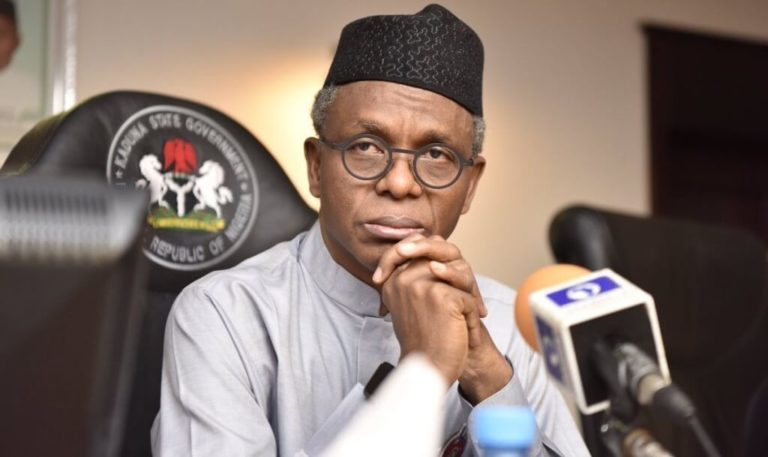
KADUNA State governor Nasir El-Rufai has accused some of his predecessors of stealing state resources to build houses in Dubai, the United Arab Emirates (UAE), and other places.
El-Rufai made the allegation during a valedictory media chat on Sunday, May 21, on the Hausa service KSMC, a state-owned radio.
He challenged past governors of the state to face the people and swear with the Holy Qur’an that they never stole from government coffers.
El-Rufai claimed he did not steal a dime from the state’s treasury.
“I can swear I never stole a kobo from the government coffers.”
The governor, in the same vein, gave his administration a pass mark in infrastructural development.
“The work we have started and the quality of the works, we are going to spend years enjoying them. It is not the type of roads they did in the past that, after two rainy seasons, the roads will spoil. These works we are doing, we are doing them with quality.
“I am happy with what I have seen, but there is still more to be done, because to us, we want people to enter Kaduna and see no untarred road anywhere.
“That was our wish, but due to the difficult circumstance our government met, we couldn’t do everything we planned to do, until we had to borrow before we could do what we did.”
A PRIEST with the Okigwe Catholic Diocese in Imo State, Rev. Fr. Jude Maduka, has been kidnapped by unknown gunmen.
The priest was abducted on Friday, May 19, while preparing for Sunday’s Eucharistic Mass celebration.
A statement issued by the Catholic Diocese of Okigwe confirmed the abduction of Maduka, who is the Parish Priest of Christ the King.Parish, Ezinnachi/Ugwaku, Okigwe Local Government Area of Imo State.
He was kidnapped at the New Adoration site in Ogii village.
Official statement from the Catholic Diocese of Okigwe confirming the Priest’s kidnap
The Imo State Police Command is yet to comment on the development.
Kidnapping and terrorism have been major concerns under President Muhammadu Buhari’s tenure, a situation which led to senior clerics meeting the President for a lasting solution to the menace.
The Buhari administration has been rated low on security, despite billions of naira spent to curb insecurity.