


NIGERIA’S arts scene is vibrant, anchored by established, content-driven festivals such as ALITFEST, KabaFest, LIPFest, the Ake Arts & Book Festival, and the WRR ‘Words Rhymes & Rhythm’ Poetry Festival.
While these platforms largely spotlight literature, poetry, and spoken word, often through poetry slams, their prominence does not signal a lack of innovation in stage performance. Instead, they exist alongside a quieter but growing wave of experimental theatre.
One visible bridge between these worlds is Dike Chukwumerije’s ‘Simply Poetry’, a hybrid form that blends theatre, choreography, and poetry. Beyond such mainstream expressions, smaller collectives are pushing the boundaries of storytelling in ways still emerging within the Nigerian performance landscape.
Among them is the Hearts Heartist Foundation, led by creative movement artist Bukunmi Olukitibi. Through community-based programmes, the group introduces young people to performance as a tool for expression, confidence-building, and storytelling. Their work took a striking turn with the adoption of shadow theatre; a form rarely explored in Nigeria.
Shadow theatre uses light, silhouettes, and movement to construct layered narratives behind a translucent screen. In 2013, a shadow theatre group, Attraction, became a viral sensation following their performing to Emeli Sandé’s “Read All About It” during their audition on Britain’s Got Talent. They acted a story of a couple who fell in love, marry, and had a child before the father left for war and died. The performance ends with the mother and child at the father’s burial place. Attraction eventually won the competition bringing global attention to shadow theatre.
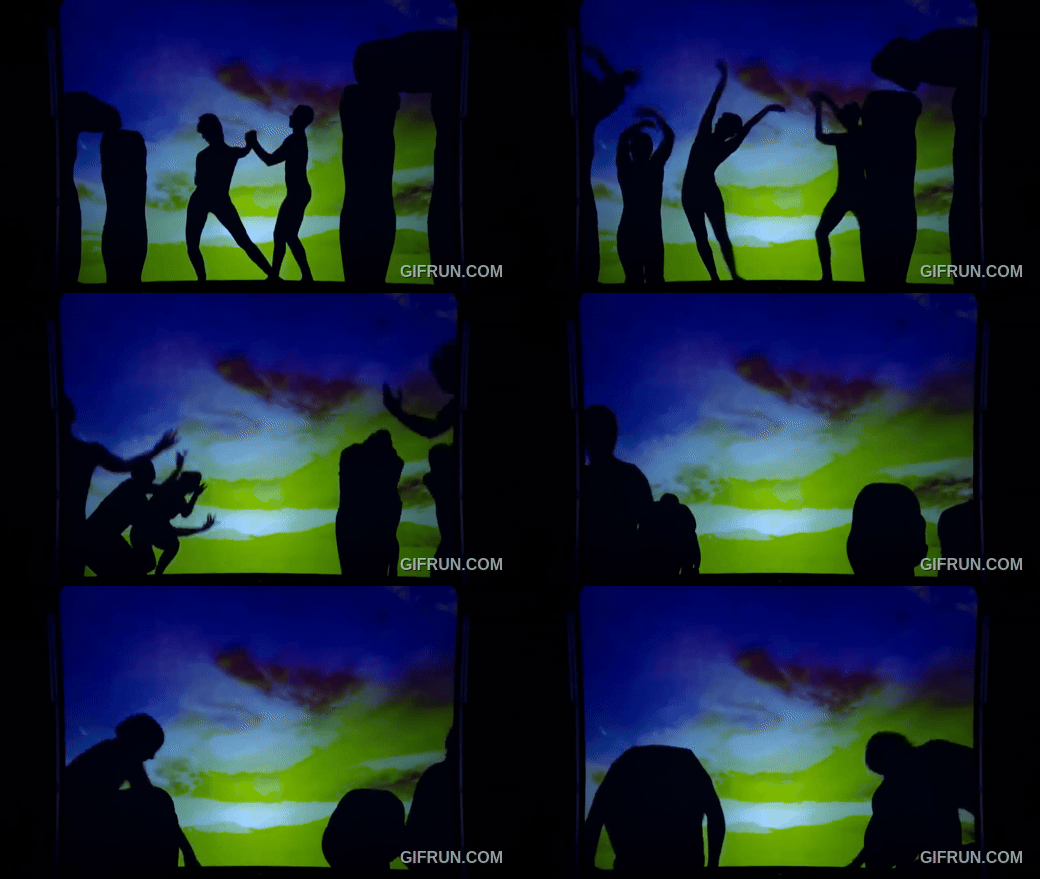
In ‘Journey of Dreams’, one of the foundation’s productions, children served as the primary performers, transforming their bodies and simple props into shifting visual canvas. The result was a performance that diverged sharply from conventional stage drama.
The staging itself reflected this departure. The performance space was split in three. The audience sat informally on rugs and throw pillows, while the stage hidden behind a large white curtain became a canvas for light and shadow. The third part, behind the stage, is the changing and transition room. Rather than acting in front of the curtain, the story unfolded through silhouettes behind it, demanding a different kind of discipline from the performers. Beyond memorising lines and choreography, the children had to understand spacing, timing, and the interplay of light and form.
Directed by David Olukitibi, the production was the culmination of weeks of rehearsals involving about 20 children from communities around the Federal Capital Territory, including Dei-Dei, Saburi, Kubwa, Gaduwa, and Utako. For many, it was their first encounter with shadow theatre.
According to Olukitibi, the choice of form was a deliberate attempt to experiment with new storytelling possibilities. The narrative itself reflects contemporary Nigerian realities, exploring themes of unity, conflict, and the consequences of ethnic intolerance. The piece shows how two communities lack of tolerance for each other led to incessant clashes resulting in fatalities, including that of the princess.
For the children, the experience extended beyond performance. The programme, which spans over 10 weeks, combines theatre with other activities such as tie-dye and environmental projects, creating a holistic creative environment. The aim, Olukitibi explains, is early exposure embedding artistic discipline and confidence at a formative stage.
“It’s a way to engage them from a very early stage,” Olukitibi said, so that by the time they get older, they become professionals.
Amina Ezekiel, whose two children participated, described the programme as transformative, noting increased confidence, social exposure, and a stronger sense of self-expression.
“The impact is that they are able to stand on their own to be able to defend themselves. It exposes them to the world positively,” she said.
Another parent, Juliet Michael, said she had never encountered shadow theatre before but was impressed by the production’s creativity and execution.

The process was not without its challenges. Diana Liabo, a theatre practitioner from Germany who worked with the group, noted that shadow theatre requires performers to exaggerate gestures and rethink presence, since facial expressions are invisible. Learning to “act with light” proved to be one of the most demanding aspects for the young cast.
For the performers, the format offered unexpected freedom. Solomon Joseph, who played multiple roles, including a warlord, prince, and dancer, explained that quick transitions were possible with minimal costume changes, thanks to the anonymity of silhouettes.
Despite its novelty, creative practitioners believe shadow theatre holds promise in Nigeria. Samson Kukogho, an award-winning poet, novelist and literary promoter, sees potential for the form to become commercially viable.
“I’ve seen this before”, he told The ICIR, “I think it does have potential to be commercially viable. The problem, as you well know, is the enabling environment for it to thrive.”
He explained that there were many viable art forms in the country “but so little support, from both government and private sector, to encourage anyone to take on their development as a full-time hustle.”
Bamas Victoria is a multimedia journalist resident in Nigeria.