UNITED States Congressman, Riley Moore, has urged the Nigerian government to take swift and decisive action against armed groups in the Middle Belt.
In reaction to the abduction of children and teachers from St. Mary’s Catholic School in Niger State on Friday, Moore in a post on his X handle on Saturday, expressing outrage over the reported attack.
“We now know that more than 300 children and 12 teachers have been kidnapped from St Mary’s Catholic School in Nigeria. As a father, seeing these attacks makes my stomach turn,” he wrote.
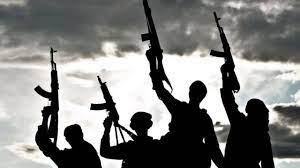
Moore called on authorities to ramp up efforts against those responsible for the violence, insisting that the government “must disarm the radical Muslim Fulani militants terrorising the Middle Belt.”
“The Nigerian government must disarm the radical Muslim Fulani militants terrorising the Middle Belt. The persecution of Christians in Nigeria is escalating out of control. I believe it is now a genocide,” the congressman wrote.
He urged stronger collaboration between Abuja and Washington to tackle insecurity and warned that continued attacks could prompt action from the US administration.
“It is up to the Nigerian government to work with the United States to stop the killings and kidnappings of our brothers and sisters in Christ. This human tragedy has to end, or else, @POTUS has made it clear that he will take action to stop this tragedy,” he added.
Moore comments come amid a wave of abductions and violent attacks on boarding schoolgirls in northern Nigeria.
The ICIR reported on Monday that gunmen stormed Government Girls’ Comprehensive Secondary School in Maga, Kebbi State, kidnapping at least 25 students.
A teacher was killed while trying to protect girls during the attack and a security guard later died in hospital from gunshot wounds.
An official of Danko Wasagu council, Hussaini Aliyu, told the BBC on November 19 that two girls among the 25 students managed to escape, explaining that the girls ran away across farmland as their armed captors were leading them into the bushes.
Aliyu added that though one of the girls needed medical treatment because she hurt her leg while running in the bushes, the girls were “back and are safe.”
Since Monday, a team of soldiers, police and volunteers have been combing forested areas in an attempt to rescue the students, but gunmen stormed St. Mary’s Papiri Private Catholic Secondary School in the Papiri community of Agwara Local Government Area, Niger State, in a fresh attack and abducted scores of students and teachers, in the early hours of Friday November 21, making it the second mass abduction within a week.
The recent attacks have led the federal and state government issuing directive over the total shutdown of public and private schools across the country over security threats, as many of the unity schools across the country had started complying by shutting down and asking students to vacate.
The ICIRreported that the Director of Senior Secondary Education at the Federal Ministry of Education, Binta Abdulkadir, directing the shutting down all 41 Unity Schools in the country with immediate effect over growing spate of abductions.
Similarly, the Plateau, Katsina, Taraba, Adamawa, and Niger State governments directed the immediate closure of all basic schools respectively between late Friday and early Saturday citing urgent need for preventive action.
Moore held a meeting with a Nigerian delegation led by National Security Adviser Nuhu Ribadu on Wednesday in Washington, DC, and he said their discussion focused on counterterrorism strategies and protecting vulnerable communities, describing the engagement as frank, honest, and productive.
The Nigerian delegation included several top government and security officials, including the Minister of State for Foreign Affairs Bianca Ojukwu; Inspector-General of Police Kayode Egbetokun; Attorney-General of the Federation Lateef Fagbemi (SAN); Chief of Defence Staff General Olufemi Olatunbosun Oluyede; and Chief of Defence Intelligence Lt Gen Emmanuel Undiendeye, among others.
The Minister of Information and National Orientation, Mohammed Idris, said during an interview on Channels TV on Friday that meeting is in response to the decision of US President Donald Trump who said that Christianity faces “an existential threat” in Nigeria, warning that if the Nigerian government fails to curb the killings, the US response would be fast, vicious, and sweet.
Idris, said that the Nigerian delegation in the US is working to correct what he described as misleading narratives about the country’s security situation, particularly allegations of religious persecution.
BARELY a day after the abduction of schoolchildren in Kebbi State, residents and worshippers in Eruku town, Ekiti Local Government Area of Kwara State, were thrown into panic as armed bandits attacked a local Church.
In a live-stream video seen by The ICIR, the worshippers, including children and elderly persons, were singing and waving their hands in devotion when sporadic gunshots rented the air across the premises.
The congregation, led by three young men, ran toward what appeared to be an exit to seek safety, but that would not save them from the ravaging bandits who had apparently surrounded the building.
About five bandits descended on those still in the Church, beat some worshippers and continued shot indiscriminately, sending the community into unspeakable terror.
In the aftermath of the incident, at least two people were confirmed dead by the Kwara State police command in a statement on Tuesday, November 18. The command confirmed that the attack, which occurred around 6 p.m., led to the death of one Aderemi, and Tunde Asaba Ajayi, a vigilante.
However, several people were abducted, including the pastor, while others escaped with injuries.
A troubling pattern
The ICIR reports that the attack is part of a troubling pattern in Kwara State. While there have been moments when the violence seemed to be slowing, each time it appeared under control, another wave of attacks struck, spreading fear among residents and disrupting daily life.
Between September and October, the police and state government frequently reported neutralising the bandits and overtaking of their camps in various parts of the state. These operations, according to officials, were part of ongoing efforts to curb banditry and restore security to communities that have been repeatedly attacked.
Despite these claims, residents said attacks on their communities continued, with many now displaced or in bandits’ captivity.
207 people killed in 10 months
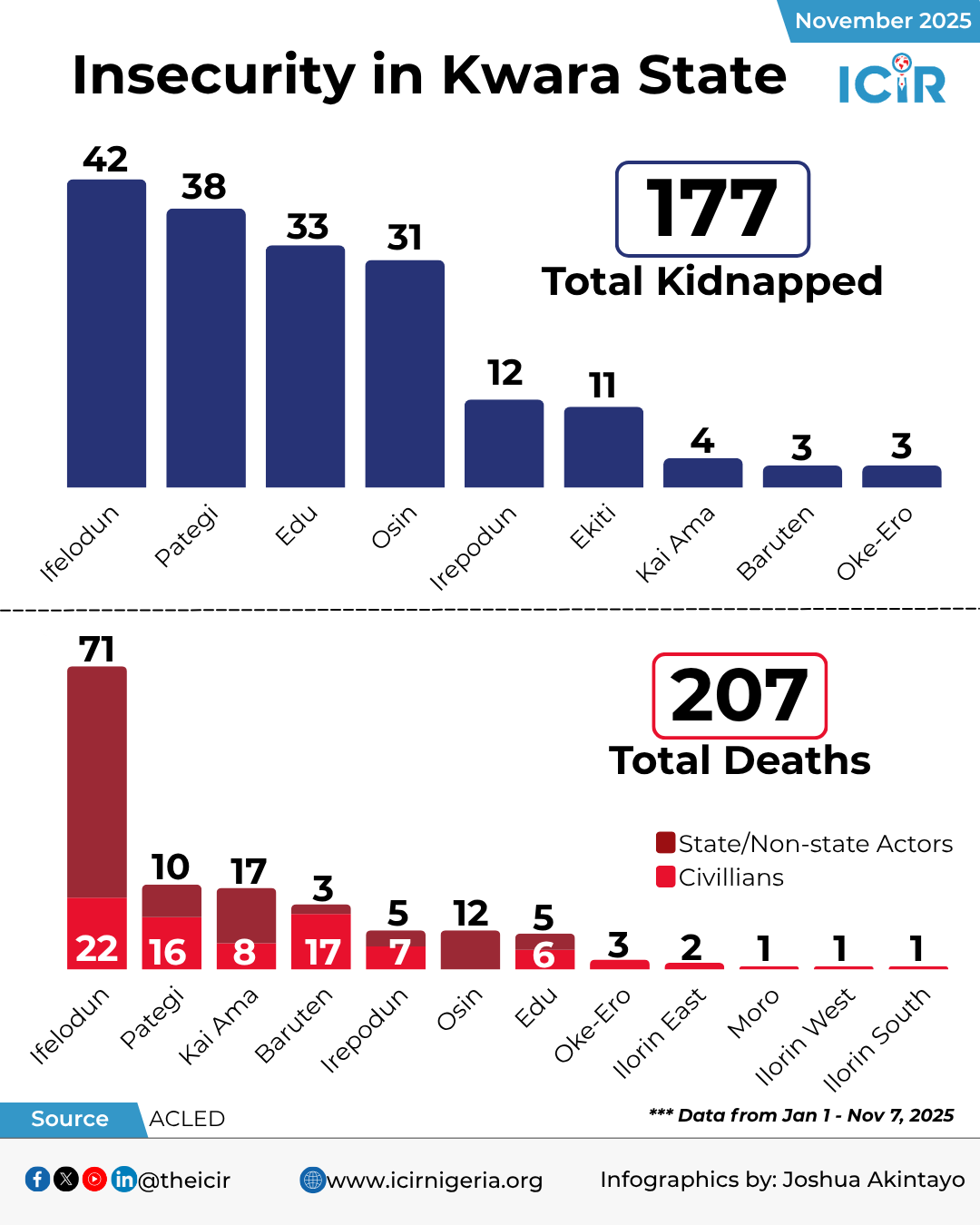
Between January 1 and November 7, 2025, at least 207 people were reportedly killed in the state, including 84 civilians.
During the same period, 177 individuals were abducted, with the highest number of victims in Ifelodun, Pategi, Kaima, Irepodun and Osin LGAs.
The data sourced from the Armed Conflict Location & Event Data (ACLED), which tracks violent incidents across Nigeria, including attacks by bandits, herders, and other non-state armed groups exploiting ungoverned areas, showed that on average, this translates to roughly two death every three days in the state.
Infographics showing the number of deaths and kidnappings in Kwara State between January and November 7.
Out of the 207 killed, 84 were civilians, while 123 deaths were linked to state or non-state actors.
The ACLED’s dataset distinguishes civilian-targeted deaths but does not clarify whether state or non-state actors were involved in other fatalities unless noted in the “notes” column.
The ICIR could not independently verify whether the 82 individuals killed were security operatives, including local vigilantes, or bandits killed during gun duels.
What we could confirm is the multiple deaths of vigilantes in some of these Kwara communities since January. For instance in September 2025, the terrorists killed over 15 vigilantes and hunters after invading Oke-Ode community in Ifelodun Local Government Area of the state. The armed men abducted an unspecified number of residents during the attack.
In another instance, in April 2025, armed terrorists attacked a vigilante group in Kemanji, Kaiama local government area of the state, killing over 15 members and villagers.
The majority of fatalities were concentrated in four LGAs with Ifelodun recording the highest deaths of 93 fatalities, nearly half of the state’s total. This included 22 civilian-targeted and 71 deaths associated with state or non-state actors.
Pategi followed with 26 fatalities, including 16 civilians. Kaiama and Baruten also recorded high numbers. Together, the four LGAs account for 164 out of 207 deaths (79.23 per cent), showing that most attacks are geographically concentrated in that area.
Some of these LGAs either border Kogi or Niger states or are in close proximity to them, making them accessible to armed groups operating from or moving through neighboring LGAs that directly border Kogi or Niger, states that have experienced insecurity in past years.
For instance, while Ifelodun does not directly border Kogi or Niger, it is close to both, particularly Kogi, located in central-east Kwara. Its high levels of violence, despite not being a frontier LGA, suggest that armed bandits may be operating from or moving through neighboring LGAs that border Kogi or Niger.
For Patigi, the LGA directly borders Niger State to the North (separated by the Niger River) and Kogi to the East (separated by the Niger River). The Niger River, rather than being a barrier, is a major avenue for movement. This makes it highly susceptible to inter-state conflict spillovers, including banditry, resource conflicts, and the movement of armed groups.
Other LGAs, include Irepodun (12) , Osin (12), Edu (11) and Oke-ero (3). Ekiti and Asa recorded zero fatalities during this period.
The same period saw 177 individuals kidnapped across Kwara State, with the largest numbers in Ifelodun (42), Pategi (38), Edu (33), Osin (31) and Irepodun (12).
Others are Ekiti (11), Kaiama (4), Baruten (3) and Oke-Ero (3).
Findings by The ICIR also showed that abductions are often linked to armed bandits or herders exploiting the locations. Families frequently pay ransoms, while many residents continue to live in fear of being targeted.
Things getting worse?
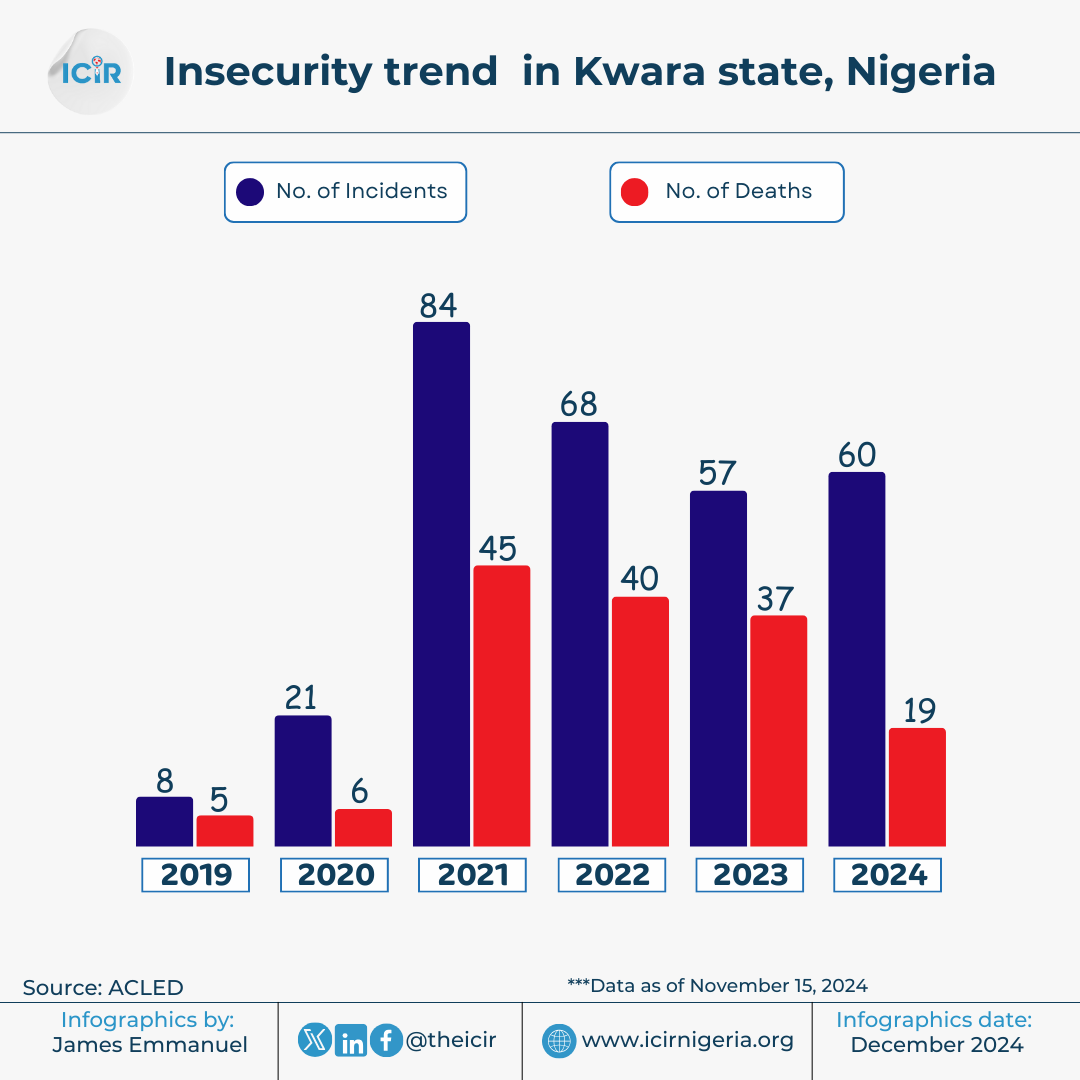
Kwara State’s insecurity has worsened steadily over the past few years. Violent incidents were relatively low until 2021, when 84 attacks resulted in 45 deaths.
Infographics showing the number of deaths and kidnappings in Kwara State between 2019 to 2024
Earlier this year, The ICIR reported how the state recorded at least 60 incidents that led to 19 deaths in 2024. Experts and residents said many attacks went unreported.
Residents also attributed this to bandit groups fleeing military pressure in the North-West, who are now continuing their activities such as kidnapping for ransom and cattle rustling. The ICIR reports that over the past years, banditry has spread extensively across the North-Western states of Zamfara, Katsina, Sokoto.
In response, the Nigerian government intensified military operations to combat these armed groups, pushing many southward into Niger, Kogi, and the Federal Capital Territory (FCT). But the violence expanding into the North-Central region, led to Kwara State feeling its effects, with the armed groups exploiting ungoverned spaces in the remote areas of the state.
Since the beginning of 2024, the state has recorded numerous incidents of attacks, kidnappings, and other violent crimes. For instance, in September, gunmen killed 10 people, including a pregnant woman, in Matogu village, Pategi Local Government Area of Kwara State.
These attacks have led to several communities in Ekiti, Asa, Moro, and Kaiama LGAs raising repeated concerns over increasing bandit movement through forest corridors linking Kwara to Kogi, Ekiti, and Niger states.
Meanwhile, a 2022 SBM Intelligence report highlighted an alarming rise in kidnappings, gang violence, inter-communal conflicts, targeted killings, and cattle rustling. The report noted that Fulani militants and herder-resident conflicts were often blamed for escalating violence.
THE Federal High Court has debunked a report claiming Justice James Omotosho survived an assassination attempt after he handed the life sentence on the leader of the outlawed Indigenous People of Biafra, Nnamdi Kanu as “fake news”.
According to the News Agency of Nigeria, a blogger had reported on his Facebook page that Justice Omotosho survived an assassination attempt on Saturday morning, days after handing down the life sentence to Kanu.
The blogger claimed that Justice Omotosho was immediately rushed to a hospital as security forces scrambled to secure the area.
Reacting to the claim, the Chief Registrar of FHC, Sulaiman Hassan, in a statement on Sunday morning, said the report was untrue, tagging it “Rebuttal to False Publication by ‘Celebrity Blogger’.
“The attention of the Federal High Court has been drawn to a publication by CELEBRITY BLOGGER, alleging that the Honourable Justice James Omotosho of the Federal High Court, Abuja, survived an assassination attempt following the life sentence imposed on Nnamdi Kanu.
“We hereby firmly and unequivocally declare that the said report is completely false and unfounded. The public is advised to treat this publication as fake news and refrain from further dissemination to prevent the spread of misinformation,” Hassan wrote.
Hassan, urged relevant security agencies to launch a probe into the report with a view to arresting and prosecuting the culprits in line with the laws.
“Given the gravity of the report, which has the potential to cause panic and undermine confidence in the judicial system, possibly intended as a form of intimidation, we call on the relevant security agencies and regulatory authorities to conduct a thorough investigation.
“The goal is to identify and apprehend the perpetrators responsible for this false report and prosecute them in accordance with the laws of the Federal Republic of Nigeria, particularly those relating to cybercrime, defamation, and public misinformation,” Hassan added.
The ICIR reports that that this claim emerged few days after Justice Omotosho had handed Nnamdi Kanu life sentence ‘out of mercy’ after finding him guilty of the seven-count terrorism offences on Thursday.
The judge sentenced him to life imprisonment in relation to counts one, two, four, five, and six, which carried a death sentence each.
Omotosho found him guilty of all counts one to seven, including his sit-at-home order resulting in economic losses and death of innocent people in the South-East, being a member of a proscribed organisation and committing acts of terrorism, and threatening anyone who failed to obey his order.
The court also found him guilty of inciting the killings of Nigerian security personnel, and for making broadcasts to kill people.
Besides, he was found guilty of committing an act of terrorism against the Federal Republic of Nigeria by threatening that people would die and the world would be at a standstill during a live broadcast.
However, he said that to further extend the mercy on the defendant, counts three and seven would run concurrently, giving a directive that the IPOB leader be kept in protective custody in any part of the country, but not in Kuje Correctional Centre, Abuja, and that the radio transmitter be forfeited to the Federal Government.
The judge also ordered that while in custody, Kanu should be restricted from making use of digital devices to prevent him from further incitement, if he must make use of a digital device, this must be closely monitored by the Office of the National Security Adviser.
He also held that other exhibits found with the IPOB leader, the prosecuting agency, which is the Department of State Services, could bring an application for forfeiture to the Federal Government after the expiration of 90 days of appeal.
THE Federal Ministry of Education has issued conflicting statements concerning the shutting of schools in the wake of terrorists’ attacks.
Barely 24 hours after an earlier statement it issued on Friday, the ministry’s Director, Press and Public Relations, Folasade Boriowo, on Saturday, November 22, warned against reports of schools’ closure from November 24, describing it as “false, misleading, and entirely fabricated.”
The statement cautioned parents, students, school administrators, and the general public against believing or sharing the rumour, which has sparked anxiety in several states.
“The Federal Ministry of Education hereby informs the general public that a message currently circulating on social media platforms, alleging that schools nationwide have been directed to close from November 24, 2025, is false, misleading, and did not originate from the federal government, the federal ministry of education, any State ministry of education or any recognised security agency,” Boriowo said.
Contradictory statement
The ICIR reports that the latest statement conflicts with the previous announcement by the Director of Senior Secondary Education at the Federal Ministry of Education, Binta Abdulkadir, directing the shutting down all 41 Unity Schools in the country with immediate effect over growing spate of abductions.
Part of the circular reads, “Sequel to the recent security challenges in some parts of the country and the need to prevent any security breaches, the Honourable Minister of Education has approved the immediate closure of the listed Federal Unity Colleges.
“Principals of the affected colleges are to ensure strict compliance. Please accept the warm regards of the Honourable Minister.”
However, Boriowo claimed that the alleged directive did not originate from the Federal Government, the Federal Ministry of Education, any State Ministry of Education, or any recognised security agency, urging Nigerians to rely strictly on verified announcements from uthorised sources.
“The public is strongly advised to rely strictly on verified information issued through the following official channels: the Federal Government, the Federal Ministry of Education, tate Governments and State Ministries of Education, recognised security agencies.
Boriowo cautioned that the spread of false information can exacerbate public fear, trigger unnecessary school disruptions, and undermine the efforts of authorities working to maintain stability nationwide, stressing that only official statements issued through government-verified platforms should be trusted.
“Any announcement, advisory, or notice coming from unofficial or unverified sources should be ignored and not shared. Members of the public are urged to always verify the authenticity of information before circulating it in order to curb the spread of misinformation,” the press secretary added.
Compliance
Checks by the ICIR indicate that following the earlier statement, many of the unity schools across the country had started complying by shutting down and asking students to vacate. Aside the unity schools, state governors have also issued directive over the closure of public and private primary schools over security threats.
The Plateau State Government directed the immediate closure of all basic schools in the state, citing urgent need for preventive action late Friday.
A statement issued by the Plateau State Universal Basic Education Board on Friday said Government Junior Model Secondary Schools would close effective Saturday, November 22, 2025, while Primary and Day Schools would shut from Monday, November 24, as a precautionary measure.
Similarly, on Friday night, the Katsina Government through its Ministry of Basic and Secondary Education on Friday ordered the immediate shutdown of all public schools across the state due to rising security concerns.
The order prompted thousands of boarding students to return home shortly after the announcement.
Ministry spokesperson keeps mum
The ICIR contacted Boriowo for clarification on the conflicting statements from the ministry.
Our inquiry sought to know if there was a fake directive in circulation today ordering all schools in Nigeria to shut down on Monday, November 24.
Although she requested that questions be sent to her via text messages, the Chief Press Secretary failed to respond as at the time of filing this report.
THe Niger State government has ordered the immediate closure of all public and private primary and secondary schools following the abduction of an abduction of pupils from St. Mary’s Catholic School, Papiri, in Agwara LGA.
This was made known in a statement by the Chief Press Secretary to the Governor, Bologi Ibrahim, shortly after an emergency security meeting held with heads of security agencies in Minna on Saturday.
“Niger State Government has ordered the closure of all public and private Primary and Secondary Schools across the State.
Bologi said that the move is aimed at preventing further attacks on educational institutions and ensuring the safety of children across the state.
The directive affects missionary and Islamic schools, as well as Federal Government Colleges, including FGC Minna.
“Tertiary Institutions are not affected except for those in the defined vulnerable areas in Niger North and East Senatorial Districts respectively,” the statement added.
The ICIR reported that gunmen stormed St. Mary’s Papiri Private Catholic Secondary School in the Papiri community of Agwara Local Government Area, Niger State, and abducted scores of students and teachers, in the early hours of Friday, the second mass abduction within a week.
Several community members who visited the school after the incident confirmed the attack and described it as a coordinated operation carried out between 2:00 a.m. and 3:00 a.m.
The Head of Department, Disaster and Relief, Agwara Local Government, Ahmed Abdullahi Rofia, also confirmed the attack.
In his latest announcement, Governor Bago described the kidnapping as “sad and unfortunate,” noting that the administration’s priority is to secure the unconditional release of the children and other victims currently in captivity across the state.
Bago charged all heads of security agencies, Civil Society Organisations, the organised labour and religious leaders to focus on the rescue of the children and reiterated that the government will continue to protect the lives and property of its citizens.
He said the number of children kidnapped from the St. Mary’s Catholic School has not been ascertained as the Department of State Service, Nigeria Police and other security agencies are already carrying out headcount to ascertain the actual figure.
Friday’s abduction came five days after terrorists attacked Maga Comprehensive Girls’ Secondary School in Kebbi State, where about 25 female students were whisked away and a staff member was killed. A guard was also injured during the early-morning assault.
Similarly, the Adamawa State Government has ordered the closure of all public and private boarding schools in the state.
In a statement on Saturday, signed by the state Commissioner for Education and Human Development, Umar Pella, the government said the decision was aimed at preventing a repeat of the recent abductions of students in Niger and Kebbi states.
“Sequel to the security challenges that the country is facing at the moment, particularly with what happened to students in Niger and Kebbi states, it has been observed with great dismay that the target of the evil perpetrators is boarding secondary schools.
“Considering this ugly situation in the country, I am directed by his Excellency, the Executive Governor of Adamawa State, Hon. Ahmadu Fintiri, to deboard all boarding schools across the state, be it public or private schools.
“They should all operate as day schools for the moment. Therefore, by this letter, all principals and proprietors of public and private schools should deboard their respective boarding schools without further delay,” Pella said.
The ICIR reported on Saturday that Taraba State Governor, Agbu Kefas, has directed all public and private secondary schools in the state to immediately deboard their students amid growing insecurity nationwide.
The government explained that the rising security threats across the country have made boarding students in both public and private secondary schools vulnerable to kidnappers, citing the recent student abductions in Kebbi and Niger states.
THE 2025 Anambra governorship election, held on November 8, drew nationwide attention as residents of the state went to the polls to elect their next administrator.
Despite high expectations for a transparent electoral process, the campaign period, election day, and the aftermath were characterised by a flurry of unverified claims and viral content designed to confuse voters and undermine the electoral process.
Reports circulated online claiming that a certain candidate had won, violent incidents occurred, that officials were caught with cash, and that voting malpractices were rampant. Many of these stories, however, were found to be false or misleading, fact-checks by the Nigerian Fact-Checkers’ Coalition (NFC) later revealed.
Over the three days, the coalition fact-checked multiple claims but were able to conclude on a total of 28 claims. Out of these, six were verified as correct, 14 as incorrect, seven as misleading, and one as unproven. Here is a recap of some of the claims fact-checked.
Analysis of claims fact-checked
Misinformation about candidates and voting processes
Before voters cast their ballots, several claims sought to mislead the electorate about the voting process and the political landscape. For instance, an X user, @mr_niceguy234, claimed that Governor Chukwuma Soludo had declared November 7 a public holiday specifically for teachers to serve as delegates. NFC investigations revealed that while the state did declare a holiday, it applied to all workers, and no official documentation supported the teacher-specific claim.
An X user @starvillageboy (archived link)claimed that the People’s Democratic Party(PDP) did not field any candidate in the Anambra gubernatorial election.
According to the finalreport from the Independent National Electoral Commission (INEC) officially lists PDP candidate Jude Ezewanfor in the Anambra governorship race. He has also appeared in multiplemedia interviews, sharing his plans for the state if elected.
Similarly, a Facebook post circulated urging voters to use their index finger to mark ballots. The claim contradicted INEC guidance, stating that any finger could be used as long as the mark was clear.
A social media user alleged that voter turnout had historically never exceeded 22 per cent, yet analysis of past elections showed turnout closer to 46–47 per cent. These pre-election misrepresentations were designed to create doubt about the electoral process and potentially influence voter behaviour.
Misleading images and videos
During and immediately after voting, social media became a hub for misleading visuals and misinformation about candidates.
For instance, a video showing women being assisted to thumbprint ballots, shared by Nigeria Undivided on TikTok, was originally posted in 2023 and had no connection to the Anambra election. Other claims suggested local government chairpersons were caught with cash or that certain candidates, like the Anambra East chairperson, intimidated voters with armed men. Investigations confirmed that neither police nor observers witnessed any intimidation, and the purported arrests were found to be false.
Even high-profile claims gained traction. A Facebook user, Michael Chibuzo, alleged that two of Soludo’s mayors were caught with N750 million each. Field checks with the Anambra State Police Command disproved this, confirming no such arrests occurred.
Similarly, a video circulated by Bube Africà showed bundles of cash purportedly delivered as “election-sensitive materials,” but reverse image searches traced it back to Obi Cubana’s birthday celebration months earlier.
Adding to the wave of misinformation, the ADC coalition circulated images of a “Ghana-Must-Go” bag filled with cash, alleging widespread collusion between APGA and APC. A reverse image check revealed that these photos were from 2019 in Benue State, unrelated to the Anambra elections.
Misleading photo by shared by ADC to depict vote buying in Anambra
Misinformation about violent incidents
It is not so uncommon to see false reports of violence during the election. The Anambra is not different. On the day of the election, an X user, @Ojay147, posted a photograph of a man with a head injury, claiming it was from election-related violence. NFC traced the image back to 2018, during a clash among APGA party members in Dunukofia Local Government Area, proving the post misleading.
Old photo falsely linked to violence in the Anambra election
Similarly, a Facebook user, Ogechukwu Akwaeze,claimedthat the local government chairperson of Anambra East, Ifeanyi Chinweze, visited Community Development Primary School, Umueri Ward 2, Unit 003, accompanied by armed men to disrupt the election and intimidate voters.
The CJID observer Grace Nnoruka informed NFC that the LGA chairperson visited some polling units in the area. She also confirmed the presence of police vans in the polling unit but noted there was no form of intimidation. The observer stated that the LG chairperson and the police arrived at different times but departed almost simultaneously.Images from Arise TV confirm the peaceful conduct of the election at the polling unit.
False and premature result claims
In the aftermath of voting, social media became a hub for premature and misleading claims about the election outcome. For instance, on November 9, an X user, @whitenigerian, falsely claimed that APGA had secured 72.5 per cent of the votes, while others prematurely congratulated Governor Charles Soludo as the winner. Another X user asserted that Soludo had won with 361,893 votes, yet the Independent National Electoral Commission (INEC) confirmed the actual figure as 422,664 votes.
Meanwhile, reports that Ezechukwu Nweke, Action Alliance candidate, was leading the polls were entirely false, as vote collation had not yet been completed at the time of posting.
In addition, the African Democratic Congress (ADC)coalitionposted some photos of collation sheets on its X account, claiming the results were fake to discredit the coalition.
A comparison between the photosuploaded by the user and those available on the INEC IReV portal for polling units 005 Amadim V Square I (Achalla III LGA), 010 UGA B.S.S I (Aguata LGA), 039 Obosi Central School III, and 014 Obosi Central School I (both in Idemili North LGA) shows that the results are identical, accurate, and were not manipulated, contrary to the ADC coalition’s claim.
Accurate claims
Not all the viral claims surrounding the Anambra 2025 governorship election were false. Some posts circulating online accurately reflected the unfolding realities of the poll.
For instance, an X user @Tkoy2025 had claimed that there was “massive vote-buying” by the All Progressives Grand Alliance (APGA) and the All Progressives Congress (APC) during the election. This was verified as correct by the Nigerian Fact-checkers’ Coalition (NFC) after reporters from Premium Times and The ICIR confirmed witnessing incidents of voters being induced with cash across multiple polling units in the state. Early reports from Premium Times also corroborated that such practices were “rampant” in some areas.
Similarly, another verified claim came from a post highlighting results at a micro-level polling unit in Agulu, Anaocha Local Government Area – the home community of Labour Party (LP) presidential candidate, Peter Obi. The claim stated that the APC governorship candidate, Nicholas Ukachukwu, defeated the LP candidate with 73 votes to 57 votes at Polling Unit 019, Umudim Akasi Square, Agulu II Ward. This was confirmed correct through data obtained from the INEC IReV portal, which matched the figures precisely as stated online.
One of the MIL cards.
In addition, the NFC verified other localised realities of the election, including reports of technical delays linked to the Bimodal Voter Accreditation System (BVAS) and verified posts describing the deployment of an AI-powered real-time result dashboard, which processed updates from all 5,720 polling units across Anambra State. These confirmed instances reflected the evolving use of technology in election monitoring and the growing accuracy of certain user-generated election content.
Another verified incident involved Governor Chukwuma Soludo’s directive to remove Arabic inscriptions from certain public materials in Anambra State. Reports circulating on social media claimed that Soludo had ordered the removal of Arabic scripts from some government signage and documents. A check on theofficial website of the nation’s apex bank reveals that Soludo was the governor of the CBN in Nigeria at the time the shift was made.
Likewise, claims of BVAS (Bimodal Voter Accreditation System) malfunctions delaying voting at Polling Unit 001, Fegge Ward 5, were confirmed by Channels TV and Sahara Reporters, showing that certain operational issues affected accreditation and voting. The claim that the People’s Democratic Party (PDP) only got 1,401 votes is also correct.
Media Information Literacy articles
During the Anambra 2025 governorship election, the Nigerian Fact-Checkers’ Coalition (NFC) produced seven quick media and information literacy (MIL) articles and cards to guide voters, prevent misinformation, and strengthen public understanding of election processes. These were from the pre-election MIL.
The articles which were done in response to misinformation trends advised voters on what to do after casting their ballots, including monitoring the process peacefully, encouraging others to vote, observing the collation of results, and reporting any irregularities. They also provided practical steps for detecting fake election results, including verifying sources, avoiding premature claims, checking the authenticity of EC60E forms, and ignoring anonymous posts.
The NFC further explained how voters can identify old or misleading videos through careful observation, reverse image searches, timeline checks, context evaluation, and keyword searches. Cards also directed citizens to credible platforms such as NEC, reputable media, and fact-checkers for authentic election results.
One of the MIL cards.
Other articles focused on election-day offences like vote buying, impersonation, incitement, campaigning near polling units, and the legal penalties attached. Voters were reminded to stay alert for misinformation during result collation, rely on multiple credible sources, and verify before sharing.
Additional guides outlined how gubernatorial votes are counted from polling units to RA, LGA, and state collation along with the role of security agencies. The NFC also clarified who is legally allowed access to collation centres, restricting entry to accredited officials, agents, security personnel, and journalists.
This analysis was done from live checks conducted by members of the Nigerian Fact-checkers Coalition(NFC) for the Anambra Gubernatorial Election.
FOMER presidential candidate of the Labour Party, Peter Obi, has raised concerns over the conviction of the Indigenous People of Biafra (IPOB) leader, Nnamdi Kanu, warning that the development risks heightening tensions at a time when Nigeria is already grappling with deep economic hardship and worsening insecurity.
In a statement issued on Saturday, Obi described the conviction as “unfortunate” and a reflection of leadership failure, arguing that the government mishandled the matter from the onset.
“The news of Mazi Nnamdi Kanu’s conviction should compel every well-meaning Nigerian to pause and reflect. This is coming at a time when our beloved nation is facing severe economic hardship, insecurity, and the consequences of poor governance.
“Rather than reducing tension, this unfortunate development may well only aggravate it. I have always maintained that Mazi Kanu should never have been arrested. His arrest, detention, and now conviction represent a failure of leadership and a misunderstanding of the issues at stake,” Obi said.
The ICIR reported on Thursday that Justice James Omotosho of the federal high court in Abuja convicted and sentenced Kanu to life imprisonment, after admitting that Kanu was a freedom fighter seeking to liberate his people but chose the path of terrorism.
He found the accused guilty of all counts one to seven, including his sit-at-home order resulting in economic losses and death of innocent people in the South-East, being a member of a proscribed organisation and committing acts of terrorism, and threatening anyone who failed to obey his order.
The court also found him guilty of inciting the killings of Nigerian security personnel, and for making broadcasts to kill people.
Obi maintained that dialogue, not force, remains the most effective pathway to lasting peace, insisting that the concerns raised by Kanu were neither new nor impossible to resolve, noting that the government missed opportunities to embrace constructive engagement, empathy, and inclusive governance.
“For years, I have consistently argued that dialogue, constructive engagement, and inclusive governance offer the path to lasting peace. Coercion becomes necessary only when reason has been exhausted. In this case, I submit that the reason was not only not exhausted, but was probably not explored at all, or not fully explored.
“The concerns Kanu raised were not unheard of. The issues for which he demanded solutions were not insoluble. It only required wisdom, empathy, and a willingness to listen. In any functional society, such grievances are met with dialogue and reforms aimed at strengthening unity,” the former presidential candidate explained.
While urging the Presidency, the Council of State, and respected statesmen to intervene urgently and pursue a political settlement that prioritizes healing, reconciliation, and national unity, Obi likened the government’s handling of the case to “a man trapped in a hole who, instead of finding a way out, keeps digging deeper,” warning that the consequences of such actions could worsen national cohesion.
“The government’s approach has only deepened mistrust and created an avoidable distraction at a time when citizens are overwhelmed by harsh economic realities and insecurity. While some may insist that “the law has taken its course,” leadership often demands more than a strict, mechanical application of the law. Nations around the world resort to political solutions, negotiated settlements, and even amnesty when legal processes alone cannot serve the broader interest of peace and stability. Nigeria is not an exception.
“The handling of Kanu’s case mirrors the government as a man trapped in a hole but who, instead of looking for a way out, keeps digging deeper. It worsens not only the government’s predicament but also the nation’s collective condition.
If we truly desire a new Nigeria – a united, peaceful, and progressive one, our leaders must choose healing over hostility, reconciliation over retaliation, and dialogue over division. Only by addressing grievances with justice, fairness, and compassion can we move towards a future where every Nigerian feels heard, valued, and safe.
“My ultimate call at this time, without prejudice to how anyone feels about the decision of the court, is for us to be optimistic for peace and reconciliation which will come in the end. I am also saying, thereby, that the Presidency, the Council of State and credible statesmen who love this country and who are interested in cohesion and inclusivity, should rise to the occasion, for a lasting solution,” he said.
The ICIR reported that Kanu’s trial began after his 2015 arrest on charges of treasonable felony and terrorism, and the case saw multiple twists and developments since then.
In 2017, Kanu left Nigeria while on bail after a military raid on his home during the “Operation Python Dance” exercise in the South-East.
In June 2021, he was arrested in Kenya under controversial circumstances and repatriated to Nigeria, a development his legal team and IPOB denounced as an “extraordinary rendition.”
Kanu’s defence team consistently questioned the legitimacy of the trial, insisting that major legal and procedural breaches, including alleged violations of international extradition protocols and jurisdictional requirements weakened the prosecution’s case.
The ICIR reported that Kanu sacked his lawyers and agreed to stand for himself in the court. He faced a seven-count charge bordering on terrorism, treasonable felony, and incitement.
TERRORIST groups have intensified attacks on religious organisations and educational institutions in Nigeria. The ICIR reports that the daring terrorists battle not only with state and other non-state actors but also target civilians.
Several Churches in Nigeria have suffered a number of attacks by armed bandits who did not only abduct the worshippers but request for ransom before releasing the victims. In some instances, the armed bandits killed victims after collecting the ransom. The Evangelical Church Winning All (ECWA) was attacked in July 2025 by armed bandits while holding a meeting in Kampani Village, Maro, located in the Kajuru Local Government Area of Kaduna State. They killed at least five persons.
The schools are no longer safe for children as terrorists continue to launch attacks and abduct both learners and staff. Since the abduction of 276 Chibok schoolgirls in 2014 under the administration of Goodluck Jonathan, Nigeria continues to witness more invasion of schools and abduction of schoolchildren by terrorists. The ICIR chronicles the abduction of schoolchildren since 2014.
Timeline of incidents
November 14
The Islamic State West Africa Province (ISWAP) terrorists on Monday captured and executed Musa Uba, a Brigadier General of the Nigerian Army during a deadly ambush on a military convoy. Four other military personnel were killed in the ambush. This took place when the convoy, led by Uba of the 25 Task Force Brigade, was returning from a patrol near Wajiroko village in northeastern Borno state late on Friday.
November 17
The Kebbi State Police Command confirmed that armed gunmen stormed the Government Girl’s Comprehensive Secondary School, Maga in Danko/Wasuga LGA in the early hours of Monday. The attack resulted in the abduction of 25 students and the killing of the school vice principal.
November 19
Unknown gunmen with masks attacked worshippers of Christ Apostolic Church (CAC), Oke Isegun in Eruku, Ekiti Local Government Area of Kwara State during a thanksgiving session. The pastor, Lawrence Bamidele, said that at least 30 worshippers were kidnapped. He added that the service was actually a thanksgiving for 18 persons who regained freedom from their abductors.
The ICIR reported that at least two persons were confirmed dead during the church attack.
November 20
Sixteen prospective Corps Members who are graduates of Adeyemi Federal University of Education (AFUED) in Ondo State were said to have lost their lives in a fatal accident while traveling to the NYSC Orientation Camp in Gombe State.
November 21
Few days after the invasion of a school in Kwara State, armed gunmen abducted 215 schoolchildren and 12 staff of St. Mary’s School, a Catholic High School in Papiri community, Agwara Local Government Area of Niger State. The attack took place between 1am and 3am of that same day.
Taraba State Governor, Agbu Kefas, has directed all public and private secondary schools in the state to immediately deboard their students amid growing insecurity nationwide.
The directive was disclosed in a statement issued on Friday and signed by the Commissioner for Education, Augustina Godwin. She explained that the rising security threats across the country have made boarding students in both public and private secondary schools vulnerable to kidnappers, citing the recent student abductions in Kebbi and Niger states.
“In light of the current circumstances, Governor Kefas has issued a directive requiring all secondary schools, both public and private, to function exclusively as day schools for the time being. Principals and owners have been advised to promptly arrange for the deboarding of all students,” she said.
The ICIRreport that Taraba government directive is coming a few hours after the Federal Government shut down all 41 Unity Schools in the country over the growing spate of abductions and other forms of insecurity.
The Director of Senior Secondary Education at the Federal Ministry of Education, Binta Abdulkadir, announced this in a circular on Friday.
Similarly, the Plateau State Government has directed the immediate closure of all basic schools in the state, citing urgent need for preventive action.
It noted Government Junior Model Secondary Schools would close effective Saturday, November 22, 2025, while Primary and Day Schools would shut from Monday, November 24, as a precautionary measure.
In the same vein, the Katsina Government through its Ministry of Basic and Secondary Education on Friday ordered the immediate shutdown of all public schools across the state due to rising security concerns.
The order prompted thousands of boarding students to return home shortly after the announcement.
Godwin added that the Taraba State government has assured parents of its commitment to restoring stability and will continue collaborating with security agencies to address the situation.
The ICIRreported that gunmen stormed St. Mary’s Papiri Private Catholic Secondary School in the Papiri community of Agwara Local Government Area, Niger State, and abducted scores of students and teachers, in the early hours of Friday, the second mass abduction within a week.
Several community members who visited the school after the incident confirmed the attack and described it as a coordinated operation carried out between 2:00 a.m. and 3:00 a.m.
The Head of Department, Disaster and Relief, Agwara Local Government, Ahmed Abdullahi Rofia, also confirmed the attack.
Friday’s abduction came five days after terrorists attacked Maga Comprehensive Girls’ Secondary School in Kebbi State, where about 25 female students were whisked away and a staff member was killed. A guard was also injured during the early-morning assault.
THE United Nations has condemned the abduction of hundreds of pupils and teachers from St. Mary’s Catholic Primary and Secondary Schools in Niger State during the early hours of Friday.
UN Spokesperson, Stéphane Dujarric, in a statement described the attack as “heartbreaking” and emphasised that “schools must be safe places for learning.”
“We have witnessed yet another abduction of pupils in Niger State, just days after the kidnapping of schoolchildren in Kebbi,” Dujarric said.
The ICIRreported that terrorists stormed St. Mary’s Papiri Private Catholic Secondary School in the Papiri community of Agwara Local Government Area, Niger State, and abducted scores of students and teachers, in the early hours of Friday, the second abduction within a week.
Several community members who visited the school after the incident confirmed the attack and described it as a coordinated operation carried out between 2:00 a.m. and 3:00 a.m.
The Head of Department, Disaster and Relief, Agwara Local Government, Ahmed Abdullahi Rofia, also confirmed the attack.
Friday’s abduction came five days after terrorists attacked Maga Comprehensive Girls Secondary School in Kebbi State, where about 25 female students were whisked away and a staff member killed. A guard was also injured during the early-morning assault.
“We join UNICEF and the UN Resident and Humanitarian Coordinator, Mohamed Malick Fall, in expressing deep sympathy to the families and communities affected. Every effort must now focus on ensuring the childrens’ safe and immediate return,” Dujarric added.
Dujarric noted that the recurring assaults highlight the urgent need to fully enforce the Safe Schools Declaration, which sets out practical steps to protect educational institutions and ensure students’ access to learning during conflict.
The ICIRreported on Friday that the Federal Government has shut down all 41 Unity Schools in the country over the growing spate of abductions and other forms of insecurity.
The Director of Senior Secondary Education at the Federal Ministry of Education, Binta Abdulkadir, announced this in a circular on Friday.
Similarly, the Plateau State Government has directed the immediate closure of all basic schools in the state, citing urgent need for preventive action.
A statement issued by the Plateau State Universal Basic Education Board on Friday said Government Junior Model Secondary Schools would close effective Saturday, November 22, 2025, while Primary and Day Schools would shut from Monday, November 24, as a precautionary measure.
Similarly, the Katsina Government through its Ministry of Basic and Secondary Education on Friday ordered the immediate shutdown of all public schools across the state due to rising security concerns.
The order prompted thousands of boarding students to return home shortly after the announcement.
The Commissioner for Basic and Secondary Education, Yusuf Jibia, said on DW Hausa that the closure was a precautionary measure, following recent attacks in neighbouring states.