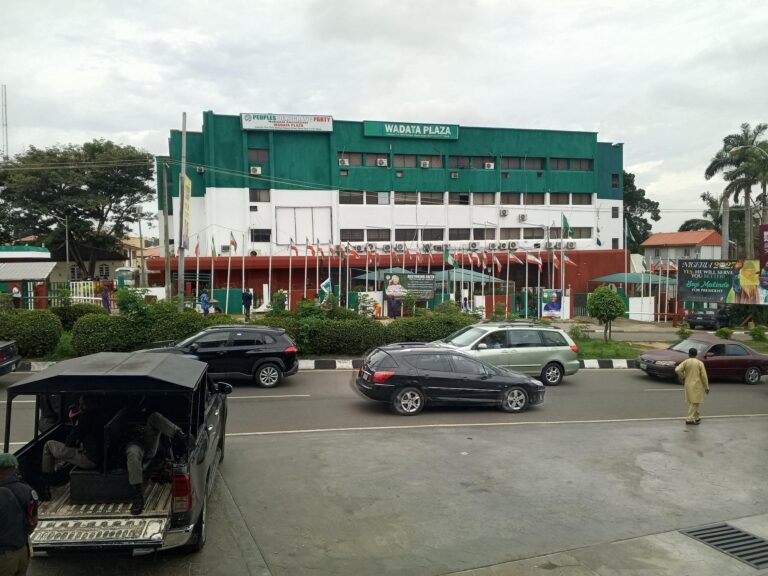
TENSION gripped the national secretariat of the Peoples Democratic Party (PDP) in Abuja on Monday as loyalists of the Minister of the Federal Capital Territory (FCT), Nyesom Wike, stormed the Wadata Plaza and announced the takeover of the party’s leadership.
The faction announced the appointment of Muhammed Abdulrahman as the Acting National Chairman, following the suspension of key party officials loyal to Wike by the National Working Committee (NWC) under Umar Damagum.
The Damagum-led NWC had earlier suspended the party’s National Secretary, Samuel Anyanwu, and other officials believed to be aligned with Wike.
Responding, the Wike camp suspended Damagum and other members of the NWC, naming Abdulrahman as replacement.
Addressing journalists at the PDP’s FCT office before moving to the secretariat, Abdulrahman said his leadership would focus on healing internal divisions and restoring order to the party.
“We are all aware of the current pitiable state of our glorious party because of the actions and inactions of our leaders and members. From being the ruling party for 16 uninterrupted years to being an opposition party for over 10 years now at the national level, from being a formidable opposition to a now humbled opposition owing to the unexplainable, unconscionable defections of governors, legislators and council chairmen, et al,” Daily Trust quoted him to have said.
Abdulrahman’s supporters were also seen at the national secretariat, where they were chanting solidarity songs and demanding that the National Working Committee, led by Umar Damagum, vacate the headquarters immediately.
The protest prompted the deployment of heavily armed police officers to prevent clashes.
Report indicates that at least ten police Hilux vans were sighted around the premises as security operatives maintain order.
The current confrontation is the latest flashpoint in the PDP’s long-running leadership crisis. Tensions between Wike’s camp and the Damagum-led NWC have deepened over issues of zoning, control of party structures, and allegations of constitutional breaches.
Since the 2023 presidential election, when Wike and four other governors, popularly known as the G5, revolted against the party’s presidential candidate, Atiku Abubakar, the PDP has struggled to recover from internal fractures.
Wike, now serving as FCT Minister under the ruling All Progressives Congress (APC) government, has maintained significant influence within the PDP, particularly in the South-South region.
United States President Donald Trump has said the American military could deploy ground troops or launch air strikes in Nigeria to halt what he described as the widespread killing of Christians in the West African nation.
According to Reuters, Trump disclosed this to reporters aboard Air Force One on Sunday, while returning to Washington after spending the weekend at his Florida vacation home.
When asked whether he was considering deploying ground troops or conducting airstrikes in Nigeria, Trump responded, “Could be”.
“I mean, other things. I envisage a lot of things. They’re killing record numbers of Christians in Nigeria … They’re killing the Christians and killing them in very large numbers. We’re not going to allow that to happen,” he said.
The ICIR reported that on Saturday, November 2, that Trump warned he would consider military action against Nigeria if the country failed to curb alleged killings of Christians, just a day after his administration placed Nigeria on the “Countries of Particular Concern” list for violating religious freedoms.
Other nations on the list include China, Myanmar, North Korea, Russia and Pakistan.
Meanwhile, the Nigerian government prompted refuted claim of Christian genocide by the US.
President Bola Tinubu said Nigeria stood firmly as a democracy governed by constitutional guarantees of religious liberty and continued to maintain open engagement with both Christian and Muslim leaders across the country.
He argued that the portrayal of Nigeria as religiously intolerant did not reflect the reality in the country, adding that the government’s efforts to safeguard freedom of belief for all Nigerians remained consistent and sincere.
The Ministry of Foreign Affairs, also dismissed the claims, stating that while it appreciated global concern for human rights and religious freedom, the allegations were inaccurate and misrepresented the country’s realities.
The ministry insisted that under Tinubu’s leadership, the country remained committed to fighting terrorism, strengthening interfaith harmony, and protecting the lives and rights of all its people.
Recall that the conversation started last month, when US lawmaker Riley Moore had urged Secretary of State Marco Rubio to take diplomatic action over what he described as the “systematic persecution and slaughter of Christians” in Nigeria, calling it “the deadliest place in the world to be a Christian.”
He also advocated suspending arms sales to Nigeria until measurable progress was made in curbing violence.
THE humanitarian crisis in Sokoto’s internally displaced persons (IDP) camps is deepening as global aid shrinks and donor support declines. The ICIR examines how funding cuts are worsening living conditions for displaced families who once relied on assistance from international and donor-funded organisations.
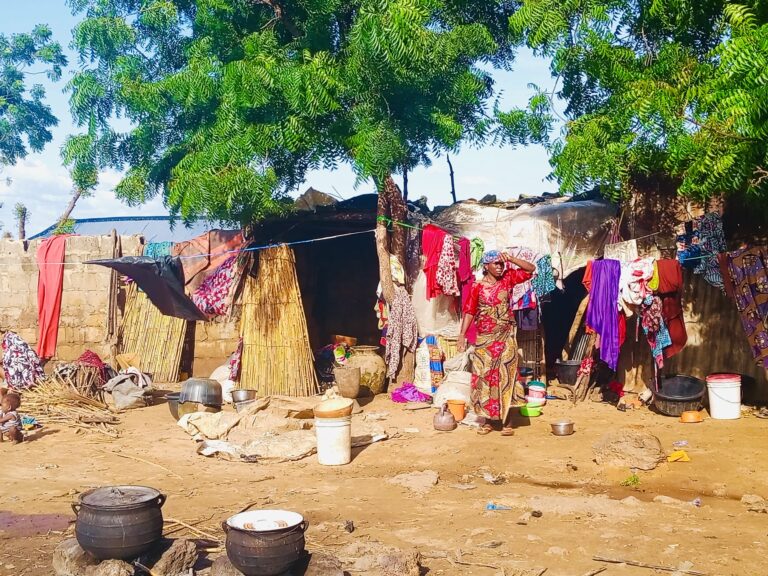
When the rains fall, they pour directly on Aisha Garba’s head through the leaking roof in her makeshift mud house in Ramen Kura, IDP camp in Sokoto state. For three years, the 50-year-old and her five children have called the crowded camp home after fleeing bandit attacks in Rijiya village, Isa Local Government Area.
Life in the camp was never easy, but it was at least survivable when foreign aid was flowing. International NGOs supported by foreign organisations, such as USAID, once delivered rice, noodles, macaroni, and even small cash gifts, which allowed Aisha to feed her children at least twice a day.
“But this year everything has changed. We are just managing. There is no support,” Aisha said.
On most days, Aisha relies on desperate measures like sending her children out to beg, borrowing food on credit from a woman who sells food, or mixing spoonfuls of rice with Garri just to stretch a meal.
“If they don’t get anything, I have to go out and ask for a loan. If I don’t get we will just manage our life,” she explains, adding, “Even if we get a hundred naira for one swallow I buy, how do you think one swallow will be enough for us?”
Aisha Garba
The consequences are damning. One of Aisha’s daughters fell gravely ill with diarrhoea and vomiting. After visits to three hospitals, doctors told her the child was battling ulcer caused by prolonged hunger. “I didn’t know ulcer comes from hunger. I have visited three hospitals with her before she got relief.”
Aisha and her family are only one of some five million people across northwest Nigeria suffering from malnourishment in what experts have called the region’s most severe food crisis in years.
The troubled region has, for a decade and a half, been in the throes of a conflict waged by the terrorists locally known as bandits, and prolonged insecurity has disrupted food supplies, resulting in a hunger crisis that state governments are struggling to contain.
Worsening the problem this year are the massive and brutal funding cuts affecting aid organisations, which have often stepped in to help by providing food assistance to the over 1.3 million displaced northwest Nigerians. Many of those organisations were dependent on funds from the United States, which, since February, has reduced contributions to aid programmes globally by about 90 per cent.
Earlier this year, the Trump administration froze foreign aid and cut support for aid groups deemed lifesaving – decisions that quickly turned into life-or-death realities for families like Aisha’s.
Nigeria is one of the largest beneficiaries of the aid on the African continent. In 2024, the country was the third-largest African recipient of development assistance from the United States Agency for International Development, receiving a total of $876 million. But with the suspension, the fates of thousands of IDPs in Sokoto and other parts of the Northwest are hanging on the balance.
When aid stop trickling
In March, U.S. Secretary of State Marco Rubio confirmed what aid workers had feared: the Trump administration had cancelled 83 per cent of U.S. USAID programmes. He announced that while the agency had spent over $715 billion in international development over the years, America would now redirect those funds into domestic priorities.
By July, USAID was officially dissolved. Decades of global development work in health, education, and humanitarian response came to an abrupt halt, leaving an aching void in fragile economies and conflict-torn regions.
For developing nations, particularly in Sub-Saharan Africa where public systems are underfunded and humanitarian crises are frequent, the move was devastating. The decision crippled health interventions, derailed nutrition and food security programmes, and emergency operations that had sustained millions of internally displaced persons. In Nigeria, where USAID had consistently been among the top donors for humanitarian and development aid, the aftershock was immediate and brutal.
Ramen Kura, IDP camp in Sokoto State. Photo: The ICIR
Before the cuts, USAID had poured millions of dollars into Nigeria’s northwest — one of the country’s most underserved regions. Sokoto State, plagued by years of banditry and displacement, had been a key beneficiary of U.S. humanitarian funding.
Through partnerships with the World Food Programme (WFP), UNICEF, and local NGOs, USAID supported life-saving nutrition and health interventions across dozens of IDP settlements in Sokoto and its border communities. These projects provided therapeutic feeding for malnourished children, maternal health services for women, clean water, and emergency food assistance for thousands displaced by armed violence.
By late 2024, the humanitarian situation in Sokoto was already fragile. Floods, poor harvests, and intensifying attacks by armed groups had displaced more than 18,000 people across the state, many of whom fled to informal camps in Wurno, Isa, and Goronyo LGAs.
When the U.S. abruptly halted its funding, those fragile gains began to unravel. Mobile nutrition centres that once dotted the dusty landscapes of Sokoto North and Rabah were forced to close. Community health workers trained under USAID-funded projects withdrew their services, while several partner organisations including Catholic Relief Services (CRS), Cooperazione Internazionale (COOPI), Grassroot Initiative for Strengthening Community Resilience (GISCOR), Finpact Development Foundation (FINDEF), Neem Foundation, and the International NGO Safety Organisation (INSO) were severely affected.
“Sequel to the stop work order by the US President, some humanitarian organisations were vacating the IDPs camp, and it affected the vulnerable population much more,” an NGO worker told The ICIR.
In March, UNICEF warned that critical nutrition supplies for acutely malnourished children were rapidly dwindling in Nigeria and Ethiopia. USAID had been the largest single donor bridging that gap. Its sudden withdrawal left agencies scrambling to reallocate limited resources from other regions, often forcing them to suspend operations in less accessible communities.
Analysts argue that the executive order exposed how dependent Nigeria’s humanitarian system had become on foreign aid, particularly from the U.S. For years, successive governments had failed to fund emergency response and social protection systems adequately. When external support disappeared, there was no domestic safety net strong enough to cushion the blow.
The U.S. government had previously spent more than $600 million annually on Nigeria’s health and humanitarian programmes, much of it flowing through USAID. Between 2022 and 2024 alone, it invested nearly $2.8 billion in health-related assistance, spanning HIV/AIDS, malaria, nutrition, and maternal health. Sokoto and Zamfara — among the most affected states — were key targets of USAID’s “Feed the Future” and “Health Resilience” programmes.
Struggling parents, starving children
For Hassan Abubakar, a 44-year-old father of eight, displacement has stretched into its fourth year. He and his family fled their village in Rabah LGA of Sokoto State after bandit attacks made life unbearable.
“At first, we used to get financial and food support,” he recalled, adding: “They gave us wheat and even built toilets for us. But now everything has changed. It’s been almost a year since we received anything, and eight months since we got wheat.”
Now, with aid withdrawn and prices skyrocketing, life has become a daily battle. Many of the displaced, including Hassan, try to earn a little through manual labour in town. “Someone called me to go and cut a tree for him so I could get money to buy food for my children,” he said.
Hassan Abubakar’s house in Sokoto State.
Farming, which once offered hope, has become another source of fear. Hassan planted millet this year, but harvesting feels like a death trap. Sometimes, before they reach the farm, they receive calls warning that bandits were approaching or that they had kidnapped some farmers while they were working.
The unharvested crops weigh heavily on him. Even though they are hungry and the millet is ripe, bandits will not allow them to harvest.
Two of his children now lie sick in bed, and medical support is out of reach. “If I had harvested, I would have sold the crops to pay for their treatment. But as I am talking to you, I am hungry, and my children are hungry too. Many nights, we sleep with empty stomachs.”
Rashida Muhammad has lived three years in the Ramin Kura camp, but she remembers with haunting clarity the night that drove her out of her home in Saturu village, Isa LGA of Sokoto State.
She had been hiding alone in her room when armed men burst in. “Why are you hiding here?” one of them demanded, pointing a gun at her.
Rashida tried to stay calm. They told her she would be married off to them, whether she agreed or not. She pushed back, saying she would not be the first woman dragged to their den. In the end, one of them threw ₦500 at her, instructing her to buy bread for her children, before warning that they would return the next day.
Rashida Muhammad
That night, she decided she could not wait for their return. By dawn, she gathered her children and fled her village.
Life in displacement has been another kind of struggle. At first, food assistance softened the blow, noodles, nut cake, and grains distributed by aid groups. But with many of those services frozen or withdrawn, Rashida said survival has become a daily gamble.
Her husband died during her years in the camp, leaving her to raise the children alone. When one of them recently fell gravely ill with fever, Rashida spent nearly ₦40,000 raised through contributions from fellow displaced families just to keep him alive.
“I can’t get the nutritional milk for him now,” she said, recalling how one of her children had once recovered with the free supplements provided by aid agencies. “Even if I want to collect the milk, I can’t get it for the second child.”
Aisha Abubakar
Aisha Abubakar’s seven children wake up not knowing when food will come every day. On some days, their first meal doesn’t arrive until after noon, and at night they may eat only around 8 p.m. “If we don’t get anything, we just go to bed hungrily,” she said.
Aisha, who fled her home in Tulluwa village of Rabah LGA, remembers when aid organisations still provided food and supplies. “Surely, we enjoyed our life when humanitarian organisations were helping us. But now we are in critical condition since they stopped coming.”
Her husband had been gravely ill and is yet to recover. Though aid groups once distributed nutritional milk, Aisha said she has not been able to get it for her children again. “I just came back from there and didn’t get it,” she explained.
Government’s response
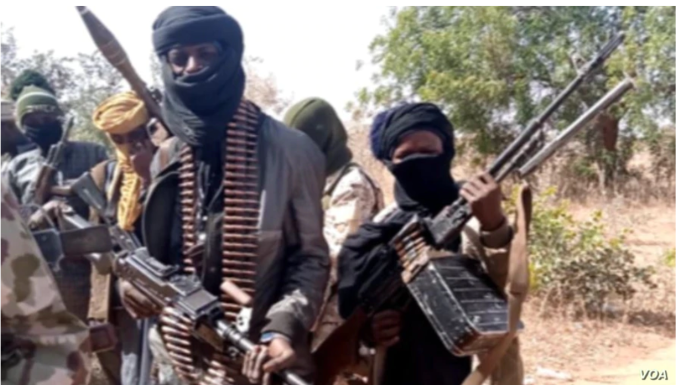
Armed bandits have subjected people in the country’s North West to a reign of terror for close to a decade now as authorities struggle to contain the growing violence. They sack villages, sexually assault women, impose levies on communities, kill locals, and control a million-dollar kidnap-for-ransom enterprise to keep their operations running.
There are believed to be as many as 30,000 terrorists belonging to different camps in the region. They wield considerable influence in some rural areas, acting as the de facto authority. Locals live under their harsh laws in such places. They also go as far as imposing levies and forcing able-bodied men among the communities to work on their farms.
Since 2011, when the crisis escalated, over 20,000 lives have been lost to armed violence in the North West, according to data gathered by the Armed Conflict Location and Event Data (ACLED) Project. The crisis has also displaced over 600,000 people across Kaduna, Kebbi, Sokoto, Katsina, and Zamfara.
Before the insecurity, families in the region, particularly outside the urban metropolis of Sokoto, survived on subsistence farming, tilling plots of land, and selling surplus harvest. These days, that is hardly an option.
In rural areas not under army control, bandits operate as a sort of government, exploiting villagers to generate money.
As a result, many end up in IDP camps where they endure squalor and grapple with contaminated water, which poses a severe threat of waterborne diseases, including cholera, to the camp’s children and pregnant women.
The ICIR had earlier reported that many IDPs face financial constraints, most resort to seeking healthcare from local chemists and untrained traditional medicine practitioners for ailments like fever, malaria, or diarrhoea, as a visit to formal medical facilities is often beyond their means. The lack of financial resources extends its grip on education, depriving their children of schooling opportunities due to an inability to meet associated costs.
Amid this dire situation, humanitarian organisations often come as sort of form of relief. However, most of them, which are backed by foreign aid, have left or downsized.
According to Sokoto, Kastina, Zamfara, SMART Survey and Integrated Food Security Phase Classification (IPC) Acute Malnutrition (AMN) Analysis survey, Sokoto is among the states with the highest number of malnourished children. Specifically, the report showed that 297,832 children were severely malnourished in the state in 2023.
As part of its strategy to address the alarming malnutrition cases in Sokoto, Governor Ahmed Aliyu, in July, said it has earmarked about N500 million to address the rising cases of severe acute malnutrition among children in the state. However, a crucial hurdle remains the uncertain release of these appropriated funds.
Data shows that 44 per cent of households in Sokoto State live below the poverty line of $1.90 per day, according to a 2021 study on the nutritional status of children under five. This dire situation translates to 11.2 per cent of children suffering from severe hunger and 18.8 per cent facing moderate hunger. The study also revealed a combined impact of poverty and hunger affecting a staggering 73 per cent of Sokoto households, far exceeding the national average of 45.4 per cent.
When compared to global and national averages, Sokoto falls short on measures of weight and height for age, indicating both immediate and long-term nutritional deficiencies, according to a 2022 study conducted in the department of paediatrics in Usmanu Danfodiyo University, Sokoto.
Rabah IDP camp, Sokoto
Speaking with The ICIR, the acting director of Sokoto State ministry of Humanitarian affairs, Salisu Abubakar, said several USAID-funded projects, including one known as Enhancing Coordination System Distance Response in Nigeria (ECODIN), were halted following the U.S. government’s decision to suspend foreign aid earlier in the year.
“It affects us seriously. There is one project called Enhancing Coordination System Distance Response in Nigeria (ECODIN) that we were about to integrate here after a meeting in Abuja, but it was suspended due to this issue of USAID.”
He explained that while the suspension disrupted the ministry’s plans, the state government sought to mitigate the impact by engaging other organisations carrying out similar interventions.
“We shifted the whole project to other organisations,” Abubakar noted, adding: “Some of them were already implementing their own programmes, so we asked if they could take on some of the responsibilities that USAID was handling. Some accepted, some didn’t.”
The director acknowledged that Sokoto had previously benefited from several USAID-supported projects in emergency response and humanitarian aid.
On how the state government is responding to the growing humanitarian needs, especially among internally displaced persons (IDPs), Abubakar said Sokoto has continued to offer limited assistance despite constraints.
NGOs lament halt of lifesaving projects
Umar Isah, former director of disaster management at the Sokoto State Emergency Management Agency (SEMA) and now Executive Director of the LinkGate for Humanitarian Development Initiatives, said the funding halt has paralysed most aid programmes in the state.
“Due to the USAID issue from the United States President, we are having serious funding constraints. Most of the NGOs that were working under USAID funding can no longer operate, and our local partners don’t have the capacity to sustain the work.”
Isah noted that before the suspension, at least five international NGOs were actively responding to the needs of displaced persons in Sokoto through projects on nutrition, water and sanitation (WASH), shelter, and livelihood empowerment.
“Right now, it’s only Action Against Hunger and COOPI that are still responding to nutrition and emergency needs,” he said. “UNICEF is planning a multisectoral intervention in hard-to-reach areas, but it hasn’t started yet.
“In the health sector, the impact is total,” he said, stressing: “Nutrition interventions, WASH, food items, and non-food item distributions have almost 90 per cent stopped because NGOs like Christian Aid and others withdrew after the funding cut.”
Umar Isah
Isah appealed to the Nigerian government and international donors to urgently step in before the humanitarian situation worsens further.
“Every local government in Sokoto has displaced people. Because of the economic hardship, they can’t cater for themselves. There is an urgent need for donors—both international and local—and the government to come to their aid.”
Ubaida Bello Muhammad, the founder of Hikima Community Mobilisation and Development Initiative in Sokoto, one of the organisations once supported by USAID, recalled how life in the IDP camps changed drastically after the U.S. Agency for International Development froze its aid programs.
“Before the freeze, there were a lot of projects going on—nutrition, maternal and child health, reproductive health, economic empowerment, even agricultural support. Thousands of women and children were benefiting, and Sokoto was a major hub for these interventions,” she explained.
“The instruction came suddenly—everyone was asked to shut down their systems and leave the office. It was the same with local NGOs like us. About 70 staff and over 60 community case workers lost their jobs that day, and the services to IDPs stopped completely. It was the end of their contract. That also meant the end of food, nutrition, and medical support for displaced families.”
Muhammad acknowledged that Sokoto state officials sometimes collaborate, but she criticised the over-reliance on foreign donors. “Local authorities are depending too heavily on international NGOs. When USAID froze its support, everything collapsed. It shows there was no backup plan.
“If this crisis is not addressed, we don’t know how it’s going to end. Women struggle after losing their husbands to bandit attacks. They can’t feed or clothe their children, and many risk dying along the way. It is very difficult, she said.”
THE Lagos State Domestic and Sexual Violence Agency (DSVA) has urged victims and survivors to share any information that could aid the ongoing investigation into e-hailing driver accused of multiple rape and assault cases in the state.
In a statement on X on Sunday, November 2, the agency said it was collaborating with the Lagos State Police Command to strengthen evidence and ensure justice following the arrest of the suspect, identified as Adedayo Adegbola.
The DSVA commended the police for their swift and diligent efforts in apprehending the driver and appealed to other possible victims to reach out through its official channels.
“The agency is working closely with the police to ensure that justice is served, and to strengthen the ongoing investigation and expand the body of substantial evidence.
“We are calling on other victims or survivors who may have been assaulted by the suspect to please come forward,” the agency urged.
Detectives from the State Criminal Investigation Department, Panti, arrested the suspect after several online posts featuring his photo went viral, with female victims identifying him.
This was made known in a statement by the Lagos State Police Public Relations Officer, Abimbola Adebisi, a superintendent of police, and shared on the command’s X account on Saturday, November 1.
According to the spokesperson, the arrest came after a discreet investigation ordered by Commissioner of Police Olohundare Jimoh.
In recent months, multiple women in Lagos have shared alarming accounts on social media, alleging that some drivers deceived or picked them up before robbing, assaulting, or sexually abusing them.
A red Toyota Corolla, with registration number JJJ 226 HT, allegedly used in the crimes, was also recovered.
The suspect remains in custody as investigations continue to trace any possible accomplices.
AMONG the doctrines that underpin the legal process in Nigeria, few are as profound and pervasive as judicial independence, but no doctrine in the ecosystem of the law rivals its elusiveness. The idea is ubiquitous in the syllabus of every programme leading to the award of a degree in law, in political science or public administration. After leaving the university, the practitioner will encounter it regularly in conferences and in after-dinner speeches.
Judicial independence is more than the stuff of law faculties and after-dinner fares. It is a fundamental human right in Nigeria. Indeed, the guarantee of the right to fair trial in section 36(1) of Nigeria’s constitution requires that every court should be “constituted in such a manner as to secure its independence and impartiality.”
Judges have a notional obligation to uphold it. The Code of Conduct for Judicial Officers in Nigeria contains five mentions of the words “independent” or “independence” and obligates them to observe “a high standard of conduct so that the integrity and respect for the independence the judiciary may be preserved.”
Despite the repetitive and obligatory genuflections before its shrine, however, few people take even appearances of judicial independence seriously, and many are these days happy to advertise undisguised ridicule for it.
Take for instance what happened last week. On 29 October, a leading national newspaper ran the headline: “FIRS, Judiciary Strengthen Collaboration on Emerging Tax Laws.” It would have been easy to disregard it as the handiwork of a distracted or mis-informed reported. The reportage, however, belied that.
The National Judicial Institute (NJI) had organised what it called “a capacity-building workshop for Justices of the Supreme Court, Court of Appeal, and Judges of the Federal High Court on (Nigeria’s) new tax law.” Effectively, this was a training for the most senior and most influential judges in Nigeria.
Established in 1991, the NJI is the statutory body responsible for continuing studies or judicial education by judges and magistrates in Nigeria. It is headed by an Administrator, who is a retired senior judge and operates under the governance of a board chaired by the Chief Justice of Nigeria (CJN). The Board approves all of its activities, including conferences, workshops, and trainings.
The NJI is funded by appropriations from the National Assembly but it also can receive sponsorships sometimes for its activities. The sums had not yet been disclosed at the time of writing but credible reports appear to indicate that the Federal Board of Inland Revenue (FIRS) substantially sponsored this latest training on the new tax laws. It is suggested, however, that the sponsorship was generous.
One of the headline speakers at that training for these most senior judges in Nigeria was the Executive Chairman of the Federal Inland Revenue Service (FIRS), who happens to share the same first name as the infamous tax collector in the Christian Holy Book. To minimise the association with its Biblical forebear, the name this time is stylised to “Zacch”.
In his address, Executive Chairman, Zaccheus, called “for deeper collaboration between the judiciary and tax authorities to ensure fair interpretation and enforcement.”
The call for collaboration of any sort, whether deep or shallow, between judges and anybody or institution clearly misapprehends the mission of the judiciary or invites them to be nobbled for value
The call for collaboration of any sort, whether deep or shallow, between judges and anybody or institution clearly misapprehends the mission of the judiciary or invites them to be nobbled for value. It is not immediately clear if the judges had any response for Zaccheus on this occasion. There, however, is evidence on the basis of previous conduct which offers us some clues.
This is far from a first in recent times for a senior public official to seek to corrupt the judiciary under the guise of seeking their collaboration. In his memoirs, The Accidental Public Servant, former Minister of the Federal Capital Territory and immediate past Governor of Kaduna State, Nasir el-Rufai, proudly tells the story of how as minister two decades ago, he led his staff to meet his High School senior, Lawal Hassan Gummi, who served in his time as Chief Judge of the High Court of the Federal Capital Territory.
Following that meeting, he gloated, “the FCT judiciary supported us strongly throughout my tenure.” The manner of the support is clear from the fact that it subsequently became nearly impossible to secure any orders against the FCT administration while those two were in office. The few cases that escaped this institutionalised nobbling did not survive to enforcement.
Two years ago, in November 2023, the incumbent Chief Judge of the Federal Capital Territory, Husseini Baba Yusuf, led the Bench of his court to the office of Nasir el-Rufai’s current successor as the Minister of the FCT, Nyesom Wike. At the meeting, the Chief Judge reminded the Minister that “as a judiciary we are part of the government and we expect that we should be able to do things that should make government work….”
As an act of prostitution of judicial powers, it is impossible to beat this. He did not have to wait too long to make good on this institutional willingness to be at the equestrian beck and call of the FCT Minister. When the FCT High Court filled judicial vacancies on its bench in the first quarter of 2024, they dutifully allocated one out of the twelve new vacancies on offer to the FCT Minister, to which he promptly deputed his sister-in-law.
This is far from the only way in which the politicians ensure that the courts are no longer constituted or able to fulfill the basic constitutional requirement of independence.
In July 2022 apparently, as he swore in a new Chief Judge for the state, Imo State Governor, Hope Uzodinma, at the same time procured the State House of Assembly to amend the High Court Law. Under the new amendment, where there is no substantive Chief Judge, the power to manage and assign cases in the High Court is transferred from the most senior judge (who is supposed to act until a new Chief Judge is appointed) to the Chief Registrar of the High Court.
There are well-founded suspicions that this amendment was procured a little more recently but backdated to 2022 to make it look older than it is in order to amputate the judicial role of the recently sworn-in Acting Chief Judge, Ijeoma Ogugua, whom the governor has been entirely unenthusiastic to allow into the role. The Acting Chief Judge functions under the authority of the National Judicial Council (NJC), in whose composition the Governor has no role.
By contrast, the Chief Registrar is appointed by the State Judicial Service Commission whose members are entirely beholden to the State Governor. In other words, by depriving the Chief Judge of the power over judicial dockets and case assignment and transferring it to the Chief Registrar, the Governor effectively makes himself the owner, controller, and manager of all cases filed in the High Court of Imo State.
This is an arrangement that makes the life of the Chief Registrar unbearable and that of the Acting Chief Judge untenable. Almost assuredly, it is also manifestly unconstitutional.
Unconstitutional is, however, not a standard that necessarily or at all bothers these peddlers of political roguery. In their books, the judges are there to be massaged in public and ransacked in private. Preachments about judicial independence are there to impress law students, pre-occupy their teachers, and distract the un-initiated. Sadly, the current leadership of the judiciary at various levels at both state and federal levels have been complicit partners in this very political ravishing of their institutional virtues.
Increasingly, doctrines of judicial independence serve only one purpose: to render the judges independent of accountability for breaching it. The value of judicial independence, rather ironically, now lies in the absence of accountability for publicly flouting it.
THE Presidency has announced that President Bola Tinubu would meet with United States President Donald Trump in the coming days to address claims of a Christian genocide in Nigeria.
Daniel Bwala, Special Adviser to the President on Policy Communication, revealed this in a post on X on Saturday, November 1, following Trump’s recent remarks accusing the Nigerian government of neglecting attacks on Christians.
According to Bwala, the meeting will focus on strengthening counterterrorism collaboration and correcting misconceptions about the nature of terrorist attacks in Nigeria.
“Both President @officialABAT and President @realDonaldTrump have shared interests in the fight against insurgency and all forms of terrorism against humanity. President Trump has assisted Nigeria a lot by authorising the sale of arms, and President Tinubu has adequately utilised that opportunity in the fight against terrorism, with massive results to show for it.
“As for the differences as to whether terrorists in Nigeria target only Christians or all faiths, those would be discussed and resolved by the two leaders when they meet in the coming days, either in the State House or White House,” Bwala wrote.
Meanwhile, Presidential Adviser on Information and Strategy, Bayo Onanuga, has said President Bola Tinubu directed newly appointed service chiefs to deliver tangible results, assuring them of full government backing in addressing emerging security challenges.
In a post on X on Sunday, November 2, Onanuga shared part of Tinubu’s Thursday address to the service chiefs, noting that the president was “well ahead of the orchestrated game unfolding in America.”
Tinubu, in the excerpt, cautioned that security threats were constantly evolving and urged the military leadership to respond with decisive action.
“Security threats are constantly evolving, constantly mutating. Of grave concern to our administration is the recent emergence of new armed groups in the North-Central, North-West, and parts of the South.
“We must not allow these new threats to fester. We must be decisive and proactive. Let us smash the new snakes right in the head,” the post quoted the president as saying.
Tinubu urged the service chiefs to be innovative and deliver tangible results, stressing that Nigerians expected outcomes, not excuses.
The president also called on the officers to act with innovation, courage, and foresight to stay ahead of those threatening the nation’s peace. He vowed that his administration would provide full support to ensure the success of their mandate, emphasising that the security crisis that began in 2009 must not be allowed to continue.
The post came amid renewed international attention on Nigeria’s security challenges.
The ICIRreports that Trump warned on Saturday, November 1, that the US might take military action against Nigeria and suspend aid to the country over alleged persecution of Christians.
On Friday, October 31, Trump designated Nigeria as a country of particular concern, citing allegations of widespread persecution of Christians. His statement came after weeks of claims by US lawmaker Riley Moore, who accused Nigeria of “systematic persecution and slaughter of Christians” and described it as the world’s deadliest place for believers.
The Nigerian government, however, has consistently dismissed these allegations as unfounded.
THE Nigeria Railway Corporation (NRC) has confirmed that one of its trains along the Warri-Itakpe route has derailed, leading to an immediate suspension of operations along the route.
The incident occurred just four days after services resumed on the corridor, according to a statement issued on Sunday, November 2, by the NRC.
Reports indicate that before the Kaduna–Abuja train accident on August 26, the NRC had suspended the Warri–Itakpe train service on August 2 following a series of breakdowns and technical issues.
It was further reported that on Sunday, October 26, the NRC announced the official resumption of the Warri–Itakpe Train Service. Operations were scheduled to resume officially on Wednesday, October 29, 2025, following the earlier suspension.
However, just four days after operations resumed, the NRC suspended services again following another derailment.
In a statement signed by its Managing Director, Kayode Opeifa, the NRC explained that the incident occurred at about 7:30 p.m. on Saturday, November 1, and involved two of the train’s seven coaches at Kilometre 212+8m in Agbor, Delta State.
Preliminary investigations, according to the statement, suggest that the derailment might have been caused by suspected track vandalism.
“We are pleased to confirm that all passengers on board were safely evacuated to Agbor, and everyone has been fully accounted for. No casualties or injuries were recorded.
“Our recovery team, supported by security personnel, has been at the site since last night, carrying out recovery operations. These efforts are progressing steadily and are expected to be completed soon,” Opeifa highlighted.
He said train services along the corridor had been temporarily suspended as a precautionary measure to allow for a thorough security and safety audit of the track and related infrastructure.
He expressed regret over the inconvenience caused to passengers and the public, assuring that normal operations would resume once the route is confirmed safe.
PRESIDENT Donald Trump has vowed to end all aid to Nigeria and deploy the United States military to fight terrorists in Africa’s most populous nation.
In a post on Truth Social on Saturday night, Trump said should President Bola Tinubu-led administration fail to stop Christians’ killings, he would order a swift and vicious attack on Nigeria.
“If the Nigerian government continues to allow the killing of Christians, the U.S.A. will immediately stop all aid and assistance to Nigeria and may very well go into that now disgraced country, ‘guns-a-blazing,’ to completely wipe out the Islamic terrorists who are committing these horrible atrocities.
“I am hereby instructing our Department of War to prepare for possible action. If we attack, it will be fast, vicious, and sweet, just like the terrorist thugs attack our CHERISHED Christians! WARNING: THE NIGERIAN GOVERNMENT BETTER MOVE FAST!”
The ICIRreported that Trump added Nigeria to countries on watchlist for Christian genocide on Friday, October 31.
“Christianity is facing an existential threat in Nigeria. Thousands of Christians are being killed. Radical Islamists are responsible for this mass slaughter,” he said.
He vowed that Nigeria would be added to the US “Countries of Particular Concern” list for nations accused of violating religious freedom.
According to the State Department’s website, the Countries of Particular Concern list also includes nations such as China, Myanmar, North Korea, Russia, and Pakistan, among others.
The US President said he had asked US Representatives Riley Moore and Tom Cole, along with the House Appropriations Committee, to investigate the issue and report their findings to him.
Responding, the Federal Government, through the Ministry of Foreign Affairs, dismissed the claims.
“The federal government of Nigeria notes the recent remarks by US President Donald Trump alleging large-scale killings of Christians in Nigeria and calling for the country’s designation as a ‘Country of Particular Concern’.
“These claims do not reflect the situation on the ground. Nigerians of all faiths have long lived, worked, and worshipped together peacefully,” said the ministry.
The government said while it appreciated global concern for human rights and religious freedom, the allegations were inaccurate and misrepresented the country’s realities.
The Nigerian government said under Tinubu’s leadership, the country remained committed to fighting terrorism, strengthening interfaith harmony, and protecting the lives and rights of all its people.
The statement added that Nigeria would continue to engage constructively with the Government of the United States to deepen mutual understanding of regional dynamics and the country’s ongoing peace and security efforts.
Tinubu reaffirmed Nigeria’s commitment to religious liberty, describing claims that the country is intolerant or hostile to Christians as inaccurate and inconsistent with the nation’s realities.
In a statement he issued on Saturday, Tinubu said Nigeria stood firmly as a democracy governed by constitutional guarantees of religious liberty and continued to maintain open engagement with both Christian and Muslim leaders across the country.
He argued that the portrayal of Nigeria as religiously intolerant did not reflect the reality in the country, adding that the government’s efforts to safeguard freedom of belief for all Nigerians remained consistent and sincere.
“Religious freedom and tolerance have been a core tenet of our collective identity and shall always remain so. Nigeria opposes religious persecution and does not encourage it,” Tinubu stated.
The president reaffirmed that Nigeria’s Constitution protects citizens of all faiths and that his administration was working closely with the United States government and the international community “to deepen understanding and cooperation on protection of communities of all faiths.”
Last month, US lawmaker Riley Moore had urged Secretary of State Marco Rubio to take diplomatic action over what he described as the “systematic persecution and slaughter of Christians” in Nigeria, calling it “the deadliest place in the world to be a Christian.” He also advocated suspending arms sales to Nigeria until measurable progress was made in curbing violence.
Meanwhile, the Minister of Information and National Orientation, Mohammed Idris, had dismissed claims that terrorists in Nigeria deliberately target Christians while speaking earlier in the week on CNN.
“Some of the claims made by certain officials of the United States are based on faulty data and assumptions that the victims of this violence are largely Christians,” Idris said, adding that “Yes, there are Christians being attacked, but these criminals do not just target one religion. They target Christians, and they also target Muslims. We have seen that especially in the northern part of the country.”
The claims of Christians genocide in Nigeria stemmed from failures of successive governments to protect citizens, with thousands of people dying yearly from terrorists, bandits and other criminals.
THE All Progressives Congress (APC) has called on the Independent National Electoral Commission (INEC) and the Nigeria Police Force to investigate Anambra State Governor, Chukwuma Soludo, for reportedly promising cash rewards to supporters whose wards secure victory for the All Progressives Grand Alliance (APGA) in the forthcoming governorship election.
The APC National Secretary, Ajibola Bashiru, made the call in an interview with The PUNCH, accusing Soludo of trying to sway voters with financial incentives rather than relying on his administration’s achievements.
The controversy began after Soludo, APGA’s governorship candidate, pledged monetary rewards to supporters based on ward performance during a campaign rally in Umunze, Orumba South Local Government Area, on October 25.
“When we were campaigning for the Senate, we knew we were going to win every ward in the South Senatorial Zone, but we still had some incentives. Any ward that APGA won received N1 million, and we won all the wards in Orumba South.
“We promised each of these wards N1 million, and next week, we will redeem it. The ward that comes first will get N5 million, the second N3 million, and the third N2 million. That was the deal. For November 8, any ward that wins again will receive N1 million, while the first three performing wards will get N5 million, N2 million, and N1 million respectively,” Soludo was quoted as saying.
Reacting to the development, Bashiru said Soludo’s remark reflected desperation and a lack of confidence, alleging that the governor’s performance in office failed to inspire voters. He added that if Soludo could not campaign based on his achievements after more than three years in office, it indicated that he was struggling and should be voted out.
“INEC should probe this matter and issue a public warning against such conduct. The police must also investigate APGA’s campaign finances to ensure compliance with electoral laws,” Bashiru said.
However, Anambra State Commissioner for Information, Law Mefor, dismissed the allegations, describing the APC as a weak and non-existent opposition in the state.
Mefor accused the APC of deliberately misrepresenting Soludo’s remarks, explaining that the governor’s statement was intended to encourage voter participation rather than buy votes in the poll slated for November 8.
“Governor Soludo has not offered any reward to those who would vote for him, but rather to all registered voters generally, regardless of party affiliation. His concern is the low voter turnout in Anambra elections, where only about 200,000 out of 2.7 million registered voters participated in the last poll,” Mefor stated.
He maintained that Soludo’s administration had exceeded expectations, adding that several communities had voluntarily contributed funds to support his re-election.
According to him, Soludo did not need to pay anyone to vote for him, as residents were eager to return him to office due to his performance.
He added that nearly every community in the state had donated millions to his re-election fund, describing it as an unprecedented show of support.
NOVEMBER 2nd of every year is observed as the International Day to End Impunity for Crimes against Journalists (IDEI). This day serves as a powerful condemnation of all acts of violence and aggression directed at journalists and media professionals.
It is a critical moment to elevate global awareness regarding the safety of journalists and to press member states to implement effective measures to prevent violence, ensure that perpetrators are held accountable, and foster a secure environment where journalists can practice their profession independently. The date commemorates the murder of two French journalists in Mali on November 2, 2013.
The 2025 theme, “Chat GBV: Raising Awareness on AI facilitated Gender Based Violence against Women,” highlights an urgent, evolving threat, especially for female journalists in the digital age. This focus is particularly pertinent in Nigeria, where journalists, male and female, face persistent attacks, often with little to no legal consequence for their assailants.
Battle on the frontlines: Attacks on female journalists
Recent accounts from Nigeria vividly illustrate the dual challenges of physical assault and sexual harassment faced by female journalists. These attacks occur both in the field and within newsrooms, and are increasingly migrating to online platforms.
The risks of on-the-job reporting frequently escalate into physical danger:
In February 2024, a Whistler reporter, Kasarachchi Aniagolu, was detained, slapped, physically assaulted, and reportedly hit with a gun by police officers in Abuja while reporting on a currency trading area raid. Despite showing her press identification and requesting a formal interview, she became a target.
In May 2023, Cliqq TV journalist Rukayya Jibia was assaulted by approximately 20 policemen in Katsina. Her offence was questioning the police decision to parade four young women arrested on prostitution allegations before trial, citing the Nigerian Constitution’s presumption of innocence.
Rukayya Jibia
Jibia stated that an officer personally twisted her hand and smashed her phone on the ground. She was detained for about five hours after being dragged to the Emir’s palace, where she was not permitted to defend herself against police accusations of undermining their authority.
Azuka Ogujiuba, a Lagos-based journalist and publisher, was subjected to an unlawful detention in an Abuja police cell for three days without food following a report on a land dispute involving a real estate developer. She was later ambushed by policemen “in a gangster like manner” and coerced into signing an apology letter circulated to discredit her publication, despite a directive from the Inspector General of Police cautioning officers against interfering in purely civil matters.
Journalist Azuka Ogujuiba
Similarly, in August 2025, Nigerian Television Authority (NTA) transport reporter Ladi Bala, a former President of the Nigerian Association of Women Journalists (NAWOJ), was verbally abused and intimidated by the Managing Director of the Nigerian Railway Corporation (NRC), Kayode Opeifa, while covering a train derailment along the Abuja-Kaduna rail line.
Opeifa disrupted her live report and allegedly used demeaning language, ordering security to remove her. Although Opeifa later publicly apologised on August 31, 2025, claiming his actions were due to intense pressure, the initial incident highlights the hostility faced by women in the media.
Also in October 2025, Jay 101.9 FM journalists Ruth Marcus and Keshia Jang were arrested by operatives of the State Security Services (SSS) in Jos, Plateau State, for posting a video of a confrontation between a cleric and security operatives at the funeral of a politician’s mother. Following public and media outrage, they were eventually released, but their illegal detention underscores the security agencies’ disregard for press freedom.
Hafsah Muhammed of WikkiTimes narrowly escaped a robbery by machete-wielding men while on her way to submit a Freedom of Information request in Gombe during the 2023 general elections.
Bolanle Olabimtan, a reporter for TheCable, was harassed by political thugs who confiscated her phone and deleted her footage. Adefemi Akinsanya of Arise TV was filmed shielding her crew from officers trying to seize their drone during the 2021 #EndSARS memorial.
Sexual harassment and coercion
Female journalists frequently navigate a deeply patriarchal environment where sexual harassment is used to control or obstruct their work:
WikkiTimes reporter Victoria Ogechukwu recounted that a source in Bauchi offered her cash and a hotel room instead of the budget documents she was seeking. Another investigative journalist, Hadiza Musa Yusuf, was approached by an elderly source in Kano’s civil service who repeatedly avoided answering her questions.
Victoria Ogochukwu
A former contract announcer at Katsina State Radio reported repeated sexual harassment during her decade-long tenure before her sudden dismissal in November 2023. A television presenter, identified as *Khadija, was subjected to a boss who publicly berated her and piled extra chores, forcing her eventual transfer.
In other news, veteran broadcaster Khadija Abdullahi was targeted by male colleagues in Kano who questioned her frequent visibility on flagship programmes, saying, “Does it always have to be Khadija?” This, combined with inappropriate messages online, pushed her to step down from certain anchoring roles. Sadia*, a newly hired journalist, faced routine dismissal of her work and stereotypical assumptions based on her background from her middle-aged male editor.
Online abuse
The threats extend viciously into the digital realm, impacting mental health and productivity:
A UNESCO ICFJ study found that 73 per cent of female reporters have experienced online harassment. Alarmingly, one in five respondents reported that this digital abuse escalated into offline threats or attacks, and 18 per cent were specifically threatened with sexual violence related to their reporting.
The unrelenting abuse leads to a devastating mental toll, with journalists reporting anxiety, depression, and Post Traumatic Stress Disorder (PTSD). Akinsanya admitted that she has avoided watching the video of her assault because it remains “quite traumatic.”
A shared predicament: Attacks on male journalists
The culture of impunity is not limited to attacks on women. Reports from The ICIR confirm that male journalists are also targets of violence and unlawful detention, often perpetrated by security operatives and powerful individuals attempting to suppress accountability.
Gabriel Idibia, a journalist in Kaduna shares this image after he stated he was assaulted by the Police in 2024
In one incident, Marcus Fatunmole, News Editor at The ICIR, was detained for approximately six hours in Abuja by security operatives, including a police officer, while investigating a viral video about luxury buses for mass transit in December 2023. His phone was seized, and his Google account was accessed.
In December 2023, Godwin Tsa, a journalist with The Sun newspaper, was forcibly arrested by security officers from the Department of Development Control at the Federal Capital Territory Administration (FCTA). Similarly, Precious Eze, an online publisher, was arrested and held incommunicado, with his laptop and devices confiscated in December 2023.
Reports indicate that a Special Task Force of the Nigeria Police from Abuja arrested and held Precious Eze incommunicado, confiscating his electronic devices in December 2023. Earlier, in November 2023, the Niger State Commissioner of Homeland Security reportedly assaulted Mustapha Batsari, a journalist reporting for Voice of America.
The collective experiences of Nigerian journalists paint a grim picture: from physical assault and illegal detention to sexual coercion and online smear campaigns.
Analysts say the international day to end impunity for crimes against journalists must serve as more than an annual reminder; it is a vital call to action. While the legal framework exists within Section 42 of the Nigerian Constitution prohibits gender based discrimination, it is the lack of enforcement that allows impunity to thrive, some said.