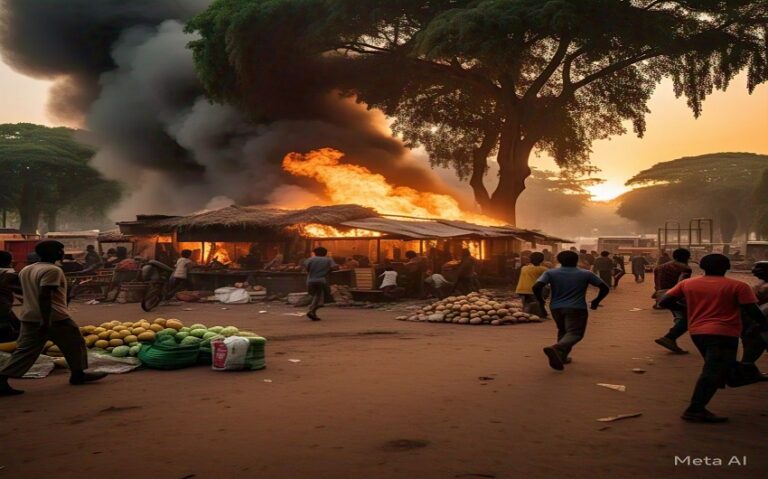
THE Federal Capital Territory (FCT) Police spokesperson, Josephine Adeh, has confirmed a fire incident occurred at the Jabi Lake Mall, Abuja, in the early hours of Thursday, October 30.
According to Punch, Adeh said police officers were deployed to the location to secure the area and prevent looting.
“We received a distress call at about 3:40 a.m. We immediately deployed our men there to secure the place and prevent any breach of public order,” she said.
Reports indicated that the fire affected only the Adidas Sports shop, though the cause of the outbreak had yet to be determined as of press time.
It was also gathered that firefighters from the Federal Fire Service, the Berger Fire Department, and the FCT Fire Service were deployed to the scene.
The incident adds to a chain of fire disasters in the FCT in recent years.
The ICIRreported in 2022 that many traders in the popular Karmo market in Abuja counted their losses after fire razed their shops.
The fire, which started around 12:00 am and lasted for over two hours, burnt down several shops and destroyed goods before it was put out by operatives of the FCT Fire Service..
Shops and goods were also destroyed during the 2021 fire outbreak at the Nyanya Market in the night and the cause of the fire could not be ascertained.
Similarly, on December, 26, 2021, The ICIR reported how the Next Cash and Carry Mall, in the nation’s capital went up in flames.
PRESIDENT Bola Ahmed Tinubu has reportedly approved 15 per cent import duty on petrol and diesel.
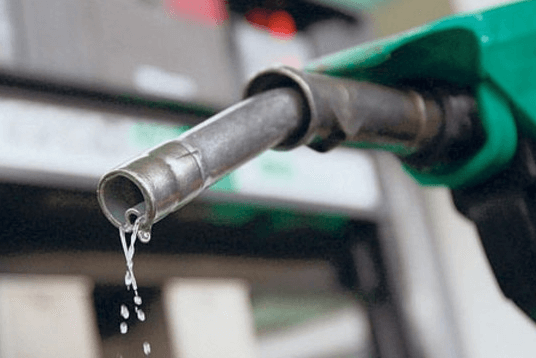
The measure is expected to push pump prices of the products up, with projections suggesting petrol could rise by as much as ₦150 per litre in some parts of the country.
The approval, contained in a presidential directive dated October 21, 2025, was communicated to the Federal Inland Revenue Service (FIRS), the Nigerian Midstream and Downstream Petroleum Regulatory Authority (NMDPRA), and the Nigeria Customs Service.’
It followed a proposal from the Ministry of Finance and FIRS seeking to align Nigeria’s fuel import pricing with domestic production realities and protect local refineries.
According to government documents obtained by The Cable, the tariff will be applied on the cost, insurance, and freight (CIF) value of imported petrol and diesel. The move, the government said, aims to stabilise the downstream petroleum market, promote energy security, and ensure fair competition between importers and local refiners.
The presidency explained that the policy was part of wider reforms to strengthen domestic refining capacity and reduce reliance on imported fuel. It follows the Federal Executive Council approval of July 29, 2024, which allowed crude oil for domestic use and refined products to be traded in naira.
Officials said domestic refining, particularly at the Dangote Refinery, has begun to increase, but that instability in pricing between local refiners and importers continued to distort the market. Import parity pricing, which often determines the pump price, has remained below cost recovery levels for local producers.
According to Arise News, in the official communication, the presidency noted that “while domestic refining of petrol is gradually improving, misalignment between local refiners and marketers has led to price instability. The 15 per cent import tariff is designed to protect consumers and producers by discouraging duty-free imports that undercut domestic refiners.”
The directive also explained that the measure would prevent unfair competition, promote investment in refinery and logistics infrastructure, and ensure that local production remains viable. Payments from the new import duty are to be made into a designated Federal Government account under the FIRS, with NMDPRA responsible for verifying compliance before any shipment is released.
Sections 71 and 72 of the Petroleum Industry Act (PIA) were cited as the legal foundation for the policy. These provisions empower NMDPRA to impose regulations that promote energy security, safeguard supply, and advance broader economic goals, including through levies or tariffs considered to be in the public interest.
The implementation of the new tariff, initially proposed to begin after a 30-day transition period to allow importers to adjust, is now expected to take effect immediately following a presidential instruction. “Approved as prayed for implementation immediately,” President Tinubu reportedly wrote in the directive.
The government also directed that future import licensing must prioritise local production capacity before foreign supply is approved. Customs and NMDPRA have been instructed to update import templates, enforce digital verification for all shipments, and issue a compliance notice to prevent market speculation.
Officials say the policy is not primarily designed to raise revenue but to correct market distortions that make locally refined products less competitive than imported fuel. The presidency believes that the import tariff will help Nigeria achieve fuel self-sufficiency, stabilise supply, and attract further investment into the refining sector.
However, concerns have emerged among stakeholders in the downstream petroleum industry. Many argue that the country’s refining capacity remains insufficient to support the policy without disrupting supply and inflating prices. Nigeria still imports more than 60 per cent of its refined petroleum products, with less than 40 per cent sourced locally—mostly from the Dangote refinery and smaller modular refineries.
Industry experts warn that, while the policy could eventually encourage local refining, consumers may bear the immediate brunt of higher fuel prices. Some marketers have already projected that the new tariff could push pump prices beyond ₦1,000 per litre if the naira weakens further or international freight costs rise.
STANDING at an elevation of over 1,800 meters, the Mambilla Plateau offers panoramic views that stretch for miles in every direction. Its rolling hills, lush green pastures, and charming villages create a unique picturesque landscape. The Plateau, which shares borders with Cameroon, is a treasure trove of natural beauty, cultural richness, and economic opportunities. However, beyond the peaks, scenic beauty,and potential to become a premier tourist destination in Nigeria,The ICIR unravels thedark side that underscores the paradox of the Plateau’s hidden gems and misbegotten communities.
Travelling through ‘hell’
The journey from Jalingo, the capital of Taraba State to Gembu, the headquarters of Sardauna LGA on the Mambilla Plateau, should be less than four hours. But it takes between seven to eight hours depending on the type of vehicle. No thanks to the bad road, coupled with the plethora of checkpoints.
For first time visitors, the 376 km road to Gembu through Bali and Gashaka is a gruelling test of endurance. Potholes, some as deep as sinkholes, pockmark the asphalt, which has long given up its battle against the elements. The surface resembles a rugged, unforgiving terrain, with jagged edges and uneven slabs of asphalt that jolt vehicles mercilessly.
As vehicles navigate the treacherous stretch, the rhythmic thud-thud-thud of wheels hitting potholes becomes a constant companion. The air is thick with the sound of scraping metal, straining engines, and the occasional loud complaint from frazzled passengers.
An aerial view of Gembu: ‘Heartbeat of the Mambilla Plateau’. Photo: TheICIR/Fidelis Mac-Leva
Dust devils swirl around the vehicles, coating everything in a fine, choking layer of dirt. The sun beats down relentlessly, offering no respite from the heat. The smell of burning rubber and gasoline hangs heavy over the landscape. In the rainy season, the road transforms into a muddy, slippery nightmare. Vehicles struggle to gain traction, wheels spinning futilely as they sink into the mire. The risk of accidents looms large, and the mere thought of breakdowns or skidding into a pothole fills every passenger with dread.
Beyond the poor state of the road lies a bigger challenge: security checkpoints. They dot the landscape, each one a potential minefield for commuters. Agents, often in worn-out uniforms, flag down vehicles with a mix of authority and expectation. At each checkpoint, the ritual plays out: agents scrutinise documents, question travellers, and inspect cargo. But the underlying message is clear – “pay up or face delays.” Commercial drivers, aware of the game, try to negotiate, hoping to minimise the “transaction fee.” Other commuters, fearful of repercussions, hand over money without question.
The extortion is veiled, often disguised as “settlement” or “dash.” But the reality is stark: security agents leveraging their positions for personal gain, leaving commuters feeling vulnerable and exploited. The practice perpetuates a cycle of poverty and mistrust, further straining relations between security forces and the communities they’re meant to protect.
As vehicles navigate the potholed roads, they are forced to factor in the added costs – financial and emotional – of these encounters. The journey becomes a test of endurance, with security checkpoints serving as reminders of the systemic challenges plaguing the region.
From Gembu to the hinterlands
From Gembu to the border communities: The road makes the journey a nightmare. Photo Fidelis Mac-Leva/The ICIR
If you are proceeding from Gembu to the rural-border communities, you are in for another round of ordeal. The journey to the rural communities within the Mambilla Plateau is an arduous odyssey. The road, barely passable, winds its way through the rugged terrain, testing the mettle of even the sturdiest vehicles. Potholes, craters, and jagged rocks stretch out like obstacles in a minefield, threatening to puncture tires or shatter axles at every turn.
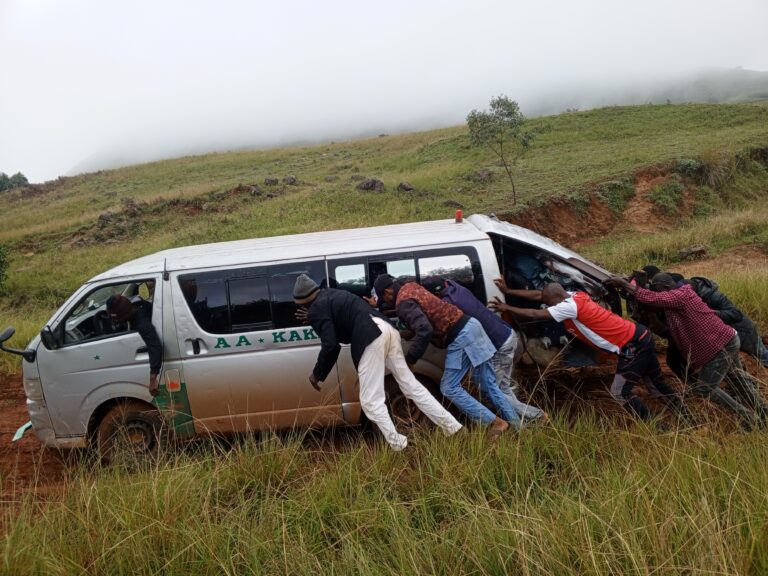
The surface, is a muddy quagmire during the rainy season, sucking wheels into its grasp like quicksand. Vehicles and motorcycles struggle to gain traction, inching forward in a slow, agonising dance. The sound of scraping metal, straining engines, and frustrated shouts fills the air.
As travellers navigate this unforgiving terrain, the scenery offers little comfort. The landscape is a mix of rolling hills, steep inclines, and sharp bends, with vegetation growing wild and untamed alongside the road. The air is cool and misty, but the road conditions make every journey feel like an adventure – or an ordeal.
Commuters face a constant battle against fatigue, injuries, and potential accidents. Breakdowns are common, leaving passengers stranded in the middle of nowhere, exposed to the elements and the uncertainties of the road. Yet, despite these challenges, the people of Mambilla persevere, driven by necessity, resilience, and a deep connection to their community. The road may be harsh, but their determination remains unbroken.
Key facts about the Mambilla Plateau
Located in the highland region of Taraba State, the Mambilla Plateau is a majestic destination that boasts breathtaking landscapes, rich cultural heritage, and abundant wildlife, making it an ideal spot for nature lovers, adventure seekers, and cultural enthusiasts.
Accessed from Gembu, headquarters of Sardauna LGA, the Plateau stands at an elevation of over 1,800 meters, offering panoramic views that stretch for miles. Its rolling hills, lush green pastures, and charming villages create a picturesque landscape. It also houses the famous Chappal Waddi mountain considered the highest point in Nigeria with an average height of about 2,419 metres (7,936 ft) above sea level.
Being among Nigeria’s top tourist destinations, the Plateau which attracts visitors from different parts of the country and beyond, has one of the best weather conditions in the country which is cool and always accommodating all year round.
The famous Highland Tea is also found there. Livestock like cow, goats, sheep and other rare birds thrive on the Plateau, including natural forests that are home to very rare species of birds and trees which have attracted lots of researchers from around the world.
Signed plebiscite, broken promises
Historical accounts record that in the early sixties, the people of the area now known as the Mambilla Plateau (then part of the British-administered Northern Cameroons) participated in a United Nations-supervised plebiscite to decide whether to join the Federation of Nigeria or the Republic of Cameroon. The majority voted in favour of joining Nigeria, and the territory was formally integrated on 1 June 1961.
Although there is no official record of any formal conditions attached to the vote, local oral histories and later writings suggest that many of the people expected that joining Nigeria would bring development opportunities including better roads, schools, and greater political inclusion. They were also assured, through political campaigns and local leaders, that they would enjoy equal treatment and participation in national affairs.
Over time, many on the Mambilla Plateau have expressed disappointment that these expectations have not been fully realised.
Saleh Alhaji Aabubakar, the district head and acting third-class chief of Mbamga chiefdom.Photo: Fidelis Mac-Leva/The ICIR
“We lack almost everything. There is no good road network. No higher institution, and our people are not partakers of the national cake,” laments Saleh Alhaji Aabubakar, the district head and acting third-class chief of Mbamga chiefdom.
The chiefdom comprising eight districts, each headed by a village chief called Mbon.
The royal father who took The ICIR through memory lane, said: “In Mambila Plateau as a whole, we joined Nigeria through a plebiscite in the early 60s by vote. We chose to join Nigeria based on certain conditions that were entered into by our forefathers with the Nigerian government.
“Today is more than 60 years and none of the conditions has been put in place. We have been faced with a lot of challenges; lacking almost everything. We are cut off from the Nigerian government, “he said.
He underscored the economic and tourism potentials of the Mambilla Pleteau, while decrying the neglect of the border communities by successive governments.
“There are a lot of things that government needs to do there. Naturally, you savour the weather and the terrain which is good for tourism. There is need for government to come and develop that place that will attract tourists all over the world.
“I have not been to Obudu, but people said the Mambilla Plateau is almost like the Obudu Cattle Ranch in terms of tourism potentials. Government can transform that place,” he said.
Echoes of anguish
A visit round the communities on the mountains and valleys of the Plateau, however, reveal that they are far from development. Across its major border settlements of Dorofi, Kan-Iyaka, Yerimaru, Tamnya, Mbamga, Mayo-Ndaga and Njimtilo, the visible scars of neglect have given rise to echoes of lamentation. Consequently, there is a boom in illicit economic activities across the borders, including smuggling.
Youths like this one have taken advantage of the bad road to smuggle petrol across the porous borders. PC: Fidelis Mac-Leva/ICIR
Like other border communities in Nigeria, locals say they are only remembered by politicians during electioneering campaign period. The timeless Chinese adage that, “Civilisation follows the road” holds no essence there as there are no access roads. Other essential infrastructure such as hospitals and schools are also lacking, leading to the communities relying more on such amenities from Cameroon.
Mike Nyako, a businessman based in Mbamga said, “Our greatest challenge here is lack of motorable roads. We convey goods, patients and corpses to Gembu on bikes even as there are no hospitals and doctors. Added to these is the absence of good schools, running water and electricity. If the federal government fails to do something, scores will continue to migrate to Cameroon where they enjoy these facilities.”
Yuguda Mairiga, a resident of Mbamga, also harped on the importance of roads on the Plateau among other amenities. “There are no motorable roads. We also need a big hospital as we travel to Gembu and Cameroon for treatment. We lack schools even as we get water from dams,” Mairiga said.
Elsewhere at a village called Mbamga Petel, Saidu Umaru, a 65-year-old cobbler ensconced in his cage-like workshop, re-echoed the absence of a motorable road as the major challenge confronting communities on the Mambilla. “We are basically farmers and traders but have no good roads to convey our farm produce to the markets,” he said, his sweat-soaked face bearing the furros of sorrow.
Ismaila Musa, another resident of Mbamga Petel said, “As a maize farmer, I convey my produce on head to the market for sale due to the absence of motorable roads. Hardship and lack of amenities have forced our children to move into Cameroon in search of opportunities. I personally have three children who are in Cameroon in search of means of survival.”
If you have visited one primary or secondary school in communities on the Mambilla, you have visited them all. They stand as a testament to neglect and abandonment, with crumbling walls that bear the scars of time and harsh weather. While most of the buildings are in mudbricks others have faded paints peeling off in strips. There are leaky roofs and broken windows-some gaping like empty eye-sockets, allowing birds to fly in and out at will.
Dilapidated structures like this are a commonplace in communities on the Mambilla Plateau which serve as classrooms for students. PC: Fidelis Mac-Leva/ICIR
Inside, the classrooms are a mess and the floors creak beneath your feet. Chalkboards are cracked and worn smooth. Desks, where available, are broken, their wooden slats splintered and uneven. Even the floors bear the scars of years of neglect with yawning cracks. Despite these challenges, the schools still hum with the whispers of eager students who trek from miles away with hope and determination.
Roselyn Wamba, Assistant Head Teacher at the Mbamga Petel Primary School said each class is overcrowded with up to seventy students. “There are only five teachers here with poor learning facilities. No first aid box, sports and sanitation facilities,” she laments.
At Bang, a border community which is fifteen minutes drive to Cameroon, Wakili Dahiru, a resident said, “We are suffering from lack of portable water, hospitals and schools. Our major challenge is lack of good road. We convey patients on shoulders to Cameroon and other places. Two of such patients died recently while being conveyed for treatment. We drink water from the streams with animals. Government has abandoned us-hence our children troop to Cameroon in search of what to do.”
Speaking in the same vein, Ibrahim Kaka, the Sarkin Hausawa of Hainare, said the lack of roads, water and medical facilities are their greatest worries. “We convey the sick on bikes and shoulders to Gembu. Most of our youths have moved into Cameroon where they enjoy these amenities and look for daily bread.
“There is no secondary school here. For over ten years, secondary classes are held in a crowded primary school. There is no government presence; we have been abandoned by government and our political representatives who only come during campaigns to curry our votes.”
One of the fragile bridges constructed by locals to connect the border communities on the Mambilla Plateau. Photo: Fidelis Mac-Leva/The ICIR
The story is no different at other border communities visited on the Mambilla Plateau, including Dorofi and Mayo Dule. Jauro Gidado Modibbo, who spoke with The ICIR in Dorofi said, “We really don’t know whether we are still in Nigeria. We are cut off, no road, no GSM network and hospitals. We are by the border and these amenities lacking here are found in Cameroon. This is why many of our youths go there to stay. Our children are educated but idleness make them to cross over to Cameroon.”
At Mayo Dule, Ardo Dini Usman lamented that about 75 per cent of their youths were in Cameroon, adding that many have abandoned schooling. The only secondary school we have here was built by the National Boundary Commission (NBC). We live in darkness here due to lack of electricity. Ironically, these amenities we lack here are found in border communities on the Cameroonian side.”
Fuel smuggling
Findings by The ICIR indicate that the bad state of the roads linking communities on the Mambilla Plateau, coupled with the poor state of infrastructure has forced youths to go into smuggling activities. Majorly, they smuggle petroleum products through the porous borders into Cameroon where they attract higher prices.
There are seven major border points between Nigeria and Cameroon within the Mambilla Plateau of Sardauna LGA in Taraba State. These are: Dorofi, Kan-Iyaka, Yerimaru, Tamnya, Mbamga, Mayo Ndaga and Njimtilo.
Large scale coordinated smuggling activities take place at these border areas, especially at Kan-Iyaka where the illicit activity has persisted for over a decade.
Local sources told The ICIR that while fuel is transported in bulk from Port Harcourt, only a small portion is reportedly offloaded within the local government area, with the remainder believed to be taken across the nearby border into Cameroon through informal routes. They gave them number that only two out of every 50 trucks are offloaded.
Security agents arrest and confiscate trucks loaded with smuggled fuel like these. But they are released after ‘settlement’. PC: Sardauna LGA information office
Along the multiple ‘illegal’ checkpoints leading to Cameroon through the border communities, security agents exploit the smugglers with extortion. It was gathered that while each truck smuggling fuel is made to part with N50,000, motorcycles loaded with the commodity pay between N1,000 to N2,000 at each checkpoint.
The ICIR was informed that some traditional rulers are also involved in the extortion as they collect N10,000 per fuel-laden vehicle as “traditional council clearance”.
The district head of Mbamga, Abubakar, denied this allegation. He, however, said, “What we are trying to do is to introduce some gates and collect some ‘maintenance tolls’ from the smugglers who spoil the road after we engage our community members to repair.”
A youth involed in fuel smuggling, who spoke on the condition of anonymity for fear of being victimised, said, “Many of us completed lower schools but we idle around because there is no money to go further and no job to do. We are left with no option than to go into smuggling.”
“Customs officials and other security agents confiscate petrol from us and demand bribes before they release.
Ray of hope?
Amid lamentations the people on the Mambilla communities are, nonetheless, appreciative of the Federal Government for awarding a contract for the road from Gembu through Mbamga. While accusing their state and federal lawmakers of not attracting development to their communities, they lauded the effort of a prominent son of the area whom they said influenced the road project.
The district head of Mbamga, Abubakar said, “We are so happy and proud with the present administration recognising us and approving the construction of the road from Gembu down to the border through Mbamga Chiefdom which will open that place.
“As you travelled down to Mbamga, you must have seen them working on the road. The government has signed a contract of over 71 billion which in the history of this area, nobody or government has ever done that to us. Also, the Taraba State government has introduced free education and established the State University of Agriculture and Climate Change, Science and Technology on the Mambila Plateau. It’s just a new university that has been passed into law by the present governor. We are so happy and overwhelmed.
“None of the previous administrations keyed into it but the current one was able to do so with the federal government. So, we are now seeing a ray of hope being part of Nigeria. But like I earlier said, apart from the road and the school they have brought, we are faced with a lot of challenges in terms of social amenities,” the royal father said.
Bakari Umar, a retired senior civil servant, who worked on a United Nations Resettlement Committee on the Mambilla Plateau in 2002, called for a needs assessment team on the development of each of the communities.
“This is important to find out what projects are most suitable to them based on their own challenges,” he said, adding: “Once that is done using local contractors for the various projects, I think everything will be okay.”
Describing smuggling within the border communities on the Plateau as “serious”, he said the problem is difficult to solve because: “There is a connivance between the community and the customs officials.”
Umar Muhammed, the chairman of Sardauna LGA, failed to respond to inquiries on the issues relating to our findings. He initially promised to speak to the issues but failed to respond to calls and text messages afterwards.
Mambilla Plateau is work in progress – Taraba SSG
The Secretary to the Taraba State Government (SSG), Timothy Gibon Kataps, admitted that the challenges in Taraba were enormous, “but gradually we will get there.”
He said, “The federal government is already doing the road from Gembu to the border. They are done with the bridge, and I am sure after the rains the work will speed up. “Government has also remobilised contractors to return to all roads that were started and I believe we will get somewhere.
“Similarly, government is looking at the issue of water. The governor recently had a townhall meeting to hear directly from the people. So, it is work in progress. As you know Taraba is the third largest state in Nigeria after Niger and Borno.”
Commenting on the issue of smuggling, Kataps said, “We have security operatives all over there. So, it depends on what is smuggled and what is not. If the security operatives allow them to pass, that means it is no longer smuggling. About two or three months ago, the Customs reportedly confiscated fuel products along the border, so I believe the security agencies are equally working on that.”
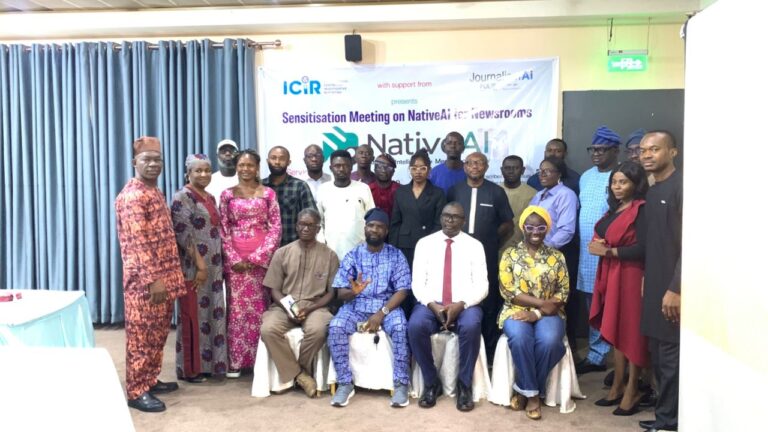
As part of its efforts to strengthen journalism through innovation and technology, the International Centre for Investigative Reporting (The ICIR) on Wednesday, October 29, held a sensitisation meeting for media professionals on the use of its new tool – NativeAI for newsrooms.
The tool is an indigenous artificial intelligence tool that supports transcription, translation, and accessibility in storytelling.
The meeting, held in Abuja, brought together journalists, editors, and media technologists to familiarise them with the product — a continuation of The ICIR’s commitment to helping journalists adapt to the changing digital landscape and enhance newsroom productivity.
Developed by The ICIR and unveiled in September at a webinar, the product is designed to help journalists and content creators transcribe audiovisual files, translate them into Nigeria’s major languages, and make media content more inclusive for diverse and hearing-impaired audiences.
Speaking at the event, the Executive Director of The ICIR, Dayo Aiyetan, noted that the organisation recognised the growing intersection between journalism and technology and the need for practitioners to embrace digital tools that make their work faster and more efficient.
“We invited not just journalists but also tech people from the media because journalism today is driven by technology “Native AI transcribes audiovisual files and translates them into Hausa, Yoruba, and Igbo. Eventually, we hope to cover more Nigerian languages,” he said.
Aiyetan explained that the tool emerged due to the challenges journalists face when manually transcribing lengthy interviews and translating local language recordings.
“At The ICIR, and even at our verification platform, The FactCheckHub, we had to pay people for translations. We thought why not build a tool that simplifies the work of journalists, researchers, and students by transcribing a one-hour video in just minutes?” Aiyetan stated.
Beyond streamlining newsroom tasks, Aiyetan said the tool also reflects The ICIR’s dedication to inclusion and accessibility. NativeAI was designed with the hearing-impaired community in mind, allowing users to upload audio files and have them transcribed or translated into text, he stated.
The programmes manager at The ICIR, Eunice Enoch, also described NativeAI as an indigenous innovation developed to make newsroom work more efficient.
She noted that the tool was designed to transcribe English audiovisual content, helping reporters save the long hours typically spent typing interviews manually.
“From the name itself — NativeAI — you can tell it’s something indigenous, something that is your own. It’s an AI-powered transcription tool developed by The ICIR to support journalists in their day-to-day newsroom workflows.
“Like most of you, The ICIR is a media organisation. We go to the field to conduct interviews and return to the newsroom to transcribe those conversations. After the stress of fieldwork, you still have to sit down, listen, pause, and type. It’s exhausting, and that was one of the reasons we developed NativeAI — to make that process easier.” Enoch explained.
Sharing a personal experience, she highlighted how tasking transcription could be while noting that NativeAI was developed to save journalists the long hours spent on manual transcription, allowing them to focus on deeper storytelling and investigative work, while also enhancing access to media content across Nigeria’s diverse linguistic and cultural landscape.
Senior Programmes Manager, Chukwudi Iwuoha, demonstrated how the platform works, explaining that users could either record directly on the platform or upload audio and video files for transcription and translation.
“When you upload a video, it extracts the audio and transcribes it. You can also upload an audio file or record directly. For now, the model supports English transcription, but translation into the three major Nigerian languages will be integrated soon,” Iwuoha explained.
Screenshot showing HOW TO USE the Native AI transcription tool on the website PC: Fatimah Quadri/The ICIR
He also assured participants of data safety, noting that the system runs on Google Cloud and does not retain user data.
“You don’t need to create an account; you simply use the platform and log out. Your data remains secure,” he stated.
Participants described the tool as a timely addition to Nigerian newsrooms. Editor of Pinnacle Daily, Sunday Michael Ogu, said Native AI could drastically reduce newsroom costs and improve turnaround time.
“Imagine spending one or two minutes to transcribe a 50-minute audio that would have taken four hours before; it increases efficiency and allows journalists to focus on storytelling,” he stated.
Assistant Editor at Dubawa, Lois Ugbede, lauded the tool’s ability to bridge Nigeria’s language divide.
“We’ve seen transcription tools before, but none that translates into our local languages. That’s what makes Native AI unique. Any newsroom that wants to evolve and make an impact should adopt it,” she said.
Editor of The Federal Radio Corporation of Nigeria (FRCN) online, Adeniyi Bakare, opined that the tool would make radio journalism faster and more efficient.
“It helps you extract inserts quickly and reduces the time spent replaying recordings,” he said, adding that “It’s a tool I’ll definitely recommend to my colleagues.”
The Chairman, Abuja Association of the Deaf, Ayoade Beyioku-Alase, commended the organisation for developing NativeAI, describing it as a valuable tool for improving accessibility.
She noted that the tool’s ability to transcribe and translate into major Nigerian languages such as Yoruba, Igbo, and Hausa could greatly benefit people with hearing impairments.
Beyioku-Alase encouraged further development of the technology to enable live translation, which, she said, would help deaf individuals follow conversations in real time and enhance inclusivity in communication.
The sensitisation meeting ended with a live demonstration of the platform and a call for journalists to continue embracing technology-driven innovations that enhance storytelling, inclusivity, and efficiency in the newsroom.
The Senate has confirmed the new service chiefs nominated by President Bola Tinubu after last Friday’s major reshuffle.
The Senate during plenary on Wednesday, October 29, confirmed Olufemi Oluyede, a lieutenant general, as Chief of Defence Staff, Wahidi Shaibu, a major general, as Chief of Army staff, Idi Abbas, a rear admiral, as Chief of Naval staff, and Kennedy Aneke, an air vice marshal, as Chief of Air Staff.
The confirmation came after a two-hour closed-door session during which senators grilled the nominees on their strategies for enhancing national security and reforming the armed forces.
Tinubu, in a letter he to the Senate on Monday, urged lawmakers to grant “expeditious consideration” to the nominees, after he held a closed-door meeting with the new service chiefs at the Presidential Villa in Abuja.
The Senate President, Godswill Akpabio, referred the president’s request to the Committee of the Whole for screening and confirmation, slated for Wednesday.
The ICIR reported that the president sacked Nigeria’s service chiefs and replaced them in a major shake-up of the nation’s security hierarchy on October 24.
Tinubu said the shake-up was “in furtherance of the efforts of the Federal Government to strengthen the national security architecture.”
He urged the new appointees to justify the trust placed in them by upholding professionalism, vigilance, and unity within the Armed Forces.
The administration expressed confidence that, once confirmed, the new appointments would strengthen inter-agency collaboration and enhance the fight against insurgency, banditry, and other security threats across the country.
THE House of Representatives on Wednesday approved President Bola Tinubu’s request to borrow $2.35 billion to finance part of Nigeria’s 2025 budget deficit.
At its plenary, the lawmakers also authorised the issuance of a $500 million debut sovereign sukuk in the international capital market to support infrastructure projects and diversify the country’s funding sources.
The approvals followed the consideration and adoption of a report by the House Committee on Aids, Loans and Debt Management during plenary in Abuja.
The new borrowing plan includes ₦1.84 trillion (about $1.23 billion) at the approved 2025 budget exchange rate of ₦1,500 per dollar, to partly cover the government’s ₦9.27 trillion budget shortfall.
Tinubu had, in a letter to the National Assembly earlier on October 7, requested approval to raise $2.3 billion from Eurobonds, syndicated loans, bridge financing, and credits from international financial institutions.
The president also sought approval to issue a $500 million sovereign sukuk, with or without credit guarantees from the Islamic Corporation for the Insurance of Investment and Export Credit (ICIEC), an arm of the Islamic Development Bank (IsDB).
In his letter, Tinubu explained that $1.2 billion of the planned borrowing would fund the implementation of the 2025 Appropriation Act, while $1.1 billion would refinance Nigeria’s maturing Eurobonds.
Tinubu noted that Nigeria had made progress in raising funds domestically through the Sukuk bond programme, which generated over ₦1.39 trillion between 2017 and May 2025 for key road projects, adding that, “domestic borrowing alone could not close the existing infrastructure and financing gaps, hence the need to turn to external sources.”
Tinubu also said 25 per cent of the sukuk proceeds would be used to repay high-interest debts, while the remainder would fund pre-selected infrastructure projects nationwide.
The request came a day after the Senate approved $21 billion borrowing framework for the same fiscal period.
The ICIR reports that this development adds to a series of foreign loan requests made since Tinubu assumed office in 2023. Earlier in July 2025, the Senate had approved a $21 billion borrowing plan to finance key sectors, including health, education, agriculture, and housing. The same framework also covered a €4 billion facility, ¥15 billion from Japan, a $65 million grant, and $2 billion in local dollar-denominated loans.
Also in July, The ICIR reported that Tinubu formally requested approval from the National Assembly to borrow $347 million under the Federal Government’s 2025–2026 external borrowing plan.
The president cited urgent infrastructure and telecommunications needs for the decision.
The country’s public debt has, however, continued to rise. Data from the Debt Management Office (DMO) show that Nigeria’s total debt stock exceeded $108 billion by mid-2025, reflecting a growing dependence on loans to sustain fiscal operations amid revenue shortfalls.
Earlier in May, former Vice President Atiku Abubakar said Tinubu’s addiction to loans would mortgage Nigeria’s future.
He expressed his concern in a statement shared on his X handle on Thursday, May 29.
According to the former vice president, the announcement by the Tinubu-led All Progressives Congress (APC) government to pursue fresh external and domestic loans was a reckless and dangerous move that threatened the future of Nigeria and generations yet unborn.
“Despite national outrage, this administration is pushing ahead with plans to borrow $21.54 billion, €2.19 billion, and ¥15 billion — an equivalent of over $24 billion, which is more than 60 per cent of Nigeria’s total foreign exchange reserves.
“This borrowing spree will raise our total public debt from ₦144.7 trillion to a crushing ₦183 trillion,” he stated.
PRESIDENT Bola Tinubu has ordered the return of several convicted persons earlier granted state pardon, including Maryam Sanda and over 140 others, to prison following widespread criticisms that greeted the decision.
In a statement from the Presidency on Tuesday, October 29, signed by the Special Adviser to the President on Information & Strategy, Bayo Onanuga, the president formally signed a revised instrument of clemency and pardon after reviewing the earlier approved list with input from the Council of State and feedback from the public.
The October 11 pardon had drawn outrage nationwide after it emerged that the list included persons convicted of murder, drug and human trafficking, fraud, and unlawful possession of firearms.
Among those pardoned at the time were former lawmaker Farouk Lawan, late environmental activist Ken Saro-Wiwa, nationalist Herbert Macaulay, the late Mamman Vatsa (a major general), and Maryam Sanda, sentenced to death in 2020 for killing her husband.
However, the latest Presidency’s statement said the president had directed a further review of the list to exclude individuals convicted of serious crimes. Those deleted from the list were persons found guilty of kidnapping, murder, drug-related offences, human trafficking, fraud, and arms dealing. The president reduced the initial list, containing 175 beneficiaries, to 34.
According to the statement, the president’s decision was guided by national security concerns, the feelings of victims and the general public, and the need to uphold justice and maintain confidence in law enforcement.
“The action became necessary in view of the seriousness and security implications of some of the offences, the need to be sensitive to the feelings of the victims of the crimes and society in general, the need to boost the morale of law enforcement agencies and adherence to bilateral obligations,” the statement said.
The Presidency also explained that the review was informed by the concept of justice as a “three-way traffic” involving the accused, the victim, and society.
While some convicts had their sentences commuted, others were ordered back to prison after the review. The final approved list of eligible beneficiaries has now been transmitted to the Nigerian Correctional Service for implementation in line with the newly signed instruments of release.
To ensure greater accountability in future exercises, Tinubu directed the relocation of the Secretariat of the Presidential Advisory Committee on Prerogative of Mercy from the Federal Ministry of Special Duties to the Federal Ministry of Justice. He also ordered the Attorney-General of the Federation, Lateef Fagbemi, to issue new operational guidelines for the exercise of the prerogative of mercy.
The guidelines, according to the statement, will make it mandatory for the committee to consult relevant prosecuting agencies before recommending any convict for clemency. This, the president said, would ensure that only deserving individuals who meet established legal and procedural requirements benefit from future pardons.
Tinubu also thanked Nigerians for their feedback on the matter, describing it as essential to improving governance and strengthening public trust in the justice system.
He reaffirmed his administration’s commitment to judicial reforms and transparency in the exercise of constitutional powers, saying the objective was to “improve the administration of justice in Nigeria and uphold the principles of fairness, accountability, and public confidence.”
In the new list, Tinubu granted clemency to 15 convicts, namely Oroka Michael Chibueze, Adesanya Olufemi Paul, Daniel Bodunwa, Hamza Abubakar, Buhari Sani, Mohammed Musa, Muharazu Abubakar, and Ibrahim Yusuf.
Others are Saad Ahmed Madaki, Ex-corporal Michael Bawa, Richard Ayuba, Adam Abubakar, Emmanuel Yusuf, Chinedu Stanley, and Johnny Ntheru Udor.
The president also granted pardons to another 15 convicts. They are: Anastasia Daniel Nwaobia, Hussaini Alhaji Umar (a lawyer), Ayinla Saadu Alanumu, Farouk M. Lawan, Herbert Macaulay, Mamman Jiya Vatsa (a late major general), Ken Saro Wiwa, and Saturday Dobee.
The list includes Nordu Eawo, Daniel Gbooko, Paul Levera, Felix Nuale, Baribor Bera, Barinem Kobel, and John Kpuine.
In addition, he commuted the death sentence of four convicts to life sentences. The beneficiaries are Emmanuel Baba, Abubakar Usman, Khalifa Umar, and Mohammed Umar
The controversy surrounding the initial pardon had triggered widespread public criticism, with rights activists and civil society groups questioning the rationale for freeing convicted murderers and drug traffickers.
Many Nigerians argued that the decision undermined the country’s anti-corruption and anti-narcotics efforts and sent the wrong message to law-abiding citizens.
THE Wole Soyinka Centre for Investigative Journalism (WSCIJ) on Tuesday, October 28, said its $5 million Collaborative Media Engagement for Development, Inclusivity and Accountability (CMEDIA) project reached over 31 million Nigerians through local and collaborative journalism.
The three-year project, supported by the MacArthur Foundation and run from 2022 to 2024, supported 26 media organisations across Nigeria to produce investigative reports, strengthen newsroom capacity, and promote inclusivity and accountability at the grassroots level.
Speaking at the project’s sustainability meeting in Ikeja, Lagos, WSCIJ Executive Director, Motunrayo Alaka, said the initiative changed the face of accountability journalism at the subnational level.
She urged media partners to embrace the “Report Until Something Happens (RUSH)” strategy to deepen impact through collaborative efforts.
A statement by the centre on Wednesday, said, “CMEDIA trained 3,790 journalists (including 1,880 women) and 1,105 student journalists, resulting in over 844 grassroots stories published through local media outlets. Within its three-year cycle (2022–2024), it empowered local journalists, media support organisations and newsrooms to produce impactful, accountability-driven stories, strengthening Nigeria’s media ecosystem.”
It further stated that the CMEDIA project boosted the growth of local media, inspired investigative journalism, and fostered a stronger culture of transparency and inclusivity across Nigeria’s newsrooms.
The statement, highlighting the fund’s impact on beneficiary organisations, said Ikenga Online, Albaraka FM, and Clear View noted that the project boosted their governance reporting and deepened engagement between the media and local communities.
It added that Daily Nigerian and Safer Media reported that their collaborative investigations led to Independent Corrupt Practices Commission (ICPC) interventions and the prosecution of corrupt officials.
“In the North-East, Wikki Times produced 59 investigative reports, 14 of which led to tangible outcomes, while launching Wikki Data, a budget-tracking platform. Exchange Hama empowered communities in Bauchi and Gombe States to demand accountability through grassroots reporting, and Kanem Press expanded inclusive reporting by publishing content in five languages.
“Keeping it Real with Adeola, KIRWA, carried out a project to improve public awareness and the ecosystem for transparency and accountability at the sub-national level and Gender Strategy Advancement International, GSAI, strengthened female journalists’ investigative capacity. Other partners, such as Yerwa Express, Stallion Times, and AD4TV, reported increased organisational sustainability, strengthened collaboration, and diversification beyond traditional media operations,” the statement added.
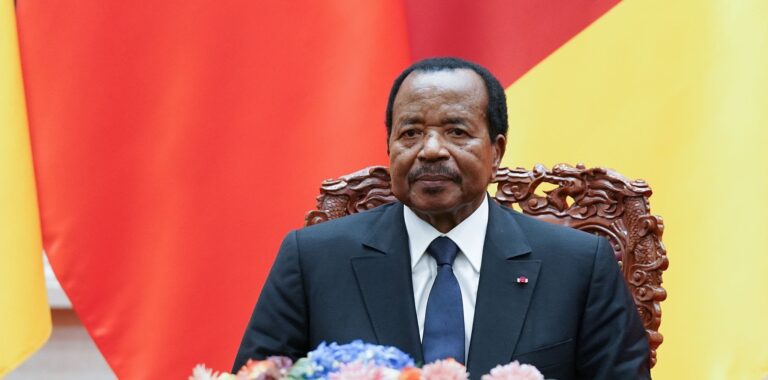
CAMEROON’S opposition parties have rejected the results of the recent presidential election that handed President Paul Biya another seven-year term, alleging widespread fraud and irregularities in a nation already grappling with a separatist crisis.
The ICIR reported that the central African nation’s constitutional council declared Biya the winner of the disputed poll with over 53 per cent of the ballots on Monday, with the court ruling its decision was final and not subject to appeal.
Biya’s victory has sparked violent protests in several cities across the oil and cocoa-producing nation as opposition candidate Issa Tchiroma Bakary, who had earlier declared himself the winner, dismissed the outcome, vowing not to recognise the results. His supporters clashed with riot police in the commercial hub of Douala, blocking major roads with burning tyres and debris.
While Biya’s supporters celebrated in his strongholds, government ministers held victory gatherings. In contrast, Douala’s usually busy streets were largely deserted on Tuesday as heavy rain and armed security forces kept protesters away.
The protests led to the death of at least four people over the weekend and two others on Monday, according to the opposition.
The European Union voiced “deep concern” over the violent suppression of demonstrations and urged the Cameroonian government to curb the excessive use of force and be open dialogue to maintain national stability.
Prominent opposition figures also denounced the election as fraudulent, as Akere Muna, a lawyer and former presidential candidate, accused the Constitutional Council of acting as “”nothing more than the rubber stamp of a tyranny.”
Tomaino Ndam Njoya, the only female candidate who finished fifth, said in a statement on Monday that the election was “not worthy of a Republic.”
“It was a confiscation of the people’s choice by interests that reject transparency in the democratic process. I solemnly reject these results,” she said, according to Reuters.
Meanwhile, Cabral Libii, who placed third, congratulated Biya on his victory.
According to reports, Douala residents braced for more unrest on Tuesday, but a combination of bad weather and a heavy police presence dispersed most demonstrators.
The ICIRreported in 2018, that Biya won the election by a landslide to rule for seven years. He was 85 at the time.
The latest victory gives him another seven years in office and bolsters his place as one of Africa’s longest serving rulers after President Teodoro Obiang Nguema of Equatorial Guinea who is in his thirty-ninth year in office.
Biya, who at 92 is the world’s oldest sitting president, has ruled Cameroon since 1982. Another seven-year term would extend his rule until he nears 100.
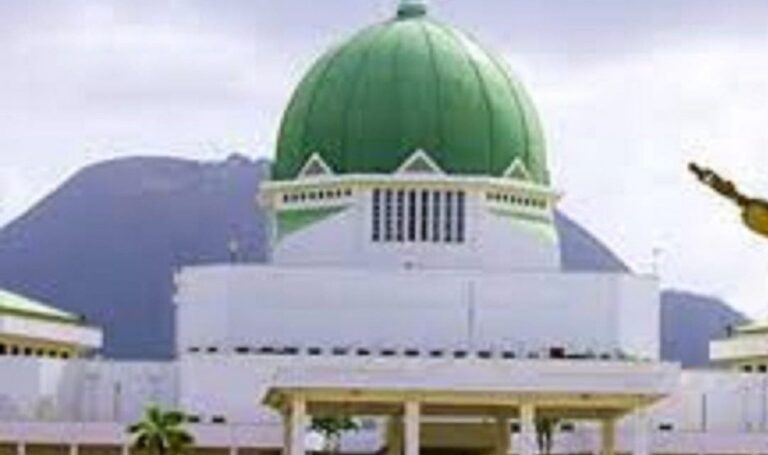
NIGERIANS have reacted sharply to the revelation by the House of Representatives that the National Assembly complex in Abuja is under threat of a terrorist attack.
The Chairman of the House Committee on Internal Security, Garba Ibrahim Muhammad, disclosed during a public hearing on Tuesday, October 28, that intelligence reports had revealed plans by terrorists to bomb the legislative complex.
The hearing was on a proposed bill seeking to establish the Legislative Security Directorate, an internal security agency that will coordinate protection within the parliament.
Muhammad explained that the complex had become vulnerable due to the daily influx of visitors, lobbyists and demonstrators, which had made it a soft target for criminals and terrorist groups. He listed recent security lapses such as car and motorcycle theft, vandalism, fake identity cards, and infiltration by unregistered persons.
According to him, “The National Assembly is going through a lot of security challenges. We have received threats from terrorists to bomb the National Assembly Complex and threats from protesters to lock up the National Assembly. Legislators are exposed to threats from constituents and others who have gained easy access to their offices without any formal appointment.”
He warned that without adequate security reinforcement, legislative activities could be disrupted, which could in turn destabilise the country’s democracy.
Following the lawmakers’ revelation, Nigerians took to social media, especially X, to express anger, disbelief, and in some cases, indifference to the security alert.
One user, Akhenoba Ishehoshime, said the lawmakers should not be alarmed since they had often ignored the cries of communities under attack. “They shouldn’t be alarmed yet. When it was towns and communities, they shouted with their voice votes in glee. So, they can be alarmed now,” he wrote.
Another user, Emerald Bliss, questioned the relevance of the legislature to citizens’ welfare, saying, “What exactly is the usefulness of the so-called rubber stamp National Assembly on the lives of the Nigerian people they claim to represent?
Ugo Ihejirika described the threat as a sign that insecurity in the country now affects everyone. “Insecurity will get to everybody. It’s turn by turn. Bulletproof cars and flying first class cannot shield you when you come down.”
Similarly, Ukachi Godwin noted that the country’s growing insecurity shows that years of legislative activities had not translated into safety or stability. “That means your legislations over the years which have cost the nation trillions of naira into the legislators’ pockets could not stop terrorism. Too bad for the country. It means the legislators are irrelevant. Only God help Nigerians,” he wrote.
Iykogueri, another user, accused the lawmakers of being selective in raising alarms, saying they only react when affected directly. “When the negativity is against them, they raise alarm but look the other way when it concerns the economic crises in the land.”
Some users, like Baresy Tunde, dismissedthe alert as a ploy to distract citizens. He wrote, “It’s all gimmicks to distract Nigerians. I can’t trust anything from this government, not even their propaganda.”
Another user, Ebony Pullah, argued that the lawmakers only take issues seriously when their own safety is threatened. “These are the only issues that concern the members of the National Assembly. Now, they will look out for themselves, but when it comes to the well-being of the masses, they will turn their backs on us.”
The proposed Legislative Security Directorate Bill seeks to provide a legal framework for protecting lawmakers, staff, visitors and government property through a dedicated internal security structure.
Security experts have repeatedly warned that the rising number of threats against state institutions in Abuja reflects the growing boldness of armed groups and the need for coordinated intelligence operations.