THE National Association of Resident Doctors (NARD) has declared a total, comprehensive, and indefinite strike, set to begin at 11:59 p.m. on Friday, October 31, 2025, following the expiration of a 30-day ultimatum issued to the Federal Government over unresolved demands.
The association’s president, Mohammad Usman Suleiman, announced the decision in a post on X on Saturday October 25, after a five-hour extraordinary National Executive Council (NEC) meeting.
He said the strike action was reached unanimously by all NEC members.
“Today, after a 5-Hour Extra-Ordinary National Executive Council Meeting, the Members of NEC have issued out new marching orders to us once again.
“The NEC has unanimously directed us to declare a TOTAL, COMPREHENSIVE AND INDEFINITE STRIKE ACTION to commence on Friday 31st October 2025 at 11:59pm,” he wrote.
According to him, the NEC also outlined minimum demands, strike monitoring directives, and resolutions concerning the “no work, no pay” policy as well as other modalities for the implementation of the strike.
Suleiman noted that the association’s National Officers Committee (NOC) had carried out the 30-day ultimatum mandate to the best of its ability but expressed concern that “some elements in government and outside government have very evil and exploitative plans for resident doctors in this country.”
He urged all members to remain united and resolute, assuring them that the leadership of the association would execute the NEC’s directive in full compliance.
“Let us take the next four working days to hand over patients, engage with traditional, religious, and community leaders, engage the media and the Nigerian public, and hold our respective congresses in compliance with NEC directives,” the statement read.
The ICIR reports that NARD had on September 28 issued a 30-day ultimatum to the Federal Government, demanding the implementation of several agreements, including improved welfare for resident doctors, payment of salary arrears, improved working conditions across federal and state hospitals among others.
The association had on September 12, began a five-day warning strike but suspended it after two days, following the release of funds for the outstanding Medical Residency Training Fund, and to allow the Federal Government two weeks to address its concerns.
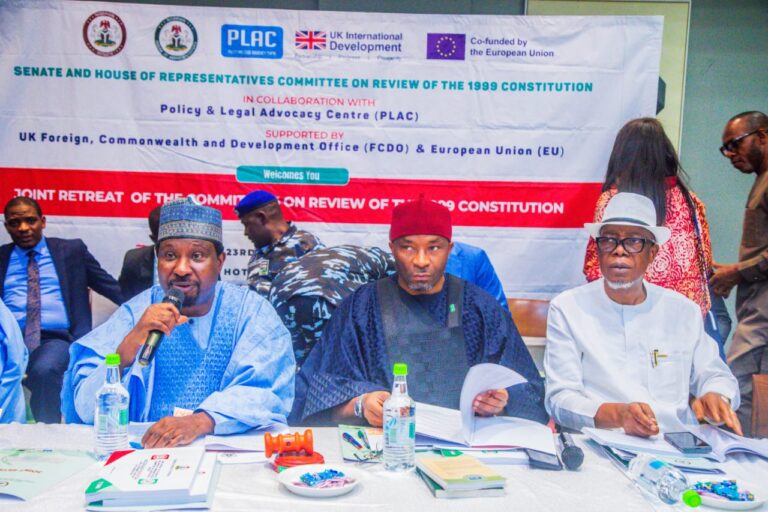
MONTHS after the House of Representatives rejected proposals for the creation of 31 new states across Nigeria, the Joint Committee of the National Assembly on the Review of the 1999 Constitution has approved the creation of an additional state in Nigeria’s South-East geopolitical zone.
The decision was reached during a two-day retreat held in Lagos between 24 and 25 October, according to Premium Times.
The approval, if ratified, will increase the number of states in the South-East from five to six bringing the region at par with other geopolitical zones. Currently, the South-East, made up of Anambra, Imo, Ebonyi, Abia, and Enugu states, is the only region with five states, compared to six or seven in others.
The retreat was chaired by Deputy Senate President Barau Jibrin and co-chaired by Deputy Speaker of the House of Representatives Benjamin Kalu, both of whom reportedly led lawmakers in deliberating on over 55 separate requests for new states across the federation.
During the meeting, lawmakers reached a consensus that the South-East’s request satisfied the principles of equity, justice, and fairness guiding the current review process.
Kalu, who has been one of the champions of the creation of a new state for the region, described the move as a constitutional necessity rather than a political demand.
Following extended deliberations, Abdul Ningi, PDP, Senator representing Bauchi Central, moved a motion for the creation of the new state, which was seconded by Ibrahim Isiaka (APC, Ogun State).
The motion was unanimously approved by members of the joint committee.
Meanwhile, The ICIR reports that the committee’s approval is still at an initial stage since it’s constitutionally mandated for a new state to be formally created, a two-thirds approval from both chambers of the National Assembly and endorsement by at least two-thirds of Nigeria’s 36 State Houses of Assembly are required.
Beyond the South-East proposal, the joint committee also announced the creation of a subcommittee to further review demands for additional states and local government areas across the six geopolitical zones.
According to the report, a total of 278 proposals were submitted by Nigerians and interest groups on state creation, boundary adjustments, and local council reforms.
Recall that in February 2025, the House of Representatives Committee on the Review of the 1999 Constitution, chaired by Benjamin Kalu, rejected 31 separate proposals for new states, citing failure to meet constitutional requirements as outlined in Section 8 of the 1999 Constitution.
Kalu, speaking at a retreat in Uyo, Akwa Ibom State, had clarified that while the proposals represented the aspirations of various regions, none satisfied the constitutional conditions for state creation.
He subsequently gave proponents of the proposals until March 5, 2025, to resubmit in full compliance with the law.
The rejected proposals included requests for six new states in the North-Central, four in the North-East, five in the North-West, five in the South-East, four in the South-South, and seven in the South-West.
THE Fédération Internationale de Football Association (FIFA) has showcased the Birnin Kebbi Stadium project in Kebbi State, noting that the facility was co-funded with the Nigeria Football Federation, just days after fresh allegations of fund mismanagement were leveled against the NFF.
The global football body revealed this on its official social media platforms on Saturday using an image of the project, as the new profile banner on its official X (formerly Twitter) and Facebook accounts.
The photo of the partially completed Birnin Kebbi Stadium quickly went viral, drawing outrage and speculation from fans, who questioned how such a project could represent progress under the FIFA Forward Programme, an initiative meant to promote grassroots football development.
In December 2023, Kebbi State Governor Nasir Idris reportedly inaugurated the FIFA/NFF-supported stadium project, stating that it was intended to “boost the morale of youths in the state.”
He stated that the project cost $1.183 million, adding that the state government provided four hectares of land and paid N19 million in compensation to the affected landowners.
Recall that in May 2023, FIFA had highlighted the Kebbi project as part of its dedication to developing grassroots football, noting on its InsideFIFA website: “It is no surprise, then, that Birnin Kebbi, the capital of Kebbi, was chosen back in 2020 as the site for the construction of an artificial football pitch now available for young boys and girls to use.
“Meanwhile, a second pitch is under construction in Ugborodo… these two ambitious projects have received around USD 2 million in funding from FIFA through its Forward Programme,” its statement added.
The latest viral photo by FIFA is coming just days after football critic Chinedu Mobike, on October 23, 2025, alleged via his Instagram handle @c_mobike that the federation had misused millions of dollars allocated for infrastructure projects, including a similar facility in Delta State.
In his viral video, Mobike alleged that FIFA provided the NFF with “$1.2 million for two stadiums” one in Kebbi and another in Ugborodo, Delta State projects which, according to him, “have yet to see the light of day.”
Drawing comparisons with other nations, Mobike alleged that while “other countries used their FIFA funds to genuinely develop football, Nigeria has nothing to show for it.”
“The NFF should sit up…There are no active projects promoting football or sports in Nigeria,” Mobike said.
According to PUNCH Online, the following day, Friday, October 24, 2025, the NFF released an official statement describing it as a “fresh clarification to misinformation” spread by unnamed social media users who alleged that the federation “receives millions of dollars from FIFA each year and misappropriates the funds.”
It noted that the NFF said in the statement that it firmly denied any wrongdoing, explaining that every dollar received from FIFA or CAF is tied to a specific purpose and audited annually.
The Federation cited ongoing FIFA Forward projects such as the NFF/FIFA Players’ Hostel and new training pitches at the MKO Abiola National Stadium, stressing that every phase is verified before funds are released directly to FIFA-approved consultants.
Meanwhile Mobike’s video has reignited demands for reform, fueling the hashtag #SaveNigerianFootball, which has been trending on X as users vent their frustration and call for greater transparency and accountability in Nigerian football governance.
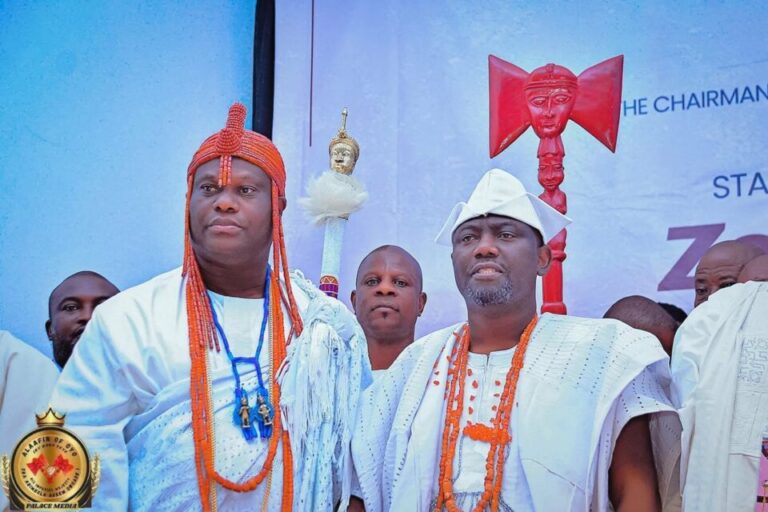
AFTER a two-month rift, the Ooni of Ife, Adeyeye Ogunwusi, and the Alaafin of Oyo, Abimbola Owoade, have jointly announced the establishment of the Yoruba Unity Council, a platform designed to foster peace, preserve culture, and drive socioeconomic development across Yoruba communities.
This was revealed in a communiqué signed by the Ooni and Alaafin, witnessed by billionaire businessman Kessington Adebutu, and issued by Kola Oyefeso, secretary of the communiqué drafting committee after a meeting in Lagos on Friday.
The meeting was convened by the billionaire businessman, popularly known as “Baba Ijebu” held at the Eko Hotel on the sidelines of his 90th birthday celebration.
“Today marks a defining chapter in our shared history. We reaffirm our dedication to promoting harmony among all Yoruba sons and daughters, and upholding the sacred values of mutual respect and brotherhood handed down by our ancestors,” the monarchs said.
The ICIR reports that the reconciliation comes two months after tensions arose following the Ooni’s conferment of the “Okanlomo of Yorubaland” title on businessman Dotun Sanusi by the Ooni on August 16.
After the conferment, the Alaafin issued a 48-hour ultimatum, demanding that the Ooni withdraw the title, condemning the act as an “affront”. He insisted that he alone holds the authority to confer titles with jurisdiction over the entire Yorubaland.
The Alaafin maintained that a Supreme Court ruling had upheld his exclusive authority in such matters.
In response, the Ooni’s media team dismissed the ultimatum as an “empty threat,” stating that the monarch would not dignify it with a formal reply.
Traditional rulers, cultural custodians, and prominent Yoruba leaders attended the gathering, where they discussed reconciliation, cooperation, and inter-kingdom relations, describing the reconciliation meeting as a historic turning point for the Yoruba nation.
The Ooni and Alaafin together offered prayers for peace, prosperity, and progress throughout Yorubaland, Nigeria, and the African continent.
Adebutu expressed joy over the renewed royal alliance, calling it “a milestone that will consolidate peace, unity, and development among the Yoruba people”.
The ICIRreported that the two monarchs had reportedly clashed in March over control of the Oyotunji African village in South Carolina after its leader, Adejuyigbe Adefunmi, was killed. The Ooni sent a delegation of monarchs to perform traditional rites, but Oba Owoade, who was then in seclusion, reportedly ordered them to leave, insisting the community belonged to Oyo.
MADAGASCAR’S new government has revoked the Malagasy citizenship of ousted President Andry Rajoelina
This is according to a decree published in the country’s official gazette on Friday just 10 days after his removal in a military coup.
The decree effectively bars Rajoelina who was impeached on October 14 after fleeing Madagascar amid weeks of Gen Z-led protests from contesting in any future elections.
According to local media reports, said it had confirmed the decree with the entourage of the new prime minister, Herintsalama Rajaonarivelo, who signed the order, noting that the decree stated that Rajoelina’s Malagasy citizenship was revoked because he obtained French nationality in 2014, with photos of the official document circulating online.
The decree referenced laws stating that any Malagasy citizen who voluntarily acquires another nationality automatically forfeits their Malagasy citizenship.
Rajoelina’s acquisition of French nationality sparked controversy when it came to light ahead of the November 2023 elections almost a decade after he had obtained it.
The revelation prompted demands for his disqualification, but he ultimately won the disputed election, which opposition parties had boycotted.
The ICIRreported that the 51-year-old politician fled Madagascar after Army Colonel Michael Randrianirina announced on October 11 that his Corps d’administration des personnels et des services administratifs et techniques (CAPSAT) unit would no longer obey orders to crush the youth-led protests, which security forces had previously tried to suppress violently.
Rajoelina later said he had gone into hiding for his own safety, without disclosing his location.
Randrianirina was sworn in as president on October 14, vowing to hold elections within two years.
The African Union suspended Madagascar with immediate effect following the coup.
The suspension by the 55-member bloc holds significant political weight and could further isolate the country’s new leadership.
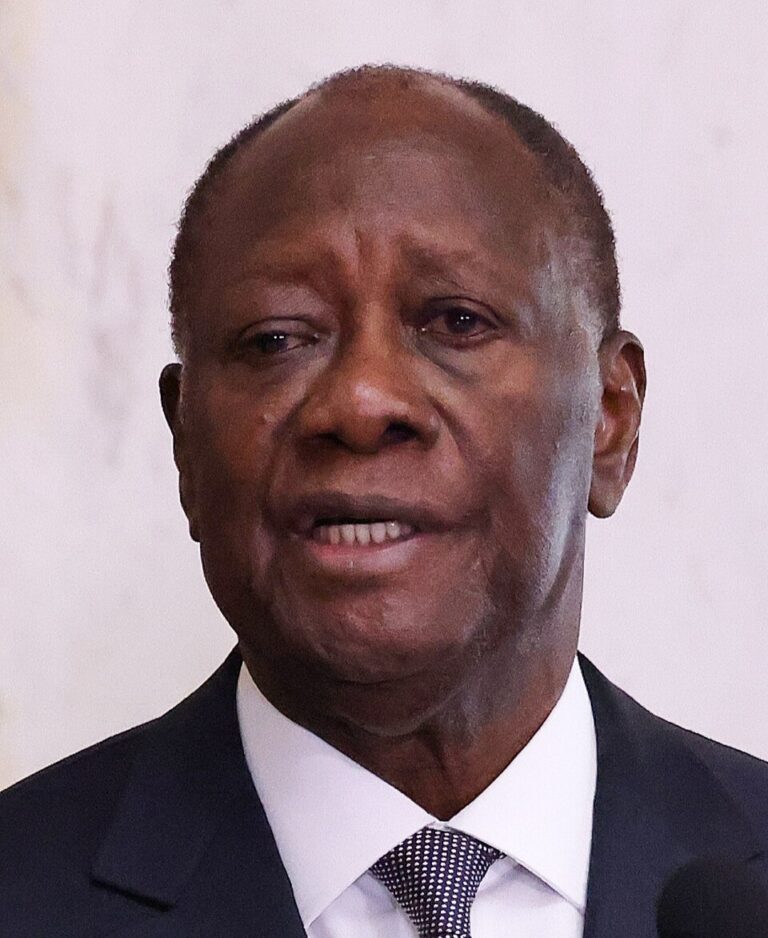
INCUMBENT Ivorian president, Alassane Ouattara is widely expected to win a fourth term in Ivory Coast’s presidential election on Saturday, with his path eased by the exclusion of several major opposition candidates.
According to Reuters, over eight million Ivorians are registered to vote on Saturday, with polling stations closing at 6 p.m. local time (1800 GMT), noting that provisional results are expected within five days, and a runoff will be held if no candidate secures more than 50 percent of the vote.
With former president Laurent Gbagbo and ex-Credit Suisse CEO Tidjane Thiam disqualified from the race, Gbagbo due to a criminal conviction and Thiam for holding French citizenship, and the remaining opposition contenders lacking major party support, Ouattara stands as the clear front-runner in the race.
None of the four opposition contenders belong to a major political party, nor do they command the nationwide influence of the ruling RHDP.
Meanwhile, former trade minister and agribusinessman Jean-Louis Billon, 60, is counting on support from his old base in the Democratic Party.
Former first lady Simone Ehivet Gbagbo, 76, aims to attract loyalists of her ex-husband, while the left-wing vote is split between her and Ahoua Don Mello, a civil engineer and independent Pan-Africanist with pro-Russian leanings.
Also in the race is centrist Henriette Lagou, a moderate who previously ran in the 2015 presidential election, securing less than one percent of the vote.
Opposition parties have urged Ivorians to protest the decision and Ouattara’s expected fourth term.
Sporadic unrest has left four people dead, including a police officer, and on Monday, an electoral commission office was set ablaze.
In response, the government banned demonstrations, and courts have sentenced dozens of people to three years in prison for disturbing public order.
Around 44,000 security personnel have been deployed nationwide particularly in former opposition strongholds in the south and west to contain any protests.
A night-time curfew remained in effect on Friday and Saturday in the Yamoussoukro region, home to the country’s political capital.
Nearly 1,000 domestic observers from Ivorian civil society are overseeing the election, along with 251 monitors from the West African economic bloc ECOWAS and the African Union.
Reports indicate that voters in the southern and western regions, traditionally aligned with Gbagbo or Thiam, may stay away from the polls without clear direction from their leaders.
Meanwhile, the ruling RHDP is counting on a strong turnout in the pro-Ouattara northern strongholds.
At 83, Ouattara has led the world’s largest cocoa producer since 2011, taking credit for nearly 15 years of economic growth and relative stability, suggesting this may be his final campaign, he points to Ivory Coast’s resurgence as a leading economic force in West Africa.
A former international banker and deputy managing director of the International Monetary Fund, Ouattara assumed power in following a four-month civil war that claimed about 3,000 lives in 2011, after then-president Laurent Gbagbo refused to concede defeat in the 2010 election.
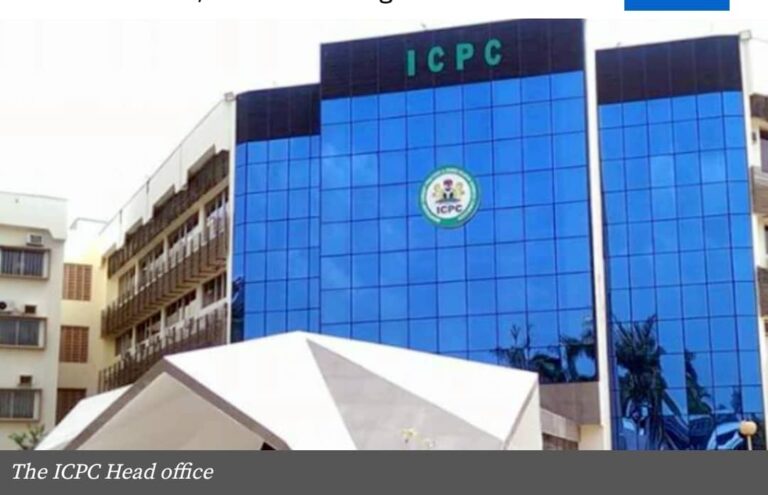
A CIVIC group under the umbrella of Concerned Citizens of Ejigbo has petitioned the Independent Corrupt Practices and Other Related Offences Commission (ICPC) against the immediate past chairman of the Ejigbo Local Council Development Area (LCDA) in Lagos State, Monsuru Oloyede Bello, over alleged corruption, financial mismanagement, and abuse of public office.
The ICIR obtained a copy of the petition, dated August 28, 2025, and signed by Folabo Clark on behalf of the group. It was received and acknowledged by the ICPC on August 29, 2025.
The group urged the Commission to launch a thorough investigation into the administration of Bello, who served two consecutive terms as council chairman between 2017 and 2025.
According to the petition, Bello allegedly violated several sections of the Lagos State Local Government Administration guidelines, particularly regarding financial accountability and transparency in project execution. The group accused him of diverting public funds, inflating contract sums, and awarding contracts without following due process.
Alleged financial misconduct
In the petition seen by The ICIR, the group listed multiple projects executed during Bello’s administration, which they claim were marred by irregularities. Among the projects cited were:
Construction of Falana Road (Phase 1) – ₦505,065,301.18
Construction of reinforced concrete drainage at Falana Street – ₦54,806,000.
Purchase of a Toyota Hilux (2024 model) – ₦90,425,531.92.
Purchase of a Toyota Lexus vehicle – ₦103,031,314.
Construction of drainage at Majiyagbe Ogunti Street – ₦479,118,411.
Construction of a canteen and office space for federal and state agencies – ₦246,065,750
Upgrading of Sheikh Niyass Street with interlocking stones – ₦981,198,222
Construction of Falana Street (Phase 2) – ₦212,962,927.80
Upgrading of Jubril Olabisi Street – ₦922,341,656.41
Front page of the petition against the former chairman of Ejigbo LCDA, Monsuru Oloyede Bello
The petitioners also alleged that several of these projects were either abandoned, inflated, or poorly executed despite being fully paid for. They claimed that some contracts were awarded to companies linked to close associates of the former chairman, raising concerns of conflict of interest.
Failure to comply with local government laws
Beyond financial irregularities, the group accused Bello of disregarding local government laws that mandate regular accountability to residents. They alleged that he failed to present monthly financial statements to the public as required by the Ejigbo LCDA byelaws.
The petition also noted that the Funds Management Committee — responsible for vetting and approving council expenditures — was never constituted during most of Bello’s second term, allowing him to take unilateral financial decisions.
Admission of irregularities
The group further claimed that Bello had, on several occasions, admitted to irregularities in the management of council funds during public discussions and community engagements. They accused him of suppressing dissent within the council by refusing to appoint a substantive Supervisor for Works during his second tenure — a key role responsible for monitoring infrastructure projects.
Bello denies allegations
When contacted by The ICIR, Bello denied all allegations, describing them as “false and misleading.”
According to him, he has not seen the petition and the ICPC have not contacted him.
“All they have submitted, as you have read out, is not what actually happened at the council. I will wait for the ICPC’s invitation before making any formal statement,” he said.
Bello insisted that all contracts awarded during his tenure followed due process and were approved by relevant state authorities.
We will look into it – ICPC Spokesperson
The ICPC did not confirm receipt of the petition. The Commission’s spokesperson, Demola Bakare, told The ICIR that he had not seen a copy of the petition but promised to look into it and forward to the appropriate department for preliminary review.
” I am not aware. But you have my WhatsApp number.Forward the petition to me. Let me make inquiries. I will forward it to the chairman,” Bakare stated.
Although the Commission did not disclose whether an investigation had formally begun, sources within the ICPC familiar with its procedures said the matter would first undergo a screening process to determine jurisdiction and validity before a full probe is launched.
NIGERIA has officially been removed from the Financial Action Task Force (FATF) grey list.
Grey list is a register of countries under increased monitoring for weak controls against money laundering and terrorist financing.
The FATF, the world’s foremost body for combating money laundering and terrorist financing, announced the decision at its October plenary session in Paris, France, after reviewing Nigeria’s progress in implementing key reforms.
Nigeria had been placed under increased monitoring in February 2023 due to strategic deficiencies in its anti-money laundering and counter-terrorist financing systems.
However, following more than two years of reforms and collaboration between key institutions, the country successfully completed its FATF Action Plan, which consequently prompted its removal from the list.
Reacting to the news, the Nigerian Financial Intelligence Unit (NFIU), in a statement, on Friday, October 24, described the delisting as a significant moment in Nigeria’s fight against serious financial crimes.
The agency noted that it reflects the country’s renewed commitment to transparency, accountability, and integrity in financial governance.
According to the NFIU, Nigeria successfully implemented a 19-point Action Plan in collaboration with the FATF and its regional partner, the Inter-Governmental Action Group Against Money Laundering in West Africa (GIABA).
They noted key reforms to include Enforcement of the Money Laundering (Prevention and Prohibition) Act, 2022 and the Terrorism (Prevention and Prohibition) Act, 2022; Operationalisation of the Beneficial Ownership Register to improve corporate transparency; Strengthened intelligence-sharing and law enforcement coordination; and Improved supervision of financial and non-financial businesses to prevent abuse of the financial system.
Tinubu welcomes FATF decision
Meanwhile, President Bola Tinubu in a statement through his media aide, Bayo Onanuga, welcomed the development, describing it as “a major milestone in Nigeria’s journey toward economic reform, institutional integrity, and global credibility.”
He said the decision showed Nigeria’s determination to meet international standards and build a transparent financial system.
“This was achieved through the coordination of the Nigerian Financial Intelligence Unit (NFIU), working in conjunction with the Attorney-General of the Federation and Minister of Justice, the Minister of Finance, and the Coordinating Minister of the Economy and the Minister of Interior.
“President Tinubu applauded the vital support from the Secretary to the Government of the Federation, the Minister of Aviation, the Minister for Budget and Economic Planning, the Minister for Defence, the Minister for Foreign Affairs, the Minister for Solid Minerals, the Minister of State for Finance, the National Security Adviser as well as the leadership of the National Assembly and the Judiciary, in the attainment of the laudable achievement,” the statement read.
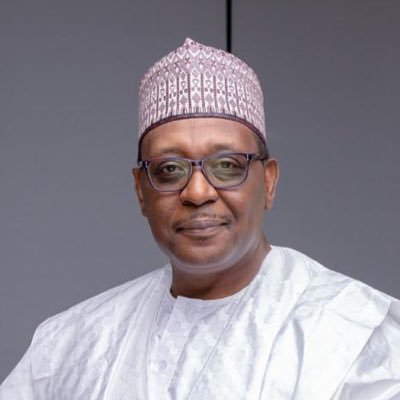
NIGERIA’s Minister of Health and Social Welfare, Muhammad Ali Pate, said the country is on track to provide health insurance coverage for 44 million citizens by 2030 as part of efforts to reduce out-of-pocket spending and achieve Universal Health Coverage (UHC).
Pate disclosed this in a statement released on Saturday, noting over 2.4 million Nigerians were newly enrolled in 2024 alone, bringing the total number of insured citizens to about 20 million.
He said the new target of 44 million by 2030 would mark a transformative leap toward ensuring access to affordable and quality healthcare for all Nigerians.
“In 2024, Nigeria broke its enrollment record with more than 2.4m new people insured, bringing total coverage to about 20m Nigerians. With new policy tools in motion, we are on course to reach 44m by 2030. This is the surest path to reducing out-of-pocket expenditure, which still represents about 70% of total health spending.
“Social health insurance schemes now account for 90% of all enrollments nationwide. A major constraint in care quality has been the low capitation fee for enrollees. For years, the capitation stood at ₦750 per person. We have doubled it to ₦1,450 to ensure providers are properly equipped to deliver consistent, high-quality care. Fee-for-service rates have also been increased by 380%, based on actuarial evidence aligning cost-reflective rates with quality requirements,” Pate said.
He described out-of-pocket payments as the dominant source of healthcare expenditure for most Nigerians.
Since 2023, he said nearly 120,000 health workers have been trained and 2,500 doctors, nurses, midwives, and community health extension workers recruited to strengthen frontline services.
He also announced the introduction of the One Hour Referral Authorization Code, designed to eliminate delays in patient referrals by ensuring that authorization from insurers to healthcare providers is issued within one hour.
Pate said in a bid to enhance oversight, lHe has directed the National Health Insurance Authority (NHIA) to begin covert mystery shopping across hospitals to monitor service delivery and ensure that enrollees are not denied treatment.
The results of these reforms, according to the minister, are already visible, adding that hospital utilization surged from fewer than 10 million visits in 2023 to more than 46 million by the second quarter of 2025.
“The evidence is clear. From fewer than 10m hospital visits in all of 2023, more than 46m visits were recorded by the second quarter of 2025. Reforms in the Basic Health Care Provision Fund @TheBHCPF and the NHIA are delivering measurable gains in patient confidence and service utilization.
“As enrollment expands, benefits multiply. Wider adoption of health insurance enhances quality, strengthens accountability, and protects households from financial hardship. These achievements reflect President Tinubu’s vision of a health system that serves all Nigerians, regardless of income or status,” he said.
The ICIR had, on September 30, reported that the country’s out-of-pocket spending accounts for 75 per cent of total health expenditure, leaving millions of Nigerians vulnerable to financial shocks when seeking medical care.
The report also warned that the system was not on track to achieve UHC, with a service coverage index of just 38.4 per cent.
NIGERIA loses over $9 billion annually to illegal mining, with a substantial portion tied to the gold sector. This investigation reveals how a significant share of gold extracted from the northwest is funnelled into terrorism financing. In Zamfara’s gold-rich underworld, Kachalla Mati, successor to slain bandit kingpin Halilu Sububu, reportedly rakes in ₦300 million weekly from illicit mining fields. The gold is smuggled across borders, where it either generates cash to procure weapons or is directly bartered for firearms, intensifying instability across northern Nigeria.
Thirty-five years ago, Hussaini Isah scraped alluvial gold from the earth of Dan-kamfani, in northwest Nigeria, without looking over his shoulder. Today, he digs deep underground, hunted by fear and surrounded by violence and destruction that have engulfed many parts of Zamfara State.
This gold form Maru is said to be 23karat; high in purity according to gold dealers at the Gusau Pollo market in Zamfara.
Back in those days, they camped in forests, worked till dawn, and lived off gold mining. “It was a hard job, but it provided our daily living,” he said. That life has now been disrupted, as armed bandits terrorise gold-rich communities in the northwest and parts of north central Nigeria, killing locals and forcing artisanal miners such as Isah into near-slavery.
For years, Nigeria’s northwest region has faced persistent insecurity, driven by bandits who exploit weak governance and porous borders. Initially fuelled by farmer-herder conflicts, these groups have evolved into organised criminal networks heavily reliant on cattle rustling, kidnapping for ransom, robbery and extortion to sustain their operations. However, since 2022, the artisanal and small-scale gold mining (ASGM) sector has turned into a key source of financing, fuelling large-scale violence and instability and stimulating a demand for firearms and ammunition.
While the Nigerian Government have deployed the military to disrupt their activities, bandits often regroup, raze villages, displace hundreds of thousands of people and defy authority. The scale of the violence, as revealed in a joint report by the Global Initiative Against Transnational Organised Crime (GI-TOC) and ACLED, found that between 2018 and 2023, banditry deaths in Zamfara and Kaduna states reached above 4,758, surpassing fatalities fuelled by violent extremist groups in the country’s northeast region.
Gold, a portable and untraceable source of wealth, offers bandits influence and control. As economic and political instability shakes governments worldwide, the global demand for it as a haven surged to a staggering 4,606.2 metric tons in 2024. In regions like Nigeria, where formal mining oversight is weak, this creates an avenue for bandits to become major players in the sector.
Constitutionally, the Federal Government has exclusive control over solid minerals, even though the sector contributes less than 1 per cent to the national GDP. However, revenue has seen a positive rise, with a 16 per cent increase from ₦345.40 billion ($226 million) in 2022 to ₦401.87 billion ($263 million) in 2023, the highest in a decade, according to an audit report by the Nigeria Extractive Industries Transparency Initiative (NEITI). Yet experts warn this represents only a fraction of its true potential, as illegal mining continues to bleed government resources.
To formalise the sector and track the flow of Nigeria’s gold, the Minister of Solid Minerals Development,Dele Alake, announced in July that over 3,000 artisanal cooperatives had been registered. Alongside this effort, the Presidential Artisanal Gold Mining Initiative (PAGMI) was launched in 2019, aiming to buy gold from artisanal miners under the National Purchase Programme to ensure revenue is remitted to the government. But for Isah and many artisanal miners across Anka and Maru in Zamfara, as well as Birnin Gwari in Kaduna, bandit control over mining communities has made these initiatives impenetrable, leaving huge deposits of gold in the control of non-state actors.
In this investigation, bandit leader, Kachalla Mati, said to be the successor of slain bandit kingpin, Halilu Sububu, boasted of extracting gold worth ₦300 million (US$196,000) weekly. A large part of it is either exchanged for weapons or sold in black markets within the Sahel, and the proceeds, used to procure firearms. The gold eventually ends up in Dubai, the United Arab Emirates, which has become the world’s second-largest gold trading hub, and a go-to selling point for Nigeria’s illicit gold. These illicit transactions increase bandits’ influence and access to firearms that spread and sustain instability in northern Nigeria.
Exported riches, vanished gold
Before 2022, there was little evidence to link armed bandits to the gold mining sector because the intense labour made their involvement unlikely. Moreover, banditry had thrived on cattle rustling, kidnapping for ransom, and community levies. But as mass displacements and military action slashed those revenues, bandits turned to artisanal gold mining, taking over major sites and forcing locals to work under their control.
To speak with gold miners, the reporter travelled to Birnin Gwari, in Kaduna State, where the immediate past governor, Nasiru El-Rufai, once boasted had more gold than South Africa. Incidentally, it is also the epicentre of Kaduna’s banditry.
Journeying through the 126-kilometre stretch Kaduna-Birnin Gwari highway was laced with anxiety. Not long ago, it was considered one of northern Nigeria’s deadliest routes because it was bandit-infested. However, a peace pact between bandits and government authorities in early 2025 made the road ‘relatively safe.’Despite this assurance, uncertainty often engulfs road users, especially since peace pacts with bandits have not always been sustainable.
A few minutes into the often-desolate Kaduna-Birnin Gwari Road that stretches into vast, ungoverned territories, the scale of Nigeria’s prolonged insecurity and widespread displacement was strikingly evident. Haunting traces of abandoned farming communities, such as Unguwar Yako, Tsohuwar Udawa, and Manini, loomed quietly overgrown by shrubs that offer a sobering reminder of the lives that once lived there. Residents had been forced to relocate as a result of constant attacks and abductions by armed bandits.
Due to the pothole-ridden road and limited or non-existent telecommunication services, the journey from Kaduna to Birnin Gwari extends twice as long as the typical one-and-a-half-hour drive. Yet, after three hours, the reproter arrived in the town of Birnin Gwari, a place that has remarkably resisted bandit attacks.
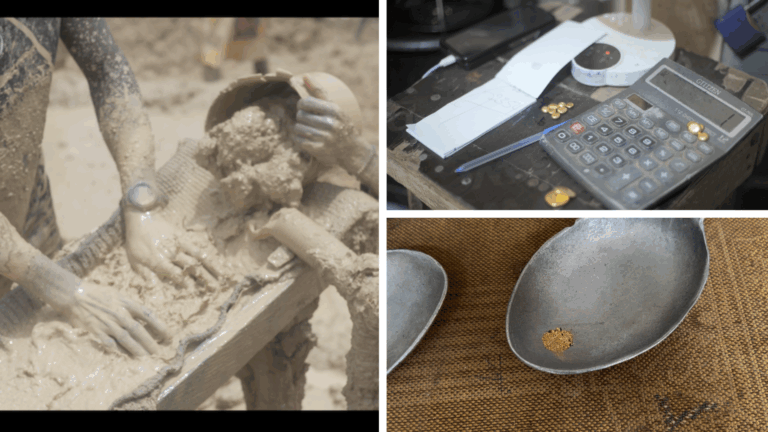
The process of washing to extract the gold.
To meet with artisanal gold miners, the reporter, in the company of local vigilante men, who help fortify the community, travelled the 16km bumpy, untarred road to Bugai mining site. Buzzing with activity, in a wide pit, mud-covered youths were seen working in sync. Shovels in hand, they dug and heaved soil to the edges. Nearby, others washed and processed the freshly dug gold-bearing earth.
“It is our right to mine. This is how we hustle, especially since what we are doing is not illegal,” said Mohammed Bello, a senior artisanal miner. But Nigeria’s Minerals and Mining Act, 2007, which provides requirements for mining, categorises Bello and many of his colleagues as illegal miners since they have no registration with the government.
Bandits had visited that mining site less than 10 months before this interview in May, said Jafar Ibrahim, another miner. He recalled their ultimatum: “Hand over the gold or be killed. We complied, surrendering ₦2 million ($1,300) worth of gold,” he said. But he acknowledged that bandits’ provocation had declined since the peace pact with the government.
Over 300 kilometres from Birnin Gwari, artisanal gold miners in Maru and Anka of Zamfara State equally depend on the informal sector to survive. For three decades, Isah worked across mining fields in Anka, finding just enough gold to cater for his family. Now working under bandit-controlled fields, he said the gold is dug in large quantities, and the quality appears good.
While gold dealers praise Anka’s gold, they claim it is second in purity to that of Maru, where purity could reach 23 karats and, occasionally, 24k, its purest form. For a smooth business transaction, locals use three measuring units for excavated gold: Per cent, digo and gram. Digo is a Hausa term that loosely translates to a drop. Gold dealers explained that 10 per cent makes up a digo while ten digo make up one gram of gold.
At the Pollo Market in Gusau, gold from parts of Nigeria and surrounding African countries is sold.
And so, local dealers often have to pile up gold in little quantities to reach a substantial gram before they move it to bigger selling points, such as the Pollo Market in Gusau, Zamfara State. From there, the gold makes its journey to Abuja and to Dubai. Aliyu Adamu Almajiri, spokesperson for Zamfara’s Gold Buyers and Sellers’ Cooperative, confirms that gold from the market travels to Dubai and weekly transactions in the market are about ₦250 million (US$164,000); a sharp drop from before the insecurity.
But gold dealers are not the only ones eyeing Dubai. From underground mines, bandit-controlled gold finds its way to global black markets, fuelling a far-reaching terror economy.
Explaining their role, bandit leader Kachalla Mati said gold from his controlled mining fields in Anka is stockpiled for weeks, then smuggled through the Nigeria/Niger border into the Sahel. Through this route, the gold indirectly makes its way to Dubai.
Although less prominent than Sububu, Mati is said to command scattered mining camps in Dan-kamfani, Kawaye, and Duhuwa, operating across the Bagega and Wuya wards of Zamfara’s Anka.
In one of two recorded interviews through an intermediary for this investigation, the bandit leader revealed that he extracts between 40 to 50 solos daily from a single mining site. A solo is a heap of gold-layered sand filled in cement bags. At the first scheduled interview conducted in Hausa, Mati, who was nursing a gunshot wound to the leg, ignored a question about how he sustained the injury but said overall, he makes between ₦200-₦300million ($130,000- $196,000) from gold mining weekly. He, however, added that a huge part of the gold is sold outside Nigeria.
Pressed for the specific countries, Mati got irritated: “It is not your business where we sell our gold, you want to alert the security agents, right?” After he calmed down, he boasted: “If we want to, we sometimes sell it here (Zamfara), we send our boys, and sometimes people from the city bring the money to us, sometimes, we send it to Dubai.”
Though he did not clarify how the gold journeys from Nigeria to Dubai, SWISSAID’s 2024 report On the trail of African gold shows that a large chunk of Nigeria’s undeclared gold, especially from the ASGM sector, is smuggled out and directly or indirectly ends up in the UAE. The report reveals a wide gap between Nigeria’s declared and non-declared gold production from ASGM, with declared production gauged at 1.96 tonnes in 2022 and non-declared estimated at between 14.3 and 15.6 tonnes per year in the early 2020s. It further explained that undeclared gold from Nigeria reaches the UAE directly through the airports, while smuggled gold, like that of Mati, makes its way to Dubai through Niger, Togo and Mali.
Illicit GOLD Supply Chain based on the investigation.
Many studies align with this argument, especially since Bamako, Mali’s capital, serves as a major regional hub offering favourable export terms for illicit gold mined around the Sahel, for smuggling to the UAE. Mali hosts around 140 gold comptoirs or gold trading posts, even though most operate outside formal registration, making it a key gateway for laundering gold into the UAE and into the global supply chain.
The Nigerian Government acknowledges this problem and, in 2023, pushed for joint regulations with the UAE to curb illegal trade and boost mutual economic gains.
“We dig; armed bandits gain”
Across Zamfara and Kaduna states, artisanal miners share a common story: bandits first appeared as curious observers, then gradually seized control of mining fields and forced locals to work. While bandits generally avoid physical labour, Isah said they take control of fields and treat miners like slaves. “They beat us and sometimes shoot to kill,” he said and described working in week-long shifts, with each day yielding heaps of gold-layered sand.
The situation is the same in Maru, where Kabiru Dahiru said some bandits give out entry tickets to miners on shifts. He described the ticket as a piece of paper with the name of the bandit leader written on it. “It provides protection for us against abduction by other bandits. When they see it, they know we are going to work for another bandit, and they let us pass,” he said.
But not all bandits are local. Miners often overhear bandit leaders introduce partners from Niger and Burkina Faso who leave mining sites with as many solos as their motorcycles can carry. “If we mine 10 solos, they might spare one to share among 10 of us,” Isah said, “but often,” he added, “their boys could intercept us and seize it.”
Bandits’ interference in the gold mining sector forced artisanal miners to change locations, but often, they see no change in bandit tactics. Jafar Ibrahim, a native of Tsafe in Zamfara, fled to Birnin Gwari, while Ibrahim Lawal and many artisanal miners fled Maganda village of Birnin Gwari, but said that in many areas where gold abounds, bandits have a grip on the area.
Lawal, who is the Chairman of artisanal miners in Maganda, said in some instances, bandits wait for them to dig, wash, and process, then seize the gold. “Sometimes they ambush us on the road and then move the gold to Farin Ruwa or Nachibi, where they refine it,” he said.
Having fled Maganda, Lawal and many of his colleagues now dig for scrapes through the rocky terrain of Rima, 10 km away from Birnin Gwari town.
Gold from Bugai mining site in Birnin Gwari, Kaduna State
But beyond preying on artisanal miners, Ashiru Usman, the Chairman of artisanal gold miners in Birnin Gwari, explained that gold-rich communities of Maganda, Layin Mai Gwari, Janruwa, Tsohuwar Garin Birnin Gwari, Farin Ruwa, Naccibi, and Saulawa have all been overrun by bandits. “Bandits have made these high-yield sites inaccessible,” he said. “Many miners have now relocated closer to Birnin Gwari town for safety.”
How bandits tighten control
Efforts to conduct one-on-one interviews with artisanal miners in bandit-controlled Bagega and Wuya wards in Anka were frustrated by the high risks. Therefore, five artisanal miners, including Isah, were convinced to travel to Anka town for the interview, but only three showed up.
Nonetheless, on the day of the interview, the 110-kilometre journey from Gusau to Anka was almost suspended after news made rounds that bandits had laid an ambush on the 71-kilometre Maiinchi/Anka route, a corridor that runs through Zuru in Kebbi State. Security advisers described the route as one of Zamfara’s perilous, subject to random attacks due to the existence of several cattle routes frequented by bandits.
It was a Wednesday morning in May, and tension rose sharply after the Kwanan Maiinci Y-turn, which veers travellers off the Gusau–Sokoto Road towards the isolated Maiinchi-Anka road. The desolation offered little reassurance, and for a while, the vehicle went into silence. Every second weighed heavily on the heart, save for the sight of seven scattered checkpoints, manned by armed community vigilante groups.
Roughly 26 kilometres to Anka, a Police post became visible, and later, a military checkpoint followed, then finally, a full military formation, which residents said helps fortify the town against bandit infiltration.
Aerial view of gold mining activities in Zamfara State
Anka town has, in the last eight years, provided refuge for thousands of displaced persons, from nearby villages of Duhuwa, Kawaye, Zakkuwa in Bagega ward, as well as Dan-kamfani, Dorowe, Jakkuka and Kurukuru in Wuya ward. To consolidate control, bandit attacks are often ruthless. Aisha Abubakar, a 35-year-old housewife, recalled how the attack on Dorowe forced out over 3,000 displaced persons who are now taking refuge at the Anka emir’s palace IDP camp.
“They killed about 26 people that day,” she recalled, saying the dead included two of her brothers, four nephews and four brothers-in-law. It was the same for Rahama Abubakar and Fatima Garba, residents of Kurukuru and Jakkuka villages, who fled their communities alongside hundreds of residents. For those who dared to return, the consequences are often fatal, said Rahama, who recounted a recent killing of seven villagers who returned to assess their maize farms.
Reinforcing the complexity of the situation, the women doubted that the attacks on their communities were linked to the rich deposits of gold buried beneath the earth. “Bandits took over Dan-kamfani and the mines, but the people were allowed to stay and work for them,” argued Fatima. “They let them have enough gold to buy food. If they’d asked, we’d equally have stayed willingly.”
Experts align this position to cooperate with bandits in exchange for protection, as a tactic employed by non-state armed groups to gain legitimacy among locals and present themselves as protectors.
But even in their perilous circumstances, the spirit of defiance persists among some residents.
As the vigilante commander in Zamfara, Rabiu Bawa knows the cost of defending such communities. “Just recently, I wanted to restructure my men, and I was very upset because many of them had been killed in a clash with bandits,” Bawa said, his voice heavy with grief.
Middlemen in the shadows
Muhammadu Abubakar, a gold dealer in Anka, transitioned from artisanal mining to gold trading within a decade. Local dealers like Abubakar are often the first point of contact once gold is extracted and processed. “We weigh the gold and pay the miners. Sometimes I buy between 10 to 20 grams of gold in a month,” Abubakar said, adding that other dealers may buy more.
Though there is no way of knowing if gold from bandits makes its way into their hands, Abubakar and his colleagues at the Pollo Market insist they never purchase gold from bandits. They, however, admitted that the criminal groups operate through middlemen.
Like many organised criminal networks, bandits rely on intermediaries for smooth operations. These middlemen play a vital, yet shadowy role in gold processing, transportation and sales to the movement and exchange of firearms and ammunition.
But this investigation found that the middlemen involved in the gold trade are often distinct from those operating in the arms trade, even though they are, in most cases, within the same communities and their paths may cross.
In Maru, Zamfara State, an artisanal miner goes into a mining tunnel
To evade detection, middlemen in the gold sector embed themselves within local communities, as explained by Isah and corroborated by other artisanal miners. He said some of them own private gold processing centres and serve as couriers of gold and cash for bandits. His account was re-echoed by Rabiu Bawa, the vigilante commander in Zamfara, who explained that when in need of cash, bandits use agents to transport gold to dealers at Gusau’s Pollo Market.
But the shadowy nature of agents is deeply entrenched in the protection they get from bandits, explained security and intelligence expert, Kabiru Adamu, who said apart from protecting gold fields, bandits also protect agents to move freely between locations.
Subsequently, to protect their interests and ward off security agents and rivals, bandits require weaponry, said Adamu, Managing Director of Beacon Consulting, a renowned firm providing enterprise risks and security management solutions in Nigeria and the Sahel. Interactions with personnel from the Nigerian Immigration Service and Customs officers stationed at the Nigeria/Niger border reveal that trafficked weapons coming into the country are mostly tracked through Jibia, in Katsina State.
“Jibia is about 40km from Gusau, and if they can come in undetected, the weapons move to parts of Zamfara and other states, especially Kaduna and Niger States,” said an immigration officer who requested anonymity.
The role of middlemen in the sector is driven by the emergence of a war economy, much like the northeast at the height of Boko Haram’s insurgency, explained a Brigadier General, Sani Kukasheka Usman (rtd), the Consultant Director of Corporate Affairs and Information Services (DCAIS) at the Nigerian Army Resource Centre (NARC), Abuja who said bandits exploit societal deprivation to smuggle and transport firearms and ammunition.
“Sometimes transporters of arms are recruited consciously or unconsciously,” he said. “Take, for example, someone living in poverty. If you hand them a parcel to deliver, they might not ask questions until they’re arrested.” Usman, a former Director of Army Public Relations, said while fear forces some to act as intermediaries for bandits, others are driven by greed.
From gold to guns
Increased demand for weapons among non-state actors has placed Nigeria in the 5th spot on the 2025 Global Terrorism Index, trailing behind Burkina Faso, Pakistan, Syria, Mali and Niger. The Sahel region, geographically straddling Nigeria, remains the global terrorism epicentre, accounting for over half of all global terrorism deaths. With competition over the region’s mineral resources, especially gold, contributing to ongoing instability in Mali and Burkina Faso, it not only exposes northern Nigeria to the regional patterns of insecurity but situates Nigeria among key hotspots of violence and arms trafficking, facilitating both importation and domestic production of weapons in West Africa.
No doubt, Nigeria’s porous borders, with about a thousand illegal entry and exit points stemming from Benin Republic, Chad, Niger Republic and Cameroon, remain a critical factor in arms smuggling, said General Usman.
Sources of firearms for bandits.
The country’s vulnerability to global insecurity was re-echoed by the then Chief of Defence Staff (CDS), Christopher Musa, in July, when he said Nigeria harbours 40 per cent of the over 500 million illegal small arms and light weapons circulating in West Africa. He noted that the weapons, smuggled from conflict zones in the Sahel and North Africa, have empowered terrorists, bandits and ethnic militias, escalating violence in northern Nigeria.
However, apart from smuggled firearms, the Federal Government acknowledges a wide range of weapons used by non-state actors, including bandits were sold to them by corrupt security agents. Speaking on this, Adamu, the intelligence experts said that though a bulk of the weaponry is smuggled through the land and sea borders, other sources include local manufacturing points where weapons such as the AK-47 are fabricated, as well as those sold by corrupt security officials.
Shedding light on Nigeria’s local weapon manufacturing dynamics, Usman noted that the illegal sector has grown “remarkably innovative, capable of fabricating nearly every type of weapon.”
Therefore, to increase their capacity for violence, bandits rely on foreign and domestic channels for firearms, funded substantially by gold extracted from Nigeria’s informal mining operations. These weapons, Adamu explained, help bandits protect mining sites against the Nigerian authority and other rival groups as well as gain more influence and control.
One figure who embodied this nexus of illicit gold mining and arms acquisition was slain bandit leader Halilu Sububu. Before he was killed in a military ambush in September 2024, Sububu was described by Murtala Rufai, a Professor of History and International Studies at Usmanu Danfodio University, Sokoto, as a key arms supplier to bandit groups and reportedly controlled mining sites across Zamfara, Katsina, and Kaduna. Whether Sububu funnelled gold profits into gun deals or outrightly swapped the metal for weapons remains unclear. What is certain, however, is that since his death, a new player, Kachalla Mati, has stepped in to fill the void.
Isah, who worked under mining sites controlled by Sububu and now under the control of Mati, said bandits often boast of how gold proceeds are used to purchase advanced weaponry, including Rocket-Propelled Grenades.
When questioned about these claims, Mati initially dismissed the inquiry as too sensitive. He later confirmed that proceeds from gold were used for various purchases, including weaponry. “Some firearms could even bring down a plane,” he said and added, “There are African countries where weapons are sold in shops.”
For international weapon transactions, Mati said gold, treated as a foreign currency, is stockpiled over several weeks and then smuggled across borders into Niger or Mali. There, it is sold, and the proceeds are used to buy weapons that are later trafficked back into Nigeria.
Offering a glimpse into how these transactions unfold, he said trade in weapons within Nigeria operates on a cash-based system using Naira. He explained that bandits sell their gold through intermediaries in local markets to raise cash used to acquire firearms either from fellow bandits, gun runners, or local fabricators.
In one instance, Mati recounted how a gun runner from Plateau State was intercepted by security forces while transporting a weapon to his group. Without identifying the type of weapon, he reinforced how middlemen trafficking firearms and ammunition across state lines are typically motivated by upfront deposits, with the rest paid after delivery. “We agreed to pay N1 million, and an advance of N800,000 was paid via POS (Point of Sale), but the driver was arrested,” he said.
In search of gold in Birnin Gwari, Kaduna State
Providing perspective into the pricing of AK47, a widely used assault rifle among Nigeria’s security forces and a favourite for non-state actors, he said new foreign versions cost between ₦5 and ₦6 million ($3,266-$3,920) while the locally fabricated versions cost around ₦500,000 ($326). Mati said bandits equally expand their arsenals from attacks on Military and Police armouries and ambushes on security forces, adding that such versions of AK47 are sold among bandits, between ₦500,000 to ₦1million ($326-$653), depending on their condition.
Ammunition, the bandit leader said, is typically sold in “mudu,” a metal grain measuring bowl popular in Nigeria. A mudu, according to him, costs anywhere between ₦800,000 to ₦1.1million ($522-$720), depending on type and market situation.
His insights on the price of a new foreign AK47 rifle are in line with a recent argument by Nigeria’s National Security Adviser (NSA), Nuhu Ribadu, who said the price of the foreign AK47 had reached N5 million in 2024, against less than N500,000 in 2023 and therefore making the rifle out of reach of bandits.
But Adamu challenges the notion that weapon prices determine their availability, arguing that bandits rely on diverse revenue streams to procure firearms. He blamed the Nigerian government for doing little to curb bandits’ access to weapons and ammunition and warned that attention must shift beyond Libya to include Sudan as a growing source of weaponry.
“Even ammunition is easily accessible to bandits, and this is evident in the way they shoot recklessly,” he said.
Swapping gold for guns
Since 2021, the Nigerian government has responded to the activities of armed banditry with a series of aggressive measures, including military interventions, a sweeping ban on mining activities and a declaration of a ‘no-fly zone’ on Zamfara to halt what it suspected as the swap of gold for arms by bandits. Though this suspicion has lingered for years, no concrete evidence has emerged to confirm how this transaction is conducted and with whom.
Mati, however, gave a glimpse into these transactions, boasting that under Sububu, bandits exchanged gold for arms with partners from Mali and Burkina Faso. He, however, said that since he assumed leadership, he has now established links with firearm dealers from Algeria.
“What we do is to exchange the gold for weapons,” he said. “We will not give them money; we give them the gold and they give us the guns,” Mati clarified, revealing the mechanics of the barter system in which gold is exchanged directly for firearms.
Building on his earlier explanation of black-market firearm pricing, he added that the cost of each firearm is negotiated, and once agreed, gold is exchanged based on its equivalent value as payment for the weapon. Based on this explanation, with high-quality gold selling at ₦155,000 per gram at Gusau’s Pollo Market in May, it would require between 33 to 39 grams, valued at over ₦5 million to purchase a new foreign-brand AK-47 rifle. And for Mati, who boasts of raking in approximately N300m weekly from his mining operations, that is equivalent to 60 AK-47 rifles from a week’s gold production.
Explaining further, he said the Algerian partners come with their own gold measuring device, “that one that makes that ‘dit, dit’ sound,” adding that once the gold is exchanged, any outstanding balance is settled at a later transaction. During the interview, Mati claimed that the weapons are delivered in batches and in May, he said about 40 firearms had arrived from Algeria, but when asked to reveal them, he became suspicious and refused the request.
Artisanal miners and local gold dealers use these tools to measure gold.
Experts agree that the connection between gold and firearms is a driving force behind banditry in Nigeria’s northwest. Adamu explained that though gold mining increases the capacity for bandits to access firearms and ammunition, bandit influence is equally derived from gaps in governance, which they exploit to take over Nigeria’s many ungoverned spaces.
We reached out to the Nigerian Government through the National Counter Terrorism Centre, under the office of the National Security Adviser and the National Coordinator, Maj. Gen. AG Laka agreed to an interview but later ignored repeated requests. The Minister of Information, Mohammed Idris Malagi, also did not respond to several interview requests on the findings of this investigation.
Though the Nigerian military is currently conducting an ongoing operation against bandits in the northwest, the spirit to fight for their freedom remains a burning desire among civilians. “If not for their guns, we’d fight back,” said Ibrahim Lawal, Chairman of artisanal miners in Maganda. As a resident and artisanal gold miner, Lawal understands that every ounce of gold seized by bandits increases their access to firearms and strengthens their grip on communities. “The best way to tackle this,” he said, “is for the government to cut off their access to weapons and take full control of the mining sites.”
Beneath the bloodstained earth of northwest Nigeria, sources say Mati and other bandits continue to wield power over mining fields. However, Isah has since relocated from Dan-kamfani to Giwaye, near Anka town, where he is scraping a living from the soil. “The gold is not much here,” he said, “but it is better than slaving for bandits.”
Names of artisanal miners used in this report have been changed to protect their identities.
This article was developed through a mentorship programme with the Global Initiative Against Transnational Organised Crime (GI-TOC) and La Cellule Norbert Zongo pour le journalisme d’investigation en Afrique de l’Ouest (CENOZO), as part of the “Support to the Mitigation of Destabilising Effects of Transnational Organised Crime (M-TOC)” project. The M-TOC project is commissioned by the German Federal Foreign Office (GFFO) and implemented by the Deutsche Gesellschaft für Internationale Zusammenarbeit (GIZ) GmbH and GI-TOC from 2024 to 2025. This article is totally independent and does not necessarily express the views of GI-TOC, CENOZO, GIZ or GFFO.