SECURITY operatives have arrested 57 members of the Islamic Movement of Nigeria (IMN), also known as Shiites, in Abuja.
FCT Police Public Relations Officer Adeh Josephine made this known in a statement shared with The ICIR on Tuesday. He said that the Shiites were arrested at the Gwarinpa area of the FCT and other parts of the city.
“A total of 57 suspects, including 39 male and 18 female, were arrested and currently being profiled at the State Criminal Investigations Department of the FCT Police Command.
“A golf vehicle, flags, petrol bombs, weapons, mobile phones, charms were recovered as exhibits,” the statement read in part.
She said it was a joint operation between the FCT Police Command and other security agencies.
The Shiites were arrested during their annual Arbaeen Symbolic Trek to mark the 40th day after the anniversary of the martyrdom of the third Shiite Imam, Hussein ibn Ali. The Arbaeen trek is usually held in Islam-dominated states.
Josephine said the Shiites “caused unnecessary hardship to motorists and other road users as well as individuals going about their lawful businesses.”
The Police further said that the Shiites also attacked the security forces with petrol bombs and weapons, including stones, but were adequately rounded up by the security teams without any casualties.
Josephine told The ICIR that there was no casualty and nobody was injured. However, according to a video seen by The ICIR, operatives of the Nigerian Army were seen beating Shiite members.
Also, another was seen stabbing a Shiite in the leg while the other beat him up.
Six persons were reportedly killed by security operatives who were out to stop the Shiites’ walk.
In 2015, the Nigerian Army massacred more than 300 Shiites following a clash with the convoy of the former Chief of Army Staff Tukur Buratai.
The fatal attack and many other violent clashes with security operatives led to the proscription of the IMN by the Nigerian government in 2019.
The group’s leader Ibrahim El-Zakzaky spent more than five years in detention of the Nigerian government before he was finally released.
Several legal disputes trailed his detention as the Nigerian government refused to release him after a court order had granted him bail.
THE Central Bank of Nigeria (CBN) Governor Godwin Emefiele is taking the biggest chunk of the blame for his poor management of the foreign exchange market, but Minister of Finance Zainab Ahmed and Minister of Trade and Investment Niyi Adebayo should not be absolved from the guilt of poor economic management in the country, The ICIR findings have shown.
Emefiele has been criticised rightly for his multiple exchange rate regime, capital controls, demand side FX model and restrictive dollar management.
These concerns have seen the naira on a downward slope and currently at about N580/$ in the parallel market, with negative impacts on household consumption, inflation (17.4 per cent) and weak purchasing managers’ indexes, dealing blows on consumers.
“What is happening in the foreign exchange market is a consequence of the CBN policy choice of a fixed exchange rate regime and administrative allocation of forex,” Economist and Private Sector Consultant Muda Yusuf told The ICIR in a recent interview.
“This weak investor confidence is expected to persist in 2021 because of lack of clarity around the country’s FX management framework,” Lagos-based Economic Analyst Damilola Adewale said in response to poor FDI inflow into the country.
In all the criticisms, however, only vey few have mentioned that Finance Minister Zainab Ahmed and Minister of Industry, Trade and Investment Niyi Adebayo have failed to provide support for the naira from the fiscal side.
Nigeria’s Ministry of Finance manages the finances of the Federal Government of Nigeria, including controlling and monitoring federal revenues and expenditures.
The Finance Ministry and the Ministry of Industry, Trade and Investment are both saddled with the enforcement of the fiscal policies of the government and attracting investment into the economy.
This has not been the case since 2019 as Nigeria continues to witness a huge drop in investment on the back of several wrong policies.
For instance, Foreign Direct Investment inflows into Nigeria fell by 21.21 per cent in 2020 to $2.6 billion, the lowest since 2015, according to data published by the United Nations Conference on Trade and Development, UNCTAD.
The consistent decline in FDI has stifled job creation in Africa’s biggest oil producer and worsened the growth prospects of the economy, ballooning the unemployment rate to 33.3 per cent in the fourth quarter of 2020.
The biggest challenge is that the two ministers have not explored several means of attracting investments and have not designed clear-cut policies for that purpose, analysts say.
“In 2014, a trader on Bloomberg in Hong Kong or New York could click a button and buy a choice of 6 Nigerian bonds from JP Morgan or 11 from Barclays. That’s how Foreign Portfolio Investments flowed in and kept the Naira strong. These ended in 2015. Now we struggle for dollar remittances with Binance,” Economist and Finance Expert Kalu Aja said in reaction to Nigeria’s economic poor run.
Minister of Finance Zainab Ahmed
Aja blamed crushing capital controls which made it difficult for bond holders to redeem dollars if they sold their securities.
Political Economist Pat Utomi has also said that the country lacks a national economic strategy for development.
On the part of the industry minister, several manufacturing companies are shutting down and he does not seem to have any formula for dealing with that. He also has not commented about them, meaning that he may not be aware that the companies are going out of business.
Two of these firms that have shut down since 2019 when Adebayo became minister are Glenz Metal in Enugu and Elton Hanniee, producer of soap and toilet cleanser.
The ICIR learnt from top industry sources that Elton Hannie went out of business in 2020 when its raw materials got stuck at the ports, incurring a lot in demurrage.
The constant occurrence of the situation led to the company’s shut-down. Other firms that have gone out of business since 2019 are: International Glass Industries in Aba, Super Glory Nigeria Limited, Iwaya, Ogun State, and West African Building Materials, Ota, Ogun State.
CBN Governor Godwin Emefiele. CREDIT: Channels TV
The reporter found that West African Building Materials shut down in 2019 due to FX policy, according to top industry sources.
Once a nation’s manufacturing sector is not strong, imports will dwarf exports, resulting in weak local currency, according to analysts.
Nigeria’s manufacturing sector contributes less than 10 per cent to the Gross Domestic Product as against South Africa’s 14 per cent and Egypt’s 16 per cent.
The National Industrial Revolution Plan, which started in 2013, expired in 2020 without achieving most of its goals, but there is yet no industrial strategy in Nigeria, industry players say.
Business and Finance Expert Richard Ayoade said until Nigeria could manufacture, produce and industrialise, real economic change would be impossible.
Also, the minister of trade is yet to re-start the Export Expansion Grant (EEG). In 2013, this policy, which was meant to improve non-oil exports, was suspended. Since Buhari came to power in 2015, the policy approval has been in the National Assembly’s desks.
While some companies have been approved for the EEG, 38 others have not since 2018/19. Up till today, there is no coherent policy to drive the non-oil exports in the economy.
The result is that non-oil exports have not exceeded $4 billion since 2013. In 2018, while Nigeria earned $3.3 billion from all the non-oil export products, Bangladesh received $33 billion from export of textiles only.
Economic analysts have insisted that Nigeria’s inability to ride on non-oil exports to strengthen the economy is taking its toll on the naira, amid the apex bank’s reluctance to float the local currency.
Former Deputy Governor of the Central Bank of Nigeria Kingsley Muoghalu said Nigeria must build a strong manufacturing and export-led economy, which must be driven from the fiscal side.
“The most important determinant of the value of the Naira is whether or not the Nigerian economy is productive or competitive in international trade. That is to say, whether it has a diversified base of complex, value-added products it exports and earns forex from those exports. I am not talking about diversification to cashew nuts and yam tubers. No. Those are primary commodities, not complex, value-added ones that are serious of serious engineering and innovation.”
The finance minister has failed to plug leakages in several government ministries, departments and agencies.
In Warri, Port Harcourt and Kaduna refineries, N168.178 billion was lost in 2019, and only N1.681 billion was realised as revenue, according to The ICIR’s calculations of the companies’ financial statements.
In 2020, the moribund refineries wasted N153.084 billion, making only N5.216 billion as revenue.
Also, there have been concerns about poor remittances of revenue by some revenue-generating government agencies.
Earlier in the month, the Nigerian Senate had issued queries to the apex bank, Nigeria Customs Service and the Nigerian National Petroleum Corporation for failures to remit their excess revenues to the Consolidated Revenue Fund of the federation.
Many analysts wonder why the Federal Ministry of Finance watches as these revenue-generating agencies fail to remit the money at a point President Muhammadu Buhari has gone on a borrowing spree across the world.
According to the National Assembly panel, the apex bank has failed to remit its operational surpluses to the Consolidated Revenue Fund (CRF) over the years from its yearly budget of about N2.3 trillion budget.
Also, on the side of the Ministry of Industry, Trade and Investment, it has been an issue of policy somersault and inconsistencies.
Nigeria lost several would-be investors in the automotive sector on the back of policy inconsistencies and the government not keeping up with the promises to investors who had pumped billions of naira into the sector.
From 2013, import of new cars attracted 35 per cent levy and 35 per cent tariff. The policy attracted several local and foreign car assembly plants who stormed Nigeria to leverage its demography and a growing economy.
However, the current government, in 2020, slashed import of cars to five per cent, hurting many firms that have invested billions into the economy.
Niyi Adebayo had hinted at plans by the Federal Government to review the automotive policy, but delay in the review has put upbeat investors hanging on the balance, discouraging future investors from expressing confidence in the Nigerian economy.
“There are several countries we can learn from in Africa. Kenya and Tanzania have national sectoral plans in each aspect of the economy devoid of political interference. This is part of the reason we make one step forward and steps backwards, ” Associate Consultant to the British Department for International Development Celestine Okeke told the ICIR.
“You saw our flight cargoes leaving empty the other time because of poor policy coordination. This is where I expect the Minister of Industry, Trade and Investment and the Ministry of Finance to come in.”
He noted that the aforementioned ministries should enable trade and investment and not kill them.
“They are to facilitate trade and not to kill trade. Why would exporters suffer to export and we are talking about the weakness of the naira?”
Experts say floating Eurobonds, as finance minister does, is not enough, but attracting direct investments that will create jobs and improve the productive capacity of the economy.
This, to them, is partly the finance minister’s job via low tariffs, tax holidays and economic reforms.
Again, experts say the finance minister, who also oversees budgets, should be more interested in running a capital-driven annual budgets to boost infrastructure investments that will facilitate a productive economy.
PRESIDENT Muhammadu Buhari has asked the Senate to confirm five persons as commissioners for the Independent Corrupt Practices and Other Related Offences Commission (ICPC).
The president’s request was contained in a letter read by the Senate President Ahmed Lawan during Tuesday’s plenary.
Buhari, in the letter, explained that the confirmation request was in accordance with the provisions of Section 3(6) of the Corrupt Practices and Other Related Offences Act, 2000.
The nominees are :Mojisola Yaya-Kolade, Ekiti (South-West); Anne Otelafu Odey, Cross River (South-South); AGoni Ali Gujba, Yobe (North-East); Louis Solomon Mandama, Adamawa (North-East); and Anthony O. Agbo, Ebonyi (South-East).
In a separate letter, Buhari also asked the Senate to confirm the appointment of Mohammed Sanni Baba as a federal commissioner for the Revenue Mobilisation, Allocation and Fiscal Commission representing Bauchi State.
This, according to the president, was in accordance with the provisions of Section 154(1) of the amended 1999 Constitution of the Federal Republic of Nigeria.
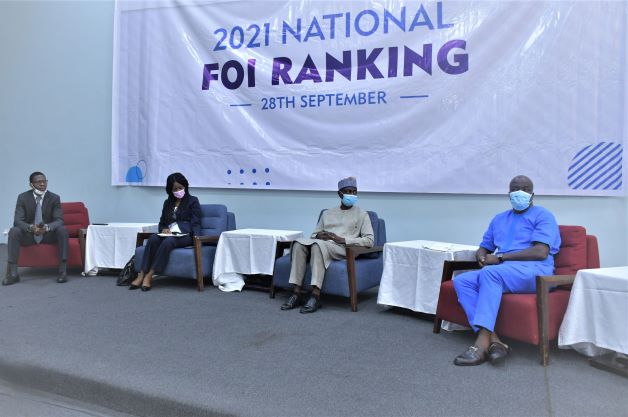
THE Nigeria Investment Promotion Commission (NIPC) has emerged winner of the 2021 edition of the National Freedom of Information (FOI) Compliance Ranking, while the Bureau of Public Service Reforms (BPSR) and National Orientation Agency (NOA) came second and third place, respectively.
The FOI ranking held at NAF Conference Centre, Abuja on Tuesday, was organised by a coalition of civil society organisations, including the International Centre for Investigative Reporting (ICIR), Public-Private Development Centre (PPDC), Basic Rights Watch (BRW), Right to Know (R2K), Media Rights Agenda (MRA) and BudgIT.
Chief Operating Officer of the Private and Public Development Centre Gift Maxwell, who delivered the opening remarks, said the programme was designed not to tarnish the image of any institution but to improve their level of disclosure and encourage citizen’s participation in governance.
During the panel discussion, Editor of the International Centre for Investigative Reporting (The ICIR) Ajibola Amzat noted that less than 25 per cent of public institutions in Nigeria complied with the FOI Act, an indication that government institutions under the Buhari administration were not as transparent as expected.
He characterised the poor compliance as a breach of the Open Government Partnership agreement signed in 2016 by President Muhammadu Buhari in London.
In response, a Legal Officer Mariah Obafemi, who spoke on behalf of the Head of FOI Unit of the Federal Ministry Of Justice Gowon Ichibor said the ministry had made several efforts to drive compliance among all public institutions.
Obafemi said the effort included holding training on FOI for ministries, departments and agencies (MDAs) and sensitizing staff of various public institutions on the need to provide free access to public information.
She expressed hope of greater compliance by the time the ministry began a new round of awareness campaigns in October.
Also speaking at the programme was Senior Legal Officer for Africa Regional Work of the Open Society Justice Initiative Maxwell Kadiri, who played a crucial role in drafting the FOIA 10 years ago.
Kadiri said one of the challenges faced since the enactment of the FOI Act was the lack of political will to implement the legislation.
“We haven’t even implemented 20 per cent of this legislation, due to lack of political will,” he said.
He queried the rationale behind the moral suasion approach adopted by the Ministry of Justice towards implementing FOIA rather than enforcing sanctions provided by the Act.
Obafemi attempted to clarify the position of the law, saying the Act didn’t empower the Ministry of Justice to punish non-compliant MDAs, but only to encourage them.
But Kadiri disagreed.
He argued instead that there were penalties embedded in the Act, including a fine of about half a million naira for negligent denial of information and a minimum of 1-year imprisonment for disclosing false information.
Section 7 (4) states that “Where the government or public institution fails to give access to information or record applied for under this Act or part thereof within the time limit set out in this Act, the institution shall, for the purposes of this Act, be deemed to have refused to give access.
Further, section 7(5) states: “Where a case of wrongful denial of access is established, the defaulting officer or institution commits an offence and is liable on conviction to a fine of N500, 000.”
Assistant Director NIPC Sambo Isiaku said one of the reasons for low compliance to the FOI Act was the loyalty of most institutions to the Official Secrets Act.
“Until the Official Secrets Act is expunged and replaced with the FOI Act, the problem will persist,” he said.
He encouraged other MDAs to regard the Act as a law with penalties attached to it and comply without hesitation.
Kadiri again noted that the Official Secrets Act had been amended by Section 1 of the FOI Act.
The section states that: “Notwithstanding anything contained in any other Act, law or regulation, the right of any person to access or request information, whether or not contained in any written form, is in the custody or possession of any public official, agency or institution howsoever described, is established.”
The NIPC has held a history of high compliance with the FOIA over the past few years.
While receiving the award for the first position, Isiaku assured the audience that the commission would hold the first position tenaciously.
The number of public institutions featured by FOI Ranking has grown from 66 in 2014 to 213 in 2021.
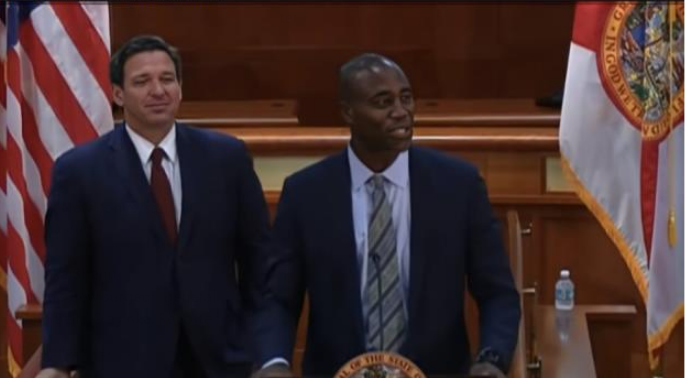
Florida’s new Surgeon General Joseph Ladapo has said that he is committed to rooting out ‘fear’ which has become a centerpiece of health policy in the United States, especially since the outbreak of COVID-19 pandemic.
Last week, Governor Ron DeSantis announced that Ladapo, a Nigerian-American medical professor, would replace Scott Rivkees, who announced his resignation last month, amid a surge in COVID-19 cases and deaths. Rivkees will vacate his office by the end of the month.
“Telling the truth is important, and I think that’s what Dr. Ladapo understands,” the governor said, agreeing there had been misinformation spread about COVID-19 to control personal behavior.
Ladapo had argued that there was nothing special about vaccines when compared to any other preventive measure and that the state should be promoting good health and not necessarily compelling people to get vaccinated.
“Vaccines are up to the person. It’s been treated almost like a religion. It’s just senseless. There’s lots of good pathways to health. Florida will completely reject fear as a way of making policies in public health. We’re going to be very explicit about the differences between the science and our opinions,” he said.
Meanwhile, criticisms have trailed his appointment that puts him in charge of managing the pandemic in the state of Florida that already has among the highest number of coronavirus cases, hospitalisations and deaths in the U.S.
Democratic National Committee Spokeswoman Adonna Biel called DeSantis’ decision to appoint Ladapo a dangerous one.
“Instead of going with a trusted advocate for science, DeSantis is once again playing games with peoples’ lives by appointing someone who has trafficked anti-vaccine and anti-mask rhetoric,” Biel said in a statement to CBS Miami.
She added that the American people were ready to return to normalcy but Ladapo’s appointment was capable of dangerously prolonging the pandemic and wreaking havoc in the state.
Ladapo was born in Nigeria and immigrated to the United States with his family when he was five years. Part of his lengthy resume includes graduating from Wake Forest University, Harvard Medical School, and Harvard’s Graduate School of Arts and Sciences.
Until his appointment, he was an associate professor at the David Geffen School of Medicine UCLA.
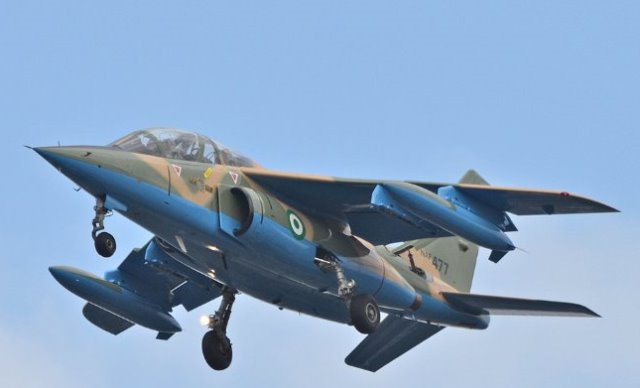
AT least 20 civilians have been mistakenly killed by a Nigerian Airforce aircraft targeting Islamic State West Africa Province (ISWAP) terrorists in the North East.
According to the AFP, the victims, who are fishermen were killed on Sunday in Kwatar Daban Masara, a coastal village along the Lake Chad Basin.
Locals said the community was about 50 kilometres from Borno capital and Boko Haram heartland Maiduguri.
AFP said the news of the incident was slow to emerge due to limited telecommunications in the area.
An unnamed intelligence source who works with anti-militant militia in the region was quoted to have said the strike was based on “credible information” of a gathering of ISWAP fighters in the village since Wednesday.
He said aerial surveillance and reports from other sources revealed militants were amassing in Kwatar Daban Masara and it was obvious they were planning an attack.
NAF State Police Spokesperson Edward Gabkwet and Director of Defence Information Benjamin Sawyerr did not respond to a text message sent to them by this reporter to solicit comments on the incident.
The ICIR had reported how 12 people were killed when a military aircraft bombed a community in Yobe State earlier this month. The incident also left many wounded.
In January 2017, at least 112 people were killed when a fighter jet struck a camp housing 40,000 people displaced by violence in Rann near the border with Cameroon.
The Nigerian military blamed “lack of appropriate marking of the area” for the bombardment in a report it issued six months later.
In July 2019 at least 13 civilians were also killed when a Nigerian fighter jet hit Gajiganna village, 50 kilometres from Borno state capital Maiduguri, as it targeted fleeing militants after they attacked a nearby base.
NORTHERN Governors’ Forum (NGF) has said that it is unconstitutional for the southern part of the country to insist on producing the next president.
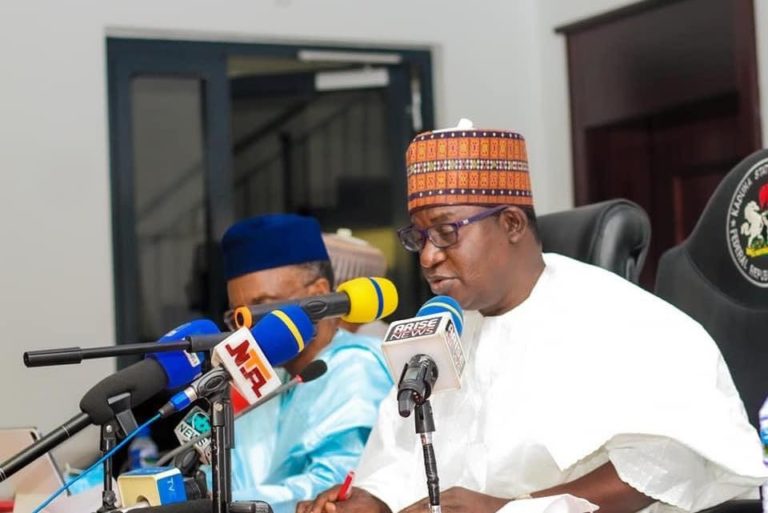
This was part of a communique issued at the end of the governors’ meeting in Kaduna on Monday.
Plateau State Governor Simon Lalong, who read out the communique, said the position of their colleagues in the South was condemnable.
Although some of the northern governors like Kaduna State Governor Nasir El-Rufai had stated that the South should produce the next president, Lalong said the 1999 Nigerian Constitution only made provisions for the candidate with the majority of votes to occupy the position of the nation’s president.
“The Forum observed that some Northern State Governors had earlier expressed views for a power-shift to three geopolitical zones in the South with a view to promoting unity and peace in the nation,” he said.
“Notwithstanding their comments, the Forum unanimously condemns the statement by the Southern Governors Forum that the Presidency must go to the South,” the communique read.
“The statement is quite contradictory with the provision of the Constitution of the Federal Republic of Nigeria (1999) as amended, that the elected President shall: score the majority votes; score at least 25 per cent of the votes cast in 2/3 states of the federation. In the case of run-up, simple majority wins the election.”
Reacting, Chairman of Southern Governors Forum (SGF), who also doubles as Ondo State Governor Rotimi Akeredolu, in a statement on Monday, emphasised that the northern governors were simply expressing themselves.
“They have expressed and indeed exercised their rights under Freedom of Expression. No one can stop them from expressing themselves,” Akeredolu said.
Last week, during their meeting in Enugu State, the Southern Governors’ Forum had reiterated their position that the presidency must return to the South in 2023.
MEMBERS of the Northern Governors Forum (NGF) have said that their southern counterparts are confusing the value added tax (VAT) with sales tax.
This was part of a communique at the end of the governors’ meeting in Kaduna on Monday.
Plateau State Governor Simon Lalong, who read out the communique after the meeting, said if states were allowed to enact their various VAT laws, there would be increases in the prices of goods and services as a result of multiple taxations.
The governors noted that the reason Lagos would account for 50 per cent of VAT collection was that most telecommunication companies, banks, manufacturing and other trading activities had their headquarters in the state.
“VAT is being confused by these state governments as a sales tax. If every state enacted its own VAT Law, multiple taxations will result in increases of prices of goods and services and collapse in interstate trade. VAT is not a production tax like excise, but terminal tax which is paid by the ultimate consumer,” he said.
The governors stated that they would maintain the status quo until the final determination of the VAT row at the Supreme Court.
He said it would be sub judice to comment on VAT until the Supreme Court pronounced judgement on the substantive matter between Rivers and Lagos states vs Federal Government.
He noted that Northern States Governors Forum would respect this.
Controversies have continued to grow across the country after a Port Harcourt Federal High Court ruled last month that the Rivers State Government had the powers to collect VAT within its territory.
In response through its house of assembly, Rivers State enacted the state VAT law and immediately expressed readiness to enforce the judgment beginning from this month.
Lagos State Government has followed suit by enacting and signing the state VAT bill into law.
The state joined Rivers as a co-defendant in an appeal filed by the Federal Inland Revenue Service (FIRS) against the Federal High Court judgement.
But an Abuja Court of Appeal has ruled that all parties in the matter should maintain status quo.
Rivers State Government has asked the Supreme Court to set aside the ruling of the Court of Appeal.
It also asked the apex court to order that the substantive appeal by the FIRS and all other processes be heard and determined by a new panel of the Court of Appeal.
Ogun State has also joined the race as the bill to legalise VAT collection passed second reading in the state house of assembly.
The Southern Governors Forum (SGF) has expressed support that states should collect VAT to engender fiscal federalism.
Although some states, including Kogi, Ebonyi and Katsina, have opposed the idea, many Nigerians believe that the current VAT face-off will set the nation on the path of fiscal federalism.
The ICIR reported that the Federal Government had expressed resolve to present the case to the Supreme Court for adjudication.
Minister of Justice and Attorney-General of the Federation (AGF) Abubakar Malami, who revealed this to newsmen last week, said VAT collection was outside the jurisdiction of states.
AHEAD of the election of new national officers of the People’s Democratic Party (PDP) at the national convention scheduled for October 30 and 31, no geo-political zone wants to produce the party’s next national chairman.
The ICIR learnt that the determination of the two regional blocs in the country – North and South – to avoid the prestigious position has so far stalled the party’s efforts to stage a hitch-free convention.
Checks by The ICIR reveal that the development is as a result of intrigues over the party’s presidential ticket for the 2023 general elections.
The PDP, at its last National Executive Council (NEC) meeting on September 9, set up key committees for the national convention – the Convention Planning Committee and the Zoning Committee.
The Convention Planning Committee, chaired by Adamawa State governor Ahmadu Fintiri, was mandated to organise the national convention.
The Zoning Committee is headed by Enugu State governor and its task is to arrive at a formula for allocating the party’s national offices, including the office of national chairman, to the various geo-political zones.
The Zoning Committee met in Enugu on September 23 to take a decision on the allocation of the various national offices to the zones.
Besides Ugwuanyi, other members of the committee that were part of the crucial meeting included: Benue State governor Samuel Ortom, Deputy Governor of Zamfara State Mahdi Aliyu Mohammed, former Senate presidents Iyorchia Ayu and Anyim Pius Anyim, former governors of Niger, Ekiti, Sokoto, Jigawa and Adamawa states, Babangida Aliyu, Ayo Fayose, Attahiru Bafarawa, Sule Lamido, and Boni Haruna, respectively.
Others at the meeting were: PDP chieftains Abubakar Kawu Baraje, Kabiru Tanimu Turaki, Sunday Okoye, Dan Orbih, Ali Odefa, Kema Chikwe, Osita Chidoka, Chidi Lloyd, Bassey Ewa Henshaw, Emmanuel Nwaka and Donatus Udeh.
However, the meeting was deadlocked as the committee could not agree on which particular zone should produce the national chairman.
The ICIR learnt that deliberations in the meeting were marred by the unwillingness of the various zones to produce the national chairman.
During the deliberations at the September 23 meeting, the Zoning Committee split into two camps – those who wanted the office of national chairman to remain in the South and others who would want the position to move to the North.
PDP National Chairman Uche Secondus, who is currently suspended, is from the South.
At the moment, the Zoning Committee has been divided along regional lines – North and South.
Southern members of the committee want a northerner as the next PDP national chairman while the northern members want the office to remain in the South.
The northern bloc, which is canvassing the maintenance of the status quo, wants the South to retain the position of national chairman in the expectation that the development would pave the way for the presidential candidate of the party to come from the North.
In the event that the presidential ticket would not be zoned to the North, the northern bloc wants the PDP to adopt the position of a committee chaired by Bauchi State governor Bala Mohammed which, after reviewing the performance of the party in the 2019 general elections, recommended that the presidential ticket be thrown open for aspirants from all the six zones in 2023.
On the other hand, according to The ICIR’s findings, the southern bloc wants all the party national positions currently held by the South to be transferred to the North while the ones in the North move southwards.
The position of the southern bloc is informed by the belief that zoning the office of national chairman to the North would automatically ensure that the South gets the presidential ticket in 2023.
Going by an informal zoning arrangement that has played out in major Nigerian political parties since the return to democratic rule in 1999, the zone where the party national chairman comes from hardly produces the presidential candidate.
Suspended National Chairman of the PDP Uche Secondus is from the South-South, specifically from Rivers State, whose Governor Nyesom Wike wields considerable influence in the party.
Secondus’ suspension is linked to the conflict of interests between him and Wike, who masterminded his emergence as national chairman in 2017.
Secondus wants to seek a second term as PDP national chairman at the national convention. However, it is believed that Wike is eyeing a presidential or vice presidential ticket in 2023 and being from the same state (Rivers) with the party’s national chairman would undermine his chances, hence his largely successful quest to remove Secondus from office.
President Muhammadu Buhari is from the North and by 2023, when he will have completed two terms in office, there are expectations that the presidency would go to the South, no matter the party that gets to produce the president – in line with a rotation of power principle that has been playing out between northern and southern Nigeria.
The Southern Governors Forum, the umbrella body of governors of the Southern states cutting across different political parties, has repeatedly insisted that it is the turn of the South to produce the president of Nigeria in 2023.
But there are indications that the rotation arrangement would encounter difficulties in 2023. Already some politicians from the North in both the PDP and the All Progressives Congress (APC) are showing interest in contesting the next presidential poll.
Governor of Kogi State in Nigeria’s North-Central Yahaya Bello has already declared his intention to vie for the presidential ticket of the APC and insists that the contest should be thrown open for all sections of the country.
Also, in the PDP, there are indications that the party’s presidential candidate in the 2019 elections former Vice President Atiku Abubakar would again run for president in 2023.
Atiku is from Adamawa State in the North-East.
Governor of Sokoto State, in the North-West, Aminu Tambuwal is also believed to be eyeing the PDP presidential ticket.
* South, North bicker over 2023 presidency
The PDP is yet to decide on zoning of its presidential ticket for 2023 but a chieftain of the party Doyin Okupe recently warned against moves by northern politicians to run for president on the party’s platform in 2023.
Okupe, a former presidential spokesman and candidate, described as unreasonable and ridiculous, alleged moves by the party’s leaders to choose a northern standard bearer for the 2023 presidential election.
“In 2023, with APC having ruled for eight years with a northern candidate, it will be preposterous, unjust, uncaring and blatant for the PDP to zone the presidential ticket to the North because the arrangement expired the moment our party lost power in 2019.
“There should be a reset of the zoning arrangement in 2023. It does not make sense to replace a northern government of eight years with another northern government for another eight years, it doesn’t make sense.
“That is why the PDP should zone the presidency to the South. The southern governors who are the leaders of the South had spoken, we should listen to them.”
Okupe warned that it would be foolish, reckless and insensitive for the party to ignore the position of the southern governors.
In a communique released after its latest meeting in Enugu on September 16, the Southern Governors’ Forum reiterated its “earlier position that the next president of Nigeria must come from the Southern part of Nigeria in line with politics of equity, justice and fairness”.
But an influential northern pressure group, the Northern Elders Forum (NEF), has voiced the North’s opposition to calls for the presidency to be zoned to the South.
NEF spokesman Hakeem Baba-Ahmed, at a lecture in memory of the late Maitama Sule in Zaria, Kaduna State, suggested that northerners would not allow the presidency to be zoned to the South in 2023, as, according to him, the position was a democratic office that should be determined by the majority.
Baba-Ahmed insisted that the North had the numbers to continue ruling Nigeria.
*PDP Governors Forum, BOT to wade into zoning impasse
Meanwhile, the PDP Zoning Committee is to hold further meetings on the zoning formula.
Chairman of the committee Enugu State governor Ifeanyi Ugwuanyi said the committee would consult relevant stakeholders in the party, particularly the PDP Governors’ Forum and the Board of Trustees (BOT), in a bid to resolve the matter.
Ugwuanyi also explained that the mandate of committee did not extend to zoning the party’s 2023 presidential ticket.
“We have no mandate to zone political offices such as president or vice president of the Federal Republic of Nigeria,” he explained.
THE West African Health Organization (WAHO) has designated Enugu State Medical Diagnostic Centre, Enugu, as its reference laboratory.
WAHO disclosed the decision through its Director-General Stanley Okolo at its three-day conference in Enugu, the state capital, on Monday.
The facility, therefore, joins the league of hospitals already endorsed by WAHO as its reference laboratories in the sub-region and has become a beneficiary of WAHO’s laboratory strengthening programmes funded by the German Government.
Reference laboratories are well-equipped, large facilities that perform miscellaneous testing not usually done in other hospitals.Okolo, a professor, expressed optimism that the state would maximize the opportunity of the hospital’s inclusion in West Africa’s network of regional reference laboratories.
Participants at the three-day WAHO conference which began in Enugu, Enugu State on Monday, September 27
He said WAHO designated reference hospitals “for the sole purpose of early detection and response to outbreaks and epidemics.”
At the conference attended by all the Economic Community of West African States (ECOWAS) member-states, Okolo noted that the COVID-19 pandemic had claimed over nine thousand lives in the ECOWAS countries.
He said the conference was historic as it was the first time such a regional meeting would meet in Enugu, the former capital of the old Eastern Region.
He said it was also “the first meeting of the Programs Committee being held physically during the COVID-19 pandemic”, adding that “as at yesterday, 26 September 2022, we had 644,521 cumulative cases of COVID-19 in the region, 9,464 deaths and 24,410 (active) cases in the ECOWAS region.”
Okolo explained that given the challenges posed by the pandemic, the meeting would discuss WAHO’s 2022 budget to reflect the challenges the region had faced from the pandemic, the lessons learnt, and the need for accelerated post-pandemic recovery.
He said, “Over the next three days, we will present some activities undertaken so far by WAHO during the year 2021 and our plans and programs for 2022.
“We will engage all of you on the development of WAHO’s Strategic Plan for the next 5-10 years, our Vision 2025/30, a piece of work which is being led by our management partner, the Tony Blair Institute (TBI), who are supporting the Director-General in strategy development, delivery and communications.”
Enugu State Commissioner for Health, Emmanuel Ikechukwu addresses participants at the three-day WAHO Conference in Enugu, Enugu State on Monday, September 27.
Declaring the conference open, Enugu State Governor Ifeanyi Ugwuanyi called for greater collaboration among ECOWAS countries in checkmating any outbreak of disease.
He said the state government recognized the importance of the overall objective of WAHO “as we all, acting together with other community institutions, contribute to the attainment of the ideal of the creation of an Economic Union of West Africa, in accordance with Article 3 of the Revised ECOWAS Treaty”.
Represented by the state Commissioner for Health Emmanuel Ikechukwu, the governor urged the participants to come up with resolutions that would help the region bolster its fight against the pandemic.
“I call on you to kindly deliberate, as I am sure you will, on how this region will emerge from this pandemic, stronger, better and able to withstand any such global health security threat in future.
“We have a public sector driven economy with the state government as the highest single employer of labour, a situation however that this present administration is gradually changing.
“Our giant strides (with representations in the health sector) have attracted international recognition and awards such as the Rockefeller Foundation’s recognition of Enugu among most Resilient Cities in the World in 2015”.
He challenged the participants to focus on WAHO’s founding protocol: namely endemic disease research, training, information management, quality control for laboratories, and vaccine production.
Others are eradicating drug dependency and abuse, human resources for health, health technology, health services and infrastructure, emergencies, collaboration, cooperation and conventions.
He also used the medium to laud his administration’s efforts to improve the state health system.