Home Blog Page 1796

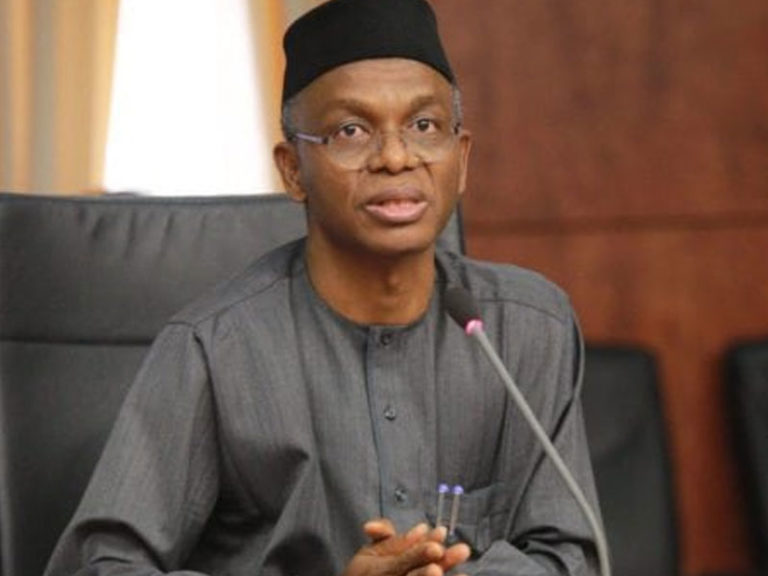
Amid feud with NLC, El Rufai sacks 19 appointees to ‘rightsize’ public service

GOVERNOR of Kaduna State Nasir El Rufai has sacked 19 political appointees in a bid to ‘rightsize’ the state’s public service.

This was contained in a statement signed by El Rufai’s Special Adviser on Media and Communications Muyiwa Adekeye on Wednesday in Kaduna, stating that it was the first phase of the rightsizing exercise at the executive level.

According to the statement, Deputy Chief of Legislative Staff Bala Yunusa Mohammed and two assistants to the DCOLS Halima Musa Nagogo and Umar Abubakar were among the disengaged workers.

Special Adviser (political) Ben Kure, Mustapha Lynda Nyusha, Umar Haruna and Jamilu Gwarzala Dan Mutum, who were all assistants to Kure, were sacked.

The governor also dismissed Special Adviser for Social Development Zainab Shehu and Special Assistant to Shehu Stephen, Hezron.

Some of the sacked officers also included: Senior Special Assistant for Stakeholders Relations Mohammed Bello Shuaibu, and Senior Special Assistant on Youth Aliyu Haruna.

“Also on the list are Halima Idris, special assistant, creative arts; Engr Aliyu Alhaji Salihu, director-general of public procurement authority; special assistant community relations, Ashiru Zuntu; and Saida Sa’ad, a senior special assistant,” the statement read.

Other sacked appointees were “Special assistant programmes, Elias Yahaya, and special assistant to the secretary to Kaduna state government,Tasiu Suleiman Yakaii, are on the list, [as well as] the special assistant on economic matters, Samuel Hadwayah, and Ahmed Mohammed Gero, senior special assistant environment.”

Adekeye said El-Rufai thanked the departing officials for their services to the state and wished them well in their future endeavours.

The dismissal came amidst the ongoing feud between the Kaduna State government and the National Labour Congress (NLC) over massive retrenchment of workers in the state.

Last week, the NLC embarked on five- day warning strike over the sack of thousands of workers and refusal to pay entitlements to retrenched workers in the state. It was called off three days after to allow for negotiation with the Federal Government.

El Rufai said the sacks were part of the government’s process to ‘rightsize’ the state’s civil service.

During the strike, El Rufai also ordered the dismissal of lecturers, nurses and all other workers in the state who joined the NLC warning strike.

A Senior Advocate of Nigeria (SAN) Femi Falana had said the ‘cruel anti- workers’ policy made by the state government was responsible for the rate of insecurity in the state.

“The level of insecurity in Kaduna State today is a function of unprecedented, cruel anti-workers’ policy of the Kaduna State government, including repeated mass layoffs,” Falana said.

He argued that loss of incomes and livelihood would make people desperate for survival.
NDLEA boss says politicians, students need to undergo drug test

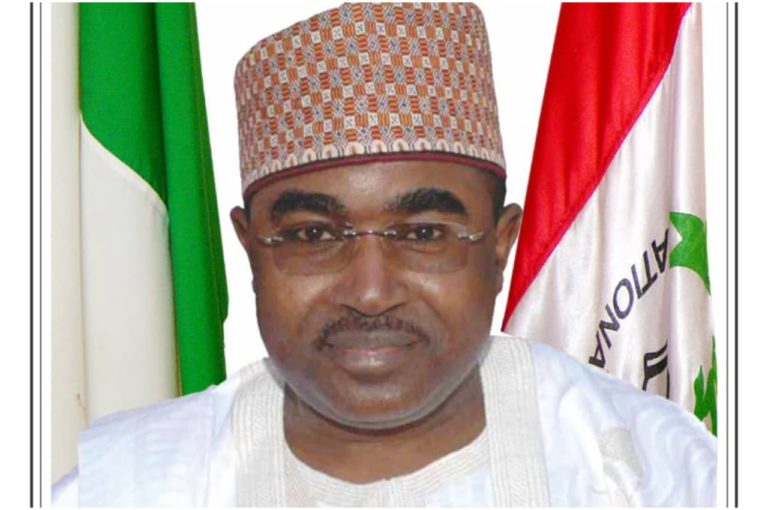
THE National Drug Law Enforcement Agency (NDLEA) Chairman Mohammed Buba Marwa said there was a need for politicians and students seeking admission into higher institutions to undergo drug integrity test.

The NDLEA chairman stated this while delivering a paper titled, ‘Drug Abuse and National Security Challenge: Way Forward’ on May 26, at the fifth anniversary lecture of the Presidential Diary Magazine in Abuja.

Marwa said as elections neared, there was a need for Nigerians to elect politicians who would think straight and were not under the influence of drugs to manage their treasuries and lives.

He said that students seeking admission into higher institutions also needed to go through the tests, saying that there was a connection between drug abuse and insecurity in the country.

READ ALSOConstitutional review: FG should only coordinate, receive royalties – Akeredolu

According to an official release, the NDLEA boss said that due to this “evidence-based connection, concerted efforts must be made towards tackling the drug scourge headlong.”

In the same event, wife of the President of Nigeria Aisha Buhari, represented by Mairo Al-Makura, enjoined Nigerians to join in the fight against drug abuse.

“My passionate commitment towards tackling the drug abuse menace prompted the inauguration of the Presidential Advisory Committee on the Elimination of Drug Abuse,” she said.

A twitter user identified as Tayo Omo Olumo said it would be difficult to scale through.

According to the NDLEA boss, “In the past 100 days, operatives of the NDLEA have carried out non-stop offensive against drug trafficking, traffickers and abusers.” The ICIR had earlier reported an instance of such operation.


Buhari avoided COAS funeral to prevent ‘closing of roads’ -Shehu

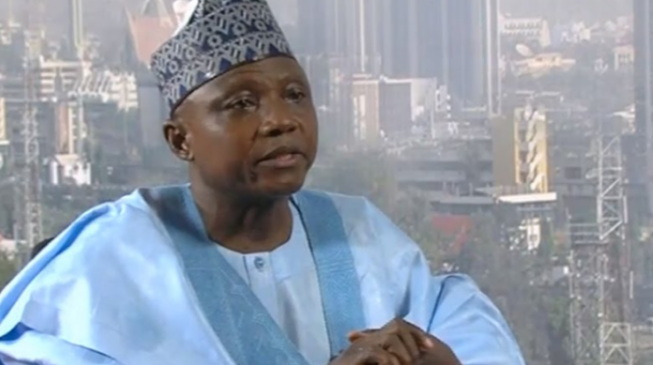
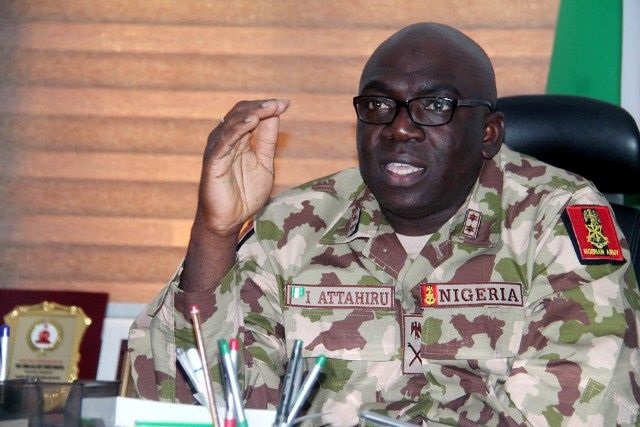
SENIOR Special Assistant to the President on Media and Publicity Garba Shehu has given reasons for the absence of the Nigerian President Muhammadu Buhari at the funeral of Chief of Army Staff (COAS) Ibrahim Attahiru held on Saturday.

Speaking at an interview with Arise TV on Tuesday, Shehu hinted that the president, in consideration of the safety of ordinary Nigerians, stayed away from the funeral ceremony to avoid ‘closing of roads’ and molestation of citizens on his account.

“I was in Europe myself on assignment and I have not spoken to the president on this, but let me give you just one example. The president is somebody who is so concerned with the safety and well-being of ordinary Nigerians on the streets.

“Do you know he now prays his Jumaat in the State House and doesn’t go to the National Mosque? Because he doesn’t like this idea of closing roads, security men molesting people on the road for the president to have right of way,” he said.

According to Shehu, the president’s absence was also to avoid taking attention away from the funeral ceremony of the COAS, which he described as a mourning situation.

READ ALSOConstitutional review: FG should only coordinate, receive royalties -Akeredolu

Recall that the COAS along with 10 other top military officers who died in a plane crash on Friday was laid to rest at the National Military Cemetery in Abuja.

Shehu also addressed the issue of the Nigerian President seeking a third term in office, saying that Buhari was not interested in such discussions.

He noted that the attacks on security facilities and INEC offices across the country were executed by anarchists and would not stop elections come 2023.

“I believe that the law enforcement is efficient enough to deal with the on-going challenge. President Buhari is not interested in third term, he is not cut out for that,” he said.

As the election year inches closer, the issue of the president’s term limit has become a topic at the centre of public discussion for many Nigerians.

The 1999 Constitution of the Federal Republic of Nigeria, however, provides in Section 137(1b) that elected presidents and government officials could only serve in government for a maximum of two terms.

“A person shall not be qualified for election to the office of the President if he has been elected to such office at any two previous elections.”

£4.2 Ibori loot: Delta State counters accountant general’s claims

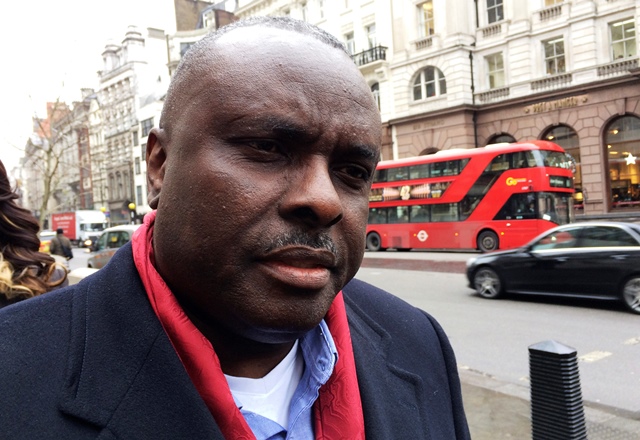
DELTA State government has denied receiving £4.2 million recovered by the British Government from the ex-governor of the state James Ibori as claimed by the Accountant General of the Federation Ahmed Idris.

Idris had claimed during his appearance before the House of Representatives Adhoc Committee on the assessment and status of all recovered loots on Tuesday that the much-contended funds had been reimbursed to the state’s coffers.

While stating that funds looted from the treasury of a state were always returned to it when recovered, Idris added that states could also sue the Federal Government to recover the funds if paid to the account of the Federal Government.

“It was paid to Delta State,” he said.

“Such recoveries go specifically to those states. Honourable Chairman, any recovery arising from the looted funds from a particular state goes to the state. The state governors will not even allow this to fly.”

He added that “some recoveries are for some state governments, specific state governments. I know there was a time recovery was made on behalf of Plateau State, there was one for Bayelsa, there is one for Delta,”

READ ALSO: Senior lawyers divided over ownership of £4.2m Ibori loot

However, Chief Press Secretary to the state government Olisa Ifejika, on Wednesday, countered the accountant general’s claim, insisting the oil-rich state was yet to receive the money.

“We appreciate the efforts of the Federal Government to return the recovered loot to Delta State where it rightly belongs. But the truth is that the money has not hit the Delta State government’s account.

“We saw it yesterday like every other Nigerian when the Accountant General of the Federation Ahmed Idris while appearing before the House of Reps committee on recovered loot made that statement and there was this avalanche of enquires to know whether that money has come to us and the truth is that the money has not come.

“We are happy that they have shown willingness to return the money and we know that very soon, the money will come,” Ifejika said while addressing journalists at the Government House in Asaba, the state capital.

He assured that the state would ensure that the funds were judiciously utilised to improve infrastructure across the state, once received.

Return £4.2m Ibori loot to Delta State, Nigerians urge FG

Attorney-General of the Federation (AGF) and Minister of Justice Abubakar Malami had earlier claimed in March that the recovered loot would be used for the construction of the Second Niger Bridge, Abuja-Kano Road, and Lagos-Ibadan Expressway and not returned to the Delta State Government where it was pilfered from.

Earlier this month, the Nigerian government had claimed that it had received the much-contended funds from the British government.

Coup: Mali’s interim president, prime minister resign

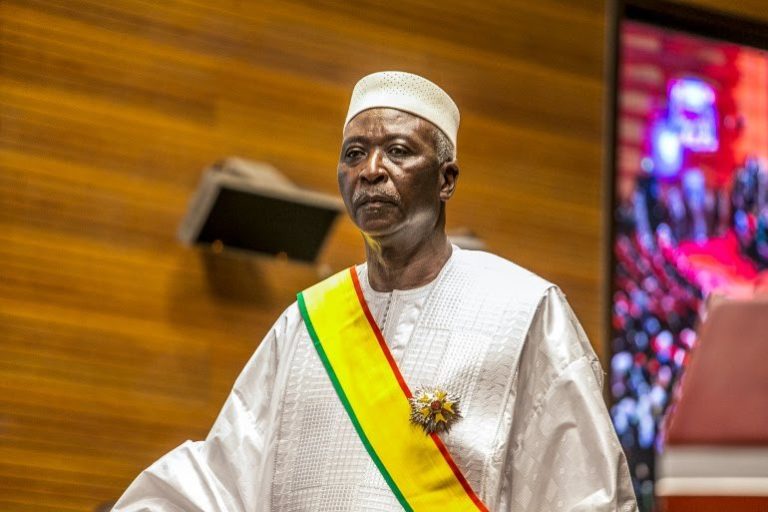
MALI’S interim President Bah Ndaw and Prime Minister Moctar Ouane have announced their resignations after being arrested in an apparent second military coup in nine months.

Baba Cisse, Special Adviser to the last year’s coup leader Assimi Goita, told the AFP that the leaders resigned ‘before the mediator’ on Wednesday.

Cisse said negotiations were underway for their release and the formation of a new government in the poor Sahel country.

A member of the Economic Community of West African States (ECOWAS) mediation mission, who pleaded not to be named, also confirmed their resignations.

The team travelled early Wednesday to the Kati military camp around 15 kilometres (nine miles) from the capital Bamako to visit the two detainees.

Goita, who holds the rank of vice president in the transitional government, accused Ndaw and Ouane of failing to consult him on a reshuffle.

READ ALSONigerian government kicks as military stages another coup in Mali

Ndaw and Ouane, who had been heading the interim government with the declared aim of restoring full civilian rule within 18 months, were arrested and detained by soldiers at the Kati Military Camp near  Bamako, on Monday.

Their detention has also triggered condemnation by many, including the United Nations Secretary-General Antonio Guterres, who had called for calm and their unconditional release.

The Nigerian government, United Nations, African Union, ECOWAS, the European Union and the United States had issued statements to condemn their detention and demanded their unconditional release.

The UN Security Council was set to hold an emergency meeting later Wednesday at the request of former colonial power France and others.

In August last year, the military toppled the democratically elected government of President Ibrahim Boubacar Keita after months of anti-government protests in the country.

An interim and a transitional government was constituted following the intervention of ECOWAS led by former Nigeria’s President Goodluck Jonathan.

FG insists no scrapping of NYSC

THE Nigerian government has insisted that it would not scrap the National Youth Service Corps scheme (NYSC).

Minister of Youth and Sports Sunday Dare said this in a tweet on Wednesday in response to a bill before the National Assembly and calls by some Nigerians that the scheme should be scrapped.

Dare said the NYSC scheme had been one of the greatest tools for national development of Nigerian youths, noting that the commitment of the government to sustaining the scheme remained.

However, the minister noted that the government was currently working on reforms and initiatives on the scheme to reflect the current realities of the country.

“The NYSC scheme remains one of the greatest tools for national development for our youth. The commitment of the government to sustaining the NYSC scheme remains.  Dynamic Reforms and Initiatives towards current realities are ongoing. Nigeria will stand with her youth,” Dare said in the tweet.

The ICIR had reported that there was a bill before Nigeria’s House of Representatives to repeal Section 315(5)(a) of the 1999  Constitution of the Federal Republic of Nigeria (as amended) that established the NYSC.

According to the sponsor of the bill, House member representing Andoni/Opobo/Nkoro constituency Awaji-Inombek Abiante, the need for scrapping the NYSC was due to insecurity and other factors.

Abiante said the purpose of NYSC was defeated as members were not posted to some parts of the country because of insecurity.

The bill has met divergent reactions from Nigerians, with some disagreeing with the provisions of the bill and others saying that the scheme should be scrapped.

The one-year NYSC scheme is a compulsory scheme for Nigerian graduates from tertiary institutions where they are attached to private or public institutions anywhere in the country.

The scheme was established in 1973 to foster social integration among Nigerians due to the multi-ethnicity of the country.

Restructuring will improve Nigerian economy – Peter Obi

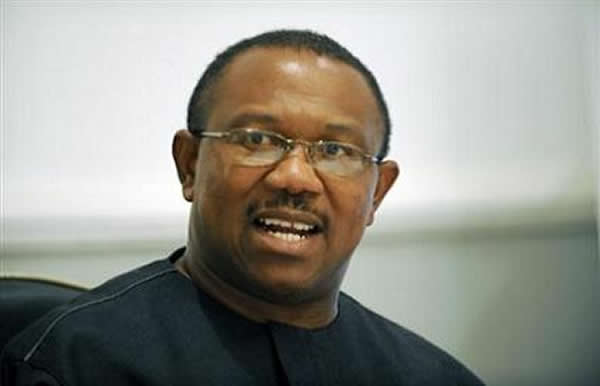
FORMER Governor of Anambra State Peter Obi has said that restructuring would boost the Nigerian economy and put an end to insecurity in the country.

Obi said this on Tuesday at the fourth Adada Public Lecture organised by the Association of Nsukka Professors (ANP) at the University of Nigeria, Nsukka (UNN).

He stated that restructuring of Nigeria would encourage governors to increase the productivity of the states and ensure maximum security as local and community police would be set up to tackle criminality within their areas.

Obi encouraged governors to seek alternative means of generating revenue, rather than the continuous dependence on federal allocation from the proceeds of oil.

“No developed country in the world depends on crude oil but they invest in their children, agriculture and encourage small and medium enterprises by giving out soft loans and other incentives. There is urgent need to restructure the country for the economy to grow to desired level,” he said.

The ex-governor stressed that restructuring should not be seen as an attempt at dividing the country, but as a move to build the ailing economy and restore security in the country.

READ ALSORestructuring: Okowa, Wike hit critics of southern governors

He further stated that restructuring would help to ensure adequate funding of the educational sector, and would bring out the comparative advantage of every state as natural resources lying waste would be harnessed to boost the state economy.

Obi added that restructuring would enable states to make adequate investment in agriculture, while creating more employment opportunities.

“In the 1960s and 1970s, agriculture was the major foreign exchange earner for the country. In the North, we had groundnut pyramid, in the West we had cocoa and the East had palm oil and Nigeria was among the best economies in the world,” he said.

He, therefore, urged professors and lecturers in the country to use their wealth of knowledge to convince Nigerians of the urgent need for restructuring in the country.

The call for restructuring has remained a recurring topic for discussions within the Nigerian government.

About two weeks ago, governors from the southern region of Nigeria resolved at a meeting held in Asaba, Delta State, that there was a need for the nation to be restructured, to reflect true federalism and create a change in the revenue allocation formula in the nation.

At a summit organised by the Northern Elders Forum (NEF) in April, the Arewa elders supported the calls for restructuring, stating that it was the only avenue through which Nigeria could realise its potential for economic and political development.

The Presidency, however, has maintained that restructuring is not a priority and has described the calls for restructuring as unpatriotic outbursts that are both unhelpful and unwarranted.

Police investigating videos of parading gunmen in Imo

THE Imo State Police Command said it had commenced investigations into viral videos of gunmen walking freely in the state.

A spokesperson for the Imo Police command Bala Elkana told The ICIR on Wednesday that investigations had commenced into identifying the persons in the videos.

Viral videos surfaced on social media showing some men in black uniforms with guns parading the streets and shooting.

https://twitter.com/TundeEddnut/status/1397218373910638595?s=20


Elkana said the videos would help the police to identify the persons and take appropriate actions.

On the violence that broke out on Tuesday in Orji Divisional Police Station, Elkana explained that hoodlums attacked the facility to ensure that police activity did not return, likening it to destruction that happened during the #ENDSARS protest.

The facility in question was destroyed during the #ENDSARS protest in October 2020, the spokesperson said, noting that it was being reconstructed before it was again disrupted by hoodlums on Tuesday.

READ ALSORestructuring will improve Nigerian economy – Peter Obi

“Orji Division was destroyed during the #ENDSARS protest, then we have someone who volunteered to repair it, then workers were mobilised to the site. These hoodlums came and said no, ‘work cannot continue and that police station must not return.”

“These hoodlums have enjoyed some free movement, harassing, stealing and looting, so they don’t want the police to return and stop them, that is the reality,” Elkana said. He noted that the police had sent reinforcement to the site to ensure that renovation of the station continued.

According to a video seen by The ICIR, a voice  said the gunmen were challenging the police and the Army to confront them in a gun battle.

In southeastern states, most especially Imo, there have been several attacks on police personnel and police stations, including the sI’mtate police headquarters and the Nigeria correctional facility in the state.

COAS death: Nigeria, China record fatalities as Beechcraft reports 23 accidents in five months

THE death of Chief of Army Ibrahim Attahiru in the ill-fated Beechcraft KingAir B350i plane crash in Kaduna, alongside 10 others aboard, shocked the nation, but two crashes in three months reveal a disturbing trend associated with the aircraft purchased by Nigeria.

Data obtained from the US-based Aviation Safety Network, an air accident tracking database, show that in the first five months of 2021 globally, there were 23 recorded incidents of air accidents involving the Beechcraft King Air 350i aeroplane series.

Only three of the accidents were fatal, resulting in 23 deaths that involved two Nigeria Air Force -NAF Beechcraft KingAir military B350i jets and a 350i jet belonging to China’s Metrological Agency, CMA.

While the fatalities in Nigeria led to the loss of 18 lives, the air mishap in China involved the death of five people.

Of all the other incidents recorded, there were no fatalities apart from the damage to the Beechcraft aircraft involved in the crash.

The Beechcraft King Air 350i is a twin-propeller aircraft made by Textron Aviation, a unit of the U.S.-based Textron Inc conglomerate and the model was first released around 2009.


You may wish to read

Fact Check: Did Late COAS say over his dead body would there be Biafran and Oduduwa nations?

PROFILE: Life and times of 11 military officers killed in Kaduna crash

Retired air officer questions age of pilot in Army plane crash


According to a report, analysis of recent and past Beechcraft King Air accidents since October 2014 shows that the air crashes occurred mostly during takeoff and the initial climb. 

On February 21, NAF 202 Beechcraft KingAir B350i aircraft crashed while returning to the Nnamdi Azikiwe International Airport after reporting engine failure en route Minna, according to preliminary findings.

The crash led to the death of seven crew members on board, who were deployed to the North-West for Intelligence, Surveillance and Reconnaissance (ISR).

Information released by the NAFshortly after the crash indicated that the accident was caused by engine failure.

The NAF spokesperson Edward Gabkwet, in an interview, said NAF would be meticulous in carrying its investigation jointly with the Accident Investigation Bureau, AIB.

“In the meantime, we are not rushing into taking a certain decision that would hamper our own operations…We should not take our eyes off the ball, we must remain focused on whatever we are doing, not take rash decisions just to please few critics on Twitter, Facebook or Instagram. No, we won’t do that,” he said.

Chief of Army Staff Ibrahim Attahiru was among the military officers who died last week when a NAF 203 Beechcraft KingAir B350i scheduled to land at the Nigerian Air Force Base, Mando, Kaduna, was diverted and crashed at the Kaduna International Airport.

The military officers were supposed to be on their way to Kaduna ahead of the passing-put- parade of soldiers from the Nigerian Army Depot in Zaria before the incident occurred.

However, Gabkwet revealed that the two crashed Beechcraft aircraft had different designations, saying the one that crashed in February was configured for intelligence, surveillance and reconnaissance while the aircraft in last Friday’s crash in Kaduna was a passenger aircraft.

READ ALSO:


According to service statistics, the aircraft serviceability rate of the Nigerian Air Force rose from 35 per cent in July 2015 to 82 per cent as of February 2020.

NAF had purchased three Beechcraft King Air 350i aircraft in August 2014, mainly for intelligence, reconnaissance and surveillance missions across the country. However, one of the aircraft was transferred from the presidential air fleet in 2015.

With the crash of NAF 201 and NAF 203 within an interval of three months, the fleet, which is a part of NAF’s 209 Executive Airlift Group (EAG), is based at Abuja-Nnamdi Azikiwe International Airport and is left with NAF 202 and NAF 204 jets.

CBN expresses worry over rising public debt, describes 0.51% GDP growth as fragile

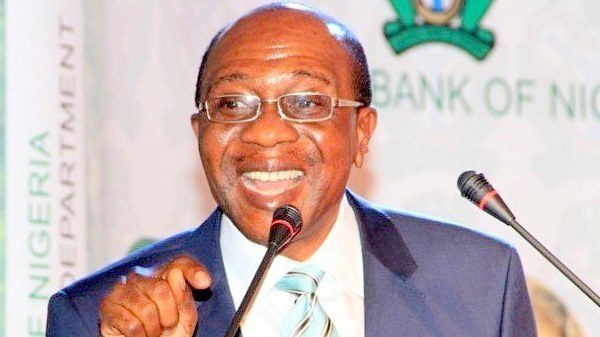
THE Central Bank of Nigeria (CBN), on Tuesday at the Monetary Policy Committee (MPC) meeting, raised concerns about the country’s rising debt, describing it as worrisome.

The CBN also described the latest 2021 first quarter Gross Domestic Growth (GDP) growth as fragile.

Central Bank Governor Godwin Emefiele said amid GDP growth recoveries being recorded by the global economy, the bank would be more determined to expand several of its interventionist programmes on the economy to improve and create wealth.

“It is important to note that for us at the Central Bank, we are not surprised at the recorded growth. We made efforts to be pro-growth and adopted variable measures that will reign inflation and manage growth output,” he said.

Emefile said the bank adopted certain measures to mop up liquidity and increase supply in the economy.

“In the process, we reduced money supply to control inflation, mopping liquidity, while using development financing to increase interventions in real sectors and improving lending at the concessionary rate. These are some of the steps we take and we are not surprised at the results we’re seeing.”

Speaking further on the measures taken by the CBN to spur grwoth, Emefiele noted that, “When the pandemic started, we said that all the facilities we give out must be at five per cent. We also asked the banks to restructure some of the facilities to support businesses being adversely affected by the pandemic.”

pension fund
Ventures africa

He explained that the bank started with N100 billion targeted facility, increased it to N150bilion, and further to N300billion at the last meeting.

“For the health sector, we made available a stimulus of N100 billion to enable some of our moribund pharmaceutical industries to come back alive. We supported our hospitals so that they could provide health facilities. These are some of our the stimulus that we used in supporting consumption expenditure,” he said.

READ ALSOExplainer: Why CBN ousted board of First Bank

The apex bank governor, who described Nigeria’s peculiar economic situation during the peak of the pandemic as ‘stagflation,’ whereby inflation and prices ran high concurrently at the same time with the contraction of the GDP, said the CBN’s responsibility was to manage inflation by ensuring that price and stability mandates were prioritised.

Emefiele further said the apex bank’s MPC voted to consolidate policies to spur output growth.

“We expected what is happening now in growth in the manufacturing sector. We mapped out N1 trillion and have disbursed N856million to manufacturers, in agriculture and mining sectors.”

‘We targeted interventions to support output growth and it reflected in the first-quarter GDP growth. What we want to continue is to consolidate these interventions and growth,” he noted.

Borrowing spree, debt service cost expose Nigeria’s precarious financial situation

He said the MPC decided to build on the recorded successes, noting that the bank would continue to build on its interventions at a subsidised interest rate with targeted credit facilities to continue pushing for growth for the economy.

“Hence, we would make more money available to households, to small businesses for them to go back to business to grow the economy,” he assured.

As of April 2021, the headline inflation was 18.12 per cent, food inflation stood at 22.72 per cent, while core inflation was at 12.74 per cent. The NAFEX exchange rate stood at N410.25 and oil price was $66.1.

Nigeria’s GDP grew by 0.51 per cent in real terms in the first quarter (Q1) of 2021, marking two consecutive quarters of growth, data released by the National Bureau of Statistics (NBS) on Sunday showed.

The uptick in growth was driven mainly by the manufacturing sector which grew 3.40 per cent(year on year) within the period, higher than -1.51 per cent in the fourth quarter (Q4) of 2020 and 0.43 per cent in first quarter (Q1) of 2020.

On the other hand, data obtained from the Debt Management Office (DMO) reveal that Nigeria’s total debt was N32.9 trillion at the end of December 2020, while debts owed to non-Nigerian lenders was pegged at N12.7 trillion.