SOME gunmen have attacked and abducted a yet-to-be-known number of students from Green Field University in Kaduna State.
According to reports, the gunmen, who caried out the attack on Tuesday evening, shot a security guard attached to the school and abducted the students of the university.
Confirming the incident, Kaduna State Police Spokesperson Muhammad Jalige said the exact number of the abducted students could not be ascertained.
However, he said a roll call was being taken to ascertain the identities and number of the abducted.
He further stated that the Police and the military had moved to the school immediately after they got information about the abduction.
The authorities of Green Field University said they were not aware if there had been any communication from the abductees.
Jalige told The ICIR that he would not like to take further questions on the abduction, saying that every other question should be directed to the Kaduna State government.
Efforts to speak with Press Secretary to the Kaduna State governor Muyiwa Adekeye was not successful as he did not respond to calls and text messages from The ICIR over the abduction.
The abduction in Green Field is coming fewer than two months after gunmen attacked and kidnapped 39 students from the Federal College of Forestry Mechanization, Afaka, Kaduna State.
The 39 students were kidnapped by the gunmen on March 12. While some have been recovered, others are still in the custody of the kidnappers.
Kaduna State has recently become a hotspot for kidnapping, but Governor of the state Nasir El-Rufai has insisted that he will neither negotiate nor pay ransom to kidnappers.
El-Rufai said the only way to rescue the kidnapped students was through military action, adding that any other option was ‘emotional and irrational.’
THE United States online retail company Amazon has concluded plans to locate its African headquarters in South Africa, leaving out Africa’s most populous nation, Nigeria.
This was according to authorities in Cape Town, who confirmed this in a statement to newsmen on Tuesday.
The company will also serve as the anchor tenant for a new development in Cape Town, located at the site of the River Club.
The municipality has approved a 15-hectare parcel of land for development. According to the city, the development will cost R4 billion and include two precincts.
“US retail giant, Amazon, will be the anchor tenant, opening a base of operations on the African continent,” the city said in a statement.
“The development design intends to create a 150,000 square metre mixed-use space, divided into commercial and housing uses across two precincts. The developer intends 31,900 square metres to be used for residential purposes.
“The development will include both market-driven and affordable housing opportunities – the latter of which will be physically integrated with the other residential units in the apartment complexes.
“It is envisaged that 5,239 jobs will be created in the construction phase alone. The project will also create up to 19,000 indirect and induced jobs,” it said.
Reacting, the Democratic Alliance has welcomed the announcement, saying that the Amazon South Africa HQ has the potential to create up to 19,000 jobs.
DA Shadow Minister for Trade Dean Macpherson said it would also inject around R4 billion into the local economy.
He lamented that the extended COVID-19 lockdown had caused devastation in the South African economy.
This is coming one week after Twitter picked Ghana for its first African office and headquarters.
Nigeria, being the continent’s most populous nation and biggest economy, is expected to attract deep-pocket investors, but high cost of doing business, multiple taxation, lack of clear-cut ease of doing business plan, poor management of foreign exchange market, land tenure system and poor electricity supply are scaring investors away, analysts say.
Falsely accused of being a cultist, Ezeanozie Obinna narrates his harrowing ordeal in the hands of SARS, who hung and tortured him until he “slumped to the ground like a lifeless chicken.”
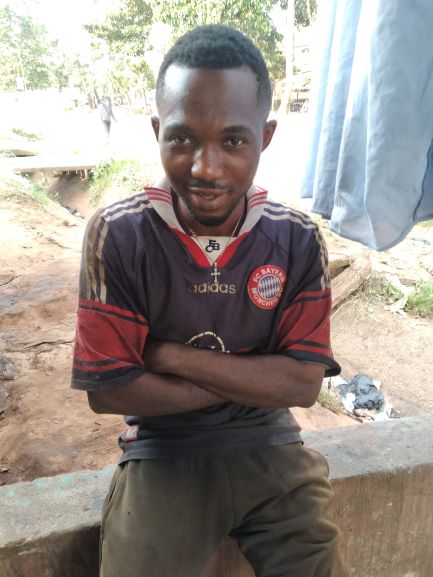
MY name is Ezeanozie Obinna. I’m a 24-year-old panel beater.
My SARS story started with a bang at 2 a.m. on May 23, 2020. My sleep was interrupted by a loud noise at the gate that leads into my compound, which is in the town of Ekwulobia, Anambra State.
Now wide-awake, I stared through the window and saw someone jump over the fence into the compound. I heard another bang at the backyard door. My dog started barking.
Soon, there was a knock at my bedroom’s door. The intruder was now at my doorstep.
It turned out not to be just an intruder, but intruders – six of them, in fact, scary men all carrying guns. I asked who they were and what the matter was. They said nothing was wrong, that they were security operatives. I was annoyed, and wondered what manner of security operatives would appear at a person’s house at this ungodly hour.
I immediately assumed they were local security men who had come to collect security fees or fines from those who had not yet paid.
But the men told me they were members of the Special Anti-Robbery Squad (SARS).
They asked me to come with them. I begged them to allow me to call someone so I could let them know what was happening to me, but they refused and dragged me out of the room.
Outside, the men led me to a Toyota Hilux and asked me to give them five names of people who were cultists. Confused, I asked why they would ask me about cultists when I was neither a cultist nor knew anything about cultism.
In the Hilux, were others who had been arrested earlier. The officers threw me into their midst. Like me, they had been forced out of their houses without knowing what was happening. We were all driven to the SARS station at Nnewi, a large town in Anambra State.
We reached Nnewi at about 4 a.m.
Monday Bala Kuryas, Anambra Police Commissioner
At the station, we were asked to call family members to tell them where we were. I called my parents.
Later, the officers interrogated us, one after the other, mainly about cultists.
I maintained my stance: I was not a cultist, and I knew nothing about cultism.
For that answer, I suffered the same fate suffered by those who had denied being cultists: my hands and legs were tied behind my back and a rod inserted in between. I hung in the air, my face staring at the ground. Then the SARS officers began hitting me with sticks.
I wept and wept. It was unbearable. The SARS officers took a break, sat in a corner, and filled their mouths with alcohol.
“It’s time you speak the truth,” one of them said to me. After drinking, one of the officers resumed the torture – mercilessly punching me. I screamed and wept. I was an absolute wreck.
Soon afterwards, when one of the SARS officers came and untied me, I remember slumping to the ground like a lifeless chicken.
At about 7 a.m. that same day, the SARS commandant asked us some questions about the cult group they accused us of being members of, and the names of the other members of that group.
I was given a piece of paper and told to write that I was a cultist.
After that, the officers collected our phones, clothes, and shoes and led us into a cell, where we were all subjected to various degrees of bullying at the hands of old inmates.
We were given a series of punishments like ‘mounting the wall’ which meant facing the wall and pretending to climb it. We were also ordered to ‘pick pin’ which meant hanging one leg in the air and pointing one finger to the ground. As we ‘performed’ the punishments, the inmates hit us with sticks.
At about 8 a.m., one of the SARS officers came into the cell and asked who Ezeanozie Obinna was. I answered. The officer told me to come out. I did.
At that moment, I remembered that an inmate had warned that if the officers came in and called my name, I should not answer because it was believed they called out inmates to kill them. This information dawned on me as I walked out, and tears began to well up in my eyes.
But it turned out to be good news. The officer led me to the counter, where he told me that they (SARS officers) had received a call from a Divisional Police Officer (DPO) who asked them to release me. The DPO had told them that I was not a cultist. He was my neighbour, and my parents had reported my arrest to him.
My belongings were returned. Six hours after I had been arrested and tortured, I was free. But I was weak, and to add insult to injury, I did not have a single Naira in my pocket.
I sat on the stairs of the station and wept. I hoped any of the SARS officers would give me transport-money. But no one did. Later, one of the SARS officers pushed me out of the station.
Outside, I stood by the gate for a while. Then I began acting like a gateman, opening the gate for whoever came in and went out, hoping that someone would notice me and give me money.
A man who happened to be the brother of one of the arrestees saw me and asked what the problem was. I told him that I had suffered the same fate as his brother. After the man had secured his brother’s release, I followed both of them. Coincidentally, they also lived in Ekwulobia.
The two men were surprised to learn that I had not paid for my release. With SARS, people are priced like goods. Relatives and friends of those arrested pay huge sums to secure the release of their loved ones.
The officers would ask for, say, 100,000 naira, and if you say you do not have that amount, they would tell you to go home and come the next day.
Though I was lucky to escape paying an expensive sum for my release, I couldn’t escape paying a lot of money to treat the injuries and wounds I sustained from being tortured. My hands were so useless, that a point, even feeding myself was a problem. For three weeks, I could not do anything.
My parents keep telling me they thank God I came out of that station alive.
I thank God, too.
This story is part of a multimedia project by Tiger Eye Foundation and media partners across Nigeria, documenting police brutality in Nigeria, and advocating for police reform.
PRESIDENT Muhammadu Buhari has mourned the death of his Chadian colleague Idris Deby, saying he was a friend of Nigeria.
This is contained in a statement signed by Presidential Spokesperson Garba Shehu on Tuesday.
Shehu said Buhari was deeply shocked and devastated by the sudden death of Deby on the battle front to defend the sovereignty of his country.
Buhari described the late Chadian leader as a friend of Nigeria who had enthusiastically lent his hand in the efforts to defeat the Boko Haram terrorists that had posed grave security challenges for Nigeria but also other African neighbours, particularly Chad, Cameroon and Niger Republic
According to him, the late Deby had played a very active role in the regional joint collaboration in the military campaign against the Boko Haram terrorists.
He added that the death of Deby would create a big vacuum in the efforts to jointly confront the Boko Haram terrorists and the Islamic State West Africa Province.
While condoling with the people of Chad and their new leader, Buhari called for greater collaboration to defeat the terrorists.
The ICIR had reported that Deby died of injuries suffered on the frontline in battle with rebels in the troubled part of the country, where he had gone to visit soldiers battling rebels.
The announcement of his death came a day after he won the country’s presidential election in a bid to rule for a sixth term, according to the provisional results released on Monday.
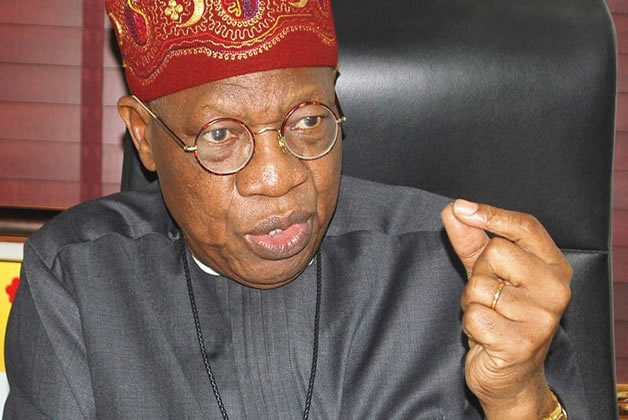
NIGERIA’S Minister of Information Lai Mohammed has said that reports on the United Kingdom granting asylum to persecuted secessionist groups -Indigenous People of Biafra (IPOB) and the Movement for the Actualization of the Sovereign State of Biafra (MASSOB) – is disrespectful to Nigeria.
Mohammed said this on Tuesday in a media chat with the News Agency of Nigeria in Abuja.
He said that although the situation was within the purview of the Minister of Foreign Affairs, he felt, as a spokesperson of the Federal Government, that there was something wrong with that.
“Against the background of the fact that IPOB is not only proscribed but also designated as a terrorist organisation here in Nigeria, the UK’s decision is disrespectful of Nigeria as a nation,” Mohammed said.
He noted that the decision also amounted to sabotaging the fight against terrorism and generally undermining Nigeria’s security.
The minister said that there had recently been heightened attacks against security agencies in the South-East zone, noting that IPOB had been fingered as being behind the attacks in spite of its denials.
The Nigeria government had, in September 2017, proscribed the secessionist group.
According to the report, the UK Visas and Immigration (UKVI) has released a new guideline to its officers on how to grant asylum to members of Biafran secessionist groups.
In the guideline, the UK said its officers should consider anyone who actively and openly supported IPOB and was likely to be at risk of arrest, detention, and ill-treatment which was likely to amount to persecution.
IPOB is agitating for the secession of South Eastern States from Nigeria even though the governors of the states are not in support of that.
There have also been violent clashes between the IPOB and Nigerian Army which have led to the death of civilians and destruction of properties in the South-East.
PRESIDENT of Major Oil Marketers Association of Nigeria Adetunji Oyebanji has assured residents of Nigeria’s capital city Abuja and other neghbouring states that long queues at various filling stations will ease by Wednesday.
Adetunji, who spoke with The ICIR on the phone, described fuel queues at various filling stations in the Federal Capital Territory (FCT), Niger and Nasarawa states as temporary, saying that tanker drivers’ earlier proposed industrial action had been called off following the intervention of the government and other relevant stakeholders.
“This is just a temporary hitch,” he said. “You know on Monday, there was strike by petroleum tanker drivers and there was no movement of stock in and out of various depots across the country. By tomorrow morning, I am sure this will be sorted out as they have started loading at various depots,” he noted.
Adetunji Oyebanji, President of Major Oil Marketers Association of Nigeria
“The government, you recall, had made the announcement about no plans to hike the fuel price. You know most often, towards the end of the month, most people resort to panic buying. It has nothing to do with the present situation as issues with the tanker drivers have been sorted out.”
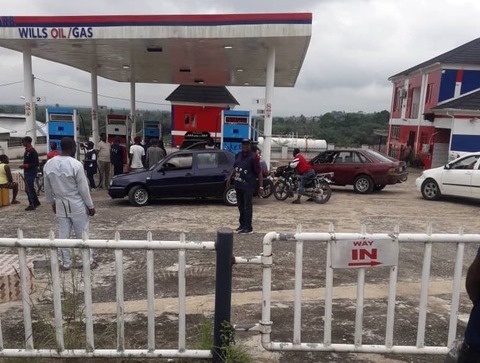
Long queues resurfaced in Nigeria’s capital city on Monday, despite assurances by the Group Managing Director of the Nigerian National Petroleum Corporation (NNPC) Mele Kyari that the ex-depot price of premium motor spirit (PMS) remained unchanged with no plans to increase the pump price.
The Petroleum Tanker Drivers (PTD), with the responsibility to deliver fuel at filling stations, had earlier planned to go on strike over the failure of the National Association of Road Transport Owners (NARTO) to negotiate the renewal of the collective bargaining agreement for new working conditions.
The union had expressed worry that its members had been going through harrowing financial situations while rendering selfless national services to ensure delivery of petroleum products at various filling stations.
Nigeria is not totally out of woods regarding the problem of fuel subsidy – a situation most analysts describe as unsustainable. Experts say fuel subsidy puts pressure on the government’s finances, draining the scarce resources needed to advance the nation’s infrastructural development.
Kyari had, in a briefing to State House correspondents on Tuesday, said the queues currently witnessed in Abuja and neighbouring states would end on Tuesday, noting that the government had resolved the proposed industrial action with Tanker Drivers Association. But the situation did not change on Tuesday as observed by The ICIR at various filling stations.
“The government has assured that it is not changing price and people seem to be reacting with long queues. There’s always that belief and suspense once the month is coming to an end. There’s no need for the queues, the product is available, ” an oil sector governance expert Henry Adigun told The ICIR.
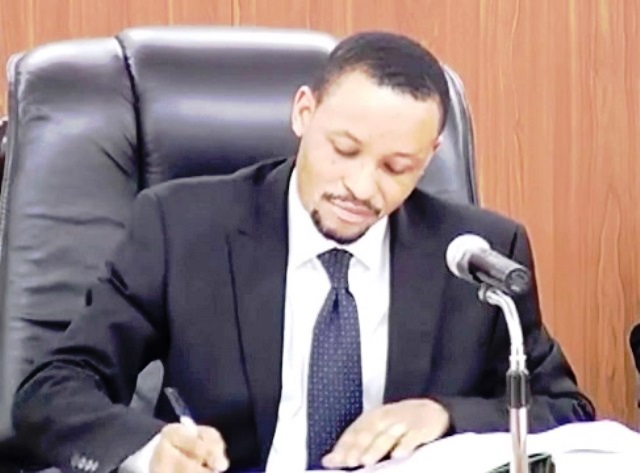
THE Nigerian Senate is considering a petition against Chairman of the Code of Conduct Tribunal (CCT) Danladi Umar over an assault on a security guard in Abuja.
During Plenary on Tuesday, Senator representing Plateau North Istifanus Gyang read the petition before the Senate concerning the assault on a member of his senatorial district, Clement Sargwak.
According to Gyang, the petition was submitted by one Samuel Ihensekhien seeking justice for the victim through the Senate.
After the petition was read by Gyang, Senate President Ahmad Lawan referred the petition to the Committee on Ethics, Privileges and Public Privileges.
Lawan further asked the committee to consider and report back to the Senate within four weeks.
The ICIR had reported how Umar assaulted 22-year old Sargwak at Banex Plaza in Wuse 2, Abuja, on March 29.
Sargwak, who is a personnel of Jul Reliable Security Guards, a private outfit, was allegedly manhandled by Umar when he approached the judge for parking his vehicle in an inappropriate manner at the plaza’s parking lot.
In a response to criticism of Umar’s action, the official statement from the CCT said it was the action of some ‘Biafran boys.’
“The boy was rude in his approach and threatened to deal with chairman if he refused to leave the scene,” the CCT spokesperson Ibraheem Al-Hassan had said.
Civil Society Organisations, the Nigeria Bar Association (NBA) and other groups have condemned the alleged assault on Sargwak, stating that the display of ‘naked power’ would not be condoned by people who were expected to exhibit a high standard of conduct.
“Further, as a member of the legal profession, Danladi Yakubu Umar Esq. is expected, by the extant rules that regulate the conduct of legal practitioners in Nigeria, to maintain a high standard of professional conduct, and not to engage in any conduct which is unbecoming of a member of the legal profession,” NBA said in a statement.
The Peoples Democratic Party (PDP)’s Eyitayo Jegede has lost his bid to overturn the outcome of the October 20, 2020 governorship election in Ondo State.
Jegede had approached the tribunal seeking nullification of result of the election, which declared the candidate of the All Progressive Congress (APC) Rotimi Akeredolu as winner.
In a joint suit with his party, Jegede had prayed the tribunal to overturn the election on allegations that the voting was marred by ‘pockets of violence and irregularities.’
He also alleged irregularities in the emergence of Akeredolu as the candidate of the APC during the party primaries held on July 20, 2020.
However, delivering its judgement on Tuesday, the State Election Petition Tribunal struck out the petition for lack of merit.
The verdict by the tribunal was delivered by a three-man panel led by Justice Umar Abubakar on Tuesday via Zoom as the regular venue of the panel was not open due to the strike action embarked upon by members of the Judicial Staff Union of Nigeria.
According to results announced by the Independent National Electoral Commission (INEC), Akeredolu won the governorship election with a total of 292,830 votes. He won in 15 of the 18 local governments.
Jegede polled 195,791 votes and won only three local governments, which were Akure South, Akure North and Ifedore.
Estranged deputy governor to Akeredolu Agbola Ajayi polled 69,127 votes to emerge third.
LAST week, the Internet was agog following an announcement by Twitter that it had concluded plans to site its Africa headquarters in Ghana.
Twitter Founder Jack Dorsey, who announced this in a statement, said the company chose Ghana because the country was a supporter of free speech, online freedom, and the open internet, which the platform was also an advocate for.
It further cited that Ghana’s recent appointment as host of the Secretariat of the African Continental Free Trade Area(AfCFTA) aligned with Twitter’s overarching goal to establish a presence in the African region.
Twitter also said it had already laid foundations through partnerships with Amref Health Africa in Kenya, Afrochella in Ghana, Mentally Aware Nigeria Initiative (MANI) in Nigeria, and The HackLab Foundation in Ghana.
Although the news was received with mixed feelings by Nigerians who accounted for the larger percentage of its usage in Africa, the Nigerian government has blamed ‘unpatriotic, judgemental Nigerians’ for the move.
Minister of Information Lai Mohammed claimed those demarketing Nigeria and projecting her negatively were to blame for Twitter’s decision.
The minister, who has a penchant for trading blames, noted that this decision would teach Nigerians to be fair and patriotic while criticising the country on social media platforms.
According to him, Nigeria had lost job opportunities and the visibility that would have been got if Twitter had chosen the country.
Why won’t it be Ghana?
The country’s social space, which should operate on the principle of freedom of speech, is currently being gagged by the Muhammadu Buhari-led administration through various proposed legislations and unfair sanctions on media houses. There is an Anti-Social Media Bill, including the Hate Speech Bill which appropriates death sentence to individuals abusing their freedom of speech.
Apart from that, the World Bank Group, in its 2020 Doing Business Report, ranked Nigeria 131 out of 190 countries on the ease of doing business index, an upward movement by 15 places from 2019 ranking of 146. Ghana was ranked at 118. The index shows how much nations make progress in key areas that aid investments. In the index, 118 is better than 131.
Nigeria improved in eight indicators, with the greatest overall positive movement being on dealing with construction permits. Africa’s biggest economy moved from 149 to 55 within a year, indicating that it is now easier to obtain necessary licenses and permits in Nigeria than in 135 countries. The significantly improved ranking in dealing with construction permits might be attributed to the elimination of the Infrastructure Development Charge (IDC – the fee for construction permits) for warehouses and factories.
However, Ghana bettered Nigeria on many indicators. The West African country was ranked at 79 in terms of access to electricity and power supply, while its populous neighbour, characterised with constant epileptic supply of power, ranked 169.
Niyi Adebayo, Minister of Industry, Trade and Investment
Nigeria generates around 12,522 megawatts (MW) of electricity but distributes about 4,000MW. This means one megawatt is to 50,000 population. On the other hand, Ghana generates 4,000MW and distributes 2,400MW, according to the USAID. This is one MW to 12,675 population. However, while “Nigeria’s new gas-fired capacity is unused because of gas supply problems, Ghana has not been able to absorb all of its new installed capacity,” according to Neil Ford of African Business.
Manufacturers and businesses in Nigeria are hard hit with energy problems. Many manufacturers generate their own power, ignoring electricity distribution companies (DisCos). They self-generate 13,233 MW, according to a survey undertaken by Economics Professor at the University of Ibadan Adeola Adenikinju, which was funded by the European Union and the government of Germany.
“Average daily power outage has constantly averaged four times per day,” the Manufacturers Association of Nigeria (MAN) said on its 2020 Second Half Economic Review.
Nigeria moved to 183 in terms of business and property registrations as against 111 of Ghana.
Nigeria recorded downward movements on the ease of paying taxes to 159 as against Ghana’s 152. This is despite the introduction and implementation of the Integrated Tax Administration System (ITAS) which was and is still expected to simplify the process of filing and paying taxes. Multiple taxation is still common in Nigeria, said Lagos Chamber of Commerce and Industry (LCCI).
Nigeria also experiences security crisis ranging from herder-farmer clashes, kidnappings, to abductions and terrorism.
“Rising spate of insecurity portrays the economy as an unsafe investment destination, and if unaddressed, would continue to undermine government’s efforts in encouraging private investment inflows into the economy,” LCCI President Toki Mabogunje said in a statement sent to The ICIR on April 14.
“We cannot afford to continue this way as a country. We need to fix this security problem urgently and at all costs,” she further said.
Ghana recorded total foreign direct investments (FDI) value of $785.62 million in the first half of 2020. On the other hand, Nigeria attracted $362.84 million in FDI within the same period.
PUBLISHER of Daily Nigerian Jaafar Jaafar has fled his house and gone into hiding after receiving several security threats.
A close media associate of the investigative reporter told PRNigeria that unknown persons had been on his trail for a while now.
“Ja’afar’s life is in danger as unidentified persons, likely to be ‘hit men,’ have been stalking him both at his Abuja and Kano residences,” the associate, who preferred anonymity, said.
The journalist had published video clips of Governor Abdullahi Ganduje of Kano in October 2018, allegedly showing him collecting dollars bribes from a contractor.
Following the governor’s recent interview with BBC Hausa on Friday March 19, where he said that they were making plans to deal with those who released the videos, Jaafar wrote a petition to the then Inspector General of Police Adamu Mohammed Adamu on the renewed threats to his life.
Prior to his ‘disappearance,’ it had been gathered that the IGP Monitoring Unit had, in a letter dated 14 April 2021, invited the Daily Nigerian publisher for questioning, alleging that he was inciting violence and spreading injurious falsehood.
In the letter signed by ACP A. A. Elleman, the Monitoring Unit said that “This office is investigating a case of Criminal Conspiracy, Defamation, Injurious Falsehood and Inciting Violence to the Inspector General of Police in which your name featured.
“In view of the foregoing, you are kindly requested to interview the undersigned on Monday 19th April 2021 by 10.00am prompt through SP Usman Garba (Admin Officer) to shed more light on the allegation.
“Your cooperation in this regard would be highly appreciated, please,” part of the letter read.
Attempts to reach Police Force Spokesperson CP Frank Mba, for a reaction, was unsuccessful at the time of filing this report.