AS part of measures to promote transparency in the management of diaspora payments, the Central Bank of Nigeria (CBN) recently announced an amendment to procedures for receipt of diaspora remittances through International Money Transfer Operators (IMTOs) that would now allow beneficiaries to receive such inflows in US dollars either as cash or in their domiciliary accounts held at designated banks of their choice.
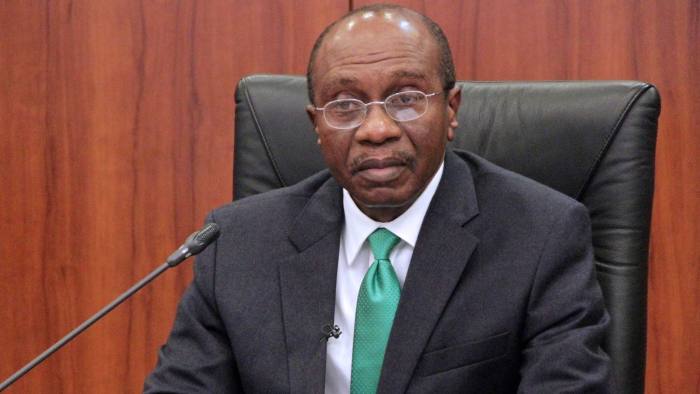
Governor of the CBN, Godwin Emefiele, while justifying the amendment, said investigations and analysed data on IMTO inflows into the country revealed that some IMTOs encouraged the use of unsafe unofficial channels, which also supported diversion of remittance flows meant for Nigeria, thereby undermining the country’s foreign exchange (FX) management framework.
“Some IMTOs, rather than compete on improving transaction volumes and create more efficient ways for Nigerians in the Diaspora to remit funds, resorted to engaging in arbitrage arrangements on the naira-dollar exchange rate, which to a large extent resulted in significant drop inflows into the country,” he said.
Our findings reveal that Nigerians in the diaspora are receiving this policy adjustment with mixed feelings. Nene Oseiwe, who resides in New Jersey with her family, told The ICIR that the regulatory agency’s move was necessary to check the problem of the dual exchange rate in the country.
“I think it should fix the FX crisis. The way it used to work was, if I sent you dollars, they would pay you at CBN’s rate, which is N390. But if I came with that same dollars and gave it to you, you would exchange it at N450 in the open market, so it was problematic,” she said.
“It’s problematic for a country to be having many exchange rates. People would buy dollars from the CBN at N380 and sell it at N460. No value-added, no products, no road, no electricity, nothing; just because they have access,” Oseiwe added.
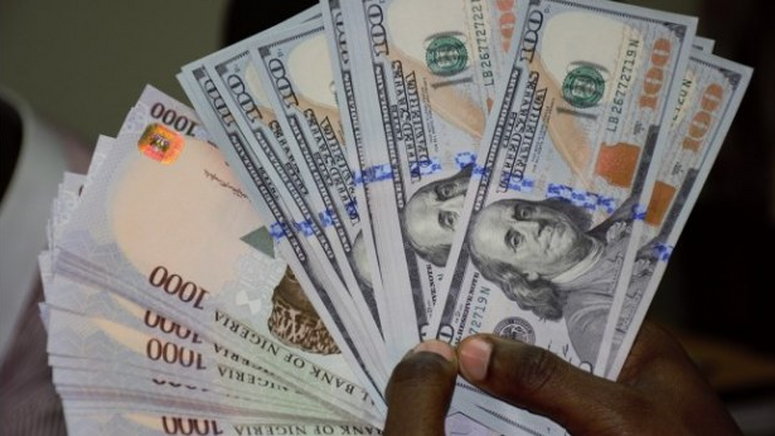
US dollars against the Naira. Credit: nairametrics.com
Augustine Ogidan, residing in Hurts Texas, told our reporter that the new procedure for diaspora remittance was a welcome development as it was convenient and removed the middlemen short-changing beneficiaries.
“I think it’s the best way to go. It might be a little bit inconvenient to those that wouldn’t know what to do, but it would remove the middlemen that cut into the actual amount that is due to the recipients. There are Western Union and MoneyGram locations in grocery and convenience stores in every city here. One can do it online as well,” he said.
On Twitter, however, the reception is different. Most comments on the diaspora remittance policy adjustment reveal that there is still a gap in understanding the implications of this reform expected to, among other things, help finance a future stream of investment opportunities for Nigerians in the diaspora, while also guaranteeing that recipients of remittances would receive a market-reflective exchange rate for their inflows.
Osaretin Victor Asemota using the handle @asemota wrote: “Dear @cenbank, I am in the diaspora and I have relatives at home that I send money to. I want to use whatever remittance channel works best for me and not what works best for you because IT IS MY MONEY. My money can be sent the way I want it to be sent because it is MY RIGHT.”
Another tweet by @theafrobeats read: “@cenbank need reverse this new remittance policy because it does (not) benefit both Nigerians in diaspora and home! This is inconvenient, to say the least! If CBN thinks any IMTO cheating Nigerians in the exchange rate, please revoke that IMTO licence! Moreover, we were not complaining!”
According to @lloydatiku, “CBN is only fighting to keep its monopoly power…on diaspora remittance ($26billion annually).” A Twitter user with the handle @ganXE called for an outright reversal of the policy: “I think the regulator should reinstate direct to naira accounts for IMTOs. This was an own goal against diaspora remittance.”
The Single/Multiple FX Rate
It would be noted that economic experts and business leaders in Nigeria have long argued that a single exchange rate for the naira will put Nigeria at a competitive advantage for the cross-border open trade.
Amine Mati of the International Monetary Fund (IMF) had emphasised that exchange rate unification should be a policy-driven decision that the government must make, arguing that multiple exchange rates had different implications across different countries in the world.
“The IMF’s policy has been consistent on this issue, such that we advise for the unification of exchange rates and the Central Bank of Nigeria and Economic Recovery and Growth Plan are already working in this direction to ensure that the country has a unified exchange rate,” he said during a Special Policy Dialogue Colloquium held in Lagos in 2019.
Managing Director of the Financial Derivatives Company (FDC), Bismarck Rewane, also stressed that unifying the exchange rate would positively impact the Nigerian economy than the current multiple exchange rate regime, which created arbitrage opportunities, would do.
Moving to the Cryptocurrency Market
Many Nigerians say that since 4th December 2020 when the policy took effect, they have turned to cryptocurrencies which are easier, more convenient option for sending money to their loved ones back in Nigeria.
Using the handle @obi_sage, Obi Sage Okoli tweeted: “We now remit through cryptocurrencies and not CBN because it’s easier and much more efficient. Remittance from the diaspora hasn’t dropped, rather it’s remittance thru CBN that tanked.”
@SuperEmbee also wrote on Twitter: “Foreign currency inflow into Nigeria is at a 4-year low. Nigeria isn’t making $£€. Banks are unable to meet the demands of diaspora remittance withdrawal. Nigeria is unable to pay in foreign currency. Citizens of Nigeria are now remitting funds through crypto exchanges bypassing the banking system. This act does not improve foreign currency supply in the economy. This will affect economic development, our naira value etc.”
“Remittances – It’s all about the benjamins. Diaspora remittance dropped drastically last year signalling one of two things: 1. People were finding non-official channels to send money (e.g. crypto) 2. Covid impacted diaspora earnings so much that people couldn’t send money back,” Hachi @senor_hachi wrote.
In recognition of the escalation in the use of cryptocurrencies by Nigerians and to protect the integrity of the financial system from the risks inherent in crypto assets transactions, the CBN in a statement released on Sunday reiterated that the use of cryptocurrencies in Nigeria was a direct contravention of existing law and remained prohibited.
The acting director of corporate communications, Osita Nwanisobi, said, “In light of the fact that unregulated and unlicensed entities issue them, their use in Nigeria goes against the key mandates of the CBN, as enshrined in the CBN Act (2007), as the issuer of legal tender in Nigeria.”
Meanwhile, as part of measures to improve diaspora remittance flow visibility, the CBN is planning to launch a central reporting portal for all foreign remittances. The portal will be managed by the Nigerian Interbank Settlement System (NIBSS).
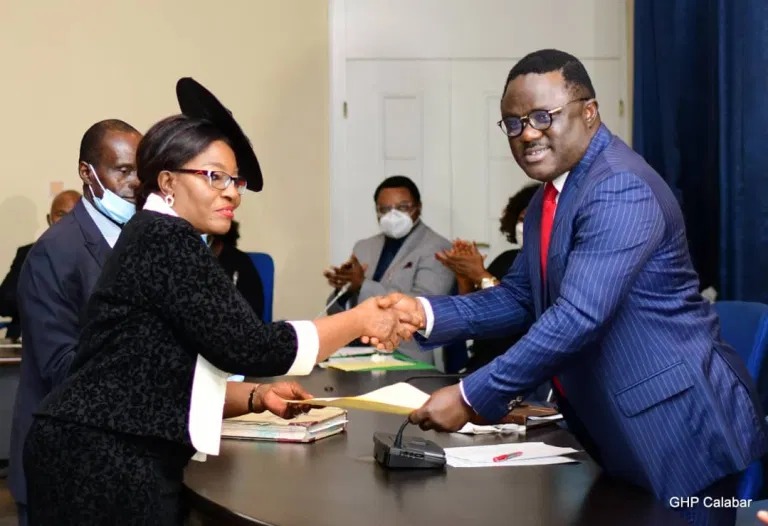
AKON Bassey Ikpeme has been sworn in as chief justice of Cross River State after many months of protests by civil society organisations (CSOs).
Ikpeme, a native of Akwa Ibom State but married to a citizen of Cross River, was rejected twice by the Cross River House of Assembly over what the legislators described as a ‘security threat’ to the state.
Her rejection drew public condemnation both from National Judicial Council (NJC) and CSOs, with the Nigeria Bar Association (NBA) calling on the NJC to compel the state government to do the right thing.
Her nomination was rectified and confirmed by the legislature late last month after allowing two of her junior colleagues to serve in acting capacity for about one year.
Governor Ben Ayade, state governor, who administered the oath of office on her at the government house, said the exercise had brought an end to the internal crisis created by the judge’s initial rejection.
”Today brings to an end the internal concerns of Cross Riverians as it concerns the stability of our Judiciary,” he said.
“God has chosen a woman and not just a woman of God but a covenant child. She is here at the right time and she is the right person for the job. We must put behind all the challenges in the process of getting back here.
“God touched my heart and the heart of every other person in the decision-making process. It was God that fought your fight and not any man,” Ayade said.
In her speech, Ikpeme said it was with deep appreciation that she thanked God who rules in the affairs of men.
“It is with deep appreciation in my heart that I want to thank God who rules in the affairs of men, who has made this day possible.
“God uses men to fulfil His purpose. I also thank His Excellency, Prof. Ben Ayade, from the depth of my heart, for making this day a reality. In my interactions, I have discovered that he is very humane.
“I want to assure His Excellency and Cross Riverians that the Judiciary under my watch will collaborate with other arms of government to move Cross River State forward.”
Olumide Apata, president of the NBA, who described the swearing-in ceremony as a fitting climax to a long process, expressed delight that the judge became the CJN of the state.
” We are extremely delighted that Justice Akon Ikpeme has finally been sworn in as the chief judge of Cross River State. It is a fitting climax to a long process. In life, the problem is not that there are challenges but what is, however, important is how effectively we are able to solve them,” he said.
“I am glad that between the dramatis personae we have been able to come to this fantastic outcome … and so at the end of the day, all is well that ends well,” Akpata further said.
“Democracy runs on three arms of government, that tripod, and they stand independently, but they must also collaborate for democracy to succeed. She is inheriting a judiciary with issues. I am praying that Lord will give her the strength and have the wisdom to navigate the stormy waters and I expect her to work effectively with other arms of government, but she must uphold the independence of the judiciary which is critical.
“We will continue to watch, and we will continue to be the watchdog, which is the role of the NBA. We will continue to take a special interest in what is happening in Cross River judiciary.
“We will continue to stand on the right side of the law, justice and constitutionality and so we are happy, the NBA is satisfied with the outcome, we cannot rest on our laurels, and we will make sure we will continue to do what is right,” he added.
MY State of origin is Ekiti. Of the thirty-five other states which make up the federation called Nigeria, Ekiti State is known and generally revered by all as the ‘fountain of knowledge’. It is that State where the only industry that thrives is education. The myth, which still thrives to date, is that there is no home in Ekiti State where you will not find a graduate either a polytechnic or a university. However, we need first to excuse the arrogance that informed the appellation, ‘fountain of knowledge’ since no State be it in Nigeria or anywhere else in the world or any institution for that matter can make such a loud monopolistic claim. There is no one choice among the states in Nigeria that owns the right to legitimately call itself the fountain of knowledge if the word ‘fountain’ means source or origin. As for being at the vanguard of education and probably topping the list of literate (not educated) people, the State has perhaps useful statistics to defend itself and parade the information as accurate.
On the latter claim, however, this paper would insist that far from generalizing that the people of Ekiti are educated, what is assumed and paraded as education is neither comprehensive in its processes and instruction nor is it fit to be called education. What exists, on the contrary, is a long-established tradition of a successful literacy programme. It follows, therefore, as this paper seeks to show, that Ekitis are only very literate but not in any conclusive unequivocal sense educated. A large percentage of the population can, in fact, read and write. Records show that the State has an intimidating number of professors compared with numbers of professors from the other States of Nigeria, but this does not translate to asserting that they are all therefore educated or that Ekiti State is the fountain of knowledge. This paper explains the reason.
The observations made concerning Ekiti State and her peoples with regards to education can exactly be made about Nigeria, namely that while it is true that Nigerians are deemed educated using varied of data, it is not the case, especially when we critically appraise what is conceived and paraded as education, that they are in fact educated. The level of literacy is certainly high a fact attested to by the varieties of positions occupied by Nigerians overseas over and above figures from other countries lending credibility to the success of the support instructional structures and systems put in place, and the numbers of persons with stacks of laminated certificates secured in briefcases.
With available statistical data on numbers of learning institutions; nurseries, primary and secondary schools, teachers training, colleges of education, polytechnics and universities be they federal, state, private and faith-based academics and tutorial centres, Nigeria is acclaimed to be up to her eyes in education. This paper claims that passing for education is only a successful literacy programme and not education.
What is: The Status Quo.
Before the colonial masters landed in Africa and spread hinterland, sequel to the scramble for Africa by explorative teams from Britain, Portuguese, Italy, Germany and France, the claim could perhaps be made that native Africans knew nothing of the English alphabet and by extension that if they saw a book written in the English language, they could not read it. Neither could they write a simple statement in the English language and clearly understand its meaning. Same would go for other colonies where the new language was French, German, Italian or Portuguese.
As the West and Europe met Africa, what was a priority for the colonialists was learning the alphabet by the natives, especially if communication must go beyond mere sign language accompanied by guttural sounds. Besides, there existed the urgent need by the new arrivals to train clerks, interpreters as vital go-betweens the imperial powers and the natives, catechists and technicians. The administration was key, so too was communication. Learning was the bridge of interaction, and knowing the alphabet to the point of using it was eureka to culture and agenda of colonization.
Learning the English alphabet, knowing and using it to make statements meant of course adopting the masters’ language, the English language. Prowess in it made the natives think in the English language, adopt English concepts and use English idioms. Very soon, through a gradual process of teaching and learning, a knowledge base was created. This would be the birthplace of the native elite class and the birthplace of what constitutes education, the sine qua non-condition if the natives must dine with their colonial masters and join with some degree of relevance in the administration of their native land. The colonization hypnotic process was thus firmly established. In exchanging the natives’ local language for that of the colonial masters, the latter was granted the fiat and final pronouncements on what is right or wrong, what is good or bad what is courteous what is barbaric and vulgar, what is tenable and acceptable for religion and what in particular would pass for education.
It was not just that Africa was partitioned, a fact demonstrated by the physical distribution of her lands, mountains, rivers and seas, there was also mental colonization through which the natives now saw the white men as the sole bearers and distributors of values enjoying the “unilateral right to define and delimit the meaning of experience, knowledge and truth”. The inference of the whites’ mental superiority would soon serve as justification for slavery, women’s oppression, and proselytisation, among other projects.
As laid down by the colonizers, education was book education, and its method of execution was by teaching; the giving of instruction. The goal was to provide a set body or units of knowledge, not a little more not a little less. These are facts hitherto not known or assumed not to be present to the receivers, ab initio. This was and still is the pedagogy, the science and method of teaching through which the ignorant pupil is provided with supposedly useful or relevant knowledge and skill. Not insight is not wisdom and certainly not that which best interest and releases the receiver of instructions’ potential. Both he and the knowledge released are secondary. They are strictly specific knowledge about specific issues. This was and still is what constitutes education. The legacy that the third world colonized nations received hook, line and sinker from their colonizers, and it is what is practised even as we speak. A little more still on the choice of pedagogy and why it was considered pragmatically most appropriate by the colonizers.
To facilitate colonization, there was the urgent need not only to change the language of the people as earlier noted but also to re-orientate the people and make communication and one understanding possible. The strain of particularity may not have been broadcast and force-fed by a catechism; nevertheless, the underpinning philosophy behind the adopted pedagogy is that Whiteman’s language is better and superior quality. By extension, it follows that the Whiteman’s way of thinking and doing things are equally the best when compared to that of the primitive, barbaric savage natives.
With an appreciative dosage of rude awakening and conviction very notable African scholars have since vehemently argued to the contrary, even crowning their revulsionary revolt with a philosophy, an African Philosophy which both in content, ethos and rigour compare favourably with Western philosophy which was inherited from the colonizers.
While not willing to appraise the African scholars’ nationalistic uprising with this paper, since it never was its intention, the posture, however, remains unconditionally justified albeit rated a little late. But then again, the Yoruba adage says you do not ask how your father met his death until you have the full weapons to fight a retaliatory battle. In the Nigeria case, however, there is neither the will nor the weapon. Neither would I spend time in this paper identifying the half-truth that the Whiteman’s position contains because indeed when the natives are closely appraised, as the history of nations growth and development vividly attests, there is very little to show for critical logical and purposeful thinking, goodwill, egalitarian service, justice, fairness, probity and accountability which, despite the Whiteman’s ill will towards Africa and its peoples they still have and parade in enviable quantity. Suffice to say using Nigeria as a case study that very little is indeed praiseworthy in good governance, purposeful leadership and impartial critical thinking. Her 58 years of independence has so little to show for administrative maturity, purposeful growth, and people’s well-being. Some have for these reasons and more have called Nigeria a failed state.
There is more to this choice of pedagogy by the Whiteman and the adoption of the same by the colonized nations. For the pressing administrative concern and in clear pursuit of the colonization agenda, there was the urgent need to train clerks, interpreters who will serve as go-betweens on policy and day-to-day information, catechists to translate homilies to the faithful, and technicians to handle specific chores. Domestically, there was the need to train the cooks and stewards, gatemen and drivers.
If there existed sufficient justifying arguments for the reasons raised above, very little of pleasant ones could, however, be found for the need to give the natives the little and narrow restricted ‘education’ that they were given. Regardless of the pragmatic need that drove the instructional system, there was too much imperative to keep the natives dependent on the whitemans’ ways and means, thus underscoring still the feelings of superiority – inferiority and that of the insufficiency of the natives mentally and physically. The natives will continue therefore to serve the imperial power. To provide their efforts with some colour as administrative service providers, they were styled civil servants, a nomenclature that they bore with understandable pride and is still very much in use today.
Again, the dependency agenda allowed exploitation, oppression and subjugation to thrive; particularly exploiting the natives’ mineral resources. Short on actual knowledge and the technical information on how things were done, the natives stood at the Whiteman’s mercy for national growth and development. Whatever the acquired independence provided was not entirely what was promised. As pointed out by Jane Kelsey, what we have is rather defective and limping sovereignty, that is to say, political sovereignty benefit of economic sovereignty. In this way, the structural and systemic impoverishment of Africa (counting Nigeria) is sustained.
Put if there was any independence, it was merely honorific flag independence. The dependency programme and agenda would further find sure footing in global funding institutions that insist on structural adjustment programmes such as the International Monetary Fund (IMF) and the globalization initiative. No doubt some African states benefited and have continued to benefit from the exploitative agenda in some degree. However, those that were very intoxicated and fixated on nationalization and indigenization policies have very little to show for efficient fiscal management and constructive national growth. South Africa will qualify as a good example for the first category while Nigeria, Uganda, and Zimbabwe fit the second category where nationalism went berserk.
The claims and observations that are made regarding international global funding initiatives can rightly be made about globalization or the borderless region initiative. A careful analysis would reveal and underscore the charge of exploitation and marginalization of the African nations the colonized people. In reality, the nations are still firmly tied to the apron string of the West never negotiating from the position of knowledge and political power. Education, that is, authentic education that guarantees true freedom and provides generous bandwidth for creative purposeful thinking would have constituted the gateway for proper enlightenment and development. However, in its narrow book-driven compartment, there is a heavy lid on progress. What is worse, as it is being suggested, the posture is deliberate and alive and well even as we speak.
What ought to be
The book-driven education that is served through colonization would seem to be fully entrenched with the frequent summersault of policy initiatives and budget allocations, the number of an existing educational institution, their interesting varieties and the energy and thirst of the people who by all means possible and available wanted so badly this impoverished and undignifying limiting instructional process.
That education is the key is the mantra that is forced to imbibe and recite for human capital upliftment, national growth and global civilization. As the title to one of my papers queries “What education”? This education?” what presently passes for education is veritably stunting mental growth and less supportive of national development.
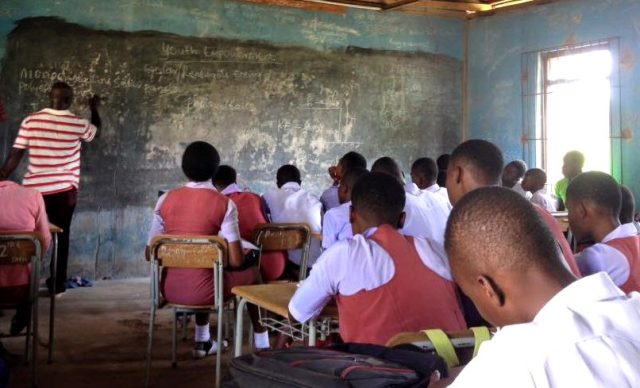
It is narrow partly because its curricula concerns are book based backed with the gratuitous assumption that knowledge so provided by the books on specific subjects are useful and therefore relevant for personal growth and national development. This is not of itself an absolute truth. The claims are not founded on reality checks. To put it bluntly, it is bogus. From early year education programming to the University level, the entire curricular is book-based, and as the programme develops, the curricular gets more narrow, restrictive, irrelevant and redundant. Being subject-based, students must read, force-fed instructions, and gain specific knowledge and get an education and be educated through the exercise. To demonstrate that the subject has in fact successfully received education and is thus affirmed educated, he is provided with a certificate with a little remark on it stating his grade and class. To arrive at this glorious point which some celebrate with masquerade dances, you must sit for regular examinations where you are expected to repeat to the examiner things that he/she has instructed you upon and what you have read.
The exercise at all levels of education produces at once two classes of human beings, namely those that responded as appropriate and as expected to the questions asked and those that responded poorly and very badly. The former is said to have ‘passed’, and the latter is said to have ‘failed’. These classifications remain permanent. They are indelible scars which in the positive, do in fact open opportunity doors within existing socio-existential structures to better survival options and in the negative, aid low self-esteem or low self-worth. Society endorses both responses. It must be emphasized with celebrations and shameful disgust, respectively.
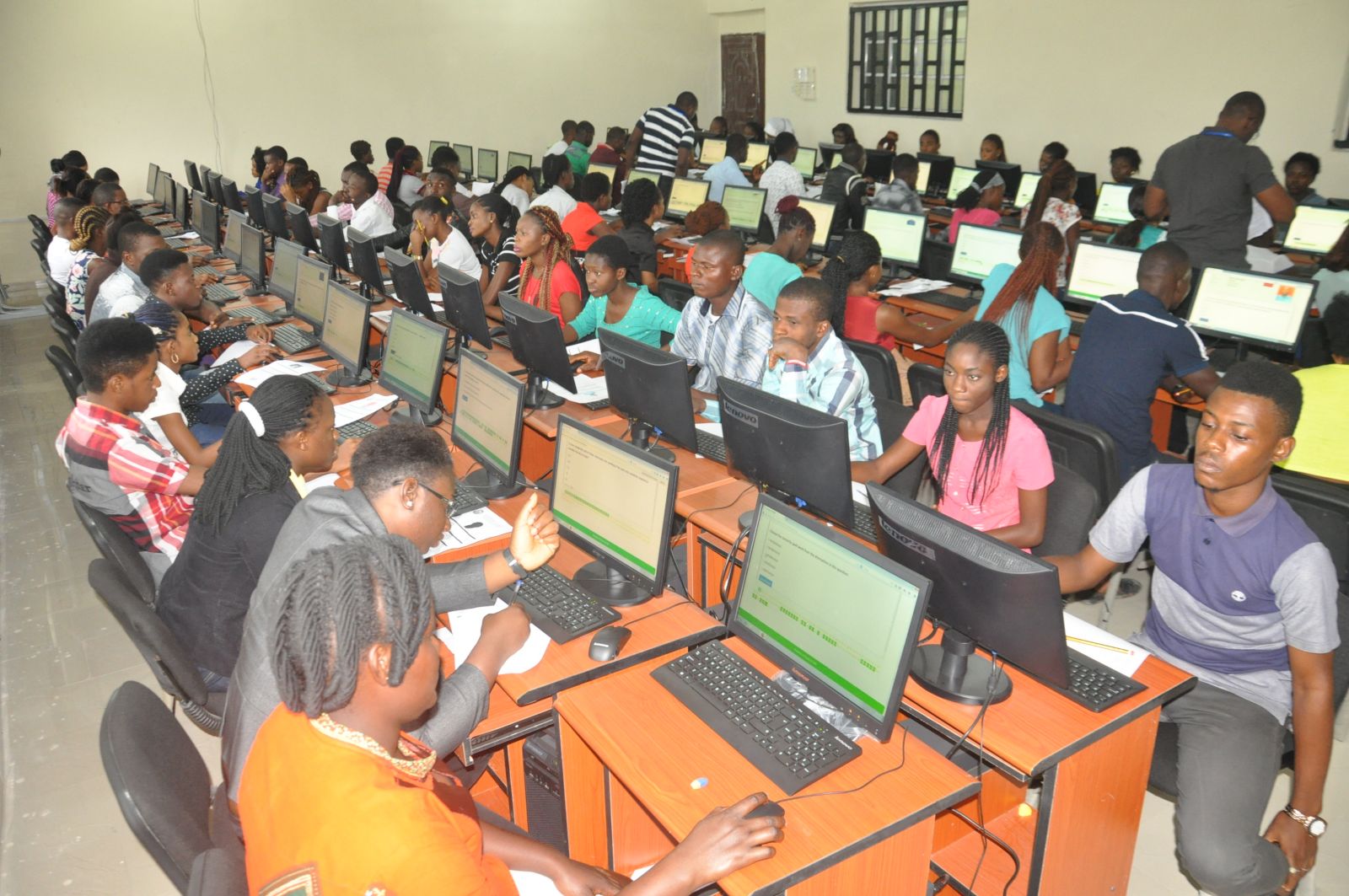
Perceived serious institutions are set up to regulate proceedings concerning curricular relevance, adequacy of the teaching and instructional personnel, availability of enabling facilities, ratio distribution of staff and students. Such include the Nigeria Universities Commission (NUC), West Africa Examination Council (WAEC) and Joint African Matriculation Board (JAMB). There are accreditation and deaccreditation rituals to underscore both the seriousness these bodies and institutions attach to themselves and the participants of the book-driven education and how it is important to validate the quality of products churned out every year.
Jamb Photo Credit: sunnewsonline
As we speak, the book-driven-certificate-issuing-education industry is booming. Private individuals who have the means now have schools from the early years to the University level. Licenses are given when the set conditions are purported to have been met. The upsurge of private universities that are in part faith-based attests to the seriousness attached to providing and making available the book driven education available to those that can afford the exorbitant fees.
The book driven education, within the subject area taught and examined, provides knowledge only in the specific area covered by the instructor. It guarantees, therefore, only specialized knowledge hence it is correctly and appropriately described as a literacy programme. By serious measurement and candid understanding, literacy is not synonymous with comprehensive education, if it is education at all. Disinterestedness is explained by the preferences of candidates in carrier pursuits just as it is evident when questions of relevance and meaning are raised about the lives of the candidates themselves and the impact on their environment.
In graphic terms, a first-class scholar in statistics is literate, and as the certificate in his hands will validate quite knowledgeable in statistics. Still, seriously that does not mean by any measure that he is therefore educated. He has been taught, he has read, he has been examined in statistics and has been found worthy of being awarded a degree in statistics. Going through these motions is not an indication of having received an education. He is only literate. As a human being, his knowledge is still seriously limited, and some times, in some different situations, where another range of knowledge is required, he could, in fact, pass for a fool.
Several specialized scholars in education have made arguments about the obvious inherent inadequacies of this kind of education. In fact, research studies continue to show the disturbing mismatch of degrees awarded and the importance of knowledge produced with needs for the 21st-century world. The endless long lines of graduates queuing up for employment pointers to an abnormality and the irrelevance of the education system as it is being practised. What this author finds abysmally self destruct is the fact that with every seriousness we are in fact carrying on as if we are unto something good a nation; as if all is well and that the inherited system of education that we are running with is the best that we can have. The frenzy of the desire for this restrictive maiming form of education is mind-boggling. If it is a case of outright ignorance, that in fact, we have not thought about the poverty and narrowness of it all and therefore that we do not know, then perhaps the criminal charge is minimal. But if it is not a case of ignorance, then the charge of bad faith is fostered by lazy, uncritical thinking sticks.
The book-driven education is run by rote learning or the banking, savings and loan pedagogy. Students who wish to succeed and earn a pass to obtain a degree with a certificate must keep track of the teachers’ ideas, absorb and maintain them for later regurgitation. Facts about specific subjects (history, biology, electrical engineering, biochemistry, medicine, mathematics etc.) are poured into empty heads to be poured out when required to do so at the examination. If the colonizers, particularly the British have adopted this system, it is robust thanks to the British philosopher John Locke who taught that the human being is born with a blank slate to be written on by whoever with whatever. Some of our teachers of philosophy still strangely pass this bogus claim to fresh students. The world now knows better that John Locke was not only generically mistaken; he was ignorant of the elements at play. Far from being a blank slate, each human being carries within through conception gestation and births a coded autobiography that sums up holistically who and what he or she is, the impact of nurture and the environment only adding varieties and heightening some details. This holistic attention and enabling interrogation that the book-driven education being practised today totally misses and have remained impotent and nearly redundant.
The word “education” is derived from the Latin word “Educare” which is “to deliver of”, to birth, to draw or brought out”, “to call forth”. Authentic comprehensive education, therefore, should deliver the individual what was coded within. To do this requires careful planning, knowledge and experience as would be found with a midwife at the hospital. Only trained personnel with genuine interest and love for the trade can succeed at it. Understanding aptitudes and precisely sourcing and mapping out their developmental graphs would be key to the curriculum handed to teachers. Technical instructions would be used to gain hands-on knowledge. It would not be for regurgitation at examinations rather for the singular purpose of cultivating the art of creative, critical thinking and the development of the capacity to solve practical problems. The target is to develop the whole person for growth by tapping into those things or chores through which imbued with self-confidence he better expresses himself and flourishes. There are no failures here because no person is born useless. Each has something unique within that he/she would gladly and readily deploy in service to humanity. Of course, there is also the added advantage of channelling discovered and development resources to meeting the challenges and needs of the time. There is simply no room for redundancy or obsoleteness.
Just as there is no room for failures, there is no space either for the feeling of low self-worth or low self-esteem. True and holistic education will cultivate and develop the best in everyone according to their gifting, talents and interests. This still does not in any way make specific knowledge packages unrequired. On the contrary, such would only receive a greater boost since ideas and creative thinking only the best would emerge from the multiple sources. This is what education in Europe and the United States of America advocates and encourages. It is all about capacity building wooing everyone’s best from the early years and encouraging creative and innovative thinking.
Conclusion
In 58 years of Nigeria’s existence as an independent nation, ask how far education has taken her in human capacity development, corporate growth and prosperity. The answer is minimal. What is disturbing is the dull realization that the seeming sanity that prevailed while the colonizers were still around, perhaps and a few years of the first republic, vanished. What is left is decay, fiscal indiscipline, political banditry, chaos and endemic corruption. Yet we are deemed educated. We are considered to have received some education, and there are certificates to validate the claim. However, if what is presently paraded as education is what it is claimed to be, no one should subscribe. In fact, it is a disservice to Nigerians as a people and a dent on their dignity as human beings. If this same book driven education that the college of philosophers wish to pursue regardless of the cultural nuances given to it, since, I am a member, we might as well debate other serious and meaningful concerns.
Prof. Wale Olajide write from the Department of Philosophy at the Ekiti State University
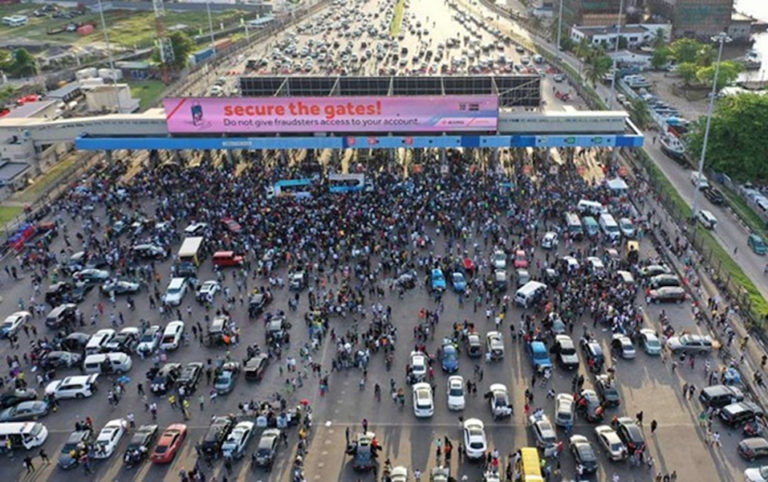
SOME Nigerians are planning to protest the reopening of Lekki toll gate in Lagos following the decision of the state’s judicial panel on police brutality to hand over the property to Lekki Concession Company (LCC), which manages it.
The mass protest currently trending on Twitter with the hashtag #OccupyLekkiTollGate has been planned to hold on Saturday to stop the toll gate from being re-opened.
Trending with over 30,000 tweets, the Nigerians are insisting that the toll gate remains closed till justice is given to victims of the October 20, 2020 shooting by officers of the Nigerian Army.
One Twitter user, identified as Obikoya Adebowale, said he and others would not allow the government to reopen the toll gate until justice was served.
“We will not allow these (sic) government to brainwash us, we need justice for those heroes that sacrificed there (sic) lives at the Lekki massacre. Enough of these oppression and tyranny,” Adebowale tweeted.
Another user, identified simply as Kaylechi, while taking the same stance as most users on the hashtag, said reopening the toll gate meant the government was insinuating that issues surrounding the Lekki shootings had passed.
“Re-opening of Lekki Toll Gate is the govt saying “forget it, that one has passed.” But what they don’t know is that youths are determined to get justice. Lekki Toll Gate must remain closed until investigations are concluded and justice is served,” Kaylechi wrote on Monday.
As observed by The ICIR, most users on the hashtag were aggrieved Nigerians seeking justice over the shooting at peaceful protesters at the Lekki toll gate on October 20.
Why another protest?
The ICIR had reported that the judicial panel chaired by Doris Okuwobi approved the hand-over of Lekki toll gate to the LCC.
The Lekki toll gate has been shut by the panel since last October for forensic examinations in connection with shooting of protesters.
Defending her stance on the hand-over of the property to LCC, Okuwobi said the forensic examinations had been concluded and there was no need to stop the company from assessing it.
“The report is ready as the panel has been satisfied and the assurances from the forensic team that it will no longer require any visit to the plaza,” Okuwobi said.
The panel has decided that it would not await the termination of the petitioners before it hands over control of Lekki to LCC,” she further said.
In contrast to her view, some panel members and youth representatives insisted that the toll gate be closed until justice was served.
Ebun Adegboruwa, a lawyer and senior advocate of Nigeria (SAN), who is also a member of the panel, said the decision to hand over the property was hasty, premature and would overreach the panel’s report.
“It will overreach whatever decisions the panel may reach and foist a situation of complete helplessness and a fait accompli, on members of the panel, in respect of any recommendation that it may make, on the general operations of the plazas,” Adegboruwa said.
Unhappy with the decision of the panel, Nigerians, again, are planning to express their grievances through a protest at the same venue where peaceful protesters were shot at, and some allegedly killed last October.
As of the time of filing this report, the Lagos State’s judicial panel had not concluded its sittings or made recommendations to the government on the victims of police brutality and the October 20 shooting but had concluded plans to hand over the property as requested by the legal counsel to LCC, Rotimi Seriki.
When contacted by The ICIR, Gbenga Omotoso, Lagos State commissioner for information, said the government had not been informed of the planned protest.
“We have not been informed of the protest,” Omotoso told The ICIR during a telephone conversation
CRITICS have disputed Tukur Buratai’s self-professed achievements, saying that heightened insecurity in the northern part of Nigeria and human rights abuses under his watch could not have been regarded as accomplishments.
Last week, President Muhammadu Buhari forwarded the name of Buratai, immediate past chief of army staff, together with others, for confirmation as non-career ambassadors.
The presidency had described their appointments as reward for hard work.
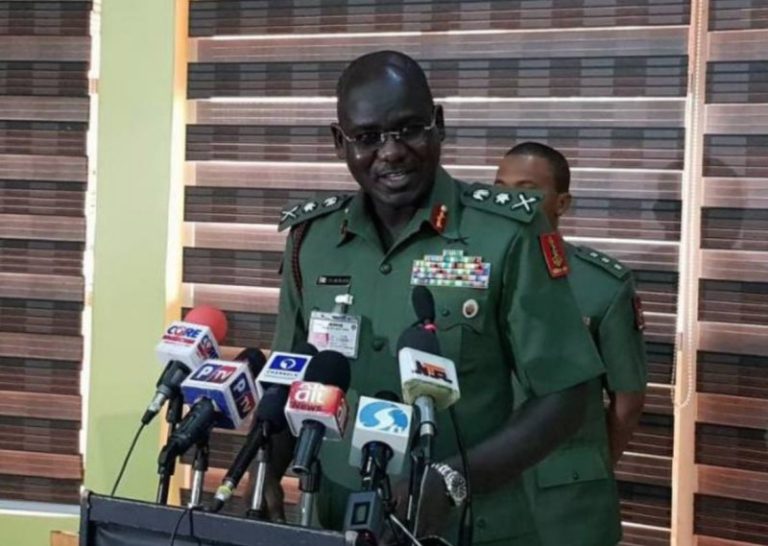
While speaking with reporters in Abuja over the weekend at a gala party organised in his favour by members of the 29th Regular Course Association of the Nigerian Defence Academy, Buratai, whose years of service were dotted with increased insecurity in the North-West, described his retirement as an honourable thing.
“It’s an honourable retirement and also an honourable appointment. I’m not a politician, so I have no word for the opposition. I have done well,” said Buratai, while reacting to the People’s Democratic Party (PDP)’s criticism of his appointment.
He said there was a ‘compendium’ of his achievements documented at the Nigerian Defence Headquarters to speak for his stewardship.
“I am happy that in July last year, my officers at the Army headquarters compiled a compendium of my achievements.
“In fact, I can’t even remember all the projects that we have executed. Is it in terms of infrastructure? Is it in terms of capacity building? Is it in terms of training?
“Since I was appointed, there was never a dull moment in terms of training. Remember the various exercises. These are training exercises from ‘Python Dance,’ ‘Crocodile Smile’ and even the latest one ‘Exercise Sahel Sanity.’
“Is it in the area of medical? In terms of education of our children and wards, the Nigerian Army University are all great achievements.” He said that books could be written about his achievements.
Critics Disagree
In its report last December, the Amnesty International (AI) had accused and indicted Buratai-led army of committing war crimes against older people in his war against Boko Haram in the North-East.
Also, in November 2020, Fatou Bensouda, prosecutor of the International Criminal Court (ICC), announced that her office had enough evidence to open a probe into human right abuses perpetrated by members of the Nigeria Security Forces (NSF) in Nigeria.
According to an issued statement, the ICC said its preliminary investigation into the situation in Nigeria had revealed that members of security forces were culpable of committing what she described as ‘crimes against humanity’ and ‘war crimes.’
Reacting, Buratai had accused the ICC of distracting the Nigerian Army, saying that he was not afraid of any probe by the International court.
But the AI is not alone. Twitter users on Monday said Buratai’s time as head of the army was brutal. While reacting to a news post on Twitter about Buratai’s achievements, users criticised the former army chief for various offences.
A Twitter user, Ibukunshine, with the handle @Ibukunshine, alleged that “All Nigerian (sic) is aware of your achievement and they are as follows: Shite massacre, Lekki toll gate massacre, Oyigbo massacre, flopping (sic) in the war against BH, flopping in the war against bandit, excorting Fulani terrorists to villages to forcefully graze crop.”
Nathaniel Olawuwo, with a Twitter handle @NOIawuwo, said the book being written about him “will narrate how you ordered the killing of innocent peaceful protester’s at Lekki toll gate.”
Another Twitter user, Owoichoyaale with the handle @owoichoyaale, referenced the events of October 20, 2020, at Lekki toll gate as one too hard to forget.
“Obviously, books will be written, stories told about the massacre of unarmed protesters at the Lekki toll gate on 20/10/2020, because your boys who you ditch out (sic) orders to committed the evil against humanity…. Can’t wait to see you told arms facing the ICC…”
Though all these are allegations, Buratai is accused majorly of supervising the killings hundreds of young Indigenous People of Biafra (IPOB) members in Onitsha and Okigwe, South-East Nigeria, including members of the Shiites religious sect in Kaduna. He is also accused of ordering the shooting of protesters of police brutality in Lekki on October 20, 2020.
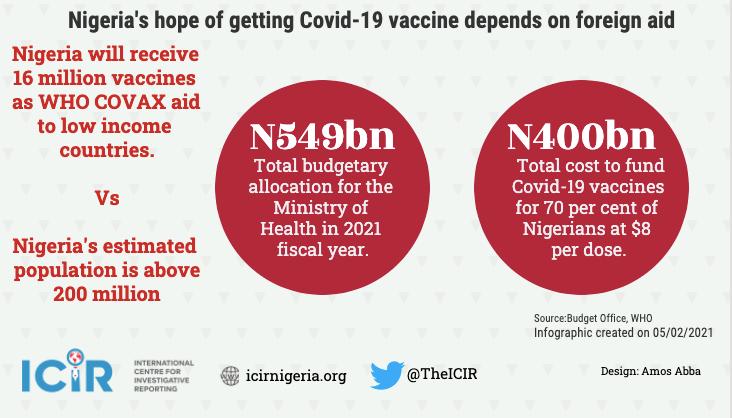
NIGERIA’S plan to provide Covid-19 vaccinations for 40 per cent of its population by the end of 2021 could only be realised through interevention from donor agencies, as its 2021 approved budget did not reflect any monetary provision to that effect.
This was revealed at the Presidential Task Force briefing on Covid-19 on February 1, by Faisal Shuaib, chief executive officer of the National Primary Health Care Development Agency who said the country was expecting 16 million doses of Covid-19 AstraZeneca vaccines from a COVAX facility.
“The COVAX facility has informed us that they will be supplying Nigeria with approximately 16 million doses of Astrazeneca vaccine this month.
“This will replace the earlier communicated 100,000 doses of Pfizer mRNA vaccine, which was grossly inadequate,” he said.
The COVAX programme is a global initiative supported by the World Health Organisation, WHO and Vaccine Alliance to equitably distribute Covid-19 vaccines to 92 middle and low – income countries.
The project was expected to raise $8 billion but $6 billion was realised to purchase 2 billion doses of the vaccines of which Africa is expected to get 600 million doses.
With Nigeria still reeling from the effects of the Covid-19 pandemic which has crippled the nation’s economy and raised its high debt obligations, experts say the robust financing of the nation’s health infrastructure will help prevent an upsurge of the pandemic.
A review of the approved budget of the 2021 fiscal year by The ICIR revealed otherwise, as the Federal Ministry of Health did not outline any specific project for Covid-19 vaccines or logistics required for a nationwide roll-out of the vaccines if they are made available.
Four insignificant items that were not related to vaccines administration which was spotted in ministry’s budget include assessing the effects of Covid-19 on snakebite patients, monitoring snakebite surveillance and the purchase of a Hilux van for the supervision which was valued at N12.5 million.
The allocation of N4.04 million which was budgeted for ”epidemic preparedness, capacity development on COVID-19, Lassa Fever and Ebola”.
Others are the purchase of 15 handheld air quality model equipment in and during Covid-19 pandemic at N24.7 million and implementation of community sanitation across the 36 states in the country during Covid-19 pandemic at N16.2 million.
This makes Nigeria’s hope of realising its ambitious goal of vaccinating about 40 per cent of its population by the end of 2021, a far-fetched dream.
Where does Nigeria stand?
According to records from the Nigeria Centre for Disease Control, NCDC, Nigeria’s infection rate is growing rapidly having recorded 42,950 new cases in January which is the highest monthly number of infections since the outset of the virus in the country last year.
Nigeria’s 2021 approved budget showed that the Ministry of Health was allocated N549 billion which accounts for 4.4 per cent of the total budget but when compared to the 2020 budgetary allocation for health, it was a 4 per cent reduction.
An unspecified project described as “Gavi/Immunisation” was assigned N45 billion while another vague item identified as “Counterpart funding including Global fund/Health/Gavi refund” was assigned N5.5 billion.
However, Gavi is an international organisation that was formed in 2000, to improve access to new and underused vaccines for children living in the world’s poorest countries.
Under the Covax facility, Pfizer’s vaccine was the only vaccine listed for emergency use by the WHO until Astrazeneza vaccines were recently added.
If the N45 billion in the health ministry’s budget is stipulated for the vaccines then that amount would be able to purchase complete doses of vaccines for 27 million Nigerians at the rate of $2.16 per dose.
With the cost of an Astrazeneza vaccine at $2.16 per dose of which each person is expected to get two doses which means that vaccinating 140 million Nigerians which is 70 per cent of the population that needs to get vaccinated to achieve herd immunity would cost N115 billion.
Since two doses are required for each person, this means N230 billion would be needed before Nigeria can attain herd immunity.
South Africa, Africa’s worst virus-hit country had ordered for AstraZeneca’s Covid-19 vaccine at a price which was 2.5 times higher than most European countries.
Read ALso:
Members of the EU paid $2.16 for each AstraZeneca’s vaccine shot, according to information leaked by a Belgian minister, Eva De Bleeker, on a tweet which he deleted, South Africa had paid $5.25 for the same vaccine shot.
In its defence, the EU said its members are entitled to a lower price because they were invested in the vaccine’s development, however, more than 2,000 South Africans had volunteered to participate in clinical trials for the AstraZeneca vaccine in 2020.
At the hearing of the Senate on the Federal Government plans to procure Covid-19 vaccines for Nigerians, Osagie Ehanire, Nigeria’s health minister said the country would need N400 billion to vaccinate 70 per cent of the population to achieve herd immunity.
“About N400 billion would be required to vaccinate 70 per cent of Nigeria’s 200 million population at $8 per person. We will need N156 billion for 2021, while N200 billion will cater for the vaccines supply in 2022,” he said.
With the inflated costs of the vaccines for low-income countries, Nigeria is expected to spend at least N280 billion going by the amount the vaccines were sold to South Africa.
Low-income countries to depend on COVAX vaccine grants
South Africa and India had proposed to the World Trade Organisation, WTO, that countries should be allowed waivers of patents related to Covid-19 vaccines, for the duration of the pandemic to allow middle and low-income countries get access to the vaccines.
“As new diagnostics, therapeutics and vaccines for Covid-19 are developed, there are significant concerns how these will be made available promptly, in sufficient quantities and at affordable prices to meet global demand,” the official statement read.
Their request was turned down as richer countries namely the United Kingdom, United States of America, Switzerland including members of the European Union, EU opposed the idea.
As of January 18, the world’s 50 richest countries had received 39 million vaccine doses when compared to 25 individual vaccine doses in low-income countries.
According to data by analytics company Airfinity, Canada has bought “enough doses to vaccinate each Canadian five times”
More developed countries such as the US and EU states have regulatory agencies that “complement” WHO’s work and could therefore roll out vaccines without the body’s approval but developing countries rely on the WHO to carry out due diligence.
The African Union, AU, is expected to secure 270 million doses to be delivered from April, through a $7 billion funding from lenders but the vaccines are yet to be approved by WHO for distribution on the continent.
According to the price list of the vaccines released by Bleeker in his tweet, the AstraZeneca-Oxford University vaccine costs $2.16 per dose, $8.50 per dose for Johnson & Johnson vaccine, $9.26 for the Sanofi/GlaxoSmithKline vaccine and $12.25 for the CureVac.
Some of these vaccines are still in the stages of development, and their advance purchasing agreements may never be activated or may take longer before the contract the EU signed with them becomes active if their vaccines work.
John Nkengasong, Director of the Africa Centers for Disease Control and Prevention, revealed in an interview that it would take three or four years to meet 60 per cent vaccination target which is needed to achieve herd immunity.
“The continent as a whole has never vaccinated 200 million people in one year but my fear is that we will peak, probably have the same peak as in July or August, in the coming months,” he said.
A survey carried out by the Africa CDC and the London School of Hygiene and Tropical Medicine which was published in December 2020, found that four out of every five African would be willing to take a Covid-19 vaccine “if it was deemed safe and effective”.
The Seychelles, Morocco and Egypt are administering the Chinese-made Sinopharm vaccine and Guinea the Russian Sputnik V which are yet to be approved by the WHO.
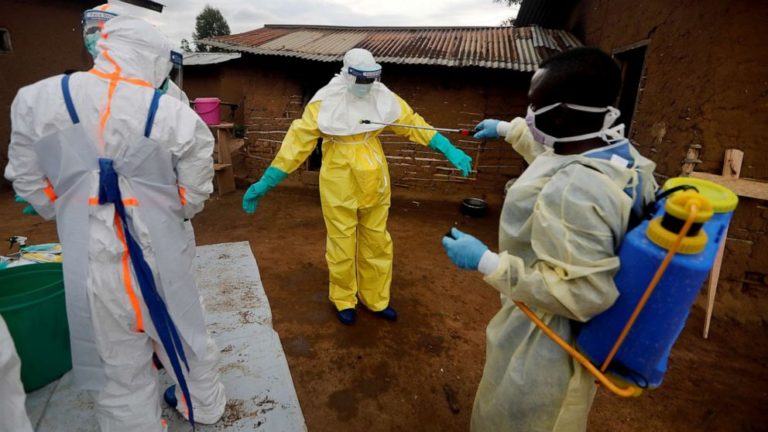
THE Democratic Republic of Congo (DRC) has announced the resurgence of Ebola in its troubled eastern part of the country. This is three months after the country was declared free from the deadly virus.
According to the AFP, the announcement was made by Eteni Longondo, DRC’s health minister to a state-owned television on Sunday.
The minister said the outbreak occurred in the Biena health zone of North Kivu province after a woman died of the disease last Wednesday.
“We have another episode of the Ebola virus in the Biena health zone of North Kivu province,” Longondo told state television, RTNC.
“It was a farmer, the wife of a survivor of Ebola, who showed typical signs of the disease on February 1,” he added.
She died on February 3, after which a sample of her blood tested positive for Ebola, the health minister said.
The DRC declared on November 18 the end of its eleventh Ebola outbreak, which claimed 55 lives out of 130 positive cases over nearly six months in the northwestern province of Equateur.
On October 16, the last person was said to have recovered from Ebola in Equateur.
The widespread use of Ebola vaccinations, which were administered to more than 40,000 people, helped curb the disease.
The return of Ebola in the country’s northeast — a region plagued by violence between armed groups — comes as the vast African country also fights its own Covid-19 outbreak.
A previous Ebola outbreak in the DRC’s east, which ran from August 1, 2018, to June 25 2020, was the country’s worst-ever, with 2,277 deaths.
It was also the second-highest toll in the 44-year history of the disease, surpassed only by a three-country outbreak in West Africa from 2013-16 that killed 11,300 people.
Ebola haemorrhagic fever was first identified in 1976 after scientists probed a string of unexplained deaths in what is now northern DRC.
The symptoms are severe: high fever and muscle pain, followed by vomiting and diarrhoea, skin eruptions, kidney and liver failure, internal and external bleeding.
The average fatality rate from Ebolais around 50 percent but this can rise to 90 percent for some epidemics, according to the World Health Organisation (WHO).
The virus that causes Ebola is believed to reside in bats.
DR Congo has also recorded 23,599 coronavirus cases and 681 deaths in a population of around 80 million people
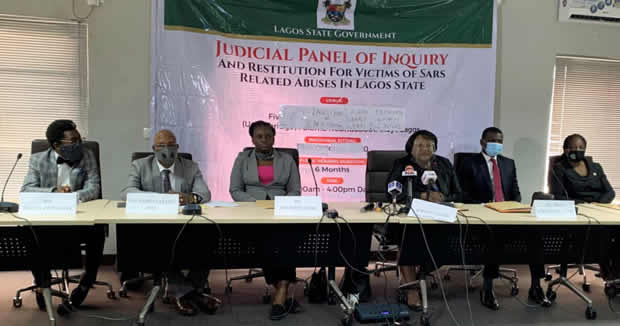
Nigerians and members of the Lagos State judicial panel set up to investigate the October 20, 2020 Lekki shooting incident are deeply divided on the re-opening of Lekki toll gate.
On Saturday, the judicial panel chaired by Doris Okuwobi approved the reopening of the Lekki toll gate following an application by the LCC through its legal counsel, Rotimi Seriki.
According to Okuwobi,“To put the record straight, it is the jurisdiction of this panel to investigate the incident of October 2020 and make recommendations is the premise by which the panel must comply with jurisdiction to look into the Lekki case.”
“The Lekki toll plaza is considered the seat of event of that day. This panel has given ample opportunity to all petitioners to access the toll plaza with the view to considering the investigation,” Okuwobi said.
She added that the report of the forensic team had been concluded hence there was no reason to hold on to the property.
“The report is ready as the panel has been satisfied and the assurances from the forensic team that it will no longer require any visit to the plaza. The panel has decided that it will not await the termination of the petitioners before it hands over control of Lekki to LCC,” she stated.
Speaking on contradictory views regarding the toll gate re-opening, Okuwobi said any evidence in connection to the property should have been taken before now as the panel had given petitioners the opportunity to do so before now.
“To say that its wreckage be preserved as evidence beats my imagination. Whatever evidence any interested person decides to have must have been taken before now as the petitioners do not have any review before the panel to restrain the use of the toll plaza,” Okuwobi added.
Unsatisfied with the decision of the panel chair, some youth representatives in the panel and legal counsel to victims of the Lekki shootings, said reopening the toll gate would hamper the recommendations of the panel.
Ebun Adegboruwa, lawyer and senior advocate of Nigeria (SAN), who is also a member of the panel, said the decision to hand over the property was hasty, premature and would overreach the panel’s report.
“It will overreach whatever decisions the panel may reach and foist a situation of complete helplessness and a fait accompli, on members of the panel, in respect of any recommendation that it may make, on the general operations of the plazas,” Adegboruwa said.
He added that since the panel was yet to ascertain the claims and counter-claims of fatalities and massacres at the toll gate, reopening it would seem ‘insensitive and callous’ to those who might have died from the shooting.
A member of the panel, Rinuola Oduola, said the ruling would not stand because a quorum was not formed before the decision was made by the panel chair, Okuwobi.
“Also, the ruling that Lekki toll gate should be reopened cannot hold, as a quorum wasn’t formed today with the youth representatives absent. It is also pertinent to note that five of nine can’t form a proper quorum.
“It should also be noted that the ruling did not include our dissenting opinions as members of the panel. Five other members of the panel held the view that the toll gate should be allowed to reopen,” Oduola said.
Stating her reason for objecting to the reopening of the toll gate, Oduola said one of her reasons was that the LCC had not given access of its CCTV servers to forensic experts.
She added that to her and another panel member, Temitope Majekodunmi, the investigation into the Lekki shooting had barely begun.
“Also, we are of the view that the investigations into the Lekki toll gate incidence have barely begun, and so the Lekki Toll Gate should remain shut until full investigations are concluded by the Panel,” she wrote on her Twitter account on Saturday.
She further noted that the same stand was also taken by Adegboruwa and Patience Udoh, members of the civil society groups in the panel.
Many Nigerians, most especially on those on the social media, are against the panel’s decision to hand over the property to LCC.
Expressing their opinions on Twitter, one Nigerian, Abayomi, stated that “People died, the blood of Lagosians were shed by their own army and their own government. People were amputated because of bullet wounds shot at them in that place. It must never be allowed to open again. It is now a massacre centre.”
Another user identified as Tee Praiz while responding to the argument of one of the members of the panel, Segun Awosanya (Segalink), who voted that the toll gate be reopened, said it was being done at the wrong time.
“No doubts that I understand the stand of Segalink on the reopening of #Lekki tollgate but it’s being done at the wrong time and wrong venue. The reason for the panel is yet to be achieved, and you’re clamouring for the reopening of where souls of patriotic and hardworking youths,” Tee Praiznoted.
Against some other opinions, a user identified as Theresa Tekenah said Lekki Tollgate was providing jobs, revenue for Lagosians and there was a legal agreement between Lekki Concession Company Limited and Lagos State government, meaning that the toll gate could not remain closed forever because of the sentiments of certain people.
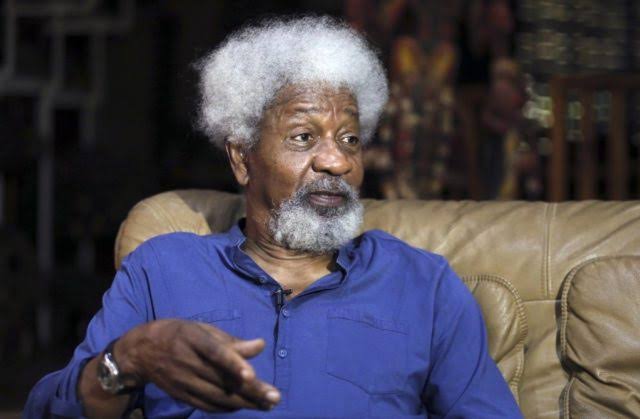
THE Nobel Laureate, Wole Soyinka, has said that recurring herdsmen crisis may develop into a civil war if urgent steps are not taken by President Muhammadu Buhari to address it.
The 1986 Nobel Prize winner for Literature also said President Muhammadu Buhari’s silence on the ‘illegal’ activities of herders across Nigeria showed that he was complicit and not ready to stop criminal herdsmen.
President Buhari has been accused of not doing enough to tackle the menace of herdsmen across the country because he is Fulani and the grand-patron to the main herders’ association, Miyetti Allah.
“What do they expect of us now that the war is on our doorstep? Of course, there will be mobilisation and if we keep waiting for this to be centrally handled, we are all going to become, if not already, slaves in our land. That, to me, is personally intolerable. It is not an acceptable condition,” he said.
“And whatever it takes, I stand ready to contribute in any way and I have made my governor understand this, that we are here not just to live in but to live in dignity. Right now, our dignity is being rubbished. My forest is being taken over, it’s been shrinking, my normal hunting ground is shrinking. My family tells me that if I go in-depth again, they will have me institutionalised.”
Soyinka, in the interview, said Buhari’s first action in trying to find a lasting solution to the menace was for him to address the nation on how the situation would be addressed.
“Yes, I know I am the patron of the Cattle Rearers Association etc., and I am a cattle rancher myself and it is a business. And I do not run my business by killing people. I do not run my business by raping, by displacing, by torturing. I do not run my business by occupying land that does not belong to me… Whatever comes to you for illegal occupation, for trespassing on other people’s property is your business and I am ordering the army, I am ordering all the security forces to back citizens’ efforts in flushing you out.
“It is very late already, but it is not too late. This is a language that we expect from President Buhari and as much as that language does not come, I must consider him as quite complicit in what is going on because the buck stops at his desk.
“We may enter a phase of serious skirmishes which get more and more violent and may develop into civil war and a very untidy mercy one. That’s my biggest fear. Unless action is taken… I am very glad that the governors are coming together and are discussing in all seriousness. I’m happy they are pulling in groups like Miyetti Allah, obviously knocking some sense into the heads of their leaders and they are talking about accepting the decision of governors and agreeing to obey.”
The interview is coming days after Saleh Alhassan, national secretary of Miyetti Allah Kautal Hore, in an interview with Punch Newspapers, accused President Muhammadu Buhari of doing nothing for the Fulani herdsmen except to create enemies for them.
The Alhassan’s interview came on the heels of the controversy generated by Rotimi Akeredolu, Ondo State governor, who ordered herders to vacate the state forest reserves over rising insecurity in the state.
He had said, “If the President is a Fulani, it doesn’t in any way affect the life of a herder. In fact, they are worse off under Buhari. What are they benefitting? They don’t access any government facility or social amenity, yet they are responsible for the bulk of animal protein we produce in this country. I think it’s deliberate for people to think otherwise.”
SundayAdeniyi Adeyemo, a Yoruba youth leader, also known as Sunday Igboho, had issued an ultimatum giving herdsmen seven days to leave Igangan, Ibarapa North Local Government Area of Oyo State, following cases of increased kidnapping and killings by suspected Fulani herdsmen in the area.
Soyinka said Igboho responded to the situation in the way he understood.
Igboho had stormed the Fulani settlement in the town by ejecting the Seriki Fulani, Salihu Abdukadir, and other herdsmen accused of fuelling insecurity in the area.
He also stormed Ogun State on the 1st of February, insisting that killer-herdsmen must vacate Yorubaland.
Soyinka said, “We’ve never met, I hope people will always report things properly. I saw a byline of one media report that Wole Soyinka calls Igboho a hero, I never made any such thing. Sunday Igboho has responded to the situation in the way he knew how. Now you will see that he’s trying to work with others.
“Somebody, one day, reaches an explosion point and he says I cannot take this any longer and he takes unilateral action. It may be excessive, it may be wrong but what matters is that somebody has responded to an unacceptable situation. Any error which he makes is for the rest of us to correct by calling him and I know that a number of people are doing that.”
Nigeria has seen heightened clashes between crop farmers and herders since Buhari, a northern Muslim from the Fulani tribe, became president in 2015.
Some states across the country have lamented the activities of armed herdsmen who they accuse of grazing their cattle on people’s farmland and also engaging in criminality such as kidnapping, raping and murder.
Samuel Ortom, governor of Benue State, last Thursday, accused President Muhammadu Buhari of only caring about Fulani herders, rather than being the president for all Nigerians.
Addressing a press conference in Makurdi on Wednesday, February 3, 2021, Ortom, whose state has seen a fair share of farmers-herders clashes, as reported by Punch Newspaper, said Buhari should know that he is the president of the Federal Republic of Nigeria, rather than president of Fulani.
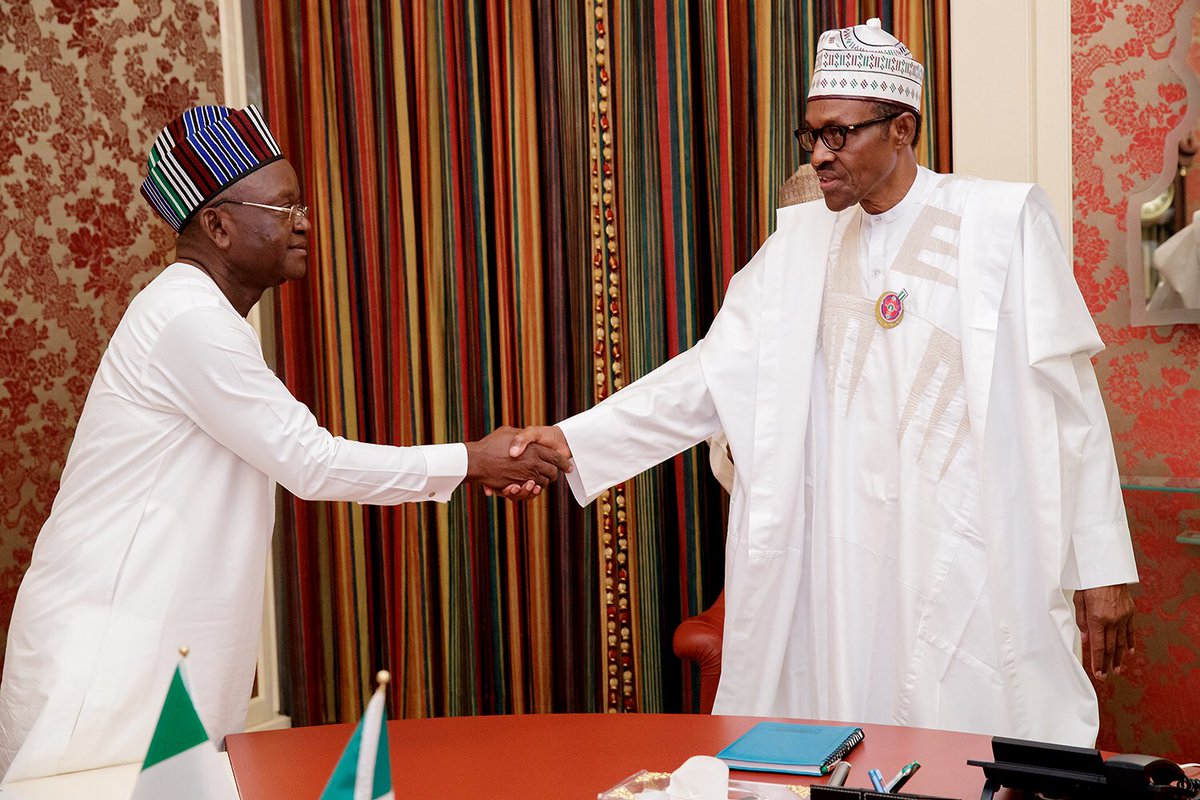
President Muhammadu Buhari and Gabriel Ortom, Benue State Governor
“Mr. President, in case you are listening to me, I want you to know that your people, Nigerians, you promised Nigerians that you will be fair to all.
“You said that you will be for everybody and for nobody, and now it will appear that you are for Fulani people because nothing is coming from you to give the people confidence that you are their president.
“You are the president of the federal republic of Nigeria, you are not the president of Fulani.
“You are the president of everybody and I owe you a duty as a stakeholder in this nation to let you know that what is going on is wrong and this has the potential of dividing this country which will not be in the interest of anyone –some of us believe in the unity of this country,” he had said.
WHEN eight-year-old Elijah Success left home for lesson on August 7, 2020, his parents and siblings had no premonition he would not return home the lively and healthy boy he had always been.
The Primary II pupil was trekking back home when the unexpected happened – he was hit by a fast-moving commercial motorcycle, leaving his skull smashed and his body bruised.
The incident happened at Gidandaya, around Orozo, a suburb of Abuja. He was immediately taken to Karshi Hospital, where he was referred to Federal Medical Centre, Keffi, and then to Garki General Hospital, Abuja, before finally finding respite at the National Hospital, where the head was operated upon.
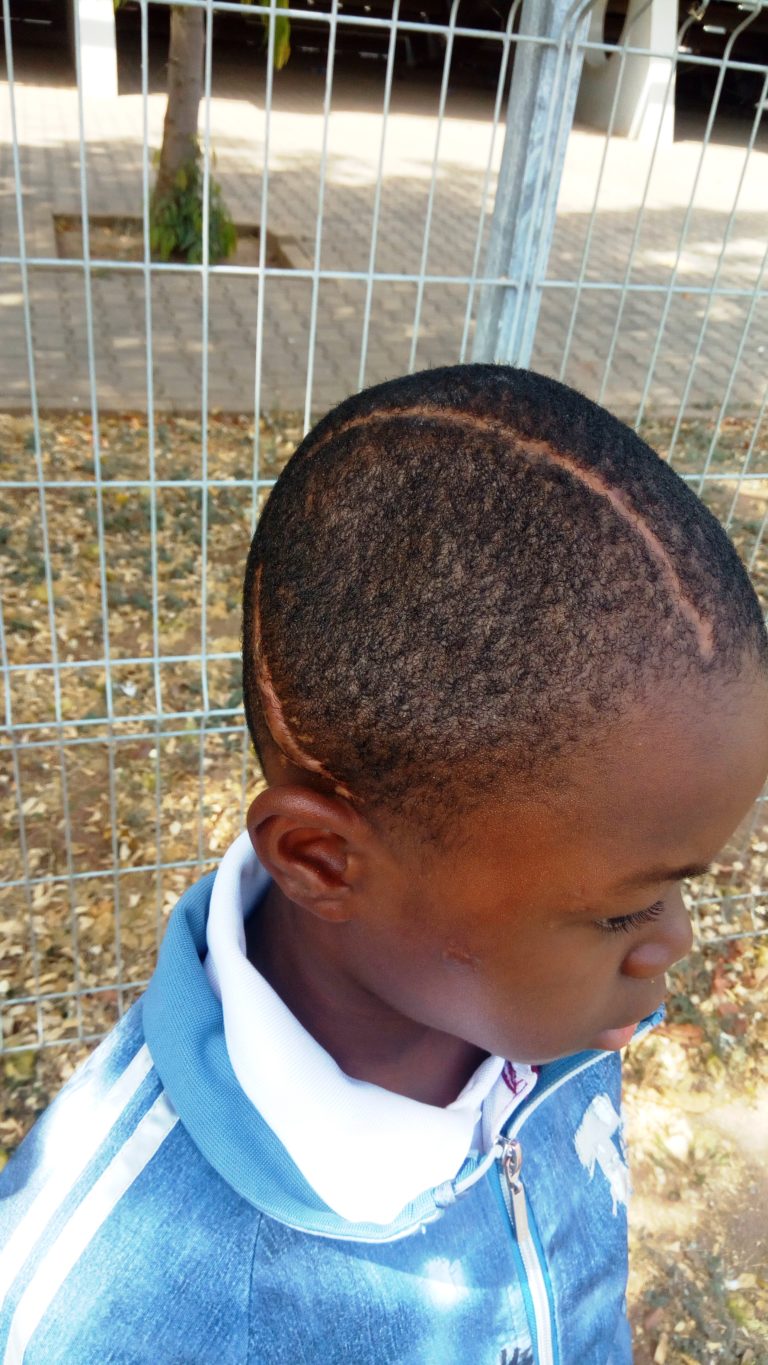
Eight-year-old Success Source: The ICIR
The damaged part of his skull was removed during the surgery, leaving only his scalp (skin of his head) to cover half of his head. He has been without half of his skull for five months, after the surgery was conducted.
A large and deep mark cuts across his head from one end to the other. The skin on affected part of his skull shakes intermittently each time he breathes. Success looks very sombre whenever he tries to talk, a sign that he is in pain. He is eager to play with other children, but he’s restrained by his disability. One of the limbs affected by the accident was paralyzed for weeks. But, now, he can stand for a few minutes and move his hand as well.
Elijah and Alice Achala, his parents, who both hail from Oju local government area of Benue state, said they already have spent over N2.5 million on the boy’s treatment, but can no longer bear the cost, particularly now that another surgery is imminent.
His poor, distraught father, a security guard who earns N25,000 monthly, lamented that he was in debt. He said that he and his wife have borrowed a lot of money from neighbours, friends and relations, many of who are now asking for the loan repayment. He said he owed N900,000 in the course of saving the boy’s lives.
His other children could no longer go to school, and he has not paid his house rent in a year, he told The ICIR.
What further compelled Achala to cry out for public assistance over his family’s travails is that he was sacked last November by the company he had worked with as a security guard.
He said he had gone to bury his father in the village that month, and was replaced by another guard. And all his appeals to his employers fell on deaf ears, he said.
His wife corroborated his claims. Mrs Achala told The ICIR that her family lives on neighbour’s charity.
“As a mother, it’s not been easy for me at all. My husband has been sacked from his place of work. I’m only surviving through the people around me. Sometimes, they will come with ‘mudu’ (a small bowl for measuring foodstuffs) of garri (cassava flake), rice and beans. That’s how we’ve been living. There are three children with me. None of them goes to school, except the orphan that is in senior secondary school,” she explained.
According to the father, Success needs weekly physiotherapy because the accident paralyzed his arm and leg on the side of his head that was affected by the accident. So, they have been able to make the paralyzed parts function a bit, through physiotherapy; which he said his family could no longer afford.
Forty-one-year-old Achala said: “My condition is very bad now. That is why I’m calling on people everywhere for help. I don’t want to lose him. He has endured much pain, and since he is alive today, I have assurance that he will survive this. All I just need is money to do this surgery. The national hospital has kept the skull with them and asked me to look for money so they fix it back.”
Unlike many other victims of crashes on Nigerian roads, the motorcyclist who hit Success stopped and helped him to the hospital. But, he has only made N18,000 contribution to his treatment since, the boy’s father told The ICIR.
He said his family was at the hospital for over a month during the first surgery before they were released to go look for money for the second lap.
Elijah Achala, Success father Source; The ICIR
Asked by The ICIR to tell how much he needed for the operation, he said the hospital did not tell him how much it would cost him, adding that the hospital told him to pay initial sum of N200,000 naira for theatre.
Achala expressed his family’s readiness to appreciate any hospital or team of experts who will be willing to collaborate with the hospital to carry out the surgery.
“All I want is to do the surgery in a way that will bring no further indebtedness to my family and ensure the safety and good health of the boy. And, I will be happy if I could get assistance to pay the N900,000 my family owes in the course of the past treatments,” the father pleaded.
He said he owed the hospital and could no longer afford the cost of checkups. He said he is not sure if the cost of the second surgery would be more than the first.
To avoid further complications, Success has been kept at home by his parents since he was discharged by the hospital, his father told our reporter.