Some media platforms on Thursday, January 7, 2021, reported that Atiku Abubakar, a former vice president of Nigeria, was the first Nigerian to receive the Pfizer-BioNTech COVID-19 vaccine.
The reports were published alongside a photo of Atiku getting a shot.
However, there were other platforms that reported the news without suggesting that the prominent politician was the first Nigerian to take the vaccination.
The report that Atiku was the first Nigerian to get the Pfizer COVID-19 vaccination generated a lot of discussions online and offline.
THE CLAIM
Atiku Abubakar is the first Nigerian to receive Pfizer COVID-19 vaccine.
THE FINDINGS
Findings by the FactCheckHub show that the claim is MISLEADING.
Atiku Abubakar got a shot of the Pfizer COVID-19 vaccine. Dele Momodu, publisher of Ovation Magazine, confirmed the vaccination. So also did Paul Ibe, Atiku’s media aide.
“The importance of the COVID-19 vaccine in mitigating the effect of coronavirus cannot be overstated, particularly in Africa and Nigeria. On Wednesday, as part of the mass vaccination programme, Atiku Abubakar received the Pfizer-BioNTech COVID-19 vaccine,” Ibe stated.
Following the outbreak of COVID-19 in Wuhan, China, in 2019, the disease within a short period became a pandemic.
Amidst increasing causalities globally and devastating effects on the global economy, the need to find a cure became a matter of urgency.
In February 2020, the World Health Organisation (WHO) set up a Global Research and Innovation Forum on the virus, with over 300 experts and funders from 48 countries.
It was to ‘identify and fund priority research’ to end the pandemic and prepare for likely future recurrence.
In April of the same year, the World Bank joined in the race to strengthen developing country responses to the pandemic.
By November 9, 2020, Pfizer and BioNTech announced a vaccine which was said to be more than 90 percent effective in preventing the COVID-19 virus.
“This is a very positive step towards ensuring global access to COVID-19 vaccines,” Mariangela Simao, WHO assistant director-general for Access to Medicines and Health, stated in a statement.
This encouraged some countries including the United States to adopt the vaccine, especially for emergency situations.
The European Union (EU), for instance, recently ordered 300 million more vaccines, after its initial 300 million purchase.
The United Arab Emirates (UAE) also adopted Pfizer-BioNTech vaccine and Sinopharm for public use.
“Residents in the capital can book for the vaccine now, free of charge,” health service operator told AFP.
It was against this backdrop that Atiku got vaccinated on Wednesday, January 6, 2021 in Dubai.
Prior to that, Adaora Okoli, a Nigerian, had tweeted a picture of herself getting vaccinated. This was on December 16, 2020.
A screenshot of tweets from Dr Adaora Okoli’s Twitter handle @DrAdaora.
She also tweeted another picture of her taking her second dosage on January 6, 2021.
She tweeted with the hashtag #PfizerCovidVaccine: “As I see more COVID-19 patients, I know I am protected and can give my best to them”.
Okoli survived Ebola. She was infected in Lagos while treating one of the first Nigerian cases of the deadly virus. After recovery, she went to the US to study infectious diseases.
Although the vaccine is not yet in Nigeria, Nigerians like Okoli in countries where the vaccines are available are getting vaccinated.
Okoli’s vaccination pre-dates Atiku’s, showing that media reports that claimed Atiku was the first Nigerian to be vaccinated were misleading.
THE VERDICT
The claim by some media platforms that Atiku Abubakar is the first Nigerian to take the Pfizer COVID-19 vaccine is MISLEADING.
THE federal government is considering suspending nationwide NIN registration owing to the surging crowd besieging designated centres, minister of state for health, Olorunnimbe Mamora, said on Monday, during an interview on Channels TV’s Sunrise Daily.
But this is considered too little, too late, as it is coming weeks after exposing many Nigerians to the possibility of contracting COVID-19 in a programme considered as a poorly thought-out project.
“My understanding is that the whole process may be suspended so as to reorder the whole process in terms of management of the crowd because it was never intended that it would become a rowdy process like that,” Mamora, who is also a member of the Presidential Task Force on COVID-19, said.
“So, people may have to wait and be called at intervals to go through the process,” he further said.
He noted that the NIN registration was becoming a super spreader event, which could worsen Nigeria’s COVID-19 status.
“I am also aware that the relevant ministry, which is the Communications and Digital Economy, is looking at this,” he further said.
Mamora said the government had a duty to protect Nigerians at all times, urging the National Identity Management Commission (NIMC) to re-order the enrolment process to avoid large crowds at NIN registration centres nationwide.
“We have a duty to ensure that people comply within the limit of what is good for the society at large,” he noted.
For fear of being disconnected by telecoms firms and network operators, Nigerians have besieged NIN registration centres across the country, flouting COVID-19 protocol set by the Nigeria’s Ministry of Health and the World Health Organisation.
Frank Umeh, a social and political analyst, blamed the federal government for allowing the registration to go ahead when the number of COVID-19 infections was on the rise.
“Should they have started the project in the first place?” he asked.
“You are in a second wave of COVID-19. More than 30 persons have died in the last five days in the country, and more could still die. Why must you suddenly wake up and realise this truth? Even at that, do not be surprised that the minister is simply giving his own opinion and is not backed by other ministers or the ministries involved in the registration process,” he noted
Infections, deaths
Thirty-four Nigerians have died of COVID-19 in the last five days, according to the Nigeria Centre for Disease Control (NCDC).
The number of COVID-19 cases in Nigeria between January 6 and 9 surpassed 1,500 in each of the four days, indicating that the virus is spreading fast in Africa’s most populous nation.
Nigeria reported its ever highest number of cases on January 6 when 1,664 persons tested positive for the virus, according to the NCDC.
On January 7, the number of new infections was estimated at 1,565. The following day, January 8, the NCDC reported 1,544 new cases. On January 9, the number of new infections was estimated at 1,585.
However, the number of COVID-19 cases and the mortality rate in Nigeria are still lower compared with the infections and deaths in Europe and the United States. Africa’s most populous nation has tested only 1.025 million people till date, which is merely 0.51 percent of the population. With 100, 087 positive cases reported so far, 1,358 residents have died since the first case in late March 2020. This puts death-to-infection rate at 1.36 percent. The number of discharged persons so far is estimated at 80,030, putting discharge rate at 80 percent, according to The ICIR’s calculations.
POVERTY, inflation and debt may increase in Nigeria this year due to COVID-19 resurgence and poor economic fundamentals, according to the 2021 Economic Outlook recently published by the Lagos Chamber of Commerce and Industry (LCCI).
In an economic review of 2020 and outlook for 2021 signed by Muda Yusuf, director-general, LCCI, the Chamber says Nigeria can avoid these trends by making the right policy choices.
“Poverty levels in Nigeria will continue to rise and living standard will deteriorate without robust productivity growth,” the Chamber says.
“The country needs the right policies and institutions to spur productivity growth and to have this achieved requires adoption of best practices in human and physical capital development, governance, and economic openness.”
The Chamber notes that headline inflation will remain elevated in 2021 as the combination of food supply shocks, foreign exchange (FX) policies, higher energy costs, FX illiquidity, and heightened insecurity in major food-producing states continue to pressure domestic consumer prices.
It further says that debt stock, which stood at N32.2 trillion in September 2020, will rise and debt-servicing to revenue ratio will be elevated as Muhammadu Buhari’s government continues to seek loans to fund projects.
“Looking forward, a resurgence of COVID-19 pandemic in year 2021 may propel the federal government to take on more (concessionary) borrowings to fulfil fiscal obligations. Additionally, a potential FX adjustment in a bid to ease pressure on the local currency (naira)might possiblyexpand Nigeria’s external debt portfolio and total debt stock in year 2021,” the chamber predicts.
It projects that the Monetary Policy Committee (MPC) of the Central Bank of Nigeria (CBN) will be faced with a tough policy choice of boosting economic recovery and tackling inflation this year.
The LCCI expects that oil price and crude production, GDP growth, inflation rate, FX trends, private investment inflows, credit to private sector and domestic interest rates will influence monetary policy direction in the short to medium-term.
Inflation in November rose to 14.89 percent from 14.23 percent in October as food prices rose sporadically on border closure and high production cost. Central banks rarely cut the interest rate in periods of high inflation, but investors and small businesses are in search of single-interest funds to expand.
The Monetary Policy Rate in Nigeria is 11.5 percent, but South Africa’s repo, equivalent to Nigeria’s MPR, is 3.5 percent. Kenya’s MPR is 7.25 percent, while Zambia’s is 8 percent. Ethiopia benchmark interest rate is currently 7 percent while Namibia’s is 7.75 percent. Average lending rate in Mali is estimated at 9.12 percent while it is 4.25 percent in Botswana.
Nigeria has been world’s poverty capital since 2018, with 87 million people in extreme poverty, according to Brooking Institute’s World Poverty Clock.
On the 2021 budget, the Chamber predicts a modest budget performance in the light of current realities.
“Global oil demand is expected to remain subdued in the first half of year 2021 considering the resurgence of covid-19 pandemic in Europe, America, and parts of Asia,” it notes.
DURING the Thursday briefing of the Presidential Task Force (PTF) on COVID-19 in Abuja, national coordinator of the PTF, Sani Aliyu, said the federal government might impose another lockdown if the recorded cases continued to increase, but Nigerians are divided about this proposal.
The ICIR examines the pros and cons of another lockdown in Nigeria.
On March 29, 2020, Muhammadu Buhari, Nigeria’s president, imposed a total lockdown on COVID-19 hotspots in the country, including the commercial hub, Lagos, and political capital, the Federal Capital Territory (Abuja).
Buhari had said the lockdown was part of efforts to curb the spread of the deadly disease.
Many unwanted events, however, followed the restrictions.
During the lockdown, the economy and commercial activities were on a total lockdown in most parts of the country, with Nigerians in almost every sector facing unprecedented economic hardship.
Apart from the economic crunch experienced by 85 percent of Nigerians, 82.9 million Nigerians were thrown into extreme poverty, constituting 40.1 percent of the total population, with real per capita expenditures below N137, 430 in 2019, according to two separate reports by the Nigeria Bureau of Statistics (NBS).
During a five-week lockdown imposed by federal government in Lagos, Ogun states and the FCT to curb the spread of Coronavirus, entrepreneurs and firms lost billions of naira.
According to a survey by the Lagos Chamber of Commerce and Industry (LCCI), 64 percent of respondents (mainly business leaders and owners) said they lost below N500, 000 daily, while 16 percent lost between N500,000 and N1 million each day during the lockdown.
Similarly, 12 percent lost above N5 million each day, while 7 percent incurred between N2 million and N4 million loss daily.
There was also massive disruption in the academic calendar of Nigerian schools, which was made worse by lack of a national plan on digital learning.
The NBS also reported that a high rate of households recorded income losses since mid-March, adding that 79 percent of households said their total income decreased.
The government’s statistics concluded that incomes from all sources were affected by the pandemic and reported to have decreased since mid-March.
The ICIR investigation also detailed the increase in Sexual and Gender-based Violence, (SGBV) due to the lockdown which meant that families had to spend more time together than usual.
While further crippling the economic strength of Nigerians, smallholder farmers, most of whom were women, narrated the harrowing effects of the lockdown on their farm produce due to ban on transportation.
Their worries also included lack of access to fertilizers and other inputs.
Holistically, this and other factors contributed to the economic recession of Nigeria, with the economic growth contracting by -3.62 per cent in the third quarter of 2020, recording a second consecutive quarterly gross development product, (GDP) decline since the recession of 2016. The cumulative GDP for the first nine months of 2020 stood at -2.48 per cent.
The recession and other negative impacts were some of the effects that are bound to recur if the federal government decides to impose another lockdown in the country.
Chukwuma Soludo, former Central Bank of Nigeria (CBN) government, had said before the first lockdown that Nigeria and Africa would not be able to bear the consequences of lockdowns due to the fragility of their economies.
Caught in-between unresolved dilemma
However, if the government does not impose another lockdown, there are chances that the cases of the deadly virus would skyrocket due to the high disrespect for the preventive measures rolled out by the Nigeria Centre for Disease Control (NCDC) and the World Health Organisation (WHO).
Amidst allayed fears of a second wave of COVID-19 and increase in the number of recorded cases, many Nigerians continue to gather in their hundreds for religious activities and festivities with total disrespect for social distancing or use of facemasks, resulting in government’s consideration of a fresh lockdown.
However, some Nigerians believe that COVID-19 is not as bad as being reported in Nigeria, arguing that government and its agencies are only profiting from the situation.
“Have you ever seen anybody killed by the virus?” Samuel Ibeabuchi asked on Sunday.
“They are only using it to make money. It only kills people in the Western world,” Ibeabuchi said.
Ibeabuchi’s position represents the position held by many Nigerians. But his assertion could only be half-truth, as 1,350 persons in Nigeria have been killed by the virus as of Saturday, January 9, according to the NCDC.
Data from the NCDC reveal that since the outbreak of the virus earlier in February 2020, a total of 97,478 cases have been confirmed as at January 9, 2021, out of which 78,552 have been discharged, representing over 80 percent recovery rate.
The federal government and its over 200 million masses are caught between the options of risking an increase in the number of cases and facing the hardship that comes with a total lockdown (again).
But some think that the government does not need to copy the lockdown measures adopted by the West where the number of infections is higher.
They suggest that social distancing, legislation of compulsory mask-wearing and increased efforts to acquire vaccines would be more fruitful.
ON Tuesday, 5th of January, 2021, the media was awash with a purported 50 percent increase in electricity tariff by the Nigerian Electricity Regulatory Commission (NERC).
Although the regulatory body issued a statement later to counter the report, it, however, explained that the said increase was just an adjustment rate for service bands A, B, C, D and E “by NGN2.00 to NGN4.00 per kWhr.”
This, according to the NERC, was to “reflect the partial impact of inflation & movement in forex.”
The federal government, through the minister for power, Saleh Mamman, had also directed the NERC to inform all the Electricity Distribution Companies (DisCOs) to revert to tariffs that were applicable in Dec. 2020 pending when the ongoing dialogue between labour unions and committees reached a logical conclusion.
NERC is an independent body of the federal government that is charged with authority for the regulation of the electric power industry in Nigeria.
One of the primary functions of the commission, as contained in Section 32 (d) of the Electric Power Sector Reform (EPSR) Act, 2005, is to ensure that the prices charged by licensees are fair to customers and sufficient to allow the licensees to finance their activities and to allow for reasonable earnings for efficient operation.
In pursuant to the authority given under Section 76 of the EPSR Act 2005, the commission established a methodology for regulating electricity prices called the Multi-Year Tariff Order (MYTO). The MYTO provides a 15-year tariff path for the Nigerian electricity industry with limited minor reviews each year in the light of changes in a limited number of parameters (such as inflation and gas prices) and major reviews every five years, when all of the inputs are reviewed with stakeholders.
The MYTO 1, introduced in 2008, was applied from 2008 to 2012. Subsequently, following a major review of the methodology in June 2012, MTYO 2.0 was issued and it was to remain effective from 2012 to 2017. Following a minor review in December 2015, NERC issued a new MYTO called the MYTO 2.1 that was to take effect from January 2015 to 2018. In 2015, NERC revised and amended the MYTO 2.1 by removing the collection loss component of the electricity, resulting in the amended version of MYTO 2.1. The uproar created by the removal of the collection loss factor resulted in NERC reinstating the collection loss, translating into MYTO 2015, which was meant to cover the period from 2015-2024.
The MYTO spelt out the methodology for determining and reviewing tariffs based on assumptions on certain variables outside the control of the DisCos, including the inflation rates in Nigeria and the United States of America, the naira-to-United States -dollar exchange rate, gas prices and available generation capacity. To facilitate the transition to and maintenance of cost-reflective tariffs, the MYTO was meant to undergo biannual (January-June; June-December) minor reviews and major reviews every five years and where necessary, tariffs were to be adjusted to reflect any changes in the underlining assumptions.
However, the first minor review of the 2015 MYTO was only carried out in 2019, four years after its issuance. Within the period where no review took place, there were significant changes to the macroeconomic variables upon which the existing tariffs were calculated and despite the government’s assurances to DisCos, the NERC failed to increase tariffs appropriately.
Previously in Nigeria, for electricity customers, there were five Tariff classes;
Residential (R1, R2, R3, R4)
Commercial (C1, C2, C3)
Industrial (D1, D2, D3)
Special (A1, A2, A3)
Public Street Lighting (S)
Across the 11 DisCos, the customers in D3, mostly facilities used for manufacturing purposes, had the highest tariff rates, while the customers in R1-residentials using household utilities with an energy demand of less than five Kilovolts-ampere (kVA)-had the lowest. Before September 1, 2020, these customer classes varied due to the infrastructural and operational costs associated with the supply and distribution of power to the varied customers.
However, the NERC, on March 31, 2020, issued a new order known as Service Reflective Tariffs (SRT) by which future tariffs for electricity consumers would be determined.
In the order, NERC unveiled a report on the public hearings it had conducted to assess applications filed by DisCos for a review of their respective end-user tariffs. From the public hearings, NERC determined that end-users of the 11 DisCos were only willing to pay tariffs commensurate with the quality services provided by DisCos. Their willingness to pay cost-reflective tariffs was conditioned on receiving guaranteed hours of supply of good quality electricity and adequate metering. In essence, from the public hearings and consultations, end-user customers would prefer a tangible improvement in quality and quantity of electricity supply before agreeing to pay increased tariffs.
The order also stipulated the parameters for measuring DisCos’ services such as: hours of supply of electricity; reliability of supply which would be determined by the frequency and duration of interruptions; and quality to be determined by voltage and operating frequency prescribed in governing industry codes. Future tariff reviews would now be based on consultations between DisCos and customer clusters, with DisCos required to provide firm commitments on the quality of service. There were also provisions for compensation mechanisms to be instituted to compensate customers for DisCos’ failure to meet performance targets.
Listed below are the various bands and descriptions to help you understand which band your home or business belong to:
Service Bands
New Tariff Classes
Number of Hours of Supply
Old Tariff Class
Lifeline
R1
R1
Band A
A-Non-MDA-MD1
A-MD2
20 and 24
R2, C1, D1, A1
R3, C2, D2, A2, S1
R4, C3, D3, A3
Band B
B-Non-MDB-MD1
B-MD2
16 to 20
R2, C1, D1, A1
R3, C2, D2, A2, S1
R4, C3, D3, A3
Band C
C-Non-MDC-MD1
C-MD2
12 to 16
R2, C1, D1, A1
R3, C2, D2, A2, S1
R4, C3, D3, A3
Band D
D-Non-MDD-MD1
D-MD2
8 to 12
R2, C1, D1, A1
R3, C2, D2, A2, S1
R4, C3, D3, A3
Band E
E-Non-MDE-MD1
E-MD2
4 to 8
R2, C1, D1, A1
R3, C2, D2, A2, S1
R4, C3, D3, A3
Below are various price approved for all the 11 DisCos in the pricing regime by the NERC.
File: BBC Pidgin.
Exceptions to the new tarrif regime
During an online interactive section with consumers shortly after the new pricing regime, Dafe Akpeneye, NERC commissioner, Legal Licensing and Compliance, insisted that DisCos must not increase tariffs of customers enjoying less than 12 hours of power supply daily.
“Anyone who is enjoying less than 12 hours of electricity must not have their tariffs increased,” he clarified.
Akpeneye stated that customers receiving electricity service below the band they had been assigned could have the DisCos move them to the actual band of electricity service they received.
“Unhappy? Contest the band classification you have been assigned,” he said.
He said in order to protect unmetered customers from exploitation by the DisCos, NERC came up with ‘Parity with Neighbours.’
“This is the principle we are applying with unmetered customers. It basically means as an unmetered customer, you cannot be charged more than your metered neighbour,” the commissioner said.
Akpeneye also disclosed that NERC had mandated all DisCos to invest in infrastructure in order to increase power supply to customers.
In summary, electricity tariffs can change to reflect changing economic realities such as movements in inflation and exchange rate. Also, cost-reflective tariffs are expected to guarantee better electricity supply, but they also mean that DisCos should meter customers, rather than exploit them via estimated bills.
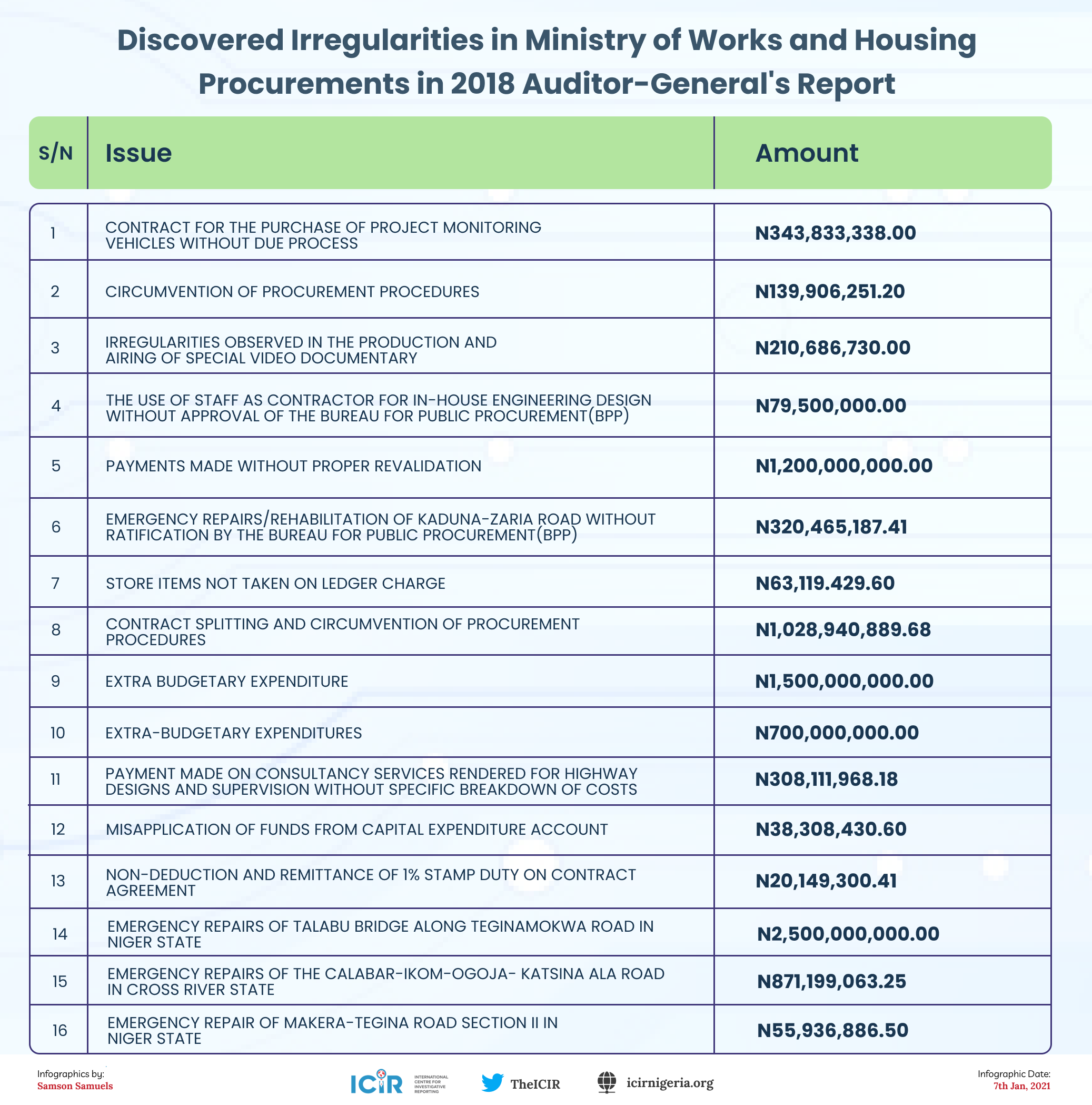
THE Federal Ministry of Works and Housing under leadership of Babatunde Fashola engaged in fraudulent procurement, contract splitting and non-remittance of statutory deductions to the tune of about N9.38 billion, report obtained by The ICIR has shown.
Latest audit report from the Office of the Auditor-General of the Federation (OAuGF) listed 16 infractions against officials of the Works Section of the ministry. The ICIR also discovered most of these offenses flout the Public Procurement Act (PPA), 2007 and the Financial Regulations Guideline.
The report, uploaded on the OAuGF website on December 23, 2020 shows huge infractions worth N105,760,058,919.43 within the Ministries, Departments and Agencies (MDAs).
Monetary values of the 16 irregularities listed against the ministry’s officials is summed at N9,380,157,474.83. Though, Fashola oversees the ministry, the Federal Government had in 2015 announced Permanent Secretaries as accounting officers of their respective ministries. So, as of the period the anomalies were committed, Alhaji Mohammed Bukar was PS of the Power, Works and Housing Ministry.
Alh Mohammed Bukar, former PS of the Ministry of Power, Works and Housing in 2018. Photo Credit: FMPWH
Some of the concerns raised in the audit report include under and non-remittance of revenues generated by the MDAs, irregular expenditures including what the OAuGf described as ‘high magnitude of unretired advances’, among others.
“Overall, our findings are indicative of significant weakness in expenditure control, and financial reporting,” it states, adding that accounting officers in the MDAs had developed thick-skin towards improving some of the audit observations raised by the OAuGF.
In a letter with reference number C/AR.2018/CONF/VOL.1/01, Anthony Ayine, the Auditor-General of the Federation had earlier submitted first part of the report on October 16, last year to Clerk of the National Assembly as mandated by Section 85 (2) and (5) of the Constitution, for necessary reviews and action.
“The Auditor-General shall have power to conduct checks of all government statutory corporations, commissions, authorities, agencies, including all persons and bodies established by an Act of the National Assembly,” Subsection 4 of the Act reads.
However, in relation to the works arm of the ministry, part of the infractions recorded by the OAuGF includes the procurement of 36 Project Monitoring Vehicles at the cost of N343.83 million (N353,833,338) without due process. This flouts Section 24 of the PPA which mandates public procurement to undergo competitive bidding, except approved otherwise by the Bureau of Public Procurement (BPP).
Further findings revealed the procured vehicles had no record because they “were not received into store as there was no document to show such delivery.”
Aside the questionable purchase, another N139.90 million (N139,906,251.20) flawed procurement of photocopying machines parts, computer accessories, and vehicle spare parts was discovered by the Office.
The ministry had no store record to validate the purchase.
Also, N2.5 billion emergency repair of Talabu Bridge along Tegina – Mokwa Road, Niger State is one of the notable contracts the OAuGF identified the ministry’s officials breached the PPA. The awarded contract surpassed threshold. It was awarded rather than seeking the Federal Executive Council (FEC) approval.
Findings by The ICIR also showed (ERGP 12106525) only N1.20 billion was approved for some ongoing projects and emergency works in the 2018 approved budget of the ministry.
“Failure to comply with procurement rules and laws could lead to poor performance, abandonment of works or loss of public funds,” the Office stated while highlighting the risk involved in non-compliance.
OAuGF is the supreme audit institution of the federal government headed by Ayine.
The Office is empowered to statutorily promote transparency and accountability across MDAs and ensure proper management of the nation’s resources independently.
Besides its responsibility, it also partners with relevant regional and international organisations such as the World Bank, African Organisation of English-Speaking Supreme Audit Institutions (AFROSAI-E) in delivering its mandate.
As such, Ayine has repeatedly criticised non-compliance of some MDAs and late submissions of audited accounts and financial statements of federal government parastatals by their chief executives.
He described the trend to be of great concerns.
For instance, as of 2016, previous report from the OAuGF showed 65 agencies of government has never submitted their audited accounts to the OAuGF.
Records from the OAuGF further revealed that between 1993 to 2010, about 12 agencies defaulted in submitting their reviewed accounts.
The number of defaulting agencies increased to 76 in 2011, 85 in 2012 and 109 in 2013. By 2014, it had increased to 148. 215 defaulting agencies was reported in 2015 while it further increased to 323 in 2016.
Incidentally, the most recent report of infractions came at a time the country is grappling with recession, increased unemployment and fluctuating oil fortune due to the global pandemic.
More so, despite the 16 infractions listed against the work ministry, OAuGF says there was no official response from the ministry to defend the accusations as of the time of the audit.
The audit report further identified irregularity in the production and broadcasting of a special video documentary awarded by the ministry for N210.68 million (N210,686,730.00).
The above sum was reportedly split into two and paid into a staff’s private account after a chunk of it was approved for release by an undisclosed former Director of Finance and Account (DFA) at the works ministry.
“N210,686,730.00 meant for a documentary was split into N130,080,730.96 and N80,606,000 and paid into a staff account…there was no evidence to show who the producer of the documentary was, or whether they were selected on a competitive basis.
“There was also no evidence to show the work was actually done.”
Again, it clearly contravenes Sections 713 of the Financial Regulations Act which states that, “personal money shall in no circumstances be paid into a government account, nor shall any public money be paid into private bank account. An officer who pays public money into a private account is deemed to have done so with fraudulent intention.
In its recommendation, the report, however, suggests the spent sum be returned to the Consolidated Revenue Fund and the DFA sanctioned for flouting the law.
Ministry allegedly paid N43m to staff as Contractor for In-House Engineering Design
In clear violation of the public procurement act, the audit report also accused the ministry of paying N43 million from N79,500,000 to its staff for an in-house design of road networks. Aside from flouting Section 42 of the PPA, the ministry’s non-compliance was said to have also denied FG of its accrued revenue from Value Added Tax and other necessary deductions summed at N4.3 million if the procurement had passed through the due process.
The DFA, in the same audit year was accused of approving N1.2 billion for the construction of Panyam-Bokko-Wamba road project in Nasarawa state without authorisation.
Similar wrongdoing was recorded against the ministry when it approved N320,465,187.41 for emergency rehabilitation of Kaduna-Zaria road without approval from the BPP.
N700 million extra-budgetary expenses, N1.02 billion Contract splitting
Also, there was an extra-budgetary expenditure of N700 million. The audit report revealed N500 million was initially paid as part of a N736 million budgeted sum for a N1.23 billion Pankshin-Ballang-Nyellen-Sara-Gindiri road project, Pankshin, Plateau State.
In another N920 million project which N720 million was budgeted for payment, a N200 million extra-budgetary expenditure was also discovered. The project was for the construction of Agaie-Katcha-Baro road in Niger State. So, a total of N700 extra-budgetary sum was penciled out by the OAuGF.
Beyond these discoveries, contract splitting amounting to N1,028,940,889.68 was exposed in the same ministry. Despite that contract splitting also contravenes the PPA, the contracts were for the same supply of stationery and office materials.
“In particular, on September 5, 2017, (51) separate contracts each valued at between N4.5 million and N9.4 million and totaling N216,633,322 were awarded to various companies all for the supply of stationery.
“The award letters were all signed by the same individual and this was just one example of similar contract splitting activities amounting to N1,028,940,889.68.” These among others were series of anomalies unearthed by the OAuGF against Works arm of the Works and Housing Ministry.
It is, however, unclear whether the anti-graft agencies have investigated MDAs that failed to submit their audited reports or violated Public Procurement Act and other regulations
Notwithstanding, the Economic and Financial Crimes Commission (EFCC) disclosed it was able to secure 865 convictions from a total of 1,305 cases it pushed to the court in 2020.
Though, no clear statement was made regarding cases bothering on the breach of procurement act and the likes, Mohammed Umar, Acting Chairman of the Commission revealed 7, 340 cases are still being investigated from 10, 152 petitions received by the Commission.
The ICIR contacted Wilson Uwujaren, the EFCC spokesperson but his line was unreachable.
On January 6, a text was sent to his line but was not replied. The next day, his line was tried but it was still out of coverage.
The Independent Corrupt Practices and Other Related Offences Commission (ICPC) was also contacted through Aruba Nwunye, the Spokesperson but she did not respond to phone calls.
“I am not aware of any actions for now,” she later replied in a text message. Efforts to get Bukar’s contact through website of the Office of Head of Service of the Federation failed.
Mrs. Oyeboade Akinola, Director of Media and Public Relations in the ministry did not respond to calls made to her line as well. Text message sent to her was also ignored.
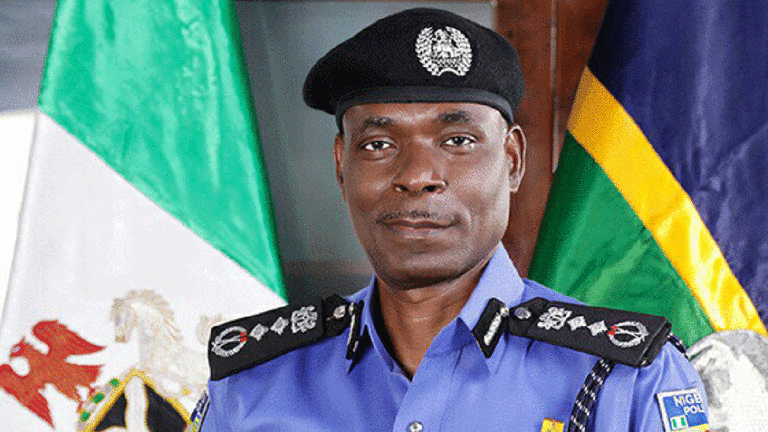
THE Divisional Police Officer (DPO) of Maitama Police Station, Abuja, CSP Magawata, has questionably succeeded in mediating in a case of road accident involving a lawyer and a man alleged to have biological link with a lawmaker and a minister in Nigeria, but covered up a criminal use of fake plate number on one of the vehicles involved in the crash.
Apart from failing to probe the fake number plate and bring the culprit to justice, the DPO also did not sight the offender’s vehicle throughout the period he superintended over the mediation process.
Driving in a black Ford Edge along the Aminu Kano Crescent, Wuse 2 on 16th November at about 3:20pm, Mr. Bashir Zuntu had crashed into Barrister Julius Atanawhemera’s Toyota Celina car from behind.
Zuntu was alleged to have immediately negotiated his way from the scene and zoomed off. But he was unlucky; one of his number plates fell off at the scene.
An occupant of his car however alighted to sympathize with the lawyer before the culprit sped off.
With the support of Atanawhemera, the police in Maitama, where the incident was reported, began to track the fleeing driver.
The number plate
There was however a major setback in the bid to apprehend him, as according to the lawyer, the number plate that fell from his vehicle, with which he was being tracked, proved to be fake when the Vehicles Inspection Officers (VIO) were engaged to conduct a check on it.
The ICIR independently investigated the number plate on Wednesday, December 23, 2020, at the Vehicle Inspection Office, Abuja; it was confirmed to be fake.
Atanawhemera argued that Zuntu was eventually arrested through the tracking of the number provided by the person who came down from his car at the scene of the accident.
The man who gave the number had allegedly fled as well, sensing the consequences of the impact of the crash, coupled with the fact that the principal offender had vanished with his vehicle.
He was, however, the first to be apprehended before Zuntu’s hideout was allegedly uncovered.
The lawyer noted that he began to suspect foul play after Zuntu was apprehended, as according to him, the accused was allowed to flee from detention and travel out of the country by the police, so he would evade punishment.
Though the lawyer claimed the fleeing driver was a son of a serving senator and a cousin to a serving minister, the DPO told the ICIR that “his parents are politicians,” and that “he is a core civil servant.”
Atanawhemera also said the DPO confided in him that some influential politicians had called him in respect of the case and that the suspect had travelled out of the country.
Peeved by the dimension his case was taking at the Maitama police station, Atanawhemera – a Principal Counsel –wrote the FCT Police Commissioner on 14th December 2020, demanding that the police furnish him with a certified true copy of the report of a preliminary investigation into the case, after four weeks of lodging a complaint about the matter. The receipt of his letter, seen by The ICIR, was acknowledged the same day by the FCT police.
He made the request through the Freedom of Information Act (2011).
The lawyer claimed that despite providing the police with financial support and other aids for him to get justice, the suspect remained at large.
Atanawherema said all citizens of the country are equal before the nation’s laws and that the “Nigeria Police Force is created under the enabling laws to fight and discourage crimes and not created to encourage crimes.”
The lawyer said he is more pained with the accused disappearance because he claimed to have supported the police to track the accused “at a huge financial cost and time expense.”
Speaking with The ICIR on the matter on Monday 21 December 2020, the DPO said the parties would be meeting him around noon that day to find an amicable way to resolve the rift.
He also denied the allegation by the complainant that the accused escaped from custody and the country.
He said the accused did not flee as alleged by the lawyer but travelled out of Abuja on official assignment.
Meanwhile, the lawyer told our reporter after the meeting that the meeting went very well.
He said a brother to the accused – a policeman – whom he had known before the accident occurred, offered to repair his car and he agreed.
The agreement resulted in amicable resolution of the case and he had withdrawn the matter from the police station, he stated.
But in a sudden twist of the event on Wednesday, December 2020, he alleged again that he was no longer hearing from the man who agreed to repair his car.
Though the lawyer had withdrawn the case from the police station at the time of filing this report, The ICIR sought to know what the police would do to the case of fake number plate on the accused’s vehicle.
This time, the police DPO in Maitama would not tolerate any question regarding that. He declined request from The ICIR on the matter. He said the matter had been settled and there was nothing more to discuss over it.
Zuntu was contacted by our reporter to state why he used fake number on his car.
He denied having any case at the station the first time he was sent a text message, after failing to pick calls. He said: “I really don’t know what you’re talking about, as I don’t have any case in any police station at the moment. Please, revert back to Julius, this must be a mistake. Thank you.”
Our reporter sent another message to him to confirm or deny if he is one Mr Bashir Buntu who had just concluded a case of accident at the Maitama police station.
He said: “Yes, but I don’t have any case, it has been withdrawn in written. The case is now officially closed.”
Then, our reporter sent his number plate, which was confirmed to be fake by the lawyer and the ICIR at different offices of Vehicle Inspection Officers, to him in a Whatsapp message to confirm if it is genuine or not.
Zuntu responded through a Whatsapp message that he didn’t know anything about it. He said the car was for sale and that he was no longer in possession of the car.
He directed our reporter to contact the Maitama police station for whatever information he needed on the matter.
“I have handed the car to the owner. I have no business to do with both parties. I have no case with anyone anymore, both barrister and the owner of the car have gotten their compensation for the damage caused. I’ll appreciate it, if you go to the station for more detail,” he stated.
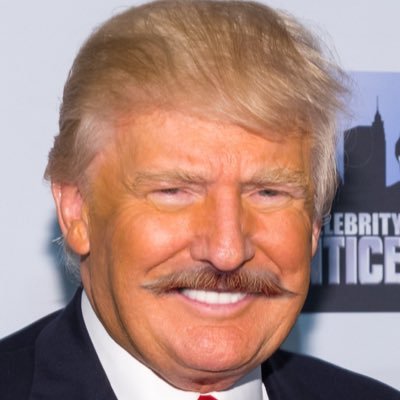
HOURS after Donald Trump’s Twitter ban, a new satire account has sprung up using the outgoing US president’s pseudonym of 1980s.
Trump used ‘John Barron’ as a pseudonym in the 1980s, according to Wikipedia.
An unknown man created a ‘John Barron’ account on Twitter 17 hours ago using Trump’s profile picture and a fake moustache. The account garnered 349,400 followers within hours, with the first post amassing 262,100 re-tweets, 1.7 million likes and 36,100 quotes within six hours.
The account has only five followers: Trump’s wife, Melania; his daughter, Ivanka; his son, Eric; Donald Trump Jr; and Rudy Guiliani, former New York mayor and Trump’s die-hard associate.
When the account tweeted its first post, “Hello I am brand new to Twitter. What are you guys up to,” several users alluded that the account must have been created by the U.S. President.
“I think this is the real Trump,” a Twitter user @OgheneNerojr said.
A Twitter user with the handle @atlas2112 replied that “I will be surprised if he does not create a new account with Putin. At this point he is one step away fron just admitting it all.”
Another Twitter user @CaroleCarole012, wrote, “New to Twitter? How did you get over 30k followers? And why are the only people you follow named Trump? I think you need to go elsewhere.”
However, some Twitter users believed it was a fake account.
“This was by far the simplest, purest, honest, and genuine light of comedy in a dark time. Haha awesome job,” tweeted a Twitter user @SlaceofSpades.
Candice Wilson with the handle @RushBluOcVoBeat said, “You know what is funny? There are MAGAS retweeting this…I guess it is funny to them. Do they know that this is satire?”
The account holder had made seven posts as of 7.45pm, describing his location as “Not the White House.”
Trump has been permanently banned by Twitter, Facebook and Instagram for inciting violence and violating rules guiding social media posts. He incited his supporters to breach Capitol Hill on Wednesday—the day the Congress was to certify Joe Biden as winner of the November 2020 U.S. presidential election.
The CNBC said in November 2020 that John Barron was “Donald Trump’s go-to pseudonym when he needed to send a message without using his own name.”
The outgoing U.S. President will leave power on January 20, but he risks being impeached before the due date for inciting violence which led to the death of five persons in the United States.
PROMINENT virologists in the country say the federal government should exercise caution in its quest to acquire COVID-19 vaccines for Nigerians.
Virologists, who spoke with The ICIR on plans by the federal government to purchase the vaccines, noted that there were still a lot of unanswered questions concerning the efficacy and possible side effects of the newly developed drugs.
The federal government had, on January 5, disclosed that it had commenced moves to get 42 million COVID-19 vaccines through the World Health Organisation’s COVAX scheme.
COVAX is a partnership involving governments, global health organisations, manufacturers, scientists, private sector, civil society and philanthropists aimed at ensuring equitable distribution of COVID-19 vaccines.
Going by government’s plan, the 42 million vaccines would cover one fifth of Nigeria’s population. The government intends to inoculate 40 percent of the country’s population in 2021, and another 30 percent in 2022. However, scientists say an individual requires two doses of COVID-19 vaccine.
A shipment of 100,000 doses of Pfizer COVID-19 vaccine is due to arrive in Nigeria by the end of January.
FG doesn’t have enough information on vaccines
Executive director of the National Primary Health Care Development Agency (NPHCDA), Faisal Shuaib, who disclosed details of the Federal Government’s coronavirus vaccination plan at a press briefing of the Presidential Taskforce on COVID-19 in Abuja on January 5, said President Muhammadu Buhari, Vice-President Yemi Osinbajo and other top government officials would be the first to receive the vaccine.
The vaccination of the country’s top leaders would be televised live on national television in order to inspire public confidence in the vaccines, according to plans put in place by the government.
But, while speaking at the press briefing, NPHCDA boss, Shuaib, confirmed the fears held by many Nigerians when he admitted that the government did not have enough information about the vaccines.
Asked how long the protection offered by the vaccines would last, Shuaib said, “One thing that we are aware of is that this vaccine is new. So we do not have absolute information about how long they will last because the vaccines are just a few months’ old. It is only a question of time before we know exactly how long their immunity will last.”
A professor of virology at the Lagos State University (LASU), Bola Oyefolu, told The ICIR that it was wrong for the federal government to move to acquire the vaccines without having adequate information about its efficacy and side effects.
Oyefolu said he was part of a team of researchers assembled by the Nigerian Institute of Medical Research (NIMR) which sequenced the gene of a strain of the coronavirus found in Nigeria. In response to questions by our correspondent, Oyefolu suggested that the COVID-19 vaccine had not gone through all the processes that it should be subjected to before being administered on people.
“Those in government should ask themselves whether they are supposed to purchase these vaccines at this time. Have the vaccines gone through the normal processes that they are supposed to go through? There are a lot of issues surrounding the vaccines that are controversial. So why should Nigeria be in the lead in buying such a vaccine? That is wrong,” he said.
“Normally, a vaccine should go through trial, lasting averagely between two and three years. How can we say we want to purchase a vaccine that we have not studied properly?”
Will the vaccine be effective against the new strain of coronavirus in Nigeria?
Oyefolu wondered if the Federal Government had determined whether the vaccine it ordered would provide effective protection against the new coronavirus strain that was recently discovered in Nigeria. The highly contagious strain has also been discovered in the United Kingdom and South Africa.
“Now, we have a new mutant of the coronavirus. The truth is, there is a lot of work that is yet to be done (on the vaccines) and there was a rush to produce the vaccine. What if we buy the vaccine and it does not cover the new strain of coronavirus in the country? It is not reasonable to go for the vaccine at this moment,” the university don said.
“It will indict the researchers in this country and make it appear as if we don’t know what we are doing. There is nothing like being sentimental or emotional about it. So far as work has not been concluded on the vaccines, for us to be going for it is wrong. It is wrong and unreasonable, and it means that we are compromising the health of the people.
“Now that we have a new strain of the virus in Nigeria, we need to study this thing first and ensure that the vaccine is effective on this new strain. We are not saying that Nigeria should not get the vaccine at all but we have to be sure of a lot of things first.
”I was privileged to be one of the team from the NIMR that sequenced the genes from one of the strains that we have here in Nigeria. It should first be ascertained that the vaccine can take care of all the various strains available, so why the haste?” he added.
Oyefolu noted with regrets that “health issues in the world have been politicised” as a result of economic considerations.
“The people that produced these vaccines on a large scale want to recoup their money and they will engage in all kinds of politicking to push the product,” he observed, wondering why the Nigerian government refused to look into the herbal remedy developed by an African country, Madagascar, for the coronavirus disease.
Advising the federal government to halt plans to get the vaccine for the moment, Oyefolu said Nigeria should rather focus on preventive measures, until it had answers to all unanswered questions concerning the vaccines.
He said, “What the new strain found in Nigeria, UK and South Africa is signalling is that we have not understood the virus completely and until you have all the information on a particular virus or pathogen, you cannot effectively produce a vaccine against it. The small details that you don’t know may be very vital and when you don’t understand this and you go ahead to produce a vaccine, the vaccine might fail.
“So Nigeria should be careful, and I don’t think we should go for it. We don’t understand the virus at the moment so the government should concentrate on preventive measures, rather than curative measures.
“This is because we are yet to understand the virus completely. You cannot cure what you don’t understand, but you can prevent.”
FG should first determine level of herd immunity in the country
Another virologist and professor, Rosemary Audu, told The ICIR that there was a need to study the level of herd immunity in the country before going ahead to administer the vaccine on Nigerians.
Herd immunity is a form of indirect protection from infectious disease that occurs when a sufficient percentage of a population has become immune to an infection, especially through previous infections, thereby reducing the likelihood of infection for individuals who lack immunity.
Audu said adequate knowledge of herd immunity would help the government to determine the distribution of the vaccine.
Audu said, “The federal government should prioritise the distribution of the vaccine. They need to know who to give first especially since the vaccine they are bringing will not be enough for the population.
“We need to do more studies to know which segments of the society are more at risk and in need of the vaccines and we can do that by measuring the herd immunity. If most of the people in the community have already come in contact with this virus and have developed immunity already, then the risk of those who have not been infected getting infected in that community is lower. So where the herd immunity is high in a community, the population that is not immunised is likely to have a lower risk. So we need to prioritise who we give this vaccine.”
Religious leaders say FG should first get credible information on vaccine safety
Besides virologists, religious leaders also called on the government to exercise caution with the vaccines.
Khalid Abubakar Aliyu, secretary-general of the apex Muslim organisation in the country, Jama’atu Nasril Islam (JNI), in a chat with The ICIR, noted that there were yet to be addressed misgivings and suspicions concerning the COVID-19 vaccines.
He said, “I understand, from the culture of medical practice, that vaccines are developed over time. So the suspicion here is, how can this vaccine be developed in just a few months? Does it mean that it was a pre-arranged thing? There are a lot of doubts being cast on the effectiveness of the vaccine but, unfortunately, these doubts are not verifiable because they are just journalistic accounts and social media posts.”
Aliyu said the WHO should use ‘verifiable facts and figures’ to enlighten the world and allay fears surrounding the vaccines, particularly concerning potential side effects.
“Then there is also the concern over whether the COVID-19 vaccine being deployed in other parts of the world is the same as the one that will be taken to Nigeria and other African countries. That is a concern,” he noted.
Stressing that religion was not against vaccination, Aliyu observed, “It is religiously expedient to undergo therapy and get inoculated with vaccines, but that should be based on truth and not misinformation.
“So I think we should first get credible information about the vaccine before using it in Nigeria, and the Federal Ministry of Health and the Nigeria Centre for Disease Control (NCDC) should tell Nigerians the true nature of the vaccines to enable people to take a decision on whether to take the vaccine or not.”
Also speaking with The ICIR, a priest and director of communications, Catholic Diocese of Enugu, Benjamin Achi, said the federal government should tread with caution on matters concerning the vaccines.
Although he noted that the emergence of the vaccine was a good development as it meant that there was now a medical response to the coronavirus pandemic, Achi added, “People are exercising caution on the use of the vaccine around the world and I think Nigeria shouldn’t be an exception.”
“The concern should not be the amount of money involved in procuring the vaccines – the concern should be the safety of the vaccine because, basically, they are still at the trial stage at the moment,” he stressed.
Continuing, the clergyman said it would not be proper to rush into introducing the vaccines in Nigeria.
“While it is not out of place to let people have the vaccine, I don’t think it is something we should rush into like that. Sometimes, the tragedy down here is that we don’t think things through before we get into it. Whatever is spent to secure life is not too much because life is priceless, but I think we need to exercise caution,” he said.
FG is doing the right thing in going for vaccines… Nigerian Academy of Science
However, the Nigerian Academy of Science (NAS) noted that the federal government was only being reasonable in rushing to acquire the vaccines for Nigerians.
President of the NAS, Mosto Onuoha, a professor, in a chat with The ICIR, said, “Every reasonable government is trying to protect its population and all the countries of the world will not be scrambling to protect its population and then we keep quiet. I think the Federal Government is simply being proactive.”
Onuoha said it would be wrong to blame the government for rushing to acquire the vaccines, as it was not yet known when the drugs would eventually get to Nigeria.
“We have up to 200 million Nigerians. Even though we don’t know the accurate figure, we don’t expect that the vaccines will be enough to get to everybody,” he said, adding that the high number of coronavirus cases being recorded in Nigeria in recent days was linked to the highly contagious new strain of the virus in the country.
“The new variant in Nigeria is said to be more dangerous, and we are not testing enough,” he said, while justifying the rush to acquire the vaccines.
Funds meant for vaccines should not be misappropriated
Rather than dwell on concerns over the safety of the vaccines, the Nigerian Academy of Science president stressed that the major challenge was how to ensure a judicious use of funds meant for the purchase of the vaccines.
He also stressed the need to ensure that the access to the vaccines was not dependent on connections to people in government.
Onuoha said, “I think the major issue is to ensure that the Nigerian factor is not brought into all of these, so that any amount appropriated for purchase of vaccines will be used judiciously, and getting the vaccine does not depend on your position in the society, or on who you know. We should follow the system as it is done in other nations.”
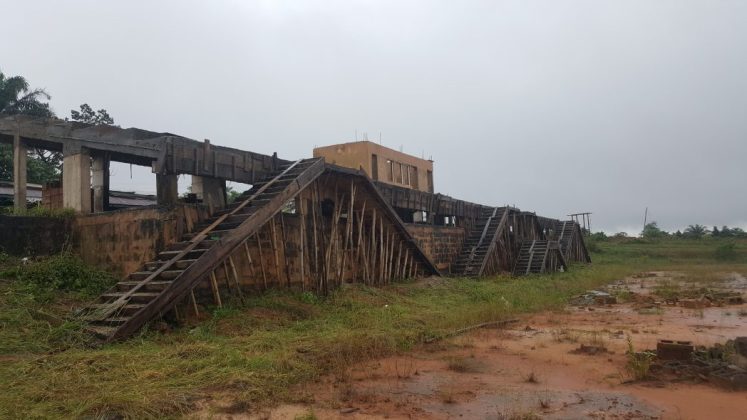
Drenched in rain and shivering from cold, young Ikechukwu Agu looked up in surprise as this reporter approached him from a small shed beside the uncompleted Arochukwu Stadium stand in Abia State.
He was angry that the stadium has been abandoned for many years, but shocked to realise later that funds for the construction of the stadium had been released.
“We are our problem in this country,” he mumbled, shaking his head.
Millions spent, yet no result
Stories of abandoned constituency projects are rife across Nigeria, especially in rural communities in the Southeast geo-political zone where funds budgeted for grassroots development rarely touch the lives of citizens.
In 2015, following his appointment as the Minister of Sports, Solomon Dalung, laid out a vision which included a short term sports development plan focused on infrastructure, athlete’s welfare, grassroots games and sports as a viable business. Like his predecessors, Dalung reaffirmed that grassroots sports development remains the only route to rebuilding the country’s sports and empowering talented youths to manifest their talents and compete at the global stage.
True to his words, the ministry embarked on several projects targeted at providing adequate infrastructure at local levels and reviving secondary school sports by providing sporting materials to selected schools.
But most of the projects initiated by the Dalung-led administration, which should be due for completion by now, are yet to be executed while others are abandoned since 2017 and 2018 when they were awarded via Zonal Intervention Funds. This happened despite the policy of the Buhari administration to cash-back all awarded contracts.
According to procurement data from the Nigerian Open Contracting Portal (NOCOPO) on contracts awarded by the Federal Government through the Federal Ministry of Youths and Sports Development, about N120 billion was budgeted for Zonal Intervention Projects in the Southeast between 2017 and 2018. Figures from the Office of the Accountant General of the Federation, showed that N3,877,621,811 and N2,560,000,000 were released in 2017 and 2018 respectively to the Ministry exclusive of other agencies under it.
Infographics on Capital Releases to Federal Ministry of Youths and Sports Development in 2017 and 2018 Read more at: https://secretsreporter.com/young-talents-waste-in-the-southeast-as-fg-abandons-sports-projects/
From this amount, N5,925,061,227 was utilized, with over N1 billion supposedly spent on the construction of mini-stadiums/mini-sports centers and supply of sporting kits to schools in selected communities within that period in the Southeast Zone.
Out of these projects initiated in the Southeast, six locations for the construction of the mini-stadiums were mapped out and visited by this reporter to ascertain their status. But not one project has been completely executed. Three out of the six projects were non-existent, one is a shadow of a stadium, and the other is still at 30 percent completion level with just one out of the lot at 60 percent near completion.
Talents with no standard field
The mini-stadium project site at Obinkita in Arochukwu Local Government Area, Abia State, is a stone’s throw from the home of Nigeria’s football legend, Kanu Nwankwo, which is a bee-hive of talents as most youths who want to attain success like Papilo, as Nwankwo is popularly called, are usually seen training daily at various secondary school fields in the community.
The level of work done at the site was nothing to write home about since its foundation laying ceremony in 2018 by Mao Ohabunwa, senator representing Abia North Senatorial District. The only visible structure is the uncompleted stand. Freshly moulded blocks were seen at the site which indicated that work was still ongoing but at a very slow pace. The contract was awarded at the cost of N173,112,629 million to Bee-Harris Investment Limited, a company registered with CAC 20 years ago.
Molded blocks and equipment at the construction site of Mini-Stadium project at Obinkita in Arochukwu, Abia State. Read more at: https://secretsreporter.com/young-talents-waste-in-the-southeast-as-fg-abandons-sports-projects/
“Please help us tell the world what these people are doing to us, December is around the corner and we can’t even play football on this ground. The little thing meant for the youths they will still pocket it,” Kalu Okolo, a 28-year-old motorcyclist said.
He expressed surprise when he learned that contrary to general knowledge in the community that the stadium was being built by Ohabunwa as his contribution to youth development in Obinkita, it was, in reality, a zonal intervention project by the federal government.
Another resident of the town, Emmanuel Ogbonnaya, a cab driver whose dream is to become a professional footballer, said Obinkita is not the only community crawling with talents, but the entire Arochukwu.
“Scouts usually come and most times they pick people, we have players in this town o,” he enthused. Ogbonanya’s major fear is simple; no mechanism is in place to harness these talents by the government apart from individual efforts.
The contractor for the project Uzochukwu Aliebo when contacted blamed the slow pace of work on the delay in the release of fund and bad road.
“The road to Arochukwu is a death trap, our trucks have broken down severally. We get chippings from Calabar and most times these people release the money in small amounts, so we are trying our best, but before the end of the year, the stadium will be ready for use,” Aliebo stated. A promise which sounded impossible and more like a political statement from a Real Estate investment company as the exact amount released so far for the project which could have justified the level of work done could not be confirmed from the Ministry.
Youths of Ikeduru, Imo requested for stadium, they got a volleyball and basketball courts instead
The Amaimo mini-stadium project in Ikeduru Local Government Area of Imo State was awarded to Naz Davision Ltd, a company with no presence on the CAC website, at the cost of N173,112,629. The project site is about five poles away from the home of Senator Samuel Anyanwu, senator representing Imo East, aka Sam Daddy. It is another project awarded to help develop grassroots sports but it has been abandoned like others.
Most villagers were surprised to learn that instead of a standard mini-stadium, all they got was a poorly constructed Lawn Tennis and basketball court alongside an empty hall overgrown with weeds erected at the community primary school by Sam Daddy as his constituency project.
Hall and Basketball court overgrown with bushes at supposed Amaimo Mini-Stadium.
Since there was no signpost to confirm that the site was indeed the location of the project, this reporter visited the palace of His Royal Majesty, Eze Godwin Ehirim Nwaebo, Duru II of Amaimo Ancient Kingdom. Though the traditional ruler was not at home, his wife Ugoeze Apolonia confirmed that the structure at the primary school is what they all know as the stadium in the community.
A signpost at the palace of HRM Eze Godwin Ehirim Nwaebo, Duru Imo II, Amaimo ancient Kingdom.
This was corroborated by one of the youth leaders in the village, Boniface Ugochukwu, who further confirmed that the project was complete and waiting to be commissioned.
When asked why the structures on the ground were no way close to a mini-stadium, he stated that it was a matter of choice. Unlike other states or regions, they had to make do with the land available to them, thus the reason why they decided to have volleyball and basketball courts instead.
“Football is one sports that bring youths in Amaimo together especially during festive periods, it creates unity among us. If such an amount was released and all we have is that structure in the school, then it’s really bad, there is no motivation for us the youth” Igwe Anyanwu a 19-year old student from Umueze village told this reporter.
Nkalagu, Ishielu, Ebonyi State
Two projects were awarded by the Federal Ministry of Youths and Sports Development to be executed at the limestone-rich town of Nkalagu. One was the supply of sporting materials to two community secondary schools located at Iyonu and Umuhuali at the cost of N9,985,750 awarded to Randburg Nigeria Limited and the latter a mini-sports stadium at Nkalagu awarded to De-Donex Integrated Global Ltd at N173, 112,629.
A visit to both schools confirmed that no single equipment or material was delivered to them. At Iyonu, the councillor, Ugah Polycarp, whom this reporter met at a burial ceremony during the visit since the school was closed due to the COVID-19 pandemic, revealed that apart from being a community leader, as a member of the school’s Parents Teachers Association, PTA, he alongside others were unaware of the fact that over N9 million was earmarked for the supply of sporting kits to the community-based schools.
“Our students are lacking sports facilities. If those things were here our students would have been using them, which is why we are lagging behind in sports,” said the Junior Principal, Igwe Uchechukwu, who has been in the school since 2016.
This was the same case in Umuhuali where then Principal, Mrs. Louisa Ajah, in a phone conversation stated that while she was in charge no such items were ever presented to the school despite their outstanding performance in state sporting events.
“The students cannot go for any competition outside Ebonyi, it is obvious they don’t have any standard facility to train with so they will definitely not perform well. You learn these skills from a young age so it’s best to start training them in time. Practice makes perfect but are they going to be kicking stones while practicing?” lamented Ifeanyi Aleke, a resident of the community, whose siblings attend the school.
However, the construction of the mini-sports center at Nkalagu is near completion as at the time of this investigation on October 2nd 2020. The contractor promised that by the end of the year, the stadium should be in full use. The pitch and the entrance were still under construction, workers were seen on site finishing the drainage around the pitch with the stands fully completed and painted. The two buildings at the far side of the large expanse of land housing the toilets were complete.
The project is the only one with evidence of N173 million approved for construction of several mini stadium in the state.
“The contractors are trying but they can do more, once they finish it will attract a lot of business that’s why they are also building a flyover at the highway. The town will be bubbling with activities by then” Nwaeze Jude who is anticipating to test his boots on the pitch someday during the community tournament said.
Non-existing Projects
Arriving in Anambra State, one notable thing was people’s love of sports, especially football, which is visible in every corner as a large number of youths were seen at most playgrounds scattered across the state capital, Awka.
The one-hour journey to the proposed site for the construction of the mini-stadium at Nsugbe, approved by the federal government at N173,112,629 was a smooth one, unlike previous states, because of good internal roads.
At a motor park adjacent to the second gate of Nwafor Orizu College of Education, Nsugbe, this reporter sought to find out the location of the stadium from the locals.
“Stadium? Here in Nsugbe? By Federal Government? Do you mean the stadium inside the school?”
These questions came in torrents as answers to the reporter’s question because the stadium, which was to be sited at the pavilion inside the school, was non existent. After the foundation laying ceremony by Senator Stella Oduah in 2017, this reporter learned, no work was done at the site.
“Senator Stella came and they laid those stones, I thought they wanted to fence our pitch and I was wondering why; I didn’t know it was a stadium,” said Uche Okechukwu, one of the boys who usually come to train at the small field beside the school’s main pitch.
Nkalagu Stadium 13 scaled
The contractor for the project, Wilangy Nig. Ltd, however, disclosed that it was only given a certificate of award for the project and since then no money has been released for construction of the stadium.
The last in the lot for investigation was the construction of a mini-stadium at Ikwo, in Ebonyi Central Senatorial District awarded to Pro-Logistics International Limited for the sum of N173,076,661.75, which regrettably was also non-existent.
The immediate past local government chairman, Orogwu Joseph, disclosed in a telephone conversation with this reporter that the town boasts of a completed mini-stadium, which was commissioned by the state governor, David Umahi. However, the feat was solely a local government executed project. The present chairman, Stephen Orogwu, confirmed this.
Blocks laid beside the pavilion since 2017 during the foundation laying ceremony of the proposed Mini-Stadium at Nwafor Orizu College of Education, Nsugbe, Anambra State.
Nobody want to be accountable for failed projects
Since most of the projects were awarded when Solomon Dalung was Minister of Youths and Sports Development, this reporter decided to reach out to him for his response.
“You can only confirm this with the office of DFA (Director, Finance and Administration) in the ministry which is responsible for releases. They are constituency projects, so also check with members of the National Assembly from the areas. Thank you.” he replied via Sms.
When contacted on why the mini-stadium project in Ikwo has not been executed the senator representing Ebonyi Central Senatorial district, Ogba Joseph, revealed that no fund has been released by the ministry for the project.
“The truth is that they have not released one kobo, there was money there in 2018 but it was not funded. In 2019 it did not appear in the budget at all. Then in 2020 it appeared because I insisted but as I am talking to you now they have not released one kobo to the contractor,” the senator said.
He further disclosed that though the Minister of Sports told him that 50 percent of the funds had been received, it has not been released to the contractors.
Though the Minister of Youths and Sports Development, Sunday Dare, did not answer his calls when contacted by this reporter to confirm if funds were fully released for the projects and to also comment about the state of the abandoned mini-stadiums, his personal assistant Tunde Akpeji, after requesting for the questions to be sent via sms, directed this reporter to contact the Director of Press, Mrs Lere-Adams as she is the right person to handle the enquiry as it concerns the ministry.
Mrs Lere-Adams in turn, directed that a letter of request be sent to the email address on the official website of the Ministry. However, no response was received from the Ministry as at the time of filing this report.
It is undoubted that Nigerian sports now wallow in mediocre performances. For the past five years, Nigerian home-based athletes have not won any medals at the global stage. The country now depends on athletes in Diaspora to compete in global tournaments.
In the current rating of African clubs by the Confederation of African Football, CAF, no Nigerian football club side made it to the Top 20 ranking. Nigeria’s female and male football teams were all knocked out of the African qualifying series for the 2020 Japan Olympics, now shifted to 2021. And in the world Under 17 and Under 20 male football competitions where Nigeria excelled in the past, the national team did not qualify for the finals in the past two editions.
Odegbami laments the dearth of quality and poor commitment to Nigeria
“These are very dreary times for Nigerian sports. For those of us that have been a part of several generations, the pain is deep. I was an active participant at the highest level from the mid-1970s when Nigerian sports were on a global ascendancy when Nigeria started an authentic dominance of Africa in Track and Field, table tennis, (lawn) tennis, boxing, weightlifting, wrestling and joined the elite forces in African football at the African Cup of Nations. It is very painful to wake up every week these days to the reality of the horror that has become the present state of Nigerian sports…
“From 1976 to 2006, a period of some 30 years and eight different Olympics, Nigeria presented some athletes that were either winning medals or had the capability to do so. From 1984 Nigeria actually started to win Olympic medals. In 1996 it won an unprecedented number including its first two gold medals. Since then her fortune in medals has been dwindling. For those of us that have been a part of the history of Nigerian sports since 1976 the present times are undoubtedly worst in our country’s history with stories so ugly they benumb the mind,” Odegbami lamented.
*This investigative report was supported by McArthur Foundation and the International Centre for Investigative Reporting, ICIR.