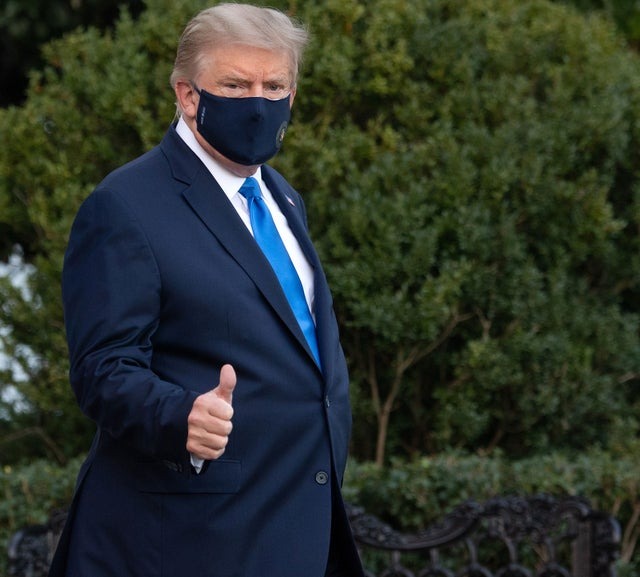
FACEBOOK, Instagram and Twitter have suspended Donald Trump’s accounts for inciting violence in Washington D.C. on Wednesday—the day the Congress was to certify Joe Biden as president.
The outgoing U.S. president was, on Thursday, banned from using both Facebook and Instagram indefinitely, according to Mark Zuckerberg, Facebook’s chief executive, in an issued statement.
Trump’s Twitter account had earlier been banned by Twitter on Wednesday for 12 hours starting at 7pm ET, but the account was still suspended 19 hours after when The ICIR checked.
According to Zuckerberg, the decision was to prevent Trump from using his accounts from undermining the ongoing peaceful transition of power to Joe Biden, US president-elect.
Since he lost the November presidential election to Biden, Trump has consistently used all of his social media platforms to instigate violence and to discredit the outcome of the election.
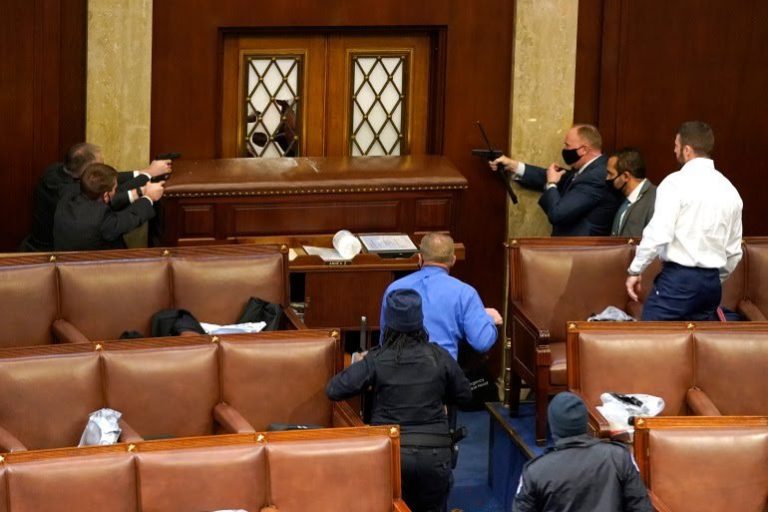
On Wednesday, hundreds of Trump’s supporters besieged the Capitol Hill to prevent the Congress from certifying the electoral victory of Biden held in November 2020.
The ensuing violence following the invasion, which has been widely condemned across the globe, led to the death of four persons with several others injured.
“The shocking events of the last 24 hours clearly demonstrate that President Donald Trump intends to use his remaining time in office to undermine the peaceful and lawful transition of power to his elected successor, Joe Biden,” Zuckerberg said.
“Over the last several years, we have allowed President Trump to use our platform consistent with our own rules, at times removing content or labelling his posts when they violate our policies. We did this because we believe that the public has a right to the broadest possible access to political speech, even controversial speech. But the current context is now fundamentally different, involving the use of our platform to incite violent insurrection against a democratically elected government.
“We believe the risks of allowing the president to continue to use our service during this period are simply too great. Therefore, we are extending the block we have placed on his Facebook and Instagram accounts indefinitely and for at least the next two weeks until the peaceful transition of power is complete.”
Zuckerberg noted with concern that Trump’s decision to use his platform to condone rather than condemn the actions of his supporters at the Capitol building had rightly disturbed people in the US and around the world.
While calling on the entire nation to ensure that the transitional process goes smoothly, he said that Facebook removed Trump’s “statements yesterday because we judged that their effect — and likely their intent — would be to provoke further violence.”
“Following the certification of the election results by Congress, the priority for the whole country must now be to ensure that the remaining 13 days and the days after inauguration pass peacefully and in accordance with established democratic norms.”
Similarly, Twitter punished Trump on Wednesday over a series of tweets that sought to cast doubt over the 2020 presidential race. One included a video in which Trump spread disinformation about the election’s outcome, even as he told rioters to leave the House and Senate at a time when lawmakers had started the certification of the election.
Twitter required Trump to delete the tweets to obtain access to his account, but it made clear it of plans to escalate its enforcement efforts and suspend the president permanently if he continues to break its rules.
Similarly, YouTube removed videos where Trump was making the inciteful comments on Wednesday’s evening.
THE federal government has reversed the recent adjustment of electricity tariff for selected sections of electricity consumers in the country.
The ICIR had, on Tuesday, reported how the Nigerian Electricity Regulatory Commission (NERC) announced an adjustment rate for service bands A, B, C, D and E “by NGN2.00 to NGN4.00 per kWhr to reflect the partial impact of inflation & movement in forex.”
But on Thursday, Saleh Mamman, Nigeria’s minister of power, through a statement by his senior special adviser, media and communications, Aaron Artimas, informed all Electricity Distribution Companies(DISCOs) to revert to tariffs that were applicable in Dec. 2020.
The decision, according to the News Agency of Nigeria (NAN), was to constructively conclude the ongoing dialogue between Labour leaders and representatives of the government.
“I have directed NERC to inform all DISCOs that they should revert to the tariffs that were applicable in December 2020 until the end of January 2021 when the FGN and Labour committee work will be concluded.
“This will allow for the outcome of all resolutions from the Committee to be implemented together,” he said.
Mamman, who decried report of a 50 percent increase by sections of the media, noted that the government had continued to subsidise electricity consumers in bands D and E.
“I would like to affirm that these reports are inaccurate and false. It is unfortunate that these reports have led to confusion with the public.
“On the contrary, government continues to fully subsidise 55 per cent of on-grid consumers in bands D and E and maintain the lifeline tariff for the poor and underprivileged.
“Those citizens have experienced no changes to tariff rates from what they have paid historically, aside from the recent minor inflation and forex adjustment. Partial subsidies were also applied for bands A, B and C in October 2020,” he said.
While stating that these measures were all directed towards cushioning the economic impact of COVID-19 on citizens, the minister noted that the Buhari-led federal government and the labour union had been engaged in positive discussions about the electricity sector through a Joint Ad-hoc Committee.
He said that the committee was led by Festus Keyamo, minister of state for labour and productivity and co-chaired by the minister of state for power, Goddy Jedy-Agba.
According to him, progress had been made in these deliberations set to be concluded at the end of January.
“Some of the achievements of this deliberation with Labour are the accelerated rollout of the National Mass Metering Plan and clampdowns on estimated billing.
“It also included improved monitoring of the Service-Based Tariff and the reduction in tariff rates for bands A to C in October 2020 (that were funded by a creative use of taxes),” he said.
The power minister stated that the regulator must be allowed to perform its function without undue interference.
He said that the role of the government was not to set tariffs but to provide policy guidance and an enabling environment for the regulator to protect consumers and for investors to engage directly with consumers.
According to him, bi-annual minor reviews to adjust factors such as inflation are part of the process for a sustainable and investable Nigeria Electricity Supply Industry (NESI)
He also stated that the regulator must be commended for implementing the subsisting regulations while putting in place extensive actions to minimise the adverse impact on end-user tariffs.
“The administration is committed to creating a sustainable, growing and rules-based electricity market for the benefit of all Nigerians.
“The administration and the Ministry of Power will also continue to devise means to provide support for vulnerable Nigerians while ensuring we have a sustainable NESI,” he said.
At a time the Nigeria government is debating whether to increase electricity tariff or not, the Ghanaian government announced in a statement on Wednesday that it is providing 3-months free electricity units to its lifeline customers.
Lifeline customers are those who consume less electricity compared to other consumers.
Kwame Agyeman-Budu, managing director of the Electricity Company of Ghana Limited, who made it known in an issued statement on Tuesday, said the gesture was part of the government’s extended COVID-19 electricity relief.
ON February 28, 2020, Nigeria recorded its first case of the deadly COVID-19.
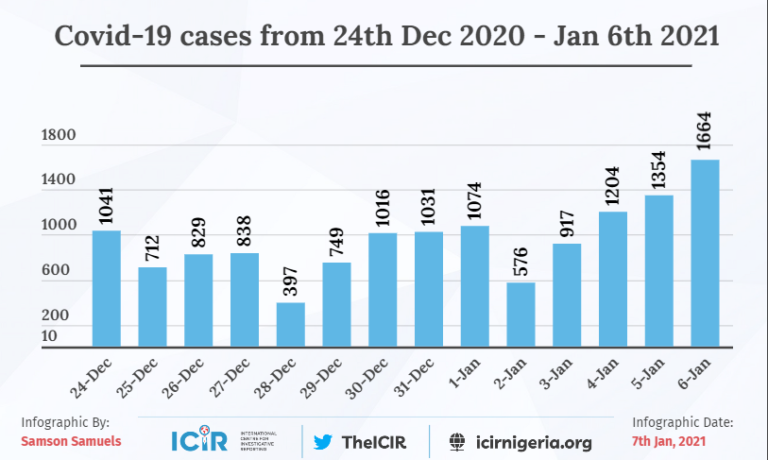
From that date to December 16 of last year, the country’s daily positive cases remained below 1,000. However, Africa’s most populous nation began to see daily cases above 1,000 from December 17 when it recorded 1,145 infections. The ICIR takes a look at how COVID-19 cases have surged to highest daily record in the last 14 days.
After recording its first over 1,000 cases on December 17, the following five days showed a decrease in the number to as low as 356 daily cases on December 21, 2020. However, the number of infections rose to 1,133 daily cases on December 23.
On December 25, the Christmas day, Nigeria recorded a total of 712 cases, a 32 percent fall from 1,041 reported the previous day.
On December 26, total number of cases increased to 829. The number of new cases rose to 832 on December 27, another increase from the previous day.
On December 28, however, there was a sharp decrease from 832 to 397 cases, more than half of what was recorded the previous day. But cases spiked again the following day, with the Nigeria Centre for Disease Control (NCDC) announcing that 749 cases were confirmed, almost double of cases from the previous day.
8836 cases in eight days
During the end of December 2020, the number of confirmed cases increased in the nation as NCDC confirmed 1,016 cases on December 30 and 1,031 on the last day of 2020.
On the 2021 New Year day, the NCDC announced another increase in the figures as 1,074 cases were confirmed positive of the deadly virus.
However, on January 2, 2021, there was a massive decrease in the number as only 576 cases were confirmed, but the decrease was short-lived following an update from the NCDC that 917 cases were confirmed on January 3.
The increase continued on January 4 when NCDC announced that 1,204 persons tested positive for the virus.
On 5th January 1,354 persons were again confirmed positive of COVID-19 while 1,664 persons tested positive on January 6, which currently represents the highest record number of daily cases in Nigeria.
In just eight days, Nigeria recorded 8,836 positive cases. Meanwhile, it took the nation more than three months to record 8,000 cases in the early days of the pandemic.
As of the time of filing this report, Lagos State leads in the number of confirmed cases in Nigeria with 32,687 infections, followed by the Federal Capital Territory (FCT) with 12, 428 of positive cases.
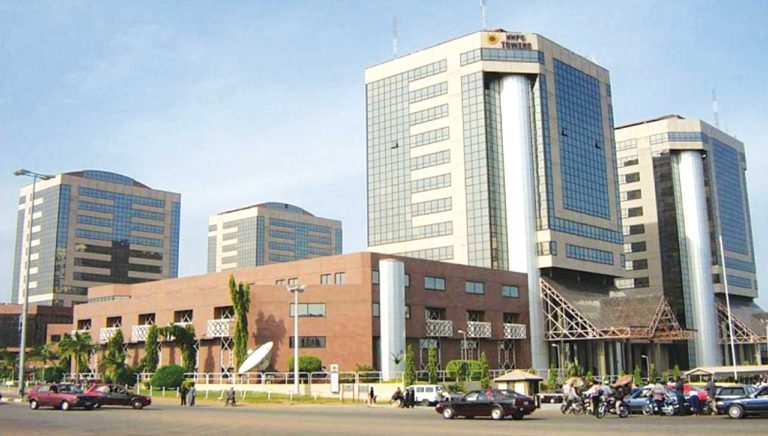
THE Nigeria National Petroleum Corporation (NNPC) is seeking to raise $1 billion from several trading firms with the option of a prepayment plan to revamp its largest refining complex situated in Port Harcourt.
This was revealed in a Reuters report, which hinted that the overhauling of the entire refinery would reduce Nigeria’s huge fuel import bill if the financing was concluded,.
Funding for the rehabilitation of the refinery is expected to come from a consortium of investors to be led by Cairo-based Afreximbank marking a second major oil-backed financing for the country since COVID-19 pandemic.
“Afreximbank is looking into a facility for the refurbishment of the Port Harcourt Refinery. However, the borrower is yet to be determined,” a source told the Reuters.
The money will be repaid over seven years through deliveries of Nigerian crude and products from the refinery once the refurbishment is complete, the sources stated.
However, the NNPC 2018 annual financial accounts show that the three major refineries reported a combined loss of N154.4 billion, with Kaduna refinery posting zero revenue.
It also revealed that the Port Harcourt Refinery marked a slump in its revenue estimated at N1.5 billion in 2018, indicating a 69 per cent drop compared to its earnings of N4.8 billion in 2017.
The Port Harcourt Refinery posted losses totaling N206 billion for five consecutive years starting in 2014, while a breakdown of its administrative expenses incurred within the period comprising salaries, guest house costs, overhead costs and others stood at N106 billion.
Nigeria is faced with the prospects of dwindling demand for oil as the country prepares to cut down oil production cost to $10 per barrel in 2021, from $15 to $35 per barrel last year, according to a report by S & P Splatts.
A PricewaterhouseCoopers 2020 report on Africa Oil and Gas Review stated that the top five oil majors in Africa experienced a $20 billion loss in export revenue in 2020, seeing an 11 per cent decline in production from 5.3 million barrels in 2019 to 4.2 million barrels in 2020.
Nigeria currently has four refineries with a combined capacity of 445,000 barrels per day located in Kaduna and three others in the Niger Delta cities of Warri and Port Harcourt. The Port Harcourt complex consists of two plants with a combined capacity of 210,000 barrels per day.
THE United States Congress has certified the Electoral College victory of Joe Biden, US president-elect, in the early hours of Wednesday.
The certification, which was presided over by Mike Pence, incumbent vice president, is a constitutional requirement by Congress in the United States electoral law to recognise the country’s incoming president and vice president.
The certification finalises the 2020 US electoral process and ensures that Joe Biden and Kamala Harris will be inaugurated on January 20, despite Trump’s weeks-long efforts to overturn the vote, including urging his supporters to converge on the Capitol on Wednesday, resulting in violence inside and outside the building.
The US Constitution requires Congress to count the votes of the Electoral College submitted by the states.
The Congress was to certify Biden’s 306 Electoral College votes. Trump, who has rejected the outcome of the election claiming the process was marred by voter fraud, polled 232 Electoral College votes.
Though a faction of Republican senators and House members had intended to object to Wednesday’s count of electors from key states that had given Biden the win, they were unable to present evidence of substantial fraud that would overturn the vote in any state.
The contested states were Arizona, Georgia, Pennsylvania, Michigan and Wisconsin. Courts have repeatedly dismissed dozens of Trump’s legal claims.
Instead, the House and the Senate, which reconvened on Wednesday night, voted to reject objections to Arizona’s vote. The Senate voted 93-6 to reject the objection to Arizona’s vote. The House voted 303 to 121 to dismiss the objection to Arizona.
A second objection to Pennsylvania’s vote pushed the process into the early hours of Thursday morning, with only 7 Senators approving it and 92 voting against. In the House, it was rejected 282 to 138, paving the way for the final certification.
On Wednesday, shortly before the certification exercise, Trump had made inciting comments to thousands of supporters outside the White House.
“If you don’t fight like hell, you’re not going to have a country anymore,” Trump had said.
Following his comments, his supporters thronged to the Capitol Hill and breached the facility with utter disdain to peace and order.
It took the intervention of security operatives to restore relative normalcy to the city.
A woman was reportedly shot dead while three other people died from medical emergencies.
The police said they recovered two pipe bombs from the Republican and Democratic Party offices near the Capitol, while about 52 people were arrested.
Republicans decried the mob action, and Democrats blamed Trump for inciting it.
“Today was ugly,” said Senator Ben Sasse, a Republican, said. “This building has been desecrated. Blood has been spilled in the hallways.”
Former President Barack Obama said in a tweet that violence at the Capitol was “incited by a sitting president who has continued to baselessly lie about the outcome of a lawful election.”
Former presidents George W Bush, Bill Clinton and Jimmy Carter also denounced the storming of the Capitol.
World leaders react
The Capitol Hill invasion has attracted wide condemnation for the Trump administration all over the globe with many calling for an orderly and peaceful transfer of power.
“Disgraceful scenes in U.S. Congress,” UK Prime Minister Boris Johnson tweeted. “The United States stands for democracy around the world and it is now vital that there should be a peaceful and orderly transfer of power.”
Disgraceful scenes in U.S. Congress. The United States stands for democracy around the world and it is now vital that there should be a peaceful and orderly transfer of power.
Nicola Sturgeon, the first minister of Scotland, tweeted that the “scenes from the Capitol are utterly horrifying.”
The scenes from the Capitol are utterly horrifying. Solidarity with those in 🇺🇸 on the side of democracy and the peaceful and constitutional transfer of power. Shame on those who have incited this attack on democracy.
Micheál Martin, the prime minister of Ireland, tweeted that he was watching the developments in the U.S. “with great concern and dismay.”
The Irish people have a deep connection with the United States of America, built up over many generations. I know that many, like me, will be watching the scenes unfolding in Washington DC with great concern and dismay. 🇮🇪 🇺🇸
Meanwhile, in a statement on Thursday, Trump promised an orderly transfer of power to Biden even though he disagrees with the outcome of the polls.
“Even though I totally disagree with the outcome of the election, and the facts bear me out, nevertheless there will be an orderly transition on January 20th,” he said.
STAFF of the National Identity Management Commission (NIMC) on Thursday embarked on a nationwide strike, citing poor welfare conditions.
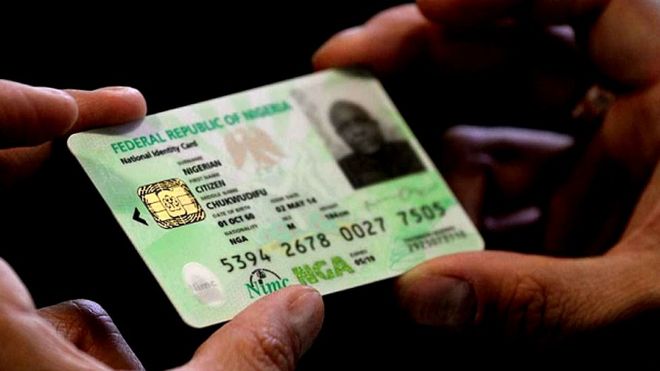
Their strike has temporarily put on hold the nationwide National Identity Numbers (NIN) registration recently ordered by the Nigerian Communications Commission (NCC).
The NCC had asked all telecoms companies to disconnect the SIM cards of all persons who had not linked their NINs to their phone lines by the end of January.
According to a report, NIMC staff also decried the lack of protective kits at their offices, saying they could get infected with COVID-19 as they attended to hundreds of residents daily.
In a notice of strike action signed by Lucky Michael, president of the Association of Senior Civil Servants of Nigeria (ASCSN), NIMC branch, and Odia Victor, secretary, the group hinted that the strike action was necessary to drive home their demands due to lack of personal protective equipment, irregularities in the promotion and poor funding provided for its members.
“Consequent upon the just concluded congress of the above-mentioned association that took place on January 6, 2020, the unit executive directs all members of grade level 12 and below in the head office and state offices to report to their respective duty posts tomorrow January 7, 2020, and do nothing.
“All members at the local government offices and special centres are advised to stay away from their various centres as a task force and implementation committees would be on parade to ensure total compliance with the directive,” a section of the notice stated.
The ICIR reached out to NIMC’s spokesperson, Kayode Adegoke, asking him the reasons for the strike action embarked on by NIMC, but he requested more time before he could speak on the issue.
“I can’t speak on this issue right now, just give me time and I will respond to you in due course,” he said.
About 42 million Nigerians currently have a NIN as of September 2020. However, the agency has been tasked with this assignment since its establishment in 2007.
Staff members of the NIMC were enjoined by the executives of ASCSN to participate in the strike action until their grievances were addressed.
“The congress agreed that the NIMC staff salary structure approved by the Federal Government vide presidential assent be implemented in the personnel appropriation of the 2021 annual budget effective January 2021.
“That the lopsided and irregular promotion done in 2017 and 2020 be reviewed, regularised and gazetted in accordance with public service rules,” the notice concluded.
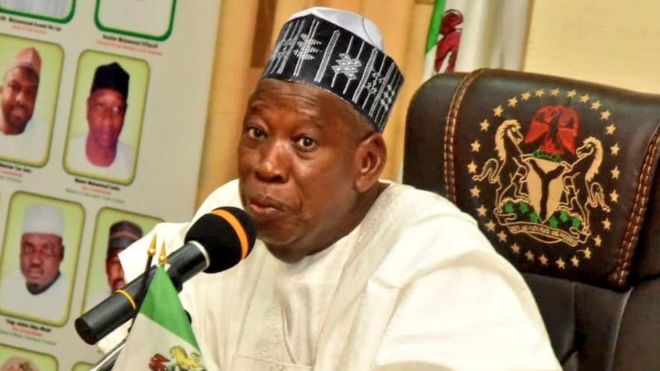
ABDULLAHI Umar Ganduje, Kano State governor, says his administration can no longer afford the payment of N30,000 minimum wage to the state’s civil servants owing to the country’s recession occasioned by the COVID-19 pandemic.
Salihu Tanko-Yakasai, special adviser to the governor on media, who confirmed this to newsmen on Wednesday, said the state was unable to continue paying N30,000 because what it was currently getting had reduced.
“Yes, the state government has stopped the payment of N30,000 minimum wage to its workers with immediate effect,” he said.
“The state government has reverted to the initial minimum wage due to the recession.
“What we are getting now as a government has reduced, and we can’t afford to pay the N30,000 minimum wage.”
President Muhammadu Buhari had in 2019 signed the N30,000 minimum wage bill into law following its passage by the National Assembly.
The ICIR understands that about seven states out of the nation’s thirty-six states, which include Kwara, Ekiti, Imo, Gombe, Kogi, Zamfara and Ebonyi, are yet to implement the wage law.
In November 2020, The ICIR had also reported how Nigeria slipped into its second recession under the Buhari-led administration in five years.
According to data from the National Bureau of Statistics (NBS), Nigeria’s economic growth contracted by -3.62 percent in the third quarter of 2020.
It means the second consecutive quarterly Gross Domestic Product (GDP) decline since the recession of 2016. The cumulative GDP for the first nine months of 2020, therefore, stood at -2.48 percent.
The last time Nigeria recorded such cumulative GDP was in 1987, when GDP declined by 10.8 percent.
The 2020 economic recession was predicted across the world as a fallout of the ongoing COVID-19 pandemic, which has affected all of the strongest nations of the world.
Reacting, the Socio-Economic Rights and Accountability Project (SERAP), in an open letter to the president, demanded a cut in the cost of governance.
SERAP charged the government to implement a bold transparency and accountability policy as a way of responding to the economic recession.
“This economic crisis provides an opportunity to prioritise access of poor and vulnerable Nigerians to basic socio-economic rights, and to genuinely re-commit to the fight against corruption. The country cannot afford to get back to business as usual,” the letter read in part.
Atiku Abubakar, a former vice president of Nigeria and candidate of the People’s Democratic Party (PDP) while commenting on the economic recession, said the proposed 2021 budget was no longer sustainable.
Atiku added that Nigeria should not continue to spend ‘lavishly’ because the country was financially broke already.
“Firstly, the proposed 2021 budget presented to the National Assembly on Tuesday, October 8, 2020, is no longer tenable. Nigeria neither has the resources, nor the need to implement such a luxury heavy budget. The nation is broke, but not broken. However, if we continue to spend lavishly, even when we do not earn commensurately, we would go from being a broke nation to being a broken nation,” Atiku said this, among other recommendations.
Meanwhile, the federal government announced in November, 2020, that it was proposing the exemption of minimum wage earners from paying the personal income tax as a way of reducing the impact of the economic recession on Nigerians.
This was disclosed in a statement by the Nigerian Presidency on social media.
“In order to reduce the impact of inflation on Nigerians, the Buhari administration, is, through the 2020 Finance Bill, proposing the exemption of minimum wage earners from Personal Income Tax,” it said.
The Nigerian economy relies on crude oil for 75 percent of its revenue and 90 percent of foreign exchange. However, oil prices have slumped by over 40 percent in the last six years, resulting in revenue shortfall and foreign exchange decline. Covid-19 has further shrunk the country’s revenue, increasing the economy’s risk status.
In order to reduce the impact of inflation on Nigerians, the @MBuhari administration, is, through the 2020 Finance Bill, proposing the exemption of minimum wage earners from Personal Income Tax. #FinanceBill2020
OPUKABU Primary School located in Patani Local Government Area of Delta State share similarities with an abandoned poultry farm.
The roofs are leaking, the seats in the classrooms are broken, the playground is mosquito-infested and swampy, fit only for swine, and there is no water supply, hence students engage in open defecation.
Amidst this deplorable condition, over 700 pupils receive instruction. Opukabu Primary School is only the distance of a football field away from the Delta State boundary in Patani, where one of the abandoned Gateway Monument projects is located.
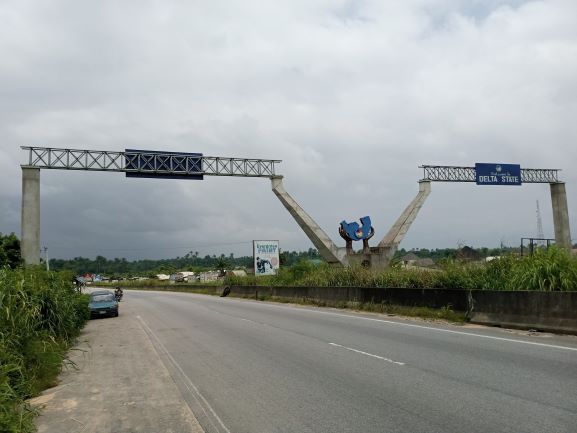
The Gateway Monument at the Patani boundary of Delta State is a mass of unpainted concrete and ironwork.
The “Welcome to Delta State” signboard hangs on atop the ironwork, but road leading to the projects is overtaken by bush and dirt.
As specified in the contract document, the gateway is to be partly adorned with tiles, and be painted, while royal palm trees are to be planted on both sides of the monument for two kilometres. But the gateway construction is a far cry from the project specification.
Similarly, residents of Ugbenu, a community that shares a boundary with Ologbo in Delta State, drink from their river due to the absence of portable water.
Movement is also a nightmare in the community when it rains because there are no motor-able roads. The gateway located in Ugbenu has also been overtaken by bush.
Picture of gateway project at Ologbo hurried painted following the investigation, by Iteveh Ekpokpobe. Photo shot on October 4, 2020 at 06:50am.
In the same vein, the Gateway Monument sited at Alifikede entrance point has been abandoned, just as the people of Alifikede community have been left to their fate by the state government. The project is only a mass of concrete and metal. It is not painted as stipulated in the contract document. Neither are there royal palm trees lining a two kilometre stretch of the road.
The last of the four projects seems to be the worst. It is sited at Asaba Head Bridge entrance. This Gateway Monument, approved for construction three years ago, is a caricature of what it should be. It has just three uncompleted concrete poles and work scaffolds can be seen hugging each of the three concrete poles.
Located between the police checkpoint and the overhead bridge, the project cannot be recognised by any passer-by for what it was intended to be.
According to the project specification, “by the design, the wings of the monuments are to spread across the road, with the centre median bearing the monuments.”
Details of project approval documents
In a memo dated 20th June, 2017, the Delta State Governor Senator Ifeanyi Okowa approved for construction of Gateway Monuments for four entry points into the state, which are the Niger Overhead Bridge, Asaba-Alifikede Entrance Point, Patani Entrance Point and Ologbo Boundary Point.
Copies of the memo approving the projects.
Copies of the memo approving the projects.
The contract was awarded to ZCI Concrete Industry at a cost of N123,059,370 only (One Hundred And Twenty Three Million, Fifty-Nine Thousand, Three Hundred And Seventy Naira) only.
The ZCI Concrete Industry was incorporated in Oshimili South, DeltaState with registration number DE26413 according to details available in NG.Check.com.
It was registered on the 12th of March, 2013, and its current status is unknown. The company’s registered address is KM 10, Benin- Onitsha Express Way Asaba, Oshimili South, Delta State.
In the aforementioned memo signed by the Executive Assistant to the Governor on Beautification, Chief Grace Aghoghovbia, the contract details indicate that each of the 4 Gateway Monuments cost 30 million naira.
A further breakdown shows that construction of each Gateway Monument was pegged at N24 million, while planting of royal palms along the road for a stretch of two kilometres would cost N6 million.
What happened to the funds?
Although all the funds have been released in 2017, as confirmed by a source in the Accountant General’s Office, three years after, the contract is still designated as on-going and at a completion stage of about 60 per cent.
In the same vein, the royal palms approved for planting on both sides of the road (a two kilometre stretch) for the four Gateways are nowhere to be seen.
Picture of gateway project at Head Bridge, Asaba, taken August 19, 2020 at 1.14pm by Iteveh Ekpokpobe.
A source in the office of the Executive Assistant on Beautification alleged that the non-completion of the four projects may be due to the fact that 30 per cent of the contract sum was deducted at the office of the Accountant General of the State.
When contacted, the former Accountant-General of Delta State, Mr. Cyril Agbeye, under whose tenure the project was approved, declined comments.
The same message was sent to him on October 7, 2020 via WhatsApp. “I have your contact my friend. What is the issue?,” he responded.
The reporter asked him to respond to the accusation of 30 percent deduction on payment for the gateway project which caused the delay in execution.
He read the questions, but that was the last time the reporter heard from him. He was contacted again on October 12, 2020 via whatsapp but did not reply.
Subsequently, calls placed on his cell phone number were not answered.
If the allegation of 30 per cent deduction is true, then over N36 million was deducted by the office of the Accountant General. This also means that the completion of the projects pegged at N123 million would be unachievable, since 24 million naira was the actual sum proposed for planting of the royal palms.
The incumbent Accountant General of the state, Mrs Joy Enwa, when contacted by our reporter also refused to comment on the matter. Text and whatsapp messages sent to her were ignored.
The message was read on whatsapp. The blue lines on WhatsApp indicates that he read the message. Subsequently, calls placed to her cell phone were not answered.
Faulty procurement plan
That the project execution is poor can also be attributed to the fact that the procurement process was faulty, even though key government officials have refused to talk about the contract.
The Director General, Delta State Bureau for Public Procurement, Dr. Duke Okezi, said he was not in office when the contract was approved hence he could not speak about it.
Picture of gateway project at Patani, taken on September 18, 2020 at 11.54am by Iteveh Ekpokpobe.
However, as contained in the contract approval memo signed by Aghoghovbia, it is obvious that ZCI Concrete Industry was awarded all four projects without following any procurement process.
In the memo, the governor’s aide wrote, “the company, ZCI Concrete Industry has proposed to beautify four strategic main entrances with monuments, featuring the Delta State map, the new logo and cultural touch to give Deltans as well as visitors a special feel as they enter the state.”
ZCI was hand-picked by Aghoghovbia whose office awarded the contract. Following series of inquiries by our reporter, the project in Ologbo was hurriedly painted four weeks ago.
Meanwhile, all efforts to reach the contractor proved abortive. Calls placed across as well as text messages were neither answered nor responded to.
Condemning the procurement process, Mr Kehinde Taiga, of the state branch of Committee for Defense of Human Rights (CDHR), said the contract should be reviewed with the contractor called to order and prosecuted according to the Procurement laws of the state which recommends three to five years jail term for defaulting on procurement agreements.
Mr Taiga said the procurement process was obviously done to serve political interest based on contribution to election.
“This is a contract that is supposed to add colour to the state. It is sad that the majority of contracts issued by the state government are fraudulently done, hence projects are abandoned or done shabbily.” He added.
Disrespect for Due Process Our Bane – CSO
Also, a Civil Society Organisation, Publish What You Pay (PWYP), frowned at the irregularities shrouding project execution and financing in the state.
The Coordinator of the organisation, Faith Nwadishi, said the issue of corruption and lack of respect for due process or laws has become endemic in the governance processes, adding that development would remain stunted in this regard.
According to her, “These are issues we have been shouting ourselves hoarse about. The issue of corruption and lack of respect for due process or laws in the country has become endemic in the governance processes”.
Grace Aghoghovbi refuses to comment on the project
Aghoghovbia, who awarded the beautification contract, declined comment. She did not answer her call and responded to messages.
However, in a case of mistaken identity, she called the reporter back asking if he was from her community since she included his name in a list of those to benefit from a government empowerment programme.
When our reporter eventually introduced himself, she promised to call back but never did, “Are you from Oviri Olomu? When we were giving names from Oviri Olomu for a list, I included your name. I will have to ask the admin to remove it,” she said
When asked why she did not respond to the earlier inquiry she said, “I wouldn’t have seen the text because I am abroad. Let me call you back. I will call you back. Is it possible for you to send the message via Whatsapp?” That was the last time she communicated with our reporter. All messages sent to her via WhatsApp were read but not replied to.
However, the Chief Press Secretary, CPS, to the Governor, Mr. Olise Ifejika, told the reporter that the lady in charge of the project was indisposed as she was in the United Kingdom for medical attention.
“I have told you about her state. If you ask anybody who knows her, that is the truth. She left this country early February. She is going blind even now. Even that surgery, they have not been able to do it. At the time it should have been done before Covid-19 came in. She is still in the United Kingdom.”
Speaking on the projects, Olise said out of four, three were on-going, adding that there must be a reason for the delay. “I think it is one thing at a time. It cannot be that it won’t be done. This government is transparent enough.”
A civil engineer with over five years in the construction industry, Engineer Terry Ighoro said the cost per project is pegged at N2,904,000 with minimal profit even with the current dollar rate.
In total, the sum of N11,616,000 million will cover for the four projects.
In his quotation, Engineer Ighoro stated that while N350, 000 could construct each of the wing rails with a total of N700,000, the Delta State map and design by artist goes for N300,000.
“Fifty bags of cement can cover each of the projects at N3000 per bag totaling N150, 000. Fifty 12mm rods at N3000 per rod including transportation is N150,000. Granite gravel, a trailer load is N250,000 although a trailer load will be too much for each of the projects.”
“Two trailer loads of sharp sand at N50,000, At most, two tankers load of water at N10,000 per truck totals N20,000. For the painting, N100,000 can cover for both buckets of paint and labour. Four cartons of tiles for the base at 5,000 per carton totals N20,000. Goodbye and welcome to Delta State signpost mounted on the wing rails at N75,000 each totals N150,000. Overall Labour and supervision is pegged at N400,000 while Miscellaneous is pegged at N264, 000.”
Ighoro said the project duration was not supposed to exceed six months if the funds were available.
* This investigation is supported by the John D. and Catherine T. MacArthur Foundation and the International Centre for Investigative Reporting (ICIR).
PRESIDENT Donald Trump’s supporters on Wednesday unleashed mayhem at the Capitol Hill as US legislators prepared to certify Joe Biden as president.
The violence happened after weeks of incitement by Trump who lost to Biden at the presidential election in November 2020.
The protesters engaged the US police in fisticuffs with a view to stopping Vice President Mike Pence and legislators from certifying Biden as president.
In the US tradition, the vice-president has the ceremonial responsibility to open the presidential election results’ envelopes and certify whoever won at the Electoral College stage.
The Electoral College met on December 14 to certify Biden as winner of the presidential election after he had won popular votes and battle states in November.
Weeks after losing the US presidential election to Biden, Trump has made unfounded claims about winning the election, inciting his band of supporters into rejecting the election result that did not favour him and encouraging them to fight for him. Trump has repeatedly claimed that he was rigged out by the Democratic Party even after Biden’s win was certified by the Electoral College in line with the US constitution.
He has also asked for recounts in several key states, including the hitherto Republican-dominated Georgia, but Republican election officials in the state have rejected Trump’s absurd claims.
Several courts have thrown out Trump’s unfounded claims of election fraud, including the Supreme Court where he has some of his appointees.
Trump has called for violence since he lost the election. On Tuesday, one Will Chamberlain tweeted, “Republican confirmed Justice Barrett, which they had the clear, lawful right to do, and in response Chuck Schumer said ‘Everything is on the table now.’ If that’s the case, why shouldn’t Republican legislators go to the wall for the president.” In response, Trump replied, Get smart Republicans. Fight.”
Trump severally encouraged his supporters to demonstrate on January 6 in Washington DC— the day the joint House and Senate would certify Biden as president.
On January 1 this year, Trump had tweeted, “The Big Protest Rally in Washington D.C, will take place at 11.00 AM on January 6th. Locational details to follow. StopTheSteal.”
Trump supporters did not observe the curfew imposed at 6pm in Washington D.C.
Trump, in response to the protest, tweeted, “These are the things and events that happen when a sacred landslide election victory is so unceremoniously & viciously stripped away from great patriots who have been badly& unfairly treated for so long. Go home with love & in peace. Remember this day forever.”
The outgoing US president also criticised his vice president for failing to do his bidding, which was to overturn the presidential election. Pence has no constitutional right to do so, according to experts.
“Mike Pence didn’t have the courage to do what should have been done to protect our country and our constitution, giving states a chance to certify a corrected set of facts, not the fraudulent or inaccurate ones which they were asked to previously certify. USA demands the truth,” Trump further tweeted,
The 2020 US election has polarised the world’s biggest democracy as Trump refuses to accept the reality of his failure.
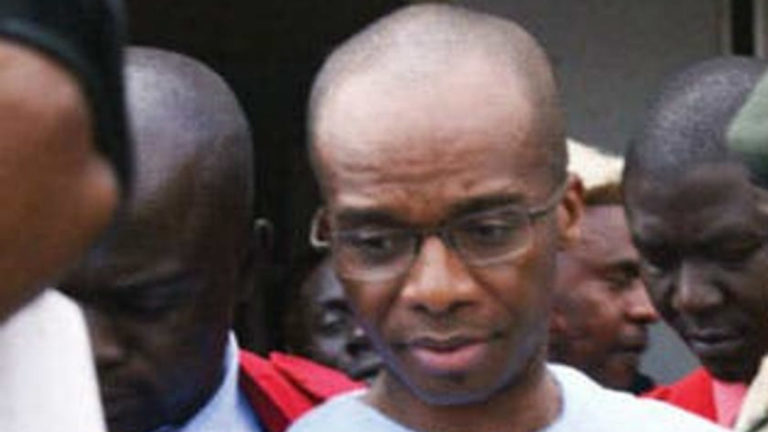
A former managing director of the defunct Finbank Plc, Okey Nwosu, has been jailed for three years by a Lagos court.
Nwosu was jailed alongside three past Finbank directors, Dayo Famoroti, Danjuma Ocholi and Agnes Ebubedike, for stealing N18 billion belonging to the bank and its customers.
Justice Lateefat Okunnu handed down the sentence on Tuesday after finding Nwosu and the former directors guilty of stealing and illegal conversion in a 26-count charge brought by the Economic and Financial Crimes Commission (EFCC).
Justice Okunnu also ordered the four convicted individuals to refund the amount stolen from the bank.
While Nwosu and Famoroti were jailed for three years, Ocholi was sentenced to 12 months in prison. However, Ebubedike was sentenced to six months of community service.
How it started
In 2009, the then Central Bank of Nigeria governor, Lamido Sanusi Lamido, wrote to the EFCC, asking the anti-graft agency to prosecute Nwosu for allegedly stealing N18billion. Sanusi had also asked the agency to take legal actions against Erastus Akingbola, former MD of the defunct Intercontinental Bank, for allegedly stealing N47.1bn, and Francis Atuche, former MD of the defunct Bank PHB, for allegedly stealing N25.7 billion. After several years of delay by courts and lawyers, the Supreme Court, in 2016, ordered Nwosu and the three directors to face trial at the Lagos court.
The four individuals had, after the commencement of the trial at the Lagos court, rushed to the Court of Appeal to contest the jurisdiction of the court to handle the case.
An appeal court in Lagos had ruled that the Lagos High Court lacked the jurisdiction to handle the case and subsequently freed the accused persons brought to the court by the EFCC.
The case was later stalled for three and a half years before it was re-started in September 2020. On the other hand, Akingbola has been in and out of the courts since 2009, and was re-arraigned by the EFCC in 2019 on N179 billion fraud charges.
After several years without success, Atuche was re-arraigned by the EFCC on N125 billion fraud charges in 2017. His case is still in court. In January 2020, he bought Ibrahim Babangida’s Lagos house with a view to starting a firm known as Hubmart Shoes.