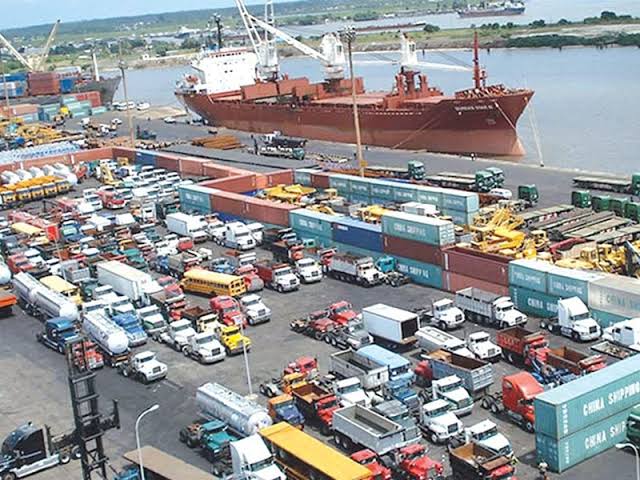
THE African Continental Free Trade Area (AfCFTA) started on January 1 this year with a view to expanding intra-African trade and removing barriers to economic cooperation.
The essence of the AfCFTA is to create a borderless Africa where trade and commodities can freely flow without customs restrictions.
Since the AfCFTA will redefine the way Nigerians live, The ICIR has compiled a list of 10 facts you must know as the continental free trade gears up.
The first fact is that the AfCFTA was signed by 55 African countries except for Eritrea.
The second fact is that there will be fewer restrictions on export products from Nigeria to African countries and imports from African countries into Nigeria, going forward.
The third fact is that intra-African trade was 15 percent in 2019, while intra-European trade stood at 68 percent. On the other hand, intra-Asian trade was 59 percent within the same period. This means that Africa is not trading so much with each other.
Fourth is that the size of African economy is $2.6 trillion, but the AfCFTA is estimated to increase this to $6.7 trillion by 2030 if the free trade treaty becomes successful.
Fifth is that Nigeria ratified the AfCFTA on November 12, 2020, making Africa’s most populous nation a signatory to the trade treaty.
The sixth fact is that there is Anti-Dumping Agreement in line with the World Trade Organisation (WTO)’s rules on Article V1 of General Agreement on Tariffs and Trade (GATT) of 1994. This means that it is a breach of the agreement for countries to turn Nigeria into a dumping ground for their products.
Seventh, the Nigerian Customs Service has a right to apply anti-dumping measures if it feels that countries are dumping products into the country.
Eighth, there are rules of origin, meaning that goods from any African country will be given preferential treatment while products from outside Africa will not, according to Article 13 of the Agreement prepared by the African Union.
Ninth, in line with Article 28 of the Agreement, Nigeria can adopt restrictions if its balance of payment position is in dire deficit or if its economy is in dire straits.
Tenth, countries can apply for amendments from time to time.
In what looks like an endless circle of deception, Hadejia Jama’are River Basin Development Authority continue to receive millions of naira in yearly allocation on poorly executed and fraudulent irrigation projects in Bauchi, Jigawa and Kano States; WikkiTimes’ investigation has revealed.
Mallam Bello Aliyu is always anxious whenever the rains are over, and dry season sets in.
“We remain at home and wait for another raining season to be able to farm again or we look for an alternative source of water supply,” says Aliyu, a small-scale farmer in Kanye Babba, Babura Local Government Area (LGA) of Jigawa state.
Shuwaki, Kanye Babba and Jama’are communities in Tudun-Wada, Babura and Jama’are Local Government Areas (LGAs) of Kano, Jigawa and Bauchi states continue to decry government’s neglect despite being predominantly agrarian. Without access to irrigation farming, farmers like Aliyu are rendered jobless whenever the dry season sets in.
Irrigation practices which give room for year-round farming has been neglected in Nigeria despite huge amount of resources thrown at it by the government. Irrigation potential estimates in Nigeria vary from 1.5 to 3.2 million acres, says the World Bank in its 2014 report. The latest estimate gives a total of about 2.3 million acres, of which over 1 million acres are in the North.
Putting it into context, the level of abundant water resources and investment in the sector does not correlate with the state of neglect of farming communities in the country.
One of such investments is the failed ₦176 million Hadejia Jama’are River Basin Pivot Scheme meant to enable irrigation farming practice in three communities across three states namely Shuwaki, in Tudun Wada LGA (Kano), Kanye Babba in Babura LGA (Jigawa) and Jama’are LGA (Bauchi).
The project’s intention is to aid subsistence farming, as well as improve food security, a major focus of the current administration. However, this is not the case due to project’s failure as most farmers in these communities continue to lament government neglect in providing irrigation support for them.
In the 2018 and 2019 national budgets, the Hadejia Jama’are River Basin Development Authority (HJRBDA), an agency under the Federal Ministry of Water Resources, proposed the construction of a center-pivot irrigation sprinkler.
A center-pivot irrigation system is a modern and mechanized irrigation method consisting of several pipes to convey water, as well as sprinklers supported by trusses and mouthed on wheels. This method of irrigation increases crops yields while also conserving water unlike flood and drip-well irrigation.
The project started only to be abandoned later, though funding continues, investigation by WikkiTimes has shown. The project, which received over N87 million as funding from the Federal Government was awarded to Isa Halilu Nigeria Limited, Triple K. Construction Company and Potentzia Seed Limited, records from open treasury portal show.
Painful lies we were told – residents
A visit to Kanye Babba community in Babura LGA, Jigawa State, one of the project locations, revealed that food insecurity is evident across the communities.
The project was moved from the Hadeija LGA, the location initially stated in the budget.
According to the community’s secretary, Ibrahim Yunusa, HJRBDA officials visited them and proposed the irrigation project.
Thereafter they requested for land, and vouched to acquire a large expanse for the project but that was the last time the residents heard from them since 2018, Yanusa said.
Bello Aliyu, a retired civil servant and the Kanye Babba (district adviser on religious matters), said farmers often travel to neighboring states including Kano, Taraba, and even Benue to get necessary irrigation support such as drip-well, manual and localized irrigation.
The same experience was observed in Shuwaki community in Tudun-Wada LGA, Kano State. Armayau Kwaringoshi is one of the residents of the community who had high hopes when the project commenced.
He expressed his disappointment in the project, adding that community members were hopeful when they were informed about the irrigation scheme and when the contractor moved to site.
Kwaringoshi, however, lamented that the project has been left in its present state shortly before the 2019 general election.
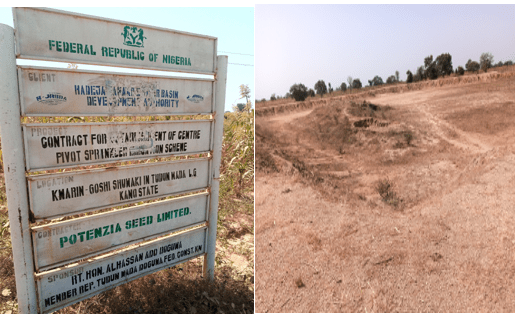
Tundun Wada LGA project Site
They only came back in March 2020 to move all their equipment. We have not seen them since then,” he said.
Another resident, Ya’u Namadi Shuwaki, corroborates Armayau’s statement.
He said he was informed by the contractor and an official of the River Basin Development that there is a change of project from the initially proposed center pivot sprinkler to the provision of boreholes in different farmlands within each project community.
In Jama’are LGA, the story remains the same.
A visit by this newspaper to the project site shows that many were abandoned.
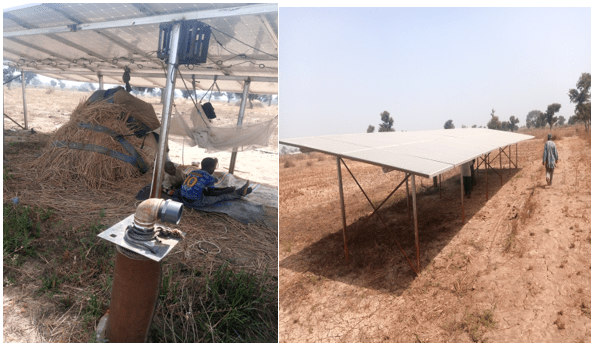
There were two installed solar panels on both sides of the farmland where the project is situated. There were also borehole pipes sunk into the ground, apparently meant for water supply to the farmland.
Mustapha Umar, engineering officer of HJRBDA, explained that the project was changed due to the unsuitability of the project site.
“It is a flood-prone area, and that was why the contractor could not do anything there, especially the installation of the center pivot irrigation sprinkler.
It was later changed, considering the high level of flooding which always affects the area during raining season. So they swapped the project for drip-well irrigation,” he said.
Installed solar and borehole at Jama’are project site wasting away
Furthermore, Umar said that the agency has since then dug over 50 boreholes at every 40 meters of every acre, providing water for each acre of farmland for farmers, using generators and pumping machines. He disclosed that farmers fuel the generating set since the cost of fueling the machines wasn’t provided for in the agency’s budget.
According to him, each of the drip-well boreholes has been functioning well as each farmer was given a water-pumping generator as an aid to use in pumping water daily.
This invariably runs contrary to the intention of the pivot irrigation scheme and brings into the question whether appropriate feasibility studies and environmental assessment was done, said Bello Gambari, an irrigation expert.
“Drip well irrigation is one of the cheapest irrigation system available in Nigeria but leaving the farmers to cater for the fueling wasn’t well thought out considering the already dire situation most rural farmers find themselves in financially,” Gambari said.
He explained that drip well cost around N50, 000 to N70, 000 depending on the size of the sumo used since most drip-wells are handmade.
Even then, Umar’s claim is difficult to believe. Findings showed that he owns acres of farmland which the wells serve, at the exclusion of other farmers. Aside Umar who claimed to be a beneficiary, attempts by this newspaper to locate other beneficiaries were futile.
Ibrahim Danjuma is a popular farmer in the area. When asked about the project, he said: “I don’t know anything about the project. I have not benefitted from any irrigation project. The land is not accessible so we don’t go there to even farm.”
False hope and lies by contractors
A breakdown of the amount expended on the contract showed that Isa Halilu Nigeria Limited was paid N18,550,054.43; Tripple K. Construction Company Limited and Potenzia Seed Limited received N36,190,476.20, and N33,178,756.28 respectively.
This reporter met with Haythman Yahaya, the Manager of Tripple K. Construction Company located at 7, Dorowa Street, off Audu Bako way, Nassarrawa LGA Kano State to enquire about the project abandonment in Kanye Babba. He chronicled how the project started, adding that the company had to stop the project due to no fault of theirs.
Yahaya explained that the company was only paid 15 percent mobilization fee and that that all the equipment needed for the project was imported from China without additional funding.
“After we were paid the mobilization fee we proceeded to clear and prepare the project site for the commencement of work. However, funding stalled and the equipment worth over N15 million imported from China for the project is left to waste,” he disclosed.
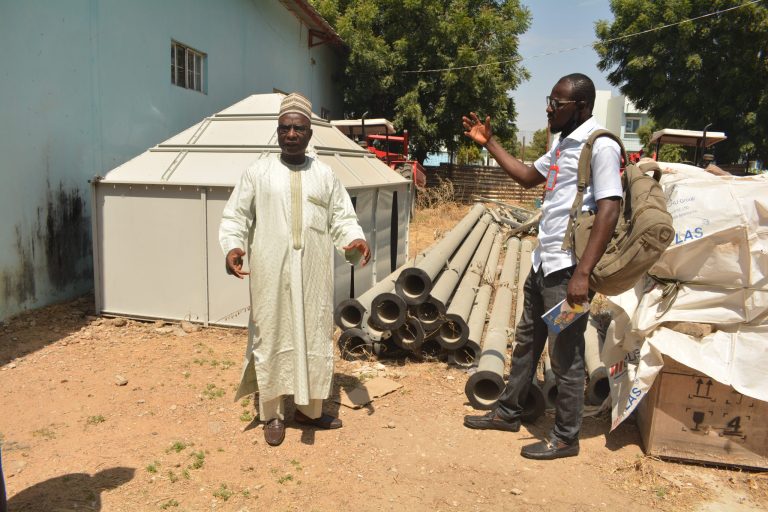
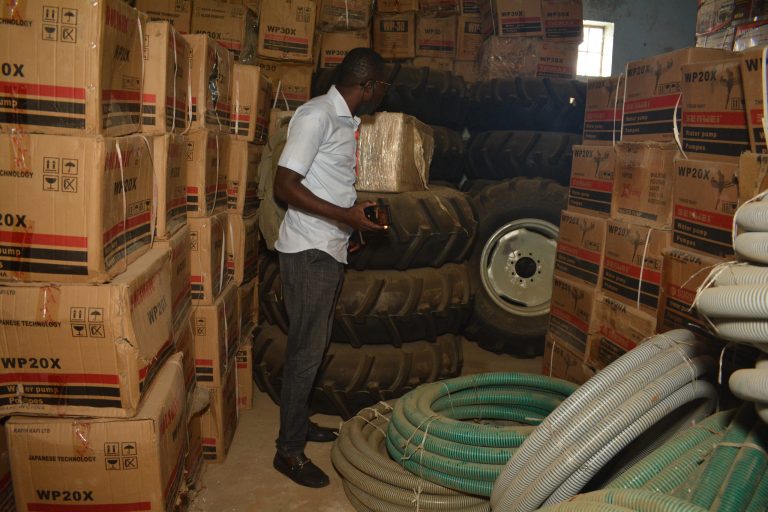
Engr Umar Showing the supplied equipment in the store house
Yahaya said the cost of acquiring the equipment is yet to be covered by the contracting agency, HJRBDA, and as such the company decided to abandon work.
Some of the Sprinkler equipment in a pity state in the store house at HJRBDA
“Until the agency pays back the money invested into the project and the contract fee, the company won’t return to site to continue the project,” he said
The River Basin Authority, however, did not dispute the fact that equipment was purchased. It added that the challenges of theft, vandalism and maintenance were the main reason why the project in Kanye Babba was stalled.
Sani Mohammed, Director of Account of the agency could not explain the outstanding amount owed the contractor when questions concerning it were posed to him.
The Managing Director, Isa Halilu Nigeria Limited, Mohammed Sani, who was contracted to provide irrigation facilities in Jama’are, Jama’are LGA, Bauchi State, could not be bothered that the project he was paid N18,550,054.43 to execute has been abandoned.
Sani could not be reached after several weeks of visit by this reporter at his office located in Hauwau house, Gyadi Gyadi, Tarauni, Kano State. However, when contacted on phone Sani asked the reporter to direct questions to the HJRBDA for answers. He insisted he was not in the position to provide any information about the project to the reporter.
A Freedom of Information Act, FOIA, request sent to the company was received by one Isa Garo on October 19, 2020 with no response weeks after the request was made.
The FOI Act (FOIA) 2011 stipulates that response to requests should be made available promptly, but in any event, not later than 7 days from the date of receipt of the request. Furthermore, section 2(7) of the FOIA provides that the act is “applicable to private companies utilizing public funds or providing public services or public function.”
The third contractor, Potenzia Seed Nigeria Limited’s address could not be located. On request, another address provided by HJRBDA at Plot 2, Sanni Marshal Road, Nassarawa LGA, Kano State belonged to another company. Also, a search on Nigeria’s company directory, Corporate Affairs Commission, CAC, was futile.
However, its project site which was said to have been cleared and ready for construction was left desolate depriving farmers of their farmlands.
Also a search in the Corporate Affairs Commission (CAC) to confirm the registration of Isa Halilu and Tripple K. construction limited proved abortive as both companies could not be found on the commission’s website, this contravenes the Public Procurement Act (BPP) (2007) which states that the minimum qualification for the awarding of any contract must be with a Proof of Registration with the Corporate Affairs Commission (CAC), a Tax Clearance from the Federal Inland Revenue Service (FIRS) for at least three years and Pension Clearance Certificate from the Pension Commission (PenCom) among others.
Federal Agency Defrauding Farmers
In reaction to a FOIA request sent to the HJRBDA enquiring about the status of the project, the agency agreed to an interview granted by the Managing Director at its headquarters on Maiduguri Road, Hotoro, Kano State. His response was at variance with that of the contractors.
According to Abdullahi, the center pivot sprinkler project was appropriated in 2018 and commenced same year. He said the project was only proposed to be sited in Tudun-Wada, Jama’are, adding that Kanye Babba was originally not among the beneficiaries.
It was later included, Abdullahi said, because there were several irrigation projects in Hadejia where the project was initially situated.
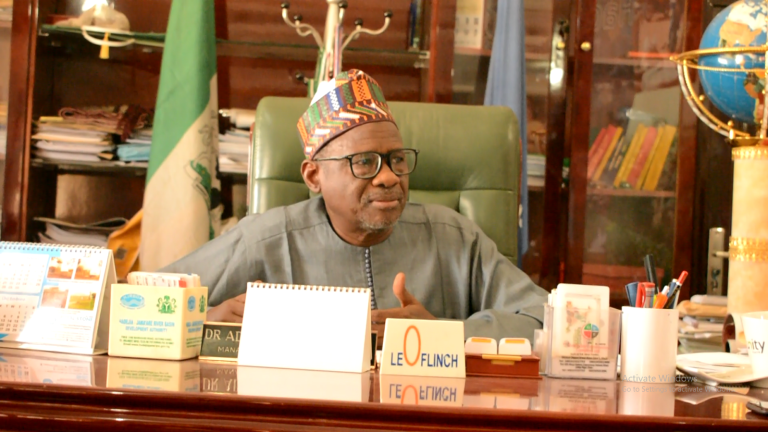
Dr. Ado Khalid Abdullahi, Managing director HJRBDA
When asked why the projects are stalled two years after the contracts were awarded, he explained that they are on-going project and are in phases, adding that he is pleased and impressed with the level of work carried out there, which he claims is at 80 percent completion.
Abdullahi also said the initially planned center pivot irrigation scheme was changed to drip-well irrigation and that over 40 drip wells have been dug. Some, he noted, were already serving farmers before the flooding which destroyed the farmlands and kept farmers away from farming for a very long time.
This naturally suggests that funding for the project should be reviewed downwards since the pivot irrigation is not as costly as the drip-well irrigation system, says Gambari.
But this was not the case. Abdullahi could not explain why the fund for a pivot irrigation project stated in the budget would be spent on drilling boreholes and buying pumping machines without any review of the procurement process.
When informed that the contractors were paid N87 million in 2019, he could not offer any concrete explanation. But he insisted the projects were near completion, despite contrary evidence.
Regardless, there is a lot more than meets the eyes in the matter. Engineer Ibrahim Abdullsalami Yakasai, Head of Procurement at HJRBDA, said the project was advertised in the national dailies specifically Daily Trust and had several bidders.
He further said the project advertised in the tender was actually the center pivot irrigation sprinkler and all contractors awarded the contract were selected on merit.
He however was not forth-coming on the procurement process when the project changed mid-way from the center pivot sprinkler to the drip well irrigation system. In his response, Yakasai stated that the need for change was necessary so as to avoid wastage of resources. But he also declined to provide additional information on the overall amount expended on the project.
A call to the members representing these local government at the National Assembly Allhassan Ado Doguwa representing Doguwa/Tudun-Wada and Isa Hassan Jama’are representing Jama’are/Itas-Gadau federal constituency by this Newspaper to get their opinion and awareness on the project was futile as their phone rang severally but it was not answered. Also, text messages sent to them in this regard, were not replied as at press time.
For Mike Falodun, an irrigation expert with International Institute of Tropical Agriculture (IITA), the project conception was poorly done.
He said although center pivot irrigation sprinkler is expensive to construct and seems more mechanized for irrigation farming, it is often prone to vandalism and poor maintenance in Nigeria.
Experts also argued that Nigeria will continue to face a lot of setbacks in its drive to ensure food security if such project abandonment, corruption and mismanagement of funds are not properly tackled.
Hamzat Lawal is the chief executive officer, Connected Development (CODE), an anti-corruption advocacy organization.
In an interview with WikkiTimes, Lawal explained that corruption is one major factor hindering government’s effort towards curbing food insecurity.
“Nigeria’s agricultural sector would have been the largest sector in the whole of Africa, considering the nature of our soil and population as an advantage. We are faced with the evil corruption and until it is brought to its knees, we will continue to face a lot of setback in the agricultural sector as a country,” he said.
Development expert and project consultant, Nura Gazali, takes it further.
He explained that: “Corruption is one of the key issues affecting public projects and policies. It is one of the major impediments for implementation of projects across public sectors including the agricultural sector.”
“Food insecurity in Nigeria is continuously being aggravated by myriad factors, and poor conceptualization of project and corruption are among the two major causes for setbacks in the quest to ensure food security,” Gazali said.
* This investigation is supported by the John D. And Catherine T. MacArthur Foundation and the International Center for Investigative Reporting.
THE Manufacturers Association of Nigeria (MAN) has told the federal government that any attempt to hike electricity tariff will worsen the state of the sector.
In a press release on Thursday signed by its director-general, Segun Ajayi-Kadir, the association said the news of federal government’s directive to the National Electricity Regulatory Commission (NERC) to suspend the implementation of the duly performed minor review from N2 per kWh to N4 per kWh till the conclusion of the Joint Ad Hoc Committee’s work at the end of January 2021 was only a temporary relief.
MAN said even though the increase could be reconsidered during this period, there was no doubt that the NERC was anticipating an increase in electricity tariff before the slight adjustment. “Apparently, the three weeks respite is to accommodate the spirit of the agreement between Labour and the federal government on tariff increase started last year,” MAN said.
“This is why the calls for circumspection and pragmatism in the matter of increase remain relevant. No matter what becomes the outcome of the Ad-Hoc Committee’s work, an increase at this time is ill-timed and not manufacturing friendly,” the statement noted. MAN said the federal government’s reasons for suspending the tariff should have included consultations with other economic actors, including manufacturers who were major electricity consumers and whose businesses would be most impacted by the increase.
“As indicated in the previous press release, the sector is already groaning under inclement operating environment, including the debilitating impact of COVID-19 disruptions and deteriorating infrastructures. It is important for us to avoid this additional burden,” the statement further said. In a previous statement, MAN had said that substantial increase in electricity would increase production cost, forcing manufacturers to seek expensive alternative energy sources to meet electricity requirements.
“It will lead to decrease in foreign exchange earnings from the sector as high cost of production feeds into export commodity prices,” MAN also said. The association said it would further reduce capacity utilisation in the sector, leading to GDP decline and large-scale unemployment across the 76 manufacturing sub-sectors.
State of Nigeria’s manufacturing sector
Nigeria’s manufacturing sector is hard hit by high energy cost due to irregular power supply from electricity distribution companies. Many of them have resorted to self-generated energy such as gas, low-pour fuel oil and coal, with self-generating capacity of Nigerian manufacturers now estimated at 13,000 megawatts, according to MAN. Members of MAN spent N34.70 billion on alternative power sources in the last six months of 2019, according to a survey done by the association in 2019.
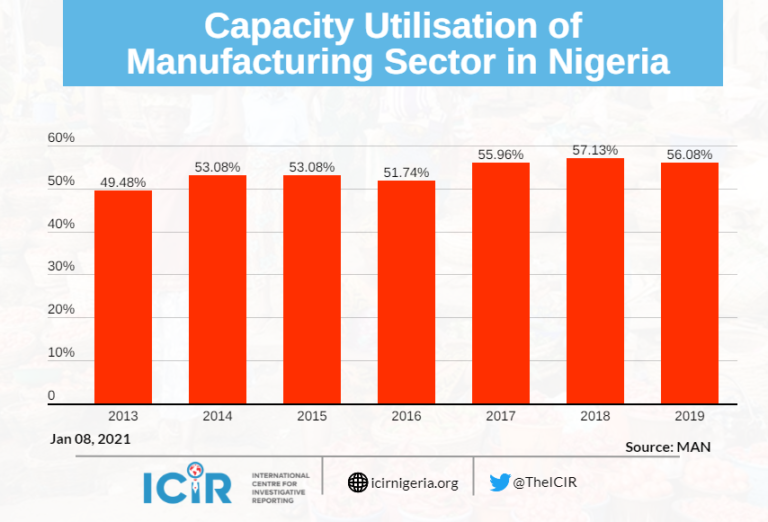
Capacity utilisation in the sector averaged 56.8 percent in 2019, which was a 0.95 percentage increase from 57.75 percent reported in 2018, MAN said. Capacity utilisation is the rate at which firms use their installed capacity. From 2013 to 2019, capacity utilisation moved from 49.48 percent to 56.8 percent, according to MAN’s data. The sector lost 1,308 jobs in the last six months of 2019, according to MAN.
Apart from energy, the state of Nigeria’s seaports has dealt a blow on Nigerian manufacturers. Access road to two major ports in Lagos cannot be easily accessed due to congestion, as the police, the Army, the Navy and the Lagos State government remain incapable of resolving the challenge. The ports also do not have functional scanners for examination of cargoes.
Vicky Haastrup, chairman, Seaport Terminal Operators Association of Nigeria (STOAN), recently condemned manual examination of cargoes at the Lagos port, saying that it was a sad situation. Haastrup, who spoke in Lagos during a virtual conference held in 2020, said, “We have a situation where people must visit the port physically to do Customs documentation and cargo examination before they can take delivery of their consignments. This is inefficient.”
“It is a shame that Nigerian ports do not have quality and functional scanners. That is why Customs relies on physical examination of containers, which drives human traffic into the port. We need to provide these scanners and other automation platforms in order to make cargo clearance quicker. Nigerian ports must operate the one-stop-shop platform if we must compete with other ports in the West and Central Africa,” she further said.
Light at the end of the tunnel
Several manufacturers did not perform well in the 2019 financial year due to COVID-19 restrictions, supply chains disruptions as well as bars and event centres’ closures. Brewers such as Nigerian Breweries, Guinness, International Breweries and Champion Breweries were heavily affected.
However, drug and food makers performed relatively well due to the essential nature of their products. In 2020 half year, Fidson Healthcare, a drug maker, reported a 12 percent rise in sales, from N7.3 billion to N8.2 billion in the corresponding period of 2019. Also, Glaxosmithkline (GSK)’s revenue in the first six months of 2020 rose 5 percent to N10.4 billion, from N9.9 billion the previous year. GSK is a key player in the pharmaceutical industry. For the food category, the revenue of Honeywell Flour Mills rose 39 percent to N26 billion in the second quarter of 2020, from N18 billion in the same period of 2019. Also, within the same period, Flour Mills of Nigeria’s revenue jumped 15 percent to N154 billion in 2020, from N134 billion reported in 2019.
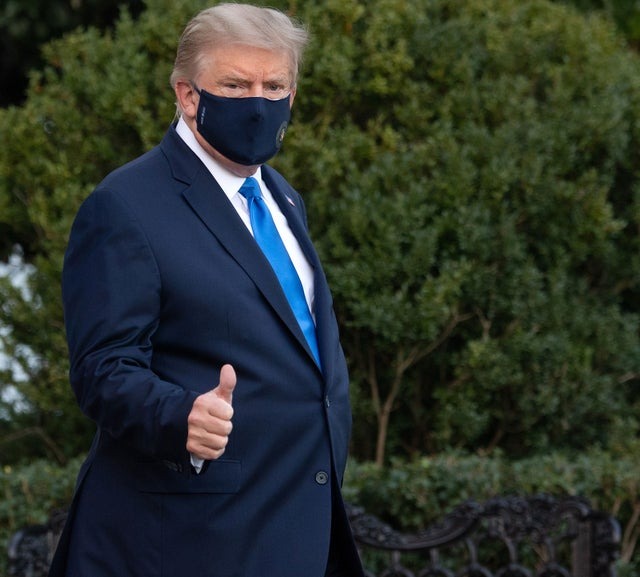
FACEBOOK, Instagram and Twitter have suspended Donald Trump’s accounts for inciting violence in Washington D.C. on Wednesday—the day the Congress was to certify Joe Biden as president.
The outgoing U.S. president was, on Thursday, banned from using both Facebook and Instagram indefinitely, according to Mark Zuckerberg, Facebook’s chief executive, in an issued statement.
Trump’s Twitter account had earlier been banned by Twitter on Wednesday for 12 hours starting at 7pm ET, but the account was still suspended 19 hours after when The ICIR checked.
According to Zuckerberg, the decision was to prevent Trump from using his accounts from undermining the ongoing peaceful transition of power to Joe Biden, US president-elect.
Since he lost the November presidential election to Biden, Trump has consistently used all of his social media platforms to instigate violence and to discredit the outcome of the election.
On Wednesday, hundreds of Trump’s supporters besieged the Capitol Hill to prevent the Congress from certifying the electoral victory of Biden held in November 2020.
The ensuing violence following the invasion, which has been widely condemned across the globe, led to the death of four persons with several others injured.
“The shocking events of the last 24 hours clearly demonstrate that President Donald Trump intends to use his remaining time in office to undermine the peaceful and lawful transition of power to his elected successor, Joe Biden,” Zuckerberg said.
“Over the last several years, we have allowed President Trump to use our platform consistent with our own rules, at times removing content or labelling his posts when they violate our policies. We did this because we believe that the public has a right to the broadest possible access to political speech, even controversial speech. But the current context is now fundamentally different, involving the use of our platform to incite violent insurrection against a democratically elected government.
“We believe the risks of allowing the president to continue to use our service during this period are simply too great. Therefore, we are extending the block we have placed on his Facebook and Instagram accounts indefinitely and for at least the next two weeks until the peaceful transition of power is complete.”
Zuckerberg noted with concern that Trump’s decision to use his platform to condone rather than condemn the actions of his supporters at the Capitol building had rightly disturbed people in the US and around the world.
While calling on the entire nation to ensure that the transitional process goes smoothly, he said that Facebook removed Trump’s “statements yesterday because we judged that their effect — and likely their intent — would be to provoke further violence.”
“Following the certification of the election results by Congress, the priority for the whole country must now be to ensure that the remaining 13 days and the days after inauguration pass peacefully and in accordance with established democratic norms.”
Similarly, Twitter punished Trump on Wednesday over a series of tweets that sought to cast doubt over the 2020 presidential race. One included a video in which Trump spread disinformation about the election’s outcome, even as he told rioters to leave the House and Senate at a time when lawmakers had started the certification of the election.
Twitter required Trump to delete the tweets to obtain access to his account, but it made clear it of plans to escalate its enforcement efforts and suspend the president permanently if he continues to break its rules.
Similarly, YouTube removed videos where Trump was making the inciteful comments on Wednesday’s evening.
THE federal government has reversed the recent adjustment of electricity tariff for selected sections of electricity consumers in the country.
The ICIR had, on Tuesday, reported how the Nigerian Electricity Regulatory Commission (NERC) announced an adjustment rate for service bands A, B, C, D and E “by NGN2.00 to NGN4.00 per kWhr to reflect the partial impact of inflation & movement in forex.”
But on Thursday, Saleh Mamman, Nigeria’s minister of power, through a statement by his senior special adviser, media and communications, Aaron Artimas, informed all Electricity Distribution Companies(DISCOs) to revert to tariffs that were applicable in Dec. 2020.
The decision, according to the News Agency of Nigeria (NAN), was to constructively conclude the ongoing dialogue between Labour leaders and representatives of the government.
“I have directed NERC to inform all DISCOs that they should revert to the tariffs that were applicable in December 2020 until the end of January 2021 when the FGN and Labour committee work will be concluded.
“This will allow for the outcome of all resolutions from the Committee to be implemented together,” he said.
Mamman, who decried report of a 50 percent increase by sections of the media, noted that the government had continued to subsidise electricity consumers in bands D and E.
“I would like to affirm that these reports are inaccurate and false. It is unfortunate that these reports have led to confusion with the public.
“On the contrary, government continues to fully subsidise 55 per cent of on-grid consumers in bands D and E and maintain the lifeline tariff for the poor and underprivileged.
“Those citizens have experienced no changes to tariff rates from what they have paid historically, aside from the recent minor inflation and forex adjustment. Partial subsidies were also applied for bands A, B and C in October 2020,” he said.
While stating that these measures were all directed towards cushioning the economic impact of COVID-19 on citizens, the minister noted that the Buhari-led federal government and the labour union had been engaged in positive discussions about the electricity sector through a Joint Ad-hoc Committee.
He said that the committee was led by Festus Keyamo, minister of state for labour and productivity and co-chaired by the minister of state for power, Goddy Jedy-Agba.
According to him, progress had been made in these deliberations set to be concluded at the end of January.
“Some of the achievements of this deliberation with Labour are the accelerated rollout of the National Mass Metering Plan and clampdowns on estimated billing.
“It also included improved monitoring of the Service-Based Tariff and the reduction in tariff rates for bands A to C in October 2020 (that were funded by a creative use of taxes),” he said.
The power minister stated that the regulator must be allowed to perform its function without undue interference.
He said that the role of the government was not to set tariffs but to provide policy guidance and an enabling environment for the regulator to protect consumers and for investors to engage directly with consumers.
According to him, bi-annual minor reviews to adjust factors such as inflation are part of the process for a sustainable and investable Nigeria Electricity Supply Industry (NESI)
He also stated that the regulator must be commended for implementing the subsisting regulations while putting in place extensive actions to minimise the adverse impact on end-user tariffs.
“The administration is committed to creating a sustainable, growing and rules-based electricity market for the benefit of all Nigerians.
“The administration and the Ministry of Power will also continue to devise means to provide support for vulnerable Nigerians while ensuring we have a sustainable NESI,” he said.
At a time the Nigeria government is debating whether to increase electricity tariff or not, the Ghanaian government announced in a statement on Wednesday that it is providing 3-months free electricity units to its lifeline customers.
Lifeline customers are those who consume less electricity compared to other consumers.
Kwame Agyeman-Budu, managing director of the Electricity Company of Ghana Limited, who made it known in an issued statement on Tuesday, said the gesture was part of the government’s extended COVID-19 electricity relief.
ON February 28, 2020, Nigeria recorded its first case of the deadly COVID-19.
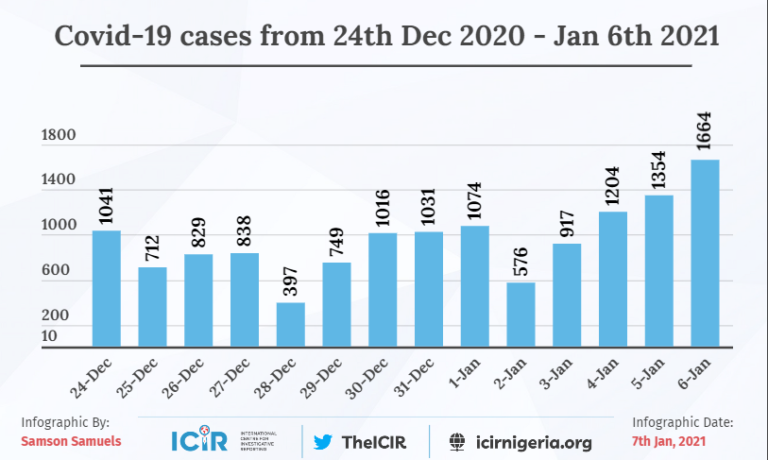
From that date to December 16 of last year, the country’s daily positive cases remained below 1,000. However, Africa’s most populous nation began to see daily cases above 1,000 from December 17 when it recorded 1,145 infections. The ICIR takes a look at how COVID-19 cases have surged to highest daily record in the last 14 days.
After recording its first over 1,000 cases on December 17, the following five days showed a decrease in the number to as low as 356 daily cases on December 21, 2020. However, the number of infections rose to 1,133 daily cases on December 23.
On December 25, the Christmas day, Nigeria recorded a total of 712 cases, a 32 percent fall from 1,041 reported the previous day.
On December 26, total number of cases increased to 829. The number of new cases rose to 832 on December 27, another increase from the previous day.
On December 28, however, there was a sharp decrease from 832 to 397 cases, more than half of what was recorded the previous day. But cases spiked again the following day, with the Nigeria Centre for Disease Control (NCDC) announcing that 749 cases were confirmed, almost double of cases from the previous day.
8836 cases in eight days
During the end of December 2020, the number of confirmed cases increased in the nation as NCDC confirmed 1,016 cases on December 30 and 1,031 on the last day of 2020.
On the 2021 New Year day, the NCDC announced another increase in the figures as 1,074 cases were confirmed positive of the deadly virus.
However, on January 2, 2021, there was a massive decrease in the number as only 576 cases were confirmed, but the decrease was short-lived following an update from the NCDC that 917 cases were confirmed on January 3.
The increase continued on January 4 when NCDC announced that 1,204 persons tested positive for the virus.
On 5th January 1,354 persons were again confirmed positive of COVID-19 while 1,664 persons tested positive on January 6, which currently represents the highest record number of daily cases in Nigeria.
In just eight days, Nigeria recorded 8,836 positive cases. Meanwhile, it took the nation more than three months to record 8,000 cases in the early days of the pandemic.
As of the time of filing this report, Lagos State leads in the number of confirmed cases in Nigeria with 32,687 infections, followed by the Federal Capital Territory (FCT) with 12, 428 of positive cases.
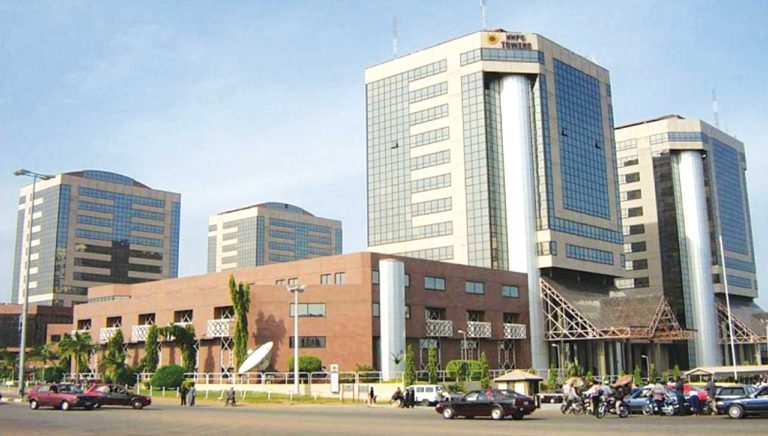
THE Nigeria National Petroleum Corporation (NNPC) is seeking to raise $1 billion from several trading firms with the option of a prepayment plan to revamp its largest refining complex situated in Port Harcourt.
This was revealed in a Reuters report, which hinted that the overhauling of the entire refinery would reduce Nigeria’s huge fuel import bill if the financing was concluded,.
Funding for the rehabilitation of the refinery is expected to come from a consortium of investors to be led by Cairo-based Afreximbank marking a second major oil-backed financing for the country since COVID-19 pandemic.
“Afreximbank is looking into a facility for the refurbishment of the Port Harcourt Refinery. However, the borrower is yet to be determined,” a source told the Reuters.
The money will be repaid over seven years through deliveries of Nigerian crude and products from the refinery once the refurbishment is complete, the sources stated.
However, the NNPC 2018 annual financial accounts show that the three major refineries reported a combined loss of N154.4 billion, with Kaduna refinery posting zero revenue.
It also revealed that the Port Harcourt Refinery marked a slump in its revenue estimated at N1.5 billion in 2018, indicating a 69 per cent drop compared to its earnings of N4.8 billion in 2017.
The Port Harcourt Refinery posted losses totaling N206 billion for five consecutive years starting in 2014, while a breakdown of its administrative expenses incurred within the period comprising salaries, guest house costs, overhead costs and others stood at N106 billion.
Nigeria is faced with the prospects of dwindling demand for oil as the country prepares to cut down oil production cost to $10 per barrel in 2021, from $15 to $35 per barrel last year, according to a report by S & P Splatts.
A PricewaterhouseCoopers 2020 report on Africa Oil and Gas Review stated that the top five oil majors in Africa experienced a $20 billion loss in export revenue in 2020, seeing an 11 per cent decline in production from 5.3 million barrels in 2019 to 4.2 million barrels in 2020.
Nigeria currently has four refineries with a combined capacity of 445,000 barrels per day located in Kaduna and three others in the Niger Delta cities of Warri and Port Harcourt. The Port Harcourt complex consists of two plants with a combined capacity of 210,000 barrels per day.
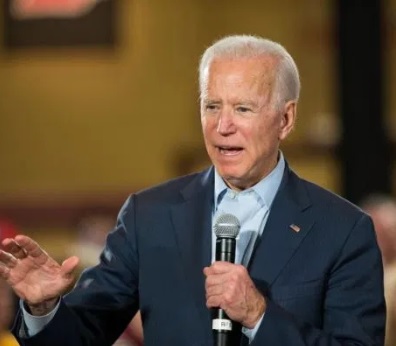
THE United States Congress has certified the Electoral College victory of Joe Biden, US president-elect, in the early hours of Wednesday.
The certification, which was presided over by Mike Pence, incumbent vice president, is a constitutional requirement by Congress in the United States electoral law to recognise the country’s incoming president and vice president.
The certification finalises the 2020 US electoral process and ensures that Joe Biden and Kamala Harris will be inaugurated on January 20, despite Trump’s weeks-long efforts to overturn the vote, including urging his supporters to converge on the Capitol on Wednesday, resulting in violence inside and outside the building.
The US Constitution requires Congress to count the votes of the Electoral College submitted by the states.
The Congress was to certify Biden’s 306 Electoral College votes. Trump, who has rejected the outcome of the election claiming the process was marred by voter fraud, polled 232 Electoral College votes.
Though a faction of Republican senators and House members had intended to object to Wednesday’s count of electors from key states that had given Biden the win, they were unable to present evidence of substantial fraud that would overturn the vote in any state.
The contested states were Arizona, Georgia, Pennsylvania, Michigan and Wisconsin. Courts have repeatedly dismissed dozens of Trump’s legal claims.
Instead, the House and the Senate, which reconvened on Wednesday night, voted to reject objections to Arizona’s vote. The Senate voted 93-6 to reject the objection to Arizona’s vote. The House voted 303 to 121 to dismiss the objection to Arizona.
A second objection to Pennsylvania’s vote pushed the process into the early hours of Thursday morning, with only 7 Senators approving it and 92 voting against. In the House, it was rejected 282 to 138, paving the way for the final certification.
On Wednesday, shortly before the certification exercise, Trump had made inciting comments to thousands of supporters outside the White House.
“If you don’t fight like hell, you’re not going to have a country anymore,” Trump had said.
Following his comments, his supporters thronged to the Capitol Hill and breached the facility with utter disdain to peace and order.
It took the intervention of security operatives to restore relative normalcy to the city.
A woman was reportedly shot dead while three other people died from medical emergencies.
The police said they recovered two pipe bombs from the Republican and Democratic Party offices near the Capitol, while about 52 people were arrested.
Republicans decried the mob action, and Democrats blamed Trump for inciting it.
“Today was ugly,” said Senator Ben Sasse, a Republican, said. “This building has been desecrated. Blood has been spilled in the hallways.”
Former President Barack Obama said in a tweet that violence at the Capitol was “incited by a sitting president who has continued to baselessly lie about the outcome of a lawful election.”
Former presidents George W Bush, Bill Clinton and Jimmy Carter also denounced the storming of the Capitol.
World leaders react
The Capitol Hill invasion has attracted wide condemnation for the Trump administration all over the globe with many calling for an orderly and peaceful transfer of power.
“Disgraceful scenes in U.S. Congress,” UK Prime Minister Boris Johnson tweeted. “The United States stands for democracy around the world and it is now vital that there should be a peaceful and orderly transfer of power.”
Disgraceful scenes in U.S. Congress. The United States stands for democracy around the world and it is now vital that there should be a peaceful and orderly transfer of power.
Nicola Sturgeon, the first minister of Scotland, tweeted that the “scenes from the Capitol are utterly horrifying.”
The scenes from the Capitol are utterly horrifying. Solidarity with those in 🇺🇸 on the side of democracy and the peaceful and constitutional transfer of power. Shame on those who have incited this attack on democracy.
Micheál Martin, the prime minister of Ireland, tweeted that he was watching the developments in the U.S. “with great concern and dismay.”
The Irish people have a deep connection with the United States of America, built up over many generations. I know that many, like me, will be watching the scenes unfolding in Washington DC with great concern and dismay. 🇮🇪 🇺🇸
Meanwhile, in a statement on Thursday, Trump promised an orderly transfer of power to Biden even though he disagrees with the outcome of the polls.
“Even though I totally disagree with the outcome of the election, and the facts bear me out, nevertheless there will be an orderly transition on January 20th,” he said.
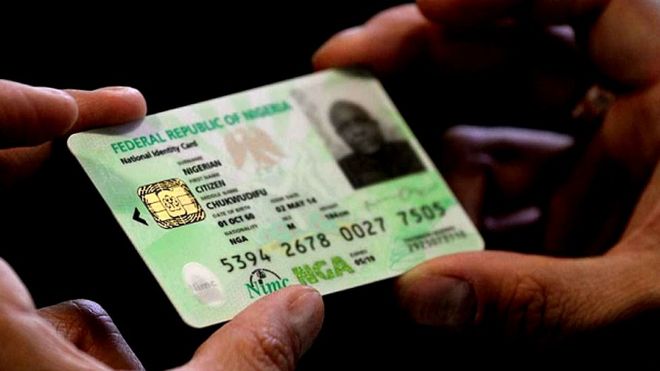
STAFF of the National Identity Management Commission (NIMC) on Thursday embarked on a nationwide strike, citing poor welfare conditions.
Their strike has temporarily put on hold the nationwide National Identity Numbers (NIN) registration recently ordered by the Nigerian Communications Commission (NCC).
The NCC had asked all telecoms companies to disconnect the SIM cards of all persons who had not linked their NINs to their phone lines by the end of January.
According to a report, NIMC staff also decried the lack of protective kits at their offices, saying they could get infected with COVID-19 as they attended to hundreds of residents daily.
In a notice of strike action signed by Lucky Michael, president of the Association of Senior Civil Servants of Nigeria (ASCSN), NIMC branch, and Odia Victor, secretary, the group hinted that the strike action was necessary to drive home their demands due to lack of personal protective equipment, irregularities in the promotion and poor funding provided for its members.
“Consequent upon the just concluded congress of the above-mentioned association that took place on January 6, 2020, the unit executive directs all members of grade level 12 and below in the head office and state offices to report to their respective duty posts tomorrow January 7, 2020, and do nothing.
“All members at the local government offices and special centres are advised to stay away from their various centres as a task force and implementation committees would be on parade to ensure total compliance with the directive,” a section of the notice stated.
The ICIR reached out to NIMC’s spokesperson, Kayode Adegoke, asking him the reasons for the strike action embarked on by NIMC, but he requested more time before he could speak on the issue.
“I can’t speak on this issue right now, just give me time and I will respond to you in due course,” he said.
About 42 million Nigerians currently have a NIN as of September 2020. However, the agency has been tasked with this assignment since its establishment in 2007.
Staff members of the NIMC were enjoined by the executives of ASCSN to participate in the strike action until their grievances were addressed.
“The congress agreed that the NIMC staff salary structure approved by the Federal Government vide presidential assent be implemented in the personnel appropriation of the 2021 annual budget effective January 2021.
“That the lopsided and irregular promotion done in 2017 and 2020 be reviewed, regularised and gazetted in accordance with public service rules,” the notice concluded.
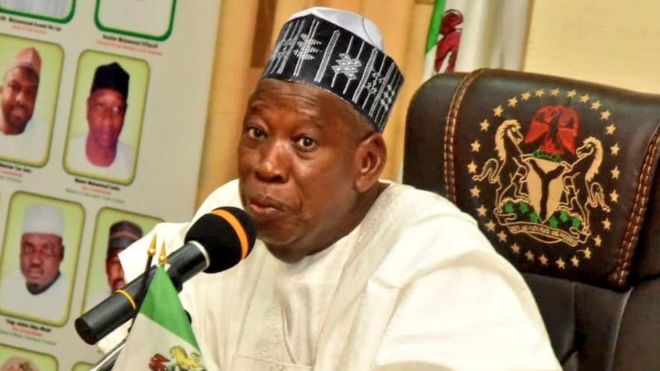
ABDULLAHI Umar Ganduje, Kano State governor, says his administration can no longer afford the payment of N30,000 minimum wage to the state’s civil servants owing to the country’s recession occasioned by the COVID-19 pandemic.
Salihu Tanko-Yakasai, special adviser to the governor on media, who confirmed this to newsmen on Wednesday, said the state was unable to continue paying N30,000 because what it was currently getting had reduced.
“Yes, the state government has stopped the payment of N30,000 minimum wage to its workers with immediate effect,” he said.
“The state government has reverted to the initial minimum wage due to the recession.
“What we are getting now as a government has reduced, and we can’t afford to pay the N30,000 minimum wage.”
President Muhammadu Buhari had in 2019 signed the N30,000 minimum wage bill into law following its passage by the National Assembly.
The ICIR understands that about seven states out of the nation’s thirty-six states, which include Kwara, Ekiti, Imo, Gombe, Kogi, Zamfara and Ebonyi, are yet to implement the wage law.
In November 2020, The ICIR had also reported how Nigeria slipped into its second recession under the Buhari-led administration in five years.
According to data from the National Bureau of Statistics (NBS), Nigeria’s economic growth contracted by -3.62 percent in the third quarter of 2020.
It means the second consecutive quarterly Gross Domestic Product (GDP) decline since the recession of 2016. The cumulative GDP for the first nine months of 2020, therefore, stood at -2.48 percent.
The last time Nigeria recorded such cumulative GDP was in 1987, when GDP declined by 10.8 percent.
The 2020 economic recession was predicted across the world as a fallout of the ongoing COVID-19 pandemic, which has affected all of the strongest nations of the world.
Reacting, the Socio-Economic Rights and Accountability Project (SERAP), in an open letter to the president, demanded a cut in the cost of governance.
SERAP charged the government to implement a bold transparency and accountability policy as a way of responding to the economic recession.
“This economic crisis provides an opportunity to prioritise access of poor and vulnerable Nigerians to basic socio-economic rights, and to genuinely re-commit to the fight against corruption. The country cannot afford to get back to business as usual,” the letter read in part.
Atiku Abubakar, a former vice president of Nigeria and candidate of the People’s Democratic Party (PDP) while commenting on the economic recession, said the proposed 2021 budget was no longer sustainable.
Atiku added that Nigeria should not continue to spend ‘lavishly’ because the country was financially broke already.
“Firstly, the proposed 2021 budget presented to the National Assembly on Tuesday, October 8, 2020, is no longer tenable. Nigeria neither has the resources, nor the need to implement such a luxury heavy budget. The nation is broke, but not broken. However, if we continue to spend lavishly, even when we do not earn commensurately, we would go from being a broke nation to being a broken nation,” Atiku said this, among other recommendations.
Meanwhile, the federal government announced in November, 2020, that it was proposing the exemption of minimum wage earners from paying the personal income tax as a way of reducing the impact of the economic recession on Nigerians.
This was disclosed in a statement by the Nigerian Presidency on social media.
“In order to reduce the impact of inflation on Nigerians, the Buhari administration, is, through the 2020 Finance Bill, proposing the exemption of minimum wage earners from Personal Income Tax,” it said.
The Nigerian economy relies on crude oil for 75 percent of its revenue and 90 percent of foreign exchange. However, oil prices have slumped by over 40 percent in the last six years, resulting in revenue shortfall and foreign exchange decline. Covid-19 has further shrunk the country’s revenue, increasing the economy’s risk status.
In order to reduce the impact of inflation on Nigerians, the @MBuhari administration, is, through the 2020 Finance Bill, proposing the exemption of minimum wage earners from Personal Income Tax. #FinanceBill2020