Home Blog Page 1918

Court grants EFCC extra time, to present Diezani in court before March 3

0

ON Thursday, Justice Ijeoma Ojukwu of the Federal High Court sitting in Abuja agreed to grant the Economic and Financial Crimes Commission, EFCC, more time to bring Diezani Alison-Madueke, former petroleum minister to face charges of money laundering.

Diezani, who is believed to have left the country for the United Kingdom shortly after leaving office in May 2015, had refused to heed the summons of the court to face trial.

Justice Ojukwu had issued criminal summons against the former petroleum minister to appear in court on July 24 but declined to grant the EFCC a warrant for her arrest, citing the commission’s failure to enforce the criminal summons she had earlier issued against the defendant.

She said the criminal summons ought to be sufficient for the commission to process her extradition to Nigeria to face her trial.

On Thursday, EFCC’s prosecuting counsel, Farouk Abdullah, pleaded for more time to enable the anti-graft agency to enforce the summons issued against the former minister.

“The prosecutions have taken steps to ensure that the orders are complied with. That has not come to fruition yet, but steps have been taken.

“In view of this, may I humbly apply that this matter be adjourned to enable the prosecution to comply fully with the order of the court,” he said.

Justice Ojukwu adjourned the case till March 3 for a report of the prosecution’s effort to produce the defendant in court and for possible arraignment.

The EFCC alleged that Diezani escaped the country shortly after her tenure as the former Minister of Petroleum Resources got wind of the plan to charge her with various offences.

Dieziani is charged by the EFCC on 13 counts of money laundering to justify the bid to have her extradited to Nigeria.

She is alleged to have unlawfully taken into her possession, the sums of $39.7 million and N3.32 billion when she reasonably ought to have known that the money formed part of the proceeds of unlawful activities.

Soyombo wins Kurt Schork Award in International Journalism

FISAYO Soyombo, an investigative journalist and former Editor of the International Centre for Investigative Reporring (ICIR), has been named winner of the Local Reporter category of the 2020 Kurt Schork Awards in International Journalism.

Soyombo won the award for his undercover investigation on Nigeria’s criminal justice system funded by TheCable and the International Centre for Investigative Reporting (ICIR). Now a freelance journalist, Soyombo spent two weeks in detention — five days in a Police cell and eight as an inmate in Ikoyi Prison — to track corruption in Nigeria’s criminal justice system, beginning from the moment of arrest by the Police to the point of release from prison.

To experience the workings of the system in its raw state, he adopted the pseudonym Ojo Olajumoke and feigned an offence for which he was arrested and detained in police custody, arraigned in court and eventually remanded in Prison.


READ ALSO:

The judges — comprising Tina Rosenberg, a Pulitzer Prize-winning author and journalist; Christiane Amanpou, CNN’s Chief International Anchor; Jeremy Bown, BBC’s Middle East Editor; Lindsey Hilsum, International Editor of Channel 4 News; Peter Maass, Senior Editor at The Intercept; and The New Yorker’s Jon Lee Anderson — commended Soyombo’s “vivid and compelling three-part series” which exposed “the everyday corruption and abuses of Nigeria’s criminal justice system”.

This was the third time in six years, the others being 2014 and 2016, that Soyombo had been short-listed for the Kurt Schork awards, which recognise excellence in courageous reporting of conflict, corruption, human rights transgressions and other related issues.

Pakistani journalist Shah Meer Baloch and Syrian journalist Kamiran Sadoun were also named winners of two other categories — Freelance and the recently-introduced News Fixer award — respectively. The three winners will each receive a cash prize of US $5000.

Nigeria’s Philip Obaji was among the eight finalists for the Freelance category won by Baloch, while TheNation Newspaper’s Olatunji Ololade, one of Nigeria’s most decorated journalists, was a finalist in the Local Reporter category won by Soyombo.

The latest international recognition for Soyombo is a continuation of a stellar year for the investigative journalist, who, this year alone, has either won or been short-listed for the Fetisov Journalism Awards (Outstanding Investigation category), the West Africa Media Excellence Award (Investigative Reporting category), the WJP Anthony Lewis Prize for Exceptional Rule of Law Journalism, the One World Media Awards (International Journalist of the Year category) and the People Journalism Prize for Africa (PJPA).

Soyombo, a three-time winner of the Wole Soyinka Award for Investigative Reporting, has won numerous other awards at home and abroad.

Pension Fraud: Police extradites wanted Maina from Niger Republic

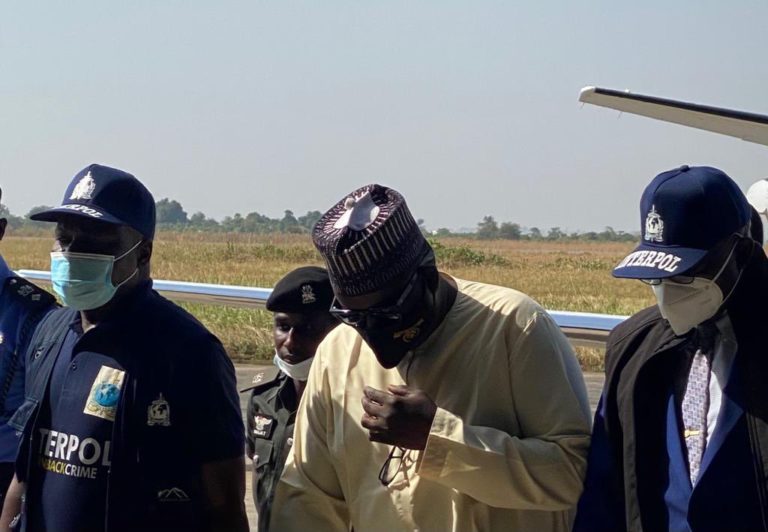
OPERATIVES of the Nigeria Police Force have extradited Abdul Rasheed Maina, the former chairman of the Pension Reform Task Team (PRTT) to Nigeria following his arrest in the Niger Republic.

This was disclosed in a tweet on the official Twitter handle of the Nigeria police force on Thursday.

According to the police, Maina was arrested earlier on 30th November 2020 through a collaborative effort of the operatives of the Nigeria Police Force, Nigeria Police Force, INTERPOL NCB, Abuja and their Nigerien counterpart.

The Police added that a team from INTERPOL Nigeria, led by Garba Umar, the Commissioner of Police INTERPOL extradited Maina following the completion of required documentation for the extradition processes.

Maina’s arrest followed a court order that declared him wanted over failure to appear for his hearing after he was granted bail.

His failure to appear before the court had led to the arrest of Ali Ndume, the senator representing Borno South who stood as surety in Maina’s bail.

Ndume said he has been unable to locate Maina after he stood as surety in his N500 million bail.

Maina is facing prosecution by the Economic and Financial Crimes Commission, (EFCC) over N2 billion money laundering charges and use of fictitious bank accounts while serving as Chairman of the PRTT.

Meanwhile, Joe Gazama, counsel to Maina in the pension fraud suit has filed an application to withdraw his appearance from the ongoing trial.

During the continued trial in absence, Gazama failed to appear before the court.

Also, Adeola Adedipe, counsel representing Maina’s company, Common Input Investment Limited has also withdrawn from the case on the grounds that he is yet to be paid for his services and he is unable to locate him.

We are not on strike but some of our aircrafts are not in operation -Arik Air

ARIK air, one of the nation’s leading airline, has denied reports that it has embarked on a strike, leaving all its intended passengers who had to pay double to board an alternative airline stranded.

Banji Ola, Arik corporate affair manager, told The ICIR on the phone that the report was far from the truth. 

He said Arik is currently not on strike but stated that some of their aircrafts are not in operation.

“We are currently not on any strike,” he said. “But some of our aircrafts are not in operation,” he added. 

He declined to make further comments when asked why some of its airlines were not working.


READ ALSO:

He said the airline will soon release a statement to that effect later today.

Arik has been in the news since September after it laid off over 90 percent of its workforce, due to the economic impact of COVID-19.

The National Union of Air Transport Employees (NUATE) and Air Transport Senior Staff Services Association of Nigeria (ATSSSAN), the aviation unions, which accused Arik of not paying its workers despite putting them on compulsory leave shut down its operations earlier in September.

Buhari’s incompetence rouses slumbering North

0

By Ikechukwu AMAECHI


UNLESS those who want to be politically correct by playing poker with the country’s fate, most Nigerians, after more than five years of Buhari’s presidency, have come to the inexorable conclusion that the onerous task of governing Nigeria is way beyond his ken.

In any other country apart from Nigeria with its asinine and highly flawed leadership recruitment process, a man with Buhari’s competencies will thank his stars if he is rewarded with the chairmanship of a local government.

The Sultan of Sokoto, Sa’ad Abubakar, amplified this depressing fact on November 26 at the fourth quarterly meeting of the Nigeria Inter-Religious Council in Abuja, when he said bandits were fast overrunning the North.

“People think the North is safe but that assumption is not true. In fact, it’s the worst place to be in this country because bandits go around in the villages, households and markets with their AK 47 and nobody is challenging them. They stop at the market, buy things, pay and collect change, with their weapons openly displayed,” he lamented.

But it is not only the North that is in ruins. Buhari’s incompetence and lack of capacity have ruined Nigeria. Farmers in the South also need security escorts to access their farms.

It is unfortunate it took the slaughtering of innocent rice farmers and the international opprobrium on the country for the North to realise that Buhari is a bad omen for all. But it is not enough for fellow compatriots to wake up from their lethargic slumber.

It will be good if the right lessons have been learnt by all Nigerians, Southerners and Northerners alike, which is: If the North is worse off in spite of the fact that a rabid ethnic supremacist like Buhari is in office, then Nigerians are better informed that competence should trump all other mundane considerations when making a choice in 2023.”

Please click on the link below to read the full article

Buhari’s incompetence rouses slumbering North

ENDSARS: IGP files suit to stop ongoing state judicial panels on police brutality

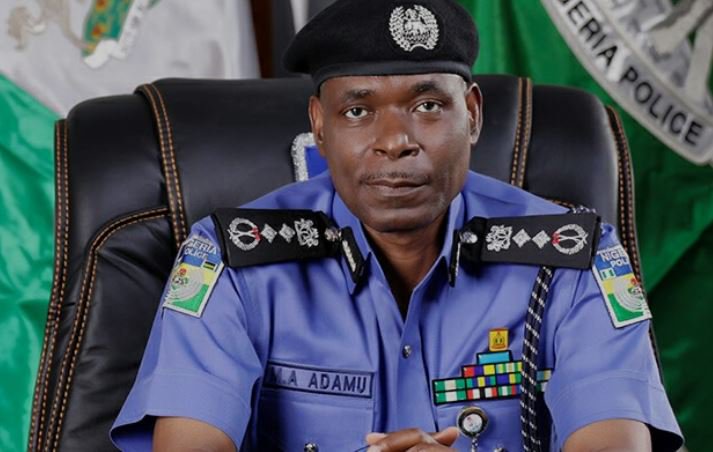
WITH over 1000 filed petitions by victims of police brutality, the Inspector General of Police, Muhammad Adamu is reportedly seeking a court order to stop the ongoing state judicial panel.

According to a report by The Punch, the police filed the suit marked FHC/ABJ/CS/1492/2020i n a federal high court sitting in Abuja on Thursday.

The Nigeria police is seeking the court to restrain the Attorneys-General of the 36 states in the country and their various panels of enquiry from continuing with the probe into alleged police misconduct.

O. M Atoyebi, counsel to the Nigeria police told the court that state governments are not provisioned to constitute panels to investigate activities of the police force or its officials.

Atoyebi said that the state panels have violated the provisions of section 241(1)(2)(a) and Item 45, Part 1, First Schedule to the Constitution and Section 21 of the Tribunals of Inquiry Act

“The establishment of a panel of enquiries by the governors of the various states of the federation of Nigeria, to inquire into the activities of the Nigeria Police Force in relation to the discharge of her statutory duties is a gross violation of the provisions of Section 241 (1)(2) (a) and Item 45, Part 1, First schedule, 1999 Constitution of the Federal Republic of Nigeria (as amended) and Section 21 of the Tribunals of Inquiry Act, Cap.T21, Laws of the Federation of Nigeria, 2004,” the suit read.

The police prayed the court to declare the actions of the governors of the states over the panel as unconstitutional, illegal, null and void and of no effect whatsoever.

Furthermore, Atoyebi sought an order of perpetual injunction restraining the state Attorneys-General of the 36 states from making or conducting any investigations, sittings, and inquiries in connection with the Nigeria Police force or its officials.

Following a protest that lasted many days and nights across various Nigerian states against police brutality and misconducts, the Federal government during the National Economic Council (NEC) meeting held on Thursday, October 16, ordered the establishment of Judicial panels of inquiry across the 36 states of the country.

According to the government, the judicial panel is part of efforts in fulfilling some of the demands by the Nigerian youths.

The panel is set up to investigate the police misconduct, illegal killings among others.

Since the establishment of the panels, Nigerians across 30 states have told sad stories of how they have been cheated, illegally detained or molested by men of the Nigerian police.

From the murder of a 3-day old daughter by police in Rivers state; to the killing of the only son of an old man in Anambra state by those who are to protected them, many petitioners told their sad stories across the states.

ENDSARS happened because we failed to keep our youths busy – Shekarau

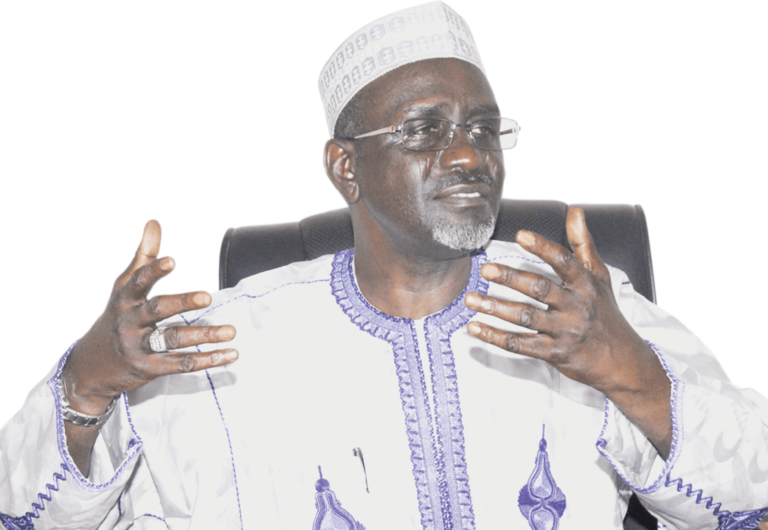
IBRAHIM Shekarau, a former minister of education, a two-term governor of Kano state and senator representing Kano-Central Senatorial District in Nigeria has said that the ENDSARS protest was as a result of the failure of the Nigerian government to keep the youths engaged.

Shekarau made this remark when he featured on Sunrise Daily programme aired on Channels Television on Thursday while discussing the lessons from the ENDSARS protests against police brutality in the country.

“If you don’t keep the youths busy, they would definitely keep you busy, see the time we wasted, the resources that have been damaged and properties and so on is because we have failed to keep them (youths) busy,” said Shekarau.

According to Shekarau, the way to keep the youth busy is a process that must come from the local, state and federal governments through adequate engagement.

“It is being ready to initiate both at state, federal and local government initiatives in a process of engaging the youths. I know the number is so enormous and right now, I am working on a proposed bill to come up with a two-year compulsory skill acquisition from the age of 18, even after graduating.

Shekarau said one of the problems in the Nigerian system is that students leave school without learning any skill while calling for a review of the National Youth Service Corps (NYSC) scheme.

“The NYSC thing that we’ve had right from ’72, of course, it is a laudable programme but I think it is not just coming to do the National Service, this time around, we need to review it and probably make it a compulsory 2-year skill acquisition,” the former minister stated.

He lamented that millions of Nigerian youths are being produced in the system and there is no government job to give them because ministries are not being expanded.

Shekarau said the bill that he would propose to the National Assembly would ‘compel’ every Nigerian above 18 years to acquire a skill.

“Government employment is no longer there, the ministries are not expanding, the same number of ministries, same number of departments and so all the millions of the youths being produced in the system are waiting for government employment, it is not there.

“The problem is you send them to school and they come out without any skill, so my Idea is we need to come up with a process that will compel every 18-year old and above even after graduating, before you get employed whether, in public or private service, you must learn a skill,” Shekarau added.

Meanwhile, in a nationwide broadcast that some had tagged as ‘disappointing,’ Muhammadu Buhari, the Nigerian President said his administration has provided ‘measures and initiatives principally targeted at youths’ at Nigerian youths.

Buhari said this while addressing the nation over the youth protest against extrajudicial killings and police brutality.

“Government has put in place measures and initiatives principally targeted at youths, women and the most vulnerable groups in our society,” said Buhari.

Zabarmari farmers: Caught between Boko Haram and the military

THE presidency was making excuses for Nigeria’s embattled military service chiefs when the Senior Special Assistant to the President on Media and Publicity, Garba Shehu, on Monday, December 1, said rice farmers killed by Boko Haram on Saturday, November 31, did not obtain military clearance to be on their farms at the time they were attacked.


The jury is still out over the actual number of victims in the Boko Haram attack but what is clear is that at least 43 farmers were tied, slaughtered and beheaded in the incident which took place at Zabarmari, a community in the Jele Local Government Area of Borno State. It was not surprising that the development would reignite calls on President Muhammadu Buhari to sack the service chiefs, whose poor handling of the country’s security has been a major concern for Nigerians who are mystified by the President’s determination to keep them in office.


While most Nigerians have learnt to live with the presidency’s mysterious, unconditional, for better-or-for-worse love for the service chiefs, Shehu’s comments, which appeared to blame the Zabarmari rice farmers for the plight that befell them, came as a rude shock.


The Buhari administration had for long insisted that Boko Haram has been ‘technically’ defeated but, while trying to absolve the military authorities of any blame over the massacre of the Zabarmari farmers, the presidential spokesman tried to explain to Nigerians that, due to Boko Haram’s activities, within some ‘spaces’ in parts of the country, law abiding citizens need to get clearance from the military in order to go about their normal activities.


* ‘Zabarmari farmers died because they failed to get clearance from military before engaging in farming’


Going by Shehu’s comments, the Zabarmari farmers paid the ultimate price because they failed to get permission from the military before going into their farms.


In the interview with BBC, Shehu said, “People need to know what it is like in the Lake Chad Basin area. Much of those areas have been liberated from Boko Haram terrorists but there are a number of spaces that have not been cleared for the return of villagers who have been displaced. So, ideally, all of these places ought to pass the test of military clearances before farmers or settlers resume activities on those fields.” Dismissing concerns that his comments would suggest that he was actually blaming the farmers, the presidential spokesman insisted that “the truth has to be said”.


He added, “Was there any clearance by the military which is in total control of those areas? Did anybody ask to resume activity? I have been told by the military leaders that they had not been so advised and certainly, therefore, it was a window that the terrorists exploited. The military is not present in every inch of space in that area. Even if the people are willing to go back, a lot of those areas have been mined and mine clearance needs to be carried out and those areas must be cast as being okay for human habitation or agricultural activity.”


Shehu took to Twitter to justify his controversial comments after Nigerians expressed outrage over the BBC interview.


In a tweet on his Twitter handle, the presidential aide observed, “Today, I found myself leading the trends in the social media for the wrong reasons. The State of Borno is essentially a military zone up till now that we are talking and much of what people do, much of where they go, are governed by the exigencies of security. Routinely, traders, administration officials and even UN agencies get the green light to go to many of the areas to avoid trouble.” Even though the farmers were not killed by landmines, Shehu noted that information from security agencies says that the Zabarmari marshlands are infested with landmines, and as a result, movement in and around the area was subject to military oversight.


He added, “No one is delighted with the massacre in Zabarmari and there is nothing anybody will gain by playing blame games. The question I tried to answer on BBC was: did the security sign off on the area as being free of mines and terrorists? The honest answer is no.”


Whether or not Shehu set out to blame the farmers for getting killed, his argument, and by extension that of the presidency, is that the Zabarmari rice farmers would not have been killed if they had not gone to their farmlands, and as such, the massacre should not be blamed on the military authorities. In that sense, the presidency was countering the renewed calls for the removal of the service chiefs.


The ill-fated Zabarmari rice farmers were reprimanded for undermining the presidency’s determination to retain the service chiefs in office with their ill-advised farming activities.


* Boko Haram says farmers were killed as punishment for aiding military

But it appears that the farmers’ fate was sealed anyway, as they have been marked for ‘punishment’ by Boko Haram for assisting the military.


The Abubakar Shekau-led faction of Boko Haram, Jama’atu Ahlussunnah Lidda’awati Wal Jihad, had, in a video it released to claim responsibility for the massacre, said the attack was a punishment on the farmers for having the effrontery to arrest one of its members and handing him to the Nigerian military.


“You think you can nab our brother and hand him to soldiers and live in peace? You think Allah will forget what you have done to our brother?” a masked Boko Haram commander asked rhetorically in the video.


“The third message is on those who notoriously nab our brethren and hand them to the military or give them a clue on us. You should know that, unless you repent, what happened to your people is awaiting you,” the unidentified Boko Haram commander added, warning that a similar fate await farmers and others who assist the military by apprehending insurgents or giving the security agencies information about them.


* Military accuse locals of sabotage, lack of cooperation


But then, the military, which failed to protect the Zabarmari farmers even after they reportedly took sides with the army against Boko Haram, turned around to accuse the locals of ‘sabotage’ in the ongoing war with the insurgents.


Major General John Enenche, coordinator of defence media operations, while featuring on Sunrise Daily, a breakfast programme on Channels Television, on Monday, November 30, said some residents of Borno State sabotage the efforts of the military by providing information on its movement and activities to Boko Haram.


Enenche noted that information available to the military concerning the attack showed that some of the insurgents were cohabiting with the villagers before the attack.


Noting that the military had no prior intelligence on the attack because the locals were not cooperating by providing information, Enenche said, “That has been our worry. It’s a concern to us. You need a guide, you need information. Will they (locals) tell us? That’s a question that we have to ask. Yes, sometimes. And most times, no. And that was one of the issues we have been ensuring to overcome, with civil-military cooperation activities, reaching out to them, even sending people by proxy to talk to them.”


The military spokesman added, “Those are the things that have been one of the banes of the final success in the whole of this operation. Our patrols will pass through a route, in a village. By the time you are going, some people are looking at you. When you are coming back, the next thing is that you meet an IED planted on the road. And people saw them, they won’t tell you and it is not possible to force information out of people. It’s not possible, just like they say you force a horse to the river, but not to drink water.” Enenche explained that the military was trying to build the locals’ confidence in the system by making them to understand that helping Boko Haram was not good for them.


  • Report says Boko Haram moved into spaces vacated by military in the implementation of army’s ‘super camps’ strategy
    However, while the military bemoan alleged sabotage and lack of cooperation from locals such as the farmers of Zabarmari, a recent report published by the Institute for Security Studies has blamed the escalation of terror attacks in the North East in recent times on Boko Haram moving in to control spaces vacated by the military in the region.


The report titled ‘Nigeria’s super camps leave civilians exposed to terrorists’, was published on issafrica.org on November 30 – two days after the Zabarmari massacre. It was authored by Malik Samuel, Researcher, Lake Chad Basin programme, ISS, Dakar.


According to the report, in 2019, the Nigerian military started pulling soldiers out of villages, small unit formations and bases into bigger, stronger and better equipped camps. The ‘super camp’ strategy sought to bolster the military’s combat posture and enhance its resistance to Boko Haram attacks on its bases.


However, the report noted that while the approach had indeed improved the ability of the Nigerian military to counter Boko Haram, it has also eroded the protection of civilians and their access to livelihoods.


“The two Boko Haram factions – Jama’at Ahl as-Sunnah lid-Da’wah wa’l-Jihad (JAS) and the Islamic State West Africa Province (ISWAP) – are taking advantage of the space created by this new military strategy. They are moving around more freely, deepening their roots in communities and strengthening their supply chains. The violent extremists have increased their power over areas from which troops have withdrawn. In addition to its control of dozens of Lake Chad island villages, Boko Haram has erected arbitrary checkpoints and habitually attacked villagers and travellers to run both territory and livelihood processes,” the report said, noting that the development has worsened forced displacements and deprived locals of their livelihoods.


The report said travellers who spoke to the Institute for Security Studies said Boko Haram had erected permanent checkpoints on several roads in Borno State, such as Maiduguri-Monguno, Monguno-Gajiram, Maiduguri-Damboa, Magumeri-Gubio, Chabbal-Magumeri, Gubio-Kareto, Kareto-Damasak and Damboa-Biu.


“Interviewees reported looting and extortion – food items, money, mobile phones and even clothes on people’s backs – and abduction for ransom. The terrorists seem to spare their victims’ lives and as a result, people continue using the roads. In this way, the group’s supply chain is maintained, especially since most roads lead to markets,” the report added.


The location of super camps away from civilian settlements hamper the capacity of the military to react quickly to attacks on civilians, the report further observed. It also pointed out that the terrorists have also adapted to the super camp approach by now using precision attacks and ambushes on military patrols and escorts since it is more difficult to successfully attack or overrun large camps. But the report also noted that the super camp approach had not stopped Boko Haram from targeting the military strongholds, as seen with the successful attacks on super camps at Gajiram and Bitta in October and November, respectively.


The report noted that the super camps approach has led to concerns that the military might have tactically traded-off the safety of the civilian local population in its quest to protect itself.

“While maintaining the impenetrability of its super camps, the military must do more to protect civilians and avoid the perception that a tactital trade-off has been made between their own safety and that of communities,” the report said.


* Farmers, in SOS to FG, warn of food crisis


Meanwhile, farmers in the North East, in a Save Our Soul message to the Federal Government, warned that if no urgent action was taken to arrest the situation, the current state of insecurity in the region could lead to serious food shortage as farms would be deserted.


The farmers, in a statement signed by the Managing Director, Wal-Wanne Group, Dr Abiso Kabir, said, “We are tired of the situation. Just when we thought we have gotten our farmlands back to support agricultural development and fight hunger in the country, we keep waking to sad events. We can’t continue to go out to our farmlands and risk being killed by the insurgents. We may be facing a severe food security crisis due to the destructive activities of the bandits who are not only destroying farms but also killing farmers.”


* Nigeria third most terrorised country in the World


The 2020 Global Terrorism Index had reported that Nigeria is still the third most impacted country in the world when it comes to terrorist attacks. According to the 2020 Global Terrorism Index, the renewed activities of Boko Haram remain a substantial threat to Nigeria and other countries in the Lake Chad basin.

CBN reverses policy on foreign remittances, orders banks to close naira ledger domiciliary accounts

0

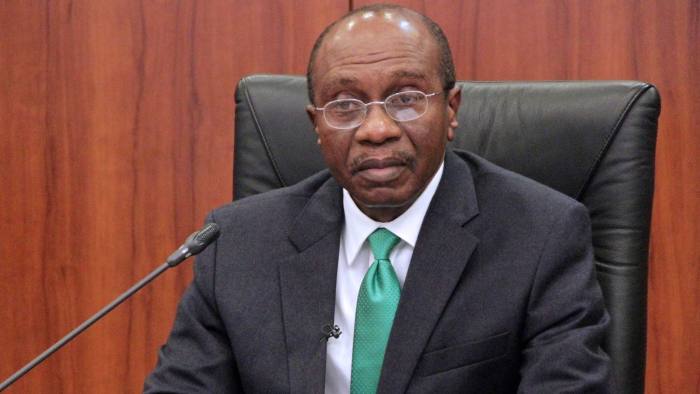
THE Central Bank of Nigeria (CBN) on Wednesday relaxed the rules on foreign remittances and domiciliary accounts by allowing beneficiaries to receive cash inflows in foreign currency.

This is coming on the heels of a circular signed by O.S. Nnaji, director of trade & exchange on behalf of the apex bank, stating the option would ensure transparency in the administration of diaspora remittances into Nigeria.

“These changes are necessary to deepen the foreign exchange market, provide more liquidity and create more transparency in the administration of Diaspora remittances into Nigeria.

“In addition, these changes would help finance a future stream of investment opportunities for Nigerians in the Diaspora, while also guaranteeing that recipients would receive a market reflective exchange rate for the market,” the statement read.

The CBN also directed banks in the country to close all naira ledger accounts opened specifically for the purpose of receiving proceeds from international money transfer operator (IMTO) with immediate effect.

It also confers agents of commercial banks in the country with the responsibility of making final payments to beneficiaries of domiciliary accounts holders in Nigeria either in foreign currency cash or through their domiciliary accounts.

Currently, a limit of $10,000 applies when a beneficiary wants to make a withdrawal of foreign currency cash deposits.

Last week the naira had exchanged at N500 to $1 but currently traded at N470 to the dollar on Wednesday.

For export proceeds, this circular warns exporters to use their forex proceeds for “legitimate” transactions and sell the rest in the Importers and Exporters window instead of selling on the parallel market.

The apex bank also noted that beneficiaries shall have unfettered access and utilisation to such foreign currency proceeds, either in cash and or in their domiciliary accounts.

Under the new guidelines, operators of export domiciliary accounts will continue to operate based on existing regulations which allow account holders use their funds for business operations only with any extra funds sold in the import and export window.

Also, operators of ordinary domiciliary accounts where accounts are funded electronically or wire transfer would be allowed unfettered and unrestricted use of these funds for eligible transactions.

And where accounts are funded by cash lodgments, existing regulation will continue to apply.

Amotekun arrests suspected killers of Ondo monarch, rescues four others

THE Ondo state security network also known as Amotekun, says it has arrested some suspected killers of Oba Isreal Adegoke Adeusi, the Olufon of lfon in Ose Local Government Area (LGA) of Ondo state.

The ICIR had reported last week how Oba Israel Adeusi, was killed by suspected gunmen at Elegbeka, a community along the Ifon-Benin highway, while returning from the monthly meeting of the state council of Obas in Akure.

His vehicle was said to have been rained with bullets while the driver was trying to escape from the gunmen. He was rushed to the Federal Medical Centre in Owo, where he died as a result of gunshots he sustained during the attack.

However, while addressing news men in Akure on Wednesday, Adetunji Adeleye, the state Commandant of Amotekun corps, said the suspects were arrested after its men in collaboration with local hunters and members of Odua Peoples Congress (OPC) combed surrounding bushes and areas where the monarch was killed.

According to Vanguard, Adeleye said four victims were also rescued during the operation and the identities of the arrested suspects will be revealed after thorough and diligent investigation.

“We apprehended them with dangerous weapons and various incriminating items. Although we are still investigating their culpability, anyone that is not found wanting would be set free while those implicated would be handed over to the appropriate security agencies for prosecution,” he said.

“We were also able to rescue four other victims that were earlier kidnapped and held hostage in the thick forest around Elegbeka where the monarch was shot dead.

He said following the increase of crime in the state, the corps has changed its mode of operation by taking the war to the hideouts of the criminals.

He added that Amotekun has launched a one month “Operation Clean Up” to rid the state of the criminal elements operating in the state.

“Following the increase in the spate of criminal activities, the Amotekun went into action with other security agencies and put up some measures that had yielded positively by stepping down the activities of the criminals.

“We have decided to change tactics; this involves massive patrol using a bike, motorised patrol of the state. We have decided to take the war to where the criminals are rather than waiting for them to come out.

“We observed a downward trend after the ban on okada at night so we had to change tactics. That was why we launched Operation Clean Up which is an intense patrol across the nook and cranny of Akure and other parts of the state.”

Ondo state has in recent times been a hotbed of criminal activities.

The same day that the monarch was killed, Sade Ale, wife of the Ondo state governor’s chief of staff, Olugbenga Ale, was kidnapped on her way from Lagos on Thursday night by some suspected gunmen at Owena area, near Akure.

She regained her freedom following security intervention.

The same day, a commercial bank was robbed at Ode Irele, in Irele Local Government Area,  with two reportedly killed and several others injured.