THE Nigeria Union of Journalists (NUJ), Federal Capital Territory (FCT) Council, has condemned the alleged harassment, intimidation, and verbal abuse of its member, Ladi Bala, a transport reporter with the Nigerian Television Authority (NTA), by the Managing Director of the Nigerian Railway Corporation (NRC), Kayode Opeifa.
The incident reportedly occurred on August 27, 2025, while Bala, who was a former president of the Nigerian Association of Women Journalists, was covering the aftermath of a train derailment along the Abuja-Kaduna rail line.
Recall that The ICIR reported how the Abuja-Kaduna train derailed at about 11 a.m. on Tuesday, August 26, triggering fear among passengers and their relations.
The incident occurred along the Kaduna corridor shortly after the train departed Abuja en route to Kaduna.
A statement by the NUJ stated that Opeifa disrupted Bala’s live reporting, verbally assaulted her with demeaning language, and ordered security personnel to remove her from the scene.
The statement, signed by FCT branch Secretary, Jide Oyekunle, further alleged that Opeifa threatened to report her to security agencies, the Presidency, and NTA management with the intent of having her dismissed.
“On August 27, 2025, while performing her professional and legal duties covering the aftermath of the train derailment along the Abuja-Kaduna rail line, Comrade Bala was subjected to unprovoked assault by the MD using words like ‘you are stupid, your management is stupid, foolish woman, look at you, you are not even properly dressed, useless.” Who is watching NTA,“ and so on.
“Opeifa, who aggressively questioned her presence, disrupted her live reporting in the process and allegedly threatened her with physical removal, and eventually ordered security personnel to bundle her away from the scene,” the statement read.
The NUJ also accused the NRC boss of threatening and insulting its chairman, Grace Ike, who attempted to mediate in the matter.
The union described Opeifa’s conduct as a blatant violation of the fundamental rights and dignity of journalists, especially women in the profession, and a grave threat to press freedom.
It said his actions contravened Sections 22 and 39 of the 1999 Constitution, which guarantee freedom of expression and press freedom.
“It is an affront on democracy and rule of law and such acts of intimidation and violence undermine the fundamental role of journalism in promoting transparency, accountability, and public enlightenment.
“The inane attitude of Mr. Opeifa is another clear indication of growing hostility against the media in Nigeria and intolerant posture of government officials to accountability and public scrutiny. Such conduct is unacceptable and contrary to the values of democracy and human rights,” the statement added.
The NUJ FCT Council demanded an immediate and unreserved public apology from Opeifa and called on the NRC to take decisive steps to prevent a recurrence of similar incidents.
The union’s outrage comes as concerns over press freedom deepen in Nigeria.
Just early this month, Niger State Governor Mohammed Umar Bago ordered the sealing of a private radio station, accusing it of incitement and unethical broadcasts, while also calling for its licence to be revoked.
The ICIRreported that the governor issued the order during an expanded All Progressive Congress (APC) caucus meeting at the Government House in Minna.
He instructed security forces to seal off the station, recommended the revocation of its broadcasting licence, and ordered that its owner, Shuaibu Badeggi, be profiled.
In Nigeria, concerns over press freedom have escalated in recent years. Journalists have faced arrests, physical assaults, and threats while carrying out their constitutional duty, particularly on issues involving security agencies, corruption, and human rights violations.
Laws such as the Cybercrimes Act have been wrongly used to clamp down on dissenting voices, including journalists.
The 2024 data by Reporters Without Borders (RSF) placed Nigeria as one of West Africa’s most dangerous and difficult countries for journalists.
COVERING Climate Now Academy is offering journalists worldwide a free, live online training programme designed to strengthen reporting skills on the climate crisis.
The training will run from September to December 2025 and will bring together a global cohort of journalists to explore pressing climate issues – from science and solutions to justice, health, diplomacy, and misinformation.
According to the academy, sessions will be interactive and practical, equipping participants with the tools needed to cover the climate emergency across different beats.
The programme will feature both mandatory and optional sessions, including an opening session (mandatory), tropical cyclones, climate science 101, diplomacy, climate across beats, and climate solutions.
Others include disinformation and greenwashing, attribution science, climate justice, climate and health, social media strategies for climate journalists, and the green transition.
The organisers said the benefits range from a deeper understanding of climate science, its links to justice, and solutions and tools to apply climate reporting angles to any journalistic beat, among others.
Applicants are encouraged to apply before September 8, 2025.
NIGERIA’s excess crude account (ECA) balance stood at $535,823.39 as of August this year, the Accountant-General of the Federation Shamseldeen Ogunjimi, has said.
He disclosed this during the 151st National Economic Council (NEC) meeting, chaired by Vice-President Kashim Shettima, on Thursday, August 28, in Abuja.
He said, “Excess Crude Account is $535,823.39; the Stabilisation Account is N78,453,757,583.19; and the Natural Resources Account is N106,727,969,527.59.”
The ECA balance rose slightly by $62,068.82 relative to $473,754.57 as of April this year.
In an earlier report, The ICIR spotlighted that the ECA balance which stood at $473,754 as of January 17, 2023, remained at the same figure as of December 2023.
Ogunjimi, who was represented by the Minister of Finance and Coordinating Minister of the Economy, Wale Edun, at the meeting, gave a further update on vital account balances.
He said the stabilisation account stood at N78,453,757,583.19 and the natural resources account at N106,727,969,527.59.
The ICIR reports that the ECA was established in 2004 by former President Olusegun Obasanjo to save excess oil revenues above the budget benchmark.
Its overriding objective is to insulate the country from economic shocks that may arise from volatility in crude oil prices in the international market.
Crude oil price relatively been selling below the $75 per barrel benchmark Nigeria set in its 2025 budget.
It has averaged $64.45 per barrel in May this year.
In February 2021, Nigeria’s ECA balance stood at $72.4 million but dropped to $473,754.57 in March 2023.
The Group Chief Executive Officer (GCEO) of the Nigerian National Petroleum Company Limited (NNPCL), Bayo Ojulari, on Thursday, August 28, said the maintenance of three refineries managed by the organisation gulped between $300 and $500 million when he took over the leadership of the NNPCL.
He also claimed there were threats to his life and those of the company’s management staff following the reforms he initiated.
“A lot of money has been spent on these refineries, but translating that into profitability has been difficult because of years of neglect. When I resumed, we found that we were losing between $300 million and $500 million monthly. We had to stop operations and look for a sustainable solution,” he said.
Ojulari said his only ‘offence’ was introducing reforms in the oil and gas sector in line with the mandate given to him by President Bola Ahmed Tinubu to revive the nation’s moribund refineries.
Addressing a delegation of the Petroleum and Natural Gas Senior Staff Association of Nigeria (PENGASSAN),led by its President, Festus Osifo, at the company’s headquarters in Abuja, Ojulari alleged that some powerful interests were opposed to his reforms.
He disclosed that the company was considering adopting an NLNG-style partnership model with “a professional refinery company” to ensure the sustainability and profitability of Nigeria’s refineries.
Ojulari explained that after technical and commercial reviews of the refineries, it was clear that running them without professional partnerships would continue to drain resources.
He stressed that the reforms had unsettled vested interests, triggering coordinated attacks against him and his management team, including petitions the Economic and Financial Crimes Commission (EFCC).
“We are under attack. It is real. There are formidable plans to take me out of this seat But we are determined to stay focused and deliver on the mandate given to us by President Tinubu,”Ojulari said.
The GCEO, however, assured staff that their jobs would not be threatened by the reforms, noting that new opportunities and training would emerge as the refineries are modernised.
On the fuel supply situation, he said there had been no major shortages because of strategic partnerships, including NNPCL’s equity stake in the Dangote Refinery.
He projected that within the next two to three years, at one or two of the nation’s refineries would be fully operational to meet growing demand in sub-saharan Africa.
Earlier, PENGASSAN president, Osifo, commended Ojulari’s leadership, noting improvement in production and pipeline stability since he assumed office.
He pledged the union’s support to ensure stability in the oil and gas sector.
The ICIR reports that NNPCL has been in the spotlight overtime as a result of inefficiencies in running the sector.
Citing complications, Ojulari recently disclosed the possible sale of the refineries on the sidelines of the Organisation of Petroleum Exporting Countries (OPEC) International Seminar in Vienna, Austria.
Ojulari, who spoke with Bloomberg on Thursday, June 10, said the NNPCL was reassessing its refinery strategies and aiming to finalise the review by year-end.
“So, refineries, we made quite a lot of investment over the last several years and brought in a lot of technologies. We’ve been challenged,” he said.
THE Independent Corrupt Practices and Other Related Offences Commission (ICPC) is currently probing the National Librarian and Chief Executive Officer of the National Library of Nigeria (NLN), Chinwe Anunobi, over allegations bordering on procurement fraud, employment racketeering, and abuse of office, The ICIR can authoritatively report.
The development follows a 2023 petition filed with the commission, prompting an initial investigation that was concluded in 2024. The petition submitted by the in-house union of workers, obtained by The ICIR, accuses the agency’s leadership of systemic corruption, including the inflation of contracts, diversion of public funds, breach of procurement laws, and sale of employment slots.
Titled, “Acts of Corruption, Contract Inflation, and Violation of Public Procurement Act 2007”, it was also submitted to the Minister of Education. It outlined how millions of naira were allegedly funnelled through irregular transactions, including the use of staff personal accounts and contracts awarded without due process.
The ICPC spokesperson, Demola Bakare, confirmed that after the matter was reviewed by the commission’s legal department for possible prosecution, it was returned for reinvestigation in 2025.
The renewed probe followed months of tension within the NLN, where insiders said corruption and mismanagement have become entrenched, leaving staff disillusioned and afraid to speak out.
Some who voiced out were said to be witch-hunted by the management of the National Library and subjected to unfair treatment in the agency.
The ICPC confirmed four victims of this alleged harassment, noting that it has communicated the cases to the Ministry of Education for possible protection of the whistleblowers.
However, for some of the staffers, the probe has dragged for too long and has placed them in a very tight spot, allegations denied by the agency’s spokesperson.
Procurement breaches, inflated contracts
While the ICPC has not yet disclosed details of the investigations and the initial outcomes, The ICIR gathered that central to the allegations against the National Librarian is the procurement of two JAC Frison 4×4 pickup vehicles at a cost of N62.6 million.
According to the petition, the National Library relied on a Certificate of No Objection issued by the Bureau of Public Procurement (BPP) in February 2022 for an entirely different set of vehicles and suppliers.
Notice of contract award to Elizade
Despite the BPP approving selective tendering for companies such as Lanre Shittu Motors, and Globe Motors, the vehicles eventually purchased were from a different brand and supplier not covered by the waiver.
“There was no advertisement for this purchase,” the petition states, adding, “No other company was invited to bid except Elizade AutoLand, from whom the vehicles were eventually procured. Worse still, the vehicles bought were completely different from the specifications approved in the BPP certificate.”
According to Nigeria’s Public Procurement Act, 2007, all government ministries, departments, and agencies (MDAs) must adopt competitive bidding for procurement above ₦2.5 million (goods) or ₦5 million (work).
The union also alleged that a forged proforma invoice bearing the name of Lanre Shittu Motors was inserted into the procurement file to simulate a competitive process.
The petitioners indicated that this amount was inflated by N14 million when compared against independent market rates for identical vehicles. In the document attached to the petition, the union got an invoice for the two vehicles from the same vendor to be N48.3million, including VAT. Each car was sold for N22,500,000 and VAT of 7.5 per cent on the two vehicles for N3.3 million.
The ICIR gathered that the invoice for the vehicle was obtained by the union just a few days after the contract was awarded. The petition noted that the contract was awarded on February 18, while the invoice was dated February 20.
When The ICIR reached out to the agency on these allegations, the spokesperson Orviel Dio, said the cost of the project was estimated to include all the statutory deductions which, according to him, amount to about 13 per cent of the total contract sum.
In practical terms, ‘13 per cent statutory deductions’, are often referred to a bundled average for supply contracts, which combines WHT, stamp duty, and some other levies (sometimes rounded up).
While the contract was awarded at ₦62,649,710, the petitioners alleged that the actual market cost for the two vehicles from the same vendors, including 7.5 per cent VAT, was N48.3 million, a difference of ₦14.35 million.
However, after statutory deductions of about 13 per cent (₦8.14 million) by the Office of the Accountant-General, the contractor would have received approximately ₦54.51 million. This still leaves a gap of ₦6.21 million between the petitioners’ claimed cost and the net amount paid to the supplier.
Speaking on the selection process and the BPP waiver, Dio maintained that the agency had provided ‘justifiable reasons’ for seeking selective bidding, which led the BPP to grant the waiver. However, he failed to clearly explain why Elizade AutoLand, a supplier allegedly not listed in the waiver, was eventually awarded the contract.
Under Nigeria’s Public Procurement Act, 2007, the BPP may grant a waiver for selective or restricted tendering in cases where goods or services are only available from a limited number of suppliers, where time is of the essence due to emergency, or where previous procurement processes have failed to produce a suitable contractor.
The ICIR gathered that even with such a waiver, procurement rules still require strict adherence to the list of approved suppliers and specifications outlined in the exemption.
Meanwhile, a similar pattern characterised other procurements listed in the petition, including 2022 digitising process.
Employment racketeering
Beyond the financial impropriety, there are strong allegations that the National Library flouted federal character principles during employment processes.
Sources noted that slots were routinely sold for as much as ₦2 million, with intermediaries allegedly linked to Anunobi overseeing the transactions.
“One of the aggrieved instituted a case at Zone 4 Division of Nigeria Police in Kubwa, which led to the arrest of the Special Adviser to the National Librarian, right in the office along with other staff and they were held in custody for days,” the union’s petition read, noting that no disciplinary action has been taken against the accused till date.
The petition also accused the National Library of violating federal character principles, claiming that most of the vacancies in the recent recruitment exercise were filled by individuals from the South-East.
The Library’s spokesperson dismissed allegations of favouritism in its recent recruitment exercises in 2023\2024, explaining that the Civil Service Commission had granted the institution a waiver to hire based on pressing manpower needs. He noted that the recruitments may have been perceived as biased because certain branches with significantly lower staff strength were given priority in filling vacancies.
According to him, this approach was aimed at balancing personnel distribution across the library’s network rather than favouring specific individuals.
Payment into staff personal accounts
Other alleged financial irregularities highlighted by the petitioners involve funnelling of substantial public funds directly into staff personal bank accounts.
The petition showed how ₦33,692,982.25 were paid to a staff personal account, in violation of Nigeria’s Public Sector Financial Regulation Act.
The money which was paid in four segments ranges from N15 million to N918,000 for projects which sources claimed were not accounted for.
Payment vouchers for August 2022 seen by The ICIR confirm that funds were funnelled into the personal account of Kalu O.I, a director of virtual library service development, for projects related to readership promotion.
Readership promotion refers to a set of activities and programmes designed to encourage and improve the culture of reading among Nigerians annually. It is typically spearheaded by the National Library of Nigeria and sometimes in collaboration with schools, media, NGOs, and government agencies.
For instance, on August 22, 2022, a payment voucher was issued for the sum of ₦11,285,000 paid into Kalu’s account for ‘Head of Branches kick-off/preparation for the conduct of the 2022 readership promotion campaign (RPC).
One of the vouchers showing money deposited to staff account
Also on the same date, Kalu received ₦15,570,000 into her account for what the voucher described as ‘printing of materials and banners for the forthcoming readership promotion campaign.’
Another voucher showing money deposited to staff account
The ICIR reports that this practice contravenes paragraph 713 of the Federal Government’s Financial Regulations (2009), which expressly prohibits the payment of public funds into private bank accounts.
Section 713 states: “An officer who pays public money into a private account is deemed to have done so with fraudulent intention.”
The section further states that, “Personal money shall in no circumstances be paid into a government bank account, nor shall any public money be paid into a private bank account.”
Dio, while justifying the payment, said the reason for making payments into staff accounts was that some projects are best executed by in-house staff and do not need to be outsourced to contractors.
According to him, the payment for that particular project was intended to be distributed to other branch heads to purchase books and other materials for the readership promotion campaign.
Phantom projects, missing millions
Also, the petitions alleged that over ₦67.9 million released for the 2022 digitisation of weak and rare materials were spent without any tangible outcome.
The petition claimed that the only traceable result related to digitisation was work carried out by staff using a Robot Scanner procured under a former administration.
Despite the large sum, the petitioners stated there is no evidence of significant progress in digitisation, while departments such as Accounts and Human Resources still operate manually.
“Fictitious waivers, with very weak justifications are usually secured, with the assistance of BPP staff in execution of projects that does not qualify as Specialized Projects.
“Interestingly, the only result associated with digitisation, as captured in the waiver, was carried out by staff using the Robot Scanner, purchased by the previous-administration. Also, the Library Automation software (KOHA) in use till date, is a free version, installed and running before her assumption of office (Open Source and not proprietary),” the petition said.
In another instance, the petition noted that ₦9.8 million was allocated for the 2023 Authors and Publishers Sensitisation programme.
However, Dio said the Library, while contracting out the digitisation project asked the contractors to teach staff on how to carry on with digitisation of weak and rare materials.
“Some materials were already over 60 years old as of last year, acquired over time. These materials are weak and need to be digitised. They were too bulky to handle all at once, and the situation became so challenging that we had to contract the work out.
“And in contracting out, because we don’t have the skills and tools, the condition is that you must use our staff, the condition was that the contractors must work with our staff so that we could learn from them, as we cannot keep outsourcing this task,” he said
Victimisation of whistle-blowers, dissent
Findings by The ICIR alshows that the management of the National Library of Nigeria, under Chinwe Anunobi, has subjected several staff members who raised concerns about irregularities to intimidation, victimisation, and punitive transfers.
Sources within the institution, who spoke on condition of anonymity for fear of victimisation, disclosed that whistle-blowers, particularly those who challenged procurement irregularities or raised red flags over recruitment practices, were either redeployed to inconsequential departments.
“The CEO being investigated has remained in position, while being investigated by the ICPC and has continued with acts of victimisation against ‘supposed’ enemies of her administration.
“Continuous covering of tracks, through redeployment of loyal officers to sensitive positions, including procurement and audit divisions. Massive attack on all staff suspected to have any connection with the petition, through punitive postings and assignment of derogatory duties to union leaders,” a follow-up letter to the Ministry of Education reads.
The ICIR, confirmed that some staff were actually redeployed to other states while a few to other departments. When asked the reasons for their sudden redeployment or repositioning, it was gathered that the staff were believed to be dissent to the administration.
For instance, Abubakar Hussaini, a director was moved from Virtual Library Services Department to another department, Collection Development and Technical Service, at the headquarters.
Also, one Abdulazeez Kikeloma, also a deputy director was posted out of the headquarters to head a branch in Kwara state.
Both Hussaini and Kikeloma were redeployed after they testified against the National Librarian during investigations by the Ministry of Education. Before then they had also challenged the Librarian for not having knowledge about the projects supposedly executed under their departments.
In a similar case, Ekpe Samuel Patience was posted out of the store unit, having said to have rejected the attempt to issue a store receipts voucher to confirm that for items supplied to the story.
According to sources, she challenged the Librarian that the books were not supplied but was met with redeployment.
In the case of Patience, the spokesperson Orviel Dio, said she was a deputy director who should be placed in a high esteem rather than being in the store giving out ‘papers’ to staff.
According to him, that job should be left for her junior, and that she was moved to another unit where her expertise was more needed.
THE longest-serving editor of BBC Hausa, Aliyu Tanko, has left the British Broadcasting Corporation amid allegations of bullying and maltreatment raised by his former colleague, Halima Umar Saleh and some current staff members.
Tanko, who joined the BBC 17 years ago and became Hausa Service Editor in 2020, confirmed his resignation to The ICIR Friday morning.
Media reports indicate that Tanko was suspended by the BBC on Wednesday, August 27, before tendering his resignation the following day.
According to a report by SolaceBase, sources within the corporation, noted that the suspension, which was to last three months, was part of an investigation ordered by BBC News Deputy CEO and Global Director, Jonathan Munro, following several internal and external petitions bordering on staff bullying and maltreatment,
The report noted that the BBC rejected Tanko’s resignation on the grounds that it did not follow due process.
“The resignation was rejected on the ground that it did not follow due process, that is, as a senior staff, he needs to give two months notice or pay two months’ salary in lieu of notice or vice versa if the organisation is terminating his service,” a source was quoted to have said.
Similarly, a report by Daily Nigerian said the BBC had launched investigation into the allegations against Tanko.
However, Tanko rubbished the reports claiming that the BBC rejected his resignation while speaking with The ICIR Friday morning.
He declined commenting on the allegation of staff bullying and maltreatment levelled against him.
“Yes. I resigned. And, secondly, BBC didn’t reject my resignation. BBC didn’t reject my resignation. Quote me on that. And, finally, I resigned on personal ground, it has nothing to do with anybody,” he said.
When asked if he’s aware of the investigation reportedly launched into his alleged staff bullying and maltreatment by his employers, he said, “I am not aware.”
He also declined making comments regarding the allegations, saying, “Go and talk to be people that know me. I don’t want to say anything about myself. But people that know me will tell you about me.”
The controversy trailing Tanko’s era at the BBC traces back to an interview in which Saleh, now a Senior Digital Editor at TRT Africa, reportedly accused a ‘higher up’ of maltreating her during her time at the BBC Hausa.
“There is someone (at BBC), I don’t even know what I did to him, but he really hated me for no reason…He threatened to get me expelled from BBC Hausa and kept harassing me constantly. I asked him, ‘What have I done wrong?’ He admitted that I hadn’t done anything wrong. He even said I was doing my job well,” she said in a video interview circulating on social media.
The interview, which was aired on Arewa24, was later taken down, consequently drawing a lot of attention.
Following the allegations, petitions were reportedly sent to the BBC headquarters in London, demanding his probe.
The BBC consequently reportedly sent a delegation from London to Nigeria to investigate the claims.
The ICIR reports that Tanko, who led a team of about 40 journalists in Nigeria, Ghana, Cameroon and Niger for the BBC, was in charge of four radio transmission, weekday TV new bulletin, and digital production.
Some of his innovations at the BBC include Ku San Malamanku, Mahangar Zamani, Korona Ina Mafita, Zamantakewa, Lafiya Zinariya, and Daga Bakin Mai Ita.
THE President Bola Tinubu-led Federal Government on Thursday, August 28, rewarded 17-year-old Nafisa Abdullahi Aminu from Yobe State, who was recently crowned the world’s best in English at the 2025 TeenEagle Global Finals in London, with N200,000.
At a recognition ceremony in Abuja, the Minister of Education, Tunji Alausa, and the Minister of State for Education, Suiwaba Ahmad, lauded Nafisa’s achievement and other students who excelled at the competition.
Representing Nigeria through the Nigerian Tulip International College (NTIC), Yobe state, Nafisa beat over 20,000 participants from 69 countries, including native English-speaking nations, to emerge the overall best in English Language.
Another Nigerian student, Rukayya Fema, 15, was named the best in debate, while Hadiza Kalli clinched the gold medal in the outstanding talent category.
The FG’s reward to Nafisa, however, has sparked reactions among Nigerians, especially when compared with the Federal Government’s recent $100,000 splashed on the Super Falcons and the D’Tigress, Nigeria’s national women’s football and basketball teams.
The ICIR reports that just few days before the news of Nafisa’s feat, the Federal Government splashed $100,000 (about N150 million) on the Super Falcons and D’Tigress for their impressive performances on the international stage.
D’Tigress clinched the AfroBasket championship after defeating Mali 78–64 in the final on Sunday, August 3, at the Palais des Sports Treichville in Abidjan, Côte d’Ivoire, while Super Falcons won their 10th Women’s Africa Cup of Nations (WAFCON) title in Casablanca.
While some Nigerians applauded the recognition of Nafisa’s feat, many questioned whether the N200,000 cash prize was commensurate with a historic academic victory that placed Nigeria ahead of the world in English, a language often used as a benchmark for global competitiveness.
Speaking at the event, Alausa had noted that the government was investing heavily in human capital and emphasised Tinubu’s commitment to education.
“You are the future of Nigeria, and you have made us proud. For the first time in the history of our nation, we have one of the highest budgetary allocations to education.
“Each time we approach the president for support in the sector, his response has been a resounding ‘yes’ because he believes in you, the children of Nigeria.
“Your success gives us the confidence to ask for more, and we will continue to do so on your behalf,” the minister said.
On her part, the Minister of State for Education, Suiwaba Ahmad, commended Nafisa’s resilience and urged her to see the award as the beginning of a bigger journey.
Reactions trail N200,000 cash gift
Meanwhile, the reward has reignited debate on the government’s appreciation of intellectual achievements compared to sports and entertainment.
Some Nigerians demanded that academic champions receive recognition and rewards equal to or greater than their sporting counterparts.
A X user @NaijadentistNG said of the situation, “This is the Nigerian paradox: intellectual excellence gets tokenism, while mediocrity and entertainment are over-rewarded. Until education and innovation are valued above spectacle, we’ll keep exporting our brightest minds and importing poverty of thought.”
Another user, Daniel Oladoja, expressed frustration over the imbalance, saying: “Sportsmen and women get 100k (100,000) USD but a child who wins a global contest gets 200k!!! And you wonder why we don’t have stable electricity? The government is telling kids it is better to excel in sports than to get a proper education.”
For Nnabuihe Okechi, the government’s gesture reflects a deeper neglect of education.
“Imagine after almost a month ago, this good news filtered (into) the Nigeria media, FG is giving only N200,000 to a global winner of an academic contest. How do we encourage the younger ones to take their studies seriously when others are busy being celebrated for bad behaviours as experienced in the airlines.
“In this era that social media is negatively influencing teenagers’ behaviour, we can’t encourage the ones academically inclined to excel more in order to serve as a good example to others,” he wrote.
NIGERIA, ranked 87th alongside Ethiopia on the 2025 Henley Passport Index, has again increased its passport fees, pledging to uphold the quality and integrity of its Standard Passport.
The ICIR reports that Nigerian passport has witnessed major fee hikes since the introduction of updated e-passport in 2019, and the fees have been more than quadrupled since then.
From N19,000 and N24,000, respectively, in 2017, passport with 32-page and 64-page 5-year validity attracted N25,000 and N35,000 respectively, while the one with 64-page and 10-year validity was issued for N70,000 in 2019.
The country saw another increase in the passport fees in 2024, as the Nigerian Immigration Service (NIS) explained that the hike was intended to maintain the quality and integrity of the Nigerian Standard Passport.
It raised the cost of the 32-page, five-year validity booklet from N35,000 to N50,000, and the 64-page, 10-year validity booklet from N70,000 to N100,000.
Hardly had the outbursts generated by the increase dwindled into silence when the Federal Government dropped another bombshell on passport fees increase by 100 per cent on August 28, 2025.
The new decision is to take effect on September 1.
The cost of the 32-page passport with five-year validity was increased from N50,000 to N100,000, while the 62-page document carrying 10-year validity rose from N100,000 to N200,000.
However, the latest decision did not affect Nigerians in the diaspora. They will continue to pay $150 for 32-page passport with 5-year validity, and $230 for 64-page carrying 10-year validity.
The ICIRreported in March 2025 that a Nigerian content creator, Alma Asinobi, expressed frustration in getting multiple visas for her intercontinental travel tours due to the Nigerian low-ranked passport.
Asinobi said she was frustrated with spending money on multiple visa applications with her Nigerian passport, only to experience repeated rejections.
THE Federal Government has increased passport fees by 100 per cent.
The decision, announced by the Nigeria Immigration Service (NIS) on Thursday, August 28, which will take effect from next Monday, September 1.
A statement on the decision, released on the website of the Service, said the increment aimed at ensuring the quality and integrity of the Nigerian Standard Passport.
The 32-page passport was raised from N50,000 to N100,000, while the 62-page passport was hiked from N100,000 to N200,000.
The ICIR reports that the decision affects only citizens living in Nigeria. Those in the diaspora were exempted. Part of the statement reads, “The review, which only affects passport application fees made in Nigeria, now set a new fee threshold for 32-page with 5-year validity at N100,000 and 64-page with 10-year validity at N200,000.
“Meanwhile, Nigerian passport application fees made by Nigerians in diaspora remain unchanged at $150 for 32-page with 5-year validity and $230 for 64-page with 10-year validity.”
The Service restated its commitment to providing quality service while ensuring that passport services remain accessible to all Nigerians.
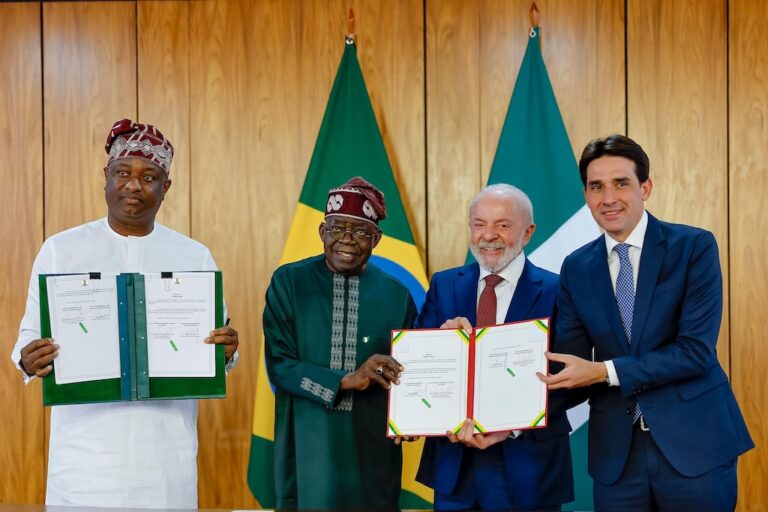
THE Nigerian government is deepening ties with Brazil through the recent visit of President Bola Ahmed Tinubu to the country, a move which was sealed with several Memoranda of Understanding (MoU) that prepare ground for the expansion of $2.1 billion trade volume.
At the just-concluded visit, President Tinubu signed five new sets of MoUs, which signalled renewed efforts towards strengthening historic ties and trade relations between both countries.
The ICIR reports that President Tinubu’s latest visit to the South American country was the third since he assumed office on May 29, 2023.
To further consolidate the trade ties, President Bola Tinubu participated in a string of bilateral talks and sealed five MoUs with his Brazilian counterpart, Luiz Inácio Lula da Silva.
The two-day state visit, which started on Monday, August 25, saw both leaders witness the inking of the five MoUs to strengthen the Nigeria-Brazil bonds.
The new deals cover a range of sectors including trade, diplomacy, science, aviation, and finance.
“The trip has the potential to accelerate Nigeria’s economic growth through targeted engagements in key sectors. Yes, this is the third visit of President Tinubu to Brazil, and it is with a justifiable cause. It reflects a renewed and focused effort to build lasting economic integration between both countries,” said Special Adviser to the President on Media and Public Communications, Sunday Dare.
Dare stressed that Nigeria and Brazil share similarities in demography, economy and cultural affinity, making the visit timely and important.
The visit also revived Nigeria’s business deal with the Brazil’s state-run oil company-Petrobras, with President Tinubu’s assurance during a press conference in Sao-Paulo that they will return to Nigeria soon.
Petrobras began operations in Nigeria in 1998 in the deep waters off the Niger Delta. It sold its stakes more than 10 years ago to raise cash for domestic projects. Since then, Nigeria has been working to address some of the problems that have limited oil and gas output.
“Petrobras is the closest to us in terms of deep-water off shore. They have similarities with us when it comes to deep-water off shore. If they come into marginal fields or acreages, it is good and signposting confidence in the government reforms,” former Chairman of Major Oil Marketers Association of Nigeria, Adetunji Oyebanji, told The ICIR.
He stressed the importance of the government officials following up with several signed MoUs to ensure it leads to a successful business deals match-making and closure.
The ICIR reports that the visit led to the signing of a Bilateral Air Services Agreement (BASA) to facilitate a direct flight route between Lagos and São Paulo. This has been a long-standing barrier to their trade relations.
It also led to the signing of an MoU on science and technology to foster collaboration in biotechnology, bioeconomy, and energy, with a focus on technology transfer.
And, it further led to the signing of a finance and agriculture agreement to promote trade, investment, and agricultural financing.
These pacts, expected to boost the trade in merchandise, which currently stands at $2.1 billion as of the 2024 year-end, are strategies to strengthen the historic bond between these two countries with the world’s largest black populations.
President Bola Tinubu and his Brazilian counterpart during his two-day state visit to Brazil on Monday, August 25… Source: Bayo Onanuga
The signing of the MoUs is very strategic to Nigerian development and will boost the agriculture sector, Director of Corporate and Regulatory Affairs, Olam Agri, Ade Adefeko, commented while speaking at the Arise Global Business programme on Tuesday, August 26.
He believes the signing of the MoUs is important to cement earlier meetings and discussions between the two leaders.
“So, there have been a lot of preliminary discussions and all that. With these MoUs being signed, what we need to do now when they [President Tinubu and his ministers] come back is action.
“Again, I think the President or the presidency must appoint ambassadors or high commissioners. It has been pending, and I think it’s been way too long.”
Tinubu had in September 2023 recalled all ambassadors,, leaving only the country’s United Nations permanent representative and has yet to replace them, The ICIR reported. Nigeria has 109 diplomatic missions worldwide, comprising 76 embassies, 22 high commissions, and 11 consulates.
Dwindling trade relations
Over the last decade, Nigeria-Brazil bilateral trade, which had risen to as high as $9 billion in 2012, before dropping to $1.3 billion in 2021 is now at $2.1 billion in 2024.
Currently, Brazil’s 49th largest export destination, Brazil exported about $1 billion to Nigeria, primarily sugar and jams, and imported $1.1 billion, mostly fertilisers.
Previous bilateral deals
Nigeria and Brazil have been sharing longstanding cordial diplomatic relations as far back as the early 1960s.
Coming down to most recent collaborations, in 2019, the Green Imperative Programme (GIP), a $1.1 billion agricultural mechanisation project, was unveiled with the aim that Brazil would supply 10,000 tractors and 50,000 units of farm equipment for assembly in Nigeria.
In 2023, both countries signed an MoU to establish the Mechanism for Strategic Dialogue to foster cooperation in agriculture, trade, defence, energy, education, power, petroleum, and mining.
In 2024, during Tinubu’s participation at the G20 Leaders’ Summit, the two countries also sealed a $2.5 billion investment aimed at boosting Nigeria’s food security efforts, agricultural production, and creating job opportunities for the youth.
Long-standing trade barriers
As groundbreaking as the recent agreements are, there have been fundamental issues in their trade relations, dwindling the trade volume and causing it to drop $9 billion in 2013 to about $2 billion in 2024.
Of particular emphasis is the lack of direct flights between the two countries.
The cut-off of direct flights between the two countries has made it extremely difficult for businessmen and women to transact business, shrinking the volume and value of imports and exports, and dwindling their incomes.
Travels between both countries which should ordinarily last for about six to seven hours, have left travellers having to go through Europe, South Africa or Dubai to connect to Brazil, and spending about 13 hours besides having to pay more for air tickets.
Harnessing the agreements
After about six years of unveiling the programme, in March this year, the Nigerian government announced that the commercial phase of the $1.1 billion Green Imperative Project had kicked off to boost agricultural productivity and enhance private-sector investment in Nigeria.
Added to this $1.1 billion deal, which is now on course, are the $4.3 billion phase 2 of the project and the $2.5 billion JBS agribusiness programme sealed during Tinubu’s visit to Brazil in late 2024.
All these now amount to $7.8 billion worth of projects, which the Tinubu administration is expected to harness.
The green imperative initiative is believed to be the largest agricultural project in Africa that prioritises the development of sustainable and low-carbon agriculture, aiming to develop structural conditions to boost food production in Nigeria efficiently and competitively, according to the Nigerian government.
“Over the past seven years, there has been negotiation with the Nigerian government with a view to obtaining the necessary funds from private and regional development banks to finance this ambitious project, which is worth approximately $1.1bn dollars,” the Ambassador of Brazil to Nigeria, Carlos Garcete, said, according to a statement on Tuesday, March 18, 2025, by the Senior Special Assistant to Vice President Kashim Shettima on Media and Communication, Stanley Nkwocha.





![[EXCLUSIVE]: National Librarian, Anunobi faces probe over procurement, recruitment fraud](https://www.icirnigeria.org/wp-content/uploads/2025/08/ceo1-e1756384921177.png "[EXCLUSIVE]: National Librarian, Anunobi faces probe over procurement, recruitment fraud")