Home Blog Page 1984

Federal High Court workers to begin strike on Monday over fuel, electricity prices hike

0

STAFF of the Federal High Court across the country say they are ready to commence a two-week strike on Monday, September 28.

This was announced in a notice, circulated in and around the Federal High Court headquarters building in Abuja on Friday.

The court staff, under the umbrella of the Judiciary Staff Union of Nigeria (JUSUN), said they were abandoning their duties in line with the industrial action planned by the Nigerian Labour Congress (NLC) expected to commence on Monday.

The NLC and the Trade Union Congress (TUC) have asked their members across the country to embark on industrial action in protest against the recent increases in electricity tariffs and pump price of premium motor spirit (PMS) popularly known as petrol.

“Please be informed that the Judiciary Staff Union of Nigeria (JUSUN), Federal High Court chapter shall, in collaboration with the Nigerian Labour Congress (NLC), commences a two-week indefinite strike action from Monday the 28th day of September 2020,” the notice read.

“All offices shall remain closed within this period. You are required to comply.”

Ayuba Wabba, NLC President had berated the government actions noting that the best way to address challenges, whether social economy or labour issues was to proactively engage labour and have its perspective.

“You understand more than most Nigerians the critical place of electricity in boosting production and making the price of goods and services cheaper,” he said.

“Unfortunately, the recent increase in electricity tariff has presented Nigerians with the double jeopardy of dealing with astronomical increases in the price of goods and services and COVID-19.”

IGP ordered me to leave Edo State on the eve of governorship election – Wike

0

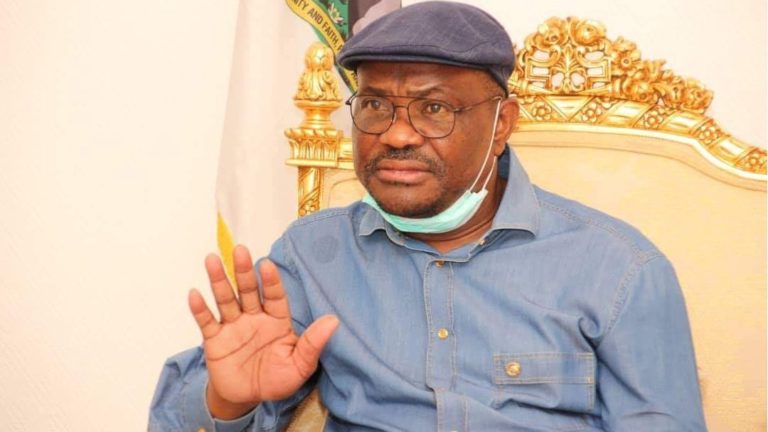
NYESOM Wike, the Governor of Rivers State says he received a call from Mohammed Adamu, the Inspector-General of Police on the eve of the Edo State governorship election that he should leave the state.

The governor said this when he appeared on Channels Television’s Sunrise Daily programme on Friday speaking on ‘Governance and State of Polity’.

“The IG never saw me outside. I was inside my room and I got a call from the IG that I must leave Edo State,” Wike said.

“What surprised me was why should I leave Edo State? I am the chairman of the campaign council and the chairman does not mean that after the campaign, you leave. No, you must monitor what is going on so that at the end of the day, you would be able to write your report.”

According to the governor, the IGP’s order was not connected with the Edo State election rather it had to do with alleged illegal deductions from Rivers State Police Fund.

“I discovered that the IG’s own had nothing to do with the election because I remembered that some time ago my Commissioner returned to me from a FAAC meeting and said there were deductions made from the Police Trust Fund.

“I asked who approved it because the police are under the exclusive list and not the concurrent list. I told my Attorney-General to challenge it. This angered the IG,” Wike explained.

He added that the IGP  was also angry with him for obstructing the arrest of Joi Nunieh, a former acting Managing Director of the Niger Delta Development Commission (NDDC).

“When our sister, Joi Nunieh, was to be abducted, IG was not happy about my intervention. He called me and I asked him how could you allow a woman to be taken away at 4 am knowing the security situation in the country today. Why didn’t you invite her?” he asked.

Wike noted that the US and UK visa ban served as a major influence in the smooth running of the Edo governorship election on September 19.

“One thing that played out and which I noticed was the role of the international community. For example, the US, the UK came out and said that there would be a visa ban if anybody tries anything in terms of violence or rigging and they have gone further to ban some governors,” he said.

“Everybody was being careful, saying, I don’t want to have any problem, I don’t want my children and family to have any problem. We all go to the UK every time.”

“In fact, they should even go further, not only politicians, but security agencies, then you’ll see everybody will sit up and say look, I cannot jeopardise the future of my children and mine, simply because you want me to rig the election, so it’s very key.”

REPORT: 13 Nigerian states are broke, lack revenue capacity to fund recurrent expenditure

0

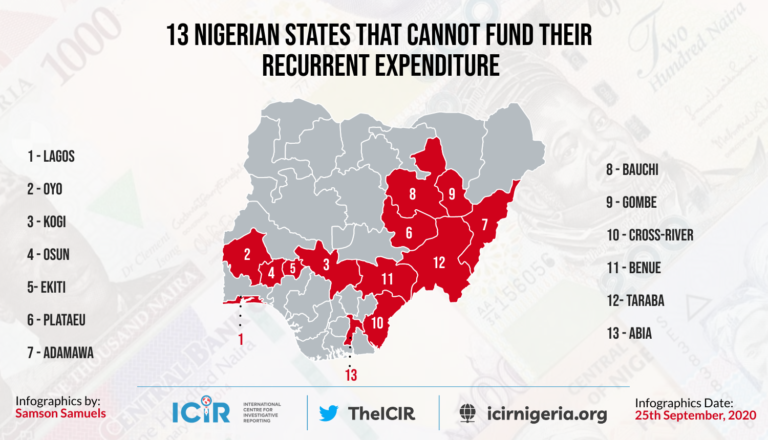
THIRTEEN states in the country are not fiscally sustainable and lack the revenue capacity to fund their recurrent revenue in 2019, according to the 2020 edition of BudgIT’s State of the States Report.

BudgIT, a civic advocacy society that uses technology to intersect Citizen-engagement with improved governance, announced the release of the report on Thursday.

The 13 states, according to the report, are Lagos, Oyo, Kogi, Osun, Ekiti, Plateau, Adamawa, Bauchi, Gombe, Cross River, Benue, Taraba and Abia.

The report noted that “13 states in the country, their respective total revenue was not enough to fund their recurrent expenditure obligations (salaries, overhead, debt service obligations) and meet their respective loan repayment schedules that were due in 2019.

The report observed that the development could indicate early signs of distress particularly for states “in this category who have very low revenue generation capacities”.

“Without cutting down certain components of their recurrent expenditure or radically growing their internally generated revenue, the affected states will have to borrow to fund parts of their recurrent expenditure, all of their capital expenditure and also borrow to pay back old loans or service old debts as was observed from their 2019 financial statements,” BudgIT warned in the report.

The report further observed that, out of the remaining 23 states that can meet recurrent expenditure and loan repayment schedules with their total revenue, eight of them have revenue leftovers that are so small (less than N6bn), that they still have to borrow heavily to fund any meaningful capital expenditure.

The worst-hit in this category, according to the report, are Zamfara, Ondo and Kwara who have N782.45m, N788.22m and N1.48bn, respectively.

Observing that the states are currently in financial distress largely as a result of misplaced priorities and soaring debts, the BudgIT report added that based on their fiscal analysis, only five states in the country – Rivers, Kaduna, Akwa Ibom, Ebonyi and Kebbi – are prioritising capital expenditure over recurrent obligations.

“However, the quality of the capital expenditure still leaves much to be desired as explored in the narratives for the respective state profiles,” the report said, noting that the remaining 31 states in the country prioritised recurrent expenditure according to their 2019 financial statements.

“Recurrent expenditures are not necessarily a bad thing, especially when skewed towards sectors like health and education which have expenses like payment of teachers and doctors’ salaries that are recurrent in nature.

“However, of the states in this category, 11 had overhead costs that were larger than their capital expenditures. These 11 states are Adamawa, Bauchi, Bayelsa, Benue, Ekiti, Kano, Kogi, Kwara, Nassarawa Plateau, Taraba,” the report said.

BudgIT further reported that the total debt for all 36 states surged by 162.87 percent or N3.34tn, from N2.05tn in 2014 to N5.39tn in 2019, with 10 states accounting for approximately half or N1.68tn of the increase.

The 10 states that accounted for N1.68tn of the debt increase are Lagos, Rivers, Akwa Ibom, Imo, Kogi, Edo, Osun, Cross River, Kaduna and Adamawa.

Kogi and Adamawa were also in the category of states who spent more on overhead costs for the government than on capital expenditures that directly benefit the people, BudgIT observed.

The report noted that options for further borrowing are reducing for Nigerian states due to safeguards and debt ceilings put in place by the Federal Government to prevent states from slipping into a debt crisis.

The revised 2020 borrowing guidelines published by Debt Management Office stipulated that for states to borrow from the capital market in any fiscal year, their total debt must not be more than 50 per cent of their previous years total revenue.

Based on the DMO guideline, BudgIT noted that for fiscal year 2020, all 36 states will need to pass through the eye of the needle to raise debt from the capital market as they now have total debts as at 2019 which breached the debt ceiling.

However, according to the report, majority of Nigerian states, except Cross River, are still within the debt ceiling that allows them to take on more debt from other sources.

The ceiling for external borrowing is set at a states total debt burden not exceeding 250 percent of their total revenue in or the previous year. Cross Rivers’ total debt of N230.88bn as of December 2019 was 391.91 percent of its total revenue of N58.91bn.

The report also noted that exchange rate volatilities recently triggered by COVID-19 induced shocks have worsened the situation for states who currently have large foreign debt and have also crystallised the risks for those who plan to incur more.

The naira suffered a recent 24.22 percent devaluation from N305.9/$1 as of December 2019 to N380/1USD as at September 2020.

“The implication of this for states is that for every $1 in foreign debt a state owes, it now needs to raise an extra N74.1 from taxpayers to pay it back,” the report said.

Five states with the highest foreign debt burden are Lagos ($1.4bn) Kaduna ($554.78m) Edo ($275.92m) Cross River ($208.96m) and Bauchi ($133.90m).

“Lagos state for example now needs to raise at least N103.46bn additionally from taxpayers over the lifespan of the same $1.4bn foreign debt stock to pay it back due to the devalued naira. That’s less money available for development projects,” the report observed.

BudgIT stressed that dependence on federal allocations portends a bleak future for states as falling crude oil prices, OPEC production cuts and other COVID-19 induced headwinds are set to impact federally collected revenue over the next two years.

It, therefore, urged the states to grow their internally generated revenue.

According to the report, Lagos, Ogun and Rivers will be least affected by dwindling federal revenue due to their higher IGR profiles, while Bayelsa, Borno and Katsina would be the worst hit.

Rivers State occupies the number one position on BudgIT’s 2020 Fiscal Sustainability Index as, according to the report, the state was able to meet its recurrent expenditure with only internally generated revenue (IGR) and value-added tax (VAT).

Painting a bleak outlook for the states, the report noted that “soaring debt burden, imprudent fiscal planning, and nearly a decade of misplaced expenditure priorities have beaten a clear path to fiscal crisis for a majority of Nigeria’s 36 states”.

Noting that states already face significant human development issues, including poverty, unemployment, underemployment, avoidable disease outbreaks (excluding COVID-19) and a host of third-world problems, BudgIT counselled that to address the challenges, “each state needs to, first and foremost, be a sustainable subnational entity” by generating enough revenue to pay its workers, its creditors and still have significant leftover to cover capital expenditure interventions for solving development issues.

Allegations of fraud at Lagos, Abuja international airports trail COVID-19 repeat tests on passengers from abroad

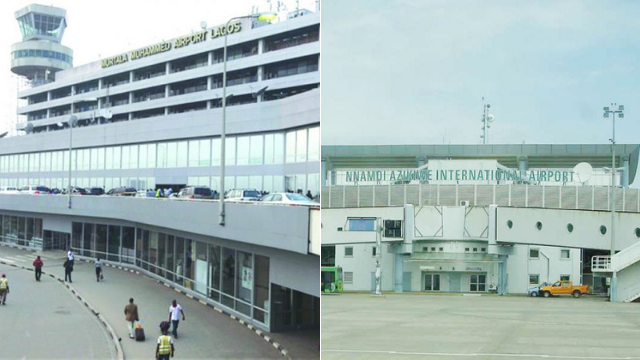
ALLEGATION of fraud and other forms of sharp practices are trailing the COVID-19 repeat tests being carried out on passengers who arrived in Nigeria on international flights from abroad.

Nigerians in the Diaspora and other persons who are travelling to Nigeria are required to carry out a COVID-19 Polymerase Chain Reaction test at least 96 hours before entering the country, and the result of the test is to be updated to the Nigeria Centre for Disease Control’s Nigeria International Travel Portal.

However, since the resumption of international flights in Nigeria on September 5, passengers are presenting negative PCR test results before boarding aircraft travelling to Nigeria, they are also being made to pay for COVID-19 PCR repeat tests that would be carried out on them when they arrive in the country.

Passengers are required to complete online payment for the repeat test before travelling to Nigeria but those who are unable to do so are allowed to pay on arrival in Nigeria.

But many passengers, particularly Nigerians, who arrived in the country since the resumption of international flights are recounting tales of outright stealing, extortion and fraud perpetrated by government officials who supervise the enforcement of the COVID-19 guidelines at the Lagos and Abuja international airports.

Some of the passengers, who narrated their experiences on Berekete Family, a reality radio program on Human Rights Radio 101.1 FM, which was monitored live on air and on YouTube on Thursday, said they were defrauded by government officials as the money they paid for the COVID-19 repeat tests were not recorded in the official account of the government.

The affected passengers said they were forced to repeat the payments in order to undergo the test, which is a requirement for returning to their base outside the country.

Also, different amounts are being collected from passengers as payment for the repeat tests, going by the testimonies of some returnees who appeared on the radio program.

According to allegations made by one Ohiare, a Nigerian who phoned-in to the Berekete Family program from his base in Turkey, government officials at the Lagos and Abuja international airports tell the returnees that they can arrange people who would impersonate them and undertake the COVID-19 repeat tests in their place.

Usually, when passengers arrive Nigeria on international flights and show evidence of payment of the fee for the repeat test, they are assigned to any authorised laboratory, within their destination in the country, for the COVID-19 test.

Narrating the experience of one of his brothers who recently travelled to Nigeria from Turkey, Ohiare said “One of my brothers travelled to Nigeria last week. Before leaving Turkey he did COVID -19 test and it is free here and you get the result two days or a day before you travel and when you get to Nigeria you tender the result.

“But when my brother tendered his result at the Lagos airport in Nigeria they asked him to pay N51,900 for another test in Nigeria. When he paid the money somebody came and told him that ‘if you don’t want to do the repeat test yourself, we can send somebody to do it for you’. If you agree they will now tell you that somebody will go to the hospital where you are supposed to do the test to represent you.”

In the same vein, a guest in the studio of the Berekete Family program, one Ndubuisi Ekwulonu, a Nigerian who said he arrived the country from Sweden on September 10, narrated how he was defrauded through payment of the fee for the COVID-19 repeat test.

Ekwulonu said he paid N42,700 for the test but his name did not appear in the list of returnees who made payment, as indicated on a government portal.

He had to repeat the payment in order to obtain a negative COVID-19 repeat test result, a requirement for boarding aircraft to leave the country, as he is to return to Sweden on Saturday.

But, according to him, he has also been informed that the second payment was not captured in the system.

Ekwulonu, who broke down in tears at a point during his testimony, said he has spent almost N90,000 on multiple payments for the COVID-19 repeat test since he arrived in Nigeria on September 10.

Narrating his travails, he said, “Before I left Sweden, there was a form the Federal Government of Nigeria asked us to fill for the repeat test. I filled the form and decided to make payment when I arrive Nigeria. On getting to Nigeria, they asked me to pay and I paid with my ATM card. They debited N42,700 and gave me two options – one laboratory in Jabi and another one in Maitama, (in Abuja) for the test.

“I chose the one in Maitama but if you put the address of the laboratory in Google Map, it will take you to one laboratory at Emab Plaza. When I got to Emab Plaza, they said they don’t know what I am talking about. After, I was directed to the isolation centre at THISDAY Dome. When I got there they said I should go to the Ministry of Health at the Federal Secretariat. I went to the Ministry of Health and I was told to go to an event centre. I got to the event centre and found the laboratory there.

“I showed them my receipt, that I have been directed to do the test there and that if I don’t do the test I cannot leave the country. The people at the laboratory then forwarded my payment details to Lagos through the computer system. After waiting the whole day they said there was no response from Lagos. I came back very early the next day and when they checked the system they said my name was not on the list they gave them of those that paid.”

Ekwulonu added that some other passengers who returned from Sweden with him on the same flight were also had the same experience.

He added, “Luckily for me, two other people that were on the same flight with me came to the laboratory but they couldn’t find their names on the list. Even my friend who also came back from Sweden couldn’t find his name. The people at the laboratory now told me that if I want to do the test, I should pay another money. I paid another N42,700 and they did the test. I am supposed to leave Nigeria on Saturday but they have now sent me a text message calling me again to pay another N42,700 to do the test. We were about 200 passengers on that flight from Sweden. Almost N90,000 have gone out of my account for the test yet they are saying they can’t find my name.”

When contacted over the allegations, the Federal Airports Authority of Nigeria said it was not involved in the COVID-19 repeat tests, which is a requirement for international flights.

The agency said the NCDC and the Federal Ministry of Health are the ones responsible for the COVID-19 tests.

General Manager, Corporate Affairs, Henrietta Yakubu, in an SMS in response to enquiries from our correspondent, said, “FAAN does not charge for COVID-19 test please. It is NCDC/Ministry of Health. We are only managers of the airports not an health institution.”

Responding to further questions, Yakubu said FAAN was not the police, nor the Economic and Financial Crimes Commission and the Independent Corrupt Practices and other related offences Commission.

However, it would be recalled that in August, FAAN had said it was investigating allegations that some officials at the Nnamdi Azikiwe International Airport, Abuja, were collecting bribe from returnees on evacuation flights during COVID-19 clearance.

International flights into and out of Nigeria was suspended on March 23 due to the COVID-19 pandemic but the suspension was lifted on September 5.

When contacted, an official in the public affairs unit of the NCDC, Emeka Oguanuo, drew attention to a press release, dated September 14, 2020, in which the organisation denied reports of fraud in COVID-19 tests for ‘air travellers’. But the September 14 statement did not specify the nature of the alleged fraud it was refuting.

However, the NCDC, in the statement attributed to the Director General, Dr. Chikwe Ihekweazu, said the repeat test was introduced to protect Nigerians from the coronavirus disease, especially since many returnees flouted self-isolation regulations after returning to the country.

“The decision to make repeat tests mandatory in Nigeria was based on a review of data by NCDC and the Presidential Taskforce on COVID-19. The goal was to find the right balance between protecting Nigeria from more infections, while supporting the restart of international travel. From May till August 2020, evacuation and emergency flights were allowed into the country following an initial restriction on international flights. Of the number of people who returned to Nigeria, 5 per cent tested positive within 14 days of arrival in Nigeria. In addition, several people flouted self-isolation guidance on return.

“Based on this data and the current capacity in Nigeria, it was decided that all travellers to Nigeria must be tested after seven days of return to the country. This was to enable early detection and to reduce the risk of further transmission of the disease,” the statement said.

The NCDC added that although public laboratories have been set up to provide free tests to Nigerians, all travel-related testing can only be carried out in private laboratories.

Seeming to shift the blame for the alleged fraudulent activities involved in the repeat tests to the private laboratories, the NCDC statement added, “The private laboratories that provide testing for COVID-19 are commercial entities, independent of the Government of Nigeria.

“The PTF-COVID-19 has ensured that the prices indicated by these laboratories are as subsidised as possible.

“All payment received on the travel platform are sent directly to the laboratories where the passenger has chosen to be tested, chosen from a list of private laboratories approved for testing COVID-19 in Nigeria.

“No payment is received by NCDC for any purpose, whatsoever. We advise that passengers should not make payments outside of the official platform.”

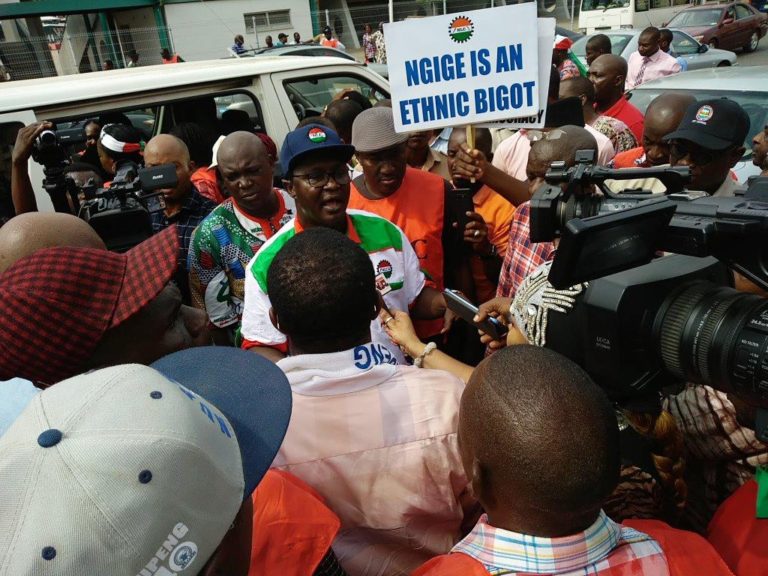
Court orders NLC, TUC to stop strike action over fuel, electricity hike

0

THE National Industrial Court (NIC) on Thursday granted an interim injunction restraining the Nigeria Labour Congress (NLC) and Trade Union Congress (TUC)  from embarking on any strike action or stoppage of work from September, 28.

Justice Ibrahim Galadima, the Abuja Vacation Judge of the NIC said the interim order was pending the hearing and determination of the Motion on Notice.

The ex-parte application which was filed by the Incorporated Trustees of Peace and Unity Ambassadors Association through their counsel, Sunusi Musa.

The court also granted an order of interim injunction restraining the unions, their officers, affiliates, privies from disrupting, restraining, picketing or preventing the workers or its affiliates or ordinary Nigerians from accessing their offices to carry out their legitimate duties on the 28th September 2020 or any other date.

The court also granted an order compelling the Inspector General of Police and the Director-General, Department of State Services (DSS) to provide protection for workers engaged in their legitimate duties from any form of harassment, intimidation and bullying by the officers, agents or privies of the unions pending the hearing and determination of the Motion on Notice.

This comes after the Federal Government met with the NLC and TUC on Thursday over the threat by the organised labour to proceed on an indefinite strike and protest against the hike in electricity traffics and the petrol pump price.

The FG and the unions had met penultimate Tuesday but the dialogue ended in a deadlock following the failure of the government to reverse the price increase or offer palliatives to cushion the effects on the workers.

Confusion in Ekiti APC as Fayemi, Ojudu’s factions trade suspensions

0

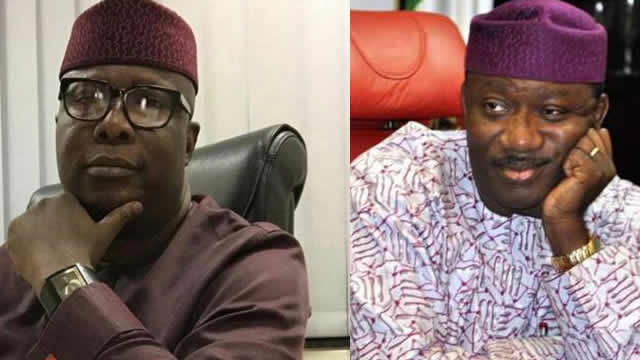
THE intra-party crisis within the ruling All Progressives Congress (APC) in Ekiti State has taken another form as two emerging factions in the party have issued two separate suspensions to party chieftains including Kayode Fayemi, the Governor of the state in less than 24 hours.

On Wednesday, a faction in the party loyal to the Governor said it has suspended Babafemi Ojudu, a presidential adviser and former senator,  and 10 other party leaders.

The faction said the 11 members were suspended for allegedly disobeying the directive of the party’s National Executive Committee (NEC).

Ade Ajayi, the State Publicity Secretary of the APC, disclosed this in a letter titled, ‘Indefinite suspension of some members of Ekiti State Chapter of APC’.

Apart from Ojudu, other affected members are Oyetunde Ojo ,the son-in-law to Bola Tinubu, National Leader of APC,  Wole Oluyede, a former governorship aspirant, Ayo Ajibade, Femi Adeleye, Bunmi Ogunleye, Akin Akomolafe, Bamigboye Adegoroye, Olusoga Owoeye, Dele Afolabi, and Toyin Oluwasola.

The letter reads, “The State Executive Council of the Ekiti State chapter of APC has approved the indefinite suspension of the following members with immediate effect from 23rd September 2020.

“The suspension is based on the recommendation of the Investigative/Disciplinary Committee inaugurated by SEC to investigate the disobedience of certain members to the directive of NEC of 25th June, 2020, which directed members of the party not to institute any court action and to withdraw existing cases in courts.

“The decision of SEC has been communicated to the caretaker/extraordinary convention planning committee of the party.”

Counter reaction that led to Fayemi’s suspension

However, in a counter-reaction to the suspension of Ojudu, and 10 other party leaders the other faction on Friday suspended the state governor, Kayode Fayemi from the party.

The faction led by  Anthony Adeniyi announced the suspension of  Fayemi from the APC for alleged anti-party activities.

The faction also described the rival faction led by Paul Omotoso-led state executives of the party as illegal.

The Adeniyi-led executives backing Ojudu and the other allegedly suspended ten members by the faction loyal to Fayemi stated in a communiqué that Fayemi was suspended for anti-party activities, particularly for his role in the Edo election.

The communiqué read, “After painstakingly reviewing the activities of some members of the APC in Ekiti State, we the authentic members of the party in the State and members of SEC per Section 12.8 of the APC Constitution being duly constituted members of the National Convention of the Party, rose from its meeting of the 23rd September 2020 with some far-reaching resolutions.

“That Dr Fayemi, the Executive Governor of Ekiti State is hereby suspended from the party in view of his numerous anti-party activities especially his role in the recently concluded governorship election in Edo State, which is contrary to the provisions of Article 21 (A) (ii) of the APC Constitution.

“The Paul Omotosho led faction of the APC Executive in the state is hereby declared illegal and suspended from the party for failure to emerge in accordance with the Constitution of the Party.

“Senator Adeniyi, as a statutory member of the SEC going by our party’s constitution, was elected by all members attending as the Acting Chairman of the State Executive Committee in the absence of direction or directive from the National Body. He is as such the only one thus capable to call the SEC meeting as duly required by the constitution from henceforth.”

The communique was signed by Adeniyi, Babafemi Ojudu,  Dayo Adeyeye, Bimbo Daramola, Robinson Ajiboye, Oye Ojo, Adewale Omirin, and Femi Adeleye.


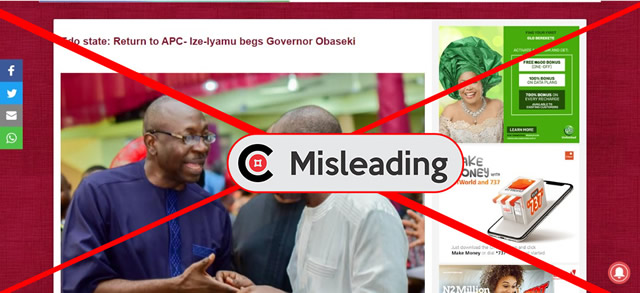
Media reports that Ize-Iyamu begged Obaseki to return to APC are MISLEADING

0

LINDA Ikeji’s blog on Thursday, September 24, 2020 reported that Osagie Ize-Iyamu, the All Progressives Congress (APC) candidate in the September 19, 2020,  Edo State gubernatorial election has begged Godwin Obaseki to return to the APC.

Obaseki, who is the incumbent governor of the state, won the election for a second term. He was initially in the APC but moved to the Peoples Democratic Party (PDP) prior to the election.

Edo is a state in southern Nigeria.

Linda Ikeji’s blog, in the news published on their website and archived here, stated that Ize-Iyamu, the APC candidate in the Edo governorship election, has called on Governor Godwin Obaseki to return to APC.

“Pastor Osagie Ize-Iyamu, the APC governorship candidate in the Saturday, September 19 governorship election in Edo state, has called on Governor Godwin Obaseki to return to APC.

“Recall that in June 2020, Obaseki defected from the APC to the PDP following his running battle with his predecessor and former National Chairman of the APC, Adams Oshiomole. The battle between both men led to Obaseki being disqualified from the APC governorship primaries. Obaseki immediately defected to PDP where he was able to secure the party’s governorship ticket and won the election.

“In a television broadcast on Wednesday night September 23, Ize-Iyamu appealed to Obaseki to return to the APC,” the news read in part.

The news was also published by some mainstream media outlets in Nigeria, including The Punch, ThisDay and Daily Post.

Although, the Punch and Thisday newspapers have deleted the news reports from their website, DailypostLailasnews and Allnewsng still have the reports on their websites as at 1.30pm on Thursday, September, 24, 2020.

Having discovered that the report is “untrue”, The Punch has apologised to Ize-Iyamu “for the embarrassment this story might have caused him.”

The apology from the Punch newspaper.

THE CLAIM:

That after the Edo governorship election, Osagie Ize-Iyamu begged Godwin Obaseki, his opponent to return to the All Progressives Congress (APC).

THE FINDINGS:

Findings by the FactCheckHub revealed that Linda Ikeji’s blog and other news websites relied on an old video in writing the report.

Earlier, Ize-Iyamu was seen in a video posted here appealing to Godwin Obaseki, his opponent to return to the APC although the video was released three months ago, before the election took place.

Similarly, the Director of Communication and Media of the Osagie Ize-Iyamu Campaign Organisation, John Mayaki, in a reaction to the media report, stated that the news is not true. He added that the video in circulation was released three months ago.

He also stated that Ize-Iyamu has not addressed the press after the election.

The misleading report on Linda Ikeji’s blog.

THE VERDICT:

The claim that Osagie Ize-Iyamu has begged Godwin Obaseki, his opponent to return to the APC is MISLEADING. Linda Ikeji blog and other news websites relied on an old video in writing their reports.

Did WAEC conduct Senior School Certificate Examination in Chibok?


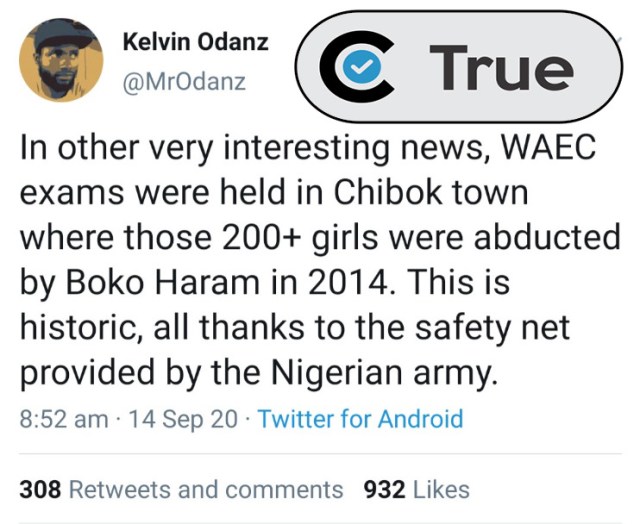
ON September 14, Kelvin Odanz @MrOdanz shared a tweet claiming that the West African Examination Council (WAEC) senior school certificate examination held in Chibok, one of the epicentres of Boko Haram insurgency in Borno State, Nigeria.

He applauded the commending the Nigerian Army for its interventions in the area.

“…WAEC exams were held in Chibok town where those 200+ girls were abducted by Boko Haram in 2014. This is historic, all thanks to the safety net provided by the Nigerian army,” he tweeted to his 63,000 followers.

The tweet, which had 933 likes, has been retweeted over 300 times as at 2:00pm on Wednesday, September 23, 2020.

THE CLAIM

That the West African Examination Council (WAEC) held its senior school certificate examination in Chibok town.

THE FINDINGS:

Chibok town became prominent following the abduction of secondary school girls by the Boko Haram insurgents in 2014.

A total of 276 girls were kidnapped from their dormitory in the Government Secondary School located in North-East Nigeria.

While some of the girls managed to escape, 100 were freed in an exchange deal during a negotiation arranged by the International Committee of the Red Cross (ICRC).

The girls’ abduction sparked social media movement with the hashtag #BringBackOurGirls.

The incident led to disruption of educational activities in the area. But six years after the incident, findings by the FactCheckHub revealed the West African examination body resolved to return to the state to resume the secondary school examination.

Two hundred and thirty-eight (238) students in Chibok participated in this year’s examination, Demianus Ojijeogu, WAEC Spokesperson told the FactCheckHub during a verification process.

“Yes, 238 candidates wrote the examination. There was no problem; everything went smoothly,” Ojijeogu said.

Media organisations had earlier reported the examination. Prior to the 2020 WAEC examination, reports say students would often travel to Jos, Maiduguri and other major cities in Nigeria’s northern states to write the examination.

THE VERDICT:

The claim that the West African Examination Council (WAEC) held its senior school certificate examination in Chibok town is TRUE.

Nigeria not building a rail line into Niger Republic – Presidency

0

THE Presidency has explained the Federal Government’s planned development of a rail line from Kano to Niger Republic.

The Federal Executive Council (FEC), had on Wednesday approved a $1.96 billion contract for the development of a rail line from Kano to Niger Republic.

The rail line according to the government will go through Kano-Jigawa-Katsina-Jibia to Maradi in Niger Republic.

Rotimi Amaechi, the Minister of Transportation while announcing the rail line project told journalists at the end of the FEC meeting that the rail line when completed is expected to aid the transportation of crude oil.

However, the proposed rail line project generated criticisms from some Nigerians on social media who described the project as a misplaced priority and project initiated based on ethnicism.

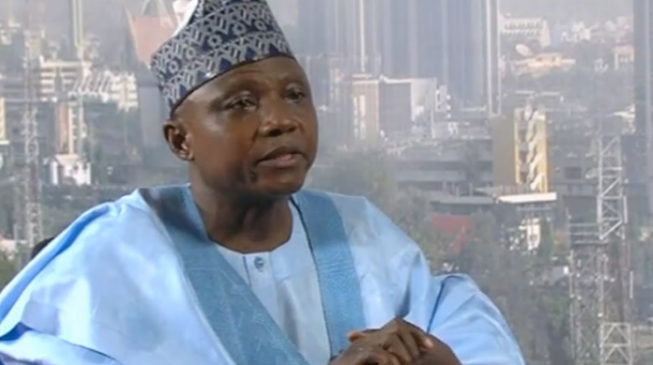
But Garba Shehu, the Senior Special Assistant, Media, and Publicity to President Muhammadu Buhari in a series of tweets in reaction to the controversy generated by the project posted on his official Twitter handle Thursday evening said the country isn’t building a rail line into Niger but, only to the designated Border point.

Shehu said“an agreement between Nigeria and Niger in 2015, coordinated by the Nigeria-Niger Joint Commission for Cooperation has a plan for the “Kano-Katsina-Maradi Corridor Master Plan, (K2M)” as it is called.”

He said going by this, the two nations would each build a rail track to meet at the border town of Maradi.

“Nigerian delegates to that meeting comprised officials from the Ministry of Foreign Affairs, National Boundaries Commission, Federal Ministry of Industry, Trade & Investment, Ministry of Agriculture and Rural Development, Water Resources as well as those of Kano and Katsina states,” Shehu explained.

“The objective of the rail is the harnessing of raw materials, mineral resources and agricultural produce. When completed, it will serve domestic industries and play the role of a viable transportation backbone to the West African subregion, starting with the neighbouring Niger Republic for their export and import logistic chain.”

Mentally-challenged woman delivers baby by roadside in Lagos

0

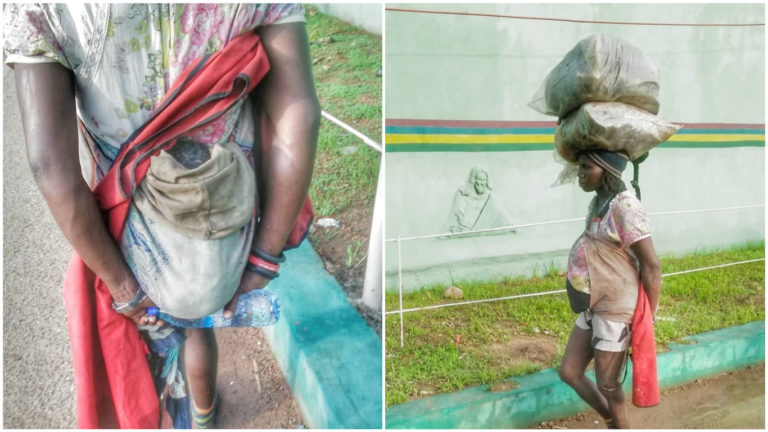
A yet-to-be-identified mentally-challenged woman was on Wednesday captured by Ademola Akinlabi, a Nigerian photojournalist shortly after she delivered a baby by the roadside in Abule Egba area of Lagos. 

The pictures which were sighted by The ICIR show the new mother hoarding a pile of garbage that was placed on her head while backing her child with the aid of a sack-like cloth tied to her chest.

In one of the photos, the mother can be seen sitting on the pavement by the road while breastfeeding her newborn, only stopping to drink water from a plastic bottle.

Akinlabi told The ICIR that all attempts to speak to the woman were futile as she remained mute, refusing to answer any of the questions directed at her.

After a short while, the mother walked away with her child and belongings, Akinlabi said.

Although Nigeria has an established Ministry of Women Affairs and Social Development, the country struggles to run a functional social welfare system that caters to vulnerable groups.

With a mission “to provide relief for distressed persons, vulnerable/disadvantaged members of the society as well as the promotion of cohesiveness and creation of condition conducive for social progress,” the Social Welfare Department under the Ministry of Women Affairs and Social Development is responsible for care and support of all vulnerable groups (destitute, the indigent, the sick and their families) but is largely constrained due to lack of enforcement of its mandate by the Federal Government.

Nigeria currently spends less on social protection than many other African countries, despite its relative wealth, according to a 2012 synthesis report by the Overseas Development Institute.