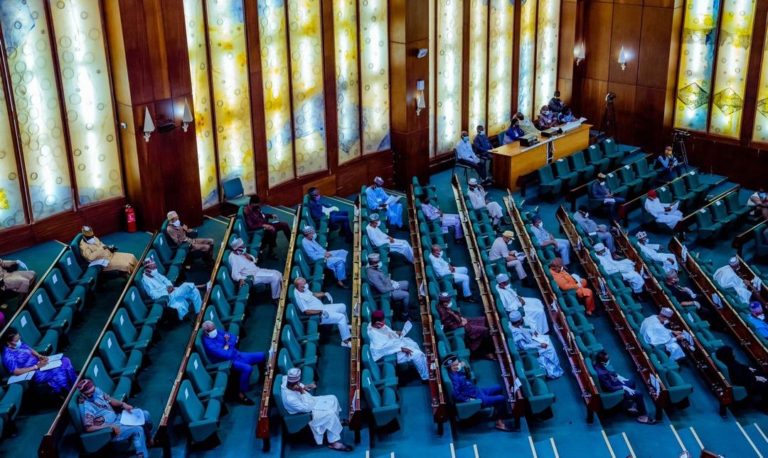
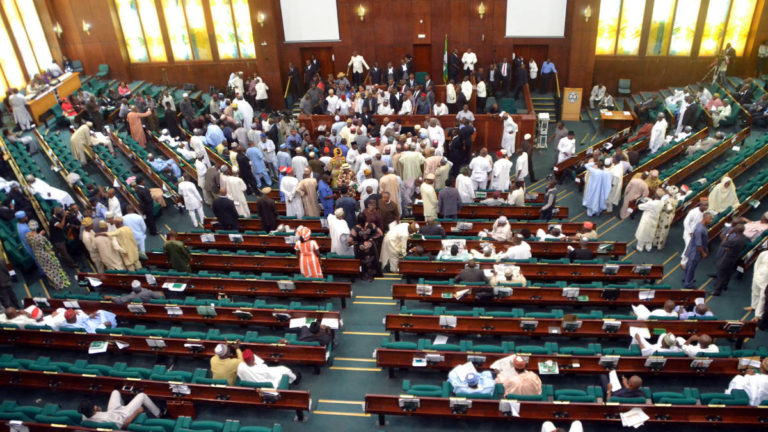
THE House of Representatives on Thursday urged the Federal Government and the Muhammad Adamu, the Inspector General of Police to effectively get rid of armed criminals who are terrorising the people of Oji-River Local Government Area of Enugu State.
This follows the recent gruesome murder of one Eugene Ilobani, a farmer while working on his farm by some unknown criminals and the killings of other farmers in the area by persons believed to be herdsmen.
While calling the attention of the lower chamber to the incident, Toby Okechukwu, member representing Agwu, Aniri and Oji-River Federal Constituency of Enugu urged the Federal Government to deploy security personnel to provide a safe environment for the persons in the community in order to continue farming and the apprehension of perpetrators of this heinous crime.
According to the police, Iloabani of Amamkpunato village was gruesomely murdered by yet to be identified persons in a forest in the community.
Daniel Ndukwe, Enugu State Police Public Relations Officer stated that preliminary investigation showed that the deceased was found in Achi forest with several degrees of machete cuts on the head and neck regions.
Ndukwe also disclosed that the state Police Commissioner has also directed the immediate launch of a full scale investigation to apprehend and prosecute the fleeing culprits.
“He made it clear that the command, under his watch, will leave no stone unturned to bring culprits of the heinous crime to book,’’ Ndukwe said.
It was also reported that about 29 communities in Oji River Local Government area have issued a ‘quit notice’ to Fulani herdsmen in the community over alleged incessant attacks and destruction of farmlands in the area.
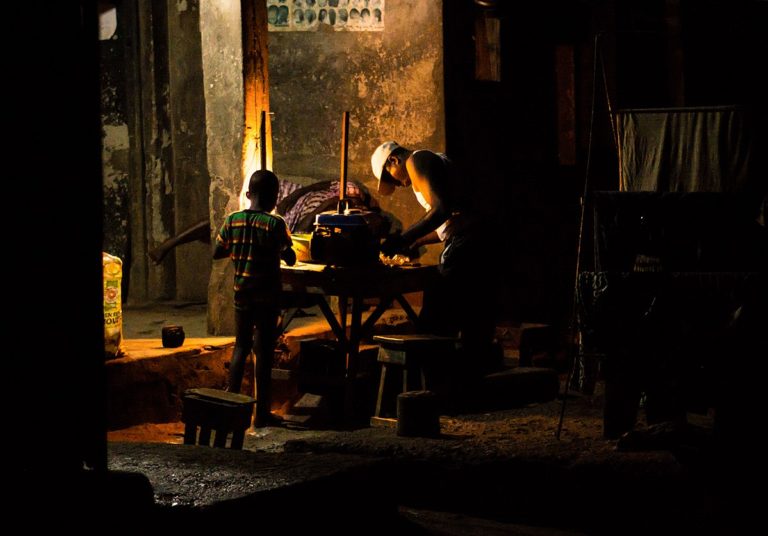
IBRAHIM Akanbi, 12, was nervous as he paced up and down in his parents’ living room. For over 12 hours, he and the rest of the household have been in the dark due to power outage.
His hope for a quick restoration of power supply by the Ibadan Electricity Distribution Company (IBEDC), the power distribution company was fast fading.
There were just a few hours left to the commencement of an online course to which, his father, Adesola Ibrahim enrolled him. He needed the online class to cover for the loss of academic time caused by the COVID-19 Pandemic.
Nigeria government could not provide e-learning facilities for pupils and students in public schools due to lack of internet, but Take A Course Online (TACO) educational services, one of several private initiatives to bridge the gap are the ones young Akanbi was eager to join online.
“I have missed my online classes for three consecutive times now due to non-availability of electricity in our area,” says a frustrated Akanbi.
“I’m beginning to get scared I might not be able to catch up with my colleagues,” adds the Junior Secondary School three (JSS3) student.
According to the United Nations Educational, Scientific and Cultural Organization (UNESCO), schools have been closed in not less than 185 countries due to COVID-19.
On March 19, the Federal government of Nigeria through the Federal Ministry of Education ordered the immediate closure of tertiary institutions, secondary and primary schools nationwide following the outbreak of coronavirus in the country and as part of measures to contain the spread.
While schools owned privately have moved on with e-learning for their students, state-owned schools are grappling with the inability to deploy internet facilities for the same purpose and poor power supply has compounded the challenge.
Akanbi is in one of those state-owned schools in his hometown, Ibadan, the capital city of Oyo State.
Like Akanbi, Ajijola Gabriel, an undergraduate studying Mass Communication at Yaba College of Technology, Lagos says he is now a nightcrawler due to incessant power outages.
“We only have power for just three out of the 24-hours we have in a day and that is always between 1:00 am and 4: 00 am,” says Gabriel who studies at night to keep abreast of the curriculum since COVID-19 forced schools to be shut down.
“In fact, I no longer sleep at night, just so I can read and get courses done online since schools are shut down due to COVID-19,” he said.
In a bid to cushion the effect of COVID-19 on the students, some states in Nigeria that could not adopt e-learning introduced Television and Radio learning to cater to the students, but the poor power supply would not allow the students to take this advantage.
On June 2, Afolayan Grace, a primary 5 pupil, who resides in Apomu town in Osun State was happy because she could watch an English class on the television for the very first time since the state government introduced both online and on-air learning in the state.
But it was just 30 minutes into the class when the power supply was disrupted and young Grace broke down in tears.
“I felt disappointed and I cried,” the 10-year-old girl recounted
Unending challenges
Power generation and distribution is a major challenge in Nigeria, despite being the largest economy in Africa.
Nigeria, though endowed with large oil, gas, hydro and solar resources has the potential to generate 12,522 megawatts (MW) of electric power from existing plants but on most days, generate 4,000 MW, which is insufficient for the country’s teeming population.
Infographics on Energy generation in Nigeria
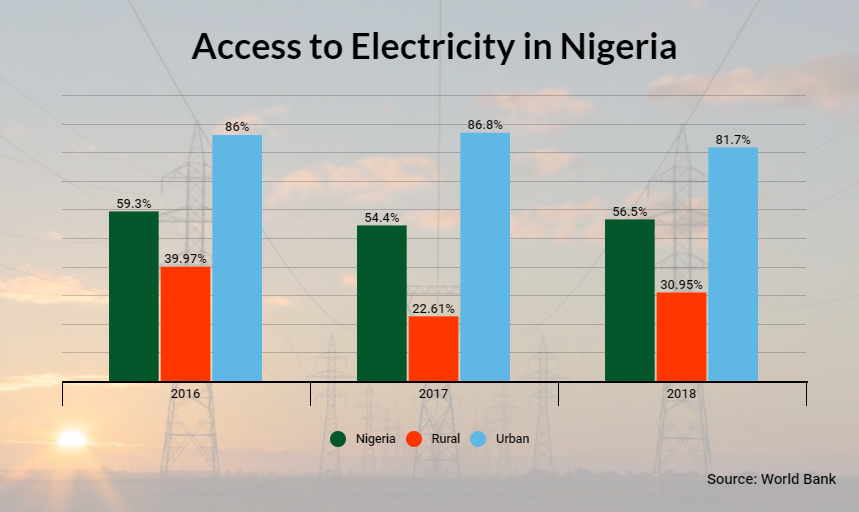
Only 57 percent of the country’s 200 million population have access to electricity.
While just 31 percent of people living in the country’s rural areas have access to electricity, the 82 percent of people living in the urban areas that have access to electricity still usually experience persistent power outages.
Infographics on Access to Electricity in Nigeria
According to a Bloomberg report, an average home in Nigeria gets national grid power for about nine hours daily. It could be worse in some communities and homes.
The Federal Government of Nigeria has so far spent over N1.7 trillion on the already privatised power sector in the last three years.
Despite this huge amount of money expended on the power sector, about 80 million Nigerians living in 8000 villages across the country lack access to electricity.
The way forward
In order to salvage the energy crisis facing a larger percentage of Nigeria’s population, so many recommendations have been made, most of which urged the country to explore renewable energy potentials.
The United States Agency for International Development (USAID) noted that improving the power sector is critical to addressing development challenges in Nigeria.
Yetunde Fadeyi, founder of Renewable Energy and Environmental Sustainability Initiative for Africa (REES Africa), says the problem of energy deficiency facing a larger percentage of Nigerians can be mitigated if the country could look inward to embrace renewable energy.
“More than half of Nigeria’s population live in rural areas and are not connected to the grid due to the peculiarities of these rural areas. Access to electricity is a luxury they cannot afford hence, they are excluded from this service and that’s why it is necessary for the government to embrace renewable energy to solve the problem of these people and that of other people facing energy challenges in the country,” she said.
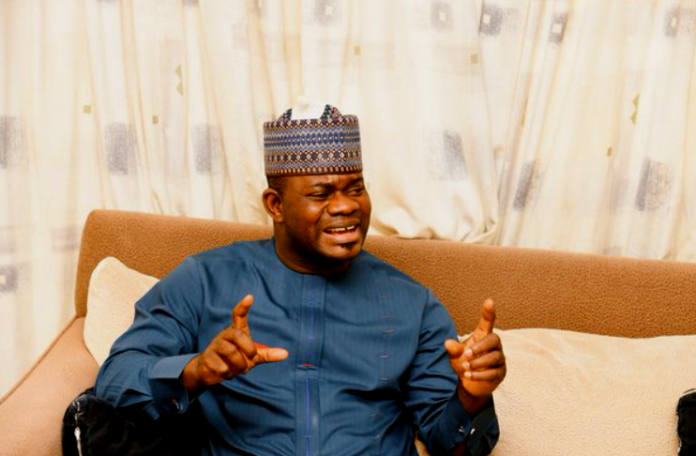
YAHAYA Bello, Governor of Kogi State says Nigeria should take advantage of the COVID-19 pandemic to create more jobs, saying the country should provide clothes for face masks to be exported to those countries who have the disease.
Bello who continues to maintain that his state, Kogi has no single case of COVID-19, also stated that politicians have been playing game with the disease and putting Nigerians into hardship by imposing lockdown.
“Let us stop this game. Nigerians are suffering. Instead of the lockdown with its attendant negative effects on the people, why can’t we turn it into employment opportunities; providing clothes for face masks to be exported to those countries who have the disease?’ he said.
The Kogi State Governor spoke on Thursday while playing host to members of the Board of Trustees (BoT) of Sir Ahmadu Bello Memorial Foundation, who paid him a courtesy call at the Government House, Lokoja.
According to him, COVID-19 is not a new disease to the country, noting that there are ways to treating it.
“COVID-19 is not a new disease in our clime. We have our own way of treating it and that is what we should be exploiting, rather than subjecting our people to hardship, hunger and starvation through lockdown,” Bello said.
Speaking on the circumstances that surrounded the death of late Justice Nasir Ajanah, Chief Judge of the state, who was reported to have died from COVID-19 complications, the governor said the deceased had battled with severe health conditions since 2016 and died because he couldn’t access good healthcare due to the lockdown order.
“We know his medical history; he was my brother. We know we have been managing him since 2016, but this time, he was completely isolated; no one was allowed to even speak to him until he passed away. We cannot afford to be playing games with the lives of Nigerians This must stop,” he said.
On June 18, Abdulateef Suleman, a Personal Assistant to Bello, was reported to have died of suspected COVID-19.
Suleiman, 41, died during the early hours of Wednesday in a private hospital in Abuja where he was admitted for treatment of an illness believed to be COVID-19 related.
In a picture seen by The ICIR, the late Aide to Kogi Governor died while he was on ventilator in the private hospital.
Since Nigeria got its index case in February, COVID-19 has continued to responsible for death of prominent Nigerians.
In April, Abba Kyari, President Muhammadu Buhari former Chief of Staff was pronounced dead after losing the battle to the deadly virus.
On June 25, Abiola Ajimobi, former Oyo State governor also died of COVID-19.
on Thursday, Wahab Adegbenro, Ondo State Commissioner for Health, lost the battle to the deadly virus, just few days after Rotimi Akeredolu, the governor of the state announced that he tested positive for coronavirus.
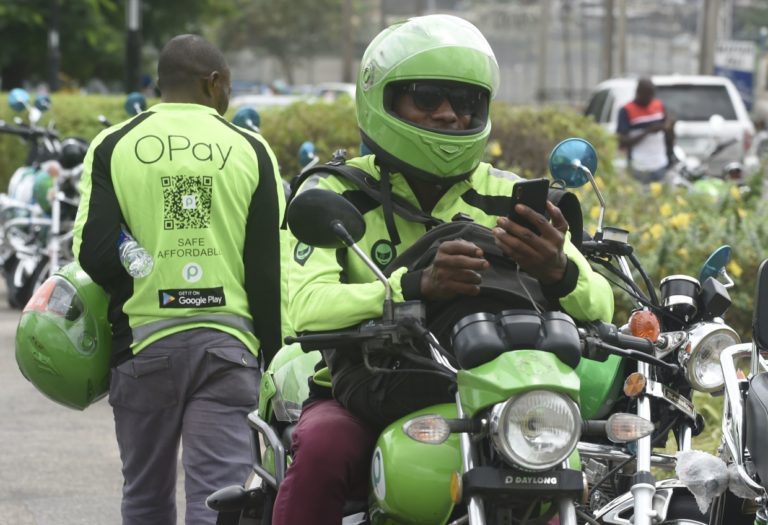
A Chinese owned digital business operator in Nigeria popularly known as OPay has announced the suspension of its digital transport services, ORide and OCar due to the COVID-19 pandemic and government ban.
OPay made this announcement via a statement seen by The ICIR on its official twitter account on Thursday.
According to the statement, the suspension is due to the government ban on motorcycles in some states of the country and lockdown imposed by government to contain the spread of COVID-19 which resulted in a ‘harsh business conditions across the country.
The ICIR had reported how commercial motorcycle companies and riders were affected by the ban on motorcycles in some parts of Lagos State in February.
OPay, in the statement, said ride-sharing businesses worldwide have been affected by coronavirus due to cessation and restriction of movement.
The company, however, stated that its other services would continue to function as the ride-sharing is only a part of the services it renders.
It further stated that the ride-sharing services are a minor part of the business as such would have a minimal impact on its overall businesses.
“Opay had already taken preemptive steps to restructure our business focus away from rides. It is worthy to note that this final restructuring has minimal impact on OPay as a whole business.
“It is important to clarify that ride-sharing had always been only one part, and not a major part of OPay, diversified business in Nigeria,” the statement read.
The statement further revealed that during the pandemic, the company witnessed an increase in demand for its online and offline mobile money service.
Due to the suspension of transport services of the company, many Nigerians who are registered as riders under the company’s digital platform are set to lose their jobs.
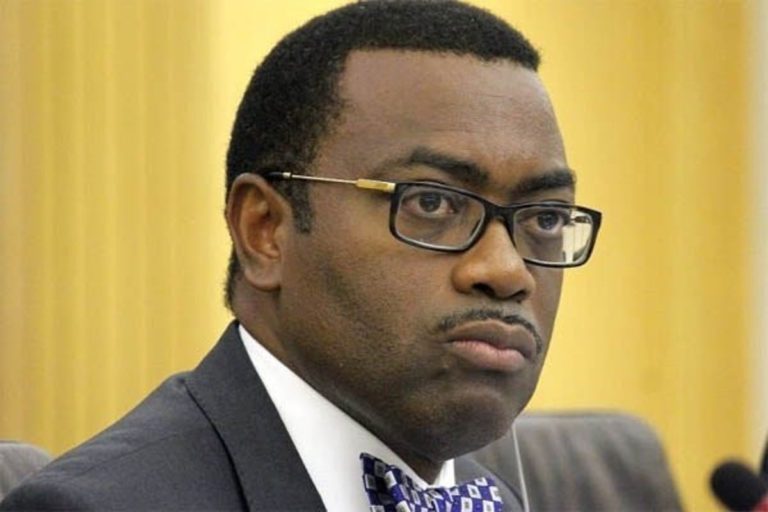
THE BUREAU of the board of governors of African Development Bank has set up a panel to carry out an independent review of the report of the ethics committee of the bank on the allegations made by whistleblowers against Akinwunmi Adesina, the president of the bank.
In a communique released on Wednesday, the bureau said it agreed on the terms of reference for the independent review at its meetings of June 18 and July 1, 2020.
The ‘High-Level Panel of Independent Experts’ to conduct the review has Mary Robinson, Hassan B. Jallow and Leonard F. McCarthy as members.
The communiqué, which was signed by Niale Kaba, Chairperson of the Bureau of the Boards of Governors of AfDB and Governor for Côte d’Ivoire, noted that the bureau expressed its utmost trust and confidence in the panel’s ability to successfully carry out the assignment and reaffirms its commitment to fully assisting the panel in the process.
The panel is expected to submit its report to the bureau within a period of two to four weeks maximum, the communiqué read.
Robinson, who is chair of the panel, is a lawyer and a former President of the Republic of Ireland. She also served as the United Nations High Commissioner for Human Rights.
She is the chairperson of the ‘Elders’, a global body of wise persons concerned about the wellbeing of the world.
Jallow is a former attorney general and minister of justice of the Republic of the Gambia as well as a former Justice of the Supreme Court of the Gambia.
In 2003. he was appointed as a judge of the Appeals Chamber of the Special Court for Sierra Leone and later that year as the Prosecutor of the United Nations’ International Criminal Tribunal for Rwanda (ICTR).
On February 5, 2017, Mr Jallow was sworn-in as the Chief Justice of the Gambia.
McCarthy had served as a former director of public prosecutions, ex-director of the Office of Serious Economic Offences, and a former head of the Directorate of Special Operations of South Africa.
He served as the Integrity Vice President of the World Bank for nine years and is the current President of LFMcCarthy Associates, Inc., an integrity risk management company based in Washington, D.C, USA.
Adesina’s re-election bid as President of the AfDB is currently threatened by the United States of America’s request for an independent probe into whistleblower allegations levelled against him.
He was accused by unnamed whistleblowers of using the bank’s resources for self-promotion and personal gain while also paying out huge undeserved severance packages to staff who resigned in unusual circumstances and favouring Nigerians.
The ethics committee of the bank’s board of governors had absolved Adesina of the charges but the US rejected the initial inquiry that cleared him and is sought for an independent probe which was eventually granted.
ADO Sanusi, the Chief Executive Officer (CEO) of Aero Contractors, says the airline would isolate any passenger on board any of its flights that shows symptoms of COVID-19 when domestic flight operations resume.
Sanusi stated this when he virtually appeared on a Sunrise Daily programme aired on Channels Television on Thursday morning.
According to him, the action is part of guidelines adopted by airline authorities to ensure that passengers are not infected with the viral disease while on air.
He stated that a separate space has been provided in all his company’s aircraft to isolate any passenger that shows any sign of COVID-19.
“We would tell the passenger to please sit in a separate place that has been provided onboard and we would let others alight before them,” Sanusi said.
The flight operator added that passengers with any sign of the disease would not be allowed to board the airplane even with a doctor’s note.
He said except the passenger comes with a valid COVID-19 test result which is only valid for four days, entrance would not be granted to such passenger by the flight operator.
This, he said is because COVID-19 and malaria shares almost the same symptoms, and a malaria test result cannot certainly affirm that it is not COVID-19.
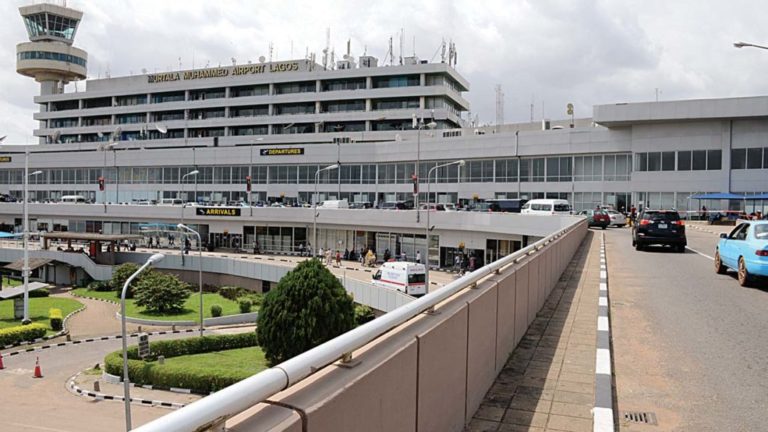
The Federal Government had on Wednesday announced the resumption of domestic flights after months of suspension to prevent the spread of the viral disease.
Hadi Sirika, Minister of Aviation announced that Abuja and Lagos airports will resume domestic operations on July 8 while Kano, Port Harcourt, Owerri and Maiduguri would commence operations on July 11.
Sirika stated that date for resumption of international flights would be announced in due course.
WAHAB Adegbenro, Ondo State Commissioner for Health has died of COVID-19 complications, reports have confirmed.
It was gathered that Adegbenro who has been sick for several days gave up the ghost on Thursday at the Ondo State Isolation Centre where he was receiving treatment.
A Government House official who did not want to be mentioned told The ICIR that the commissioner had died.
He said the government has not issued an official statement on his death.
“Yes, it is true that the Commissioner has died, but the state government has not issued any official statement,” he said.
Adegbenro who served as the Chairman, Ondo State Council of All Progressive Congress (APC) Muslim Members, died at age 65.
His death is coming shortly after Rotimi Akeredolu, Governor of Ondo State, disclosed that he had tested positive for the COVID-19 on Tuesday, after coming down with malaria.
Akeredolu confirmed his status in a video clip shared on his Twitter page in which the he disclosed that he is asymptomatic and is currently self isolating.
THE House of Representatives on Wednesday demanded for the data of pupils who are benefiting from the Federal Government National Home Grown School Feeding Programme.
The House Committee Public Accounts chaired by Wole Oke, lawmaker representing Obokun/Oriade Federal Constituency of Osun State, noted that the data used for the programme has been unverifiable since its inception.
Oke directed Yemi Kale, the Statistician-General of the Federation and the National Bureau of Statistics, to provide data of all private, public schools and pupils benefiting from the initiative.
The lawmaker further demanded the details of the food vendors involved in the programme and the adequate parameters for the qualifications of the vendors.
This, he said was necessary for the purpose of accountability adding that it was also in accordance with the Public Procurement Act.
Furthermore, Oke stated that details of the food vendors were also imperative so as to safeguard the lives of the pupils who were beneficiaries of the programme.
Although he commended President Muhammadu Buhari for introducing the programme, he argued that the programme must be reviewed by the lawmakers to ensure that public funds are not mismanaged.
While responding, Yemi Kale, said his office would do the headcount as requested and provide the list of public and private school pupils who benefited from the feeding programme.
There have been issues surrounding the School Feeding Programme especially when Sadiya Farouk, the Minister of Humanitarian Affairs, announced that the programme would continue despite the closure of schools nationwide during the ongoing COVID-19 pandemic.
The opposition party, Peoples Democratic Party (PDP) had described the School Feeding programme as a scam and an avenue for government officials to siphon public funds.
The PDP alleged that the decision to continue the school feeding programme despite the closure of schools nationwide would allow the government to embezzle about N13.5 billion.
RAMONI Igbalode Abbas, alleged criminal mastermind known as ‘Hushpuppi’ has been extradited from the United Arab Emirates (UAE) to the United States.
His accomplice, Olalekan Jacob Ponle also known as Woodberry is also being extradited to the US on the request of the Federal Bureau of Investigations (FBI).
The FBI in a Twitter message thanked Dubai police for arresting the two internet fraudsters.
Also, a statement released by the Dubai Police on Thursday indicated FBI’s appreciation to the UAE crime unit over its role in arresting and extraditing Hushpuppi and Woodberry.
Christopher Wray, Director of FBI praised the exceptional efforts exerted by the United Arab Emirate, represented by the Dubai Police General HQ, in combating transnational organised cybercrime including the recent arrest of of Hushpuppi and Woodberry who were taken down in operation “Fox Hunt 2”.
Wray also extended his appreciations to Dubai Police for their cooperation in extraditing the wanted criminals, who committed money-laundering and multiple cybercrimes, to the United States
The Dubai Police in June had arrested the duo and ten African cybercriminals in a special operation dubbed “Fox Hunt 2.
The operation took down the suspects for committing crimes outside the UAE, including money-laundering, cyber fraud, hacking, criminal impersonating, scamming individuals, banking fraud and identity theft.
The suspects were caught in a series of synchronized raids by six SWAT teams from Dubai Police who foiled the gang’s bid to deceive many people from around the world and steal their money.
Jamal Salem Al Jallaf, director of Dubai CID said the raid resulted in confiscating incriminating documents of a planned fraud on a global scale worth AED 1.6 billion ($ 435 million).
“The team also seized more than AED 150 million ($40.9 million) in cash, 13 luxury cars with an estimated value of AED 25 million ($6.8 million) obtained from fraud crimes, and confiscated 21 computer devices, 47 smartphones, 15 memory sticks, five hard disks containing 119,580 fraud files as well as addresses of 1,926,400 victims,” he said.
After conducting further investigations and analyzing confiscated electronic devices, Dubai Police investigators uncovered sensitive information mined by the suspects on individuals and companies overseas including bank accounts and fake credit cards as well as documents and files condemning the gangs’ illegal activities.
THE Socio-Economic Rights and Accountability Project (SERAP) has urged President Muhammadu Buhari to use his good offices to immediately reverse the increase in the pump price of petrol from N143.80 per litre to N121.50 per litre.
“We urge President Buhari to immediately reverse the proposed upward review of the retail pump price of petrol from N121.50 to between N140.80 and N143.80 per litre,” SERAP wrote on Twitter.
This follows the announcement on Wednesday by the Petroleum Products Pricing Regulatory Agency (PPPRA) that the pump price of petrol has been reviewed upward from N121.50 to N143.80 per litre to reflect developments in the global crude oil market.
BREAKING: We urge President Buhari to immediately reverse proposed upward review of the retail pump price of petrol from N121.50 to between N140.80 and N143.80 per litre.
Increasing fuel price in the middle of COVID-19 is unfair, illegal and a grave violation of human rights.
Describing, the decision as a violation of the human rights of Nigerians, the group also stated that the timing for the rise in petrol price as the nation battled COVID-19 made it illegal.
“Increasing fuel price in the middle of COVID-19 is unfair, illegal and a grave violation of human rights,” it said.
The organisation also called on the leadership of National Assembly to move swiftly to stop and stop “this travesty and side with the country’s poorest and most vulnerable people.”
“Oil shouldn’t be a ‘curse’ for Nigerians; being endowed with natural resources ought to be a synonym for opportunities and development,” SERAP said.
On July 1, the PPPRA revealed in a circular to marketers stating that the decision was based considerations to the marketers’ realistic operating costs and prevailing market variables.
“After a review of the prevailing market fundamentals in the month of June and considering marketers’ realistic operating costs, as much as practicable, we wish to advise a new PMS pump price band of N140.80-N143.80 per litre for the month of July 2020,” the statement read.
In March, the Federal Government announced its first review of the petrol pump price per litre for the year from N145 to N125 per litre.
On April 1, the PPPRA, through, Abdulkadir Saidu, its Executive Secretary announced that all retail petrol outlets should start selling at the new pump price of N123.50k and N125 per litre of petrol.
Oil retailers were to choose between two price bands of N121.50k and N123.50k at which they were supposed to sell to their customers.
The price review was necessitated by a drop in crude oil prices due to the spread of coronavirus as the landing cost of petrol hit a record low in March, while the petrol subsidy was temporarily removed.