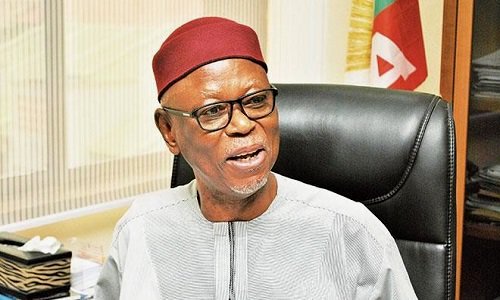
JOHN Odigie-Oyegun, the immediate former National Chairman of All Progressive Congress(APC), says the ruling party is fast becoming a most dangerous threat to the legacy of the government of President Muhammadu Buhari.
In an article titled ‘Before it is too late’, Oyegun called the attention of state governors and leaders of the party to what he described as ‘the internal ‘steady erosion’ bewildering the growth of the party.’
He urged the governors to put a stop to the disgraceful and humiliating charade occurring ‘within the National Secretariat of our great party.’
“This statement is, therefore, a clarion call to leaders of the party, particularly the Governors and Mr President to urgently bring a stop to the disgraceful and humiliating charade occurring within the National Secretariat of our great party,” Oyegun said.
Oyegun who noted that the ruling party was built on the blood and sweat of Nigerians, called for a special national convention before it is too late to be arranged by a caretaker committee instituted by the National Executive Council (NEC) of APC.
“There is a most urgent need for the party NEC to meet and institute for the party, a Caretaker Committee (even if we have to invoke the doctrine of necessity), whose main responsibility will be to arrange for a special National Convention,”he said.
He noted that he has added his voice together with other leaders of the party to ensure the ideals of the party are not completely ruptured.
Oyegun alleged that almost every member of the party feels dissatisfied with the present state of the party.
“Today, almost every member of the party feels a deep sense of alienation and dissatisfaction with the state of the party. It hurts deeply to see how hollow it now rings to mention our party and “change” together.”
The ICIRreported how Victor Giadom, Deputy National Secretary of the All Progressive Congress (APC) declared himself as the acting National Chairman of the party following the suspension of Adams Oshiomhole as the National Chairman of the party.
Victor made the declaration barely six hours after the National Working Committee (NWC) of the party announced Abiola Ajimobi, a former governor of Oyo State as the party’s acting National Chairman following the ruling of an Abuja Appeal Court upholding the suspension of Oshiomole, as the party’s elected chairman.
Prior to the suspension of Oshiomole, the party’s screening committee for Edo State governorship primary election led by Professor Jonathan Ayuba, in Abuja had screened out Godwin Obaseki, the governor of the state after sighting multiple inconsistencies in Obaseki’s submitted academic certificates.
This made the embattled governor to leave APC and joined the People’s Democratic Party (PDP) on Friday, in order to seek re-election in the forthcoming governorship election in the state.
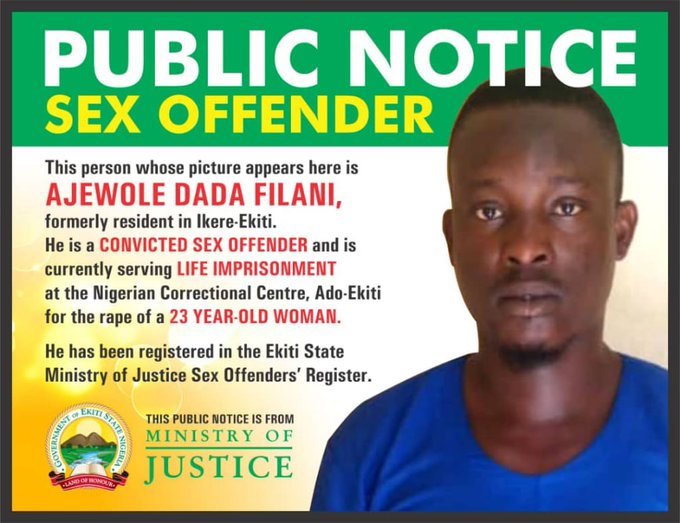
EKITI State Government has made public the details of a convicted rapist in its ‘Name and Shame’ initiative to curb gender based violence in the state.
In what it tagged ‘ Public Announcement, the state government released the detail of the rape convict as Ajewole Dada Filani who raped a 23-year-old woman.
The state’s Ministry of Justice said the release of convicted rapists was in response to the frequency of reported cases of gender-based violence and sexual abuse in the state.
Filani whose detail was released on the Twitter page of Ekiti State Government is currently serving a life imprisonment.
According to the ministry, Filani before his conviction was a resident of Ikere-Ekiti town in the state.
His name has been added to the Sex Offenders Registry with the State’s Ministry of Justice.
“The Ministry of Justice under the leadership of @AGWaleFapohunda has released a Public Notice on the status of Ajewole Dada Filani, formerly resident in Ikere-Ekiti who was convicted for the rape of a 23-year-old woman,” the Twitter message read.
The state government noted that the ‘name and shame’ policy is part of the proactive measures deployed Kayode Fayemi, Governor of the state to rid state of all forms of violence against women and children.
The Ekiti Gender-Based Violence (GBV) Management Committee, chaired by the First Lady of the state, Bisi fayemi, is said to be on advocacy tour to engage key stakeholders in proactive ways to eliminate GBV, FGM & sexual harassment, and to ensure the security of victims and access to justice in Ekiti.
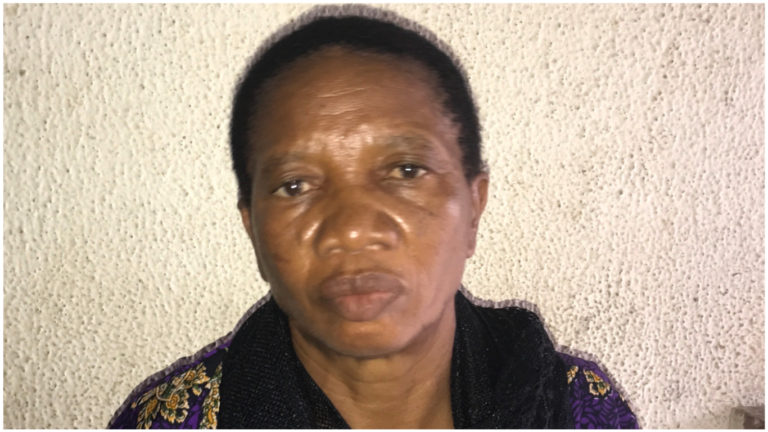
THE Independent Corrupt Practices and Other Related Offences Commission (ICPC) says it has apprehended a teacher, identified as Roseline Uche Egbuha, three Guaranty Trust Bank staff, and a lawyer over alleged money laundering to the tune of N539.5 million.
The Commission in a statement on its websitestated it had arrested Egbuha, a teacher with Ozala Primary School, Abagana, Anambra State, in October, 2019 and was granted administrative bail, after an investigation into her financial transactions which had shown her alleged involvement in money laundering.
It stated that this followed the receipt of a petition against her.
Also in ICPC custody are Beckley Ojo, a Compliance officer of GTB, Chisomaga Daly-Okoro, an Operations Manager, Sarah Ugamah, a staff of the legal department of the bank, and Nsikak Udoh, an external lawyer to GTB.
They were alleged to have connived with the school teacher to perpetrate the fraud.
The ICPC said after a series of investigation, it found that the school teacher had N539.5 million in her Guaranty Trust Bank account alleged to have been proceeds of money laundering from Malaysia.
She had told investigators during interrogation that the money found in her account belonged to her 24-year-old son, Chidozie Fabian Ejeaka, whose whereabouts could not be established.
The Commission said a Post No Debit (PND) was placed on the account to allow it to carry out further investigation, while a case of forfeiture of the suspected proceeds of crime was instituted against her in a court of law.
However, Egbuha approached another court to challenge the restriction placed on her account by ICPC, as well as ask for the enforcement of her fundamental human right.
The ICPC said her fresh arrest with the staff of GTB and the lawyer was due to their alleged connivance in lifting the restriction placed on her account and the subsequent transfer of N550 million (principal sum and interest) into the GTB account of FBI Legal, a company owned by Egbuha’s lawyer, Ferdinand Isa.
“The Commission found out that the money was transferred on 4th June, 2020, the same day a court order was said to have been obtained,” the statement said.
“The lawyer claimed that the order vacating the restriction on the account was based on an out-of-court settlement with GTB which empowered his client to access her money.”
The Commission said it also found out that the N550 million was promptly split and moved into multiple bank accounts owned by Bureau de Change operators and private individuals.
“N340 million, in two instalments of N200 million and N140 million respectively, was allegedly moved into the Polaris bank account of a Bureau de Change operator.”
“N100 million was transferred into the GTB account of Edokaf Multi-globalwhile N18 million was transferred to the private account of the lawyer, Isa. The balance of the money was moved into other accounts.”
The Commission said investigation is still ongoing noting that appropriate actions will be taken upon conclusion.
SADIYA Farouq, Minister of Humanitarian Affairs, Disaster Management and Social Development has said that the Batch A and B of the N-Power beneficiaries will be disengaged from the scheme by June 30 and July 31, respectively.
“We have commenced the transitioning of beneficiaries from Batches A & B into government entrepreneurship schemes and engaging private sector bodies to absorb some of the beneficiaries after the completion of psychometric assessment to determine competency and placement into various opportunities,” a statement by the Ministry said.
The statement explained that the Federal Government would begin the enrolment and oboarding of new Batch of beneficiaries.
Since its commencement in 2016, the N-Power scheme has enrolled a total of 500,000 Nigerians- 200, 000 in September as Batch A and 300, 000 in August 2018 as Batch B.
The minister added that the enrolment for a new batch of N-Power beneficiaries will be effective from July 26 while the online portal would be opened to receive applications from noon on June 26.
The ICIR had reported how some beneficiaries of the N-Power cried out to the government over non-payment of their three-month stipends since March till June.
On Wednesday, they also wrote to Ahmed Lawan, the Senate President over the failure of the Minister in charge of the scheme to pay their monthly stipends in the last three months.
The N-Power Programme was inaugurated by President Muhammadu Buhari in 2016 under the National Social Investment Programme (NSIP) with the mandate of lifting citizens out of poverty through capacity building, investment, and direct support.
The Peoples Democratic Party (PDP) has slammed President Muhammadu Buhari over a memo by Abubakar Malami, the Attorney General of the Federation and Minister of Justice alleging insubordination and diversion of recovered assets by Ibrahim Magu, acting Chairman of the Economics and Financial Crimes Commission (EFCC)of financial scam.
Kola Ologbondiyan, National Publicity Secretary of the PDP in n a statement said the memo on Magu has exposed the hypocrisy, abysmal corruption, and deception that pervade the Buhari’s administration.
The opposition party called on the acting EFCC chairman to immediately step aside and submit himself for an independent investigation in order to clear his name.
The PDP argued that, based on the allegation of diversion of recovered funds coming from the nation’s Attorney General, the EFCC Chairman has lost all moral rectitude to preside over the nation’s anti-corruption agency to investigate and prosecute others until he comes clean of these ‘horrible allegations.’
It noted that that it was the worst national embarrassment in the history of Nigeria, that the head of anti-corruption agency in an administration that prides itself on zero tolerance for corruption, was being dragged on allegation of diversion of recovered funds and fraudulent sale of assets seized by the agency.
The PDP further stated that Malami’s memo had also exposed the credentials of President Buhari’s anti-corruption architecture, rubbished his standing as Africa Union (AU) anti-corruption champion and shattered Nigeria’s national integrity in the international arena.
”The world can now see that the much hyped anti-corruption fight of Buhari administration, has been nothing but a huge fraud and a racket by certain persons in the APC administration to harass political opponents, intimidate and extort money from innocent Nigerians and steal public funds,” part of the statement read.
The party stated that itself, Nigerians and members of the international community have completely lost confidence in President Buhari’s capacity to fight corruption as he has not demonstrated the littlest effort against corruption since he came into office in 2015, also adding the world have further seen why corruption has worsened his administration.
It added that the president had continued to run a system that condones corrupt practices by officials of his administration while providing cover for individuals indicted for corruption including those who are now serving as cabinet ministers and other federal appointees in his government.
The PDP recalled that President Buhari had insisted on Magu as the EFCC Chairman despite his rejection by the Senate over reports by the Department of State Services (DSS), which raised certain integrity issues against him.
The party further recalled that the DSS report, which was read out on the floor of the Senate allegedly stated that “Magu has failed the integrity test and will eventually constitute a liability to the anti-corruption stand of the current government”.
”Our party therefore holds the latest report coming from none other than the Attorney General of the Federation; the EFCC’s supervising minister, who believably has unhindered access to facts and documents related to the anti-graft issues,… must be received by President Buhari as a huge demand on him to clean up the system.
”PDP therefore charged the National Assembly to immediately constitute a joint ad-hoc committee and commence an independent investigation into these alleged acts which it described as disgraceful which it said has the potency of collapsing the nation’s integrity before the comity of nations.”
For some Nigerians the COVID-19 pandemic is not only about the virus that is killing people in thousands all over the world, it is also a season of brutality by the police and other security agents tasked with implementing the consequent lockdown, Grace OBIKE reports.
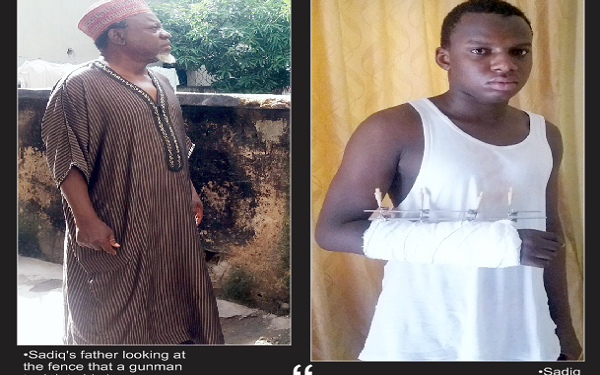
17-year-old survivor: I had to run for my life
IT was Ramadan fasting period and 17-year-old Sadiq Ibrahim was trying to ensure that his family members observed the usual prayers in his father’s study since the lockdown occasioned by the coronavirus (Covid-19) pandemic prevented them from praying in the mosque.
He had just finished his ablution, arranged the room and was reading as he waited for his parents and siblings to join him when he started hearing gunshots.
Unknown to him, some plain-clothes policemen were in their neighbourhood, searching for some criminals who were said to have kidnapped an army officer and a few other people in Kogi State.
At first, Sadiq tried to ignore the unfriendly sound of gunshots, believing that he had no business with the brains behind them. But when the shots became persistent and were getting nearer, he looked out of the window only to see a dreadlocks wearing man in jeans and T-shirt jumping into their compound in Gwarimpa part of Abuja, the federal capital.
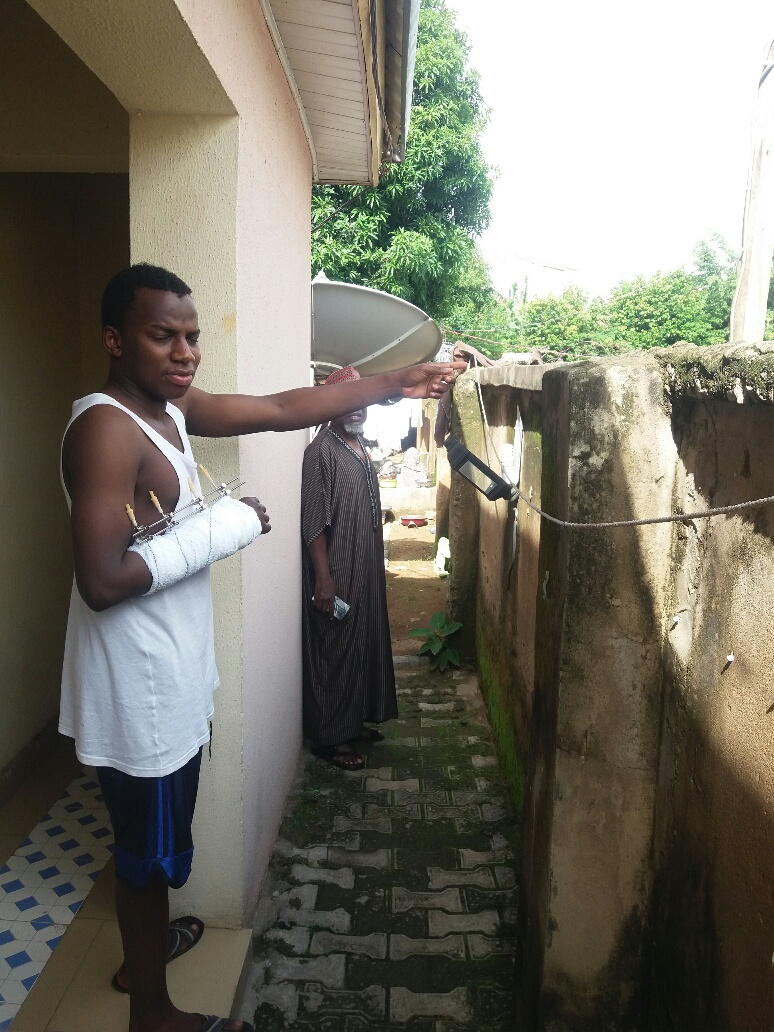
Thinking that his family was being attacked by armed robbers, Sadiq sneaked out the back door and ran towards his neighbour’s house. The neighbour’s fence is low and has no barbed wire, so he planned to jump over the fence and take refuge.
Just then, he saw another gun trotting man who opened fire as soon as he sighted Sadiq. The hapless teenager turned round and ran back towards their second neighbour’s house. Although the fence is higher and fortified with razor-sharp barbed wire, he damned the danger and jumped over it as the dreadlocks wearing gunman galloped after him, shooting sporadically.
In the process of scaling the fence, Sadiq’s body was badly bruised by barbed wire. But he cared less because his life was more precious. Unfortunately, the neigbours he thought would give him refuge had shut their doors and did not respond to his cries.
Not feeling safe in the compound, Sadiq decided to jump out and seek refuge elsewhere, but in the process, he was shot in the arm. Driven by the fear of death, he felt no pains as he continued to run until he hid himself in a bush. He was, however, forced to leave his hiding place as thorns tore into his skin, only to find that two of his assailants were still searching for him.
As soon as they sighted Sadiq, the dreadlocked man began to chase him again, running with the excitement of a hunter that had sighted an antelope.
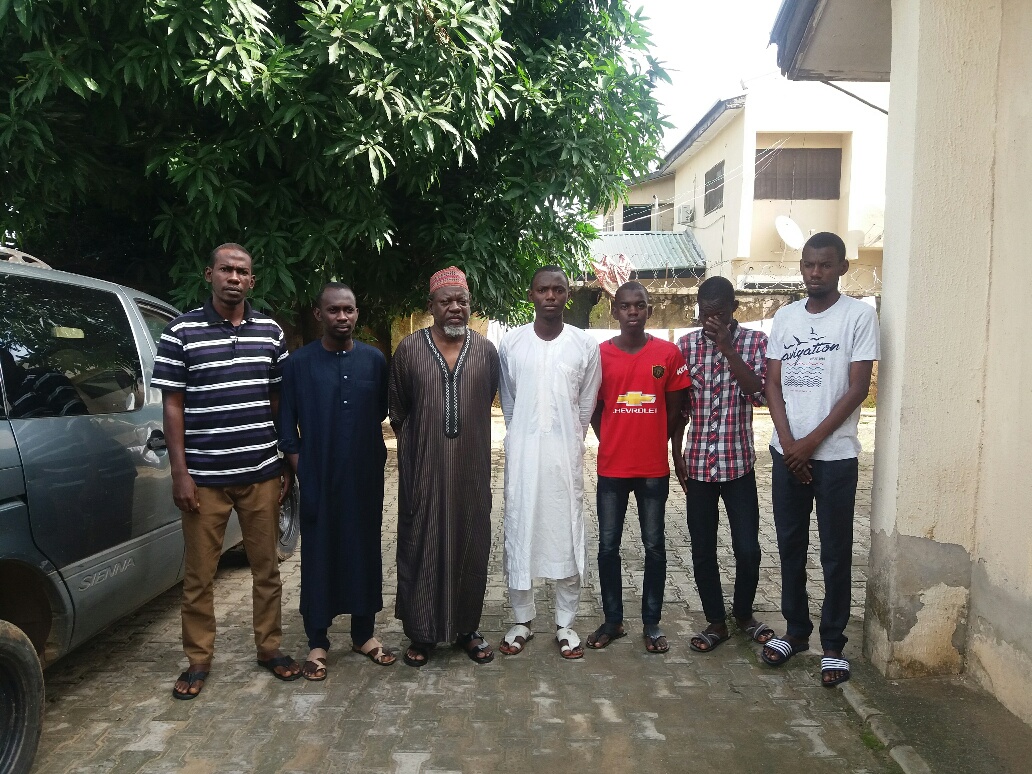
Sadiq’s father and brothers that where also arrested
“It was like he realised that he was never going to catch up with me,” Sadiq said. “So, at a point, he started shouting thief, thief, as he ran after me. But the people on my street ignored him because they know that I’m not a thief.
“Unfortunately, a stray bullet hit a man that was passing by and he died. We later learnt that the man does not even live on our street.”
Sadiq said the gun trotting cop chased him over another 200 metres as he ran towards the house of his friend whose father is a former senator. On getting to the house, he ran past his friend’s elder brother who was shocked at the sight of the blood that dripped from the teenager’s arm.
Sadiq ran upstairs where the family quickly wrapped his bleeding arm with a rag. He was weak and almost fainting when the man in dreadlocks arrived.
He asked after Sadiq from the young man at the door and the young man told him that Sadiq had left. But he sighted the trail of blood that had dropped from Sadiq’s arm and in anger he handcuffed the young man, insisting that Sadiq must be brought out.
The gun trotting man eventually introduced himself to the ex-senator as a police officer and the ex-senator asked that Sadiq be brought out and handed over to the policeman, who also arrested Sadiq friend’s elder brother for initially refusing to bring Sadiq out.
But Sadiq said he never knew that the dreadlocked man was a policeman, saying that he would have cooperated with him if he did.
He said: “I thought it was an armed robber. He did not identify himself to me as a police officer or ask me to stop. He just started shooting at me the moment he saw me.
“If he had identified himself, I would not have been scared. I would have gone with him. His intention was to kill me. He said so himself when I asked him why he shot at me. He said I was even lucky; that his intention was to kill me.”
Tears on the home front
The dreadlocks wearing policeman tried to force Sadiq to ride with him in a Corolla LE vehicle that already had four plain-clothes men in it, but the boy refused, saying that he was not sure that they were policemen and that he wanted to get home first to ensure that his family was safe.
The dreadlocked man stopped a tricycle which they boarded together with the senator’s son to Saheed’s family house only to find his father and brothers already packed into a police bus and were looking for him.
Sadiq’s mother was making barbecue in the compound when she also heard gunshots, ran into the kitchen and shut the door. But a man came banging the door and asking her to open. She did and the strangers gathered everyone in the house and made the females to kneel down while the males were made to lie on the floor.
Sadiq’s father, Engr. Abubakar Yaro, a former sole administrator for the National Iron Ore Mining Company (NIOMCO), said the uninvited guests looked every bit like armed robbers and he did not know who they were until he and his sons were marched outside and he saw one of their badges. That, he said, was when he realised that they were policemen from the Special Tactical Squad of the Inspector General of Police office.
He said the family was unaware of what had happened to Sadiq until they had been packed into a police bus after the men had beaten up his other sons who tried to ask who they were. He said that one of Sadiq’s friends had seen the men in a bus and rushed to the house to inform them about their presence.
He added: “When they brought him into our bus and I saw him, I cried. We pleaded with them to allow us take him to the hospital but they refused.
“It was when we got to the office that we heard that an army major and some people had been kidnapped in Kogi State and the kidnappers were asking for a lot of money as ransom and they had been given the assignment to track them.
“They said they had traced them to the front of my house. They showed me the picture of a bushy abandoned space opposite my house, and there was no recorded voice of the kidnappers to indicate that they mentioned my house. “As far as I am concerned, they have no respect for human dignity. We pay the tax from which the guns they use are purchased, but they are using them to kill us.”
Sadiq pointing out where he escaped from
Sadiq’s cousin, Fatima Baba-Shehu who posted the incident on social media told our reporter that shortly after the police had driven off with the arrested members of the family, they returned to pick up the bullet shells.
She added: “When I arrived at my aunt’s house, I was told that the men that came were drunk and reeking of alcohol. And when we went to see them at the SARS office in Guzape, I was told that each of the men who arrested them was given shots of alcohol as they arrived the station with their captives.”
Fatima, who gave the name of the man who allegedly shot Sadiq as Sgt Yohanna Ebilong, said that when she went in to see Sadiq and realised that his condition was getting critical, she begged them to allow the family take him to the hospital, but they said they wanted to take him to the Gwagwalada Specialist Hospital.
She, however, said the family was eventually able to convince the officers to allow the family to take him to the National Hospital where it was realised that the bullet had damaged his radius, ulna bones and the tendons on his wrist. He had to undergo a plastic and orthopaedic surgery for about eight hours and the family paid almost N500,000.
Efforts made by our reporters to get the reaction of the Nigeria Police Force to the incident yielded no results as repeated phone calls made to the Police Public Relations Officer, Mr Frank Mba, a Deputy Commissioner of Police, went unanswered.
A catalogue of human rights abuses in lock down period
The experience of Sadiq and his parents about police brutality has been retold by many families across the country.
Speaking during a programme on Channels TV on January 23, 2019, police spokesperson Mr. Frank Mba, who was a guest on the show, had assured Nigerians that the reforms on SARS would not be cosmetic. He said the squad would be decentralised in a bid to correct its abnormalities, restore order and bring the police closer to the people.
Mba said the police would work with other security and safety agencies to ensure a safe and secure environment. But since then and during the lockdown, security agents have continued with the use of excessive force in their bid to implement the lockdown orders in different parts of the country.
On April 1, officials of the Delta State Taskforce on Environment attacked two journalists, Michael Ikeogwu and Matthew Omonigho, who were monitoring the compliance with the stay-at-home order over the Covid-19 pandemic for asking questions as to why they were ordering people to come out for environmental sanitation when they were supposed to be on lockdown as directed by the federal government.
In the process, the taskforce destroyed a Nikon D3100 camera belonging to one of the journalists. Omonigho, who confirmed the incident in a telephone interview, however, said the chairman of the taskforce eventually fixed the damaged camera.
On April 2, a 28 years old man, Joseph Kpesu, was killed by suspected soldiers who were out to enforce the sit-at-home order in Asaba, Delta State for refusing to stop at a checkpoint. Omonigho, who reported the incident, explained that the soldier in question was arrested, taken to the Area Command and a petition was been filed for his prosecution.
On April 3, a surgeon with the University of Uyo Teaching Hospital, Daniel Edet, was taking his sick wife to the hospital when he was stopped by a police sergeant who was trying to enforce the stay-at-home order and was assaulted. The Nation correspondent in Uyo, Bassey Anthony, who confirmed the incident, said that the police had been very uncooperative with essential duty workers, particularly medical doctors who felt like they were not being carried along.
The development prompted the Nigerian Medical Association of the state to call for the sack of the Commissioner for Health while the threats by doctors in the state to embark on a strike led to the demotion of the officer.
On April 5, a diabetic 26-year-old petrol attendant, Chibuisi Okameme, was shot dead by some policemen attached to the Ohuru Isimiri Police Division in Aba Abia State on his way to the hospital.
On April 7, six young people were killed in the Sabon Gari Trikania Market after a clash between the police and traders who had defied the stay at home order in search of their daily bread and the police shot into the crowd to disperse them. On the same day, a popular television station reported that its reporter was taking videos of policemen checking motorists at a checkpoint in Delta State when he was attacked and dragged to the police station after his equipment had been confiscated.
On April 14, protesters in Uratta, Abia State went on the rampage, demanding the release of an Uratta driver that was eventually discovered to have been killed. On the same day in Anambra State, two men were killed by the police for drinking beer in front of their compound. Policemen drove in and ordered them to go inside but they refused.
On April 15, a middle-aged commercial driver, Amobi Igwe, was killed by a Nigeria Security and Civil Defence Corps (NSCDC) officer in Isialangwa, Abia State for refusing to pay bribe. In Osun State on April 17, the Nigeria Police announced that it had dismissed two officers for assaulting a woman in Iwo; an incident that was videotaped.
On April 18, a drunken police officer in Ohafia, Abia State killed 20-year-old Friday Arunsi after his colleague had injured the victim with a machete. According to an eyewitness who spoke with The Nation reporter on the telephone on condition of anonymity because according to him the case was under investigation and only the community council had the permission to speak on it, described the victim as very strong.
In a report by the Agence France-Presse (AFP), on the same day in Borno State, five women and children met their demise in a stampede, although a witness was reported as claiming that 12 people died as N5000 and cloths were being handed to thousands of people in Gamboru.
On April 20, ten-year-old Usman Abdulkadir was shot in the head by the police while trying to disperse people who were buying and selling at a market in Ringim, Jigawa State while enforcing the lockdown, leading to a violent protest.
On April 21, the police in Ogun State opened fire in a market on the Lagos-Abeokuta Expressway, leading to the death of a 25-year-old motorcycle repairer, Akeem Akinsanya, while many others were injured.
On May 3, the COVID-19 taskforce in Abia State severely flogged a young woman for not wearing a facemask. The video trended on Facebook. On May 13, officers of the Nigerian police were accused of killing a 20-year-old 300-level student of the University of Jos, Rinji Bala, during the lockdown.
On May 19, 62-year-old Mrs. Florence Onuobodo was killed in a stampede while four others including a 91-year-old woman were injured in Ikwerre, Rivers State during the sharing of state government’s Covid-19 palliative in the area.
On May 20 in Lagos, an Inspector of Police attached to Ikotun Division killed a 28-year-old Islamic cleric Fatai Oladipupo. On May 21, hundreds of Youths in Njikoka, Anambra State went on the rampage, following the death of Anthony Okafor, an apprentice barber in the area said to be an only son of his parents, when members of the police force who were trying to enforce the curfew in the state were pursuing him for being outside after 8pm but he was knocked down by a vehicle.
In Waterside LGA on May 22, another protest erupted after a pregnant woman, Waidat Adedeji, reportedly died after she was unduly delayed for hours by policemen enforcing the lockdown order and she bled to death.
On May 26, social media user @OworoTv tweeted about an incident in Iyana Oworo Berger bus Stop in Lagos State where 16-year-old Tina Ezekwe was shot by a drunken #SARS Officer while in a public vehicle. An Assistant Superintendent of Police and a Police Inspector attached to Bariga Police Station in Lagos have since been arrested and paraded over the alleged killing of Ezekwe and the shooting of 35-year old Musa Yakubu on May 26 at the Berger area of Lagos State.”
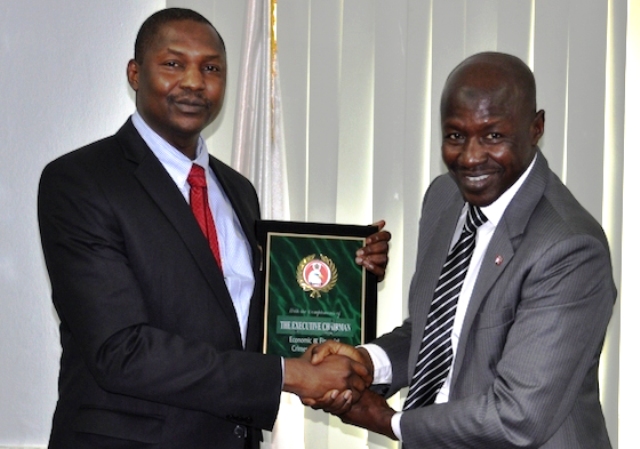
ABUBAKAR Malami, Attorney General of the Federation and Minister of Justice, has urged President Muhammadu Buhari to sack the acting Chairman of the Economic Financial Crimes Commission (EFCC), Ibrahim Magu over allegations of corruption.
The Attorney General is also alleging that the acting EFCC chairman of insubordination to his office and diversion of assets recovered by the Commission, as well as lack of transparency and discrepancies of figures about recovered assets.
Malami’s demand for the removal of Magu was contained in a memo written to President Buhari on Thursday, according to This Day.
One of such allegations, according to the publication was that the EFCC boss disclosed a total recovery of N504 billion but lodged N543 billion in the Recovery Account with the Central Bank of Nigeria (CBN).
The other one is that most of the recovered assets by the EFCC were allegedly sold by Magu without the knowledge of anyone.
The report says the Minister’s letter to the president contained 22 weighty allegations that require Buhari’s decision on whether or not to send Magu’s name to the Senate for confirmation or replace him.
According to the report, the Minister had made a recommendation of three candidates from which the president could appoint a replacement for Magu when he is finally removed.
The Office of the Attorney General of the Federation and the Minister of Justice is the Supervisory Ministry to the EFCC, and Malami according to the memo alleged that Magu was not carrying the ministry along in his actions.
Magu has survived previous plots to remove him as the acting Chairman of EFCC, while the National Assembly also declined to confirm him twice as the substantive chairman of the Commission.
In a report sent to the 8th Assembly in 2017 by the Department of State Service (DSS) upon which the Senate declined to confirm Magu, August 2008, it was reported that some sensitive EFCC documents which were not supposed to be at his disposal were discovered.
“He was subsequently redeployed to the police after days of detention and later suspended from the Force. In December 2010, the Police Service Commission found Magu guilty of “action prejudicial to state security, withholding of EFCC files, sabotage, unauthorised removal of EFCC files and acts unbecoming of a Police officer,” and awarded him severe reprimand as punishment,” part of the letter read.
The DSS report largely indicted him for unwholesome practices.
The report stated that Magu often embarked on air trips with a retired Air Commodore Umar Mohammed who the DSS tagged ‘questionable businessman and ally of the subject who has subsequently arrested by the Service.’
According to the DSS report, Magu traveled with a particular Managing Director of a bank who was being investigated by EFCC for complicity in funds allegedly stolen by former Petroleum Minister, Diezani Alison-Madueke.
Apart from spending time with persons being investigated by the Commission, the report stated that Magu was dismissed by the Police Commission for ‘action prejudicial to state security, withholding of EFCC files, sabotage, unauthorised removal of EFCC files and acts unbecoming of a Police officer’.
Earlier in December 2015, the same 8th National Assembly refusedto confirm Magu as Chairman of the Commission following Buhari’s recommendation.
The Red Chamber said it could not confirm him as the Chairman of EFCC based on security report.
“The Senate wishes to inform the public that based on available security report, the Senate cannot proceed with the confirmation of Ibrahim Magu as Chairman of the Economic and Financial Crimes Commission,” said Aliyu Abdullahi, Senate spokesperson at the time.
Meanwhile, Magu had recently boasted of the achievements of the Commission under his leadership stating that the EFCC recorded 2,240 convictions in the last five years.
He disclosed that the Commission recovered assets worth N980 billion including oil vessels, private jets, estates among others.
When contacted by The ICIR, Dele Oyewale Head, Media and Publicity at the EFCC declined comment on the memo seeking the removal of his boss.
“I don’t have any comment to make on it,” Oyewale told The ICIR.
Phone calls to Abubakar Malami and SMS sent to him to clarify issues about his memo to the president were not answered or replied at the time of filing this report.
PRESIDENT Muhammadu Buhari has approved the release of N19.67 billion for the completion of sections I-IV of the East-West Road project by 2021, a move designed to address the infrastructure deficit in the Niger Delta and boost the economy of the region.
Godswill Akpabio, the Minister of Niger Delta Affairs, revealed this after a meeting with contractors handling different segment of the road project.
He stated that the road project which was conceived in 2006 by the Obasanjo administration, ought to have been completed in 2010 but for the paucity of funds.
The minister said in April 2009, the project was transferred to the Ministry of Niger Delta Affairs to speed its completion.
Akpabio said despite the chequered history of the project, it could not be realised due to inflexible terms prescribed by financial institutions which may not require less than N102 billion for its completion.
According to him, the presidential directive mandated that the project should be completed by 2021.
“The project, which starts from the Delta Steel Company Roundabout in Delta State, transverses through Kaiama in Bayelsa State, goes through Ahoada in Port Harcourt in Rivers State, down to Eket and from Eket to Oron in Akwa Ibom State, is to complete the Section I-IV being part of the two sections that had previously been completed. Section–V, which covers 23km from Oron to Calabar, is still under process,” he said.
“Considering the disposition of the region to the stability of Nigeria’s economy, the project will not only redress infrastructural deficit in the region, but its completion would also assist the oil industry in terms of moving goods that will facilitate oil production, movement within the area, restiveness and boast the economic life of the people and the nation at large.”
The Buhari administration, he said, had undertaken more infrastructural development projects than any other government, adding that the East-West road would be one of the legacy projects of this administration.
He thanked the contractors for being committed to ensuring that the presidential mandate is achieved by re-mobilising back to site even when funds have not been made available and assured them of the people’s cooperation.
The contractors thanked Akpabio for giving them the opportunity to work with the ministry and reiterated their readiness to return to the site immediately to meet the 2021 completion target.
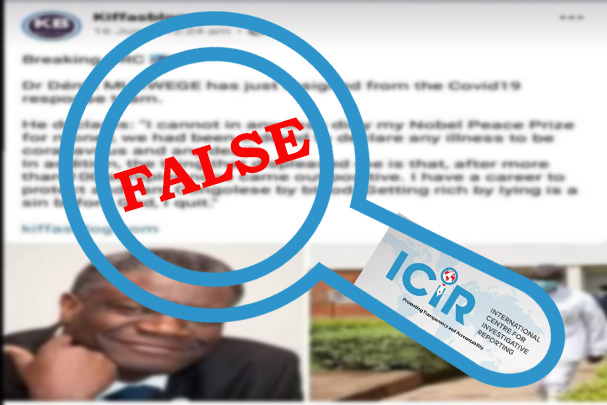
ON June 16, a viral post on social media by Kiffasblog claimed that Denis Mukwege, a medical doctor and Nobel Peace laureate from the Democratic Republic of Congo, resigned from the Congolese government’s Coronavirus Response (Taskforce) Team after he was reportedly asked to declare any illness from patients, brought to hospitals in his province as Coronavirus Disease (COVID-19).
The post, which went viral on Twitter, Facebook, and among WhatsApp users in Nigeria, Cameroon and Kenya, etc, was also shared by a Facebook page, Feedback Express Show, on June 17. As of Friday, June 19, it has been shared 370 times and garnered 395 reactions with 99 comments.
FALSE CLAIM
The Claim
“I cannot in any case dirty my Nobel Peace Prize for money, we had been ordered to declare any illness to be Coronavirus and any death.
“In addition, the thing that displeased me is that, after more than 100 samples, none came out positive. I have a career to protect and I am Congolese by blood. Getting rich by lying is a sin before God, I quit,” the blogger stated quoting Mukwege.
The Findings
A fact-check by The ICIR revealed that Mukwege had earlier issued a statement explaining his position on why he decided to resign. This was published on June 10 on the website of Panzi Foundation RDC.
The ICIR reports that Mukwege had on Wednesday, June 10 announced his resignation as vice president of the Multi-sectoral Commission and president of the Health Commission at the Province of South Kivu.
Mukwege, a renowned gynaecologist had assisted over 30 rape victims and targets of sexual violence with medical care at the Panzi Hospital in Bukavu, a gesture that earned him the global peace award in 2018.
In the statement, Mukwege attributed his decision to resign his position to slow the testing of suspected COVID-19 cases due to lack of laboratories.
The obstetrician-gynaecologist also blamed the Congolese government and identified challenges of poor coordination and organisation among the team members.
These concerns were reported by credible international news media such as Washington Post, rfi, France 24 but to mention a few.
FALSE CLAIM
“Two major difficulties prevented us from effectively applying our strategy:
“On one hand, the impossibility of having in our province of RT‐PCR allowing to quickly confirm the diagnosis of COVID +. The time required, of more than two weeks, to receive the results of the samples sent to the National Biomedical Research Institute in Kinshasa, constituted a major handicap for our strategy based on “testing, identifying, isolating and treating,” he said in the statement.
He added: “On the other hand, a loosening of prevention measures by our population, denial of realities, the impossibility of enforcing barrier measures, the porosity of our borders with the massive return of thousands of compatriots from neighbouring countries without having been quarantined, decreased the effectiveness of our strategy.”
But a blog – Kiffasblog.com, contrary to Mukwege’s position reported wrongly why he resigned. Though the news report has since been deleted from the website, it has gone viral and shared many times on social media.
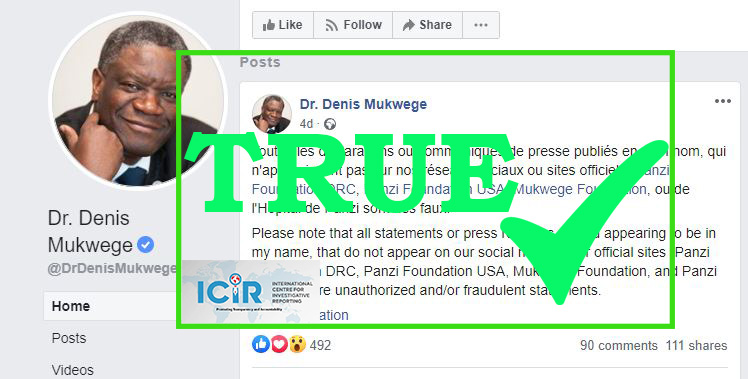
Four days after the statement was released, Mukwege took to his verified Facebook account to warn against deceitful statements that might be credited to him.
“Please note that all statements or press releases posted appearing to be in my name, that do not appear on our social networks or official sites (Panzi Foundation DRC, Panzi Foundation USA, Mukwege Foundation, and Panzi Hospital) are unauthorized and/or fraudulent statements,” he stated in the Facebook post.
Meanwhile, as of Thursday, June 18, 116 COVID-19 related deaths have been recorded in DR Congo with 5,282 confirmed cases, according to the World Health Organisation (WHO).
The Verdict
Based on The ICIR findings, the report on Dr. Mukwege by Kiffasblog is FALSE.
THE presidency has reacted to a report by the United Kingdom All-Party Parliamentary Group for International Freedom of Religion or Belief, that cited instances of persecution and genocides of Christians in Nigeria.
The report which is titled; “Nigeria – Unfolding Genocide?” raised the concerns of escalating violence in Nigeria between Fulani herders and farmers in Northern Nigeria.
The report claimed that the violence is mostly directed at and affected by Christians in the North, most of whom have lost their lives and others, their livelihoods to violent Fulani headers.
“APPG members have been alarmed by the dramatic and escalating violence in Nigeria characterised as the farmer-herder conflict. This violence has manifested along ideological lines, as the herders are predominantly ethnic Fulani Muslims and the farmers are predominantly Christians.
“There has been significant debate about what factors are driving and exacerbating this crisis. Therefore the APPG launched a parliamentary inquiry to help develop a nuanced understanding of the drivers of violence and increase parliamentary, public and Governmental interest in the issue. The report is the result of that inquiry.”
APPG stated that the response of the Nigerian Government to the conflict involving farmers and herders had been inadequate or ineffective and that this had allowed violence to emerge and escalate.
In a statement on Friday, the presidential spokesperson, Mr. Garba Shehu, rejected the content of the report. He said, unlike previous administrations, the Muhammadu Buhari’s administration has been taking steps to ensure the security of lives and properties in the North regardless of religious beliefs.
Mr. Garba said religious tension between farmers and headers in Nigeria is a long age battle for arable lands by farmers and quality grazing by headers.
He admitted that religious tensions in the country became heightened due to the activities of Boko-Haram whom he claimed the Nigerian Military has brought to the minimum.
He said, “The President and Government of Nigeria wish to thank members of the United Kingdom All-Party Parliamentary Group on International Religious Freedom or Belief for their report, launched a few days ago. Although it is difficult reading, the statement also acknowledges the importance of accurate, unbiased, depoliticised and truthful information when it comes to understanding the realities and addressing the challenges for those of faith in Nigeria. In this regard when uncritical attention is afforded to critics with dubious intentions, it only becomes harder for both the government and people of Nigeria to engage in constructive dialogue to resolve our differences, and uphold what is enshrined in our Constitution and laws: that everyone has the right to freedom of thought, conscience and religion.
“It is clear for all to see that there have, for generations in Nigeria, been tensions between our major religions, Christianity and Islam – and between herders and farmers – both for access to ever-decreasing arable and farmland due to a rapidly rising population, temperatures and desertification through global warming.
“Exacerbating those tensions, our nation has also been in recent times and focused within the northern states – subject to vicious and criminal attacks by the terror group Boko Haram.
“In concert with our American and British allies, Nigeria’s military have pushed back the terrorists and largely reduced their capacity over the last five years compared to the previous decade.
“Boko Haram have targeted Christians and Churches specifically because they know it drives forward religious and land tensions already existent in the country. Similarly, they attack mosques and Muslims in order to issue the threat: radicalise, or become targets yourselves.”
He said the president is working very hard with the vice president to make sure all of these concerns become a thing of the past.
“In the months and years ahead, our President who is Muslim and our Vice President who is an evangelical Christian pastor are irrevocably committed to addressing these multiple and long-term challenges for today’s and future generations.”
Some of the steps being taken by the president include “continuing and increasing Nigeria’s efforts alongside our allies to fully defeat and finally finish Boko Haram, in order to bring security to the north of the country.
“Continuing to seek, negotiate for, and secure the return of all those held hostage and in captivity by the terrorists, regardless of the religious faith or belief.
“Uniting our nation through dialogue organised around respect for difference in religion. Such a programme is already underway under the leadership of the Vice President, Pastor Yemi Osinbajo.
“Addressing, through Joint Federal and State Governments programmes, access to arable farmland – with land mandated both for farmers and herders. The federal government will issue detailed measures regarding this plan and its rollout in the coming weeks
“Countering fake news – particularly on social and digital media – by working with the non-partisan stakeholder community, the National Broadcasting Commission and social media platforms themselves, to address the proliferation of false and inflammatory commentary,” he said.