MEMBERS of the National Association of Resident Doctors (NARD) have embarked on an indefinite nationwide strike.
This followed the expiration of a 14-day ultimatum issued by the association to the Federal Government to meet its demands.
The resident doctors’ strike is coming at a time Nigeria grapples with increasing cases of confirmed COVID-19 and attendant deaths.
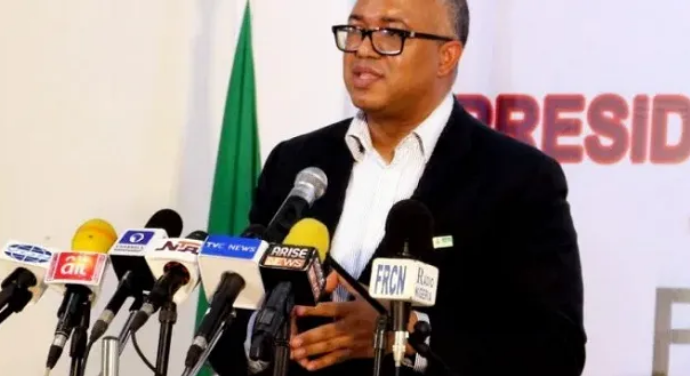
Aliyu Sokomba, National President of NARD announced the commencement of the industrial action at a press conference on Monday in Abuja, the Federal Capital Territory.
Sokomba, however, stated that members of the association working in various Coronavirus (COVID-19) isolation and treatment centres across the country were exempted from the strike.
He explained that exemption of the members attending to COVID-19 patients was for two weeks before they join the industrial action.
The NARD president further stated that the association took the decision to go on strike as a result of the failed series of meetings between the doctors and the Federal Government in the last two weeks.
It will be recalled that the association had earlier issued a warningto the Federal Government to embark on strike regardless of the current COVID-19 pandemic.
According to Sokomba, the meetings have failed to resolve the lingering industrial disputes which include the non-payment of the resident doctors’ special allowances.
He also decried the deplorable state of hospitals across the country and the lack of protective equipment for members of the association treating COVID-19 patients.
Sokomba added that this has exposed many of doctors to coronavirus and resulted in the death of some of them.
When contacted for comment, Olujimi Oyetomi, Director of Press at the Federal Ministry of Health, did not answer calls to his mobile phone and also did not reply text message sent to at the time of filing this report.
GARBA Shehu, the Senior Special Assistant to the Nigerian President, Muhammadu Buhari on Sunday confirmed the shooting that took place inside the State House.
Shehu in a statement noted that although a shot was fired, it was outside the president’s residence.
He added that Buhari has not come under any danger from the shooting.
The presidential spokesperson noted that the shooting is currently being investigated by the authorities.
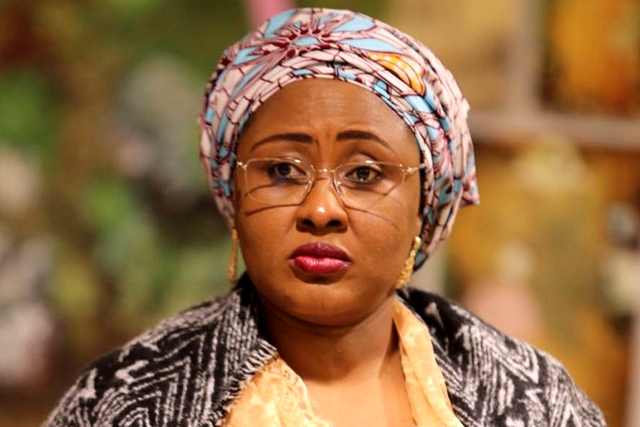
The ICIR learnt that the fired shot was a result of an altercation between the First Lady, Aisha Buhari, her Aide de Camp, Usman Shugaba and a presidential aide Sabiu Yusuf.
The first lady had directed Yusuf to go on 14 days isolation after returning from a trip as advised by health authorities however, Yusuf insisted that the president had instructed him otherwise.
During the altercation, shot was allegedly fired by the security detail of the First Lady leading to the arrest of Shugaba and the other security personnel.
Aisha Buhari confirming the arrest of her security detail took to her Twitter handle to demand their release from the Inspector General of Police, Adamu Muhammed.
The spokesperson to the First Lady, Aliyu Abdullahi told Channelstv on Sunday evening that the aides of the president’s wife are still in custody of the police.
“The aides of the First Lady, to the best of my knowledge, are still in police custody,” Abdullahi said.
He added that he does not know her feelings over the happening in the State House but he knows that the First Lady means well.
“I don’t know her feelings over the happenings, the First Lady means well and she always speaks out. She has stopped speaking out recently because she is misconstrued,” Abdullahi noted.
THE Federal Capital Territory Ministerial Enforcement Task Force on COVID-19 Restrictions has sealed off Jabi Lake Mall for two weeks for violating the government’s ban on public gathering.
“Jabi Lake Mall has been sealed for two weeks after a court order,” Ikharo Attah, Chairman FCT Ministerial Enforcement Task Force on COVID-19 Restrictions told The ICIR in an interview on Sunday.
This is coming after controversial Nigerian singer, Naira Marley, on Saturday, performed at a concert in Abuja despite the interstate travel ban and social distancing rules aimed at curbing the spread of COVID-19.
Attah said the musician violated the interstate travel ban, noting that the FCT Administration expected that the Lagos State Government would prosecute him accordingly.
Naira Marley violated the law and we expect our Lagos brothers to do the right thing, because he flew in, hoping that they would pick him up and follow up with that,” he said.
Earlier while addressing journalists, after sealing off Jabi Lake Mall, Attah lamented that despite many warnings from the Presidential Task Force and the FCT Administration on guidelines to operate, the management of the Jabi Lake mall chose to encourage and permitted a concerts by Naira Marley and was also conducting business activities to exceeding the normal hours allowed by the authorities.
He said the seal off order was given by a mobile court headed by Magistrate Idayat Akanni who sat in the Mall’s premises in Jabi.
Attah Ikharo said that the seal up order was necessitated by the the unlawful and embarrassing event at the mall Friday night.
When asked if the FCT administration plans to declare Marley wanted, Attah noted: “He flew in to Abuja Friday from Lagos and returned back same day to the nations formal Capital City. we are convinced that the Lagos State government who had in recent past had unpleasant experience with the artist will do the needful since he also breached the inter state travel ban which applies to Lagos state.”
Naira Marley flew into the nation’s capital via a private jet. Instablognaija shared a video of him stepping out of the aircraft with members of his crew.
The ICIR gather that the concert was meant to be an exclusive Mercedes Benz drive in party where those who are in attendance would be in the car but it turned out to be a full blown concert where social distancing rule was violated.
The restriction of movements by federal and state governments in the wake of the coronavirus outbreak in the country appears to have hampered progress in the agriculture sector, thereby constituting a veritable threat to the nation’s food security drive. Innocent DURU, who visited smallholder women farmers in different communities in Lagos State, reports that the COVID–19 palliatives announced by the government to help farmers stay afloat has not been the target women.
WHERE is the monetary palliative announced by the federal government to help farmers cope with the challenges posed by the novel coronavirus pandemic? That is the question on the lips of members of the Smallholder Women Farmers Organisation (SWOFON) in Lagos State, as they seek reduction in the huge losses they have recorded on their investments as a result of the global health crisis.
SWOFON is a coalition of women farmers associations and groups across Nigeria, representing over 500,000 grassroots women farmers in the country. Their goal is to advocate for and support women farmers, especially those in the rural areas, to spur rural economic development, increase food production through capacity building of smallholder women farmers to demand for their rights and privileges from the duty bearers, while serving as a vocal and visible pressure group on behalf of smallholder women farmers in Nigeria.
Many of the smallholder women farmers set out early this year to expand their businesses and contribute to the government’s food security plan, but the lockdown shortly after, made it impossible for their customers from within and outside the country to patronise them.
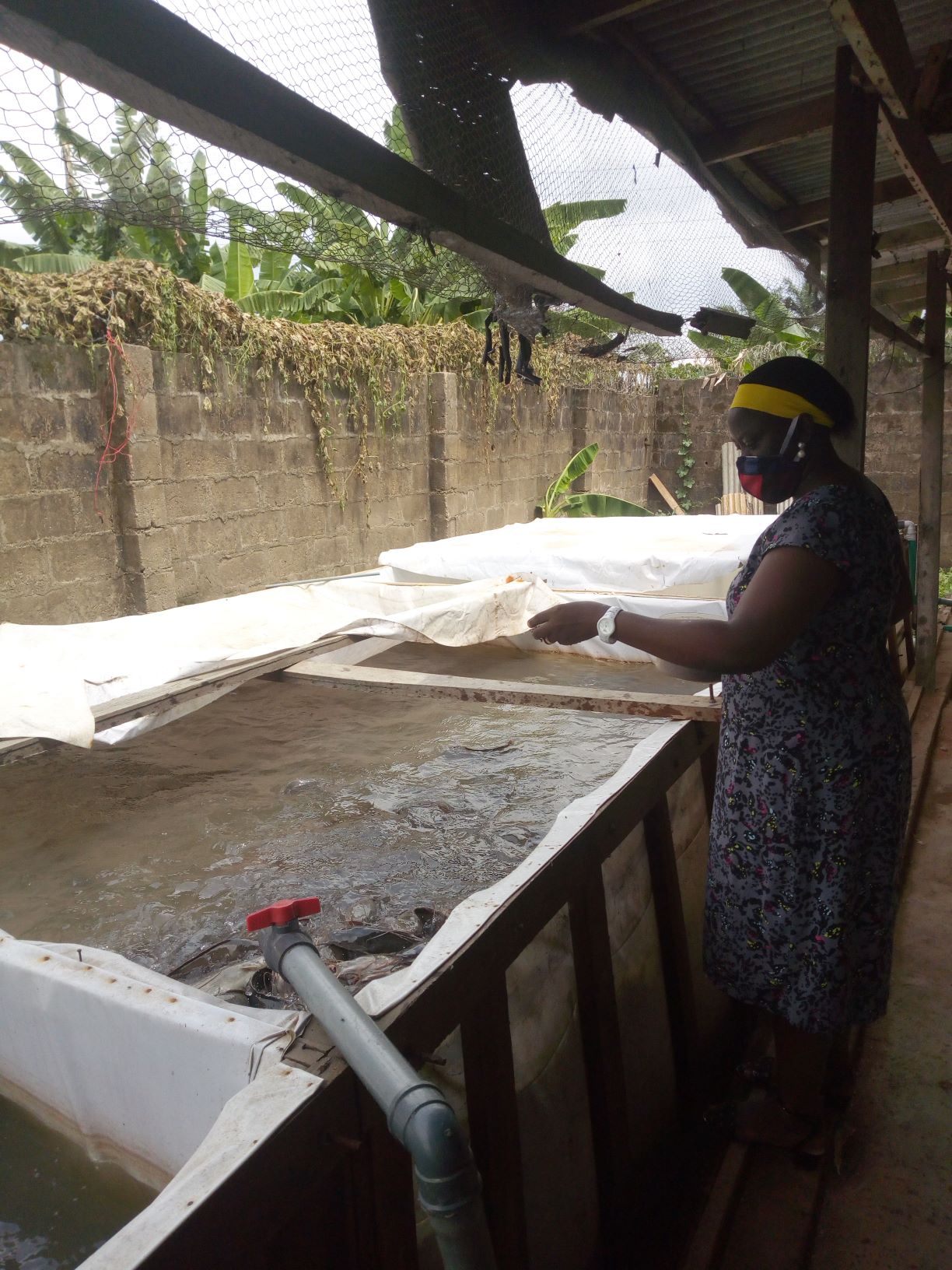
A fish farmer in Ejigbo area of Lagos, Madam Oluwatoyin Odofin, who is specifically into hatchery, is in a quandary about how to deal with the discomforting corner the pandemic has boxed her into.
The fingerlings she ought to have sold have continued to feed and grow into big fishes in her ponds because her customers could not come from their various locations as a result of the lockdown.
“Before the lockdown, people were coming from Cameroon, Akwa Ibom, Cross River, the north and parts of Southeast to buy from us. But since the lockdown started, they have stopped coming.
“We are cash-strapped. The fishes have been eating and getting bigger. That is a huge problem for us.
“The feeds for fingerlings that we deal in are more expensive than the ones for bigger fishes. If you don’t feed them very well, they will start eating each other, and that will bring about a bigger loss,” Odofin said.
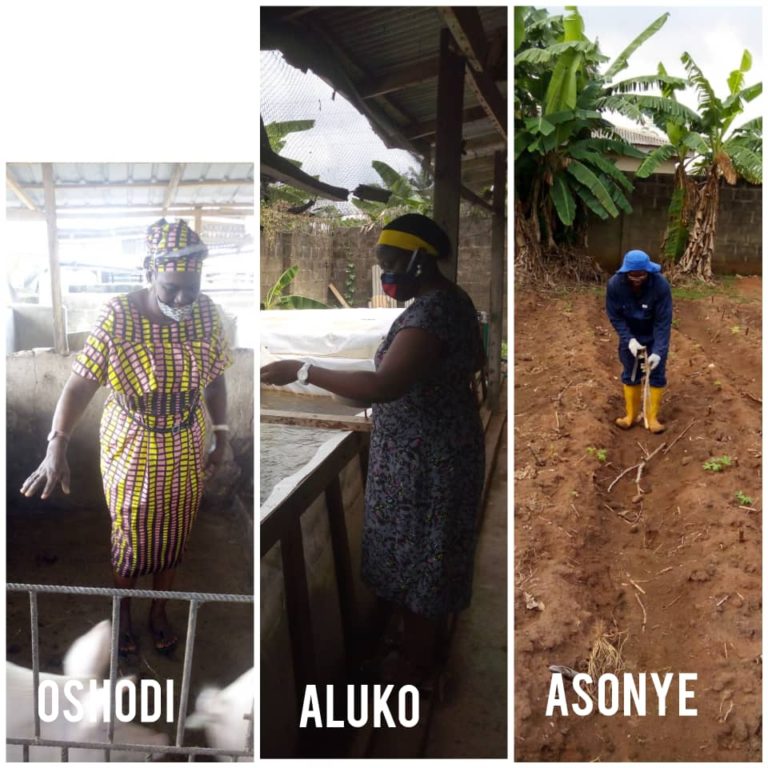
A catfish farmer, Mrs Olufunmilayo Aluko, was bubbling with zeal and energy at the beginning of the year to expand her business and make better profit as a result of the boost the federal government’s school feeding programme gave her business, but the pandemic and the attendant challenges have robbed her of that dream.
She said: “I set out this year to make some good profit, but lo and behold, this uncertainty befell us. Presently, the expectations are low. I came out in 2020 with high hopes and mapped out strategies on how to go about the work. When government came up with school feeding, I said I was going to do more of table sizes that are 700 grams and above. Now schools have been shut since March.
“While the school feeding programme was on, we had some vendors buying from farmers. As a result, we didn’t have challenges with selling.”
Aluko continued: “It was good last year, and that was why someone like me could work with that projection. Now, it is not only schools that are shut, restaurants are down, and there are no social gatherings. That means nobody is buying the fishes we have heavily invested in. Egg and meat producers are also crying.
“I have up to two tons in the ponds, which have grown beyond the age I was supposed to sell them. I am talking about 3,000 fishes and we are still feeding them at my own cost. How do I know when the fishes will be leaving when schools are shut, restaurants are shut, and there are no parties?
“Do you think it is easy for farmers to continue to keep these fishes with them? We really need help at this point.”
She told this reporter how, in frustration and in a bid to avert a major loss, she packed some of her fish and went to sell them cheaply just to get some money.
“I sold them below the normal prices because at that time, our vendors had challenges associated with the restriction of movement. It was difficult for them to move around. They had to do some settlements to get here and that discouraged them from coming.
“There are some fishes in this farm that I should still continue to feed with grower ration, but because of the present state, I have to just feed every one of them on the finisher ration because it is cheaper.
“But the effect is on the growth rate, which I don’t have a choice but to cope with.”
Aluko also expressed concern over the rising cost of feeds and the consequences for her investment. She said a brand of feeds that was selling for N8,800 now goes for N10,500.
“How do I cope with that? Our milling has also gone up. Our feed millers have to import some parts of their machines, but because of the border closure, they can’t get those parts into the country.
“The implication is that the cost of production is higher. In fish business, you can’t determine the price. You are at the mercy of the vendors. When your cost of production goes up, you can’t increase price.”
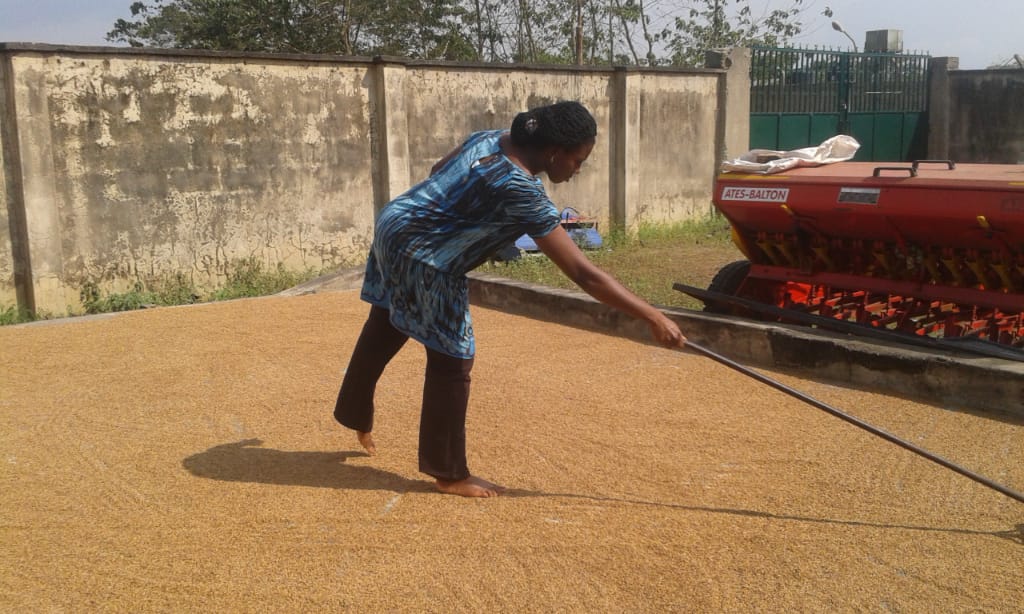
Mrs Asonye spreading harvested rice
The Coordinator, SWOFON, Lagos State chapter, Mrs Chinasa Asonye, has also had her projection for the year battered by the pandemic. She said business was good before the Covid-19 outbreak and she had special plans for her business at the beginning of the year.
“Before the lockdown, I had stocked these ponds here at Maya and those in Ijebu. I had about three ponds which I wanted to sell before the lockdown.
“We had buses that used to come and buy from us. They used to buy as much as 1.2 tons, 2 tons and so on, depending on the number of buses coming to buy.
“With the situation at hand now, we are not able to sell. There is no money coming in, and the little we have at hand is what we are using to feed them.
“I have more than seven tons of fish stuck in the pond. I have been feeding them but cannot sell.”
Asonye disclosed that her major customers were eateries, hotels and people who were coming in from other states. But she said because of restrictions on inter-state movements, the buyers could no longer come.
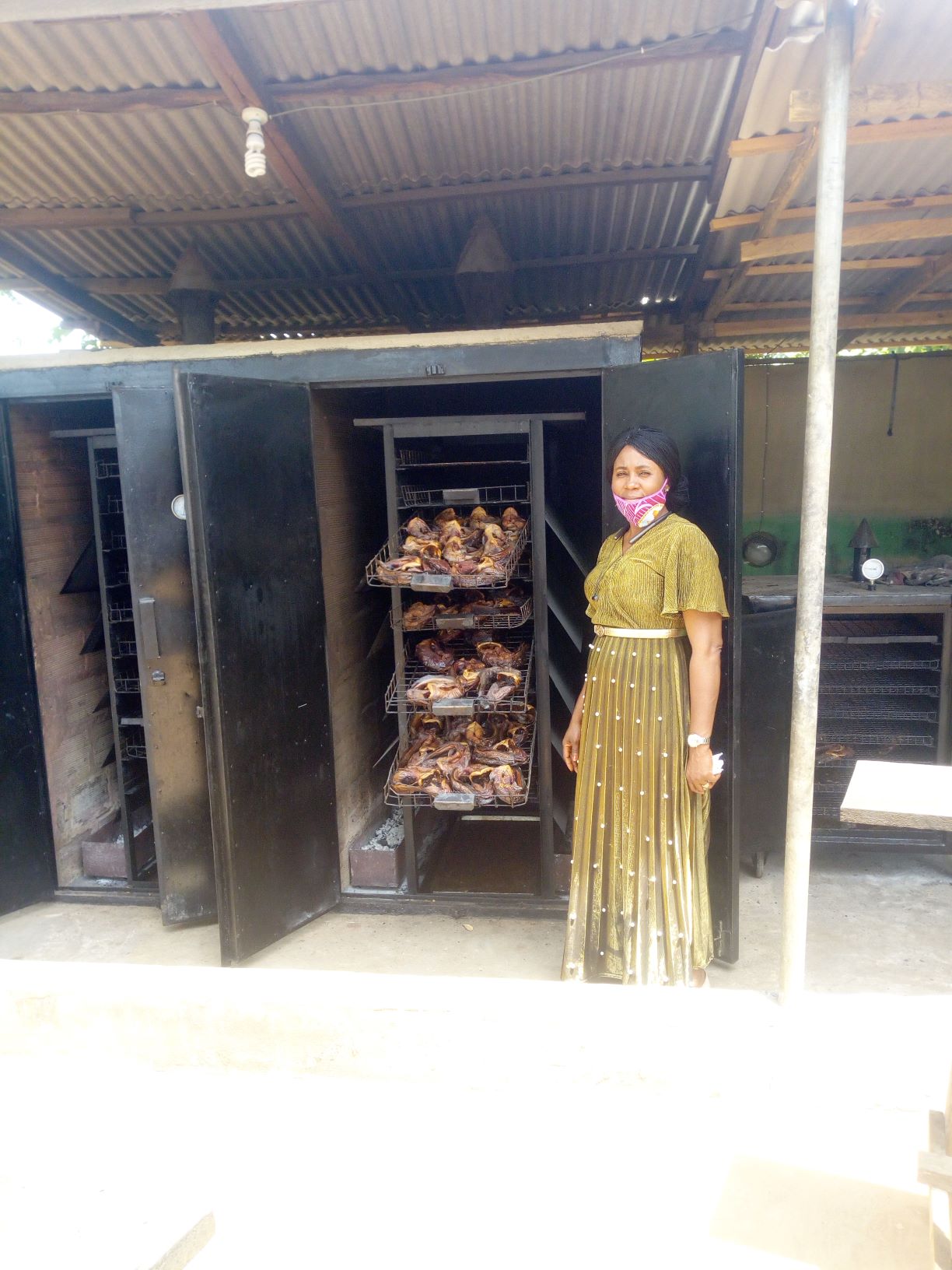
Mrs Asonye showing how they preserve fishes by smoking them
“We are locked down with our fish,” she said in an emotion laden voice
Aside the challenges bedevilling her fish farms, Asonye said her poultry business has also nosedived.
“We used to supply our chickens to eateries but we have not been able to sell since the lockdown started. Instead of going to the market to buy meat, we have been eating the broilers. We are just stuck here.”
The development, she said, is a pure loss for her because “we are now feeding indefinitely. In this business, the customers dictate the price.
“The school feeding programme was very beautiful for us. Then, I sold some because I had fish. I had to go and start buying from other farmers.
“We didn’t have to be calling on the fish mongers because those ones will be buying at ridiculous prices.
“We were supplying the fish every Monday for the school feeding programme. It was a good off-take for the famers.
“I had already stocked my ponds for the school feeding programme this year.”
She also decried the hike in the prices of feeds and other factors of production. The feed millers, she said, are not getting raw materials and are suffering because they cannot bring what they need to work. “They had to increase the prices of the little ones they have,” she said.
Asonye told this reporter that the ravaging effects of the pandemic had forced her to stop rice processing because the ones she had processed were still in her mill.
She said: “I process for farmers around Ikorodu axis. The fear of this Covid-19 made me to stop them from bringing rice.
“This is a crisis that all sectors need to address. If we don’t address this problem now, it is going to cause a big problem subsequently.
“I am not the only person affected. We have clusters of women farmers around whose fishes have stayed beyond the time they are supposed to sell them. Many of them are crying.
“If we don’t trash this problem, it is going to affect us in 2021. This is why we are begging the government to help us to see how they can buy these produce from us.”
More women farmers lament
Roli Afinotan, a young female farmer, has been an inspiration to several young ladies, as her love for agriculture has always motivated them to join the oldest human occupation.
Like the other farmers, she has had her plans and projections for the year destabilised.
She said: “I am into fish farming and poultry. My chickens were already mature at the time the lockdown started and ready for sale, but that was not possible because the buyers could not come. We had to keep feeding them; along the line, we had to kill all of them and freeze them.
Roli standing in front of one of her ponds
“We later ate some, gave some out and sold some at a loss. By that, I mean we sold them at give-away prices because there was no power supply to continue to preserve the chickens.”
Speaking on the effects of the pandemic and lockdown on her fish business, Afinotan said: “Business was quite good before the outbreak of Covid-19. But with the lockdown, a lot of people have lost their jobs and have no money to buy as they would ordinarily. That has affected our income a great deal.”
Ironically, the pandemic appears to have also paved the way for creativity. Afinotan told of how the need to salvage her investment made her to come up with the option of selling online. She said the move helped her a great deal even though she had challenges with delivery.
“To find a reliable delivery company was difficult, and now it is even more difficult,” she said. “This makes income really slow and trickle – unlike before when after selling we had bulk money.”
Mrs. Patience Oshodi, a pig farmer and her colleagues at Oke Aro area of Lagos, on their part, have more than the coronavirus problems to deal with. She and her pig farmer colleagues had their plight compounded in April, when African Swine Flu (ASF) afflicted their farms, killing over 145,000 pigs valued at N4.9 billion.
“I decided that I should expand my business in December 2019 in preparation for this year’s business. The expansion made me to invest more, and that required borrowing money.
“They were supposed to be ready for market by April through May, but unfortunately, Covid-19 and swine flu made all that impossible. I have lost more than 180 animals worth about N5.1 million.
“On a particular day, I lost seven; on another, five, and so on. Everything was gone in a space of three weeks. It is very discouraging but the Bible says we should encourage ourselves and move on.”
She was however able to save some of her pigs.
“We still have some, which we want to salvage. The challenge has no cure, so once we notice any death, we immediately move it out and try to salvage the remaining. We also sanitise and wash the room with disinfectants. My contribution at the home-front has suffered. I don’t have money to spend anymore. It is my husband who now gives me money if I have to go to the farm. The other day, I had to collect money from my husband to buy feeds for the surviving animals.”
But for the lockdown, Oshodi said “Buyers would have come to select the ones they wanted. But the lockdown made that impossible. Even though the government said farm produce can move, the farmers are being harassed on the road.
“So, when they look at the cost of coming and the harassment and other things, they simply decide not to come.”
Farmers yet to get FG’s palliatives
Following the setback their businesses have suffered, one would have expected them to immediately access the federal government’s economic relief package, meant to help them weather the Covid-19 storm, but the farmers said they have not received any such support.
Like other governments around the world, the Nigerian government had introduced various economic measures to help businesses mitigate the impact of the pandemic and save the economy.
On March 27, President Donald Trump signed into law a $2.3 trillion economic stimulus package, the largest of such emergency aid in America’s history, to support businesses in the country. The government also provided $600 billion in loans to small scale businesses with over 10,000 employees, to help them survive the lockdown period.
In the United Kingdom, the government provided nearly $400 billion assistance package to help businesses through the coronavirus period.
On its part, Italy, one of the countries worst hit by the pandemic, announced a €25 billion fiscal package in March to support businesses. The government also extended the 2019 annual Value Added Tax (VAT) return deadline by two months from 30th April to 30th June 2020.
In Nigeria, President Muhammadu Buhari enacted the Covid-19 Regulation 2020, which among other measures, imposed significant restrictions on the movement of persons and goods in Lagos and Ogun states, as well as the Federal Capital Territory (FCT).
Respective state governments also imposed varying degrees of restrictions on movement of persons and goods, including public gatherings and markets within their states.
The effects of these prompted the Federal Government to introduce fiscal and economic stimulus measures to ameliorate the impact on businesses and save the economy from collapse.
Part of the measures included placing a moratorium on all government-funded loans issued by the Bank of Industry, Bank of Agriculture and the Nigeria Export Import Bank.
In an address to the nation on April 13, President Buhari, speaking specifically on plans to enhance food security, announced an initiative aimed at minimising the impact of the pandemic on the agriculture sector. He said he was “directing the Minister of Agriculture and Rural Development, the National Security Adviser, the Vice Chairman, National Food Security Council and the Chairman, Presidential Fertiliser Initiative to work with the Presidential Task Force on Covid-19 to ensure the impact of this pandemic on our 2020 farming season is minimised.”
As a follow-up, the Minister of Agriculture and Rural Development, Muhammad Nanono, on April 26, inaugurated a joint technical task team on emergency response to the Covid-19 pandemic.
However, nothing specific has been announced on how the government emergency intervention will minimise the impact of the pandemic on farming and farmers.
The Central Bank of Nigeria (CBN), in response to the pandemic, quickly drew up a policy framework covering immediate, medium and long-term measures.
Keeping faith with its stated objectives, on March 17, the CBN announced a credit relief package of N50 billion (about $136.6m) to businesses affected by the pandemic. Godwin Emefiele, the CBN governor, said beneficiaries would be households, small and medium sized enterprises (SMEs), agriculture food chain businesses, airline operators, service providers, hotels and healthcare merchants.
On April 30, the bank said it had identified 3,256 individuals and businesses to benefit from the N50 billion Targeted Credit Facility (TCF) through NIRSAL Microfinance Bank.
However, laudable as these promises appear, the women farmers said they are yet to benefitted from any of them.
Pictures of beneficiaries of the programme could be seen all over the twitter handle of the Government Enterprise and Empowerment Programme (GEEP) of the Federal Government of Nigeria, but not a single smallholder woman farmer in Lagos State testified to having benefitted from the programme. Some of the farmers also expressed their frustration in getting the CBN/NIRSAL Microfinance Bank loan they had earlier applied for.
For example, Asonye claimed that smallholder farmers in the state had not had access to farmer moni, the federal government’s programme meant to enable farmers have access to credit. She said: “I have been hearing about the federal government’s farmer moni palliative, but none of such has come to Lagos State. If it has come into Lagos State, we would have keyed into it.
“The only one we are aware of is the CBN/NIRSAL Microfinance Bank which some of our farmers have benefitted from.”
Mrs Aluko also said she had not received any such support.
“I have not benefitted from any government loan. Why will I not be interested?” She asked almost rhetorically.
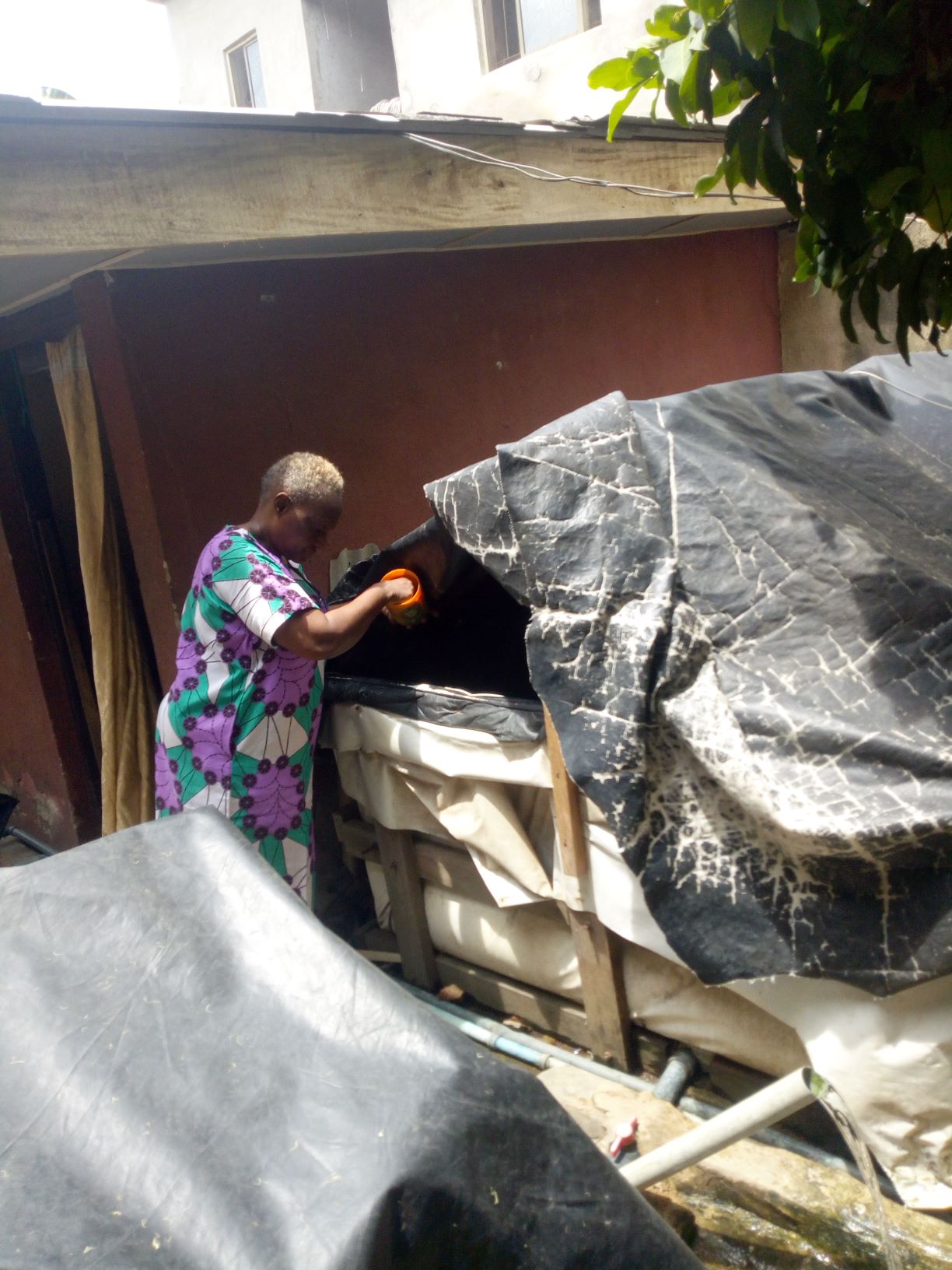
Mrs Aluko pouring feeds into one of her ponds for her fishes
“I applied for the CBN loan since two years ago but I am still waiting. I was called for the interview which I attended in December 2018 at the CBN. They told us last year that the disbursement would be done through NIRSAL Microfinance Bank and I had to open an account with them. I am still waiting and hoping.
While appreciating the place of loan in helping businesses thrive, Aluko strongly believes that loan is not what they, as farmers, need at the moment.
“The major help we need now is in the marketing area. The government can engage in direct buying, by buying these produce off the farmers, so that we can continue in business.
“I thank God that we have a responsive government in Lagos State, and I believe that when they hear the farmers’ cry, especially the women, they will respond.
Speaking in the same vein, Afinotan said: “I have not benefitted from any federal government loan scheme for farmers since this pandemic started. I am not even aware of any.
“Yes, we always take loans for our business. We have taken loans from cooperatives and individuals with the intention to sell and repay the loan.”
Afinotan believes that loans should always be designed in such a way that the business will be able to pay back. But she regretted that “that has not been the case. We have had to call the people we took the loans from to give us more time to pay back.
“We have also been processing loans from the CBN since last year but we’re yet to get it. We are hoping on that to expand the farm. With Covid-19, everything has come to a halt.”
Odofin decried the frustrations that come with taking bank loans. “I would have loved to go for the CBN/ NIRSAL Microfinance Bank loan. I actually applied for it. But when they were calling them for interview, I was not around.
Madam Odofin feeding her fishes
“I had plans to diversify into smoking fish; and that was part of the prerequisite we gave them while applying for the loan.”
The retired nurse added: “When I came back, I went with my sister to NIRSAL Microfinance Bank that CBN is using to disburse the loan. They were telling us that they had a vendor to do the smoking for us. That was not part of the conditions for the loan. We are supposed to be the ones smoking the fish. That caused a lot of problem and they are still on it till now.”
“I don’t want to go for it anymore because the troubles from banks are too much. My sister and I put in for the loan but she was not able to access all the money.
She disclosed that her sister applied for N10 million loan but got only N770,000 as working capital. “The remaining money is still with them. They didn’t disburse it to her. Now they are telling her that she will start paying back the loan by this month (June). Which work did we do up to this time to start repaying the loan? I didn’t even envisage this when I said I wouldn’t want to take the loan anymore.”
Food security under threat
As a result of the daunting setback the coronavirus has caused them, the farmers fear that the country could face shortage of food supply in the days ahead.
“The pandemic will affect food security,” Madam Odofin said, with a measure of conviction. “Right now, we have people on our platform announcing that they have fish to sell, but where is the money to buy? They want to sell off so that they can start producing another one, but where are the buyers?
“How would the people coming from Cameroon get here to buy? Until this house arrest called lockdown ends, I don’t know what to do. Except government genuinely allows people on essential duty to be moving around, this problem will persist,” she said.
Afinotan expressed concern about how farmers can restock and continue production when they are not selling. According to her, “there is concern about restocking. The inflow of income to sustain the business is not there and we are still struggling to repay loans.
“It is realistic for us to restock and look at production in the future. If not, we would have more problems in our hands.
“I imagine that many farmers will be having this same problem. That means that in the future there will be less food. When there is less food in the market and there is more demand, you know what that means.”
Why farmers can’t access our loan —NIRSAL
When our reporter reached out to the Humanitarian Ministry, which is responsible for disbursing the farmer moni, the spokesperson, Hamila Oyelade, said she would find out from the social investment team and get back same day.
However, she was yet to get back at the time of filing this report.
When contacted for clarification on why the farmers were yet to access the CBN loan, an official of NIRSAL Microfinance Bank, Hyacinth Peter, said he would need to know the stage of their applications to be able to respond appropriately.
“There are lots of requirements. Some people just do the online registration and think that is all. Some will do online registration without submitting the documents required. Some submit some documents and leave out others. There are lots of inconsistencies with some applicants.”
On those who got a fraction of the amount they applied for, he said: “We don’t have somebody who applied for N10 million and was given N750, 000. We don’t have such. May be there is a missing link.”
The loan, according to him, is specifically designed for a purpose. He said the loan is not a working capital where people can take money and do whatever they wish. “It is tailor made and well guided.”
The NIRSAL official expressed disappointment at the performance of some of the applicants during interviews. “After listening to some applicants, you will shake your head. But in order not to dismiss them altogether, you just approve something that is minimal just to encourage them.
“Sometimes if you don’t need asset, the loan is not for you. The loan is designed in such a way that asset is 75 per cent and working capital is 25 per cent. Sometimes, some people’s need for asset is just about 10 or 15 per cent. Sometimes it is better to decline a loan or out of charity, you just find a way to approve something very, very significant compared to what the person required.”
This report was made possible with support from the International Budget Partnership (IBP).
THE Nigeria Centre for Disease Control (NCDC) has issued guidelines for the reopening of religious centres across the country, demanding that children and people aged 60 and above should avoid worship centres for the time being.
According to the guidelines posted on its website, the NCDC said “Holy communion should be packaged in disposable wraps. Drinking water points, public toilets and sales outlets must be closed for now.”
This is coming barely two weeks after the Federal Government lifted the banon religious centres and other public gatherings.
The NCDC said before reopening, religious houses should fumigate their auditoriums, car parks and other buildings by wiping all surfaces with a disinfecting agent.
It also said during services, windows and doors must be opened to enable airflow while adequate provision should be made for soap, running water and hand sanitisers at entry points.
The Centre cautioned that there should be no entry without face masks noting that places of worship should provide disposable face masks where practicable.
To educate worshippers on COVID-19, it recommended that places worship should have preventive messages from NCDC posted at entry points and around places of worship.
The statement added that for Muslims, ablution should be done at home and discouraged the sharing of kettles and any personal items.
According to NCDC, places of worship must open only between 5am and 8pm daily. It noted that choristers are to go home with their robes while hijabs are not to be shared.
“Attendance in every service should not exceed one-third of sitting capacity of the auditorium to enable physical distancing,” it said.
In addition, the NCDC discouraged shaking of hands, hugging and all physical contacts for the time being and advised that worshippers from 60 years old and above, or those with underlying medical conditions, to stay at home.
However, NCDC encouraged electronic means of collecting tithes and contributions to limit contact with
possible contaminated cash or cheques.
The global health challenge, COVID-19, which affected every sphere of life in Nigeria and across the globe, has not spared the agricultural sector. And among the worst it are smallholder women farmers across the country.
In this investigative report, made possible with support from the International Budget Partnership, (IBP), correspondent Alfred AJAYI highlights the impacts of COVID -19 on smallholder women farmers in Idemili, North, Ekwusigo, Orumba North, Ogbaru, and Nnewi South Local Government Areas of Anambra State.
ANAMBRA State by the outcome of the last population census in 2006, has a total population of four million, one hundred and seventy-seven thousand, eight hundred and twenty-eight. The population is expected to have grown to six million going by the 2.2 per cent national annual population growth.
An Agricultural Value Chain Expert, Mr Abraham Ogwu, in an interview with Radio Nigeria, revealed that women, who are largely involved in subsistence farming, constitute over seventy per cent of the entire farmer population in the country.
“You see all through the value chain. They are farm managers, they are suppliers of labour. They are involved in other activities like harvesting, processing, selling of these farm produce. You may hardly see them in all these long-term gestation crops, most especially export crops like cocoa and cotton. But when it comes to food crops, you see them planting pepper, vegetables. You see them in rice production, maize production. Also, you see in smallscale poultry, piggery, fishery. In a nutshell, the significance of women in ensuring food security is not something we should relegate”.
Statistical evidence also indicates that over five hundred thousand women farmers operate under the umbrella of Small Scale Women Farmers Organization of Nigeria, SWOFON, in various parts of the country, including Anambra State.
The goal of this all-important group is to advocate for and support women farmers especially those in rural areas, to spur rural village economic development, increase food production through capacity building of smallholder women farmers to demand for their rights and privileges from the duty bearers, while serving as vocal and visible pressure group on behalf of smallholder women farmers in Nigeria.
For different reasons, some of theserural women farmers have becomebreadwinners of their various families and are poised to weather the storms not minding the drudgery and other challenges associated with small scale farming. They have kept their passion and are undeterred in the quest to contribute to the food security programme of the government.
…Rude interruption by COVID-19
However, the global health challenge, covid-19 pandemic, which had shattered national and global economies, did not spare these farmers, as revealed in separate interactions with some of them in various communities of Idemili, North, Ekwusigo, Orumba North, Ogbaru, and Nnewi South Local Government Areas.
Mrs Georgina Akunyiba lost her husband in October 2014 but the proceeds of her agricultural engagements have kept her afloat.
She boasted, “It was when I was in secondary school that I started this business. Then I continued from there. When my husband died in 2014, my first daughter was reading Anatomy, first year in the University. Today, she has graduated and finished her NYSC service. My son you saw in the shop was at SS 3 that time. He finished from secondary school and is now studying Animal Science, 400 Level, to produce more people from Agriculture. The other one is now entering. It’s all from agriculture to pay house rent, meet other demands. Let me tell you that I am looking for anybody to come and help me. Yes, I am a widow, but God has been helping me through this agriculture”.
Despite her exploits in poultry farming, Mrs Akunyiba, who co-ordinates the Small Scale Women Farmers Organization in Nigeria in Anambra State, recounted bitterly the effects of covid-19 on her business.
“This COVID-19 did a lot to me. We were supposed to dispose these birds by Easter. But there was no market. Even egg is not moving. Two hundred layers are supposed to eat one bag of feed a day. But, now because of the problem, we are rationing them and the basic result is to cut egg. They will lose weight. And you know that when you want to buy, you will look for a bigger one. The question is where is the money to feed them to reach the size that everybody will want to buy. One of our members took loan from the cooperative for poultry business. I tell you she ran at a loss, making only fifty thousand naira plus from a business she invested eighty five thousand naira. It is difficult for her to pay back now”.
Investigation also revealed that the lockdown ordered by the federal and Anambra state governments as part of measures to halt the spread of coronavirus left several of these women farmers with tale of woes.
Mrs Monica Igbokwe, who leads small scale women farmers in Nnewi South Local Government Area, is a former manager in one of the insurance companies in the country. She told this reporter in May 2020 that her voyage into farming started only six years ago and shs has nothing to regret, but for COVID-19 pandemic.
“I have a farm in Igbariam where I cultivate yam, cassava and many other things. Then at home, I start this poultry business. But, this coronavirus has brought everything back. Now, we are in May, by now we should have started farming. But when I got to the market to get cassava stems, the stems I got five hundred naira last year, were sold for one thousand, five hundred naira. If I could buy fifty bundles last year, this coronavirus had made it that I should buy only ten. I cannot even travel to where I go to get some input. You now see that something will happen”.
For Mrs Stella Onuchukwu, a farmer in Ufuma, Orumba North Local Government Area, farming is enjoyable but COVID-19 also dealt a big blow to them at the peak of the lockdown.
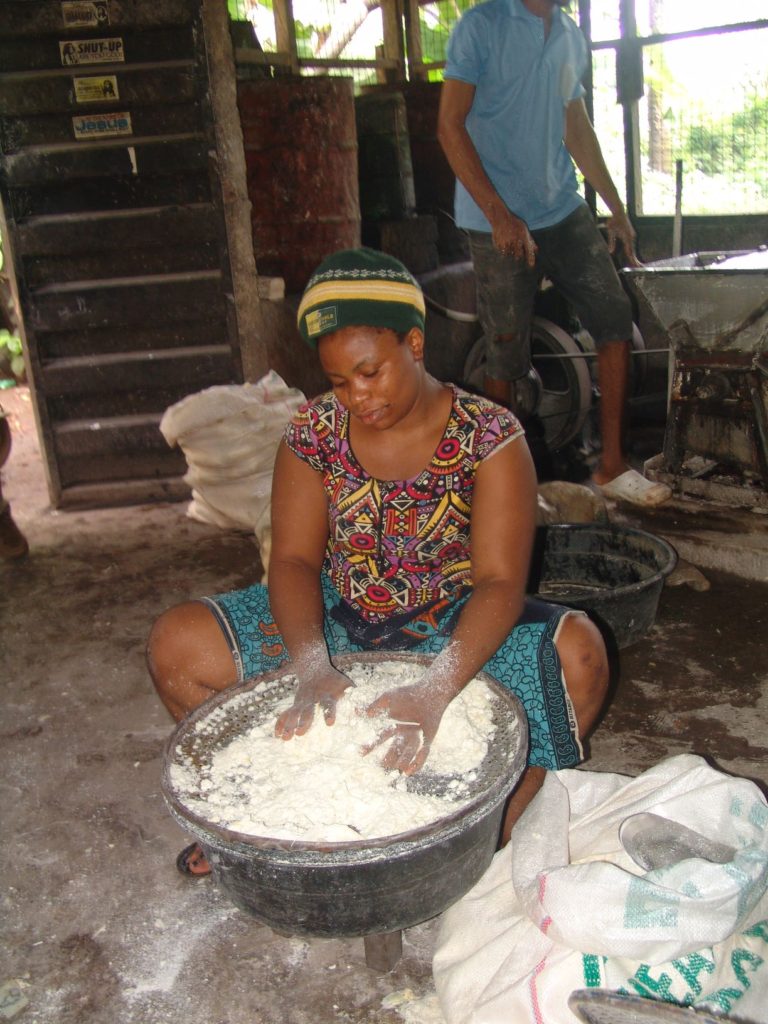
“We operate as a cooperative society here. We do cassava cultivation and garri processing. The coronavirus disease really affected us. During the time they said we should stay at home, our machine broke down and we did not have the money to repair. Even when we succeeded in raising the money, the next challenge was how to get somebody to come and carry out the repairs. For days, economic activities at the mill were stalled until we finally got somebody who came all the way from Onitsha to Ufuma here to repair. And even for that person to get here was a tug of war”.
A Garri Processing Mill at Ufuma, owned by Women Farmers
Mrs Onuchukwu feared the situation, which had adversely affected agricultural activities, while it lasted, may further raise the prices of agricultural produce in the months ahead.
Mrs Eunice Nduka in Atani, Ogbaru Local Government Area was into business before venturing into farming. She now specialises in the cultivation of cassava and maize. The young and energetic mother lamented the failure of the government to encourage the women farmers as they contribute to food production in various parts of the country.
“I prefer farming than business because when you farm, you have food to eat. But when you do business, you will be buying food. That’s why I chose to be a farmer. People have been coming to us to register. We have been writing our names, but to no avail. I haven’t received anything, but I am pleading to the government so that they will come to my rescue. I can do more than I am doing at the moment, with the right assistance from the government”.
However, Mrs Ngozi Obiajulu, at Ihembosi, Ekwusigo Local Government Area, has a different story to tell about COVID-19 and its impact on agriculture. For her, COVID-19 has no negative impacts on their business. This may be hinged on the fact that Ihembosi is a remote location, where enforcement of the lockdown would not have been as serious as it was in the urban centres.
“We were in our farm o. You can’t tell women to stay in-door in this our community. Women are bread winners of their families and nothing stops them from going to farm at any time they want to. The only thing we did then was Personal Protective Equipment. We wore our facemasks and hand gloves when we wanted to remove crops or weeds from our farms. But, to ask us to stay at home, it’s not possible. Okay, if we have stayed in-door, who gives us food to eat? What would have been our fate now? You can see the crops growing so fast. If we had stayed at home, we will just be starting the whole process of farming now”.
…Government is also concerned
As part of efforts to minimise the negative impacts of the pandemic on the economy of the nation, President Muhammadu Buhari in a nationwide broadcast, on April 13, 2020, ordered that the Social Register of the poor and vulnerable be extended from two point six million to three point six million in the next two weeks.
The President also directed the Minister of Agriculture and Rural Development, the National Security Adviser, the Vice Chairman, National Food Security Council and the Chairman, Presidential Fertilizer Initiative to work with the Presidential Task Force on COVID-19 to minimise the impact of the pandemic on 2020 farming season.
On its part, the Central Bank of Nigeria on March 17, announced a Credit Relief Package of fifty billion naira for businesses affected by the pandemic including households, small and medium sized enterprises, hotels and healthcare merchants, airline operators as well as agriculture food chain businesses.
In Anambra State, Governor Willie Obiano, during one of his previous broadcasts on COVID-19, directed farmers to return to their farms as the only way to prevent the impending hunger.
The governor also announced plans of the government to improve food security in the state.
He said the government would provide women and youths with cages for poultry and feedstock for birds in order to achieve food security.
Inputs at subsidised rates for farmers.
Although nothing was specifically mentioned for small-scale farmers in the interventions by Federal and Anambra State governments, it was expected that the implementation of some of the measures enumerated above would impact them positively.
However, all the small-holders women farmers interviewed across the five selected local government areas of the state were embittered that the milk of kindness from the federal and state governments had not flowed to them.
Mrs Onuchekwu said: “Nothing nothing and we have been applying for assistance. Even we applied not only to the federal but also the state government. Yet, nothing has been given to us”
For Mrs Igbokwe: “Government is a total disappointment to me. we went to ADP and submitted our data. I just came back from Awka yesterday to submit the ID card that they have said I will submit. Yet, I have seen nothing”.
The coordinator of SWOFON, Mrs Georgina Akunyiba and her members wondered how these incentives are disbursed that their members have not been getting them all these years, especially now that the coronavirus diseased had undermined agricultural production.
The women were equally dismayed that several interventions targeted at them by successive administrations had ended up in the hands of political farmers.
“None has been given to us except the inputs of maize and cassava that they shared last week to local government. They tried for that. But if you are talking about animal husbandry and other things, we have seen anything. We were only hearing it on radio and watching them saying these things on the television. We are the main farmers. All these politicians are political farmers. But they are the ones getting all forms of incentives. Putting the money, where there is no assurance of it yielding any good dividends of increased food production, is an error”.
Her counterpart, Mrs Igbokwe, advised the government to redesign the implementation strategies for some of these interventions to ensure that the targeted beneficiaries take advantage of them.
“I am now advising them, if you want to help the farmers, always try to take the help to where the farmers can be found. If you continue dealing with farmers using some of these fraudsters who divert whatever the government is bringing, food security will remain threatened and we all will suffer for it. I think special attention must be given to women farmers. We are too many across the country to be neglected”.
…Essence of gender policy in agriculture defeated
These testimonies are against the spirit of the Gender Policy in Agriculture, designed to promote and ensure the adoption of gender-sensitive and responsive approaches towards engendering agriculture plans and programmes in such a way that men and women have access to and control of productive resources and facilities to bridge gender gaps.
The policy document also targets to enhance the platform to build an agri-business ecosystem to meet both domestic and foreign demands to achieve food security and accelerated development.
It provides a policy direction and underscores the fact that, the different roles of women and men in agriculture for development and gender equality in access to resources as well as equal opportunities in maximizing means of livelihood, is a necessary condition for progressively realizing the SDGs.
The Gender Policy is therefore expected to drastically reduce the vulnerability of women to biases in agriculture, address the unequal gender power relation and bridge gender gap. Improve the contributions of Small Holder Farmers who are predominantly women though huge, yet their access base to Agricultural asset is low.
The policy was a response to the realization that gender inequalities limit agricultural productivity and efficiency and in so doing, undermine development agenda. Failure to recognize the different roles of women and men is costly because it results in misguided projects and programmes, foregone agricultural output and incomes, as well as food and nutrition insecurity.
It is therefore time to take into account the critical contribution and role of women in agricultural production in order to move women, as the main farmers and producers in many parts of the world, including Nigeria, beyond production for subsistence into higher value, market oriented production.
…Expert advice
The agricultural value chain development expert, Mr Abraham Ogwu, suggested what the government can do to cushion the negative impacts of the coronavirus on women farmers.
Development projects should be tailored to suit women. If we are able to break that barrier of access, food insecurity challenge can be overcome. We need to look at how women can be better organized to be able to have access to extension services, financial services, market information. I know every sector needs attention at this critical time. But, I advise the government to pay greater attention to agriculture. Allocation to agriculture to be increased to invest in activities that will help to prevent food crisis.
Apart from this, Mr Ogwu encouraged productive synergy between the government, the private sector, financial service providers and development partners to work together towards improving the lot of these neglected segment of the farming population.
He also advised policymakers to promptly increase access and address the problem of capacity, which had hitherto impacted negatively on the small scale women farmers.
…the final assurance
The women assured that if adequately encouraged with all the needed assistance, they are poised to help government achieve the lofty goals around food security, despite the adverse impacts of COVID-19 on the agricultural sector.
The helpless farmers also expressed optimism that Nigeria can beat the imminent food scarcity, orchestrated by the pandemic, if all tiers of government would adequately encourage all aspects of agricultural production to be at their best, whether small, medium or large scale farming.
*This report was made possible with support from the International Budget Partnership (IBP).
BOKO Haram’s splinter group, Islamic State West Africa Province (ISWAP) has claimed the attacks in Monguno and Nganzai in Borno State which killed at least 20 soldiers and over 40 civilians.
Two humanitarian workers and three residents told Reuters that fighters armed with heavy weaponry including rocket launchers arrived in Monguno, a hub for international non-governmental organisations, at roughly 11am (10:00 GMT), Aljazeera reported.
The terrorists reportedly overran troops, taking some casualties but killing at least 20 soldiers and roaming the area for three hours.
They drove into the remote village and opened fire on residents trading cows in an open herding field, according to multiple sources.
Terrorists during the attacks also burned down the United Nations’ humanitarian hub in the area and set a police station on fire.
According to local vigilante sources, the terrorists had distributed letters written in Hausa language to residents, warning them not to work with the military or international aid groups.
ISWAP claimed the two Saturday attacks as well as the Gubio attack.
The sources said hundreds of civilians were injured in the crossfire, overwhelming the local hospital and forcing some of the injured to lie outside the facility awaiting help.
This is coming after about 81 persons were killed in an attack in Felo village in Gubio District, in the same Borno State.
NIGERIAN government often advocates against the spread of fake news in the country, but its official website that serves as window to the world has not been updated since December 23, 2019.
The ICIR’s check revealed that the last information shared on the website was a statement by the Attorney General of the Federation, Abubakar Malami.
Screen capture of the website
The website https://nigeria.gov.ng/news/ is listed on Wikipedia as Nigeria’s official information hub for citizens and foreigners who are interested in updates
about the country.
But the last activity of the Federal Executive Council (FEC) uploaded on the website was on November 17, 2017 when the government approved N27 billion for the construction of Gombe – Biu road.
One good strategy to verify fake news is to use diverse and reliable alternatives for obtaining news, said Roberta Tipton, an information science expert at Rutgers University in New Jersey, United States of America.
It appears this truth is yet to find place within Nigerian government bureaucracy.
The Ministry of Information and Culture is responsible for updating the website.
And in the 2020 Appropriation Budget, the ministry demanded for a total of N9.3 million for Information and Communication Technology (ICT) and N2 million for internet charges.
By leaving the official website of the nation without being updated, Nigerians would be left to search elsewhere for information which could lead them into fake information thereby giving wings to fake news.
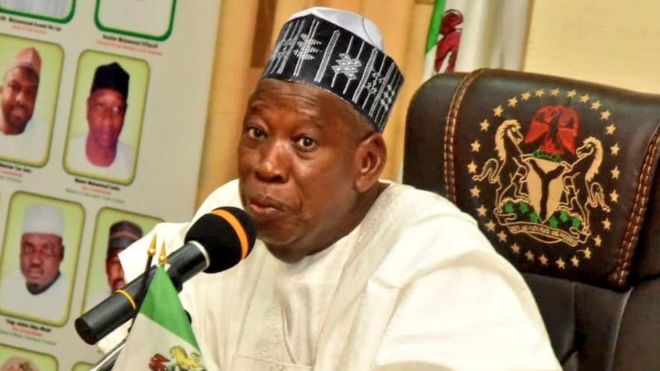
ABDULLAHI Ganduje, Governor of Kano State, has announced the reopening of football viewing centres across the state following the resumption of European football leagues in Europe.
A press statement by Abba Anwar, Chief Press Secretary to the Governor of Kano State, Ganduje made the announcement while receiving the leadership of Soccer Viewing Centres Association,(SVCA), in the state who paid him a courtesy visit, urging for ease of the lockdown order for the centres.
As part of the measures to control the spread of COVID-19 in the state, the governor donated 40, 000 face masks to the association and urged them to observe all protocols put in place by health workers.
“It is in line with our decision to see that our economy bounces back, through reinvigorating commercial and other business activities in the state, that I have directed all viewing centres to be re-opened from today,” he said.
The governor also suggested that the gathering of youths in their viewing centres should also be a medium to create awareness on ways to help manage the pandemic.
Sharu Rabi’u Ahlan, Chairman of the association, lauded the efforts made by the state government to halt the spread of the virus.
“On behalf of all our members, we are appreciative of your unrelenting effort to human development, especially youth, in the state. We are grateful for the face masks His Excellency gave us. And we promise to abide by all the protocols, Sir.
“Our members are always supportive of your policies. And we are in a good working relationship with the state Ministry of Information and the state Censorship Board,” he said.
On June 11, 2020, a popular entertainment news blog known as weddingdigestnaija.com reported that Pastor Enoch Adeboye, General-Overseer of the Redeemed Christian Church of God (RCCG) allegedly threatened to kill anyone that ‘messes’ with his wife, Folu Adeboye.
The report, which was also published by other online news platforms, claimed that the strict warning was issued to the general public during the clergy’s virtual morning devotion last week. It was posted on the clergy’s verified Instagram account: @PastorEAAdeboyeOfficial with the topic: Joys of Having a Successful Marriage.
The Claim
“You have heard me say it before. You can do whatever you like to me, you can criticize me, you can insult me, you can trample on me, I will only pray for you. But if you mess around with my wife, I will kill you,” the report stated, quoting Adeboye.
“I will kill you so thoroughly you won’t even be able to rise on the resurrection morning. When some people ask how are you going to do that, I tell my daddy to send you to hell straight away, so that there will be no need to come forward for judgement.”
Findings
The ICIR’s findings revealed that the video footage is real and the comment true, as it was also posted on the verified Instagram page of the clergy named @pastoreaadeboyeofficial on 4th June, 2020.
In the sermon, the clergy spoke on how couples could enjoy a successful marriage based on Biblical teachings. He established some of these teachings with different Biblical passages including Ephesians 5: 20-30.
For instance, while he encouraged women to submit to their husbands irrespective of the academic qualifications and status, he tasked men to love their wives, just as Christ loves the church.
Based on the context of the teaching, the two adults he identified are man and woman. But on the claim to kill anyone that ‘mess’ with his wife, Adeboye emphasised that a man should love his wife to the extent that he could give his life for hers.
“The only big problem comes when you asked the question, how much love must I have for my wife? And the Bible made it clear, as Christ loves the church. That is a big one because it means you have to love your wife to the extent of being willing to die for her,” he stated in the 36 minutes and 34 seconds footage.
The influential clergy particularly stressed that he would not shoot the person, as the government could only arrest him if he uses any lethal weapon. However, he said his divine power would come against such an individual.
“…who told you I’m going to shoot the fellow? You can only arrest me if I use any human weapon. To mess around with my wife, then every power God has given me will descend on you.”
“Why? Because the Bible says you are to love your wife as Christ loves the church that he gave himself for man,” he said, describing the act of love as an assignment of every husband in marriage.
Adeboye insisted further that husbands should develop such love for their wives only. He buttressed the teachings in Yoruba language, after citing examples including that of two couples who were both Professors.
“Husbands will forever be husbands, but you, the husband must love your wife. That should not be difficult until the Bible added that as Jesus loves the church….”
“That made it a bit difficult because it implies that you must be ready to die for your wife,” he stated.
Further findings revealed that the clergy disassociated himself from the actual killing but would rely on divine help.
THE VERDICT
Though the claim that Adeboye threatened to kill anyone who messes with his wife is TRUE, the short footage was taken out of context, to MISLEAD members of the public.