back to top
Home Blog Page 2085

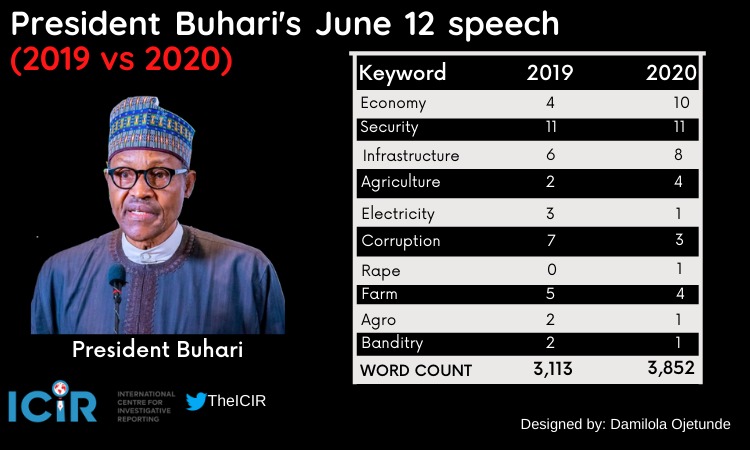
Counting Buhari’s words on Democracy Day

The ICIR editor, Ajibola AMZAT, counted the number of keywords in Buhari’s Democracy Day speech and reported that though the president’s choice of words rings true to his election promise, not much has changed since 2015.


PRESIDENT Muhammadu Buhari read a 3,561-word speech this morning to Nigerians in celebration of the Democracy Day. The speech consists of 148 sentences and 96 paragraphs.

Last year, when he declared June 12  as Democracy Day, his speech was shorter by 404 words. Notwithstanding, the president harped on similar issues he addressed in 2019, except that he focused attention much more on the economy this year than he did 12 months ago.

In his 2019 Democracy Day’s speech, the president mentioned the word “economy” only four times, this year the word occurred 10 times.

That is understandable. The Nigerian GDP has dropped from 2.27 per cent in 2019 to 1.87 per cent in the first quarter of 2020 due to the COVID-19 pandemic. The crash is deeper than the growth rates of many African countries, including Ghana, Rwanda, Kenya, and Egypt.

As at December 2019, Nigeria’s domestic debt was over N18 trillion and foreign debt was over 9 trillion, according to Debt Management Office.

Yet, Nigeria’s Senate in March approved a plan to borrow another $22.7 billion from external creditors, a decision that has increased the external debt by nearly 28 per cent.

Data from Nigeria Natural Resource Charter shows that Nigeria Excess Crude Account has dropped to $71.8 million from $324.9 million in January 2020. And to make matters worse, the country’s Sovereign Wealth Fund has been depleted to 1.5 billion.


READ ALSO:

Although the president blamed the economic misfortune on the  “pandemic [that] has affected the global economy,” he was silent on the fact that countries like Nigeria are more affected than others, due to what pundits have attributed to poor economic management.

As a national response, Buhari said his administration is integrating rural communities to the formal economy by extending access to credit and inputs to rural farmers as well as building feeder roads. He also disclosed that the National Digital Economy Policy and Strategy has been launched to enhance the productivity of Nigerians. This effort has not shown a significant impact.

In fact, a few months ago, his Minister of Finance, Budget and National Planning, Zainab Ahmed, warned that Nigeria is sliding into recession. Since then, the slide has not stopped.

Another issue that featured prominently in the president’s speech is security. The president harped on the word “security’ 11 times, as he did in the year before.

To reduce security challenges, the president listed a number of measures he has taken.

The list included the creation of Ministry of Police Affairs, expansion of the National Command and Control Centre to nineteen states of the federation, resuscitation of the National Public Security Communication System and commencement of the implementation of the Community Policing Strategy.

He said his government has also established a Nigerian Police Trust Fund for alternative sources of funding security activities as well as introduced operation “Ex-Swift Response”.

But it appears these strategies have not reduced the high incidence of violent deaths in the land – at least not yet.

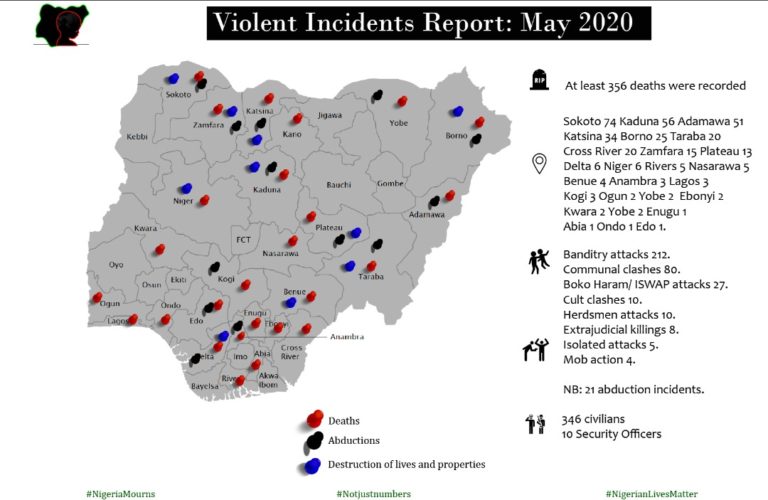
A report released yesterday by NigeriaMourns, a movement by Nigerians to mourn victims of the upsurge in violent killings, indicated that no fewer than 356 Nigerians were killed in 27 states of the country in the month of May 2020 alone.

The report indicated that 212 deaths were attributed to banditry attacks. And while communal conflicts accounted for 80 deaths, 27 were attributed to Boko Haram/ISWAP, 10 to cult clash, herdsmen attack took 10, eight were due to extrajudicial killings while five were killings related to isolated attacks and four to mob action.

In its latest report published in June, the Centre for Democracy and Development has noted that “President Buhari has exercised weak civilian oversight over his long-serving service chiefs, giving them wide leeway to manage military affairs.”

Infrastructure is another word that featured prominently in Buhari’s speech. In his address on June 12, 2019, the president used the word six times but used the same word eight times in his address this year.

The president spoke about the Presidential Infrastructure Development Fund projects aimed to deliver the 2nd Niger Bridge, Abuja – Kaduna – Kano Road, Obajana – Kabba Road, and wider railway network among other projects. He disclosed that N800 billion recovered from corrupt public officials are being ploughed into development and infrastructure projects.

But there are indications that the execution of many of these projects are shrouded in secrecy. Despite the provision of the Public Procurement Act that compelled government agencies to upload their procurement plan on the Open Treasury Portal and the website of the Bureau of Public Procurement, many agencies do not abide by this law.

Last week, The ICIR published a report about Ecological Fund Office, EFO that awarded a contract to a company that has no official address.

EFO is one of the agencies accused by the Office of Auditor General (OAuG) of disregard for financial probity.

According to the 2017 Auditor General’s report published in 2019, no fewer than 265 of government agencies failed to submit their audited reports.  In fact, under President Buhari’s watch, eleven agencies have never submitted their financial statement for auditing.

It is, therefore, curious to note that the word “corruption” appeared only thrice in his speech this year as opposed to seven times it did last year.

The president said “anti-corruption agencies have secured more than 1,400 convictions and also recovered funds in excess of N800 billion,”  but CDD noted that most of the convictions, especially those secured by EFCC, are from cybercrime.

According to the think-tank group, Buhari has fallen short of his promise to “demonstrate zero tolerance for corrupt practices.”

In his speech this year, President Buhari barely stressed the issue of human rights violations that have been widely reported before and during the outbreak of the COVID-19 pandemic. Though, he mentioned the word “rights” three times, it was in respect to mineral rights. The only time he spoke about ‘legal right” was when he said his government has initiated a number of policies and programmes designed to promote the legal rights of Nigerians. But there have been reports of human rights abuse by law enforcement agents.

Meanwhile, the National Human Rights Commission in its latest report shows that 18 Nigerians were violently killed by law enforcement agents while enforcing COVID-19 regulations. While the Nigeria Correctional Service was responsible for eight deaths, the Nigeria Police Force was responsible for seven deaths. The Nigeria Army, on the other hand, was responsible for two deaths while the Ebonyi State Task Force on COVIV-19, Afikpo South LGA was responsible for one death.

Even before the outbreak of Coronavirus, Special Anti-Robbery Squad (SARS) has been trending for killing Nigerian youths extra-judicially. The Nigerian Security Tracker has recorded no fewer than 29 deaths caused by the SARS operatives between 2015 and 2020. Some of the perpetrators are rarely held to account for their involvement in torture and other ill-treatment of detainees, and in some cases, they are transferred to another location to avoid punishment, according to a 2016 report by Amnesty International.

Furthermore, the subject of rape that has become almost a talking point in the national conversation, did not get prominent mention in the president’s speech.  Buhari only used the word “rape” once in the entire speech.

The president said he was “upset at recent incidents of rape especially of very young girls,” and he added that “the Police are pursuing these cases with a view to bringing perpetrators of these heinous crimes to swift justice.”  And that was it.

Other keywords that featured less this year than in the previous year’s speech are banditry (1) and electricity (1).

But the words like “Agriculture” or “agro”, or “farm” do well in the president’s speech this year than in the last year. And the reason is not far fetched.

“Agriculture remains the key to our economic diversification strategy,” the President said.


Multiple inconsistencies in Obaseki’s academic certificates cause disqualification

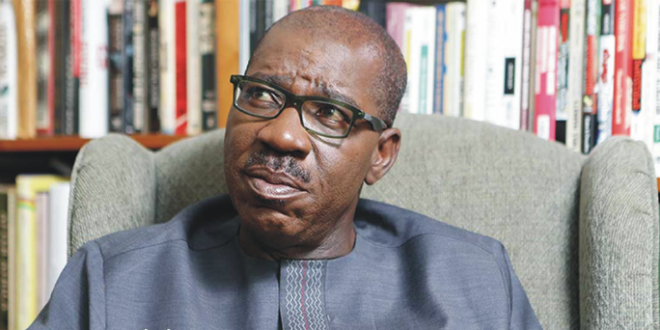
GODWIN Obaseki, the embattled Governor of Edo State was disqualified from contesting the All Progressive Congress (APC) primary election in the state because of “multiple inconsistencies in his presented academic certificates,” a party source told The ICIR.

While the screening committee, cleared Osagie-Ize Iyamu to participate in the party’s primary election scheduled for June 22, it disqualified Obaseki for discrepancies in his academic credentials.

“Governor Godwin Obaseki was deemed ineligible by the screening committee over multiple inconsistencies in his presented academic certificates, including a Higher School Leaving Certificate the Governor claimed to have obtained from an Institute of Continuing Education in Benin City, Edo State,” the source said.

The high school leaving certificate, the committee ruled, was unknown to the Nigerian education system.

“The Governor also admitted during the screening that he never received the certificate.”

The committee also noted that his NYSC certificate indicated the name ‘Obasek’, and while it acknowledged that this could be an error on the part of the issuing body, it flagged the Governor’s failure to address the problem for years and thus solidified doubts on its authenticity.

The source said Obaseki also failed to supply additional documents solicited as proof of its claims.

“On these grounds, the Committee, relying on the party constitution, ruled Governor Godwin Obaseki ineligible for participation in the party primary,” the source said.

Also, Chris Ogiemwonyi was also ruled ineligible over inconsistencies in the name contained in his submitted academic certificates while Matthew Iduoriyekemwen was also disqualified

Meanwhile, Pius Odubu and Osaro Obaze however passed the screening alongside Osagie Ize-Iyamu as the aspirants eligible to participate in the primary election.

Reacting to his disqualification, Obaseki in a statement signed by Crusoe Osagie, his spokesman, the governor said he would not appeal the outcome of the screening exercise.

Obaseki who has been on in a political battle with Adams Oshiomole, the party’s National Chairman said he watched the mockery of the democratic processes, which according to him, Oshiomole is administering and superintending’ over the ruling party, APC.

He added that it has been an unfortunate, disheartening and dreadful spectacle


FACT-CHECK: Has Buhari government recovered all local councils taken over by Boko Haram in Borno, Yobe, Adamawa?

By Opeyemi Kehinde


THE Nigerian President, Muhammadu Buhari, in the speech delivered on Friday, June 12, 2020 to commemorate the national Democracy Day, claimed that “all the Local Governments that were taken over by the Boko Haram insurgents in Borno, Yobe and Adamawa have long been recovered and are now occupied by indigenes of these areas…” The claim has stirred intense public reactions offline and on the internet.

The speech titled: “NATIONAL BROADCAST BY PRESIDENT MUHAMMADU BUHARI ON DEMOCRACY DAY, JUNE 12TH 2020”, was aired on the national television (Nigerian Television Authority [NTA]) and radio network (Radio Nigeria), and was also widely published by the media and several online news platforms in the nation including Daily Trust, Vanguard, The Cable etc.


THE CLAIM

Buhari, while giving stewardship account of his All Progressives Congress (APC)-led government in the area of national security during the presidential broadcast, had claimed that the local government areas in three north-eastern states of the country – Adamawa, Borno and Yobe – hitherto known for relentless insurgency since almost a decade ago have been secured as the areas “are now occupied by indigenes of these areas who were hitherto forced to seek a living in areas far from their ancestral homes.”


Parts of his speech read: “In the area of security, we remain unshaken in our resolve to protect our national infrastructure including on-shore and off-shore oil installations, secure our territorial waters and end piracy in the Gulf of Guinea.

“Ending insurgency, banditry and other forms of criminality across the nation is being accorded appropriate priorities and the men and women of the Armed Forces of Nigeria have considerably downgraded such threats across all geo-political zones.

“All the Local Governments that were taken over by the Boko Haram insurgents in Borno, Yobe and Adamawa have long been recovered and are now occupied by indigenes of these areas who were hitherto forced to seek a living in areas far from their ancestral homes.

“The total collapse of the economies of these areas, which constituted a threat to our food security, has also been reversed with the gradual recovery of farming and other economic activities.

“I regret recent sporadic incidents with tragic loss of lives in Katsina and Borno States as a result of criminals taking advantage of COVID-19 restrictions. Security Agencies will pursue the perpetrators and bring them to swift justice.

“I must implore state and local governments to revamp their intelligence assets so that the Security Agencies can nip in the bud any planned attacks in remote rural areas. I send my heartfelt condolences to all the relatives and communities affected.

“As part of the strengthening of our internal security architecture, the Ministry of Police Affairs was created.

“Amongst others, Government has expanded the National Command and Control Centre to nineteen states of the federation, resuscitated the National Public Security Communication System and commenced the implementation of the Community Policing Strategy.

“Government has similarly established a Nigerian Police Trust Fund as a public-private sector vehicle for alternative sources of funding security activities.

“To reduce security challenges through our external borders especially smuggling of oil products out of the country, inflow of small arms and drugs into the country and equally protect our local manufacturers, we introduced operation “Ex-Swift Response” closing our borders from August 20th 2019, and have considerably succeeded in meeting its objectives as well as improving our national revenue.”

THE CHECK

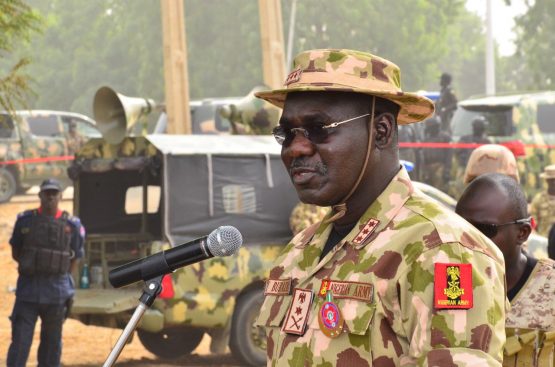
A fact-check investigation by The ICIR shows that contrary to the victory claim by the Nigerian president against the Boko Haram insurgents, “the fight is still ongoing,” according to the nation’s Army chief, General Tukur Buratai.

A news report published on Monday, June 8 on Daily Trust website quoted Buratai as saying that “The fight is still ongoing and over 1,429 Boko Haram terrorists have been neutralised and we have arrested over 166 Boko Haram terrorists informants, their spies, couriers on logistics and their coordinators in the villages, the towns and even the forest.”

Nigeria’s Army chief, General Tukur Buratai.

Buratai disclosed this on Monday at the Presidential Villa, Abuja, while speaking with journalists on his two months’ sojourn in the theatre of war (North East) after briefing President Buhari.

“So, this is a tremendous achievement, our intelligence corps along with the Department of State Services and of course our good friends the civilian Joint Task Force (CJTF), have worked very hard to see that this is achieved and I assure you that things will continue to improve as the days go by,” the Army chief added.

Media reports within the week indicated that Boko Haram insurgents were still in control of several villages and remote areas especially in Abadam, Damboa, Guzamala, Gubio, Bama, Konduga and Mafa local government areas of Borno state, from where they launched deadly attacks on other parts of the state.

Though no recent attack was reported in Yobe and Adamawa as of June 11, 2020, the insurgents’ attack on Dapchi, headquarters of Bursari local government in Yobe state on May 18, 2020 still leaves some residents displaced, as the attackers set fire on the palace of Dapchi District head, media reports noted.

On Tuesday, 69 persons were killed and seven others abducted by the Boko Haram insurgents at Foduma Kolomaiya village, in Gubio local government area of Borno state, but the state governor, Professor Babagana Zulum, on Wednesday confirmed that 81 civilians were buried following the attack, media reports stated.

“It is the most deadly attack in recent times. The location of the village made rescue mission a bit difficult. Many people were killed and others missing because the attackers waylaid the village in broad daylight, surrounded it and opened fire,” a source told Daily Trust.

Similarly, six Nigerian soldiers were killed while 45 others were declared missing during an attack by insurgents on a military base in northeast Nigeria on Saturday, June 6, the AFP news agency reported.

It said insurgents from the Islamic State West Africa Province (ISWAP) in trucks equipped with machine guns, attacked the Auno base, 25 kilometres from Maiduguri, Borno’s capital.

“We lost six soldiers in the attacks which the terrorists launched around 6:30 pm (1730 GMT), on Saturday,” a military officer told AFP. “A search is ongoing for 45 soldiers who are still unaccounted for but we assume they escaped during the attack and are yet to return,” the second source said. Auno lies on a 120-kilometre highway linking Maiduguri and Damaturu in neighbouring Yobe state. The area has been repeatedly targeted by militants who attack troops and abduct motorists at bogus checkpoints.

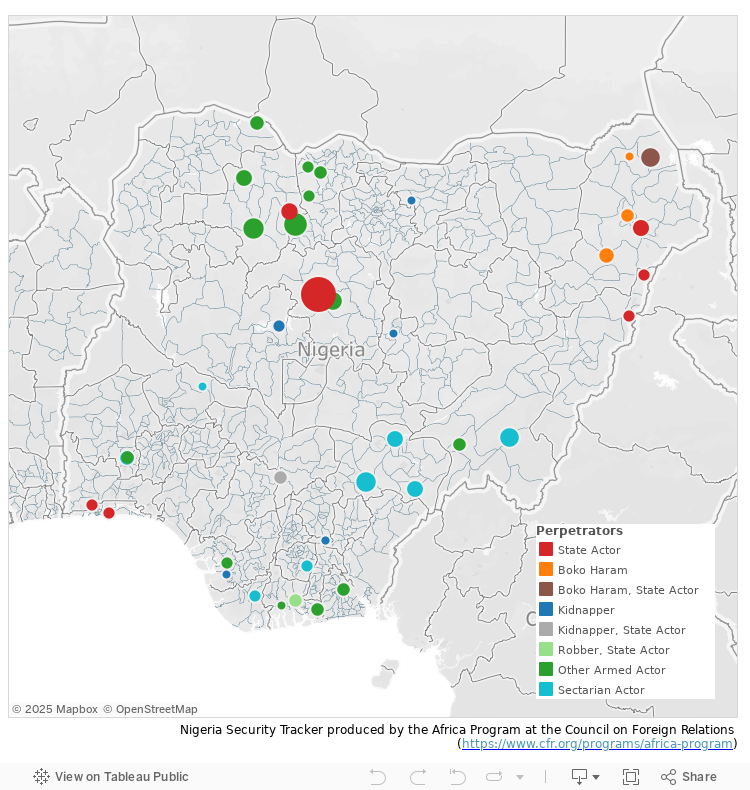
Also, a weekly report by the Nigeria Security Tracker, published on the Council on Foreign Relations (CFR) website also revealed fighting between Boko Haram insurgents and the Nigerian military in two of the three north-eastern states, as they battle for control of the areas.


On May 26, Nigerian troops killed seventy-five Boko Haram militants in Bama, Borno, it said.

It listed incidence of violence related to the Boko Haram insurgency from May 30 to June 5 as follows:

May 30: Boko Haram killed two in Askira/Uba, Borno.

May 31: A Boko Haram suicide bomber killed herself but no others in Konduga, Borno.

June 1: Boko Haram killed four in Konduga LGA and four in Damboa LGA, Borno.

June 1: Nigerian troops killed one Boko Haram militant in Madagali, Adamawa.

June 2: Boko Haram kidnapped one soldier and three aid workers in Guzamala, Borno.

June 2: Nine Boko Haram militants and one soldier were killed during a clash in Kukawa, Borno.

June 3: Nigerian troops killed six Boko Haram militants in Konduga, Borno.

Professor Zulum, in two separate reports published by Daily Trust this week also confirmed that many displaced persons were still homeless, as the state government races against time to house them and provide them with sustainable means of livelihood.

The IDPs, now staying in Bama town, according to the report, were mostly from villages sacked by insurgents in Banki, Gulumba, Jaudari and Nguro Soye, in Bama local government area and in Ajiri, a community in Mafa local government area of Borno state.

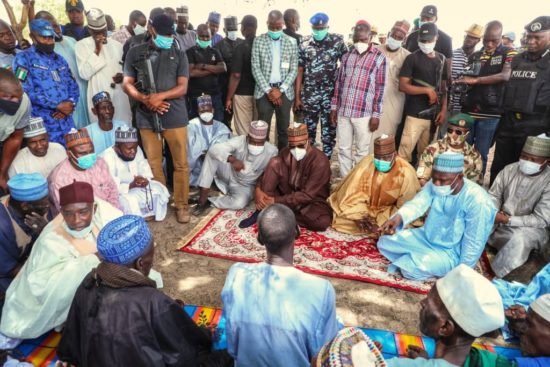
Prof. Zulum seated with some villagers on Wednesday when he visited the scene of Tuesday’s Boko Haram attack in Gubio LGA of Borno state. PHOTO CREDITS: Daily Trust/ Olatunji Omirin

The rising spate of Boko Haram attacks in north-eastern Nigeria also worried the nation’s lawmakers, as the Senate President, Ahmad Lawan, and the Speaker, House of Representatives, Femi Gbajabiamila, reportedly plan to meet with President Buhari over the issue.

Addressing parliamentarians on Thursday in Abuja, Lawan, who spoke while giving his remark to a motion on the resurgence of Boko Haram attacks in some parts of Borno state by Senator Abubakar Kyari (APC, Borno), said: “Boko Haram has now become an industry. It is an industry because what they do is no more religious. They have people from different faiths, different countries among them.”

Earlier in his lead debate, Senator Abubakar Kyari, noted that the attacks had become worrisome in view of the fact that the Nigerian Army had recorded successes recently in their fight against the insurgents, adding that the attacks had resulted in the killings of people and other dastardly acts like kidnapping, cattle rustling and displacement of communities.

While charging the security agencies to deploy more personnel and equipment to critical areas of the Lake Chad shores to flush out the insurgents, the lawmakers urged the federal government to provide enough equipment to the troops prosecuting the ‘Boko Haram war.’

Further report by John Campbell, a Conflict and Security expert and Ralph Bunche Senior Fellow for Africa Policy Studies also confirmed the presence of Boko Haram insurgents in the north-eastern states.

“They operate freely in Borno and Yobe States, and in adjacent parts of Cameroon, Chad, and Niger. They share the goal of destroying the Nigerian secular state and establishing a new polity based on their idiosyncratic seventh-century interpretation of Islamic theology and law,” Campbell wrote in the report.

The ICIR reports that the Boko Haram insurgency had claimed more than 37,500 lives since May 2011, displaced an estimated 2.7 million people in the Lake Chad Basin and turned 292,510 Nigerians into refugees in Chad, Cameroon and Niger as of May 31, 2020, according to data obtained from the United Nations High Commissioner for Refugees (UNHCR).


THE VERDICT

All evidence available in public domain invalidates the claim by President Buhari as several media reports indicate that some areas in these three north-eastern states are still suffering from recurring Boko Haram attacks while many residents of these areas have fled to and/or still living in Internally Displaced Persons (IDPs) camps hosted by their respective state governments. The claim is absolutely FALSE.

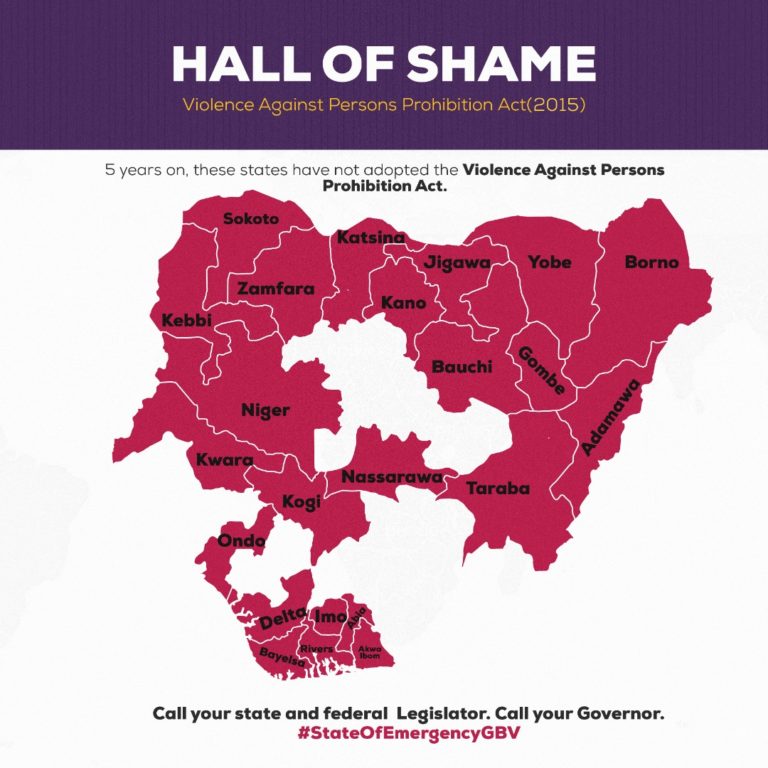
Hall of Shame: 23 states yet to pass anti- rape law, majority are from the North

TWENTY-three out of the 36 states of the federation are yet to domesticate the Violence Against Persons Prohibition (VAPP) Act, five years after the Act was signed into law.

THE VAPP Act is a law that guarantees protection of the rights of victims of all forms of sexual and gender-based violence in the country.

Fifteen out of these 23 states, representing 65 percent, are Northern states, six, representing 26 percent are in the Eastern region, while one is a South-western state, according to data collected by TechHer

TechHer is a civil society organisation that provides a platform for technology knowledge exchange amongst women.

The states are; Sokoto,Katsina, Jigawa, Yobe, Borno, Zamfara, Kano, Bauchi, Gombe, Adamawa, Kebbi, Niger, Nassarawa and Taraba.

Others are Kwara, Kogi, Ondo, Delta, Imo, Abia, Rivers, Bayelsa and Akwa Ibom.

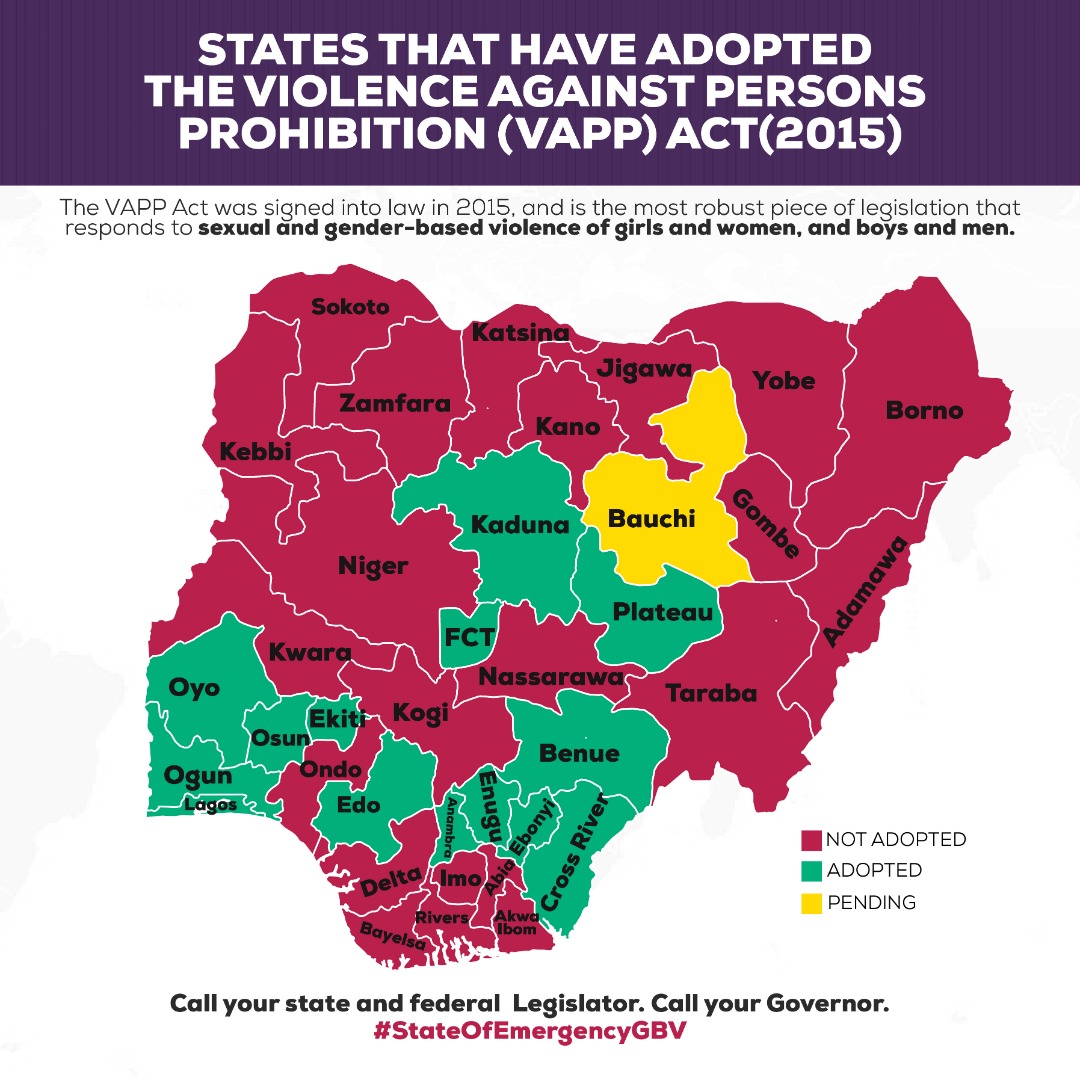
Only 14 states have domesticated the Act since it was enacted five years ago.

They are Kaduna, Plateau, FCT, Benue, Oyo, Osun, Ekiti, Ogun, Lagos, Edo, Anambra, Enugu, Ebonyi, Cross River.

Map showing states that have and have not domesticated VAPP Act in Nigeria.
CREDIT: TechHer

Signed into law by President Muhammadu Buhari in May 2015, the VAPP Act is the single law in place that transcends the criminal and penal code in guaranteeing justice and protecting the rights and properties of victims of sexual and gender-based violence across the country.

The VAPP Act expands the definition of rape, domestic offences, incest and several forms of violence. It also ensures justice and protection of victims in a way that guarantees freedom, compensation and respect to human rights.

Under the VAPP Act, a wide range of Sexual and Gender-Based Violence (SGBV) including; forced financial dependence or economic abuse, harmful widowhood practices, genital mutilation, abandonment of children, harmful substance attacks, and incest are all recognized as punishable offences.

According to the 2018 Nigeria Demographic and Health Survey (NDHS) report, approximately 31 percent of women aged between 15 and 49 had experienced some form of physical violence since age 15, and 14 percent had experienced physical violence in the 12 months preceding the survey.

Lemmy Ughegbe, a children’s advocate and Director of Make a Difference Initiative, said it is for lack of uniformity in the law with regards to the battle to eliminate pedophilia, gender-based violence and sundry discrimination and abuses that the VAPP Act was enacted.

“The major stumbling block to this is the far north where early marriages is a culture,” Ughegbe told The ICIR in a WhatsApp interview.

According to Women At Risk International Foundation, in a year, over 30 percent of women in Nigeria experience one form of domestic violence or another.

In a 2015 UNICEF report, it was found that one in four females in Nigeria experience sexual violence in childhood with approximately 70 percent reporting more than one incident of sexual violence before they clock 18.

Chioma Agwuegbo, founder TechHerNG, during a protest against SGBV, held at the Police Headquarters on June 5,  read out 100 cases of SGBV that have occurred in the country between January – June 2020, lamenting that sexual violence has become a scourge.

According to Agwuegbo, the 100 names of victims represent cases that have come to her organisation, iterating that there are many more which have gone unreported and hundreds of cases in which justice is completely eluded.

A new dawn in Bauchi State

While several Northern states are yet to adopt the VAPP Act, Bauchi State House Assembly is already in the process of enacting the law.

On Tuesday, the VAPP Act passed second reading at the state House of Assembly.

According to Abubakar Suleiman, Speaker of the State Assembly who is also the sponsor of the bill, cases of rape and domestic violence have become the other of the day across the country and indeed in Bauchi State.

“Ugly events currently happening in the country and particularly Bauchi State in which violence against persons mostly in the form of rape and other domestic violence on both women, men and children are becoming the order of the day,” Suleiman said.

“They rape and also kill their victims. How many more girls need to die this way? We cannot continue this way. We cannot continue to look away and ignore these murders. This is insane, ” Suleiman said, while vowing that the State House Assembly would put to end, the anomalies through effective legislation.


PDP condemns Buhari’s democracy day speech, says it’s a slap on democratic process

THE People’s Democratic Party has described President Muhammadu Buhari’s Democracy Day speech as a huge and unpardonable slap on the face of Nigeria’s democratic process. 

The opposition party in a statement signed by  Kola Ologbondiyan, its National publicity secretary  on Friday stressed that Buhari’s silence on the values of democracy as well as the myriads of violations under his watch has further vindicated the party’s stance and that of majority of Nigerians that the Buhari administration has no regard for democracy and is not prepared to uphold its tenets in the country.

The PDP noted that on the day Buhari set aside to celebrate democracy, he had no democratic scorecard to present; thereby directly confirming that he had taken no step to uphold democratic practice in the last five years.

The party urged Nigerians to note  that the president’s speech had no space for  MKO Abiola, which it said shows no regard  for the late politician and the essence of June 12.

” It is scandalous that on a day like this, President Buhari had no assurances on electoral reforms and credible election; which is the hallmark of democracy,” the statement read

The PDP expressed concern that the Buhari led administration did not restate it’s commitments to electoral reform which shows that his administration has no plans to guarantee credible elections in the country.

The party also noted that the President’s address had no words of assurance towards respect for the constitution, particularly the principles of separation of powers, federal character, equality, equity, fairness, transparency and respect for the sensibilities of the federal structure.

It added that Buhari had no words of commitment on how to tackle the constitutional and human rights violations under his watch, including reported intimidation and brutalization of citizens, disobedience to court orders, arbitrary arrests, illegal detentions, extra-judicial killings as well as hounding of opposition and dissenting voices.

The PDP stated that the address by the President and his handlers seeks to divert attention from their failures and violations associated with this administration by taking the nation on a merry-go-round of recycled false performance claims that are not backed by any empirical or verifiable data.

It said it was shocking to Nigerians on Buhari’s claims to a secured nation while bandits were busy killing our compatriots in Katsina, Kaduna, Zamfara, Borno, Kogi and various parts of our nation, even on the eve of his broadcast.

“It is even more distressing that Mr. President opted to use the COVID-19 pandemic to make excuses for the attack by the bandits even as he had no soothing words or decisive assurances for the victims beyond a cold passing comment lacking in expected human empathy.”

The opposition party urged Nigerians not to resign to despondency or allow the failures and violations of the APC administration to erode their faith in ‘our democracy but remain united in their commitment to the stability of our nation.’

APC screening committee disqualifies Obaseki from contesting Edo election

GODWIN Obaseki, the incumbent Governor of Edo State has been disqualified from contesting in the All Progressives Congress (APC) primary election ahead of the governorship election coming up in the state on September 19.

The Screening Committee of the APC cleared Pastor Osagie-Ize Iyamu to participate in the party’s primary election in Edo State scheduled for the 22nd of June while disqualifying the embattled incumbent governor over discrepancies in his academic credentials.

The ICIR gathered that his disqualification was affirmed by the seven-man panel screening committee of APC led by Professor Jonathan Ayuba, in Abuja who said Obaseki is not eligible to stand for the primary slated for June 22.

Obaseki was deemed ineligible by the Screening Committee over multiple inconsistencies in his presented academic certificates, including a Higher School Leaving Certificate the Governor claimed to have obtained from an Institute of Continuing Education in Benin City, Edo State.

The certificate, according to the committee, is unknown to the Nigerian education system and the Governor also admitted during the screening that he never received the certificate.

It could be recalled that some members of the party had earlier written the leadership of APC calling for the disqualification of Obaseki due to the inconsistencies in his academic credentials pasted alongside other contestants on the party’s notice board.

The ICIR learnt that those seeking Obaseki’s disqualification were afraid that the party would be faced with a likely repeat of its experience in Bayelsa State where it won the last November governorship election but its candidate, David Lyon, was stopped on the eve of his inauguration following a judgment of the Supreme Court that voided his election.

However, the embattled Governor, while responding to journalists said he would not appeal the outcome of the screening exercise which disqualified him from participating in the primary election of the party.

Days after terrorists killed 81 persons in Borno, Buhari insists Nigeria winning war against insecurity

Barely 72 hours after 81 persons were killed in Faduma Kolomdi village in Borno State, President Muhammadu Buhari on Friday says the Nigerian military has ‘considerably downgraded’ insurgency and banditry in the country.

Boko Haram terrorists Tuesday afternoon launched an attack at Faduma Kolomdi, Gubio district, Borno State.

The terrorists group, which has killed more than 30,000 people since 2009, has not stopped staging regular attacks and stealing livestock in the country’s Northeast during the COVID-19 pandemic.

Also, 20 persons were also allegedly killed same Tuesday by about 200 armed men in Kadisau village, Katsina state.

But President Buhari, in his Democracy Day National Broadcast restated his commitment to protecting the citizens and national infrastructures.

He said some local governments which were earlier taken over by the insurgents in Borno, Yobe, and Adamawa states had been recovered while his administration remains dedicated to national security.

“Ending insurgency, banditry and other forms of criminality across the nation is being accorded appropriate priorities and the men and women of the Armed Forces of Nigeria have considerably downgraded such threats across all geo-political zones,”  Buhari said.

“All the LGAs that were taken over by the Boko Haram insurgents in Borno, Yobe and Adamawa have long been recovered and are now occupied by indigenes of these areas who were hitherto forced to seek a living in areas far from their ancestral homes.”

Though President expressed disappointment over the Katsina and Borno incidents, he attributed the killings to criminals who had taken advantage of the Coronavirus dsease (COVID-19) restrictions to perpetrate crimes in the concerned states.

He admitted that some of the attacks have affected rural economies of the state and could mar the nation’s effort to food security.

Buhari, however, expressed hope that security agencies would arrest the perpetrators and bring them to justice.

He appealed to states and local governments authorities to complement efforts of security operatives by providing intelligent information to end insecurity in the affected locations.

“I send my heartfelt condolences to all the relatives and communities affected,” he stated.

He emphasised that part of efforts to strengthen the nation’s internal security architecture, led to the creation of the Ministry of Police Affairs.

The president listed the expansion of the National Command and Control Centre to 19 states, reviving of the National Public Security Communication System as well as the implementation of the community policing strategy as measures taken to restore security.

According to him, the government also established the Nigerian Police Trust Fund as a public-private sector initiative for alternative sources of funding security activities.

In order to reduce security challenges at the external borders, especially smuggling of oil products out of the country, inflow of small arms and drugs into the country, the President said operation “Ex-Swift Response” was introduced.

These, he noted led to the border closure from August 20th 2019, and have reportedly met its objectives and improved nation’s revenue.

Reports say Boko Haram insurgents have killed over 30,000 people since 2009 and displaced more than 3.3 million people.

Democracy day: Gbajabiamila urges Nigerians to remain united

FEMI Gbajabiamila, Speaker of the House of Representatives has urged Nigerians to remain united in the face of daunting challenges in the country while also congratulating everyone for marking this year’s Democracy Day.

Gbajabiamila also called for fervent prayers for the country to overcome the myriad of security challenges in parts of Nigeria.

In a statement by Lanre Lasisi, his Special Adviser on Media and Publicity, the Speaker said he believes Nigeria has learnt a lot in the last 21 years of uninterrupted democracy.

He said since 1999, Nigeria has come a long way in democratic practice, noting that the country’s system is growing by the day.

Gbajabiamila expressed satisfaction that June 12 has now become Nigeria’s Democracy Day, courtesy of the All Progressives Congress (APC) led government.

Democracy Day: We have recovered all local governments taken by Boko Haram, restored peace in Niger Delta – Buhari

NIGERIA President,  Muhammadu Buhari says all local governments taken by Boko Haram insurgents in Borno, Adamawa and Yobe states have been recovered by the Nigerian troops under his administration.

The President also disclosed that his government has succeeded in restoring peace in the Niger Delta region of the country through engagements with the youth and stakeholders.. 

Buhari who is marking his fight year in office said this in a  nationwide broadcast to commemorate June 12, Nigeria’s Democracy Day.

He won a second term of four years in the 2019 general elections.

The president recalled that he promised Nigerians in his 2019 Democracy Day address, to frontally address the nation’s daunting challenges, especially insecurity, economy and corruption.

“I therefore find it necessary to give an account of my stewardship on this day,” he said.

While highlighting his achievements so far, he said ending insurgency and banditry remains a priority to his administration.

He said all displaced persons in the three states have been restored back to their ancestral homes.

The President said he had ordered a forensic audit of the Niger Delta Development Commission (NDDC) to ensure that what is for the people of the region gets to them.

“Furthermore, I am determined to ensure that development meant for the people of the Niger Delta get to them so I have authorised a forensic audit of the Niger Delta Development Commission,” Buhari noted.

On power, the president said by 2023, a total of 11,000 megawatts would be transmitted to Nigerians.

“Our agreement with Siemens will transmit and distribute a total of 11,000 Megawatts by 2023, to serve our electricity needs,” he said.

He added that five power projects are currently being executed through the Transmission Rehabilitation and Expansion Programme.

Buhari stated that Nigerian airports are being upgraded to international standards while investments are also being made into the agricultural sector.

He further stated that the nation’s foreign reserve grew from $33.42 billion on April 29, 2020 to about $36.00 billion in May, 2020.

He said the growth is enough for Nigeria to finance seven months of import commitments.

On Social Investment Programmes , Buhari noted that 2,238,334 Nigerians have benefited from the Growth Enhancement and Empowerment Programme.

He added that there are 549,500 N-Power beneficiaries and 408,682 beneficiaries of the Conditional Cash Transfer Programme.

Speaking on the economy, the president noted that the nation witnessed eleven quarters of consecutive GDP growth since exiting recession.

He stated that the GDP grew from 1.91 percent in 2018 to 2.27 percent in 2019 but declined to 1.87 percent in the first quarter of 2020 as a result of the decline in global economic activities due to the COVID-19 pandemic.

Though the COVID-19 pandemic has caused a lot of job loss among Nigerians, the president said the impacts have been moderate on the country’s economy.

“Every single economy in the world has suffered a decline. Ours has been relatively moderate,” he said.

Speaking on his government’s efforts  on growing non-oil exports, Buhari disclosed that such efforts have started to yield some results.

“For instance, in the past year, our revenue from Cocoa and Sesame Seed increased by $79.4 million and $153 million.”

He maintained that Africa presents a huge opportunity for the country’s export base diversification, saying “we are developing our strategy to grow intra-Africa trade through the Africa Continental Free Trade Area Agreement.”

The Presidential Fertilizer Initiative programme, according to him continues to deliver significant quantities of affordable and high-quality fertilizers to Nigerian farmers.

He further stated that the has also revived 31 blending plants and created a significant number of direct and indirect jobs across the value chain.

“Government is also revamping the cotton, textile and garment sector via a CBN Textile Revival Intervention Fund that would considerably reduce foreign exchange spent on cotton and other textile imports.”

Nigeria, the president said has risen by 25 places on the World Bank’s Ease of Doing Business ranking from 146th to 131st and is now rated as one of the top ten reforming countries.

This, he said was  due to the Visa on Arrival policy, consistent promotion of initiatives that expand facilities available to Micro Small and Medium Scale Enterprises, robust electronic registration and payment system, seamless processing of business registration and reduction of cost of registering business by 50 percent.

“We are confident that on-going efforts would result in further improvement of this rating.”

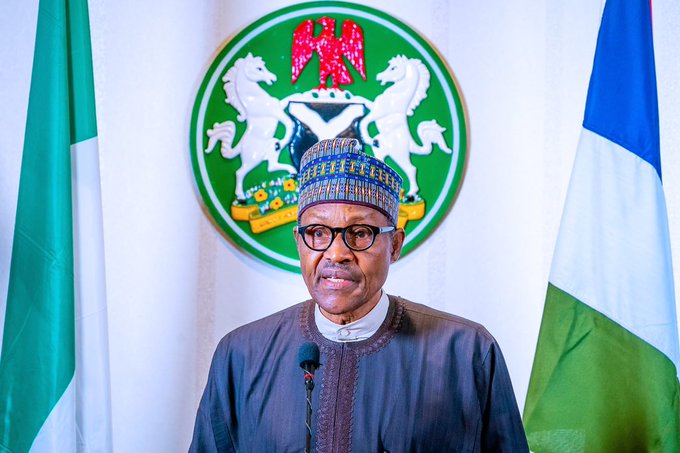
National Broadcast by President Muhammadu Buhari on Democracy Day, June 12th, 2020

Fellow Nigerians,

The 2020 celebration of Democracy Day marks 21 years of uninterrupted civil administration in our dear country. This day provides us an opportunity to reflect on our journey as a nation, our achievements and struggles.

It is a day to honour our founding fathers who toiled to establish our republic and every Nigerian who has worked tirelessly to sustain it.

We are celebrating this year’s Democracy Day despite the COVID-19 pandemic which afflicts our nation and the whole world.

It is indeed a very difficult time for everyone especially those who have lost loved ones to the virus and those whose sources of livelihood have been severely constrained by the stringent measures we introduced at every level of government to contain the virus and save lives.

The dedication of our health and other essential services staff towards containing this virus is a testament of our courage and resilience as a people and as a great nation, and I use this opportunity to say thank you to all of you for your service to the nation.

Sustaining our democracy thus far has been a collective struggle, and I congratulate all Nigerians and particularly leaders of our democratic institutions on their resilience and determination to ensure that Nigeria remains a shining example of democracy.

In my 2019 Democracy Day address, I promised to frontally address the nation’s daunting challenges, especially insecurity, economy and corruption. I therefore find it necessary to give an account of my stewardship on this day.

We have recorded notable achievements in the course of implementing our nine priority objectives and are establishing a solid foundation for future success.

On the economic front, our objectives have remained to stabilize the macroeconomy, achieve agricultural and food security, ensure energy sufficiency in power and petroleum products, develop infrastructure, fight corruption and improve governance.

We have witnessed eleven quarters of consecutive GDP growth since exiting recession. The GDP grew from 1.91% in 2018 to 2.27% in 2019 but declined to 1.87% in the first quarter of 2020 as a result of the decline in global economic activities due to the COVID-19 pandemic.

Every single economy in the world has suffered a decline. Ours has been relatively moderate.

In order to stabilize the economy, the Monetary Authority took steps to build the external reserves which resulted in improved liquidity in the foreign exchange market. The external reserves grew from $33.42 billion on April 29th 2020 to about $36.00 billion in May, 2020 which is enough to finance seven months of import commitments.

Agriculture remains the key to our economic diversification strategy. The Presidential Fertilizer Initiative programme continues to deliver significant quantities of affordable and high-quality fertilizers to our farmers. This initiative has also revived 31 blending plants and created a significant number of direct and indirect jobs across the value chain.

Government is also revamping the cotton, textile and garment sector via a CBN Textile Revival Intervention Fund that would considerably reduce foreign exchange spent on cotton and other textile imports.

Through the food security initiative, we are promoting “Grow What We Eat” and “Eat What We Grow”. I am also delighted that more and more Nigerians are taking advantage of the opportunities in the agriculture and agri-business sector. I assure you that government will continue to support the Agriculture sector through the CBN Anchor Borrowers Programme and similar schemes.

To protect our farming investments, we have deployed 5,000 Agro-Rangers and employed 30,289 in our para-military agencies.

We are also integrating rural communities to the formal economy by extending access to credit and inputs to rural farmers and building feeder roads.

Our efforts on growing non-oil exports have started to yield some results. For instance, in the past year, our revenue from Cocoa and Sesame Seed increased by $79.4 million and $153 million.

Africa presents a huge opportunity for our export base diversification and we are developing our strategy to grow intra-Africa trade through the Africa Continental Free Trade Area Agreement.

Nigeria has risen by 25 places on the World Bank’s Ease of Doing Business ranking from 146th to 131st and is now rated as one of the top ten reforming countries.

This development is due to the Visa on Arrival policy, consistent promotion of initiatives that expand facilities available to Micro Small and Medium Scale Enterprises, robust electronic registration and payment system, seamless processing of business registration and reduction of cost of registering business by 50%. We are confident that on-going efforts would result in further improvement of this rating.

We remain committed to expanding our mining sector. To this end, I have directed the resuscitation of the Ajaokuta Steel Plant based on Government-to-Government financing and a Public-Private Sector financing.

With foreign and domestic investments and the participation of Small Scale Miners, we are harnessing the supply value chain in gold production.

We would also be launching a fully digitized mineral rights management platform for quick processing of mineral rights application, digitization of records and plugging revenue leakages.

The Power Sector remains very critical to meeting our industrial development aspirations and we are tackling the challenges that still exist in the delivery of power through different strategies.

We are executing some critical projects through the Transmission Rehabilitation and Expansion Programme including the:

a. Alaoji to Onitsha, Delta Power Station to Benin and Kaduna to Kano;

b. 330kv DC 62km line between Birnin Kebbi and Kamba;

c. Lagos/Ogun Transmission Infrastructure Project;

d. Abuja Transmission Ring Scheme; and

e. Northern Corridor Transmission Project.

Our agreement with Siemens will transmit and distribute a total of 11,000 Megawatts by 2023, to serve our electricity needs.

On transportation, another critical sector to improving our economic competitiveness, we are growing the stock and quality of our road, rail, air and water transport infrastructure.

Through the SUKUK-Funded Road Projects, a total of 412km of the targeted 643km road projects have been completed, representing 64%.

The Presidential Infrastructure Development Fund projects are also progressing very well. On the 2nd Niger Bridge, piling work has been completed and the approach roads are being constructed. 48% of work on this bridge has been achieved. We have constructed 102km of the 376km Abuja – Kaduna – Kano Road, representing 38%, and the 42.9km Obajana – Kabba Road is 87.03% complete.

Furthermore, the Federal Roads Maintenance Agency has completed routine maintenance on over 4,000km of federal roads out of the 5,000km targeted.

We are extending and upgrading our railway network too. We are introducing more locomotives, coaches and wagons for the Abuja-Kaduna Rail Line. The Central Ajaokuta – Itakpe – Warri Line has been completed and is being extended from Itakpe to Abuja on one end and from Warri Town to Warri Port on the other.

The Lagos-Ibadan Rail Line is 90% completed and would be extended to the Lagos Port which would help address the long-standing grid-lock at the Apapa port.

The Kano – Maradi Single Track Standard Gauge Railway, Coastal Railway Project and Port Harcourt – Maiduguri Standard Gauge Railway, with its associated branch lines running through the South Eastern and Gombe States, industrial park and Bonny Deep Sea Port are all ready for concessioning.

Government continues to make investments in the Aviation sector to position it as a travel and trade hub in West Africa and the wider African continent.

Airport Terminals in Abuja, Lagos, Kano and Port Harcourt are being expanded, while the rehabilitation of the Enugu Airport is almost completed. All our airports are being raised to international standards with the provision of necessary equipment, especially navigational aids, to guarantee world class safety standards.

For the first time in over ten years, Nigeria is conducting bidding process for 57 Marginal Oil Fields to increase revenue and increase the participation of Nigerian companies in oil and exploration and production business.

We continue to grow local content in other areas of the oil and gas sector with the disbursement of funds from the $200 million Nigerian Content Intervention Fund to indigenous manufacturers and service providers.

With sustained engagement of youths, opinion leaders and other stakeholders, we have restored peace in the Niger Delta Region and maintained our oil production levels.

The Head office of the Niger Delta Development Commission will be commissioned shortly. The Funding of sections I–IV of the East-West Road shall be pursued with a view to completing the project by the end of 2021.

Furthermore, I am determined to ensure that development meant for the people of the Niger Delta get to them so I have authorised a Forensic Audit of the Niger Delta Development Commission.

Digital Economy continues to play an important role in our development agenda as we move into the age of Artificial Intelligence.

Since the creation of the Ministry of Communication and Digital Economy, the National Digital Economy Policy and Strategy has been launched. Steps have been taken to achieve a reduction of connectivity cluster gaps from 207 to 114 as well as increase the level of 4G coverage by 30%.

Nigeria remains committed to expanding access to quality education to enhance the productivity of its citizens and would continue to pursue the enforcement of free and compulsory basic education for the first 9 years of schooling.

In pursuit of this, we have launched the Better Education Service Delivery for All in 17 states, established additional 6 Federal Science and Technical Colleges and currently executing a pro-active Teacher Training Plan with all states of the Federation.

In our revision of the operations of specialized education funds and to implement reforms that would optimize their benefits to the sector, we have adopted a Public-Private Sector Partnership for provision of infrastructure and also collaborate with the private sector to create jobs.

Our pursuit of affordable housing for the low and middle-income earners has received a boost with the delivery of 1,200 housing units, provision of 520 service plots with infrastructure through a Public Private Sector partnership and the issuance of 868 mortgages totaling N7.7 Billion. Similarly, Home Renovation Loans totaling N16.2 Billion have been granted to 19,210 people.

To enable sustainable access to safe and sufficient water to meet the social, cultural, environmental and economic development needs of all Nigerians, we continue to expand our water supply, irrigation and dam facilities.

The Completion of Amauzari, Amla Otukpo and other 42 Earth Dams with combined job creation of about 43,354 direct jobs and 71,172 indirect jobs, would provide more support for irrigation agriculture and water supply.

To further institutionalize our effort in this regard, I signed the Executive Order 009 on Ending Open Defecation in Nigeria.

In order to improve our forest cover and in fulfilment of my commitment at the 74th Session of the United Nations General Assembly in 2019, we have commenced the planting of 25 million trees. This initiative will also contribute to our effort to mitigate the effect of climate change.

In the area of security, we remain unshaken in our resolve to protect our national infrastructure including on-shore and off-shore oil installations, secure our territorial waters and end piracy in the Gulf of Guinea.

Ending insurgency, banditry and other forms of criminality across the nation is being accorded appropriate priorities and the men and women of the Armed Forces of Nigeria have considerably downgraded such threats across all geo-political zones.

All the Local Governments that were taken over by the Boko Haram insurgents in Borno, Yobe and Adamawa have long been recovered and are now occupied by indigenes of these areas who were hitherto forced to seek a living in areas far from their ancestral homes.

The total collapse of the economies of these areas, which constituted a threat to our food security, has also been reversed with the gradual recovery of farming and other economic activities.

I regret recent sporadic incidents with tragic loss of lives in Katsina and Borno States as a result of criminals taking advantage of COVID-19 restrictions. Security Agencies will pursue the perpetrators and bring them to swift justice.

I must implore state and local governments to revamp their intelligence assets so that the Security Agencies can nip in the bud any planned attacks in remote rural areas. I send my heartfelt condolences to all the relatives and communities affected.

As part of the strengthening of our internal security architecture, the Ministry of Police Affairs was created.

Amongst others, Government has expanded the National Command and Control Centre to nineteen states of the federation, resuscitated the National Public Security Communication System and commenced the implementation of the Community Policing Strategy.

Government has similarly established a Nigerian Police Trust Fund as a public-private sector vehicle for alternative sources of funding security activities.

To reduce security challenges through our external borders especially smuggling of oil products out of the country, inflow of small arms and drugs into the country and equally protect our local manufacturers, we introduced operation “Ex-Swift Response” closing our borders from August 20th 2019, and have considerably succeeded in meeting its objectives as well as improving our national revenue.

Our Government has continued to work to reduce social and economic inequality through targeted social investment programmes, education, technology and improved information.

Our Social Investment Programme has continued to be a model to other nations and has engaged 549,500 N-Power beneficiaries, 408,682 beneficiaries of the Conditional Cash Transfer Programme and 2,238,334 beneficiaries of the Growth Enhancement and Empowerment Programme. This is being done in collaboration with the States.

Similarly, “Marketmoni” and “Tradermoni” Programmes have provided affordable loans to small and micro scale enterprises to grow their businesses. Under the National Home-Grown School Feeding Programme, over 9,963,729 children are being fed to keep them in school and improve their nutritional status.

Fellow Nigerians, the year 2020 has been like none other. In January 2020, the COVID-19 was declared a global pandemic by the World Health Organization. The number of global infections has risen from less than 8,000 shared between China and eighteen other countries to over 7million spread over 216 countries and on all continents.

Nigeria recorded its first case of COVID-19 on February 27th 2020 and within the first 100 days, I have had cause to address the nation on three occasions within one month, which underscores the gravity of this pandemic.

There is no doubt that this pandemic has affected the global economy and all known socio-economic systems. It has also brought grief and pain to families that have lost their loved ones. Like many Nigerians, I feel the grief and pain not only as your President but also as someone who has lost a close member of my staff and some relatives and friends.

In order to have a robust National response, I approved a Presidential Task Force on COVID-19 to provide guidance and leadership in tackling the pandemic nationwide.

State Governments also constituted their own COVID-19 Task Forces. Complementing this was the establishment of a National Emergency Operations Centre responsible for providing technical and professional guidance in the National Response.

The overall objective of the PTF COVID-19 is to ensure that the pandemic does not overwhelm our health systems, while ensuring that we maintain an effective Case Management System to help in containing the spread of the virus.

The impact of the pandemic has disrupted our economic system and to ensure its functioning while still addressing the spread, the Federal Government put in place a number of various non-pharmaceutical measures to slow down the spread of the virus, in addition to a progressive re-opening of the economy.

As part of the strategy to create jobs in reducing the effect of COVID-19 on our youths, I directed the employment of 774, 000 Nigerians. These youths will be engaged in Special Public Works Programme aimed at cushioning the effects of economic downturn. Each of the 774 local government areas in the country will be allotted 1,000 slots. I am pleased to report that this programme has commenced.

I receive regular briefing from the PTF on COVID-19. I note that the National Response relies on Science, Data and Experience in taking decisions. This informed my approval for the ease of lock down phase to ensure a balance between lives and livelihoods.

I am confident that the steps being taken by the PTF would result in flattening the COVID-19 curve. I, therefore, implore all Nigerians to abide by the approved guidelines and protocols. There is hope for us all if we take individual and collective responsibility.

Government is determined to turn this COVID-19 challenge into a motivation to action by building a nation-wide public health care system that will help us overcome the COVID-19 pandemic and prepare for any future outbreak.

Already, we have begun to look inward and I charge our inventors, researchers and scientists to come up with solutions to cure COVID-19.

Government has continued to implement accountability and transparent policies through the Open Government Partnership and the transparency portal on financial transactions. Similarly, we have strengthened auditing and accountability mechanisms so as to ensure that rules and regulations are followed strictly.

Anti-Corruption Agencies have secured more than 1,400 convictions and also recovered funds in excess of N800 billion. These monies are being ploughed into development and infrastructure projects.

The Public Service of Nigeria remains the bedrock for the formulation and implementation of policies, programmes and projects in the country. This accounts for why it continues to evolve especially as new socio-economic challenges emerge for Government to address.

I will continue to give all the necessary support for the on-going reforms designed to return discipline, integrity and patriotism as the hallmark of the public service.

In the face of dwindling resources and rising cost of governance, I have authorized that the White Paper on the Rationalisation of Government Parastatals and Agencies be reviewed for implementation.

Our youth population remains a source of strength in achieving development objectives. In this regard, we would continue to concentrate in developing their skills, providing them with opportunities to express their entrepreneurial, research and industrial capacities as well as ample opportunity to take leadership positions in the service of the nation.

The commitment of this Administration to the well-being of people living with disabilities remains unwavering. Government recognises their contributions to development. I have directed that all relevant Government agencies pay special attention to the peculiarities of persons with disabilities in the formulation and implementation of their policies and programmes, and where suitable their employment.

Nigerian women remain a particular treasure to this nation and for this reason this Administration has continued to give them a place of pride in the affairs of our country.

I salute your courage, enterprise and resilience as well as your contributions to national development. I wish to assure all our women of this administration’s determination to fight Gender Based Violence through the instrumentality of the law and awareness creation. I am particularly upset at recent incidents of rape especially of very young girls. The Police are pursuing these cases with a view to bringing perpetrators of these heinous crimes to swift justice.

Government continues to recognize and harness the power of the media for positive development. The reforms of the broadcast and advertising industries including digital switch over and continuous engagement through town hall meetings remain central to accurate and credible information dissemination.

Our culture provides the basis for our existence as a people and a nation. In preserving iconic aspects of our national culture, this government has been pursuing the recovery of artefacts removed from Nigeria, promoting heritage sites and festivals and working towards designating some of our heritage sites as UNESCO World Heritage Centres.

This administration is focused on ensuring that Nigeria would always be governed by the Rule of Law and I would do my utmost to uphold the constitution and protect the lives and property of all Nigerians.

Government has initiated a number of policies and programmes designed to promote the legal rights of Nigerians, facilitate the institutionalization of a responsive legal system, provide support to all constituted bodies in implementing their mandates and improve our custodial system of justice.

The National Assembly has been an important partner in our quest to sustain our democracy and achieve our development objectives.

I therefore greatly thank the leadership and members of the Senate and the House of Representatives for their invaluable support at all times.

I will also like to convey our deep appreciation to members of the Press for your doggedness in the struggle for attainment of democracy since the beginning of our nationhood.

I must admit that the relationship between the media and successive governments has not always been perfect. But there is no denying the fact that you have been an effective watchdog for the society especially in holding public officers to account. It is sad that in the course of securing our democracy, some of your colleagues have had to pay a heavy price.

We will continue to guarantee freedom of the Press as we place high premium on responsible journalism that is devoid of hate speech, fake news and other unethical professional conduct.

Fellow Nigerians, as we celebrate this year’s Democracy Day, let us remember that, notwithstanding our aspirations, humanity and indeed democracy is under the threat of COVID-19. Nigeria has survived many crises before and came out stronger. I am confident that by God’s grace we shall overcome this one and emerge stronger and more purposeful.

Thank you for listening. God bless the Federal Republic of Nigeria.


Nigerians mourn victims of mass atrocities

Not fewer than  356 Nigerians were reported killed in 27 states of the country in the month of May 2020 alone, a new report has shown.

NigeriaMourns, a Non-governmental Organisation that released “Violence Incidents Report: May 2020” on Wednesday documented daily deaths and violence happening across the country amidst the COVID-19 pandemic.

According to the report, Sokoto, Kaduna and Adamawa were the states with the highest number of killings, totalling 181 deaths.

The report also indicated that 212 deaths were attributed to banditry attacks, while communal conflicts accounted for 80 deaths, 27 were attributed to Boko Haram/ISWAP, 10 to cult clash, herdsmen attack took 10, eight were due to extrajudicial killings while five were killings related to isolated attacks and four to mob action.

NigeriaMourns described the continuous crisis in Southern Kaduna which led to a large scale death of people and destructions as a source of concern.

In the report, four civilians’ deaths were also attributed to Nigerian soldiers while enforcing the lockdown orders in Karim Lamido, Taraba State.

“At Owode, Yewa South Local Government of Ogun state, 15-year-old Riliwan Bello died from an “accidental bullet discharge” fired by men of the Nigerian Customs Service (NCS), Ogun 1 Area Command. The incident occurred barely a month after unnamed agents of the NCS reportedly killed another 15-year-old girl, Sekinat Agbelade at Agosasa, Ipokia Local Government Area of Ogun State,” the report said.

“Rinji Peter Bala, a 20-year-old student of the University of Jos, was first arrested by vigilantes alongside six others for violating the lockdown order. Shortly after they were released, officers of the Nigerian Army “accidentally” shot and killed Rinji.

“An unidentified inmate was reported dead from a shot fired by a prison guard, at the Nigeria Correction Service, Aba. The incident occurred when some old inmates had tried, but failed to escape from the prison.

“16-year-old Tina Ezekwe was shot and killed by a policeman at a bus stop near her home in Lagos State. Provoked by this tragic incident and the endless extrajudicial killings in Nigeria, Nigerians led a protest with the hashtag #JusticeforTina,” the report stated.

And 10 security agents were killed during violent attacks in the same month.

According to the report, Killing of security officers in Nigeria has continued at an alarming rate.

“A police officer attached to Bomadi Divisional Police Station was shot dead by an army officer attached to 222 battalions in Agbarha-Otor, Ughelli North L.G.A Delta State.

“Five Nigerian soldiers were also killed in an attack on a military outpost by ISWAP terrorists in Mainok, Borno State, in addition to the two earlier reported killed by Boko Haram at Gujba local government area of Yobe.”

They were #NotJustNumbers, They had names, They had dreams, There were us.

Below are names of the victims.

Alhaji Musa Na’ibi, Alhaji Isihu Al-Jimma,Mamman Kada,Murtala Dan-Kasuwa,Bello    Abubakar,Sani,Bello,Isah  Mohammed,Tukur Mohammed,Mohammed Dangona.Buda Alhaji Joli,Alhaji Karami Magami,Aliyu Mohammed,Garba Babangida,Sani Saje,Sadau Ilah,Umaru Na-Sadau,Halilu Dan-Idi ,Garba Giye ,Ibrahim Maigandi,Salisu Gado Faru,Sule Bazamfare,Rabiu Shinge

,Tikana Mohammed,Zagi Fallau,Dan-Ataka Awala ,Ibrahim Mohammed,Sa’adu Mohammed ,Danjuma Magami,Rufa’I Mohammed,Bilyaminu Sani Magami,Basiru Magami,Salisu Gurmu,Rabi’u Danbanga, Dungu Rukudawa, Dangaladima Labandi,Nuhu Labandi, Sani Kozo, Alhaji Bello Gurbin-Bore, Alhaji Kabiru Mayasa , Alhaji Kasimu Birane, Mati Baushi, Kasimu Yahaya, Ilah Adamu, Abdullahi Koli, Lawali Gobirawa, Ahmad Dauda, Isah Umar, Musa Mamman, Ahmaed Sanu A, Faruk Musa, Dauda Isa, Bello Mamman, Kabiru Tukur, Ibrahim

Madawakin Kucheri, Hadi Isah, Mamman Ahmed, Sunday Adoh, Asebeh Zamfara, Musa Rigye, Audu KohTina Yaro, Zamfara

Tatu, Chohu Joshua, Danladi John, Sunday Etsi, Gado Bari, Ngwebah Gideon, Goh Kwa, Idu Tibeh, Ize The, Musa John, Kende Ginge Rangu, John Kwa, Kura Goh,Ladi Wuh, Mummy Tibeh, Nah Musa, Richard Yakubu, Musa Ayuba, Rugu Kpe, Tingwe Magaji,Cinge Uvu, Yakubu Wande Kperien, Musa Yaro, Wuh Bre,Nkiedonwro, Nshe Dodo, Zongo Chochu,Ku Zongo, Demi John Ishaya, Abbah Basi Ncha,Sunday Washi Adi, Rinji Peter Bala, Henry Dokotri, Benjamin Izang , David Yakubu, Luka Magwa, Dr. Nandi Drentkat, Ishaya Yakubu, Sunday Biri, Abba Ibrahim, Izhe Nkama, Stephen Ngwe, Talatu Daniel, Dantala Benedict Danjuma Utengye Zando,Abiyeyi Dodongiya Kenda,Nuhu Agyo, + wife and daughter, Eka Samuel Abe,

Gambo Richard Agabi, James Iffe, Amayi Solomon (Sondi Youths Leader), Emmanuel Tanko,  Attah Danladi, Aliyuda Barnabas, Rautan Yari, Sarki Lawan, Wycliff Bitrus, Nathan Waziri, Kenneth Waziri, Habila Barnabas, Taro Shanffi, Daniel Waya,

Simon Umaru, Jonathan Dawaka, Sibor Tuwa, Princes Thomas, Ezra Andrews, Mathias Audu, Daniel Samuel, Yusa Sam, Okala Joshua, Yusuf Labura Ysa, Alh. Musa Manya Burti, Alh. Sheuto Nanaji, Abdullahi Bahago, Abubakar Usman, Boderi Alh Kae, Habu Alh Jobdi, Barkindo Alh Umaru,

Umaru Alh Hamidu, Babangida Madam, Dobo Alh Kae, Eggi Kae, Mamudu kae,Sa’adu Seini, Sajo Gado, Abdulmumini Yabam, Sunday Garaya, Usman Musa Tep, Hamman Bagi tunga, Sa’udu Seini Buba Mbar, Alh Musa Manya A. Burti, Alhaji Sheuto Nabaji, Abdullahi Badago, Abubakar Usman, Ibollo Seini, Ali Manya, Muhammadu Seuto, Salihu Kae, Hamman Bargaji, Adamu Bala Gashoka, Biju Dasisi, Akase Wanbua, Akor Samuel, Atume

Nor, Akaajime Kumanya, Mwarga Atume,Ande Tomkwagh, Ngustwen  Ayilamu, Gbir Ityough, Ahile Adigor, Terhile Kuca,Terngu Kajo, Asor Gbekua, Ahongba Ityohee, Lanshima Kwaghsar, Rose Terhile, Andi Angbianshio, John Tortyav, Terzungwe Anje, Elizabeth Samu, Terfa Iortim,Gande Asor, Tsombor Shausu,Terkuma Ganden, Torkuma Ashiee, Gwaza Aki, Ashier Ikyange, Hange Anongo, Doonongon Agba, Sebastian Tse, Ityoule Aco,  Tsetim Atseree, Gawan Bebeshi, Tsenongo Afanyo, Mbakasen Shaapera, Swen Vanger, Akaakohol Atee, Buruku Ishangen, Bem Akaaior, Chi Nyam, Iorse Kwembe, Micheal Shawon

Terkura Kumun, Ihemba Iorkaha, Aondowase Kanyi, Mbageren Ityoapine, Kwaghtsea Ibusen,Ngutor Atime, Selumun Wuanshachi, Hemba Kine, Terzungwe Anaibo, Terzungwe Igande,

Manemkaa Gbelagi, Iorwuese Jeje,Akor Hileihongo, Adigbe Mbausuu, Ndagbo Udam, Mgise Ikyo, Shija Apo, Igbadoo Ornguga,Famave  Apekaan

Tseen Semali, Terzungwe Icagh, Tyaykase Gyam, Lydia Tange, Mnena Atani, Iorkegh Kwangi, Aodohemba Acin, Iorember Aver, Iorsase Acin, Atser Wanibya, Iorasuu Bundepuun, Depuun Udele, Malafiya Dalatu, Yari Dalatu

Jonathan Yakubu, Sheba Jonathan, Blessing Yari, Patience Jonathan, Revelation Jonathan, Sarauniya Lucky, Popula Ticha, Shaulu Bawa, Rahila Shaulu, Kauna Magaji, Rejoice Jonathan, Faith Magaji, Francis Daniel, Yaki Luka, Laraba Danmari, Luka Paymaster, Akilu Aruwa, Irimiya Dauke, Kephas Agya, Nehemiah Istifanus, Matthew Danmari, Ado Maisamari, Abel Amos,

Titus Amos, Geoffrey Zaka, Lazarus Joseph, Odeh Stephen, Woburueke Martins Ikenga, Princewill Temple Ikenga, Rowland Abraham, Kazeem, Mgbibari Nyornyaa, Sorlesi Youngman, Dornu Aanu, Bariagra Menebe, Lekia Eleaee, Boy-Mgbibari,  Sira Mgbibari, Oliver Tito, Foundation Onuekwem Bright

Oteh, Junior Kayi, Otochi Ogbonna, Frank Promise, Justice Azubuike, Kingsley Woke, Nwobueze Woke, Rhino, Capt.  Junaid Mohammed Yelwa(Jboy), Nyebuchi Jeremiah, Precious Gladstone, Nen, Eekpege Lezor Legbara,Tiger, Chinedu Osigwe, Bobo, Chioma Okogbule, Jonah Sokolo, Prince Orubum, Clinton Worenwu, Chimenem Amadi, Pepple

Hon. Benson Omunakwe, Emmanuel Jack, Daniel Agori, Jude (Dollar Boy. Marcus Whyte, Destiny Balogun, Okeh, Felix Miikpugi, Bright Dezua, Wisdom Lemea, Pele Ikporah, Bobby Barade, Neenebari Koola, Zorbari Sisi, Nwiimene Ikurika, Lekpoa Nwidae, Nenalebari, Bobo A.K.A Ogbobga Pdp, Bright, Chief Nnaa Akiika, Comrade Kiabari Yaabari, Meshack, Chima Jonah Gift Adeh, Holy Boy, Ratty, Omisowhorum, Kolokolo, Frank, Blank, Famous, Promise Umunaegbu, Robertson Ndigbara, Nen- Eekpege Legbara, Ebi Pade

Abdullahi Idris, Korobe Menele Gberegbara, Augustine Bariledum, Nwibari Fade, Barilugbenu Doole , Prof. Emmanuel Amadi, Aaron, Junior Ovundah

Chimezie Eze, Eze,John Ogbue, George Thomas, Joseph Lazarus, Ade, Abraham Anthony Alex, Aleruchi Woko, Amaechi Ezioka, Nkiruka Imo

Lawrence Igwe, Chief Orji Azu, Prince Tuakabari, Linus Chioma (Montana Million), Maureen Ewuru, Befe Bornu,  Tombari Thomas, Kingdom Nyaa, Nboy Nbani, Kporkpor, Ikechukwu Emmanuel, Jennifer Nwokocha, Monday Iko, Nwisaanee, Edward Okechukwu, Precious Steve, Blessing Mary Effiong, Charity Ohaka, Nnochiri Kingdom Alozie, Otamiri Ugochukwu, Chima Ikwunado, Kolade Johnson, Otobong Jumbowho, Iyabo Olakunle, Kazeem Tiamiyu, Sekinat Agbelade, Alex Ogbu, Hammed Abdullahi, Lucky Ugokam

Yahu Salisu, Chibuisi, Joseph Pessu, Arunsi, Usman Abdulkadir, Ebuka Chukwu Nwoye, Umar Faruk Funtua, Ahmad Yakubu, Maxwell Nashan, Rev. Dennis Bagauri, Rev. Lawan Andimi, Michael Nnadi, Mrs. Idenyi Ebere Ukamaka, Alhaji Babatunde Oreitan, Eric Isaiah, Muhammed Abubakar, Danlami Barde, Moses Barde, Marvelous Akintubuwa, Joseph Ochogwu, Richard Yakubu, Musa John, Kura Goh, Kwa Goh, Mummy Tibeh, Idu Tibeh, Sunday Etsi, Ngwebah Gideon, Sunday Adoh, Asebeh Zamfara, Zamfara Tatu, Audu Koh, Chohu Joshua, Danladi John, Musa Ayuba, Rugu Peh, Musa Rigye, Tina Yaro, Ladi Wuh, Wuh Bre, Izeh Teh, Kenge Cinge, Rangu, John Kwa, Tingwe Magaji, Musa Yaro, Yakubu Wande Kperien, Cinge Uvu, Anas Yakubu, Abdullahi Musa, Musaddiq Abubakar, Usman Kazim Ibrahim, Muhammad Mujahid Abdulkadir, Umar Faruk Abdullahi, Muhammad Magaji Jibir, Usman Bello, Muhammad Mahdi Abubakar, Ali Muhammad Mai gari, Abdullahi Adamu , Ukasha Muhammad, Zaharadden Idris, Alhassan Adamu, Abbakar Ilyas, Ukasha Ibrahim, Naziru Tijjani, Ukasha Idris Ibrahim, Muhammad Abubakar, Ishaqa Adamu, Ahmad Sale, Nura Haruna, Aminu Abubakar Mai Bulawus, Muhammad Auwal Darazo, Zaharadden Musa, Muhammad Jangude Umar, Adamu Shahid Usman, Zainab Shahid Usaman Bello, Yunusa Shahid Usman Bello, Ahmaad Saleh, Muhammaed Sabu Babaji, Sheikh Muhammad Turi, Aminu Yusuf, M. Ayuba Ibrahim, Habibu Adamu Sulaiman, Hafizu Dauda Alhasan, Alasan Adamu, Muhammad Balarabe Siraj, Ali Abdulhamid, Ibrahim Abdulhamid, Zaharadden Usman, Musa Abubakar Abdullahi, Haruna Nuhu, M. Faruq Muhammad Abdullahi, Saifullah Muhammad, Abdullahi Ilyas, Muazu Muhammad, Ibrahim Hama’u, Ammar Katsina,Mustapha Abubakar, Bashir Muhammad, Musa Zana, Bashir Sale, Sani Abdullahi, Musa Ibrahim Zabuni, Hizbullah Isa, Aminu Abdulmutalib, Nuhu Habibu, Nasiru Garba, Umar Abdullahi, Alhasan Sulaiman, Abdurrahman Ismail, Bilya Rabiu, Mukhtar (Abba) Bashir, Hujjatullah Bashir, Zailani Ali, Saman Muhammad, Yusuf Abubakar, Ibrahim Sarki,Yahaya Garba, Abdulmalik  Safyan, Garba Ishaq Usman, Mansur Adam, Mukhtar Ibrahim, Ishaq Ibrahim, Shehu Ibrahim, Abdullahi Ibrahim, Musa Bargi, Iliya Jaafar, Mubarak Yahaya, Muhammad Bello Abdullahi, Tukur Shehu, Usman Safiyanu, Abdulkarim Umar, Hasan Tukur, Abdulkadir Ayuba, Sani Shehu, Musa Hassan, Nasiru Muhammad, Suraj Khalid, Abubakar Usman, Kabiru Shahid Abubakar, Ismail Abdullahi, Awwalu Shuaibu, Basiru Musa, Suraja Shuaibu, Musa Anasir, Yakubu Husaini, Muhammad  Rabiu, Isah Shehu, Ibrahim Usman, Aminu Yusuf Kazaure, Shafiu Alhassan Kazaure, Lawal Umar, Aliyu Lawan Umar, Bakir Adamu,Murtala Ibrahim, Kabiru Ahmad, Nusaiba Shafiu Alhasan, Fatima Aliyu, Aliyu Lawan, Abdulkadir Idris, Muhammmad A. Haruna, Zakariyya Salihu, Dahiru Isah, Aliyu Muhd Sani, Tajuddeen Muhd Isa, Sabiu Muhd Isa, Haruna Isa Tofawa, Abdulkadir Mahmoud, Yusuf Isa Usman, Zakari Yau Tukur, Isa Yunusa, Shuaibu Saidu, Abubakar Shuaibu, Rabiu Mahmoud, Aliyu Muhammad Dahiru, Mutari Shuaibu, Muhd Usman Dpo, Khalid Abdullahi, Awwal Abdullahi, Sawwanu S. Hamza, Shihibu Dauda, Abdullahi Habibu, Ibrahim Aminu, Murtala Ahmad, Kabiru Shuaibu, Shuaibu Imrana, Abdulfatah Yunusa, Nuhu Yunusa, Muhammad Sirajo, Alasan Adamu, Ayuba Abdulkadir, Saminu Yau Tofawa, Mikailu yusif, Aliyu Abdulhamid, Sani Ibrahim, Ayba Bawa Hassan, Bala Magaji, Abdullahi Garba, Nusaiba Abubakar Abdullahi, Mukhtar Sahabi Dan Kwarai, Umar Aliyu, Bello Lawal Magami, Saadu Bello, Salisu Galadima, Muhammad Salisu, Salisu Muazu, Bilal Hamza Mafara, Nasir Saadu Gusau, Ilyasu Muhammad Mafara, Aliyu Muhammad Rabiu, Naziru Usman, Hamza Abubakar Yauri, Abubakar Sadiq Yauri, Mubarak Muhammad Tadruga, Rufai Muhammad Tadruga, Khadija Ibrahim, Musa Mai Kifi, Abubakar Musa, Zuladaini Aminu, Badaru Makera, Zaharadden Usman, Hudu Muhammad, Muhammad Idris, Abdussalam Bello Mani, Muhammad Ibrahim, Isah Yan Shantuma, Abdulkadir,Nuradden Sulaiman, Awwal Mai Pop, Muhammad Aminu, Alhaji Ibrahi M Dutsinma, Nuhu Ibrahim, Ammar Alhasan, Umar Isah, Salahu Auwal Yusuf, Yusuf Sulaiman, Nafiu Mus, Ibrahim Alhasan, Mahadi Auwal, Yahaya Ahamad, Ibrahim Mikail, Mustapha Lawan Nasidi, Abdulkarim Lawan Dambam, Salihu Ahmad, Tijjani Muhammad, Babawuro Baffa (Abubakar Isa), Aiiyu Sulaiman Kwardallo, Idris Musa Kurba, Saidu Ibrahim, Muhammad Maina, Abdullahi, Zakari Abdullahi, Umar Isiyaku, Umar Garba, Muhammad Salihu Saqapa, Muhammad Isa Adamu, Al-Amin Abbas, Bello Ismail, Ammar Abdullahi, Ibrahim Muhammad, Abubakar Hussaini, Buhari M. Bello, Musa Abubakar, Umar Abubakar, Zahardeen Murtala, Ibrahim Adamu, Shehu Aliyu, Adamu Aliyu, Ummar Shehu, A’isha Abubakar, Nusaiba Abubakar, Fatima Abubakar, Batula Abubakar, Hussain Aminu, Aliyu Muhammad, Abdul’Azeez Haruna, Basiru Abdulmuminu, Aminu Muh’d Sani, Musa Salisu (coach), Jafaru Habibu, Ibrahim Yusuf, Muhammad Rabiu, Jamilu Yahaya (comm), Nura Umar, Muh’d Inuwa Jalabi, Aliyu Zainul Abidin, Bashar Shahid Adam, Ibrahim Ahmad Badikko, Rabiu Shuaib, Ibrahim Usman, Muhammad Auwal Mabo, Sunusi Bala Kafinta, Saidq Yusuf, Yusuf Sani Mando, Dayyabu Sa’idu, Idris Khalid Mando, Abujihad Isa (Aflan), Hassan Nuhu, Muhammad Musa Rili, Salihu Hussaini, Badaru Muhammad, Habiba Abdullahi, Aliyu Shu’Aibu, Abbas Ishaq, Abdulkarim Sani(m/gashi), Salisu Muhammad, Isa Yunus (Abbas), Yahaya Garba, Abdulmalik Safiyan, Shafi’u Alarama,Ibrahim Abubakar, Wasila A. Musa, Zakariyya Muhammad, Ramda Muhammad, Abubakar Lawal, Muhammad Sani (Roba), Abubakar Hakaika, Abdullahi Muh’d Jibrin, Hussaina Sa’ad (Markaz), Samaila Suleman, Aliyu Ibrahim, Yakubu Dahiru, Mu’azu Dahiru, Mika’il Muhammad, Ishaq Abdullahi, Maimuna Mas’ud, Sa’idu Salihu, Yusuf Badamasi, Sheikh Muhktar Sahabi, Mika’il Yusuf,Barr. Bashiir Mansur, Kabir Muhammad, Aliyu Ahmad Zango, Sanusi Ibrahim, Salisu Uzairu, Usman Isah, Aliyu Umar, Abubakar Musa B/yero, Yakubu Tukur, Kabir Abdulmumin, Maimuna Shehu, Fauziyya Shehu, Khalid Yahaya Gilima, Mahmud Yahaya Gulima, Abdulrahman Yahaya Gilima, Aliyu S. Karofi, Faisal A. Gilima, Abdulaziz Abdulmuminu, Buhari


Sma’il, Yakubu Sa’idu, Ishaq Abdulkadir, Sa’idu Salisu, Kabir Salisu, Alh. Abdurrazak Haruna , Yusuf Alhaji Yusuf , Salisu Hassan, Dauda Hassan , Isyaku Ja’afar, Bashar Isma’il, Jafar Mahmud , Aliyu Umar, Hamisu Musa,Saleh Umar, Basiru Salisu, Saminu Zubairu, Basher Isah, Saleh Halliru, Hussaini Abubakar, Karibullahi Mustapha, Muhammad Inuwa Salisu ,Muttaka Sabi’u

, Adamu Aliyu, Alkasim Abubakar, Jamilu Abubakar, Haruna Salihu, Sabitu Abdulkarim, Abubakar Saleh, Muh’d Gazali Abubakar, Aliyu Sulaiman, Abdurrashid Awwal, Muh’d Ayatullah Salihu, Mustapha Isma’il, Muhammad Habibu, Muh’d Rajau Hussaini, Abubakar Isa, Abubakar Abdullahi, Salihu Badaru, Abdulkarim Bello, Isiyaku Abdurrasheed, Dahuru Abdulwahab, Rukayya Nuhu , Abdullahi Adamu, Abdullahi Yunusa, Yahaya Sani, Aliyu Abdulmumin, Garba Jibril, Ibrahim Dauda , Usman Alhaji Aliyu, Adamu Alhaji Aliyu, Ahmad Muhammad Sidi, Abdullahi Jibril, Nura Dauda, Adamu Alhassan, Abdullahi Musa, Suleiman Muhammad NEPA, Juwaira Muhammad, Rabi’u Muhammad Sani, Bashir Yakub,Yusuf Adamu, Rabiu Adamu, Bashir Sa’ad, Abubakar Yakubu, Jawad Sani, Hamisu Abubakar, Ali Zainul’Abidin Abu, Ja’afar Rabi’u, Mal. Salisu Usman, Yahaya Muhammad, Rabilu Suleiman, Ibrahim Yahaya, Mujtaba Rabi’u, Auwal Garba Nuhu, Musa Tasiu, Mustapha Sani, Ibrahim Kabiru, Muhammed Mikaila, Muhammed Salisu, Mubarak Dalhat, Mahdi Yunusa, Yusuf Ishaq, Alhassan Sani, Adamu Usman, Tukur Abdullahi, Badamasi Muhammad, Ahmad Tijjani Shitu, Abdulraa’uf Aminu, Alaramma Ahmad Yahuza, Ibrahim Sufi Usman, Hamza Matari, Idris Khalid, Husaini Khalid, Muhammad Abdullahi, Ibrahim Usman, Ridwan Musa,Mu’azu Ridwan, Aminu Ali, Mudassir Mustapha, Abdullahi Musa, Ammar Sani, Akilu  Aliyu (Bala), Nasiru Muhammad, Sakina Jafar Gimi, Kabiru Muhammad, Shehu Rabi’u, Ibrahim Idris, Muhammad G. Yakubu, Nafi’u Usman, Jawad Nurudden, Haruna Abdullahi, Sabi’u Shitu, Haruna Adamu, Rabi’u Musa, Dalyanu Sale, Ya’u Sa’idu, Bashir Nuhu, Aminu .M. Kabiru, Musa Abubakar, Umar Abubakar, Umar Musa,Saluhu Yunusa, Sahabi Ibrahim, Isah Abubkar, Naziru Abubakar, Umar Ahmad, Rabi’u Ahmad, Abdurrahman Zayyanu, Zaharaddeen Abdullahi, Auwal Ahmad, Khalid Salisu, Musa Usman, Umar Shehu, Hassan Yusuf, Ibrahim Isah, Nasiru Musa, Muazu Ummar, Ahmad Lawal, Lawal Ahmad, Garba Haruna, Zailani Muhammad, Salman Mukhtar, Bashir Adamu, Salahuddin Salmanu, Bashir Mansur, Mashkur Shitu, Halliru Abdullahi, Abdullahi Musa, Isa Ibrahim, Hassan Shehu, Saifullahi Kabir, Zayyanu Muhammad, Mahdi Shehu, Salahuddeen Ibrahim, Mahdi Sani Rais, Muhammad Idris, Hammad Ibraheem Zakzaky, Ali Ibraheem Zakzaky, Humaid Ibraheem Zakzaky, Shamsuddeen Abdulqadir, Hajiya Fatima Yaqoub, Nuhu Muhammad Rahma, Basiru Muhammad Rahma, Zuhair Abubakar Maina, Dr.

Musthapha U. Sa’id, Muhammad Musthapha Sa’id, Ali Musthapha Sa’id, Ruhullah Musthapha Sa’id, Alhasan Ishaq, Nuhu Yunusa (Digging), Mahmud Ibrahim, Lawal Aliyu, Ahmad Rufa’i Abubakar, Yusuf Ahmad (Salawat), Ali Abdulqadir Pele, Mubarak Yakubu, Nusaiba Yakubu, Aliyu Umar, Muttaqa Adam, Mustapha Lawal, Fatima Lawal, Salmanu Idris, Sa’adu Musa, Abbas Muhammad, Umar Dalhatu, Hussaini Musa, Balarabe Adamu, Abdulkadir Yusuf, Ibrahim Idris, Kabiru Ibrahim, Mal.

Umar, Idris Halliru, Mu’azu Muhammad, Taikon Bala, Hayatudeen Abubakar, Shafi’u Yusuf, Yakubu Nuhu, Muntari Abbas, Hauwa’u Dalhatu, Abdulwahab Ahmad, Sulaiman Isah, Sadiq Mustapha, Hussain Abubakar, Umar Adam P.Z, Saifuddin Umar, Fatima Ahmad Gashua, Ibrahim Muhammad Maiturare, Abdullahi Shuaibu, Zakariyya Danmarka, Mal. Bello Umar, Suleiman Mainika, Usman Musa, Yakubu Musa, Mu’azu Hamza Alaramma, Abdurrashid Yusuf, Saifullahi Kabiru, Basiru Sani, Anas Dahiru, Hassan Dahiru, Zaharaddeen Ibrahim,Rabi Muhammad, Muntaka Adamu, Mu’azu Hamza, Abubakar Al- Kasim (Alfa), Hassan Mika’ilu, Lawal Abubakar, Muttaqa Sani Haruna, Shehu Yahaya, Muhammad Daha Abubakar, Mahdi Idris Umar, Muhammad Mujahid Abdullahi, Yahaya Iliyasu (Abba), Sirajo Ibrahim, Usman Mukhtar, Yusha’u Nuhu, Muhammad Nasir Adam, Abubakar Abdullahi, Umar Dauda (Shugaba), Muhammad Abubakar Audi, Sumayya Isah Hassan, Muhammad Waziri Isa, Hassan Waziri Isa, Hussaini Waziri Isa, Fatima Waziri Isa, Zaharaddeen Isah, Mubarak Bala, Ibrahim Suleiman, Salihu Mukhtar, Musa Ibrahim (Taikon), Adamu Ibrahim, M Yakubu Muhammad (Okene), Fatima Yakubu, Khadija Yakubu, Ahmad Yakubu, Ahmad Buhari Isma’il, Adam Muhammad Adam,  Junaidu Muhammad Sabi’u, Atiku Muhammad Sabi’u, Sani Sufi, Mustapha Ibrahim, Aliyu Gambo, Baraka Ishaq, Mubarak Danjuma, Nuhu Suleiman, Zaharaddeen Salisu, Shamsu Isah, Abdulhamid Mukhtar, Hamisu Salisu, Mukhtar Hamisu, Muhammad Haruna Bichi, m. Muhammad Kabir Kanawi, Ammar Isa, Abdullahi Abubakar Gadu, Tsalha Garba, Umar Gambo (Umaruru), Muhammad Saminu Yusuf, Rabilu Sa’idu, Jamila Alh. Jibril, Abdullahi Sa’ad, Hamza Alhassan, Muhammad Ibrahim, Murtala Salihu, Suleiman Abdullahi, Suleiman Ahmad, Abubakar Labaran, Muhammad Abdulhamid, Abdulmuttalib Yusuf, Usman Abdullahi Kankia, Abubakar Muhammad Nera, Shehu Muhammad Mairuwa, Abdulfatah Isa, Shema’u Nasiru, Ibrahim Ali, Hudu Muhammad (Gambo), Mahdi Alh Rabi’u, Bilya Nakowa, Kasimu Abdullahi, Hashimu GamboAdo Yakubu, Ishak Abdullahi,Umar Alhassan, Sagir Muhammad Auwal, Sani Abubakar, Ibrahim Tukur, Hamisu Abubakar, Tahir Idris, Badamasi Abdulhamid, Shafi’u Makera, Umar Musa, Muhammad Auwal Gambo, Abubakar Musa, Tanimu Suleiman, Umar Ibrahim, Muhammad Mu’azu, Ali Mu’azu, Jibrin Abdulaziz, Badamasi Abdulaziz, Nasiru Ayuba, Idris Usman, Ali. M. Lawal, Hudu Muhammad Gambo, Abdullahi Abbas, Abdulrazak Abdullahi, Ahmad Abdullahi, Ibrahim Abdullahi, Jawad Abdullahi, Abbas Abdullahi, Muhammad Abdullahi, M. Muhammad Auwal Iyal, Muhammad Bakiru Muhammad, Fatima Aminu, Ibrahim Hashim, Muhammad Daha Mahrazu, Abdulkarim Driver, Suleiman Mai Waya, Ja’afar Aminu, Kabir Muhammad Sani, Muhammad Bello Lukman, Mahmud Sa’id, Aliyu Haruna Adam, Almajiri, Junaidu Abubakar, Muhammad Madassir Bala, Muhammad Mabarak Bala, Abdurrazak, Muhammad Awwal Yawale, Idris Ibrahim, Muhammad Adamu, Aminu Muhammad, Surajo Yakubu, Saifullahi A. Kabir, Muhammad Sani Abubakar, Suleiman Musa Bai’a, Muhammad Baqir , Abdulqadir Muhammad, Yunusa Alhaji Haro, Hauwa’u Alhaji Haro, Animatu Alhaji Haro, Yahya Alhaji Haro, Yahya Alhaji Haro, Yidi Alhaji Haro, Adamu Alhaji Haro, Fadimatu Alhaji Haro, Buhari Alhaji Haro, Adamu Alhaji Har, Gambo Alhaji Adamu, Ahamadu Alhaji Adamu, Hauwa’u Alhaji

Adamu , Ahmadu Alhaji Adamu, Sanda Alhaji Adamu, Gada Alhaji Adamu, Hauwa’u Alhaji Kaku Galadima Musa Alhaji Ahmad, Abubakar Ahmadu, Aminatu Usman, Hadiza Alhaji Sale, Ahmadu Alhaji Abdu, Aishatu Abdulllahi, Laraba Abdullahi, Aliyu Ya’u, Rahmatu Alhaji Ya’u, Ya’u Alhaji Damuna, Musa Zubairu Ahmadu, Fadimatu Zubairu Ahmadu, Inuwa Yahya, Rukayyatu Muhammad, Ahmadu Muhammad, Abubakar Muhammad, Adamu Aliyu, Usman Aliyu, Sa’idu Aliyu Bakari, Idirisu Yunusa Musa, Muhammad Yunusa Musa, Lawal Bayu, Musa Idi, Yahuza Musa, Farida Sa’idu, Suleiman Babayo, Babangida Idirisu, Husaina Yahya , Adamu Jibirilla , Halima Musa, Salamatu Musa, Muhammad Musa, Aminatu Alhaji Kaku Galadima, Baby Hassana Abdullahu, Habibu Yusuf, Adam Abubakar, Buhari Kabiru, Sani Abdullah, Riliwan Bello. Sekinat Agbelade, Insp. Felix Egbon, Femi Ayeni Joel Fali, Kwakwi Fali, Yusuf Yakubu, Iyabo, Olukunle, Umar Faruk Funtua, Maxwell Nashan, Rev Denis Bagauri, Idenyi Ebere Ukamaka, Augustine Avertse, Gabriel Bulus, Lawan Andimi, James Onogu, Samuel Risky, Eric Isaiah, Saturday  Moses, Hosea Bawa, Moses Iguando. Chioma Precious Okwuadigbo, Yusuf Mohammed, Abdullah Mohammed, Yusuf Abdulraham, Adebayo Mukaila, Wasiu Ibrahim, Fatai Ibrahim, Adamu Galadima, Peter Malgwui, Araba, Arajase, Oluka Jona, Onovughe Jovi, Haruna Basullube, Bashir Leta, Sahabi Ummaru. Osariemen Agho. Ali Iyachi, Laetitia Naankang Dagan, Usman Adam, Frederick Original, Sergeant Rowland Tafida, Charles Adenikinju, Saheed Osiefa, Malam Fatori, Alhaji Yusuph, Baba Wetle, Enyinna Ibiam Uche

Anyogu, Mr. Jagahp, Abdullahi Isah, Onyeka, Kazeem Tiamiyu, Malam Gambo Kujemi. Gabriel Amawu, Mohammed Sani, Hassan and Husaini, Umar Ibrahim, Simon Tarfa, Rachel Anthony, Jacob Anthony, Charity Anthony, Joseph Pessu, Danlami Barde, Moses Barde, Amadi Kingdom, Chibuisi, Vera Omozuwa, Gambo Chakau, Abubakar Atiku Maidabino, Friday Okoloba, Sheba Yakubu, Patience Yakubu, Revelation Yakubu, Rejoice Yakubu, Saraunia Lucky, John Paul, Asanalo, Magaji, Yayo Magaji, Paul Bawa, Rahila, Mailafia Dalhatu, Yaro Dalhatu, Saratu Dalhatu, Blessing Yari, Popular Teacher, Innocent Vincent.

People whose homes/properties were destroyed

 Adamu Chairman Usman, Hassan Usman, Abdullahi mbaso, Muhammed Ibrahim, Haruna Gambo, Saádu Dahiru, Sule Isa Hammaáda Mbar, Musa Sanda, Buhari Hassan, Habuba, Ba Ibrahim Mbar, Abdulrahaman Hammajoda, Yakubu Muhammed Sani, Samson Dogo, YAKUBU Lanlo, Ali Ba Ibrahim, Hassan Hamidu, Ba John Barup, Sali Lekkitaba, Abdullahi Sali, Abubakar Kabri, Usman Abubakar Kabri, Saliffu Abubakar Kabri, Abdulkadiri Ali, JAbari Abdullahi, Musa Haruna, Musa Adamu, Dr. Samuel G. Warwar, Adamu Abubaker, Sanusi Usman, Haruna Umaru, Dauda Minagwa, Sule Abubakar, Adamu Chairman, Hassan Usman, Abdullahi Mbaso, Muhammed Ibrahim, Haruna Gambo, Sa’adu Dahiru, Sule Isa Hamanbuba Mbar, Musa Sanda, Buhari Hassan, Habuba, Ba Ibrahim, Abdulraman Hamanjoda, Yakubu Mohammed Sani, Samson Dogo, Yakubu Laulo, Ali

Ba Ibrahim, Hassan Hamidu, Ba John Barup, Sali Lekkitaba, Abdullahi Sali, Abubakar Kabri, Usman Abubakar Kabir, Salihu Abubakar Kabir, Abdul Kadiri Ali, Jabari Abdullahi, Musa Haruna

, Musa Adamu, Boderi Alh Kae, Habu Alh Jobdi, Barkindo Alh Umar, Umaru Alh Hamidu, Babandgida Madam, Dabo Alh Ka’e, Dr Samuel G Warwar, Mustapha  Halilu, Hassan Halilu,

Ahmadu Halilu, Zainab Halilu, Isa Suleman, Adbulkadiri Husseini, Hamman Baji, ALiyu A. Hamman, Abdulkarimu Hamman, Mamudu hamman, Isa Bakari, Adamu Gidau, Saidu Isa, Shuaibu Adamu, Abdullahi Dahiru, Zunairu Bakari, Adamu Ali, Abubakar Adamu, Sule Ibrahim, Asmau Gado, Aliyu S. Hamman, Habu

  1. Adamu, Sali Ali, Musa Jatau, Dauda usman, Ibrahim Musa, Usman Vallide, Ibrahim Ali, Maryam Gindau, Nuhu Abubakar, Ibrahim Umar, Zulei Musa, Adamu Gindau, Usman Gindau, Abdu Gundau, Abdulkadiri Bakari, Iliyasu Sajo, Ibrahim Sajo,

Hammasumo Sajo, Yusufa Sajo, Late Gado Sajo Gassol, Mal. Sale Njidda Gassol, Dahiru Saleh, Adbullahi Njidda GAssol, Ado A. Massinja , Saidu Aboki, Usmanu Taban, Kulsumi Halilu, Jamilatu Halilu, Abdulkarim Ramani, Ahmadu Halilu, Mustapha Halilu, Hassana Halilu, Zainab Halilu, Isa Sulieman, Abdulkadiri Husseini

, Late Hamman Baggi, Aliyu A Hamman, Abdulkarim Hamman, Mammadu Hamman, Isa Bakari, Gindau Adamu, Saidu Isa, Shaibu Adamu, Abdullahi Dairu, Zubairu Bakari, Adamu Ali, Abubakar Adamu, Sulei Ibrahim, Aliyu S Hamman, Habu L Adamu, Usman Valide , Ado A Masinja, Usman Zeban, Musa Zatau, Iliyasu Sajo Gasol, Mallam Sale Gasol, Adamu Gindau , Abdullahi Gasol, Ibrahim Sajo Gasol, Hassana Sajo Gasol, Yusufa Sajo Gasol,

Sajo Gado Gasol, Theddius Maichibi, Irimiya Maichibi, Yohanna Maichibi, Raymond John, Samson John, Bitrus Gimba, Iliya Imaki, Stephen Rumiti, Amos Maganda, Sardona Zaure, Amos Musa, Sunday Musa, Bitrus Francis, Markus Jibo, Solomon Maiungwa, Aminu Francis, Boniface Francis, Bitrus Dangaye, Julius Dangaye, John Dangaye, Solomon Dangaye, Douglas Maichibi, Raymond Lawal, Bulus Linus, Dogara Linus, Francis Gabriel, Timothy Iliya, Ayuba Osini, Israel Kato, Titus Gabriel, Gabriel James, Emmanuel Kato, Dalami Ado, David Kato, Amos Kato, Joshua Boka, Israel Boka, Mathew Boka, Dikko Boka, James Baushe , Habila Baushe, Audu Haruna, Elisha Haruna, Ayyuka Haruna, Simon Gaya, Ayuba Simon, Yarima Simon, Dabo Baturi, Henry Ahmadu, Timothy Ahmadu, Livinus Maiungwa, Ibrahim Miki, Dio Jemmi, Thomas Dio, Isa’ac Hassan, Victor Hassan, Arike Hassan, Haruna Amos, Yakubu Raphael, Francis Abinfada, Elisha Dio, Irimiya Dio, Tarawa A’aron, Peter Maigida, Inusa Wakili, Joseph Nemi, Isah Iliya, Markus Maigubiri, Maigubiri Sarkinnoma, Peter Bauna, Paul Boka, Yohanna Boka, Mathew Nemi, Bitrus Bawa, Amos Bauna, Ishaya Markus, James Markus, Markus Dogo, Usman Bauna , Emmanuel Bauna, Barnabas Luka, Audu Luka, Andrew Joseph, Mata Zauri , Sunday Iliya, Merjency Ahmadu, Godwin Dogonyaro, Ishaya Dauda Anthony Mazadu Daniel Makeri Bitrus Ayuba, Bitrus Michael, Amos Micheal, Gideon Makeri, Habila Dogonyaro, Shuaibu Dogonyaro, Agango Dogonyaro.


Villages Displaced in Kajuru LGA

Doka, Ungwan Rana, Ungwan Mudi, Umiko, Ifele, Adunga , Adama dutse, Makyali, Gonan Rogo , Aduma, Ungwan Gora, Katul Gida